belt MERCEDES-BENZ SPRINTER 2006 Service Manual
[x] Cancel search | Manufacturer: MERCEDES-BENZ, Model Year: 2006, Model line: SPRINTER, Model: MERCEDES-BENZ SPRINTER 2006Pages: 2305, PDF Size: 48.12 MB
Page 2012 of 2305
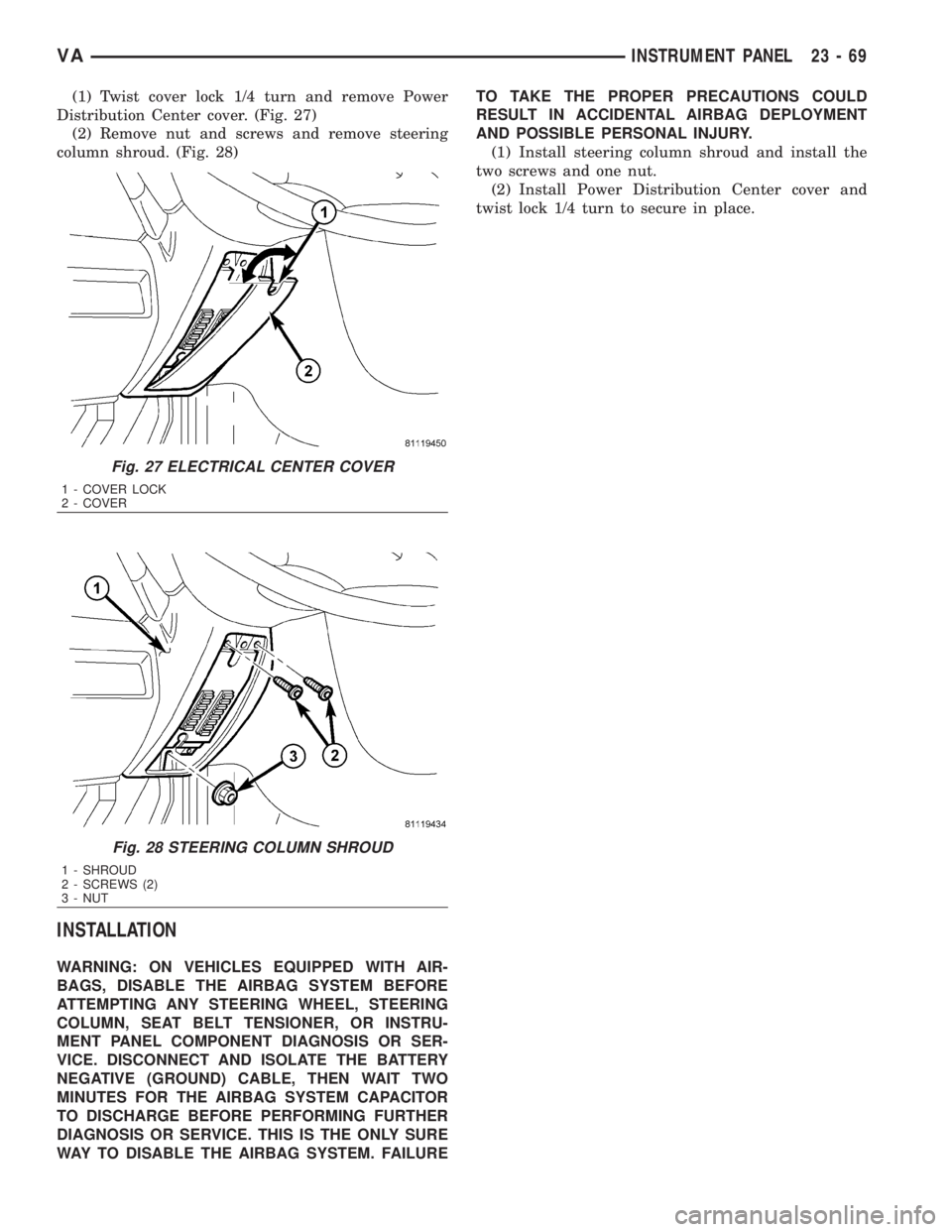
(1) Twist cover lock 1/4 turn and remove Power
Distribution Center cover. (Fig. 27)
(2) Remove nut and screws and remove steering
column shroud. (Fig. 28)
INSTALLATION
WARNING: ON VEHICLES EQUIPPED WITH AIR-
BAGS, DISABLE THE AIRBAG SYSTEM BEFORE
ATTEMPTING ANY STEERING WHEEL, STEERING
COLUMN, SEAT BELT TENSIONER, OR INSTRU-
MENT PANEL COMPONENT DIAGNOSIS OR SER-
VICE. DISCONNECT AND ISOLATE THE BATTERY
NEGATIVE (GROUND) CABLE, THEN WAIT TWO
MINUTES FOR THE AIRBAG SYSTEM CAPACITOR
TO DISCHARGE BEFORE PERFORMING FURTHER
DIAGNOSIS OR SERVICE. THIS IS THE ONLY SURE
WAY TO DISABLE THE AIRBAG SYSTEM. FAILURETO TAKE THE PROPER PRECAUTIONS COULD
RESULT IN ACCIDENTAL AIRBAG DEPLOYMENT
AND POSSIBLE PERSONAL INJURY.
(1) Install steering column shroud and install the
two screws and one nut.
(2) Install Power Distribution Center cover and
twist lock 1/4 turn to secure in place.
Fig. 27 ELECTRICAL CENTER COVER
1 - COVER LOCK
2 - COVER
Fig. 28 STEERING COLUMN SHROUD
1 - SHROUD
2 - SCREWS (2)
3 - NUT
VAINSTRUMENT PANEL 23 - 69
Page 2014 of 2305
INSTALLATION
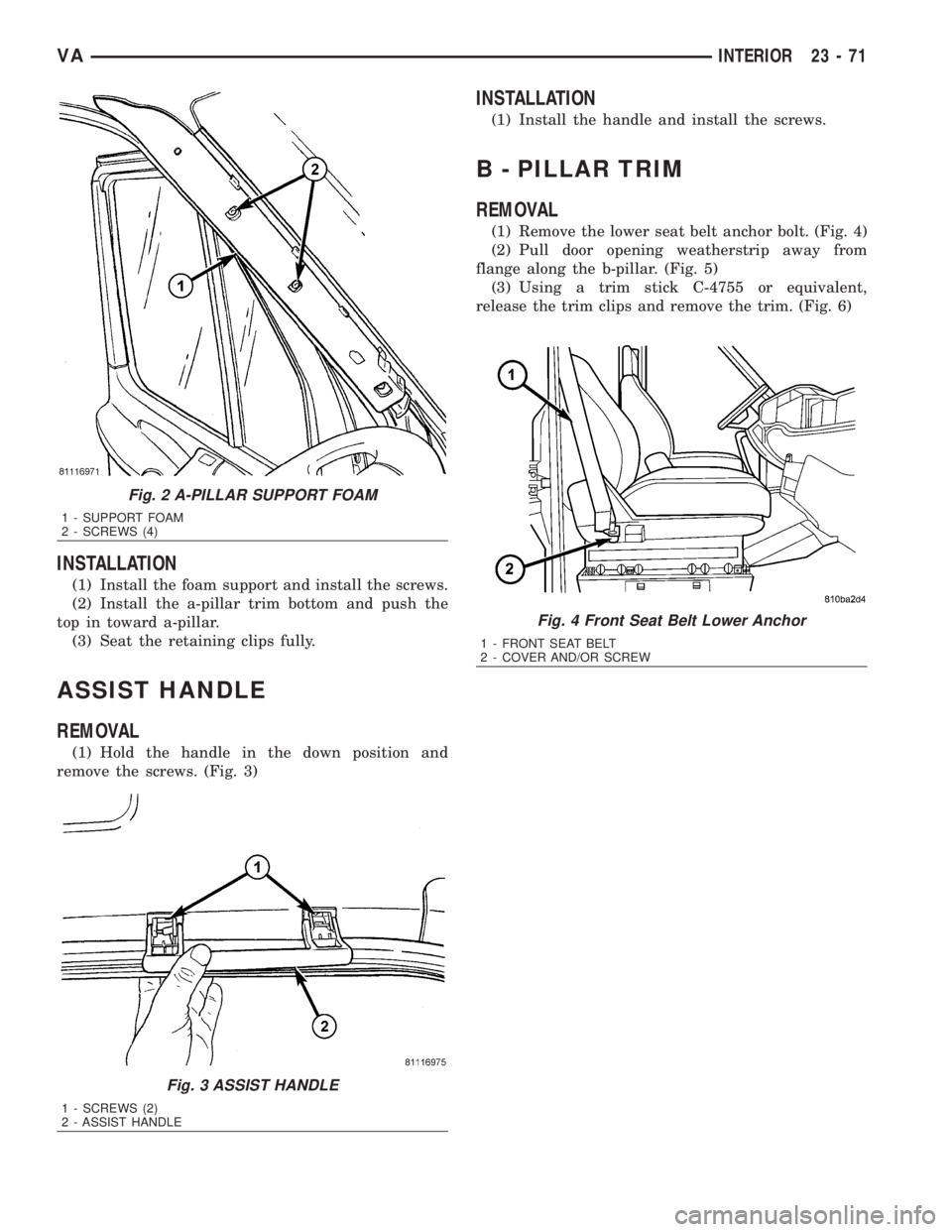
(1) Install the foam support and install the screws.
(2) Install the a-pillar trim bottom and push the
top in toward a-pillar.
(3) Seat the retaining clips fully.
ASSIST HANDLE
REMOVAL
(1) Hold the handle in the down position and
remove the screws. (Fig. 3)
INSTALLATION
(1) Install the handle and install the screws.
B - PILLAR TRIM
REMOVAL
(1) Remove the lower seat belt anchor bolt. (Fig. 4)
(2) Pull door opening weatherstrip away from
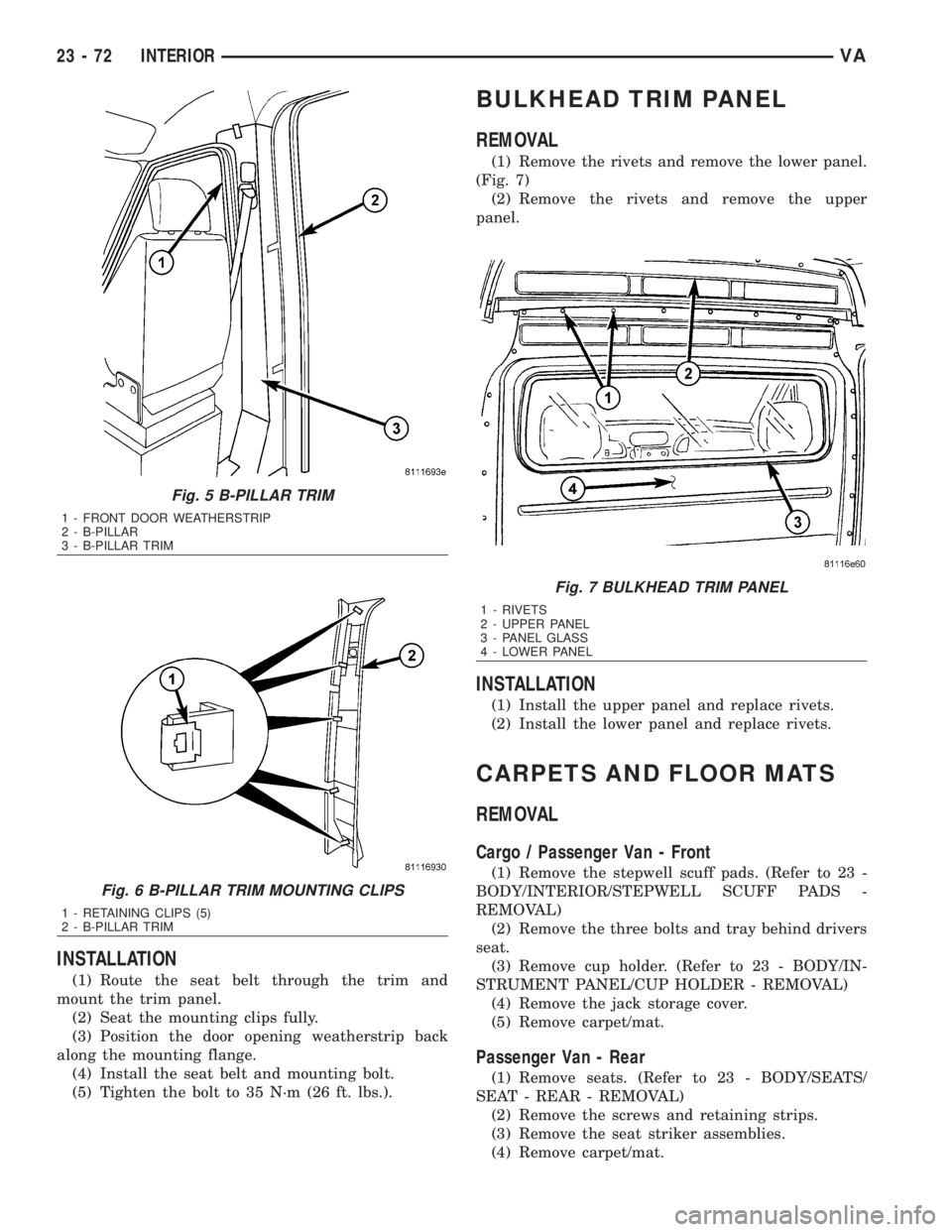
flange along the b-pillar. (Fig. 5)
(3) Using a trim stick C-4755 or equivalent,
release the trim clips and remove the trim. (Fig. 6)
Fig. 2 A-PILLAR SUPPORT FOAM
1 - SUPPORT FOAM
2 - SCREWS (4)
Fig. 3 ASSIST HANDLE
1 - SCREWS (2)
2 - ASSIST HANDLE
Fig. 4 Front Seat Belt Lower Anchor
1 - FRONT SEAT BELT
2 - COVER AND/OR SCREW
VAINTERIOR 23 - 71
Page 2015 of 2305
INSTALLATION
(1) Route the seat belt through the trim and
mount the trim panel.
(2) Seat the mounting clips fully.
(3) Position the door opening weatherstrip back
along the mounting flange.
(4) Install the seat belt and mounting bolt.
(5) Tighten the bolt to 35 N´m (26 ft. lbs.).
BULKHEAD TRIM PANEL
REMOVAL
(1) Remove the rivets and remove the lower panel.
(Fig. 7)
(2) Remove the rivets and remove the upper
panel.
INSTALLATION
(1) Install the upper panel and replace rivets.
(2) Install the lower panel and replace rivets.
CARPETS AND FLOOR MATS
REMOVAL
Cargo / Passenger Van - Front
(1) Remove the stepwell scuff pads. (Refer to 23 -
BODY/INTERIOR/STEPWELL SCUFF PADS -
REMOVAL)
(2) Remove the three bolts and tray behind drivers
seat.
(3) Remove cup holder. (Refer to 23 - BODY/IN-
STRUMENT PANEL/CUP HOLDER - REMOVAL)
(4) Remove the jack storage cover.
(5) Remove carpet/mat.
Passenger Van - Rear
(1) Remove seats. (Refer to 23 - BODY/SEATS/
SEAT - REAR - REMOVAL)
(2) Remove the screws and retaining strips.
(3) Remove the seat striker assemblies.
(4) Remove carpet/mat.
Fig. 5 B-PILLAR TRIM
1 - FRONT DOOR WEATHERSTRIP
2 - B-PILLAR
3 - B-PILLAR TRIM
Fig. 6 B-PILLAR TRIM MOUNTING CLIPS
1 - RETAINING CLIPS (5)
2 - B-PILLAR TRIM
Fig. 7 BULKHEAD TRIM PANEL
1 - RIVETS
2 - UPPER PANEL
3 - PANEL GLASS
4 - LOWER PANEL
23 - 72 INTERIORVA
Page 2022 of 2305
SEATS
TABLE OF CONTENTS
page page
ARMREST
REMOVAL.............................79
INSTALLATION.........................79
HEADREST
REMOVAL.............................79
INSTALLATION.........................79
SEAT - FRONT
REMOVAL.............................79
INSTALLATION.........................80
SEAT BACK - FRONT
REMOVAL.............................80
INSTALLATION.........................80
SEAT CUSHION - FRONT
REMOVAL.............................80
INSTALLATION.........................81SEAT ADJUSTERS - FRONT
REMOVAL.............................81
INSTALLATION.........................81
SEAT - REAR
REMOVAL.............................81
INSTALLATION.........................82
REAR SEAT BACK SHIELD
REMOVAL.............................82
INSTALLATION.........................82
SEAT BACK CUSHION/COVER - REAR
REMOVAL.............................82
INSTALLATION.........................82
SEAT CUSHION/COVER - REAR
REMOVAL.............................83
INSTALLATION.........................83
ARMREST
REMOVAL
(1) Remove the screws and remove the armrest
cover.
(2) Remove the three bolts and remove the arm-
rest from the seat back.
INSTALLATION
(1) Install the armrest and install the three bolts.
(2) Install the armrest cover and install the
screws.
HEADREST
REMOVAL
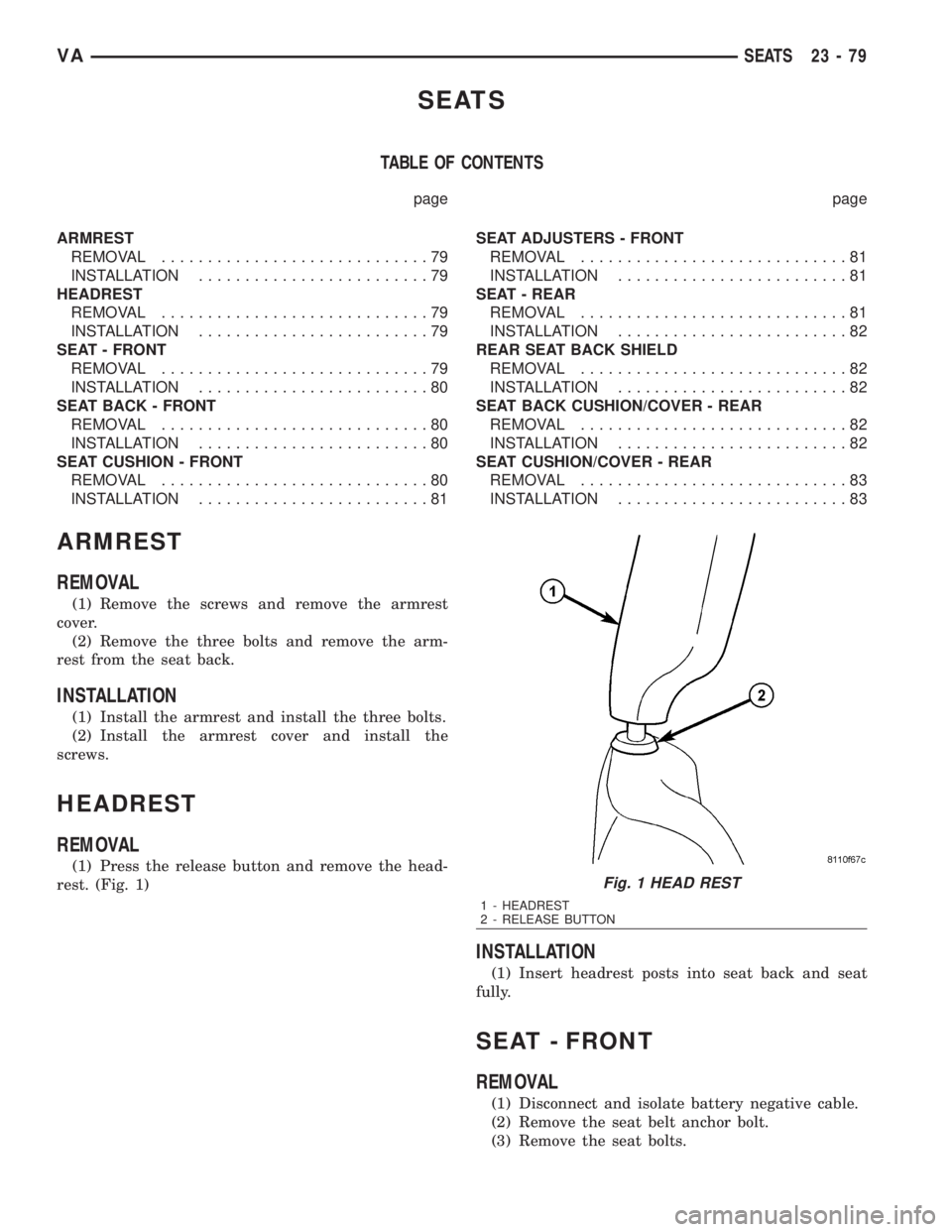
(1) Press the release button and remove the head-
rest. (Fig. 1)
INSTALLATION
(1) Insert headrest posts into seat back and seat
fully.
SEAT - FRONT
REMOVAL
(1) Disconnect and isolate battery negative cable.
(2) Remove the seat belt anchor bolt.
(3) Remove the seat bolts.
Fig. 1 HEAD REST
1 - HEADREST
2 - RELEASE BUTTON
VASEATS 23 - 79
Page 2023 of 2305

(4) Disconnect the electrical connectors, if
equipped.
INSTALLATION
(1) Position seat in vehicle and connect the electri-
cal connectors, if equipped.
(2) Install the mounting bolts and tighten to 25
N´m (18 ft. lbs.).
(3) Install the seat belt anchor and bolt.
(4) Tighten anchor bolt to 35 N´m (26 ft. lbs.).
(5) Connect battery negative cable.
SEAT BACK - FRONT
REMOVAL
(1) Disconnect and isolate battery negative cable.
(2) Remove seat cushion. (Refer to 23 - BODY/
SEATS/SEAT CUSHION - FRONT - REMOVAL)
(3) Verify that seat back is in full upright position.
(4) Disconnect lumbar support hose, if equipped.
(Fig. 3)
(5) Remove seat back bolts and remove seat
back.
INSTALLATION
(1) Remove stop screw.
(2) Install seat back locking spline side first.
NOTE: For better centering of seat back in the
mounting bore during installation, operate the seat
back release lever once.
(3) Install the spline side seat back bolt.
(4) Install remaining seat back side.
NOTE: It may be necessary to press the guide tabs
apart slightly.
(5) Install the remaining seat back bolt.
(6) Tighten the seat back bolts to 20 N´m (15 ft.
lbs.).
(7) Place seat back in the foremost position until
the hold down spring latches audibly.
(8) Install stop bolt and tighten to 20 N´m (15 ft.
lbs.).
(9) Connect the lumbar support hose, if equipped.
(10) Check seat back operation.
(11) Install the seat cushion. (Refer to 23 - BODY/
SEATS/SEAT CUSHION - FRONT - INSTALLA-
TION)
SEAT CUSHION - FRONT
REMOVAL
(1) Disconnect and isolate battery negative cable.
(2) Move seat to the foremost position.
(3) On standard cushion equipped vehicles, remove
the front two screws. (Fig. 4)
Fig. 2 FRONT SEAT
1 - SEAT BELT ANCHOR BOLT
2 - BOLTS (6)
Fig. 3 FRONT SEAT BACK
1 - SEAT BACK
2 - STOP BOLT
3 - LUMBAR SUPPORT HOSE
4 - GUIDE TAB
5 - RELEASE LEVER
6 - SEAT BACK BOLTS (2)
23 - 80 SEATSVA
Page 2025 of 2305
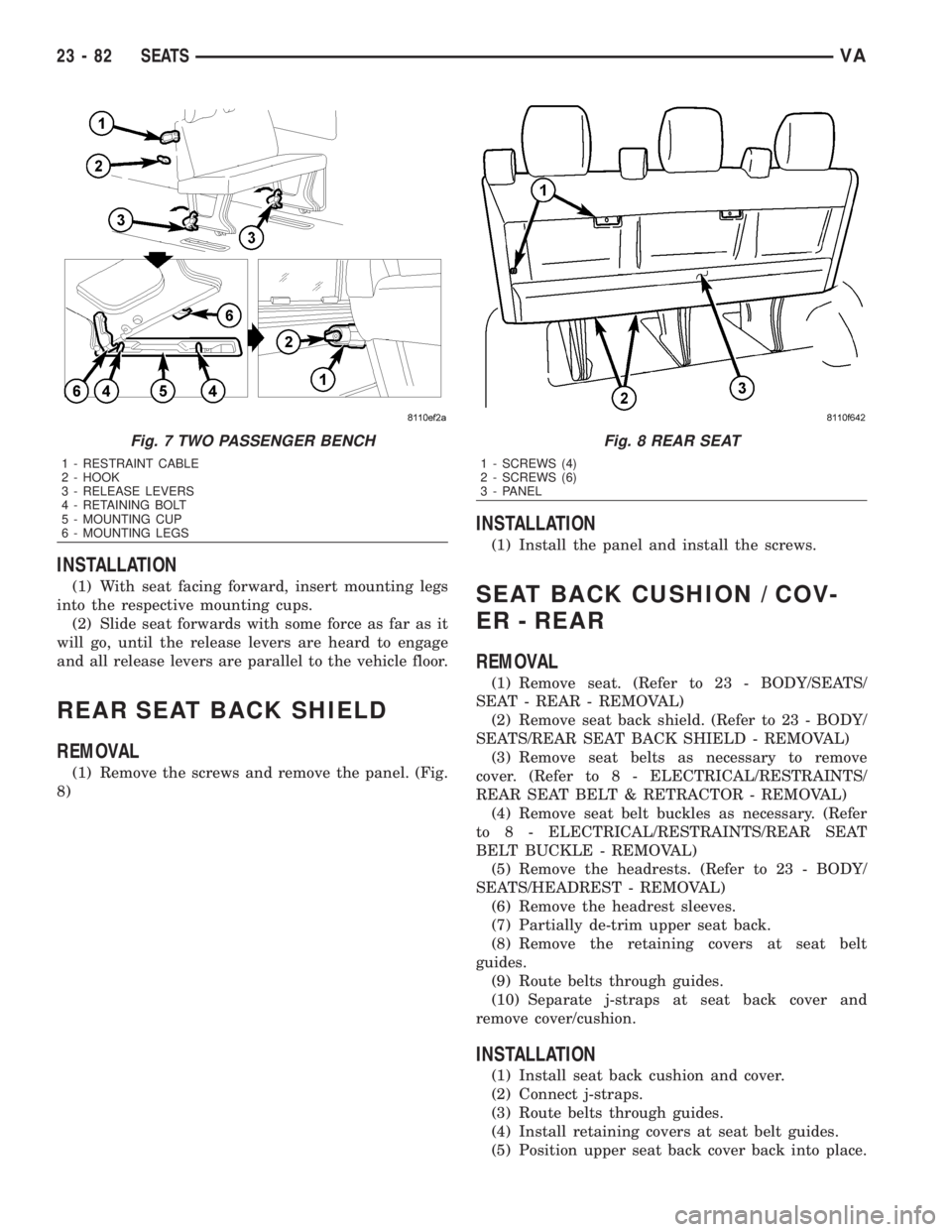
INSTALLATION
(1) With seat facing forward, insert mounting legs
into the respective mounting cups.
(2) Slide seat forwards with some force as far as it
will go, until the release levers are heard to engage
and all release levers are parallel to the vehicle floor.
REAR SEAT BACK SHIELD
REMOVAL
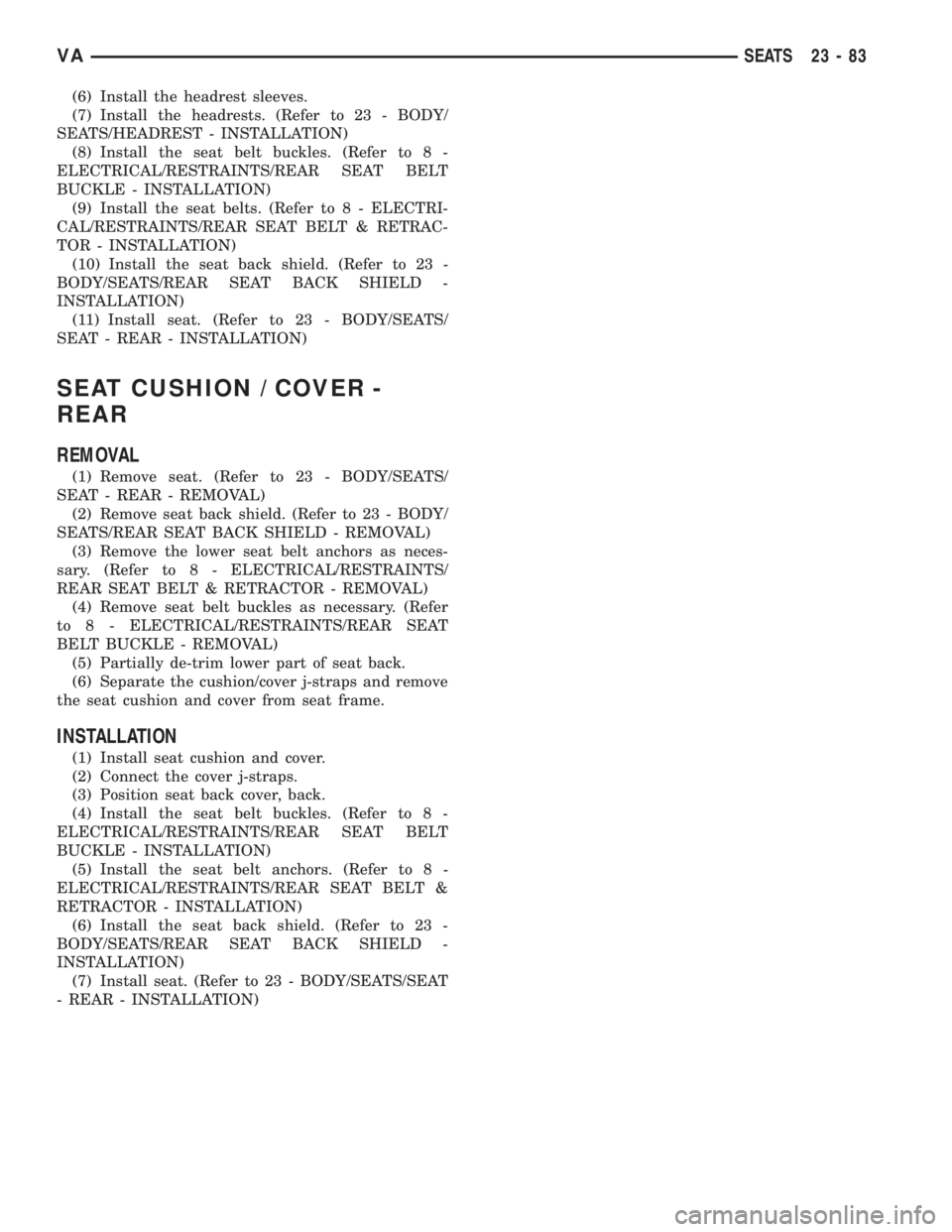
(1) Remove the screws and remove the panel. (Fig.
8)
INSTALLATION
(1) Install the panel and install the screws.
SEAT BACK CUSHION / COV-
ER - REAR
REMOVAL
(1) Remove seat. (Refer to 23 - BODY/SEATS/
SEAT - REAR - REMOVAL)
(2) Remove seat back shield. (Refer to 23 - BODY/
SEATS/REAR SEAT BACK SHIELD - REMOVAL)
(3) Remove seat belts as necessary to remove
cover. (Refer to 8 - ELECTRICAL/RESTRAINTS/
REAR SEAT BELT & RETRACTOR - REMOVAL)
(4) Remove seat belt buckles as necessary. (Refer
to 8 - ELECTRICAL/RESTRAINTS/REAR SEAT
BELT BUCKLE - REMOVAL)
(5) Remove the headrests. (Refer to 23 - BODY/
SEATS/HEADREST - REMOVAL)
(6) Remove the headrest sleeves.
(7) Partially de-trim upper seat back.
(8) Remove the retaining covers at seat belt
guides.
(9) Route belts through guides.
(10) Separate j-straps at seat back cover and
remove cover/cushion.
INSTALLATION
(1) Install seat back cushion and cover.
(2) Connect j-straps.
(3) Route belts through guides.
(4) Install retaining covers at seat belt guides.
(5) Position upper seat back cover back into place.
Fig. 7 TWO PASSENGER BENCH
1 - RESTRAINT CABLE
2 - HOOK
3 - RELEASE LEVERS
4 - RETAINING BOLT
5 - MOUNTING CUP
6 - MOUNTING LEGS
Fig. 8 REAR SEAT
1 - SCREWS (4)
2 - SCREWS (6)
3 - PANEL
23 - 82 SEATSVA
Page 2026 of 2305
(6) Install the headrest sleeves.
(7) Install the headrests. (Refer to 23 - BODY/
SEATS/HEADREST - INSTALLATION)
(8) Install the seat belt buckles. (Refer to 8 -
ELECTRICAL/RESTRAINTS/REAR SEAT BELT
BUCKLE - INSTALLATION)
(9) Install the seat belts. (Refer to 8 - ELECTRI-
CAL/RESTRAINTS/REAR SEAT BELT & RETRAC-
TOR - INSTALLATION)
(10) Install the seat back shield. (Refer to 23 -
BODY/SEATS/REAR SEAT BACK SHIELD -
INSTALLATION)
(11) Install seat. (Refer to 23 - BODY/SEATS/
SEAT - REAR - INSTALLATION)
SEAT CUSHION / COVER -
REAR
REMOVAL
(1) Remove seat. (Refer to 23 - BODY/SEATS/
SEAT - REAR - REMOVAL)
(2) Remove seat back shield. (Refer to 23 - BODY/
SEATS/REAR SEAT BACK SHIELD - REMOVAL)
(3) Remove the lower seat belt anchors as neces-
sary. (Refer to 8 - ELECTRICAL/RESTRAINTS/
REAR SEAT BELT & RETRACTOR - REMOVAL)
(4) Remove seat belt buckles as necessary. (Refer
to 8 - ELECTRICAL/RESTRAINTS/REAR SEAT
BELT BUCKLE - REMOVAL)
(5) Partially de-trim lower part of seat back.
(6) Separate the cushion/cover j-straps and remove
the seat cushion and cover from seat frame.
INSTALLATION
(1) Install seat cushion and cover.
(2) Connect the cover j-straps.
(3) Position seat back cover, back.
(4) Install the seat belt buckles. (Refer to 8 -
ELECTRICAL/RESTRAINTS/REAR SEAT BELT
BUCKLE - INSTALLATION)
(5) Install the seat belt anchors. (Refer to 8 -
ELECTRICAL/RESTRAINTS/REAR SEAT BELT &
RETRACTOR - INSTALLATION)
(6) Install the seat back shield. (Refer to 23 -
BODY/SEATS/REAR SEAT BACK SHIELD -
INSTALLATION)
(7) Install seat. (Refer to 23 - BODY/SEATS/SEAT
- REAR - INSTALLATION)
VASEATS 23 - 83
Page 2033 of 2305
WEATHERSTRIP / SEALS
TABLE OF CONTENTS
page page
FRONT DOOR INNER BELT WEATHERSTRIP
REMOVAL.............................90
INSTALLATION.........................90
FRONT DOOR OUTER BELT WEATHERSTRIP
REMOVAL.............................90INSTALLATION.........................90
DOOR OPENING SEALS
REMOVAL.............................90
INSTALLATION.........................90
FRONT DOOR INNER BELT
WEATHERSTRIP
REMOVAL
(1) Remove the front door trim panel. (Refer to 23
- BODY/DOOR - FRONT/TRIM PANEL - REMOVAL)
(2) Remove the inner belt weatherstrip.
INSTALLATION
(1) Install the inner belt weatherstrip.
(2) Install the trim panel. (Refer to 23 - BODY/
DOOR - FRONT/TRIM PANEL - INSTALLATION)
FRONT DOOR OUTER BELT
WEATHERSTRIP
REMOVAL
(1) Remove door glass. (Refer to 23 - BODY/DOOR
- FRONT/DOOR GLASS - REMOVAL)
(2) Remove screws at window channel and remove
channel.
(3) Remove outer belt weatherstrip.
INSTALLATION
(1) Install outer belt weatherstrip.
(2) Install glass run channel and install the
screws.
(3) Install the door glass. (Refer to 23 - BODY/
DOOR - FRONT/DOOR GLASS - INSTALLATION)
DOOR OPENING SEALS
REMOVAL
(1) Open door and separate the door opening seal
from the door opening flange.
INSTALLATION
(1) Position the seal to the bottom of the door
opening, with bulb facing outboard, starting the
installation at the center of the lower flange. Pressthe seal onto the sill flange and work around the
perimeter of the door opening until fully seated.
Work in one direction, smoothing the seal to avoid
puckers or wrinkles.
(2) When installing a new weatherstrip on the
front door opening, remove the tear strip starting at
the splice and moving around the front of the door to
the back of the opening.
23 - 90 WEATHERSTRIP/SEALSVA
Page 2042 of 2305
Condition Possible Causes Correction
The low side pressure is
normal or slightly low, and
the high side pressure is too
low.1. Low refrigerant system
charge.1. See Refrigerant System Leaks in this
group. Test the refrigerant system for leaks.
Repair, evacuate and charge the refrigerant
system, if required.
2. Refrigerant flow through the
A/C evaporator is restricted.2. See A/C Evaporator in this group. Replace
the restricted A/C evaporator, if required.
3. Faulty A/C compressor. 3. See A/C Compressor in this group. Re-
place the A/C compressor, if required.
The low side pressure is
normal or slightly high, and
the high side pressure is too
high.1. A/C condenser air flow re-
stricted.1. Check the A/C condenser for damaged
fins, foreign objects obstructing air flow
through the condenser fins, and missing or
improperly installed air seals. Clean, repair, or
replace components as required.
2. Refrigerant flow through the
receiver/drier is restricted.2. See Receiver/Drier in this group. Replace
the restricted receiver/drier, if required.
3. Inoperative radiator cooling
fan.3. Test the radiator cooling fan and replace, if
required. Refer to Group 7 - Cooling.
4. Refrigerant system over-
charged.4. See Refrigerant System Charge in this
group. Recover the refrigerant from the refrig-
erant system. Charge the refrigerant system
to the proper level, if required.
5. Air in the refrigerant system. 5. See Refrigerant System Leaks in this
group. Test the refrigerant system for leaks.
Repair, evacuate and charge the refrigerant
system, if required.
6. Engine overheating. 6. Test the engine cooling system and repair,
if required. Refer to Group 7 - Cooling.
The low side pressure is too
high, and the high side pres-
sure is too low.1. Accessory drive belt slip-
ping.1. Inspect the accessory drive belt condition
and tension. Repair as required. Refer to
Group 7 - Cooling.
2. Faulty A/C expansion valve. 2. See A/C Expansion Valve in this group.
Replace the valve, if required.
3. Faulty A/C compressor. 3. See A/C Compressor in this group. Re-
place the A/C compressor, if required.
The low side pressure is too
low, and the high side pres-
sure is too high.1. Restricted refrigerant flow
through the refrigerant lines.1. See Liquid Line, Suction Line and Dis-
charge Line in this group. Inspect the refriger-
ant lines for kinks, tight bends or improper
routing. Correct the routing or replace the re-
frigerant line, if required.
2. Restricted refrigerant flow
through the A/C expansion
valve.2. See A/C Expansion Valve in this group.
Replace the valve, if required.
3. Restricted refrigerant flow
through the A/C condenser.3. See A/C Condenser in this group. Replace
the restricted A/C condenser, if required.
HEATER PERFORMANCE TEST
Before performing the following tests, perform the
ATC Function Test using the DRBIIItand refer to
Cooling for the procedures to check the radiator cool-
ant level, serpentine drive belt tension, radiator air
flow and the radiator fan operation.
MAXIMUM HEATER OUTPUT
Engine coolant is provided to the heater core
through a heater valve and heater hose. With the
engine idling at normal operating temperature, set
the heater-A/C controls as follows:
²Temperature control in the full hot position
VAHEATING & AIR CONDITIONING 24 - 5
Page 2046 of 2305
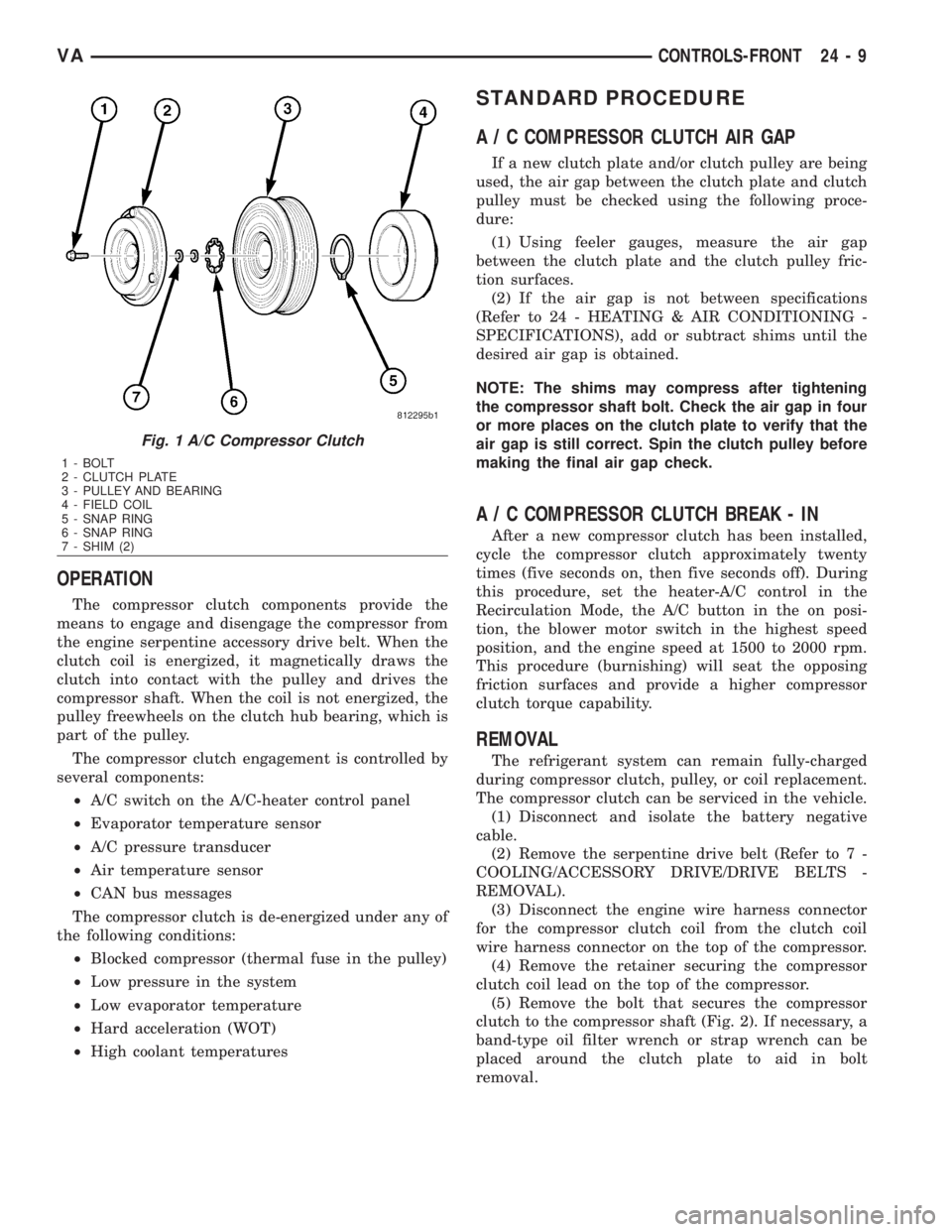
OPERATION
The compressor clutch components provide the
means to engage and disengage the compressor from
the engine serpentine accessory drive belt. When the
clutch coil is energized, it magnetically draws the
clutch into contact with the pulley and drives the
compressor shaft. When the coil is not energized, the
pulley freewheels on the clutch hub bearing, which is
part of the pulley.
The compressor clutch engagement is controlled by
several components:
²A/C switch on the A/C-heater control panel
²Evaporator temperature sensor
²A/C pressure transducer
²Air temperature sensor
²CAN bus messages
The compressor clutch is de-energized under any of
the following conditions:
²Blocked compressor (thermal fuse in the pulley)
²Low pressure in the system
²Low evaporator temperature
²Hard acceleration (WOT)
²High coolant temperatures
STANDARD PROCEDURE
A / C COMPRESSOR CLUTCH AIR GAP
If a new clutch plate and/or clutch pulley are being
used, the air gap between the clutch plate and clutch
pulley must be checked using the following proce-
dure:
(1) Using feeler gauges, measure the air gap
between the clutch plate and the clutch pulley fric-
tion surfaces.
(2) If the air gap is not between specifications
(Refer to 24 - HEATING & AIR CONDITIONING -
SPECIFICATIONS), add or subtract shims until the
desired air gap is obtained.
NOTE: The shims may compress after tightening
the compressor shaft bolt. Check the air gap in four
or more places on the clutch plate to verify that the
air gap is still correct. Spin the clutch pulley before
making the final air gap check.
A / C COMPRESSOR CLUTCH BREAK - IN
After a new compressor clutch has been installed,
cycle the compressor clutch approximately twenty
times (five seconds on, then five seconds off). During
this procedure, set the heater-A/C control in the
Recirculation Mode, the A/C button in the on posi-
tion, the blower motor switch in the highest speed
position, and the engine speed at 1500 to 2000 rpm.
This procedure (burnishing) will seat the opposing
friction surfaces and provide a higher compressor
clutch torque capability.
REMOVAL
The refrigerant system can remain fully-charged
during compressor clutch, pulley, or coil replacement.
The compressor clutch can be serviced in the vehicle.
(1) Disconnect and isolate the battery negative
cable.
(2) Remove the serpentine drive belt (Refer to 7 -
COOLING/ACCESSORY DRIVE/DRIVE BELTS -
REMOVAL).
(3) Disconnect the engine wire harness connector
for the compressor clutch coil from the clutch coil
wire harness connector on the top of the compressor.
(4) Remove the retainer securing the compressor
clutch coil lead on the top of the compressor.
(5) Remove the bolt that secures the compressor
clutch to the compressor shaft (Fig. 2). If necessary, a
band-type oil filter wrench or strap wrench can be
placed around the clutch plate to aid in bolt
removal.
Fig. 1 A/C Compressor Clutch
1 - BOLT
2 - CLUTCH PLATE
3 - PULLEY AND BEARING
4 - FIELD COIL
5 - SNAP RING
6 - SNAP RING
7 - SHIM (2)
VACONTROLS-FRONT 24 - 9