warning MERCEDES-BENZ SPRINTER 2006 Service Manual
[x] Cancel search | Manufacturer: MERCEDES-BENZ, Model Year: 2006, Model line: SPRINTER, Model: MERCEDES-BENZ SPRINTER 2006Pages: 2305, PDF Size: 48.12 MB
Page 2092 of 2305
(15) Reconnect the negative battery cable.
(16) Evacuate the rear refrigerant system (Refer to
24 - HEATING & AIR CONDITIONING/PLUMBING
- STANDARD PROCEDURE - REFRIGERANT SYS-
TEM EVACUATE).
(17) Charge the rear refrigerant system (Refer to
24 - HEATING & AIR CONDITIONING/PLUMBING
- STANDARD PROCEDURE - REFRIGERANT SYS-
TEM CHARGE).
(18) Install the rear air filter (Refer to 24 - HEAT-
ING & AIR CONDITIONING/DISTRIBUTION -
REAR/AIR FILTER - INSTALLATION).
(19) Install the cover onto the rear A/C condenser
housing (Refer to 24 - HEATING & AIR CONDI-
TIONING/DISTRIBUTION - REAR/A/C CON-
DENSER COVER - INSTALLATION).
A/CEVAPORATOR COVER
REMOVAL
(1) Disconnect and isolate the negative battery
cable.
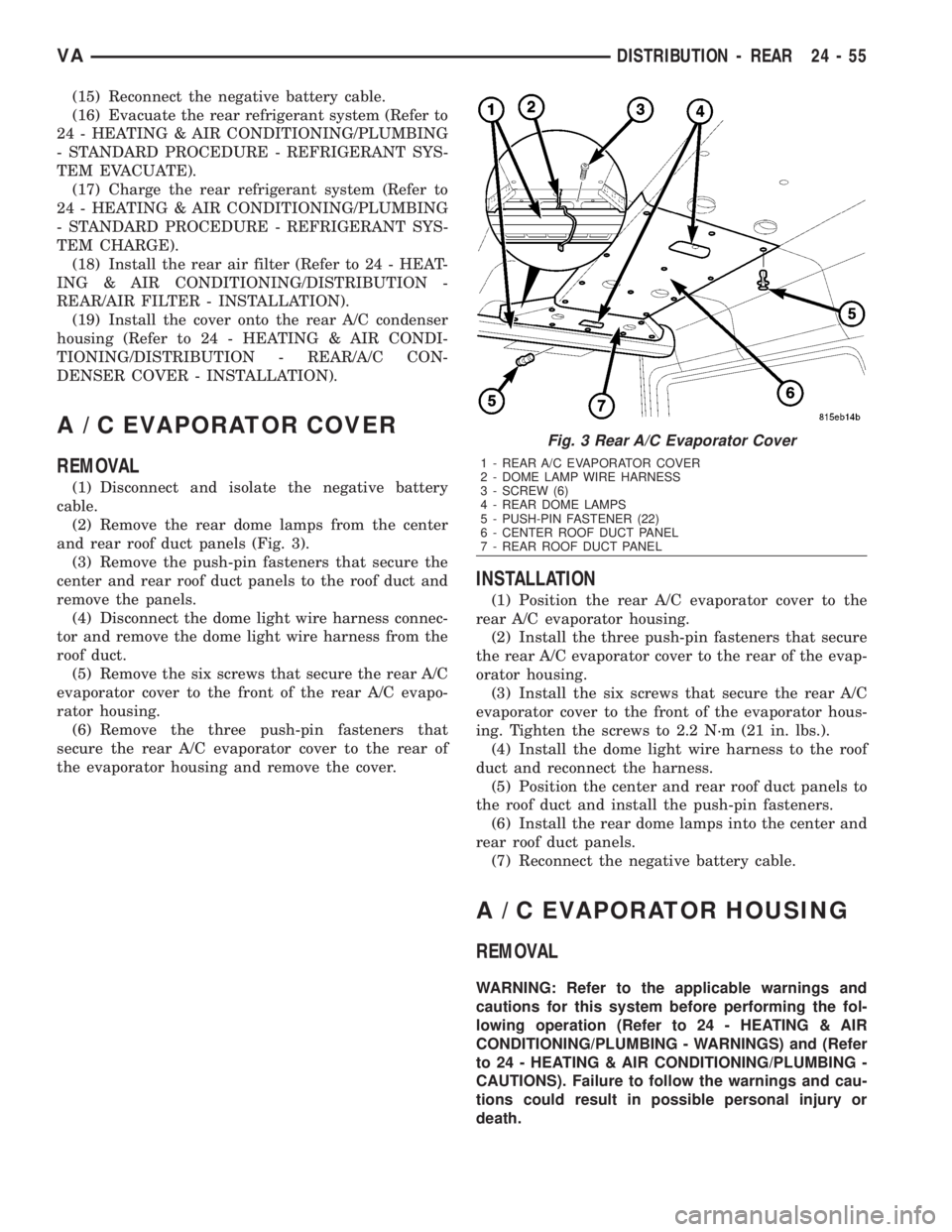
(2) Remove the rear dome lamps from the center
and rear roof duct panels (Fig. 3).
(3) Remove the push-pin fasteners that secure the
center and rear roof duct panels to the roof duct and
remove the panels.
(4) Disconnect the dome light wire harness connec-
tor and remove the dome light wire harness from the
roof duct.
(5) Remove the six screws that secure the rear A/C
evaporator cover to the front of the rear A/C evapo-
rator housing.
(6) Remove the three push-pin fasteners that
secure the rear A/C evaporator cover to the rear of
the evaporator housing and remove the cover.
INSTALLATION
(1) Position the rear A/C evaporator cover to the
rear A/C evaporator housing.
(2) Install the three push-pin fasteners that secure
the rear A/C evaporator cover to the rear of the evap-
orator housing.
(3) Install the six screws that secure the rear A/C
evaporator cover to the front of the evaporator hous-
ing. Tighten the screws to 2.2 N´m (21 in. lbs.).
(4) Install the dome light wire harness to the roof
duct and reconnect the harness.
(5) Position the center and rear roof duct panels to
the roof duct and install the push-pin fasteners.
(6) Install the rear dome lamps into the center and
rear roof duct panels.
(7) Reconnect the negative battery cable.
A/CEVAPORATOR HOUSING
REMOVAL
WARNING: Refer to the applicable warnings and
cautions for this system before performing the fol-
lowing operation (Refer to 24 - HEATING & AIR
CONDITIONING/PLUMBING - WARNINGS) and (Refer
to 24 - HEATING & AIR CONDITIONING/PLUMBING -
CAUTIONS). Failure to follow the warnings and cau-
tions could result in possible personal injury or
death.
Fig. 3 Rear A/C Evaporator Cover
1 - REAR A/C EVAPORATOR COVER
2 - DOME LAMP WIRE HARNESS
3 - SCREW (6)
4 - REAR DOME LAMPS
5 - PUSH-PIN FASTENER (22)
6 - CENTER ROOF DUCT PANEL
7 - REAR ROOF DUCT PANEL
VADISTRIBUTION - REAR 24 - 55
Page 2097 of 2305
PLUMBING
TABLE OF CONTENTS
page page
PLUMBING
DESCRIPTION.........................61
OPERATION...........................61
WARNINGS...........................61
CAUTIONS............................62
DIAGNOSIS AND TESTING
REFRIGERANT SYSTEM LEAKS..........62
STANDARD PROCEDURE
REFRIGERANT SYSTEM SERVICE
EQUIPMENT.........................63
REFRIGERANT SYSTEM RECOVERY......64
REFRIGERANT SYSTEM EVACUATE......64
REFRIGERANT SYSTEM CHARGE........64
A/C COMPRESSOR
DESCRIPTION.........................66
OPERATION...........................66
DIAGNOSIS AND TESTING
A/C COMPRESSOR NOISE..............66
REMOVAL
DENSO 7SBU16C A/C COMPRESSOR.....67
DENSO 10S17 A/C COMPRESSOR........68
INSTALLATION
DENSO 7SBU16C A/C COMPRESSOR.....68
DENSO 10S17 A/C COMPRESSOR........69
A/C CONDENSER
DESCRIPTION.........................69
OPERATION...........................69
REMOVAL.............................70
INSTALLATION.........................70
A/C DISCHARGE LINE
REMOVAL.............................71
INSTALLATION.........................71
A/C EVAPORATOR
DESCRIPTION.........................72
OPERATION...........................72
REMOVAL.............................72
INSTALLATION.........................73
A/C EXPANSION VALVE
DESCRIPTION.........................73
OPERATION...........................73
DIAGNOSIS AND TESTING
A/C EXPANSION VALVE................74
REMOVAL.............................74
INSTALLATION.........................74
ELECTRIC COOLANT PUMP
DESCRIPTION.........................75
OPERATION...........................75
REMOVAL.............................75
INSTALLATION.........................76HEATER CORE
DESCRIPTION.........................76
OPERATION...........................76
REMOVAL.............................76
INSTALLATION.........................77
LIQUID LINE
REMOVAL.............................77
INSTALLATION.........................79
RECEIVER/DRIER
DESCRIPTION.........................79
OPERATION...........................79
REMOVAL.............................80
INSTALLATION.........................80
REFRIGERANT
DESCRIPTION.........................80
OPERATION...........................80
REFRIGERANT OIL
DESCRIPTION.........................81
OPERATION...........................81
STANDARD PROCEDURE
REFRIGERANT OIL LEVEL..............81
SUCTION LINE
REMOVAL.............................81
INSTALLATION.........................82
WAT E R VA LV E
REMOVAL.............................83
INSTALLATION.........................83
REAR A/C CONDENSER FAN
REMOVAL.............................83
INSTALLATION.........................84
REAR A/C EVAPORATOR
REMOVAL.............................84
INSTALLATION.........................85
REAR A/C EXPANSION VALVE
DESCRIPTION.........................85
OPERATION...........................85
REMOVAL.............................86
INSTALLATION.........................87
REAR DISCHARGE LINE
DESCRIPTION.........................88
REMOVAL.............................88
INSTALLATION.........................90
REAR LIQUID LINE
DESCRIPTION.........................91
REMOVAL.............................91
INSTALLATION.........................93
REAR RECEIVER/DRIER
REMOVAL.............................94
INSTALLATION.........................94
24 - 60 PLUMBINGVA
Page 2098 of 2305
REAR REFRIGERANT RESERVOIR
REMOVAL.............................95
INSTALLATION.........................95
REAR SUCTION LINE
DESCRIPTION.........................96
REMOVAL.............................96
INSTALLATION.........................98
REFRIGERANT LINE COUPLER
DESCRIPTION.........................98OPERATION...........................98
REMOVAL.............................99
INSTALLATION.........................99
UNDERBODY LINES
REMOVAL............................100
INSTALLATION........................102
PLUMBING
DESCRIPTION
The refrigerant lines and hoses are used to carry
the refrigerant between the various air conditioning
system components. A barrier hose design with a
nylon tube, which is sandwiched between rubber lay-
ers, is used for the R-134a air conditioning system on
this vehicle. This nylon tube helps to further contain
the R-134a refrigerant, which has a smaller molecu-
lar structure than R-12 refrigerant. The ends of the
refrigerant hoses are made from lightweight alumi-
num or steel, and commonly use braze-less fittings.
Any kinks or sharp bends in the refrigerant plumb-
ing will reduce the capacity of the entire air condi-
tioning system. Kinks and sharp bends reduce the
flow of refrigerant in the system. A good rule for the
flexible hose refrigerant lines is to keep the radius of
all bends at least ten times the diameter of the hose.
In addition, the flexible hose refrigerant lines should
be routed so they are at least 80 millimeters (3
inches) from the exhaust manifold.
OPERATION
High pressures are produced in the refrigerant sys-
tem when the air conditioning compressor is operat-
ing. Extreme care must be exercised to make sure
that each of the refrigerant system connections is
pressure-tight and leak free. It is a good practice to
inspect all flexible hose refrigerant lines at least once
a year to make sure they are in good condition and
properly routed.
The refrigerant lines and hoses cannot be repaired
and, if faulty or damaged, they must be replaced.
WARNINGS
WARNING: The A/C system contains refrigerant
under high pressure. Repairs should only be per-
formed by qualified service personnel. Severe per-
sonal injury or death may result from improper
service procedures.
WARNING: Avoid breathing the refrigerant and
refrigerant oil vapor or mist. Exposure may irritate
the eyes, nose, and/or throat. Wear eye protectionwhen servicing the A/C refrigerant system. Serious
eye injury can result from direct contact with the
refrigerant. If eye contact occurs, seek medical
attention immediately.
WARNING: Do not expose the refrigerant to open
flame. Poisonous gas is created when refrigerant is
burned. An electronic leak detector is recom-
mended. Severe personal injury or death may result
from improper service procedures.
WARNING: If accidental system discharge occurs,
ventilate the work area before resuming service.
Large amounts of refrigerant released in a closed
work area will displace the oxygen and cause suf-
focation and death.
WARNING: The evaporation rate of R-134a refriger-
ant at average temperature and altitude is extremely
high. As a result, anything that comes in contact
with the refrigerant will freeze. Always protect the
skin or delicate objects from direct contact with the
refrigerant.
WARNING: The R-134a service equipment or the
vehicle refrigerant system should not be pressure
tested or leak tested with compressed air. Some
mixtures of air and R-134a have been shown to be
combustible at elevated pressures. These mixtures
are potentially dangerous, and may result in fire or
explosion causing property damage, personal injury
or death.
WARNING: The engine cooling system is designed
to develop internal pressures of 97 to 123 kilopas-
cals (14 to 18 pounds per square inch). Do not
remove or loosen the coolant pressure cap, cylin-
der block drain plugs, radiator drain, radiator
hoses, heater hoses, or hose clamps while the
engine cooling system is hot and under pressure.
Allow the vehicle to cool for a minimum of 15 min-
utes before opening the cooling system for service.
Failure to observe this warning can result in seri-
ous burns from the heated engine coolant.
VAPLUMBING 24 - 61
Page 2099 of 2305
CAUTIONS
CAUTION: Never add R-12 to a refrigerant system
designed to use R-134a. Do not use R-12 equipment
or parts on a R-134a A/C system. These refrigerants
are not compatible and damage to the A/C system
will result.
CAUTION: Never use R-12 refrigerant oil in a A/C
system designed to use R-134a refrigerant oil.
These refrigerant oils are not compatible and dam-
age to the A/C system will result.
CAUTION: The use of A/C system sealers may
result in damage to A/C refrigerant recovery/evacu-
ation/recharging equipment and/or A/C system.
Many federal, state/provincial and local regulations
prohibit the recharge of A/C systems with known
leaks. DaimlerChrysler recommends the detection
of A/C system leaks through the use of approved
leak detectors and fluorescent leak detection dyes.
Vehicles found with A/C system sealers should be
treated as contaminated and replacement of the
entire A/C refrigerant system is recommended. A/C
systems found to be contaminated with A/C system
sealers, A/C stop-leak products or seal conditioners
voids the warranty for the A/C system.
CAUTION: Recover the refrigerant before opening
any fitting or connection. Open the fittings with
caution, even after the system has been dis-
charged. Never open or loosen a connection before
recovering the refrigerant.
CAUTION: If equipped, do not remove the second-
ary retention clip from any spring-lock coupler con-
nection while the refrigerant system is under
pressure. Recover the refrigerant before removing
the secondary retention clip. Open the fittings with
caution, even after the system has been dis-
charged. Never open or loosen a connection before
recovering the refrigerant.
CAUTION: The internal parts of the A/C system will
remain stable as long as moisture-free refrigerant
and refrigerant oil is used. Abnormal amounts of
dirt, moisture or air can upset the chemical stability.
This may cause operational troubles or even seri-
ous damage if present in more than very small
quantities. Before disconnecting a component,
clean the outside of the fittings thoroughly to pre-
vent contamination from entering the refrigerant
system. Keep service tools and the work area clean.
Do not open the refrigerant system or uncap areplacement component until you are ready to ser-
vice the system. Immediately after disconnecting a
component from the refrigerant system, seal the
open fittings with a cap or plug. This will prevent
contamination from entering the A/C system.
CAUTION: Refrigerant oil will absorb moisture from
the atmosphere if left uncapped. Do not open a
container of refrigerant oil until you are ready to
use it. Replace the cap on the oil container immedi-
ately after using. Store refrigerant oil only in a
clean, airtight, and moisture-free container.
CAUTION: Do not overcharge the refrigerant sys-
tem. Overcharging will cause excessive compressor
head pressure and can cause compressor noise
and A/C system failure.
DIAGNOSIS AND TESTING
REFRIGERANT SYSTEM LEAKS
WARNING: R-134a service equipment or vehicle A/C
system should not be pressure tested or leak tested
with compressed air. Mixture of air and R-134a can
be combustible at elevated pressures. These mix-
tures are potentially dangerous and may result in
fire or explosion causing property damage, per-
sonal injury or death.
Avoid breathing A/C refrigerant and lubricant vapor
or mist. Exposure may irritate eyes, nose and
throat. Use only approved service equipment meet-
ing SAE requirements to discharge R-134a system.
If accidental system discharge occurs, ventilate
work area before resuming service.
If the A/C system is not cooling properly, determine
if the refrigerant system is fully charged with
R-134a. This is accomplished by performing a Refrig-
erant System Charge Level test (Refer to 24 - HEAT-
ING & AIR CONDITIONING/PLUMBING -
DIAGNOSIS AND TESTING - REFRIGERANT SYS-
TEM CHARGE LEVEL) or by completely evacuating
and recharging the A/C system. If the A/C liquid line
pressure is found to be less than 345 kPa (50 psi)
while performing the Refrigerant System Charge
Level test, proceed to the System Empty procedure
below. If liquid line pressure is found to be greater
than 345 kPa (50 psi), proceed to the System Low
procedure. If the refrigerant system is empty or low
in refrigerant charge, a leak at any line fitting or
component seal is likely. A review of the fittings,
lines and components for oily residue is an indication
of the leak location. To detect a leak in the refriger-
ant system, perform one of the following procedures
as indicated by the symptoms.
24 - 62 PLUMBINGVA
Page 2100 of 2305
SYSTEM EMPTY
(1) Evacuate the refrigerant system to the lowest
degree of vacuum possible (approximately 28 in Hg.)
(Refer to 24 - HEATING & AIR CONDITIONING/
PLUMBING - STANDARD PROCEDURE - REFRIG-
ERANT SYSTEM EVACUATE). Determine if the
system holds a vacuum for 15 minutes. If vacuum is
held, a leak is probably not present. If system will
not maintain vacuum level, proceed to Step 2.
(2) Prepare and dispense 0.284 kilograms (10
ounces) of R-134a refrigerant into the evacuated
refrigerant system (Refer to 24 - HEATING & AIR
CONDITIONING/PLUMBING - STANDARD PRO-
CEDURE - REFRIGERANT SYSTEM CHARGE) and
proceed to Step 1 of the System Low procedure.
SYSTEM LOW
(1) Position the vehicle in a wind free work area.
This will aid in detecting small leaks.
(2) Operate the heating-A/C system with the
engine at idle under the following conditions for at
least five minutes.
²Doors or windows open
²Transmission in Park
²A/C-heater controls set to outside air, full cool,
panel mode, high blower and with A/C compressor
engaged
CAUTION: A leak detector only designed for R-12
refrigerant will not detect leaks in a R-134a refriger-
ant system.
(3) Shut the vehicle Off and wait 2-7 minutes.
Then use an electronic leak detector that is designed
to detect R-134a refrigerant and search for leaks. Fit-
tings, lines or components that appear to be oily usu-
ally indicate a refrigerant leak. To inspect the A/C
evaporator for leaks, insert the leak detector probe
into the drain tube opening or an air outlet. A dye for
R-134a is available to aid in leak detection. Use only
DaimlerChrysler approved refrigerant dye.
STANDARD PROCEDURE
REFRIGERANT SYSTEM SERVICE EQUIPMENT
WARNING: Eye protection must be worn when ser-
vicing an A/C refrigerant system. Turn off (rotate
clockwise) all valves on the equipment being used,
before connecting to or disconnecting from the
refrigerant system. Failure to observe these warn-
ings may result in possible personal injury.
WARNING: Refer to the applicable warnings and
cautions for this system before performing the fol-
lowing operation (Refer to 24 - HEATING & AIR
CONDITIONING/PLUMBING - WARNINGS) and (Referto 24 - HEATING & AIR CONDITIONING/PLUMBING -
CAUTIONS). Failure to follow the warnings and cau-
tions could result in possible personal injury or
death.
When servicing the air conditioning system, a
R-134a refrigerant recovery/recycling/charging sta-
tion that meets SAE Standard J2210 must be used.
Contact an automotive service equipment supplier for
refrigerant recovery/recycling/charging equipment.
Refer to the operating instructions supplied by the
equipment manufacturer for proper care and use of
this equipment.
A manifold gauge set may be needed with some
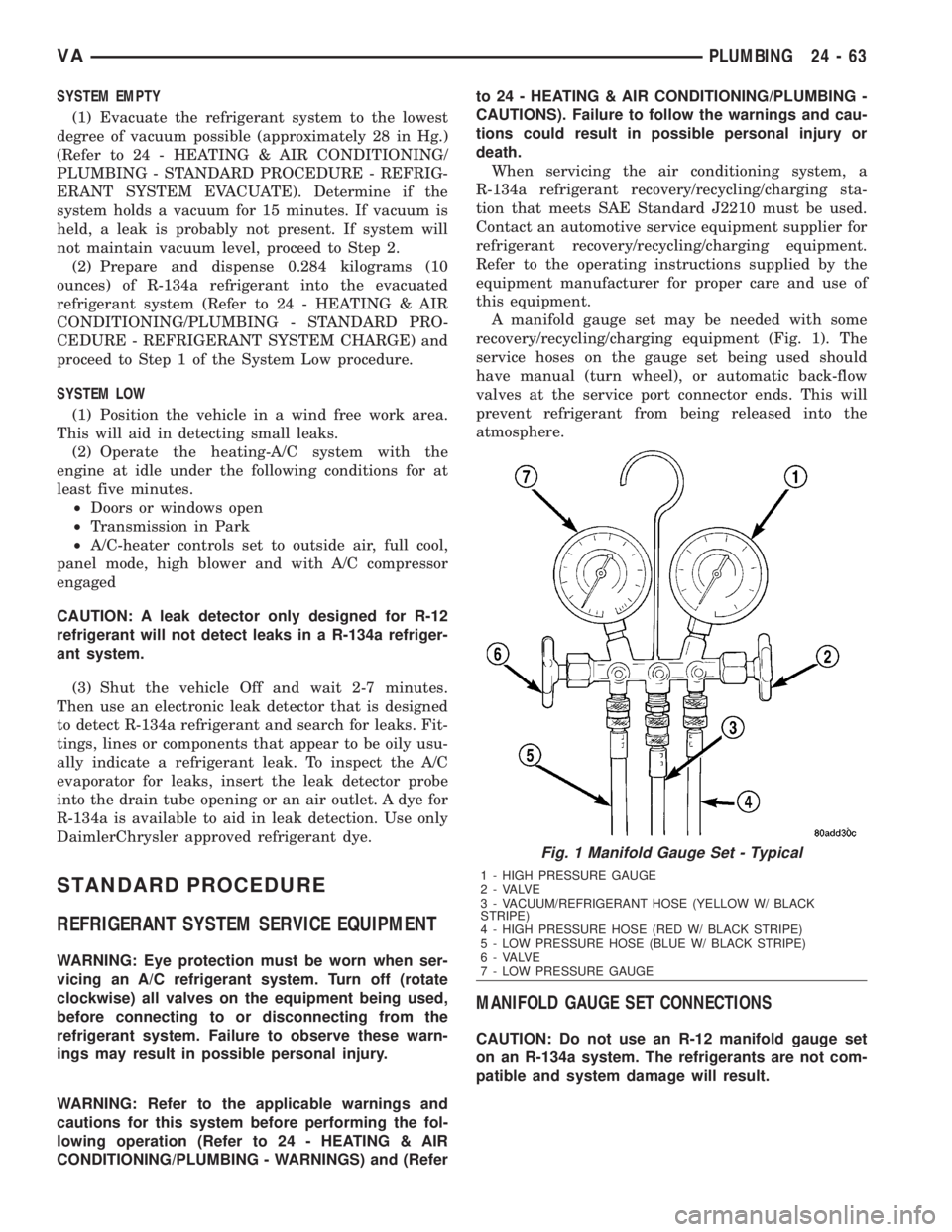
recovery/recycling/charging equipment (Fig. 1). The
service hoses on the gauge set being used should
have manual (turn wheel), or automatic back-flow
valves at the service port connector ends. This will
prevent refrigerant from being released into the
atmosphere.
MANIFOLD GAUGE SET CONNECTIONS
CAUTION: Do not use an R-12 manifold gauge set
on an R-134a system. The refrigerants are not com-
patible and system damage will result.
Fig. 1 Manifold Gauge Set - Typical
1 - HIGH PRESSURE GAUGE
2 - VALVE
3 - VACUUM/REFRIGERANT HOSE (YELLOW W/ BLACK
STRIPE)
4 - HIGH PRESSURE HOSE (RED W/ BLACK STRIPE)
5 - LOW PRESSURE HOSE (BLUE W/ BLACK STRIPE)
6 - VALVE
7 - LOW PRESSURE GAUGE
VAPLUMBING 24 - 63
Page 2101 of 2305
FRONTA/CSYSTEM
²LOW PRESSURE GAUGE HOSEÐThe low
pressure hose (Blue with Black stripe) attaches to
the suction line service port. This port is located on
the suction line near the dash panel.
²HIGH PRESSURE GAUGE HOSEÐThe high
pressure hose (Red with Black stripe) attaches to the
discharge line service port. This port is located on the
liquid line between the condenser and the reciver-
drier.
²RECOVERY/RECYCLING/EVACUATION/
CHARGING HOSEÐThe center manifold hose (Yel-
low, or White, with Black stripe) is used to recover,
evacuate, and charge the refrigerant system. When
the low or high pressure valves on the manifold
gauge set are opened, the refrigerant in the system
will escape through this hose.
REARA/CSYSTEM
²LOW PRESSURE GAUGE HOSEÐThe low
pressure hose (Blue with Black stripe) attaches to
the suction line service port. This port is located
within the rear A/C evaporator housing near the left
side of the evaporator, below the high-pressure ser-
vice port.
²HIGH PRESSURE GAUGE HOSEÐThe high
pressure hose (Red with Black stripe) attaches to the
liquid line service port. This port is located within
the rear A/C evaporator housing near the left side of
the evaporator, above the low-pressure service port.
²RECOVERY/RECYCLING/EVACUATION/
CHARGING HOSEÐThe center manifold hose (Yel-
low, or White, with Black stripe) is used to recover,
evacuate, and charge the refrigerant system. When
the low or high pressure valves on the manifold
gauge set are opened, the refrigerant in the system
will escape through this hose.
REFRIGERANT SYSTEM RECOVERY
WARNING: Refer to the applicable warnings and
cautions for this system before performing the fol-
lowing operation (Refer to 24 - HEATING & AIR
CONDITIONING/PLUMBING - WARNINGS) and (Refer
to 24 - HEATING & AIR CONDITIONING/PLUMBING -
CAUTIONS). Failure to follow the warnings and cau-
tions could result in possible personal injury or
death.
A R-134a refrigerant recovery/recycling/charging
station that meets SAE Standard J2210 must be
used to recover the refrigerant from an R-134a refrig-
erant system. Refer to the operating instructions sup-
plied by the equipment manufacturer for the proper
care and use of this equipment.
REFRIGERANT SYSTEM EVACUATE
WARNING: Refer to the applicable warnings and
cautions for this system before performing the fol-
lowing operation (Refer to 24 - HEATING & AIR
CONDITIONING/PLUMBING - WARNINGS) and (Refer
to 24 - HEATING & AIR CONDITIONING/PLUMBING -
CAUTIONS). Failure to follow the warnings and cau-
tions could result in possible personal injury or
death.
If the refrigerant system has been open to the
atmosphere, it must be evacuated before the system
can be charged. If moisture and air enters the system
and becomes mixed with the refrigerant, the com-
pressor head pressure will rise above acceptable
operating levels. This will reduce the performance of
the air conditioner and damage the compressor.
Evacuating the refrigerant system will remove the
air and boil the moisture out of the system at near
room temperature. To evacuate the refrigerant sys-
tem, use the following procedure:
(1) Connect a R-134a refrigerant recovery/recy-
cling/charging station that meets SAE Standard
J2210 and a manifold gauge set to the refrigerant
system of the vehicle.
(2) Open the low and high side valves and start
the charging station vacuum pump. When the suc-
tion gauge reads 88 kPa (26 in. Hg.) vacuum or
greater, close all of the valves and turn off the vac-
uum pump.
(a) If the refrigerant system fails to reach the
specified vacuum, the system has a leak that must
be corrected. (Refer to 24 - HEATING & AIR CON-
DITIONING/PLUMBING - DIAGNOSIS AND
TESTING - REFRIGERANT SYSTEM LEAKS)
(b) If the refrigerant system maintains the spec-
ified vacuum for five minutes, restart the vacuum
pump, open the suction and discharge valves and
evacuate the system for an additional ten minutes.
(3) Close all of the valves, and turn off the charg-
ing station vacuum pump.
(4) The refrigerant system is now ready to be
charged with R-134a refrigerant. (Refer to 24 -
HEATING & AIR CONDITIONING/PLUMBING -
STANDARD PROCEDURE - REFRIGERANT SYS-
TEM CHARGE)
REFRIGERANT SYSTEM CHARGE
WARNING: Refer to the applicable warnings and
cautions for this system before performing the fol-
lowing operation (Refer to 24 - HEATING & AIR
CONDITIONING/PLUMBING - WARNINGS) and (Refer
to 24 - HEATING & AIR CONDITIONING/PLUMBING -
CAUTIONS). Failure to follow the warnings and cau-
tions could result in possible personal injury or
death.
24 - 64 PLUMBINGVA
Page 2104 of 2305
mounting brackets, or a loose compressor clutch
assembly.
Drive belts are speed sensitive. At different engine
speeds and depending upon belt tension, belts can
develop noises that are mistaken for a compressor
noise. Improper belt tension can cause a misleading
noise when the compressor clutch is engaged, which
may not occur when the compressor clutch is disen-
gaged. Check the serpentine drive belt condition and
tension as described in Cooling before beginning this
procedure.
(1) Select a quiet area for testing. Duplicate the
complaint conditions as much as possible. Switch the
compressor on and off several times to clearly iden-
tify the compressor noise. Listen to the compressor
while the clutch is engaged and disengaged. Probe
the compressor with an engine stethoscope or a long
screwdriver with the handle held to your ear to bet-
ter localize the source of the noise.
(2) Loosen all of the compressor mounting hard-
ware and retighten. Tighten the compressor clutch
mounting nut. Be certain that the clutch coil is
mounted securely to the compressor, and that the
clutch plate and pulley are properly aligned and have
the correct air gap. (Refer to 24 - HEATING & AIR
CONDITIONING/CONTROLS/A/C COMPRESSOR
CLUTCH - INSTALLATION)
(3) To duplicate a high-ambient temperature condi-
tion (high head pressure), restrict the air flow
through the condenser. Install a manifold gauge set
to be certain that the discharge pressure does not
exceed 2760 kPa (400 psi).
(4) Check the refrigerant system plumbing for
incorrect routing, rubbing or interference, which can
cause unusual noises. Also check the refrigerant lines
for kinks or sharp bends that will restrict refrigerant
flow, which can cause noises. (Refer to 24 - HEAT-
ING & AIR CONDITIONING/PLUMBING - CAU-
TION - REFRIGERANT HOSES/LINES/TUBES
PRECAUTIONS)
(5) If the noise is from opening and closing of the
high pressure relief valve, reclaim, evacuate, and
recharge the refrigerant system. (Refer to 24 - HEAT-
ING & AIR CONDITIONING/PLUMBING - STAN-
DARD PROCEDURE - REFRIGERANT RECOVERY)
(Refer to 24 - HEATING & AIR CONDITIONING/
PLUMBING - STANDARD PROCEDURE - REFRIG-
ERANT SYSTEM EVACUATE) (Refer to 24 -
HEATING & AIR CONDITIONING/PLUMBING -
STANDARD PROCEDURE - REFRIGERANT SYS-
TEM CHARGE) If the high pressure relief valve still
does not seat properly, replace the a/c compressor.
(Refer to 24 - HEATING & AIR CONDITIONING/
PLUMBING/A/C COMPRESSOR - REMOVAL)
(6) If the noise is from liquid slugging on the suc-
tion line, check the refrigerant oil level and the
refrigerant system charge. (Refer to 24 - HEATING
& AIR CONDITIONING/PLUMBING/REFRIGER-ANT OIL - STANDARD PROCEDURE) (Refer to 24 -
HEATING & AIR CONDITIONING/PLUMBING -
SPECIFICATIONS - CHARGE CAPACITY).
(7) If the noise continues, replace the compressor
and repeat Step 1.
REMOVAL
DENSO 7SBU16CA/CCOMPRESSOR
WARNING: Refer to the applicable warnings and
cautions for this system before performing the fol-
lowing operation (Refer to 24 - HEATING & AIR
CONDITIONING/PLUMBING - WARNINGS) and (Refer
to 24 - HEATING & AIR CONDITIONING/PLUMBING -
CAUTIONS). Failure to follow the warnings and cau-
tions could result in possible personal injury or
death.
NOTE: The A/C compressor may be removed and
repositioned without disconnecting the refrigerant
lines or discharging the refrigerant system. Dis-
charging is not necessary if servicing the compres-
sor clutch, clutch coil or the engine.
NOTE: If an internal failure of the A/C compressor
has occurred, the receiver/drier must be replaced.
(1) Disconnect and isolate the negative battery
cable.
(2) Recover the refrigerant from the refrigerant
system (Refer to 24 - HEATING & AIR CONDITION-
ING/PLUMBING - STANDARD PROCEDURE -
REFRIGERANT SYSTEM RECOVERY).
(3) Remove the serpentine drive belt (Refer to 7 -
COOLING/ACCESSORY DRIVE/BELTS-DRIVE -
REMOVAL).
(4) Disconnect the wire harness connector from the
A/C compressor clutch coil.
(5) Remove the bolts that secure the A/C suction
and discharge lines to the A/C compressor.
(6) Disconnect the A/C suction and discharge lines
from the A/C compressor and remove and discard the
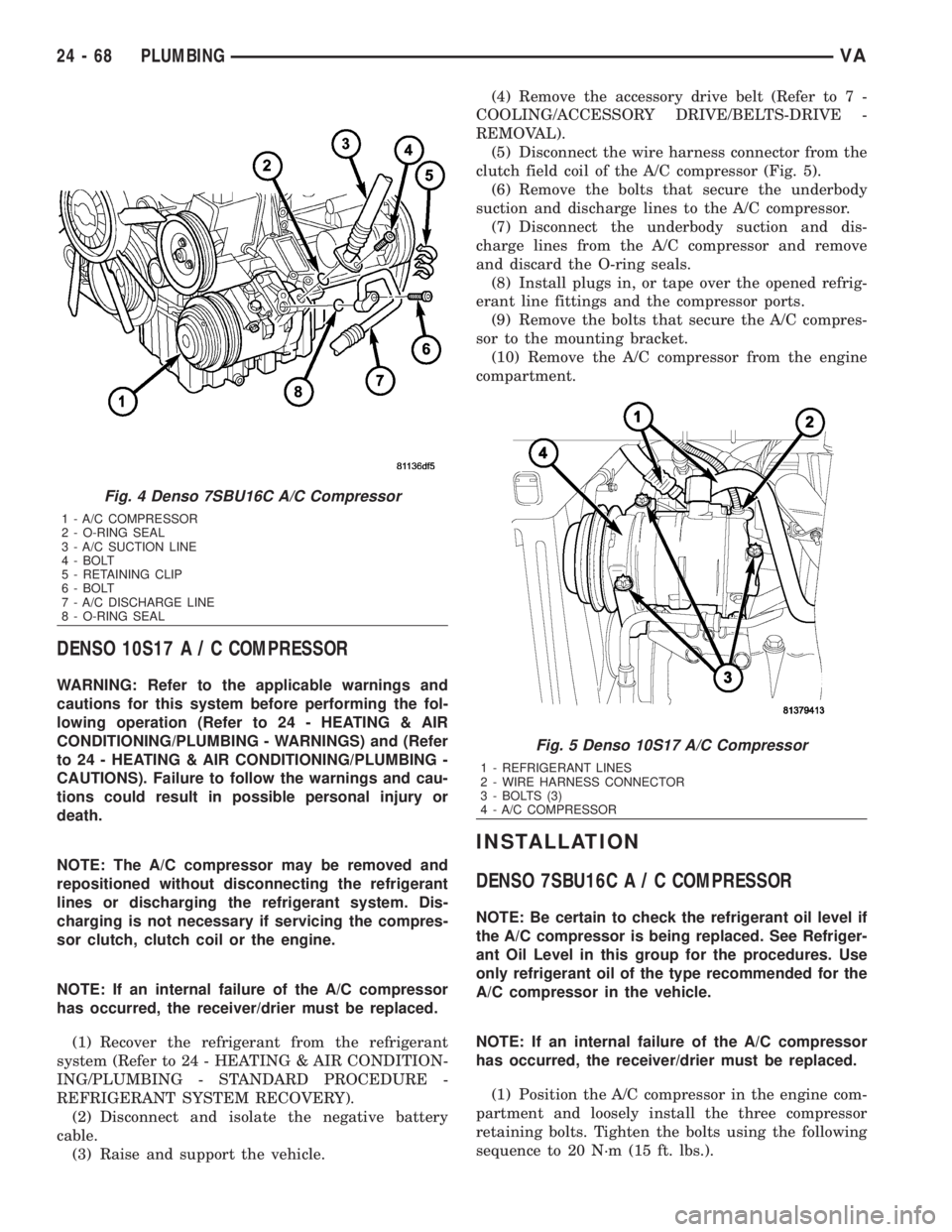
O-ring seals (Fig. 4).
(7) Install plugs in, or tape over the opened refrig-
erant line fittings and the compressor ports.
(8) Raise the vehicle on a hoist.
(9) If equipped with an add-on rear A/C system,
remove the lower A/C compressor and position it out
of the way (Refer to 24 - HEATING & AIR CONDI-
TIONING/PLUMBING/A/C COMPRESSOR -
REMOVAL - DENSO 10S17).
(10) Support the A/C compressor and remove the
compressor mounting bolts.
(11) Remove the A/C compressor from the engine
compartment.
VAPLUMBING 24 - 67
Page 2105 of 2305
DENSO 10S17A/CCOMPRESSOR
WARNING: Refer to the applicable warnings and
cautions for this system before performing the fol-
lowing operation (Refer to 24 - HEATING & AIR
CONDITIONING/PLUMBING - WARNINGS) and (Refer
to 24 - HEATING & AIR CONDITIONING/PLUMBING -
CAUTIONS). Failure to follow the warnings and cau-
tions could result in possible personal injury or
death.
NOTE: The A/C compressor may be removed and
repositioned without disconnecting the refrigerant
lines or discharging the refrigerant system. Dis-
charging is not necessary if servicing the compres-
sor clutch, clutch coil or the engine.
NOTE: If an internal failure of the A/C compressor
has occurred, the receiver/drier must be replaced.
(1) Recover the refrigerant from the refrigerant
system (Refer to 24 - HEATING & AIR CONDITION-
ING/PLUMBING - STANDARD PROCEDURE -
REFRIGERANT SYSTEM RECOVERY).
(2) Disconnect and isolate the negative battery
cable.
(3) Raise and support the vehicle.(4) Remove the accessory drive belt (Refer to 7 -
COOLING/ACCESSORY DRIVE/BELTS-DRIVE -
REMOVAL).
(5) Disconnect the wire harness connector from the
clutch field coil of the A/C compressor (Fig. 5).
(6) Remove the bolts that secure the underbody
suction and discharge lines to the A/C compressor.
(7) Disconnect the underbody suction and dis-
charge lines from the A/C compressor and remove
and discard the O-ring seals.
(8) Install plugs in, or tape over the opened refrig-
erant line fittings and the compressor ports.
(9) Remove the bolts that secure the A/C compres-
sor to the mounting bracket.
(10) Remove the A/C compressor from the engine
compartment.
INSTALLATION
DENSO 7SBU16CA/CCOMPRESSOR
NOTE: Be certain to check the refrigerant oil level if
the A/C compressor is being replaced. See Refriger-
ant Oil Level in this group for the procedures. Use
only refrigerant oil of the type recommended for the
A/C compressor in the vehicle.
NOTE: If an internal failure of the A/C compressor
has occurred, the receiver/drier must be replaced.
(1) Position the A/C compressor in the engine com-
partment and loosely install the three compressor
retaining bolts. Tighten the bolts using the following
sequence to 20 N´m (15 ft. lbs.).
Fig. 4 Denso 7SBU16C A/C Compressor
1 - A/C COMPRESSOR
2 - O-RING SEAL
3 - A/C SUCTION LINE
4 - BOLT
5 - RETAINING CLIP
6 - BOLT
7 - A/C DISCHARGE LINE
8 - O-RING SEAL
Fig. 5 Denso 10S17 A/C Compressor
1 - REFRIGERANT LINES
2 - WIRE HARNESS CONNECTOR
3 - BOLTS (3)
4 - A/C COMPRESSOR
24 - 68 PLUMBINGVA
Page 2107 of 2305
there are no objects placed in front of the radiator
grille openings in the front of the vehicle or foreign
material on the condenser fins that might obstruct
proper air flow. Also, any factory-installed air seals or
shrouds must be properly reinstalled following radia-
tor or condenser service.
The condenser cannot be repaired and, if faulty or
damaged, it must be replaced.
REMOVAL
WARNING: Refer to the applicable warnings and
cautions for this system before performing the fol-
lowing operation (Refer to 24 - HEATING & AIR
CONDITIONING/PLUMBING - WARNINGS) and (Refer
to 24 - HEATING & AIR CONDITIONING/PLUMBING -
CAUTIONS). Failure to follow the warnings and cau-
tions could result in possible personal injury or
death.
(1) Disconnect and isolate the negative battery
cable.
(2) Recover the refrigerant from the refrigerant
system (Refer to 24 - HEATING & AIR CONDITION-
ING/PLUMBING - STANDARD PROCEDURE -
REFRIGERANT SYSTEM RECOVERY).
(3) Remove the front fascia.
(4) Remove the grille (Refer to 23 - BODY/EXTE-
RIOR/GRILLE - REMOVAL).
(5) Remove the headlamps from their mounts.
(6) Remove the radiator crossmember (Refer to 23
- BODY/EXTERIOR/RADIATOR CROSSMEMBER -
REMOVAL).
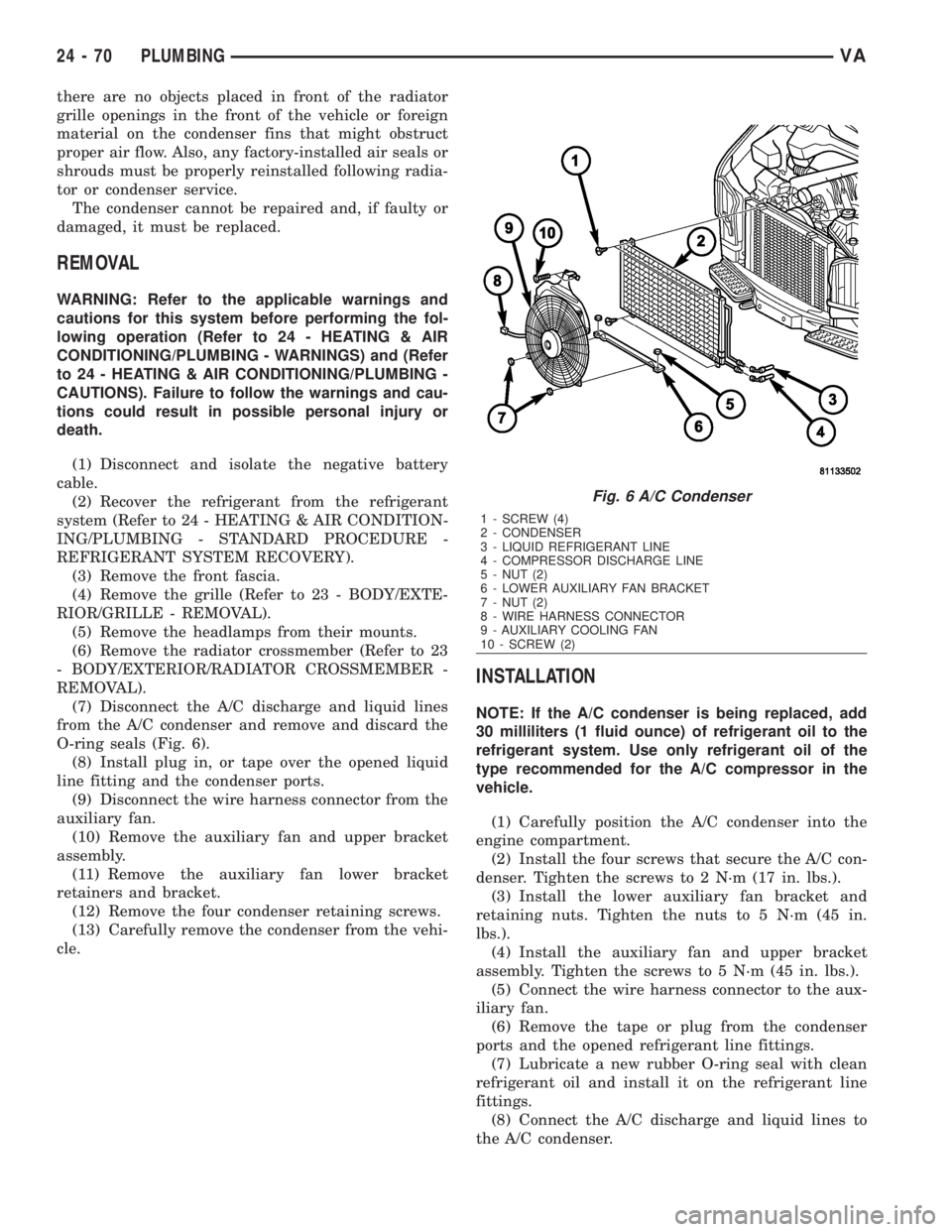
(7) Disconnect the A/C discharge and liquid lines
from the A/C condenser and remove and discard the
O-ring seals (Fig. 6).
(8) Install plug in, or tape over the opened liquid
line fitting and the condenser ports.
(9) Disconnect the wire harness connector from the
auxiliary fan.
(10) Remove the auxiliary fan and upper bracket
assembly.
(11) Remove the auxiliary fan lower bracket
retainers and bracket.
(12) Remove the four condenser retaining screws.
(13) Carefully remove the condenser from the vehi-
cle.
INSTALLATION
NOTE: If the A/C condenser is being replaced, add
30 milliliters (1 fluid ounce) of refrigerant oil to the
refrigerant system. Use only refrigerant oil of the
type recommended for the A/C compressor in the
vehicle.
(1) Carefully position the A/C condenser into the
engine compartment.
(2) Install the four screws that secure the A/C con-
denser. Tighten the screws to 2 N´m (17 in. lbs.).
(3) Install the lower auxiliary fan bracket and
retaining nuts. Tighten the nuts to 5 N´m (45 in.
lbs.).
(4) Install the auxiliary fan and upper bracket
assembly. Tighten the screws to 5 N´m (45 in. lbs.).
(5) Connect the wire harness connector to the aux-
iliary fan.
(6) Remove the tape or plug from the condenser
ports and the opened refrigerant line fittings.
(7) Lubricate a new rubber O-ring seal with clean
refrigerant oil and install it on the refrigerant line
fittings.
(8) Connect the A/C discharge and liquid lines to
the A/C condenser.
Fig. 6 A/C Condenser
1 - SCREW (4)
2 - CONDENSER
3 - LIQUID REFRIGERANT LINE
4 - COMPRESSOR DISCHARGE LINE
5 - NUT (2)
6 - LOWER AUXILIARY FAN BRACKET
7 - NUT (2)
8 - WIRE HARNESS CONNECTOR
9 - AUXILIARY COOLING FAN
10 - SCREW (2)
24 - 70 PLUMBINGVA
Page 2108 of 2305
(9) Install the nuts that secure the A/C discharge
and liquid lines to the A/C condenser. Tighten the
nuts to 33 N´m (24 ft. lbs.).
(10) Install the radiator crossmember (Refer to 23
- BODY/EXTERIOR/RADIATOR CROSSMEMBER -
INSTALLATION).
(11) Install the headlamps into their mounts.
(12) Install the grille (Refer to 23 - BODY/EXTE-
RIOR/GRILLE - INSTALLATION).
(13) Install the front fascia.
(14) Reconnect the negative battery cable.
(15) Evacuate the refrigerant system (Refer to 24 -
HEATING & AIR CONDITIONING/PLUMBING -
STANDARD PROCEDURE - REFRIGERANT SYS-
TEM EVACUATE).
(16) Recharge the refrigerant system (Refer to 24 -
HEATING & AIR CONDITIONING/PLUMBING -
STANDARD PROCEDURE - REFRIGERANT SYS-
TEM CHARGE).
A / C DISCHARGE LINE
REMOVAL
WARNING: Refer to the applicable warnings and
cautions for this system before performing the fol-
lowing operation (Refer to 24 - HEATING & AIR
CONDITIONING/PLUMBING - WARNINGS) and (Refer
to 24 - HEATING & AIR CONDITIONING/PLUMBING -
CAUTIONS). Failure to follow the warnings and cau-
tions could result in possible personal injury or
death.
(1) Disconnect and isolate the negative battery
cable.
(2) Recover the refrigerant from the refrigerant
system (Refer to 24 - HEATING & AIR CONDITION-
ING/PLUMBING - STANDARD PROCEDURE -
REFRIGERANT RECOVERY).
(3) Remove the grille (Refer to 23 - BODY/EXTE-
RIOR/GRILLE - REMOVAL).
(4) Remove the nut that secures the discharge line
fitting to the condenser on the left side of the con-
denser.
(5) Disconnect the discharge line fitting from the
condenser inlet port.
(6) Remove the seal from the discharge line fitting
and discard.
(7) Install plug in, or tape over the opened dis-
charge line fitting and the condenser inlet port.
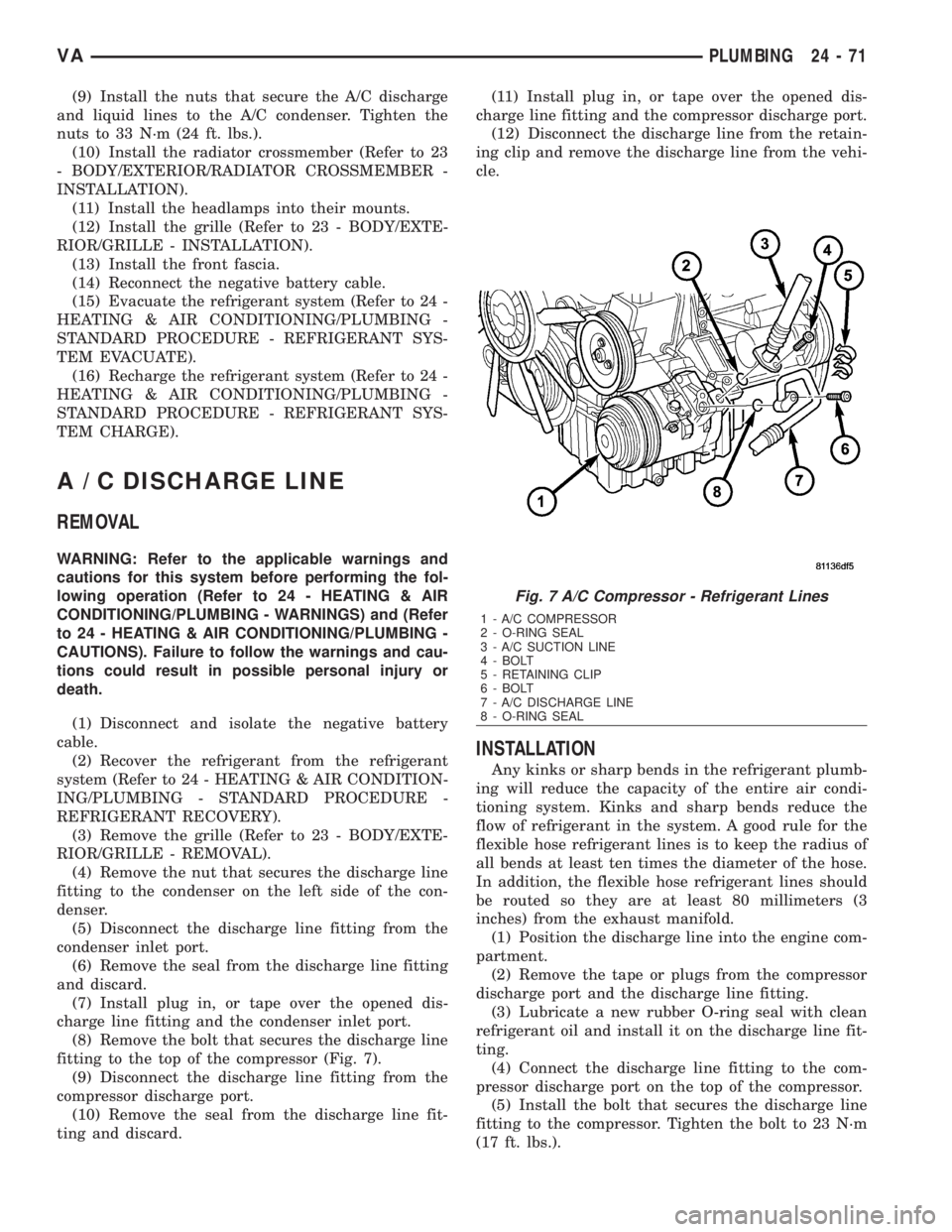
(8) Remove the bolt that secures the discharge line
fitting to the top of the compressor (Fig. 7).
(9) Disconnect the discharge line fitting from the
compressor discharge port.
(10) Remove the seal from the discharge line fit-
ting and discard.(11) Install plug in, or tape over the opened dis-
charge line fitting and the compressor discharge port.
(12) Disconnect the discharge line from the retain-
ing clip and remove the discharge line from the vehi-
cle.
INSTALLATION
Any kinks or sharp bends in the refrigerant plumb-
ing will reduce the capacity of the entire air condi-
tioning system. Kinks and sharp bends reduce the
flow of refrigerant in the system. A good rule for the
flexible hose refrigerant lines is to keep the radius of
all bends at least ten times the diameter of the hose.
In addition, the flexible hose refrigerant lines should
be routed so they are at least 80 millimeters (3
inches) from the exhaust manifold.
(1) Position the discharge line into the engine com-
partment.
(2) Remove the tape or plugs from the compressor
discharge port and the discharge line fitting.
(3) Lubricate a new rubber O-ring seal with clean
refrigerant oil and install it on the discharge line fit-
ting.
(4) Connect the discharge line fitting to the com-
pressor discharge port on the top of the compressor.
(5) Install the bolt that secures the discharge line
fitting to the compressor. Tighten the bolt to 23 N´m
(17 ft. lbs.).
Fig. 7 A/C Compressor - Refrigerant Lines
1 - A/C COMPRESSOR
2 - O-RING SEAL
3 - A/C SUCTION LINE
4 - BOLT
5 - RETAINING CLIP
6 - BOLT
7 - A/C DISCHARGE LINE
8 - O-RING SEAL
VAPLUMBING 24 - 71