warning MERCEDES-BENZ SPRINTER 2006 Service Manual
[x] Cancel search | Manufacturer: MERCEDES-BENZ, Model Year: 2006, Model line: SPRINTER, Model: MERCEDES-BENZ SPRINTER 2006Pages: 2305, PDF Size: 48.12 MB
Page 2128 of 2305
REAR LIQUID LINE
DESCRIPTION
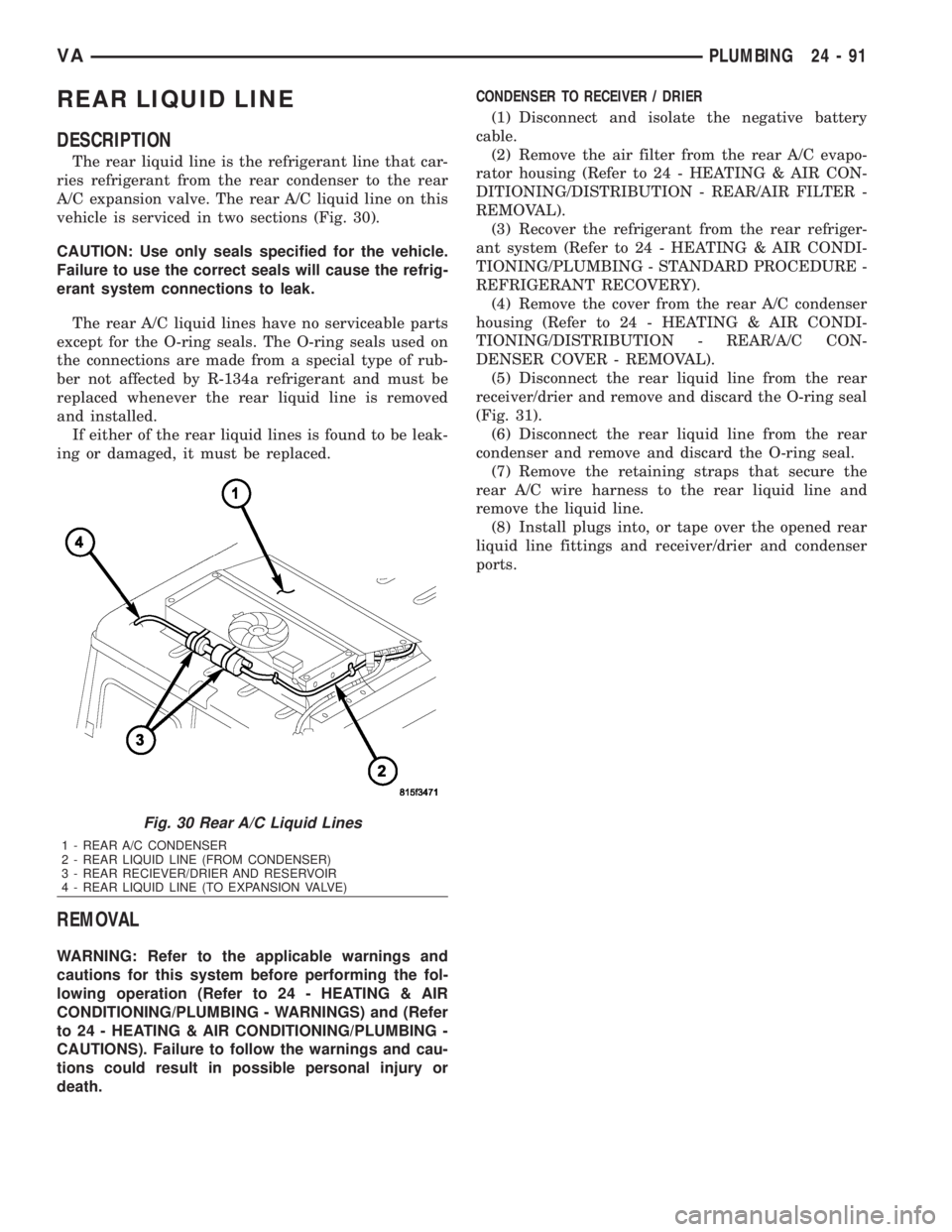
The rear liquid line is the refrigerant line that car-
ries refrigerant from the rear condenser to the rear
A/C expansion valve. The rear A/C liquid line on this
vehicle is serviced in two sections (Fig. 30).
CAUTION: Use only seals specified for the vehicle.
Failure to use the correct seals will cause the refrig-
erant system connections to leak.
The rear A/C liquid lines have no serviceable parts
except for the O-ring seals. The O-ring seals used on
the connections are made from a special type of rub-
ber not affected by R-134a refrigerant and must be
replaced whenever the rear liquid line is removed
and installed.
If either of the rear liquid lines is found to be leak-
ing or damaged, it must be replaced.
REMOVAL
WARNING: Refer to the applicable warnings and
cautions for this system before performing the fol-
lowing operation (Refer to 24 - HEATING & AIR
CONDITIONING/PLUMBING - WARNINGS) and (Refer
to 24 - HEATING & AIR CONDITIONING/PLUMBING -
CAUTIONS). Failure to follow the warnings and cau-
tions could result in possible personal injury or
death.CONDENSER TO RECEIVER / DRIER
(1) Disconnect and isolate the negative battery
cable.
(2) Remove the air filter from the rear A/C evapo-
rator housing (Refer to 24 - HEATING & AIR CON-
DITIONING/DISTRIBUTION - REAR/AIR FILTER -
REMOVAL).
(3) Recover the refrigerant from the rear refriger-
ant system (Refer to 24 - HEATING & AIR CONDI-
TIONING/PLUMBING - STANDARD PROCEDURE -
REFRIGERANT RECOVERY).
(4) Remove the cover from the rear A/C condenser
housing (Refer to 24 - HEATING & AIR CONDI-
TIONING/DISTRIBUTION - REAR/A/C CON-
DENSER COVER - REMOVAL).
(5) Disconnect the rear liquid line from the rear
receiver/drier and remove and discard the O-ring seal
(Fig. 31).
(6) Disconnect the rear liquid line from the rear
condenser and remove and discard the O-ring seal.
(7) Remove the retaining straps that secure the
rear A/C wire harness to the rear liquid line and
remove the liquid line.
(8) Install plugs into, or tape over the opened rear
liquid line fittings and receiver/drier and condenser
ports.
Fig. 30 Rear A/C Liquid Lines
1 - REAR A/C CONDENSER
2 - REAR LIQUID LINE (FROM CONDENSER)
3 - REAR RECIEVER/DRIER AND RESERVOIR
4 - REAR LIQUID LINE (TO EXPANSION VALVE)
VAPLUMBING 24 - 91
Page 2131 of 2305
(8) Charge the rear refrigerant system (Refer to 24
- HEATING & AIR CONDITIONING/PLUMBING -
STANDARD PROCEDURE - REFRIGERANT SYS-
TEM CHARGE).
(9) Install the cover onto the rear A/C evaporator
housing (Refer to 24 - HEATING & AIR CONDI-
TIONING/DISTRIBUTION - REAR/A/C EVAPORA-
TOR COVER-REAR - INSTALLATION).
(10) Install the cover onto the rear A/C condenser
housing (Refer to 24 - HEATING & AIR CONDI-
TIONING/DISTRIBUTION - REAR/A/C CON-
DENSER COVER - INSTALLATION).
REAR RECEIVER / DRIER
REMOVAL
WARNING: Refer to the applicable warnings and
cautions for this system before performing the fol-
lowing operation (Refer to 24 - HEATING & AIR
CONDITIONING/PLUMBING - WARNINGS) and (Refer
to 24 - HEATING & AIR CONDITIONING/PLUMBING -
CAUTIONS). Failure to follow the warnings and cau-
tions could result in possible personal injury or
death.
(1) Disconnect and isolate the negative battery
cable.
(2) Remove the air filter from the rear A/C evapo-
rator housing (Refer to 24 - HEATING & AIR CON-
DITIONING/DISTRIBUTION - REAR/AIR FILTER -
REMOVAL).
(3) Recover the refrigerant from the rear refriger-
ant system (Refer to 24 - HEATING & AIR CONDI-
TIONING/PLUMBING - STANDARD PROCEDURE -
REFRIGERANT RECOVERY).
(4) Remove the cover from the rear A/C condenser
housing (Refer to 24 - HEATING & AIR CONDI-
TIONING/DISTRIBUTION - REAR/A/C CON-
DENSER COVER - REMOVAL).
(5) Disconnect the rear refrigerant reservoir from
the rear receiver/drier and remove and discard the
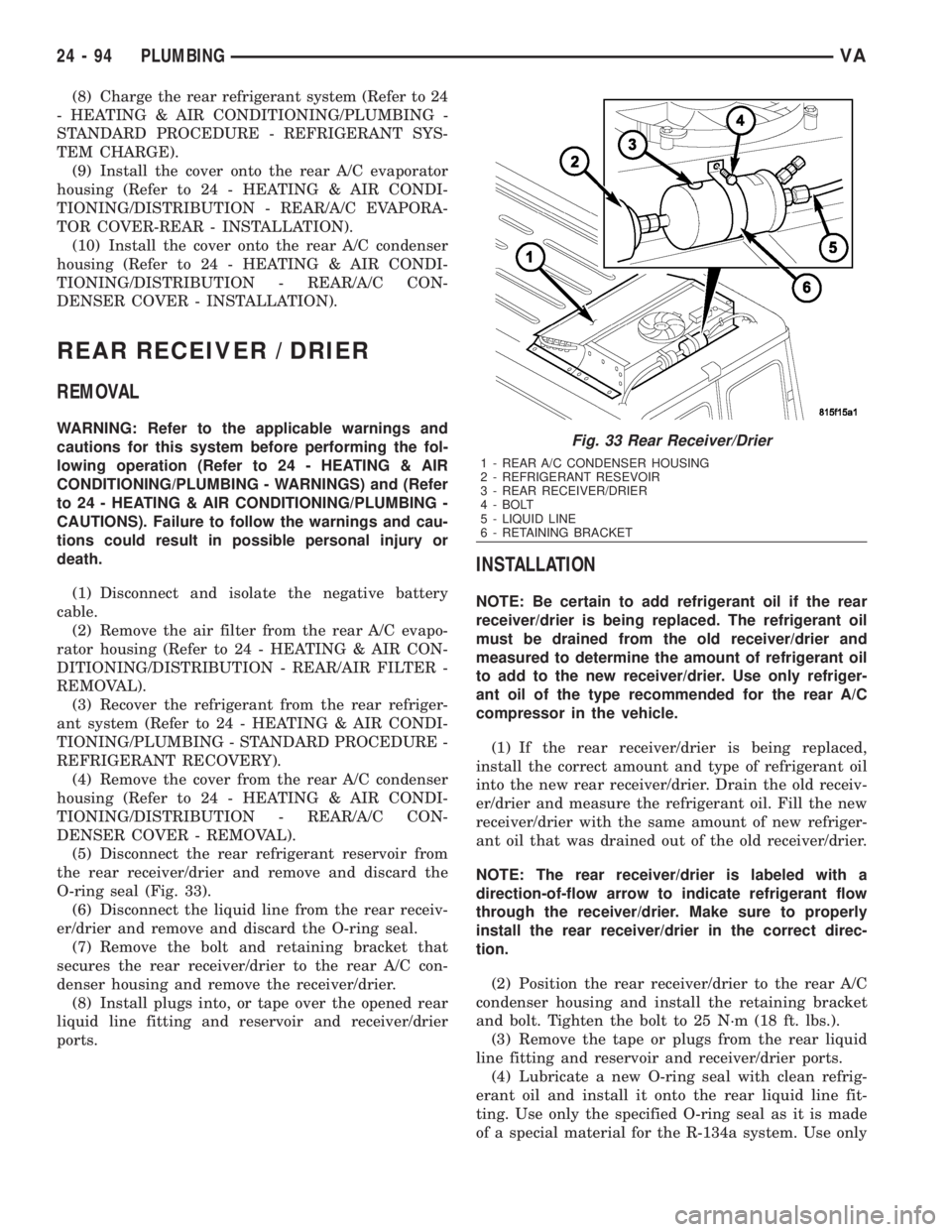
O-ring seal (Fig. 33).
(6) Disconnect the liquid line from the rear receiv-
er/drier and remove and discard the O-ring seal.
(7) Remove the bolt and retaining bracket that
secures the rear receiver/drier to the rear A/C con-
denser housing and remove the receiver/drier.
(8) Install plugs into, or tape over the opened rear
liquid line fitting and reservoir and receiver/drier
ports.
INSTALLATION
NOTE: Be certain to add refrigerant oil if the rear
receiver/drier is being replaced. The refrigerant oil
must be drained from the old receiver/drier and
measured to determine the amount of refrigerant oil
to add to the new receiver/drier. Use only refriger-
ant oil of the type recommended for the rear A/C
compressor in the vehicle.
(1) If the rear receiver/drier is being replaced,
install the correct amount and type of refrigerant oil
into the new rear receiver/drier. Drain the old receiv-
er/drier and measure the refrigerant oil. Fill the new
receiver/drier with the same amount of new refriger-
ant oil that was drained out of the old receiver/drier.
NOTE: The rear receiver/drier is labeled with a
direction-of-flow arrow to indicate refrigerant flow
through the receiver/drier. Make sure to properly
install the rear receiver/drier in the correct direc-
tion.
(2) Position the rear receiver/drier to the rear A/C
condenser housing and install the retaining bracket
and bolt. Tighten the bolt to 25 N´m (18 ft. lbs.).
(3) Remove the tape or plugs from the rear liquid
line fitting and reservoir and receiver/drier ports.
(4) Lubricate a new O-ring seal with clean refrig-
erant oil and install it onto the rear liquid line fit-
ting. Use only the specified O-ring seal as it is made
of a special material for the R-134a system. Use only
Fig. 33 Rear Receiver/Drier
1 - REAR A/C CONDENSER HOUSING
2 - REFRIGERANT RESEVOIR
3 - REAR RECEIVER/DRIER
4 - BOLT
5 - LIQUID LINE
6 - RETAINING BRACKET
24 - 94 PLUMBINGVA
Page 2132 of 2305
refrigerant oil of the type recommended for the rear
A/C compressor in the vehicle.
(5) Connect the rear liquid line to the rear receiv-
er/drier. Tighten the nut to 35 N´m (26 ft. lbs.).
(6) Lubricate a new O-ring seal with clean refrig-
erant oil and install it onto the receiver/drier outlet
fitting. Use only the specified O-ring seal as it is
made of a special material for the R-134a system.
Use only refrigerant oil of the type recommended for
the rear A/C compressor in the vehicle.
(7) Connect the rear refrigerant reservoir to the
rear receiver/drier. Tighten the nut to 35 N´m (26 ft.
lbs.).
(8) Reconnect the negative battery cable.
(9) Evacuate the rear refrigerant system (Refer to
24 - HEATING & AIR CONDITIONING/PLUMBING
- STANDARD PROCEDURE - REFRIGERANT SYS-
TEM EVACUATE).
(10) Charge the rear refrigerant system (Refer to
24 - HEATING & AIR CONDITIONING/PLUMBING
- STANDARD PROCEDURE - REFRIGERANT SYS-
TEM CHARGE).
(11) Install the rear air filter (Refer to 24 - HEAT-
ING & AIR CONDITIONING/DISTRIBUTION -
REAR/AIR FILTER - INSTALLATION).
(12) Install the cover onto the rear A/C condenser
housing (Refer to 24 - HEATING & AIR CONDI-
TIONING/DISTRIBUTION - REAR/A/C CON-
DENSER COVER - INSTALLATION).
REAR REFRIGERANT RESER-
VOIR
REMOVAL
WARNING: Refer to the applicable warnings and
cautions for this system before performing the fol-
lowing operation (Refer to 24 - HEATING & AIR
CONDITIONING/PLUMBING - WARNINGS) and (Refer
to 24 - HEATING & AIR CONDITIONING/PLUMBING -
CAUTIONS). Failure to follow the warnings and cau-
tions could result in possible personal injury or
death.
(1) Disconnect and isolate the negative battery
cable.
(2) Remove the air filter from the rear A/C evapo-
rator housing (Refer to 24 - HEATING & AIR CON-
DITIONING/DISTRIBUTION - REAR/AIR FILTER -
REMOVAL).
(3) Recover the refrigerant from the rear refriger-
ant system (Refer to 24 - HEATING & AIR CONDI-
TIONING/PLUMBING - STANDARD PROCEDURE -
REFRIGERANT RECOVERY).
(4) Remove the cover from the rear A/C condenser
housing (Refer to 24 - HEATING & AIR CONDI-TIONING/DISTRIBUTION - REAR/A/C CON-
DENSER COVER - REMOVAL).
(5) Disconnect the rear liquid line from the rear
refrigerant reservoir and remove and discard the
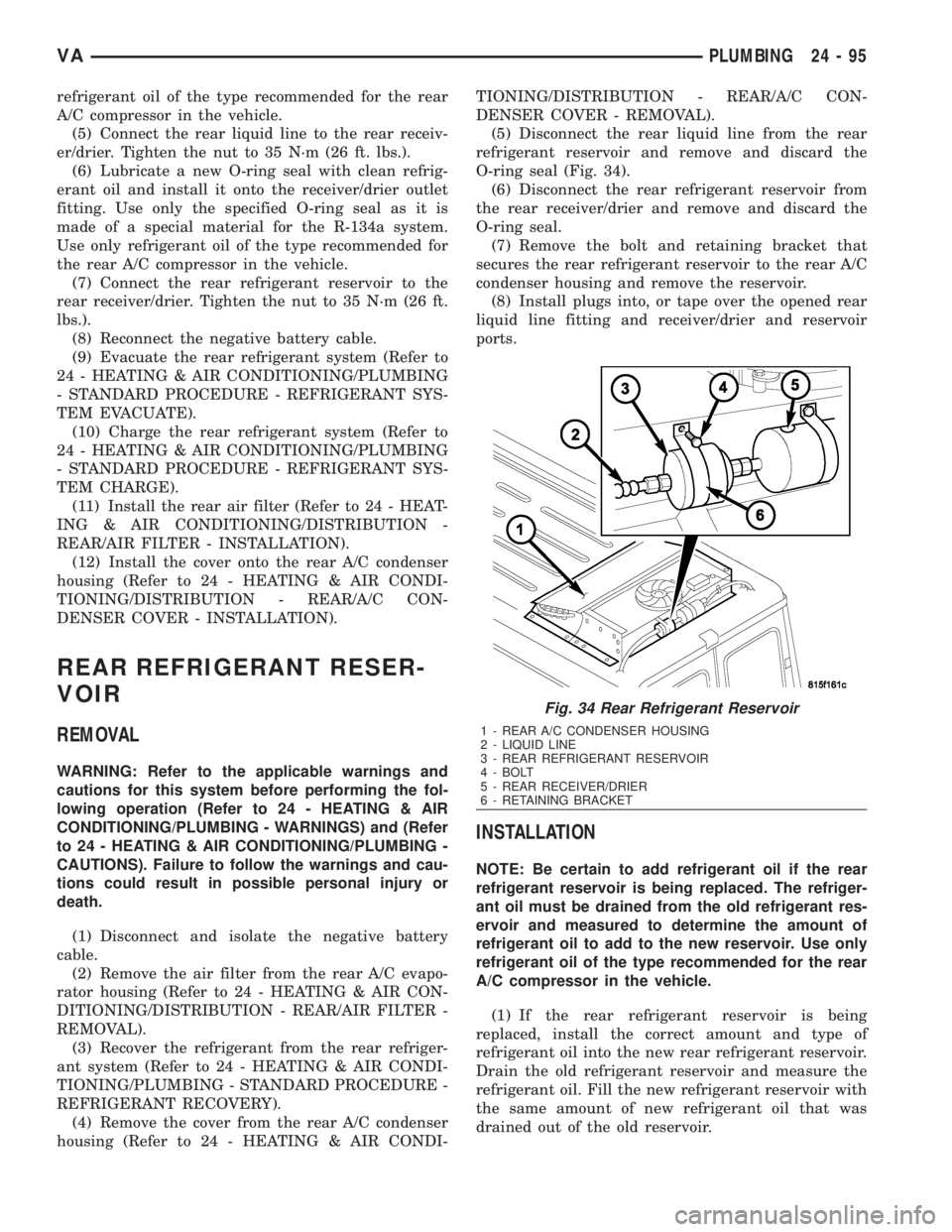
O-ring seal (Fig. 34).
(6) Disconnect the rear refrigerant reservoir from
the rear receiver/drier and remove and discard the
O-ring seal.
(7) Remove the bolt and retaining bracket that
secures the rear refrigerant reservoir to the rear A/C
condenser housing and remove the reservoir.
(8) Install plugs into, or tape over the opened rear
liquid line fitting and receiver/drier and reservoir
ports.
INSTALLATION
NOTE: Be certain to add refrigerant oil if the rear
refrigerant reservoir is being replaced. The refriger-
ant oil must be drained from the old refrigerant res-
ervoir and measured to determine the amount of
refrigerant oil to add to the new reservoir. Use only
refrigerant oil of the type recommended for the rear
A/C compressor in the vehicle.
(1) If the rear refrigerant reservoir is being
replaced, install the correct amount and type of
refrigerant oil into the new rear refrigerant reservoir.
Drain the old refrigerant reservoir and measure the
refrigerant oil. Fill the new refrigerant reservoir with
the same amount of new refrigerant oil that was
drained out of the old reservoir.
Fig. 34 Rear Refrigerant Reservoir
1 - REAR A/C CONDENSER HOUSING
2 - LIQUID LINE
3 - REAR REFRIGERANT RESERVOIR
4 - BOLT
5 - REAR RECEIVER/DRIER
6 - RETAINING BRACKET
VAPLUMBING 24 - 95
Page 2133 of 2305
(2) Install a new rear receiver/drier (Refer to 24 -
HEATING & AIR CONDITIONING/PLUMBING/
REAR RECEIVER/DRIER - INSTALLATION).
(3) Position the rear refrigerant reservoir to the
rear A/C condenser housing and install the retaining
bracket and bolt. Tighten the bolt to 25 N´m (18 ft.
lbs.).
(4) Remove the tape or plugs from the rear liquid
line fitting and receiver/drier and reservoir ports.
(5) Lubricate a new O-ring seal with clean refrig-
erant oil and install it onto the rear receiver/drier fit-
ting. Use only the specified O-ring seal as it is made
of a special material for the R-134a system. Use only
refrigerant oil of the type recommended for the rear
A/C compressor in the vehicle.
(6) Connect the rear receiver/drier to the rear
refrigerant reservoir. Tighten the nut to 35 N´m (26
ft. lbs.).
(7) Lubricate a new O-ring seal with clean refrig-
erant oil and install it onto the rear liquid line fit-
ting. Use only the specified O-ring seal as it is made
of a special material for the R-134a system. Use only
refrigerant oil of the type recommended for the rear
A/C compressor in the vehicle.
(8) Connect the rear liquid line to the rear refrig-
erant reservoir. Tighten the nut to 35 N´m (26 ft.
lbs.).
(9) Reconnect the negative battery cable.
(10) Evacuate the rear refrigerant system (Refer to
24 - HEATING & AIR CONDITIONING/PLUMBING
- STANDARD PROCEDURE - REFRIGERANT SYS-
TEM EVACUATE).
(11) Charge the rear refrigerant system (Refer to
24 - HEATING & AIR CONDITIONING/PLUMBING
- STANDARD PROCEDURE - REFRIGERANT SYS-
TEM CHARGE).
(12) Install the rear air filter (Refer to 24 - HEAT-
ING & AIR CONDITIONING/DISTRIBUTION -
REAR/AIR FILTER - INSTALLATION).
(13) Install the cover onto the rear A/C condenser
housing (Refer to 24 - HEATING & AIR CONDI-
TIONING/DISTRIBUTION - REAR/A/C CON-
DENSER COVER - INSTALLATION).
REAR SUCTION LINE
DESCRIPTION
The rear A/Csuction line is the refrigerant line that
carries refrigerant from the rear A/C evaporator to
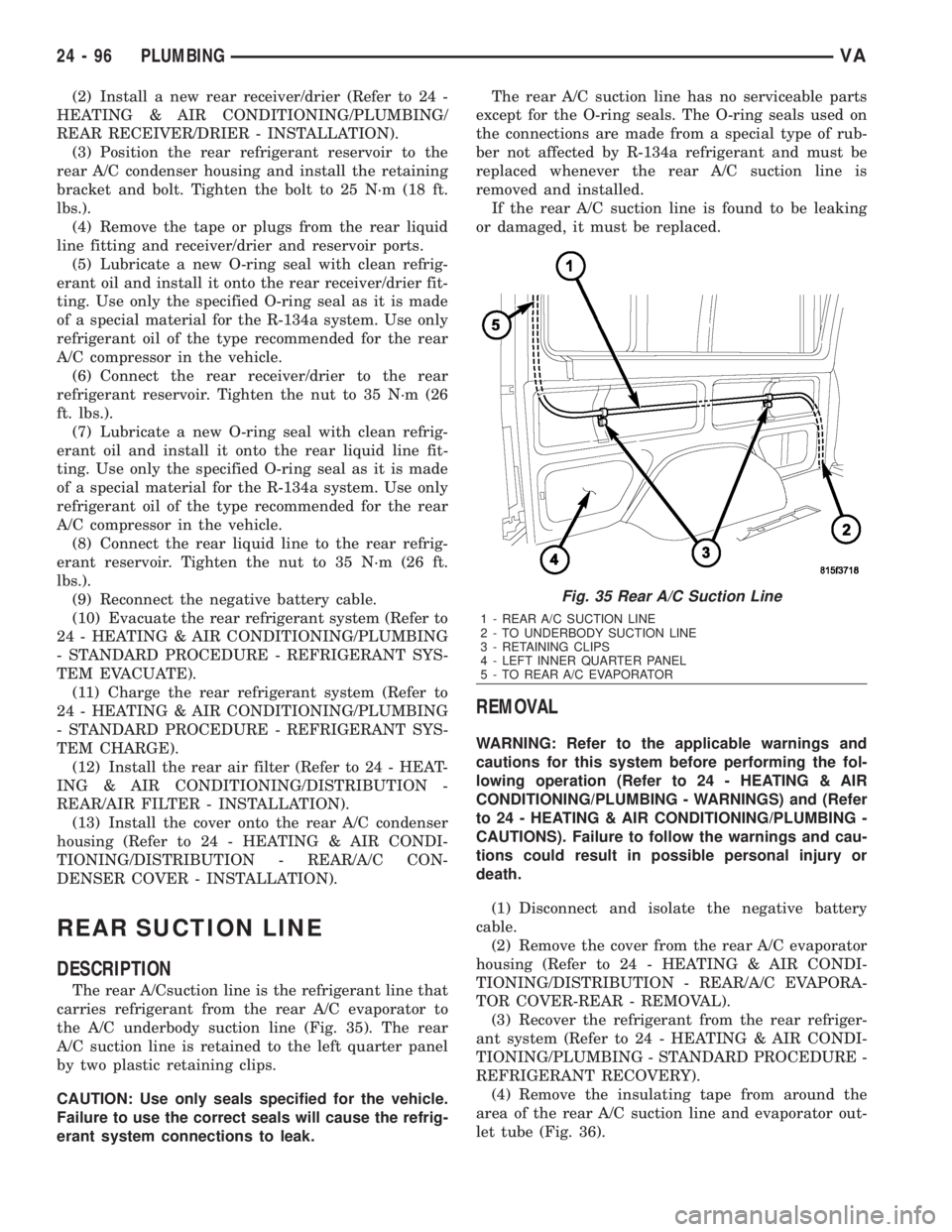
the A/C underbody suction line (Fig. 35). The rear
A/C suction line is retained to the left quarter panel
by two plastic retaining clips.
CAUTION: Use only seals specified for the vehicle.
Failure to use the correct seals will cause the refrig-
erant system connections to leak.The rear A/C suction line has no serviceable parts
except for the O-ring seals. The O-ring seals used on
the connections are made from a special type of rub-
ber not affected by R-134a refrigerant and must be
replaced whenever the rear A/C suction line is
removed and installed.
If the rear A/C suction line is found to be leaking
or damaged, it must be replaced.
REMOVAL
WARNING: Refer to the applicable warnings and
cautions for this system before performing the fol-
lowing operation (Refer to 24 - HEATING & AIR
CONDITIONING/PLUMBING - WARNINGS) and (Refer
to 24 - HEATING & AIR CONDITIONING/PLUMBING -
CAUTIONS). Failure to follow the warnings and cau-
tions could result in possible personal injury or
death.
(1) Disconnect and isolate the negative battery
cable.
(2) Remove the cover from the rear A/C evaporator
housing (Refer to 24 - HEATING & AIR CONDI-
TIONING/DISTRIBUTION - REAR/A/C EVAPORA-
TOR COVER-REAR - REMOVAL).
(3) Recover the refrigerant from the rear refriger-
ant system (Refer to 24 - HEATING & AIR CONDI-
TIONING/PLUMBING - STANDARD PROCEDURE -
REFRIGERANT RECOVERY).
(4) Remove the insulating tape from around the
area of the rear A/C suction line and evaporator out-
let tube (Fig. 36).
Fig. 35 Rear A/C Suction Line
1 - REAR A/C SUCTION LINE
2 - TO UNDERBODY SUCTION LINE
3 - RETAINING CLIPS
4 - LEFT INNER QUARTER PANEL
5 - TO REAR A/C EVAPORATOR
24 - 96 PLUMBINGVA
Page 2136 of 2305
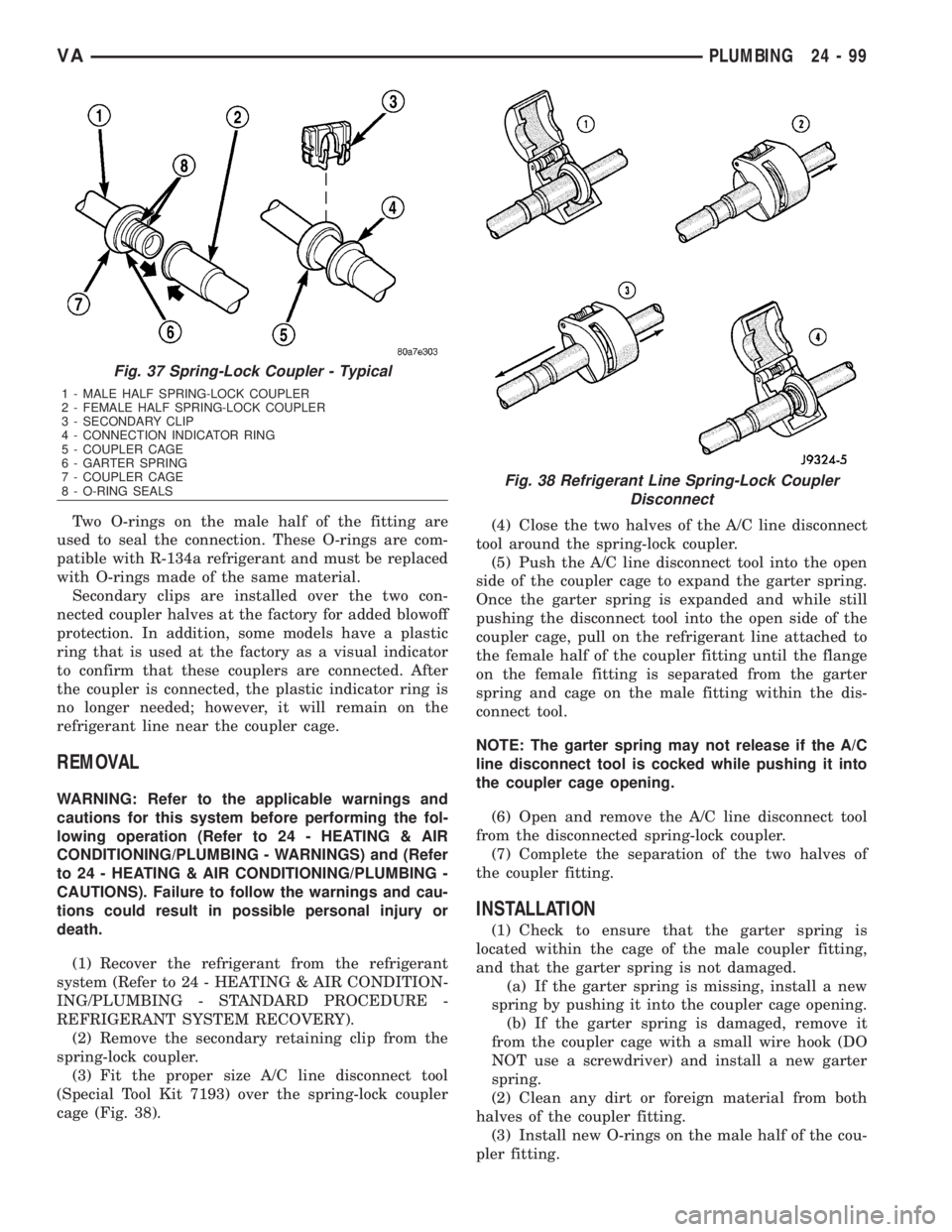
Two O-rings on the male half of the fitting are
used to seal the connection. These O-rings are com-
patible with R-134a refrigerant and must be replaced
with O-rings made of the same material.
Secondary clips are installed over the two con-
nected coupler halves at the factory for added blowoff
protection. In addition, some models have a plastic
ring that is used at the factory as a visual indicator
to confirm that these couplers are connected. After
the coupler is connected, the plastic indicator ring is
no longer needed; however, it will remain on the
refrigerant line near the coupler cage.
REMOVAL
WARNING: Refer to the applicable warnings and
cautions for this system before performing the fol-
lowing operation (Refer to 24 - HEATING & AIR
CONDITIONING/PLUMBING - WARNINGS) and (Refer
to 24 - HEATING & AIR CONDITIONING/PLUMBING -
CAUTIONS). Failure to follow the warnings and cau-
tions could result in possible personal injury or
death.
(1) Recover the refrigerant from the refrigerant
system (Refer to 24 - HEATING & AIR CONDITION-
ING/PLUMBING - STANDARD PROCEDURE -
REFRIGERANT SYSTEM RECOVERY).
(2) Remove the secondary retaining clip from the
spring-lock coupler.
(3) Fit the proper size A/C line disconnect tool
(Special Tool Kit 7193) over the spring-lock coupler
cage (Fig. 38).(4) Close the two halves of the A/C line disconnect
tool around the spring-lock coupler.
(5) Push the A/C line disconnect tool into the open
side of the coupler cage to expand the garter spring.
Once the garter spring is expanded and while still
pushing the disconnect tool into the open side of the
coupler cage, pull on the refrigerant line attached to
the female half of the coupler fitting until the flange
on the female fitting is separated from the garter
spring and cage on the male fitting within the dis-
connect tool.
NOTE: The garter spring may not release if the A/C
line disconnect tool is cocked while pushing it into
the coupler cage opening.
(6) Open and remove the A/C line disconnect tool
from the disconnected spring-lock coupler.
(7) Complete the separation of the two halves of
the coupler fitting.
INSTALLATION
(1) Check to ensure that the garter spring is
located within the cage of the male coupler fitting,
and that the garter spring is not damaged.
(a) If the garter spring is missing, install a new
spring by pushing it into the coupler cage opening.
(b) If the garter spring is damaged, remove it
from the coupler cage with a small wire hook (DO
NOT use a screwdriver) and install a new garter
spring.
(2) Clean any dirt or foreign material from both
halves of the coupler fitting.
(3) Install new O-rings on the male half of the cou-
pler fitting.
Fig. 37 Spring-Lock Coupler - Typical
1 - MALE HALF SPRING-LOCK COUPLER
2 - FEMALE HALF SPRING-LOCK COUPLER
3 - SECONDARY CLIP
4 - CONNECTION INDICATOR RING
5 - COUPLER CAGE
6 - GARTER SPRING
7 - COUPLER CAGE
8 - O-RING SEALS
Fig. 38 Refrigerant Line Spring-Lock Coupler
Disconnect
VAPLUMBING 24 - 99
Page 2137 of 2305
CAUTION: Use only the specified O-rings as they
are made of a special material for the R-134a sys-
tem. The use of any other O-rings may allow the
connection to leak intermittently during vehicle
operation.
(4) Lubricate the male fitting and O-rings, and the
inside of the female fitting with clean R-134a refrig-
erant oil. Use only refrigerant oil of the type recom-
mended for the compressor in the vehicle.
(5) Fit the female half of the coupler fitting over
the male half of the fitting.
(6) Push together firmly on the two halves of the
coupler fitting until the garter spring in the cage on
the male half of the fitting snaps over the flanged
end on the female half of the fitting.
(7) Ensure that the spring-lock coupler is fully
engaged by trying to separate the two coupler halves.
This is done by pulling the refrigerant lines on either
side of the coupler away from each other.
(8) Reinstall the secondary retaining clip over the
spring-lock coupler cage.
(9) Evacuate the refrigerant system (Refer to 24 -
HEATING & AIR CONDITIONING/PLUMBING -
STANDARD PROCEDURE - REFRIGERANT SYS-
TEM EVACUATE).
(10) Charge the refrigerant system (Refer to 24 -
HEATING & AIR CONDITIONING/PLUMBING -
STANDARD PROCEDURE - REFRIGERANT SYS-
TEM CHARGE).
UNDERBODY LINES
REMOVAL
WARNING: Refer to the applicable warnings and
cautions for this system before performing the fol-
lowing operation (Refer to 24 - HEATING & AIR
CONDITIONING/PLUMBING - WARNINGS) and (Refer
to 24 - HEATING & AIR CONDITIONING/PLUMBING -
CAUTIONS). Failure to follow the warnings and cau-
tions could result in possible personal injury or
death.
NOTE: The underbody refrigerant lines for the
optional rear A/C system are serviced in five sec-
tions. Two sections are connected the A/C compres-
sor. Two sections of the underbody suction line
(low-side) are connected together by a tapping
block with an O-ring seal. The underbody A/C dis-
charge line uses a spring-lock type refrigerant line
coupler with an O-ring seal.
DISCHARGE LINE
(1) Remove the cover from the rear A/C evaporator
housing (Refer to 24 - HEATING & AIR CONDI-TIONING/DISTRIBUTION - REAR/A/C EVAPORA-
TOR COVER-REAR - REMOVAL).
(2) Recover the refrigerant from the rear refriger-
ant system (Refer to 24 - HEATING & AIR CONDI-
TIONING/PLUMBING - STANDARD PROCEDURE -
REFRIGERANT RECOVERY).
(3) Raise and support the vehicle.
(4) Using the proper A/C line disconnect tool, dis-
connect the underbody discharge line spring-lock cou-
pler from the compressor section of the underbody
discharge line and remove and discard the O-ring
seal (Refer to 24 - HEATING & AIR CONDITION-
ING/PLUMBING/REFRIGERANT LINE COUPLER -
REMOVAL) (Fig. 39).
(5) Disconnect the underbody discharge line from
the rear A/C discharge line and remove and discard
the O-ring seal.
(6) Install plug in, or tape over all of the opened
discharge line fittings.
(7) Disengage the fuel lines from the retaining clip
located near the transmission and position the fuel
lines out of the way.
(8) Remove the screws and brackets that secure
the discharge line to the underneath of the vehicle.
(9) Support transmission with a suitable lifting
device and remove the rear transmission crossmem-
ber (Refer to 13 - FRAME & BUMPERS/FRAME/
REAR CROSSMEMBER-TRANSMISSION -
REMOVAL).
(10) Remove the underbody discharge line from
the vehicle. Push the discharge line forward and over
the transmission, then pull it rearward to remove.
(11) If necessary, remove the bolt that secures the
compressor section of the underbody discharge line to
the A/C compressor and remove and discard the
O-ring seal. Make sure to plug in, or tape over the
opened discharge line fitting and compressor port.
24 - 100 PLUMBINGVA
Page 2142 of 2305
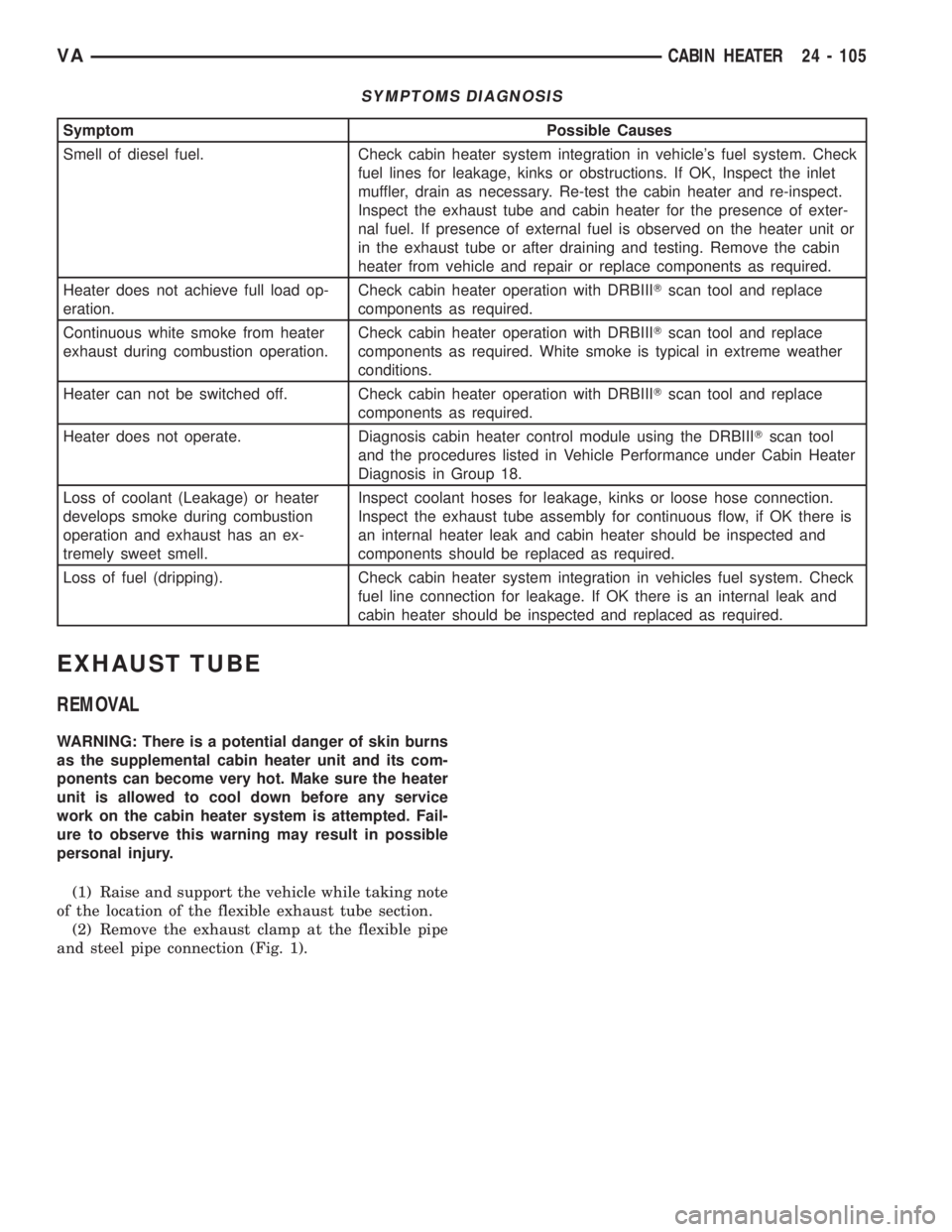
SYMPTOMS DIAGNOSIS
Symptom Possible Causes
Smell of diesel fuel. Check cabin heater system integration in vehicle's fuel system. Check
fuel lines for leakage, kinks or obstructions. If OK, Inspect the inlet
muffler, drain as necessary. Re-test the cabin heater and re-inspect.
Inspect the exhaust tube and cabin heater for the presence of exter-
nal fuel. If presence of external fuel is observed on the heater unit or
in the exhaust tube or after draining and testing. Remove the cabin
heater from vehicle and repair or replace components as required.
Heater does not achieve full load op-
eration.Check cabin heater operation with DRBIIITscan tool and replace
components as required.
Continuous white smoke from heater
exhaust during combustion operation.Check cabin heater operation with DRBIIITscan tool and replace
components as required. White smoke is typical in extreme weather
conditions.
Heater can not be switched off. Check cabin heater operation with DRBIIITscan tool and replace
components as required.
Heater does not operate. Diagnosis cabin heater control module using the DRBIIITscan tool
and the procedures listed in Vehicle Performance under Cabin Heater
Diagnosis in Group 18.
Loss of coolant (Leakage) or heater
develops smoke during combustion
operation and exhaust has an ex-
tremely sweet smell.Inspect coolant hoses for leakage, kinks or loose hose connection.
Inspect the exhaust tube assembly for continuous flow, if OK there is
an internal heater leak and cabin heater should be inspected and
components should be replaced as required.
Loss of fuel (dripping). Check cabin heater system integration in vehicles fuel system. Check
fuel line connection for leakage. If OK there is an internal leak and
cabin heater should be inspected and replaced as required.
EXHAUST TUBE
REMOVAL
WARNING: There is a potential danger of skin burns
as the supplemental cabin heater unit and its com-
ponents can become very hot. Make sure the heater
unit is allowed to cool down before any service
work on the cabin heater system is attempted. Fail-
ure to observe this warning may result in possible
personal injury.
(1) Raise and support the vehicle while taking note
of the location of the flexible exhaust tube section.
(2) Remove the exhaust clamp at the flexible pipe
and steel pipe connection (Fig. 1).
VACABIN HEATER 24 - 105
Page 2146 of 2305
(3) Remove clamp from the fuel line at the fuel
tank connection and separate the line from the tank.
(4) Remove any retaining clips and remove the
fuel line from vehicle.
INSTALLATION
WARNING: Do not operate the diesel supplemental
cabin heater in an enclosed area such as a garage
that does not have exhaust ventilation facilities.
Always vent the cabin heater exhaust when operat-
ing the cabin heater. Allow the diesel supplemental
cabin heater to cool before performing any service
procedures to the cabin heater. Verify that all diesel
supplemental cabin heater fuel lines are securely
fastened to their respective components before per-
forming any service procedures to the cabin heater.
Failure to follow these warnings may result in pos-
sible personal injury or death.
NOTE: Verify that there is more than 1/8 of a tank of
fuel in the vehicle's fuel tank before performing this
procedure. Add fuel, if necessary.
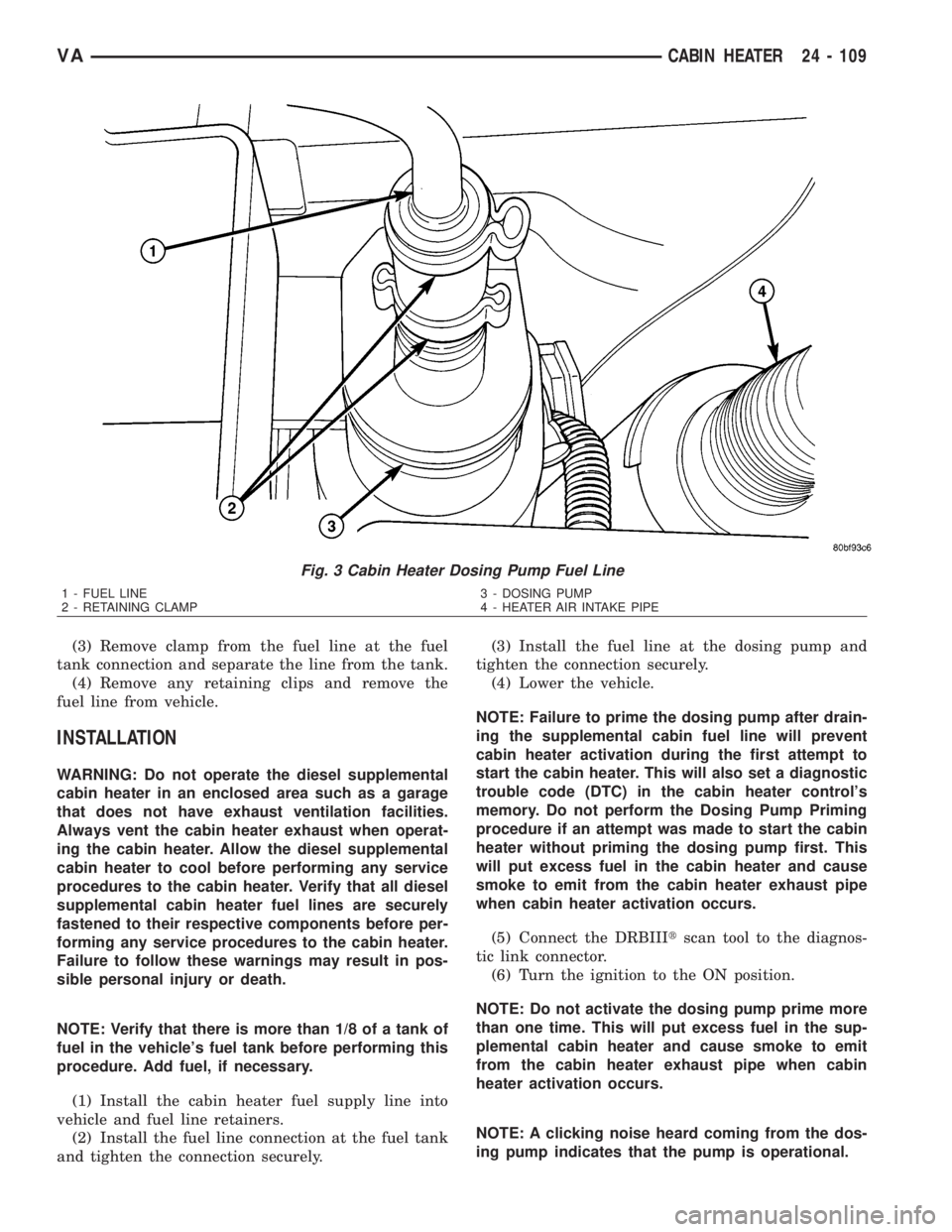
(1) Install the cabin heater fuel supply line into
vehicle and fuel line retainers.
(2) Install the fuel line connection at the fuel tank
and tighten the connection securely.(3) Install the fuel line at the dosing pump and
tighten the connection securely.
(4) Lower the vehicle.
NOTE: Failure to prime the dosing pump after drain-
ing the supplemental cabin fuel line will prevent
cabin heater activation during the first attempt to
start the cabin heater. This will also set a diagnostic
trouble code (DTC) in the cabin heater control's
memory. Do not perform the Dosing Pump Priming
procedure if an attempt was made to start the cabin
heater without priming the dosing pump first. This
will put excess fuel in the cabin heater and cause
smoke to emit from the cabin heater exhaust pipe
when cabin heater activation occurs.
(5) Connect the DRBIIItscan tool to the diagnos-
tic link connector.
(6) Turn the ignition to the ON position.
NOTE: Do not activate the dosing pump prime more
than one time. This will put excess fuel in the sup-
plemental cabin heater and cause smoke to emit
from the cabin heater exhaust pipe when cabin
heater activation occurs.
NOTE: A clicking noise heard coming from the dos-
ing pump indicates that the pump is operational.
Fig. 3 Cabin Heater Dosing Pump Fuel Line
1 - FUEL LINE
2 - RETAINING CLAMP3 - DOSING PUMP
4 - HEATER AIR INTAKE PIPE
VACABIN HEATER 24 - 109
Page 2147 of 2305
(7) With the DRBIIItscan tool in Cabin Heater,
select System Tests and Dosing Pump Prime. Allow
the dosing pump to run for the full 45 second cycle
time. When the 45 second cycle is complete, press
Page Back on the DRBIIItscan tool key pad to exit
the Dosing Pump Prime. The Dosing Pump Priming
procedure is now complete.
HEATER UNIT
REMOVAL
HEATER UNIT
WARNING: Do not operate the diesel supplemental
cabin heater in an enclosed area such as a garage
that does not have exhaust ventilation facilities.
Always vent the cabin heater exhaust when operat-
ing the cabin heater. Allow the diesel supplemental
cabin heater to cool before performing any service
procedures to the cabin heater. Verify that all diesel
supplemental cabin heater fuel lines are securely
fastened to their respective components before per-
forming any service procedures to the cabin heater.
Failure to follow these warnings may result in pos-
sible personal injury or death.
(1) Raise and support the vehicle. Take note of the
location of the flexible section of the cabin heater
exhaust tube.
(2) Drain the engine cooling system (Refer to 7 -
COOLING - STANDARD PROCEDURE - DRAINING
COOLING SYSTEM).
(3) Carefully open one hose to the underbody tube
assembly and drain the remaining coolant. A salvage
hose is a good idea to control the residual coolant, as
flow will occur from both the cabin heater and the
hose and tube assemblies.
(4) Remove the second hose from the underbody
hose and tube assembly.
(5) Loosen the hose and tube assembly from the
toe-board crossmember at two locations.
(6) Disconnect the electrical connector from the
body harness near the toe-board crossmember and
rail.
(7) Remove the wiring harness from the toe-board
crossmember (Refer to 24 - HEATING & AIR CON-
DITIONING/CABIN HEATER/HEATER UNIT -
REMOVAL - WIRE HARNESS).
(8) Open the fuel filler cap. Disconnect the rubber
fuel hose between the body tube assembly and the
fuel pump nipple at the body tube joint. A minimal
amount of fuel may flow from the open port.
NOTE: Utilize an approved fuel storage container to
catch any residual fuel.(9) Loosen the two fasteners at the rail. Take care
to notice that the exhaust tube bracket tab is on top
of the heater bracket and that there are two spacer
washers installed between the rubber grommets.
(10) Remove the flexible section of the cabin
heater exhaust tube from the exhaust tube by loos-
ening the clamp. Remove the hose from the exhaust
tube. Removal of the rail tube assembly may aid in
this service operation (Refer to 24 - HEATING & AIR
CONDITIONING/CABIN HEATER/EXHAUST TUBE
- REMOVAL).
(11) Remove seat hex nut at the heater mounting
flange to crossmember.
(12) Loosen the remaining fasteners which mount
the exhaust tube assembly to the vehicle.
(a) Install a suitable support device under the
cabin heater and secure the cabin heater to the
support.
(13) Loosen the remaining three fasteners to the
crossmembers.
(14) Remove the loosened fasteners that support
the cabin heater while supporting the weight of the
heater.
(15) Swing the cabin heater mounting bracket
from between the exhaust bracket and rail mounting
location. Drain any residual coolant from the cabin
heater.
(16) Remove the cabin heater from the vehicle.
WIRE HARNESS
(1) Raise and support the vehicle while taking note
of the location of the flexible exhaust tube section.
(2) Disconnect the cabin heater wire harness con-
nector from the vehicle wiring harness.
(3) Disconnect the cabin heater wire harness con-
nector from the dosing pump.
(4) Disconnect the two cabin heater wire harness
connectors from the cabin heater controller.
(5) Remove two wiring harness retainers from the
underbody.
(6) Remove two wiring harness retainers from the
cabin heater shield.
(7) Carefully route the cabin heater wire harness
out the left side between the heater unit and the
heater shield.
INSTALLATION
HEATER UNIT
(1) Install the cabin heater mounting bracket
between the exhaust bracket and the rail mounting
location.
(2) Support the cabin heater and install the fasten-
ers that secure the cabin heater to the mounting
bracket.
(3) Install the three fasteners to the crossmem-
bers. Tighten the M6 fasteners to 7 N´m (62 in. lbs.).
24 - 110 CABIN HEATERVA
Page 2162 of 2305
TABLE OF CONTENTS
1.0 INTRODUCTION.........................................................1
1.1SYSTEM COVERAGE...............................................1
1.2SIX -STEP TROUBLESHOOTING PROCEDURE..........................1
2.0 IDENTIFICATION OF SYSTEM.............................................1
3.0 SYSTEM DESCRIPTION AND FUNCTIONAL OPERATION......................1
3.1GENERAL DESCRIPTION............................................1
3.2FUNCTIONAL OPERATION...........................................1
3.2.1CONTROLLER MODES OF OPERATION........................2
3.2.2MIL ILLUMINATION..........................................2
3.2.3SOLENOIDS...............................................2
3.2.4TRANSMISSION COMPONENT DESCRIPTIONS.................3
3.2.5TRANSMISSION OPERATION AND SHIFT SCHEDULING..........4
3.2.6TRANSMISSION ADAPTIVES - INITIALIZE AND STORE...........4
3.3DIAGNOSTIC TROUBLE CODES......................................4
3.3.1ACTIVE (HARD) CODE......................................4
3.3.2STORED (INTERMITTENT) CODE.............................4
3.3.3TROUBLE CODE ERASURE..................................5
3.4USING THE DRBIIIT.................................................5
3.5DRBIIITERROR MESSAGES.........................................5
3.5.1DRBIIITDOES NOT POWER UP (BLANK SCREEN)...............5
3.5.2DISPLAY IS NOT VISIBLE....................................5
4.0 DISCLAIMERS, SAFETY, AND WARNINGS..................................5
4.1DISCLAIMERS......................................................5
4.2SAFETY...........................................................6
4.2.1TECHNICIAN SAFETY INFORMATION..........................6
4.2.2VEHICLE PREPARATION FOR TESTING........................6
4.2.3SERVICING SUB-ASSEMBLIES...............................6
4.2.4DRBIIITSAFETY INFORMATION...............................6
4.3WARNINGS........................................................7
4.3.1VEHICLE DAMAGE WARNINGS...............................7
4.3.2ROAD TESTING A COMPLAINT VEHICLE.......................7
4.4.4BULLETINS AND RECALLS...................................7
5.0 REQUIRED TOOLS AND EQUIPMENT......................................8
6.0 GLOSSARY OF TERMS...................................................8
6.1ACRONYMS.......................................................8
6.2DEFINITIONS......................................................8
7.0 DIAGNOSTIC INFORMATION AND PROCEDURES............................9
COMMUNICATION
*NO RESPONSE FROM SHIFTER ASSEMBLY...............................10
*NO RESPONSE FROM TRANSMISSION CONTROL MODULE.................12
SHIFT LEVER ASSEMBLY
BACKUP LAMP CKT SHORT TO GROUND..................................14
i