display MERCEDES-BENZ SPRINTER 2006 Owner's Guide
[x] Cancel search | Manufacturer: MERCEDES-BENZ, Model Year: 2006, Model line: SPRINTER, Model: MERCEDES-BENZ SPRINTER 2006Pages: 2305, PDF Size: 48.12 MB
Page 155 of 2305
Symptom:
AUX FAN RELAY CONTROL SHORTED LOW (ACTIVE)
POSSIBLE CAUSES
A/C AUXILIARY FAN RELAY
A/C AUXILIARY FAN RELAY HIGH SIDE CONTROL CIRCUIT SHORTED TO GROUND
A/C AUXILIARY FAN RELAY HIGH SIDE CONTROL CIRCUIT SHORTED TO GROUND CIRCUIT
AUTOMATIC TEMPERATURE CONTROL (ATC)
A/C AUXILIARY FAN RELAY HIGH SIDE CONTROL CKT SHORTED TO SENSOR GROUND CKT
TEST ACTION APPLICABILITY
1 Turn the ignition off.
Install a substitute relay in place of the A/C Auxiliary Fan Relay.
NOTE: All of the following criteria must be met in order to successfully run
the ATC Function Test.
Place the shift lever in Park.
Turn the ignition on.
With the DRBIIIt, record and erase ATC DTC's.
Start the engine. Allow the engine to reach normal operating temperature.
Set the blower to high speed.
Press the Air Conditioning switch On.
With the DRBIIIt, verify that the ambient temperature is above 59ÉF (15ÉC), the
refrigerant pressure is between 29 and 348 PSI (2 and 24 bar), the evaporator
temperature is above 36.5ÉF (2.5ÉC), and the coolant temperature is above 158ÉF
(70ÉC).
With the DRBIIItin Automatic Temperature Control (ATC), select System Tests and
select ATC Function Test. When the ATC Function Test is complete, proceed as
follows:
With the DRBIIIt, read the active ATC DTCs.
Does the DRBIIItdisplay: AUX FAN RELAY CONTROL SHORTED LOW?All
Ye s!Go To 2
No!Replace the original A/C Auxiliary Fan Relay in accordance with
the Service Information.
Perform BODY VERIFICATION TEST - VER 1.
2 Turn the ignition off.
Remove the substitute A/C Auxiliary Fan Relay from the relay center.
Disconnect the Automatic Temperature Control (ATC) C1 harness connector.
Measure the resistance between ground and the A/C Auxiliary Fan Relay High Side
Control circuit.
Is the resistance below 10K ohms?All
Ye s!Repair the A/C Auxiliary Fan Relay High Side Control circuit for
a short to ground. Reinstall the original A/C Auxiliary Fan Relay.
Perform BODY VERIFICATION TEST - VER 1.
No!Go To 3
142
HEATING & A/C
Page 159 of 2305
Symptom:
BLOWER STAGE 1 SHORTED LOW (ACTIVE)
POSSIBLE CAUSES
BLOWER MOTOR FUSE
BLOWER MOTOR
BLOWER MOTOR DRIVER CIRCUIT(S) SHORTED TO GROUND
FUSED B+ CIRCUIT SHORTED TO GROUND
BLOWER MOTOR RESISTOR BLOCK
AUTOMATIC TEMPERATURE CONTROL (ATC)
TEST ACTION APPLICABILITY
1 Turn the ignition off.
Remove and inspect the Blower Motor Fuse, and replace it if necessary.
NOTE: All of the following criteria must be met in order to successfully run
the ATC Function Test.
Place the shift lever in Park.
Turn the ignition on.
With the DRBIIIt, record and erase ATC DTC's.
Start the engine. Allow the engine to reach normal operating temperature.
Set the blower to high speed.
Press the Air Conditioning switch On.
With the DRBIIIt, verify that the ambient temperature is above 59ÉF (15ÉC), the
refrigerant pressure is between 29 and 348 PSI (2 and 24 bar), the evaporator
temperature is above 36.5ÉF (2.5ÉC), and the coolant temperature is above 158ÉF
(70ÉC).
With the DRBIIItin Automatic Temperature Control (ATC), select System Tests and
select ATC Function Test. When the ATC Function Test is complete, proceed as
follows:
With the DRBIIIt, read the active ATC DTCs.
Does the DRBIIItdisplay: BLOWER STAGE ONE SHORTED LOW?All
Ye s!Go To 2
No!Refer to the wiring diagrams located in the service information to
help isolate a possible intermittent short to ground condition.
Perform BODY VERIFICATION TEST - VER 1.
2 Turn the ignition off.
Disconnect the Blower Motor harness connector.
Connect a fused jumper wire between Battery (+) and Blower Motor cavity 1.
Connect a jumper wire between ground and Blower Motor cavity 2.
Does the Blower Motor run at full speed?All
Ye s!Go To 3
No!Replace the Blower Motor in accordance with the Service Infor-
mation. Remove and inspect the Blower Motor Fuse, and replace
it if necessary.
Perform BODY VERIFICATION TEST - VER 1.
146
HEATING & A/C
Page 163 of 2305
Symptom:
CABIN HEATER CONTROL SHORTED LOW (ACTIVE)
POSSIBLE CAUSES
CABIN HEATER OR HEATER BOOSTER CONTROL UNIT
CABIN HEATER CONTROL CIRCUIT SHORTED TO GROUND
CABIN HEATER CONTROL CIRCUIT SHORTED TO GROUND CIRCUIT
CABIN HEATER CONTROL CIRCUIT SHORTED TO SENSOR GROUND CIRCUIT
AUTOMATIC TEMPERATURE CONTROL (ATC)
TEST ACTION APPLICABILITY
1 Turn the ignition off.
Disconnect the Cabin Heater or Heater Booster harness connector.
NOTE: All of the following criteria must be met in order to successfully run
the ATC Function Test.
Place the shift lever in Park.
Turn the ignition on.
With the DRBIIIt, record and erase ATC DTC's.
Start the engine. Allow the engine to reach normal operating temperature.
Set the blower to high speed.
Press the Air Conditioning switch On.
With the DRBIIIt, verify that the ambient temperature is above 59ÉF (15ÉC), the
refrigerant pressure is between 29 and 348 PSI (2 and 24 bar), the evaporator
temperature is above 36.5ÉF (2.5ÉC), and the coolant temperature is above 158ÉF
(70ÉC).
With the DRBIIItin Automatic Temperature Control (ATC), select System Tests and
select ATC Function Test. When the ATC Function Test is complete, proceed as
follows:
With the DRBIIIt, read the active ATC DTCs.
Does the DRBIIItdisplay: CABIN HEATER CONTROL SHORTED LOW?All
Ye s!Go To 2
No!Replace the Cabin Heater Assembly or the Heater Booster assem-
bly in accordance with the Service Information.
Perform BODY VERIFICATION TEST - VER 1.
2 Turn the ignition off.
Disconnect the Cabin Heater or Heater Booster harness connector.
Disconnect the Automatic Temperature Control (ATC) C1 harness connector.
Measure the resistance between ground and the Cabin Heater Control circuit.
Is the resistance below 30k ohms?All
Ye s!Repair the Cabin Heater Control circuit for a short to ground.
Perform BODY VERIFICATION TEST - VER 1.
No!Go To 3
150
HEATING & A/C
Page 171 of 2305
Symptom:
EVAP TEMP SENSOR SHORTED LOW (ACTIVE)
POSSIBLE CAUSES
EVAPORATOR TEMPERATURE SENSOR
EVAP TEMP SENSOR SIGNAL CIRCUIT SHORTED TO GROUND
EVAP TEMP SENSOR SIGNAL CIRCUIT SHORTED TO GROUND CIRCUIT
EVAP TEMP SENSOR SIGNAL CIRCUIT SHORTED TO SENSOR GROUND CIRCUIT
AUTOMATIC TEMPERATURE CONTROL (ATC)
TEST ACTION APPLICABILITY
1 Turn the ignition off.
Disconnect the Evaporator Temperature Sensor harness connector.
Turn the ignition on.
With the DRBIIIt, record and erase Automatic Temperature Control DTCs.
Turn the ignition off, wait 5 seconds, then turn the ignition on.
With the DRBIIIt, read the Automatic Temperature Control DTCs.
Does the DRBIIItdisplay: EVAP TEMP SENSOR HIGH OR OPEN?All
Ye s!Replace the Evaporator Temperature Sensor in accordance with
the Service Information.
Perform BODY VERIFICATION TEST - VER 1.
No!Go To 2
2 Turn the ignition off.
Disconnect the Automatic Temperature Control (ATC) C1 harness connector.
Measure the resistance between ground and the Evaporator Temperature Sensor
Signal circuit.
Is the resistance below 10k ohms?All
Ye s!Repair the Evaporator Temperature Sensor Signal circuit for a
short to ground.
Perform BODY VERIFICATION TEST - VER 1.
No!Go To 3
3 Turn the ignition off.
Disconnect the Automatic Temperature Control (ATC) C1 harness connector.
Measure the resistance between the Evaporator Temperature Sensor Signal circuit
and the Ground circuit.
Is the resistance below 10k ohms?All
Ye s!Repair the Evaporator Temperature Sensor Signal circuit for a
short to the Ground circuit.
Perform BODY VERIFICATION TEST - VER 1.
No!Go To 4
158
HEATING & A/C
Page 176 of 2305
Symptom:
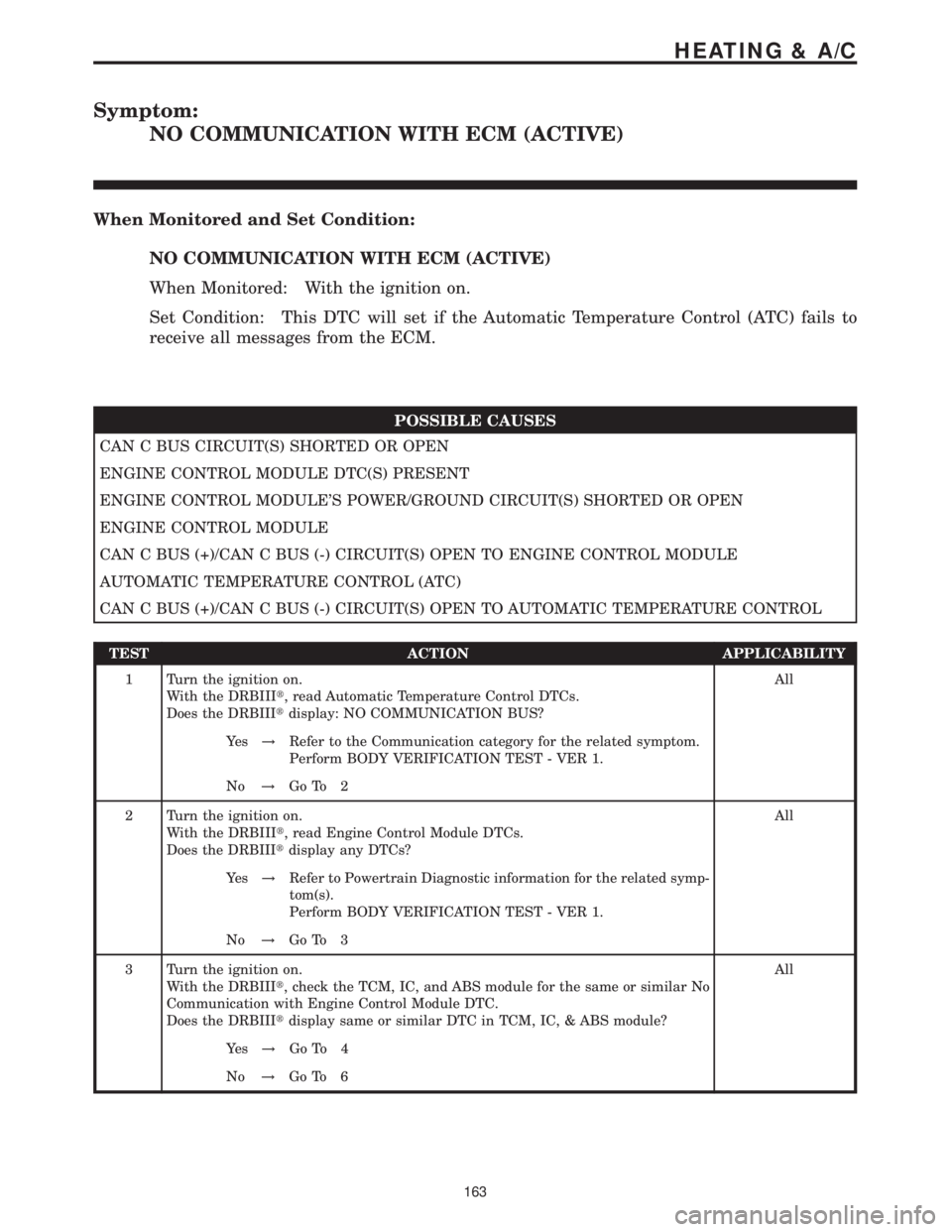
NO COMMUNICATION WITH ECM (ACTIVE)
When Monitored and Set Condition:
NO COMMUNICATION WITH ECM (ACTIVE)
When Monitored: With the ignition on.
Set Condition: This DTC will set if the Automatic Temperature Control (ATC) fails to
receive all messages from the ECM.
POSSIBLE CAUSES
CAN C BUS CIRCUIT(S) SHORTED OR OPEN
ENGINE CONTROL MODULE DTC(S) PRESENT
ENGINE CONTROL MODULE'S POWER/GROUND CIRCUIT(S) SHORTED OR OPEN
ENGINE CONTROL MODULE
CAN C BUS (+)/CAN C BUS (-) CIRCUIT(S) OPEN TO ENGINE CONTROL MODULE
AUTOMATIC TEMPERATURE CONTROL (ATC)
CAN C BUS (+)/CAN C BUS (-) CIRCUIT(S) OPEN TO AUTOMATIC TEMPERATURE CONTROL
TEST ACTION APPLICABILITY
1 Turn the ignition on.
With the DRBIIIt, read Automatic Temperature Control DTCs.
Does the DRBIIItdisplay: NO COMMUNICATION BUS?All
Ye s!Refer to the Communication category for the related symptom.
Perform BODY VERIFICATION TEST - VER 1.
No!Go To 2
2 Turn the ignition on.
With the DRBIIIt, read Engine Control Module DTCs.
Does the DRBIIItdisplay any DTCs?All
Ye s!Refer to Powertrain Diagnostic information for the related symp-
tom(s).
Perform BODY VERIFICATION TEST - VER 1.
No!Go To 3
3 Turn the ignition on.
With the DRBIIIt, check the TCM, IC, and ABS module for the same or similar No
Communication with Engine Control Module DTC.
Does the DRBIIItdisplay same or similar DTC in TCM, IC, & ABS module?All
Ye s!Go To 4
No!Go To 6
163
HEATING & A/C
Page 178 of 2305
Symptom:
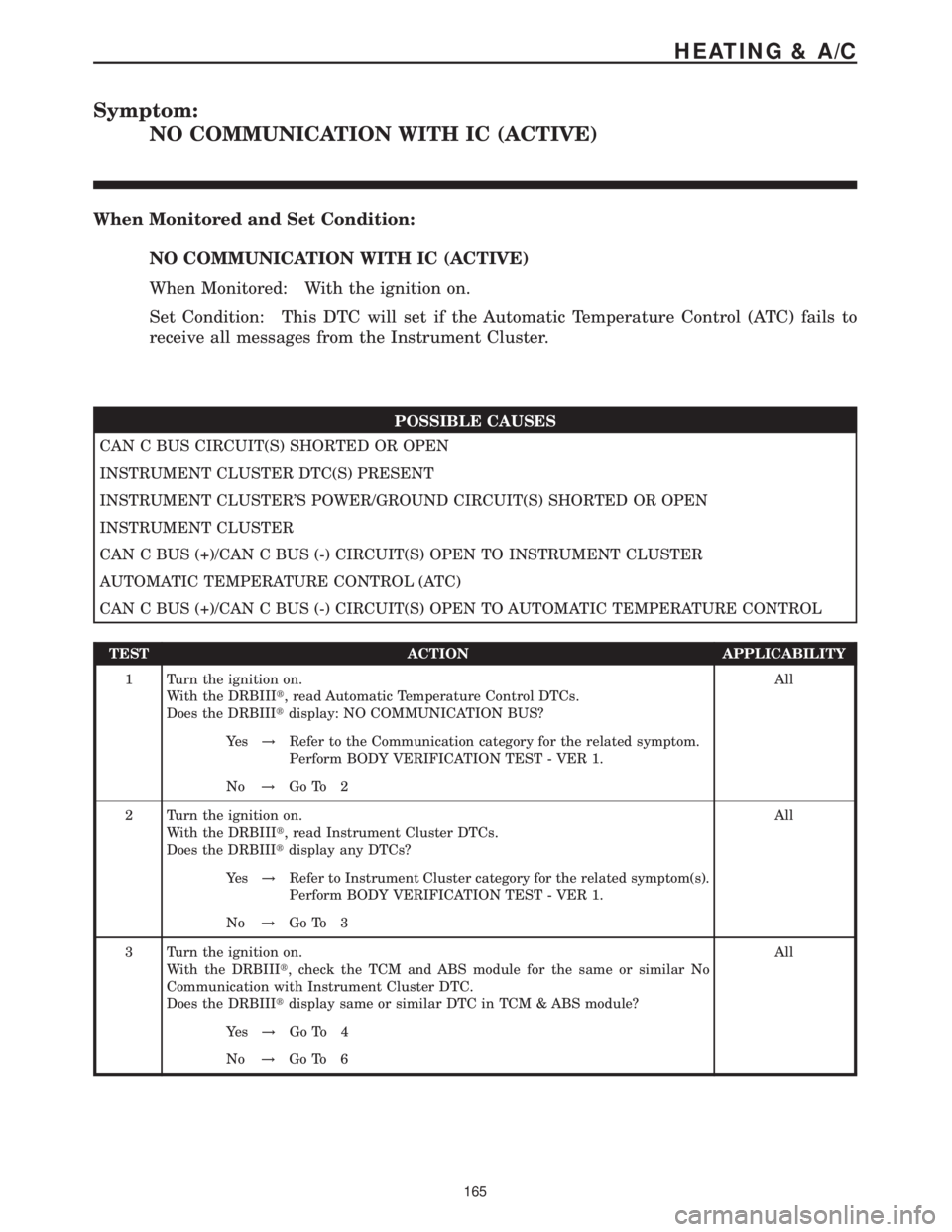
NO COMMUNICATION WITH IC (ACTIVE)
When Monitored and Set Condition:
NO COMMUNICATION WITH IC (ACTIVE)
When Monitored: With the ignition on.
Set Condition: This DTC will set if the Automatic Temperature Control (ATC) fails to
receive all messages from the Instrument Cluster.
POSSIBLE CAUSES
CAN C BUS CIRCUIT(S) SHORTED OR OPEN
INSTRUMENT CLUSTER DTC(S) PRESENT
INSTRUMENT CLUSTER'S POWER/GROUND CIRCUIT(S) SHORTED OR OPEN
INSTRUMENT CLUSTER
CAN C BUS (+)/CAN C BUS (-) CIRCUIT(S) OPEN TO INSTRUMENT CLUSTER
AUTOMATIC TEMPERATURE CONTROL (ATC)
CAN C BUS (+)/CAN C BUS (-) CIRCUIT(S) OPEN TO AUTOMATIC TEMPERATURE CONTROL
TEST ACTION APPLICABILITY
1 Turn the ignition on.
With the DRBIIIt, read Automatic Temperature Control DTCs.
Does the DRBIIItdisplay: NO COMMUNICATION BUS?All
Ye s!Refer to the Communication category for the related symptom.
Perform BODY VERIFICATION TEST - VER 1.
No!Go To 2
2 Turn the ignition on.
With the DRBIIIt, read Instrument Cluster DTCs.
Does the DRBIIItdisplay any DTCs?All
Ye s!Refer to Instrument Cluster category for the related symptom(s).
Perform BODY VERIFICATION TEST - VER 1.
No!Go To 3
3 Turn the ignition on.
With the DRBIIIt, check the TCM and ABS module for the same or similar No
Communication with Instrument Cluster DTC.
Does the DRBIIItdisplay same or similar DTC in TCM & ABS module?All
Ye s!Go To 4
No!Go To 6
165
HEATING & A/C
Page 186 of 2305
Symptom:
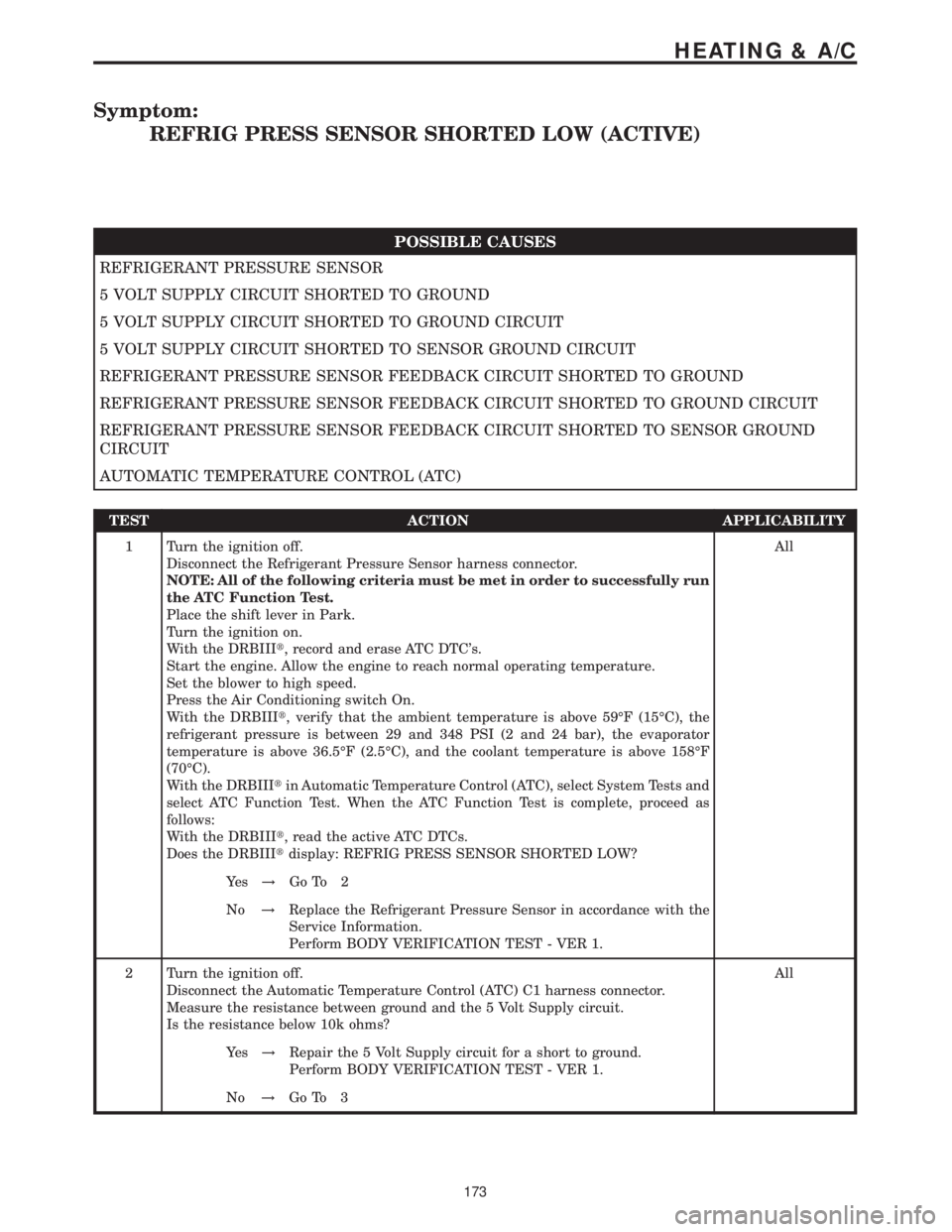
REFRIG PRESS SENSOR SHORTED LOW (ACTIVE)
POSSIBLE CAUSES
REFRIGERANT PRESSURE SENSOR
5 VOLT SUPPLY CIRCUIT SHORTED TO GROUND
5 VOLT SUPPLY CIRCUIT SHORTED TO GROUND CIRCUIT
5 VOLT SUPPLY CIRCUIT SHORTED TO SENSOR GROUND CIRCUIT
REFRIGERANT PRESSURE SENSOR FEEDBACK CIRCUIT SHORTED TO GROUND
REFRIGERANT PRESSURE SENSOR FEEDBACK CIRCUIT SHORTED TO GROUND CIRCUIT
REFRIGERANT PRESSURE SENSOR FEEDBACK CIRCUIT SHORTED TO SENSOR GROUND
CIRCUIT
AUTOMATIC TEMPERATURE CONTROL (ATC)
TEST ACTION APPLICABILITY
1 Turn the ignition off.
Disconnect the Refrigerant Pressure Sensor harness connector.
NOTE: All of the following criteria must be met in order to successfully run
the ATC Function Test.
Place the shift lever in Park.
Turn the ignition on.
With the DRBIIIt, record and erase ATC DTC's.
Start the engine. Allow the engine to reach normal operating temperature.
Set the blower to high speed.
Press the Air Conditioning switch On.
With the DRBIIIt, verify that the ambient temperature is above 59ÉF (15ÉC), the
refrigerant pressure is between 29 and 348 PSI (2 and 24 bar), the evaporator
temperature is above 36.5ÉF (2.5ÉC), and the coolant temperature is above 158ÉF
(70ÉC).
With the DRBIIItin Automatic Temperature Control (ATC), select System Tests and
select ATC Function Test. When the ATC Function Test is complete, proceed as
follows:
With the DRBIIIt, read the active ATC DTCs.
Does the DRBIIItdisplay: REFRIG PRESS SENSOR SHORTED LOW?All
Ye s!Go To 2
No!Replace the Refrigerant Pressure Sensor in accordance with the
Service Information.
Perform BODY VERIFICATION TEST - VER 1.
2 Turn the ignition off.
Disconnect the Automatic Temperature Control (ATC) C1 harness connector.
Measure the resistance between ground and the 5 Volt Supply circuit.
Is the resistance below 10k ohms?All
Ye s!Repair the 5 Volt Supply circuit for a short to ground.
Perform BODY VERIFICATION TEST - VER 1.
No!Go To 3
173
HEATING & A/C
Page 192 of 2305
Symptom:
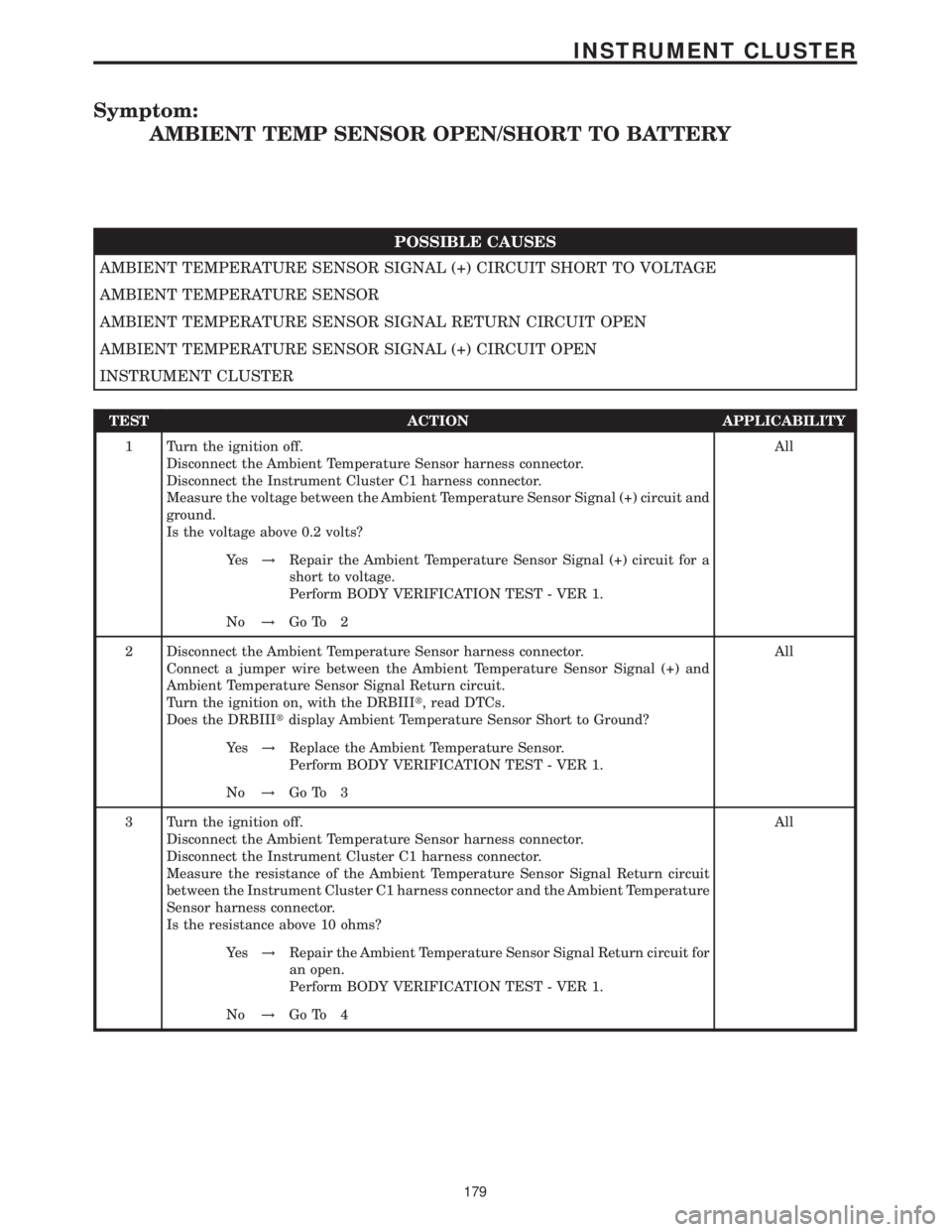
AMBIENT TEMP SENSOR OPEN/SHORT TO BATTERY
POSSIBLE CAUSES
AMBIENT TEMPERATURE SENSOR SIGNAL (+) CIRCUIT SHORT TO VOLTAGE
AMBIENT TEMPERATURE SENSOR
AMBIENT TEMPERATURE SENSOR SIGNAL RETURN CIRCUIT OPEN
AMBIENT TEMPERATURE SENSOR SIGNAL (+) CIRCUIT OPEN
INSTRUMENT CLUSTER
TEST ACTION APPLICABILITY
1 Turn the ignition off.
Disconnect the Ambient Temperature Sensor harness connector.
Disconnect the Instrument Cluster C1 harness connector.
Measure the voltage between the Ambient Temperature Sensor Signal (+) circuit and
ground.
Is the voltage above 0.2 volts?All
Ye s!Repair the Ambient Temperature Sensor Signal (+) circuit for a
short to voltage.
Perform BODY VERIFICATION TEST - VER 1.
No!Go To 2
2 Disconnect the Ambient Temperature Sensor harness connector.
Connect a jumper wire between the Ambient Temperature Sensor Signal (+) and
Ambient Temperature Sensor Signal Return circuit.
Turn the ignition on, with the DRBIIIt, read DTCs.
Does the DRBIIItdisplay Ambient Temperature Sensor Short to Ground?All
Ye s!Replace the Ambient Temperature Sensor.
Perform BODY VERIFICATION TEST - VER 1.
No!Go To 3
3 Turn the ignition off.
Disconnect the Ambient Temperature Sensor harness connector.
Disconnect the Instrument Cluster C1 harness connector.
Measure the resistance of the Ambient Temperature Sensor Signal Return circuit
between the Instrument Cluster C1 harness connector and the Ambient Temperature
Sensor harness connector.
Is the resistance above 10 ohms?All
Ye s!Repair the Ambient Temperature Sensor Signal Return circuit for
an open.
Perform BODY VERIFICATION TEST - VER 1.
No!Go To 4
179
INSTRUMENT CLUSTER
Page 194 of 2305
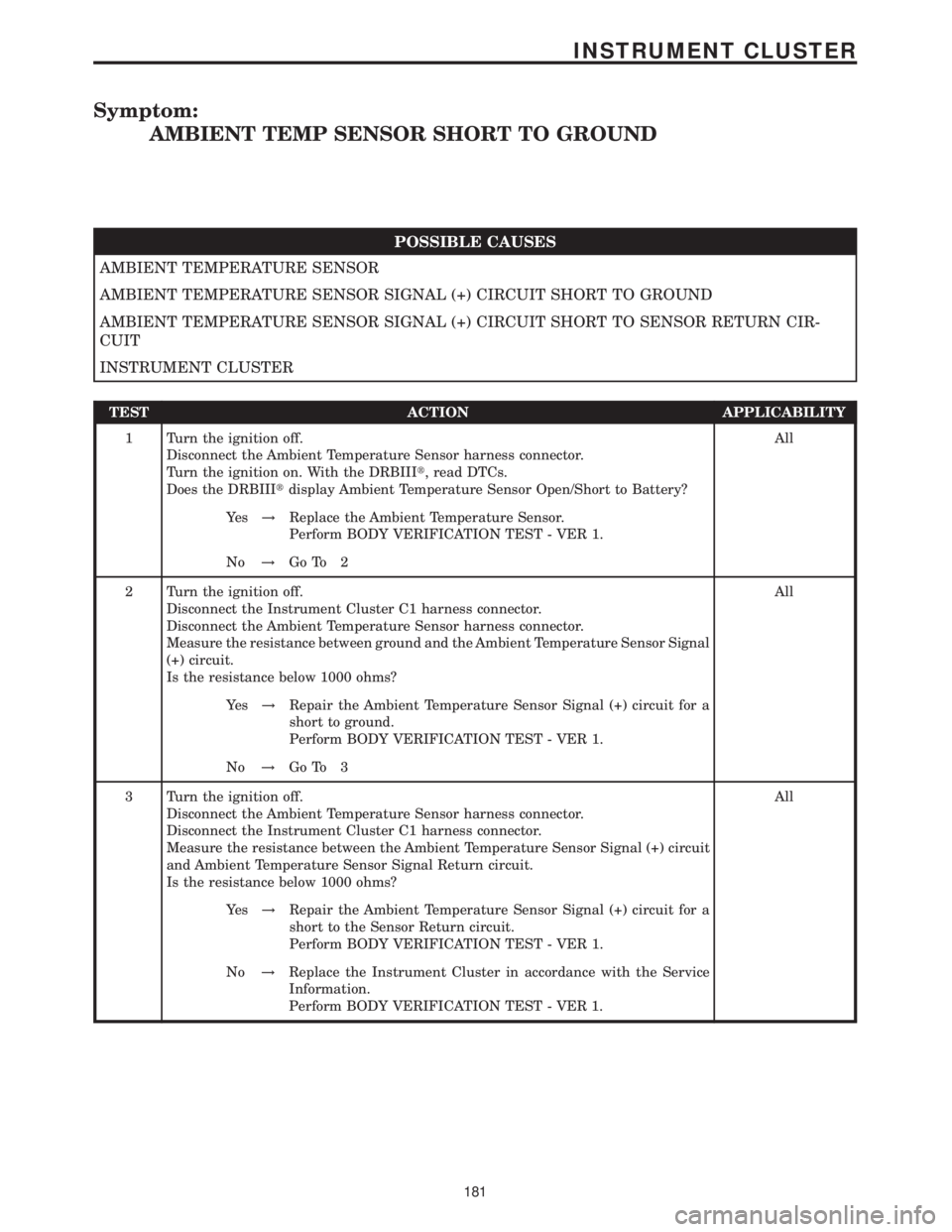
Symptom:
AMBIENT TEMP SENSOR SHORT TO GROUND
POSSIBLE CAUSES
AMBIENT TEMPERATURE SENSOR
AMBIENT TEMPERATURE SENSOR SIGNAL (+) CIRCUIT SHORT TO GROUND
AMBIENT TEMPERATURE SENSOR SIGNAL (+) CIRCUIT SHORT TO SENSOR RETURN CIR-
CUIT
INSTRUMENT CLUSTER
TEST ACTION APPLICABILITY
1 Turn the ignition off.
Disconnect the Ambient Temperature Sensor harness connector.
Turn the ignition on. With the DRBIIIt, read DTCs.
Does the DRBIIItdisplay Ambient Temperature Sensor Open/Short to Battery?All
Ye s!Replace the Ambient Temperature Sensor.
Perform BODY VERIFICATION TEST - VER 1.
No!Go To 2
2 Turn the ignition off.
Disconnect the Instrument Cluster C1 harness connector.
Disconnect the Ambient Temperature Sensor harness connector.
Measure the resistance between ground and the Ambient Temperature Sensor Signal
(+) circuit.
Is the resistance below 1000 ohms?All
Ye s!Repair the Ambient Temperature Sensor Signal (+) circuit for a
short to ground.
Perform BODY VERIFICATION TEST - VER 1.
No!Go To 3
3 Turn the ignition off.
Disconnect the Ambient Temperature Sensor harness connector.
Disconnect the Instrument Cluster C1 harness connector.
Measure the resistance between the Ambient Temperature Sensor Signal (+) circuit
and Ambient Temperature Sensor Signal Return circuit.
Is the resistance below 1000 ohms?All
Ye s!Repair the Ambient Temperature Sensor Signal (+) circuit for a
short to the Sensor Return circuit.
Perform BODY VERIFICATION TEST - VER 1.
No!Replace the Instrument Cluster in accordance with the Service
Information.
Perform BODY VERIFICATION TEST - VER 1.
181
INSTRUMENT CLUSTER
Page 195 of 2305
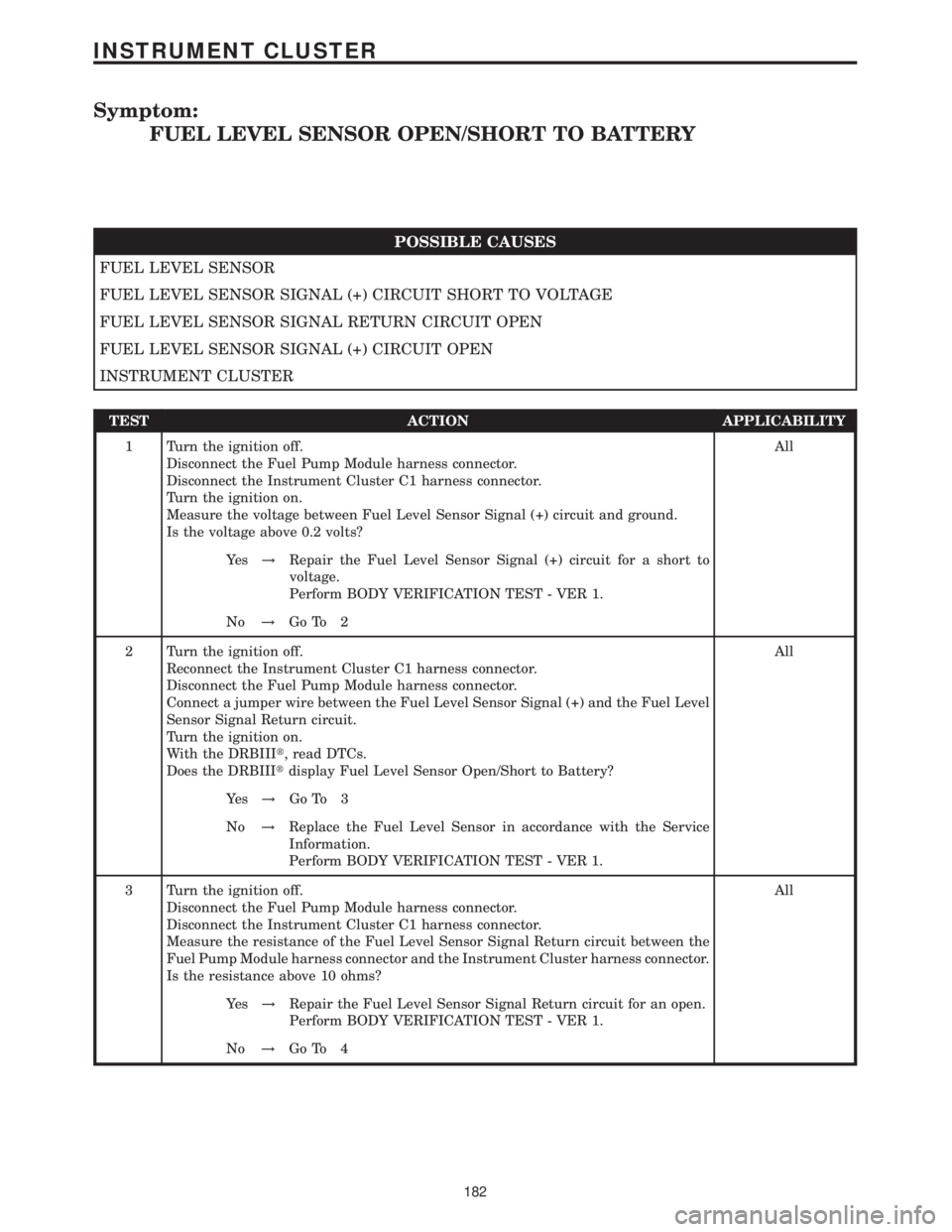
Symptom:
FUEL LEVEL SENSOR OPEN/SHORT TO BATTERY
POSSIBLE CAUSES
FUEL LEVEL SENSOR
FUEL LEVEL SENSOR SIGNAL (+) CIRCUIT SHORT TO VOLTAGE
FUEL LEVEL SENSOR SIGNAL RETURN CIRCUIT OPEN
FUEL LEVEL SENSOR SIGNAL (+) CIRCUIT OPEN
INSTRUMENT CLUSTER
TEST ACTION APPLICABILITY
1 Turn the ignition off.
Disconnect the Fuel Pump Module harness connector.
Disconnect the Instrument Cluster C1 harness connector.
Turn the ignition on.
Measure the voltage between Fuel Level Sensor Signal (+) circuit and ground.
Is the voltage above 0.2 volts?All
Ye s!Repair the Fuel Level Sensor Signal (+) circuit for a short to
voltage.
Perform BODY VERIFICATION TEST - VER 1.
No!Go To 2
2 Turn the ignition off.
Reconnect the Instrument Cluster C1 harness connector.
Disconnect the Fuel Pump Module harness connector.
Connect a jumper wire between the Fuel Level Sensor Signal (+) and the Fuel Level
Sensor Signal Return circuit.
Turn the ignition on.
With the DRBIIIt, read DTCs.
Does the DRBIIItdisplay Fuel Level Sensor Open/Short to Battery?All
Ye s!Go To 3
No!Replace the Fuel Level Sensor in accordance with the Service
Information.
Perform BODY VERIFICATION TEST - VER 1.
3 Turn the ignition off.
Disconnect the Fuel Pump Module harness connector.
Disconnect the Instrument Cluster C1 harness connector.
Measure the resistance of the Fuel Level Sensor Signal Return circuit between the
Fuel Pump Module harness connector and the Instrument Cluster harness connector.
Is the resistance above 10 ohms?All
Ye s!Repair the Fuel Level Sensor Signal Return circuit for an open.
Perform BODY VERIFICATION TEST - VER 1.
No!Go To 4
182
INSTRUMENT CLUSTER