oil type MERCEDES-BENZ SPRINTER 2006 Owner's Guide
[x] Cancel search | Manufacturer: MERCEDES-BENZ, Model Year: 2006, Model line: SPRINTER, Model: MERCEDES-BENZ SPRINTER 2006Pages: 2305, PDF Size: 48.12 MB
Page 1950 of 2305
will remain stationary during the repair. Misalign-
ment can cause stress in the repair areas and can
result in future failure.
VISUAL INSPECTION
Composite materials can mask the severity of an
accident. Adhesive bond lines, interior structure of
the doors, and steel structures need to be inspected
carefully to get a true damage assessment. Close
inspection may require partial removal of interior
trim or inner panels.
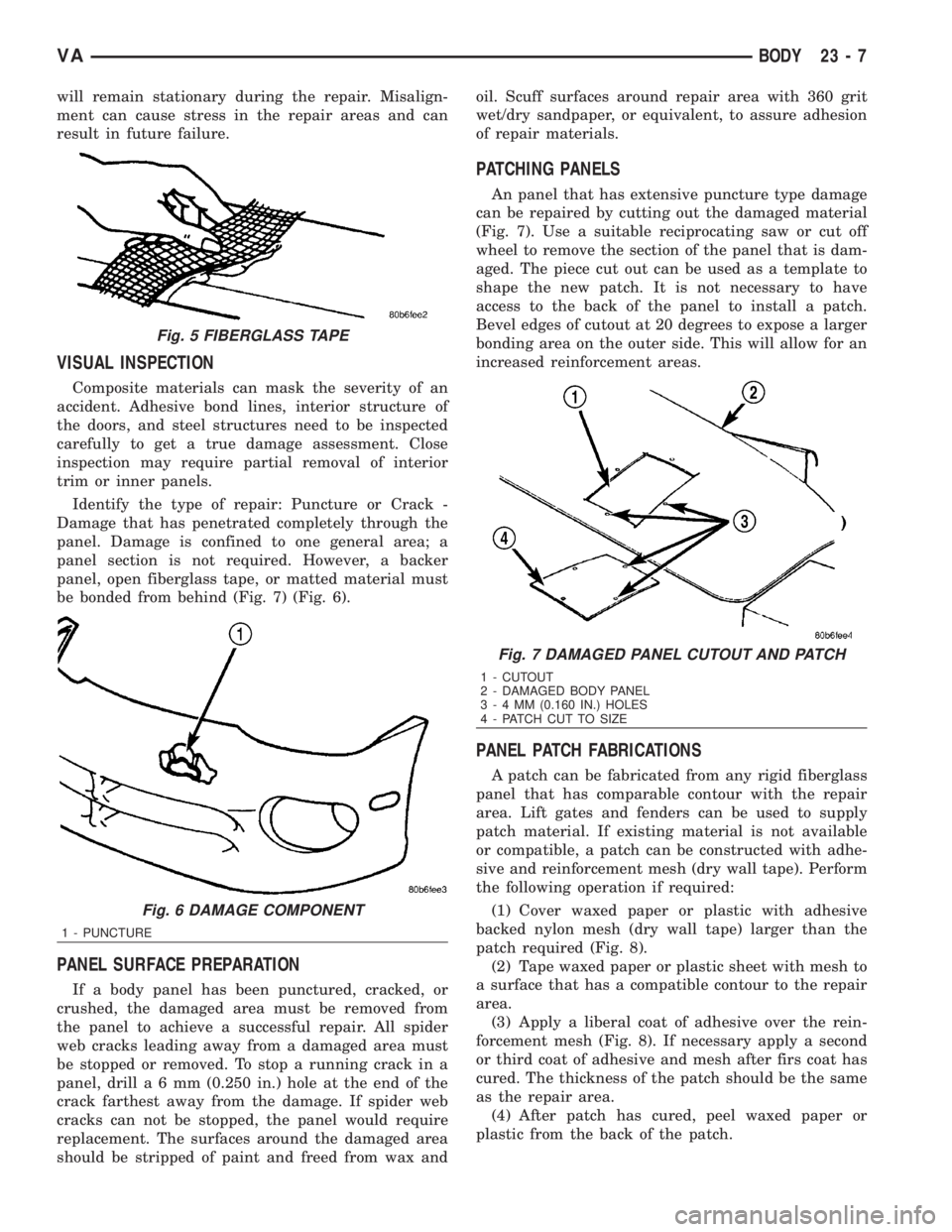
Identify the type of repair: Puncture or Crack -
Damage that has penetrated completely through the
panel. Damage is confined to one general area; a
panel section is not required. However, a backer
panel, open fiberglass tape, or matted material must
be bonded from behind (Fig. 7) (Fig. 6).
PANEL SURFACE PREPARATION
If a body panel has been punctured, cracked, or
crushed, the damaged area must be removed from
the panel to achieve a successful repair. All spider
web cracks leading away from a damaged area must
be stopped or removed. To stop a running crack in a
panel, drilla6mm(0.250 in.) hole at the end of the
crack farthest away from the damage. If spider web
cracks can not be stopped, the panel would require
replacement. The surfaces around the damaged area
should be stripped of paint and freed from wax andoil. Scuff surfaces around repair area with 360 grit
wet/dry sandpaper, or equivalent, to assure adhesion
of repair materials.
PATCHING PANELS
An panel that has extensive puncture type damage
can be repaired by cutting out the damaged material
(Fig. 7). Use a suitable reciprocating saw or cut off
wheel to remove the section of the panel that is dam-
aged. The piece cut out can be used as a template to
shape the new patch. It is not necessary to have
access to the back of the panel to install a patch.
Bevel edges of cutout at 20 degrees to expose a larger
bonding area on the outer side. This will allow for an
increased reinforcement areas.
PANEL PATCH FABRICATIONS
A patch can be fabricated from any rigid fiberglass
panel that has comparable contour with the repair
area. Lift gates and fenders can be used to supply
patch material. If existing material is not available
or compatible, a patch can be constructed with adhe-
sive and reinforcement mesh (dry wall tape). Perform
the following operation if required:
(1) Cover waxed paper or plastic with adhesive
backed nylon mesh (dry wall tape) larger than the
patch required (Fig. 8).
(2) Tape waxed paper or plastic sheet with mesh to
a surface that has a compatible contour to the repair
area.
(3) Apply a liberal coat of adhesive over the rein-
forcement mesh (Fig. 8). If necessary apply a second
or third coat of adhesive and mesh after firs coat has
cured. The thickness of the patch should be the same
as the repair area.
(4) After patch has cured, peel waxed paper or
plastic from the back of the patch.
Fig. 5 FIBERGLASS TAPE
Fig. 6 DAMAGE COMPONENT
1 - PUNCTURE
Fig. 7 DAMAGED PANEL CUTOUT AND PATCH
1 - CUTOUT
2 - DAMAGED BODY PANEL
3-4MM(0.160 IN.) HOLES
4 - PATCH CUT TO SIZE
VABODY 23 - 7
Page 2046 of 2305
OPERATION
The compressor clutch components provide the
means to engage and disengage the compressor from
the engine serpentine accessory drive belt. When the
clutch coil is energized, it magnetically draws the
clutch into contact with the pulley and drives the
compressor shaft. When the coil is not energized, the
pulley freewheels on the clutch hub bearing, which is
part of the pulley.
The compressor clutch engagement is controlled by
several components:
²A/C switch on the A/C-heater control panel
²Evaporator temperature sensor
²A/C pressure transducer
²Air temperature sensor
²CAN bus messages
The compressor clutch is de-energized under any of
the following conditions:
²Blocked compressor (thermal fuse in the pulley)
²Low pressure in the system
²Low evaporator temperature
²Hard acceleration (WOT)
²High coolant temperatures
STANDARD PROCEDURE
A / C COMPRESSOR CLUTCH AIR GAP
If a new clutch plate and/or clutch pulley are being
used, the air gap between the clutch plate and clutch
pulley must be checked using the following proce-
dure:
(1) Using feeler gauges, measure the air gap
between the clutch plate and the clutch pulley fric-
tion surfaces.
(2) If the air gap is not between specifications
(Refer to 24 - HEATING & AIR CONDITIONING -
SPECIFICATIONS), add or subtract shims until the
desired air gap is obtained.
NOTE: The shims may compress after tightening
the compressor shaft bolt. Check the air gap in four
or more places on the clutch plate to verify that the
air gap is still correct. Spin the clutch pulley before
making the final air gap check.
A / C COMPRESSOR CLUTCH BREAK - IN
After a new compressor clutch has been installed,
cycle the compressor clutch approximately twenty
times (five seconds on, then five seconds off). During
this procedure, set the heater-A/C control in the
Recirculation Mode, the A/C button in the on posi-
tion, the blower motor switch in the highest speed
position, and the engine speed at 1500 to 2000 rpm.
This procedure (burnishing) will seat the opposing
friction surfaces and provide a higher compressor
clutch torque capability.
REMOVAL
The refrigerant system can remain fully-charged
during compressor clutch, pulley, or coil replacement.
The compressor clutch can be serviced in the vehicle.
(1) Disconnect and isolate the battery negative
cable.
(2) Remove the serpentine drive belt (Refer to 7 -
COOLING/ACCESSORY DRIVE/DRIVE BELTS -
REMOVAL).
(3) Disconnect the engine wire harness connector
for the compressor clutch coil from the clutch coil
wire harness connector on the top of the compressor.
(4) Remove the retainer securing the compressor
clutch coil lead on the top of the compressor.
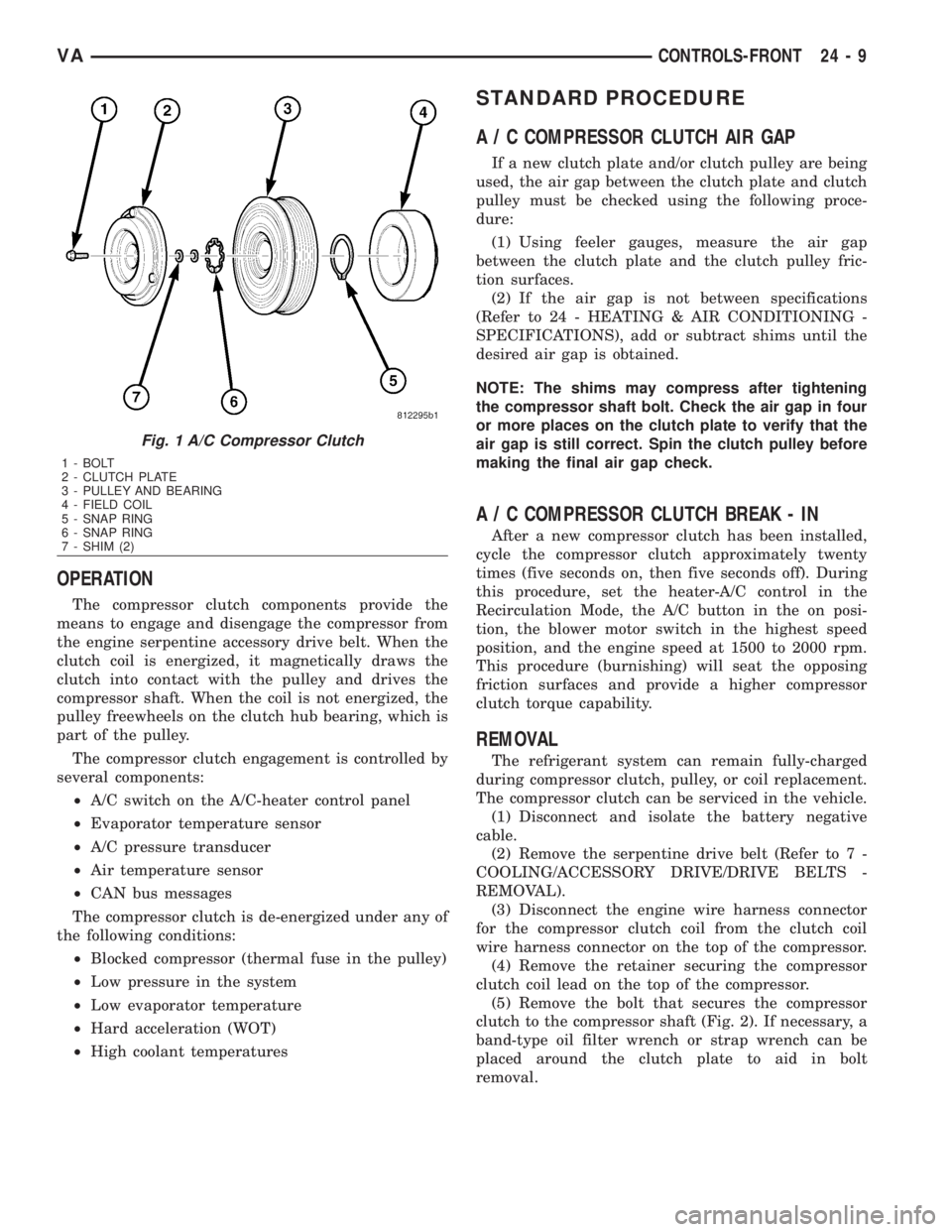
(5) Remove the bolt that secures the compressor
clutch to the compressor shaft (Fig. 2). If necessary, a
band-type oil filter wrench or strap wrench can be
placed around the clutch plate to aid in bolt
removal.
Fig. 1 A/C Compressor Clutch
1 - BOLT
2 - CLUTCH PLATE
3 - PULLEY AND BEARING
4 - FIELD COIL
5 - SNAP RING
6 - SNAP RING
7 - SHIM (2)
VACONTROLS-FRONT 24 - 9
Page 2049 of 2305
front cover of the compressor. Be certain that the
snap ring is properly fully and properly seated in the
groove.
(6) If the original clutch plate and clutch pulley
are to be reused, reinstall the original shim(s) on the
compressor shaft against the shoulder. If a new
clutch plate and/or clutch pulley are being used,
install a trial stack of shims 1.0 mm (0.040 in.) thick
on the compressor shaft against the shoulder.
(7) Install the clutch plate onto the compressor
shaft.
(8) Install and tighten the compressor shaft bolt. If
necessary, a band-type oil filter wrench or a strap
wrench can be placed around the clutch plate to aid
in bolt tightening. Tighten the bolt to 17.5 N´m (155
in. lbs.).
NOTE: The shims may compress after tightening
the shaft bolt. Check the air gap in four or more
places to verify the air gap is still correct. Spin the
pulley before performing a final check of the air
gap.
(9) If a new clutch plate and/or clutch pulley are
being installed, the air gap between the clutch plate
and clutch pulley must be checked (Refer to 24 -
HEATING & AIR CONDITIONING/CONTROLS/A/C
COMPRESSOR CLUTCH - STANDARD PROCE-
DURE).
(10) Install the retainer that secures the compres-
sor clutch coil lead to the top of the compressor.
(11) Reconnect the engine wire harness connector
to the clutch coil lead on the top of the compressor.
(12) Reinstall the serpentine accessory drive belt
(Refer to 7 - COOLING/ACCESSORY DRIVE/DRIVE
BELTS - INSTALLATION).
(13) Reconnect the battery negative cable.
(14) If a new clutch plate and/or clutch pulley are
being installed, the new clutch components must be
burnished (Refer to 24 - HEATING & AIR CONDI-
TIONING/CONTROLS/A/C COMPRESSOR CLUTCH
- STANDARD PROCEDURE).
A / C COMPRESSOR CLUTCH
COIL
DIAGNOSIS AND TESTING
A / C COMPRESSOR CLUTCH COIL
The air conditioning compressor clutch coil electri-
cal circuit is controlled by the ATC control module
which is integral to the heater-A/C control. Begin
testing of a suspected compressor clutch coil problem
by performing the ATC Function Test using the
DRBIIItscan tool.PRELIMINARY CHECKS
(1) If no diagnostic trouble codes (DTCs) are found
in the A/C-heater control or the powertrain control
module (PCM), go to Step 2. If any DTCs are found,
repair as required.
(2) If the A/C compressor clutch still will not
engage, verify the refrigerant charge level (Refer to
24 - HEATING & AIR CONDITIONING/PLUMBING
- DIAGNOSIS AND TESTING - REFRIGERANT
SYSTEM LEAKS). If the refrigerant charge level is
OK, go to TESTS. If the refrigerant charge level is
not OK, adjust the refrigerant charge as required.
TESTS
(1) Verify the battery state of charge (Refer to 8 -
ELECTRICAL/BATTERY SYSTEM/BATTERY -
DIAGNOSIS AND TESTING).
(2) Connect an ammeter (0 to 10 ampere scale
selected) in series with the clutch coil feed terminal.
Connect a voltmeter (0 to 20 volt scale selected) to
measure voltage across the battery and the clutch
coil.
(3) With the A/C-heater control in the A/C mode
and the blower motor at low speed, start the engine
and allow it to run at a normal idle speed.
(4) The A/C compressor clutch should engage
immediately, and the clutch coil supply voltage
should be within two volts of the battery voltage. If
the coil supply voltage is OK, go to Step 5. If the coil
supply voltage is not within two volts of battery volt-
age, test the clutch coil feed circuit for excessive volt-
age drop and repair as necessary.
(5) For the acceptable A/C clutch coil current draw
specifications refer to 24 - HEATING & AIR CONDI-
TIONING - SPECIFICATIONS. Specifications apply
for a work area temperature of 21É C (70É F). If volt-
age is more than 12.5 volts, add electrical loads by
turning on electrical accessories until voltage reads
below 12.5 volts.
(a) If the A/C clutch coil current reading is zero,
the coil is open and must be replaced.
(b) If the A/C clutch coil current reading is above
specifications, the coil is shorted and must be
replaced.
A / C HEATER CONTROL
DESCRIPTION
This ATC system uses a combination of electrical
and mechanical controls. These controls provide the
vehicle operator with a number of setting options to
help control the climate and comfort within the vehi-
cle.
The A/C-heater control is located on the instrument
panel inboard of the steering column and below the
24 - 12 CONTROLS-FRONTVA
Page 2061 of 2305
CONTROLS - REAR
TABLE OF CONTENTS
page page
A/C CLUTCH RELAY
DESCRIPTION.........................24
OPERATION...........................25
REMOVAL.............................25
INSTALLATION.........................26
A/C CONDENSER FAN RELAY
DESCRIPTION.........................26
OPERATION...........................26
REMOVAL.............................27
INSTALLATION.........................28
A/C CONTROL MODULE
DESCRIPTION.........................28
OPERATION...........................28
REMOVAL.............................29
INSTALLATION.........................30
A/C HIGH PRESSURE SWITCH
DESCRIPTION.........................30
OPERATION...........................30
REMOVAL.............................31
INSTALLATION.........................31
A/C LOW PRESSURE SWITCH
DESCRIPTION.........................32
OPERATION...........................32
REMOVAL.............................32
INSTALLATION.........................33
BLOWER MOTOR RELAY
DESCRIPTION.........................33
OPERATION...........................33
REMOVAL.............................34
INSTALLATION.........................35
BLOWER MOTOR SWITCH
DESCRIPTION.........................35
OPERATION...........................35
DIAGNOSIS AND TESTING
REAR BLOWER MOTOR SWITCH.........36REMOVAL.............................36
INSTALLATION.........................37
EVAPORATOR TEMPERATURE SENSOR
DESCRIPTION.........................37
OPERATION...........................37
REMOVAL.............................37
INSTALLATION.........................38
TEMPERATURE CONTROL
DESCRIPTION.........................38
OPERATION...........................38
DIAGNOSIS AND TESTING
REAR A/C TEMPERATURE CONTROL.....39
REMOVAL.............................39
INSTALLATION.........................40
TEMPERATURE SENSOR
DESCRIPTION.........................40
OPERATION...........................40
DIAGNOSIS AND TESTING
REAR TEMPERATURE SENSOR..........40
REMOVAL.............................40
INSTALLATION.........................41
SUPPRESSOR FILTER - REAR BLOWER
MOTOR
DESCRIPTION.........................41
OPERATION...........................41
REMOVAL.............................42
INSTALLATION.........................43
SUPPRESSOR FILTER - REAR CONDENSER
FA N
DESCRIPTION.........................43
OPERATION...........................44
REMOVAL.............................44
INSTALLATION.........................44
A / C CLUTCH RELAY
DESCRIPTION
The rear A/C clutch relay for the rear A/C system
is an International Standards Organization (ISO)-
type relay (Fig. 1). Relays conforming to the ISO
specifications have common physical dimensions, cur-
rent capacities, terminal functions and patterns. The
rear A/C clutch relay is an electromechanical device
that uses a low current input controlled by the rear
A/C control module to control the high current output
to the A/C clutch field coil for the rear A/C system.The rear A/C clutch relay is located in the relay
block in the rear A/C evaporator housing.
24 - 24 CONTROLS - REARVA
Page 2063 of 2305
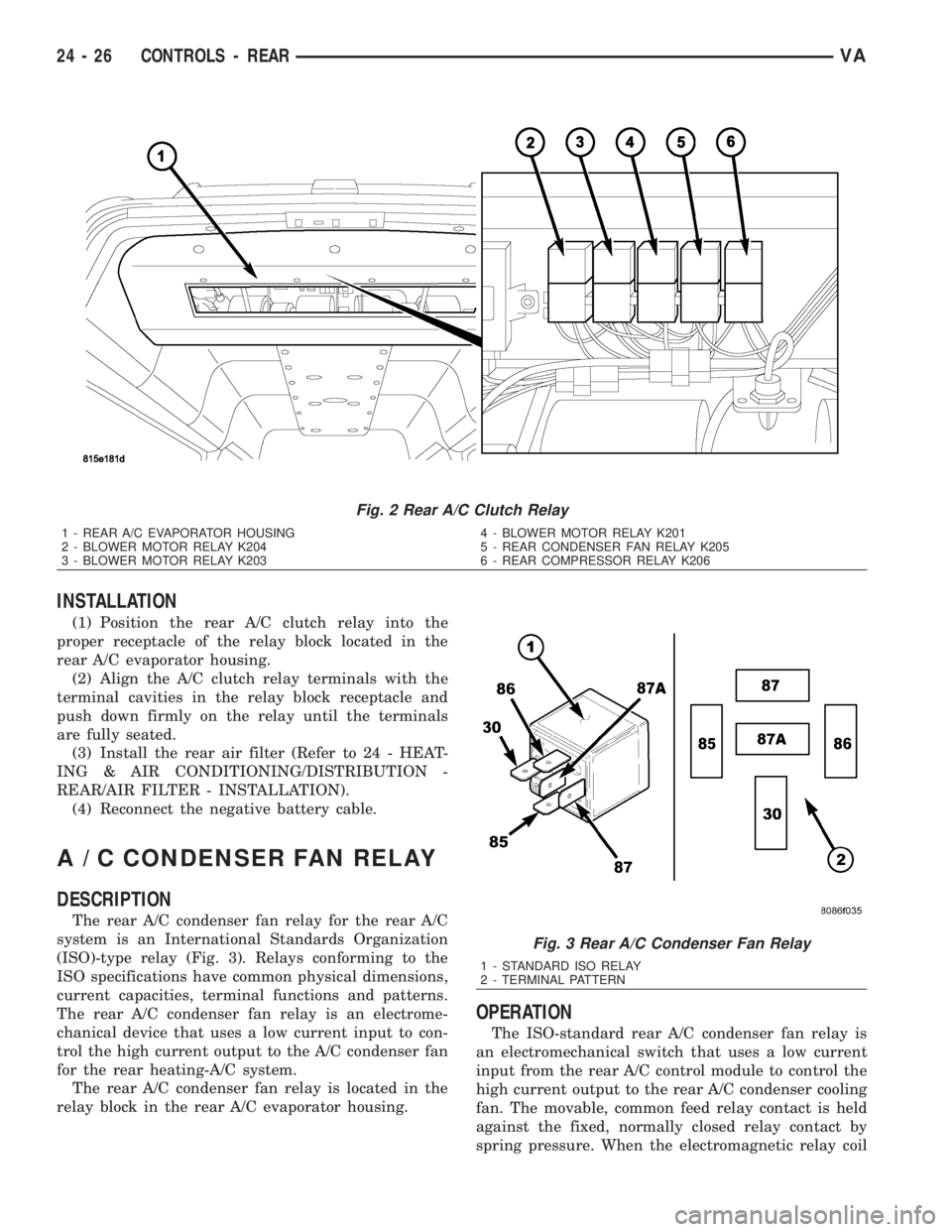
INSTALLATION
(1) Position the rear A/C clutch relay into the
proper receptacle of the relay block located in the
rear A/C evaporator housing.
(2) Align the A/C clutch relay terminals with the
terminal cavities in the relay block receptacle and
push down firmly on the relay until the terminals
are fully seated.
(3) Install the rear air filter (Refer to 24 - HEAT-
ING & AIR CONDITIONING/DISTRIBUTION -
REAR/AIR FILTER - INSTALLATION).
(4) Reconnect the negative battery cable.
A / C CONDENSER FAN RELAY
DESCRIPTION
The rear A/C condenser fan relay for the rear A/C
system is an International Standards Organization
(ISO)-type relay (Fig. 3). Relays conforming to the
ISO specifications have common physical dimensions,
current capacities, terminal functions and patterns.
The rear A/C condenser fan relay is an electrome-
chanical device that uses a low current input to con-
trol the high current output to the A/C condenser fan
for the rear heating-A/C system.
The rear A/C condenser fan relay is located in the
relay block in the rear A/C evaporator housing.
OPERATION
The ISO-standard rear A/C condenser fan relay is
an electromechanical switch that uses a low current
input from the rear A/C control module to control the
high current output to the rear A/C condenser cooling
fan. The movable, common feed relay contact is held
against the fixed, normally closed relay contact by
spring pressure. When the electromagnetic relay coil
Fig. 2 Rear A/C Clutch Relay
1 - REAR A/C EVAPORATOR HOUSING
2 - BLOWER MOTOR RELAY K204
3 - BLOWER MOTOR RELAY K2034 - BLOWER MOTOR RELAY K201
5 - REAR CONDENSER FAN RELAY K205
6 - REAR COMPRESSOR RELAY K206
Fig. 3 Rear A/C Condenser Fan Relay
1 - STANDARD ISO RELAY
2 - TERMINAL PATTERN
24 - 26 CONTROLS - REARVA
Page 2070 of 2305
INSTALLATION
NOTE: Replacement of the PTFE thread sealing
tape is required anytime the rear A/C low pressure
switch is removed from the rear suction line line.
Failure to replace the sealing tape could result in a
rear refrigerant system leak.
(1) Remove the tape or plug from the rear suction
line fitting.
(2) Install PTFE thread sealing tape onto the rear
A/C low pressure switch and install the switch onto
the rear suction line. Tightened the A/C low pressure
switch to 10 N´m (88 in. lbs.).
(3) Connect the wiring harness connector to the
rear A/C low pressure switch.
(4) Install new insulating tape around the rear A/C
low pressure switch area.
(5) Reconnect the negative battery cable.
(6) Evacuate the rear refrigerant system (Refer to
24 - HEATING & AIR CONDITIONING/PLUMBING
- STANDARD PROCEDURE - REFRIGERANT SYS-
TEM EVACUATE).
(7) Charge the rear refrigerant system (Refer to 24
- HEATING & AIR CONDITIONING/PLUMBING -
STANDARD PROCEDURE - REFRIGERANT SYS-
TEM CHARGE).
(8) Install the cover onto the rear A/C evaporator
housing (Refer to 24 - HEATING & AIR CONDI-
TIONING/DISTRIBUTION - REAR/A/C EVAPORA-
TOR COVER-REAR - INSTALLATION).
BLOWER MOTOR RELAY
DESCRIPTION
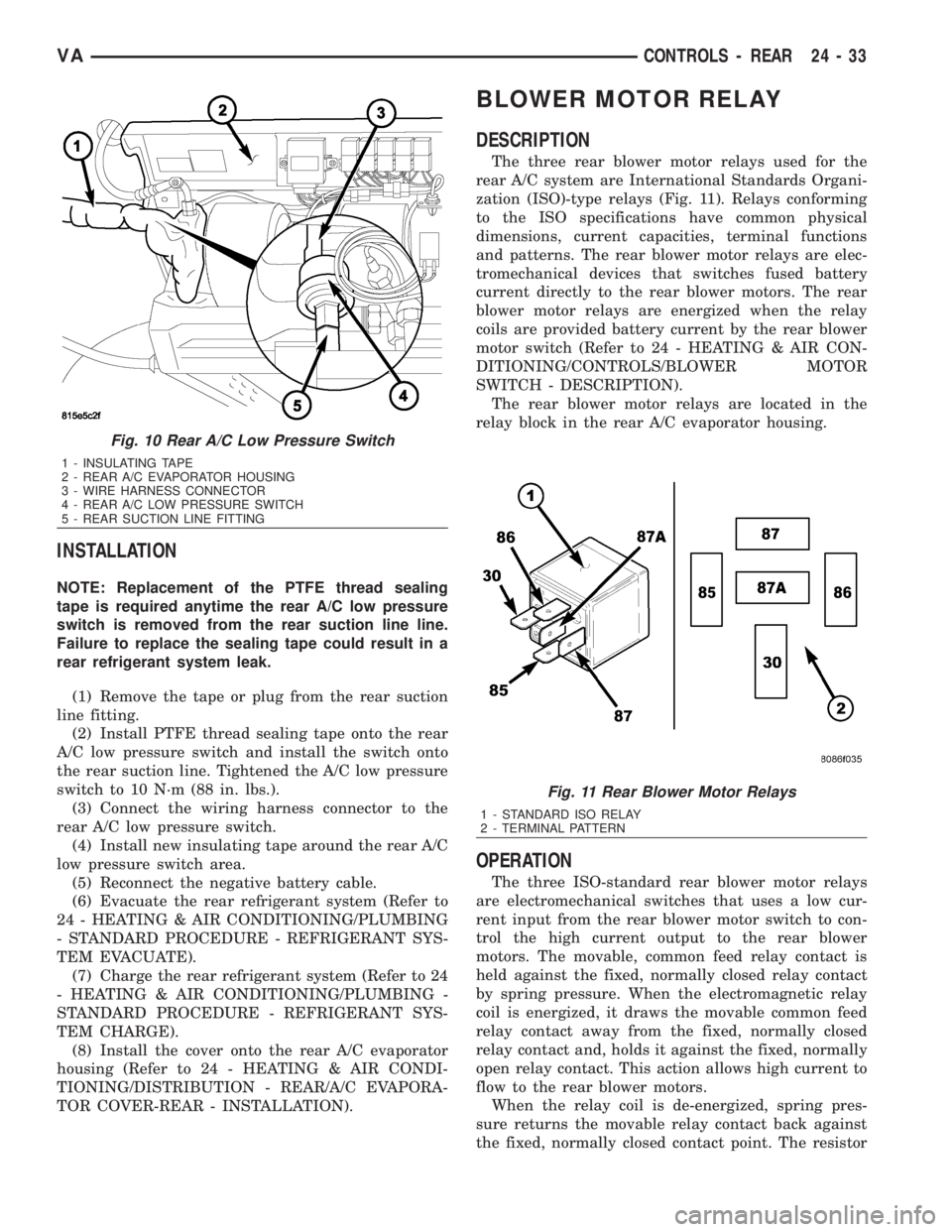
The three rear blower motor relays used for the
rear A/C system are International Standards Organi-
zation (ISO)-type relays (Fig. 11). Relays conforming
to the ISO specifications have common physical
dimensions, current capacities, terminal functions
and patterns. The rear blower motor relays are elec-
tromechanical devices that switches fused battery
current directly to the rear blower motors. The rear
blower motor relays are energized when the relay
coils are provided battery current by the rear blower
motor switch (Refer to 24 - HEATING & AIR CON-
DITIONING/CONTROLS/BLOWER MOTOR
SWITCH - DESCRIPTION).
The rear blower motor relays are located in the
relay block in the rear A/C evaporator housing.
OPERATION
The three ISO-standard rear blower motor relays
are electromechanical switches that uses a low cur-
rent input from the rear blower motor switch to con-
trol the high current output to the rear blower
motors. The movable, common feed relay contact is
held against the fixed, normally closed relay contact
by spring pressure. When the electromagnetic relay
coil is energized, it draws the movable common feed
relay contact away from the fixed, normally closed
relay contact and, holds it against the fixed, normally
open relay contact. This action allows high current to
flow to the rear blower motors.
When the relay coil is de-energized, spring pres-
sure returns the movable relay contact back against
the fixed, normally closed contact point. The resistor
Fig. 10 Rear A/C Low Pressure Switch
1 - INSULATING TAPE
2 - REAR A/C EVAPORATOR HOUSING
3 - WIRE HARNESS CONNECTOR
4 - REAR A/C LOW PRESSURE SWITCH
5 - REAR SUCTION LINE FITTING
Fig. 11 Rear Blower Motor Relays
1 - STANDARD ISO RELAY
2 - TERMINAL PATTERN
VACONTROLS - REAR 24 - 33
Page 2091 of 2305
INSTALLATION
NOTE: Be certain to add refrigerant oil if the rear
A/C condenser is being replaced. The refrigerant oil
must be drained from the old condenser and mea-
sured to determine the amount of refrigerant oil to
add to the new condenser. Use only refrigerant oil
of the type recommended for the rear A/C compres-
sor in the vehicle.
(1) If the rear A/C condenser is being replaced,
install the correct amount and type of refrigerant oil
into the new rear A/C condenser. Drain the old con-
denser and measure the refrigerant oil. Fill the new
condenser with the same amount of new refrigerant
oil that was drained out of the old condenser.
(2) Install new body sealant and any removed
shims onto the top of the roof panel.
(3) With help from an assistant, position the rear
A/C condenser housing onto the top of the roof panel.
(4) Install the eight nuts and washers that secure
the rear A/C condenser housing to the roof panel.
Tighten the nuts to 25 N´m (18 ft. lbs.).
(5) Remove the tape or plugs from the rear liquid
line fitting and rear refrigerant reservoir port.
(6) Lubricate a new O-ring seal with clean refrig-
erant oil and install it onto the rear liquid line fit-
ting. Use only the specified O-ring seal as it is madeof a special material for the R-134a system. Use only
refrigerant oil of the type recommended for the rear
A/C compressor in the vehicle.
(7) Connect the rear liquid line to the rear refrig-
erant reservoir outlet. Tighten the liquid line nut to
35 N´m (26 ft. lbs.).
(8) Remove the tape or plugs from the rear dis-
charge line fitting and rear condenser port.
(9) Lubricate a new O-ring seal with clean refrig-
erant oil and install it onto the rear discharge line
fitting. Use only the specified O-ring seal as it is
made of a special material for the R-134a system.
Use only refrigerant oil of the type recommended for
the rear A/C compressor in the vehicle.
(10) Connect the rear discharge line to the rear
A/C condenser. Tighten the discharge line nut to 35
N´m (26 ft. lbs.).
(11) Install the bracket and screw that secures the
rear discharge line to the right side of the rear con-
denser housing. Tighten the screw securely.
(12) Connect the rear A/C wire harness to the rear
blower motor suppression filter and to the rear A/C
high pressure switch.
(13) Install new retaining straps to secure the rear
A/C wire harness to the rear liquid line.
(14) Install a new rear receiver/drier (Refer to 24 -
HEATING & AIR CONDITIONING/PLUMBING/
REAR RECEIVER/DRIER - INSTALLATION).
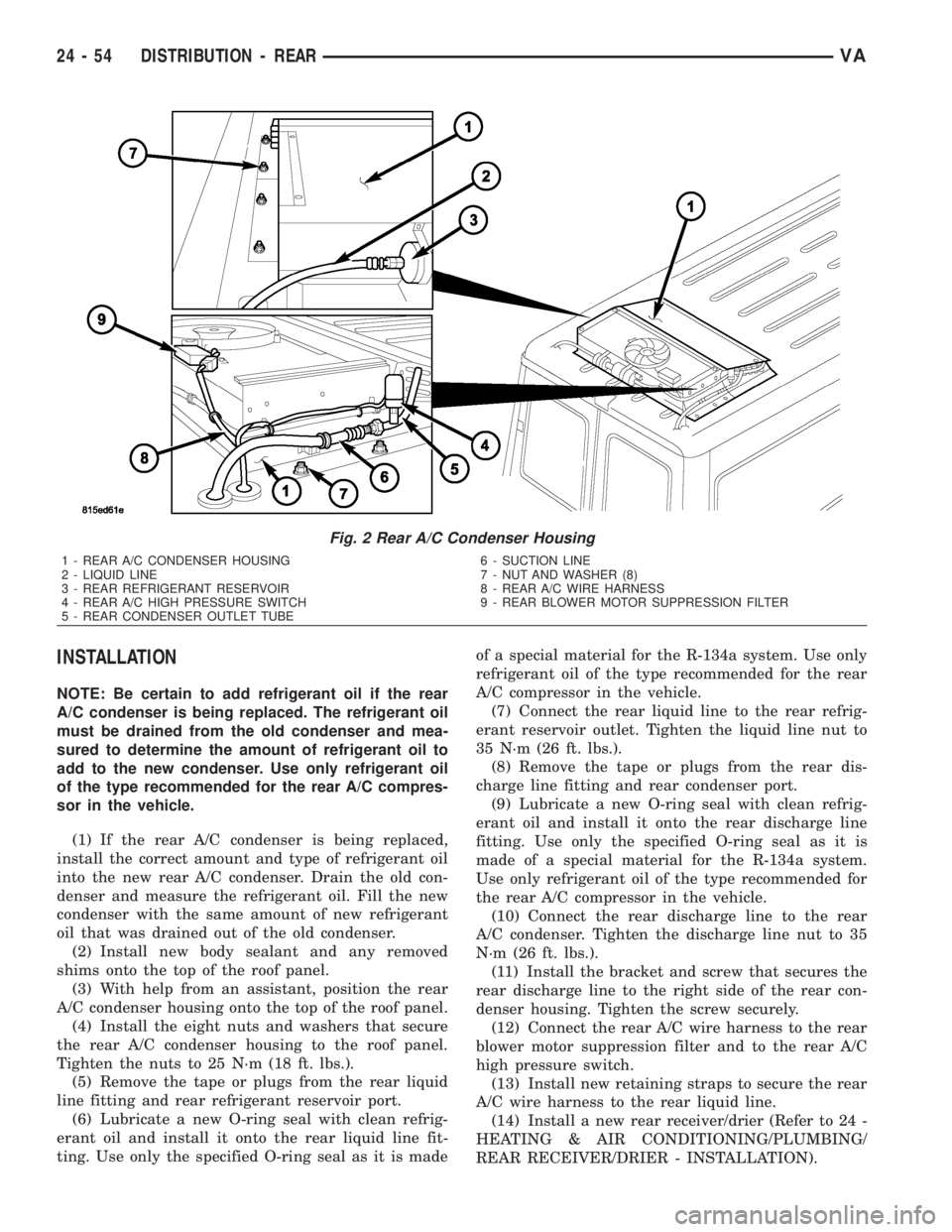
Fig. 2 Rear A/C Condenser Housing
1 - REAR A/C CONDENSER HOUSING
2 - LIQUID LINE
3 - REAR REFRIGERANT RESERVOIR
4 - REAR A/C HIGH PRESSURE SWITCH
5 - REAR CONDENSER OUTLET TUBE6 - SUCTION LINE
7 - NUT AND WASHER (8)
8 - REAR A/C WIRE HARNESS
9 - REAR BLOWER MOTOR SUPPRESSION FILTER
24 - 54 DISTRIBUTION - REARVA
Page 2094 of 2305
INSTALLATION
NOTE: Be certain to add refrigerant oil if the rear
A/C evaporator is being replaced. The refrigerant oil
must be drained from the old evaporator and mea-
sured to determine the amount of refrigerant oil to
add to the new evaporator. Use only refrigerant oil
of the type recommended for the rear A/C compres-
sor in the vehicle.
(1) If the rear A/C evaporator is being replaced,
install the correct amount and type of refrigerant oil
into the new rear A/C evaporator. Drain the old evap-
orator and measure the refrigerant oil. Fill the new
evaporator with the same amount of new refrigerant
oil that was drained out of the old evaporator.
(2) With help from an assistant, position and sup-
port the rear A/C evaporator housing into the vehicle.
(3) Inspect the four rubber damping washers for
correct sealing. Replace the washers as required.
CAUTION: Be sure to install the rear A/C system
ground lead with one of the rear evaporator hous-
ing retaining bolts. Failure to correctly install theground lead could result in improper operation or
possible damage to the rear A/C system.
(4) Position the ground lead to the rear A/C evap-
orator housing and install the four bolts and washers
and four damping washers that secure the evapora-
tor housing to the roof panel. Tighten the bolts to 25
N´m (18 ft. lbs.).
(5) Install the nine screws that secure the rear A/C
evaporator housing to the roof panel. Tighten the
screws to 5 N´m (45 in. lbs.).
(6) Unplug and connect the two rear evaporator
drain hoses.
(7) Remove the tape or plugs from the refrigerant
line fittings and the rear expansion valve and evap-
orator tube ports.
(8) Lubricate a new O-ring seal with clean refrig-
erant oil and install it onto the rear liquid line fit-
ting. Use only the specified O-ring seal as it is made
of a special material for the R-134a system. Use only
refrigerant oil of the type recommended for the rear
A/C compressor in the vehicle.
(9) Connect the rear liquid line to the rear A/C
expansion valve. Tighten the liquid line nut to 35
N´m (26 ft. lbs.).
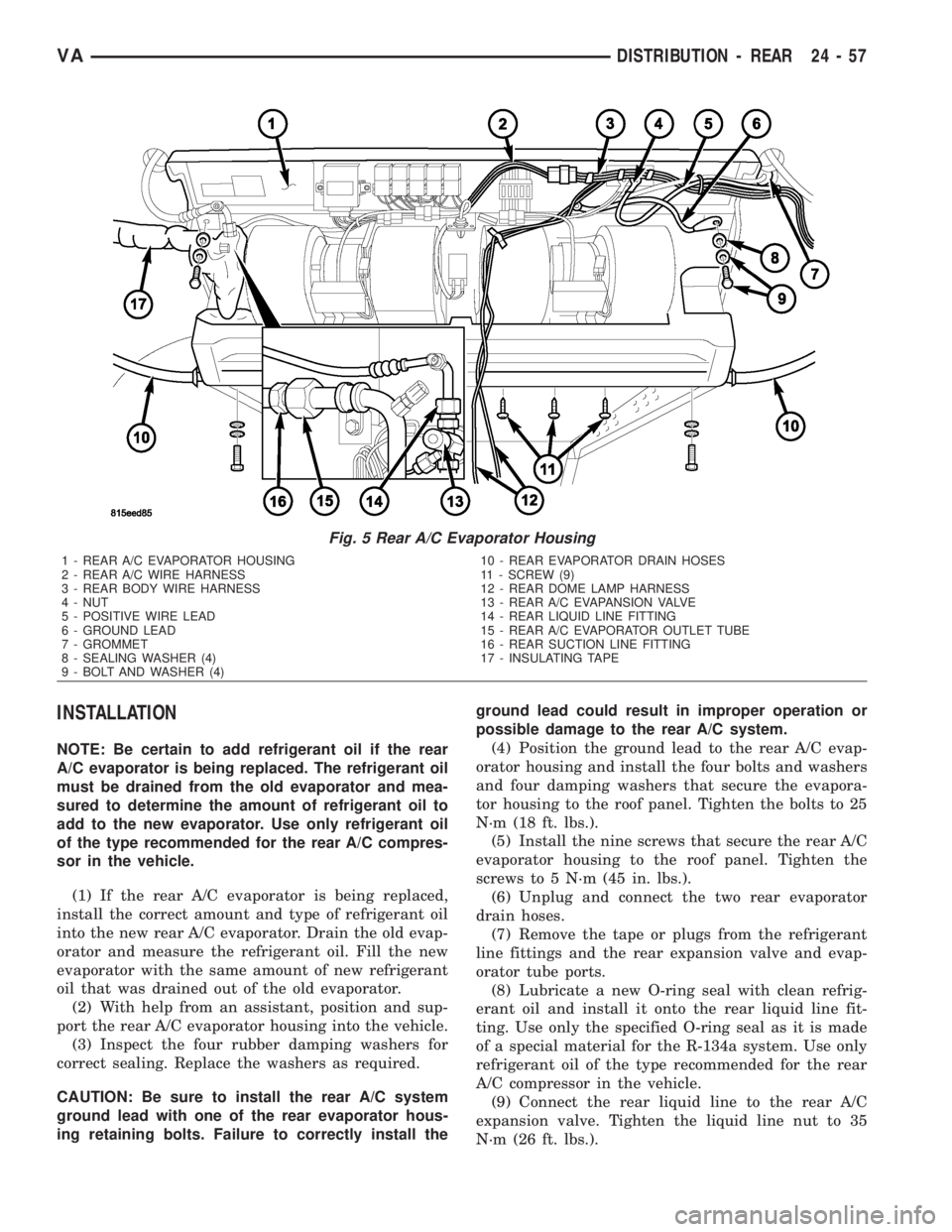
Fig. 5 Rear A/C Evaporator Housing
1 - REAR A/C EVAPORATOR HOUSING
2 - REAR A/C WIRE HARNESS
3 - REAR BODY WIRE HARNESS
4 - NUT
5 - POSITIVE WIRE LEAD
6 - GROUND LEAD
7 - GROMMET
8 - SEALING WASHER (4)
9 - BOLT AND WASHER (4)10 - REAR EVAPORATOR DRAIN HOSES
11 - SCREW (9)
12 - REAR DOME LAMP HARNESS
13 - REAR A/C EVAPANSION VALVE
14 - REAR LIQUID LINE FITTING
15 - REAR A/C EVAPORATOR OUTLET TUBE
16 - REAR SUCTION LINE FITTING
17 - INSULATING TAPE
VADISTRIBUTION - REAR 24 - 57
Page 2095 of 2305
(10) Lubricate a new O-ring seal with clean refrig-
erant oil and install it onto the rear suction line fit-
ting. Use only the specified O-ring seal as it is made
of a special material for the R-134a system. Use only
refrigerant oil of the type recommended for the rear
A/C compressor in the vehicle.
(11) Connect the rear suction line to the rear evap-
orator outlet tube. Tighten the suction line nut to 35
N´m (26 ft. lbs.).
(12) Install new insulating tape around the rear
evaporator connections.
(13) Install the positive wire lead onto the rear
A/C system terminal block and install the retaining
nut. Tighten the nut securely.
(14) Reposition the rear dome lamp harness and
install the retaining straps that secure the harness
to the rear A/C evaporator housing.
(15) Connect the rear A/C wire harness connector
to the rear body wire harness.
(16) Route the rear A/C wire harness up through
the roof panel and install the grommet.
(17) Connect the rear A/C wire harness to the rear
condenser fan suppression filter and the rear A/C
high pressure switch and install the retaining straps
that secure the wire harness to the rear liquid line.
(18) Reconnect the negative battery cable.
(19) Evacuate the rear refrigerant system (Refer to
24 - HEATING & AIR CONDITIONING/PLUMBING
- STANDARD PROCEDURE - REFRIGERANT SYS-
TEM EVACUATE).
(20) Charge the rear refrigerant system (Refer to
24 - HEATING & AIR CONDITIONING/PLUMBING
- STANDARD PROCEDURE - REFRIGERANT SYS-
TEM CHARGE).
(21) Install the cover onto the rear A/C evaporator
housing (Refer to 24 - HEATING & AIR CONDI-
TIONING/DISTRIBUTION - REAR/A/C EVAPORA-
TOR COVER-REAR - INSTALLATION).
(22) Install the cover onto the rear A/C condenser
housing (Refer to 24 - HEATING & AIR CONDI-
TIONING/DISTRIBUTION - REAR/A/C CON-
DENSER COVER - INSTALLATION).
AIR FILTER
REMOVAL
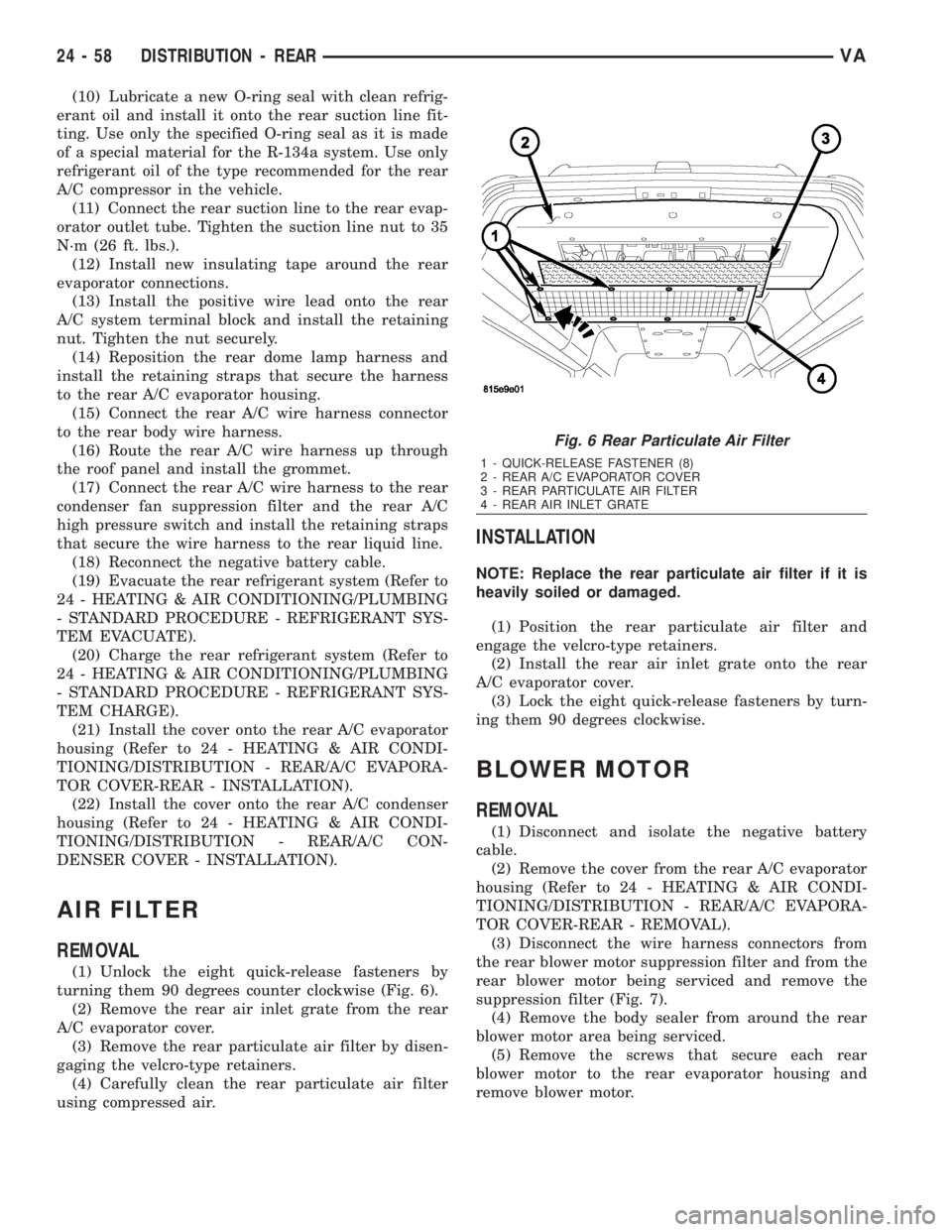
(1) Unlock the eight quick-release fasteners by
turning them 90 degrees counter clockwise (Fig. 6).
(2) Remove the rear air inlet grate from the rear
A/C evaporator cover.
(3) Remove the rear particulate air filter by disen-
gaging the velcro-type retainers.
(4) Carefully clean the rear particulate air filter
using compressed air.
INSTALLATION
NOTE: Replace the rear particulate air filter if it is
heavily soiled or damaged.
(1) Position the rear particulate air filter and
engage the velcro-type retainers.
(2) Install the rear air inlet grate onto the rear
A/C evaporator cover.
(3) Lock the eight quick-release fasteners by turn-
ing them 90 degrees clockwise.
BLOWER MOTOR
REMOVAL
(1) Disconnect and isolate the negative battery
cable.
(2) Remove the cover from the rear A/C evaporator
housing (Refer to 24 - HEATING & AIR CONDI-
TIONING/DISTRIBUTION - REAR/A/C EVAPORA-
TOR COVER-REAR - REMOVAL).
(3) Disconnect the wire harness connectors from
the rear blower motor suppression filter and from the
rear blower motor being serviced and remove the
suppression filter (Fig. 7).
(4) Remove the body sealer from around the rear
blower motor area being serviced.
(5) Remove the screws that secure each rear
blower motor to the rear evaporator housing and
remove blower motor.
Fig. 6 Rear Particulate Air Filter
1 - QUICK-RELEASE FASTENER (8)
2 - REAR A/C EVAPORATOR COVER
3 - REAR PARTICULATE AIR FILTER
4 - REAR AIR INLET GRATE
24 - 58 DISTRIBUTION - REARVA
Page 2103 of 2305
(12)EXAMPLE:The ambient temperature is 21É
C (70É F). The evaporator inlet tube temperature is
12É C (54É F) and the evaporator outlet tube temper-
ature is 10É C (50É F). Subtract the inlet tube tem-
perature from the outlet tube temperature. The
difference is -2É C (-4É F). With a -2É C (-4É F) tem-
perature differential at 21É C (70É F) ambient tem-
perature, the system is fully charged.
(13) Add enough refrigerant to bring the refriger-
ant system up to a full charge.
(14) Remove the jumper wire from the low pres-
sure cycling clutch switch wire harness connector
and plug the connector back into the switch.
A / C COMPRESSOR
DESCRIPTION
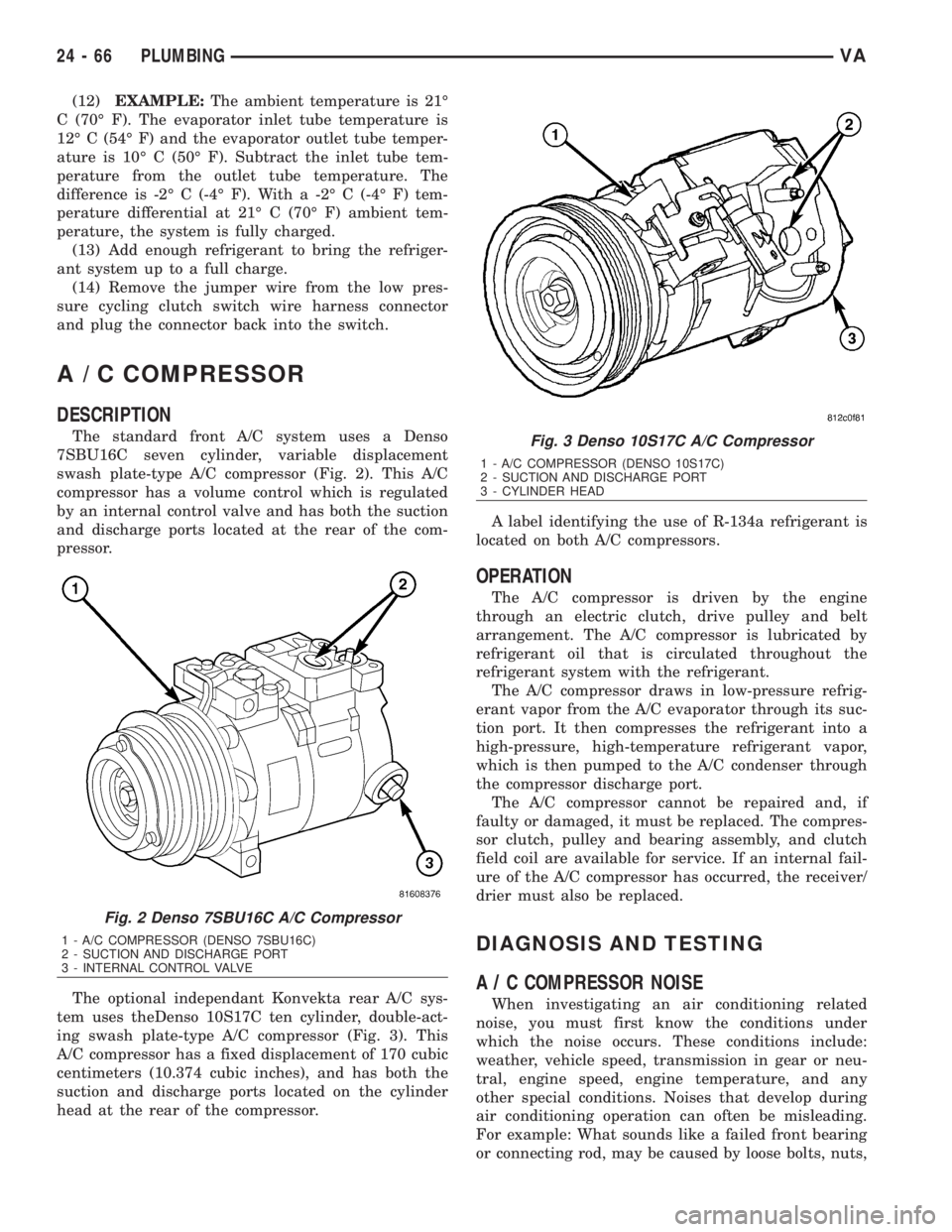
The standard front A/C system uses a Denso
7SBU16C seven cylinder, variable displacement
swash plate-type A/C compressor (Fig. 2). This A/C
compressor has a volume control which is regulated
by an internal control valve and has both the suction
and discharge ports located at the rear of the com-
pressor.
The optional independant Konvekta rear A/C sys-
tem uses theDenso 10S17C ten cylinder, double-act-
ing swash plate-type A/C compressor (Fig. 3). This
A/C compressor has a fixed displacement of 170 cubic
centimeters (10.374 cubic inches), and has both the
suction and discharge ports located on the cylinder
head at the rear of the compressor.A label identifying the use of R-134a refrigerant is
located on both A/C compressors.
OPERATION
The A/C compressor is driven by the engine
through an electric clutch, drive pulley and belt
arrangement. The A/C compressor is lubricated by
refrigerant oil that is circulated throughout the
refrigerant system with the refrigerant.
The A/C compressor draws in low-pressure refrig-
erant vapor from the A/C evaporator through its suc-
tion port. It then compresses the refrigerant into a
high-pressure, high-temperature refrigerant vapor,
which is then pumped to the A/C condenser through
the compressor discharge port.
The A/C compressor cannot be repaired and, if
faulty or damaged, it must be replaced. The compres-
sor clutch, pulley and bearing assembly, and clutch
field coil are available for service. If an internal fail-
ure of the A/C compressor has occurred, the receiver/
drier must also be replaced.
DIAGNOSIS AND TESTING
A / C COMPRESSOR NOISE
When investigating an air conditioning related
noise, you must first know the conditions under
which the noise occurs. These conditions include:
weather, vehicle speed, transmission in gear or neu-
tral, engine speed, engine temperature, and any
other special conditions. Noises that develop during
air conditioning operation can often be misleading.
For example: What sounds like a failed front bearing
or connecting rod, may be caused by loose bolts, nuts,
Fig. 2 Denso 7SBU16C A/C Compressor
1 - A/C COMPRESSOR (DENSO 7SBU16C)
2 - SUCTION AND DISCHARGE PORT
3 - INTERNAL CONTROL VALVE
Fig. 3 Denso 10S17C A/C Compressor
1 - A/C COMPRESSOR (DENSO 10S17C)
2 - SUCTION AND DISCHARGE PORT
3 - CYLINDER HEAD
24 - 66 PLUMBINGVA