battery MERCEDES-BENZ SPRINTER 2006 Service Manual
[x] Cancel search | Manufacturer: MERCEDES-BENZ, Model Year: 2006, Model line: SPRINTER, Model: MERCEDES-BENZ SPRINTER 2006Pages: 2305, PDF Size: 48.12 MB
Page 2022 of 2305
SEATS
TABLE OF CONTENTS
page page
ARMREST
REMOVAL.............................79
INSTALLATION.........................79
HEADREST
REMOVAL.............................79
INSTALLATION.........................79
SEAT - FRONT
REMOVAL.............................79
INSTALLATION.........................80
SEAT BACK - FRONT
REMOVAL.............................80
INSTALLATION.........................80
SEAT CUSHION - FRONT
REMOVAL.............................80
INSTALLATION.........................81SEAT ADJUSTERS - FRONT
REMOVAL.............................81
INSTALLATION.........................81
SEAT - REAR
REMOVAL.............................81
INSTALLATION.........................82
REAR SEAT BACK SHIELD
REMOVAL.............................82
INSTALLATION.........................82
SEAT BACK CUSHION/COVER - REAR
REMOVAL.............................82
INSTALLATION.........................82
SEAT CUSHION/COVER - REAR
REMOVAL.............................83
INSTALLATION.........................83
ARMREST
REMOVAL
(1) Remove the screws and remove the armrest
cover.
(2) Remove the three bolts and remove the arm-
rest from the seat back.
INSTALLATION
(1) Install the armrest and install the three bolts.
(2) Install the armrest cover and install the
screws.
HEADREST
REMOVAL
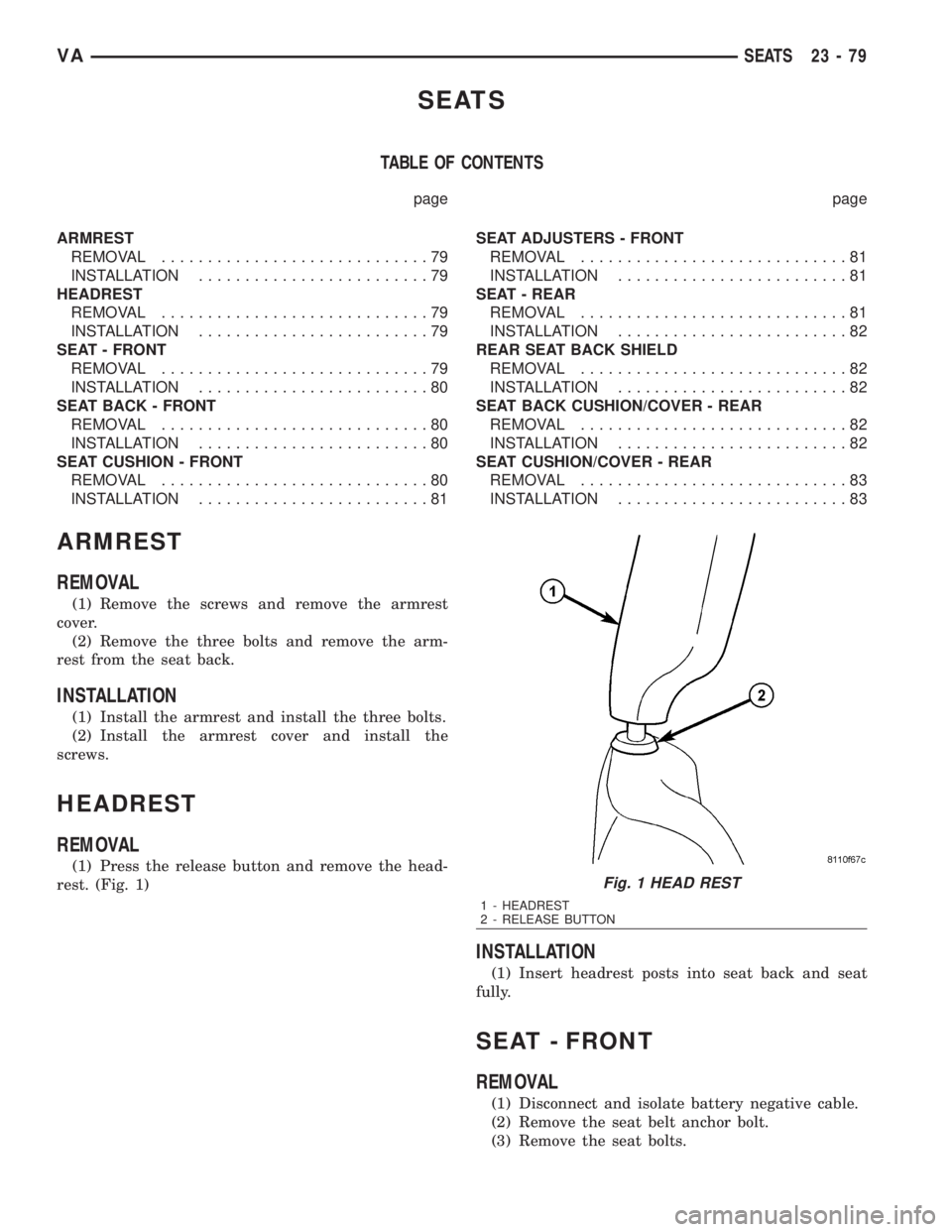
(1) Press the release button and remove the head-
rest. (Fig. 1)
INSTALLATION
(1) Insert headrest posts into seat back and seat
fully.
SEAT - FRONT
REMOVAL
(1) Disconnect and isolate battery negative cable.
(2) Remove the seat belt anchor bolt.
(3) Remove the seat bolts.
Fig. 1 HEAD REST
1 - HEADREST
2 - RELEASE BUTTON
VASEATS 23 - 79
Page 2023 of 2305

(4) Disconnect the electrical connectors, if
equipped.
INSTALLATION
(1) Position seat in vehicle and connect the electri-
cal connectors, if equipped.
(2) Install the mounting bolts and tighten to 25
N´m (18 ft. lbs.).
(3) Install the seat belt anchor and bolt.
(4) Tighten anchor bolt to 35 N´m (26 ft. lbs.).
(5) Connect battery negative cable.
SEAT BACK - FRONT
REMOVAL
(1) Disconnect and isolate battery negative cable.
(2) Remove seat cushion. (Refer to 23 - BODY/
SEATS/SEAT CUSHION - FRONT - REMOVAL)
(3) Verify that seat back is in full upright position.
(4) Disconnect lumbar support hose, if equipped.
(Fig. 3)
(5) Remove seat back bolts and remove seat
back.
INSTALLATION
(1) Remove stop screw.
(2) Install seat back locking spline side first.
NOTE: For better centering of seat back in the
mounting bore during installation, operate the seat
back release lever once.
(3) Install the spline side seat back bolt.
(4) Install remaining seat back side.
NOTE: It may be necessary to press the guide tabs
apart slightly.
(5) Install the remaining seat back bolt.
(6) Tighten the seat back bolts to 20 N´m (15 ft.
lbs.).
(7) Place seat back in the foremost position until
the hold down spring latches audibly.
(8) Install stop bolt and tighten to 20 N´m (15 ft.
lbs.).
(9) Connect the lumbar support hose, if equipped.
(10) Check seat back operation.
(11) Install the seat cushion. (Refer to 23 - BODY/
SEATS/SEAT CUSHION - FRONT - INSTALLA-
TION)
SEAT CUSHION - FRONT
REMOVAL
(1) Disconnect and isolate battery negative cable.
(2) Move seat to the foremost position.
(3) On standard cushion equipped vehicles, remove
the front two screws. (Fig. 4)
Fig. 2 FRONT SEAT
1 - SEAT BELT ANCHOR BOLT
2 - BOLTS (6)
Fig. 3 FRONT SEAT BACK
1 - SEAT BACK
2 - STOP BOLT
3 - LUMBAR SUPPORT HOSE
4 - GUIDE TAB
5 - RELEASE LEVER
6 - SEAT BACK BOLTS (2)
23 - 80 SEATSVA
Page 2024 of 2305
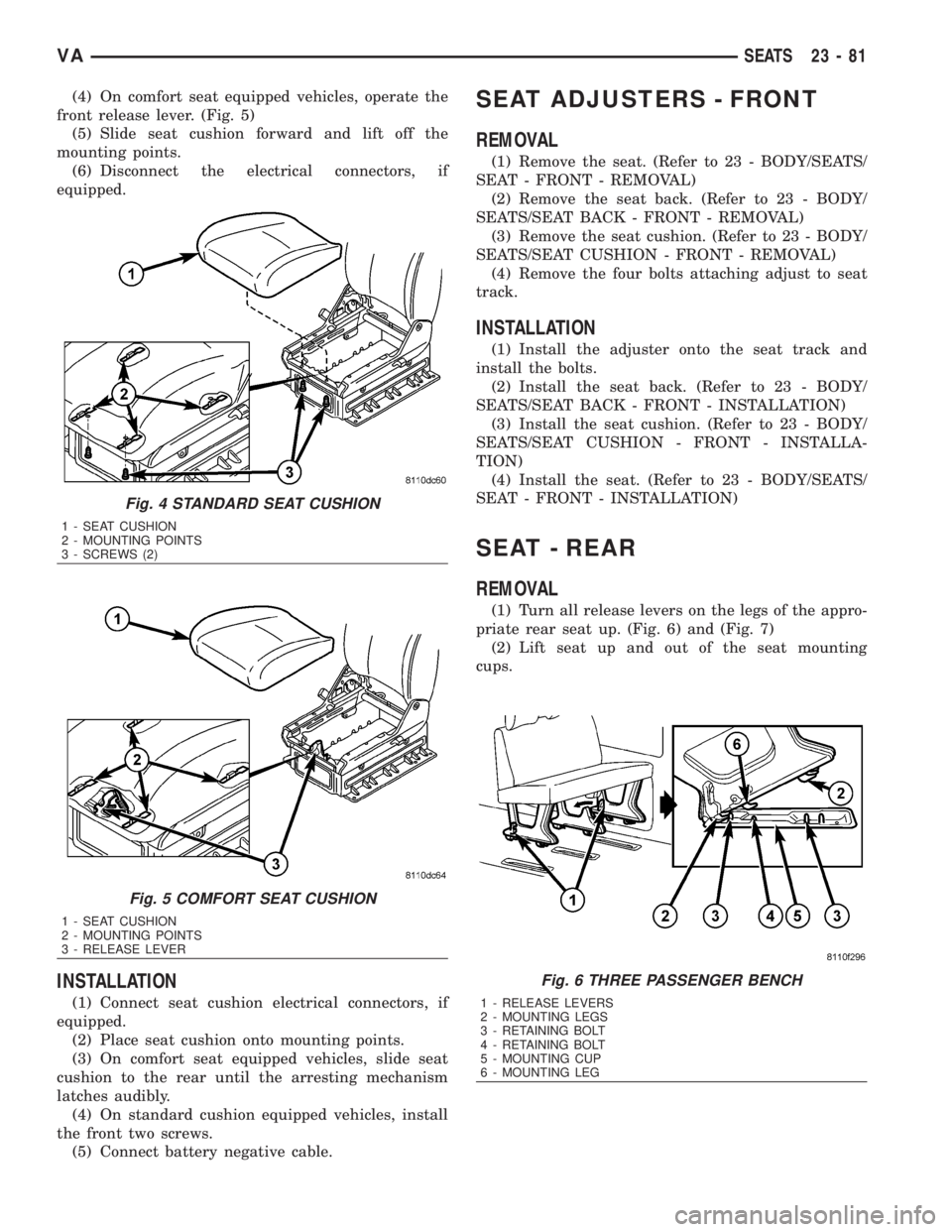
(4) On comfort seat equipped vehicles, operate the
front release lever. (Fig. 5)
(5) Slide seat cushion forward and lift off the
mounting points.
(6) Disconnect the electrical connectors, if
equipped.
INSTALLATION
(1) Connect seat cushion electrical connectors, if
equipped.
(2) Place seat cushion onto mounting points.
(3) On comfort seat equipped vehicles, slide seat
cushion to the rear until the arresting mechanism
latches audibly.
(4) On standard cushion equipped vehicles, install
the front two screws.
(5) Connect battery negative cable.
SEAT ADJUSTERS - FRONT
REMOVAL
(1) Remove the seat. (Refer to 23 - BODY/SEATS/
SEAT - FRONT - REMOVAL)
(2) Remove the seat back. (Refer to 23 - BODY/
SEATS/SEAT BACK - FRONT - REMOVAL)
(3) Remove the seat cushion. (Refer to 23 - BODY/
SEATS/SEAT CUSHION - FRONT - REMOVAL)
(4) Remove the four bolts attaching adjust to seat
track.
INSTALLATION
(1) Install the adjuster onto the seat track and
install the bolts.
(2) Install the seat back. (Refer to 23 - BODY/
SEATS/SEAT BACK - FRONT - INSTALLATION)
(3) Install the seat cushion. (Refer to 23 - BODY/
SEATS/SEAT CUSHION - FRONT - INSTALLA-
TION)
(4) Install the seat. (Refer to 23 - BODY/SEATS/
SEAT - FRONT - INSTALLATION)
SEAT - REAR
REMOVAL
(1) Turn all release levers on the legs of the appro-
priate rear seat up. (Fig. 6) and (Fig. 7)
(2) Lift seat up and out of the seat mounting
cups.
Fig. 4 STANDARD SEAT CUSHION
1 - SEAT CUSHION
2 - MOUNTING POINTS
3 - SCREWS (2)
Fig. 5 COMFORT SEAT CUSHION
1 - SEAT CUSHION
2 - MOUNTING POINTS
3 - RELEASE LEVER
Fig. 6 THREE PASSENGER BENCH
1 - RELEASE LEVERS
2 - MOUNTING LEGS
3 - RETAINING BOLT
4 - RETAINING BOLT
5 - MOUNTING CUP
6 - MOUNTING LEG
VASEATS 23 - 81
Page 2046 of 2305
OPERATION
The compressor clutch components provide the
means to engage and disengage the compressor from
the engine serpentine accessory drive belt. When the
clutch coil is energized, it magnetically draws the
clutch into contact with the pulley and drives the
compressor shaft. When the coil is not energized, the
pulley freewheels on the clutch hub bearing, which is
part of the pulley.
The compressor clutch engagement is controlled by
several components:
²A/C switch on the A/C-heater control panel
²Evaporator temperature sensor
²A/C pressure transducer
²Air temperature sensor
²CAN bus messages
The compressor clutch is de-energized under any of
the following conditions:
²Blocked compressor (thermal fuse in the pulley)
²Low pressure in the system
²Low evaporator temperature
²Hard acceleration (WOT)
²High coolant temperatures
STANDARD PROCEDURE
A / C COMPRESSOR CLUTCH AIR GAP
If a new clutch plate and/or clutch pulley are being
used, the air gap between the clutch plate and clutch
pulley must be checked using the following proce-
dure:
(1) Using feeler gauges, measure the air gap
between the clutch plate and the clutch pulley fric-
tion surfaces.
(2) If the air gap is not between specifications
(Refer to 24 - HEATING & AIR CONDITIONING -
SPECIFICATIONS), add or subtract shims until the
desired air gap is obtained.
NOTE: The shims may compress after tightening
the compressor shaft bolt. Check the air gap in four
or more places on the clutch plate to verify that the
air gap is still correct. Spin the clutch pulley before
making the final air gap check.
A / C COMPRESSOR CLUTCH BREAK - IN
After a new compressor clutch has been installed,
cycle the compressor clutch approximately twenty
times (five seconds on, then five seconds off). During
this procedure, set the heater-A/C control in the
Recirculation Mode, the A/C button in the on posi-
tion, the blower motor switch in the highest speed
position, and the engine speed at 1500 to 2000 rpm.
This procedure (burnishing) will seat the opposing
friction surfaces and provide a higher compressor
clutch torque capability.
REMOVAL
The refrigerant system can remain fully-charged
during compressor clutch, pulley, or coil replacement.
The compressor clutch can be serviced in the vehicle.
(1) Disconnect and isolate the battery negative
cable.
(2) Remove the serpentine drive belt (Refer to 7 -
COOLING/ACCESSORY DRIVE/DRIVE BELTS -
REMOVAL).
(3) Disconnect the engine wire harness connector
for the compressor clutch coil from the clutch coil
wire harness connector on the top of the compressor.
(4) Remove the retainer securing the compressor
clutch coil lead on the top of the compressor.
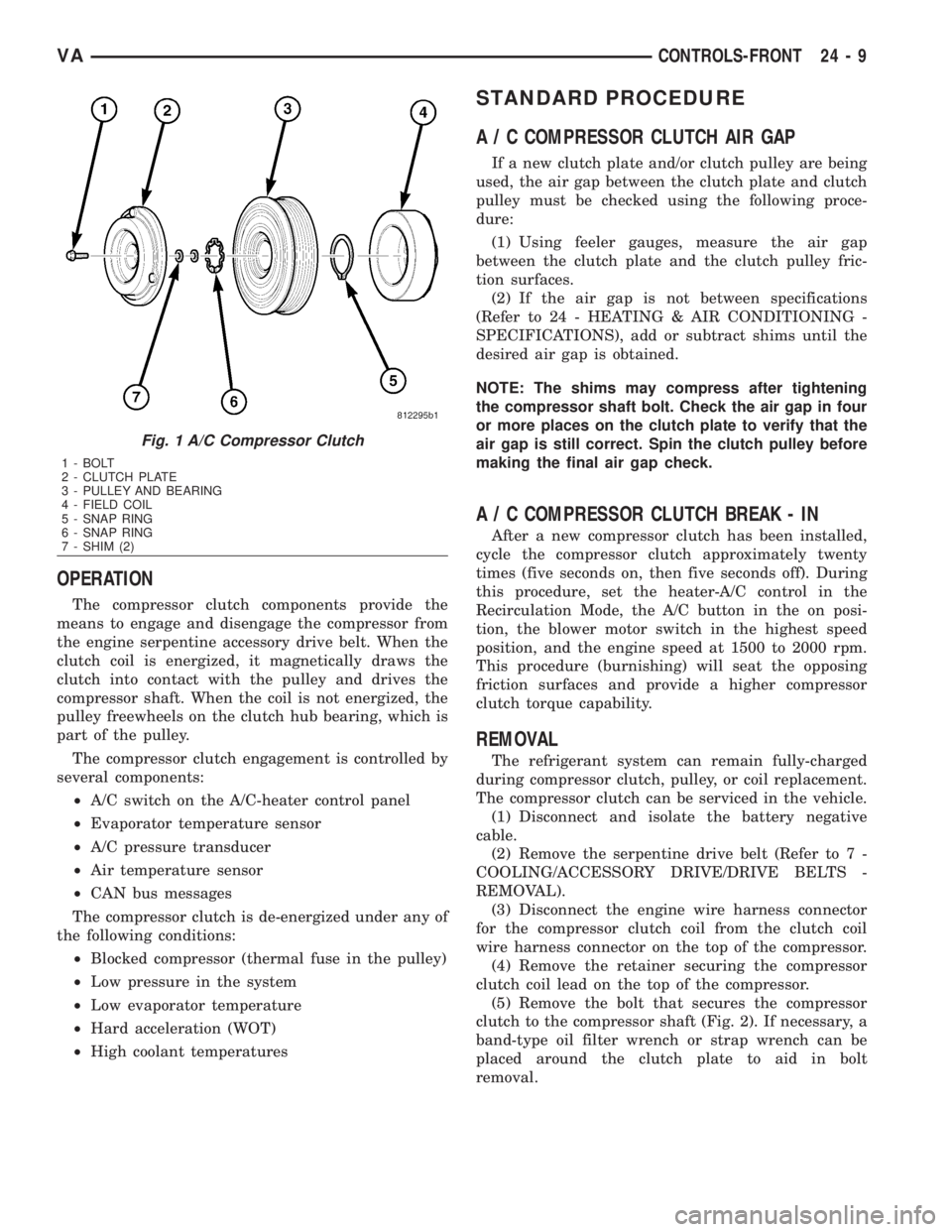
(5) Remove the bolt that secures the compressor
clutch to the compressor shaft (Fig. 2). If necessary, a
band-type oil filter wrench or strap wrench can be
placed around the clutch plate to aid in bolt
removal.
Fig. 1 A/C Compressor Clutch
1 - BOLT
2 - CLUTCH PLATE
3 - PULLEY AND BEARING
4 - FIELD COIL
5 - SNAP RING
6 - SNAP RING
7 - SHIM (2)
VACONTROLS-FRONT 24 - 9
Page 2049 of 2305
front cover of the compressor. Be certain that the
snap ring is properly fully and properly seated in the
groove.
(6) If the original clutch plate and clutch pulley
are to be reused, reinstall the original shim(s) on the
compressor shaft against the shoulder. If a new
clutch plate and/or clutch pulley are being used,
install a trial stack of shims 1.0 mm (0.040 in.) thick
on the compressor shaft against the shoulder.
(7) Install the clutch plate onto the compressor
shaft.
(8) Install and tighten the compressor shaft bolt. If
necessary, a band-type oil filter wrench or a strap
wrench can be placed around the clutch plate to aid
in bolt tightening. Tighten the bolt to 17.5 N´m (155
in. lbs.).
NOTE: The shims may compress after tightening
the shaft bolt. Check the air gap in four or more
places to verify the air gap is still correct. Spin the
pulley before performing a final check of the air
gap.
(9) If a new clutch plate and/or clutch pulley are
being installed, the air gap between the clutch plate
and clutch pulley must be checked (Refer to 24 -
HEATING & AIR CONDITIONING/CONTROLS/A/C
COMPRESSOR CLUTCH - STANDARD PROCE-
DURE).
(10) Install the retainer that secures the compres-
sor clutch coil lead to the top of the compressor.
(11) Reconnect the engine wire harness connector
to the clutch coil lead on the top of the compressor.
(12) Reinstall the serpentine accessory drive belt
(Refer to 7 - COOLING/ACCESSORY DRIVE/DRIVE
BELTS - INSTALLATION).
(13) Reconnect the battery negative cable.
(14) If a new clutch plate and/or clutch pulley are
being installed, the new clutch components must be
burnished (Refer to 24 - HEATING & AIR CONDI-
TIONING/CONTROLS/A/C COMPRESSOR CLUTCH
- STANDARD PROCEDURE).
A / C COMPRESSOR CLUTCH
COIL
DIAGNOSIS AND TESTING
A / C COMPRESSOR CLUTCH COIL
The air conditioning compressor clutch coil electri-
cal circuit is controlled by the ATC control module
which is integral to the heater-A/C control. Begin
testing of a suspected compressor clutch coil problem
by performing the ATC Function Test using the
DRBIIItscan tool.PRELIMINARY CHECKS
(1) If no diagnostic trouble codes (DTCs) are found
in the A/C-heater control or the powertrain control
module (PCM), go to Step 2. If any DTCs are found,
repair as required.
(2) If the A/C compressor clutch still will not
engage, verify the refrigerant charge level (Refer to
24 - HEATING & AIR CONDITIONING/PLUMBING
- DIAGNOSIS AND TESTING - REFRIGERANT
SYSTEM LEAKS). If the refrigerant charge level is
OK, go to TESTS. If the refrigerant charge level is
not OK, adjust the refrigerant charge as required.
TESTS
(1) Verify the battery state of charge (Refer to 8 -
ELECTRICAL/BATTERY SYSTEM/BATTERY -
DIAGNOSIS AND TESTING).
(2) Connect an ammeter (0 to 10 ampere scale
selected) in series with the clutch coil feed terminal.
Connect a voltmeter (0 to 20 volt scale selected) to
measure voltage across the battery and the clutch
coil.
(3) With the A/C-heater control in the A/C mode
and the blower motor at low speed, start the engine
and allow it to run at a normal idle speed.
(4) The A/C compressor clutch should engage
immediately, and the clutch coil supply voltage
should be within two volts of the battery voltage. If
the coil supply voltage is OK, go to Step 5. If the coil
supply voltage is not within two volts of battery volt-
age, test the clutch coil feed circuit for excessive volt-
age drop and repair as necessary.
(5) For the acceptable A/C clutch coil current draw
specifications refer to 24 - HEATING & AIR CONDI-
TIONING - SPECIFICATIONS. Specifications apply
for a work area temperature of 21É C (70É F). If volt-
age is more than 12.5 volts, add electrical loads by
turning on electrical accessories until voltage reads
below 12.5 volts.
(a) If the A/C clutch coil current reading is zero,
the coil is open and must be replaced.
(b) If the A/C clutch coil current reading is above
specifications, the coil is shorted and must be
replaced.
A / C HEATER CONTROL
DESCRIPTION
This ATC system uses a combination of electrical
and mechanical controls. These controls provide the
vehicle operator with a number of setting options to
help control the climate and comfort within the vehi-
cle.
The A/C-heater control is located on the instrument
panel inboard of the steering column and below the
24 - 12 CONTROLS-FRONTVA
Page 2050 of 2305
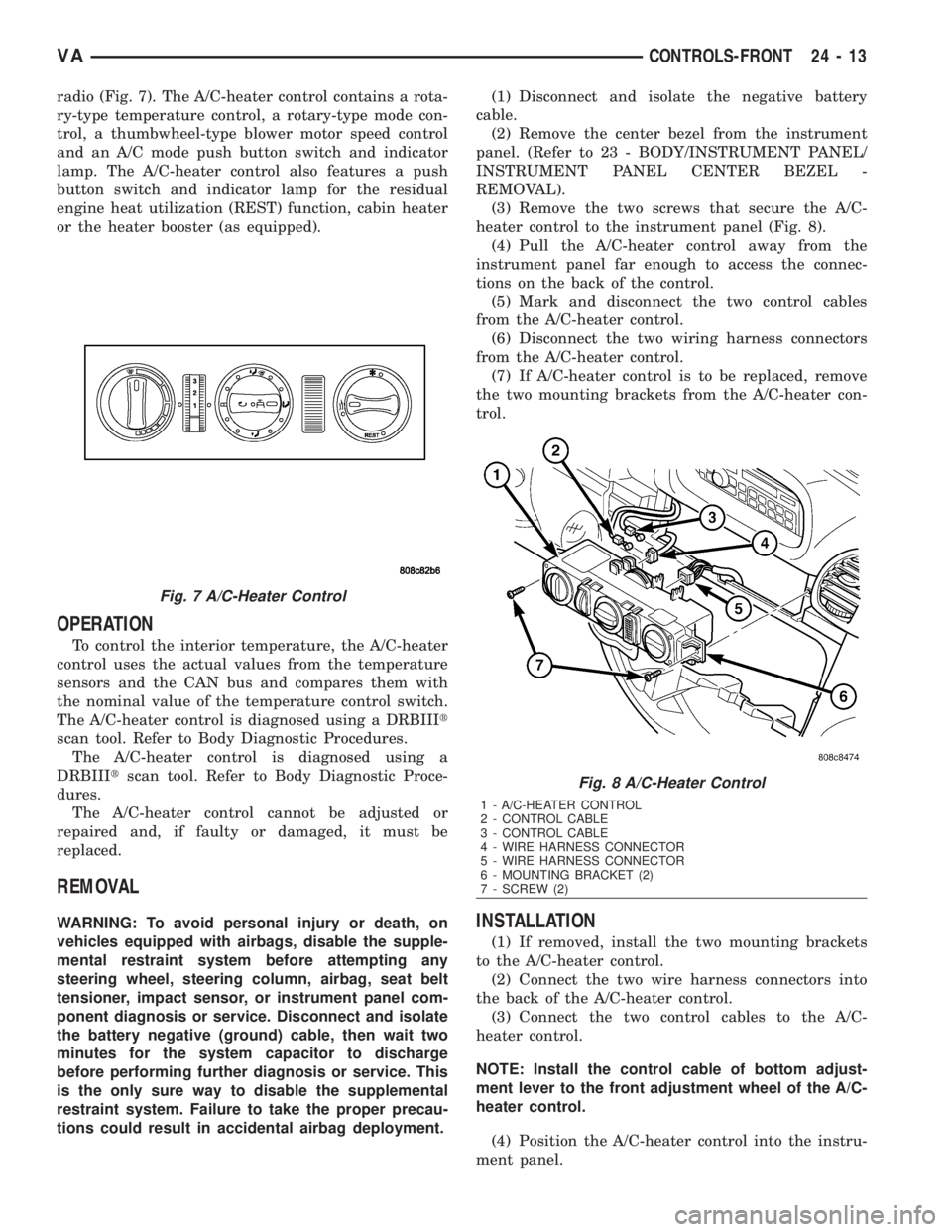
radio (Fig. 7). The A/C-heater control contains a rota-
ry-type temperature control, a rotary-type mode con-
trol, a thumbwheel-type blower motor speed control
and an A/C mode push button switch and indicator
lamp. The A/C-heater control also features a push
button switch and indicator lamp for the residual
engine heat utilization (REST) function, cabin heater
or the heater booster (as equipped).
OPERATION
To control the interior temperature, the A/C-heater
control uses the actual values from the temperature
sensors and the CAN bus and compares them with
the nominal value of the temperature control switch.
The A/C-heater control is diagnosed using a DRBIIIt
scan tool. Refer to Body Diagnostic Procedures.
The A/C-heater control is diagnosed using a
DRBIIItscan tool. Refer to Body Diagnostic Proce-
dures.
The A/C-heater control cannot be adjusted or
repaired and, if faulty or damaged, it must be
replaced.
REMOVAL
WARNING: To avoid personal injury or death, on
vehicles equipped with airbags, disable the supple-
mental restraint system before attempting any
steering wheel, steering column, airbag, seat belt
tensioner, impact sensor, or instrument panel com-
ponent diagnosis or service. Disconnect and isolate
the battery negative (ground) cable, then wait two
minutes for the system capacitor to discharge
before performing further diagnosis or service. This
is the only sure way to disable the supplemental
restraint system. Failure to take the proper precau-
tions could result in accidental airbag deployment.(1) Disconnect and isolate the negative battery
cable.
(2) Remove the center bezel from the instrument
panel. (Refer to 23 - BODY/INSTRUMENT PANEL/
INSTRUMENT PANEL CENTER BEZEL -
REMOVAL).
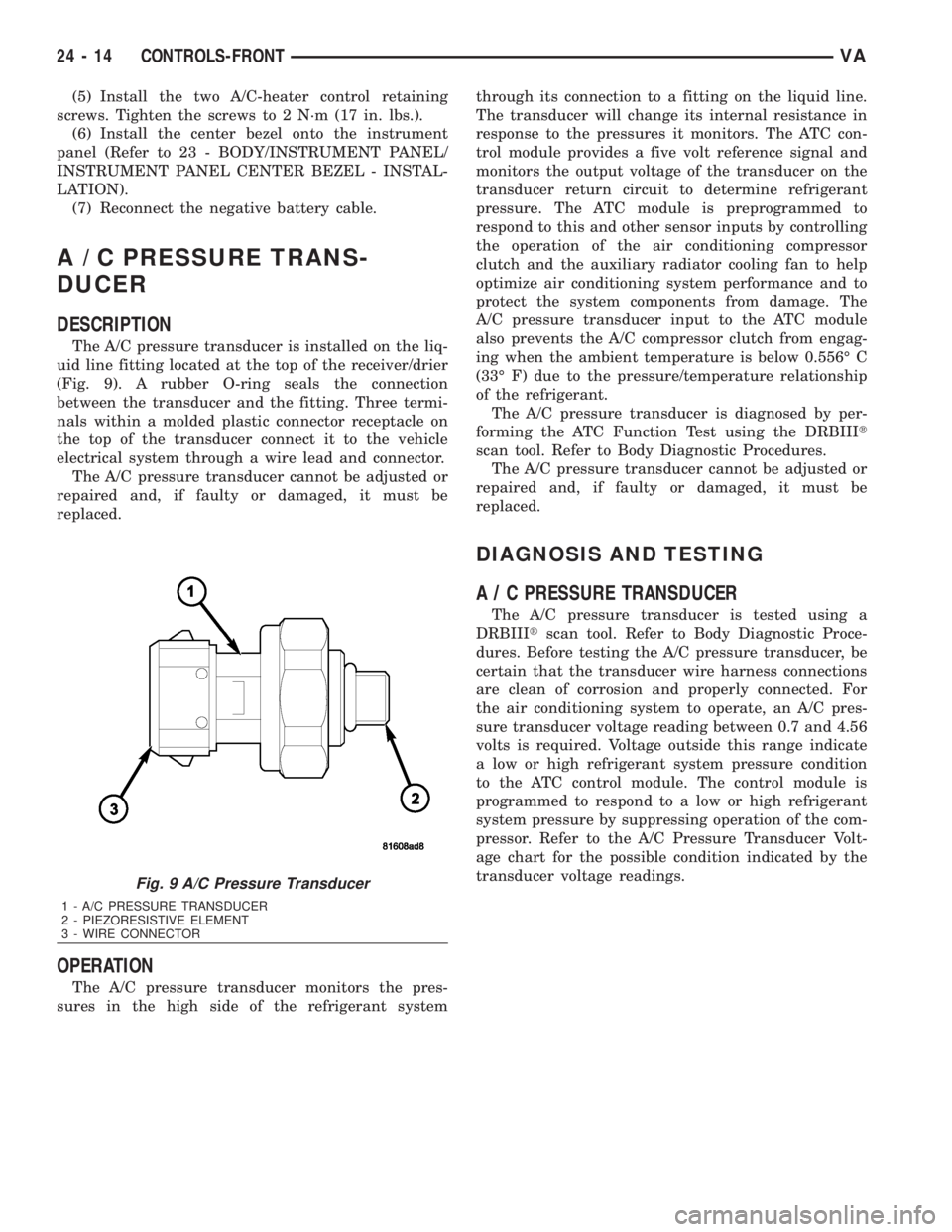
(3) Remove the two screws that secure the A/C-
heater control to the instrument panel (Fig. 8).
(4) Pull the A/C-heater control away from the
instrument panel far enough to access the connec-
tions on the back of the control.
(5) Mark and disconnect the two control cables
from the A/C-heater control.
(6) Disconnect the two wiring harness connectors
from the A/C-heater control.
(7) If A/C-heater control is to be replaced, remove
the two mounting brackets from the A/C-heater con-
trol.INSTALLATION
(1) If removed, install the two mounting brackets
to the A/C-heater control.
(2) Connect the two wire harness connectors into
the back of the A/C-heater control.
(3) Connect the two control cables to the A/C-
heater control.
NOTE: Install the control cable of bottom adjust-
ment lever to the front adjustment wheel of the A/C-
heater control.
(4) Position the A/C-heater control into the instru-
ment panel.
Fig. 7 A/C-Heater Control
Fig. 8 A/C-Heater Control
1 - A/C-HEATER CONTROL
2 - CONTROL CABLE
3 - CONTROL CABLE
4 - WIRE HARNESS CONNECTOR
5 - WIRE HARNESS CONNECTOR
6 - MOUNTING BRACKET (2)
7 - SCREW (2)
VACONTROLS-FRONT 24 - 13
Page 2051 of 2305
(5) Install the two A/C-heater control retaining
screws. Tighten the screws to 2 N´m (17 in. lbs.).
(6) Install the center bezel onto the instrument
panel (Refer to 23 - BODY/INSTRUMENT PANEL/
INSTRUMENT PANEL CENTER BEZEL - INSTAL-
LATION).
(7) Reconnect the negative battery cable.
A / C PRESSURE TRANS-
DUCER
DESCRIPTION
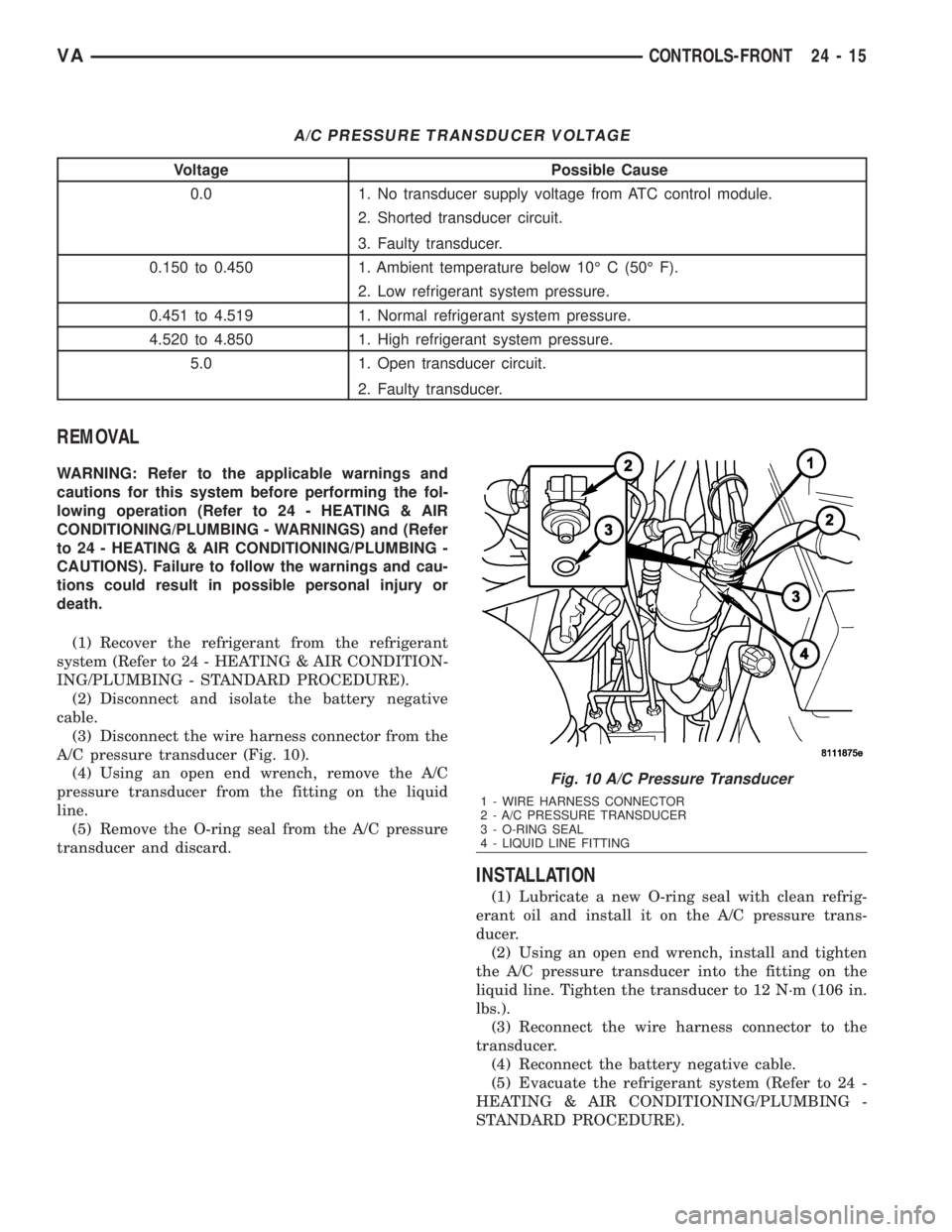
The A/C pressure transducer is installed on the liq-
uid line fitting located at the top of the receiver/drier
(Fig. 9). A rubber O-ring seals the connection
between the transducer and the fitting. Three termi-
nals within a molded plastic connector receptacle on
the top of the transducer connect it to the vehicle
electrical system through a wire lead and connector.
The A/C pressure transducer cannot be adjusted or
repaired and, if faulty or damaged, it must be
replaced.
OPERATION
The A/C pressure transducer monitors the pres-
sures in the high side of the refrigerant systemthrough its connection to a fitting on the liquid line.
The transducer will change its internal resistance in
response to the pressures it monitors. The ATC con-
trol module provides a five volt reference signal and
monitors the output voltage of the transducer on the
transducer return circuit to determine refrigerant
pressure. The ATC module is preprogrammed to
respond to this and other sensor inputs by controlling
the operation of the air conditioning compressor
clutch and the auxiliary radiator cooling fan to help
optimize air conditioning system performance and to
protect the system components from damage. The
A/C pressure transducer input to the ATC module
also prevents the A/C compressor clutch from engag-
ing when the ambient temperature is below 0.556É C
(33É F) due to the pressure/temperature relationship
of the refrigerant.
The A/C pressure transducer is diagnosed by per-
forming the ATC Function Test using the DRBIIIt
scan tool. Refer to Body Diagnostic Procedures.
The A/C pressure transducer cannot be adjusted or
repaired and, if faulty or damaged, it must be
replaced.
DIAGNOSIS AND TESTING
A / C PRESSURE TRANSDUCER
The A/C pressure transducer is tested using a
DRBIIItscan tool. Refer to Body Diagnostic Proce-
dures. Before testing the A/C pressure transducer, be
certain that the transducer wire harness connections
are clean of corrosion and properly connected. For
the air conditioning system to operate, an A/C pres-
sure transducer voltage reading between 0.7 and 4.56
volts is required. Voltage outside this range indicate
a low or high refrigerant system pressure condition
to the ATC control module. The control module is
programmed to respond to a low or high refrigerant
system pressure by suppressing operation of the com-
pressor. Refer to the A/C Pressure Transducer Volt-
age chart for the possible condition indicated by the
transducer voltage readings.
Fig. 9 A/C Pressure Transducer
1 - A/C PRESSURE TRANSDUCER
2 - PIEZORESISTIVE ELEMENT
3 - WIRE CONNECTOR
24 - 14 CONTROLS-FRONTVA
Page 2052 of 2305
A/C PRESSURE TRANSDUCER VOLTAGE
Voltage Possible Cause
0.0 1. No transducer supply voltage from ATC control module.
2. Shorted transducer circuit.
3. Faulty transducer.
0.150 to 0.450 1. Ambient temperature below 10É C (50É F).
2. Low refrigerant system pressure.
0.451 to 4.519 1. Normal refrigerant system pressure.
4.520 to 4.850 1. High refrigerant system pressure.
5.0 1. Open transducer circuit.
2. Faulty transducer.
REMOVAL
WARNING: Refer to the applicable warnings and
cautions for this system before performing the fol-
lowing operation (Refer to 24 - HEATING & AIR
CONDITIONING/PLUMBING - WARNINGS) and (Refer
to 24 - HEATING & AIR CONDITIONING/PLUMBING -
CAUTIONS). Failure to follow the warnings and cau-
tions could result in possible personal injury or
death.
(1) Recover the refrigerant from the refrigerant
system (Refer to 24 - HEATING & AIR CONDITION-
ING/PLUMBING - STANDARD PROCEDURE).
(2) Disconnect and isolate the battery negative
cable.
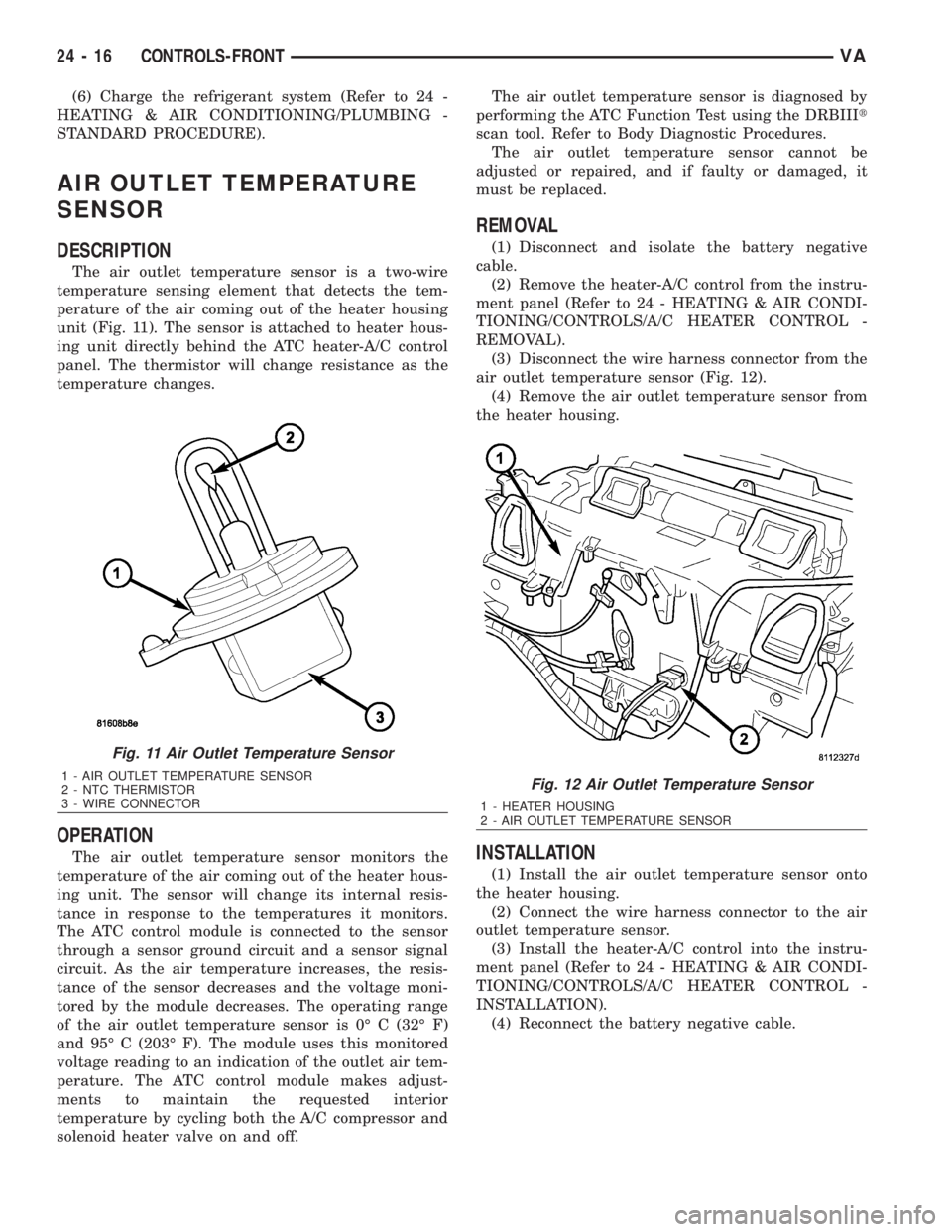
(3) Disconnect the wire harness connector from the
A/C pressure transducer (Fig. 10).
(4) Using an open end wrench, remove the A/C
pressure transducer from the fitting on the liquid
line.
(5) Remove the O-ring seal from the A/C pressure
transducer and discard.
INSTALLATION
(1) Lubricate a new O-ring seal with clean refrig-
erant oil and install it on the A/C pressure trans-
ducer.
(2) Using an open end wrench, install and tighten
the A/C pressure transducer into the fitting on the
liquid line. Tighten the transducer to 12 N´m (106 in.
lbs.).
(3) Reconnect the wire harness connector to the
transducer.
(4) Reconnect the battery negative cable.
(5) Evacuate the refrigerant system (Refer to 24 -
HEATING & AIR CONDITIONING/PLUMBING -
STANDARD PROCEDURE).
Fig. 10 A/C Pressure Transducer
1 - WIRE HARNESS CONNECTOR
2 - A/C PRESSURE TRANSDUCER
3 - O-RING SEAL
4 - LIQUID LINE FITTING
VACONTROLS-FRONT 24 - 15
Page 2053 of 2305
(6) Charge the refrigerant system (Refer to 24 -
HEATING & AIR CONDITIONING/PLUMBING -
STANDARD PROCEDURE).
AIR OUTLET TEMPERATURE
SENSOR
DESCRIPTION
The air outlet temperature sensor is a two-wire
temperature sensing element that detects the tem-
perature of the air coming out of the heater housing
unit (Fig. 11). The sensor is attached to heater hous-
ing unit directly behind the ATC heater-A/C control
panel. The thermistor will change resistance as the
temperature changes.
OPERATION
The air outlet temperature sensor monitors the
temperature of the air coming out of the heater hous-
ing unit. The sensor will change its internal resis-
tance in response to the temperatures it monitors.
The ATC control module is connected to the sensor
through a sensor ground circuit and a sensor signal
circuit. As the air temperature increases, the resis-
tance of the sensor decreases and the voltage moni-
tored by the module decreases. The operating range
of the air outlet temperature sensor is 0É C (32É F)
and 95É C (203É F). The module uses this monitored
voltage reading to an indication of the outlet air tem-
perature. The ATC control module makes adjust-
ments to maintain the requested interior
temperature by cycling both the A/C compressor and
solenoid heater valve on and off.The air outlet temperature sensor is diagnosed by
performing the ATC Function Test using the DRBIIIt
scan tool. Refer to Body Diagnostic Procedures.
The air outlet temperature sensor cannot be
adjusted or repaired, and if faulty or damaged, it
must be replaced.
REMOVAL
(1) Disconnect and isolate the battery negative
cable.
(2) Remove the heater-A/C control from the instru-
ment panel (Refer to 24 - HEATING & AIR CONDI-
TIONING/CONTROLS/A/C HEATER CONTROL -
REMOVAL).
(3) Disconnect the wire harness connector from the
air outlet temperature sensor (Fig. 12).
(4) Remove the air outlet temperature sensor from
the heater housing.
INSTALLATION
(1) Install the air outlet temperature sensor onto
the heater housing.
(2) Connect the wire harness connector to the air
outlet temperature sensor.
(3) Install the heater-A/C control into the instru-
ment panel (Refer to 24 - HEATING & AIR CONDI-
TIONING/CONTROLS/A/C HEATER CONTROL -
INSTALLATION).
(4) Reconnect the battery negative cable.
Fig. 11 Air Outlet Temperature Sensor
1 - AIR OUTLET TEMPERATURE SENSOR
2 - NTC THERMISTOR
3 - WIRE CONNECTORFig. 12 Air Outlet Temperature Sensor
1 - HEATER HOUSING
2 - AIR OUTLET TEMPERATURE SENSOR
24 - 16 CONTROLS-FRONTVA
Page 2054 of 2305
AMBIENT TEMPERATURE SEN-
SOR
DESCRIPTION
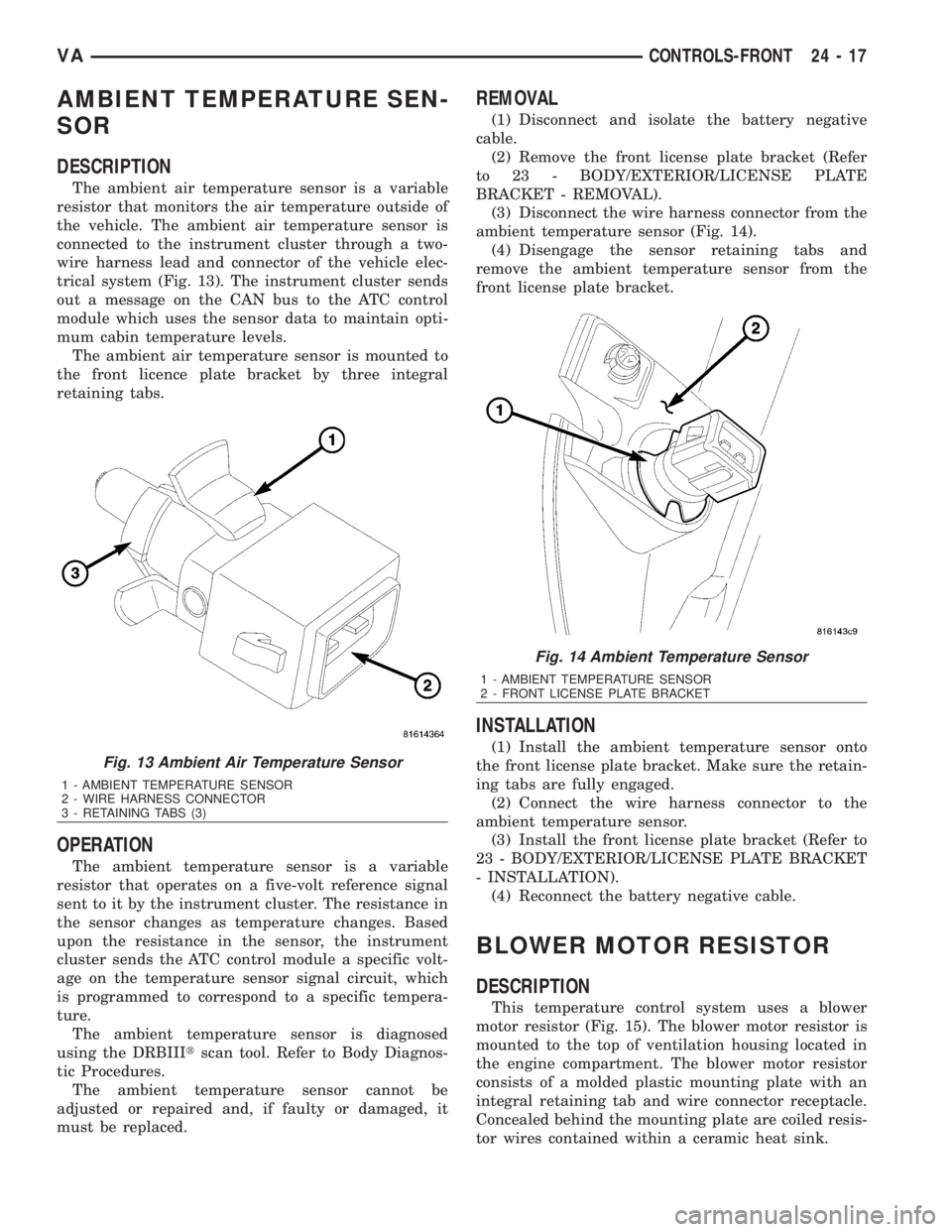
The ambient air temperature sensor is a variable
resistor that monitors the air temperature outside of
the vehicle. The ambient air temperature sensor is
connected to the instrument cluster through a two-
wire harness lead and connector of the vehicle elec-
trical system (Fig. 13). The instrument cluster sends
out a message on the CAN bus to the ATC control
module which uses the sensor data to maintain opti-
mum cabin temperature levels.
The ambient air temperature sensor is mounted to
the front licence plate bracket by three integral
retaining tabs.
OPERATION
The ambient temperature sensor is a variable
resistor that operates on a five-volt reference signal
sent to it by the instrument cluster. The resistance in
the sensor changes as temperature changes. Based
upon the resistance in the sensor, the instrument
cluster sends the ATC control module a specific volt-
age on the temperature sensor signal circuit, which
is programmed to correspond to a specific tempera-
ture.
The ambient temperature sensor is diagnosed
using the DRBIIItscan tool. Refer to Body Diagnos-
tic Procedures.
The ambient temperature sensor cannot be
adjusted or repaired and, if faulty or damaged, it
must be replaced.
REMOVAL
(1) Disconnect and isolate the battery negative
cable.
(2) Remove the front license plate bracket (Refer
to 23 - BODY/EXTERIOR/LICENSE PLATE
BRACKET - REMOVAL).
(3) Disconnect the wire harness connector from the
ambient temperature sensor (Fig. 14).
(4) Disengage the sensor retaining tabs and
remove the ambient temperature sensor from the
front license plate bracket.
INSTALLATION
(1) Install the ambient temperature sensor onto
the front license plate bracket. Make sure the retain-
ing tabs are fully engaged.
(2) Connect the wire harness connector to the
ambient temperature sensor.
(3) Install the front license plate bracket (Refer to
23 - BODY/EXTERIOR/LICENSE PLATE BRACKET
- INSTALLATION).
(4) Reconnect the battery negative cable.
BLOWER MOTOR RESISTOR
DESCRIPTION
This temperature control system uses a blower
motor resistor (Fig. 15). The blower motor resistor is
mounted to the top of ventilation housing located in
the engine compartment. The blower motor resistor
consists of a molded plastic mounting plate with an
integral retaining tab and wire connector receptacle.
Concealed behind the mounting plate are coiled resis-
tor wires contained within a ceramic heat sink.
Fig. 13 Ambient Air Temperature Sensor
1 - AMBIENT TEMPERATURE SENSOR
2 - WIRE HARNESS CONNECTOR
3 - RETAINING TABS (3)
Fig. 14 Ambient Temperature Sensor
1 - AMBIENT TEMPERATURE SENSOR
2 - FRONT LICENSE PLATE BRACKET
VACONTROLS-FRONT 24 - 17