battery MERCEDES-BENZ SPRINTER 2006 Service Manual
[x] Cancel search | Manufacturer: MERCEDES-BENZ, Model Year: 2006, Model line: SPRINTER, Model: MERCEDES-BENZ SPRINTER 2006Pages: 2305, PDF Size: 48.12 MB
Page 2055 of 2305
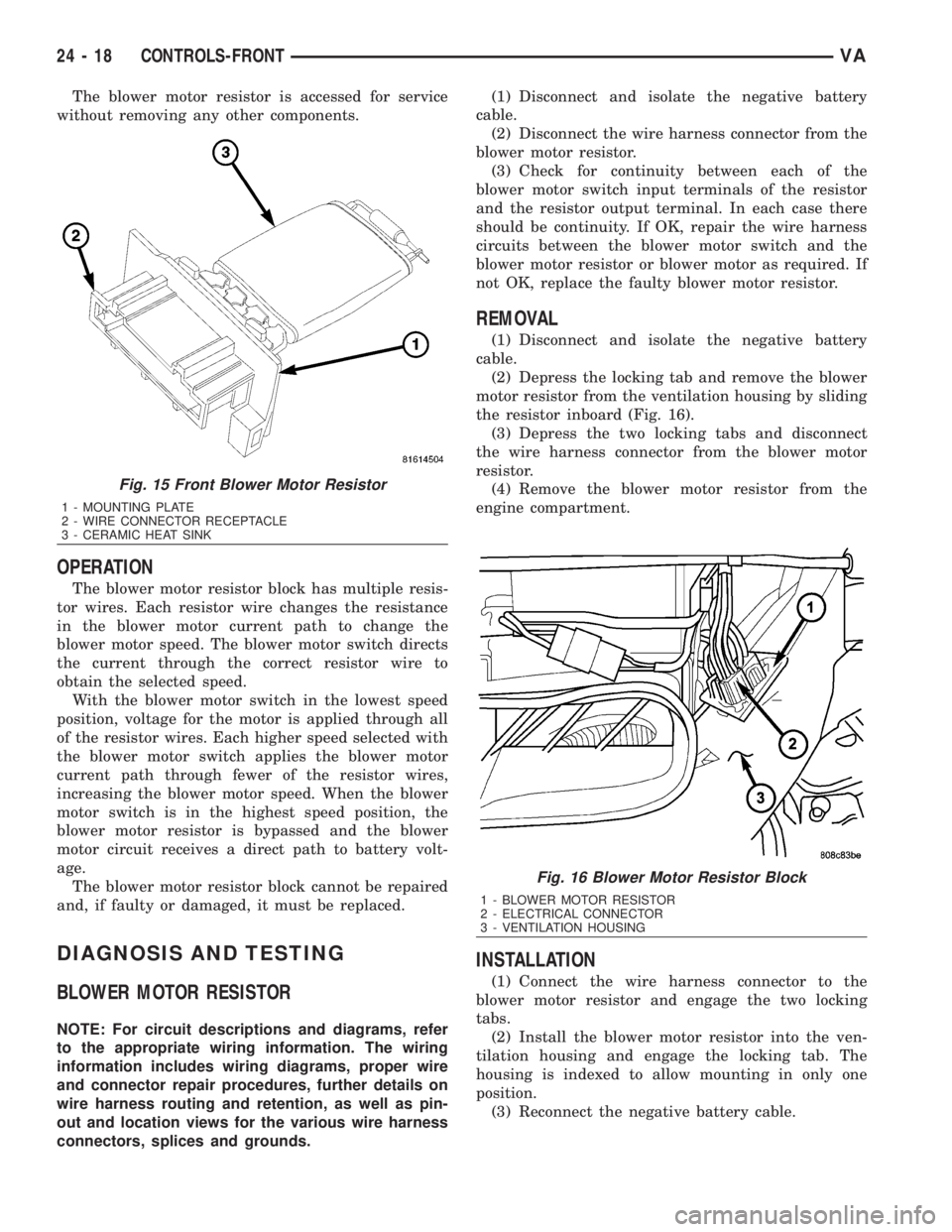
The blower motor resistor is accessed for service
without removing any other components.
OPERATION
The blower motor resistor block has multiple resis-
tor wires. Each resistor wire changes the resistance
in the blower motor current path to change the
blower motor speed. The blower motor switch directs
the current through the correct resistor wire to
obtain the selected speed.
With the blower motor switch in the lowest speed
position, voltage for the motor is applied through all
of the resistor wires. Each higher speed selected with
the blower motor switch applies the blower motor
current path through fewer of the resistor wires,
increasing the blower motor speed. When the blower
motor switch is in the highest speed position, the
blower motor resistor is bypassed and the blower
motor circuit receives a direct path to battery volt-
age.
The blower motor resistor block cannot be repaired
and, if faulty or damaged, it must be replaced.
DIAGNOSIS AND TESTING
BLOWER MOTOR RESISTOR
NOTE: For circuit descriptions and diagrams, refer
to the appropriate wiring information. The wiring
information includes wiring diagrams, proper wire
and connector repair procedures, further details on
wire harness routing and retention, as well as pin-
out and location views for the various wire harness
connectors, splices and grounds.(1) Disconnect and isolate the negative battery
cable.
(2) Disconnect the wire harness connector from the
blower motor resistor.
(3) Check for continuity between each of the
blower motor switch input terminals of the resistor
and the resistor output terminal. In each case there
should be continuity. If OK, repair the wire harness
circuits between the blower motor switch and the
blower motor resistor or blower motor as required. If
not OK, replace the faulty blower motor resistor.
REMOVAL
(1) Disconnect and isolate the negative battery
cable.
(2) Depress the locking tab and remove the blower
motor resistor from the ventilation housing by sliding
the resistor inboard (Fig. 16).
(3) Depress the two locking tabs and disconnect
the wire harness connector from the blower motor
resistor.
(4) Remove the blower motor resistor from the
engine compartment.
INSTALLATION
(1) Connect the wire harness connector to the
blower motor resistor and engage the two locking
tabs.
(2) Install the blower motor resistor into the ven-
tilation housing and engage the locking tab. The
housing is indexed to allow mounting in only one
position.
(3) Reconnect the negative battery cable.
Fig. 15 Front Blower Motor Resistor
1 - MOUNTING PLATE
2 - WIRE CONNECTOR RECEPTACLE
3 - CERAMIC HEAT SINK
Fig. 16 Blower Motor Resistor Block
1 - BLOWER MOTOR RESISTOR
2 - ELECTRICAL CONNECTOR
3 - VENTILATION HOUSING
24 - 18 CONTROLS-FRONTVA
Page 2057 of 2305
The external location of the sensor allows the sensor
to be removed or installed without disturbing the
refrigerant in the A/C system.
The evaporator temperature sensor is diagnosed by
performing the ATC Function Test using a DRBIIIt
scan tool. Refer to Body Diagnostic Procedures.
The evaporator temperature sensor cannot be
adjusted or repaired and, if faulty or damaged, it
must be replaced.
REMOVAL
(1) Disconnect and isolate the negative battery
cable.
(2) Remove the radio (Refer to 8 - ELECTRICAL/
AUDIO/RADIO - REMOVAL).
(3) Remove glove compartment.
(4) Remove cover from instrument cluster (Refer to
23 - BODY/INSTRUMENT PANEL/INSTRUMENT
PANEL TOP COVER - REMOVAL).
(5) Remove the instrument cluster (Refer to 8 -
ELECTRICAL/INSTRUMENT CLUSTER -
REMOVAL).
(6) Remove passenger side airbag.
(7) Remove cover above air nozzle on passenger
side.
(8) Remove speaker.
(9) Remove center section of instrument panel.
(10) Remove A/C-heater control from the instru-
ment panel (Refer to 24 - HEATING & AIR CONDI-
TIONING/CONTROLS/A/C HEATER CONTROL -
REMOVAL).
(11) Remove instrument panel top section.
(12) Remove electrical connections.
(13) Remove air bezels from instrument panel.
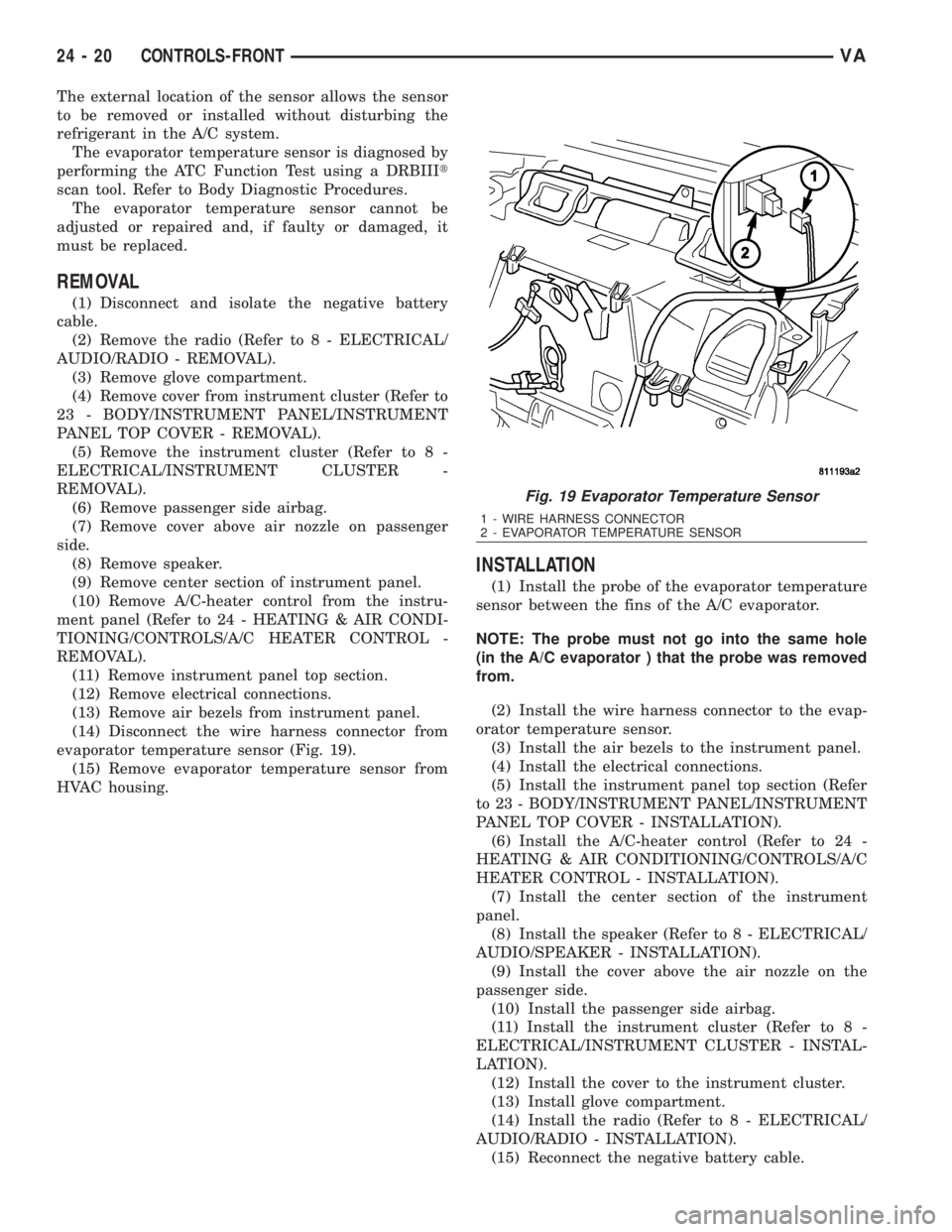
(14) Disconnect the wire harness connector from
evaporator temperature sensor (Fig. 19).
(15) Remove evaporator temperature sensor from
HVAC housing.
INSTALLATION
(1) Install the probe of the evaporator temperature
sensor between the fins of the A/C evaporator.
NOTE: The probe must not go into the same hole
(in the A/C evaporator ) that the probe was removed
from.
(2) Install the wire harness connector to the evap-
orator temperature sensor.
(3) Install the air bezels to the instrument panel.
(4) Install the electrical connections.
(5) Install the instrument panel top section (Refer
to 23 - BODY/INSTRUMENT PANEL/INSTRUMENT
PANEL TOP COVER - INSTALLATION).
(6) Install the A/C-heater control (Refer to 24 -
HEATING & AIR CONDITIONING/CONTROLS/A/C
HEATER CONTROL - INSTALLATION).
(7) Install the center section of the instrument
panel.
(8) Install the speaker (Refer to 8 - ELECTRICAL/
AUDIO/SPEAKER - INSTALLATION).
(9) Install the cover above the air nozzle on the
passenger side.
(10) Install the passenger side airbag.
(11) Install the instrument cluster (Refer to 8 -
ELECTRICAL/INSTRUMENT CLUSTER - INSTAL-
LATION).
(12) Install the cover to the instrument cluster.
(13) Install glove compartment.
(14) Install the radio (Refer to 8 - ELECTRICAL/
AUDIO/RADIO - INSTALLATION).
(15) Reconnect the negative battery cable.
Fig. 19 Evaporator Temperature Sensor
1 - WIRE HARNESS CONNECTOR
2 - EVAPORATOR TEMPERATURE SENSOR
24 - 20 CONTROLS-FRONTVA
Page 2058 of 2305
IN - CAR TEMPERATURE SEN-
SOR
DESCRIPTION
The in-car temperature sensor measures the actual
air temperature within the passenger compartment.
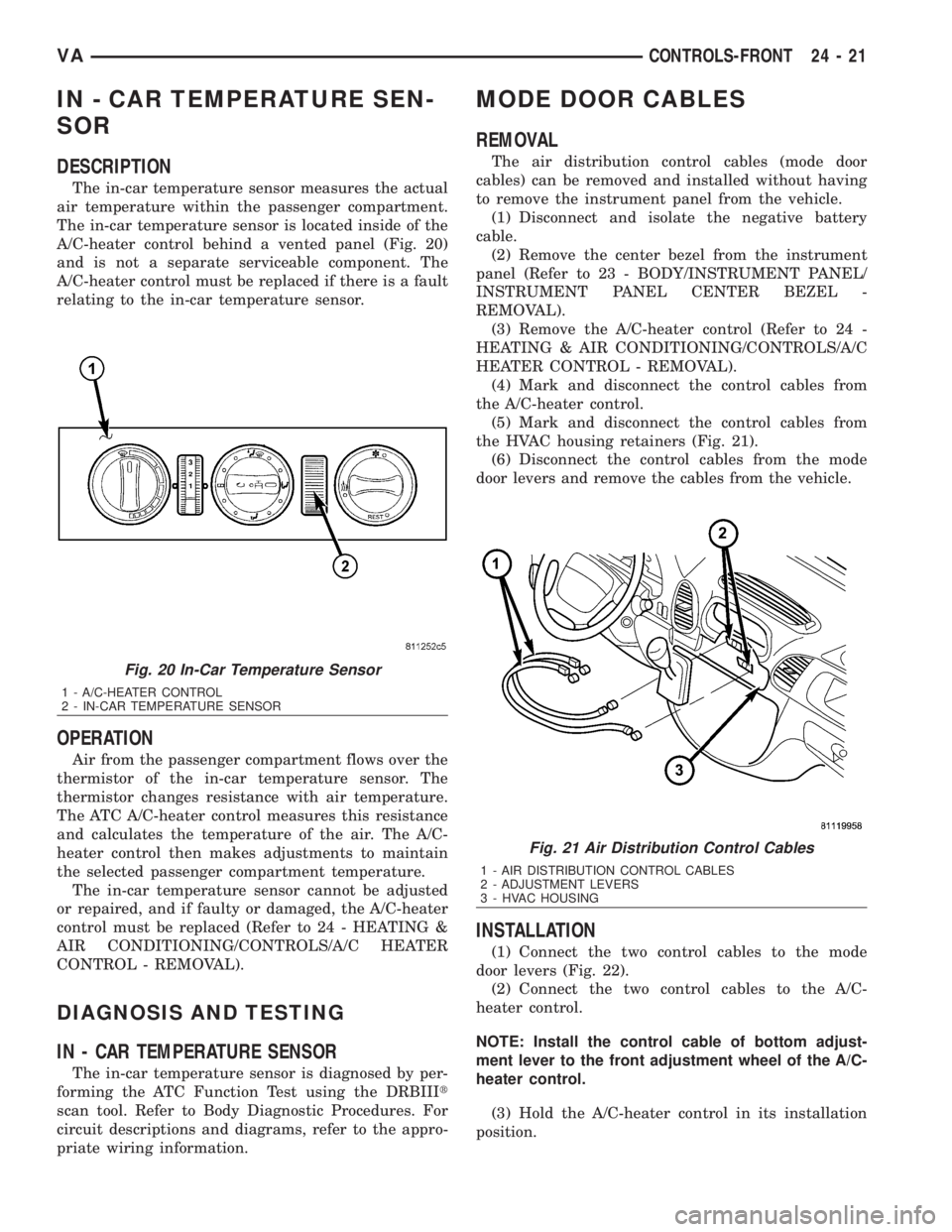
The in-car temperature sensor is located inside of the
A/C-heater control behind a vented panel (Fig. 20)
and is not a separate serviceable component. The
A/C-heater control must be replaced if there is a fault
relating to the in-car temperature sensor.
OPERATION
Air from the passenger compartment flows over the
thermistor of the in-car temperature sensor. The
thermistor changes resistance with air temperature.
The ATC A/C-heater control measures this resistance
and calculates the temperature of the air. The A/C-
heater control then makes adjustments to maintain
the selected passenger compartment temperature.
The in-car temperature sensor cannot be adjusted
or repaired, and if faulty or damaged, the A/C-heater
control must be replaced (Refer to 24 - HEATING &
AIR CONDITIONING/CONTROLS/A/C HEATER
CONTROL - REMOVAL).
DIAGNOSIS AND TESTING
IN - CAR TEMPERATURE SENSOR
The in-car temperature sensor is diagnosed by per-
forming the ATC Function Test using the DRBIIIt
scan tool. Refer to Body Diagnostic Procedures. For
circuit descriptions and diagrams, refer to the appro-
priate wiring information.
MODE DOOR CABLES
REMOVAL
The air distribution control cables (mode door
cables) can be removed and installed without having
to remove the instrument panel from the vehicle.
(1) Disconnect and isolate the negative battery
cable.
(2) Remove the center bezel from the instrument
panel (Refer to 23 - BODY/INSTRUMENT PANEL/
INSTRUMENT PANEL CENTER BEZEL -
REMOVAL).
(3) Remove the A/C-heater control (Refer to 24 -
HEATING & AIR CONDITIONING/CONTROLS/A/C
HEATER CONTROL - REMOVAL).
(4) Mark and disconnect the control cables from
the A/C-heater control.
(5) Mark and disconnect the control cables from
the HVAC housing retainers (Fig. 21).
(6) Disconnect the control cables from the mode
door levers and remove the cables from the vehicle.
INSTALLATION
(1) Connect the two control cables to the mode
door levers (Fig. 22).
(2) Connect the two control cables to the A/C-
heater control.
NOTE: Install the control cable of bottom adjust-
ment lever to the front adjustment wheel of the A/C-
heater control.
(3) Hold the A/C-heater control in its installation
position.
Fig. 20 In-Car Temperature Sensor
1 - A/C-HEATER CONTROL
2 - IN-CAR TEMPERATURE SENSOR
Fig. 21 Air Distribution Control Cables
1 - AIR DISTRIBUTION CONTROL CABLES
2 - ADJUSTMENT LEVERS
3 - HVAC HOUSING
VACONTROLS-FRONT 24 - 21
Page 2059 of 2305
NOTE: While holding the A/C-heater control in the
installation position, verify that the control cables
are not twisted.
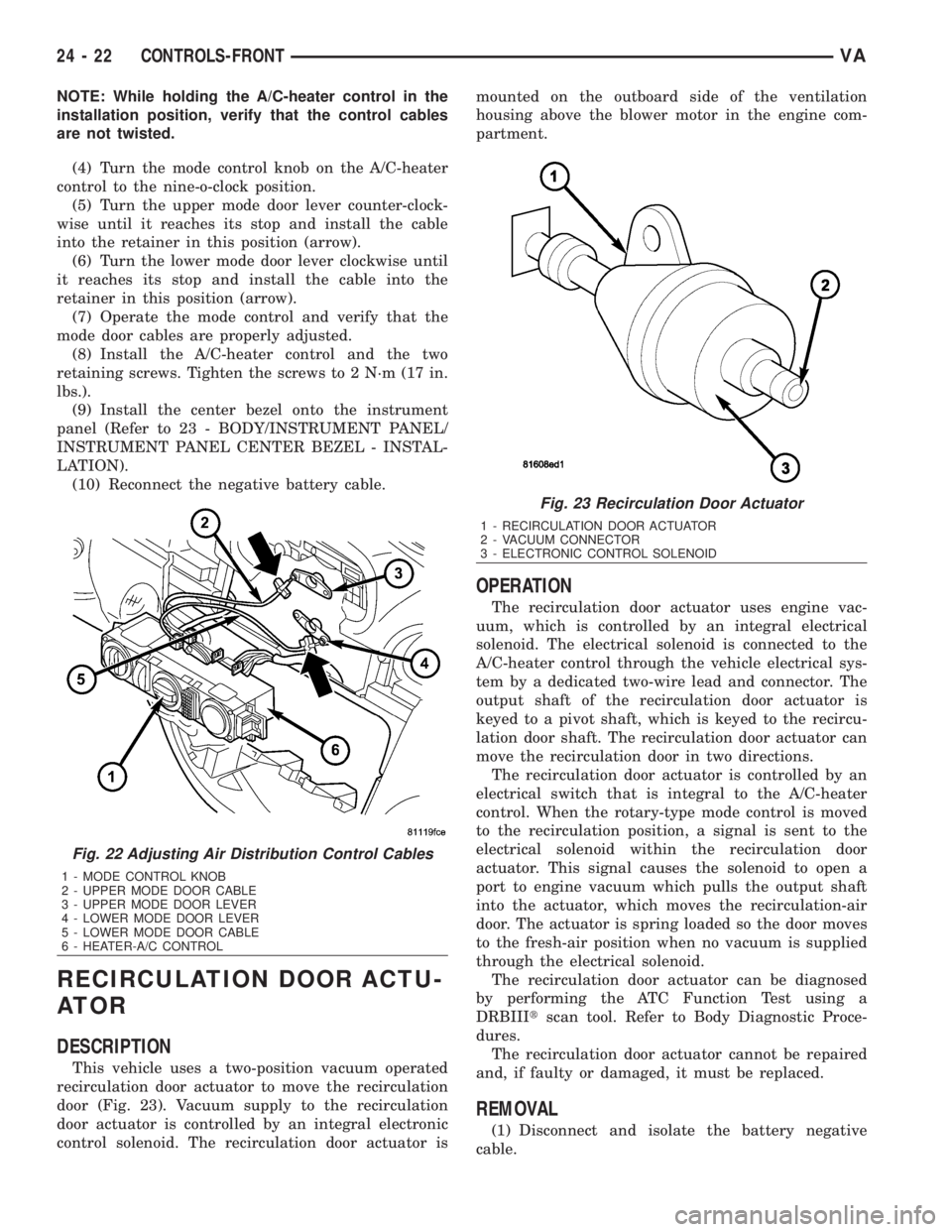
(4) Turn the mode control knob on the A/C-heater
control to the nine-o-clock position.
(5) Turn the upper mode door lever counter-clock-
wise until it reaches its stop and install the cable
into the retainer in this position (arrow).
(6) Turn the lower mode door lever clockwise until
it reaches its stop and install the cable into the
retainer in this position (arrow).
(7) Operate the mode control and verify that the
mode door cables are properly adjusted.
(8) Install the A/C-heater control and the two
retaining screws. Tighten the screws to 2 N´m (17 in.
lbs.).
(9) Install the center bezel onto the instrument
panel (Refer to 23 - BODY/INSTRUMENT PANEL/
INSTRUMENT PANEL CENTER BEZEL - INSTAL-
LATION).
(10) Reconnect the negative battery cable.
RECIRCULATION DOOR ACTU-
ATOR
DESCRIPTION
This vehicle uses a two-position vacuum operated
recirculation door actuator to move the recirculation
door (Fig. 23). Vacuum supply to the recirculation
door actuator is controlled by an integral electronic
control solenoid. The recirculation door actuator ismounted on the outboard side of the ventilation
housing above the blower motor in the engine com-
partment.
OPERATION
The recirculation door actuator uses engine vac-
uum, which is controlled by an integral electrical
solenoid. The electrical solenoid is connected to the
A/C-heater control through the vehicle electrical sys-
tem by a dedicated two-wire lead and connector. The
output shaft of the recirculation door actuator is
keyed to a pivot shaft, which is keyed to the recircu-
lation door shaft. The recirculation door actuator can
move the recirculation door in two directions.
The recirculation door actuator is controlled by an
electrical switch that is integral to the A/C-heater
control. When the rotary-type mode control is moved
to the recirculation position, a signal is sent to the
electrical solenoid within the recirculation door
actuator. This signal causes the solenoid to open a
port to engine vacuum which pulls the output shaft
into the actuator, which moves the recirculation-air
door. The actuator is spring loaded so the door moves
to the fresh-air position when no vacuum is supplied
through the electrical solenoid.
The recirculation door actuator can be diagnosed
by performing the ATC Function Test using a
DRBIIItscan tool. Refer to Body Diagnostic Proce-
dures.
The recirculation door actuator cannot be repaired
and, if faulty or damaged, it must be replaced.
REMOVAL
(1) Disconnect and isolate the battery negative
cable.
Fig. 22 Adjusting Air Distribution Control Cables
1 - MODE CONTROL KNOB
2 - UPPER MODE DOOR CABLE
3 - UPPER MODE DOOR LEVER
4 - LOWER MODE DOOR LEVER
5 - LOWER MODE DOOR CABLE
6 - HEATER-A/C CONTROL
Fig. 23 Recirculation Door Actuator
1 - RECIRCULATION DOOR ACTUATOR
2 - VACUUM CONNECTOR
3 - ELECTRONIC CONTROL SOLENOID
24 - 22 CONTROLS-FRONTVA
Page 2060 of 2305
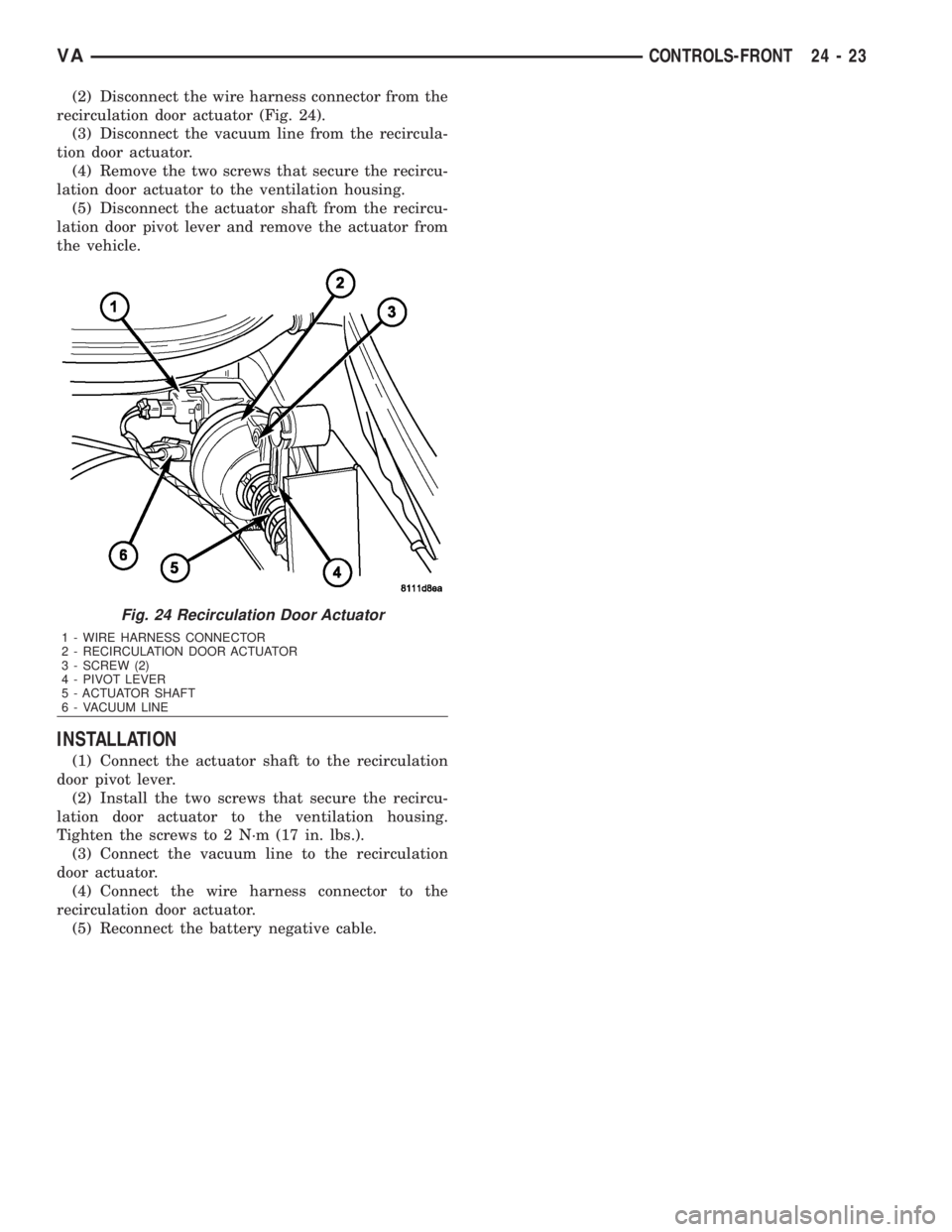
(2) Disconnect the wire harness connector from the
recirculation door actuator (Fig. 24).
(3) Disconnect the vacuum line from the recircula-
tion door actuator.
(4) Remove the two screws that secure the recircu-
lation door actuator to the ventilation housing.
(5) Disconnect the actuator shaft from the recircu-
lation door pivot lever and remove the actuator from
the vehicle.
INSTALLATION
(1) Connect the actuator shaft to the recirculation
door pivot lever.
(2) Install the two screws that secure the recircu-
lation door actuator to the ventilation housing.
Tighten the screws to 2 N´m (17 in. lbs.).
(3) Connect the vacuum line to the recirculation
door actuator.
(4) Connect the wire harness connector to the
recirculation door actuator.
(5) Reconnect the battery negative cable.
Fig. 24 Recirculation Door Actuator
1 - WIRE HARNESS CONNECTOR
2 - RECIRCULATION DOOR ACTUATOR
3 - SCREW (2)
4 - PIVOT LEVER
5 - ACTUATOR SHAFT
6 - VACUUM LINE
VACONTROLS-FRONT 24 - 23
Page 2062 of 2305
OPERATION
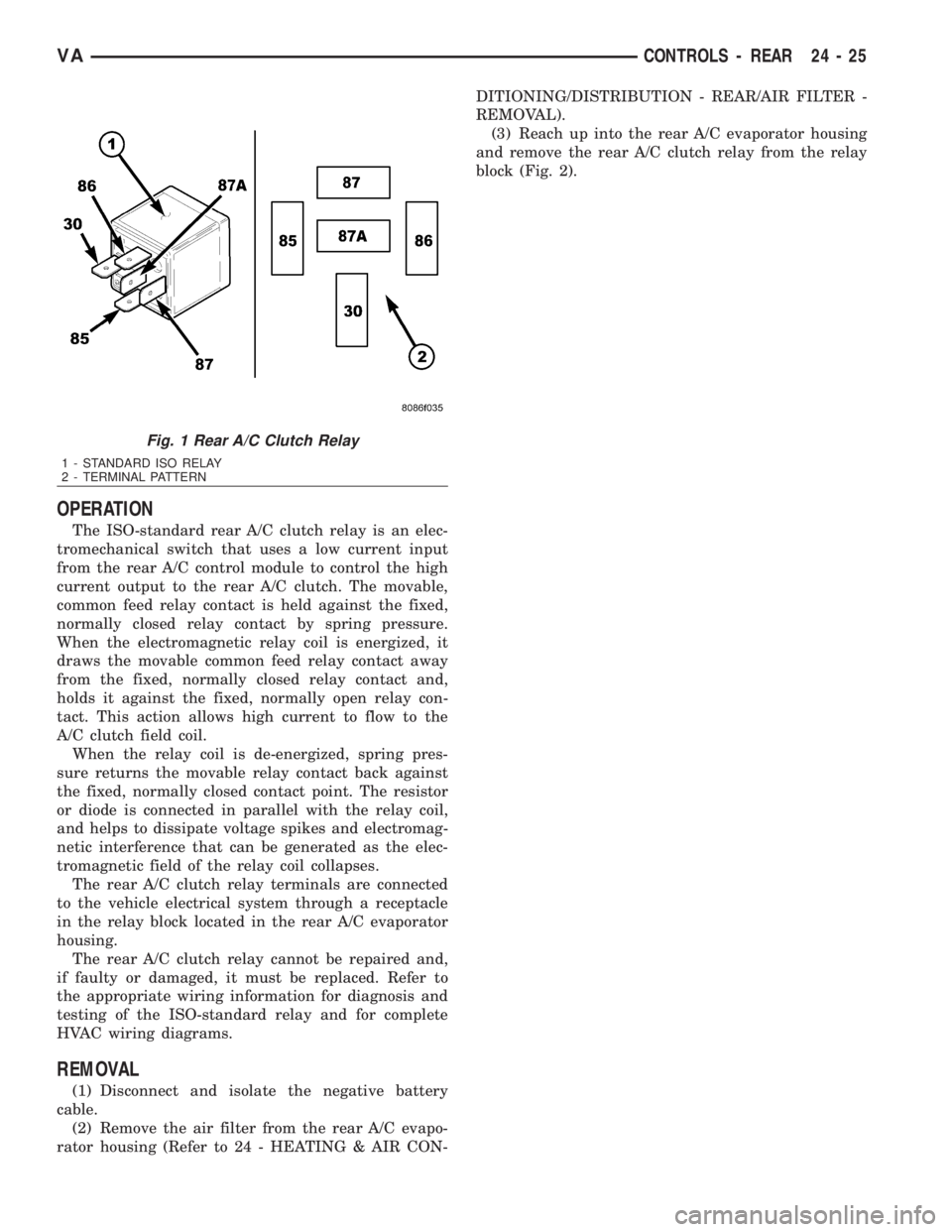
The ISO-standard rear A/C clutch relay is an elec-
tromechanical switch that uses a low current input
from the rear A/C control module to control the high
current output to the rear A/C clutch. The movable,
common feed relay contact is held against the fixed,
normally closed relay contact by spring pressure.
When the electromagnetic relay coil is energized, it
draws the movable common feed relay contact away
from the fixed, normally closed relay contact and,
holds it against the fixed, normally open relay con-
tact. This action allows high current to flow to the
A/C clutch field coil.
When the relay coil is de-energized, spring pres-
sure returns the movable relay contact back against
the fixed, normally closed contact point. The resistor
or diode is connected in parallel with the relay coil,
and helps to dissipate voltage spikes and electromag-
netic interference that can be generated as the elec-
tromagnetic field of the relay coil collapses.
The rear A/C clutch relay terminals are connected
to the vehicle electrical system through a receptacle
in the relay block located in the rear A/C evaporator
housing.
The rear A/C clutch relay cannot be repaired and,
if faulty or damaged, it must be replaced. Refer to
the appropriate wiring information for diagnosis and
testing of the ISO-standard relay and for complete
HVAC wiring diagrams.
REMOVAL
(1) Disconnect and isolate the negative battery
cable.
(2) Remove the air filter from the rear A/C evapo-
rator housing (Refer to 24 - HEATING & AIR CON-DITIONING/DISTRIBUTION - REAR/AIR FILTER -
REMOVAL).
(3) Reach up into the rear A/C evaporator housing
and remove the rear A/C clutch relay from the relay
block (Fig. 2).
Fig. 1 Rear A/C Clutch Relay
1 - STANDARD ISO RELAY
2 - TERMINAL PATTERN
VACONTROLS - REAR 24 - 25
Page 2063 of 2305
INSTALLATION
(1) Position the rear A/C clutch relay into the
proper receptacle of the relay block located in the
rear A/C evaporator housing.
(2) Align the A/C clutch relay terminals with the
terminal cavities in the relay block receptacle and
push down firmly on the relay until the terminals
are fully seated.
(3) Install the rear air filter (Refer to 24 - HEAT-
ING & AIR CONDITIONING/DISTRIBUTION -
REAR/AIR FILTER - INSTALLATION).
(4) Reconnect the negative battery cable.
A / C CONDENSER FAN RELAY
DESCRIPTION
The rear A/C condenser fan relay for the rear A/C
system is an International Standards Organization
(ISO)-type relay (Fig. 3). Relays conforming to the
ISO specifications have common physical dimensions,
current capacities, terminal functions and patterns.
The rear A/C condenser fan relay is an electrome-
chanical device that uses a low current input to con-
trol the high current output to the A/C condenser fan
for the rear heating-A/C system.
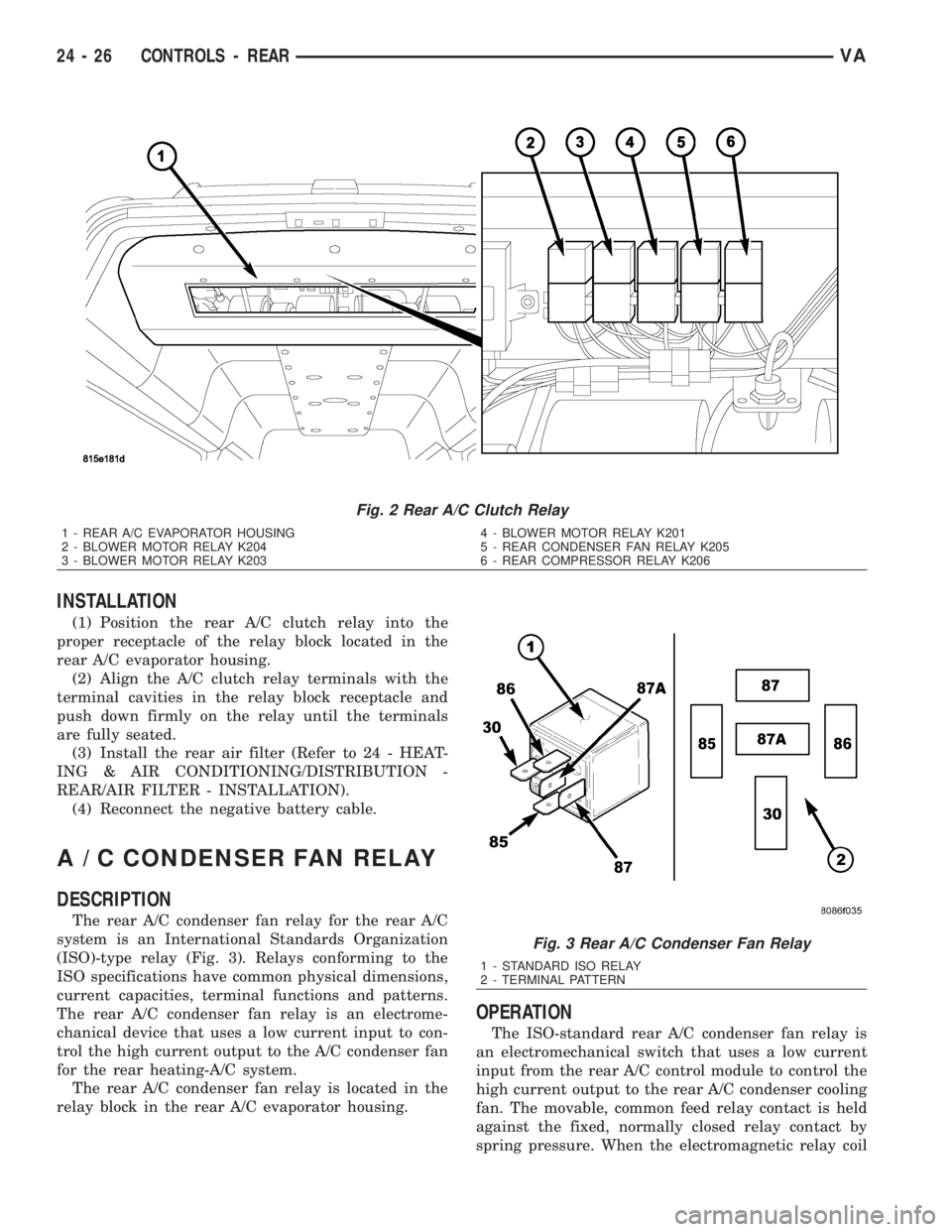
The rear A/C condenser fan relay is located in the
relay block in the rear A/C evaporator housing.
OPERATION
The ISO-standard rear A/C condenser fan relay is
an electromechanical switch that uses a low current
input from the rear A/C control module to control the
high current output to the rear A/C condenser cooling
fan. The movable, common feed relay contact is held
against the fixed, normally closed relay contact by
spring pressure. When the electromagnetic relay coil
Fig. 2 Rear A/C Clutch Relay
1 - REAR A/C EVAPORATOR HOUSING
2 - BLOWER MOTOR RELAY K204
3 - BLOWER MOTOR RELAY K2034 - BLOWER MOTOR RELAY K201
5 - REAR CONDENSER FAN RELAY K205
6 - REAR COMPRESSOR RELAY K206
Fig. 3 Rear A/C Condenser Fan Relay
1 - STANDARD ISO RELAY
2 - TERMINAL PATTERN
24 - 26 CONTROLS - REARVA
Page 2064 of 2305
is energized, it draws the movable common feed relay
contact away from the fixed, normally closed relay
contact and, holds it against the fixed, normally open
relay contact. This action allows high current to flow
to the electric cooling fan motor.
When the relay coil is de-energized, spring pres-
sure returns the movable relay contact back against
the fixed, normally closed contact point. The resistor
or diode is connected in parallel with the relay coil,
and helps to dissipate voltage spikes and electromag-
netic interference that can be generated as the elec-
tromagnetic field of the relay coil collapses.
The rear A/C condenser fan relay terminals are
connected to the vehicle electrical system through a
receptacle in the relay block located in the rear A/C
evaporator housing.
The rear A/C condenser fan relay cannot be
repaired and, if faulty or damaged, it must be
replaced. Refer to the appropriate wiring information
for diagnosis and testing of the ISO-standard relay
and for complete HVAC wiring diagrams.
REMOVAL
(1) Disconnect and isolate the negative battery
cable.
(2) Remove the air filter from the rear A/C evapo-
rator housing (Refer to 24 - HEATING & AIR CON-
DITIONING/DISTRIBUTION - REAR/AIR FILTER -
REMOVAL).
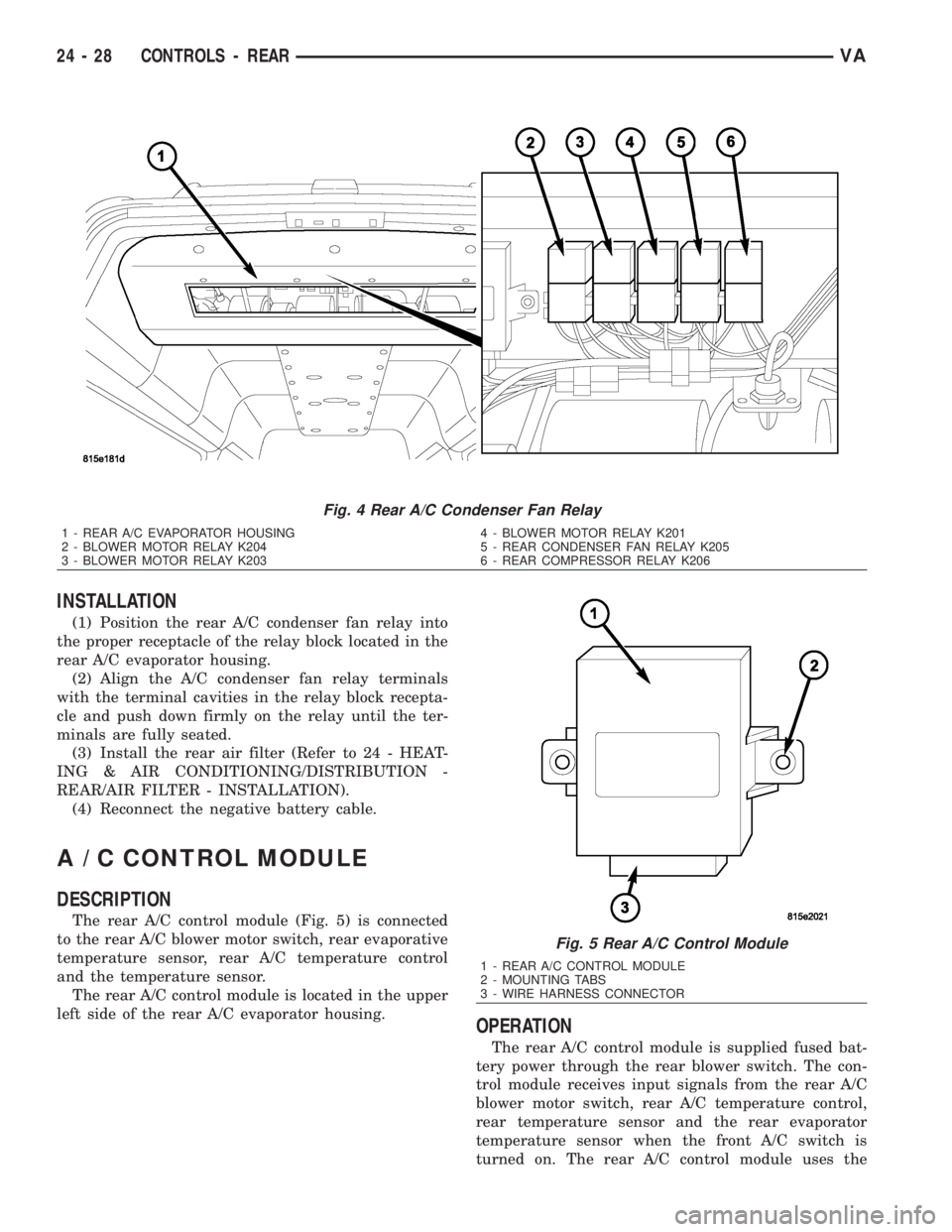
(3) Reach up into the rear A/C evaporator housing
and remove the rear A/C condenser fan relay from
the relay block (Fig. 4).
VACONTROLS - REAR 24 - 27
Page 2065 of 2305
INSTALLATION
(1) Position the rear A/C condenser fan relay into
the proper receptacle of the relay block located in the
rear A/C evaporator housing.
(2) Align the A/C condenser fan relay terminals
with the terminal cavities in the relay block recepta-
cle and push down firmly on the relay until the ter-
minals are fully seated.
(3) Install the rear air filter (Refer to 24 - HEAT-
ING & AIR CONDITIONING/DISTRIBUTION -
REAR/AIR FILTER - INSTALLATION).
(4) Reconnect the negative battery cable.
A / C CONTROL MODULE
DESCRIPTION
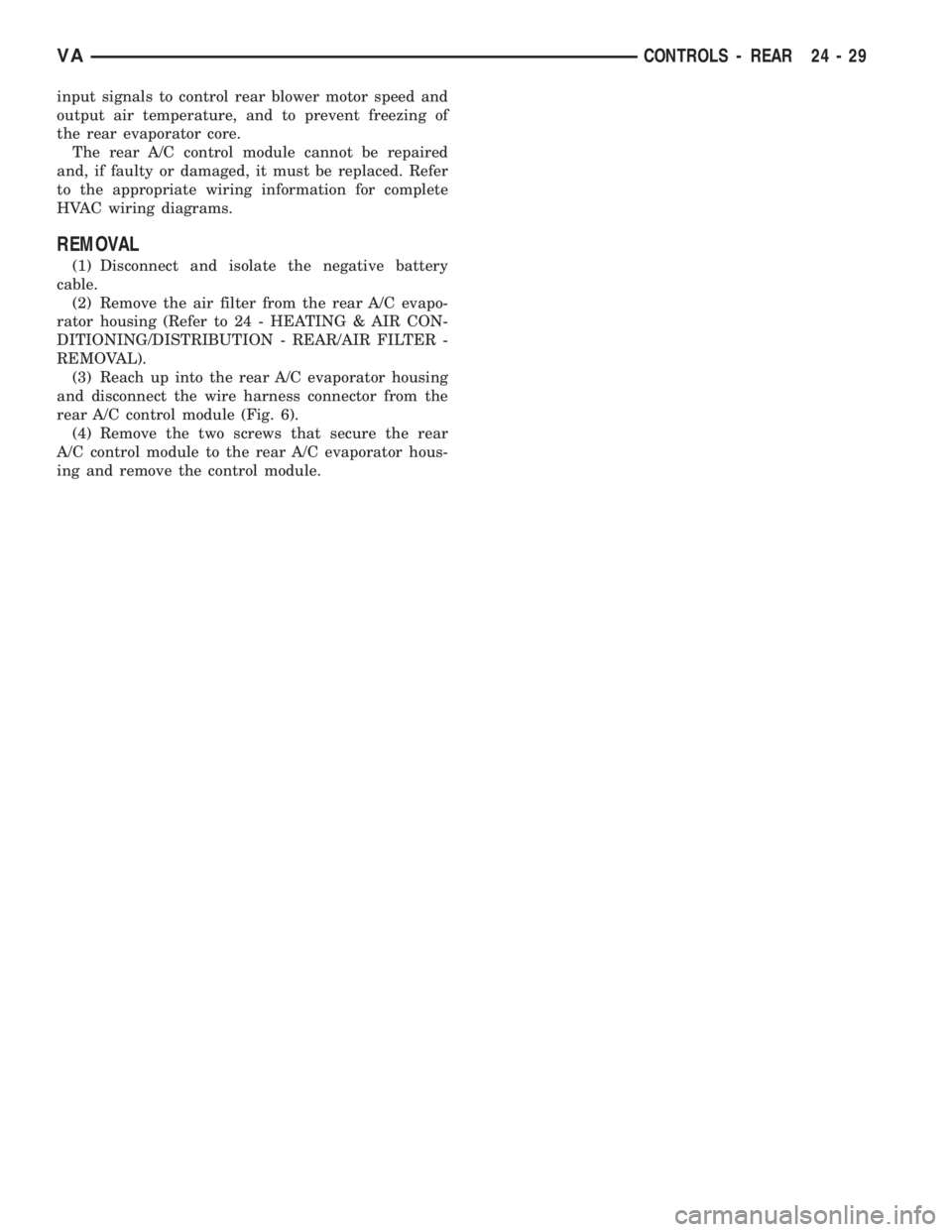
The rear A/C control module (Fig. 5) is connected
to the rear A/C blower motor switch, rear evaporative
temperature sensor, rear A/C temperature control
and the temperature sensor.
The rear A/C control module is located in the upper
left side of the rear A/C evaporator housing.
OPERATION
The rear A/C control module is supplied fused bat-
tery power through the rear blower switch. The con-
trol module receives input signals from the rear A/C
blower motor switch, rear A/C temperature control,
rear temperature sensor and the rear evaporator
temperature sensor when the front A/C switch is
turned on. The rear A/C control module uses the
Fig. 4 Rear A/C Condenser Fan Relay
1 - REAR A/C EVAPORATOR HOUSING
2 - BLOWER MOTOR RELAY K204
3 - BLOWER MOTOR RELAY K2034 - BLOWER MOTOR RELAY K201
5 - REAR CONDENSER FAN RELAY K205
6 - REAR COMPRESSOR RELAY K206
Fig. 5 Rear A/C Control Module
1 - REAR A/C CONTROL MODULE
2 - MOUNTING TABS
3 - WIRE HARNESS CONNECTOR
24 - 28 CONTROLS - REARVA
Page 2066 of 2305
input signals to control rear blower motor speed and
output air temperature, and to prevent freezing of
the rear evaporator core.
The rear A/C control module cannot be repaired
and, if faulty or damaged, it must be replaced. Refer
to the appropriate wiring information for complete
HVAC wiring diagrams.
REMOVAL
(1) Disconnect and isolate the negative battery
cable.
(2) Remove the air filter from the rear A/C evapo-
rator housing (Refer to 24 - HEATING & AIR CON-
DITIONING/DISTRIBUTION - REAR/AIR FILTER -
REMOVAL).
(3) Reach up into the rear A/C evaporator housing
and disconnect the wire harness connector from the
rear A/C control module (Fig. 6).
(4) Remove the two screws that secure the rear
A/C control module to the rear A/C evaporator hous-
ing and remove the control module.
VACONTROLS - REAR 24 - 29