battery MERCEDES-BENZ SPRINTER 2006 Service Manual
[x] Cancel search | Manufacturer: MERCEDES-BENZ, Model Year: 2006, Model line: SPRINTER, Model: MERCEDES-BENZ SPRINTER 2006Pages: 2305, PDF Size: 48.12 MB
Page 2067 of 2305
INSTALLATION
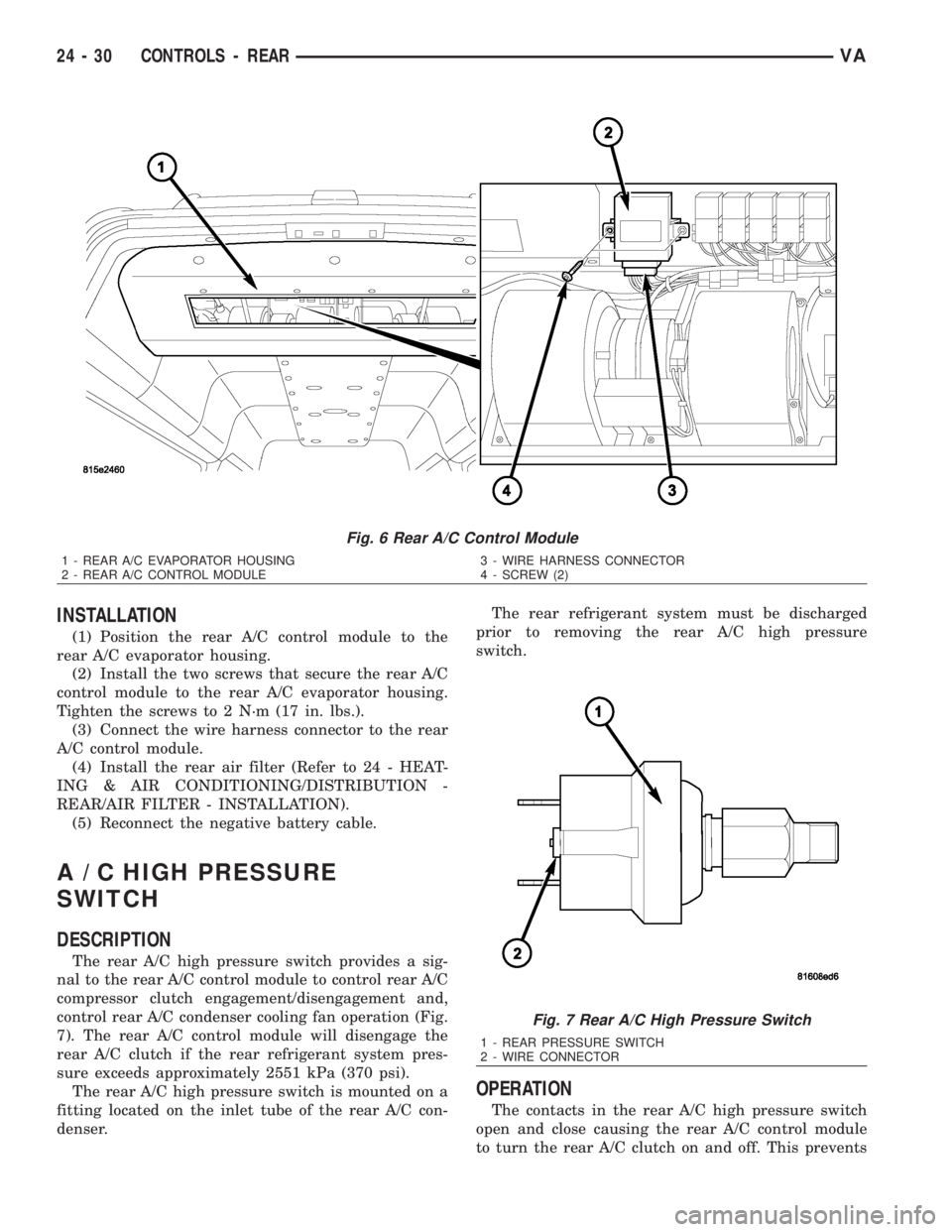
(1) Position the rear A/C control module to the
rear A/C evaporator housing.
(2) Install the two screws that secure the rear A/C
control module to the rear A/C evaporator housing.
Tighten the screws to 2 N´m (17 in. lbs.).
(3) Connect the wire harness connector to the rear
A/C control module.
(4) Install the rear air filter (Refer to 24 - HEAT-
ING & AIR CONDITIONING/DISTRIBUTION -
REAR/AIR FILTER - INSTALLATION).
(5) Reconnect the negative battery cable.
A / C HIGH PRESSURE
SWITCH
DESCRIPTION
The rear A/C high pressure switch provides a sig-
nal to the rear A/C control module to control rear A/C
compressor clutch engagement/disengagement and,
control rear A/C condenser cooling fan operation (Fig.
7). The rear A/C control module will disengage the
rear A/C clutch if the rear refrigerant system pres-
sure exceeds approximately 2551 kPa (370 psi).
The rear A/C high pressure switch is mounted on a
fitting located on the inlet tube of the rear A/C con-
denser.The rear refrigerant system must be discharged
prior to removing the rear A/C high pressure
switch.
OPERATION
The contacts in the rear A/C high pressure switch
open and close causing the rear A/C control module
to turn the rear A/C clutch on and off. This prevents
Fig. 6 Rear A/C Control Module
1 - REAR A/C EVAPORATOR HOUSING
2 - REAR A/C CONTROL MODULE3 - WIRE HARNESS CONNECTOR
4 - SCREW (2)
Fig. 7 Rear A/C High Pressure Switch
1 - REAR PRESSURE SWITCH
2 - WIRE CONNECTOR
24 - 30 CONTROLS - REARVA
Page 2068 of 2305
rear A/C compressor operation when the rear dis-
charge line pressure approaches high levels, and also
reduces electrical surging from rear A/C clutch
engagement.
The rear A/C high pressure switch controls rear
A/C condenser cooling fan operation by monitoring
the rear discharge line pressure. When the rear dis-
charge pressure rises above approximately 1900 to
2200 kPa (280 to 320 psi) the rear A/C condenser
cooling fan will turn on. The rear condenser cooling
fan will turn off when the rear discharge pressure
drops to approximately 1600 kPa (235 psi).
The rear A/C high pressure switch contacts open
when the rear discharge line pressure rises above
approximately 3100 to 3375 kPa (450 to 490 psi). The
rear A/C high pressure switch contacts close when
the rear discharge line pressure drops to approxi-
mately 1860 to 2275 kPa (270 to 330 psi).
The rear A/C high pressure switch is factory-cali-
brated and cannot be adjusted or repaired and, if
faulty or damaged, it must be replaced. Refer to the
appropriate wiring information for complete HVAC
wiring diagrams.
REMOVAL
WARNING: Refer to the applicable warnings and
cautions for this system before performing the fol-
lowing operation (Refer to 24 - HEATING & AIR
CONDITIONING/PLUMBING - WARNINGS) and (Refer
to 24 - HEATING & AIR CONDITIONING/PLUMBING -
CAUTIONS). Failure to follow the warnings and cau-
tions could result in possible personal injury or
death.
(1) Disconnect and isolate the negative battery
cable.
(2) Remove the air filter from the rear A/C evapo-
rator housing (Refer to 24 - HEATING & AIR CON-
DITIONING/DISTRIBUTION - REAR/AIR FILTER -
REMOVAL).
(3) Recover the refrigerant from the rear refriger-
ant system (Refer to 24 - HEATING & AIR CONDI-
TIONING/PLUMBING - STANDARD PROCEDURE -
REFRIGERANT RECOVERY).
(4) Remove the cover from the rear A/C condenser
housing (Refer to 24 - HEATING & AIR CONDI-
TIONING/DISTRIBUTION - REAR/A/C CON-
DENSER COVER - REMOVAL).
(5) Disconnect the wire harness connector from the
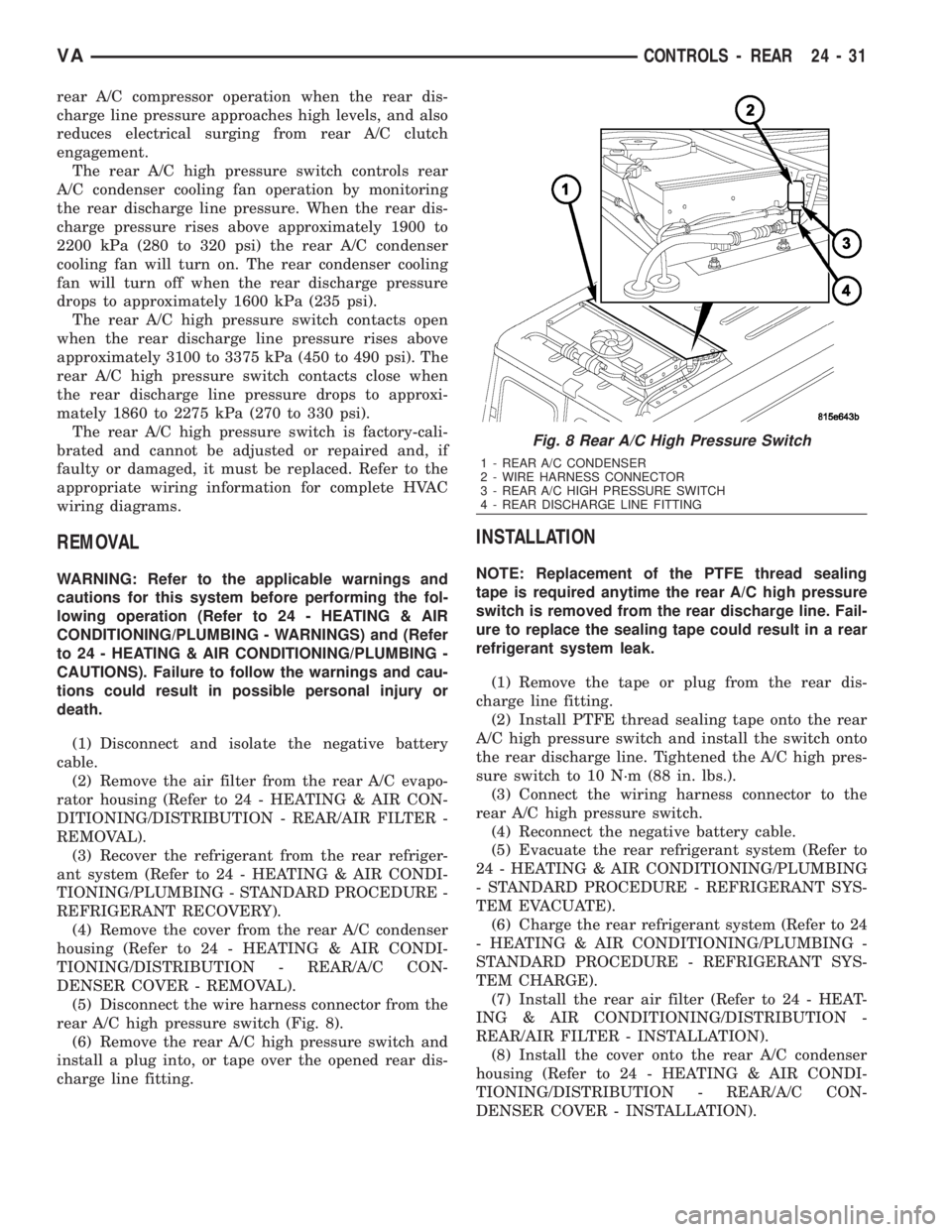
rear A/C high pressure switch (Fig. 8).
(6) Remove the rear A/C high pressure switch and
install a plug into, or tape over the opened rear dis-
charge line fitting.
INSTALLATION
NOTE: Replacement of the PTFE thread sealing
tape is required anytime the rear A/C high pressure
switch is removed from the rear discharge line. Fail-
ure to replace the sealing tape could result in a rear
refrigerant system leak.
(1) Remove the tape or plug from the rear dis-
charge line fitting.
(2) Install PTFE thread sealing tape onto the rear
A/C high pressure switch and install the switch onto
the rear discharge line. Tightened the A/C high pres-
sure switch to 10 N´m (88 in. lbs.).
(3) Connect the wiring harness connector to the
rear A/C high pressure switch.
(4) Reconnect the negative battery cable.
(5) Evacuate the rear refrigerant system (Refer to
24 - HEATING & AIR CONDITIONING/PLUMBING
- STANDARD PROCEDURE - REFRIGERANT SYS-
TEM EVACUATE).
(6) Charge the rear refrigerant system (Refer to 24
- HEATING & AIR CONDITIONING/PLUMBING -
STANDARD PROCEDURE - REFRIGERANT SYS-
TEM CHARGE).
(7) Install the rear air filter (Refer to 24 - HEAT-
ING & AIR CONDITIONING/DISTRIBUTION -
REAR/AIR FILTER - INSTALLATION).
(8) Install the cover onto the rear A/C condenser
housing (Refer to 24 - HEATING & AIR CONDI-
TIONING/DISTRIBUTION - REAR/A/C CON-
DENSER COVER - INSTALLATION).
Fig. 8 Rear A/C High Pressure Switch
1 - REAR A/C CONDENSER
2 - WIRE HARNESS CONNECTOR
3 - REAR A/C HIGH PRESSURE SWITCH
4 - REAR DISCHARGE LINE FITTING
VACONTROLS - REAR 24 - 31
Page 2069 of 2305
A / C LOW PRESSURE SWITCH
DESCRIPTION
The rear A/C low pressure switch provides a signal
to the rear A/C control module to regulate the rear
refrigerant system pressure and control rear A/C
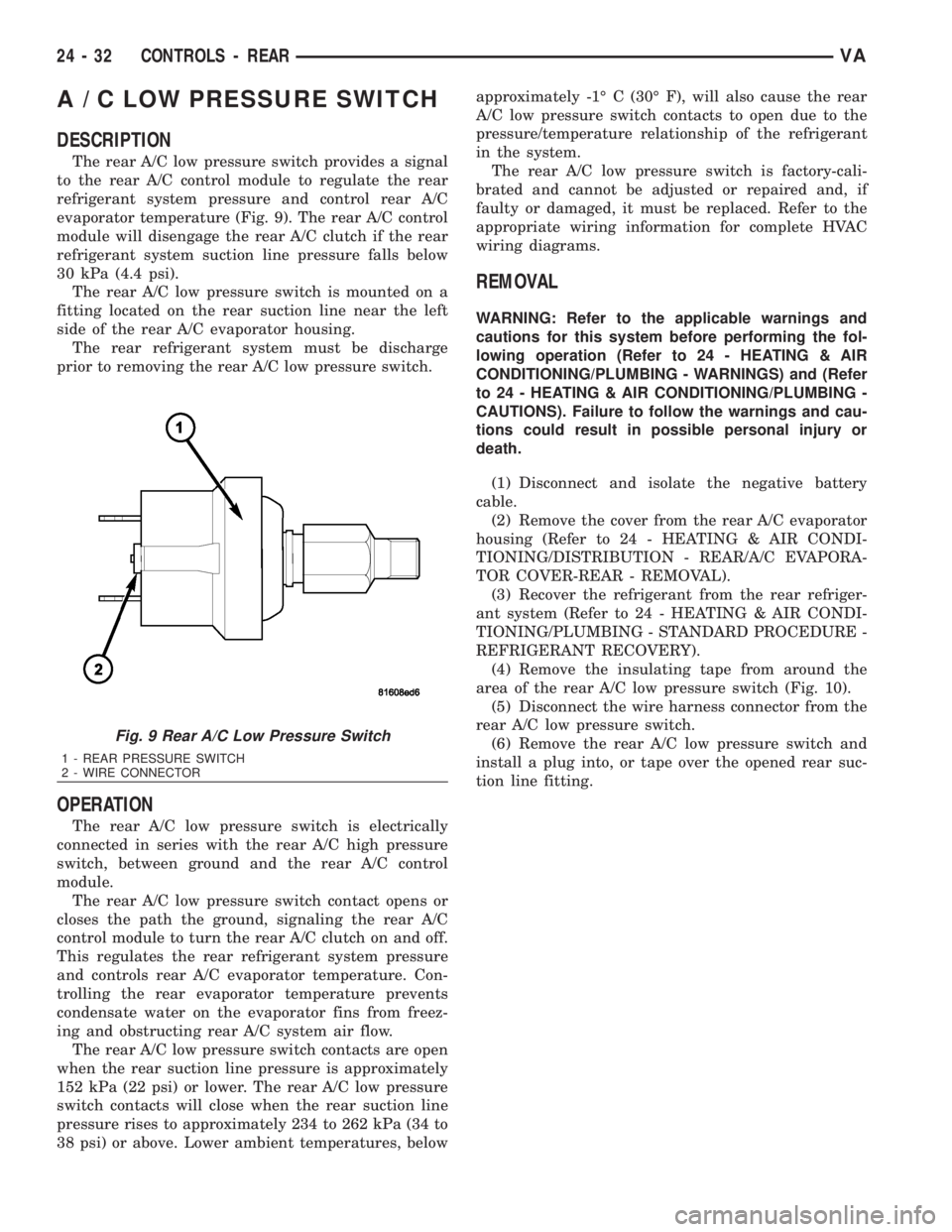
evaporator temperature (Fig. 9). The rear A/C control
module will disengage the rear A/C clutch if the rear
refrigerant system suction line pressure falls below
30 kPa (4.4 psi).
The rear A/C low pressure switch is mounted on a
fitting located on the rear suction line near the left
side of the rear A/C evaporator housing.
The rear refrigerant system must be discharge
prior to removing the rear A/C low pressure switch.
OPERATION
The rear A/C low pressure switch is electrically
connected in series with the rear A/C high pressure
switch, between ground and the rear A/C control
module.
The rear A/C low pressure switch contact opens or
closes the path the ground, signaling the rear A/C
control module to turn the rear A/C clutch on and off.
This regulates the rear refrigerant system pressure
and controls rear A/C evaporator temperature. Con-
trolling the rear evaporator temperature prevents
condensate water on the evaporator fins from freez-
ing and obstructing rear A/C system air flow.
The rear A/C low pressure switch contacts are open
when the rear suction line pressure is approximately
152 kPa (22 psi) or lower. The rear A/C low pressure
switch contacts will close when the rear suction line
pressure rises to approximately 234 to 262 kPa (34 to
38 psi) or above. Lower ambient temperatures, belowapproximately -1É C (30É F), will also cause the rear
A/C low pressure switch contacts to open due to the
pressure/temperature relationship of the refrigerant
in the system.
The rear A/C low pressure switch is factory-cali-
brated and cannot be adjusted or repaired and, if
faulty or damaged, it must be replaced. Refer to the
appropriate wiring information for complete HVAC
wiring diagrams.
REMOVAL
WARNING: Refer to the applicable warnings and
cautions for this system before performing the fol-
lowing operation (Refer to 24 - HEATING & AIR
CONDITIONING/PLUMBING - WARNINGS) and (Refer
to 24 - HEATING & AIR CONDITIONING/PLUMBING -
CAUTIONS). Failure to follow the warnings and cau-
tions could result in possible personal injury or
death.
(1) Disconnect and isolate the negative battery
cable.
(2) Remove the cover from the rear A/C evaporator
housing (Refer to 24 - HEATING & AIR CONDI-
TIONING/DISTRIBUTION - REAR/A/C EVAPORA-
TOR COVER-REAR - REMOVAL).
(3) Recover the refrigerant from the rear refriger-
ant system (Refer to 24 - HEATING & AIR CONDI-
TIONING/PLUMBING - STANDARD PROCEDURE -
REFRIGERANT RECOVERY).
(4) Remove the insulating tape from around the
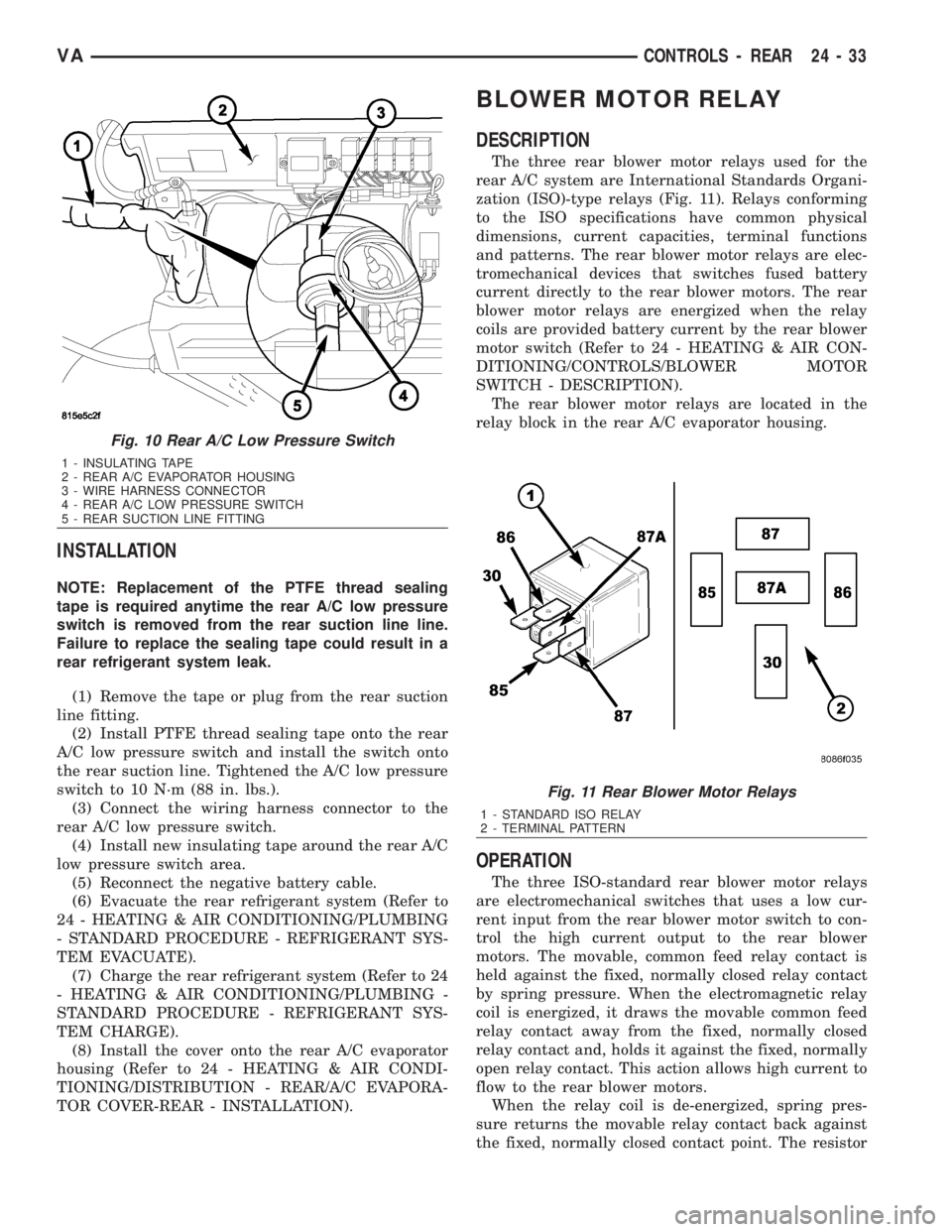
area of the rear A/C low pressure switch (Fig. 10).
(5) Disconnect the wire harness connector from the
rear A/C low pressure switch.
(6) Remove the rear A/C low pressure switch and
install a plug into, or tape over the opened rear suc-
tion line fitting.
Fig. 9 Rear A/C Low Pressure Switch
1 - REAR PRESSURE SWITCH
2 - WIRE CONNECTOR
24 - 32 CONTROLS - REARVA
Page 2070 of 2305
INSTALLATION
NOTE: Replacement of the PTFE thread sealing
tape is required anytime the rear A/C low pressure
switch is removed from the rear suction line line.
Failure to replace the sealing tape could result in a
rear refrigerant system leak.
(1) Remove the tape or plug from the rear suction
line fitting.
(2) Install PTFE thread sealing tape onto the rear
A/C low pressure switch and install the switch onto
the rear suction line. Tightened the A/C low pressure
switch to 10 N´m (88 in. lbs.).
(3) Connect the wiring harness connector to the
rear A/C low pressure switch.
(4) Install new insulating tape around the rear A/C
low pressure switch area.
(5) Reconnect the negative battery cable.
(6) Evacuate the rear refrigerant system (Refer to
24 - HEATING & AIR CONDITIONING/PLUMBING
- STANDARD PROCEDURE - REFRIGERANT SYS-
TEM EVACUATE).
(7) Charge the rear refrigerant system (Refer to 24
- HEATING & AIR CONDITIONING/PLUMBING -
STANDARD PROCEDURE - REFRIGERANT SYS-
TEM CHARGE).
(8) Install the cover onto the rear A/C evaporator
housing (Refer to 24 - HEATING & AIR CONDI-
TIONING/DISTRIBUTION - REAR/A/C EVAPORA-
TOR COVER-REAR - INSTALLATION).
BLOWER MOTOR RELAY
DESCRIPTION
The three rear blower motor relays used for the
rear A/C system are International Standards Organi-
zation (ISO)-type relays (Fig. 11). Relays conforming
to the ISO specifications have common physical
dimensions, current capacities, terminal functions
and patterns. The rear blower motor relays are elec-
tromechanical devices that switches fused battery
current directly to the rear blower motors. The rear
blower motor relays are energized when the relay
coils are provided battery current by the rear blower
motor switch (Refer to 24 - HEATING & AIR CON-
DITIONING/CONTROLS/BLOWER MOTOR
SWITCH - DESCRIPTION).
The rear blower motor relays are located in the
relay block in the rear A/C evaporator housing.
OPERATION
The three ISO-standard rear blower motor relays
are electromechanical switches that uses a low cur-
rent input from the rear blower motor switch to con-
trol the high current output to the rear blower
motors. The movable, common feed relay contact is
held against the fixed, normally closed relay contact
by spring pressure. When the electromagnetic relay
coil is energized, it draws the movable common feed
relay contact away from the fixed, normally closed
relay contact and, holds it against the fixed, normally
open relay contact. This action allows high current to
flow to the rear blower motors.
When the relay coil is de-energized, spring pres-
sure returns the movable relay contact back against
the fixed, normally closed contact point. The resistor
Fig. 10 Rear A/C Low Pressure Switch
1 - INSULATING TAPE
2 - REAR A/C EVAPORATOR HOUSING
3 - WIRE HARNESS CONNECTOR
4 - REAR A/C LOW PRESSURE SWITCH
5 - REAR SUCTION LINE FITTING
Fig. 11 Rear Blower Motor Relays
1 - STANDARD ISO RELAY
2 - TERMINAL PATTERN
VACONTROLS - REAR 24 - 33
Page 2071 of 2305
or diode is connected in parallel with the relay coil,
and helps to dissipate voltage spikes and electromag-
netic interference that can be generated as the elec-
tromagnetic field of the relay coil collapses.
The rear blower motor relay terminals are con-
nected to the vehicle electrical system through recep-
tacles in the relay block located in the rear A/C
evaporator housing.
The rear blower motor relays cannot be repaired
and, if faulty or damaged, they must be replaced.
Refer to the appropriate wiring information for diag-
nosis and testing of the ISO-standard relay and for
complete HVAC wiring diagrams.
REMOVAL
(1) Disconnect and isolate the negative battery
cable.
(2) Remove the air filter from the rear A/C evapo-
rator housing (Refer to 24 - HEATING & AIR CON-
DITIONING/DISTRIBUTION - REAR/AIR FILTER -
REMOVAL).
(3) Reach up into the rear A/C evaporator housing
and remove the rear blower motor relays as neces-
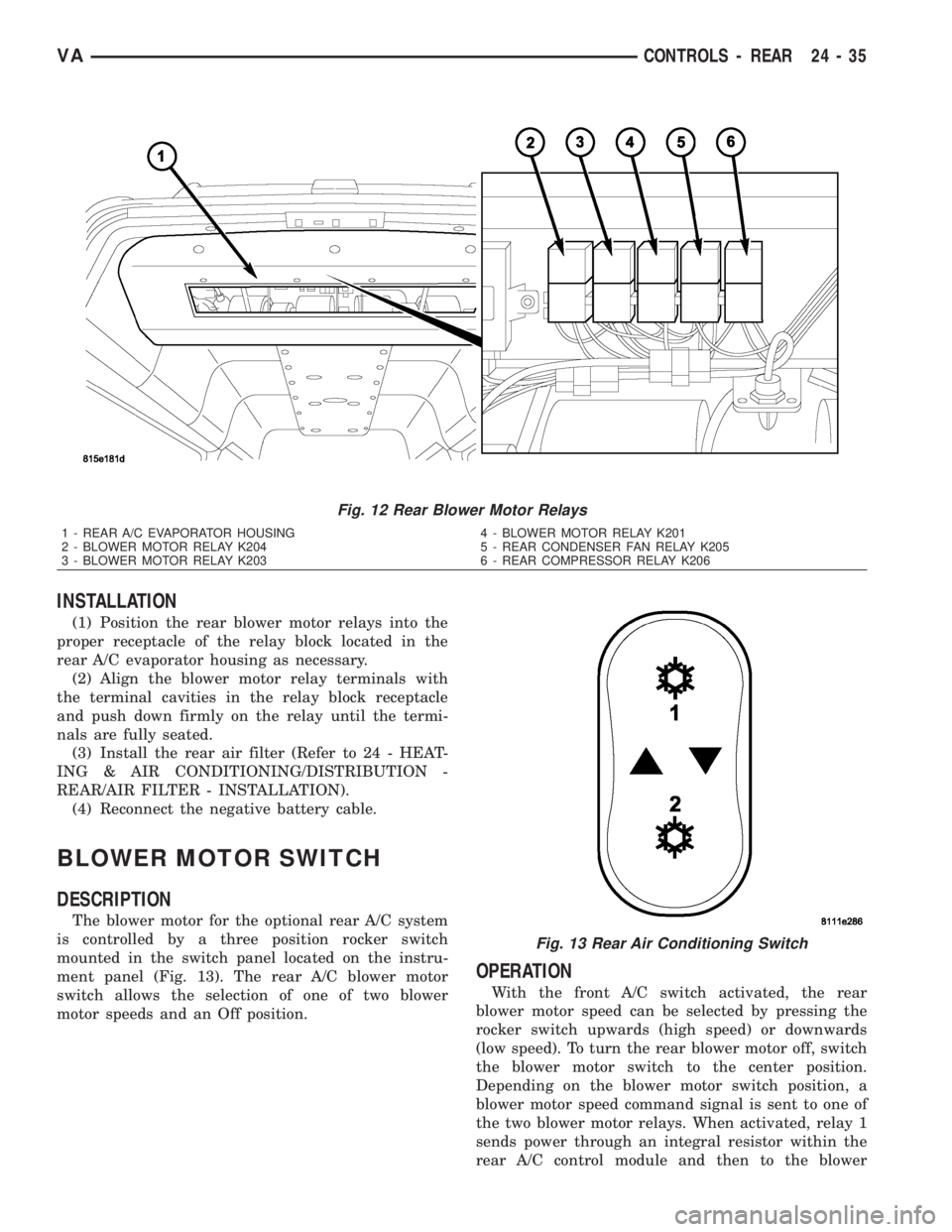
sary from the relay block (Fig. 12).
24 - 34 CONTROLS - REARVA
Page 2072 of 2305
INSTALLATION
(1) Position the rear blower motor relays into the
proper receptacle of the relay block located in the
rear A/C evaporator housing as necessary.
(2) Align the blower motor relay terminals with
the terminal cavities in the relay block receptacle
and push down firmly on the relay until the termi-
nals are fully seated.
(3) Install the rear air filter (Refer to 24 - HEAT-
ING & AIR CONDITIONING/DISTRIBUTION -
REAR/AIR FILTER - INSTALLATION).
(4) Reconnect the negative battery cable.
BLOWER MOTOR SWITCH
DESCRIPTION
The blower motor for the optional rear A/C system
is controlled by a three position rocker switch
mounted in the switch panel located on the instru-
ment panel (Fig. 13). The rear A/C blower motor
switch allows the selection of one of two blower
motor speeds and an Off position.
OPERATION
With the front A/C switch activated, the rear
blower motor speed can be selected by pressing the
rocker switch upwards (high speed) or downwards
(low speed). To turn the rear blower motor off, switch
the blower motor switch to the center position.
Depending on the blower motor switch position, a
blower motor speed command signal is sent to one of
the two blower motor relays. When activated, relay 1
sends power through an integral resistor within the
rear A/C control module and then to the blower
Fig. 12 Rear Blower Motor Relays
1 - REAR A/C EVAPORATOR HOUSING
2 - BLOWER MOTOR RELAY K204
3 - BLOWER MOTOR RELAY K2034 - BLOWER MOTOR RELAY K201
5 - REAR CONDENSER FAN RELAY K205
6 - REAR COMPRESSOR RELAY K206
Fig. 13 Rear Air Conditioning Switch
VACONTROLS - REAR 24 - 35
Page 2073 of 2305
motor, while relay 2 when activated, sends power
directly to the blower motor.
The rear blower motor switch cannot be repaired
and, if faulty or damaged, it must be replaced.
DIAGNOSIS AND TESTING
REAR BLOWER MOTOR SWITCH
Before testing the rear blower motor switch, verify
that the front A/C system is functional by performing
the ATC Fuction Test using the DRBIIItscan tool.
Use a volt/ohmmeter to test the rear blower motor
switch. For circuit descriptions and diagrams, refer
to the appropriate wiring information. The wiring
information includes wiring diagrams, proper wire
and connector repair procedures, details of wire har-
ness routing and retention, connector pin-out infor-
mation and location views for the various wire
harness connectors, splices and grounds.
WARNING: To avoid personal injury or death, on
vehicles equipped with airbags, disable the supple-
mental restraint system before attempting any
steering wheel, steering column, airbag, seat belt
tensioner, impact sensor, or instrument panel com-
ponent diagnosis or service. Disconnect and isolate
the battery negative (ground) cable, then wait two
minutes for the system capacitor to discharge
before performing further diagnosis or service. This
is the only sure way to disable the supplemental
restraint system. Failure to take the proper precau-
tions could result in accidental airbag deployment.
(1) Disconnect and isolate the battery negative
cable.
(2) Unplug the wire harness connector from the
rear blower motor switch.
(3) Check for continuity between terminal 10 and
terminals 1, 7 and 4 of the blower motor switch. In
all instances, there should be continuity.
NOTE: To check the switch's internal circuits, con-
nect the negative lead of the ohmmeter to terminal
10 and the positive ohmmeter lead to terminals 1, 7
and 4. To check the switch's integral light emitting
diodes, reverse the ohmmeter leads.
(4) Check for continuity between the rear blower
motor switch terminals 3 and 7 as you move the
blower motor switch to each of the two speed posi-
tions, and the Off position. There should be continu-
ity in only one blower motor switch speed position.
(5) Check for continuity between the rear blower
motor switch terminals 4 and 8 as you move the
blower motor switch to each of the two speed posi-
tions, and the Off position. There should be continu-ity in only the other blower motor switch speed
position.
(6) If OK, test and repair the rear blower motor
switch wire harness circuits. If not OK, replace the
faulty rear blower motor switch.
REMOVAL
WARNING: To avoid personal injury or death, on
vehicles equipped with airbags, disable the supple-
mental restraint system before attempting any
steering wheel, steering column, airbag, seat belt
tensioner, impact sensor, or instrument panel com-
ponent diagnosis or service. Disconnect and isolate
the battery negative (ground) cable, then wait two
minutes for the system capacitor to discharge
before performing further diagnosis or service. This
is the only sure way to disable the supplemental
restraint system. Failure to take the proper precau-
tions could result in accidental airbag deployment.
NOTE: The rear A/C blower motor switch is used on
vehicles with the optional rear A/C system.
(1) Disconnect and isolate the negative battery
cable.
(2) Remove the accessory switch panel from the
instrument panel (Refer to 23 - BODY/INSTRU-
MENT PANEL/ACCESSORY SWITCH BEZEL -
REMOVAL).
(3) Disconnect the wire harness connector from the
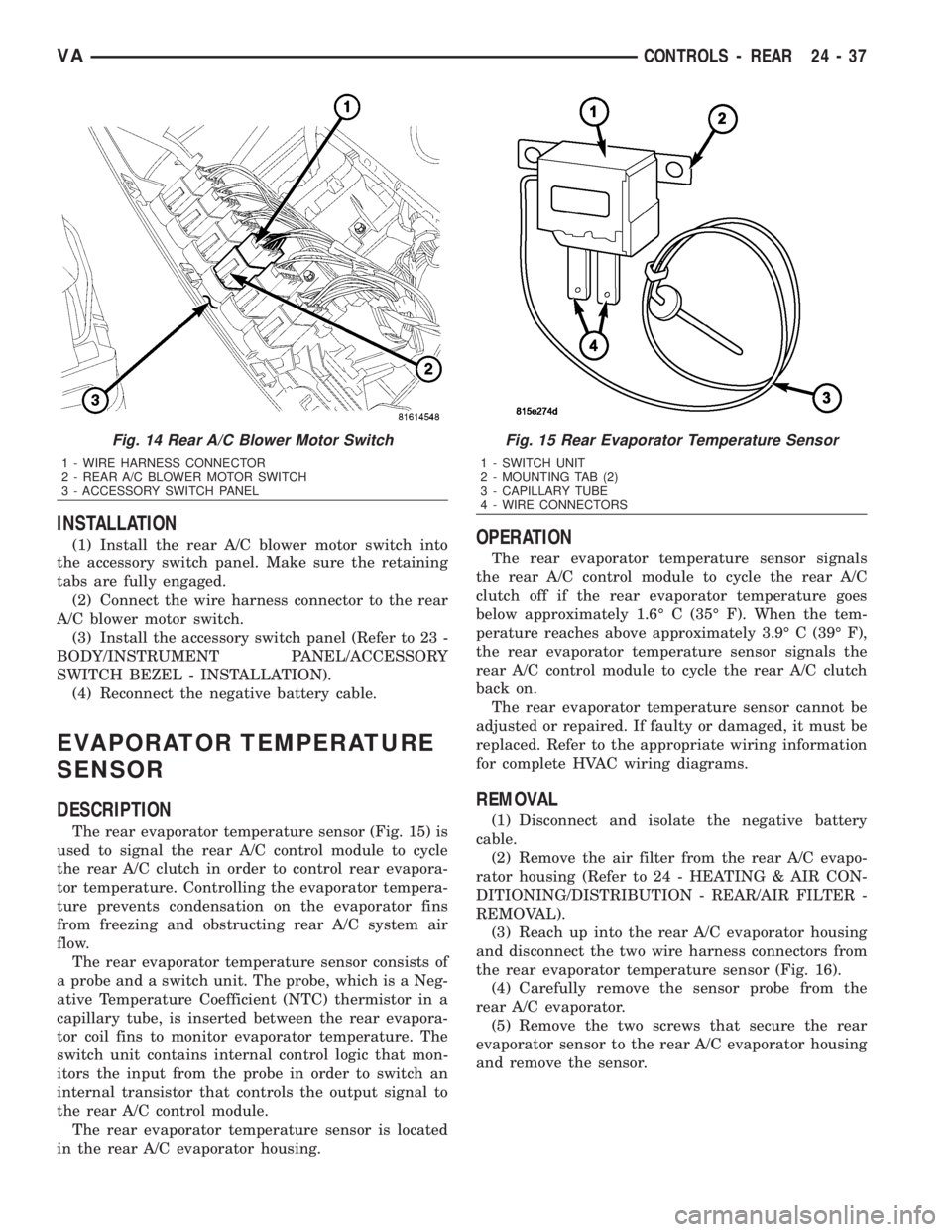
rear A/C blower motor switch (Fig. 14).
(4) Disengage the retaining tabs and remove the
rear A/C blower motor switch from the accessory
switch panel.
24 - 36 CONTROLS - REARVA
Page 2074 of 2305
INSTALLATION
(1) Install the rear A/C blower motor switch into
the accessory switch panel. Make sure the retaining
tabs are fully engaged.
(2) Connect the wire harness connector to the rear
A/C blower motor switch.
(3) Install the accessory switch panel (Refer to 23 -
BODY/INSTRUMENT PANEL/ACCESSORY
SWITCH BEZEL - INSTALLATION).
(4) Reconnect the negative battery cable.
EVAPORATOR TEMPERATURE
SENSOR
DESCRIPTION
The rear evaporator temperature sensor (Fig. 15) is
used to signal the rear A/C control module to cycle
the rear A/C clutch in order to control rear evapora-
tor temperature. Controlling the evaporator tempera-
ture prevents condensation on the evaporator fins
from freezing and obstructing rear A/C system air
flow.
The rear evaporator temperature sensor consists of
a probe and a switch unit. The probe, which is a Neg-
ative Temperature Coefficient (NTC) thermistor in a
capillary tube, is inserted between the rear evapora-
tor coil fins to monitor evaporator temperature. The
switch unit contains internal control logic that mon-
itors the input from the probe in order to switch an
internal transistor that controls the output signal to
the rear A/C control module.
The rear evaporator temperature sensor is located
in the rear A/C evaporator housing.
OPERATION
The rear evaporator temperature sensor signals
the rear A/C control module to cycle the rear A/C
clutch off if the rear evaporator temperature goes
below approximately 1.6É C (35É F). When the tem-
perature reaches above approximately 3.9É C (39É F),
the rear evaporator temperature sensor signals the
rear A/C control module to cycle the rear A/C clutch
back on.
The rear evaporator temperature sensor cannot be
adjusted or repaired. If faulty or damaged, it must be
replaced. Refer to the appropriate wiring information
for complete HVAC wiring diagrams.
REMOVAL
(1) Disconnect and isolate the negative battery
cable.
(2) Remove the air filter from the rear A/C evapo-
rator housing (Refer to 24 - HEATING & AIR CON-
DITIONING/DISTRIBUTION - REAR/AIR FILTER -
REMOVAL).
(3) Reach up into the rear A/C evaporator housing
and disconnect the two wire harness connectors from
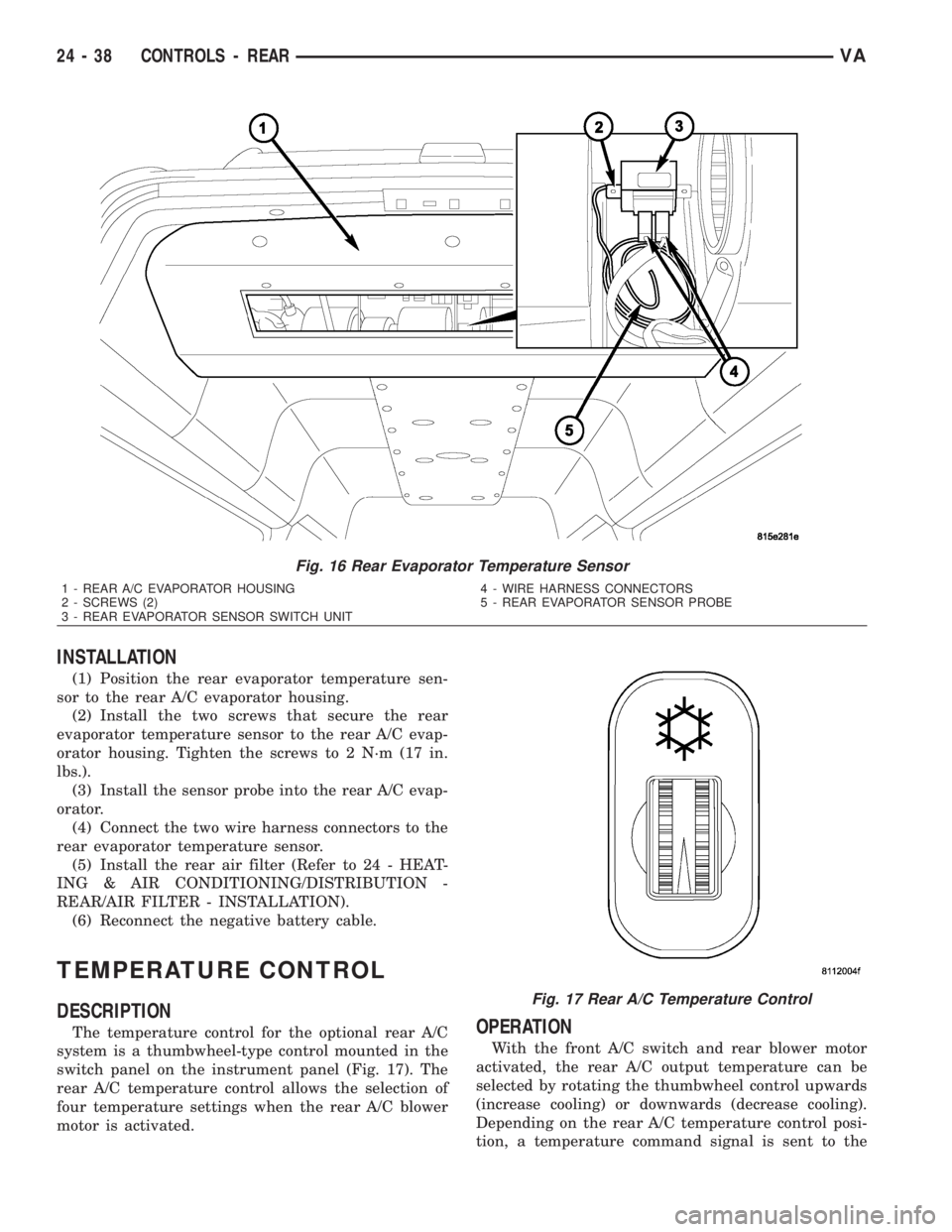
the rear evaporator temperature sensor (Fig. 16).
(4) Carefully remove the sensor probe from the
rear A/C evaporator.
(5) Remove the two screws that secure the rear
evaporator sensor to the rear A/C evaporator housing
and remove the sensor.
Fig. 14 Rear A/C Blower Motor Switch
1 - WIRE HARNESS CONNECTOR
2 - REAR A/C BLOWER MOTOR SWITCH
3 - ACCESSORY SWITCH PANEL
Fig. 15 Rear Evaporator Temperature Sensor
1 - SWITCH UNIT
2 - MOUNTING TAB (2)
3 - CAPILLARY TUBE
4 - WIRE CONNECTORS
VACONTROLS - REAR 24 - 37
Page 2075 of 2305
INSTALLATION
(1) Position the rear evaporator temperature sen-
sor to the rear A/C evaporator housing.
(2) Install the two screws that secure the rear
evaporator temperature sensor to the rear A/C evap-
orator housing. Tighten the screws to 2 N´m (17 in.
lbs.).
(3) Install the sensor probe into the rear A/C evap-
orator.
(4) Connect the two wire harness connectors to the
rear evaporator temperature sensor.
(5) Install the rear air filter (Refer to 24 - HEAT-
ING & AIR CONDITIONING/DISTRIBUTION -
REAR/AIR FILTER - INSTALLATION).
(6) Reconnect the negative battery cable.
TEMPERATURE CONTROL
DESCRIPTION
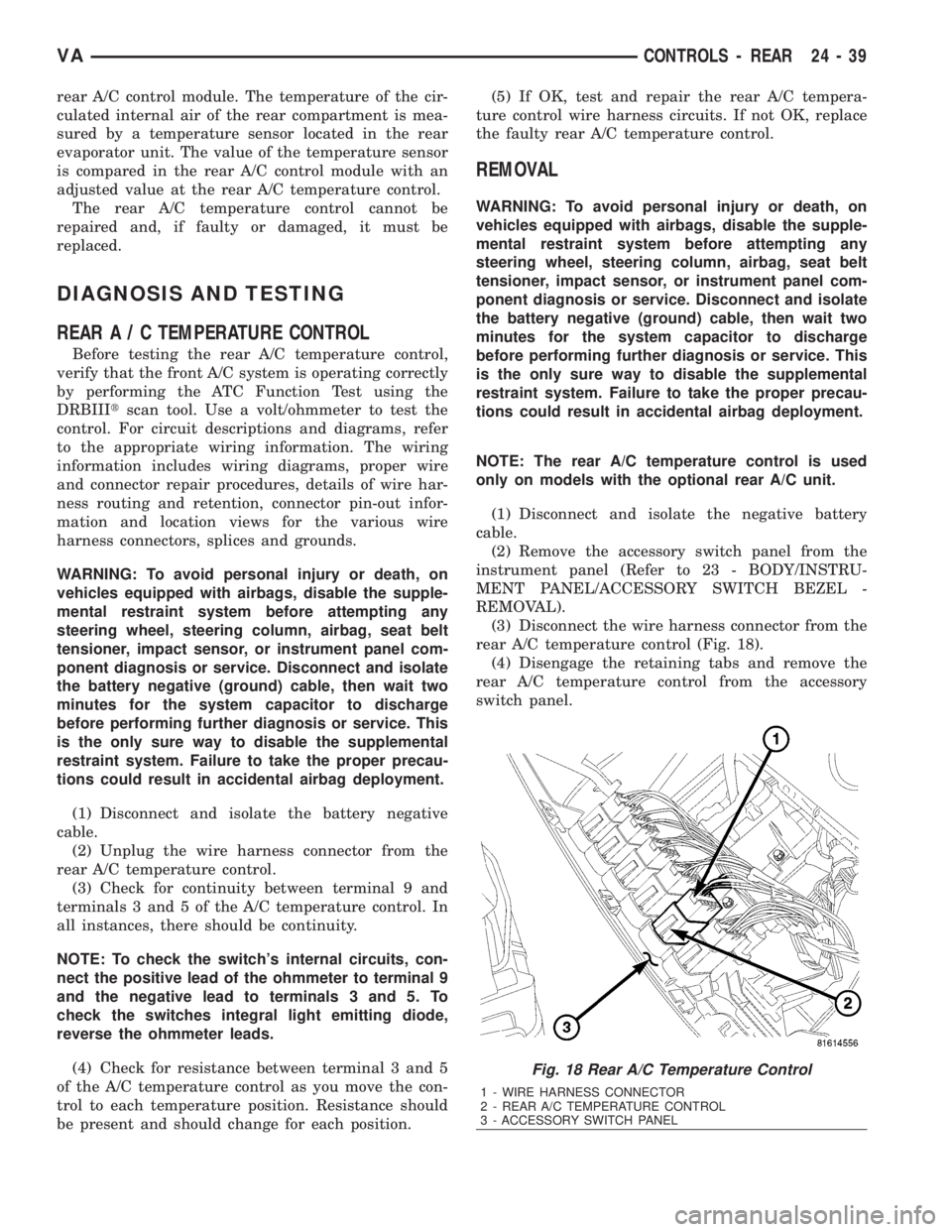
The temperature control for the optional rear A/C
system is a thumbwheel-type control mounted in the
switch panel on the instrument panel (Fig. 17). The
rear A/C temperature control allows the selection of
four temperature settings when the rear A/C blower
motor is activated.OPERATION
With the front A/C switch and rear blower motor
activated, the rear A/C output temperature can be
selected by rotating the thumbwheel control upwards
(increase cooling) or downwards (decrease cooling).
Depending on the rear A/C temperature control posi-
tion, a temperature command signal is sent to the
Fig. 16 Rear Evaporator Temperature Sensor
1 - REAR A/C EVAPORATOR HOUSING
2 - SCREWS (2)
3 - REAR EVAPORATOR SENSOR SWITCH UNIT4 - WIRE HARNESS CONNECTORS
5 - REAR EVAPORATOR SENSOR PROBE
Fig. 17 Rear A/C Temperature Control
24 - 38 CONTROLS - REARVA
Page 2076 of 2305
rear A/C control module. The temperature of the cir-
culated internal air of the rear compartment is mea-
sured by a temperature sensor located in the rear
evaporator unit. The value of the temperature sensor
is compared in the rear A/C control module with an
adjusted value at the rear A/C temperature control.
The rear A/C temperature control cannot be
repaired and, if faulty or damaged, it must be
replaced.
DIAGNOSIS AND TESTING
REARA/CTEMPERATURE CONTROL
Before testing the rear A/C temperature control,
verify that the front A/C system is operating correctly
by performing the ATC Function Test using the
DRBIIItscan tool. Use a volt/ohmmeter to test the
control. For circuit descriptions and diagrams, refer
to the appropriate wiring information. The wiring
information includes wiring diagrams, proper wire
and connector repair procedures, details of wire har-
ness routing and retention, connector pin-out infor-
mation and location views for the various wire
harness connectors, splices and grounds.
WARNING: To avoid personal injury or death, on
vehicles equipped with airbags, disable the supple-
mental restraint system before attempting any
steering wheel, steering column, airbag, seat belt
tensioner, impact sensor, or instrument panel com-
ponent diagnosis or service. Disconnect and isolate
the battery negative (ground) cable, then wait two
minutes for the system capacitor to discharge
before performing further diagnosis or service. This
is the only sure way to disable the supplemental
restraint system. Failure to take the proper precau-
tions could result in accidental airbag deployment.
(1) Disconnect and isolate the battery negative
cable.
(2) Unplug the wire harness connector from the
rear A/C temperature control.
(3) Check for continuity between terminal 9 and
terminals 3 and 5 of the A/C temperature control. In
all instances, there should be continuity.
NOTE: To check the switch's internal circuits, con-
nect the positive lead of the ohmmeter to terminal 9
and the negative lead to terminals 3 and 5. To
check the switches integral light emitting diode,
reverse the ohmmeter leads.
(4) Check for resistance between terminal 3 and 5
of the A/C temperature control as you move the con-
trol to each temperature position. Resistance should
be present and should change for each position.(5) If OK, test and repair the rear A/C tempera-
ture control wire harness circuits. If not OK, replace
the faulty rear A/C temperature control.
REMOVAL
WARNING: To avoid personal injury or death, on
vehicles equipped with airbags, disable the supple-
mental restraint system before attempting any
steering wheel, steering column, airbag, seat belt
tensioner, impact sensor, or instrument panel com-
ponent diagnosis or service. Disconnect and isolate
the battery negative (ground) cable, then wait two
minutes for the system capacitor to discharge
before performing further diagnosis or service. This
is the only sure way to disable the supplemental
restraint system. Failure to take the proper precau-
tions could result in accidental airbag deployment.
NOTE: The rear A/C temperature control is used
only on models with the optional rear A/C unit.
(1) Disconnect and isolate the negative battery
cable.
(2) Remove the accessory switch panel from the
instrument panel (Refer to 23 - BODY/INSTRU-
MENT PANEL/ACCESSORY SWITCH BEZEL -
REMOVAL).
(3) Disconnect the wire harness connector from the
rear A/C temperature control (Fig. 18).
(4) Disengage the retaining tabs and remove the
rear A/C temperature control from the accessory
switch panel.
Fig. 18 Rear A/C Temperature Control
1 - WIRE HARNESS CONNECTOR
2 - REAR A/C TEMPERATURE CONTROL
3 - ACCESSORY SWITCH PANEL
VACONTROLS - REAR 24 - 39