ignition MERCEDES-BENZ SPRINTER 2006 Service Manual
[x] Cancel search | Manufacturer: MERCEDES-BENZ, Model Year: 2006, Model line: SPRINTER, Model: MERCEDES-BENZ SPRINTER 2006Pages: 2305, PDF Size: 48.12 MB
Page 678 of 2305
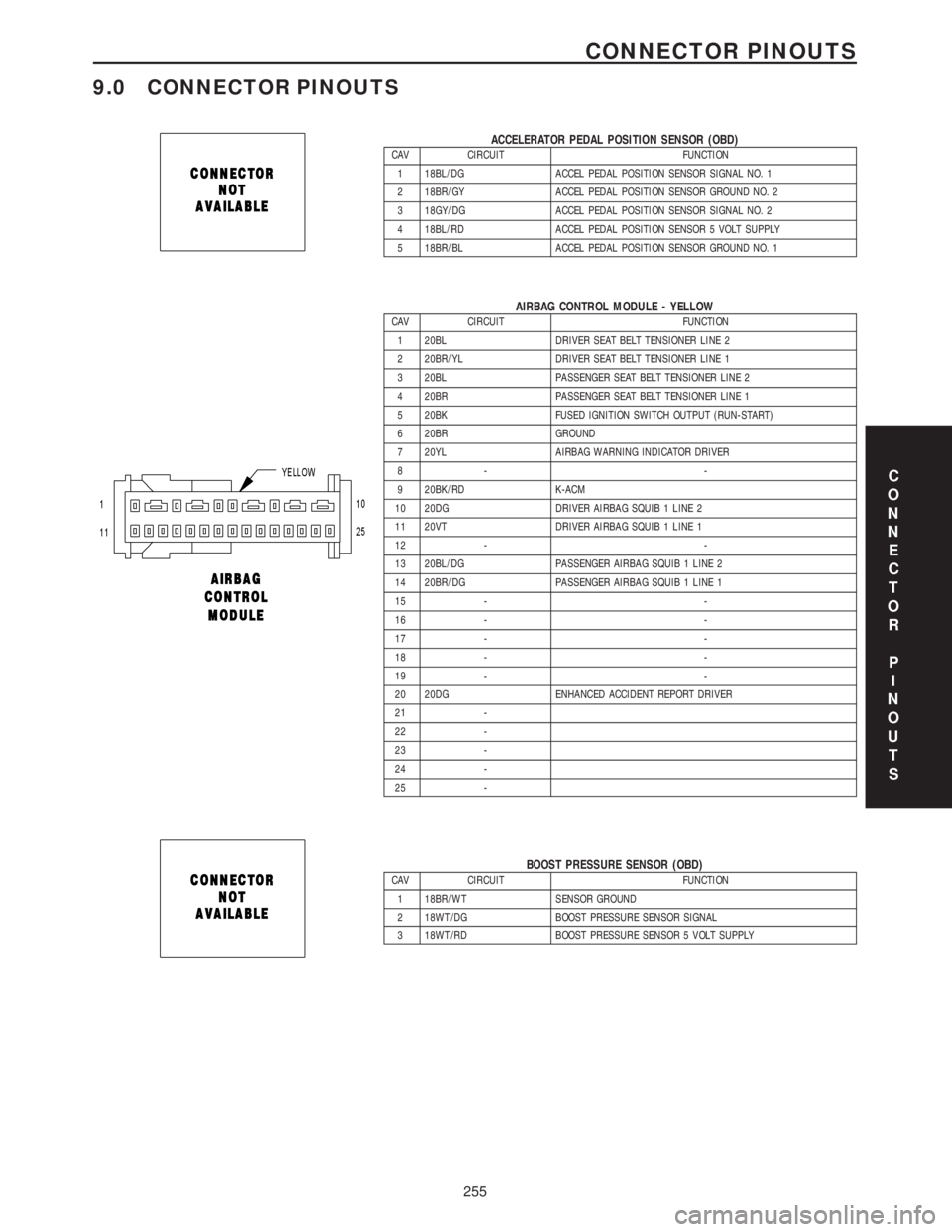
9.0 CONNECTOR PINOUTS
ACCELERATOR PEDAL POSITION SENSOR (OBD)CAV CIRCUIT FUNCTION
1 18BL/DG ACCEL PEDAL POSITION SENSOR SIGNAL NO. 1
2 18BR/GY ACCEL PEDAL POSITION SENSOR GROUND NO. 2
3 18GY/DG ACCEL PEDAL POSITION SENSOR SIGNAL NO. 2
4 18BL/RD ACCEL PEDAL POSITION SENSOR 5 VOLT SUPPLY
5 18BR/BL ACCEL PEDAL POSITION SENSOR GROUND NO. 1
AIRBAG CONTROL MODULE - YELLOWCAV CIRCUIT FUNCTION
1 20BL DRIVER SEAT BELT TENSIONER LINE 2
2 20BR/YL DRIVER SEAT BELT TENSIONER LINE 1
3 20BL PASSENGER SEAT BELT TENSIONER LINE 2
4 20BR PASSENGER SEAT BELT TENSIONER LINE 1
5 20BK FUSED IGNITION SWITCH OUTPUT (RUN-START)
6 20BR GROUND
7 20YL AIRBAG WARNING INDICATOR DRIVER
8- -
9 20BK/RD K-ACM
10 20DG DRIVER AIRBAG SQUIB 1 LINE 2
11 20VT DRIVER AIRBAG SQUIB 1 LINE 1
12 - -
13 20BL/DG PASSENGER AIRBAG SQUIB 1 LINE 2
14 20BR/DG PASSENGER AIRBAG SQUIB 1 LINE 1
15 - -
16 - -
17 - -
18 - -
19 - -
20 20DG ENHANCED ACCIDENT REPORT DRIVER
21 -
22 -
23 -
24 -
25 -
BOOST PRESSURE SENSOR (OBD)CAV CIRCUIT FUNCTION
1 18BR/WT SENSOR GROUND
2 18WT/DG BOOST PRESSURE SENSOR SIGNAL
3 18WT/RD BOOST PRESSURE SENSOR 5 VOLT SUPPLY
C
O
N
N
E
C
T
O
R
P
I
N
O
U
T
S
255
CONNECTOR PINOUTS
Page 681 of 2305
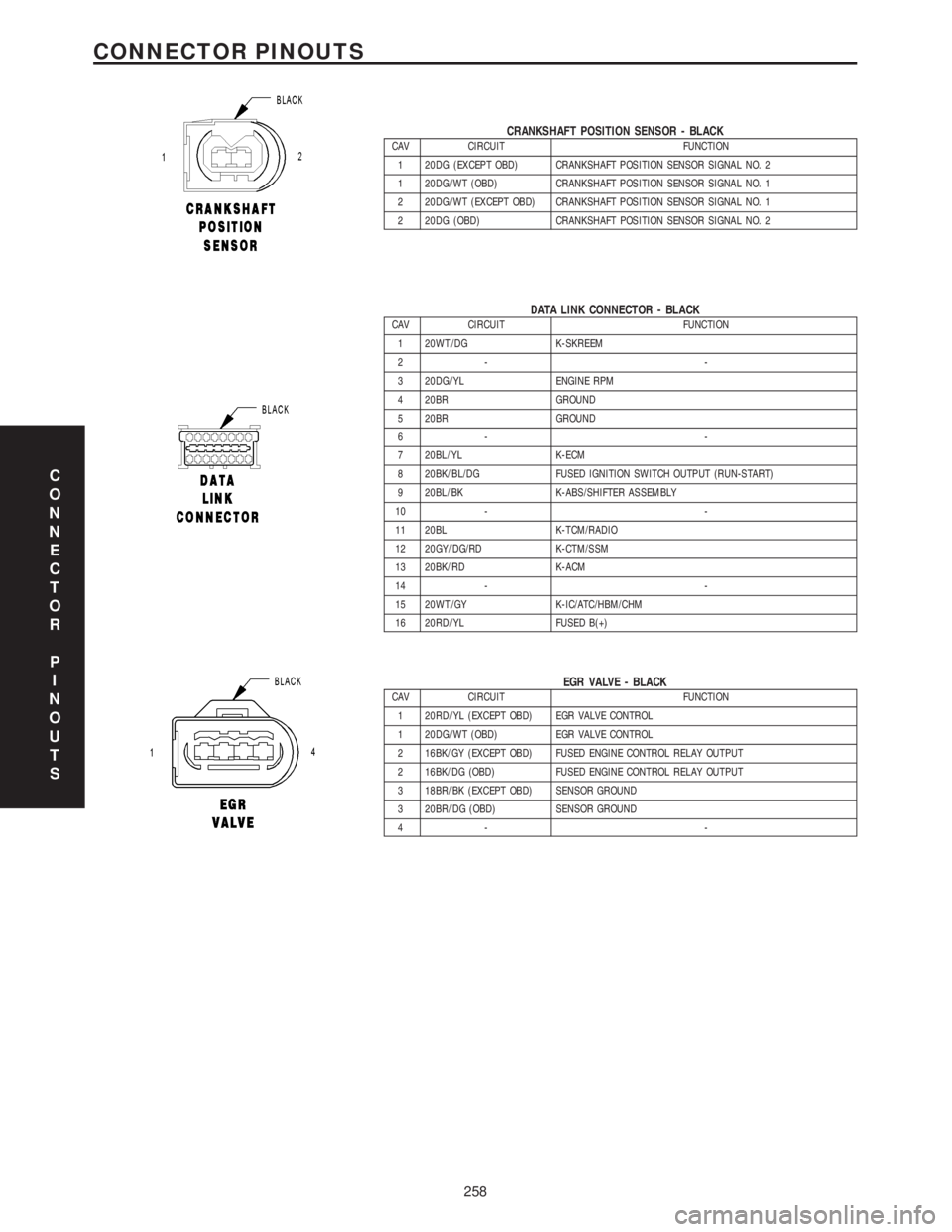
CRANKSHAFT POSITION SENSOR - BLACKCAV CIRCUIT FUNCTION
1 20DG (EXCEPT OBD) CRANKSHAFT POSITION SENSOR SIGNAL NO. 2
1 20DG/WT (OBD) CRANKSHAFT POSITION SENSOR SIGNAL NO. 1
2 20DG/WT (EXCEPT OBD) CRANKSHAFT POSITION SENSOR SIGNAL NO. 1
2 20DG (OBD) CRANKSHAFT POSITION SENSOR SIGNAL NO. 2
DATA LINK CONNECTOR - BLACKCAV CIRCUIT FUNCTION
1 20WT/DG K-SKREEM
2- -
3 20DG/YL ENGINE RPM
4 20BR GROUND
5 20BR GROUND
6- -
7 20BL/YL K-ECM
8 20BK/BL/DG FUSED IGNITION SWITCH OUTPUT (RUN-START)
9 20BL/BK K-ABS/SHIFTER ASSEMBLY
10 - -
11 20BL K-TCM/RADIO
12 20GY/DG/RD K-CTM/SSM
13 20BK/RD K-ACM
14 - -
15 20WT/GY K-IC/ATC/HBM/CHM
16 20RD/YL FUSED B(+)
EGR VALVE - BLACKCAV CIRCUIT FUNCTION
1 20RD/YL (EXCEPT OBD) EGR VALVE CONTROL
1 20DG/WT (OBD) EGR VALVE CONTROL
2 16BK/GY (EXCEPT OBD) FUSED ENGINE CONTROL RELAY OUTPUT
2 16BK/DG (OBD) FUSED ENGINE CONTROL RELAY OUTPUT
3 18BR/BK (EXCEPT OBD) SENSOR GROUND
3 20BR/DG (OBD) SENSOR GROUND
4- -
C
O
N
N
E
C
T
O
R
P
I
N
O
U
T
S
258
CONNECTOR PINOUTS
Page 683 of 2305
ENGINE CONTROL MODULE C2 (OBD)CAV CIRCUIT FUNCTION
1 16BK/RD FUSED ENGINE CONTROL RELAY OUTPUT
2 14BR GROUND
3 14BK/BL FUSED ENGINE CONTROL RELAY OUTPUT
4 14BR GROUND
5 14BK/BL FUSED ENGINE CONTROL RELAY OUTPUT
6 14BR GROUND
7 18RD S/C SWITCH 12 VOLT SUPPLY
8 18BR/WT HIGH IDLE ON SIGNAL
10 18WT/RD BOOST PRESSURE SENSOR 5 VOLT SUPPLY
11 18WT/DG BOOST PRESSURE SENSOR SIGNAL
12 18BR/WT SENSOR GROUND
13 18GY/DG ACCEL PEDAL POSITION SENSOR SIGNAL NO. 2
14 18BR/GY ACCEL PEDAL POSITION SENSOR GROUND NO. 2
17 18BR/DG KICKDOWN SWITCH SIGNAL
18 20DG/YL ENGINE RPM
19 18BK FUSED IGNITION SWITCH OUTPUT (RUN-START)
24 18BL/RD ACCEL PEDAL POSITION SENSOR 5 VOLT SUPPLY
25 18BL/DG ACCEL PEDAL POSITION SENSOR SIGNAL NO. 1
26 18BR/BL ACCEL PEDAL POSITION SENSOR GROUND NO. 1
28 18BR/DG INTAKE AIR TEMPERATURE SENSOR GROUND
31 20BL/YL K-ECM
32 20DG ENHANCED ACCIDENT REPORT DRIVER
36 18VT IGNITION SWITCH OUTPUT (START)
37 18DG ACCEL/SET SIGNAL
38 18BK VERIFICATION SIGNAL
42 18DG/WT INTAKE AIR TEMPERATURE SENSOR SIGNAL
43 18BK/RD GLOW PLUG MODULE CONTROL
44 18YL/BL ENGINE CONTROL RELAY CONTROL
50 18YL DECEL/SET SIGNAL
51 18GY OFF SIGNAL
52 18BL RESUME SIGNAL
53 20DG/WT CAN C BUS (+)
54 20DG CAN C BUS (-)
55 18BR/RD FUEL PUMP RELAY CONTROL
58 18VT/DG STARTER MOTOR RELAY CONTROL
ENGINE COOLANT TEMPERATURE SENSOR - BLACKCAV CIRCUIT FUNCTION
1 20BR/WT ENGINE COOLANT TEMPERATURE SENSOR GROUND
2 20DG/RD ENGINE COOLANT TEMPERATURE SENSOR SIGNAL
C
O
N
N
E
C
T
O
R
P
I
N
O
U
T
S
260
CONNECTOR PINOUTS
Page 688 of 2305
ENGINE CONTROL RELAY (FUSE BLOCK NO. 1)CAV CIRCUIT FUNCTION
30 INTERNAL FUSED B(+)
85 INTERNAL ENGINE CONTROL RELAY CONTROL
86 INTERNAL FUSED B(+)
87 INTERNAL ENGINE CONTROL RELAY OUTPUT
87A --
FUSES (FUSE BLOCK NO. 1)FUSE
NO.AMPS FUSED CIRCUIT FUNCTION
1- - -
2 10A 16WT FUSED HIGH BEAM SWITCH OUTPUT
3 10A 16WT FUSED HIGH BEAM SWITCH OUTPUT
4 10A 16WT/BL/RD FUSED IGNITION SWITCH OUTPUT (RUN-START)
5 10A 16BK/BL/WT FUSED IGNITION SWITCH OUTPUT (RUN-START)
6 20A INTERNAL FUSED IGNITION SWITCH OUTPUT (RUN-START)
7 15A 16BK/YL FUSED IGNITION SWITCH OUTPUT (RUN-START)
8 20A 16RD/YL FUSED B(+)
9 15A INTERNAL FUSED B(+)
10 10A 16GY/DG/RD HEADLAMP SWITCH OUTPUT
11 10A 16GY/BK FUSED LEFT LAMP RELAY OUTPUT
12 10A 18YL HEADLAMP SWITCH OUTPUT
13 10A 18YL HEADLAMP SWITCH OUTPUT
14 15A 16BK/YL/WT FOG LAMP RELAY SIGNAL
15 10A 16BK/RD FUSED IGNITION SWITCH OUTPUT (ACC-RUN-START)
16 15A 12BK/BL ENGINE CONTROL RELAY OUTPUT
17 15A 16BK/RD ENGINE CONTROL RELAY OUTPUT
18 15A 14BK FUSED IGNITION SWITCH OUTPUT (RUN-START)
19 15A 14RD/BK (OBD) FUSED B(+)
20 15A 16RD/BL FUSED B(+)
21 30A 12RD FUSED B(+)
C
O
N
N
E
C
T
O
R
P
I
N
O
U
T
S
265
CONNECTOR PINOUTS
Page 692 of 2305
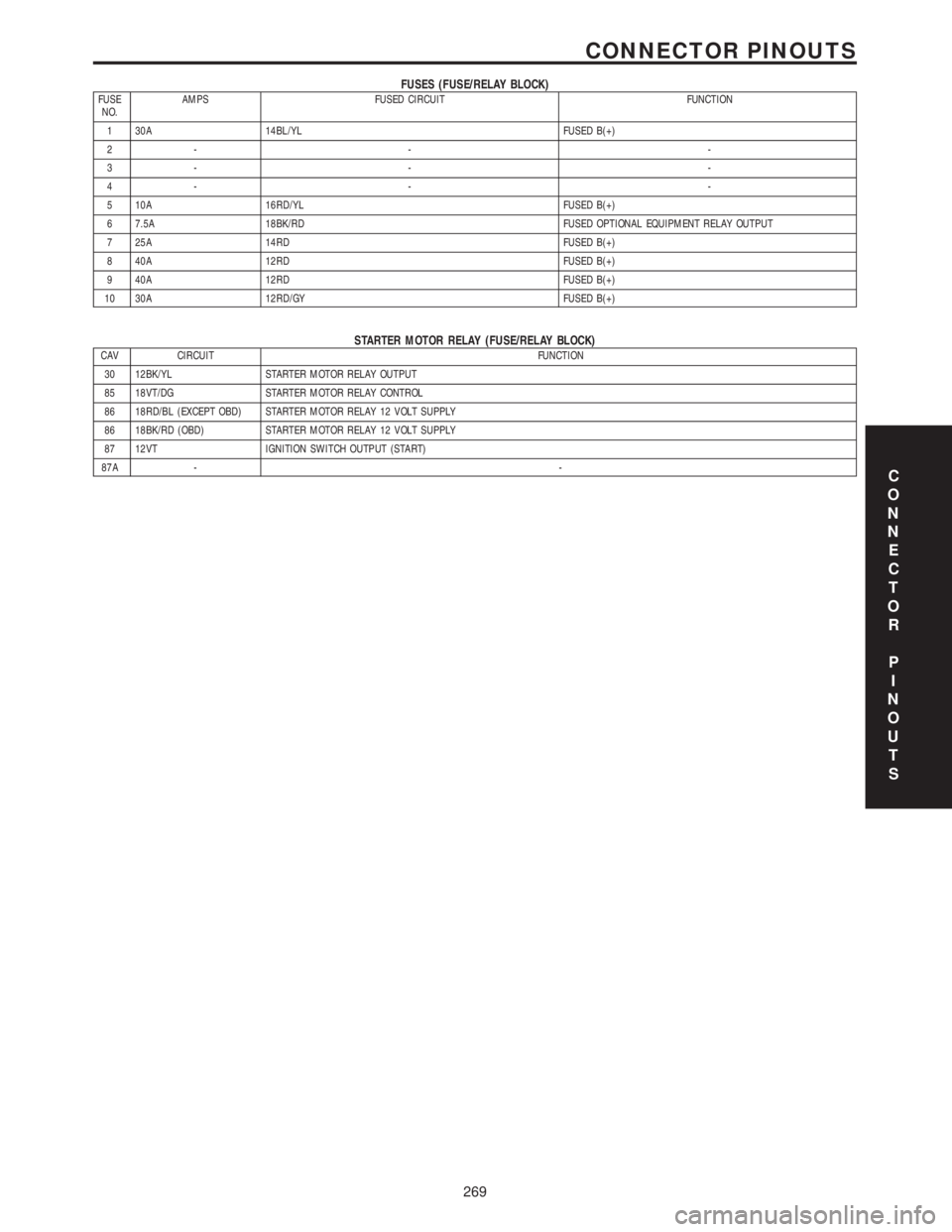
FUSES (FUSE/RELAY BLOCK)FUSE
NO.AMPS FUSED CIRCUIT FUNCTION
1 30A 14BL/YL FUSED B(+)
2- - -
3- - -
4- - -
5 10A 16RD/YL FUSED B(+)
6 7.5A 18BK/RD FUSED OPTIONAL EQUIPMENT RELAY OUTPUT
7 25A 14RD FUSED B(+)
8 40A 12RD FUSED B(+)
9 40A 12RD FUSED B(+)
10 30A 12RD/GY FUSED B(+)
STARTER MOTOR RELAY (FUSE/RELAY BLOCK)CAV CIRCUIT FUNCTION
30 12BK/YL STARTER MOTOR RELAY OUTPUT
85 18VT/DG STARTER MOTOR RELAY CONTROL
86 18RD/BL (EXCEPT OBD) STARTER MOTOR RELAY 12 VOLT SUPPLY
86 18BK/RD (OBD) STARTER MOTOR RELAY 12 VOLT SUPPLY
87 12VT IGNITION SWITCH OUTPUT (START)
87A --
C
O
N
N
E
C
T
O
R
P
I
N
O
U
T
S
269
CONNECTOR PINOUTS
Page 694 of 2305
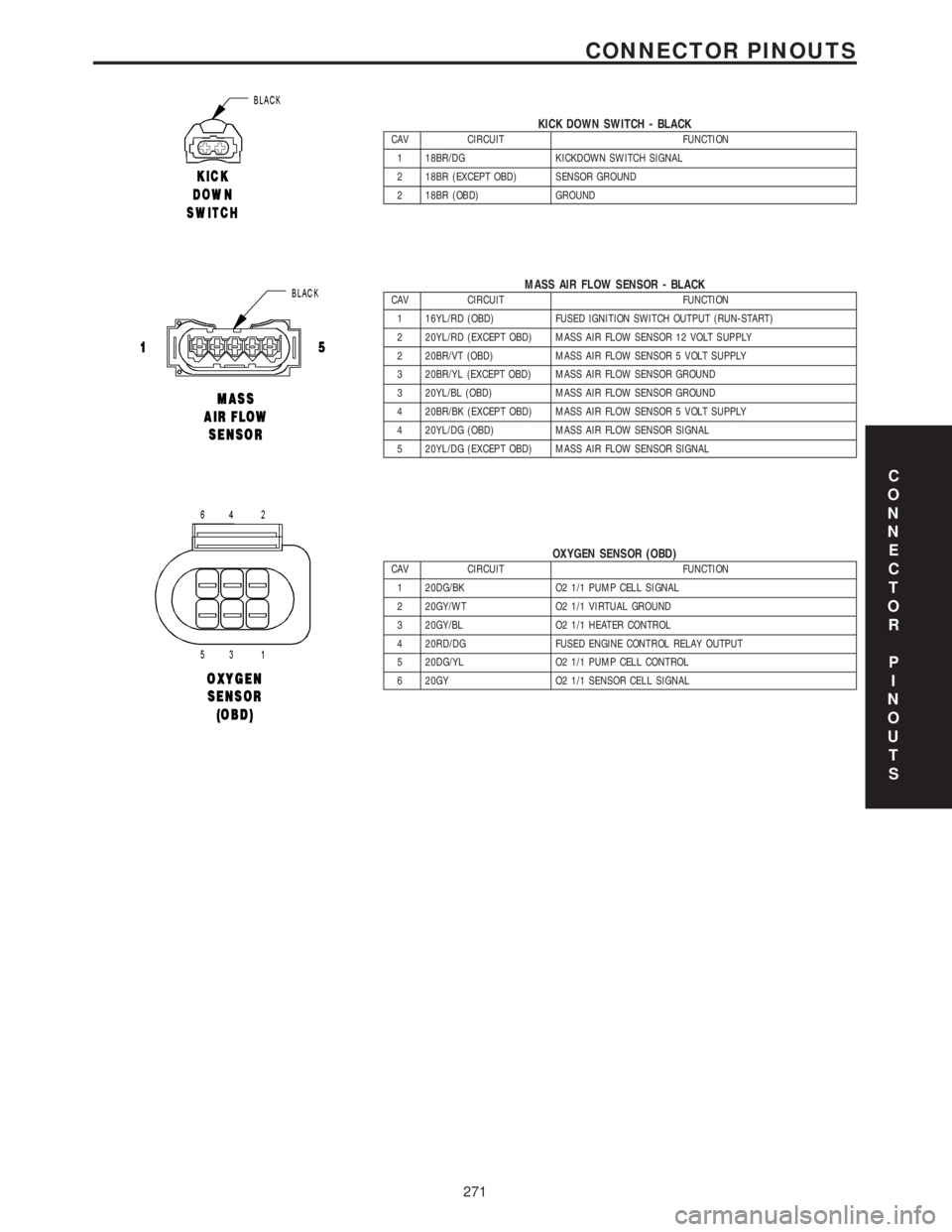
KICK DOWN SWITCH - BLACKCAV CIRCUIT FUNCTION
1 18BR/DG KICKDOWN SWITCH SIGNAL
2 18BR (EXCEPT OBD) SENSOR GROUND
2 18BR (OBD) GROUND
MASS AIR FLOW SENSOR - BLACKCAV CIRCUIT FUNCTION
1 16YL/RD (OBD) FUSED IGNITION SWITCH OUTPUT (RUN-START)
2 20YL/RD (EXCEPT OBD) MASS AIR FLOW SENSOR 12 VOLT SUPPLY
2 20BR/VT (OBD) MASS AIR FLOW SENSOR 5 VOLT SUPPLY
3 20BR/YL (EXCEPT OBD) MASS AIR FLOW SENSOR GROUND
3 20YL/BL (OBD) MASS AIR FLOW SENSOR GROUND
4 20BR/BK (EXCEPT OBD) MASS AIR FLOW SENSOR 5 VOLT SUPPLY
4 20YL/DG (OBD) MASS AIR FLOW SENSOR SIGNAL
5 20YL/DG (EXCEPT OBD) MASS AIR FLOW SENSOR SIGNAL
OXYGEN SENSOR (OBD)CAV CIRCUIT FUNCTION
1 20DG/BK O2 1/1 PUMP CELL SIGNAL
2 20GY/WT O2 1/1 VIRTUAL GROUND
3 20GY/BL O2 1/1 HEATER CONTROL
4 20RD/DG FUSED ENGINE CONTROL RELAY OUTPUT
5 20DG/YL O2 1/1 PUMP CELL CONTROL
6 20GY O2 1/1 SENSOR CELL SIGNAL
C
O
N
N
E
C
T
O
R
P
I
N
O
U
T
S
271
CONNECTOR PINOUTS
Page 696 of 2305
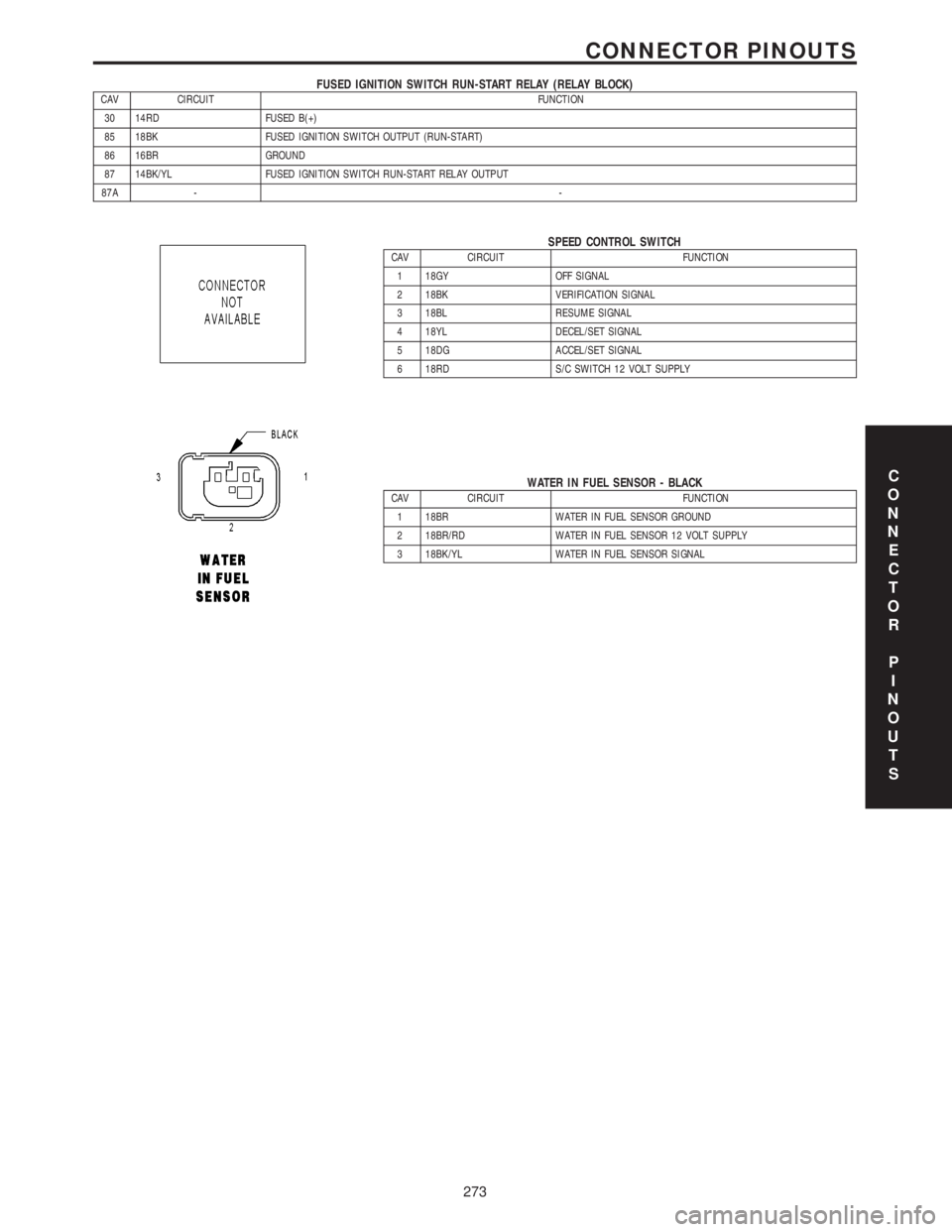
FUSED IGNITION SWITCH RUN-START RELAY (RELAY BLOCK)CAV CIRCUIT FUNCTION
30 14RD FUSED B(+)
85 18BK FUSED IGNITION SWITCH OUTPUT (RUN-START)
86 16BR GROUND
87 14BK/YL FUSED IGNITION SWITCH RUN-START RELAY OUTPUT
87A --
SPEED CONTROL SWITCHCAV CIRCUIT FUNCTION
1 18GY OFF SIGNAL
2 18BK VERIFICATION SIGNAL
3 18BL RESUME SIGNAL
4 18YL DECEL/SET SIGNAL
5 18DG ACCEL/SET SIGNAL
6 18RD S/C SWITCH 12 VOLT SUPPLY
WATER IN FUEL SENSOR - BLACKCAV CIRCUIT FUNCTION
1 18BR WATER IN FUEL SENSOR GROUND
2 18BR/RD WATER IN FUEL SENSOR 12 VOLT SUPPLY
3 18BK/YL WATER IN FUEL SENSOR SIGNAL
C
O
N
N
E
C
T
O
R
P
I
N
O
U
T
S
273
CONNECTOR PINOUTS
Page 704 of 2305
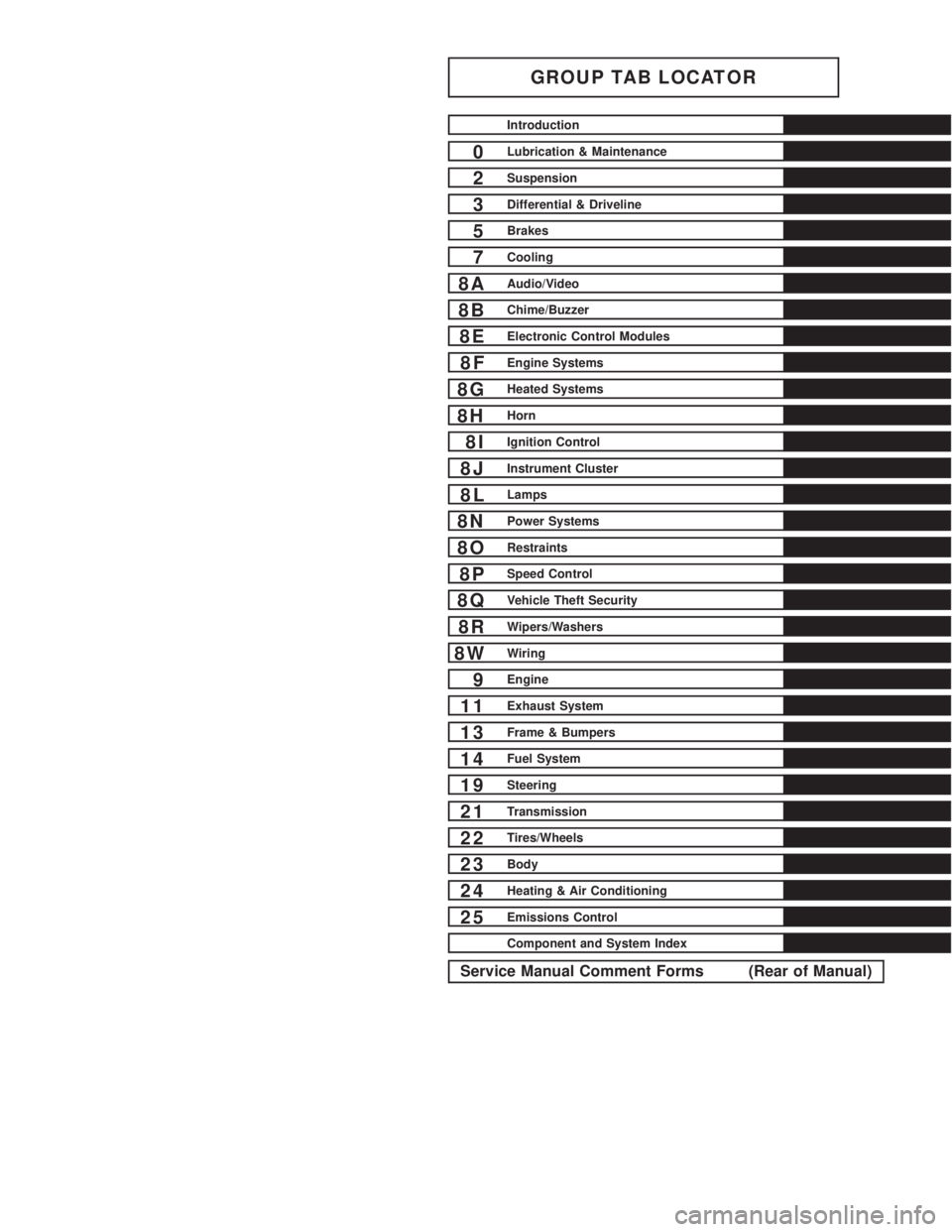
GROUP TAB LOCATOR
Introduction
0Lubrication & Maintenance
2Suspension
3Differential & Driveline
5Brakes
7Cooling
8AAudio/Video
8BChime/Buzzer
8EElectronic Control Modules
8FEngine Systems
8GHeated Systems
8HHorn
8IIgnition Control
8JInstrument Cluster
8LLamps
8NPower Systems
8ORestraints
8PSpeed Control
8QVehicle Theft Security
8RWipers/Washers
8WWiring
9Engine
11Exhaust System
13Frame & Bumpers
14Fuel System
19Steering
21Transmission
22Tires/Wheels
23Body
24Heating & Air Conditioning
25Emissions Control
Component and System Index
Service Manual Comment Forms (Rear of Manual)
Page 721 of 2305
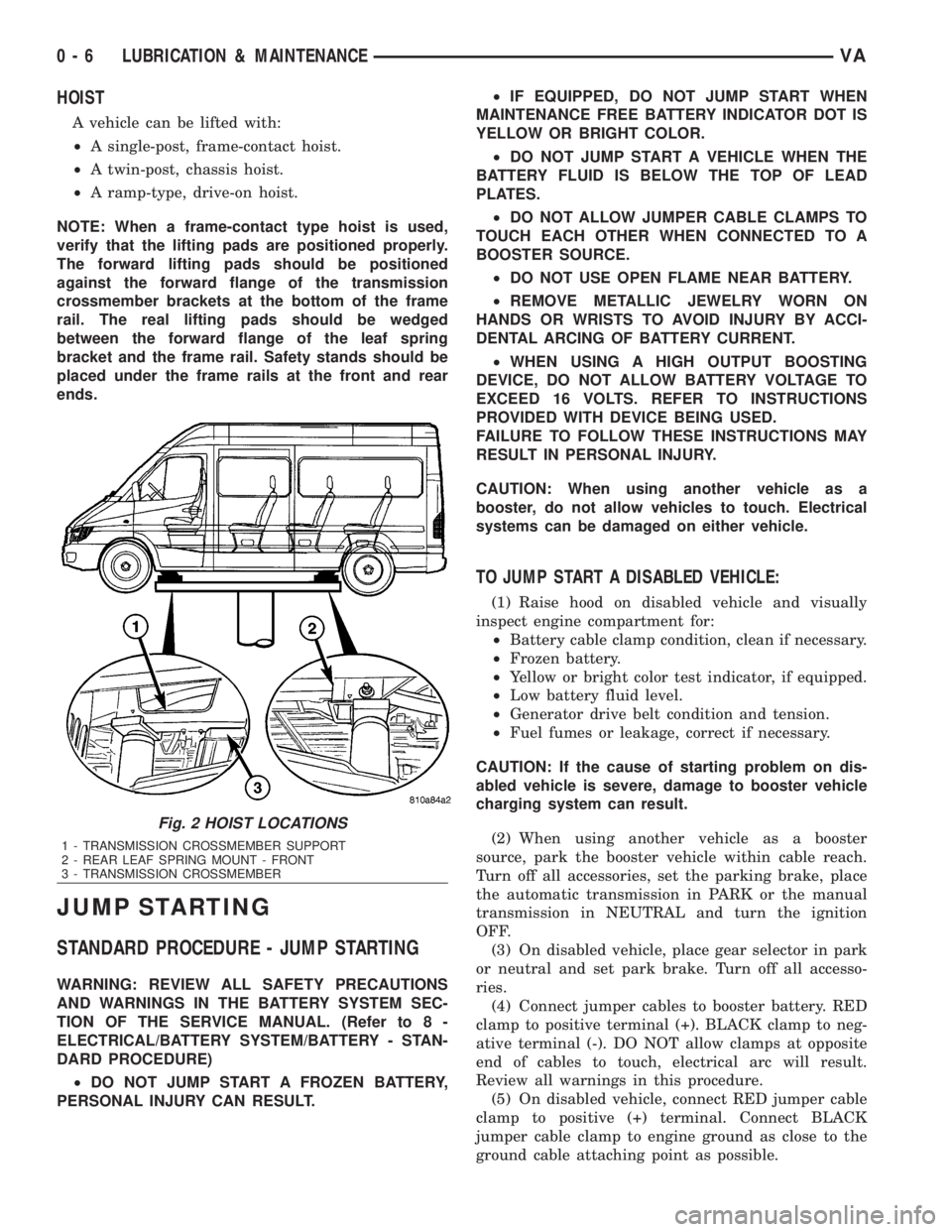
HOIST
A vehicle can be lifted with:
²A single-post, frame-contact hoist.
²A twin-post, chassis hoist.
²A ramp-type, drive-on hoist.
NOTE: When a frame-contact type hoist is used,
verify that the lifting pads are positioned properly.
The forward lifting pads should be positioned
against the forward flange of the transmission
crossmember brackets at the bottom of the frame
rail. The real lifting pads should be wedged
between the forward flange of the leaf spring
bracket and the frame rail. Safety stands should be
placed under the frame rails at the front and rear
ends.
JUMP STARTING
STANDARD PROCEDURE - JUMP STARTING
WARNING: REVIEW ALL SAFETY PRECAUTIONS
AND WARNINGS IN THE BATTERY SYSTEM SEC-
TION OF THE SERVICE MANUAL. (Refer to 8 -
ELECTRICAL/BATTERY SYSTEM/BATTERY - STAN-
DARD PROCEDURE)
²DO NOT JUMP START A FROZEN BATTERY,
PERSONAL INJURY CAN RESULT.²IF EQUIPPED, DO NOT JUMP START WHEN
MAINTENANCE FREE BATTERY INDICATOR DOT IS
YELLOW OR BRIGHT COLOR.
²DO NOT JUMP START A VEHICLE WHEN THE
BATTERY FLUID IS BELOW THE TOP OF LEAD
PLATES.
²DO NOT ALLOW JUMPER CABLE CLAMPS TO
TOUCH EACH OTHER WHEN CONNECTED TO A
BOOSTER SOURCE.
²DO NOT USE OPEN FLAME NEAR BATTERY.
²REMOVE METALLIC JEWELRY WORN ON
HANDS OR WRISTS TO AVOID INJURY BY ACCI-
DENTAL ARCING OF BATTERY CURRENT.
²WHEN USING A HIGH OUTPUT BOOSTING
DEVICE, DO NOT ALLOW BATTERY VOLTAGE TO
EXCEED 16 VOLTS. REFER TO INSTRUCTIONS
PROVIDED WITH DEVICE BEING USED.
FAILURE TO FOLLOW THESE INSTRUCTIONS MAY
RESULT IN PERSONAL INJURY.
CAUTION: When using another vehicle as a
booster, do not allow vehicles to touch. Electrical
systems can be damaged on either vehicle.
TO JUMP START A DISABLED VEHICLE:
(1) Raise hood on disabled vehicle and visually
inspect engine compartment for:
²Battery cable clamp condition, clean if necessary.
²Frozen battery.
²Yellow or bright color test indicator, if equipped.
²Low battery fluid level.
²Generator drive belt condition and tension.
²Fuel fumes or leakage, correct if necessary.
CAUTION: If the cause of starting problem on dis-
abled vehicle is severe, damage to booster vehicle
charging system can result.
(2) When using another vehicle as a booster
source, park the booster vehicle within cable reach.
Turn off all accessories, set the parking brake, place
the automatic transmission in PARK or the manual
transmission in NEUTRAL and turn the ignition
OFF.
(3) On disabled vehicle, place gear selector in park
or neutral and set park brake. Turn off all accesso-
ries.
(4) Connect jumper cables to booster battery. RED
clamp to positive terminal (+). BLACK clamp to neg-
ative terminal (-). DO NOT allow clamps at opposite
end of cables to touch, electrical arc will result.
Review all warnings in this procedure.
(5) On disabled vehicle, connect RED jumper cable
clamp to positive (+) terminal. Connect BLACK
jumper cable clamp to engine ground as close to the
ground cable attaching point as possible.
Fig. 2 HOIST LOCATIONS
1 - TRANSMISSION CROSSMEMBER SUPPORT
2 - REAR LEAF SPRING MOUNT - FRONT
3 - TRANSMISSION CROSSMEMBER
0 - 6 LUBRICATION & MAINTENANCEVA
Page 722 of 2305
(6) Start the engine in the vehicle which has the
booster battery, let the engine idle a few minutes,
then start the engine in the vehicle with the dis-
charged battery.
CAUTION: Do not crank starter motor on disabled
vehicle for more than 15 seconds, starter will over-
heat and could fail.
(7) Allow battery in disabled vehicle to charge to
at least 12.4 volts (75% charge) before attempting to
start engine. If engine does not start within 15 sec-
onds, stop cranking engine and allow starter to cool
(15 min.), before cranking again.
DISCONNECT CABLE CLAMPS AS FOLLOWS:
²Disconnect BLACK cable clamp from engine
ground on disabled vehicle.
²When using a Booster vehicle, disconnect
BLACK cable clamp from battery negative terminal.
Disconnect RED cable clamp from battery positive
terminal.
²Disconnect RED cable clamp from battery posi-
tive terminal on disabled vehicle.
TOWING
STANDARD PROCEDURE - TOWING
WARNING: Do not tow the vehicle if the key cannot
be turned in the ignition lock. If the key cannot be
turned, the ignition lock remains locked and the
vehicle cannot be steered. With the engine not run-
ning there is no power assistance for the braking
and steering systems. In this case, it is important to
keep in mind that a considerably higher degree of
effort is necessary to brake and steer the vehicle.
The vehicle must not be towed with the front axle
raised and the key in position 2 in the ignition lock
as the drive wheels could then lock due to the
acceleration skid control (ASR)
If the Engine is Damaged
For towing distances up to 30 miles (about 50
km)
²Shift selector lever in ªNº position.
²Do not exceed a towing speed of 30 m.p.h. (50
km/h).
For towing distances greater than 30 mile
(about 50 km)
²Remove the propeller shafts leading to the drive
axles. The vehicle can be towed without restriction.
If the Transmission is Damaged
²Remove the propeller shafts leading to the drive
axles. The vehicle can be towed without restriction.
If the Front Axle is Damaged
²Raise the front axle.
²Observe the same towing restrictions as for
engine damage.
If the Rear Axle is Damaged
²Raise the rear axle.
NOTE: Comply with local legal regulations regard-
ing towing vehicles.
SAFETY PRECAUTIONS
NOTE: The following safety precautions must be
observed when towing a vehicle.
²Secure loose and protruding parts.
²Always use a safety chain system that is inde-
pendent of the lifting and towing equipment.
²Do not allow towing equipment to contact the
disabled vehicle's fuel tank.
²Do not allow anyone under the disabled vehicle
while it is lifted by the towing device.
²Do not allow passengers to ride in a vehicle
being towed.
²Always observe state and local laws regarding
towing regulations.
²Do not tow a vehicle in a manner that could
jeopardize the safety of the operator, pedestrians or
other motorists.
²Do not attach tow chains, T-hooks, J-hooks, or a
tow sling to a bumper, steering linkage, drive shafts
or a non-reinforced frame hole.
²Remove exhaust pipe tips that interfere with the
tow sling and crossbar
²Padding should be placed between the tow sling/
crossbar and any painted surfaces
²When placing tow hooks on the rear axle, posi-
tion them so they do not damage the brake tubing or
hoses
²Do not tow the vehicle by connecting to the front
or rear shock absorbers
²Do not tow a heavily loaded vehicle. Damage to
the vehicle may result. Use a flatbed device to trans-
port a loaded vehicle.
GROUND CLEARANCE
CAUTION: If vehicle is towed with wheels removed,
install lug nuts to retain brake drums.
A towed vehicle should be raised until lifted wheels
are a minimum 100 mm (4 in) from the ground. Be
sure there is adequate ground clearance at the oppo-
site end of the vehicle, especially when towing over
rough terrain, steep rises in the road or if the vehicle
is equipped with air dams, spoilers, and/or ground
VALUBRICATION & MAINTENANCE 0 - 7