heating MERCEDES-BENZ SPRINTER 2006 Repair Manual
[x] Cancel search | Manufacturer: MERCEDES-BENZ, Model Year: 2006, Model line: SPRINTER, Model: MERCEDES-BENZ SPRINTER 2006Pages: 2305, PDF Size: 48.12 MB
Page 189 of 2305
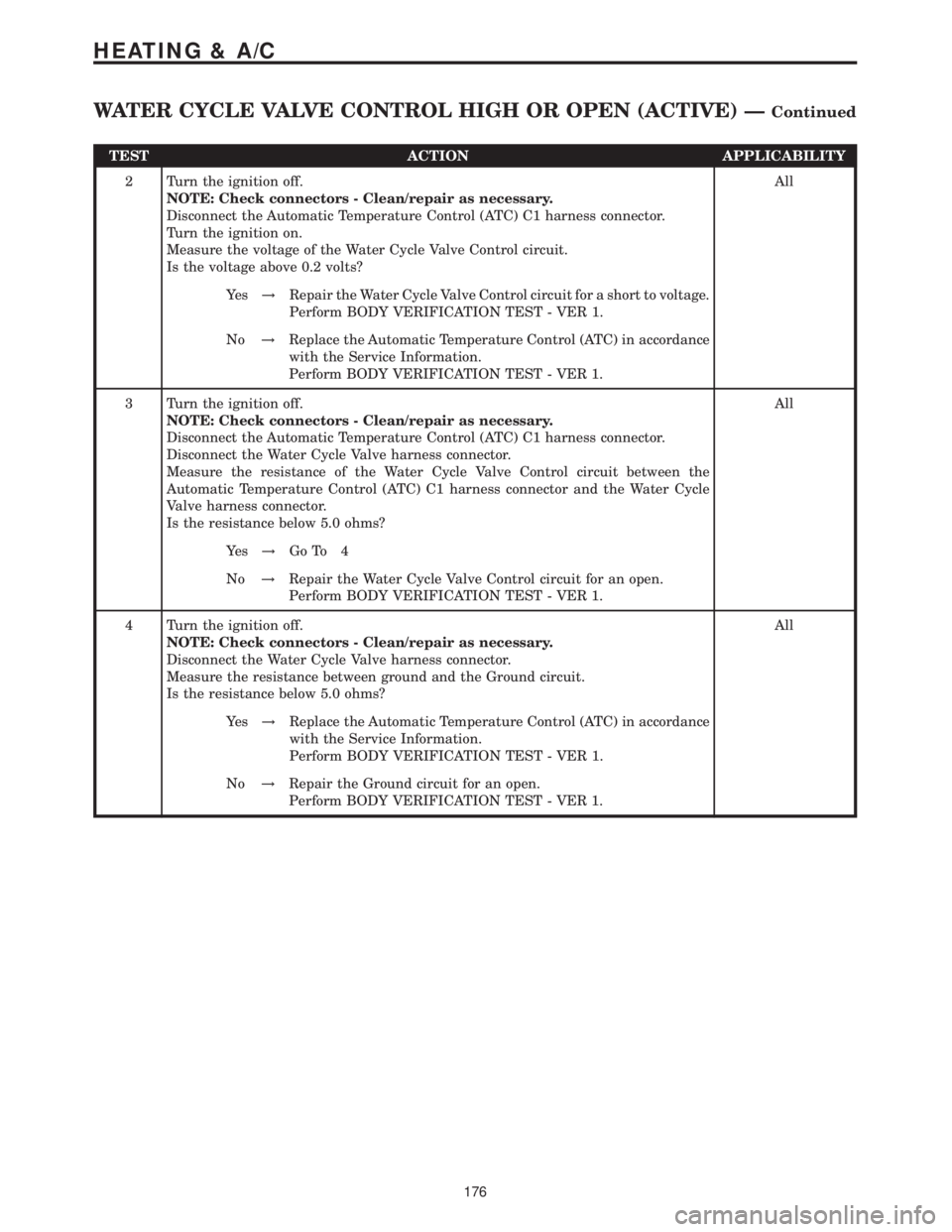
TEST ACTION APPLICABILITY
2 Turn the ignition off.
NOTE: Check connectors - Clean/repair as necessary.
Disconnect the Automatic Temperature Control (ATC) C1 harness connector.
Turn the ignition on.
Measure the voltage of the Water Cycle Valve Control circuit.
Is the voltage above 0.2 volts?All
Ye s!Repair the Water Cycle Valve Control circuit for a short to voltage.
Perform BODY VERIFICATION TEST - VER 1.
No!Replace the Automatic Temperature Control (ATC) in accordance
with the Service Information.
Perform BODY VERIFICATION TEST - VER 1.
3 Turn the ignition off.
NOTE: Check connectors - Clean/repair as necessary.
Disconnect the Automatic Temperature Control (ATC) C1 harness connector.
Disconnect the Water Cycle Valve harness connector.
Measure the resistance of the Water Cycle Valve Control circuit between the
Automatic Temperature Control (ATC) C1 harness connector and the Water Cycle
Valve harness connector.
Is the resistance below 5.0 ohms?All
Ye s!Go To 4
No!Repair the Water Cycle Valve Control circuit for an open.
Perform BODY VERIFICATION TEST - VER 1.
4 Turn the ignition off.
NOTE: Check connectors - Clean/repair as necessary.
Disconnect the Water Cycle Valve harness connector.
Measure the resistance between ground and the Ground circuit.
Is the resistance below 5.0 ohms?All
Ye s!Replace the Automatic Temperature Control (ATC) in accordance
with the Service Information.
Perform BODY VERIFICATION TEST - VER 1.
No!Repair the Ground circuit for an open.
Perform BODY VERIFICATION TEST - VER 1.
176
HEATING & A/C
WATER CYCLE VALVE CONTROL HIGH OR OPEN (ACTIVE) ÐContinued
Page 190 of 2305
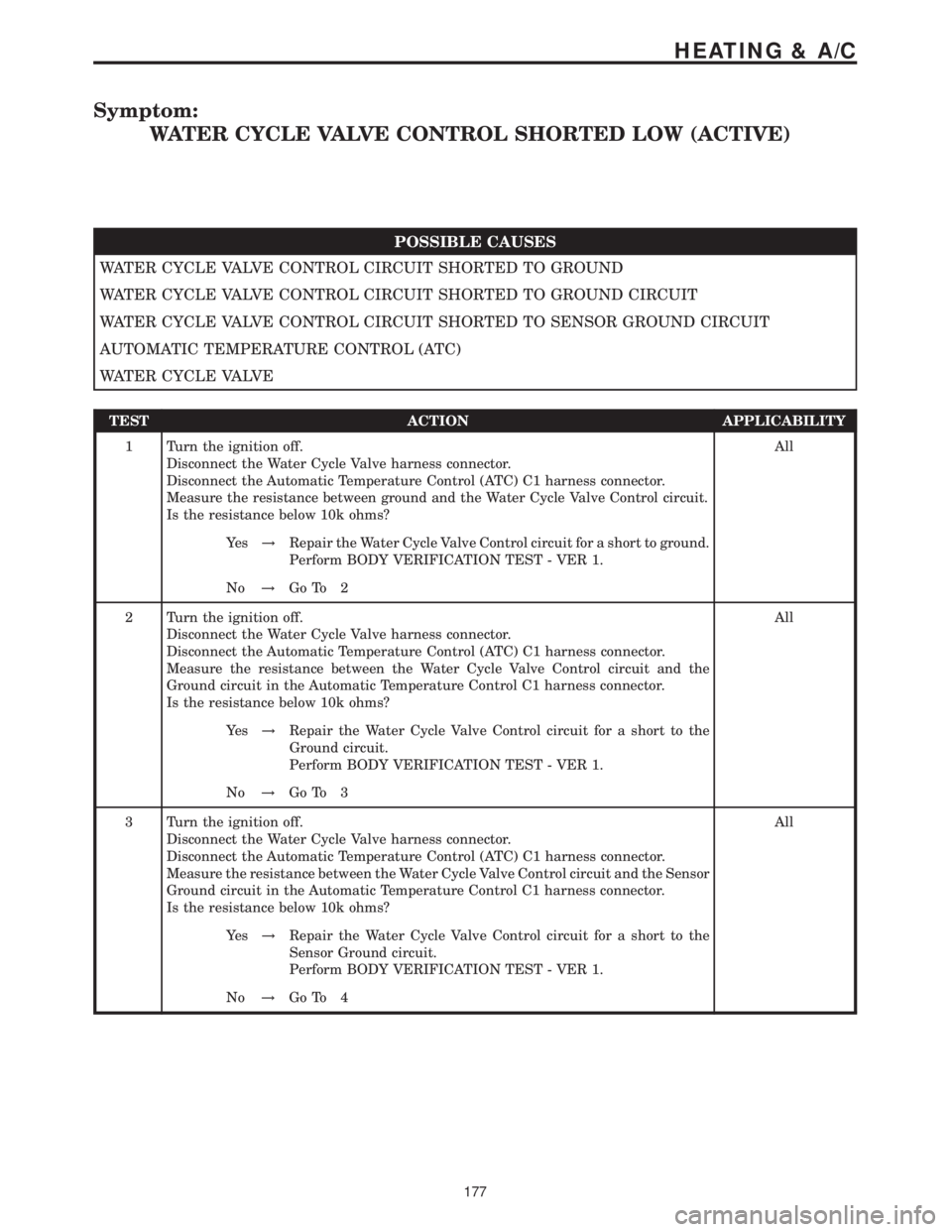
Symptom:
WATER CYCLE VALVE CONTROL SHORTED LOW (ACTIVE)
POSSIBLE CAUSES
WATER CYCLE VALVE CONTROL CIRCUIT SHORTED TO GROUND
WATER CYCLE VALVE CONTROL CIRCUIT SHORTED TO GROUND CIRCUIT
WATER CYCLE VALVE CONTROL CIRCUIT SHORTED TO SENSOR GROUND CIRCUIT
AUTOMATIC TEMPERATURE CONTROL (ATC)
WATER CYCLE VALVE
TEST ACTION APPLICABILITY
1 Turn the ignition off.
Disconnect the Water Cycle Valve harness connector.
Disconnect the Automatic Temperature Control (ATC) C1 harness connector.
Measure the resistance between ground and the Water Cycle Valve Control circuit.
Is the resistance below 10k ohms?All
Ye s!Repair the Water Cycle Valve Control circuit for a short to ground.
Perform BODY VERIFICATION TEST - VER 1.
No!Go To 2
2 Turn the ignition off.
Disconnect the Water Cycle Valve harness connector.
Disconnect the Automatic Temperature Control (ATC) C1 harness connector.
Measure the resistance between the Water Cycle Valve Control circuit and the
Ground circuit in the Automatic Temperature Control C1 harness connector.
Is the resistance below 10k ohms?All
Ye s!Repair the Water Cycle Valve Control circuit for a short to the
Ground circuit.
Perform BODY VERIFICATION TEST - VER 1.
No!Go To 3
3 Turn the ignition off.
Disconnect the Water Cycle Valve harness connector.
Disconnect the Automatic Temperature Control (ATC) C1 harness connector.
Measure the resistance between the Water Cycle Valve Control circuit and the Sensor
Ground circuit in the Automatic Temperature Control C1 harness connector.
Is the resistance below 10k ohms?All
Ye s!Repair the Water Cycle Valve Control circuit for a short to the
Sensor Ground circuit.
Perform BODY VERIFICATION TEST - VER 1.
No!Go To 4
177
HEATING & A/C
Page 191 of 2305
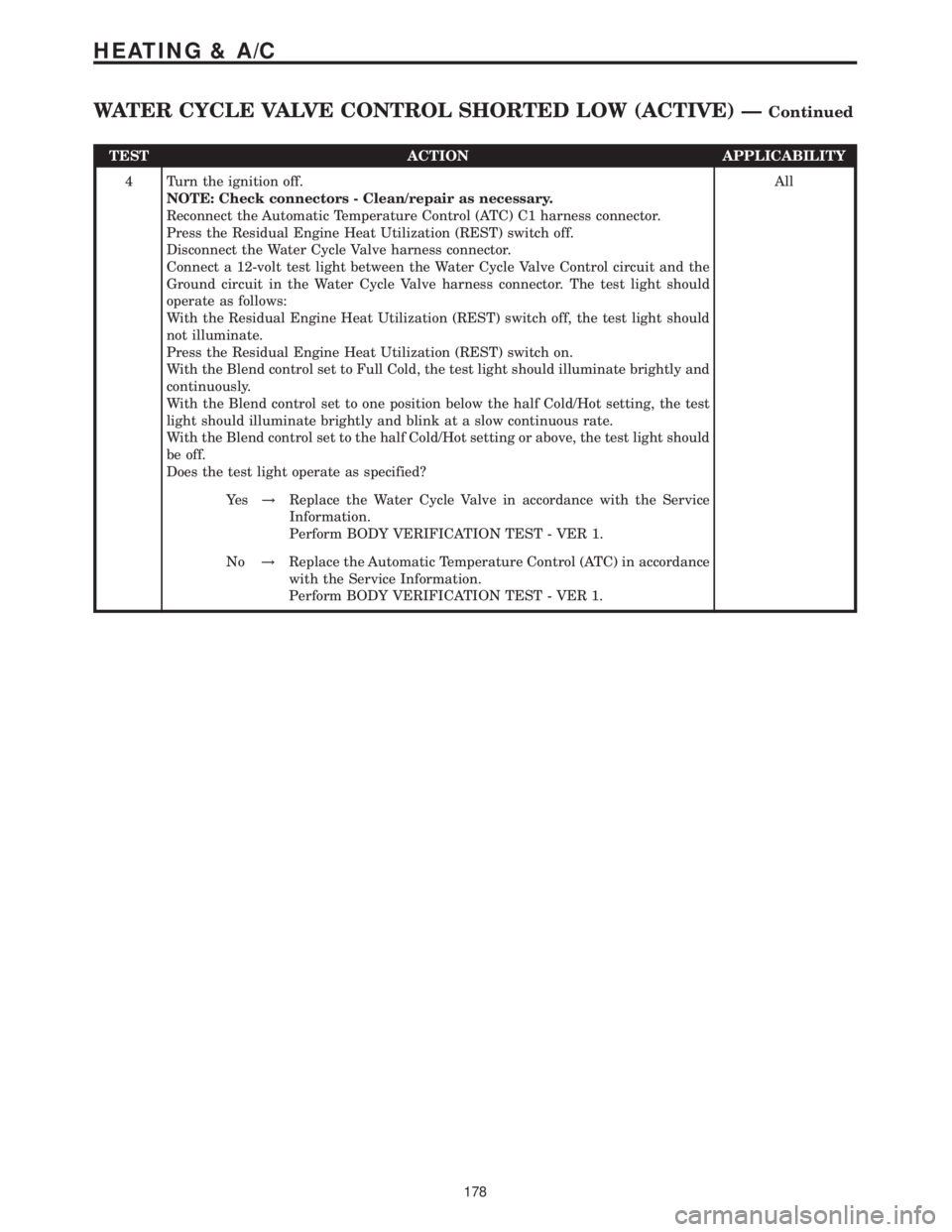
TEST ACTION APPLICABILITY
4 Turn the ignition off.
NOTE: Check connectors - Clean/repair as necessary.
Reconnect the Automatic Temperature Control (ATC) C1 harness connector.
Press the Residual Engine Heat Utilization (REST) switch off.
Disconnect the Water Cycle Valve harness connector.
Connect a 12-volt test light between the Water Cycle Valve Control circuit and the
Ground circuit in the Water Cycle Valve harness connector. The test light should
operate as follows:
With the Residual Engine Heat Utilization (REST) switch off, the test light should
not illuminate.
Press the Residual Engine Heat Utilization (REST) switch on.
With the Blend control set to Full Cold, the test light should illuminate brightly and
continuously.
With the Blend control set to one position below the half Cold/Hot setting, the test
light should illuminate brightly and blink at a slow continuous rate.
With the Blend control set to the half Cold/Hot setting or above, the test light should
be off.
Does the test light operate as specified?All
Ye s!Replace the Water Cycle Valve in accordance with the Service
Information.
Perform BODY VERIFICATION TEST - VER 1.
No!Replace the Automatic Temperature Control (ATC) in accordance
with the Service Information.
Perform BODY VERIFICATION TEST - VER 1.
178
HEATING & A/C
WATER CYCLE VALVE CONTROL SHORTED LOW (ACTIVE) ÐContinued
Page 263 of 2305
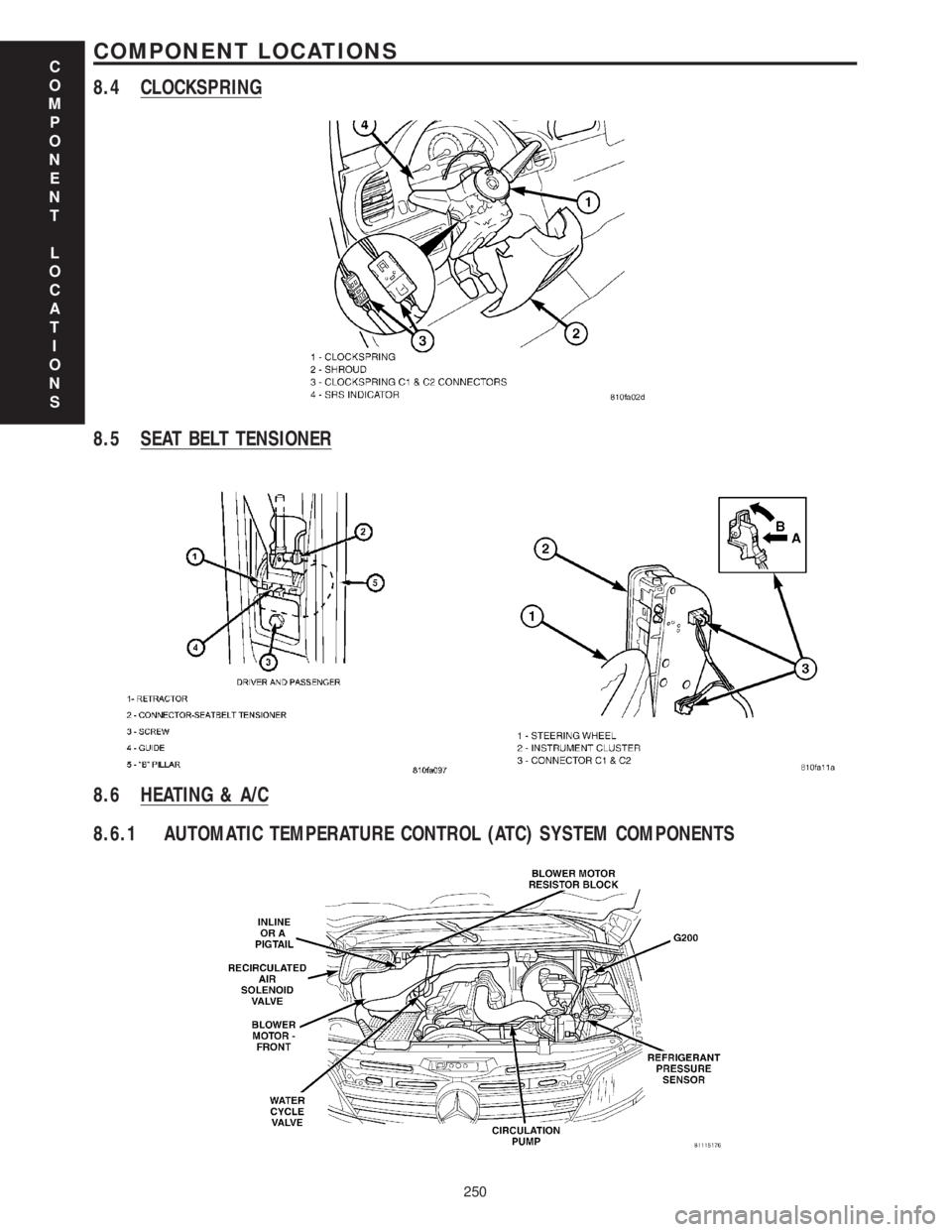
8.4 CLOCKSPRING
8.5 SEAT BELT TENSIONER
8.6 HEATING & A/C
8.6.1 AUTOMATIC TEMPERATURE CONTROL (ATC) SYSTEM COMPONENTS
C
O
M
P
O
N
E
N
T
L
O
C
A
T
I
O
N
S
250
COMPONENT LOCATIONS
Page 305 of 2305
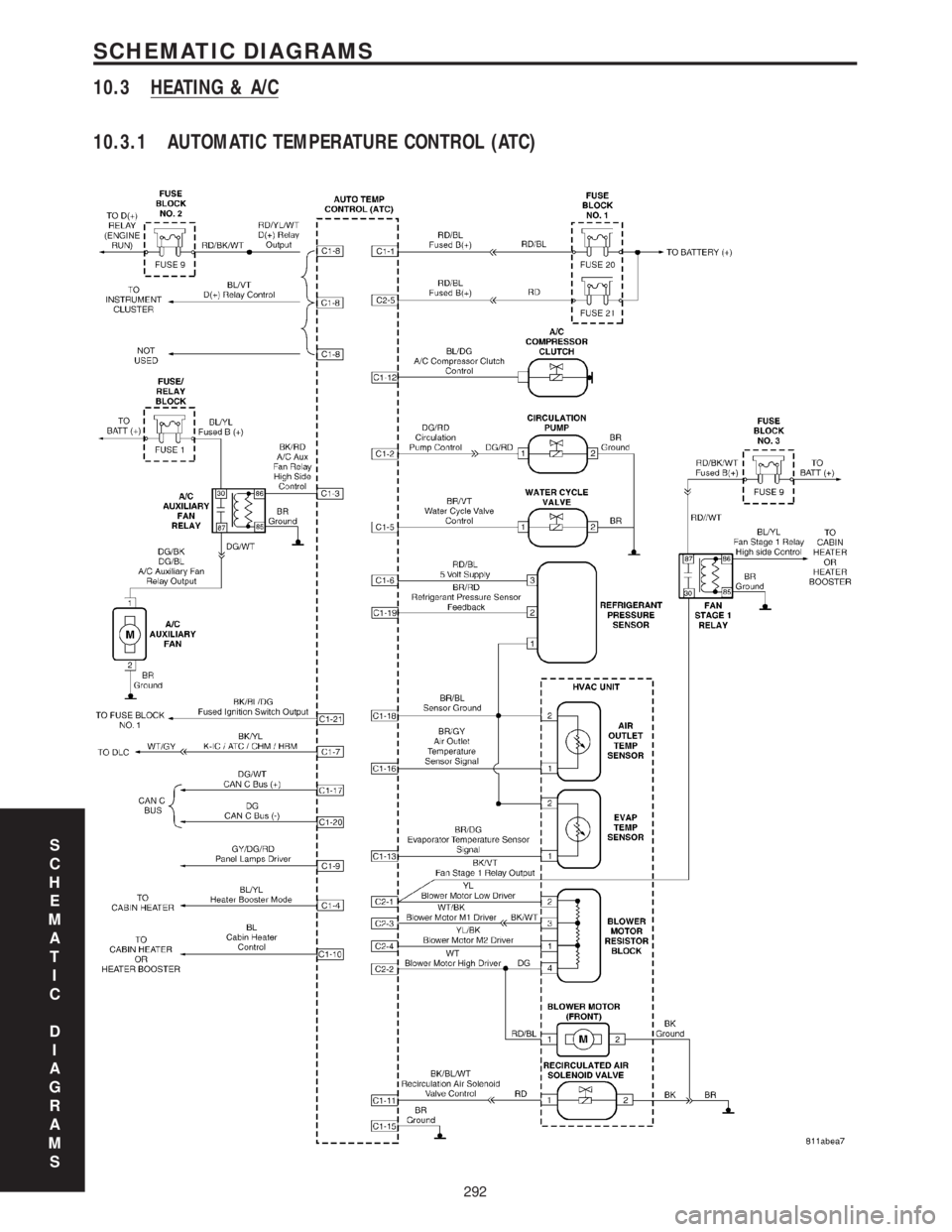
10.3 HEATING & A/C
10.3.1 AUTOMATIC TEMPERATURE CONTROL (ATC)
S
C
H
E
M
A
T
I
C
D
I
A
G
R
A
M
S
292
SCHEMATIC DIAGRAMS
Page 307 of 2305
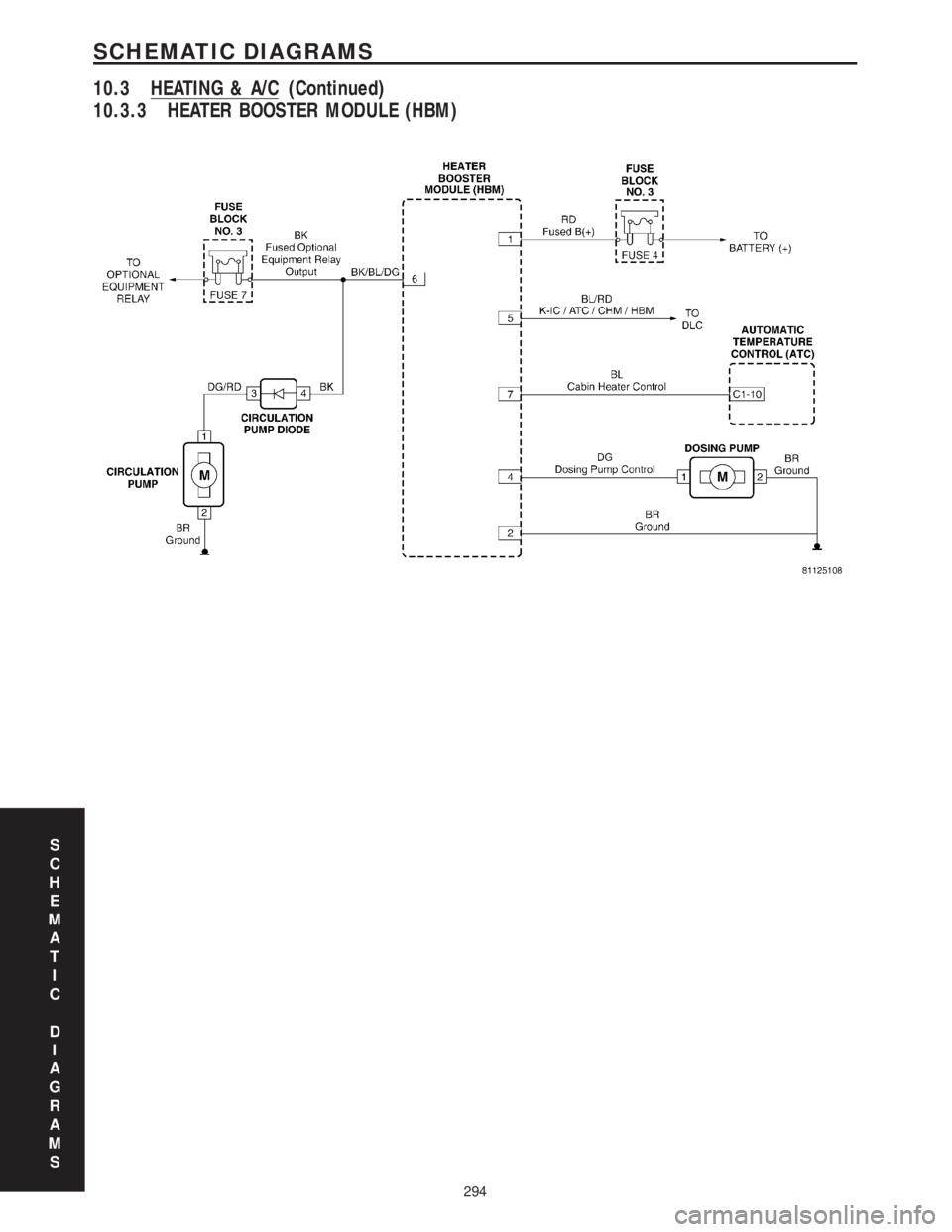
10.3.3 HEATER BOOSTER MODULE (HBM)
S
C
H
E
M
A
T
I
C
D
I
A
G
R
A
M
S
294
SCHEMATIC DIAGRAMS
10.3 HEATING & A/C (Continued)
Page 354 of 2305
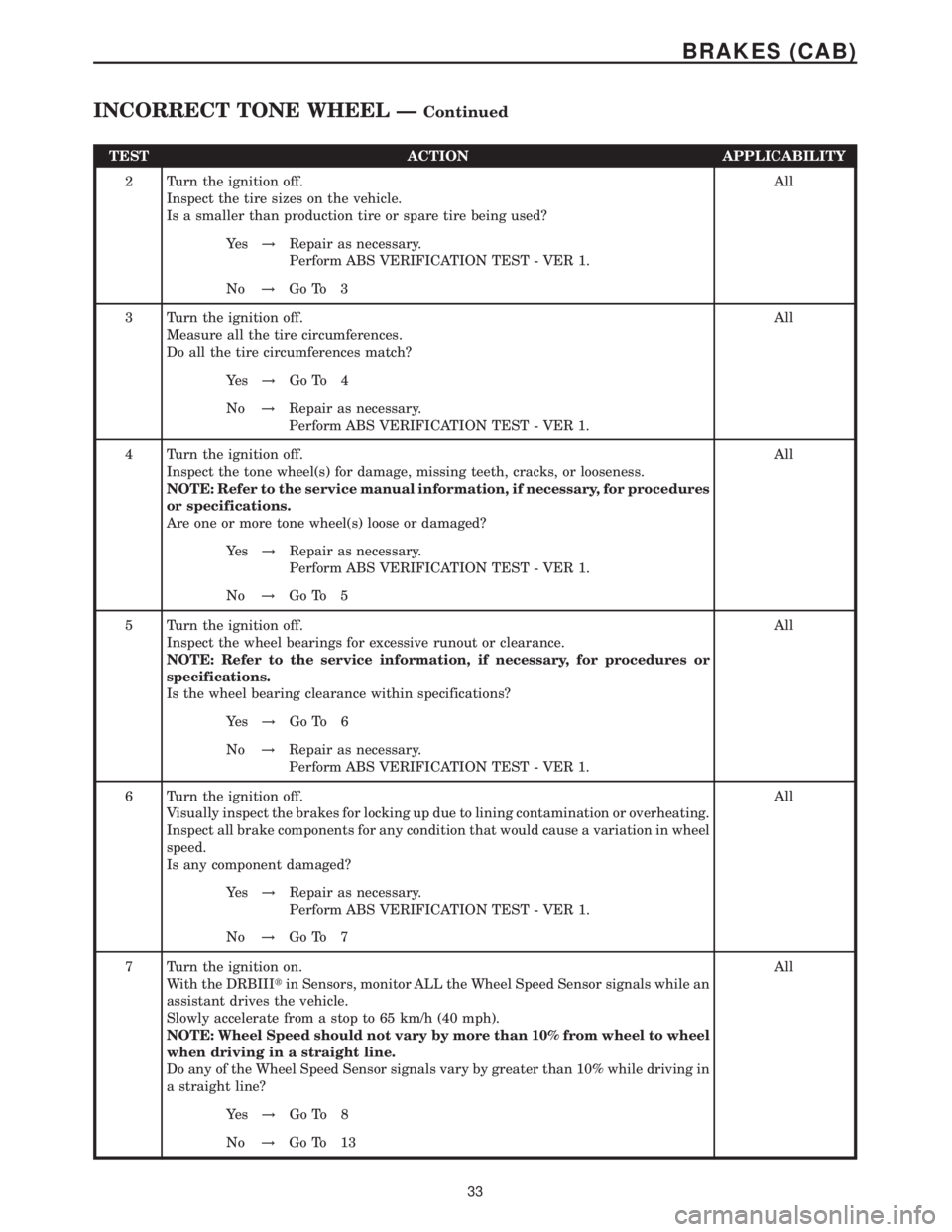
TEST ACTION APPLICABILITY
2 Turn the ignition off.
Inspect the tire sizes on the vehicle.
Is a smaller than production tire or spare tire being used?All
Ye s!Repair as necessary.
Perform ABS VERIFICATION TEST - VER 1.
No!Go To 3
3 Turn the ignition off.
Measure all the tire circumferences.
Do all the tire circumferences match?All
Ye s!Go To 4
No!Repair as necessary.
Perform ABS VERIFICATION TEST - VER 1.
4 Turn the ignition off.
Inspect the tone wheel(s) for damage, missing teeth, cracks, or looseness.
NOTE: Refer to the service manual information, if necessary, for procedures
or specifications.
Are one or more tone wheel(s) loose or damaged?All
Ye s!Repair as necessary.
Perform ABS VERIFICATION TEST - VER 1.
No!Go To 5
5 Turn the ignition off.
Inspect the wheel bearings for excessive runout or clearance.
NOTE: Refer to the service information, if necessary, for procedures or
specifications.
Is the wheel bearing clearance within specifications?All
Ye s!Go To 6
No!Repair as necessary.
Perform ABS VERIFICATION TEST - VER 1.
6 Turn the ignition off.
Visually inspect the brakes for locking up due to lining contamination or overheating.
Inspect all brake components for any condition that would cause a variation in wheel
speed.
Is any component damaged?All
Ye s!Repair as necessary.
Perform ABS VERIFICATION TEST - VER 1.
No!Go To 7
7 Turn the ignition on.
With the DRBIIItin Sensors, monitor ALL the Wheel Speed Sensor signals while an
assistant drives the vehicle.
Slowly accelerate from a stop to 65 km/h (40 mph).
NOTE: Wheel Speed should not vary by more than 10% from wheel to wheel
when driving in a straight line.
Do any of the Wheel Speed Sensor signals vary by greater than 10% while driving in
a straight line?All
Ye s!Go To 8
No!Go To 13
33
BRAKES (CAB)
INCORRECT TONE WHEEL ÐContinued
Page 368 of 2305
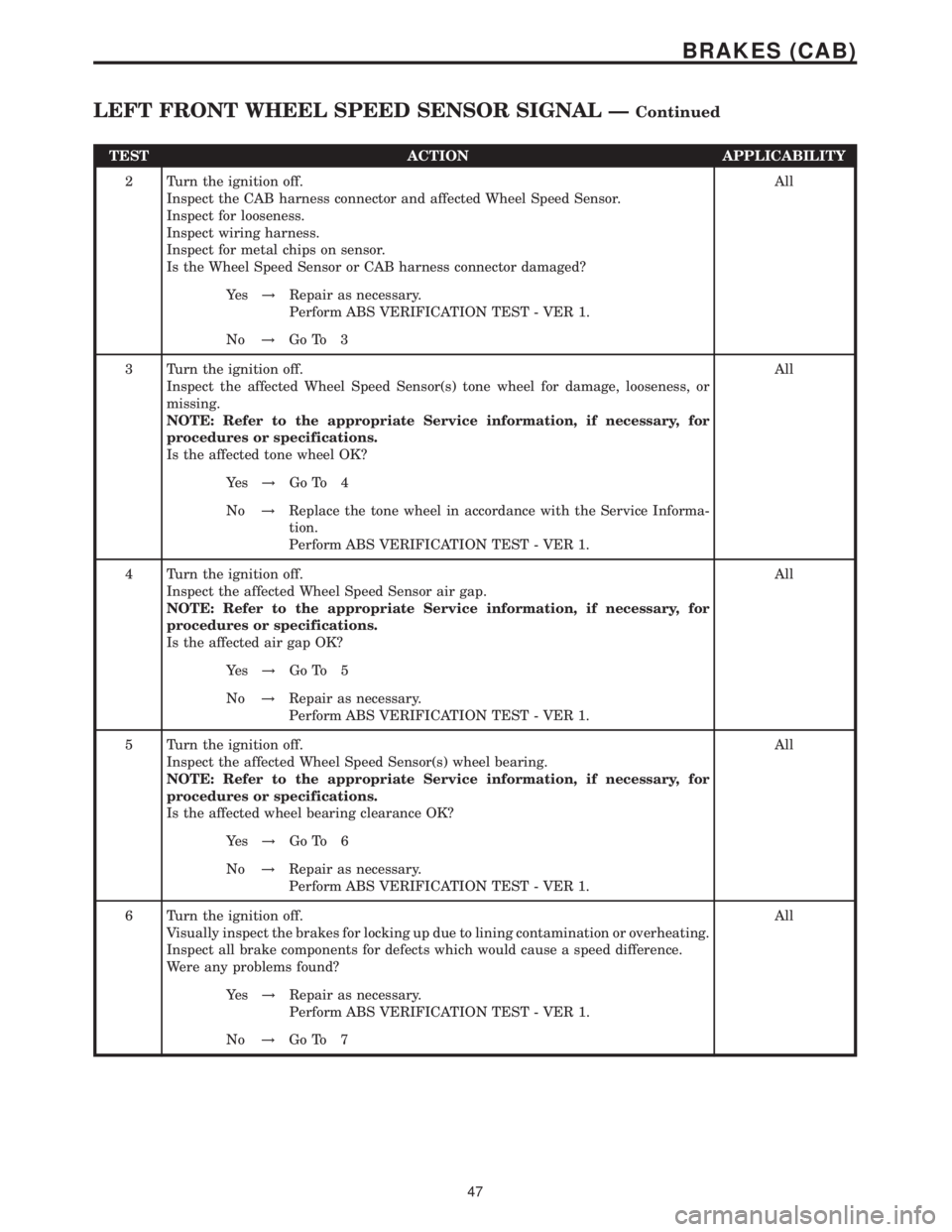
TEST ACTION APPLICABILITY
2 Turn the ignition off.
Inspect the CAB harness connector and affected Wheel Speed Sensor.
Inspect for looseness.
Inspect wiring harness.
Inspect for metal chips on sensor.
Is the Wheel Speed Sensor or CAB harness connector damaged?All
Ye s!Repair as necessary.
Perform ABS VERIFICATION TEST - VER 1.
No!Go To 3
3 Turn the ignition off.
Inspect the affected Wheel Speed Sensor(s) tone wheel for damage, looseness, or
missing.
NOTE: Refer to the appropriate Service information, if necessary, for
procedures or specifications.
Is the affected tone wheel OK?All
Ye s!Go To 4
No!Replace the tone wheel in accordance with the Service Informa-
tion.
Perform ABS VERIFICATION TEST - VER 1.
4 Turn the ignition off.
Inspect the affected Wheel Speed Sensor air gap.
NOTE: Refer to the appropriate Service information, if necessary, for
procedures or specifications.
Is the affected air gap OK?All
Ye s!Go To 5
No!Repair as necessary.
Perform ABS VERIFICATION TEST - VER 1.
5 Turn the ignition off.
Inspect the affected Wheel Speed Sensor(s) wheel bearing.
NOTE: Refer to the appropriate Service information, if necessary, for
procedures or specifications.
Is the affected wheel bearing clearance OK?All
Ye s!Go To 6
No!Repair as necessary.
Perform ABS VERIFICATION TEST - VER 1.
6 Turn the ignition off.
Visually inspect the brakes for locking up due to lining contamination or overheating.
Inspect all brake components for defects which would cause a speed difference.
Were any problems found?All
Ye s!Repair as necessary.
Perform ABS VERIFICATION TEST - VER 1.
No!Go To 7
47
BRAKES (CAB)
LEFT FRONT WHEEL SPEED SENSOR SIGNAL ÐContinued
Page 704 of 2305
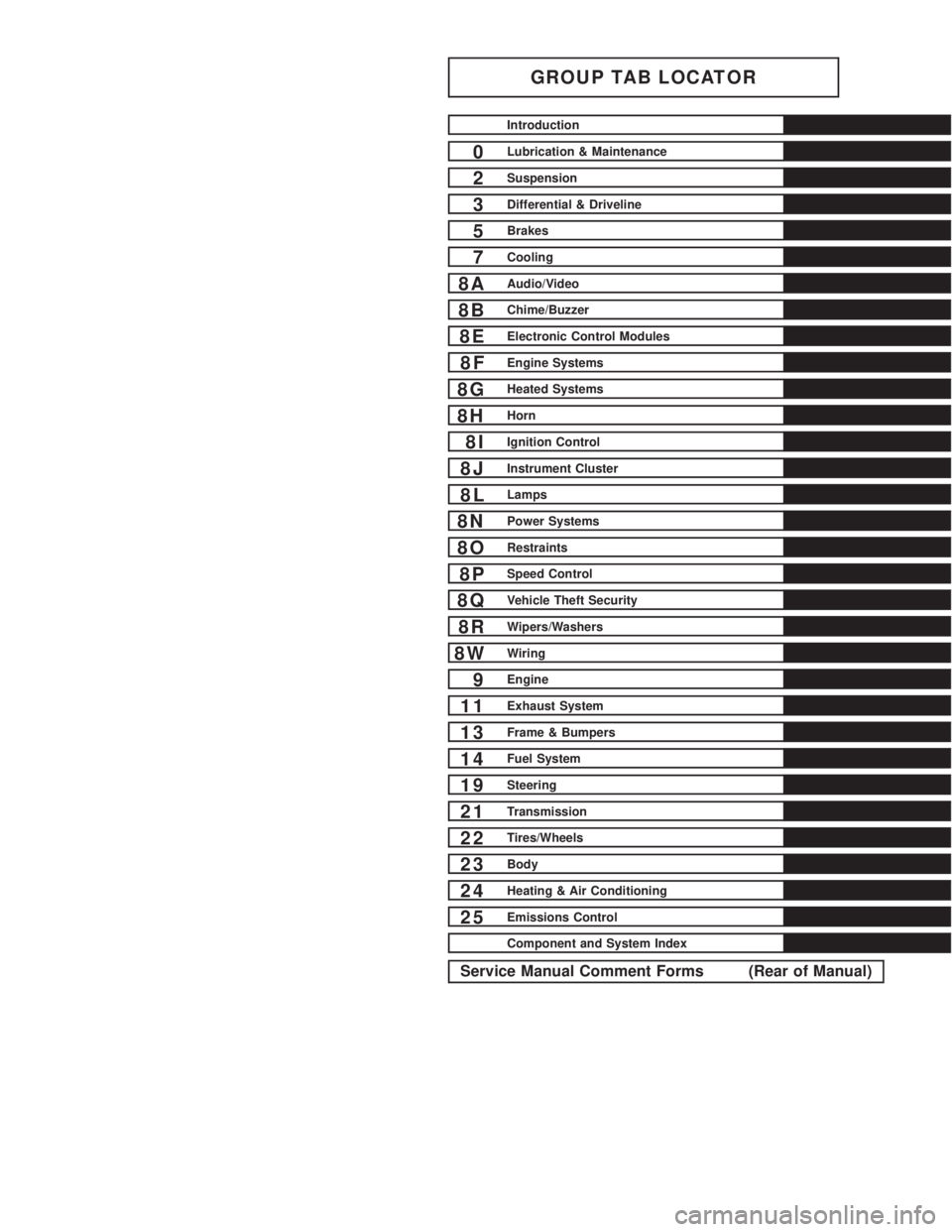
GROUP TAB LOCATOR
Introduction
0Lubrication & Maintenance
2Suspension
3Differential & Driveline
5Brakes
7Cooling
8AAudio/Video
8BChime/Buzzer
8EElectronic Control Modules
8FEngine Systems
8GHeated Systems
8HHorn
8IIgnition Control
8JInstrument Cluster
8LLamps
8NPower Systems
8ORestraints
8PSpeed Control
8QVehicle Theft Security
8RWipers/Washers
8WWiring
9Engine
11Exhaust System
13Frame & Bumpers
14Fuel System
19Steering
21Transmission
22Tires/Wheels
23Body
24Heating & Air Conditioning
25Emissions Control
Component and System Index
Service Manual Comment Forms (Rear of Manual)
Page 716 of 2305
LUBRICATION & MAINTENANCE
TABLE OF CONTENTS
page page
FLUID TYPES
DESCRIPTION
PARTS AND LUBRICANT
RECOMMENDATIONS...................1
AUTOMATIC TRANSMISSION FLUID - NAG1 . 1
AXLE FLUID..........................2
BRAKE FLUID.........................2
HOAT COOLANT.......................2
ENGINE OIL - DIESEL ENGINES...........3
FUEL REQUIREMENTS - DIESEL ENGINE . . . 4
POWER STEERING FLUID...............5
OPERATION - AUTOMATIC TRANSMISSION
FLUID...............................5
FLUID CAPACITIES
SPECIFICATIONS - FLUID CAPACITIES.......5FLUID FILL/CHECK LOCATIONS
INSPECTION - FLUID FILL/CHECK
LOCATIONS..........................5
HOISTING
STANDARD PROCEDURE - HOISTING........5
JUMP STARTING
STANDARD PROCEDURE - JUMP STARTING . . 6
TOWING
STANDARD PROCEDURE - TOWING.........7
MAINTENANCE SCHEDULES
DESCRIPTION..........................8
INTERNATIONAL SYMBOLS
DESCRIPTION..........................9
FLUID TYPES
DESCRIPTION
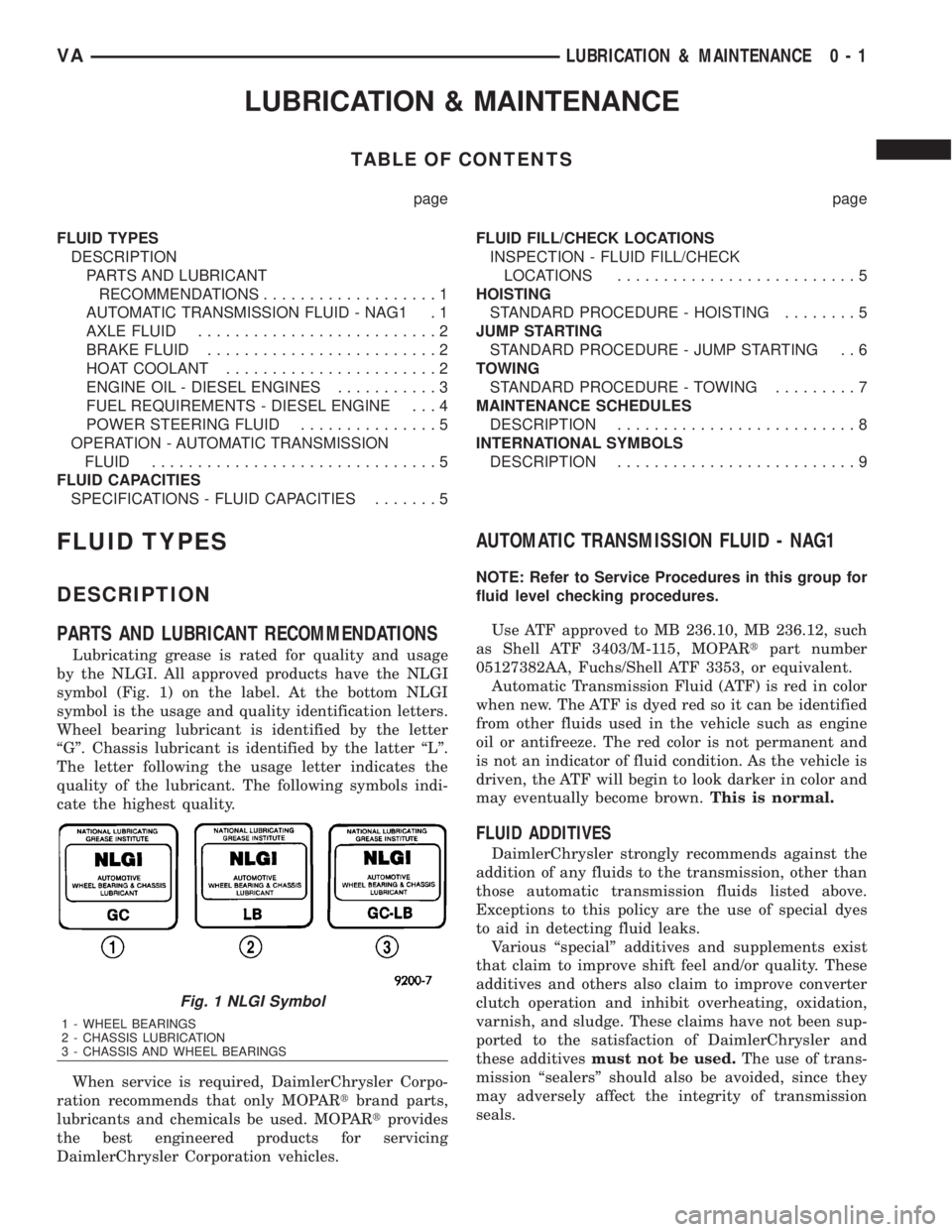
PARTS AND LUBRICANT RECOMMENDATIONS
Lubricating grease is rated for quality and usage
by the NLGI. All approved products have the NLGI
symbol (Fig. 1) on the label. At the bottom NLGI
symbol is the usage and quality identification letters.
Wheel bearing lubricant is identified by the letter
ªGº. Chassis lubricant is identified by the latter ªLº.
The letter following the usage letter indicates the
quality of the lubricant. The following symbols indi-
cate the highest quality.
When service is required, DaimlerChrysler Corpo-
ration recommends that only MOPARtbrand parts,
lubricants and chemicals be used. MOPARtprovides
the best engineered products for servicing
DaimlerChrysler Corporation vehicles.
AUTOMATIC TRANSMISSION FLUID - NAG1
NOTE: Refer to Service Procedures in this group for
fluid level checking procedures.
Use ATF approved to MB 236.10, MB 236.12, such
as Shell ATF 3403/M-115, MOPARtpart number
05127382AA, Fuchs/Shell ATF 3353, or equivalent.
Automatic Transmission Fluid (ATF) is red in color
when new. The ATF is dyed red so it can be identified
from other fluids used in the vehicle such as engine
oil or antifreeze. The red color is not permanent and
is not an indicator of fluid condition. As the vehicle is
driven, the ATF will begin to look darker in color and
may eventually become brown.This is normal.
FLUID ADDITIVES
DaimlerChrysler strongly recommends against the
addition of any fluids to the transmission, other than
those automatic transmission fluids listed above.
Exceptions to this policy are the use of special dyes
to aid in detecting fluid leaks.
Various ªspecialº additives and supplements exist
that claim to improve shift feel and/or quality. These
additives and others also claim to improve converter
clutch operation and inhibit overheating, oxidation,
varnish, and sludge. These claims have not been sup-
ported to the satisfaction of DaimlerChrysler and
these additivesmust not be used.The use of trans-
mission ªsealersº should also be avoided, since they
may adversely affect the integrity of transmission
seals.
Fig. 1 NLGI Symbol
1 - WHEEL BEARINGS
2 - CHASSIS LUBRICATION
3 - CHASSIS AND WHEEL BEARINGS
VALUBRICATION & MAINTENANCE 0 - 1