relay MERCEDES-BENZ SPRINTER 2006 Repair Manual
[x] Cancel search | Manufacturer: MERCEDES-BENZ, Model Year: 2006, Model line: SPRINTER, Model: MERCEDES-BENZ SPRINTER 2006Pages: 2305, PDF Size: 48.12 MB
Page 398 of 2305
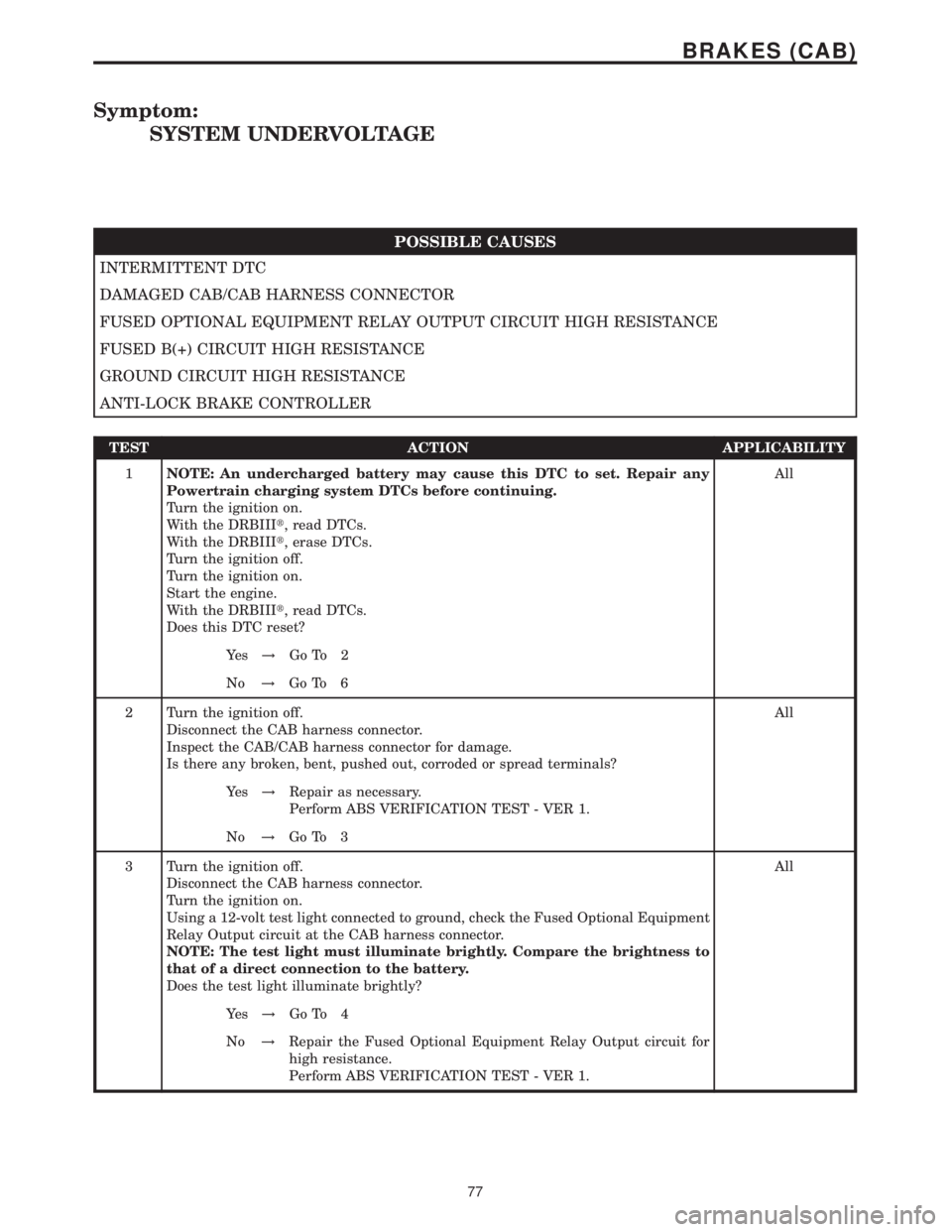
Symptom:
SYSTEM UNDERVOLTAGE
POSSIBLE CAUSES
INTERMITTENT DTC
DAMAGED CAB/CAB HARNESS CONNECTOR
FUSED OPTIONAL EQUIPMENT RELAY OUTPUT CIRCUIT HIGH RESISTANCE
FUSED B(+) CIRCUIT HIGH RESISTANCE
GROUND CIRCUIT HIGH RESISTANCE
ANTI-LOCK BRAKE CONTROLLER
TEST ACTION APPLICABILITY
1NOTE: An undercharged battery may cause this DTC to set. Repair any
Powertrain charging system DTCs before continuing.
Turn the ignition on.
With the DRBIIIt, read DTCs.
With the DRBIIIt, erase DTCs.
Turn the ignition off.
Turn the ignition on.
Start the engine.
With the DRBIIIt, read DTCs.
Does this DTC reset?All
Ye s!Go To 2
No!Go To 6
2 Turn the ignition off.
Disconnect the CAB harness connector.
Inspect the CAB/CAB harness connector for damage.
Is there any broken, bent, pushed out, corroded or spread terminals?All
Ye s!Repair as necessary.
Perform ABS VERIFICATION TEST - VER 1.
No!Go To 3
3 Turn the ignition off.
Disconnect the CAB harness connector.
Turn the ignition on.
Using a 12-volt test light connected to ground, check the Fused Optional Equipment
Relay Output circuit at the CAB harness connector.
NOTE: The test light must illuminate brightly. Compare the brightness to
that of a direct connection to the battery.
Does the test light illuminate brightly?All
Ye s!Go To 4
No!Repair the Fused Optional Equipment Relay Output circuit for
high resistance.
Perform ABS VERIFICATION TEST - VER 1.
77
BRAKES (CAB)
Page 405 of 2305
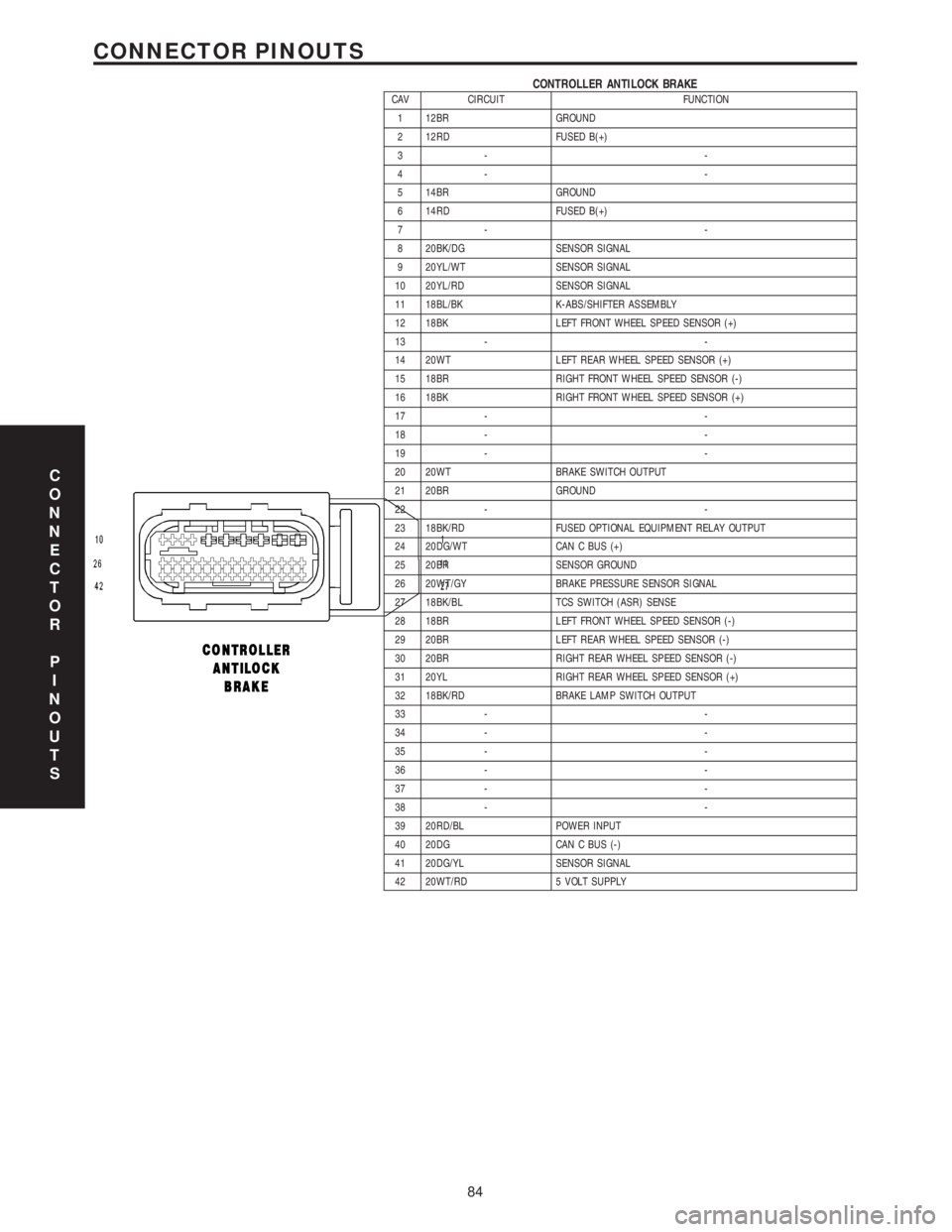
CONTROLLER ANTILOCK BRAKECAV CIRCUIT FUNCTION
1 12BR GROUND
2 12RD FUSED B(+)
3- -
4- -
5 14BR GROUND
6 14RD FUSED B(+)
7- -
8 20BK/DG SENSOR SIGNAL
9 20YL/WT SENSOR SIGNAL
10 20YL/RD SENSOR SIGNAL
11 18BL/BK K-ABS/SHIFTER ASSEMBLY
12 18BK LEFT FRONT WHEEL SPEED SENSOR (+)
13 - -
14 20WT LEFT REAR WHEEL SPEED SENSOR (+)
15 18BR RIGHT FRONT WHEEL SPEED SENSOR (-)
16 18BK RIGHT FRONT WHEEL SPEED SENSOR (+)
17 - -
18 - -
19 - -
20 20WT BRAKE SWITCH OUTPUT
21 20BR GROUND
22 - -
23 18BK/RD FUSED OPTIONAL EQUIPMENT RELAY OUTPUT
24 20DG/WT CAN C BUS (+)
25 20BR SENSOR GROUND
26 20WT/GY BRAKE PRESSURE SENSOR SIGNAL
27 18BK/BL TCS SWITCH (ASR) SENSE
28 18BR LEFT FRONT WHEEL SPEED SENSOR (-)
29 20BR LEFT REAR WHEEL SPEED SENSOR (-)
30 20BR RIGHT REAR WHEEL SPEED SENSOR (-)
31 20YL RIGHT REAR WHEEL SPEED SENSOR (+)
32 18BK/RD BRAKE LAMP SWITCH OUTPUT
33 - -
34 - -
35 - -
36 - -
37 - -
38 - -
39 20RD/BL POWER INPUT
40 20DG CAN C BUS (-)
41 20DG/YL SENSOR SIGNAL
42 20WT/RD 5 VOLT SUPPLY
C
O
N
N
E
C
T
O
R
P
I
N
O
U
T
S
84
CONNECTOR PINOUTS
Page 406 of 2305
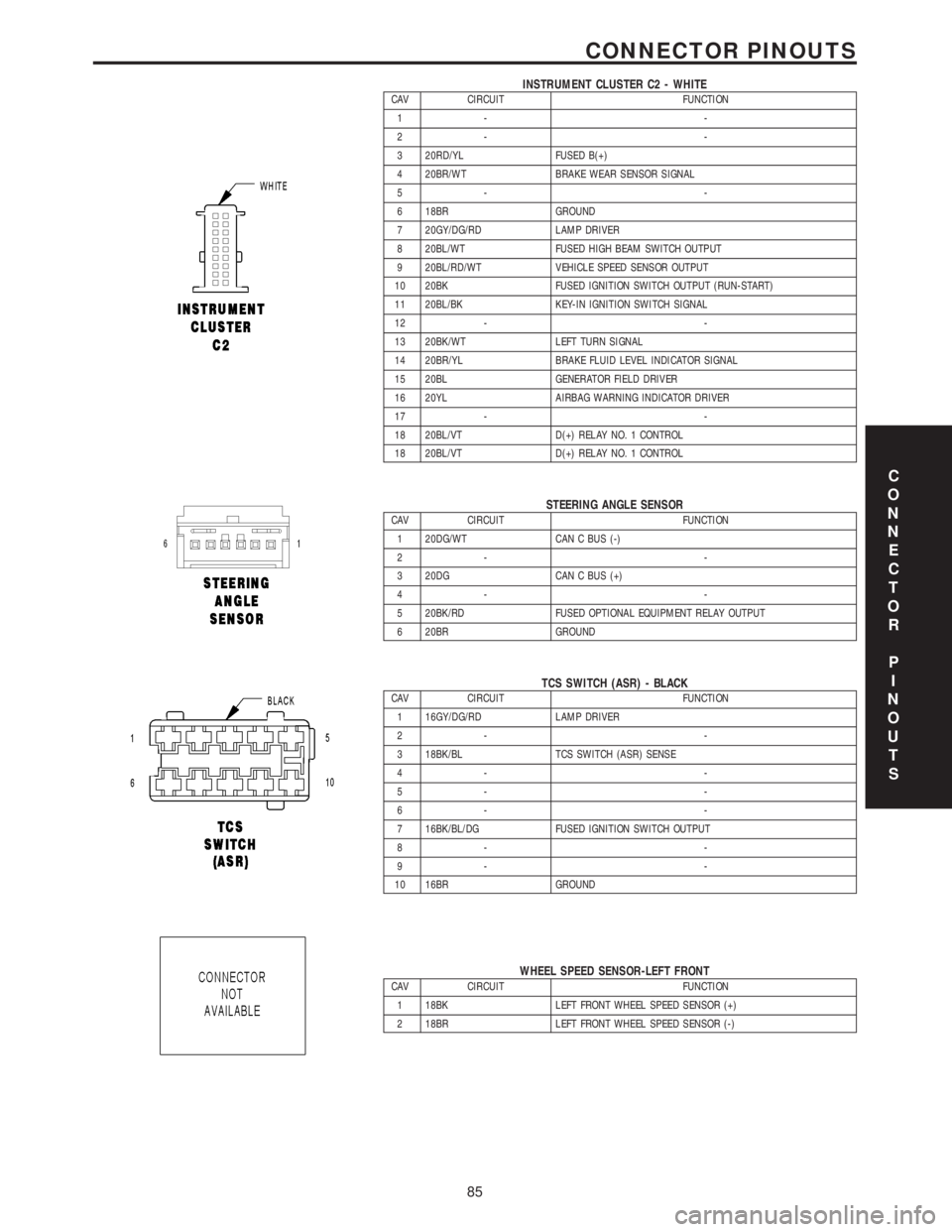
INSTRUMENT CLUSTER C2 - WHITECAV CIRCUIT FUNCTION
1- -
2- -
3 20RD/YL FUSED B(+)
4 20BR/WT BRAKE WEAR SENSOR SIGNAL
5- -
6 18BR GROUND
7 20GY/DG/RD LAMP DRIVER
8 20BL/WT FUSED HIGH BEAM SWITCH OUTPUT
9 20BL/RD/WT VEHICLE SPEED SENSOR OUTPUT
10 20BK FUSED IGNITION SWITCH OUTPUT (RUN-START)
11 20BL/BK KEY-IN IGNITION SWITCH SIGNAL
12 - -
13 20BK/WT LEFT TURN SIGNAL
14 20BR/YL BRAKE FLUID LEVEL INDICATOR SIGNAL
15 20BL GENERATOR FIELD DRIVER
16 20YL AIRBAG WARNING INDICATOR DRIVER
17 - -
18 20BL/VT D(+) RELAY NO. 1 CONTROL
18 20BL/VT D(+) RELAY NO. 1 CONTROL
STEERING ANGLE SENSORCAV CIRCUIT FUNCTION
1 20DG/WT CAN C BUS (-)
2- -
3 20DG CAN C BUS (+)
4- -
5 20BK/RD FUSED OPTIONAL EQUIPMENT RELAY OUTPUT
6 20BR GROUND
TCS SWITCH (ASR) - BLACKCAV CIRCUIT FUNCTION
1 16GY/DG/RD LAMP DRIVER
2- -
3 18BK/BL TCS SWITCH (ASR) SENSE
4- -
5- -
6- -
7 16BK/BL/DG FUSED IGNITION SWITCH OUTPUT
8- -
9- -
10 16BR GROUND
WHEEL SPEED SENSOR-LEFT FRONTCAV CIRCUIT FUNCTION
1 18BK LEFT FRONT WHEEL SPEED SENSOR (+)
2 18BR LEFT FRONT WHEEL SPEED SENSOR (-)
C
O
N
N
E
C
T
O
R
P
I
N
O
U
T
S
85
CONNECTOR PINOUTS
Page 413 of 2305
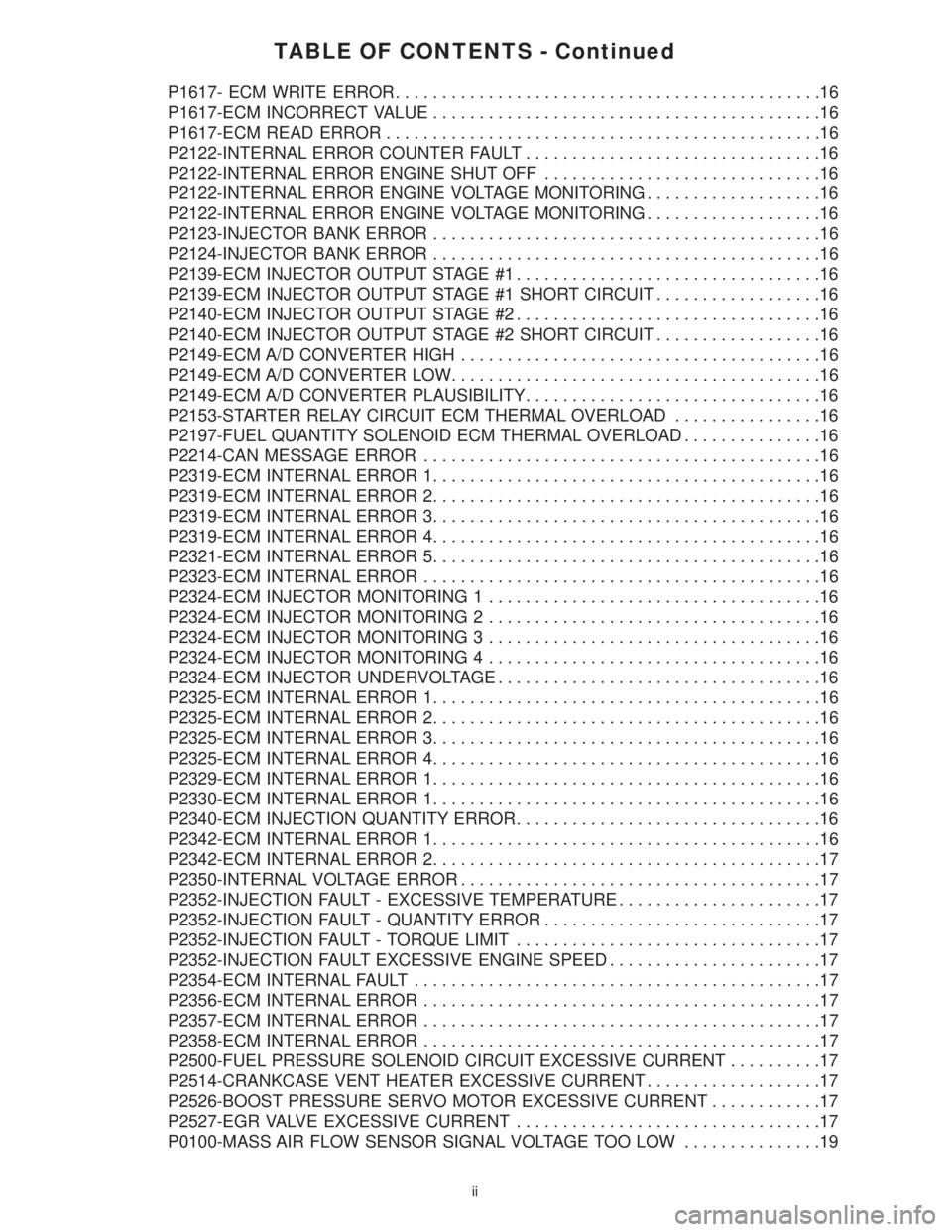
TABLE OF CONTENTS - Continued
P1617- ECM WRITE ERROR..............................................16
P1617-ECM INCORRECT VALUE..........................................16
P1617-ECM READ ERROR...............................................16
P2122-INTERNAL ERROR COUNTER FAULT................................16
P2122-INTERNAL ERROR ENGINE SHUT OFF..............................16
P2122-INTERNAL ERROR ENGINE VOLTAGE MONITORING...................16
P2122-INTERNAL ERROR ENGINE VOLTAGE MONITORING...................16
P2123-INJECTOR BANK ERROR..........................................16
P2124-INJECTOR BANK ERROR..........................................16
P2139-ECM INJECTOR OUTPUT STAGE #1.................................16
P2139-ECM INJECTOR OUTPUT STAGE #1 SHORT CIRCUIT..................16
P2140-ECM INJECTOR OUTPUT STAGE #2.................................16
P2140-ECM INJECTOR OUTPUT STAGE #2 SHORT CIRCUIT..................16
P2149-ECM A/D CONVERTER HIGH.......................................16
P2149-ECM A/D CONVERTER LOW........................................16
P2149-ECM A/D CONVERTER PLAUSIBILITY................................16
P2153-STARTER RELAY CIRCUIT ECM THERMAL OVERLOAD................16
P2197-FUEL QUANTITY SOLENOID ECM THERMAL OVERLOAD...............16
P2214-CAN MESSAGE ERROR...........................................16
P2319-ECM INTERNAL ERROR 1..........................................16
P2319-ECM INTERNAL ERROR 2..........................................16
P2319-ECM INTERNAL ERROR 3..........................................16
P2319-ECM INTERNAL ERROR 4..........................................16
P2321-ECM INTERNAL ERROR 5..........................................16
P2323-ECM INTERNAL ERROR...........................................16
P2324-ECM INJECTOR MONITORING 1....................................16
P2324-ECM INJECTOR MONITORING 2....................................16
P2324-ECM INJECTOR MONITORING 3....................................16
P2324-ECM INJECTOR MONITORING 4....................................16
P2324-ECM INJECTOR UNDERVOLTAGE...................................16
P2325-ECM INTERNAL ERROR 1..........................................16
P2325-ECM INTERNAL ERROR 2..........................................16
P2325-ECM INTERNAL ERROR 3..........................................16
P2325-ECM INTERNAL ERROR 4..........................................16
P2329-ECM INTERNAL ERROR 1..........................................16
P2330-ECM INTERNAL ERROR 1..........................................16
P2340-ECM INJECTION QUANTITY ERROR.................................16
P2342-ECM INTERNAL ERROR 1..........................................16
P2342-ECM INTERNAL ERROR 2..........................................17
P2350-INTERNAL VOLTAGE ERROR.......................................17
P2352-INJECTION FAULT - EXCESSIVE TEMPERATURE......................17
P2352-INJECTION FAULT - QUANTITY ERROR..............................17
P2352-INJECTION FAULT - TORQUE LIMIT.................................17
P2352-INJECTION FAULT EXCESSIVE ENGINE SPEED.......................17
P2354-ECM INTERNAL FAULT............................................17
P2356-ECM INTERNAL ERROR...........................................17
P2357-ECM INTERNAL ERROR...........................................17
P2358-ECM INTERNAL ERROR...........................................17
P2500-FUEL PRESSURE SOLENOID CIRCUIT EXCESSIVE CURRENT..........17
P2514-CRANKCASE VENT HEATER EXCESSIVE CURRENT...................17
P2526-BOOST PRESSURE SERVO MOTOR EXCESSIVE CURRENT............17
P2527-EGR VALVE EXCESSIVE CURRENT.................................17
P0100-MASS AIR FLOW SENSOR SIGNAL VOLTAGE TOO LOW...............19
ii
Page 416 of 2305
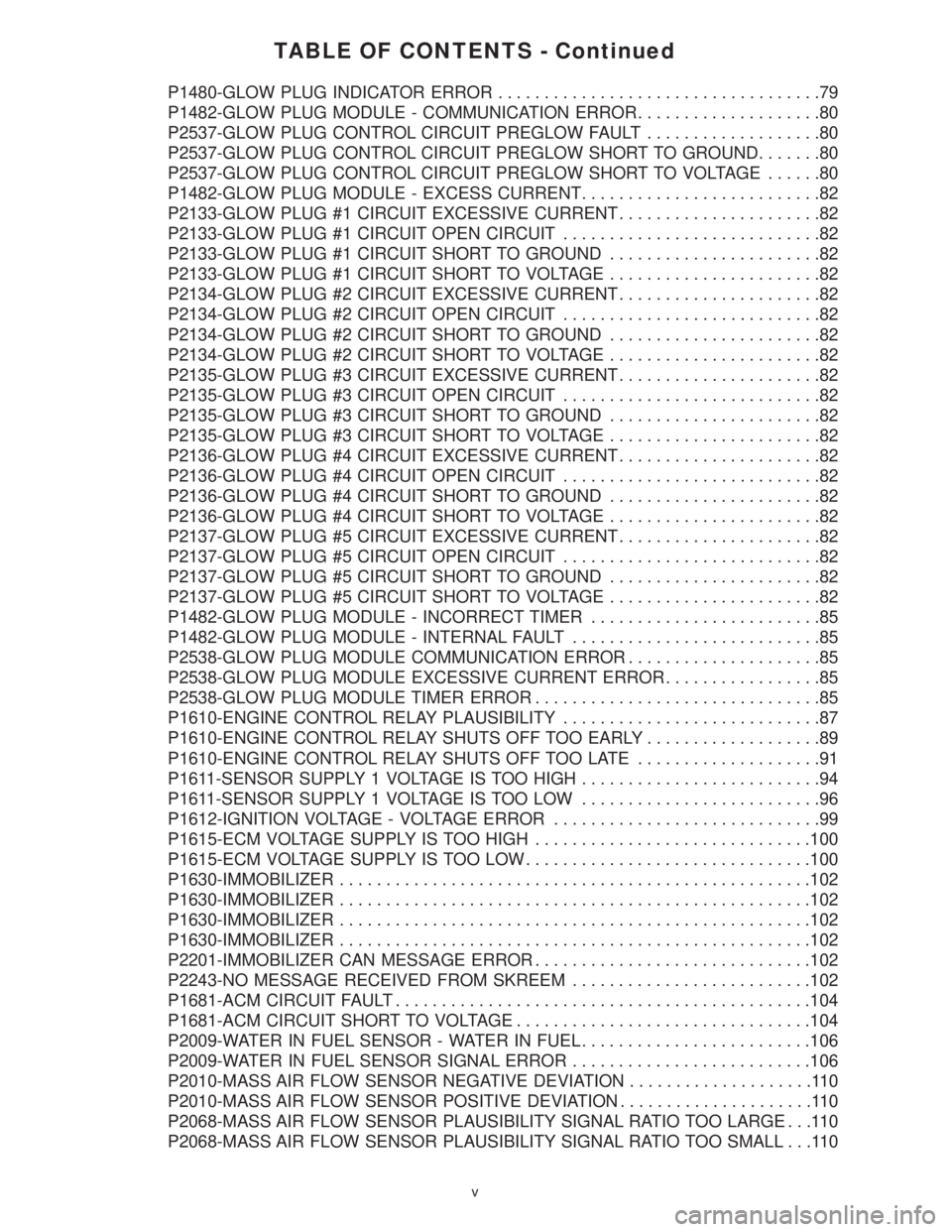
TABLE OF CONTENTS - Continued
P1480-GLOW PLUG INDICATOR ERROR...................................79
P1482-GLOW PLUG MODULE - COMMUNICATION ERROR....................80
P2537-GLOW PLUG CONTROL CIRCUIT PREGLOW FAULT...................80
P2537-GLOW PLUG CONTROL CIRCUIT PREGLOW SHORT TO GROUND.......80
P2537-GLOW PLUG CONTROL CIRCUIT PREGLOW SHORT TO VOLTAGE......80
P1482-GLOW PLUG MODULE - EXCESS CURRENT..........................82
P2133-GLOW PLUG #1 CIRCUIT EXCESSIVE CURRENT......................82
P2133-GLOW PLUG #1 CIRCUIT OPEN CIRCUIT............................82
P2133-GLOW PLUG #1 CIRCUIT SHORT TO GROUND.......................82
P2133-GLOW PLUG #1 CIRCUIT SHORT TO VOLTAGE.......................82
P2134-GLOW PLUG #2 CIRCUIT EXCESSIVE CURRENT......................82
P2134-GLOW PLUG #2 CIRCUIT OPEN CIRCUIT............................82
P2134-GLOW PLUG #2 CIRCUIT SHORT TO GROUND.......................82
P2134-GLOW PLUG #2 CIRCUIT SHORT TO VOLTAGE.......................82
P2135-GLOW PLUG #3 CIRCUIT EXCESSIVE CURRENT......................82
P2135-GLOW PLUG #3 CIRCUIT OPEN CIRCUIT............................82
P2135-GLOW PLUG #3 CIRCUIT SHORT TO GROUND.......................82
P2135-GLOW PLUG #3 CIRCUIT SHORT TO VOLTAGE.......................82
P2136-GLOW PLUG #4 CIRCUIT EXCESSIVE CURRENT......................82
P2136-GLOW PLUG #4 CIRCUIT OPEN CIRCUIT............................82
P2136-GLOW PLUG #4 CIRCUIT SHORT TO GROUND.......................82
P2136-GLOW PLUG #4 CIRCUIT SHORT TO VOLTAGE.......................82
P2137-GLOW PLUG #5 CIRCUIT EXCESSIVE CURRENT......................82
P2137-GLOW PLUG #5 CIRCUIT OPEN CIRCUIT............................82
P2137-GLOW PLUG #5 CIRCUIT SHORT TO GROUND.......................82
P2137-GLOW PLUG #5 CIRCUIT SHORT TO VOLTAGE.......................82
P1482-GLOW PLUG MODULE - INCORRECT TIMER.........................85
P1482-GLOW PLUG MODULE - INTERNAL FAULT...........................85
P2538-GLOW PLUG MODULE COMMUNICATION ERROR.....................85
P2538-GLOW PLUG MODULE EXCESSIVE CURRENT ERROR.................85
P2538-GLOW PLUG MODULE TIMER ERROR...............................85
P1610-ENGINE CONTROL RELAY PLAUSIBILITY............................87
P1610-ENGINE CONTROL RELAY SHUTS OFF TOO EARLY...................89
P1610-ENGINE CONTROL RELAY SHUTS OFF TOO LATE....................91
P1611-SENSOR SUPPLY 1 VOLTAGE IS TOO HIGH..........................94
P1611-SENSOR SUPPLY 1 VOLTAGE IS TOO LOW..........................96
P1612-IGNITION VOLTAGE - VOLTAGE ERROR.............................99
P1615-ECM VOLTAGE SUPPLY IS TOO HIGH..............................100
P1615-ECM VOLTAGE SUPPLY IS TOO LOW...............................100
P1630-IMMOBILIZER...................................................102
P1630-IMMOBILIZER...................................................102
P1630-IMMOBILIZER...................................................102
P1630-IMMOBILIZER...................................................102
P2201-IMMOBILIZER CAN MESSAGE ERROR..............................102
P2243-NO MESSAGE RECEIVED FROM SKREEM..........................102
P1681-ACM CIRCUIT FAULT.............................................104
P1681-ACM CIRCUIT SHORT TO VOLTAGE................................104
P2009-WATER IN FUEL SENSOR - WATER IN FUEL.........................106
P2009-WATER IN FUEL SENSOR SIGNAL ERROR..........................106
P2010-MASS AIR FLOW SENSOR NEGATIVE DEVIATION....................110
P2010-MASS AIR FLOW SENSOR POSITIVE DEVIATION.....................110
P2068-MASS AIR FLOW SENSOR PLAUSIBILITY SIGNAL RATIO TOO LARGE . . .110
P2068-MASS AIR FLOW SENSOR PLAUSIBILITY SIGNAL RATIO TOO SMALL . . .110
v
Page 418 of 2305
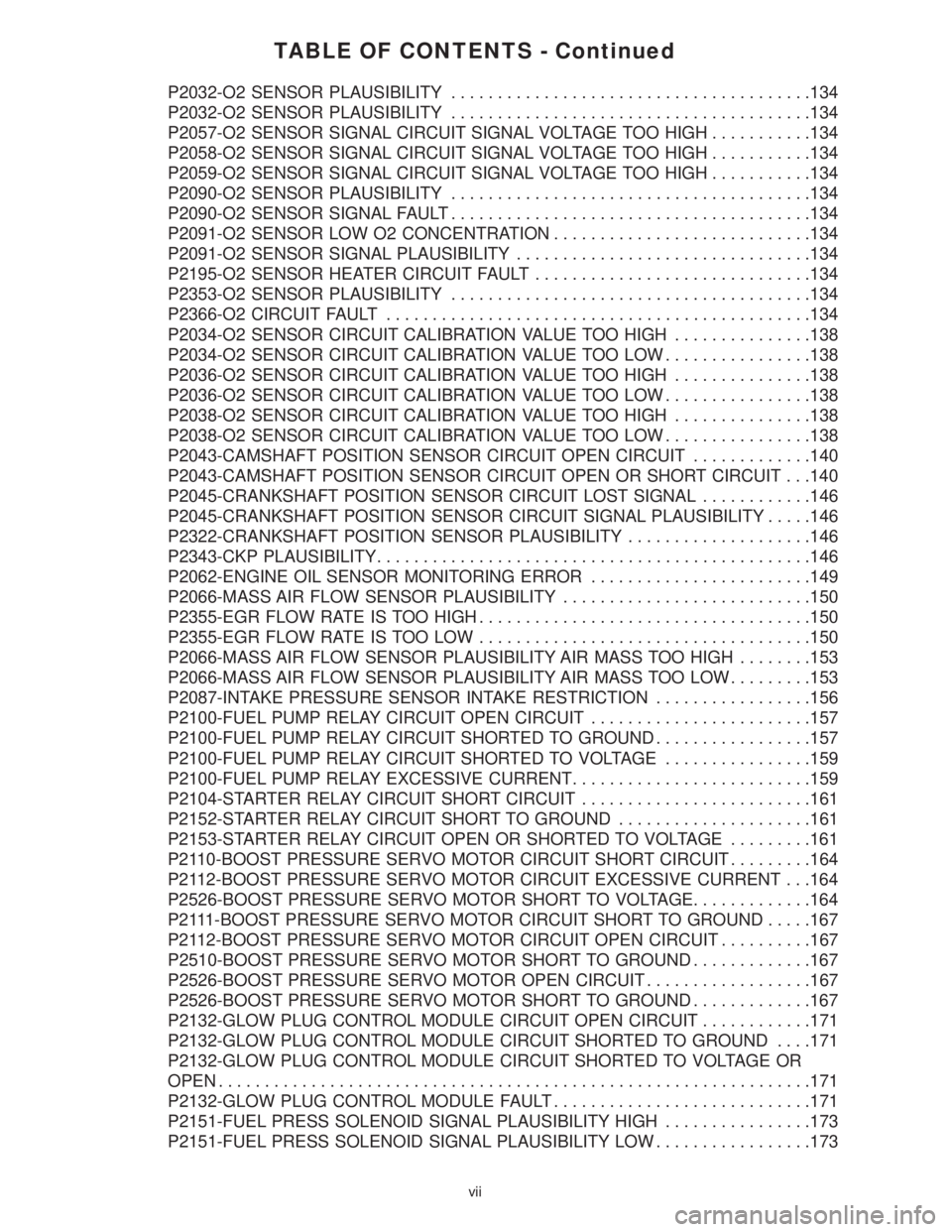
TABLE OF CONTENTS - Continued
P2032-O2 SENSOR PLAUSIBILITY.......................................134
P2032-O2 SENSOR PLAUSIBILITY.......................................134
P2057-O2 SENSOR SIGNAL CIRCUIT SIGNAL VOLTAGE TOO HIGH...........134
P2058-O2 SENSOR SIGNAL CIRCUIT SIGNAL VOLTAGE TOO HIGH...........134
P2059-O2 SENSOR SIGNAL CIRCUIT SIGNAL VOLTAGE TOO HIGH...........134
P2090-O2 SENSOR PLAUSIBILITY.......................................134
P2090-O2 SENSOR SIGNAL FAULT.......................................134
P2091-O2 SENSOR LOW O2 CONCENTRATION............................134
P2091-O2 SENSOR SIGNAL PLAUSIBILITY................................134
P2195-O2 SENSOR HEATER CIRCUIT FAULT..............................134
P2353-O2 SENSOR PLAUSIBILITY.......................................134
P2366-O2 CIRCUIT FAULT..............................................134
P2034-O2 SENSOR CIRCUIT CALIBRATION VALUE TOO HIGH...............138
P2034-O2 SENSOR CIRCUIT CALIBRATION VALUE TOO LOW................138
P2036-O2 SENSOR CIRCUIT CALIBRATION VALUE TOO HIGH...............138
P2036-O2 SENSOR CIRCUIT CALIBRATION VALUE TOO LOW................138
P2038-O2 SENSOR CIRCUIT CALIBRATION VALUE TOO HIGH...............138
P2038-O2 SENSOR CIRCUIT CALIBRATION VALUE TOO LOW................138
P2043-CAMSHAFT POSITION SENSOR CIRCUIT OPEN CIRCUIT.............140
P2043-CAMSHAFT POSITION SENSOR CIRCUIT OPEN OR SHORT CIRCUIT . . .140
P2045-CRANKSHAFT POSITION SENSOR CIRCUIT LOST SIGNAL............146
P2045-CRANKSHAFT POSITION SENSOR CIRCUIT SIGNAL PLAUSIBILITY.....146
P2322-CRANKSHAFT POSITION SENSOR PLAUSIBILITY....................146
P2343-CKP PLAUSIBILITY...............................................146
P2062-ENGINE OIL SENSOR MONITORING ERROR........................149
P2066-MASS AIR FLOW SENSOR PLAUSIBILITY...........................150
P2355-EGR FLOW RATE IS TOO HIGH....................................150
P2355-EGR FLOW RATE IS TOO LOW....................................150
P2066-MASS AIR FLOW SENSOR PLAUSIBILITY AIR MASS TOO HIGH........153
P2066-MASS AIR FLOW SENSOR PLAUSIBILITY AIR MASS TOO LOW.........153
P2087-INTAKE PRESSURE SENSOR INTAKE RESTRICTION.................156
P2100-FUEL PUMP RELAY CIRCUIT OPEN CIRCUIT........................157
P2100-FUEL PUMP RELAY CIRCUIT SHORTED TO GROUND.................157
P2100-FUEL PUMP RELAY CIRCUIT SHORTED TO VOLTAGE................159
P2100-FUEL PUMP RELAY EXCESSIVE CURRENT..........................159
P2104-STARTER RELAY CIRCUIT SHORT CIRCUIT.........................161
P2152-STARTER RELAY CIRCUIT SHORT TO GROUND.....................161
P2153-STARTER RELAY CIRCUIT OPEN OR SHORTED TO VOLTAGE.........161
P2110-BOOST PRESSURE SERVO MOTOR CIRCUIT SHORT CIRCUIT.........164
P2112-BOOST PRESSURE SERVO MOTOR CIRCUIT EXCESSIVE CURRENT . . .164
P2526-BOOST PRESSURE SERVO MOTOR SHORT TO VOLTAGE.............164
P2111-BOOST PRESSURE SERVO MOTOR CIRCUIT SHORT TO GROUND.....167
P2112-BOOST PRESSURE SERVO MOTOR CIRCUIT OPEN CIRCUIT..........167
P2510-BOOST PRESSURE SERVO MOTOR SHORT TO GROUND.............167
P2526-BOOST PRESSURE SERVO MOTOR OPEN CIRCUIT..................167
P2526-BOOST PRESSURE SERVO MOTOR SHORT TO GROUND.............167
P2132-GLOW PLUG CONTROL MODULE CIRCUIT OPEN CIRCUIT............171
P2132-GLOW PLUG CONTROL MODULE CIRCUIT SHORTED TO GROUND. . . .171
P2132-GLOW PLUG CONTROL MODULE CIRCUIT SHORTED TO VOLTAGE OR
OPEN................................................................171
P2132-GLOW PLUG CONTROL MODULE FAULT............................171
P2151-FUEL PRESS SOLENOID SIGNAL PLAUSIBILITY HIGH................173
P2151-FUEL PRESS SOLENOID SIGNAL PLAUSIBILITY LOW.................173
vii
Page 421 of 2305
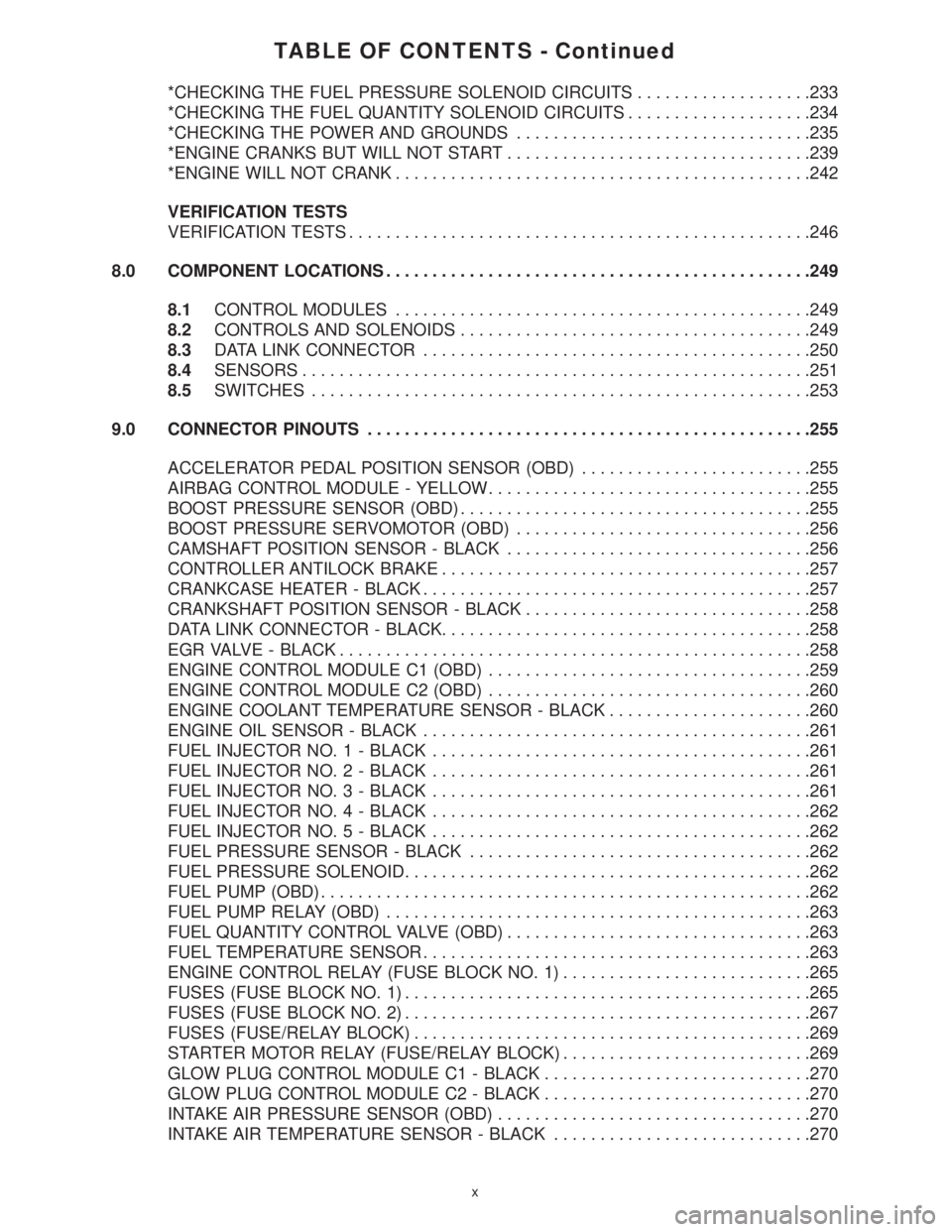
TABLE OF CONTENTS - Continued
*CHECKING THE FUEL PRESSURE SOLENOID CIRCUITS...................233
*CHECKING THE FUEL QUANTITY SOLENOID CIRCUITS....................234
*CHECKING THE POWER AND GROUNDS................................235
*ENGINE CRANKS BUT WILL NOT START.................................239
*ENGINE WILL NOT CRANK.............................................242
VERIFICATION TESTS
VERIFICATION TESTS..................................................246
8.0 COMPONENT LOCATIONS..............................................249
8.1CONTROL MODULES.............................................249
8.2CONTROLS AND SOLENOIDS......................................249
8.3DATA LINK CONNECTOR..........................................250
8.4SENSORS.......................................................251
8.5SWITCHES......................................................253
9.0 CONNECTOR PINOUTS................................................255
ACCELERATOR PEDAL POSITION SENSOR (OBD).........................255
AIRBAG CONTROL MODULE - YELLOW...................................255
BOOST PRESSURE SENSOR (OBD)......................................255
BOOST PRESSURE SERVOMOTOR (OBD)................................256
CAMSHAFT POSITION SENSOR - BLACK.................................256
CONTROLLER ANTILOCK BRAKE........................................257
CRANKCASE HEATER - BLACK..........................................257
CRANKSHAFT POSITION SENSOR - BLACK...............................258
DATA LINK CONNECTOR - BLACK........................................258
EGR VALVE - BLACK...................................................258
ENGINE CONTROL MODULE C1 (OBD)...................................259
ENGINE CONTROL MODULE C2 (OBD)...................................260
ENGINE COOLANT TEMPERATURE SENSOR - BLACK......................260
ENGINE OIL SENSOR - BLACK..........................................261
FUEL INJECTOR NO. 1 - BLACK.........................................261
FUEL INJECTOR NO. 2 - BLACK.........................................261
FUEL INJECTOR NO. 3 - BLACK.........................................261
FUEL INJECTOR NO. 4 - BLACK.........................................262
FUEL INJECTOR NO. 5 - BLACK.........................................262
FUEL PRESSURE SENSOR - BLACK.....................................262
FUEL PRESSURE SOLENOID............................................262
FUEL PUMP (OBD).....................................................262
FUEL PUMP RELAY (OBD)..............................................263
FUEL QUANTITY CONTROL VALVE (OBD).................................263
FUEL TEMPERATURE SENSOR..........................................263
ENGINE CONTROL RELAY (FUSE BLOCK NO. 1)...........................265
FUSES (FUSE BLOCK NO. 1)............................................265
FUSES (FUSE BLOCK NO. 2)............................................267
FUSES (FUSE/RELAY BLOCK)...........................................269
STARTER MOTOR RELAY (FUSE/RELAY BLOCK)...........................269
GLOW PLUG CONTROL MODULE C1 - BLACK.............................270
GLOW PLUG CONTROL MODULE C2 - BLACK.............................270
INTAKE AIR PRESSURE SENSOR (OBD)..................................270
INTAKE AIR TEMPERATURE SENSOR - BLACK............................270
x
Page 422 of 2305
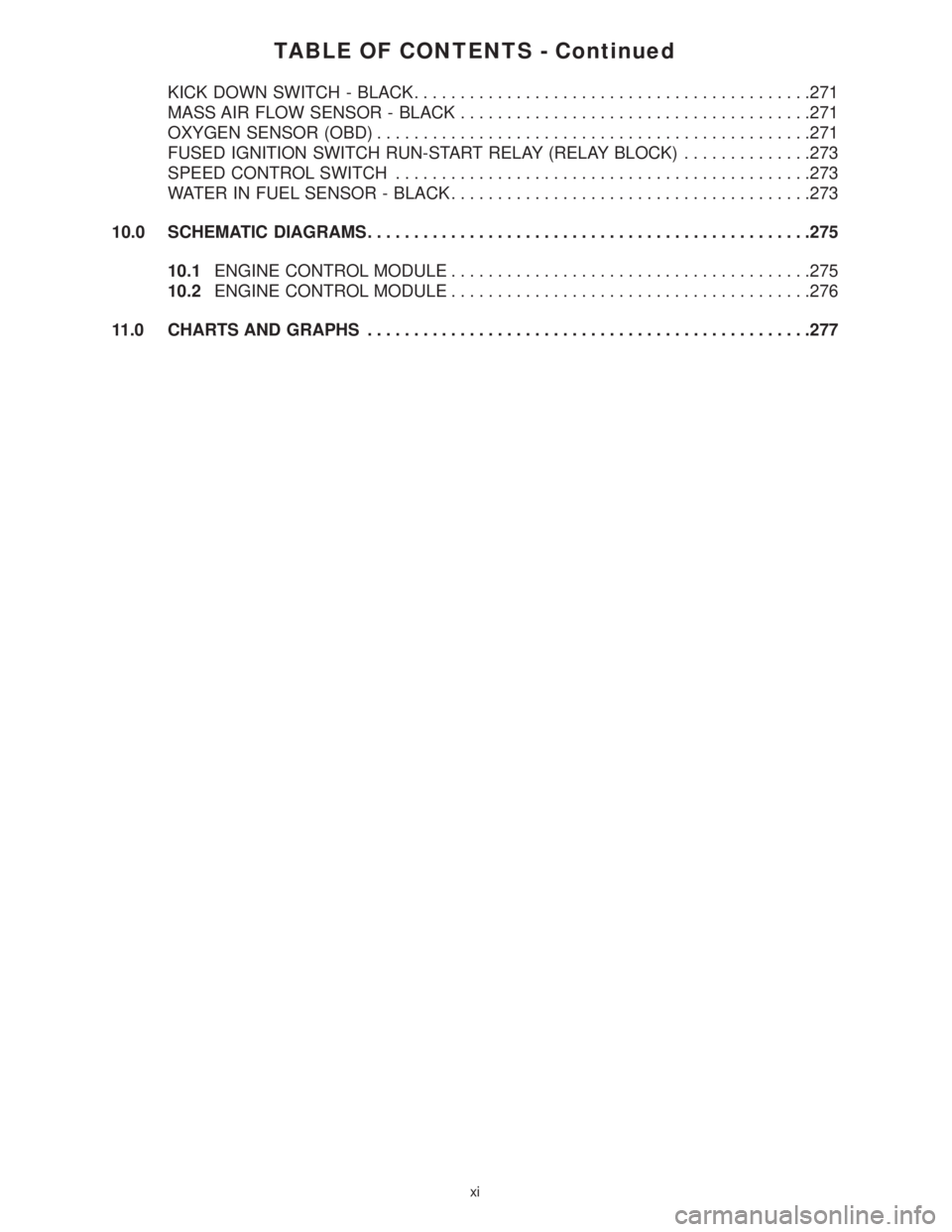
TABLE OF CONTENTS - Continued
KICK DOWN SWITCH - BLACK...........................................271
MASS AIR FLOW SENSOR - BLACK......................................271
OXYGEN SENSOR (OBD)...............................................271
FUSED IGNITION SWITCH RUN-START RELAY (RELAY BLOCK)..............273
SPEED CONTROL SWITCH.............................................273
WATER IN FUEL SENSOR - BLACK.......................................273
10.0 SCHEMATIC DIAGRAMS................................................275
10.1ENGINE CONTROL MODULE.......................................275
10.2ENGINE CONTROL MODULE.......................................276
11.0 CHARTS AND GRAPHS................................................277
xi
Page 425 of 2305
3.2.2 ECM OPERATING MODES
As input signals to the ECM change, the ECM
adjusts its response to the output devices. For
example, the ECM must calculate a different fuel
quantity and fuel timing for engine idle condition
than it would for a wide open throttle condition.
There are several different modes of operation that
determine how the ECM responds to the various
input signals.
Ignition Switch On (Engine Off)
When the ignition is turned on the ECM activates
the glow plug relay for a time period that is deter-
mined by engine coolant temperature, intake air
temperature and battery voltage.
Engine Start-Up Mode
The ECM uses the intake air temperature sensor,
engine temperature sensor and the crankshaft po-
sition sensor (engine speed) inputs to determine
fuel injection quantity.
Normal Driving Modes
Engine idle, warm-up, acceleration, deceleration
and wide open throttle modes are controlled based
on all of the sensor inputs to the ECM. The ECM
uses these sensor inputs to adjust fuel quantity and
fuel injector timing. EGR valve control is performed
using feedback from the oxygen sensor. An oxygen
sensor is located in the exhaust manifold to sample
oxygen content exiting the engine cylinders. The
ECM uses the O2 sensor, along with other sensor
inputs, to govern the amount of exhaust gas recir-
culation to reduce HC (HydroCarbons) and CO
(Carbon Monoxide). Engine coolant is routed
through the base of the EGR valve to provide
additional cooling of the exhaust gas, which further
helps the reductions of emissions. The EGR valve
has a self-cleaning function. When the engine is
shut off, the EGR valve rotates twice to reduce
carbon deposits at the valve seat.
Overheat Production Mode
If the engine temperature is above 105ÉC (221ÉF)
and vehicle speed is above 40 km/h (25 MPH) the
ECM will limit fuel quantity for engine protection.
Limp-In Mode
The ECM utilizes different degrees of engine
limp-in. The ECM is able to limit engine rpm,
engine power output (turbo boost reduction), acti-
vate engine cooling fan or all of these functions
based on the type of fault that is detected. Critical
engine performance faults such as accelerator pedal
position sensor fault will result in a fixed idle speed
of approximately 680 rpm regardless of actual pedalposition. Other less critical faults will result in
power reduction throughout the full range of driv-
ing conditions.
Overspeed Detection Mode
If the ECM detects engine RPM that exceeds
5200 RPM, the ECM will set a DTC in memory,
limit engine RPM to no more than 2500 RPM, and
illuminate the MIL until the DTC is cleared.
After-Run Mode
The ECM transfers RAM information to ROM
and performs an Input/Output state check.
3.2.3 MONITORED CIRCUITS
The ECM is able to monitor and identify most
driveability related trouble conditions. Some cir-
cuits are directly monitored through ECM feedback
circuitry. In addition, the ECM monitors the voltage
state of some circuits and compares those states
with expected values. Other systems are monitored
indirectly when the ECM conducts a rationality test
to identify problems.
Although most subsystems of the engine control
module are either directly or indirectly monitored,
there may be occasions when diagnostic trouble
codes are not immediately identified. For a trouble
code to set, a specific set of conditions must occur
and unless these conditions occur, a DTC will not
set.
3.2.4 SKREEM OVERVIEW
The sentry key remote entry module system
(SKREEM) is designed to prevent unauthorized
vehicle operation. The system consists of a sentry
key remote entry module (SKREEM), ignition
key(s) equipped with a transponder chip and the
ECM. When the ignition switch is turned on, the
SKREEM interrogates the ignition key. If the igni-
tion key is Valid or Invalid, the SKREEM sends a
message to the ECM indicating ignition key status.
Upon receiving this message the ECM will termi-
nate engine operation or allow the engine to con-
tinue to operate.
3.2.5 SKREEM ON-BOARD DIAGNOSTICS
The SKREEM has been programmed to transmit
and monitor many different coded messages as well
as CAN Bus messages. This monitoring is called
On-Board Diagnostics. Certain criteria must be met
for a DTC to be entered into SKREEM memory. The
criteria may be a range of; input voltage, CAN Bus
message or coded messages to the SKREEM. If all
the criteria for monitoring a circuit or function are
met and a fault is detected, a DTC will be stored in
the SKREEM memory and the START ERROR indi-
cator will be turned on in the instrument cluster.
2
GENERAL INFORMATION
Page 426 of 2305
3.2.6 SKREEM OPERATION
When ignition power is supplied to the SKREEM,
the SKREEM performs an internal self-test. After
the self-test is complete, the SKREEM energizes
the antenna (this activates the transponder chip)
and sends a challenge to the transponder chip. The
transponder chip responds to the challenge by gen-
erating an encrypted response message.
After responding to the coded message, the tran-
sponder sends a transponder ID message to the
SKREEM. The SKREEM compares the transpon-
der ID message to the available valid key codes in
SKREEM memory (8 key maximum at any one
time). After validating the ignition key the
SKREEM sends a CAN Bus message request to the
ECM, then waits for the ECM response. If the ECM
does not respond, the SKREEM will send the re-
quest again. If the ECM does not respond again, the
SKREEM will stop sending the request and store a
trouble code in memory. If the ECM sends a correct
response to the SKREEM, the SKREEM sends a
valid/invalid key message to the ECM. The ECM
will allow or disallow engine operation based on this
message.
Secret Key - an electronically stored value (iden-
tification number) that is unique to each SKREEM.
The secret key is stored in the SKREEM, ECM and
all ignition key transponders.
Challenge - a random number that is generated by
the SKREEM at each ignition key cycle.
The secret key and challenge are the two vari-
ables used in the algorithm that produces the
encrypted response message. The transponder uses
the crypto algorithm to receive, decode and respond
to the message sent by the SKREEM. After re-
sponding to the coded message, the transponder
sends a transponder ID message to the SKREEM.
3.3 DIAGNOSTIC TROUBLE CODES
Each diagnostic trouble code (DTC) is diagnosed
by following a specific procedure. The diagnostic
test procedure contains step-by-step instruction for
determining the cause of the DTC as well as no
trouble code problems. It is not necessary to per-
form all of the tests in this book to diagnose an
individual code.
Always begin diagnosis by reading the DTCs
using the DRBIIIt. This will direct you to the
specific test(s) that must be performed.
3.3.1 HARD CODE
A DTC that comes back within one cycle of the
ignition key is a hard code. This means that the
problem is current every time the ECM/SKREEM
checks that circuit or function. Procedures in this
manual verify if the DTC is a hard code at thebeginning of each test. When the fault is not a hard
code, an intermittent test must be performed.
NOTE: If the DRBIIITdisplays faults for
multiple components (i.e. ECT, MAF, IAT
sensors) identify and check the shared
circuits for possible problems before
continuing (i.e. sensor grounds or 5-volt
supply circuits). Refer to the appropriate
schematic to identify shared circuits.
3.3.2 INTERMITTENT CODE
A DTC that is not current every time the ECM/
SKREEM checks the circuit or function is an inter-
mittent code. Most intermittent DTCs are caused
by wiring or connector problems. Problems that
come and go like this are the most difficult to
diagnose; they must be looked for under specific
conditions that cause them. The following checks
may assist you in identifying a possible intermit-
tent problem.
± Visually inspect the related wire harness con-
nectors. Look for broken, bent, pushed out or
corroded terminals.
± Visually inspect the related wire harness.
Look for chafed, pierced or partially broken
wire.
± Refer to hotlines or technical service bulletins
that may apply.
NOTE: Electromagnetic (radio) interference
can cause an intermittent system
malfunction. This interference can interrupt
communication between the ignition key
transponder and the SKREEM.
3.3.3 ECM DIAGNOSTIC TROUBLE CODES
IMPORTANT NOTE: Before replacing the
ECM for a failed driver, control circuit or
ground circuit, be sure to check the related
component/circuit integrity for failures not
detected due to a double fault in the circuit.
Most ECM driver/control circuit failures are
caused by internal failures to components
(i.e. relays and solenoids) and shorted
circuits (i.e. sensor pull-ups, drivers and
ground circuits). These faults are difficult to
detect when a double fault has occurred and
only one DTC has set.
If the DRBIIItdisplays faults for multiple com-
ponents (i.e. MAF, ECT, ENG OIL, etc.), identify
and check the shared circuits for possible problems
before continuing (i.e. sensor grounds or 5-volt
3
GENERAL INFORMATION