clock MERCEDES-BENZ SPRINTER 2006 Manual PDF
[x] Cancel search | Manufacturer: MERCEDES-BENZ, Model Year: 2006, Model line: SPRINTER, Model: MERCEDES-BENZ SPRINTER 2006Pages: 2305, PDF Size: 48.12 MB
Page 1650 of 2305
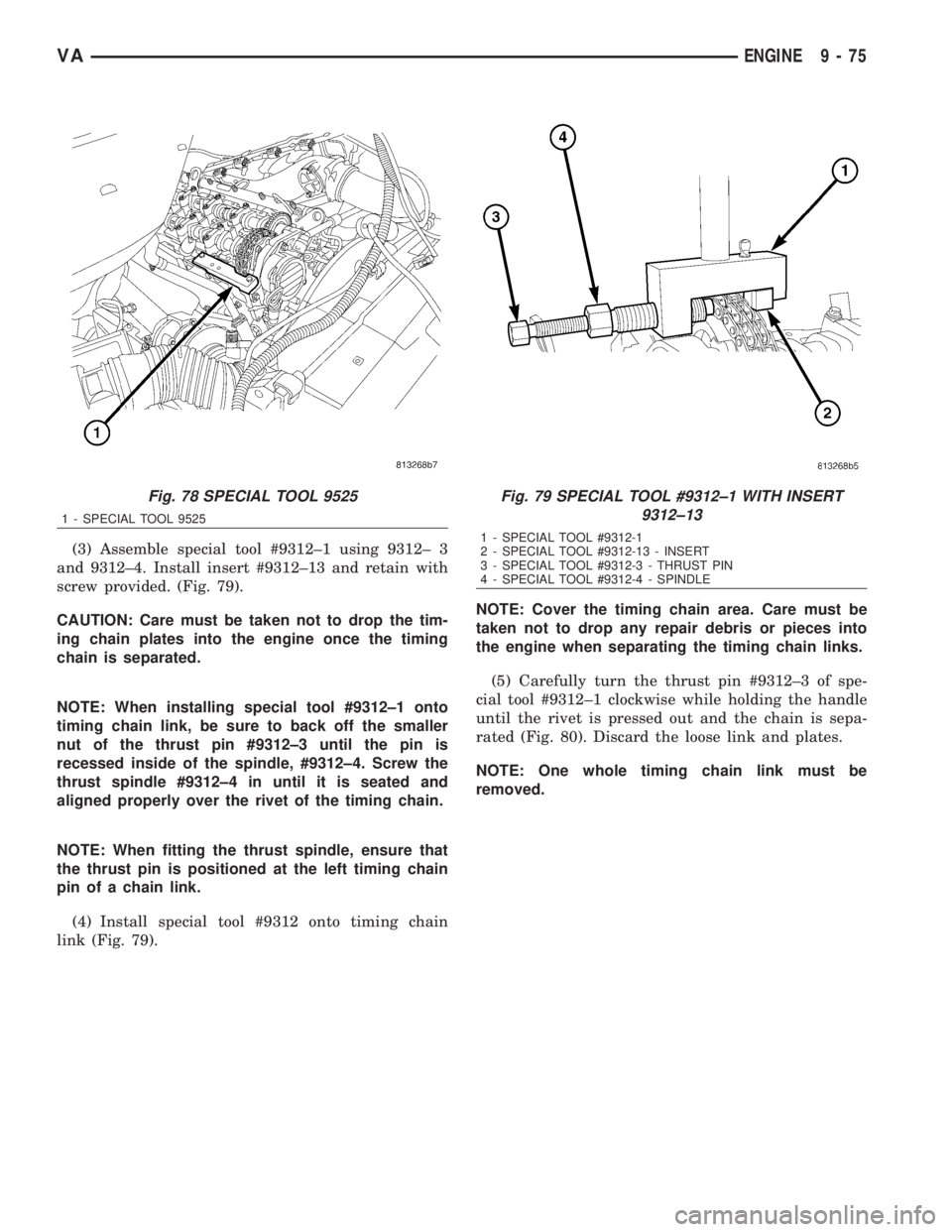
(3) Assemble special tool #9312±1 using 9312± 3
and 9312±4. Install insert #9312±13 and retain with
screw provided. (Fig. 79).
CAUTION: Care must be taken not to drop the tim-
ing chain plates into the engine once the timing
chain is separated.
NOTE: When installing special tool #9312±1 onto
timing chain link, be sure to back off the smaller
nut of the thrust pin #9312±3 until the pin is
recessed inside of the spindle, #9312±4. Screw the
thrust spindle #9312±4 in until it is seated and
aligned properly over the rivet of the timing chain.
NOTE: When fitting the thrust spindle, ensure that
the thrust pin is positioned at the left timing chain
pin of a chain link.
(4) Install special tool #9312 onto timing chain
link (Fig. 79).NOTE: Cover the timing chain area. Care must be
taken not to drop any repair debris or pieces into
the engine when separating the timing chain links.
(5) Carefully turn the thrust pin #9312±3 of spe-
cial tool #9312±1 clockwise while holding the handle
until the rivet is pressed out and the chain is sepa-
rated (Fig. 80). Discard the loose link and plates.
NOTE: One whole timing chain link must be
removed.
Fig. 78 SPECIAL TOOL 9525
1 - SPECIAL TOOL 9525
Fig. 79 SPECIAL TOOL #9312±1 WITH INSERT
9312±13
1 - SPECIAL TOOL #9312-1
2 - SPECIAL TOOL #9312-13 - INSERT
3 - SPECIAL TOOL #9312-3 - THRUST PIN
4 - SPECIAL TOOL #9312-4 - SPINDLE
VAENGINE 9 - 75
Page 1653 of 2305
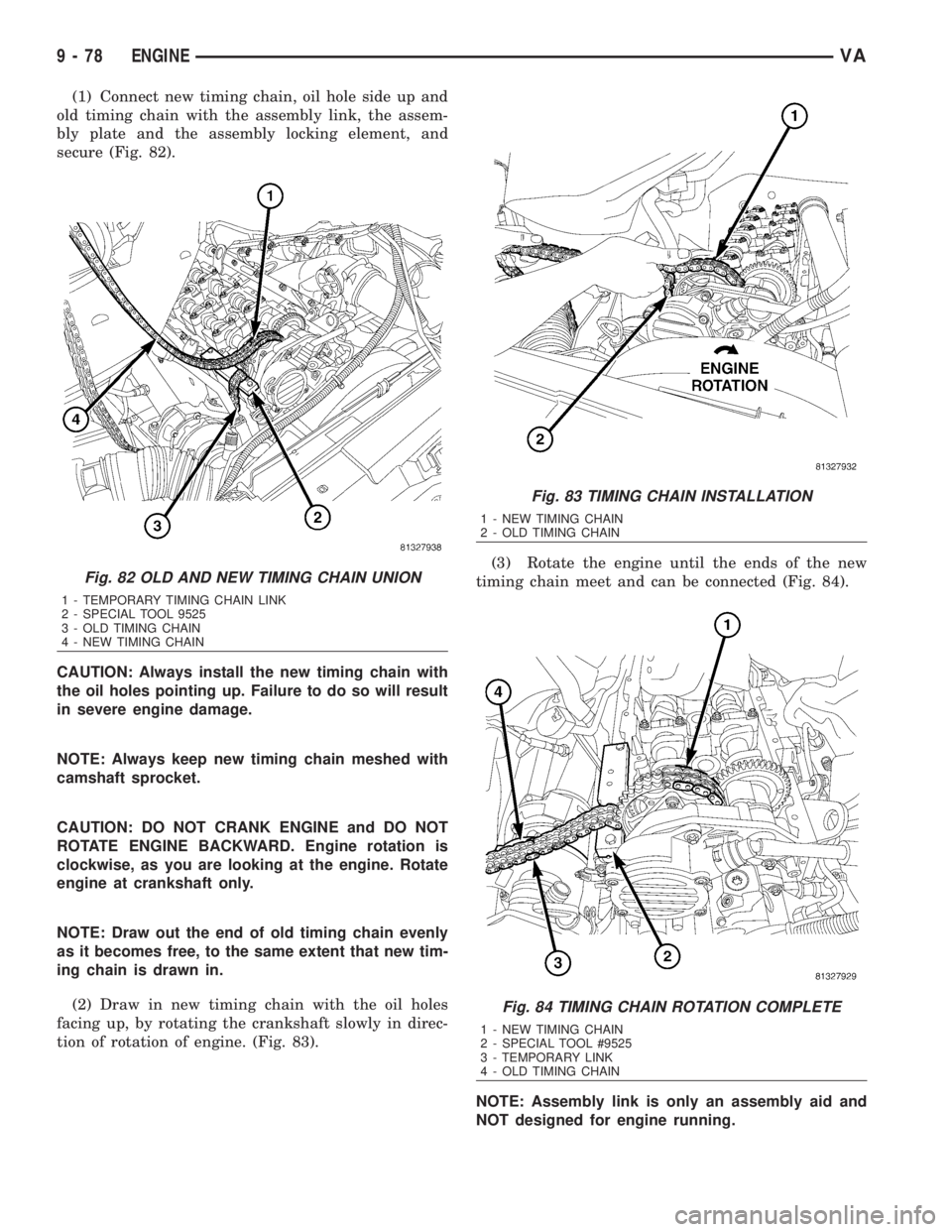
(1) Connect new timing chain, oil hole side up and
old timing chain with the assembly link, the assem-
bly plate and the assembly locking element, and
secure (Fig. 82).
CAUTION: Always install the new timing chain with
the oil holes pointing up. Failure to do so will result
in severe engine damage.
NOTE: Always keep new timing chain meshed with
camshaft sprocket.
CAUTION: DO NOT CRANK ENGINE and DO NOT
ROTATE ENGINE BACKWARD. Engine rotation is
clockwise, as you are looking at the engine. Rotate
engine at crankshaft only.
NOTE: Draw out the end of old timing chain evenly
as it becomes free, to the same extent that new tim-
ing chain is drawn in.
(2) Draw in new timing chain with the oil holes
facing up, by rotating the crankshaft slowly in direc-
tion of rotation of engine. (Fig. 83).(3) Rotate the engine until the ends of the new
timing chain meet and can be connected (Fig. 84).
NOTE: Assembly link is only an assembly aid and
NOT designed for engine running.
Fig. 82 OLD AND NEW TIMING CHAIN UNION
1 - TEMPORARY TIMING CHAIN LINK
2 - SPECIAL TOOL 9525
3 - OLD TIMING CHAIN
4 - NEW TIMING CHAIN
Fig. 83 TIMING CHAIN INSTALLATION
1 - NEW TIMING CHAIN
2 - OLD TIMING CHAIN
Fig. 84 TIMING CHAIN ROTATION COMPLETE
1 - NEW TIMING CHAIN
2 - SPECIAL TOOL #9525
3 - TEMPORARY LINK
4 - OLD TIMING CHAIN
9 - 78 ENGINEVA
Page 1656 of 2305
TIMING CHAIN TENSIONER
REMOVAL
(1) Disconnect negative battery cable.
CAUTION: Rotate engine at crankshaft only. DO
NOT rotate the engine with the bolt of the camshaft
sprocket. DO NOT rotate the engine counter clock-
wise.
NOTE: Markings on the camshaft and camshaft
bearing cap must be aligned.
(2) Position piston of number 1 cylinder to ignition
TDC.
(3) Remove intake air duct.
(4) Remove accessory drive belt and idler pulley
above generator (Refer to 7 - COOLING/ACCES-
SORY DRIVE/DRIVE BELTS - REMOVAL).
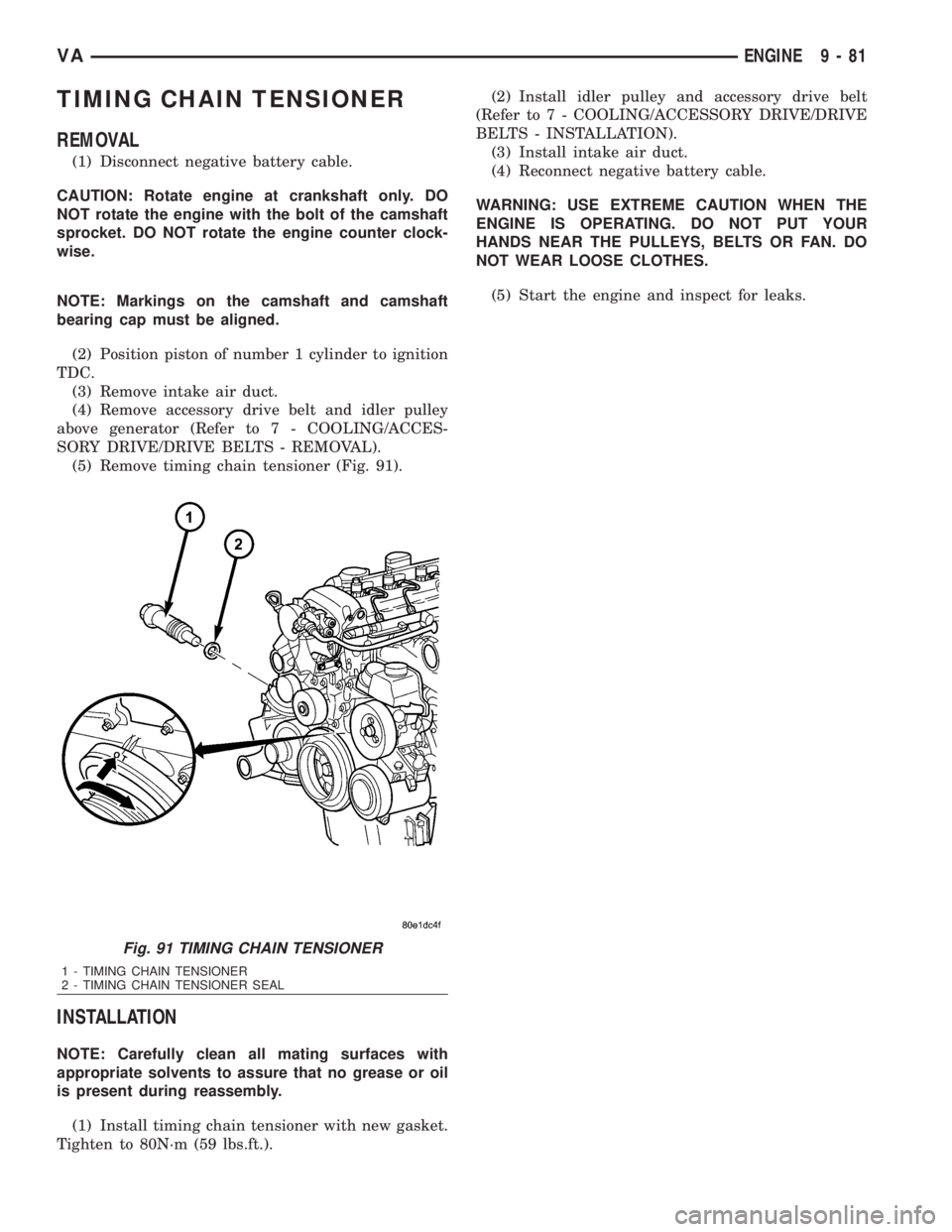
(5) Remove timing chain tensioner (Fig. 91).
INSTALLATION
NOTE: Carefully clean all mating surfaces with
appropriate solvents to assure that no grease or oil
is present during reassembly.
(1) Install timing chain tensioner with new gasket.
Tighten to 80N´m (59 lbs.ft.).(2) Install idler pulley and accessory drive belt
(Refer to 7 - COOLING/ACCESSORY DRIVE/DRIVE
BELTS - INSTALLATION).
(3) Install intake air duct.
(4) Reconnect negative battery cable.
WARNING: USE EXTREME CAUTION WHEN THE
ENGINE IS OPERATING. DO NOT PUT YOUR
HANDS NEAR THE PULLEYS, BELTS OR FAN. DO
NOT WEAR LOOSE CLOTHES.
(5) Start the engine and inspect for leaks.
Fig. 91 TIMING CHAIN TENSIONER
1 - TIMING CHAIN TENSIONER
2 - TIMING CHAIN TENSIONER SEAL
VAENGINE 9 - 81
Page 1684 of 2305
(7) Connect a scan tool, select from Main Menu,
System Select, Engine, System Tests, Fuel Quantity
Test, Engine Cranking Test and follow the screen.
(8) After ten seconds, a maximum of 2.5 ml
(between2&3graduation lines) may be reached in
the inner vials. If the level has exceeded the 2.5 ml,
replace that affected cylinder's injector, clear the
memory using the scan tool, empty the test vials, and
retest.
RUNNING TEST
NOTE: If an injector is found to be out of specifica-
tion, repeat this test procedure after the injector
replacement. Hydraulic flow will take the path of
least resistance and multiple failures may be identi-
fied. Engine temperature must be above 80É C
(176ÉF) to perform the running test.
Perform this test with the engine at operating tem-
perature. This test will assist in determining a defec-
tive or internally leaking injector(s) is present by
measuring the amount of fuel return.
(1) Turn the ignition off.
(2) Remove the engine cover (Refer to 9 - ENGINE
- REMOVAL).
(3) Disconnect the fuel return hoses at the top of
the injectors.
(4) Pinch off the fuel return line at the banjo bolt
fitting of the fuel rail.
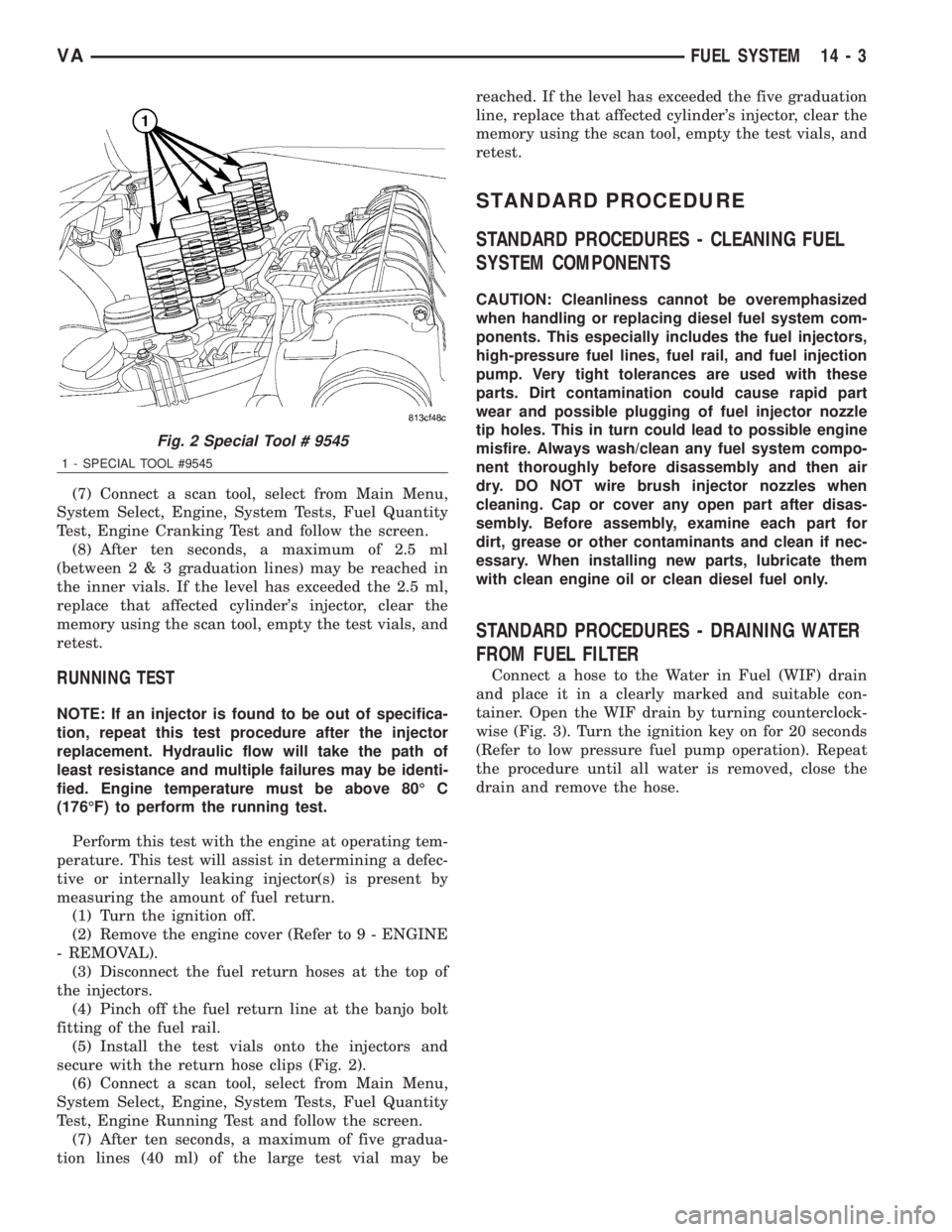
(5) Install the test vials onto the injectors and
secure with the return hose clips (Fig. 2).
(6) Connect a scan tool, select from Main Menu,
System Select, Engine, System Tests, Fuel Quantity
Test, Engine Running Test and follow the screen.
(7) After ten seconds, a maximum of five gradua-
tion lines (40 ml) of the large test vial may bereached. If the level has exceeded the five graduation
line, replace that affected cylinder's injector, clear the
memory using the scan tool, empty the test vials, and
retest.
STANDARD PROCEDURE
STANDARD PROCEDURES - CLEANING FUEL
SYSTEM COMPONENTS
CAUTION: Cleanliness cannot be overemphasized
when handling or replacing diesel fuel system com-
ponents. This especially includes the fuel injectors,
high-pressure fuel lines, fuel rail, and fuel injection
pump. Very tight tolerances are used with these
parts. Dirt contamination could cause rapid part
wear and possible plugging of fuel injector nozzle
tip holes. This in turn could lead to possible engine
misfire. Always wash/clean any fuel system compo-
nent thoroughly before disassembly and then air
dry. DO NOT wire brush injector nozzles when
cleaning. Cap or cover any open part after disas-
sembly. Before assembly, examine each part for
dirt, grease or other contaminants and clean if nec-
essary. When installing new parts, lubricate them
with clean engine oil or clean diesel fuel only.
STANDARD PROCEDURES - DRAINING WATER
FROM FUEL FILTER
Connect a hose to the Water in Fuel (WIF) drain
and place it in a clearly marked and suitable con-
tainer. Open the WIF drain by turning counterclock-
wise (Fig. 3). Turn the ignition key on for 20 seconds
(Refer to low pressure fuel pump operation). Repeat
the procedure until all water is removed, close the
drain and remove the hose.
Fig. 2 Special Tool # 9545
1 - SPECIAL TOOL #9545
VAFUEL SYSTEM 14 - 3
Page 1733 of 2305
COLUMN
TABLE OF CONTENTS
page page
COLUMN
SPECIFICATIONS - TORQUE CHART.........4
INTERMEDIATE SHAFT
REMOVAL.............................4
INSTALLATION..........................5
KEY/LOCK CYLINDER
REMOVAL.............................5INSTALLATION..........................6
STEERING WHEEL
REMOVAL.............................6
INSTALLATION..........................6
COLUMN
SPECIFICATIONS - TORQUE CHART
TORQUE SPECIFICATIONS
DESCRIPTION N´m Ft. Lbs. In. Lbs.
Steering Wheel With Air-
bag To Steering Shaft80 59 Ð
Jacket Tube For Steering
Shaft To Waist Rail25 18 221
U-Joint To Steering Gear
Shaft24 18 212
INTERMEDIATE SHAFT
REMOVAL
(1) Disconnect the ground cable from the battery.
(2) Remove the air bag module from the steering
wheel.
(3) Turn the steering wheel and lock the steering
wheel in the straight ahead position.The position
of the steering gear must not be altered again
for the entire duration of the work procedure.
(4) Remove the electrical center.
(5) Remove the steering wheel bolt.
(6) Remove the steering wheel from the steering
column.
(7) Remove the clockspring.Unscrew the retain-
ing bolts just enough to be able to remove the
clockspring. Do not twist or disassemble the
clockspring.
(8) Remove the combination switch.
(9) Disconnect the electrical connector for the igni-
tion lock.
(10) Remove the spring for the brake pedal from
the steering column.(11) Remove the fitted bolt from the universal joint
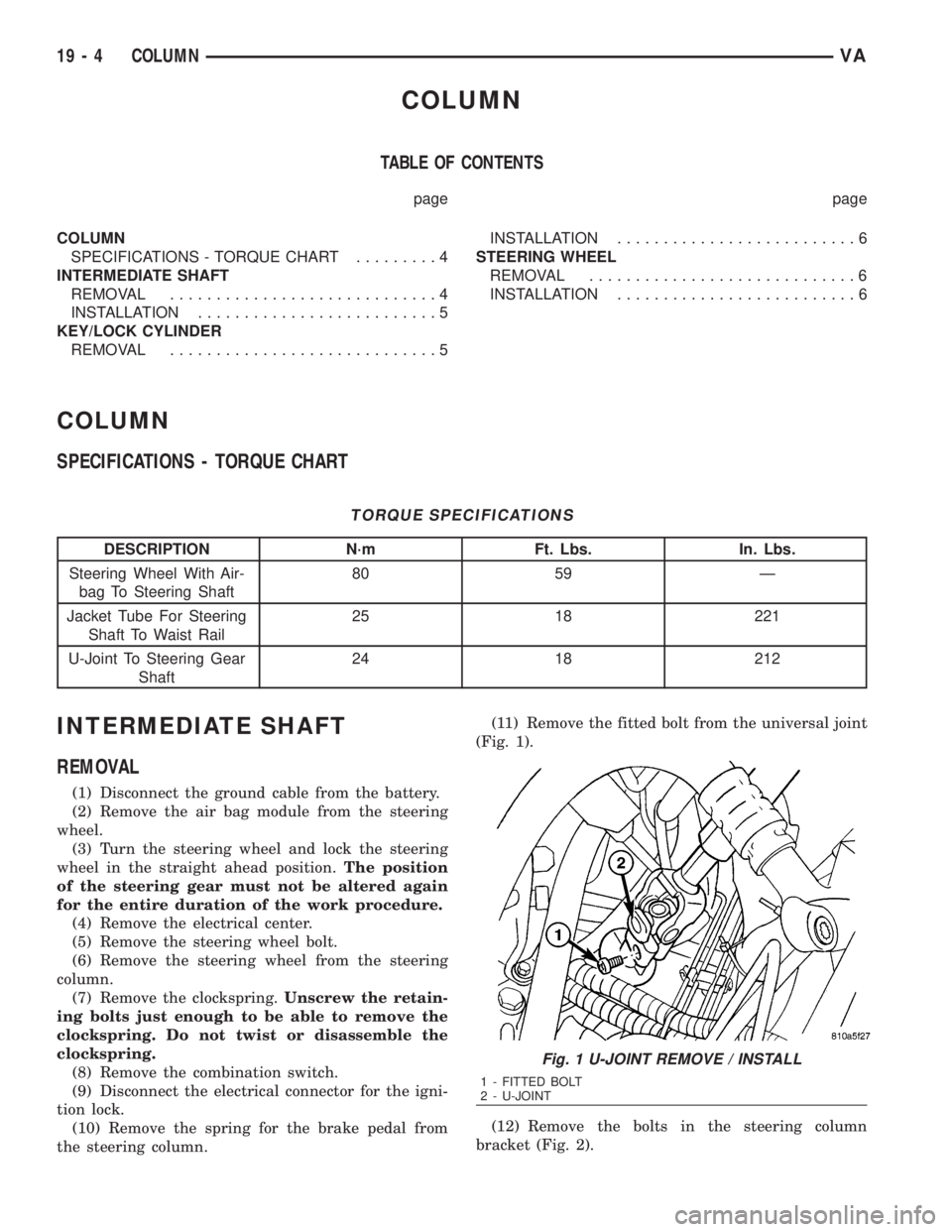
(Fig. 1).
(12) Remove the bolts in the steering column
bracket (Fig. 2).
Fig. 1 U-JOINT REMOVE / INSTALL
1 - FITTED BOLT
2 - U-JOINT
19 - 4 COLUMNVA
Page 1734 of 2305
(13) Remove the steering shaft with the universal
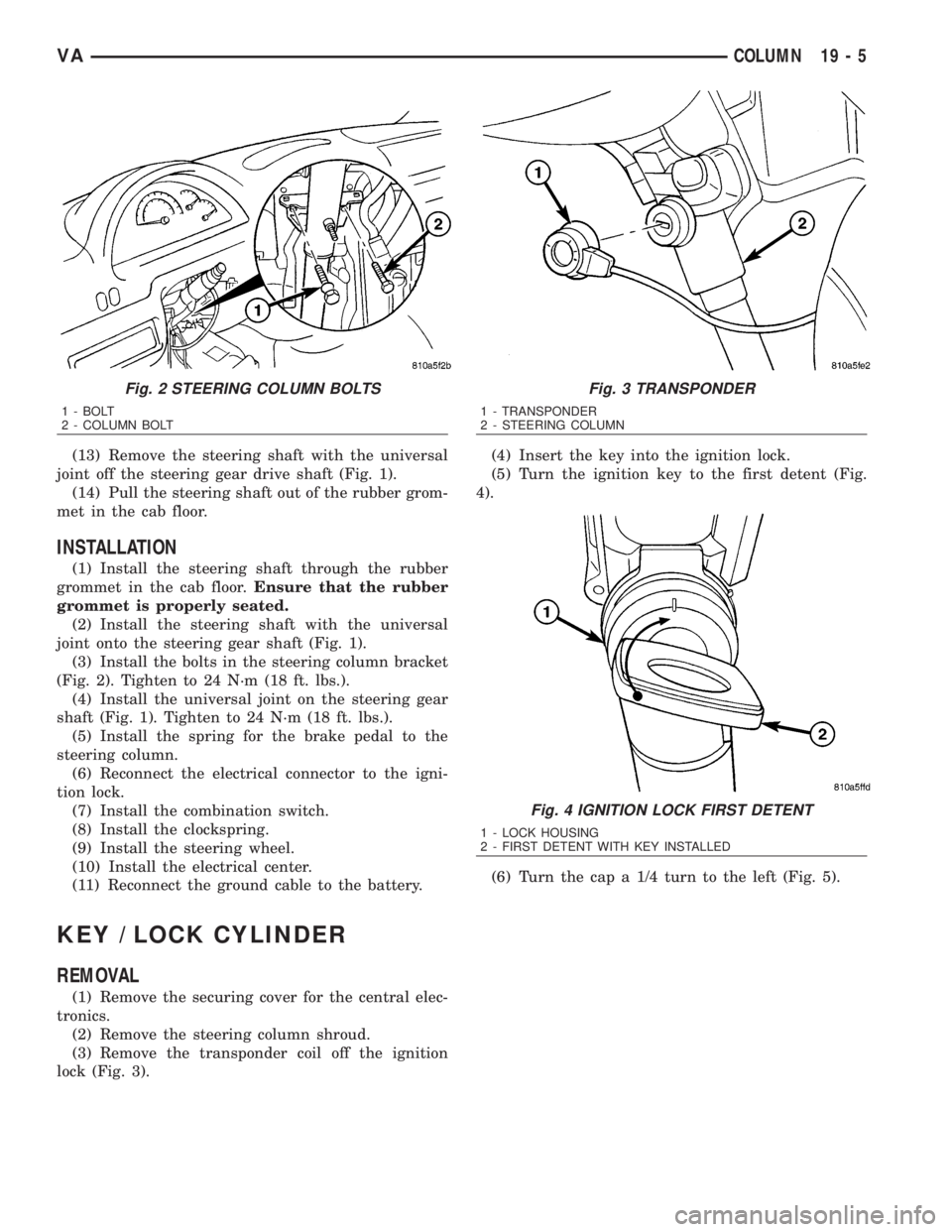
joint off the steering gear drive shaft (Fig. 1).
(14) Pull the steering shaft out of the rubber grom-
met in the cab floor.
INSTALLATION
(1) Install the steering shaft through the rubber
grommet in the cab floor.Ensure that the rubber
grommet is properly seated.
(2) Install the steering shaft with the universal
joint onto the steering gear shaft (Fig. 1).
(3) Install the bolts in the steering column bracket
(Fig. 2). Tighten to 24 N´m (18 ft. lbs.).
(4) Install the universal joint on the steering gear
shaft (Fig. 1). Tighten to 24 N´m (18 ft. lbs.).
(5) Install the spring for the brake pedal to the
steering column.
(6) Reconnect the electrical connector to the igni-
tion lock.
(7) Install the combination switch.
(8) Install the clockspring.
(9) Install the steering wheel.
(10) Install the electrical center.
(11) Reconnect the ground cable to the battery.
KEY / LOCK CYLINDER
REMOVAL
(1) Remove the securing cover for the central elec-
tronics.
(2) Remove the steering column shroud.
(3) Remove the transponder coil off the ignition
lock (Fig. 3).(4) Insert the key into the ignition lock.
(5) Turn the ignition key to the first detent (Fig.
4).
(6) Turn the cap a 1/4 turn to the left (Fig. 5).
Fig. 2 STEERING COLUMN BOLTS
1 - BOLT
2 - COLUMN BOLT
Fig. 3 TRANSPONDER
1 - TRANSPONDER
2 - STEERING COLUMN
Fig. 4 IGNITION LOCK FIRST DETENT
1 - LOCK HOUSING
2 - FIRST DETENT WITH KEY INSTALLED
VACOLUMN 19 - 5
Page 1787 of 2305
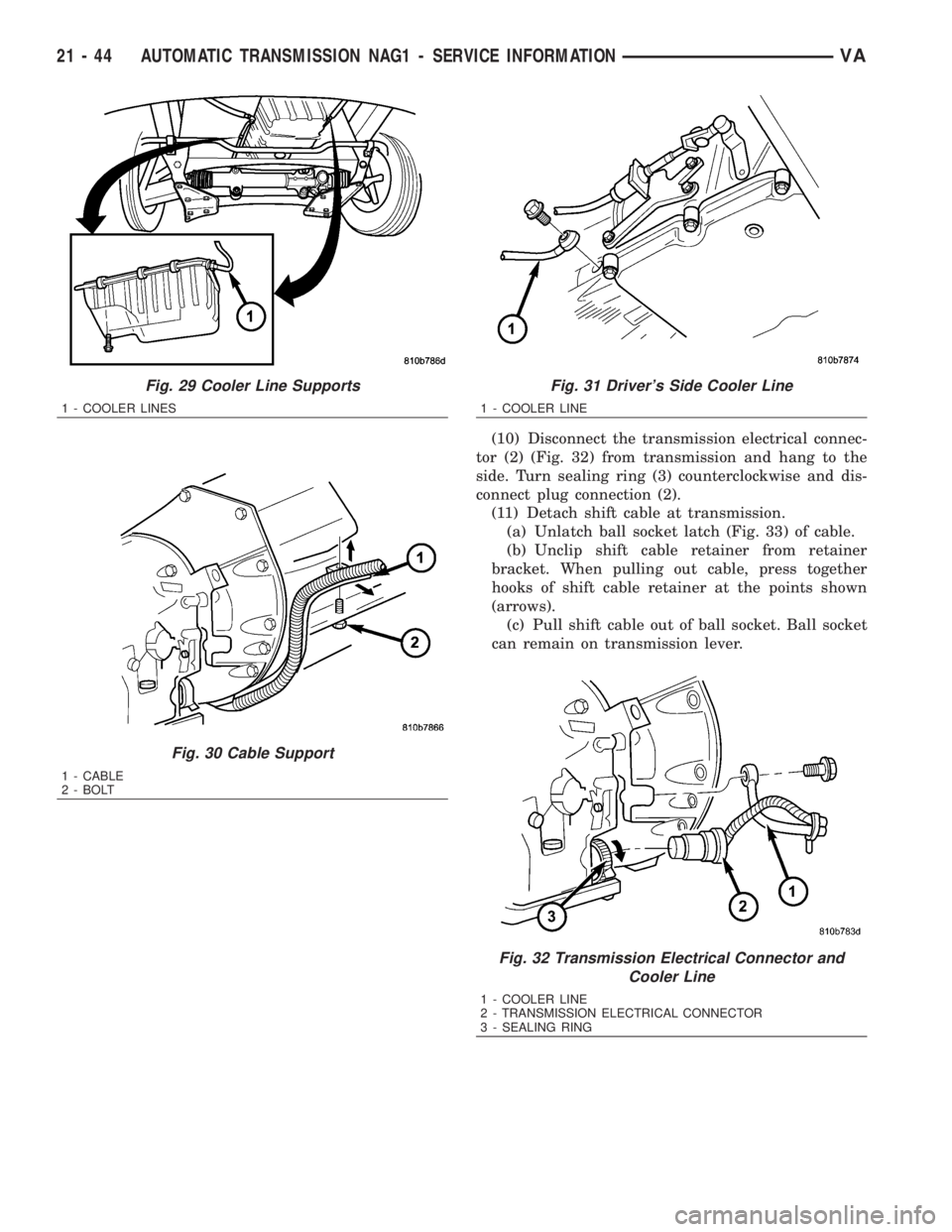
(10) Disconnect the transmission electrical connec-
tor (2) (Fig. 32) from transmission and hang to the
side. Turn sealing ring (3) counterclockwise and dis-
connect plug connection (2).
(11) Detach shift cable at transmission.
(a) Unlatch ball socket latch (Fig. 33) of cable.
(b) Unclip shift cable retainer from retainer
bracket. When pulling out cable, press together
hooks of shift cable retainer at the points shown
(arrows).
(c) Pull shift cable out of ball socket. Ball socket
can remain on transmission lever.
Fig. 29 Cooler Line Supports
1 - COOLER LINES
Fig. 30 Cable Support
1 - CABLE
2 - BOLT
Fig. 31 Driver's Side Cooler Line
1 - COOLER LINE
Fig. 32 Transmission Electrical Connector and
Cooler Line
1 - COOLER LINE
2 - TRANSMISSION ELECTRICAL CONNECTOR
3 - SEALING RING
21 - 44 AUTOMATIC TRANSMISSION NAG1 - SERVICE INFORMATIONVA
Page 1805 of 2305
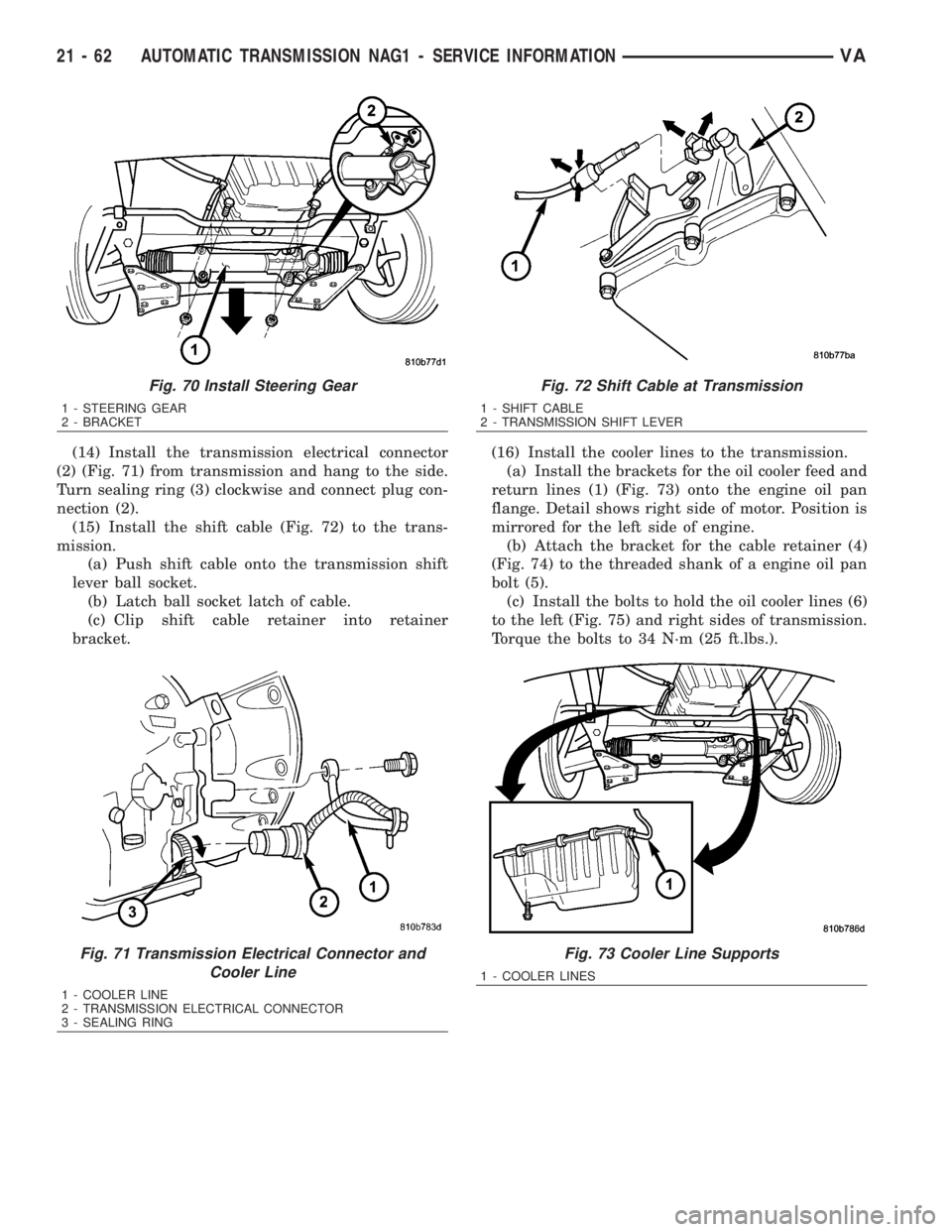
(14) Install the transmission electrical connector
(2) (Fig. 71) from transmission and hang to the side.
Turn sealing ring (3) clockwise and connect plug con-
nection (2).
(15) Install the shift cable (Fig. 72) to the trans-
mission.
(a) Push shift cable onto the transmission shift
lever ball socket.
(b) Latch ball socket latch of cable.
(c) Clip shift cable retainer into retainer
bracket.(16) Install the cooler lines to the transmission.
(a) Install the brackets for the oil cooler feed and
return lines (1) (Fig. 73) onto the engine oil pan
flange. Detail shows right side of motor. Position is
mirrored for the left side of engine.
(b) Attach the bracket for the cable retainer (4)
(Fig. 74) to the threaded shank of a engine oil pan
bolt (5).
(c) Install the bolts to hold the oil cooler lines (6)
to the left (Fig. 75) and right sides of transmission.
Torque the bolts to 34 N´m (25 ft.lbs.).
Fig. 70 Install Steering Gear
1 - STEERING GEAR
2 - BRACKET
Fig. 71 Transmission Electrical Connector and
Cooler Line
1 - COOLER LINE
2 - TRANSMISSION ELECTRICAL CONNECTOR
3 - SEALING RING
Fig. 72 Shift Cable at Transmission
1 - SHIFT CABLE
2 - TRANSMISSION SHIFT LEVER
Fig. 73 Cooler Line Supports
1 - COOLER LINES
21 - 62 AUTOMATIC TRANSMISSION NAG1 - SERVICE INFORMATIONVA
Page 1863 of 2305
REMOVAL
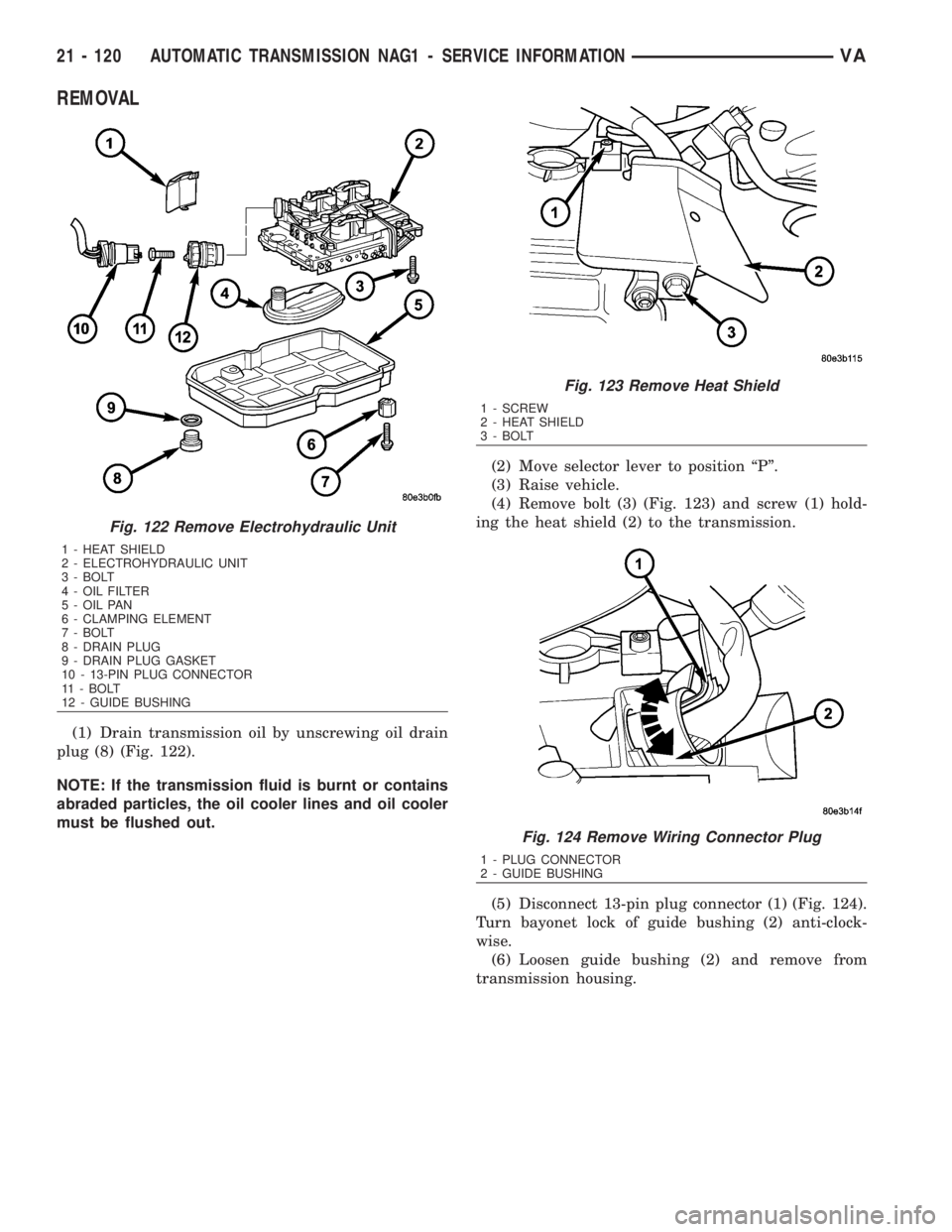
(1) Drain transmission oil by unscrewing oil drain
plug (8) (Fig. 122).
NOTE: If the transmission fluid is burnt or contains
abraded particles, the oil cooler lines and oil cooler
must be flushed out.(2) Move selector lever to position ªPº.
(3) Raise vehicle.
(4) Remove bolt (3) (Fig. 123) and screw (1) hold-
ing the heat shield (2) to the transmission.
(5) Disconnect 13-pin plug connector (1) (Fig. 124).
Turn bayonet lock of guide bushing (2) anti-clock-
wise.
(6) Loosen guide bushing (2) and remove from
transmission housing.
Fig. 122 Remove Electrohydraulic Unit
1 - HEAT SHIELD
2 - ELECTROHYDRAULIC UNIT
3 - BOLT
4 - OIL FILTER
5 - OIL PAN
6 - CLAMPING ELEMENT
7 - BOLT
8 - DRAIN PLUG
9 - DRAIN PLUG GASKET
10 - 13-PIN PLUG CONNECTOR
11 - BOLT
12 - GUIDE BUSHING
Fig. 123 Remove Heat Shield
1 - SCREW
2 - HEAT SHIELD
3 - BOLT
Fig. 124 Remove Wiring Connector Plug
1 - PLUG CONNECTOR
2 - GUIDE BUSHING
21 - 120 AUTOMATIC TRANSMISSION NAG1 - SERVICE INFORMATIONVA
Page 1873 of 2305
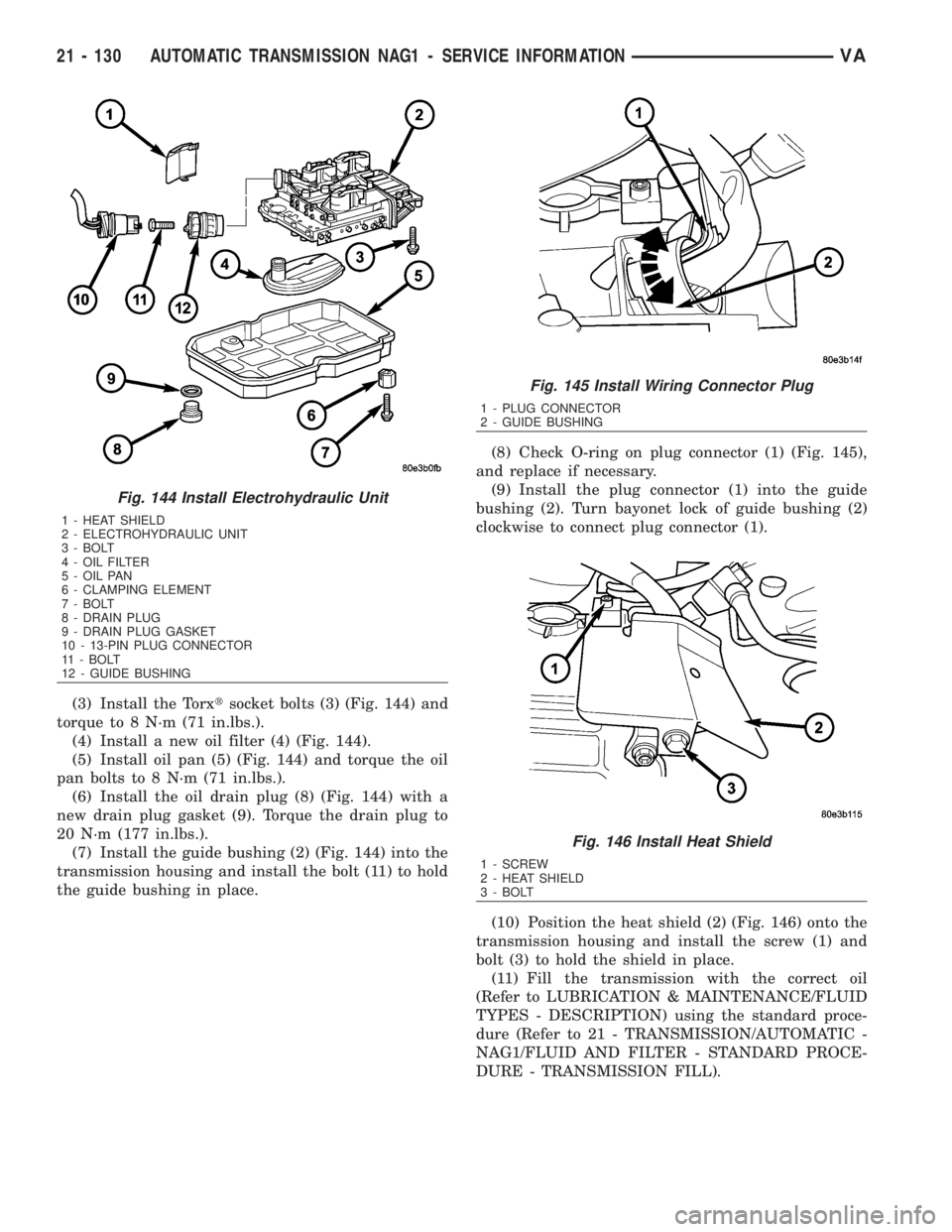
(3) Install the Torxtsocket bolts (3) (Fig. 144) and
torque to 8 N´m (71 in.lbs.).
(4) Install a new oil filter (4) (Fig. 144).
(5) Install oil pan (5) (Fig. 144) and torque the oil
pan bolts to 8 N´m (71 in.lbs.).
(6) Install the oil drain plug (8) (Fig. 144) with a
new drain plug gasket (9). Torque the drain plug to
20 N´m (177 in.lbs.).
(7) Install the guide bushing (2) (Fig. 144) into the
transmission housing and install the bolt (11) to hold
the guide bushing in place.(8) Check O-ring on plug connector (1) (Fig. 145),
and replace if necessary.
(9) Install the plug connector (1) into the guide
bushing (2). Turn bayonet lock of guide bushing (2)
clockwise to connect plug connector (1).
(10) Position the heat shield (2) (Fig. 146) onto the
transmission housing and install the screw (1) and
bolt (3) to hold the shield in place.
(11) Fill the transmission with the correct oil
(Refer to LUBRICATION & MAINTENANCE/FLUID
TYPES - DESCRIPTION) using the standard proce-
dure (Refer to 21 - TRANSMISSION/AUTOMATIC -
NAG1/FLUID AND FILTER - STANDARD PROCE-
DURE - TRANSMISSION FILL).
Fig. 144 Install Electrohydraulic Unit
1 - HEAT SHIELD
2 - ELECTROHYDRAULIC UNIT
3 - BOLT
4 - OIL FILTER
5 - OIL PAN
6 - CLAMPING ELEMENT
7 - BOLT
8 - DRAIN PLUG
9 - DRAIN PLUG GASKET
10 - 13-PIN PLUG CONNECTOR
11 - BOLT
12 - GUIDE BUSHING
Fig. 145 Install Wiring Connector Plug
1 - PLUG CONNECTOR
2 - GUIDE BUSHING
Fig. 146 Install Heat Shield
1 - SCREW
2 - HEAT SHIELD
3 - BOLT
21 - 130 AUTOMATIC TRANSMISSION NAG1 - SERVICE INFORMATIONVA