tow MERCEDES-BENZ SPRINTER 2006 Manual PDF
[x] Cancel search | Manufacturer: MERCEDES-BENZ, Model Year: 2006, Model line: SPRINTER, Model: MERCEDES-BENZ SPRINTER 2006Pages: 2305, PDF Size: 48.12 MB
Page 1693 of 2305
INSTALLATION - HIGH PRESSURE LINES
WARNING: NO SPARKS, OPEN FLAMES OR SMOK-
ING. RISK OF POISONING FROM INHALING AND
SWALLOWING FUEL. RISK OF INJURY TO EYES
AND SKIN FROM CONTACT WITH FUEL. POUR
FUELS ONLY INTO SUITABLE AND APPROPRI-
ATELY MARKED CONTAINERS. WEAR PROTECTIVE
CLOTHING.
(1) Loosen the fuel rail mounting bolts to install
lines free of stress.
CAUTION: Inspect sealing cone at lines. Replace if
compression points exist. Ensure lines are exactly
located.
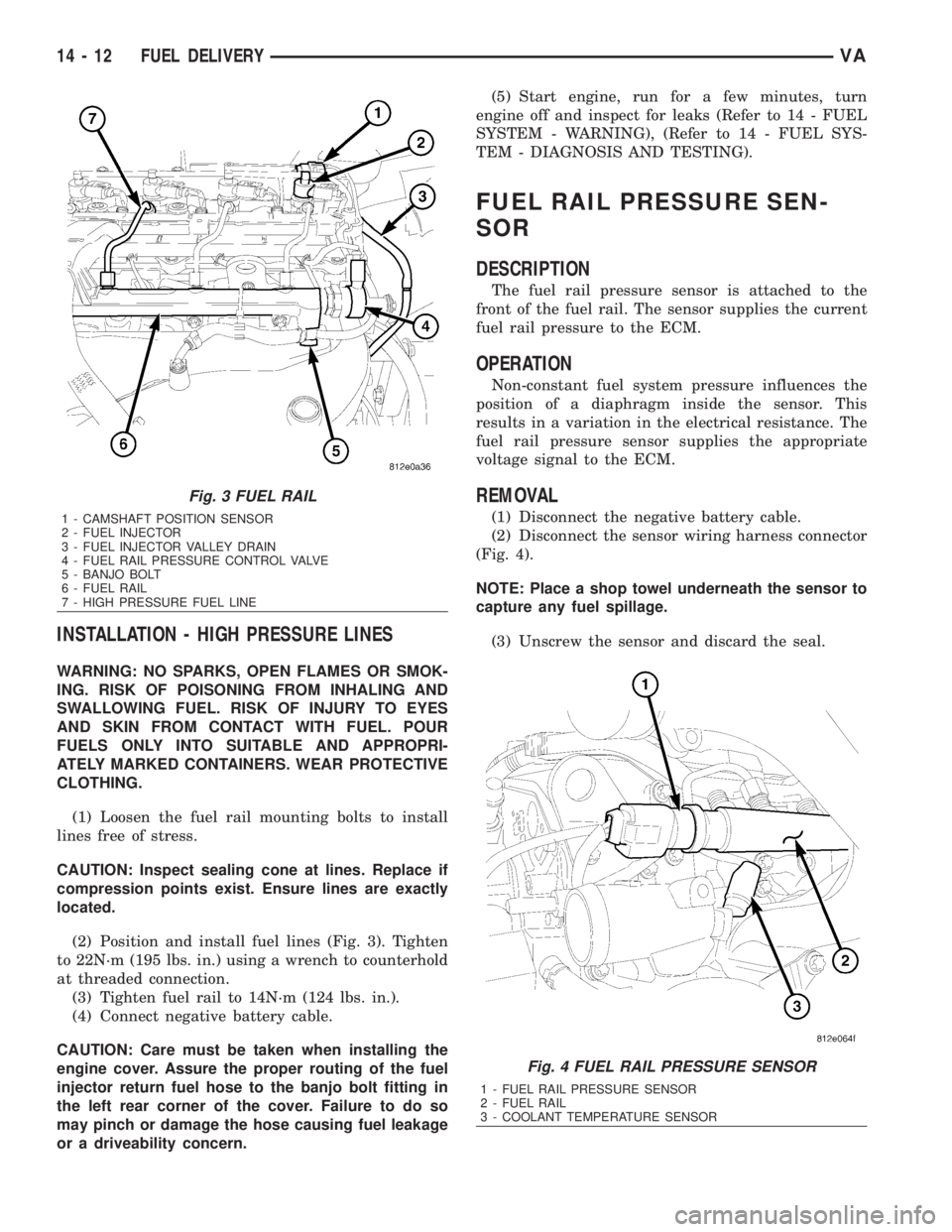
(2) Position and install fuel lines (Fig. 3). Tighten
to 22N´m (195 lbs. in.) using a wrench to counterhold
at threaded connection.
(3) Tighten fuel rail to 14N´m (124 lbs. in.).
(4) Connect negative battery cable.
CAUTION: Care must be taken when installing the
engine cover. Assure the proper routing of the fuel
injector return fuel hose to the banjo bolt fitting in
the left rear corner of the cover. Failure to do so
may pinch or damage the hose causing fuel leakage
or a driveability concern.(5) Start engine, run for a few minutes, turn
engine off and inspect for leaks (Refer to 14 - FUEL
SYSTEM - WARNING), (Refer to 14 - FUEL SYS-
TEM - DIAGNOSIS AND TESTING).
FUEL RAIL PRESSURE SEN-
SOR
DESCRIPTION
The fuel rail pressure sensor is attached to the
front of the fuel rail. The sensor supplies the current
fuel rail pressure to the ECM.
OPERATION
Non-constant fuel system pressure influences the
position of a diaphragm inside the sensor. This
results in a variation in the electrical resistance. The
fuel rail pressure sensor supplies the appropriate
voltage signal to the ECM.
REMOVAL
(1) Disconnect the negative battery cable.
(2) Disconnect the sensor wiring harness connector
(Fig. 4).
NOTE: Place a shop towel underneath the sensor to
capture any fuel spillage.
(3) Unscrew the sensor and discard the seal.
Fig. 3 FUEL RAIL
1 - CAMSHAFT POSITION SENSOR
2 - FUEL INJECTOR
3 - FUEL INJECTOR VALLEY DRAIN
4 - FUEL RAIL PRESSURE CONTROL VALVE
5 - BANJO BOLT
6 - FUEL RAIL
7 - HIGH PRESSURE FUEL LINE
Fig. 4 FUEL RAIL PRESSURE SENSOR
1 - FUEL RAIL PRESSURE SENSOR
2 - FUEL RAIL
3 - COOLANT TEMPERATURE SENSOR
14 - 12 FUEL DELIVERYVA
Page 1701 of 2305
INSTALLATION
CAUTION: Whenever the fuel pump module is ser-
viced, the rubber gasket must be replaced.
(1) Thoroughly clean locknut (lockring) and lock-
nut threads at top of tank.
(2) Position new gasket (seal) to fuel tank opening.
(3) Position float rod assembly partially into fuel
tank.
(4) Position fuel pump module partially into fuel
tank.
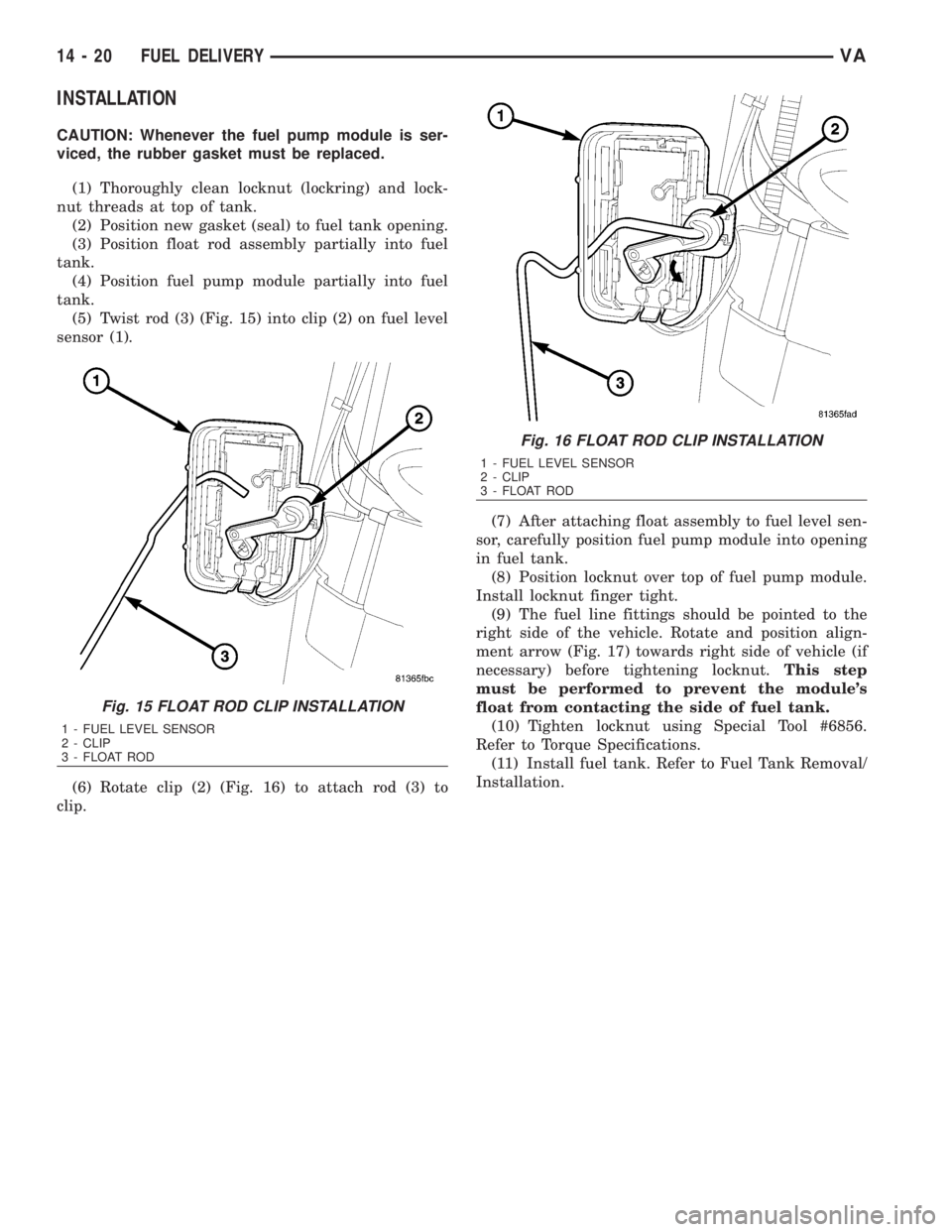
(5) Twist rod (3) (Fig. 15) into clip (2) on fuel level
sensor (1).
(6) Rotate clip (2) (Fig. 16) to attach rod (3) to
clip.(7) After attaching float assembly to fuel level sen-
sor, carefully position fuel pump module into opening
in fuel tank.
(8) Position locknut over top of fuel pump module.
Install locknut finger tight.
(9) The fuel line fittings should be pointed to the
right side of the vehicle. Rotate and position align-
ment arrow (Fig. 17) towards right side of vehicle (if
necessary) before tightening locknut.This step
must be performed to prevent the module's
float from contacting the side of fuel tank.
(10) Tighten locknut using Special Tool #6856.
Refer to Torque Specifications.
(11) Install fuel tank. Refer to Fuel Tank Removal/
Installation.
Fig. 15 FLOAT ROD CLIP INSTALLATION
1 - FUEL LEVEL SENSOR
2 - CLIP
3 - FLOAT ROD
Fig. 16 FLOAT ROD CLIP INSTALLATION
1 - FUEL LEVEL SENSOR
2 - CLIP
3 - FLOAT ROD
14 - 20 FUEL DELIVERYVA
Page 1702 of 2305
FUEL QUANTITY CONTROL
VA LV E
DESCRIPTION
The fuel quantity control valve mounts to front of
the high pressure pump and is controlled by the
ECM. The quantity control valve assists in maintain-
ing proper fuel quantity injected under all operating
conditions. Fuel tank heat protection is also provided
by the quantity control valve. The valve meters the
exact amount of fuel to prevent excess heated fuel
from returning to the tank.
OPERATION
The ECM monitors the fuel system and measures
for pressure vibrations. The ECM will then send a
pulse width signal to the quantity control valve to
regulate the amount of fuel to the high pressure
pump plunger and barrel assemblies. The valve then
adjusts the injection correction quantity for each
individual cylinder in line with the firing order, there
by eliminating the pressure resonance in the fuel rail
and improving each independent injectors operation.
The fuel quantity valve also interrupts the fuel sup-
ply to the high pressure pump plunger and barrel
assemblies when the engine is switched off.
The ECM detects the operating state which exists
at the engine by means of the sensors. In order to
adapt the quantity injected, either the rail pressure
can be adjusted by way of the pressure regulator
valve and the quantity control valve, or the actuationtime of the solenoid valves in the fuel injectors can
be extended or shortened.
Fuel quantity control is performed under the fol-
lowing operating conditions:
²Approximately 30 seconds after the engine has
started
²Fuel temperature > 20ÉC (68ÉF)
²Engine not in deceleration mode
REMOVAL
(1) Disconnect the negative battery cable.
(2) Disconnect the control valve wiring harness
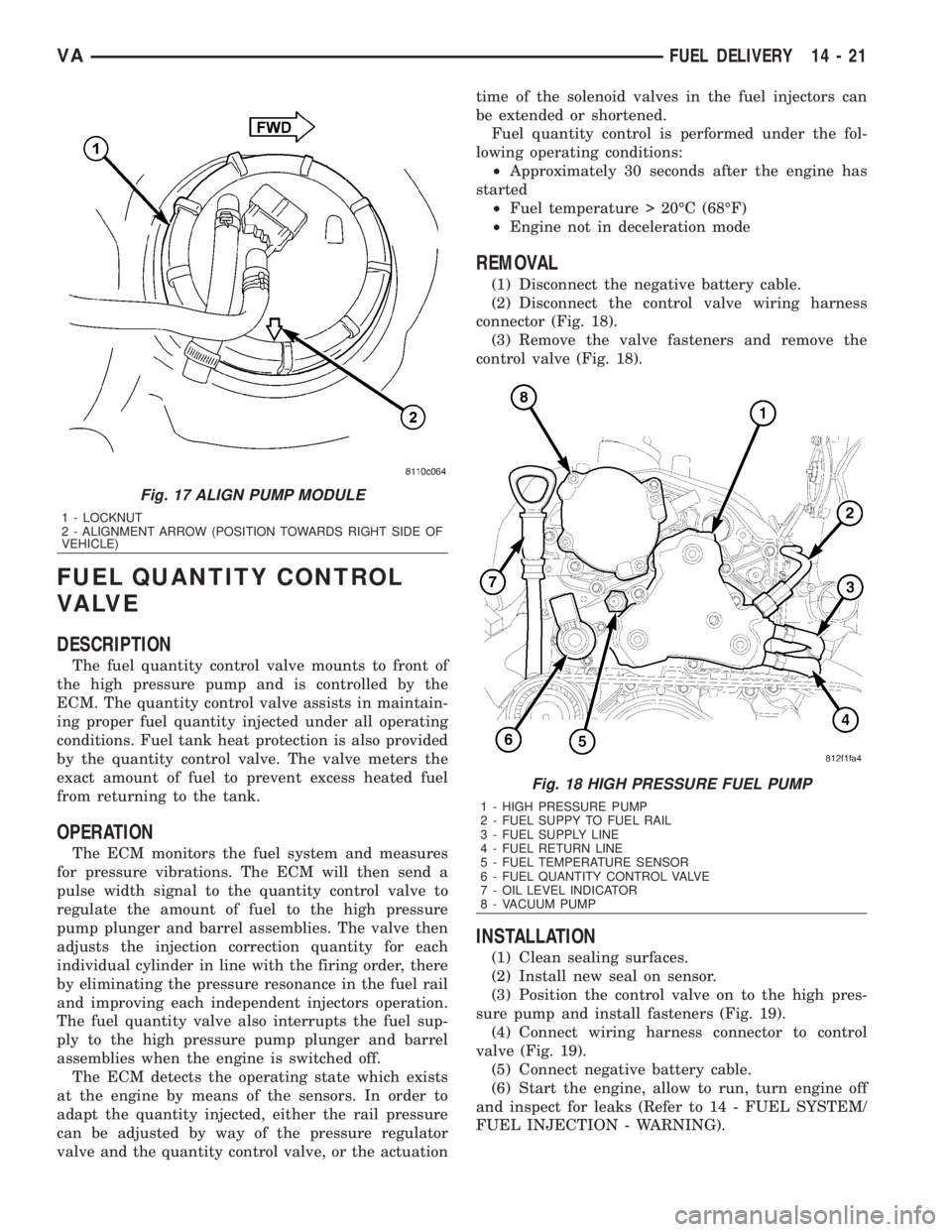
connector (Fig. 18).
(3) Remove the valve fasteners and remove the
control valve (Fig. 18).
INSTALLATION
(1) Clean sealing surfaces.
(2) Install new seal on sensor.
(3) Position the control valve on to the high pres-
sure pump and install fasteners (Fig. 19).
(4) Connect wiring harness connector to control
valve (Fig. 19).
(5) Connect negative battery cable.
(6) Start the engine, allow to run, turn engine off
and inspect for leaks (Refer to 14 - FUEL SYSTEM/
FUEL INJECTION - WARNING).
Fig. 17 ALIGN PUMP MODULE
1 - LOCKNUT
2 - ALIGNMENT ARROW (POSITION TOWARDS RIGHT SIDE OF
VEHICLE)
Fig. 18 HIGH PRESSURE FUEL PUMP
1 - HIGH PRESSURE PUMP
2 - FUEL SUPPY TO FUEL RAIL
3 - FUEL SUPPLY LINE
4 - FUEL RETURN LINE
5 - FUEL TEMPERATURE SENSOR
6 - FUEL QUANTITY CONTROL VALVE
7 - OIL LEVEL INDICATOR
8 - VACUUM PUMP
VAFUEL DELIVERY 14 - 21
Page 1706 of 2305
REMOVAL
(1) Drain diesel fuel from tank. Refer to Standard
Procedure Ð Draining Fuel Tank Ð Diesel.
(2) Disconnect fuel fill and vent lines from body.
(3) Raise and support vehicle.
(4) Support tank with a hydraulic jack.
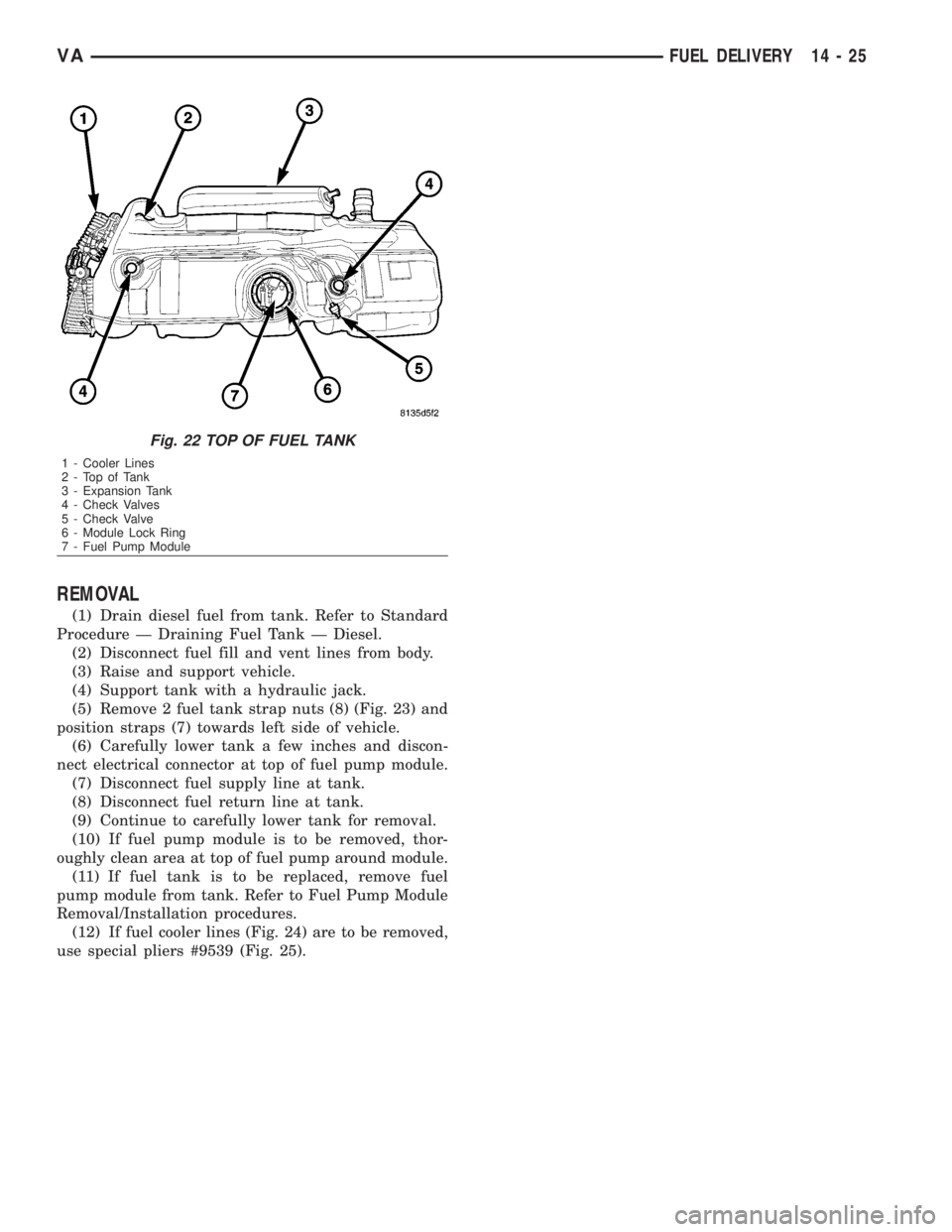
(5) Remove 2 fuel tank strap nuts (8) (Fig. 23) and
position straps (7) towards left side of vehicle.
(6) Carefully lower tank a few inches and discon-
nect electrical connector at top of fuel pump module.
(7) Disconnect fuel supply line at tank.
(8) Disconnect fuel return line at tank.
(9) Continue to carefully lower tank for removal.
(10) If fuel pump module is to be removed, thor-
oughly clean area at top of fuel pump around module.
(11) If fuel tank is to be replaced, remove fuel
pump module from tank. Refer to Fuel Pump Module
Removal/Installation procedures.
(12) If fuel cooler lines (Fig. 24) are to be removed,
use special pliers #9539 (Fig. 25).
Fig. 22 TOP OF FUEL TANK
1 - Cooler Lines
2-TopofTank
3 - Expansion Tank
4 - Check Valves
5 - Check Valve
6 - Module Lock Ring
7 - Fuel Pump Module
VAFUEL DELIVERY 14 - 25
Page 1714 of 2305
(2) Position the sensor (Fig. 3) and install the fas-
teners.
(3) Connect the negative battery cable.
BOOST PRESSURE SENSOR
DESCRIPTION
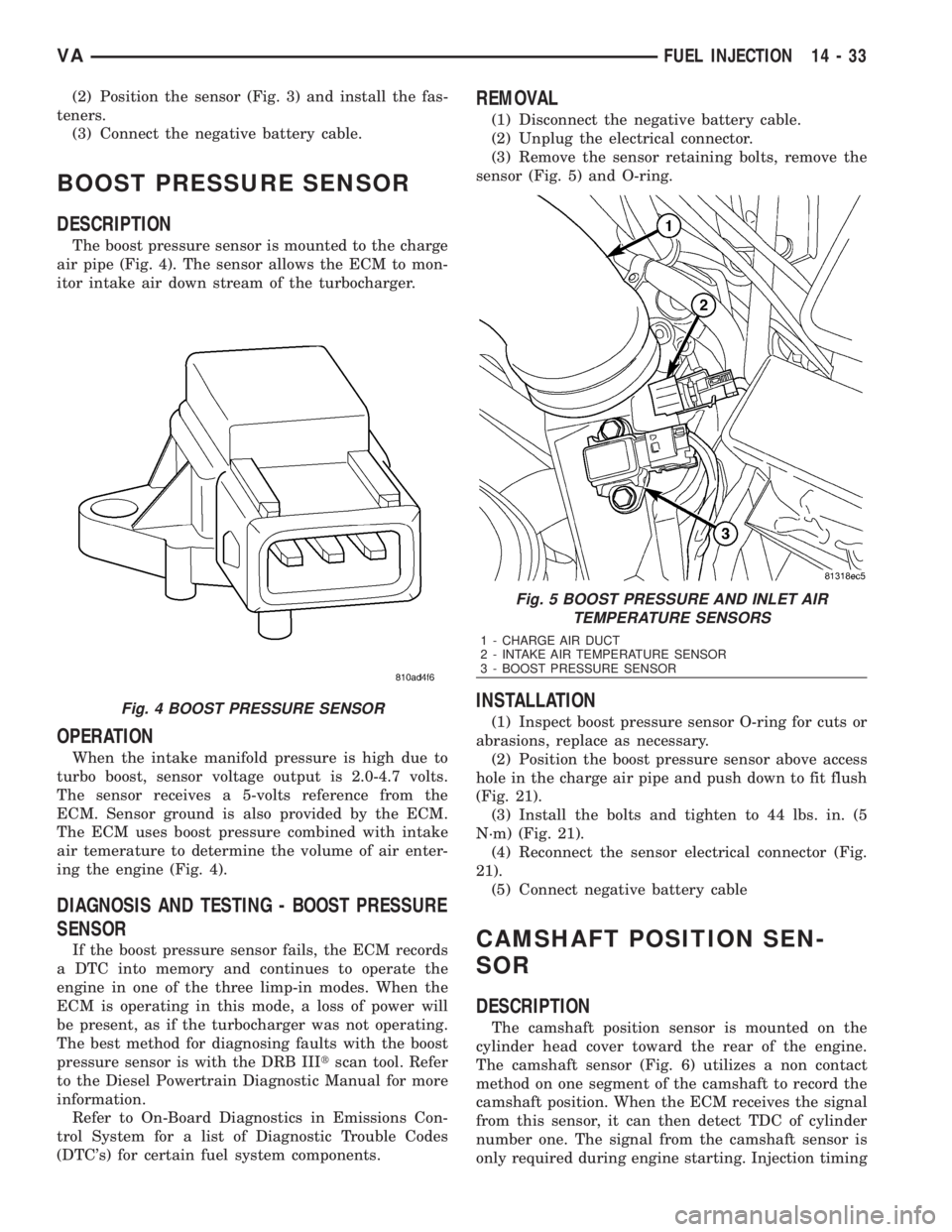
The boost pressure sensor is mounted to the charge
air pipe (Fig. 4). The sensor allows the ECM to mon-
itor intake air down stream of the turbocharger.
OPERATION
When the intake manifold pressure is high due to
turbo boost, sensor voltage output is 2.0-4.7 volts.
The sensor receives a 5-volts reference from the
ECM. Sensor ground is also provided by the ECM.
The ECM uses boost pressure combined with intake
air temerature to determine the volume of air enter-
ing the engine (Fig. 4).
DIAGNOSIS AND TESTING - BOOST PRESSURE
SENSOR
If the boost pressure sensor fails, the ECM records
a DTC into memory and continues to operate the
engine in one of the three limp-in modes. When the
ECM is operating in this mode, a loss of power will
be present, as if the turbocharger was not operating.
The best method for diagnosing faults with the boost
pressure sensor is with the DRB IIItscan tool. Refer
to the Diesel Powertrain Diagnostic Manual for more
information.
Refer to On-Board Diagnostics in Emissions Con-
trol System for a list of Diagnostic Trouble Codes
(DTC's) for certain fuel system components.
REMOVAL
(1) Disconnect the negative battery cable.
(2) Unplug the electrical connector.
(3) Remove the sensor retaining bolts, remove the
sensor (Fig. 5) and O-ring.
INSTALLATION
(1) Inspect boost pressure sensor O-ring for cuts or
abrasions, replace as necessary.
(2) Position the boost pressure sensor above access
hole in the charge air pipe and push down to fit flush
(Fig. 21).
(3) Install the bolts and tighten to 44 lbs. in. (5
N´m) (Fig. 21).
(4) Reconnect the sensor electrical connector (Fig.
21).
(5) Connect negative battery cable
CAMSHAFT POSITION SEN-
SOR
DESCRIPTION
The camshaft position sensor is mounted on the
cylinder head cover toward the rear of the engine.
The camshaft sensor (Fig. 6) utilizes a non contact
method on one segment of the camshaft to record the
camshaft position. When the ECM receives the signal
from this sensor, it can then detect TDC of cylinder
number one. The signal from the camshaft sensor is
only required during engine starting. Injection timing
Fig. 4 BOOST PRESSURE SENSOR
Fig. 5 BOOST PRESSURE AND INLET AIR
TEMPERATURE SENSORS
1 - CHARGE AIR DUCT
2 - INTAKE AIR TEMPERATURE SENSOR
3 - BOOST PRESSURE SENSOR
VAFUEL INJECTION 14 - 33
Page 1736 of 2305
GEAR
TABLE OF CONTENTS
page page
GEAR
DESCRIPTION..........................7
REMOVAL.............................7INSTALLATION..........................7
SPECIFICATIONS - TORQUE CHART.........8
GEAR
DESCRIPTION
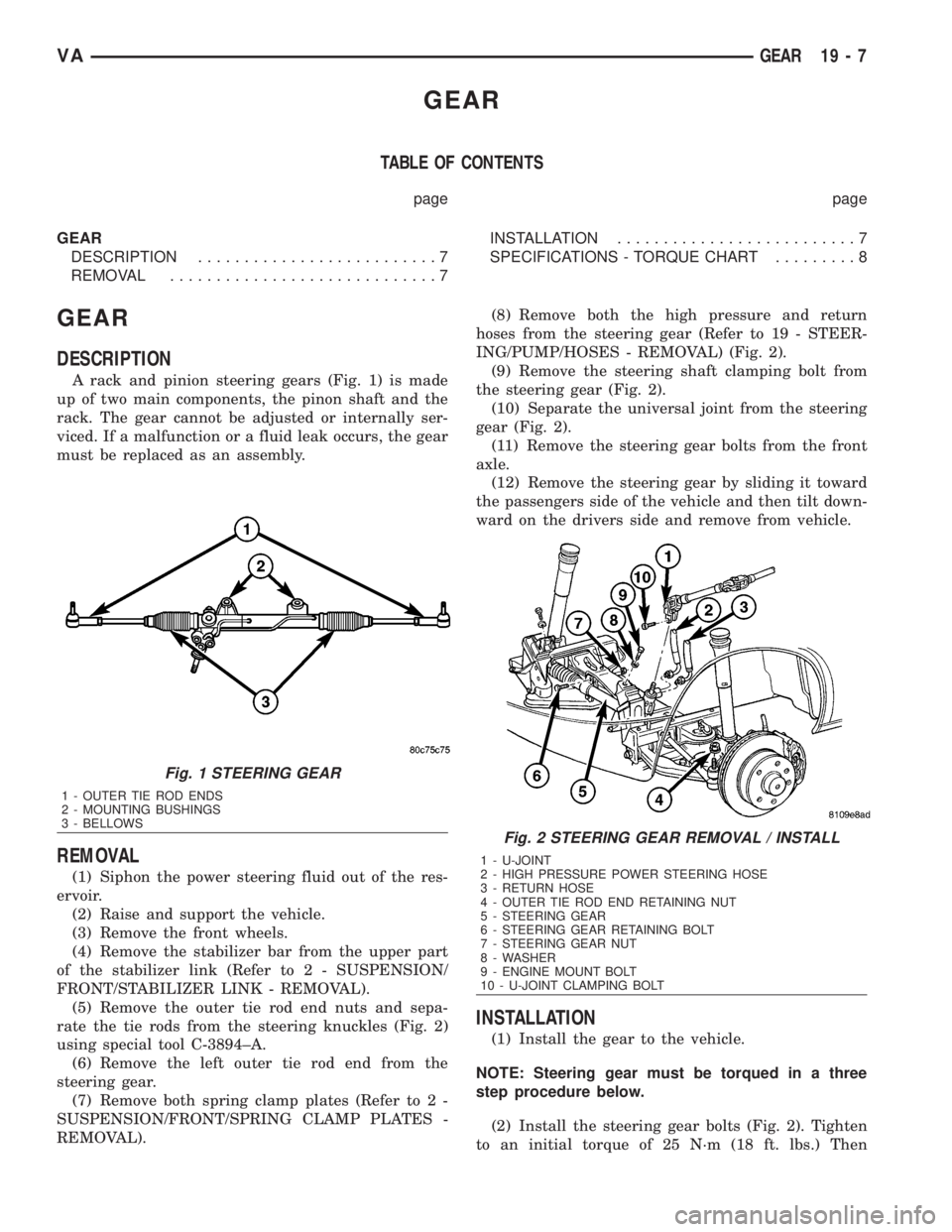
A rack and pinion steering gears (Fig. 1) is made
up of two main components, the pinon shaft and the
rack. The gear cannot be adjusted or internally ser-
viced. If a malfunction or a fluid leak occurs, the gear
must be replaced as an assembly.
REMOVAL
(1) Siphon the power steering fluid out of the res-
ervoir.
(2) Raise and support the vehicle.
(3) Remove the front wheels.
(4) Remove the stabilizer bar from the upper part
of the stabilizer link (Refer to 2 - SUSPENSION/
FRONT/STABILIZER LINK - REMOVAL).
(5) Remove the outer tie rod end nuts and sepa-
rate the tie rods from the steering knuckles (Fig. 2)
using special tool C-3894±A.
(6) Remove the left outer tie rod end from the
steering gear.
(7) Remove both spring clamp plates (Refer to 2 -
SUSPENSION/FRONT/SPRING CLAMP PLATES -
REMOVAL).(8) Remove both the high pressure and return
hoses from the steering gear (Refer to 19 - STEER-
ING/PUMP/HOSES - REMOVAL) (Fig. 2).
(9) Remove the steering shaft clamping bolt from
the steering gear (Fig. 2).
(10) Separate the universal joint from the steering
gear (Fig. 2).
(11) Remove the steering gear bolts from the front
axle.
(12) Remove the steering gear by sliding it toward
the passengers side of the vehicle and then tilt down-
ward on the drivers side and remove from vehicle.
INSTALLATION
(1) Install the gear to the vehicle.
NOTE: Steering gear must be torqued in a three
step procedure below.
(2) Install the steering gear bolts (Fig. 2). Tighten
to an initial torque of 25 N´m (18 ft. lbs.) Then
Fig. 1 STEERING GEAR
1 - OUTER TIE ROD ENDS
2 - MOUNTING BUSHINGS
3 - BELLOWS
Fig. 2 STEERING GEAR REMOVAL / INSTALL
1 - U-JOINT
2 - HIGH PRESSURE POWER STEERING HOSE
3 - RETURN HOSE
4 - OUTER TIE ROD END RETAINING NUT
5 - STEERING GEAR
6 - STEERING GEAR RETAINING BOLT
7 - STEERING GEAR NUT
8 - WASHER
9 - ENGINE MOUNT BOLT
10 - U-JOINT CLAMPING BOLT
VAGEAR 19 - 7
Page 1781 of 2305
First Gear Engaged
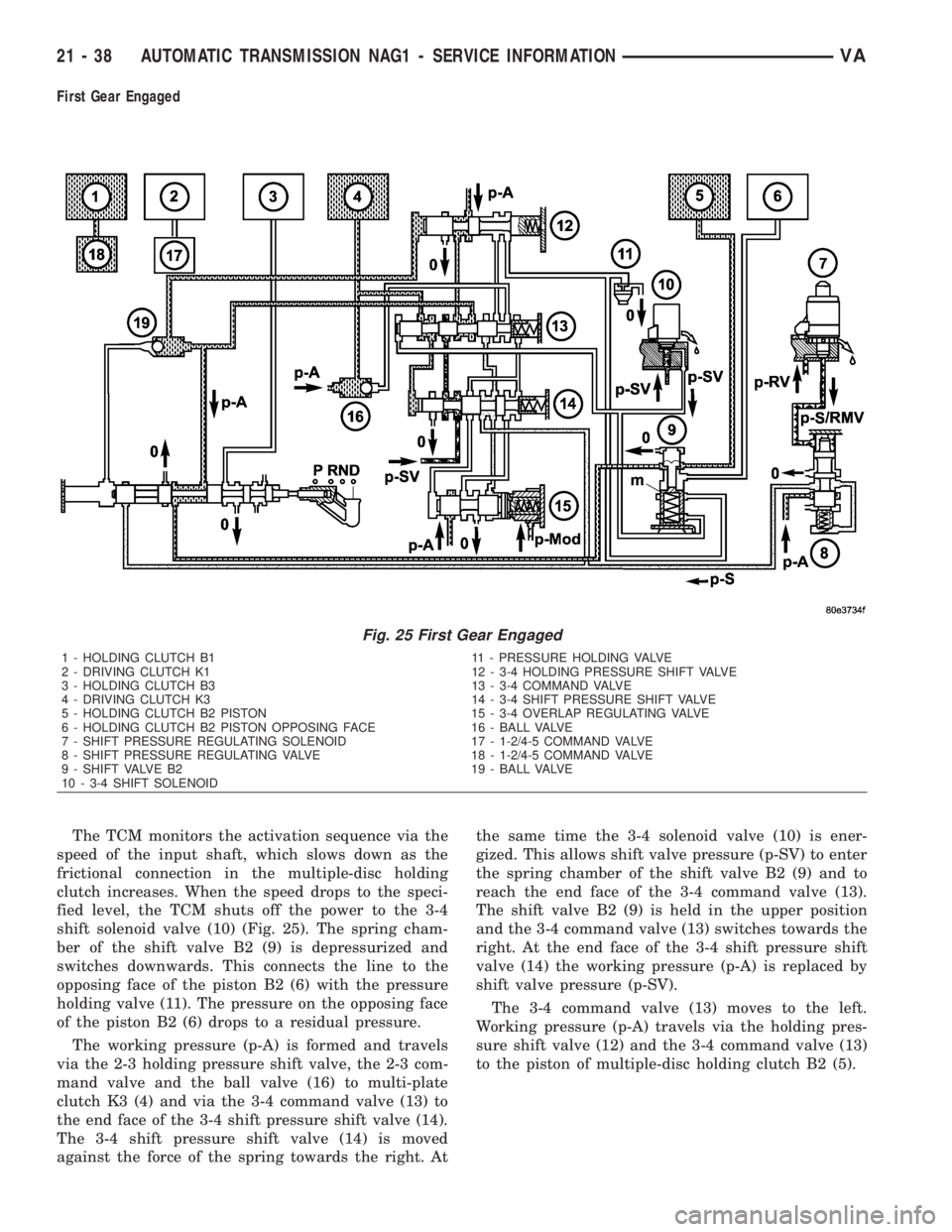
The TCM monitors the activation sequence via the
speed of the input shaft, which slows down as the
frictional connection in the multiple-disc holding
clutch increases. When the speed drops to the speci-
fied level, the TCM shuts off the power to the 3-4
shift solenoid valve (10) (Fig. 25). The spring cham-
ber of the shift valve B2 (9) is depressurized and
switches downwards. This connects the line to the
opposing face of the piston B2 (6) with the pressure
holding valve (11). The pressure on the opposing face
of the piston B2 (6) drops to a residual pressure.
The working pressure (p-A) is formed and travels
via the 2-3 holding pressure shift valve, the 2-3 com-
mand valve and the ball valve (16) to multi-plate
clutch K3 (4) and via the 3-4 command valve (13) to
the end face of the 3-4 shift pressure shift valve (14).
The 3-4 shift pressure shift valve (14) is moved
against the force of the spring towards the right. Atthe same time the 3-4 solenoid valve (10) is ener-
gized. This allows shift valve pressure (p-SV) to enter
the spring chamber of the shift valve B2 (9) and to
reach the end face of the 3-4 command valve (13).
The shift valve B2 (9) is held in the upper position
and the 3-4 command valve (13) switches towards the
right. At the end face of the 3-4 shift pressure shift
valve (14) the working pressure (p-A) is replaced by
shift valve pressure (p-SV).
The 3-4 command valve (13) moves to the left.
Working pressure (p-A) travels via the holding pres-
sure shift valve (12) and the 3-4 command valve (13)
to the piston of multiple-disc holding clutch B2 (5).
Fig. 25 First Gear Engaged
1 - HOLDING CLUTCH B1 11 - PRESSURE HOLDING VALVE
2 - DRIVING CLUTCH K1 12 - 3-4 HOLDING PRESSURE SHIFT VALVE
3 - HOLDING CLUTCH B3 13 - 3-4 COMMAND VALVE
4 - DRIVING CLUTCH K3 14 - 3-4 SHIFT PRESSURE SHIFT VALVE
5 - HOLDING CLUTCH B2 PISTON 15 - 3-4 OVERLAP REGULATING VALVE
6 - HOLDING CLUTCH B2 PISTON OPPOSING FACE 16 - BALL VALVE
7 - SHIFT PRESSURE REGULATING SOLENOID 17 - 1-2/4-5 COMMAND VALVE
8 - SHIFT PRESSURE REGULATING VALVE 18 - 1-2/4-5 COMMAND VALVE
9 - SHIFT VALVE B2 19 - BALL VALVE
10 - 3-4 SHIFT SOLENOID
21 - 38 AUTOMATIC TRANSMISSION NAG1 - SERVICE INFORMATIONVA
Page 1789 of 2305
(16) Disconnect ground strap and tie back to one
side.
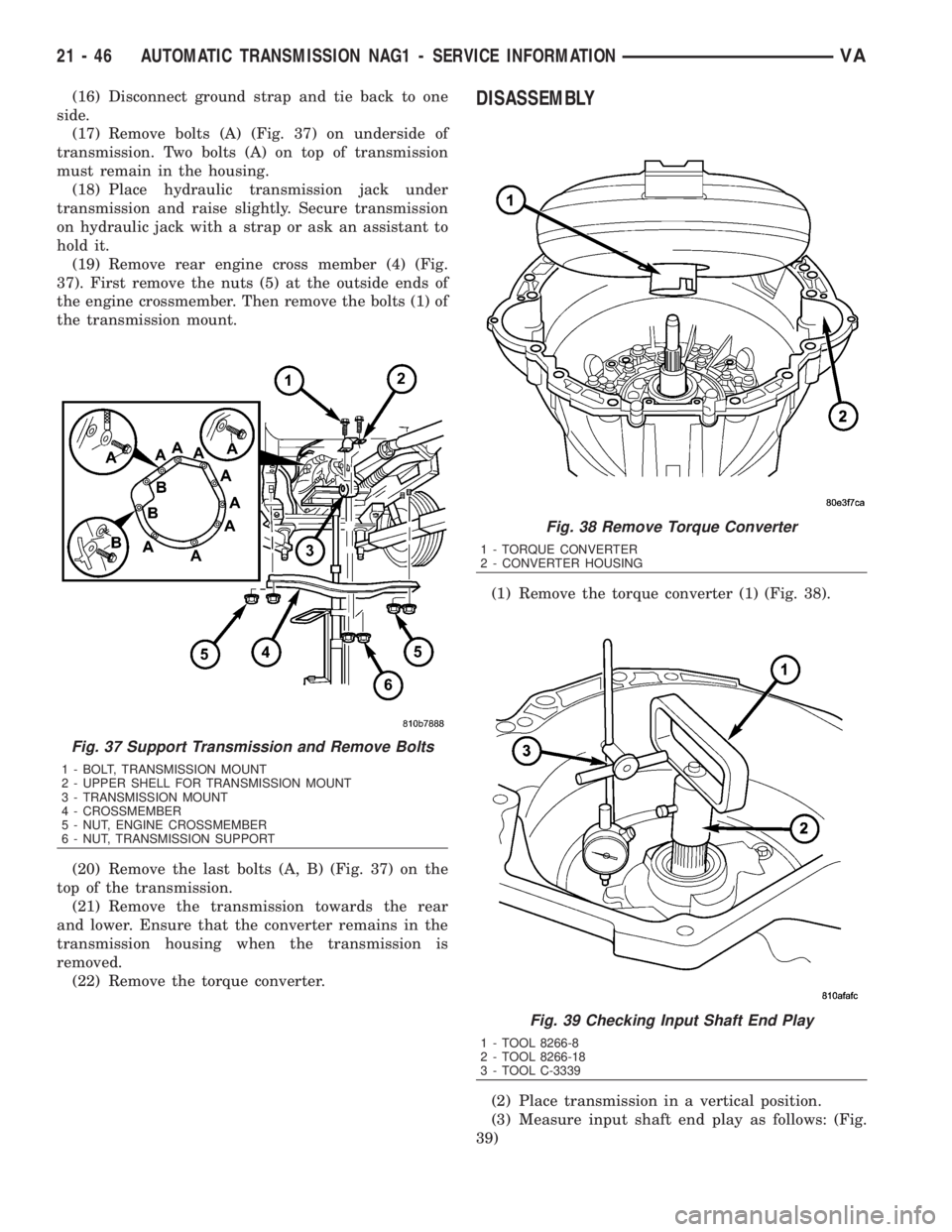
(17) Remove bolts (A) (Fig. 37) on underside of
transmission. Two bolts (A) on top of transmission
must remain in the housing.
(18) Place hydraulic transmission jack under
transmission and raise slightly. Secure transmission
on hydraulic jack with a strap or ask an assistant to
hold it.
(19) Remove rear engine cross member (4) (Fig.
37). First remove the nuts (5) at the outside ends of
the engine crossmember. Then remove the bolts (1) of
the transmission mount.
(20) Remove the last bolts (A, B) (Fig. 37) on the
top of the transmission.
(21) Remove the transmission towards the rear
and lower. Ensure that the converter remains in the
transmission housing when the transmission is
removed.
(22) Remove the torque converter.DISASSEMBLY
(1) Remove the torque converter (1) (Fig. 38).
(2) Place transmission in a vertical position.
(3) Measure input shaft end play as follows: (Fig.
39)
Fig. 37 Support Transmission and Remove Bolts
1 - BOLT, TRANSMISSION MOUNT
2 - UPPER SHELL FOR TRANSMISSION MOUNT
3 - TRANSMISSION MOUNT
4 - CROSSMEMBER
5 - NUT, ENGINE CROSSMEMBER
6 - NUT, TRANSMISSION SUPPORT
Fig. 38 Remove Torque Converter
1 - TORQUE CONVERTER
2 - CONVERTER HOUSING
Fig. 39 Checking Input Shaft End Play
1 - TOOL 8266-8
2 - TOOL 8266-18
3 - TOOL C-3339
21 - 46 AUTOMATIC TRANSMISSION NAG1 - SERVICE INFORMATIONVA
Page 1800 of 2305
(18) Using grease, install both Teflon rings in the
groove at the rear of the output shaft so that the
joint stays together.
(19) Mount transmission housing on converter
housing.
(20) Screw in Torx socket bolts through the trans-
mission housing into the converter housing. Tighten
the bolts to 20 N´m (177 in.lbs.).
(21) Measure end-play between park pawl gear
and grooved ball bearing in order to select the proper
geartrain end-play shim.
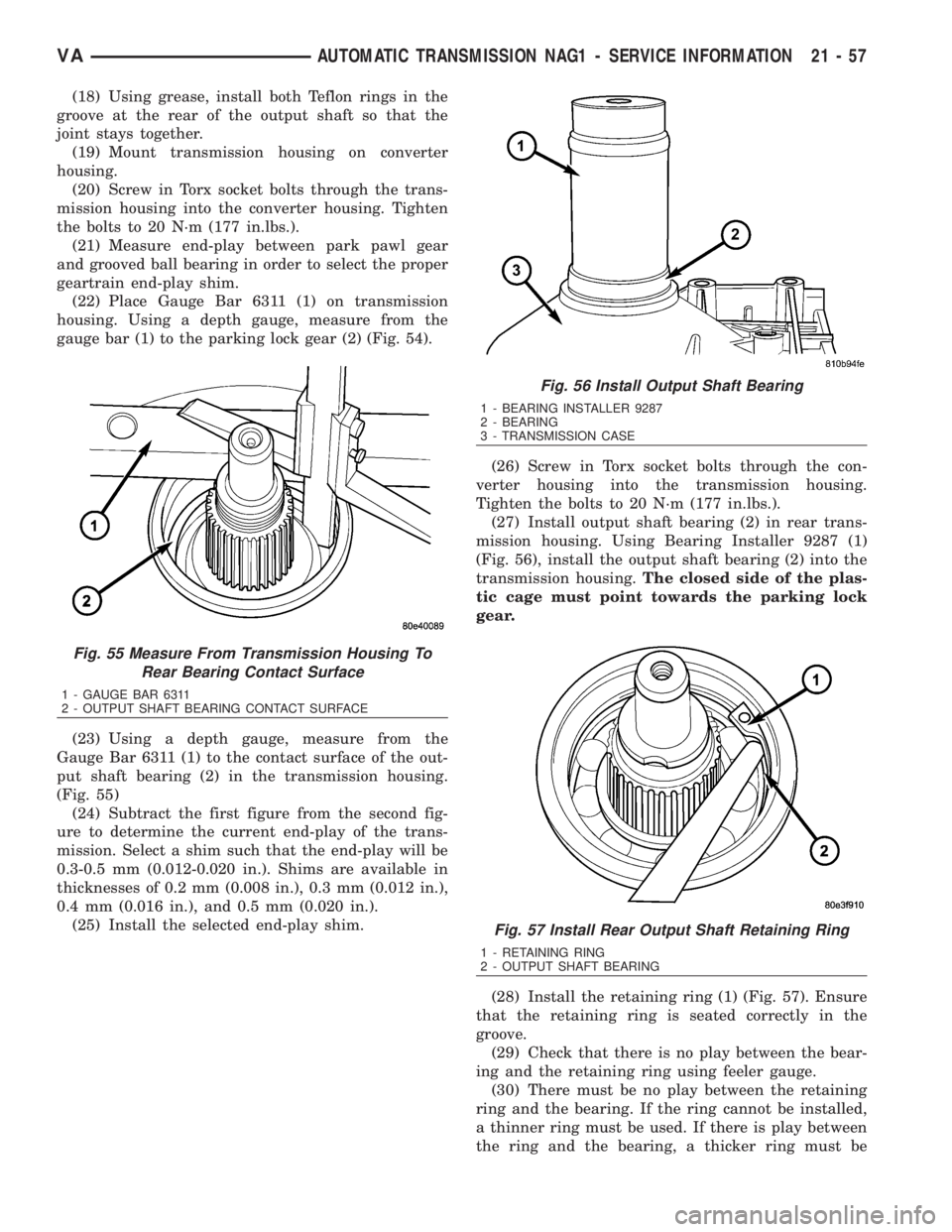
(22) Place Gauge Bar 6311 (1) on transmission
housing. Using a depth gauge, measure from the
gauge bar (1) to the parking lock gear (2) (Fig. 54).
(23) Using a depth gauge, measure from the
Gauge Bar 6311 (1) to the contact surface of the out-
put shaft bearing (2) in the transmission housing.
(Fig. 55)
(24) Subtract the first figure from the second fig-
ure to determine the current end-play of the trans-
mission. Select a shim such that the end-play will be
0.3-0.5 mm (0.012-0.020 in.). Shims are available in
thicknesses of 0.2 mm (0.008 in.), 0.3 mm (0.012 in.),
0.4 mm (0.016 in.), and 0.5 mm (0.020 in.).
(25) Install the selected end-play shim.(26) Screw in Torx socket bolts through the con-
verter housing into the transmission housing.
Tighten the bolts to 20 N´m (177 in.lbs.).
(27) Install output shaft bearing (2) in rear trans-
mission housing. Using Bearing Installer 9287 (1)
(Fig. 56), install the output shaft bearing (2) into the
transmission housing.The closed side of the plas-
tic cage must point towards the parking lock
gear.
(28) Install the retaining ring (1) (Fig. 57). Ensure
that the retaining ring is seated correctly in the
groove.
(29) Check that there is no play between the bear-
ing and the retaining ring using feeler gauge.
(30) There must be no play between the retaining
ring and the bearing. If the ring cannot be installed,
a thinner ring must be used. If there is play between
the ring and the bearing, a thicker ring must be
Fig. 55 Measure From Transmission Housing To
Rear Bearing Contact Surface
1 - GAUGE BAR 6311
2 - OUTPUT SHAFT BEARING CONTACT SURFACE
Fig. 56 Install Output Shaft Bearing
1 - BEARING INSTALLER 9287
2 - BEARING
3 - TRANSMISSION CASE
Fig. 57 Install Rear Output Shaft Retaining Ring
1 - RETAINING RING
2 - OUTPUT SHAFT BEARING
VAAUTOMATIC TRANSMISSION NAG1 - SERVICE INFORMATION 21 - 57
Page 1837 of 2305
ASSEMBLY
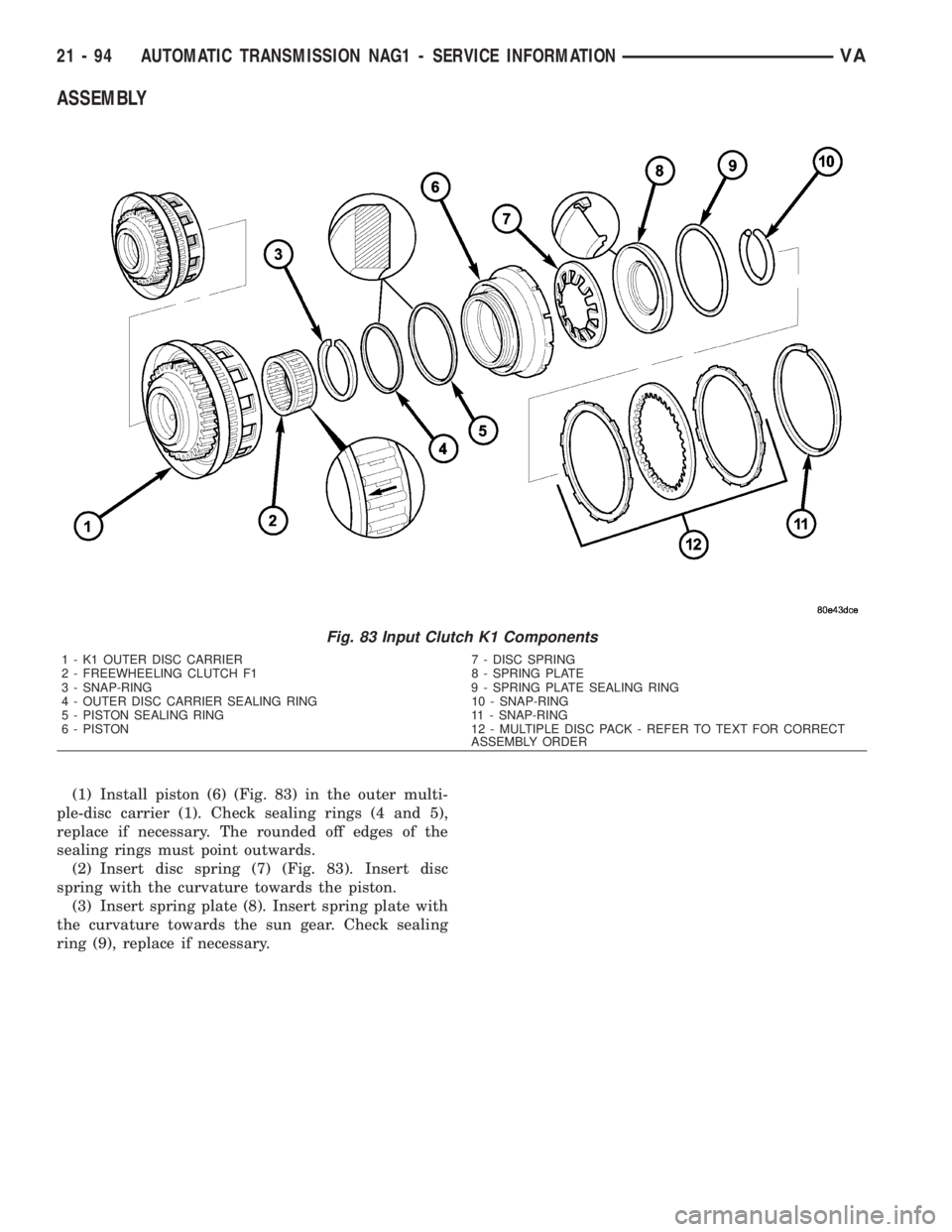
(1) Install piston (6) (Fig. 83) in the outer multi-
ple-disc carrier (1). Check sealing rings (4 and 5),
replace if necessary. The rounded off edges of the
sealing rings must point outwards.
(2) Insert disc spring (7) (Fig. 83). Insert disc
spring with the curvature towards the piston.
(3) Insert spring plate (8). Insert spring plate with
the curvature towards the sun gear. Check sealing
ring (9), replace if necessary.
Fig. 83 Input Clutch K1 Components
1 - K1 OUTER DISC CARRIER 7 - DISC SPRING
2 - FREEWHEELING CLUTCH F1 8 - SPRING PLATE
3 - SNAP-RING 9 - SPRING PLATE SEALING RING
4 - OUTER DISC CARRIER SEALING RING 10 - SNAP-RING
5 - PISTON SEALING RING 11 - SNAP-RING
6 - PISTON 12 - MULTIPLE DISC PACK - REFER TO TEXT FOR CORRECT
ASSEMBLY ORDER
21 - 94 AUTOMATIC TRANSMISSION NAG1 - SERVICE INFORMATIONVA