tow MERCEDES-BENZ SPRINTER 2006 Repair Manual
[x] Cancel search | Manufacturer: MERCEDES-BENZ, Model Year: 2006, Model line: SPRINTER, Model: MERCEDES-BENZ SPRINTER 2006Pages: 2305, PDF Size: 48.12 MB
Page 1498 of 2305
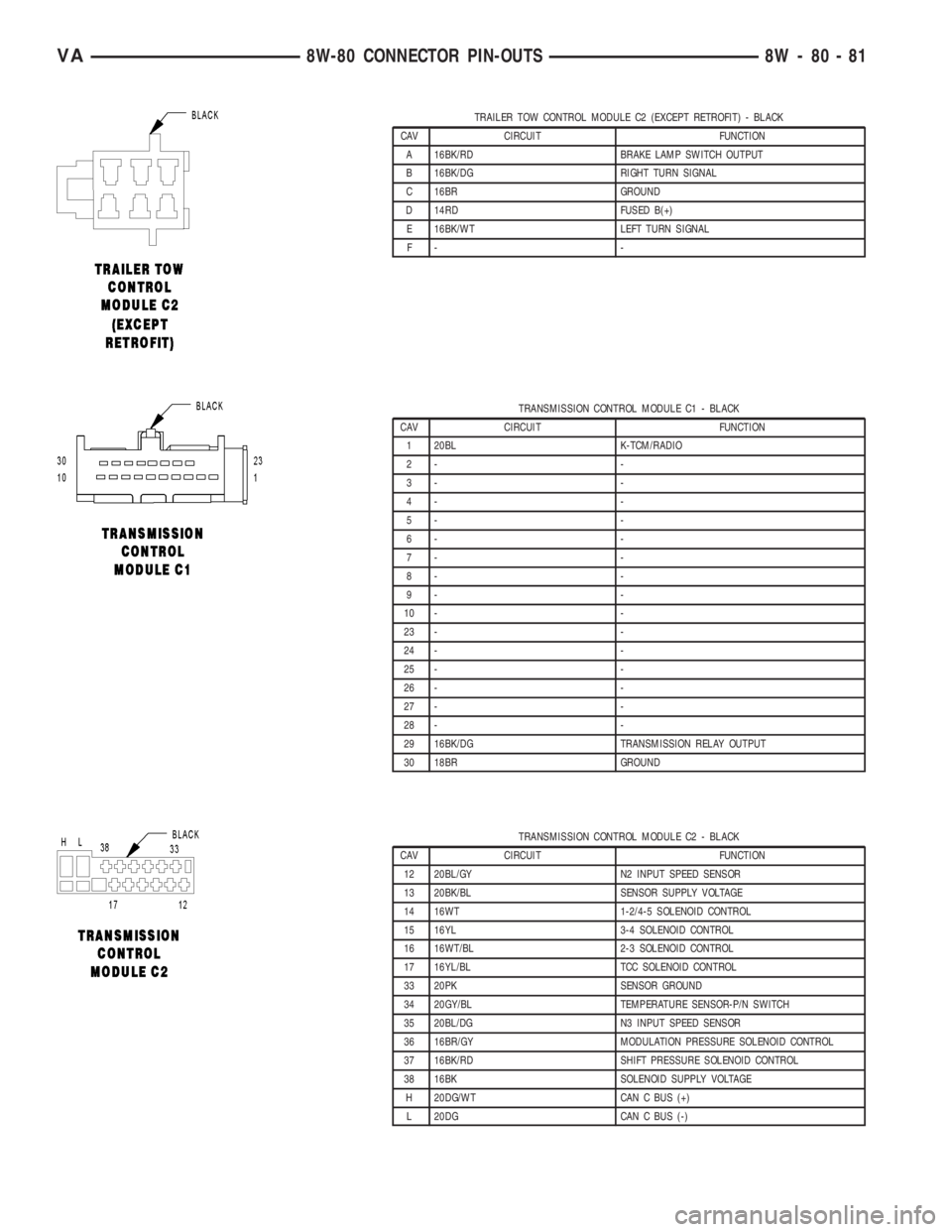
TRAILER TOW CONTROL MODULE C2 (EXCEPT RETROFIT) - BLACK
CAV CIRCUIT FUNCTION
A 16BK/RD BRAKE LAMP SWITCH OUTPUT
B 16BK/DG RIGHT TURN SIGNAL
C 16BR GROUND
D 14RD FUSED B(+)
E 16BK/WT LEFT TURN SIGNAL
F- -
TRANSMISSION CONTROL MODULE C1 - BLACK
CAV CIRCUIT FUNCTION
1 20BL K-TCM/RADIO
2- -
3- -
4- -
5- -
6- -
7- -
8- -
9- -
10 - -
23 - -
24 - -
25 - -
26 - -
27 - -
28 - -
29 16BK/DG TRANSMISSION RELAY OUTPUT
30 18BR GROUND
TRANSMISSION CONTROL MODULE C2 - BLACK
CAV CIRCUIT FUNCTION
12 20BL/GY N2 INPUT SPEED SENSOR
13 20BK/BL SENSOR SUPPLY VOLTAGE
14 16WT 1-2/4-5 SOLENOID CONTROL
15 16YL 3-4 SOLENOID CONTROL
16 16WT/BL 2-3 SOLENOID CONTROL
17 16YL/BL TCC SOLENOID CONTROL
33 20PK SENSOR GROUND
34 20GY/BL TEMPERATURE SENSOR-P/N SWITCH
35 20BL/DG N3 INPUT SPEED SENSOR
36 16BR/GY MODULATION PRESSURE SOLENOID CONTROL
37 16BK/RD SHIFT PRESSURE SOLENOID CONTROL
38 16BK SOLENOID SUPPLY VOLTAGE
H 20DG/WT CAN C BUS (+)
L 20DG CAN C BUS (-)
VA8W-80 CONNECTOR PIN-OUTS 8W - 80 - 81
Page 1512 of 2305
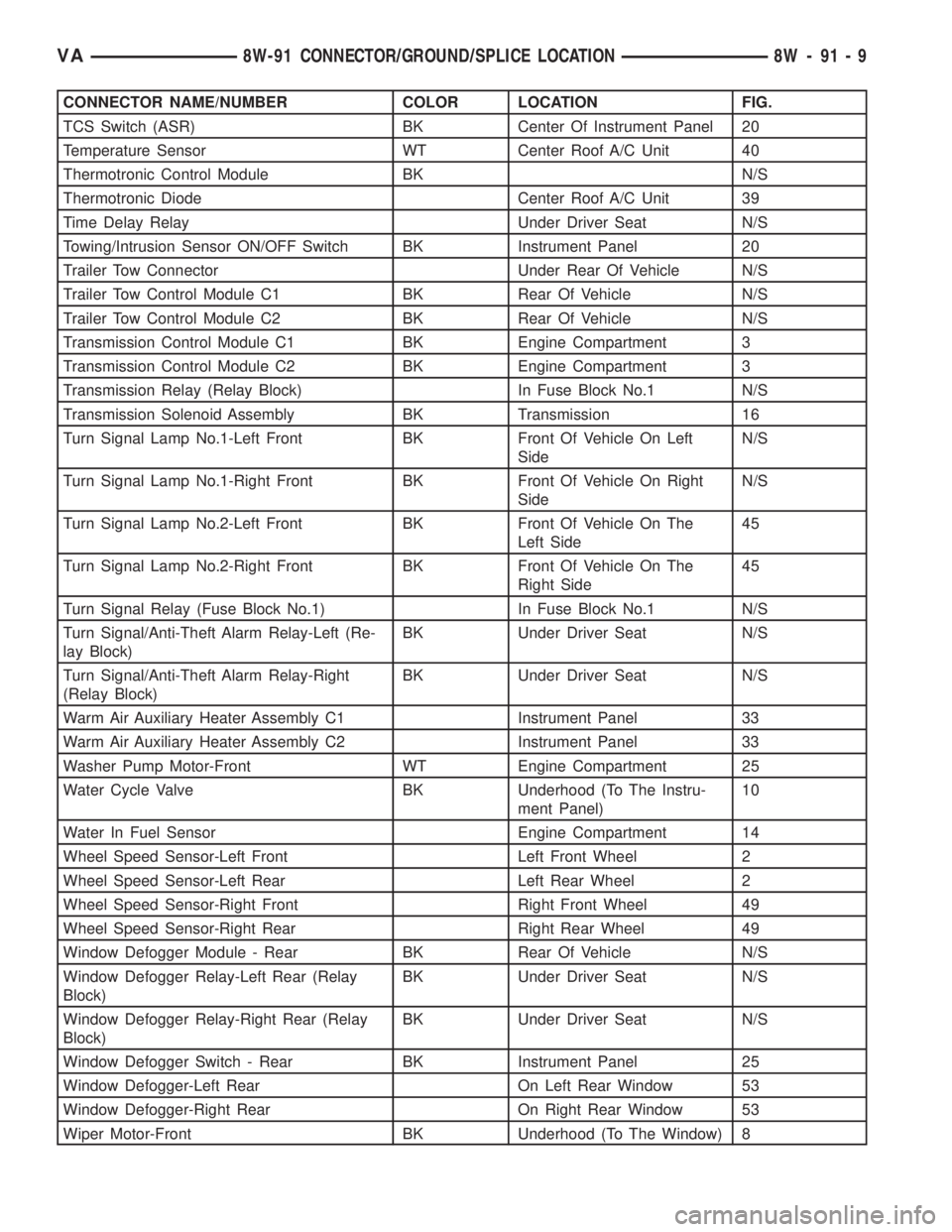
CONNECTOR NAME/NUMBER COLOR LOCATION FIG.
TCS Switch (ASR) BK Center Of Instrument Panel 20
Temperature Sensor WT Center Roof A/C Unit 40
Thermotronic Control Module BK N/S
Thermotronic Diode Center Roof A/C Unit 39
Time Delay Relay Under Driver Seat N/S
Towing/Intrusion Sensor ON/OFF Switch BK Instrument Panel 20
Trailer Tow Connector Under Rear Of Vehicle N/S
Trailer Tow Control Module C1 BK Rear Of Vehicle N/S
Trailer Tow Control Module C2 BK Rear Of Vehicle N/S
Transmission Control Module C1 BK Engine Compartment 3
Transmission Control Module C2 BK Engine Compartment 3
Transmission Relay (Relay Block) In Fuse Block No.1 N/S
Transmission Solenoid Assembly BK Transmission 16
Turn Signal Lamp No.1-Left Front BK Front Of Vehicle On Left
SideN/S
Turn Signal Lamp No.1-Right Front BK Front Of Vehicle On Right
SideN/S
Turn Signal Lamp No.2-Left Front BK Front Of Vehicle On The
Left Side45
Turn Signal Lamp No.2-Right Front BK Front Of Vehicle On The
Right Side45
Turn Signal Relay (Fuse Block No.1) In Fuse Block No.1 N/S
Turn Signal/Anti-Theft Alarm Relay-Left (Re-
lay Block)BK Under Driver Seat N/S
Turn Signal/Anti-Theft Alarm Relay-Right
(Relay Block)BK Under Driver Seat N/S
Warm Air Auxiliary Heater Assembly C1 Instrument Panel 33
Warm Air Auxiliary Heater Assembly C2 Instrument Panel 33
Washer Pump Motor-Front WT Engine Compartment 25
Water Cycle Valve BK Underhood (To The Instru-
ment Panel)10
Water In Fuel Sensor Engine Compartment 14
Wheel Speed Sensor-Left Front Left Front Wheel 2
Wheel Speed Sensor-Left Rear Left Rear Wheel 2
Wheel Speed Sensor-Right Front Right Front Wheel 49
Wheel Speed Sensor-Right Rear Right Rear Wheel 49
Window Defogger Module - Rear BK Rear Of Vehicle N/S
Window Defogger Relay-Left Rear (Relay
Block)BK Under Driver Seat N/S
Window Defogger Relay-Right Rear (Relay
Block)BK Under Driver Seat N/S
Window Defogger Switch - Rear BK Instrument Panel 25
Window Defogger-Left Rear On Left Rear Window 53
Window Defogger-Right Rear On Right Rear Window 53
Wiper Motor-Front BK Underhood (To The Window) 8
VA8W-91 CONNECTOR/GROUND/SPLICE LOCATION 8W - 91 - 9
Page 1514 of 2305
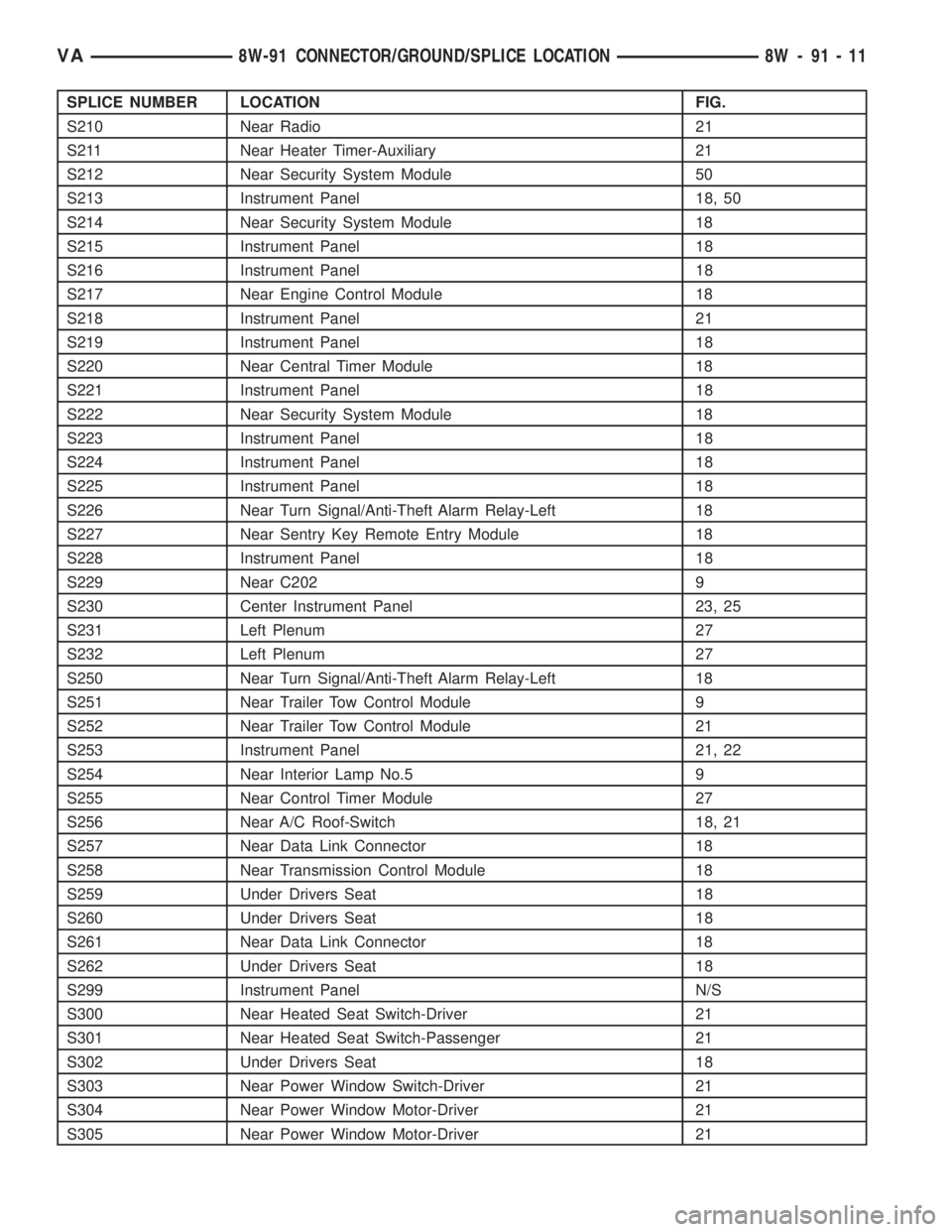
SPLICE NUMBER LOCATION FIG.
S210 Near Radio 21
S211 Near Heater Timer-Auxiliary 21
S212 Near Security System Module 50
S213 Instrument Panel 18, 50
S214 Near Security System Module 18
S215 Instrument Panel 18
S216 Instrument Panel 18
S217 Near Engine Control Module 18
S218 Instrument Panel 21
S219 Instrument Panel 18
S220 Near Central Timer Module 18
S221 Instrument Panel 18
S222 Near Security System Module 18
S223 Instrument Panel 18
S224 Instrument Panel 18
S225 Instrument Panel 18
S226 Near Turn Signal/Anti-Theft Alarm Relay-Left 18
S227 Near Sentry Key Remote Entry Module 18
S228 Instrument Panel 18
S229 Near C202 9
S230 Center Instrument Panel 23, 25
S231 Left Plenum 27
S232 Left Plenum 27
S250 Near Turn Signal/Anti-Theft Alarm Relay-Left 18
S251 Near Trailer Tow Control Module 9
S252 Near Trailer Tow Control Module 21
S253 Instrument Panel 21, 22
S254 Near Interior Lamp No.5 9
S255 Near Control Timer Module 27
S256 Near A/C Roof-Switch 18, 21
S257 Near Data Link Connector 18
S258 Near Transmission Control Module 18
S259 Under Drivers Seat 18
S260 Under Drivers Seat 18
S261 Near Data Link Connector 18
S262 Under Drivers Seat 18
S299 Instrument Panel N/S
S300 Near Heated Seat Switch-Driver 21
S301 Near Heated Seat Switch-Passenger 21
S302 Under Drivers Seat 18
S303 Near Power Window Switch-Driver 21
S304 Near Power Window Motor-Driver 21
S305 Near Power Window Motor-Driver 21
VA8W-91 CONNECTOR/GROUND/SPLICE LOCATION 8W - 91 - 11
Page 1515 of 2305
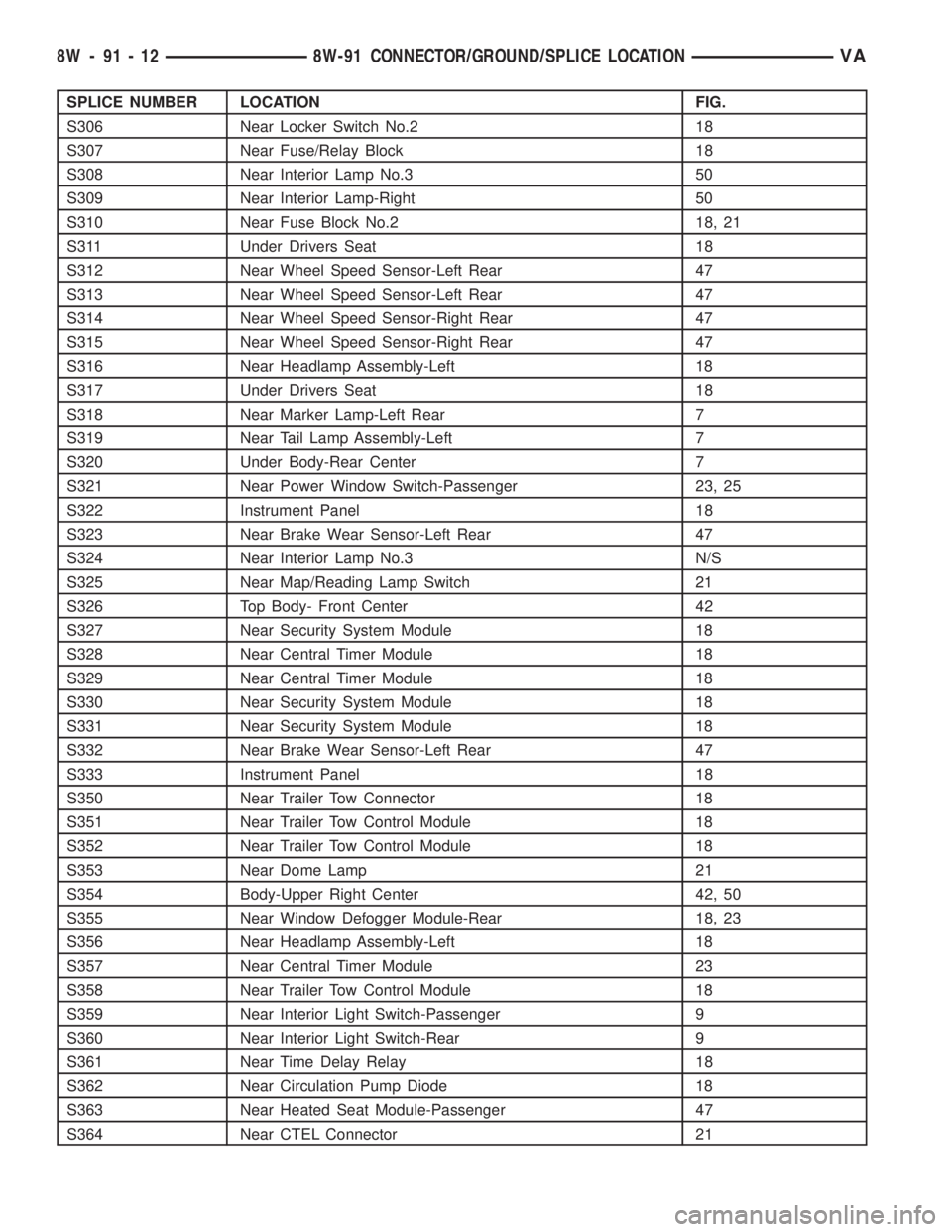
SPLICE NUMBER LOCATION FIG.
S306 Near Locker Switch No.2 18
S307 Near Fuse/Relay Block 18
S308 Near Interior Lamp No.3 50
S309 Near Interior Lamp-Right 50
S310 Near Fuse Block No.2 18, 21
S311 Under Drivers Seat 18
S312 Near Wheel Speed Sensor-Left Rear 47
S313 Near Wheel Speed Sensor-Left Rear 47
S314 Near Wheel Speed Sensor-Right Rear 47
S315 Near Wheel Speed Sensor-Right Rear 47
S316 Near Headlamp Assembly-Left 18
S317 Under Drivers Seat 18
S318 Near Marker Lamp-Left Rear 7
S319 Near Tail Lamp Assembly-Left 7
S320 Under Body-Rear Center 7
S321 Near Power Window Switch-Passenger 23, 25
S322 Instrument Panel 18
S323 Near Brake Wear Sensor-Left Rear 47
S324 Near Interior Lamp No.3 N/S
S325 Near Map/Reading Lamp Switch 21
S326 Top Body- Front Center 42
S327 Near Security System Module 18
S328 Near Central Timer Module 18
S329 Near Central Timer Module 18
S330 Near Security System Module 18
S331 Near Security System Module 18
S332 Near Brake Wear Sensor-Left Rear 47
S333 Instrument Panel 18
S350 Near Trailer Tow Connector 18
S351 Near Trailer Tow Control Module 18
S352 Near Trailer Tow Control Module 18
S353 Near Dome Lamp 21
S354 Body-Upper Right Center 42, 50
S355 Near Window Defogger Module-Rear 18, 23
S356 Near Headlamp Assembly-Left 18
S357 Near Central Timer Module 23
S358 Near Trailer Tow Control Module 18
S359 Near Interior Light Switch-Passenger 9
S360 Near Interior Light Switch-Rear 9
S361 Near Time Delay Relay 18
S362 Near Circulation Pump Diode 18
S363 Near Heated Seat Module-Passenger 47
S364 Near CTEL Connector 21
8W - 91 - 12 8W-91 CONNECTOR/GROUND/SPLICE LOCATIONVA
Page 1571 of 2305
OPERATION
The cigar lighter consists of two major components:
a knob and heating element unit, and the cigar
lighter base or receptacle shell. The receptacle shell
is connected to ground, and an insulated contact in
the bottom of the shell is connected to battery cur-
rent. The cigar lighter receives battery voltage from a
fuse in the fuseblock only when the ignition switch is
in the Accessory or On positions.
The knob and heating element are encased within
a spring-loaded housing, which also features a sliding
protective heat shield. When the heating element is
inserted in the receptacle shell, the heating element
resistor coil is grounded through its housing to the
receptacle shell. If the cigar lighter knob is pushed
inward, the heat shield slides up toward the knob
exposing the heating element.
Two small spring-clip retainers are located on
either side of the insulated contact inside the bottom
of the receptacle shell. These clips engage and hold
the heating element against the insulated contact
long enough for the resistor coil to heat up and glow.
When the resistor coil becomes sufficiently heated,
excess heat radiates from the heating element caus-
ing the spring-clips to expand. Once the spring-clips
expand far enough to release the heating element,
the spring-loaded housing forces the knob and heat-
ing element to pop back outward to their relaxed
position. When the cigar lighter knob and element
are pulled out of the receptacle shell, the protective
heat shield slides downward on the housing so that
the heating element is recessed and shielded around
its circumference for safety.
DIAGNOSIS AND TESTING - CIGAR LIGHTER
OUTLET
For cigar lighter outlet diagnosis and testing pro-
cedures (Refer to 8 - ELECTRICAL/POWER DISTRI-
BUTION/POWER OUTLET - DIAGNOSIS AND
TESTING)
REMOVAL
For cigar lighter outlet removal procedure (Refer to
8 - ELECTRICAL/POWER DISTRIBUTION/POWER
OUTLET - REMOVAL).
CIRCUIT BREAKER
DESCRIPTION
Automatic resetting circuit breakers are used to
protect the power window voltage supply circuits.
These circuit breakers can protect the systems from a
short circuit, or from an overload condition caused byan obstructed or stuck power window regulator or
switch.
The circuit breaker cannot be repaired and, if
faulty or damaged, it must be replaced.
OPERATION
The circuit breaker contains a bi-metal strip sand-
wiched between two contacts forming the connection
in the circuit. An overload condition causes the
bi-metal strip to heat and bend to the open position,
disconnecting current flow to the circuit. Then as the
system overload or short circuit is removed, the
bi-metal strip cools, re-establishing contact to allow
current flow to the circuit.
DIAGNOSIS AND TESTING - CIRCUIT BREAKER
For complete circuit descriptions and diagrams,
refer toWiring.
(1) Locate the correct circuit breaker in the fuse-
block. Pull out the circuit breaker slightly, but be cer-
tain that the circuit breaker terminals still contact
the terminals in the fuseblock cavities.
(2) Connect the negative lead of a 12-volt DC volt-
meter to a good ground.
(3) With the voltmeter positive lead, check both
terminals of the circuit breaker for battery voltage.
If only one terminal has battery voltage, the circuit
breaker is faulty and must be replaced. If neither ter-
minal has battery voltage, repair the open circuit
from the Power Distribution Center as required.
FUSE BLOCK #1
DESCRIPTION
An electrical fuse block is concealed under the
driver side steering column. The fuse block serves to
distribute electrical current to many of the electrical
systems in the vehicle. The fuse block contains blade-
type mini fuses, relays and micro processors that
enable automatic control of some of the power distri-
bution circuits throughout the vehicle.
The molded plastic fuse block housing has an inte-
gral mounting bracket that is secured with screws to
the steering column. A finger recess is molded into
the cover for easy removal. A fuse layout map is
molded onto the back side of the cover to ensure
proper fuse identification.
The fuse block cannot be repaired, if the fuse block
is faulty or damaged or if any internal circuit is
faulty or damaged, the entire fuse block must be
replaced.
8W - 97 - 2 8W-97 POWER DISTRIBUTIONVA
Page 1615 of 2305
(5) Inspect standard size of crankshaft bearing
shells.
(6) Inspect crankshaft bearing cap.
(7) Mount crankshaft radially.
(8) Inspect crankshaft bearing play.
NOTE: Radial mounting of the main bearings of
standard size crankshaft is possible by assigning
the color-coded bearing shells.
ASSIGN CRANKSHAFT BEARING SHELLS
The oil pan rail of the cylinder block is marked
with chisel punches indicating what bearing shell are
used.
(9) Assign crankshaft bearing shells.
(10) Mount crankshaft axially.
(11) Inspect crankshaft bearing play.
REMOVAL
(1) Remove engine (Refer to 9 - ENGINE -
REMOVAL).
(2) Remove timing case cover (Refer to 9 -
ENGINE/VALVE TIMING/TIMING BELT / CHAIN
COVER(S) - REMOVAL)
(3) Remove end cover. (Refer to 9 - ENGINE/EN-
GINE BLOCK/CRANKSHAFT OIL SEAL - REAR -
REMOVAL).
(4) Remove pistons (Refer to 9 - ENGINE/ENGINE
BLOCK/PISTON & CONNECTING ROD -
REMOVAL).
CAUTION: The crankshaft bearing caps are num-
bered consecutively, beginning with the first crank-
shaft bearing cap at the front of the engine.
Attention must be paid to the way crankshaft bear-
ing caps fit.
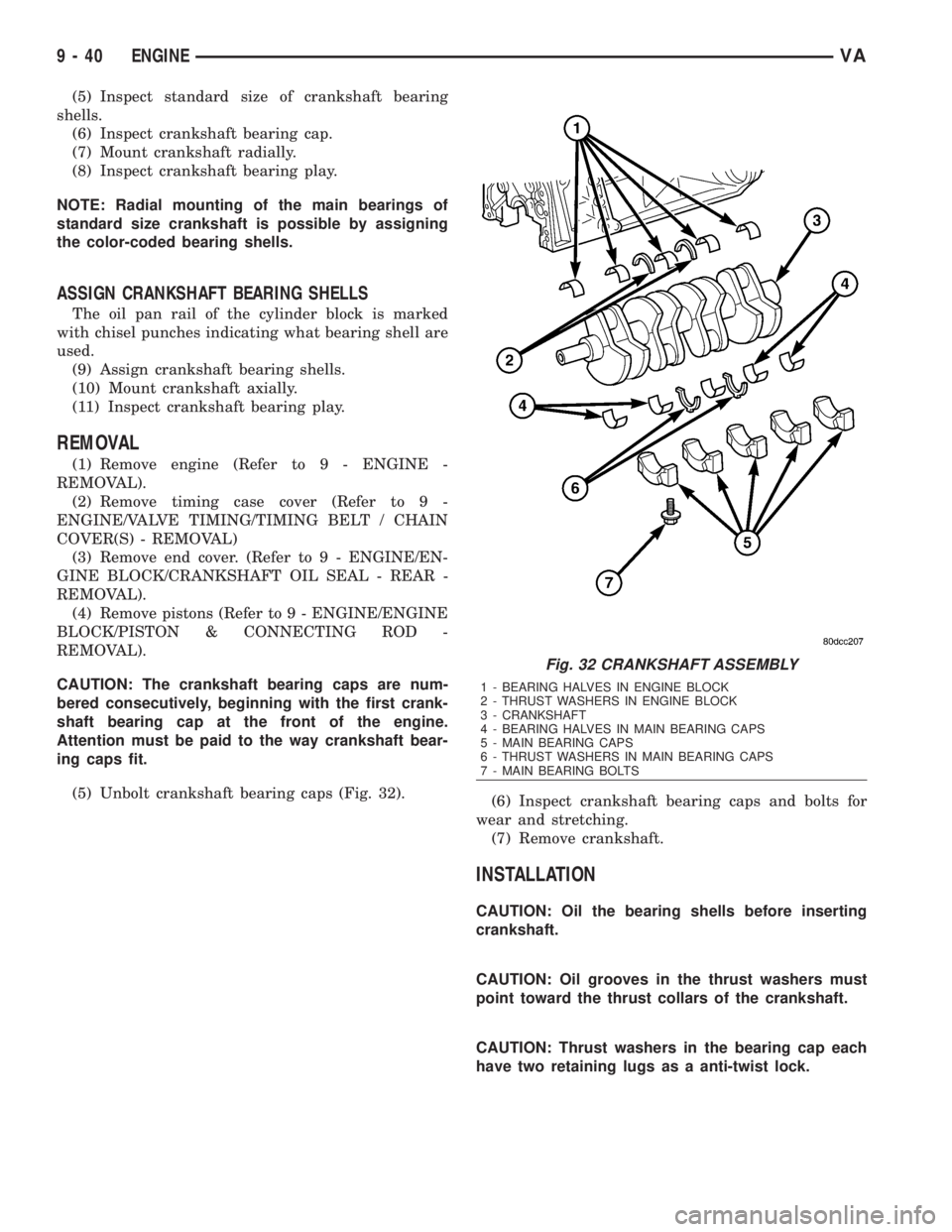
(5) Unbolt crankshaft bearing caps (Fig. 32).
(6) Inspect crankshaft bearing caps and bolts for
wear and stretching.
(7) Remove crankshaft.
INSTALLATION
CAUTION: Oil the bearing shells before inserting
crankshaft.
CAUTION: Oil grooves in the thrust washers must
point toward the thrust collars of the crankshaft.
CAUTION: Thrust washers in the bearing cap each
have two retaining lugs as a anti-twist lock.
Fig. 32 CRANKSHAFT ASSEMBLY
1 - BEARING HALVES IN ENGINE BLOCK
2 - THRUST WASHERS IN ENGINE BLOCK
3 - CRANKSHAFT
4 - BEARING HALVES IN MAIN BEARING CAPS
5 - MAIN BEARING CAPS
6 - THRUST WASHERS IN MAIN BEARING CAPS
7 - MAIN BEARING BOLTS
9 - 40 ENGINEVA
Page 1624 of 2305
(10) Mark the connecting rod bearing shell and
connecting rod to each other.
CAUTION: Care must be taken not to damage the
piston.
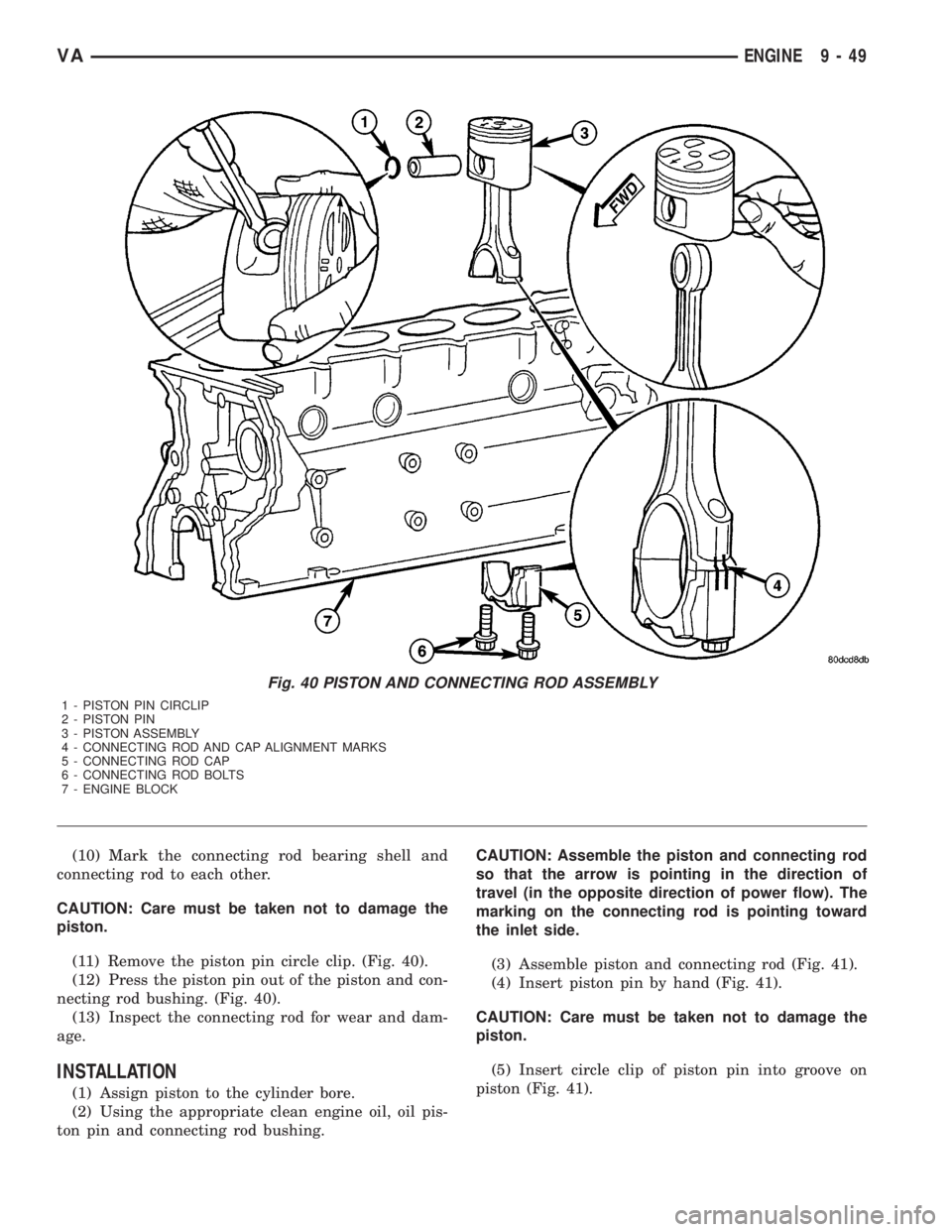
(11) Remove the piston pin circle clip. (Fig. 40).
(12) Press the piston pin out of the piston and con-
necting rod bushing. (Fig. 40).
(13) Inspect the connecting rod for wear and dam-
age.
INSTALLATION
(1) Assign piston to the cylinder bore.
(2) Using the appropriate clean engine oil, oil pis-
ton pin and connecting rod bushing.CAUTION: Assemble the piston and connecting rod
so that the arrow is pointing in the direction of
travel (in the opposite direction of power flow). The
marking on the connecting rod is pointing toward
the inlet side.
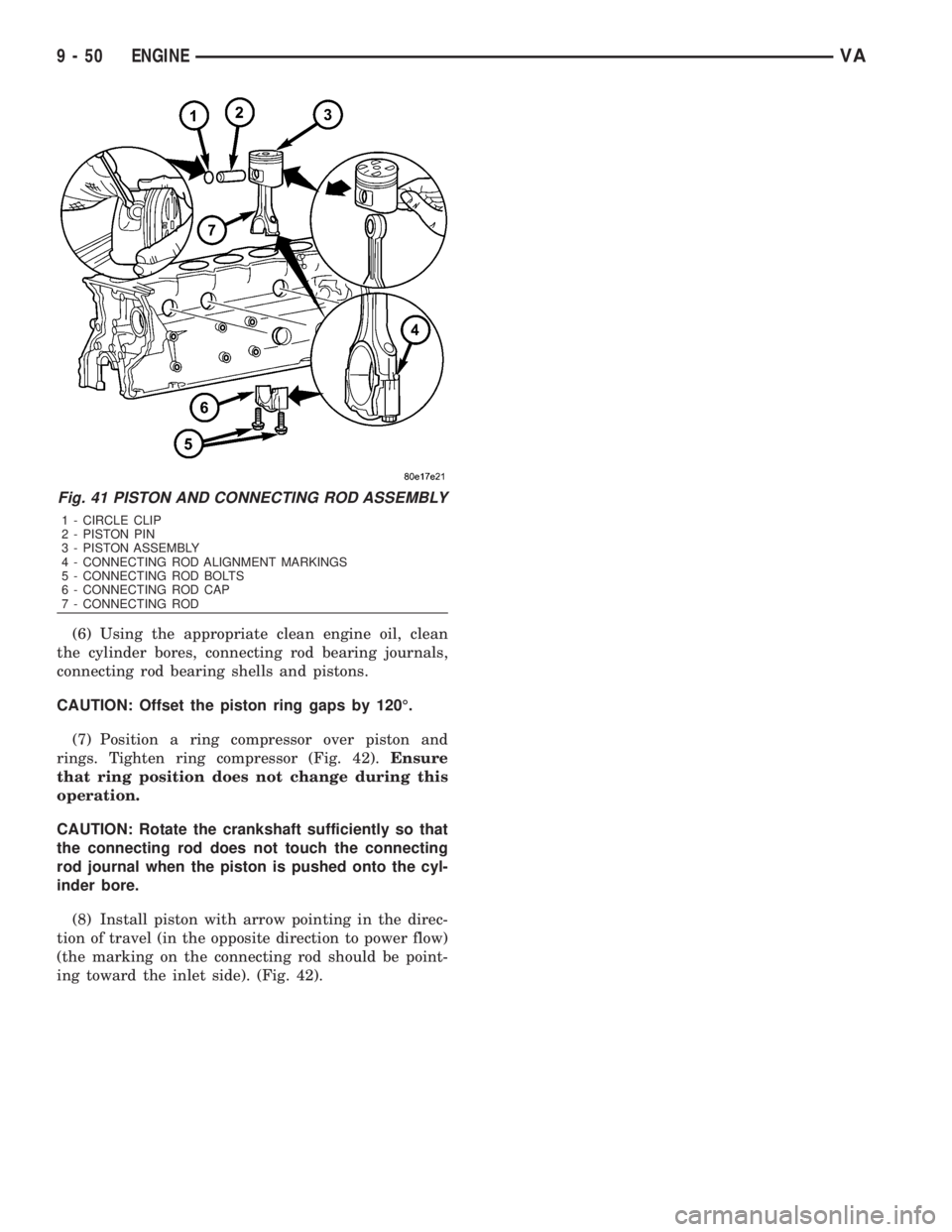
(3) Assemble piston and connecting rod (Fig. 41).
(4) Insert piston pin by hand (Fig. 41).
CAUTION: Care must be taken not to damage the
piston.
(5) Insert circle clip of piston pin into groove on
piston (Fig. 41).
Fig. 40 PISTON AND CONNECTING ROD ASSEMBLY
1 - PISTON PIN CIRCLIP
2 - PISTON PIN
3 - PISTON ASSEMBLY
4 - CONNECTING ROD AND CAP ALIGNMENT MARKS
5 - CONNECTING ROD CAP
6 - CONNECTING ROD BOLTS
7 - ENGINE BLOCK
VAENGINE 9 - 49
Page 1625 of 2305
(6) Using the appropriate clean engine oil, clean
the cylinder bores, connecting rod bearing journals,
connecting rod bearing shells and pistons.
CAUTION: Offset the piston ring gaps by 120É.
(7) Position a ring compressor over piston and
rings. Tighten ring compressor (Fig. 42).Ensure
that ring position does not change during this
operation.
CAUTION: Rotate the crankshaft sufficiently so that
the connecting rod does not touch the connecting
rod journal when the piston is pushed onto the cyl-
inder bore.
(8) Install piston with arrow pointing in the direc-
tion of travel (in the opposite direction to power flow)
(the marking on the connecting rod should be point-
ing toward the inlet side). (Fig. 42).
Fig. 41 PISTON AND CONNECTING ROD ASSEMBLY
1 - CIRCLE CLIP
2 - PISTON PIN
3 - PISTON ASSEMBLY
4 - CONNECTING ROD ALIGNMENT MARKINGS
5 - CONNECTING ROD BOLTS
6 - CONNECTING ROD CAP
7 - CONNECTING ROD
9 - 50 ENGINEVA
Page 1627 of 2305
(19) Fill the cooing system with proper coolant, to
the proper level (Refer to 7 - COOLING/ENGINE/
COOLANT - STANDARD PROCEDURE).
(20) Connect negative battery cable.
WARNING: USE EXTREME CAUTION WHEN THE
ENGINE IS OPERATING. DO NOT STAND IN A
DIRECT LINE WITH THE FAN. DO NOT PUT YOUR
HANDS NEAR THE PULLEYS, BELTS, OR FAN. DO
NOT WEAR LOOSE CLOTHES.
WARNING: (Refer to 14 - FUEL SYSTEM - WARN-
ING).
(21) Start the engine and inspect for leaks.
PISTON RINGS
STANDARD PROCEDURE - PISTON RING FIT-
TING
(1) Carefully clean the carbon from all ring
grooves. Oil drain openings in the oil ring groove and
pin boss must be clear. DO NOT remove metal from
the grooves or lands. This will change ring-to-groove
clearances and will damage the ring-to-land seating.
(2) Be sure the piston ring grooves are free of
nicks and burrs.
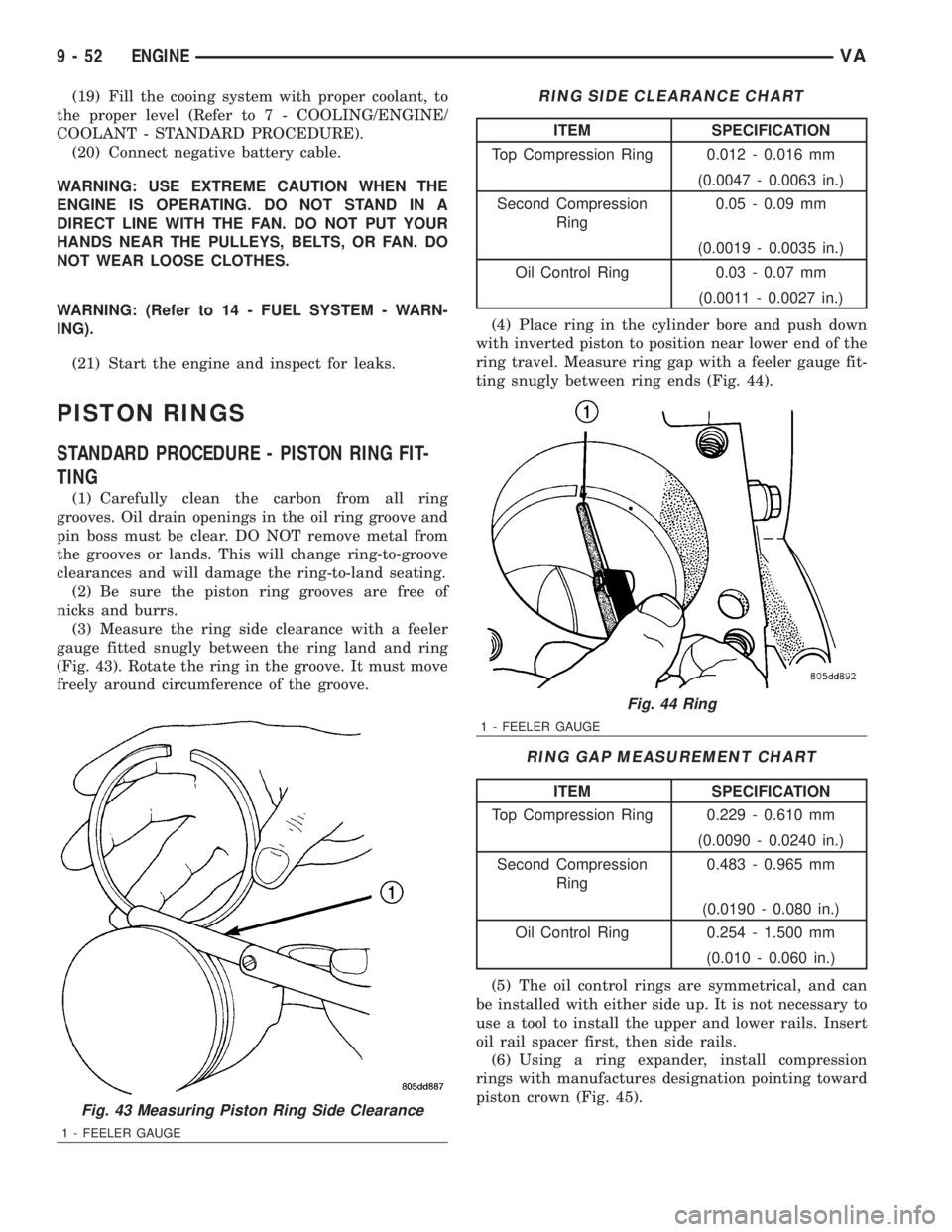
(3) Measure the ring side clearance with a feeler
gauge fitted snugly between the ring land and ring
(Fig. 43). Rotate the ring in the groove. It must move
freely around circumference of the groove.
RING SIDE CLEARANCE CHART
ITEM SPECIFICATION
Top Compression Ring 0.012 - 0.016 mm
(0.0047 - 0.0063 in.)
Second Compression
Ring0.05 - 0.09 mm
(0.0019 - 0.0035 in.)
Oil Control Ring 0.03 - 0.07 mm
(0.0011 - 0.0027 in.)
(4) Place ring in the cylinder bore and push down
with inverted piston to position near lower end of the
ring travel. Measure ring gap with a feeler gauge fit-
ting snugly between ring ends (Fig. 44).
RING GAP MEASUREMENT CHART
ITEM SPECIFICATION
Top Compression Ring 0.229 - 0.610 mm
(0.0090 - 0.0240 in.)
Second Compression
Ring0.483 - 0.965 mm
(0.0190 - 0.080 in.)
Oil Control Ring 0.254 - 1.500 mm
(0.010 - 0.060 in.)
(5) The oil control rings are symmetrical, and can
be installed with either side up. It is not necessary to
use a tool to install the upper and lower rails. Insert
oil rail spacer first, then side rails.
(6) Using a ring expander, install compression
rings with manufactures designation pointing toward
piston crown (Fig. 45).
Fig. 43 Measuring Piston Ring Side Clearance
1 - FEELER GAUGE
Fig. 44 Ring
1 - FEELER GAUGE
9 - 52 ENGINEVA
Page 1685 of 2305
STANDARD PROCEDURE - LOW PRESSURE
FUEL PUMP TEST
NOTE: Assure fuel tank quantity and proper fuel
gauge operation. Assure that the fuel pump fuse or
relay is not open. Capture any fuel spillage and
store in appropriately marked containers.
NOTE: When the ignition switch is turned to the ON
position the fuel pump will begin to run for 20±30
seconds and then it stops.
The low pressure pump draws fuel out of the fuel
tank module and pushes the fuel towards the fuel fil-
ter. If the pressure reading is below specification,
look for damaged or leaking fuel lines or a restricted
fuel filter. If no problem is found with the fuel sys-
tem replace the low pressure fuel pump.
(1) Disconnect the negative battery cable.
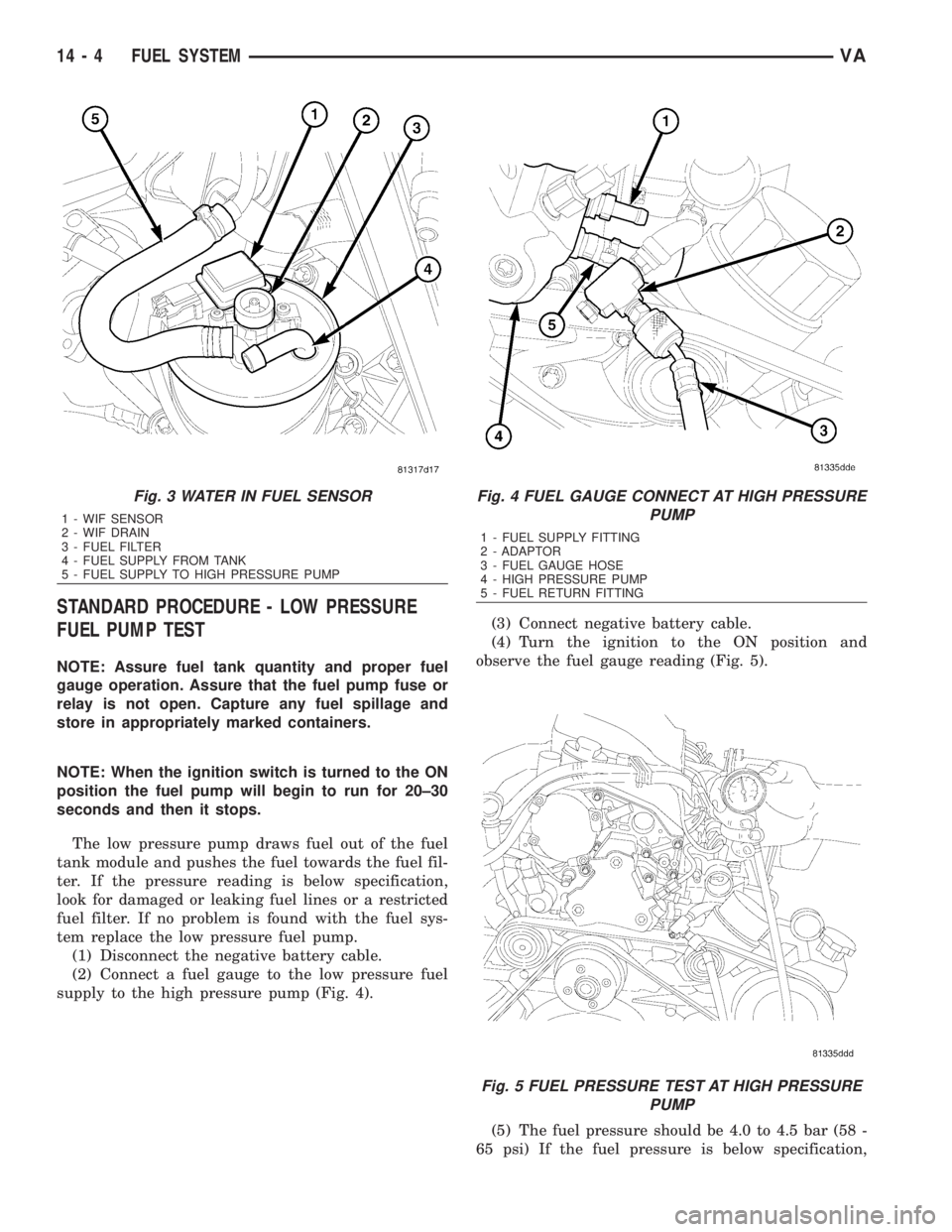
(2) Connect a fuel gauge to the low pressure fuel
supply to the high pressure pump (Fig. 4).(3) Connect negative battery cable.
(4) Turn the ignition to the ON position and
observe the fuel gauge reading (Fig. 5).
(5) The fuel pressure should be 4.0 to 4.5 bar (58 -
65 psi) If the fuel pressure is below specification,
Fig. 3 WATER IN FUEL SENSOR
1 - WIF SENSOR
2 - WIF DRAIN
3 - FUEL FILTER
4 - FUEL SUPPLY FROM TANK
5 - FUEL SUPPLY TO HIGH PRESSURE PUMP
Fig. 4 FUEL GAUGE CONNECT AT HIGH PRESSURE
PUMP
1 - FUEL SUPPLY FITTING
2 - ADAPTOR
3 - FUEL GAUGE HOSE
4 - HIGH PRESSURE PUMP
5 - FUEL RETURN FITTING
Fig. 5 FUEL PRESSURE TEST AT HIGH PRESSURE
PUMP
14 - 4 FUEL SYSTEMVA