tow MERCEDES-BENZ SPRINTER 2006 Manual Online
[x] Cancel search | Manufacturer: MERCEDES-BENZ, Model Year: 2006, Model line: SPRINTER, Model: MERCEDES-BENZ SPRINTER 2006Pages: 2305, PDF Size: 48.12 MB
Page 1842 of 2305
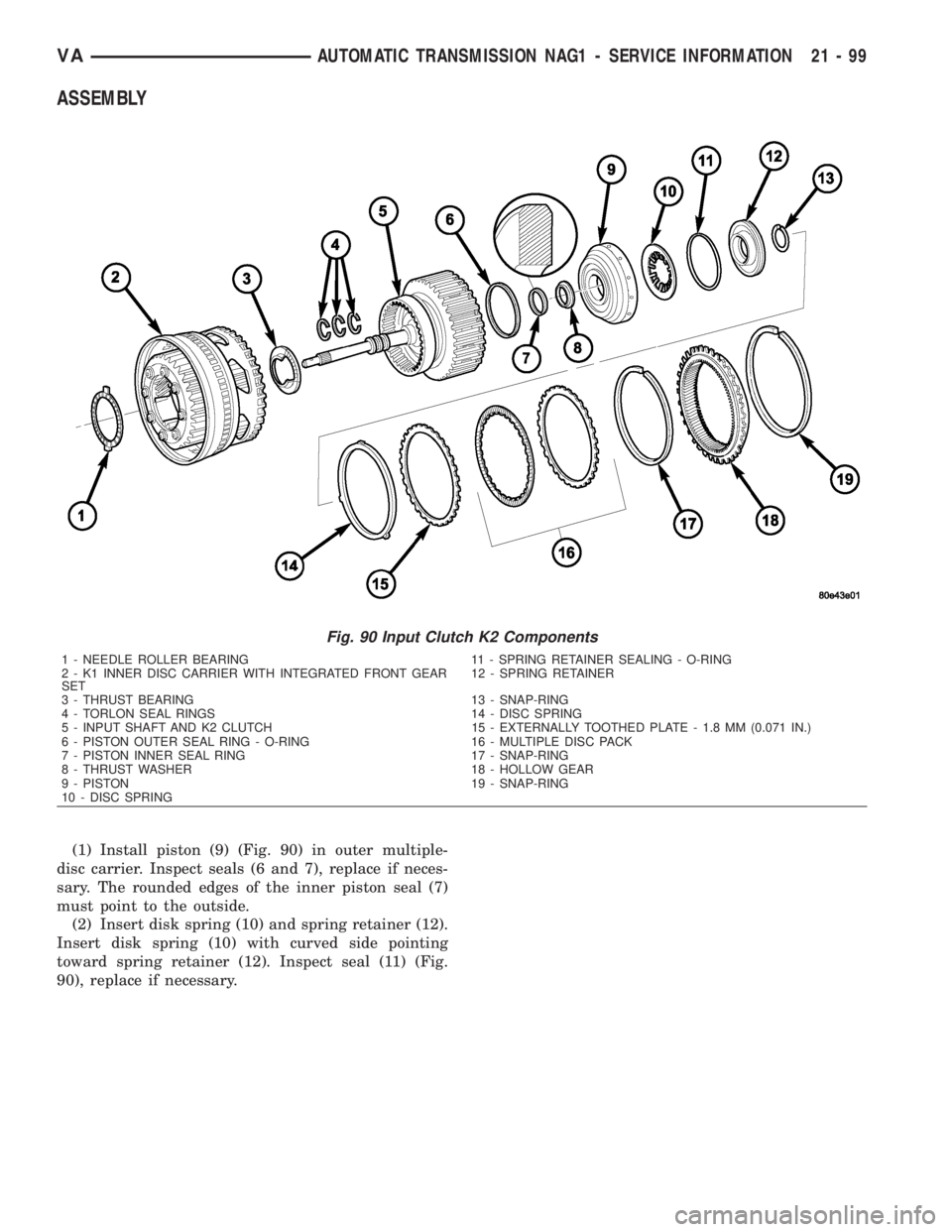
ASSEMBLY
(1) Install piston (9) (Fig. 90) in outer multiple-
disc carrier. Inspect seals (6 and 7), replace if neces-
sary. The rounded edges of the inner piston seal (7)
must point to the outside.
(2) Insert disk spring (10) and spring retainer (12).
Insert disk spring (10) with curved side pointing
toward spring retainer (12). Inspect seal (11) (Fig.
90), replace if necessary.
Fig. 90 Input Clutch K2 Components
1 - NEEDLE ROLLER BEARING 11 - SPRING RETAINER SEALING - O-RING
2 - K1 INNER DISC CARRIER WITH INTEGRATED FRONT GEAR
SET12 - SPRING RETAINER
3 - THRUST BEARING 13 - SNAP-RING
4 - TORLON SEAL RINGS 14 - DISC SPRING
5 - INPUT SHAFT AND K2 CLUTCH 15 - EXTERNALLY TOOTHED PLATE - 1.8 MM (0.071 IN.)
6 - PISTON OUTER SEAL RING - O-RING 16 - MULTIPLE DISC PACK
7 - PISTON INNER SEAL RING 17 - SNAP-RING
8 - THRUST WASHER 18 - HOLLOW GEAR
9 - PISTON 19 - SNAP-RING
10 - DISC SPRING
VAAUTOMATIC TRANSMISSION NAG1 - SERVICE INFORMATION 21 - 99
Page 1846 of 2305
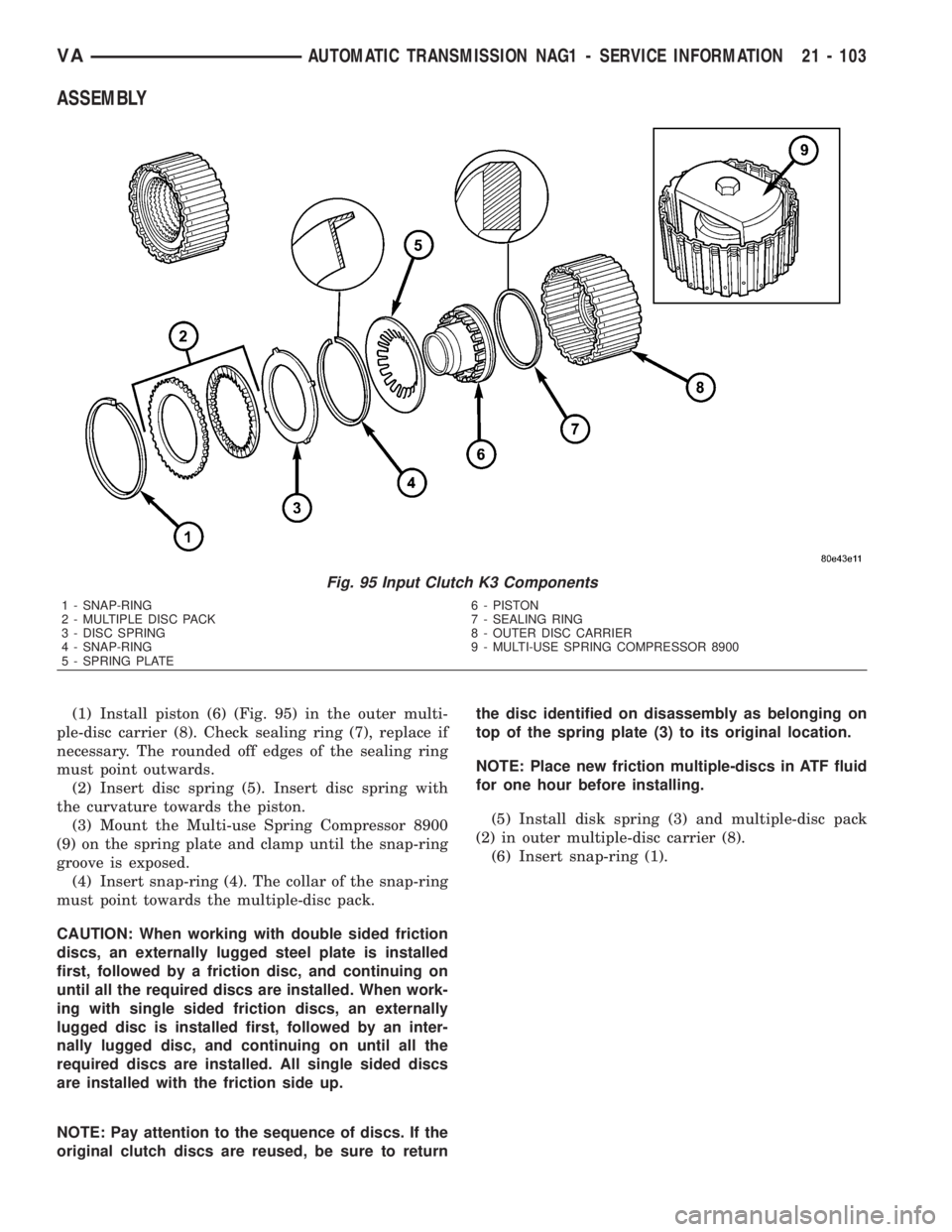
ASSEMBLY
(1) Install piston (6) (Fig. 95) in the outer multi-
ple-disc carrier (8). Check sealing ring (7), replace if
necessary. The rounded off edges of the sealing ring
must point outwards.
(2) Insert disc spring (5). Insert disc spring with
the curvature towards the piston.
(3) Mount the Multi-use Spring Compressor 8900
(9) on the spring plate and clamp until the snap-ring
groove is exposed.
(4) Insert snap-ring (4). The collar of the snap-ring
must point towards the multiple-disc pack.
CAUTION: When working with double sided friction
discs, an externally lugged steel plate is installed
first, followed by a friction disc, and continuing on
until all the required discs are installed. When work-
ing with single sided friction discs, an externally
lugged disc is installed first, followed by an inter-
nally lugged disc, and continuing on until all the
required discs are installed. All single sided discs
are installed with the friction side up.
NOTE: Pay attention to the sequence of discs. If the
original clutch discs are reused, be sure to returnthe disc identified on disassembly as belonging on
top of the spring plate (3) to its original location.
NOTE: Place new friction multiple-discs in ATF fluid
for one hour before installing.
(5) Install disk spring (3) and multiple-disc pack
(2) in outer multiple-disc carrier (8).
(6) Insert snap-ring (1).
Fig. 95 Input Clutch K3 Components
1 - SNAP-RING 6 - PISTON
2 - MULTIPLE DISC PACK 7 - SEALING RING
3 - DISC SPRING 8 - OUTER DISC CARRIER
4 - SNAP-RING 9 - MULTI-USE SPRING COMPRESSOR 8900
5 - SPRING PLATE
VAAUTOMATIC TRANSMISSION NAG1 - SERVICE INFORMATION 21 - 103
Page 1875 of 2305
CAUSES OF BURNT FLUID
Burnt, discolored fluid is a result of overheating
which has three primary causes.
1. Internal clutch slippage, usually caused by low
line pressure, inadequate clutch apply pressure, or
clutch seal failure.
2. A result of restricted fluid flow through the
main and/or auxiliary cooler. This condition is usu-
ally the result of a faulty or improperly installed
drainback valve, a damaged oil cooler, or severe
restrictions in the coolers and lines caused by debris
or kinked lines.
3. Heavy duty operation with a vehicle not prop-
erly equipped for this type of operation. Trailer tow-
ing or similar high load operation will overheat the
transmission fluid if the vehicle is improperly
equipped. Such vehicles should have an auxiliary
transmission fluid cooler, a heavy duty cooling sys-
tem, and the engine/axle ratio combination needed to
handle heavy loads.
FLUID CONTAMINATION
Transmission fluid contamination is generally a
result of:
²adding incorrect fluid
²failure to clean dipstick and fill tube when
checking level
²engine coolant entering the fluid
²internal failure that generates debris
²overheat that generates sludge (fluid break-
down)
²failure to replace contaminated converter after
repair
The use of non-recommended fluids can result in
transmission failure. The usual results are erratic
shifts, slippage, abnormal wear and eventual failure
due to fluid breakdown and sludge formation. Avoid
this condition by using recommended fluids only.
The dipstick cap and fill tube should be wiped
clean before checking fluid level. Dirt, grease and
other foreign material on the cap and tube could fall
into the tube if not removed beforehand. Take the
time to wipe the cap and tube clean before withdraw-
ing the dipstick.
Engine coolant in the transmission fluid is gener-
ally caused by a cooler malfunction. The only remedy
is to replace the radiator as the cooler in the radiator
is not a serviceable part. If coolant has circulated
through the transmission, an overhaul is necessary.
The torque converter should be replaced whenever
a failure generates sludge and debris. This is neces-
sary because normal converter flushing procedures
will not remove all contaminants.
STANDARD PROCEDURE
CHECK OIL LEVEL
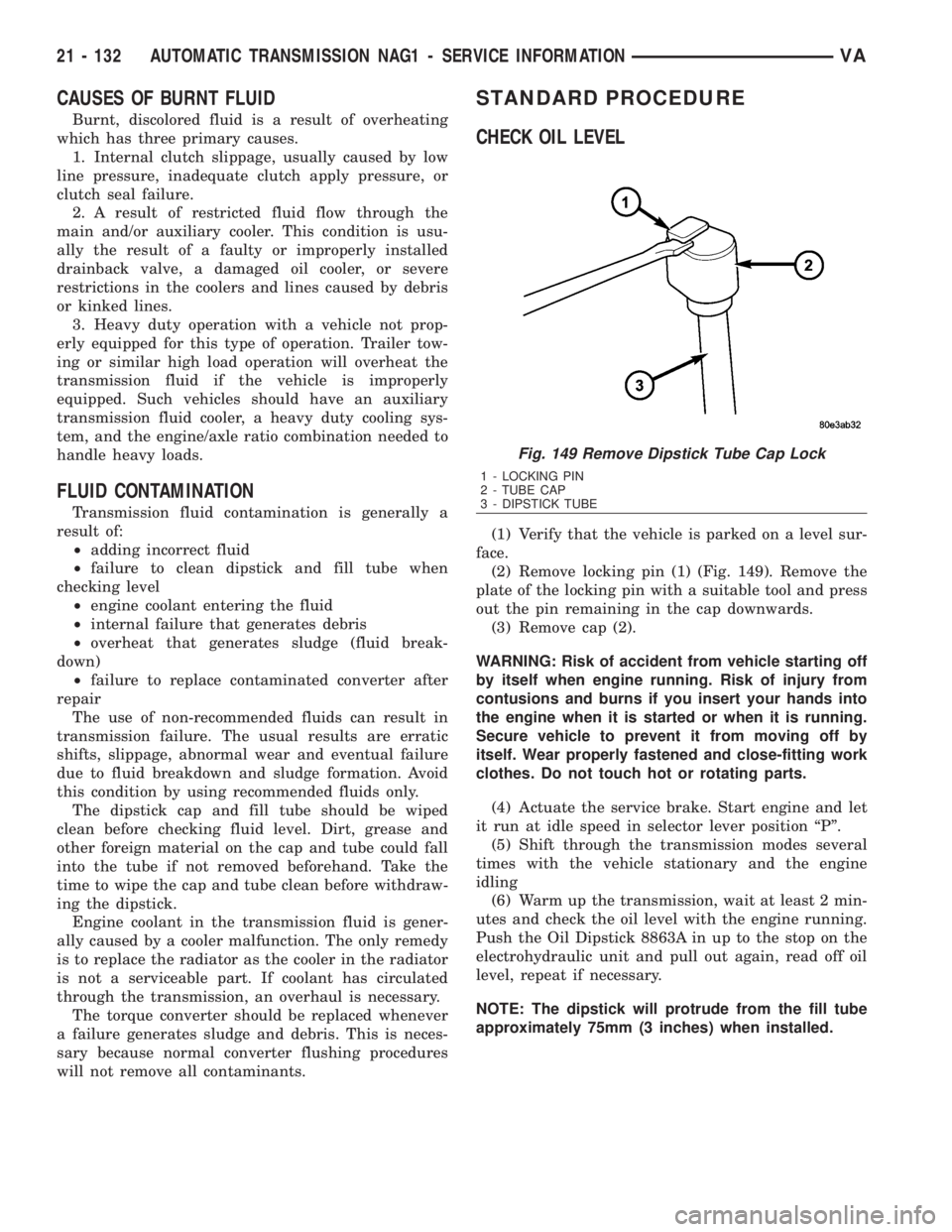
(1) Verify that the vehicle is parked on a level sur-
face.
(2) Remove locking pin (1) (Fig. 149). Remove the
plate of the locking pin with a suitable tool and press
out the pin remaining in the cap downwards.
(3) Remove cap (2).
WARNING: Risk of accident from vehicle starting off
by itself when engine running. Risk of injury from
contusions and burns if you insert your hands into
the engine when it is started or when it is running.
Secure vehicle to prevent it from moving off by
itself. Wear properly fastened and close-fitting work
clothes. Do not touch hot or rotating parts.
(4) Actuate the service brake. Start engine and let
it run at idle speed in selector lever position ªPº.
(5) Shift through the transmission modes several
times with the vehicle stationary and the engine
idling
(6) Warm up the transmission, wait at least 2 min-
utes and check the oil level with the engine running.
Push the Oil Dipstick 8863A in up to the stop on the
electrohydraulic unit and pull out again, read off oil
level, repeat if necessary.
NOTE: The dipstick will protrude from the fill tube
approximately 75mm (3 inches) when installed.
Fig. 149 Remove Dipstick Tube Cap Lock
1 - LOCKING PIN
2 - TUBE CAP
3 - DIPSTICK TUBE
21 - 132 AUTOMATIC TRANSMISSION NAG1 - SERVICE INFORMATIONVA
Page 1888 of 2305
ASSEMBLY
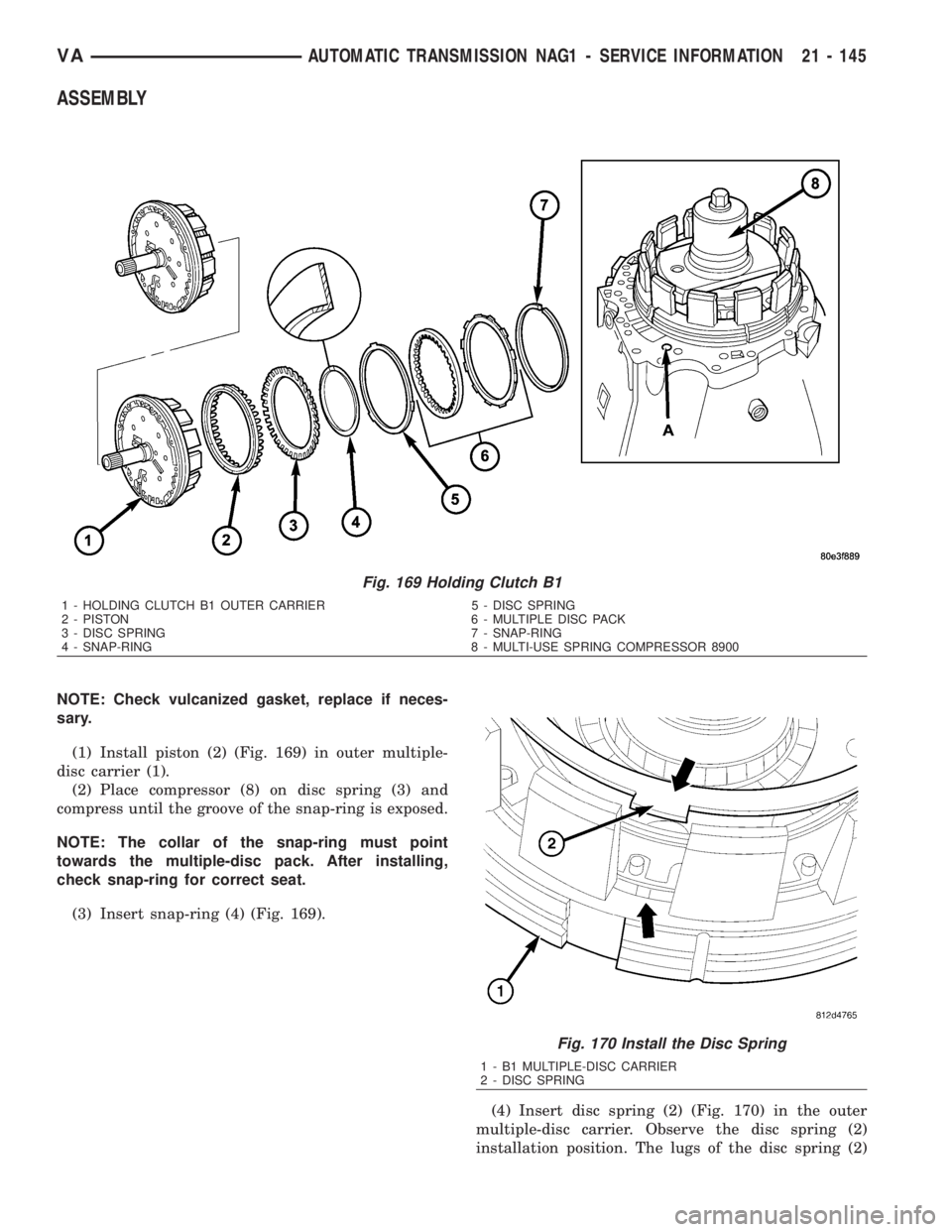
NOTE: Check vulcanized gasket, replace if neces-
sary.
(1) Install piston (2) (Fig. 169) in outer multiple-
disc carrier (1).
(2) Place compressor (8) on disc spring (3) and
compress until the groove of the snap-ring is exposed.
NOTE: The collar of the snap-ring must point
towards the multiple-disc pack. After installing,
check snap-ring for correct seat.
(3) Insert snap-ring (4) (Fig. 169).
(4) Insert disc spring (2) (Fig. 170) in the outer
multiple-disc carrier. Observe the disc spring (2)
installation position. The lugs of the disc spring (2)
Fig. 169 Holding Clutch B1
1 - HOLDING CLUTCH B1 OUTER CARRIER 5 - DISC SPRING
2 - PISTON 6 - MULTIPLE DISC PACK
3 - DISC SPRING 7 - SNAP-RING
4 - SNAP-RING 8 - MULTI-USE SPRING COMPRESSOR 8900
Fig. 170 Install the Disc Spring
1 - B1 MULTIPLE-DISC CARRIER
2 - DISC SPRING
VAAUTOMATIC TRANSMISSION NAG1 - SERVICE INFORMATION 21 - 145
Page 1895 of 2305
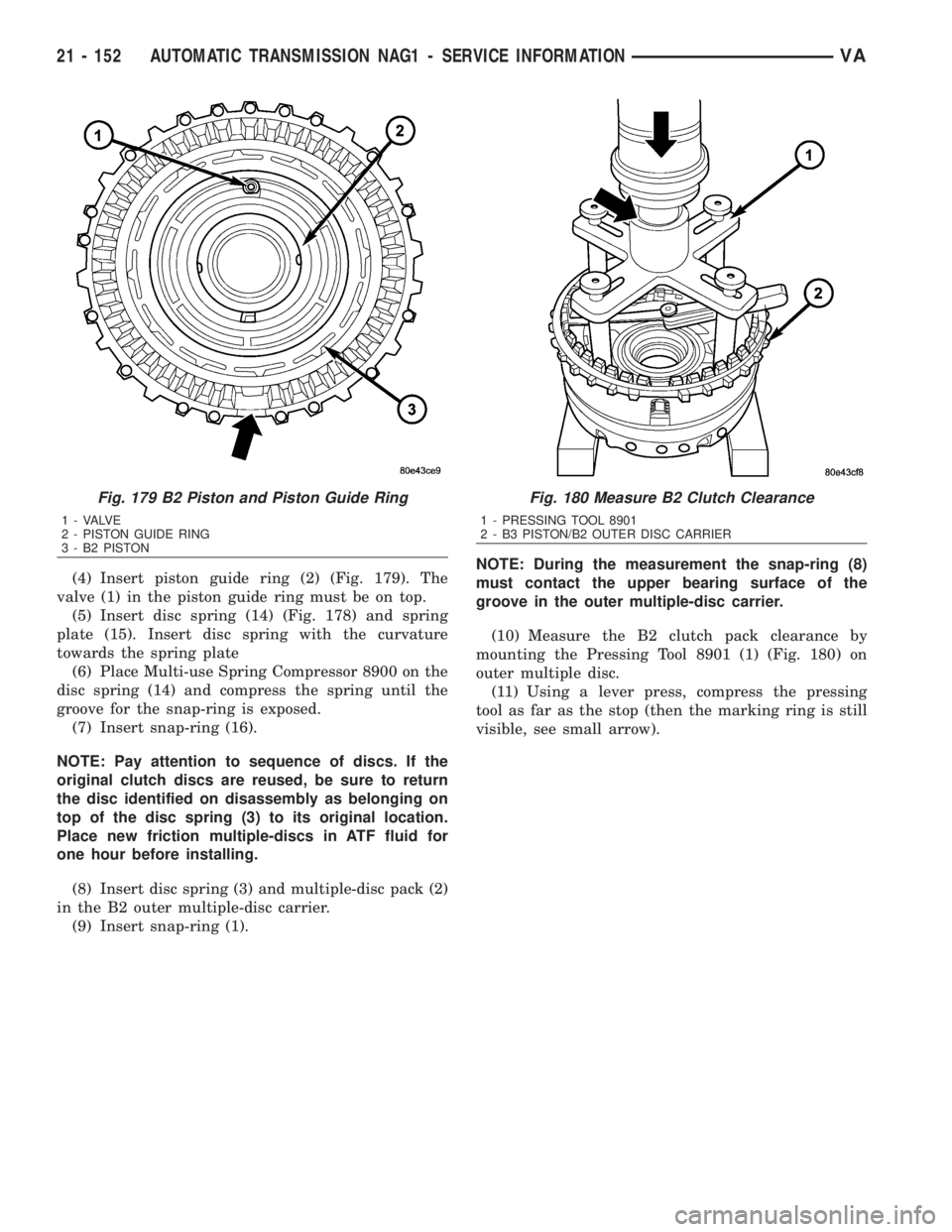
(4) Insert piston guide ring (2) (Fig. 179). The
valve (1) in the piston guide ring must be on top.
(5) Insert disc spring (14) (Fig. 178) and spring
plate (15). Insert disc spring with the curvature
towards the spring plate
(6) Place Multi-use Spring Compressor 8900 on the
disc spring (14) and compress the spring until the
groove for the snap-ring is exposed.
(7) Insert snap-ring (16).
NOTE: Pay attention to sequence of discs. If the
original clutch discs are reused, be sure to return
the disc identified on disassembly as belonging on
top of the disc spring (3) to its original location.
Place new friction multiple-discs in ATF fluid for
one hour before installing.
(8) Insert disc spring (3) and multiple-disc pack (2)
in the B2 outer multiple-disc carrier.
(9) Insert snap-ring (1).NOTE: During the measurement the snap-ring (8)
must contact the upper bearing surface of the
groove in the outer multiple-disc carrier.
(10) Measure the B2 clutch pack clearance by
mounting the Pressing Tool 8901 (1) (Fig. 180) on
outer multiple disc.
(11) Using a lever press, compress the pressing
tool as far as the stop (then the marking ring is still
visible, see small arrow).
Fig. 179 B2 Piston and Piston Guide Ring
1 - VALVE
2 - PISTON GUIDE RING
3 - B2 PISTON
Fig. 180 Measure B2 Clutch Clearance
1 - PRESSING TOOL 8901
2 - B3 PISTON/B2 OUTER DISC CARRIER
21 - 152 AUTOMATIC TRANSMISSION NAG1 - SERVICE INFORMATIONVA
Page 1899 of 2305
ASSEMBLY
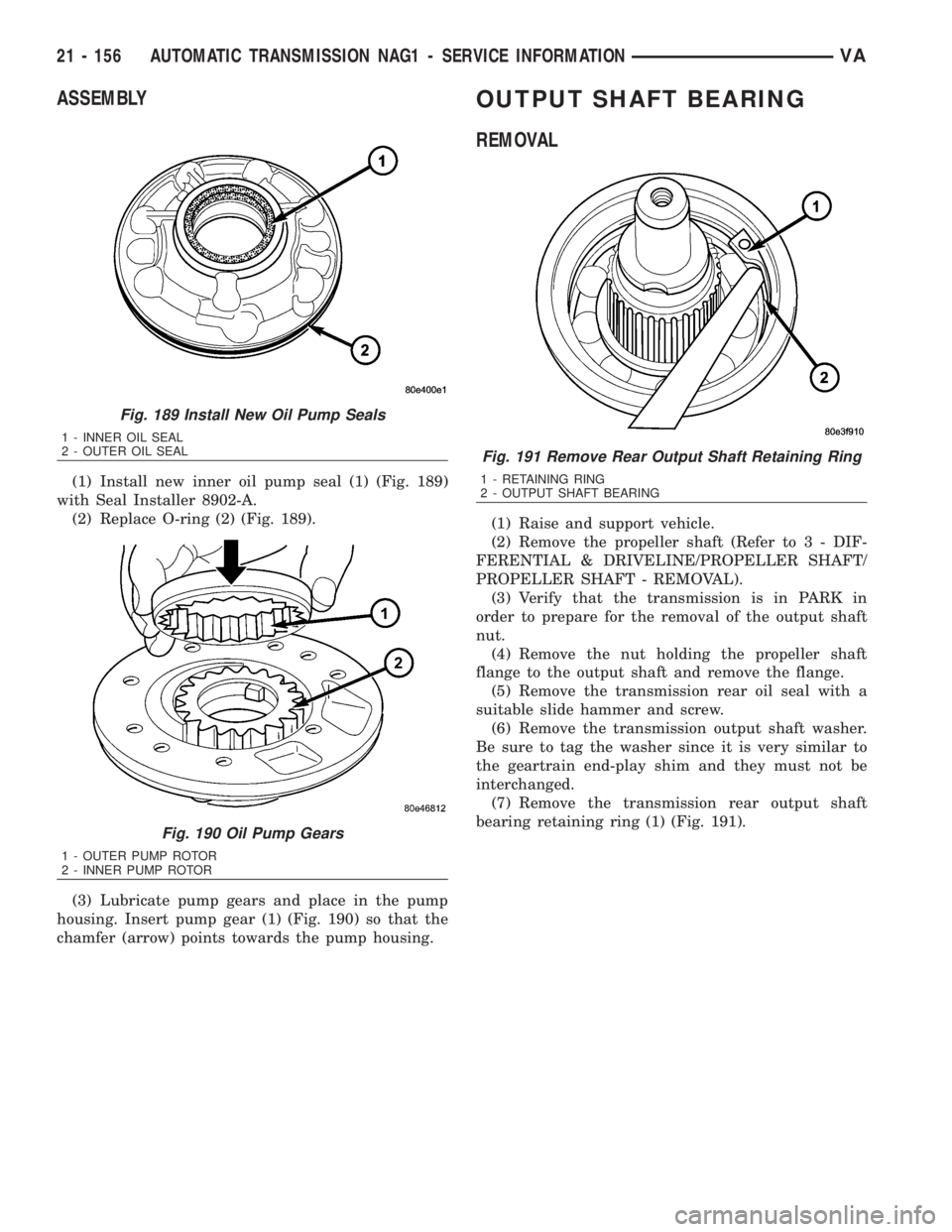
(1) Install new inner oil pump seal (1) (Fig. 189)
with Seal Installer 8902-A.
(2) Replace O-ring (2) (Fig. 189).
(3) Lubricate pump gears and place in the pump
housing. Insert pump gear (1) (Fig. 190) so that the
chamfer (arrow) points towards the pump housing.
OUTPUT SHAFT BEARING
REMOVAL
(1) Raise and support vehicle.
(2) Remove the propeller shaft (Refer to 3 - DIF-
FERENTIAL & DRIVELINE/PROPELLER SHAFT/
PROPELLER SHAFT - REMOVAL).
(3) Verify that the transmission is in PARK in
order to prepare for the removal of the output shaft
nut.
(4) Remove the nut holding the propeller shaft
flange to the output shaft and remove the flange.
(5) Remove the transmission rear oil seal with a
suitable slide hammer and screw.
(6) Remove the transmission output shaft washer.
Be sure to tag the washer since it is very similar to
the geartrain end-play shim and they must not be
interchanged.
(7) Remove the transmission rear output shaft
bearing retaining ring (1) (Fig. 191).
Fig. 189 Install New Oil Pump Seals
1 - INNER OIL SEAL
2 - OUTER OIL SEAL
Fig. 190 Oil Pump Gears
1 - OUTER PUMP ROTOR
2 - INNER PUMP ROTOR
Fig. 191 Remove Rear Output Shaft Retaining Ring
1 - RETAINING RING
2 - OUTPUT SHAFT BEARING
21 - 156 AUTOMATIC TRANSMISSION NAG1 - SERVICE INFORMATIONVA
Page 1901 of 2305
INSTALLATION
CAUTION: Verify that the geartrain end-play shim is
properly installed over the output shaft and against
the park gear.
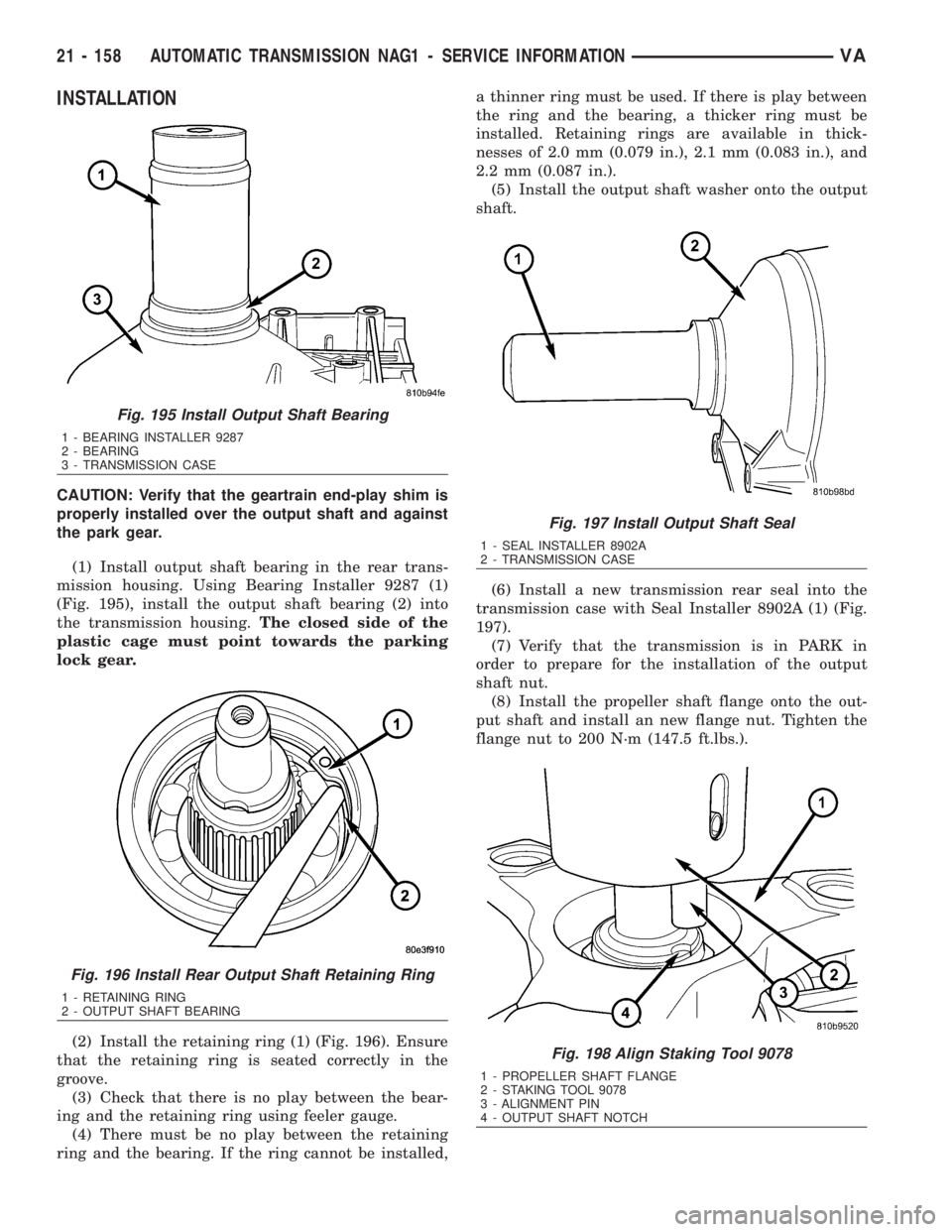
(1) Install output shaft bearing in the rear trans-
mission housing. Using Bearing Installer 9287 (1)
(Fig. 195), install the output shaft bearing (2) into
the transmission housing.The closed side of the
plastic cage must point towards the parking
lock gear.
(2) Install the retaining ring (1) (Fig. 196). Ensure
that the retaining ring is seated correctly in the
groove.
(3) Check that there is no play between the bear-
ing and the retaining ring using feeler gauge.
(4) There must be no play between the retaining
ring and the bearing. If the ring cannot be installed,a thinner ring must be used. If there is play between
the ring and the bearing, a thicker ring must be
installed. Retaining rings are available in thick-
nesses of 2.0 mm (0.079 in.), 2.1 mm (0.083 in.), and
2.2 mm (0.087 in.).
(5) Install the output shaft washer onto the output
shaft.
(6) Install a new transmission rear seal into the
transmission case with Seal Installer 8902A (1) (Fig.
197).
(7) Verify that the transmission is in PARK in
order to prepare for the installation of the output
shaft nut.
(8) Install the propeller shaft flange onto the out-
put shaft and install an new flange nut. Tighten the
flange nut to 200 N´m (147.5 ft.lbs.).
Fig. 195 Install Output Shaft Bearing
1 - BEARING INSTALLER 9287
2 - BEARING
3 - TRANSMISSION CASE
Fig. 196 Install Rear Output Shaft Retaining Ring
1 - RETAINING RING
2 - OUTPUT SHAFT BEARING
Fig. 197 Install Output Shaft Seal
1 - SEAL INSTALLER 8902A
2 - TRANSMISSION CASE
Fig. 198 Align Staking Tool 9078
1 - PROPELLER SHAFT FLANGE
2 - STAKING TOOL 9078
3 - ALIGNMENT PIN
4 - OUTPUT SHAFT NOTCH
21 - 158 AUTOMATIC TRANSMISSION NAG1 - SERVICE INFORMATIONVA
Page 1910 of 2305
ASSEMBLY
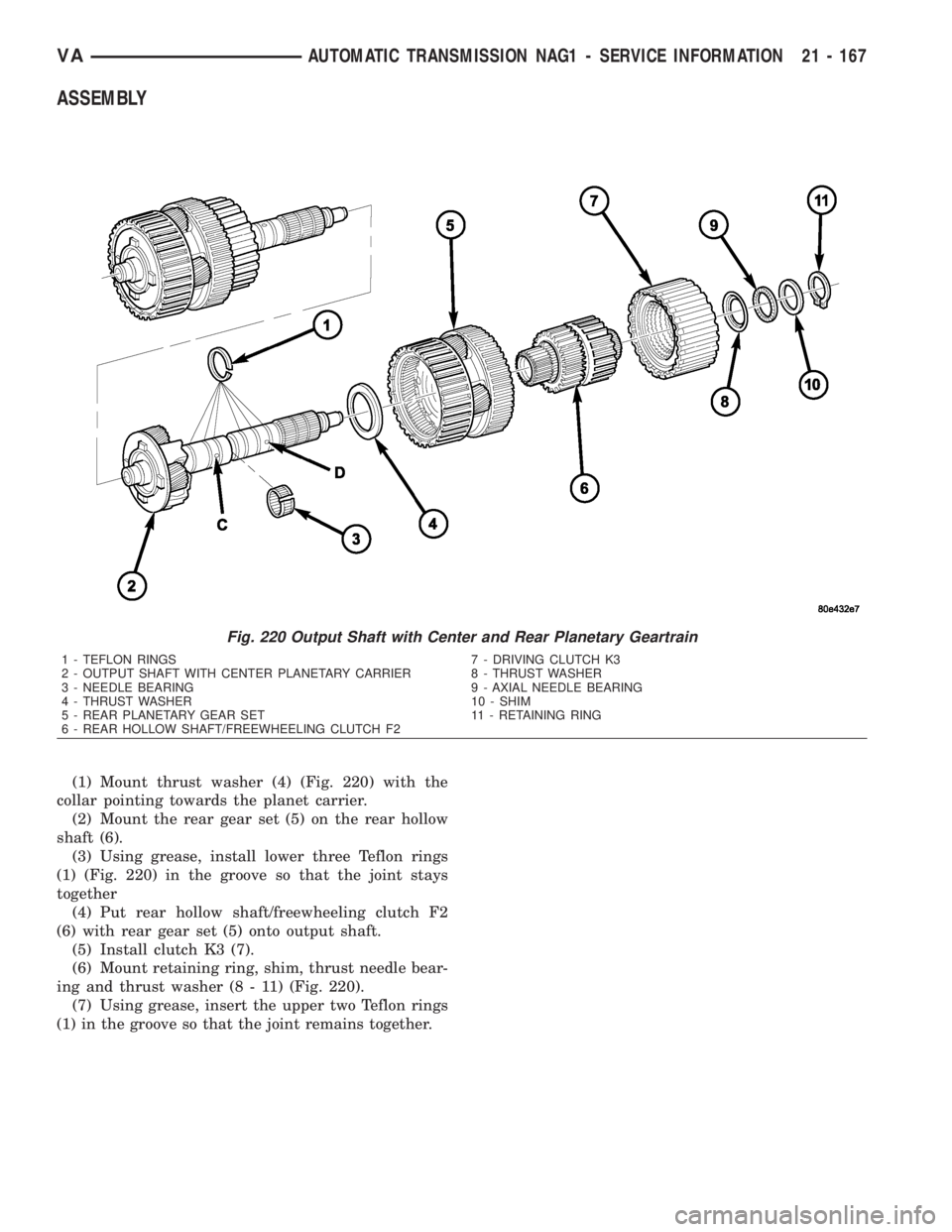
(1) Mount thrust washer (4) (Fig. 220) with the
collar pointing towards the planet carrier.
(2) Mount the rear gear set (5) on the rear hollow
shaft (6).
(3) Using grease, install lower three Teflon rings
(1) (Fig. 220) in the groove so that the joint stays
together
(4) Put rear hollow shaft/freewheeling clutch F2
(6) with rear gear set (5) onto output shaft.
(5) Install clutch K3 (7).
(6) Mount retaining ring, shim, thrust needle bear-
ing and thrust washer (8 - 11) (Fig. 220).
(7) Using grease, insert the upper two Teflon rings
(1) in the groove so that the joint remains together.
Fig. 220 Output Shaft with Center and Rear Planetary Geartrain
1 - TEFLON RINGS 7 - DRIVING CLUTCH K3
2 - OUTPUT SHAFT WITH CENTER PLANETARY CARRIER 8 - THRUST WASHER
3 - NEEDLE BEARING 9 - AXIAL NEEDLE BEARING
4 - THRUST WASHER 10 - SHIM
5 - REAR PLANETARY GEAR SET 11 - RETAINING RING
6 - REAR HOLLOW SHAFT/FREEWHEELING CLUTCH F2
VAAUTOMATIC TRANSMISSION NAG1 - SERVICE INFORMATION 21 - 167
Page 1912 of 2305
²Tipping the selector lever toward ª-º one
time after another:The shift range is reduced in
descending sequence by one gear each time, i.e., from
D-4-3-2-1.Iftheselected limitation of the shift
range would result in a downshift causing excessive
engine speed, the shifting is not executed and the
engaged gear as well as the shift range remain
unchanged. This is to prevent the engine from over-
speeding. Engine retardation is low with the selector
lever in position ªDº. To make use of the full braking
power of the engine, ªmanualº downshifting by tip-
ping the lever towards the left-hand side is recom-
mended. If this has been done, subsequent upshifting
must be carried out manually as well.
²Tipping the selector lever toward ª-º and
holding it in this position:The currently engaged
gear in range ªDº is indicated in the instrument clus-
ter display and the shift range is limited to this gear.
²Tipping the selector lever toward ª+º one
time after another:The shift range is increased by
one gear each time and the increased shift range is
displayed in the instrument cluster; possibly, the
transmission upshifts to a faster gear.
²Tipping the selector lever toward ª+º sev-
eral times:The shift range is increased by one gear
each time the lever is tipped until the shift range
ends up in ªDº.
²Tipping the selector lever toward ª+º and
holding it in this position:The shift range is
extended immediately to ªDº, shift ranges are indi-
cated in ascending sequence; possibly, the transmis-
sion upshifts to a faster gear due to the extension of
the shift range.
REMOVAL
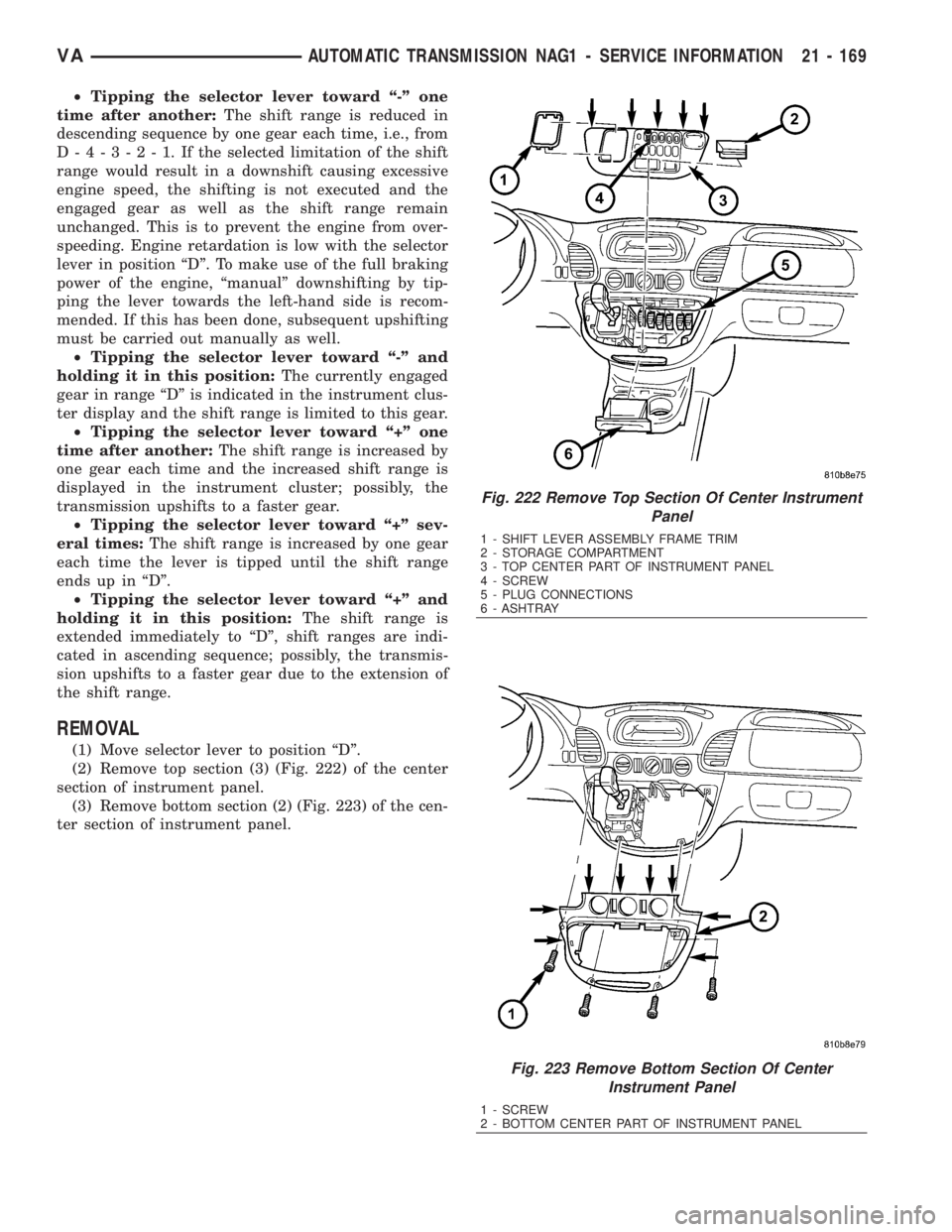
(1) Move selector lever to position ªDº.
(2) Remove top section (3) (Fig. 222) of the center
section of instrument panel.
(3) Remove bottom section (2) (Fig. 223) of the cen-
ter section of instrument panel.
Fig. 222 Remove Top Section Of Center Instrument
Panel
1 - SHIFT LEVER ASSEMBLY FRAME TRIM
2 - STORAGE COMPARTMENT
3 - TOP CENTER PART OF INSTRUMENT PANEL
4 - SCREW
5 - PLUG CONNECTIONS
6 - ASHTRAY
Fig. 223 Remove Bottom Section Of Center
Instrument Panel
1 - SCREW
2 - BOTTOM CENTER PART OF INSTRUMENT PANEL
VAAUTOMATIC TRANSMISSION NAG1 - SERVICE INFORMATION 21 - 169
Page 1925 of 2305
²Transmission fluid temperature
²Engine coolant temperature
²Input speed
²Throttle angle
²Engine speed
OPERATION
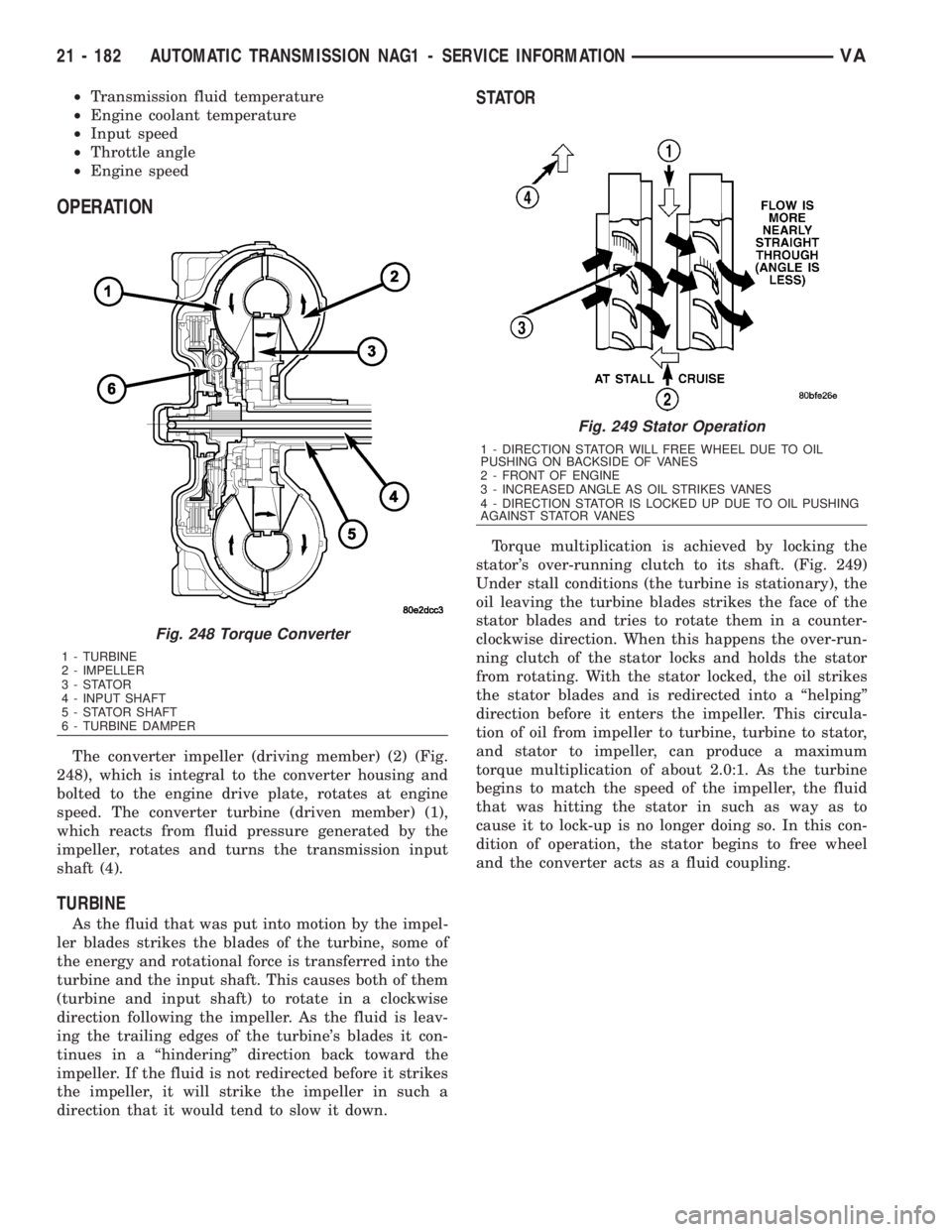
The converter impeller (driving member) (2) (Fig.
248), which is integral to the converter housing and
bolted to the engine drive plate, rotates at engine
speed. The converter turbine (driven member) (1),
which reacts from fluid pressure generated by the
impeller, rotates and turns the transmission input
shaft (4).
TURBINE
As the fluid that was put into motion by the impel-
ler blades strikes the blades of the turbine, some of
the energy and rotational force is transferred into the
turbine and the input shaft. This causes both of them
(turbine and input shaft) to rotate in a clockwise
direction following the impeller. As the fluid is leav-
ing the trailing edges of the turbine's blades it con-
tinues in a ªhinderingº direction back toward the
impeller. If the fluid is not redirected before it strikes
the impeller, it will strike the impeller in such a
direction that it would tend to slow it down.
STATOR
Torque multiplication is achieved by locking the
stator's over-running clutch to its shaft. (Fig. 249)
Under stall conditions (the turbine is stationary), the
oil leaving the turbine blades strikes the face of the
stator blades and tries to rotate them in a counter-
clockwise direction. When this happens the over-run-
ning clutch of the stator locks and holds the stator
from rotating. With the stator locked, the oil strikes
the stator blades and is redirected into a ªhelpingº
direction before it enters the impeller. This circula-
tion of oil from impeller to turbine, turbine to stator,
and stator to impeller, can produce a maximum
torque multiplication of about 2.0:1. As the turbine
begins to match the speed of the impeller, the fluid
that was hitting the stator in such as way as to
cause it to lock-up is no longer doing so. In this con-
dition of operation, the stator begins to free wheel
and the converter acts as a fluid coupling.
Fig. 248 Torque Converter
1 - TURBINE
2 - IMPELLER
3-STATOR
4 - INPUT SHAFT
5 - STATOR SHAFT
6 - TURBINE DAMPER
Fig. 249 Stator Operation
1 - DIRECTION STATOR WILL FREE WHEEL DUE TO OIL
PUSHING ON BACKSIDE OF VANES
2 - FRONT OF ENGINE
3 - INCREASED ANGLE AS OIL STRIKES VANES
4 - DIRECTION STATOR IS LOCKED UP DUE TO OIL PUSHING
AGAINST STATOR VANES
21 - 182 AUTOMATIC TRANSMISSION NAG1 - SERVICE INFORMATIONVA