wiring MERCEDES-BENZ SPRINTER 2006 Manual PDF
[x] Cancel search | Manufacturer: MERCEDES-BENZ, Model Year: 2006, Model line: SPRINTER, Model: MERCEDES-BENZ SPRINTER 2006Pages: 2305, PDF Size: 48.12 MB
Page 345 of 2305
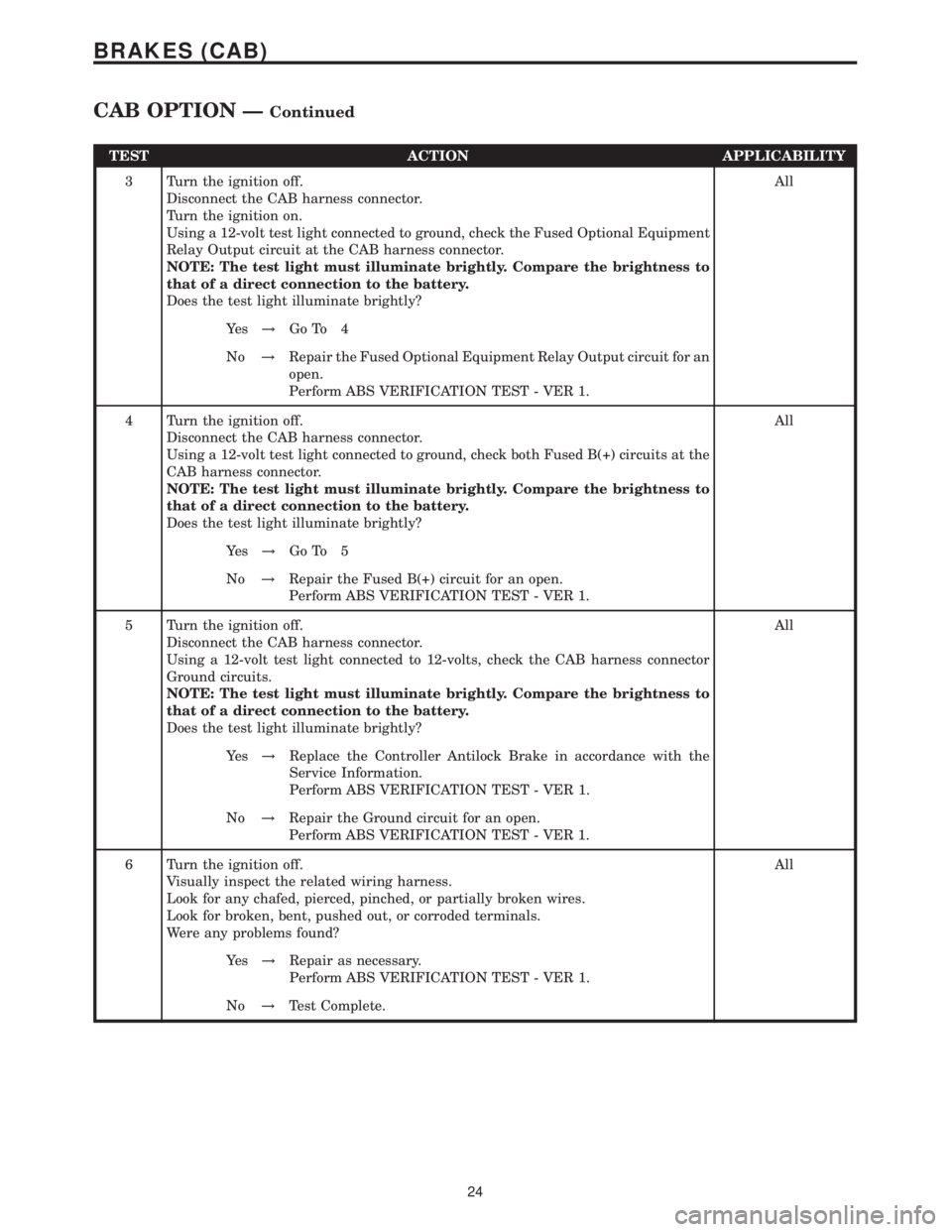
TEST ACTION APPLICABILITY
3 Turn the ignition off.
Disconnect the CAB harness connector.
Turn the ignition on.
Using a 12-volt test light connected to ground, check the Fused Optional Equipment
Relay Output circuit at the CAB harness connector.
NOTE: The test light must illuminate brightly. Compare the brightness to
that of a direct connection to the battery.
Does the test light illuminate brightly?All
Ye s!Go To 4
No!Repair the Fused Optional Equipment Relay Output circuit for an
open.
Perform ABS VERIFICATION TEST - VER 1.
4 Turn the ignition off.
Disconnect the CAB harness connector.
Using a 12-volt test light connected to ground, check both Fused B(+) circuits at the
CAB harness connector.
NOTE: The test light must illuminate brightly. Compare the brightness to
that of a direct connection to the battery.
Does the test light illuminate brightly?All
Ye s!Go To 5
No!Repair the Fused B(+) circuit for an open.
Perform ABS VERIFICATION TEST - VER 1.
5 Turn the ignition off.
Disconnect the CAB harness connector.
Using a 12-volt test light connected to 12-volts, check the CAB harness connector
Ground circuits.
NOTE: The test light must illuminate brightly. Compare the brightness to
that of a direct connection to the battery.
Does the test light illuminate brightly?All
Ye s!Replace the Controller Antilock Brake in accordance with the
Service Information.
Perform ABS VERIFICATION TEST - VER 1.
No!Repair the Ground circuit for an open.
Perform ABS VERIFICATION TEST - VER 1.
6 Turn the ignition off.
Visually inspect the related wiring harness.
Look for any chafed, pierced, pinched, or partially broken wires.
Look for broken, bent, pushed out, or corroded terminals.
Were any problems found?All
Ye s!Repair as necessary.
Perform ABS VERIFICATION TEST - VER 1.
No!Test Complete.
24
BRAKES (CAB)
CAB OPTION ÐContinued
Page 348 of 2305
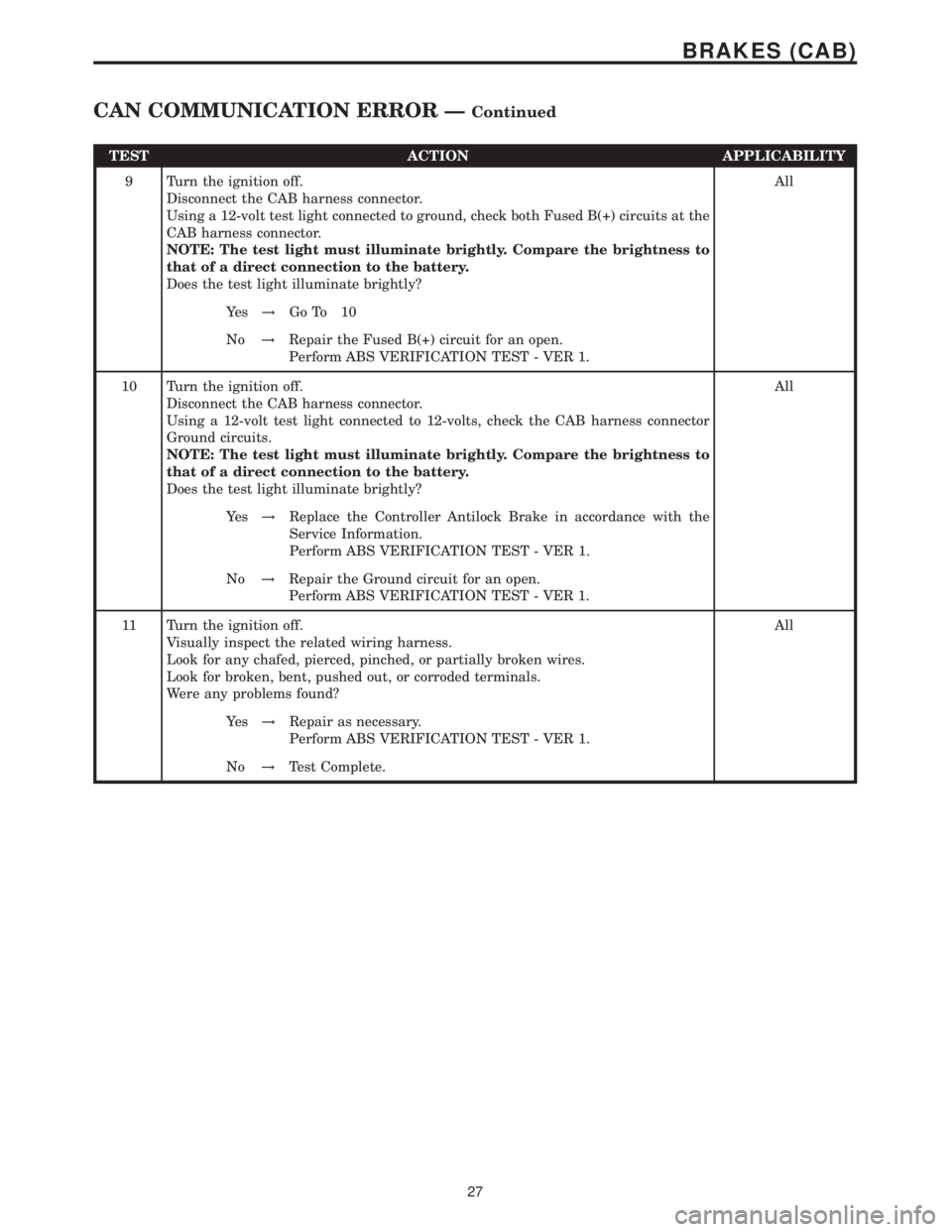
TEST ACTION APPLICABILITY
9 Turn the ignition off.
Disconnect the CAB harness connector.
Using a 12-volt test light connected to ground, check both Fused B(+) circuits at the
CAB harness connector.
NOTE: The test light must illuminate brightly. Compare the brightness to
that of a direct connection to the battery.
Does the test light illuminate brightly?All
Ye s!Go To 10
No!Repair the Fused B(+) circuit for an open.
Perform ABS VERIFICATION TEST - VER 1.
10 Turn the ignition off.
Disconnect the CAB harness connector.
Using a 12-volt test light connected to 12-volts, check the CAB harness connector
Ground circuits.
NOTE: The test light must illuminate brightly. Compare the brightness to
that of a direct connection to the battery.
Does the test light illuminate brightly?All
Ye s!Replace the Controller Antilock Brake in accordance with the
Service Information.
Perform ABS VERIFICATION TEST - VER 1.
No!Repair the Ground circuit for an open.
Perform ABS VERIFICATION TEST - VER 1.
11 Turn the ignition off.
Visually inspect the related wiring harness.
Look for any chafed, pierced, pinched, or partially broken wires.
Look for broken, bent, pushed out, or corroded terminals.
Were any problems found?All
Ye s!Repair as necessary.
Perform ABS VERIFICATION TEST - VER 1.
No!Test Complete.
27
BRAKES (CAB)
CAN COMMUNICATION ERROR ÐContinued
Page 356 of 2305
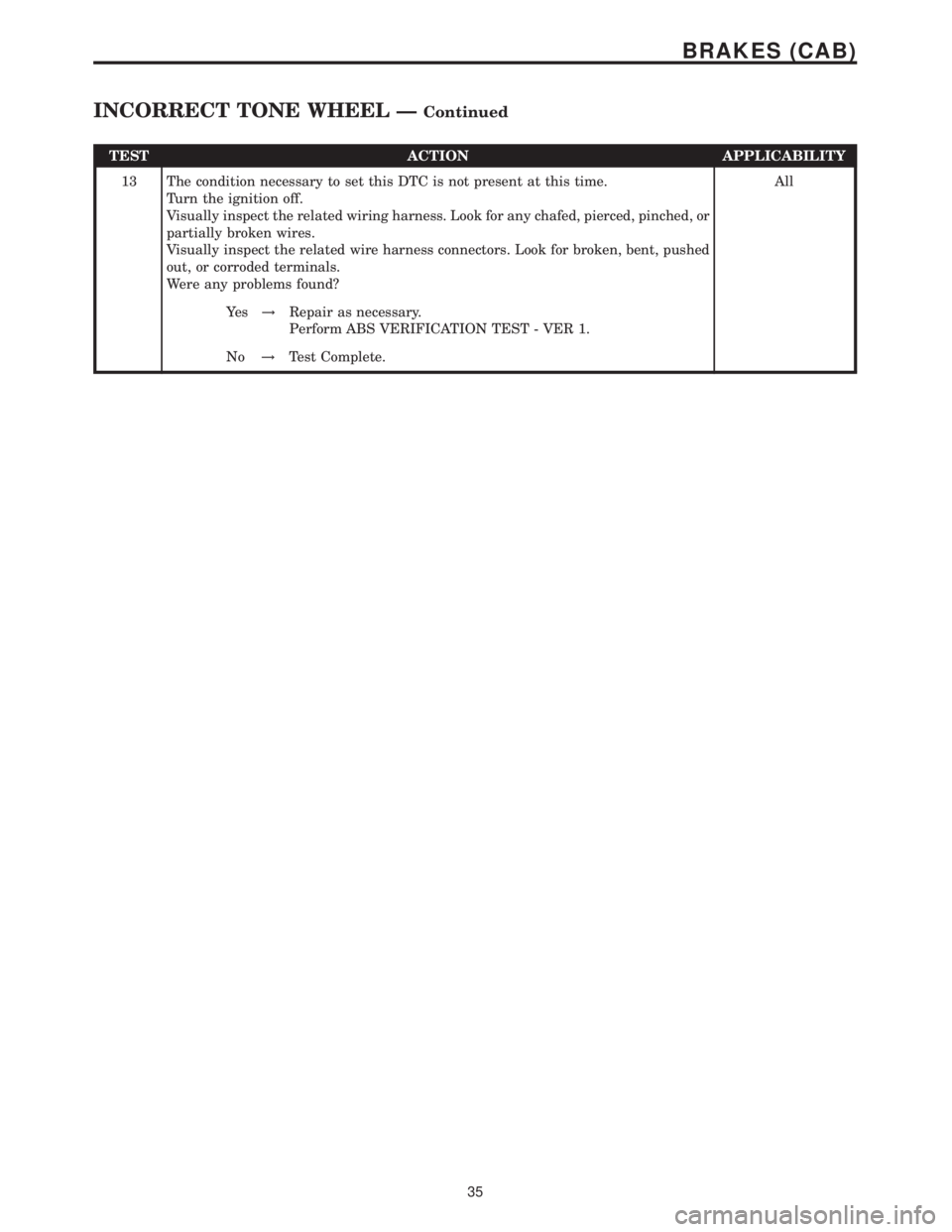
TEST ACTION APPLICABILITY
13 The condition necessary to set this DTC is not present at this time.
Turn the ignition off.
Visually inspect the related wiring harness. Look for any chafed, pierced, pinched, or
partially broken wires.
Visually inspect the related wire harness connectors. Look for broken, bent, pushed
out, or corroded terminals.
Were any problems found?All
Ye s!Repair as necessary.
Perform ABS VERIFICATION TEST - VER 1.
No!Test Complete.
35
BRAKES (CAB)
INCORRECT TONE WHEEL ÐContinued
Page 363 of 2305
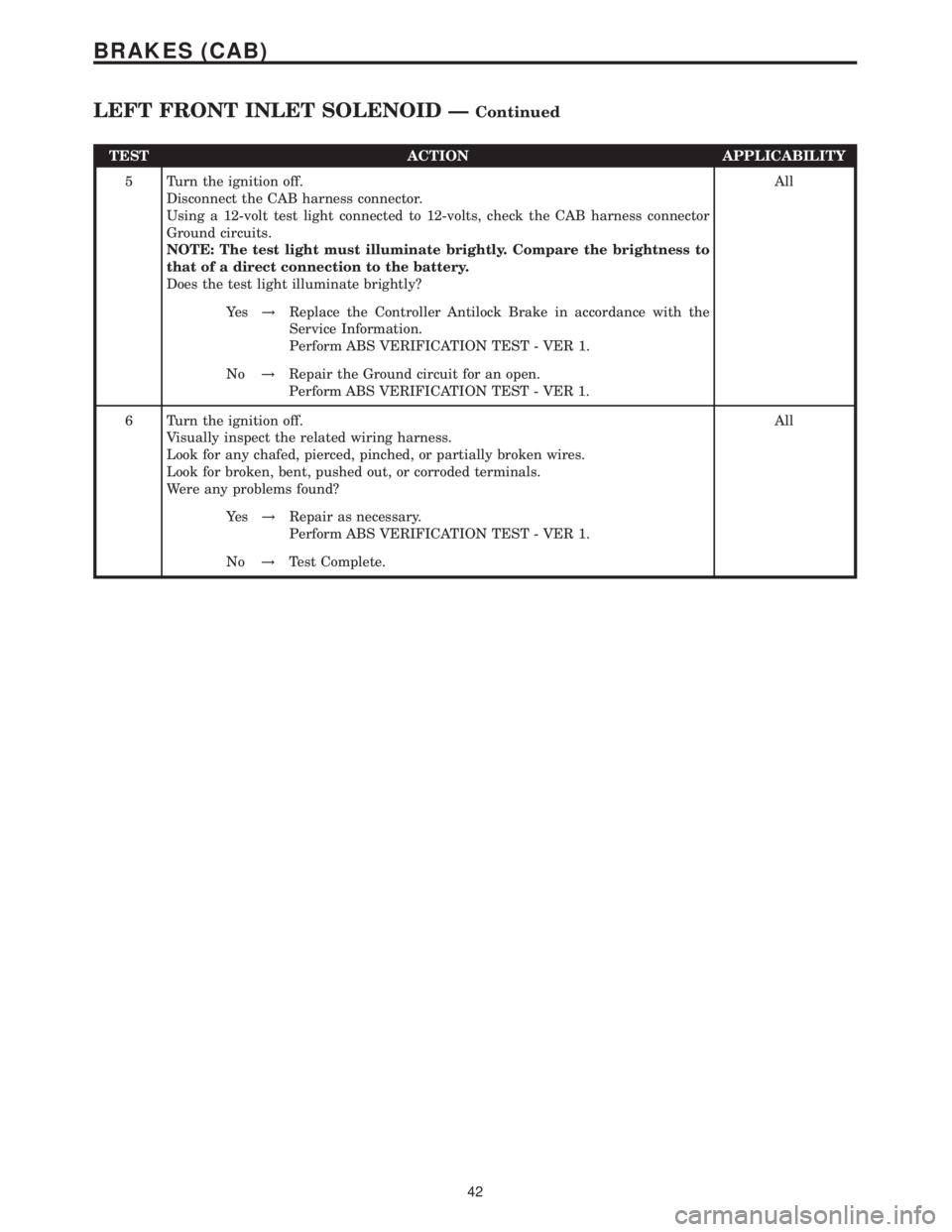
TEST ACTION APPLICABILITY
5 Turn the ignition off.
Disconnect the CAB harness connector.
Using a 12-volt test light connected to 12-volts, check the CAB harness connector
Ground circuits.
NOTE: The test light must illuminate brightly. Compare the brightness to
that of a direct connection to the battery.
Does the test light illuminate brightly?All
Ye s!Replace the Controller Antilock Brake in accordance with the
Service Information.
Perform ABS VERIFICATION TEST - VER 1.
No!Repair the Ground circuit for an open.
Perform ABS VERIFICATION TEST - VER 1.
6 Turn the ignition off.
Visually inspect the related wiring harness.
Look for any chafed, pierced, pinched, or partially broken wires.
Look for broken, bent, pushed out, or corroded terminals.
Were any problems found?All
Ye s!Repair as necessary.
Perform ABS VERIFICATION TEST - VER 1.
No!Test Complete.
42
BRAKES (CAB)
LEFT FRONT INLET SOLENOID ÐContinued
Page 366 of 2305
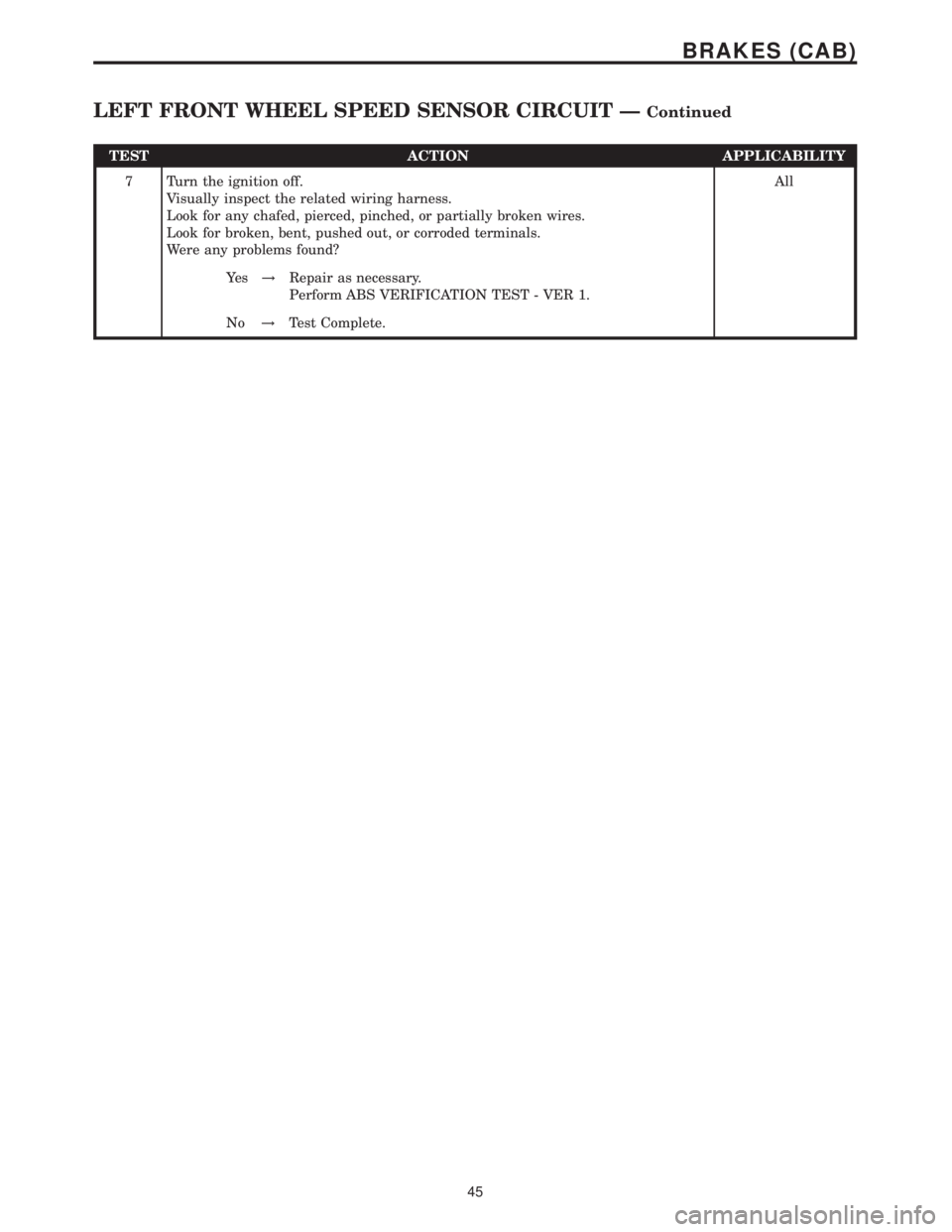
TEST ACTION APPLICABILITY
7 Turn the ignition off.
Visually inspect the related wiring harness.
Look for any chafed, pierced, pinched, or partially broken wires.
Look for broken, bent, pushed out, or corroded terminals.
Were any problems found?All
Ye s!Repair as necessary.
Perform ABS VERIFICATION TEST - VER 1.
No!Test Complete.
45
BRAKES (CAB)
LEFT FRONT WHEEL SPEED SENSOR CIRCUIT ÐContinued
Page 368 of 2305
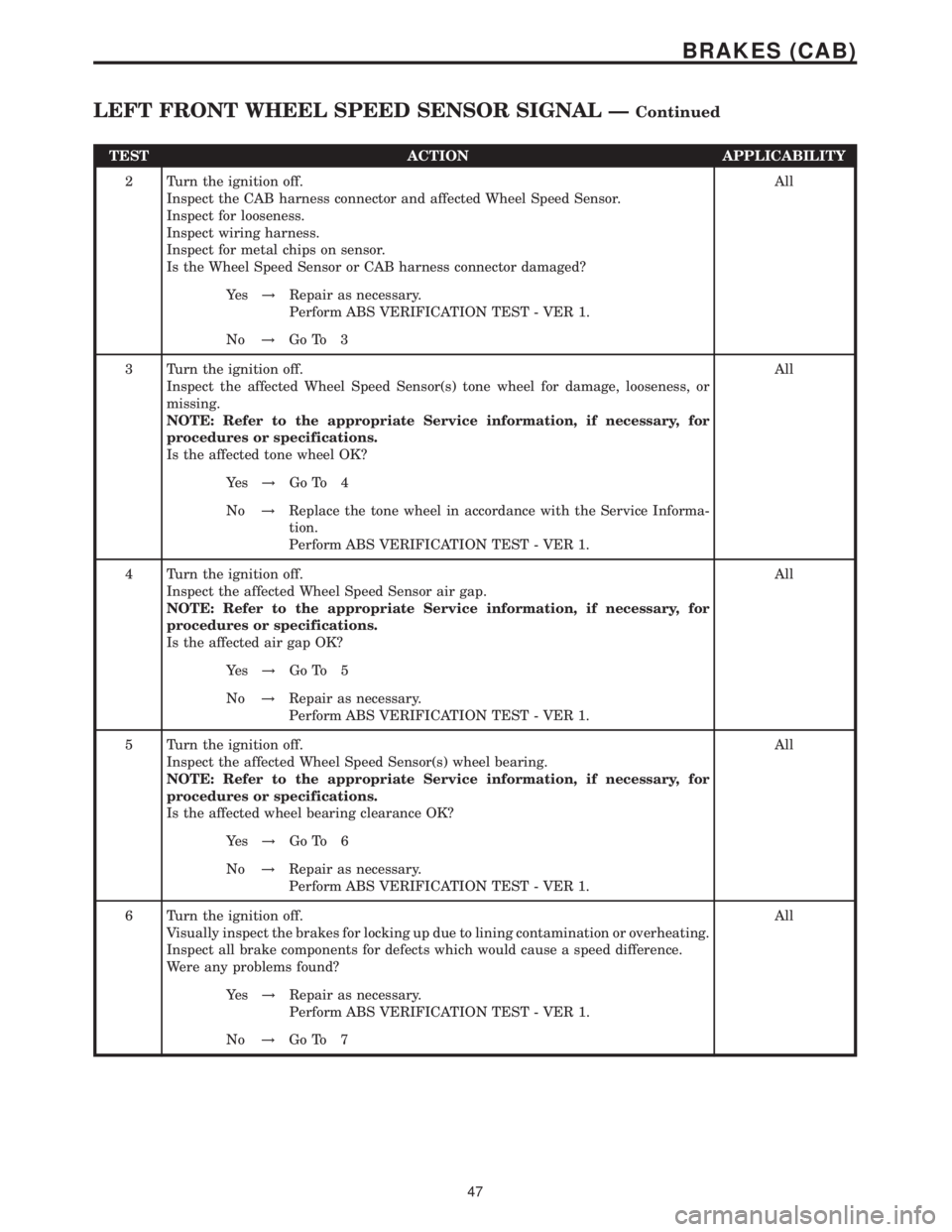
TEST ACTION APPLICABILITY
2 Turn the ignition off.
Inspect the CAB harness connector and affected Wheel Speed Sensor.
Inspect for looseness.
Inspect wiring harness.
Inspect for metal chips on sensor.
Is the Wheel Speed Sensor or CAB harness connector damaged?All
Ye s!Repair as necessary.
Perform ABS VERIFICATION TEST - VER 1.
No!Go To 3
3 Turn the ignition off.
Inspect the affected Wheel Speed Sensor(s) tone wheel for damage, looseness, or
missing.
NOTE: Refer to the appropriate Service information, if necessary, for
procedures or specifications.
Is the affected tone wheel OK?All
Ye s!Go To 4
No!Replace the tone wheel in accordance with the Service Informa-
tion.
Perform ABS VERIFICATION TEST - VER 1.
4 Turn the ignition off.
Inspect the affected Wheel Speed Sensor air gap.
NOTE: Refer to the appropriate Service information, if necessary, for
procedures or specifications.
Is the affected air gap OK?All
Ye s!Go To 5
No!Repair as necessary.
Perform ABS VERIFICATION TEST - VER 1.
5 Turn the ignition off.
Inspect the affected Wheel Speed Sensor(s) wheel bearing.
NOTE: Refer to the appropriate Service information, if necessary, for
procedures or specifications.
Is the affected wheel bearing clearance OK?All
Ye s!Go To 6
No!Repair as necessary.
Perform ABS VERIFICATION TEST - VER 1.
6 Turn the ignition off.
Visually inspect the brakes for locking up due to lining contamination or overheating.
Inspect all brake components for defects which would cause a speed difference.
Were any problems found?All
Ye s!Repair as necessary.
Perform ABS VERIFICATION TEST - VER 1.
No!Go To 7
47
BRAKES (CAB)
LEFT FRONT WHEEL SPEED SENSOR SIGNAL ÐContinued
Page 369 of 2305
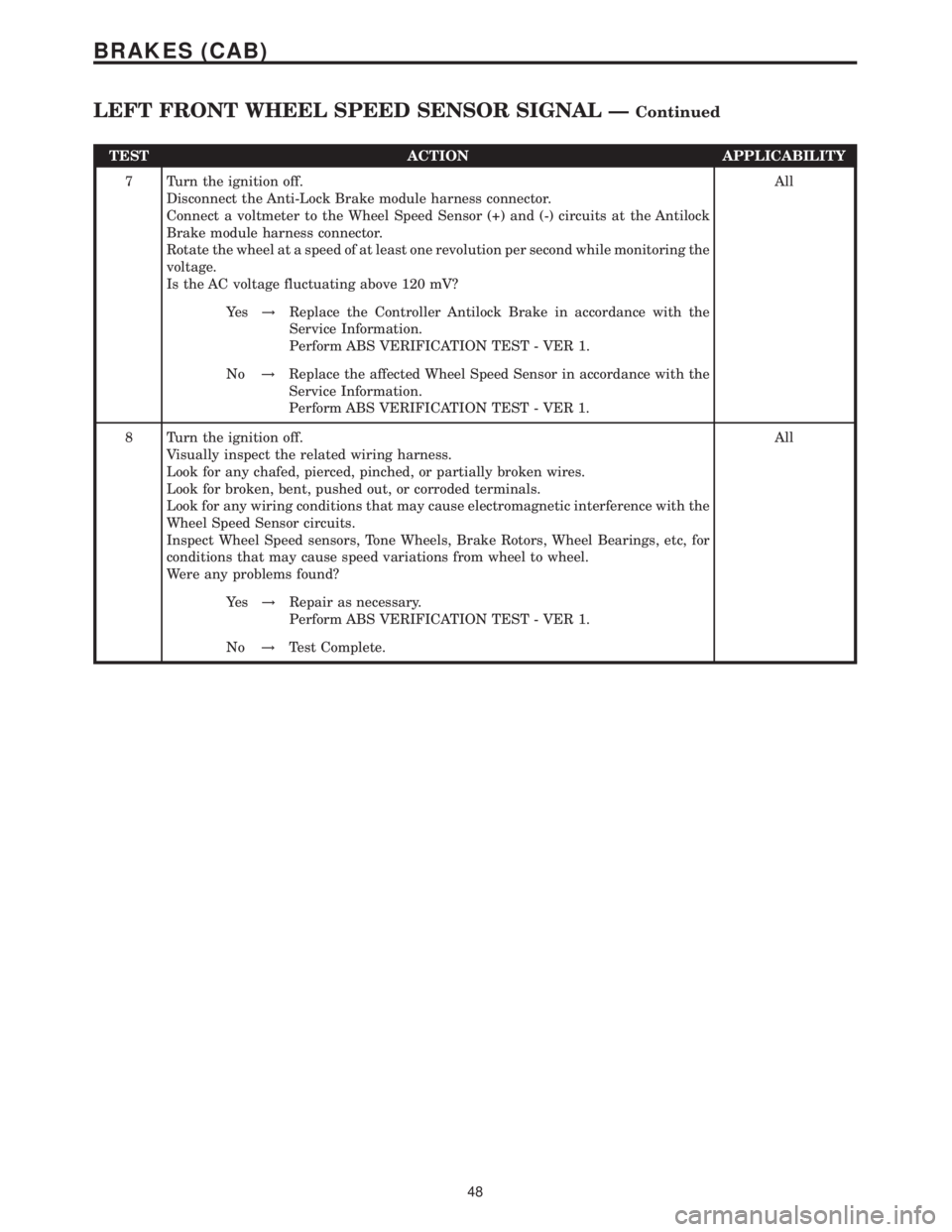
TEST ACTION APPLICABILITY
7 Turn the ignition off.
Disconnect the Anti-Lock Brake module harness connector.
Connect a voltmeter to the Wheel Speed Sensor (+) and (-) circuits at the Antilock
Brake module harness connector.
Rotate the wheel at a speed of at least one revolution per second while monitoring the
voltage.
Is the AC voltage fluctuating above 120 mV?All
Ye s!Replace the Controller Antilock Brake in accordance with the
Service Information.
Perform ABS VERIFICATION TEST - VER 1.
No!Replace the affected Wheel Speed Sensor in accordance with the
Service Information.
Perform ABS VERIFICATION TEST - VER 1.
8 Turn the ignition off.
Visually inspect the related wiring harness.
Look for any chafed, pierced, pinched, or partially broken wires.
Look for broken, bent, pushed out, or corroded terminals.
Look for any wiring conditions that may cause electromagnetic interference with the
Wheel Speed Sensor circuits.
Inspect Wheel Speed sensors, Tone Wheels, Brake Rotors, Wheel Bearings, etc, for
conditions that may cause speed variations from wheel to wheel.
Were any problems found?All
Ye s!Repair as necessary.
Perform ABS VERIFICATION TEST - VER 1.
No!Test Complete.
48
BRAKES (CAB)
LEFT FRONT WHEEL SPEED SENSOR SIGNAL ÐContinued
Page 371 of 2305
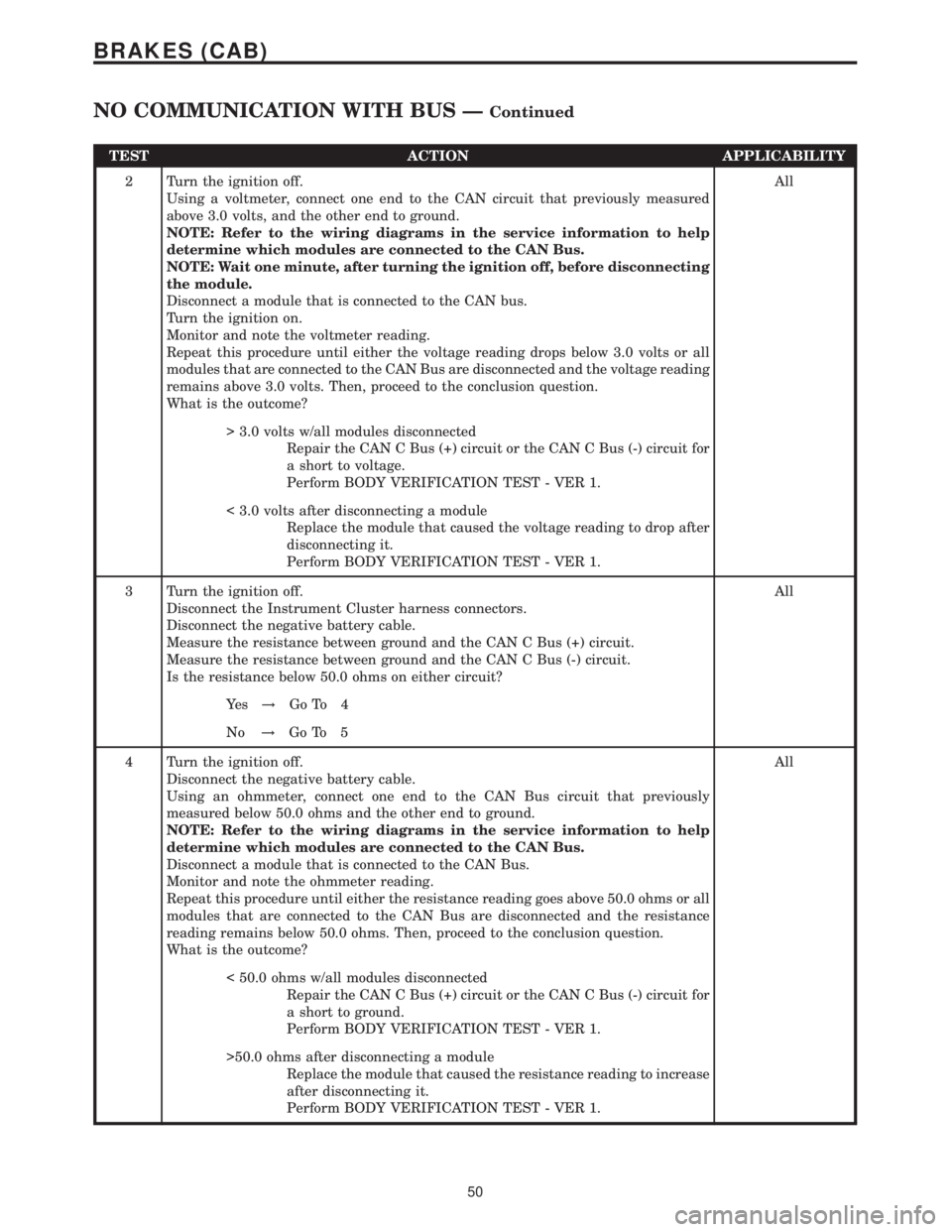
TEST ACTION APPLICABILITY
2 Turn the ignition off.
Using a voltmeter, connect one end to the CAN circuit that previously measured
above 3.0 volts, and the other end to ground.
NOTE: Refer to the wiring diagrams in the service information to help
determine which modules are connected to the CAN Bus.
NOTE: Wait one minute, after turning the ignition off, before disconnecting
the module.
Disconnect a module that is connected to the CAN bus.
Turn the ignition on.
Monitor and note the voltmeter reading.
Repeat this procedure until either the voltage reading drops below 3.0 volts or all
modules that are connected to the CAN Bus are disconnected and the voltage reading
remains above 3.0 volts. Then, proceed to the conclusion question.
What is the outcome?All
> 3.0 volts w/all modules disconnected
Repair the CAN C Bus (+) circuit or the CAN C Bus (-) circuit for
a short to voltage.
Perform BODY VERIFICATION TEST - VER 1.
< 3.0 volts after disconnecting a module
Replace the module that caused the voltage reading to drop after
disconnecting it.
Perform BODY VERIFICATION TEST - VER 1.
3 Turn the ignition off.
Disconnect the Instrument Cluster harness connectors.
Disconnect the negative battery cable.
Measure the resistance between ground and the CAN C Bus (+) circuit.
Measure the resistance between ground and the CAN C Bus (-) circuit.
Is the resistance below 50.0 ohms on either circuit?All
Ye s!Go To 4
No!Go To 5
4 Turn the ignition off.
Disconnect the negative battery cable.
Using an ohmmeter, connect one end to the CAN Bus circuit that previously
measured below 50.0 ohms and the other end to ground.
NOTE: Refer to the wiring diagrams in the service information to help
determine which modules are connected to the CAN Bus.
Disconnect a module that is connected to the CAN Bus.
Monitor and note the ohmmeter reading.
Repeat this procedure until either the resistance reading goes above 50.0 ohms or all
modules that are connected to the CAN Bus are disconnected and the resistance
reading remains below 50.0 ohms. Then, proceed to the conclusion question.
What is the outcome?All
< 50.0 ohms w/all modules disconnected
Repair the CAN C Bus (+) circuit or the CAN C Bus (-) circuit for
a short to ground.
Perform BODY VERIFICATION TEST - VER 1.
>50.0 ohms after disconnecting a module
Replace the module that caused the resistance reading to increase
after disconnecting it.
Perform BODY VERIFICATION TEST - VER 1.
50
BRAKES (CAB)
NO COMMUNICATION WITH BUS ÐContinued
Page 372 of 2305
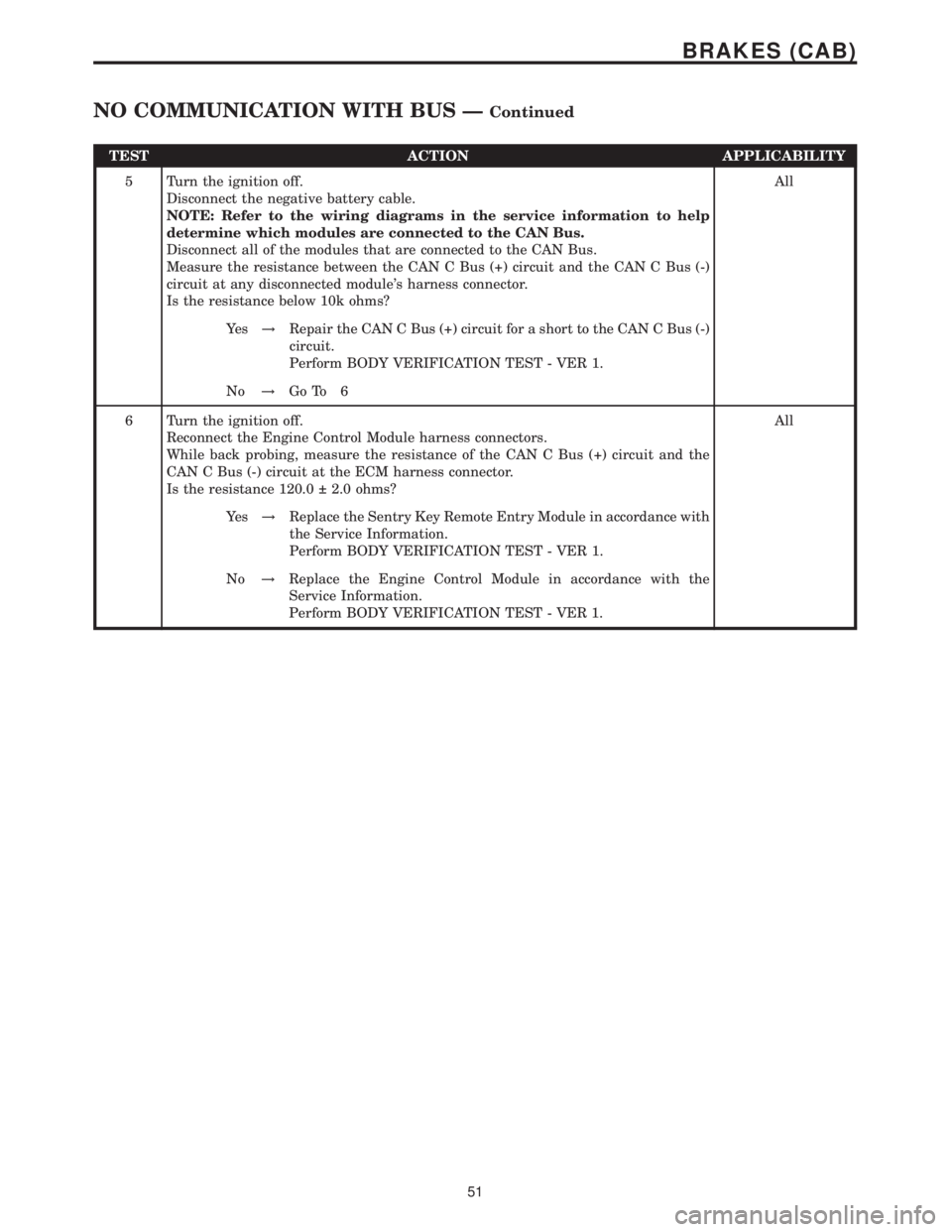
TEST ACTION APPLICABILITY
5 Turn the ignition off.
Disconnect the negative battery cable.
NOTE: Refer to the wiring diagrams in the service information to help
determine which modules are connected to the CAN Bus.
Disconnect all of the modules that are connected to the CAN Bus.
Measure the resistance between the CAN C Bus (+) circuit and the CAN C Bus (-)
circuit at any disconnected module's harness connector.
Is the resistance below 10k ohms?All
Ye s!Repair the CAN C Bus (+) circuit for a short to the CAN C Bus (-)
circuit.
Perform BODY VERIFICATION TEST - VER 1.
No!Go To 6
6 Turn the ignition off.
Reconnect the Engine Control Module harness connectors.
While back probing, measure the resistance of the CAN C Bus (+) circuit and the
CAN C Bus (-) circuit at the ECM harness connector.
Is the resistance 120.0 2.0 ohms?All
Ye s!Replace the Sentry Key Remote Entry Module in accordance with
the Service Information.
Perform BODY VERIFICATION TEST - VER 1.
No!Replace the Engine Control Module in accordance with the
Service Information.
Perform BODY VERIFICATION TEST - VER 1.
51
BRAKES (CAB)
NO COMMUNICATION WITH BUS ÐContinued
Page 379 of 2305
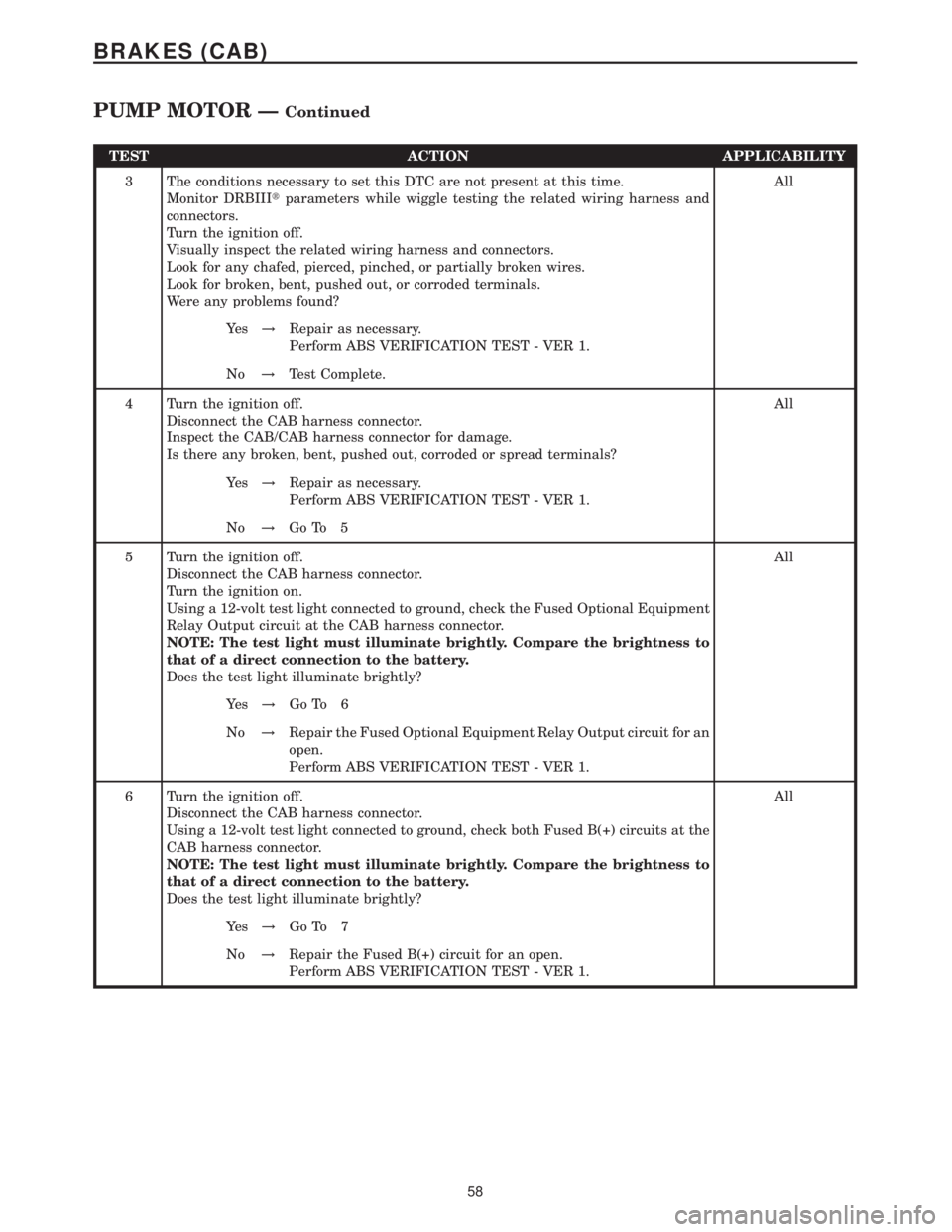
TEST ACTION APPLICABILITY
3 The conditions necessary to set this DTC are not present at this time.
Monitor DRBIIItparameters while wiggle testing the related wiring harness and
connectors.
Turn the ignition off.
Visually inspect the related wiring harness and connectors.
Look for any chafed, pierced, pinched, or partially broken wires.
Look for broken, bent, pushed out, or corroded terminals.
Were any problems found?All
Ye s!Repair as necessary.
Perform ABS VERIFICATION TEST - VER 1.
No!Test Complete.
4 Turn the ignition off.
Disconnect the CAB harness connector.
Inspect the CAB/CAB harness connector for damage.
Is there any broken, bent, pushed out, corroded or spread terminals?All
Ye s!Repair as necessary.
Perform ABS VERIFICATION TEST - VER 1.
No!Go To 5
5 Turn the ignition off.
Disconnect the CAB harness connector.
Turn the ignition on.
Using a 12-volt test light connected to ground, check the Fused Optional Equipment
Relay Output circuit at the CAB harness connector.
NOTE: The test light must illuminate brightly. Compare the brightness to
that of a direct connection to the battery.
Does the test light illuminate brightly?All
Ye s!Go To 6
No!Repair the Fused Optional Equipment Relay Output circuit for an
open.
Perform ABS VERIFICATION TEST - VER 1.
6 Turn the ignition off.
Disconnect the CAB harness connector.
Using a 12-volt test light connected to ground, check both Fused B(+) circuits at the
CAB harness connector.
NOTE: The test light must illuminate brightly. Compare the brightness to
that of a direct connection to the battery.
Does the test light illuminate brightly?All
Ye s!Go To 7
No!Repair the Fused B(+) circuit for an open.
Perform ABS VERIFICATION TEST - VER 1.
58
BRAKES (CAB)
PUMP MOTOR ÐContinued