flat tire MERCEDES-BENZ SPRINTER 2012 MY12 Operator’s Manual
[x] Cancel search | Manufacturer: MERCEDES-BENZ, Model Year: 2012, Model line: SPRINTER, Model: MERCEDES-BENZ SPRINTER 2012Pages: 292, PDF Size: 6.75 MB
Page 228 of 292
X
Hook tire sealant bottle 006F into the upper
vent hole in the wheel using hook 0072.
X Push angled connecting piece 0074 located
on the hose of tire sealant filler bottle 006F
as far
as
it will go on to valve core extractor
0071 and fix it in place.
X Make sure that the pressure release screw
on pressure gauge 0086 is closed.
X Connect connector 0087 to the 12 V socket
(12 V, 25 A, 300 W) on the center console
(Y page 133).
! Only use the 12 V socket on the center
console to connect the electric air pump.
You could otherwise damage the vehicle's
electrics.
X Start the engine.
X Press I on tire inflation compressor
switch 0046.
The tire inflation compressor is activated.
The tire
sealant
is then pumped into the tire
and the tire pressure is increased. Let the
tire inflation compressor run for at least 10
minutes until tire sealant bottle 006F is
completely empty and the tire pressure is
at least 43.5 psi (3.0 bar).
! Do not
run
the electric air pump for longer
than 20 minutes without a break; otherwise
it may overheat.
The air pump can be used again once it has
cooled down.
X Inflate the tire using the tire inflation
compressor until the recommended tire
pressure ( Y page 281) is reached.
X Then, press 0 on tire inflation compressor
switch 0046.
The tire inflation compressor is
deactivated.
X Slide knob 0073 quickly to the stop in valve
core extractor 0071.
X Turn knob 0073 clockwise
until
the valve core
is firmly screwed into tire valve 0075.i
Do not pull the valve core extractor from
the tire valve while the valve core is
unscrewed from the
tire valve. Tire sealant
could otherwise escape and make you
dirty.
The tire sealant is water-soluble. If tire
sealant escapes, you can wash it away with
water.
X Pull knob 0073 out of valve core extractor
0071 as far as it will go.
X Unscrew valve core extractor 0071 counter-
clockwise from tire valve 0075.
X Screw valve extension 0070 onto tire valve
0075 and tighten it.
X Screw the valve cap onto valve extension
0070.
After filling with tire sealant, ( Y page 228).
Twin tires, outer wheel The tire valve is located on the inside of the
outer wheel and should be positioned
horizontally on the left side of the wheel for
the repair process.
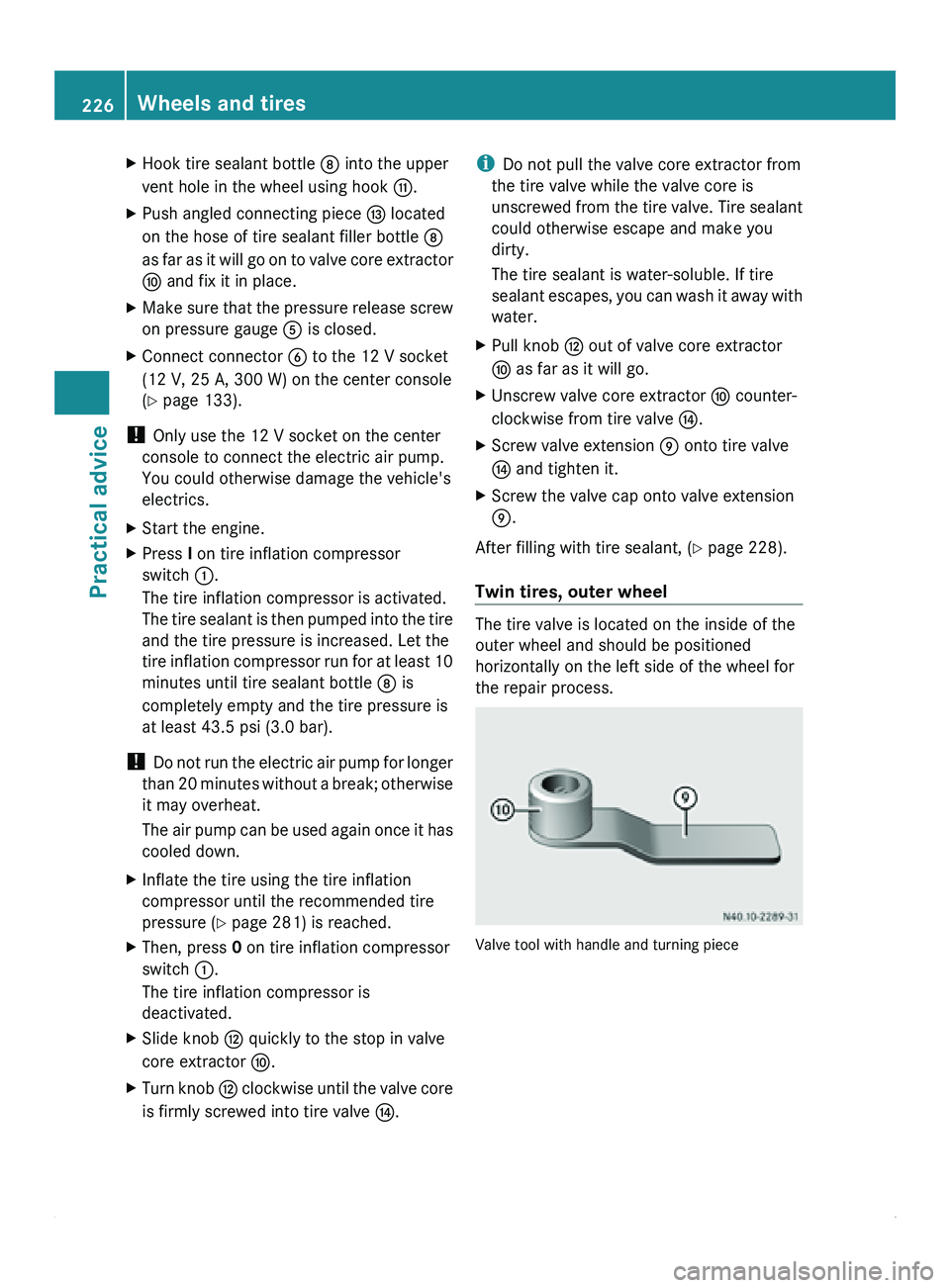
Valve tool with handle and turning piece226
Wheels and tires
Practical advice
Page 229 of 292
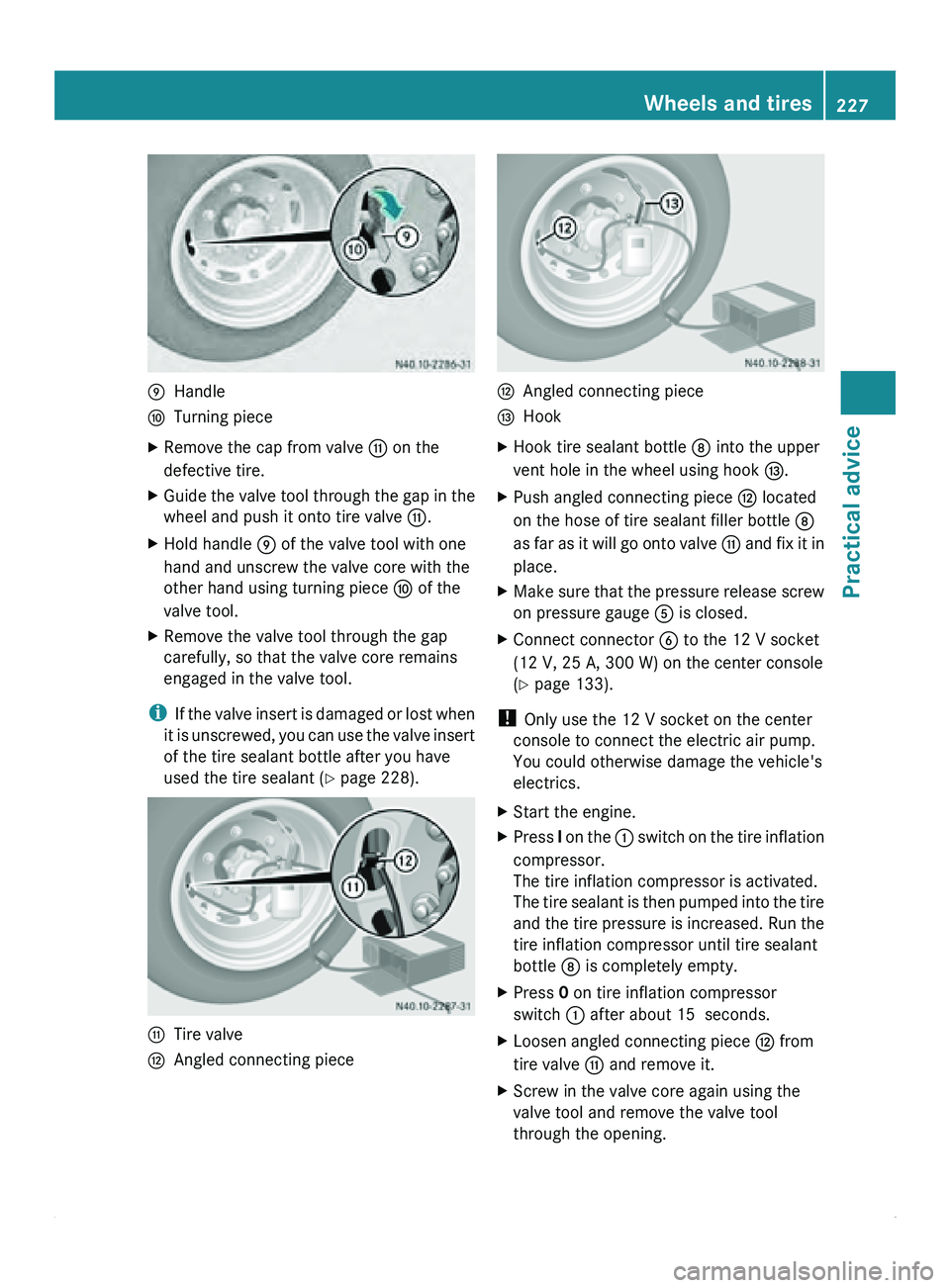
0070
Handle
0071 Turning piece
X Remove the cap from valve 0072 on the
defective tire.
X Guide the valve tool through the gap in the
wheel and push it onto tire valve 0072.
X Hold handle 0070 of the valve tool with one
hand and unscrew the valve core with the
other hand using turning piece 0071 of the
valve tool.
X Remove the valve tool through the gap
carefully, so that the valve core remains
engaged in the valve tool.
i If the
valve
insert is damaged or lost when
it is unscrewed, you can use the valve insert
of the tire sealant bottle after you have
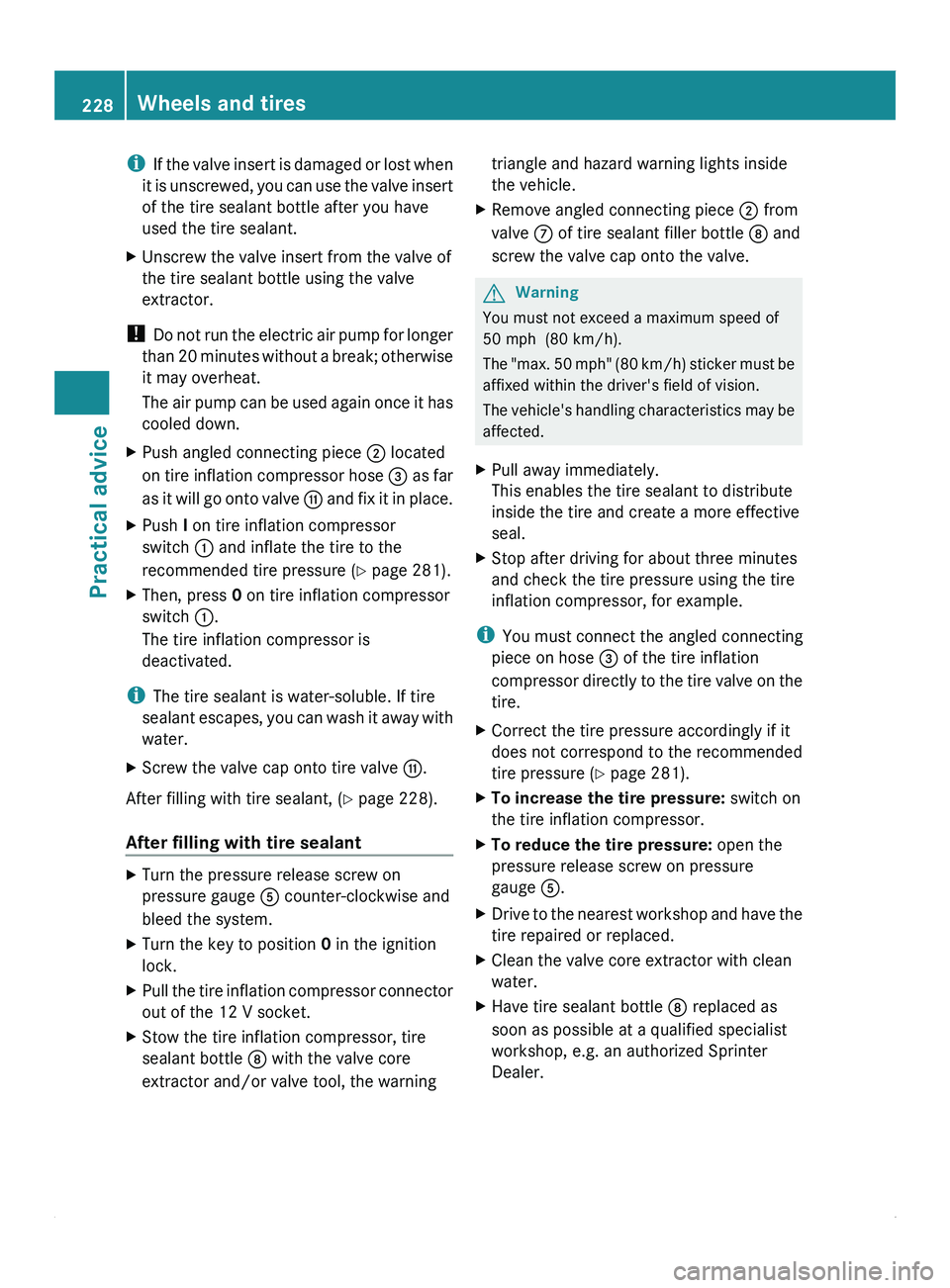
used the tire sealant ( Y page 228).0072
Tire valve
0073 Angled connecting piece 0073
Angled connecting piece
0074 Hook
X Hook tire sealant bottle 006F into the upper
vent hole in the wheel using hook 0074.
X Push angled connecting piece 0073 located
on the hose of tire sealant filler bottle 006F
as far
as
it will go onto valve 0072 and fix it in
place.
X Make sure that the pressure release screw
on pressure gauge 0086 is closed.
X Connect connector 0087 to the 12 V socket
(12 V, 25 A, 300 W) on the center console
(Y page 133).
! Only use the 12 V socket on the center
console to connect the electric air pump.
You could otherwise damage the vehicle's
electrics.
X Start the engine.
X Press I on the 0046
switch on the tire inflation
compressor.
The tire inflation compressor is activated.
The tire sealant is then pumped into the tire
and the tire pressure is increased. Run the
tire inflation compressor until tire sealant
bottle 006F is completely empty.
X Press 0 on tire inflation compressor
switch 0046 after about 15 seconds.
X Loosen angled connecting piece 0073 from
tire valve 0072 and remove it.
X Screw in the valve core again using the
valve tool and remove the valve tool
through the opening. Wheels and tires
227
Practical advice Z
Page 230 of 292
i
If the valve
insert is damaged or lost when
it is unscrewed, you can use the valve insert
of the tire sealant bottle after you have
used the tire sealant.
X Unscrew the valve insert from the valve of
the tire sealant bottle using the valve
extractor.
! Do not run
the electric air pump for longer
than 20 minutes without a break; otherwise
it may overheat.
The air pump can be used again once it has
cooled down.
X Push angled connecting piece 0047 located
on tire inflation
compressor hose 008A as far
as it will go onto valve 0072 and fix it in place.
X Push I on tire inflation compressor
switch 0046 and inflate the tire to the
recommended tire pressure ( Y page 281).
X Then, press 0 on tire inflation compressor
switch 0046.
The tire inflation compressor is
deactivated.
i The tire sealant is water-soluble. If tire
sealant escapes,
you
can wash it away with
water.
X Screw the valve cap onto tire valve 0072.
After filling with tire sealant, ( Y page 228).
After filling with tire sealant X
Turn the pressure release screw on
pressure gauge 0086 counter-clockwise and
bleed the system.
X Turn the key to position 0 in the ignition
lock.
X Pull the tire inflation compressor connector
out of the 12 V socket.
X Stow the tire inflation compressor, tire
sealant bottle 006F with the valve core
extractor and/or valve tool, the warning triangle and hazard warning lights inside
the vehicle.
X Remove angled connecting piece 0047 from
valve 006E of tire sealant filler bottle 006F and
screw the valve cap onto the valve. G
Warning
You must not exceed a maximum speed of
50 mph (80 km/h) .
The "max.
50 mph" (80 km/h) sticker must be
affixed within the driver's field of vision.
The vehicle's handling characteristics may be
affected.
X Pull away immediately.
This enables the tire sealant to distribute
inside the tire and create a more effective
seal.
X Stop after driving for about three minutes
and check the tire pressure using the tire
inflation compressor, for example.
i You must connect the angled connecting
piece on hose 008A of the tire inflation
compressor directly to
the tire valve on the
tire.
X Correct the tire pressure accordingly if it
does not correspond to the recommended
tire pressure ( Y page 281).
X To increase the tire pressure: switch on
the tire inflation compressor.
X To reduce the tire pressure: open the
pressure release screw on pressure
gauge 0086.
X Drive to the nearest workshop and have the
tire repaired or replaced.
X Clean the valve core extractor with clean
water.
X Have tire sealant bottle 006F replaced as
soon as possible at a qualified specialist
workshop, e.g. an authorized Sprinter
Dealer.228
Wheels and tires
Practical advice
Page 231 of 292
G
Warning
If the minimum tire pressure of 43.5 psi
(3 bar) still cannot
be achieved, the tire is too
badly damaged.
Do not drive any further. Consult a qualified
specialist workshop which has the necessary
specialist knowledge and tools to carry out
the work required.
For this reason, we recommend an authorized
Sprinter Dealer. In particular, work relevant to
safety or on safety-related systems must be
carried out at a qualified specialist workshop.
0040Environmental note
Have the used tire sealant disposed of at a
qualified specialist workshop, e.g. an
authorized Sprinter Dealer.
! Have the tire sealant bottle replaced
every eight years at a qualified specialist
workshop, e.g. an authorized Sprinter
Dealer. Changing a
wheel in the event of a flat
tire G
Warning
To avoid the risk of serious or even fatal injury
and to avoid damage to the vehicle, observe
the following:
R the vehicle's jack is intended only to raise
the vehicle for
a short time when changing
a wheel.
R position the jack on the appropriate jacking
point only. Make sure that the jack is
correctly positioned under the jacking point
before raising the vehicle.
R the jack must be placed on a firm, flat
surface.
R before raising the vehicle, you should also
secure it against rolling away, e.g. by
placing chocks under the wheels. Never
release the parking brake while the vehicle
is raised. R
make sure that the distance between the
underside
of the
tires and the ground does
not exceed 1.2 in (3 cm). The vehicle could
otherwise slip off the jack or tip over.
R never place your hands or feet under the
raised vehicle.
R never start the engine, and prevent other
jolts or vibrations while the vehicle is
raised. The vehicle could otherwise slip off
the jack.
Preparing to change a wheel X
Prepare the vehicle as described
(Y
page 222).
X Secure the vehicle against rolling away
using chocks or similar items.
Use the chock ( Y
page 183) to do so. G
Warning
The vehicle
could slip off the jack on uphill and
downhill gradients.
To avoid the risk of causing serious or even
fatal injury or damage to the vehicle, do not
change wheels on uphill and downhill
gradients.
On a level road:
X Place chocks in front of and behind the
wheel which is diagonally opposite the
wheel you wish to change.
X Take the vehicle tool kit and the jack from
the footwell on the co-driver's side
(Y page 182).
X Remove the spare wheel from the spare
wheel bracket ( Y page 185).
X On wheels with wheel bolts, remove the
hub cap.
X Assemble the lug wrench extension using
the middle rod
and the rod with the largest
diameter from the three-piece jack pump
lever.
X Starting with the middle rod, slide the lug
wrench extension as far as it will go onto
the lug wrench. Wheels and tires
229
Practical advice Z
Page 232 of 292
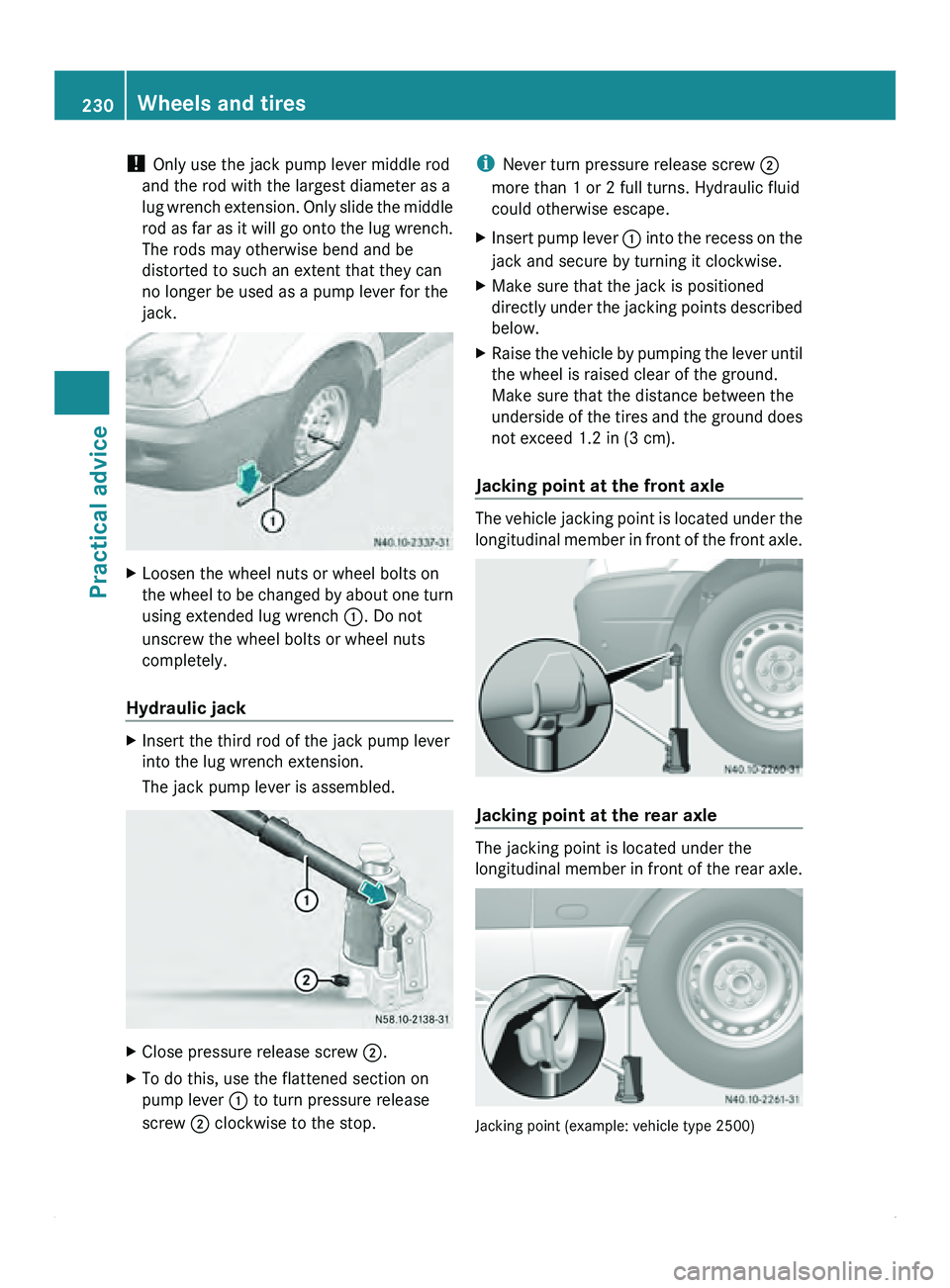
!
Only use the jack pump lever middle rod
and the rod with the largest diameter as a
lug wrench extension.
Only slide the middle
rod as far as it will go onto the lug wrench.
The rods may otherwise bend and be
distorted to such an extent that they can
no longer be used as a pump lever for the
jack. X
Loosen the wheel nuts or wheel bolts on
the wheel to
be changed by about one turn
using extended lug wrench 0046. Do not
unscrew the wheel bolts or wheel nuts
completely.
Hydraulic jack X
Insert the third rod of the jack pump lever
into the lug wrench extension.
The jack pump lever is assembled. X
Close pressure release screw 0047.
X To do this, use the flattened section on
pump lever 0046 to turn pressure release
screw 0047 clockwise to the stop. i
Never turn pressure release screw 0047
more than 1 or 2 full turns. Hydraulic fluid
could otherwise escape.
X Insert pump lever 0046 into the
recess on the
jack and secure by turning it clockwise.
X Make sure that the jack is positioned
directly under the
jacking points described
below.
X Raise the vehicle by pumping the lever until
the wheel is raised clear of the ground.
Make sure that the distance between the
underside of the
tires and the ground does
not exceed 1.2 in (3 cm).
Jacking point at the front axle The vehicle jacking point is located under the
longitudinal member
in
front of the front axle. Jacking point at the rear axle
The jacking point is located under the
longitudinal member
in
front of the rear axle. Jacking point (example: vehicle type 2500)230
Wheels and tires
Practical advice
Page 254 of 292
Vehicle equipment
i Diese Betriebsanleitung beschreibt alle
Modelle, Serien- und
Sonderausstattungen
Ihres Fahrzeugs, die zum Zeitpunkt des
Redaktionsschlusses dieser
Betriebsanleitung erhältlich waren.
Länderspezifische Abweichungen sind
möglich. Beachten Sie, dass Ihr Fahrzeug
nicht mit allen beschriebenen Funktionen
ausgestattet sein könnte. Dies betrifft auch
sicherheitsrelevante Systeme und
Funktionen. Important safety notes
Contact an authorized Sprinter Dealer if you
require information on tested and
recommended tires and wheels for summer
and winter driving.
Advice on purchasing and
caring for tires is also available there. G
Warning
Replace rims or tires with the same
designation, manufacturer and
type as shown
on the original part. For further information,
contact an authorized Sprinter Dealer. If
incorrectly sized rims and tires are mounted,
the wheel brakes or suspension components
can be damaged. Also, the operating
clearance of the wheels and the tires may no
longer be correct. G
Warning!
Worn, old
tires can cause accidents. If the tire
tread is worn to minimum tread depth, or if
the tires have sustained damage, replace
them.
When replacing rims, only use genuine
Sprinter wheel bolts specified for the
particular rim type.
Failure to do so can result
in the bolts loosening and possibly an
accident.
Retreaded tires are not tested or
recommended by the dealer named on the
inside cover page, since previous damage cannot always
be recognized on retreads. The
operating safety of the vehicle cannot be
assured when such tires are used. G
Warning!
Only for vehicles without a tire pressure
monitor:
For safety reasons, we recommend that you
only use tire valves manufactured by
Schrader. These have been tested for use on
your vehicle.
Use only tire valves of type:
R TR 600 for the vehicle types 2500
R TR 418 for the vehicle types 3500
Using other tire inflation valves or valves
made by other manufacturers can result in
tire pressure loss and thereby impair the
operating safety of the vehicle.
! Do not screw additional weights (check
valves, etc.) onto the tire valves. The
electronic components could thus be
damaged. G
Warning
If you feel a sudden significant vibration or
ride disturbance, or
you suspect that possible
damage to your vehicle has occurred, you
should turn on the hazard warning lamps,
carefully slow down, and drive with caution to
an area which is a safe distance from the road.
Inspect the tires and the vehicle underbody
for possible damage. If the vehicle appears
unsafe, have the vehicle towed to the nearest
authorized Sprinter Dealer for repairs. G
Warning
Do not drive with a flat tire. A flat tire affects
the ability to steer or brake the vehicle. You
might lose control of the vehicle. Continued
driving with a
flat tire or driving at high speed
with a flat tire will cause excessive heat build-
up and possibly a fire. 252
Important safety notes
Wheels and tires
Page 255 of 292
Operation
Notes on driving
R If the vehicle
is heavily laden, check the tire
pressures, and correct them, if necessary.
R When parking your vehicle, make sure that
the tires do not get deformed by the curb
or other obstacles. If it is necessary to drive
over curbs, speed humps or similar
elevations, try to do so slowly and at an
obtuse angle. Otherwise, the tires,
particularly the sidewalls, can get
damaged. Notes on regularly inspecting wheels
and tires
G
Warning
Regularly check the tires for damage.
Damaged tires can cause tire inflation
pressure loss. As a result, you could lose
control of your vehicle.
Worn, old tires
can cause accidents. If the tire
tread is worn to minimum tread depth, or if
the tires have sustained damage, replace
them.
R Regularly check the wheels and tires of
your vehicle for damage (e.g. cuts,
punctures, tears, bulges on tires and
deformation or severe corrosion on
wheels), at least once a month, as well as
after driving off-road or on rough roads.
Damaged wheels can cause a loss of tire
pressure.
R Regularly check the tire tread depth and
the condition of the tread across the whole
width of the tire (Y page 253). If necessary,
turn the front wheels to full lock in order to
inspect the inner side of the tire surface.
R All wheels must have a valve cap to protect
the valve against dirt and moisture. Do not
install anything onto the valve (such as tire
pressure monitoring systems) other than the standard valve cap or other valve caps
approved for your vehicle.
R Regularly check the
pressure of all the tires
including the spare wheel, particularly prior
to long trips, and correct the pressure
(Y page 255). Tire tread
G
Warning
Although the
applicable federal motor vehicle
safety laws consider a tire to be worn when
the tread wear indicators (TWI) become
visible at approximately 1
/ 16 in (1.6 mm), we
recommend that you do not allow your tires
to wear down to that level. As tread depth
approaches 1
/ 8 in (3 mm), the adhesion
properties on a
wet road are sharply reduced.
Depending upon the weather and/or road
surface (conditions), the tire traction varies
widely.
Replace tires before they become excessively
worn, as the tire traction on wet road surfaces
decreases significantly when the tread depth
is less than ⅛ in (3 mm).
Tread wear indicators (TWIs) are required by
law. Six indicators are positioned over the tire
tread. They are visible once the tread depth
is approximately 1
/ 16 in (1.6 mm). If this is the
case, the tire is so worn that it must be
replaced.
The recommended tread depth for summer
tires is at least ⅛ in (3 mm). The
recommended tread depth for winter tires is
at least 1/6
in (4 mm). Operation
253
Wheels and tires Z
Page 257 of 292
When you have mounted M+S tires:
X
Check the tire pressure (Y page 255).
X Restart the tire pressure monitor
(Y page 258). G
Warning
If you use your spare wheel when M+S tires
are fitted on the other wheels, be aware that
the difference in
tire characteristics may very
well impair turning stability and that overall
driving stability may be reduced. Adapt your
driving style accordingly.
Have the spare wheel replaced by a regular
road wheel with an M+S tire at the nearest
authorized Sprinter Dealer. Snow chains
Snow chains increase traction on roads in
wintry conditions.
We recommend, for safety reasons, that you
only use class
U snow chains or traction aids
that conform to the SAE type U specification
and are approved for Sprinters. You can
obtain information about snow chains from
any authorized Sprinter Dealer.
R Only use snow chains when the road is
covered by a layer of snow. Do not exceed
the maximum permissible speed of 30 mph
(50 km/h). Remove the snow chains as
soon as possible once the road is no longer
covered with snow.
R The use of snow chains may be restricted
by local regulations. Observe the relevant
regulations when mounting snow chains.
! Check the snow chains for damage before
mounting them. Damaged or worn snow
chains may break, causing damage to
wheels, wheel arches or wheel suspension.
For this reason, you must use only snow
chains that are free of defects. Observe the
manufacturer's mounting instructions. If you intend to mount snow chains, please
bear the following points in mind:
R
You may not mount snow chains on all
wheel/tire combinations. When mounting
the snow chains, note the permissible tire
and snow chain dimensions.
R Mount snow chains only in pairs and only
to the rear wheels. Observe the
manufacturer's mounting instructions.
R Check the chain tension after driving
approximately 0.5 miles (1.0 km) .
i You can deactivate ASR when pulling
away with snow chains mounted.
(
Y page 49). This allows the wheels to spin
in a controlled manner, generating more
tractive force (friction effect). Tire pressure
Notes about tire pressure
G
Warning
Follow recommended tire inflation pressures.
Do not underinflate tires. Underinflated tires
wear excessively and/or unevenly, adversely
affect handling and fuel economy, and are
more likely to fail from being overheated.
Do not overinflate
tires. Overinflated tires can
adversely affect handling and ride comfort,
wear unevenly, increase stopping distance,
and result in sudden deflation (blowout)
because they are more likely to become
punctured or damaged by road debris,
potholes etc.
Do not overload the tires by exceeding the
specified load limit as indicated on the Tire
and Loading Information placard on the
driver's door B-pillar. Overloading the tires
can overheat them, possibly causing a
blowout. Overloading the tires can also result
in handling or steering problems, or brake
failure. Tire pressure
255Wheels and tires Z
Page 258 of 292
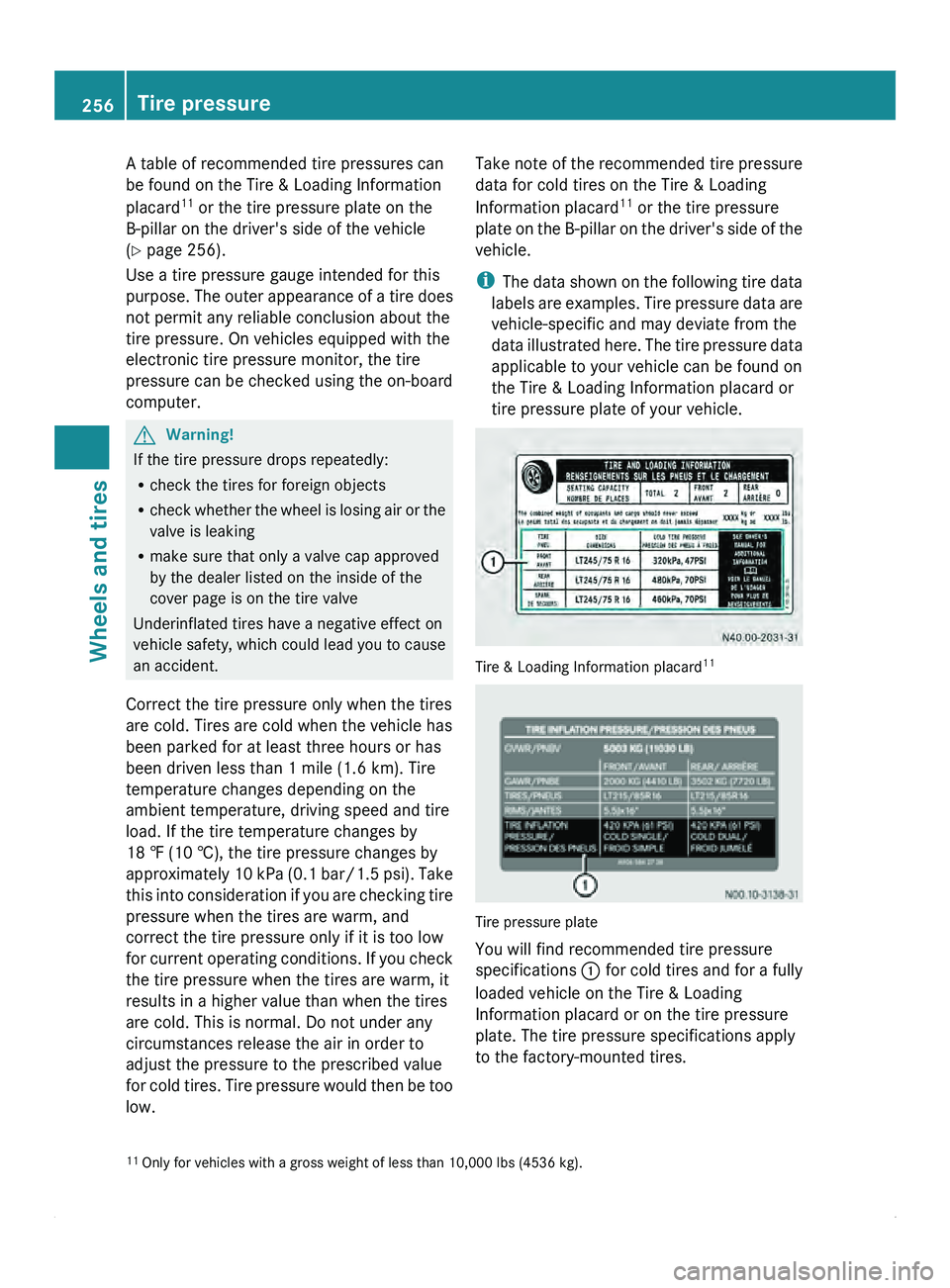
A table of recommended tire pressures can
be found on the Tire & Loading Information
placard
11
or the tire pressure plate on the
B-pillar on the driver's side of the vehicle
(Y page 256).
Use a tire pressure gauge intended for this
purpose. The outer
appearance of a tire does
not permit any reliable conclusion about the
tire pressure. On vehicles equipped with the
electronic tire pressure monitor, the tire
pressure can be checked using the on-board
computer. G
Warning!
If the tire pressure drops repeatedly:
R check the tires for foreign objects
R check whether the
wheel is losing air or the
valve is leaking
R make sure that only a valve cap approved
by the dealer listed on the inside of the
cover page is on the tire valve
Underinflated tires have a negative effect on
vehicle safety, which could lead you to cause
an accident.
Correct the tire pressure only when the tires
are cold. Tires are cold when the vehicle has
been parked for at least three hours or has
been driven less than 1 mile (1.6 km). Tire
temperature changes depending on the
ambient temperature, driving speed and tire
load. If the tire temperature changes by
18 ‡ (10 †), the tire pressure changes by
approximately 10 kPa (0.1 bar/1.5 psi). Take
this into consideration if you are checking tire
pressure when the tires are warm, and
correct the tire pressure only if it is too low
for current operating conditions. If you check
the tire pressure when the tires are warm, it
results in a higher value than when the tires
are cold. This is normal. Do not under any
circumstances release the air in order to
adjust the pressure to the prescribed value
for cold tires. Tire pressure would then be too
low. Take note of the recommended tire pressure
data for cold tires on the Tire & Loading
Information placard
11
or the tire pressure
plate on the
B-pillar on the driver's side of the
vehicle.
i The data shown on the following tire data
labels are examples. Tire pressure data are
vehicle-specific and may deviate from the
data illustrated here. The tire pressure data
applicable to your vehicle can be found on
the Tire & Loading Information placard or
tire pressure plate of your vehicle. Tire & Loading Information placard
11 Tire pressure plate
You will find recommended tire pressure
specifications
0046 for cold
tires and for a fully
loaded vehicle on the Tire & Loading
Information placard or on the tire pressure
plate. The tire pressure specifications apply
to the factory-mounted tires.
11 Only for vehicles with a gross weight of less than 10,000 lbs (4536 kg).256
Tire pressure
Wheels and tires
Page 259 of 292
Tire pressure too low or too high
Underinflated tires G
Warning
Follow recommended tire inflation pressures.
Do not underinflate tires. Underinflated tires
wear excessively and/or unevenly, adversely
affect handling and fuel economy, and are
more likely to fail from being overheated.
Underinflated tires can:
R wear excessively and/or unevenly
R adversely affect fuel economy
R fail from being overheated
R adversely affect handling
Overinflated tires G
Warning
Follow recommended tire inflation pressures.
Do not overinflate
tires. Overinflated tires can
adversely affect handling and ride comfort,
wear unevenly, increase stopping distance,
and result in sudden deflation (blowout)
because they are more likely to become
punctured or damaged by road debris,
potholes etc.
Overinflated tires can:
R adversely affect handling
R wear excessively and/or unevenly
R be more likely to become damaged
R adversely affect ride comfort
R increase stopping distance
Maximum tire pressures G
Warning
Never exceed the maximum tire inflation
pressure. Follow recommended tire inflation
pressures.
Do not underinflate tires. Underinflated tires
wear excessively and/or unevenly, adversely affect handling and fuel economy, and are
more likely to fail from being overheated.
Do not
overinflate
tires. Overinflated tires can
adversely affect handling and ride comfort,
wear unevenly, increase stopping distance,
and result in sudden deflation (blowout)
because they are more likely to become
punctured or damaged by road debris,
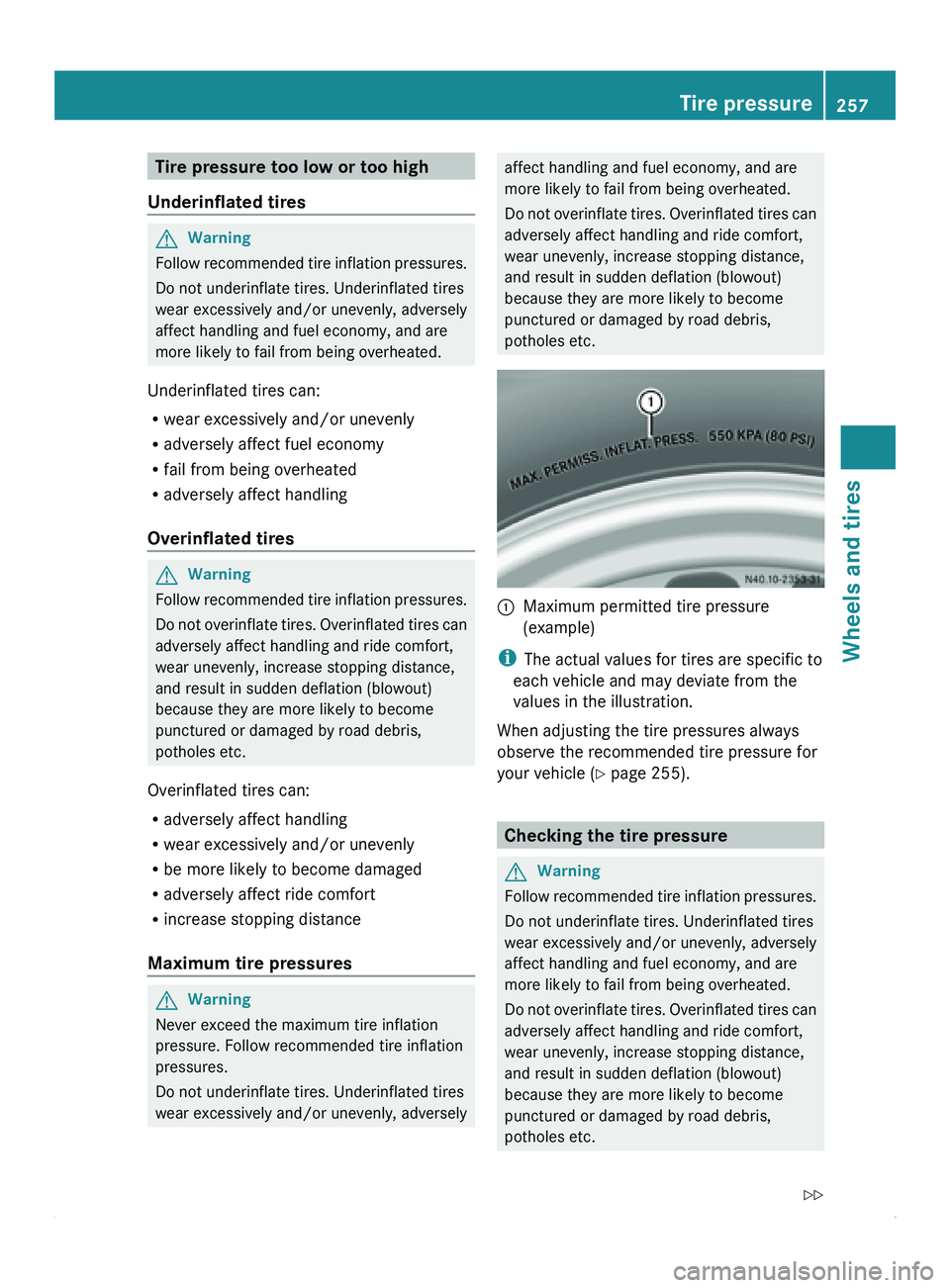
potholes etc. 0046
Maximum permitted tire pressure
(example)
i The actual values for tires are specific to
each vehicle and may deviate from the
values in the illustration.
When adjusting the tire pressures always
observe the recommended tire pressure for
your vehicle ( Y page 255). Checking the tire pressure
G
Warning
Follow recommended
tire inflation pressures.
Do not underinflate tires. Underinflated tires
wear excessively and/or unevenly, adversely
affect handling and fuel economy, and are
more likely to fail from being overheated.
Do not overinflate
tires. Overinflated tires can
adversely affect handling and ride comfort,
wear unevenly, increase stopping distance,
and result in sudden deflation (blowout)
because they are more likely to become
punctured or damaged by road debris,
potholes etc. Tire pressure
257
Wheels and tires
Z