flat tire MERCEDES-BENZ SPRINTER 2012 MY12 Operator’s Manual
[x] Cancel search | Manufacturer: MERCEDES-BENZ, Model Year: 2012, Model line: SPRINTER, Model: MERCEDES-BENZ SPRINTER 2012Pages: 292, PDF Size: 6.75 MB
Page 260 of 292
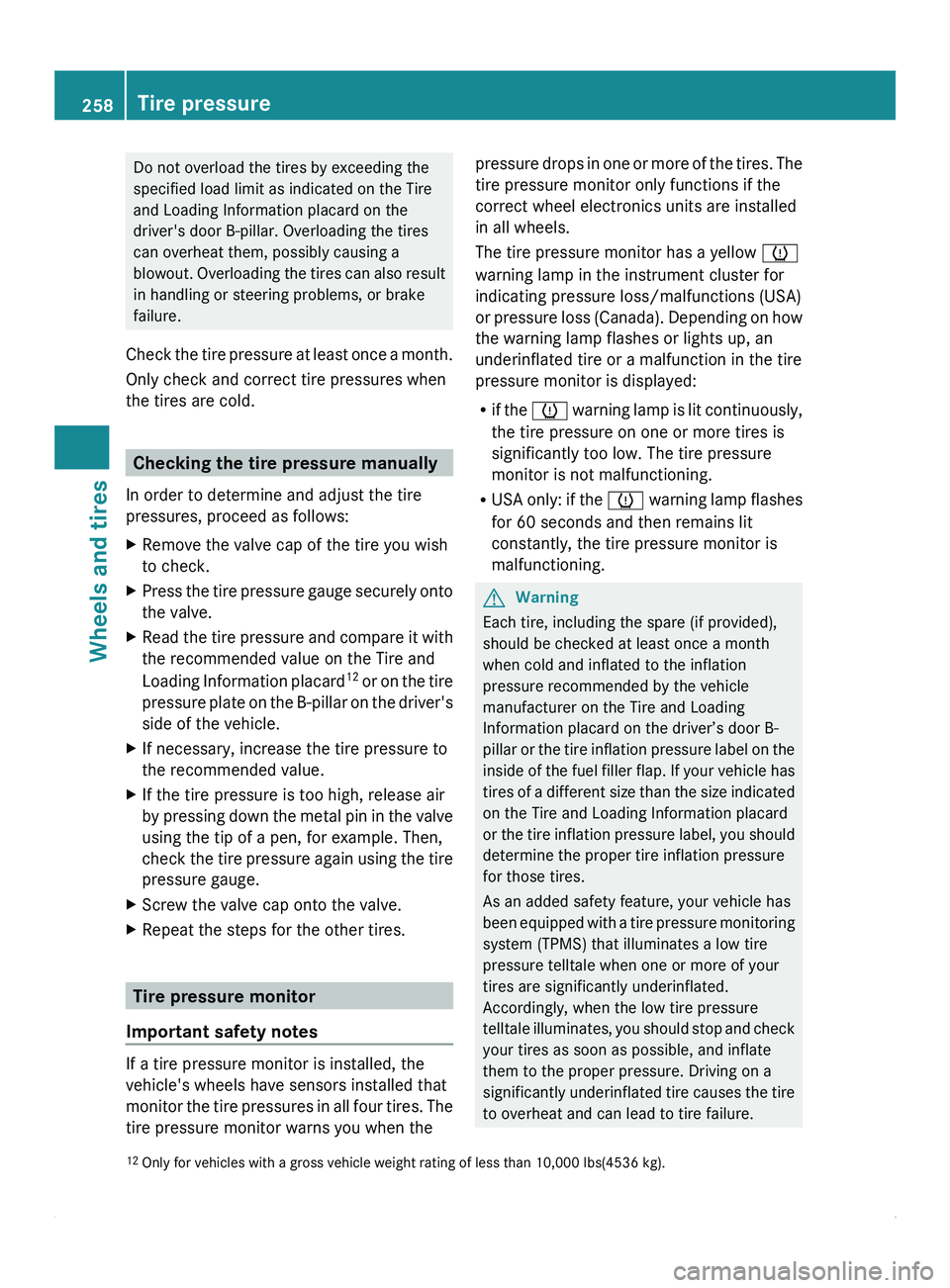
Do not overload the tires by exceeding the
specified load limit as indicated on the Tire
and Loading Information placard on the
driver's door B-pillar. Overloading the tires
can overheat them, possibly causing a
blowout. Overloading
the tires can also result
in handling or steering problems, or brake
failure.
Check the tire pressure at least once a month.
Only check and correct tire pressures when
the tires are cold. Checking the tire pressure manually
In order to determine and adjust the tire
pressures, proceed as follows:
X Remove the valve cap of the tire you wish
to check.
X Press the
tire pressure gauge securely onto
the valve.
X Read the tire pressure and compare it with
the recommended value on the Tire and
Loading Information placard12
or on the tire
pressure plate on the B-pillar on the driver's
side of the vehicle.
X If necessary, increase the tire pressure to
the recommended value.
X If the tire pressure is too high, release air
by pressing down
the metal pin in the valve
using the tip of a pen, for example. Then,
check the tire pressure again using the tire
pressure gauge.
X Screw the valve cap onto the valve.
X Repeat the steps for the other tires. Tire pressure monitor
Important safety notes If a tire pressure monitor is installed, the
vehicle's wheels have sensors installed that
monitor the
tire
pressures in all four tires. The
tire pressure monitor warns you when the pressure drops in one or more of the tires. The
tire pressure monitor only functions if the
correct wheel electronics units are installed
in all wheels.
The tire pressure monitor has a yellow
0077
warning lamp in the instrument cluster for
indicating pressure loss/malfunctions (USA)
or pressure loss
(Canada). Depending on how
the warning lamp flashes or lights up, an
underinflated tire or a malfunction in the tire
pressure monitor is displayed:
R if the 0077 warning lamp is lit continuously,
the tire pressure on one or more tires is
significantly too low. The tire pressure
monitor is not malfunctioning.
R USA only: if the 0077 warning lamp flashes
for 60 seconds and then remains lit
constantly, the tire pressure monitor is
malfunctioning. G
Warning
Each tire, including the spare (if provided),
should be checked at least once a month
when cold and inflated to the inflation
pressure recommended by the vehicle
manufacturer on the Tire and Loading
Information placard on the driver’s door B-
pillar or the
tire inflation pressure label on the
inside of the fuel filler flap. If your vehicle has
tires of a different size than the size indicated
on the Tire and Loading Information placard
or the tire inflation pressure label, you should
determine the proper tire inflation pressure
for those tires.
As an added safety feature, your vehicle has
been equipped with a tire pressure monitoring
system (TPMS) that illuminates a low tire
pressure telltale when one or more of your
tires are significantly underinflated.
Accordingly, when the low tire pressure
telltale illuminates, you should stop and check
your tires as soon as possible, and inflate
them to the proper pressure. Driving on a
significantly underinflated tire causes the tire
to overheat and can lead to tire failure.
12 Only for vehicles with a gross vehicle weight rating of less than 10,000 lbs(4536 kg).258
Tire pressure
Wheels and tires
Page 261 of 292
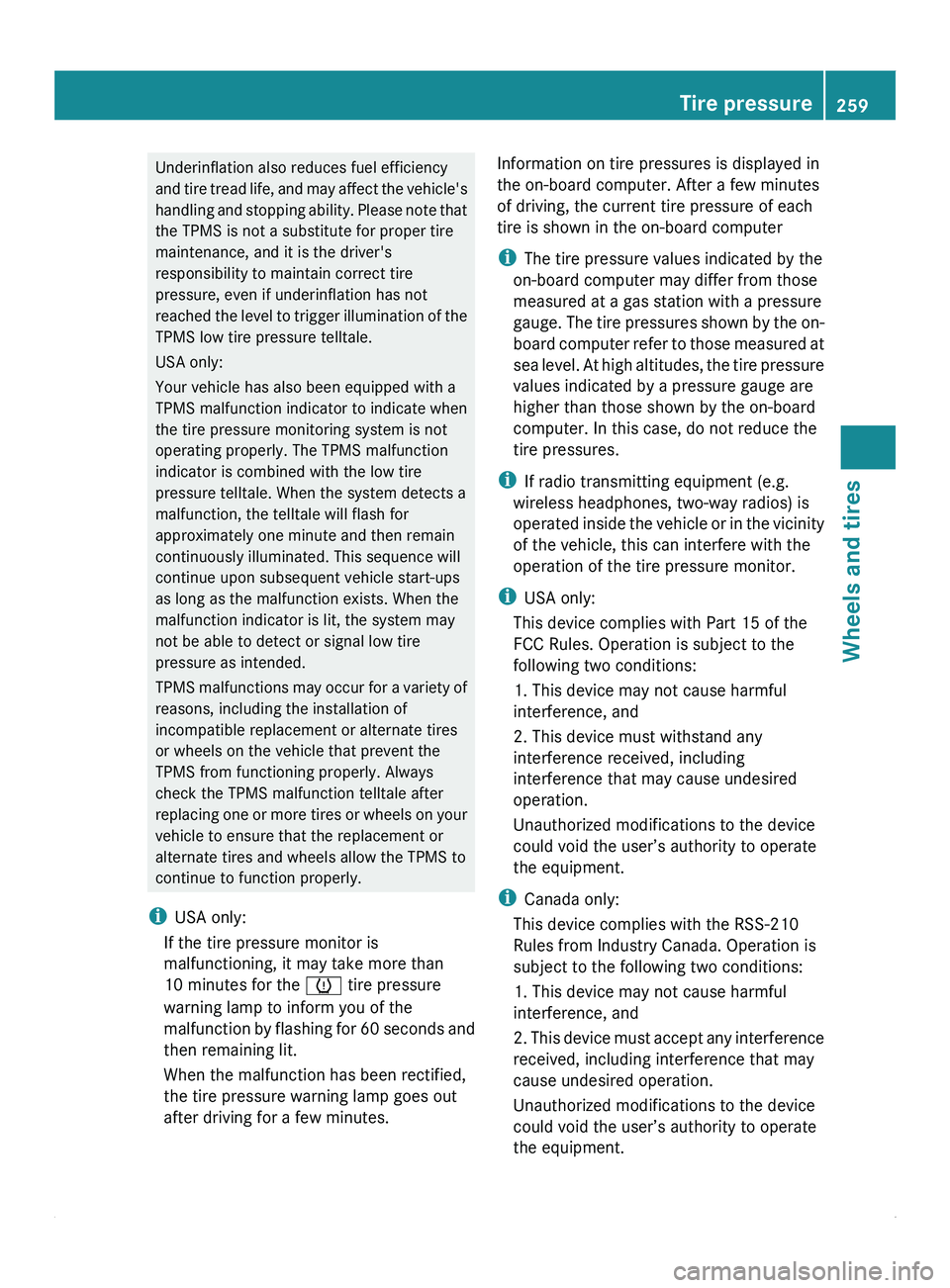
Underinflation also reduces fuel efficiency
and tire
tread
life, and may affect the vehicle's
handling and stopping ability. Please note that
the TPMS is not a substitute for proper tire
maintenance, and it is the driver's
responsibility to maintain correct tire
pressure, even if underinflation has not
reached the level to trigger illumination of the
TPMS low tire pressure telltale.
USA only:
Your vehicle has also been equipped with a
TPMS malfunction indicator to indicate when
the tire pressure monitoring system is not
operating properly. The TPMS malfunction
indicator is combined with the low tire
pressure telltale. When the system detects a
malfunction, the telltale will flash for
approximately one minute and then remain
continuously illuminated. This sequence will
continue upon subsequent vehicle start-ups
as long as the malfunction exists. When the
malfunction indicator is lit, the system may
not be able to detect or signal low tire
pressure as intended.
TPMS malfunctions may occur for a variety of
reasons, including the installation of
incompatible replacement or alternate tires
or wheels on the vehicle that prevent the
TPMS from functioning properly. Always
check the TPMS malfunction telltale after
replacing one or more tires or wheels on your
vehicle to ensure that the replacement or
alternate tires and wheels allow the TPMS to
continue to function properly.
i USA only:
If the tire pressure monitor is
malfunctioning, it may take more than
10 minutes for the 0077 tire pressure
warning lamp to inform you of the
malfunction by flashing for 60 seconds and
then remaining lit.
When the malfunction has been rectified,
the tire pressure warning lamp goes out
after driving for a few minutes. Information on tire pressures is displayed in
the on-board computer. After a few minutes
of driving, the current tire pressure of each
tire is shown in the on-board computer
i
The tire pressure values indicated by the
on-board computer may differ from those
measured at a gas station with a pressure
gauge. The tire
pressures shown by the on-
board computer refer to those measured at
sea level. At high altitudes, the tire pressure
values indicated by a pressure gauge are
higher than those shown by the on-board
computer. In this case, do not reduce the
tire pressures.
i If radio transmitting equipment (e.g.
wireless headphones, two-way radios) is
operated inside the vehicle or in the vicinity
of the vehicle, this can interfere with the
operation of the tire pressure monitor.
i USA only:
This device complies with Part 15 of the
FCC Rules. Operation is subject to the
following two conditions:
1. This device may not cause harmful
interference, and
2. This device must withstand any
interference received, including
interference that may cause undesired
operation.
Unauthorized modifications to the device
could void the user’s authority to operate
the equipment.
i Canada only:
This device complies with the RSS-210
Rules from Industry Canada. Operation is
subject to the following two conditions:
1. This device may not cause harmful
interference, and
2. This device must accept any interference
received, including interference that may
cause undesired operation.
Unauthorized modifications to the device
could void the user’s authority to operate
the equipment. Tire pressure
259
Wheels and tires Z
Page 273 of 292
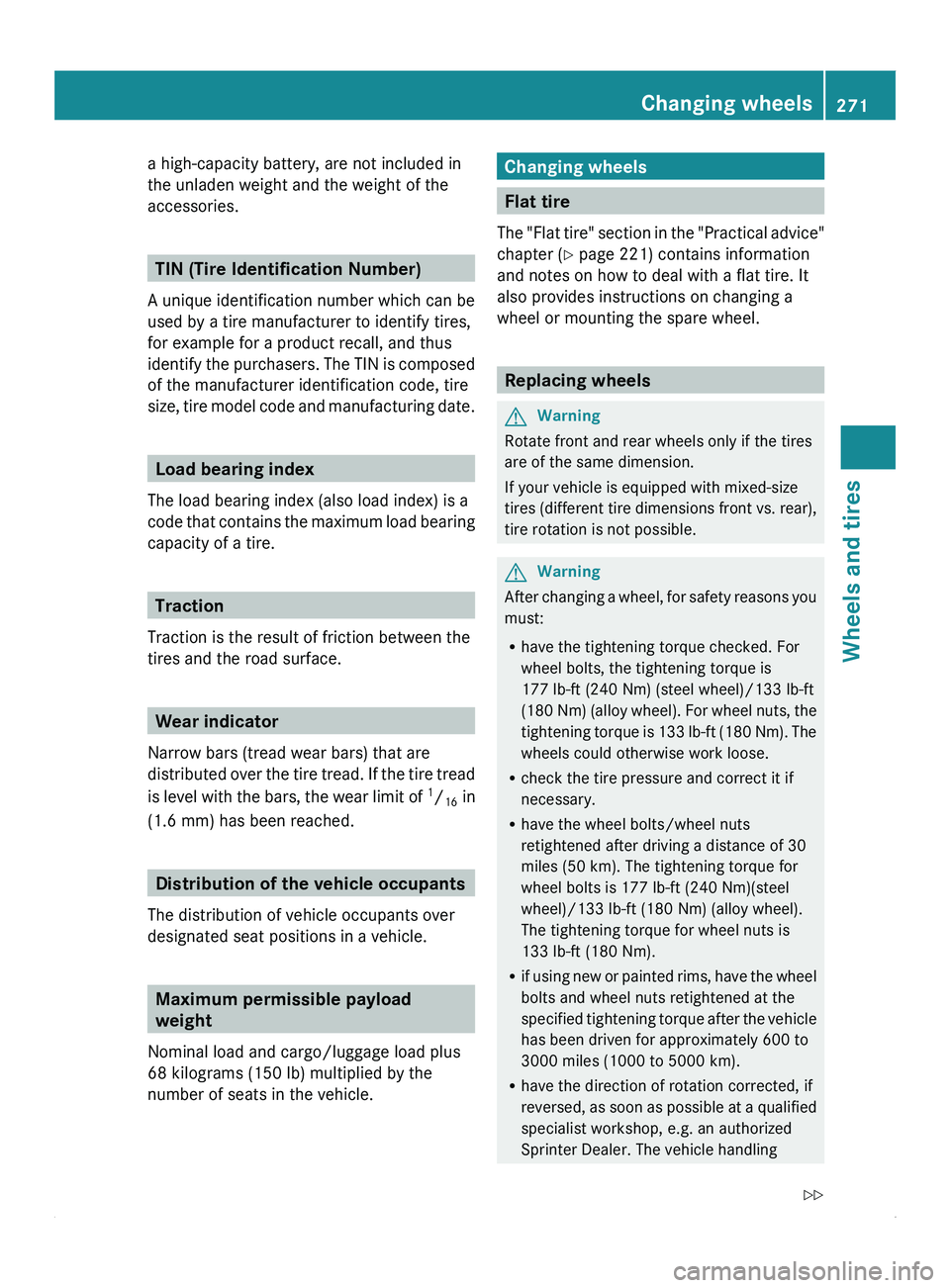
a high-capacity battery, are not included in
the unladen weight and the weight of the
accessories.
TIN (Tire Identification Number)
A unique identification number which can be
used by a tire manufacturer to identify tires,
for example for a product recall, and thus
identify the purchasers.
The TIN is composed
of the manufacturer identification code, tire
size, tire model code and manufacturing date. Load bearing index
The load bearing index (also load index) is a
code that contains
the maximum load bearing
capacity of a tire. Traction
Traction is the result of friction between the
tires and the road surface. Wear indicator
Narrow bars (tread wear bars) that are
distributed over the
tire tread. If the tire tread
is level with the bars, the wear limit of 1
/ 16 in
(1.6 mm) has been reached. Distribution of the vehicle occupants
The distribution of vehicle occupants over
designated seat positions in a vehicle. Maximum permissible payload
weight
Nominal load and cargo/luggage load plus
68 kilograms (150 lb) multiplied by the
number of seats in the vehicle. Changing wheels
Flat tire
The "Flat tire"
section in the "Practical advice"
chapter (Y page 221) contains information
and notes on how to deal with a flat tire. It
also provides instructions on changing a
wheel or mounting the spare wheel. Replacing wheels
G
Warning
Rotate front and rear wheels only if the tires
are of the same dimension.
If your vehicle is equipped with mixed-size
tires (different tire
dimensions front vs. rear),
tire rotation is not possible. G
Warning
After changing a wheel, for safety reasons you
must:
R have the tightening torque checked. For
wheel bolts, the tightening torque is
177 lb-ft (240 Nm) (steel wheel)/ 133 lb-ft
(180
Nm) (alloy wheel). For wheel nuts, the
tightening torque is 133 lb-ft (180 Nm). The
wheels could otherwise work loose.
R check the tire pressure and correct it if
necessary.
R have the wheel bolts/wheel nuts
retightened after driving a distance of 30
miles (50 km). The tightening torque for
wheel bolts is 177 lb-ft (240 Nm)(steel
wheel)/133 lb-ft (180 Nm) (alloy wheel).
The tightening torque for wheel nuts is
133 lb-ft (180 Nm).
R if using new or painted rims, have the wheel
bolts and wheel nuts retightened at the
specified tightening torque after the vehicle
has been driven for approximately 600 to
3000 miles (1000 to 5000 km).
R have the direction of rotation corrected, if
reversed, as soon as possible at a qualified
specialist workshop, e.g. an authorized
Sprinter Dealer. The vehicle handling Changing wheels
271
Wheels and tires
Z
Page 283 of 292
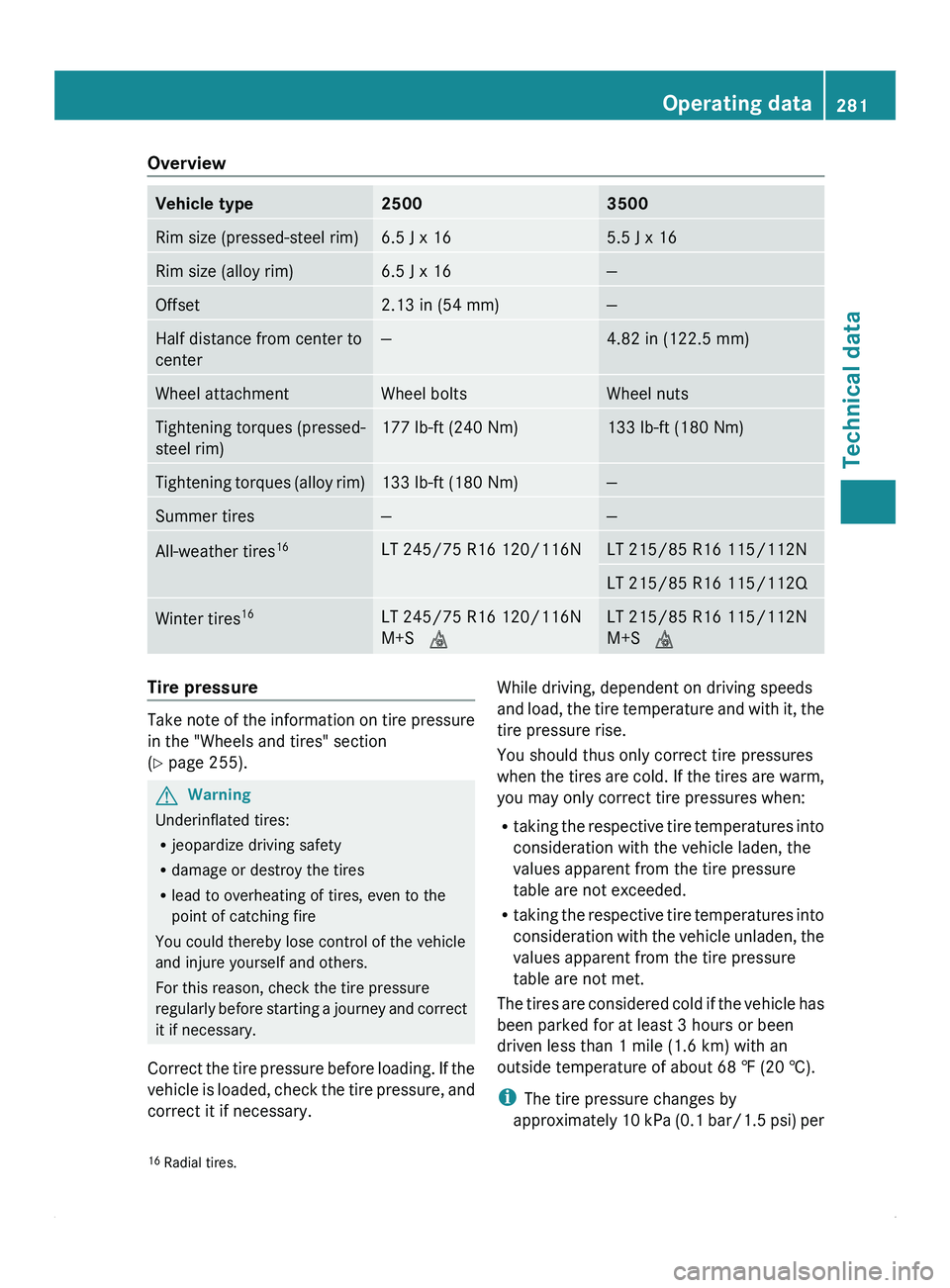
Overview
Vehicle type 2500 3500
Rim size (pressed-steel rim) 6.5 J x 16 5.5 J x 16
Rim size (alloy rim) 6.5 J x 16 —
Offset 2.13 in (54 mm) —
Half distance from center to
center — 4.82 in (122.5 mm)
Wheel attachment Wheel bolts Wheel nuts
Tightening torques (pressed-
steel rim) 177 lb-ft (240 Nm) 133 lb-ft (180 Nm)
Tightening torques (alloy rim) 133 lb-ft (180 Nm) —
Summer tires — —
All-weather tires
16 LT 245/75 R16 120/116N LT 215/85 R16 115/112N
LT 215/85 R16 115/112Q
Winter tires
16 LT 245/75 R16 120/116N
M+S 004D LT 215/85 R16 115/112N
M+S 004D
Tire pressure
Take note of the information on tire pressure
in the "Wheels and tires" section
(Y page 255).
G
Warning
Underinflated tires:
R jeopardize driving safety
R damage or destroy the tires
R lead to overheating of tires, even to the
point of catching fire
You could thereby lose control of the vehicle
and injure yourself and others.
For this reason, check the tire pressure
regularly before starting
a journey and correct
it if necessary.
Correct the tire pressure before loading. If the
vehicle is loaded, check the tire pressure, and
correct it if necessary. While driving, dependent on driving speeds
and
load, the
tire temperature and with it, the
tire pressure rise.
You should thus only correct tire pressures
when the tires are cold. If the tires are warm,
you may only correct tire pressures when:
R taking the respective tire temperatures into
consideration with the vehicle laden, the
values apparent from the tire pressure
table are not exceeded.
R taking the respective tire temperatures into
consideration with the vehicle unladen, the
values apparent from the tire pressure
table are not met.
The tires are considered cold if the vehicle has
been parked for at least 3 hours or been
driven less than 1 mile (1.6 km) with an
outside temperature of about 68 ‡ (20 †).
i The tire pressure changes by
approximately 10 kPa (0.1 bar/1.5 psi) per
16 Radial tires. Operating data
281
Technical data Z