mirror MERCEDES-BENZ SPRINTER 2012 MY12 Operator’s Manual
[x] Cancel search | Manufacturer: MERCEDES-BENZ, Model Year: 2012, Model line: SPRINTER, Model: MERCEDES-BENZ SPRINTER 2012Pages: 292, PDF Size: 6.75 MB
Page 153 of 292
X
Make sure that the automatic transmission
is set to position P.
X Engage the vehicle's parking brake.
X Close the rear doors.
X Couple the trailer.
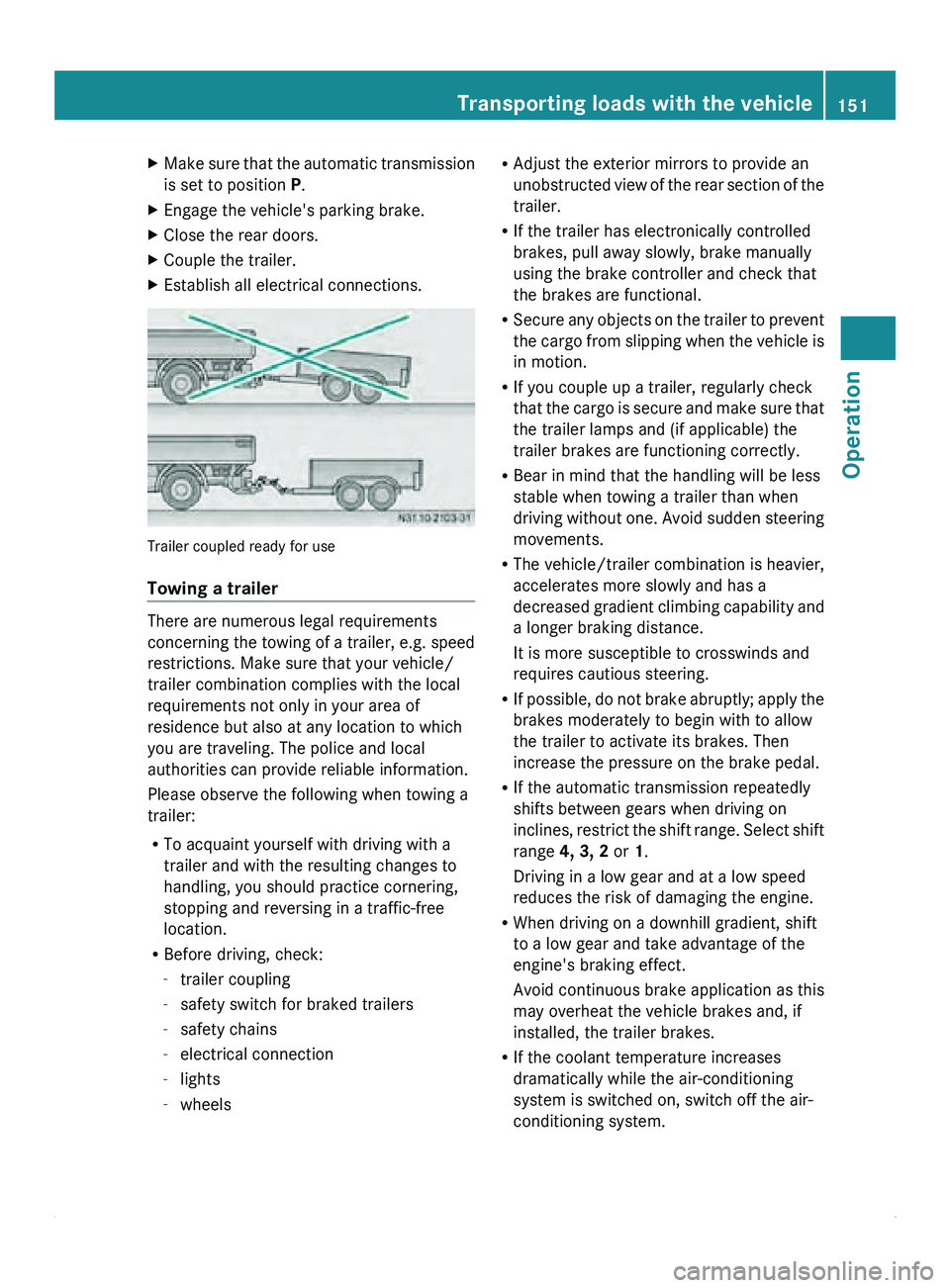
X Establish all electrical connections. Trailer coupled ready for use
Towing a trailer
There are numerous legal requirements
concerning the
towing
of a trailer, e.g. speed
restrictions. Make sure that your vehicle/
trailer combination complies with the local
requirements not only in your area of
residence but also at any location to which
you are traveling. The police and local
authorities can provide reliable information.
Please observe the following when towing a
trailer:
R To acquaint yourself with driving with a
trailer and with the resulting changes to
handling, you should practice cornering,
stopping and reversing in a traffic-free
location.
R Before driving, check:
-trailer coupling
- safety switch for braked trailers
- safety chains
- electrical connection
- lights
- wheels R
Adjust the exterior mirrors to provide an
unobstructed view of
the rear section of the
trailer.
R If the trailer has electronically controlled
brakes, pull away slowly, brake manually
using the brake controller and check that
the brakes are functional.
R Secure any objects on the trailer to prevent
the cargo from slipping when the vehicle is
in motion.
R If you couple up a trailer, regularly check
that the cargo is secure and make sure that
the trailer lamps and (if applicable) the
trailer brakes are functioning correctly.
R Bear in mind that the handling will be less
stable when towing a trailer than when
driving without one. Avoid sudden steering
movements.
R The vehicle/trailer combination is heavier,
accelerates more slowly and has a
decreased gradient climbing capability and
a longer braking distance.
It is more susceptible to crosswinds and
requires cautious steering.
R If possible, do not brake abruptly; apply the
brakes moderately to begin with to allow
the trailer to activate its brakes. Then
increase the pressure on the brake pedal.
R If the automatic transmission repeatedly
shifts between gears when driving on
inclines, restrict the shift range. Select shift
range 4, 3, 2 or 1.
Driving in a low gear and at a low speed
reduces the risk of damaging the engine.
R When driving on a downhill gradient, shift
to a low gear and take advantage of the
engine's braking effect.
Avoid continuous brake application as this
may overheat the vehicle brakes and, if
installed, the trailer brakes.
R If the coolant temperature increases
dramatically while the air-conditioning
system is switched on, switch off the air-
conditioning system. Transporting loads with the vehicle
151
Operation Z
Page 167 of 292
from the windshield and the wiper blades to
prevent smearing.
Smears
impair the driver's
view, and their effect is made worse in
conditions where visibility is poor (e.g. glare,
mist, darkness, snow). You may therefore fail
to recognize dangers, or not recognize them
in time, and thereby cause an accident.
! Make sure that the automatic car wash is
suitable for the size of the vehicle.
Before washing the vehicle in an automatic
car wash, fold in the exterior mirrors and
remove the radio/telephone antenna.
Otherwise, the exterior mirror, antenna or
the vehicle itself could be damaged.
Make sure that the antenna is installed and
that the exterior mirrors are fully folded out
again when you leave the automatic car
wash.
! Make sure that the side windows are
completely closed, that the ventilation/
heating is switched off and that the
windshield wiper switch is set to 0.
Otherwise, the rain/light sensor could be
activated, triggering unintended wiper
movements. This can cause damage to the
vehicle.
After putting the vehicle through an
automatic car wash, wipe off wax from:
R the rear-view camera lens ( Y page 163)
R the windshield and the wiper blades. This
prevents smears and reduces wiping noise
which can be caused by residue on the
windshield. Cleaning the engine
! Water must not
enter intake or ventilation
openings. When cleaning with high
pressure water or steam cleaners, the
spray must not be aimed directly at
electrical components or the terminals of
electrical lines. Preserve the engine after the engine has
been cleaned.
Protect
the belt drive system
from exposure to the preservative agent. Alloy wheels
Clean the alloy wheels regularly.
! Do not use
any acidic or alkaline cleaning
agents. They can cause corrosion on the
wheel bolts (wheel nuts) or the retainer
springs for the wheel-balancing weights. After driving off-road or on
construction sites
G
Warning
Dirt on the vehicle can affect road and
operating safety.
It can specifically result in the following
dangers:
Stone impact. Stones trapped between the
tires can be thrown out while driving. This
could injure other
road users or damage other
vehicles (especially windscreens).
Risk of skidding. Dirt and mud on the tires/
on the road reduce the grip of the tires on the
road. This especially applies when the surface
is wet. The vehicle could then start to skid.
Risk of injury. Dirt and mud on the steps and
entrance can make the steps unsafe. This
could cause you to slip off the steps and be
injured.
For this reason, you should always clean your
vehicle carefully after driving off-road or on
construction sites before driving on public
roads. Observe the corresponding safety
notices in this chapter if you use a power
washer or an automatic car wash to clean your
vehicle.
X Clean the vehicle, paying special attention
to the following:
R
Lighting system
R Windows and exterior mirrors
R Access steps and entrances Cleaning and care
165
Operation Z
Page 236 of 292
Do not change Xenon bulbs yourself, but have
them replaced at a qualified specialist
workshop which has
the necessary specialist
knowledge and tools to carry out the work
required.
We recommend an authorized Sprinter Dealer
for this purpose. In particular, work relevant
to safety or on safety-related systems must
be carried out at a qualified specialist
workshop.
R To prevent short circuits, switch off the
lighting system before changing a bulb.
R Only touch new bulbs with a clean, lint-free
cloth or similar. Do not work with wet or
greasy fingers.
R Only install 12 V bulbs of the same type and
of the correct wattage.
R Have the headlamp setting checked
regularly.
R If the new bulb still does not light up consult
a qualified specialist workshop, e.g. an
authorized Sprinter Dealer.
R Have the following LEDs and bulbs replaced
at a qualified specialist workshop, e.g. an
authorized Sprinter Dealer:
-the additional turn signals in the exterior
mirrors
- the high-mounted brake lamp
- the Bi-Xenon bulbs
- the fog lamps
! Make sure the bulbs are always securely
installed. Changing bulbs
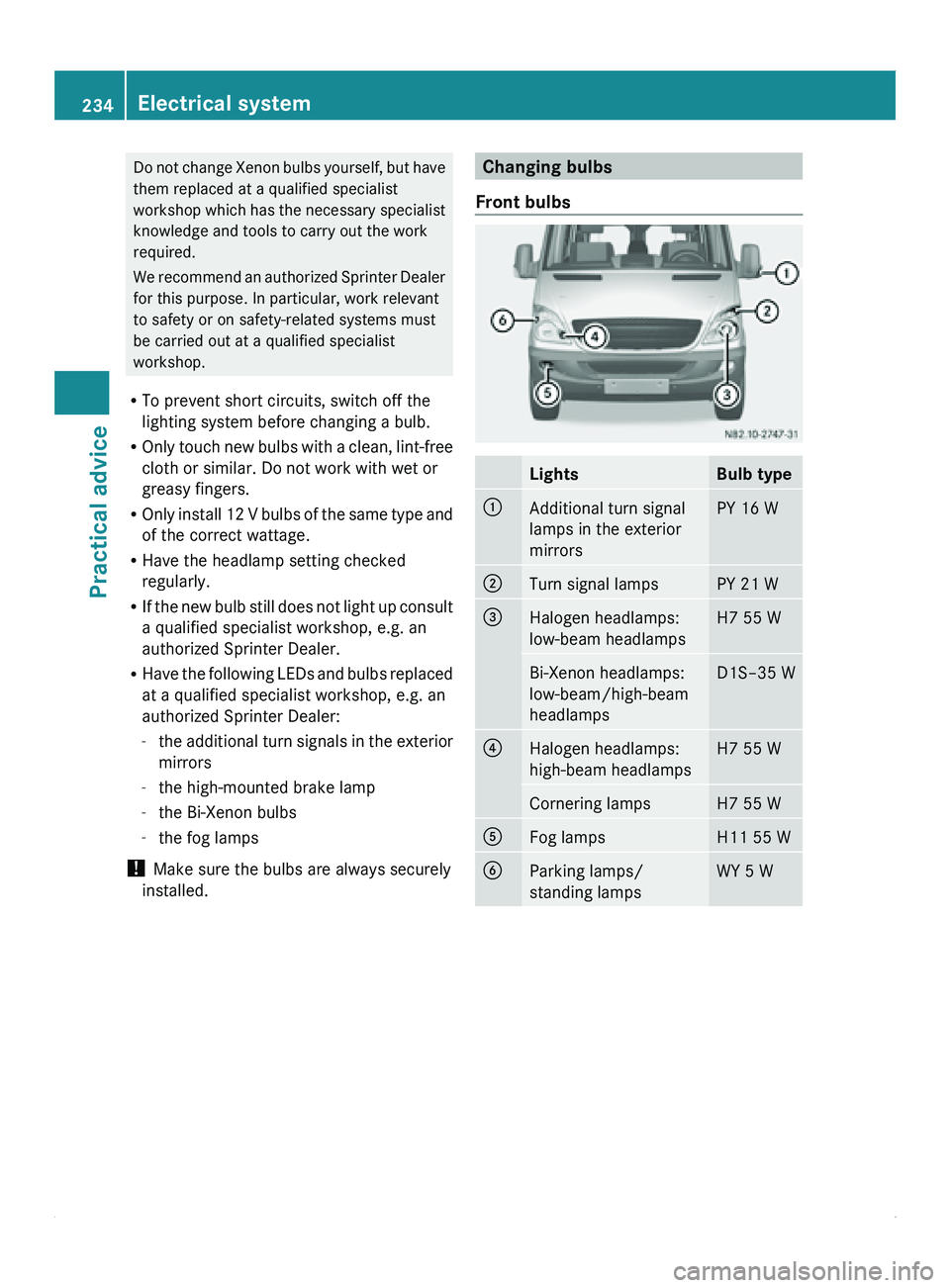
Front bulbs Lights Bulb type
0046
Additional turn signal
lamps in the exterior
mirrors PY 16 W
0047
Turn signal lamps PY 21 W
008A
Halogen headlamps:
low-beam headlamps H7 55 W
Bi-Xenon headlamps:
low-beam/high-beam
headlamps D1S–35 W
0088
Halogen headlamps:
high-beam headlamps H7 55 W
Cornering lamps H7 55 W
0086
Fog lamps H11 55 W
0087
Parking lamps/
standing lamps WY 5 W234
Electrical system
Practical advice
Page 246 of 292
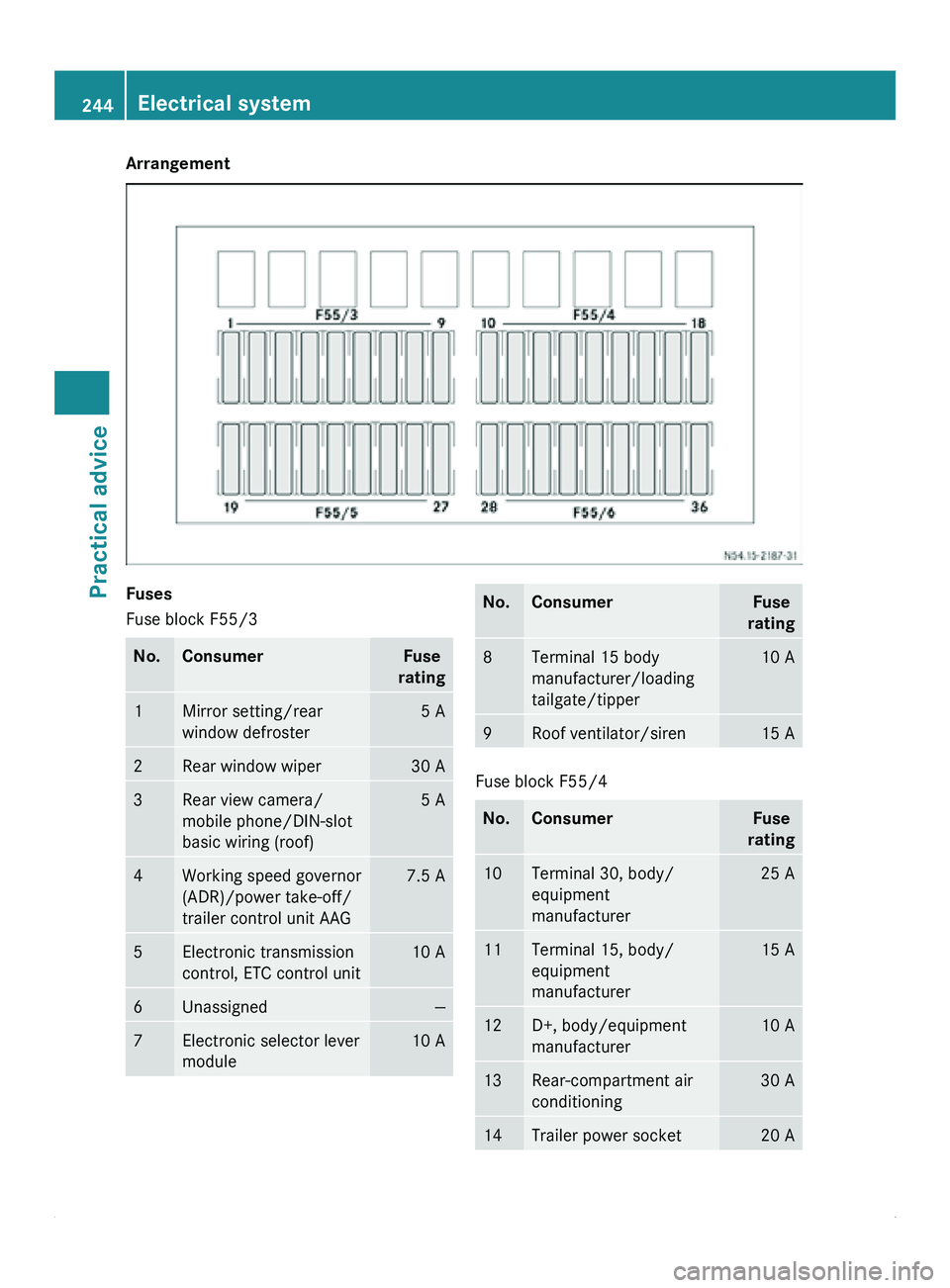
Arrangement
Fuses
Fuse block F55/3
No. Consumer Fuse
rating 1 Mirror setting/rear
window defroster 5 A
2 Rear window wiper 30 A
3 Rear view camera/
mobile phone/DIN-slot
basic wiring (roof) 5 A
4 Working speed governor
(ADR)/power take-off/
trailer control unit AAG 7.5 A
5 Electronic transmission
control, ETC control unit 10 A
6 Unassigned —
7 Electronic selector lever
module 10 A No. Consumer Fuse
rating 8 Terminal 15 body
manufacturer/loading
tailgate/tipper 10 A
9 Roof ventilator/siren 15 A
Fuse block F55/4
No. Consumer Fuse
rating 10 Terminal 30, body/
equipment
manufacturer 25 A
11 Terminal 15, body/
equipment
manufacturer 15 A
12 D+, body/equipment
manufacturer 10 A
13 Rear-compartment air
conditioning 30 A
14 Trailer power socket 20 A244
Electrical systemPractical advice