service MERCEDES-BENZ SPRINTER 2012 MY12 Operator’s Manual
[x] Cancel search | Manufacturer: MERCEDES-BENZ, Model Year: 2012, Model line: SPRINTER, Model: MERCEDES-BENZ SPRINTER 2012Pages: 292, PDF Size: 6.75 MB
Page 78 of 292
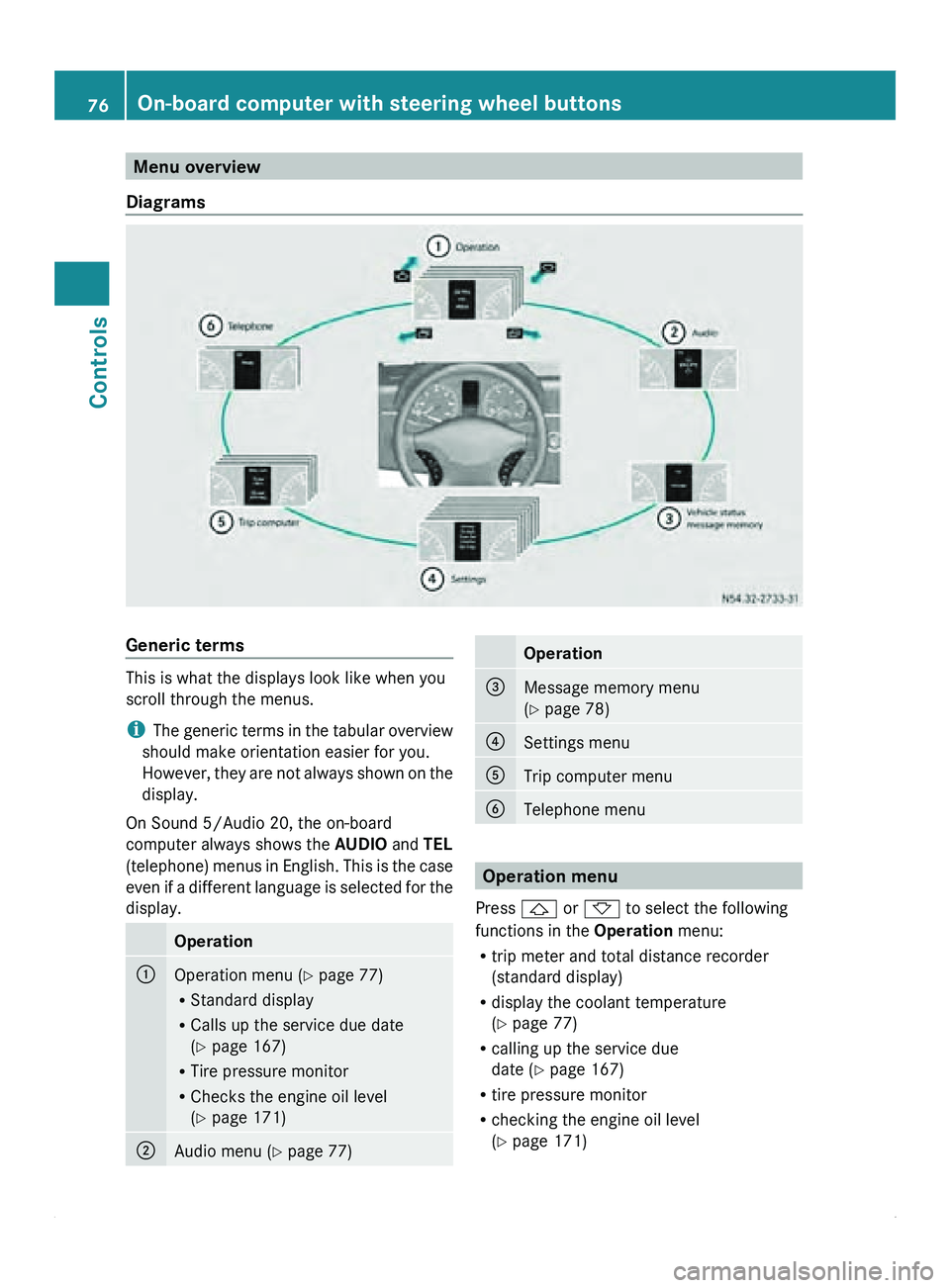
Menu overview
Diagrams Generic terms
This is what the displays look like when you
scroll through the menus.
i
The generic terms
in the tabular overview
should make orientation easier for you.
However, they are not always shown on the
display.
On Sound 5/Audio 20, the on-board
computer always shows the AUDIO and TEL
(telephone) menus in English. This is the case
even if a different language is selected for the
display. Operation
0046
Operation menu (
Y page 77)
R Standard display
R Calls up the service due date
(
Y page 167)
R Tire pressure monitor
R Checks the engine oil level
(Y page 171) 0047
Audio menu (
Y page 77) Operation
008A
Message memory menu
(Y
page 78)
0088
Settings menu
0086
Trip computer menu
0087
Telephone menu
Operation menu
Press 0029 or 002D to select the following
functions in the Operation menu:
R trip meter and total distance recorder
(standard display)
R display the coolant temperature
(Y page 77)
R calling up the service due
date ( Y page 167)
R tire pressure monitor
R checking the engine oil level
(Y page 171)76
On-board computer with steering wheel buttons
Controls
Page 112 of 292
Starting the engine
X
Turn the key to position 2 in the ignition
lock.
The 0028 preglow indicator lamp in the
instrument cluster lights up.
X When the 0028 preglow indicator lamp
goes out, turn the key to position 3 in the
ignition lock and release it as soon as the
engine is running.
i You can start
the engine without preglow
when the engine is warm.
i Depending on the equipment installed,
the vehicle either automatically locks
centrally after switching on the ignition or
after pulling away. The locking knobs in the
doors drop down.
You can open the doors from the inside at
any time.
Automatic door locking can be deactivated
(Y page 55). Driving off
G
Warning
Do not downshift for additional engine
braking on a
slippery road surface. This could
cause the drive wheels to lose their grip and
the vehicle could skid. You could lose control
of the vehicle and cause an accident.
i After pulling away or switching on the
ignition, the vehicle automatically locks
centrally. The locking knobs in the doors
drop down.
You can open the doors from the inside at
any time.
Automatic door locking can be deactivated
(Y page 55). X
Depress the brake pedal and keep it
depressed.
The selector lever lock is released.
X Release the parking brake ( Y page 112).
The 0066 indicator lamp in the instrument
cluster goes out.
X Move the selector lever to position D or R.
i On vehicles with a reverse warning
feature, a warning signal sounds when
reverse gear is
engaged to alert other road
users.
! Only shift into reverse gear when the
vehicle is stationary. You could otherwise
damage the transmission.
X Release the brake pedal.
X Carefully depress the accelerator pedal. General driving tips
Steering G
Warning
Do not switch off the engine while the vehicle
is in motion.
There is no
power assistance for the steering
or the service brake when the engine is not
running.
Steering and braking require significantly
more effort and you could lose control of the
vehicle and cause an accident as a result.
! Do not hold the steering wheel at full
steering angle for a long time, e.g. when
turning or maneuvering.
The hydraulic pump could be damaged if
the hydraulic fluid temperature increases.
Overrun cut-off If you take your foot off the accelerator pedal,
the diesel fuel supply is cut off in overrun
mode when the
engine speed is out of the idle
speed control range. 110
Driving and parking
Controls
Page 115 of 292
Applying the parking brake
X
Pull brake lever 0046 up as far as the last
possible detent.
The 0066 indicator lamp in the instrument
cluster lights up.
i On vehicles with
a folding brake lever, you
can then press lever 0046 down to the stop.
Releasing the parking brake i
On vehicles with
a folding brake lever, you
must first pull brake lever 0046 up to the stop.
X Raise brake lever 0046 slightly and press
release knob 0047.
X Guide brake lever 0046 down to the stop.
The 0066 indicator lamp in the instrument
cluster goes out.
Emergency braking As a rule, you may only apply the parking
brake when the vehicle is stationary.
In exceptional cases, the parking brake can
be used for emergency braking if the service
brake fails.
X
Keep release knob 0047 pressed and
carefully apply brake lever 0046.G
Warning
If the brake lever is applied abruptly, the rear
wheels could lock. The vehicle could then go
into a skid.
Make sure that you apply the brake lever
carefully to ensure
that braking application is
moderated. Automatic transmission
Overview
The automatic transmission adapts to your
individual driving style by continuously
adjusting its shift points. These shift point
adjustments take into account the current
operating and driving conditions. If the operating or driving conditions change, the
automatic transmission reacts by adjusting
the gearshift program.
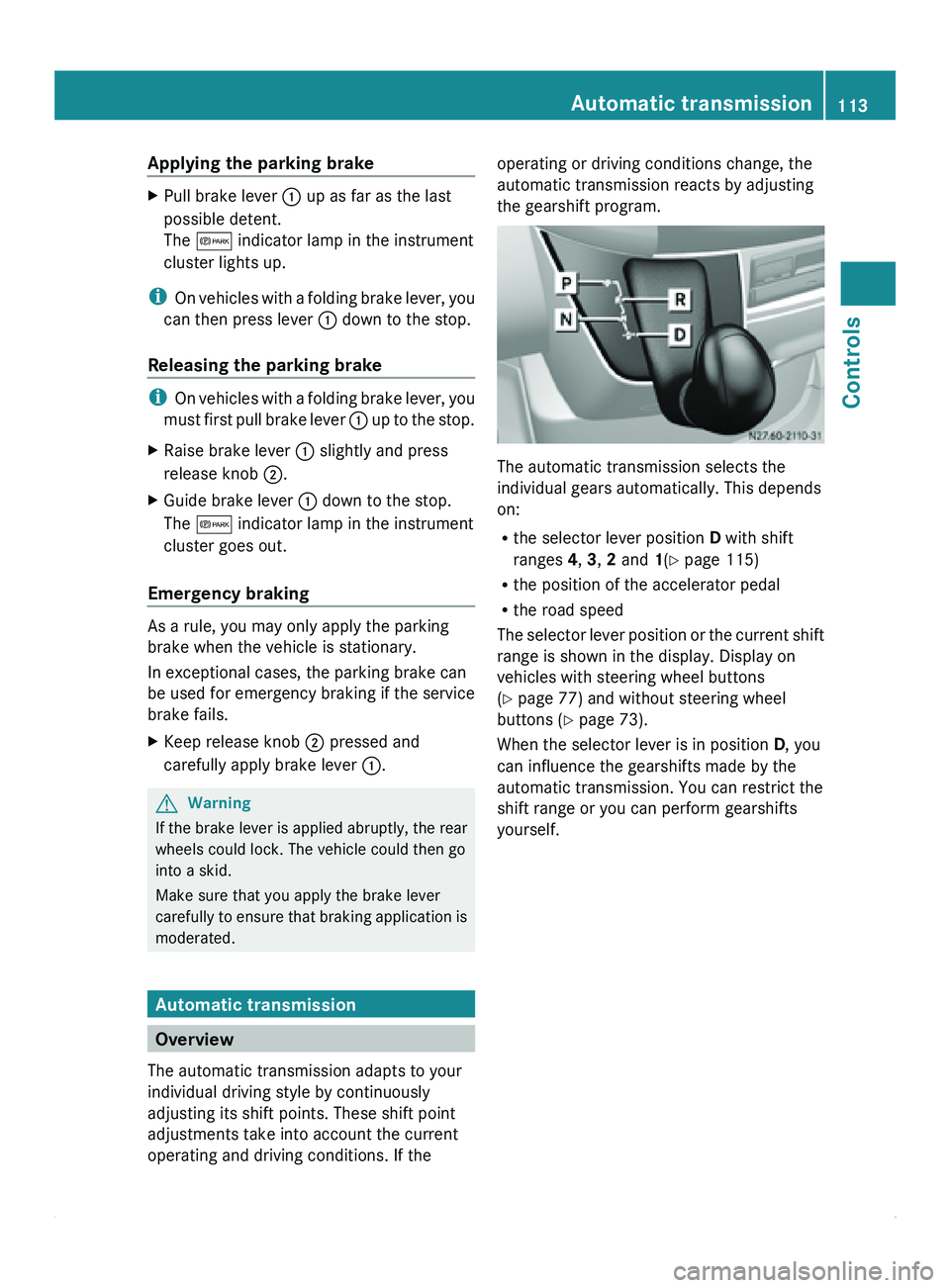
The automatic transmission selects the
individual gears automatically. This depends
on:
R
the selector lever position D with shift
ranges 4, 3, 2 and 1(Y page 115)
R the position of the accelerator pedal
R the road speed
The selector lever
position or the current shift
range is shown in the display. Display on
vehicles with steering wheel buttons
(Y page 77) and without steering wheel
buttons ( Y page 73).
When the selector lever is in position D, you
can influence the gearshifts made by the
automatic transmission. You can restrict the
shift range or you can perform gearshifts
yourself. Automatic transmission
113
Controls Z
Page 118 of 292
vehicle. Otherwise, the vehicle could roll
away.
Driving the vehicle
Exhaust gas aftertreatment
The exhaust gas aftertreatment requires a
reducing agent, Diesel
Exhaust Fluid (DEF), in
order to function correctly. Filling up the DEF
tank is usually part of the service scope. DEF
consumption depends on operational and
driving conditions; the supply does not have
to suffice until the next scheduled service. For
this reason, refill the DEF tank regularly
during vehicle operation, or, at the latest,
after the first warning message has been
received from the on-board computer.
To conform with emission regulations, you
must operate the vehicle with DEF and refill
the supply regularly. If you try to operate the
vehicle without DEF, with diluted DEF, or with
a different reduction agent, the engine
management detects this and issues a
warning message, after which the engine
cannot be restarted.
If the DEF supply drops below
1.5 US gal (5.5 l), you receive the first warning
message and you hear a warning tone. After
the first message appears, the remaining DEF
supply suffices for approximately 1000 miles
(1600 km) in normal driving conditions.
Then, the reserve range of 0.8 US gal (3.0 l)
is reached. Once the reserve range has been
reached, you receive the next warning
message and you hear a series of warning
tones. After the first message appears, the
DEF reserve suffices for approximately
1200 miles (1900 km). You can, however,
only start the engine another 16 times.
You should now, at the latest, fill up with at
least 2.0 US gal (7.6 l) of DEF (Y page 143)
or have the DEF tank filled at a qualified
specialist workshop. When the number of remaining engine starts
is 0, the engine management prevents the
engine from being started.
If the
00BB
check engine indicator lamp lights
up, the exhaust gas aftertreatment is faulty or
an emission-relevant malfunction has
occurred (Y page 195). You can then drive a
maximum of 50 miles (80 km) before the
engine management limits the number of
remaining engine starts.
If the exhaust gas aftertreatment is faulty,
have it checked and repaired at a qualified
specialist workshop. We recommend that you
use an authorized Sprinter Dealer for this
purpose.
You will find further information on DEF in the
"Service products" section (Y page 155).
Level indicator You will find further information about DEF
consumption in the "Driving tips" section
(Y
page 140).
Vehicles without steering wheel buttons
If the DEF supply is less than
1.5 US gal (5.5 l), the 00E4 indicator lamp in
the instrument cluster lights up and the
009BdEF Chk message appears in the
display.
If the DEF supply drops below the reserve
level of 0.8 US gal (3.0 l), the 00E4 indicator
lamp in the instrument cluster lights up and
the 009BStArtS RE
xx
message is shown in
the display. xx refers to the number of
remaining engine starts (from 16 to 0).
Vehicles with steering wheel buttons
If the DEF supply is less than
1.5 US gal (5.5 l), the Check Diesel
Exhaust Fluid See Operator's Manual
message appears in the display.
If the DEF supply drops below the reserve
level of 0.8 US gal (3.0 l), the 00E4xx
starts remaining message appears in the
display. xx refers to the number of remaining
engine starts (from 16 to 0).116
Driving the vehicle
Controls
Page 139 of 292
Vehicle equipment ............................
138
Driving tips ........................................ 138
Refueling ............................................ 142
Transporting loads with the vehicle 144 Operation in winter ...........................153
Service products ............................... 153
Cleaning and care ............................. 161
Maintenance ...................................... 166 137Operation
Page 140 of 292
Vehicle equipment
i Diese Betriebsanleitung beschreibt alle
Modelle, Serien- und
Sonderausstattungen
Ihres Fahrzeugs, die zum Zeitpunkt des
Redaktionsschlusses dieser
Betriebsanleitung erhältlich waren.
Länderspezifische Abweichungen sind
möglich. Beachten Sie, dass Ihr Fahrzeug
nicht mit allen beschriebenen Funktionen
ausgestattet sein könnte. Dies betrifft auch
sicherheitsrelevante Systeme und
Funktionen. Driving tips
Breaking-in
It is of decisive importance for the operating
life, reliability and
economy of the vehicle that
the engine is not subjected to its full rated
load during the breaking-in period.
Up to 1000 miles (1500 km)
R Run the vehicle in carefully. Drive at varying
road and engine speeds.
R Avoid heavy loads (driving at full throttle)
and high engine speeds. Do not exceed ¾
of the maximum speed for each gear.
R Do not change down a gear manually in
order to brake.
R Avoid depressing the accelerator pedal
beyond the pressure point (kickdown) and
only engage gear 4, 3, 2 or 1 while driving
slowly.
After 1000 miles (1500 km)
R Gradually bring the vehicle up to full road
and engine speeds.
i These instructions must also be observed
if you have the engine, the transmission, or
the rear axle differential of your vehicle
replaced. Driving abroad
An extensive network of authorized Sprinter
Dealers is also
at your disposal when you are
traveling abroad. The respective workshop
directories are available from any authorized
Sprinter Dealer.
In some countries, only fuels with a lower
octane rating or a higher sulfur content are
available.
You will find information about fuel in the
"Service products" section (Y page 153).
If you are traveling in countries where
vehicles are driven on the opposite side of the
road to that in which the vehicle is registered,
you must have the headlamps:
R partially masked (halogen headlamps)
R switched over (Bi-Xenon headlamps) G
Warning
Masking the headlamps incorrectly can
impair your visibility when driving with the
headlamps switched on. You could also
impede other road users. Oncoming traffic
may be dazzled.
Always have the headlamps masked/
switched over at a qualified specialist
workshop which has
the necessary specialist
knowledge and tools to carry out the work
required.
For this we recommend an authorized
Sprinter Dealer. All work relevant to safety or
on safety-related systems must be carried out
at a qualified specialist workshop. Driving off-road
When driving the vehicle, particularly on
rough terrain, ensure that the driven wheels
always have sufficient traction.
Avoid letting the drive wheels spin. Spinning
drive wheels can damage the differential.
! Always observe the ground clearance of
the vehicle and avoid obstacles, e.g. deep
ruts. 138
Driving tips
Operation
Page 141 of 292
Obstacles could damage the vehicle, for
example:
R
the axles
R the propeller shafts
and the transmission
R the tanks and supply reservoirs
For this reason, you should always drive
slowly when driving off-road. If you have to
drive over obstacles, have the co-driver
direct you. G
Warning
If you drive too fast off-road, you may not
recognize obstacles in good time or you may
underestimate the roughness of the ground.
When driving off-road, always drive slowly to
avoid damaging the vehicle.
The vehicle may slip to the side, tip and roll
over. Always drive along the line of fall when
you are on
a slope. Never drive across a slope.
Never turn the vehicle around on a slope. If
the vehicle cannot manage an uphill slope,
drive back down the slope in reverse gear.
You could lose control of the vehicle if you
shift the transmission to neutral or disengage
the clutch on an incline and then try to brake
the vehicle using only the service brake.
Never let the vehicle roll.
Overloading the vehicle will increase the risk
of the vehicle tipping over. Never exceed the
maximum permissible axle loads under any
circumstances. Keep the vehicle's center of
gravity as low as possible when the vehicle is
laden.
If the vehicle is frequently or mainly operated
in muddy or marshy terrain, substances that
impair braking efficiency, such as sand or oil
mixed with water, could get into the brake
system. This may lead to excessive wear and
a reduction in braking efficiency. In an
emergency, there is a risk that full braking
power may no longer be available.
After driving off-road, always carry out a short
brake test. If you detect a reduced braking
effect or hear grinding noises, have the brake
system checked at a qualified specialist workshop, for example at an authorized
Sprinter Dealer.
G
Warning
When driving off-road, your body is subject to
forces from all directions, due to the uneven
surface. There is a danger that you could be
thrown out of
your seat and be injured. Always
wear a seat belt, even when driving off-road.
Rules for driving off-road G
Warning
If you drive over obstacles or in ruts, the
steering wheel may jerk out of your grip and
you could injure the thumbs on both hands.
Always hold the steering wheel cross firmly
with both hands.
When driving over obstacles,
you must expect steering forces to increase
briefly and suddenly.
R Before driving off-road, stop the vehicle and
shift to a low gear.
R Only drive off-road with the engine running
and a gear engaged.
R Drive slowly and smoothly. Walking pace is
necessary in many situations.
R Make sure that the wheels always remain
in contact with the ground.
R Drive with extreme care over unknown
terrain where you can only see for a short
distance. As a precaution, get out of the
vehicle to take a look at the route to be
taken first.
R Check the water depth before fording.
R Watch out for obstacles (e.g. rocks, holes,
tree stumps and ruts).
R Avoid edges where the surface could
crumble or break away. Driving tips
139
Operation Z
Page 144 of 292
reduced in volume each time reverse gear
is engaged.
Refueling
G
Warning
Fuel is highly flammable. Fire, naked flames
and smoking as well as the use of auxiliary
heaters (sparks) are therefore prohibited
when handling fuel.
Switch off the
engine and the auxiliary heating
before refueling. G
Warning
Avoid any contact with fuels.
You can damage your health if your skin
comes into direct contact with fuel or if you
inhale fuel vapors.
0040Environmental note
If fuels are handled improperly, they pose a
danger to persons and the environment. Do
not allow fuels
to run into the sewage system,
the surface waters, the ground water or into
the ground.
! Filter the fuel
before transferring it to the
vehicle if you are refueling the vehicle from
barrels or containers.
This will prevent malfunctions in the fuel
system due to contaminated fuel. G
Warning
Do not use gasoline to refuel vehicles with a
diesel engine. Never
mix diesel with gasoline.
This causes damage to the fuel system and
engine and could result in the vehicle catching
fire.
! Do not use gasoline to refuel vehicles with
a diesel engine. Even small amounts of
gasoline will cause damage to the fuel
system and engine. Damage resulting from
adding gasoline is not covered by the New
Vehicle Limited Warranty. !
If the wrong fuel has been added by
mistake, do not switch on the ignition. If
you do, the fuel could enter the fuel lines.
The tank and the fuel lines must then be
drained. Inform a qualified specialist
workshop and have the tank and the fuel
lines drained completely.
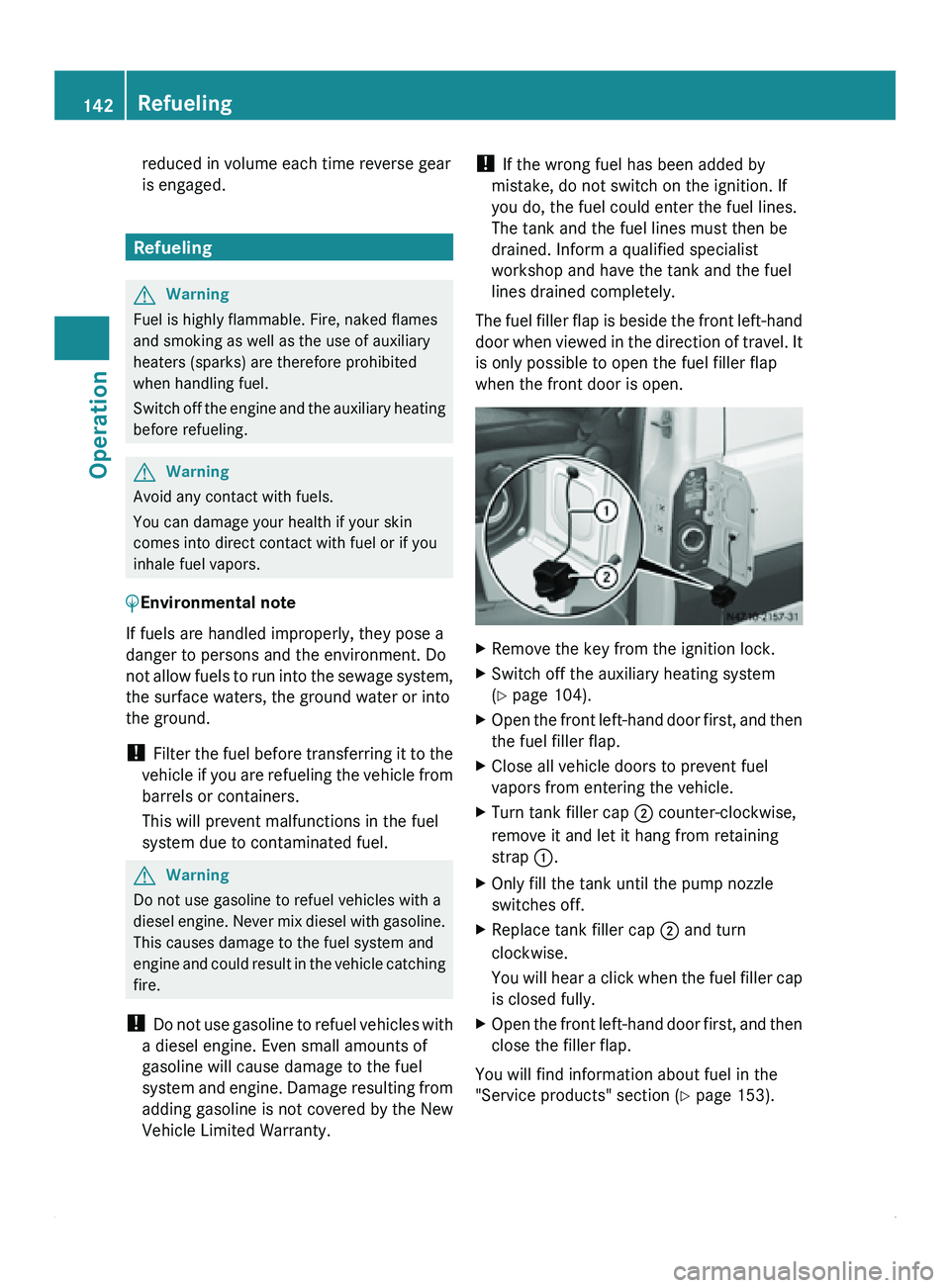
The fuel filler
flap is beside the front left-hand
door when viewed in the direction of travel. It
is only possible to open the fuel filler flap
when the front door is open. X
Remove the key from the ignition lock.
X Switch off the auxiliary heating system
(Y page 104).
X Open the front left-hand door first, and then
the fuel filler flap.
X Close all vehicle doors to prevent fuel
vapors from entering the vehicle.
X Turn tank filler cap 0047 counter-clockwise,
remove it and let it hang from retaining
strap 0046.
X Only fill the tank until the pump nozzle
switches off.
X Replace tank filler cap 0047 and turn
clockwise.
You will
hear
a click when the fuel filler cap
is closed fully.
X Open the front left-hand door first, and then
close the filler flap.
You will find information about fuel in the
"Service products" section (Y page 153). 142
Refueling
Operation
Page 145 of 292
Diesel Exhaust Fluid (DEF)
The exhaust gas aftertreatment requires a
reducing agent, Diesel
Exhaust Fluid (DEF), in
order to function correctly. G
Warning
If you open the DEF reservoir cap at high
temperatures, ammonia vapors could be
released.
Ammonia vapors have
a pungent odor and are
particularly irritating for your skin, respiratory
organs and eyes. This may result in burning
eyes, nose and throat, as well as coughing and
watering eyes.
Do not inhale ammonia vapors. G
Warning
Avoid contact with DEF.
DEF is hazardous
to health. Do not allow DEF
to come into contact with your skin. Rinse
affected areas with plenty of clean water and
consult a doctor if necessary.
0040Environmental note
Dispose of DEF in an environmentally
responsible manner.
! Only use DEF in accordance with
ISO 22241 .
The exhaust gas aftertreatment
system may otherwise be damaged.
Observe the MB Specifications for Service
Products, Sheet No. 352.0.
Damage caused by the use of other
reducing agents will result in the loss of
your New Vehicle Limited Warranty
entitlements.
! If DEF comes into contact with a painted
or aluminum surface, wash the surface off
immediately with plenty of water.
! DEF is not a diesel additive and must not
be mixed with fuel in the tank. Even small
amounts of DEF can cause engine damage.
Damage resulting from adding DEF is not
covered by the New Vehicle Limited
Warranty. i
If the DEF level drops below the reserve
level, the second warning message
(Y page 116) appears and at this point, at
the latest, you
must add at least 2.0 US gal
(7.6 l) of DEF.
You will find further information on DEF in the
"Service products" section (Y page 155).
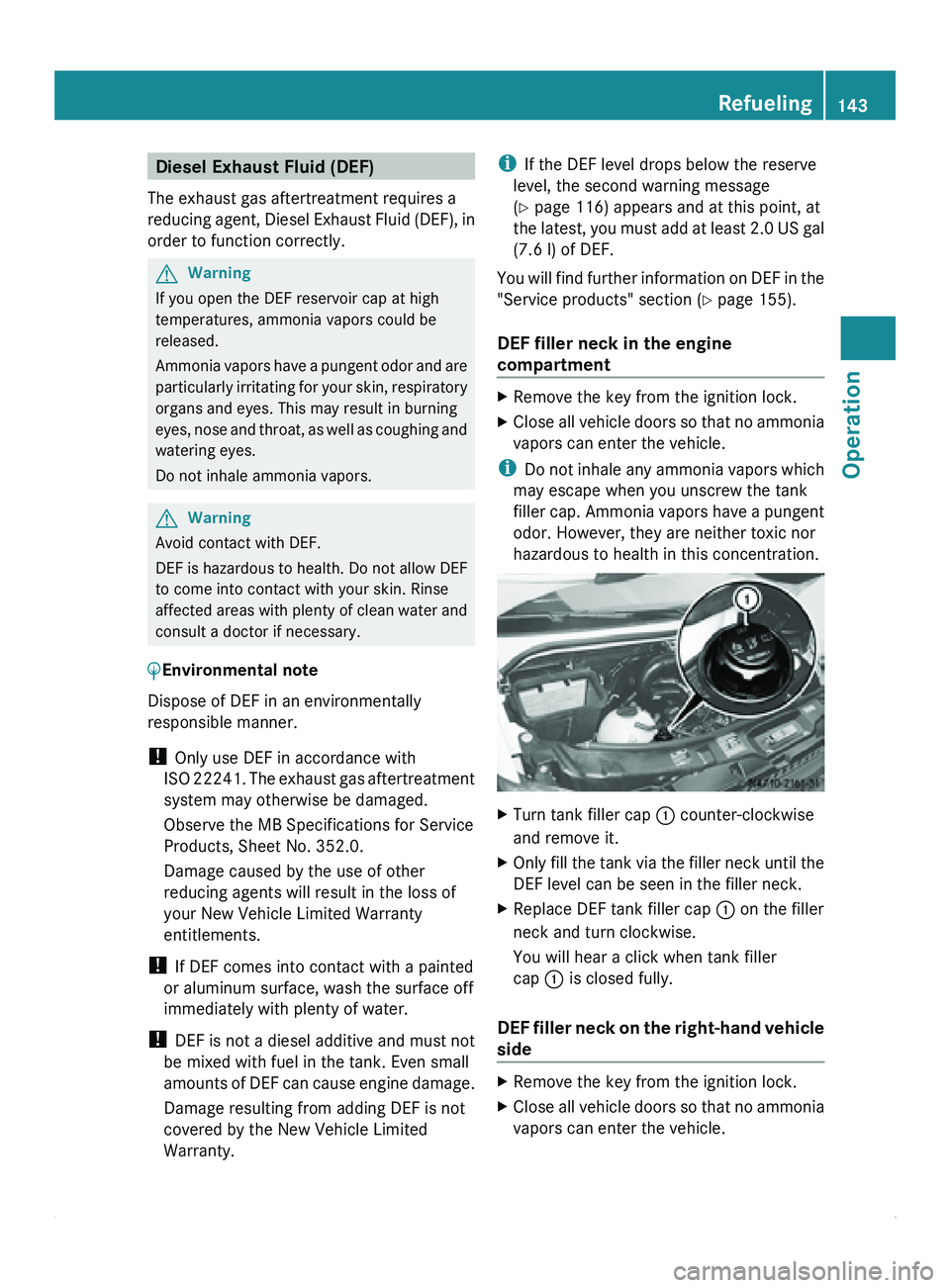
DEF filler neck in the engine
compartment X
Remove the key from the ignition lock.
X Close all
vehicle doors so that no ammonia
vapors can enter the vehicle.
i Do not inhale
any ammonia vapors which
may escape when you unscrew the tank
filler cap. Ammonia vapors have a pungent
odor. However, they are neither toxic nor
hazardous to health in this concentration. X
Turn tank filler cap 0046
counter-clockwise
and remove it.
X Only fill the tank via the filler neck until the
DEF level can be seen in the filler neck.
X Replace DEF tank filler cap 0046 on the filler
neck and turn clockwise.
You will hear a click when tank filler
cap 0046 is closed fully.
DEF filler neck on the right-hand vehicle
side X
Remove the key from the ignition lock.
X Close all vehicle doors so that no ammonia
vapors can enter the vehicle. Refueling
143
Operation Z
Page 155 of 292
Verify compliance with weight limitations on
a weighbridge.
Trailer power supply
Your vehicle may be equipped with various
electrical fittings for trailer towing.
Depending on your trailer, you may need an
adapter to allow your trailer to be connected
to the vehicle. Information about your
vehicle's electrical equipment is available
from any authorized Sprinter Dealer.
!
Faulty wiring of the connector plug could
in certain circumstances cause other
electronic systems to
malfunction. For this
reason, we recommend having the wiring
of the connector plug performed at an
authorized Sprinter Dealer. Operation in winter
General notes
Have your vehicle winterized at a qualified
specialist workshop, e.g. an authorized
Sprinter Dealer, at the onset of winter.
This service includes the following:
R oil change, if the engine oil currently used
does not have adequate low temperature
characteristics or if these are no longer
sufficient due to aging
R the antifreeze/anticorrosion
concentration in the coolant is checked.
R the addition of a concentrated cleaning
agent to the water in the windshield
washer/headlamp cleaning system
R battery check
R a tire change
Prior to the
onset of winter, ensure that snow
chains are available in the vehicle.
Do not cover the surface of the radiator or the
radiator grill, even in winter. Doing so could
cause the engine diagnostics to record false
or incorrect data. Recording of engine
diagnostic data is legally prescribed and must therefore be correct, clear and
comprehensible at all times.
You
will find
information about diesel fuel for
use at low outside temperatures in the
"Operation" section ( Y page 154).
Please also observe the information about
winter driving (Y page 111).
You will find information about winter tires
and about driving with snow chains in the
"Wheel and tires" section (Y page 153). Service products
Fuel
G
Warning
Fuel is highly flammable. Fire, naked flames
and smoking as well as the use of auxiliary
heaters (sparks) are therefore prohibited
when handling fuel.
Switch off the
engine and the auxiliary heating
before refueling. G
Warning
Avoid any contact with fuels.
You can damage your health if your skin
comes into direct contact with fuel or if you
inhale fuel vapors.
! Filter the fuel
before transferring it to the
vehicle if you are refueling the vehicle from
barrels or containers.
This will prevent malfunctions in the fuel
system due to contaminated fuel.
! Refuel only with commercially available
vehicle diesel fuel, ULTRA-LOW SULFUR
DIESEL with a sulfur content no greater
than 15 ppm. Fuels such as fatty acid
methyl ester FAME (bio-diesel fuels),
marine diesel, heating oil etc. may not be
used as a diesel fuel mixture.
Refuel with B5 bio-diesel only if it fulfills the
requirements listed under "Fuel quality". Service products
153
Operation Z