tire pressure MERCEDES-BENZ SPRINTER 2012 MY12 Operator’s Manual
[x] Cancel search | Manufacturer: MERCEDES-BENZ, Model Year: 2012, Model line: SPRINTER, Model: MERCEDES-BENZ SPRINTER 2012Pages: 292, PDF Size: 6.75 MB
Page 78 of 292
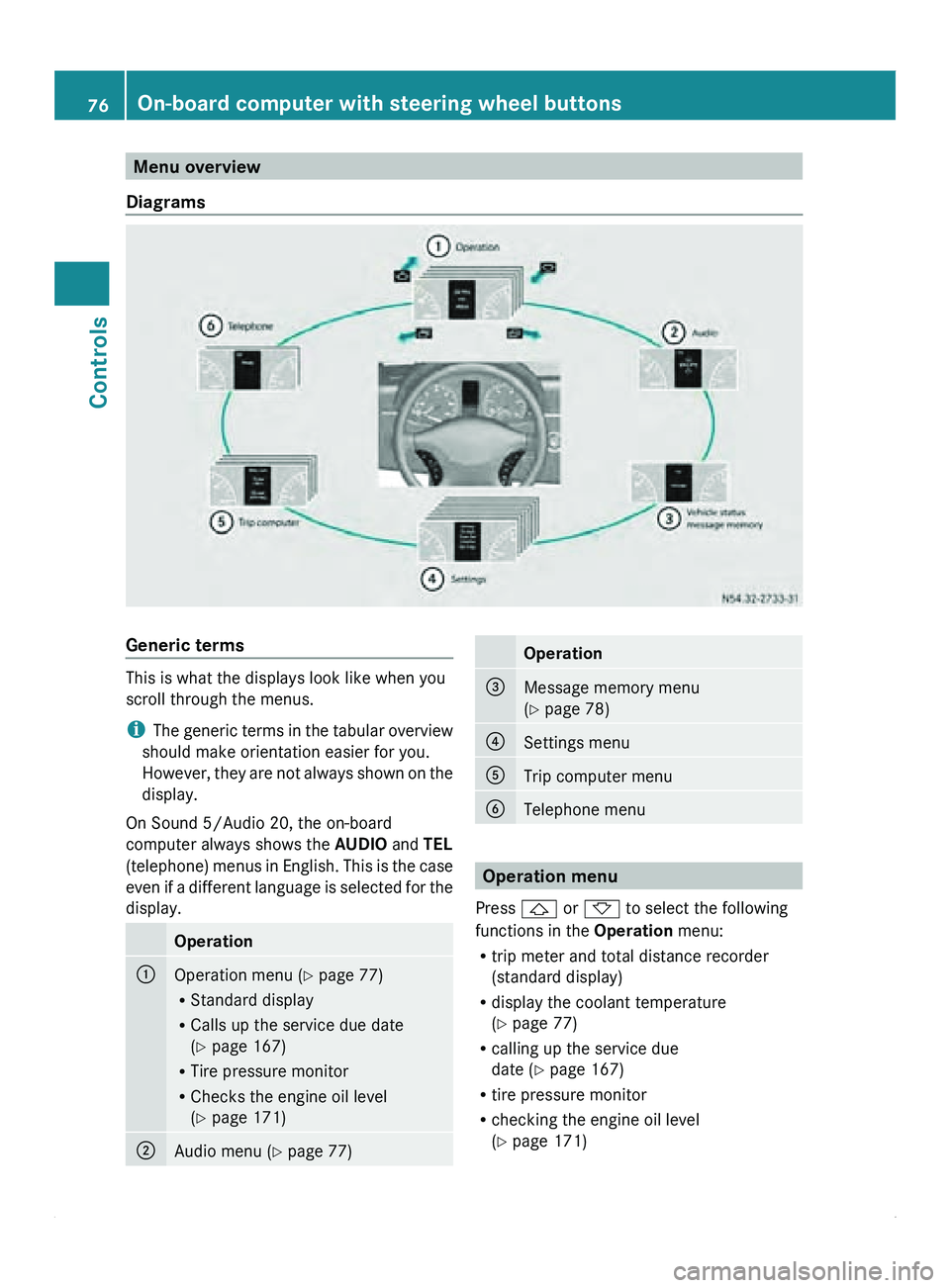
Menu overview
Diagrams Generic terms
This is what the displays look like when you
scroll through the menus.
i
The generic terms
in the tabular overview
should make orientation easier for you.
However, they are not always shown on the
display.
On Sound 5/Audio 20, the on-board
computer always shows the AUDIO and TEL
(telephone) menus in English. This is the case
even if a different language is selected for the
display. Operation
0046
Operation menu (
Y page 77)
R Standard display
R Calls up the service due date
(
Y page 167)
R Tire pressure monitor
R Checks the engine oil level
(Y page 171) 0047
Audio menu (
Y page 77) Operation
008A
Message memory menu
(Y
page 78)
0088
Settings menu
0086
Trip computer menu
0087
Telephone menu
Operation menu
Press 0029 or 002D to select the following
functions in the Operation menu:
R trip meter and total distance recorder
(standard display)
R display the coolant temperature
(Y page 77)
R calling up the service due
date ( Y page 167)
R tire pressure monitor
R checking the engine oil level
(Y page 171)76
On-board computer with steering wheel buttons
Controls
Page 83 of 292
X
Press 005A or 005B to select the unit for all
messages in the display: km (kilometers) or
miles.
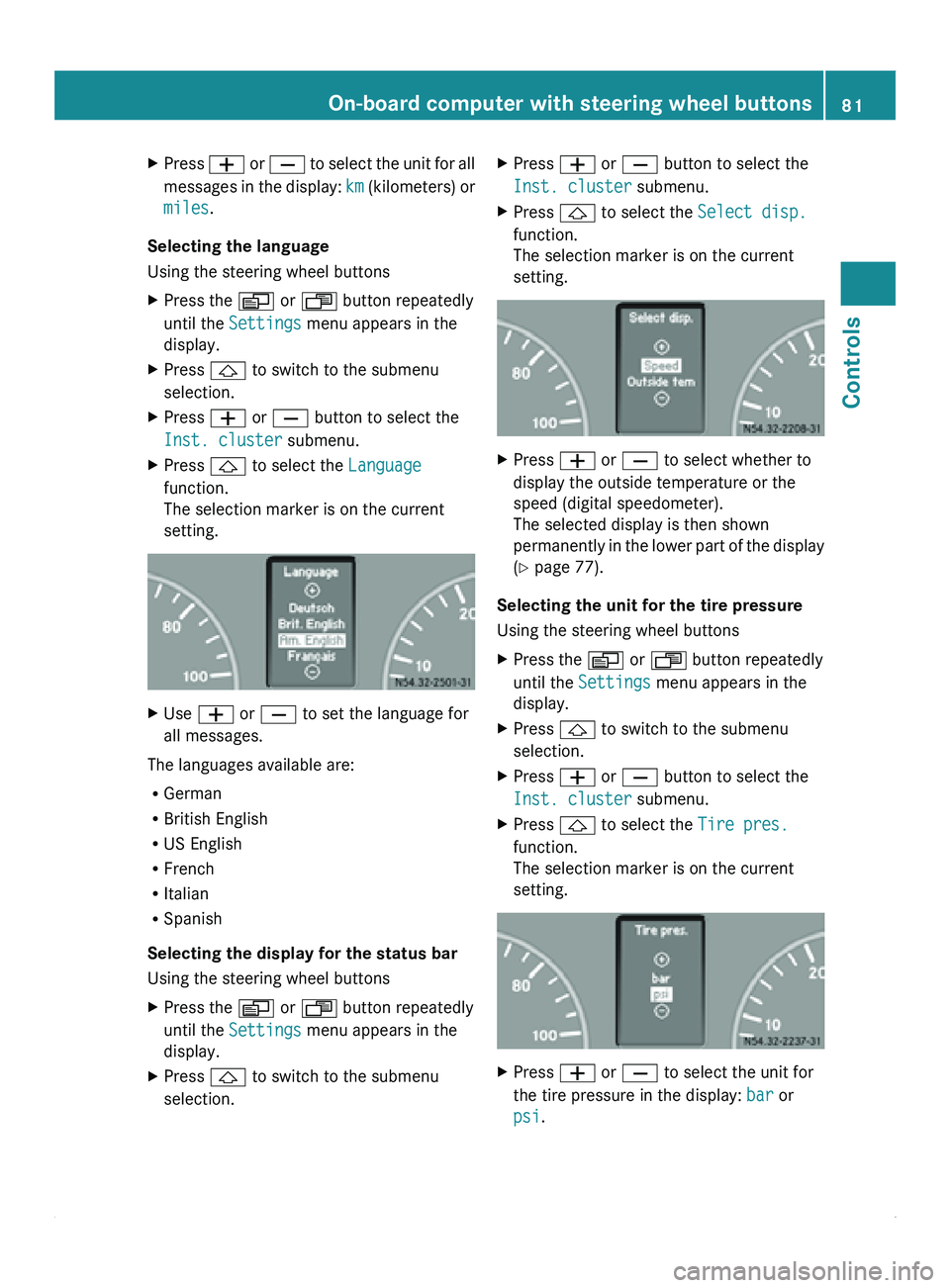
Selecting the language
Using the steering wheel buttons
X Press the 0059 or 0058 button repeatedly
until the Settings menu appears in the
display.
X Press 0029 to switch to the submenu
selection.
X Press 005A or 005B button to select the
Inst. cluster submenu.
X Press 0029 to select the Language
function.
The selection marker is on the current
setting. X
Use 005A or 005B to set the language for
all messages.
The languages available are:
R German
R British English
R US English
R French
R Italian
R Spanish
Selecting the display for the status bar
Using the steering wheel buttons
X Press the 0059 or 0058 button repeatedly
until the Settings menu appears in the
display.
X Press 0029 to switch to the submenu
selection. X
Press 005A or 005B button to select the
Inst. cluster submenu.
X Press 0029 to select the Select disp.
function.
The selection marker is on the current
setting. X
Press 005A or 005B to select whether to
display the outside temperature or the
speed (digital speedometer).
The selected display is then shown
permanently in the
lower part of the display
(Y page 77).
Selecting the unit for the tire pressure
Using the steering wheel buttons
X Press the 0059 or 0058 button repeatedly
until the Settings menu appears in the
display.
X Press 0029 to switch to the submenu
selection.
X Press 005A or 005B button to select the
Inst. cluster submenu.
X Press 0029 to select the Tire pres.
function.
The selection marker is on the current
setting. X
Press 005A or 005B to select the unit for
the tire pressure in the display: bar or
psi. On-board computer with steering wheel buttons
81
Controls Z
Page 110 of 292
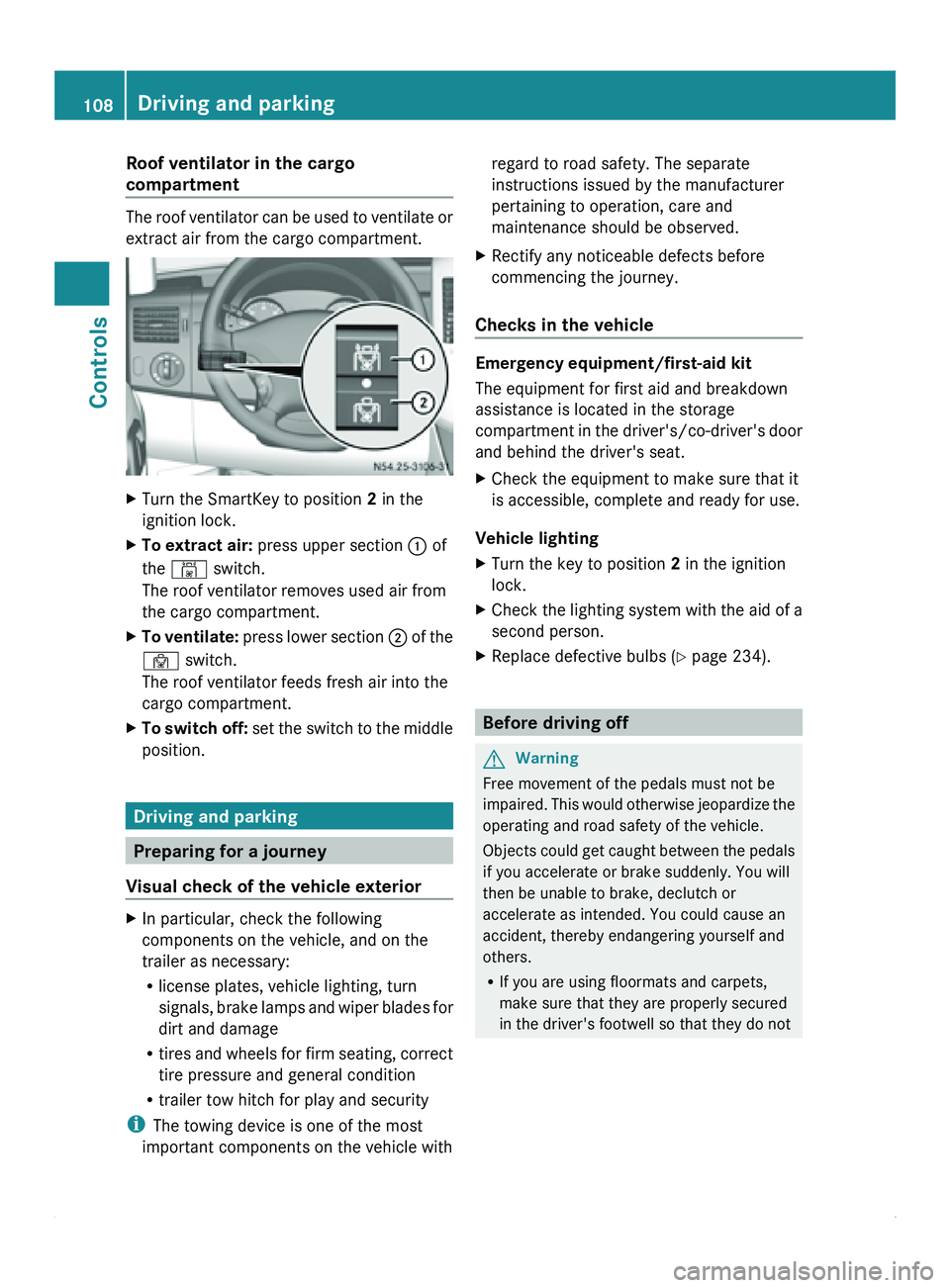
Roof ventilator in the cargo
compartment
The roof ventilator can be used to ventilate or
extract air from the cargo compartment.
X
Turn the SmartKey to position 2 in the
ignition lock.
X To extract air: press upper section 0046 of
the 00B4 switch.
The roof ventilator removes used air from
the cargo compartment.
X To ventilate: press lower section 0047 of the
00B3 switch.
The roof ventilator feeds fresh air into the
cargo compartment.
X To switch off: set the
switch to the middle
position. Driving and parking
Preparing for a journey
Visual check of the vehicle exterior X
In particular, check the following
components on the vehicle, and on the
trailer as necessary:
R
license plates, vehicle lighting, turn
signals, brake lamps
and wiper blades for
dirt and damage
R tires and wheels for firm seating, correct
tire pressure and general condition
R trailer tow hitch for play and security
i The towing device is one of the most
important components on the vehicle with regard to road safety. The separate
instructions issued by the manufacturer
pertaining to operation, care and
maintenance should be observed.
X Rectify any noticeable defects before
commencing the journey.
Checks in the vehicle Emergency equipment/first-aid kit
The equipment for first aid and breakdown
assistance is located in the storage
compartment in
the
driver's/co-driver's door
and behind the driver's seat.
X Check the equipment to make sure that it
is accessible, complete and ready for use.
Vehicle lighting
X Turn the key to position 2 in the ignition
lock.
X Check the lighting system with the aid of a
second person.
X Replace defective bulbs ( Y page 234). Before driving off
G
Warning
Free movement of the pedals must not be
impaired. This would
otherwise jeopardize the
operating and road safety of the vehicle.
Objects could get caught between the pedals
if you accelerate or brake suddenly. You will
then be unable to brake, declutch or
accelerate as intended. You could cause an
accident, thereby endangering yourself and
others.
R If you are using floormats and carpets,
make sure that they are properly secured
in the driver's footwell so that they do not108
Driving and parking
Controls
Page 142 of 292
Before driving off-road
X
If the surface demands it, temporarily
deactivate acceleration skid control (ASR)
when pulling away ( Y
page 49).
X Safely stow or secure any items of luggage
or loads ( Y page 144).
i We recommend that you additionally
carry a shovel and a recovery rope with
shackle in the vehicle.
After driving off-road G
Warning
Damage caused to the vehicle when driving
off-road may cause consequential damage,
the failure of mechanical assemblies as well
as accidents. Clean and inspect the vehicle
after any off-road use. Repair any damage
before using the vehicle again.
X Activate the acceleration skid control
system (ASR) ( Y page 49).
X Clean the vehicle (Y page 165).
X Check the vehicle for damage. Transport by rail
Transporting your vehicle by rail may be
subject to certain restrictions or require
special measures to be taken in some
countries due to varying tunnel heights and
loading standards.
You may obtain information about this from
any authorized Sprinter Dealer. Fuel consumption
Fuel consumption depends on:
R the vehicle version
R the style of driving
R the operating conditions
R the type or quality of the fuel used The vehicle will use more fuel than usual in
the following situations:
R
at very low temperatures
R in city traffic
R on short trips
R when towing a trailer
R in mountainous terrain
Observe the advice in the "Protection of the
environment" section to keep fuel
consumption low .
The following components of the different
vehicle versions influence fuel consumption:
R tire sizes, tire tread, tire pressure, tire
condition
R body
R drive unit gear ratios
R additional equipment (e.g. air-conditioning
system, auxiliary heating system).
Details concerning fuel consumption are
recorded in the on-board computer; use the
steering wheel buttons to call up the Trip
computer menu (Y page 85). DEF consumption
Depending on the vehicle version, the DEF
consumption of:
R a Cargo Van/Passenger Van is
approximately 2322 MPG
(0.10 l/100 km)
R a Chassis Cab
is approximately 1720 MPG
(0.14 l/100 km)
In each case, the stated consumption figure
is a mean value between urban and extra-
urban driving cycles. The consumption figure
does not refer to a specific vehicle, but is
provided for the purposes of comparison
between different vehicle types.
DEF consumption, like fuel consumption, is
very dependent on the driving style and the
operating conditions. This means that the real
consumption figures during operation of your
vehicle may deviate from those stated. 140
Driving tips
Operation
Page 143 of 292
Engine oil consumption
! If the vehicle is predominantly used for
short-distance driving, this could lead to a
malfunction in the automatic cleaning
function for the diesel particle filter. As a
result, fuel may accumulate in the engine
oil and cause engine failure.
Therefore, if you mainly drive short
distances, you should
drive on a highway or
on rural roads for 20 minutes every
310 miles (500 km). This ensures sufficient
regeneration of the diesel particle filter.
Depending on the driving style, the vehicle
consumes a maximum of 1.0 US qt(1.0 l) of
oil over a distance of 620 miles (1000 km).
Engine oil consumption may be higher if:
R the vehicle is new.
R you mainly operate the vehicle under
arduous operating conditions.
R you frequently drive at high engine speeds.
Regular maintenance is one of the
preconditions for moderate rates of
consumption.
You can only estimate the engine oil
consumption after you have driven a
considerable distance.
Check the engine oil level on a regular basis,
e.g. weekly or each time you refuel
(Y page 171). Speed limiter
You can permanently limit the maximum
speed of your vehicle to 75 mph (120 km/h)
.
We recommend that you have the maximum
speed programmed at an authorized Sprinter
Dealer. This has the necessary specialist
knowledge and tools to carry out the required
work. G
Warning
Exceeding the permissible maximum speed
can cause tire damage, which could lead to
loss of control of the vehicle. As the driver, you must find out about the
maximum speed of the vehicle and the
resulting permissible maximum speed of the
tires (tire and tire pressure).
You must not exceed the speed limit for the
tires listed in the tire pressure tables.
i You will find information about tire
pressure in the "Technical data" section
(Y
page 280).
Reverse warning device
On vehicles with
a reverse warning feature, a
warning signal sounds when reverse gear is
engaged to alert other road users. The volume
of this warning signal can be reduced for
night-time driving. G
Warning
Other road users could fail to hear or could
ignore the reverse warning feature warning
signal. For this reason, the reverse warning
feature cannot guarantee that there are no
people or objects behind your vehicle.
The reverse warning feature is a system
designed to assist you in ensuring the safety
of other road users. It does not, however,
relieve you of
your responsibility to make sure
that there are no persons or objects behind
your vehicle while you are maneuvering.
For this reason, always observe the road and
traffic conditions with due caution. To avoid
damage and injury, make sure that there are
no persons or objects behind the vehicle while
you are maneuvering. Have a second person
assist you when maneuvering if necessary.
X To set the warning signal to quiet:
engage the reverse gear twice in brief
succession.
The volume of the warning signal is
reduced.
i The warning signal sounds at normal
volume by default and will need to be Driving tips
141
Operation Z
Page 147 of 292
Always make sure that the distribution of the
load is correct and adapt your driving style
according to the load. G
Warning
If you have installed a roof carrier, the
vehicle’s handling, steering and braking
characteristics may change
due to the higher
center of gravity. This is the case particularly
if the roof carrier is laden. Adapt your driving
style according to the vehicle load.
Observe the manufacturer's installation
instructions. An incorrectly secured roof
carrier and/or load could come loose, fall off
and thereby endanger you or others.
Observe the maximum roof load and
maximum roof carrier load. Loads transported
on the roof must always be secured with
particular care.
Do not allow the load, including passengers,
to exceed the permissible gross vehicle
weight or the gross axle weight rating for your
vehicle. G
Warning
When using suitable load securing aids and
lashing material, always follow the
manufacturer's operating instructions, in
particular the notes on discard criteria
contained therein.
Load securing aids and lashing material may
not be used, for example, if:
R identification marks are
missing or illegible
R there are yarn breakages, damage to
bearing seams or other signs of tearing
R there are signs of shearing, deformation,
pinching or other damage
R there is damage to clamping or connecting
elements
Load securing aids and lashing material in this
condition are ready for discard and must be
replaced.
If you use load securing aids or lashing
materials that are ready for discard, the load
is not correctly secured and could cause serious injuries to you and others and cause
material damage.
G
Warning!
After an
accident, have a damaged cargo floor
or cargo area, lashing eyelets and lashing
material checked at a qualified specialist
workshop that has the necessary specialist
knowledge and tools to carry out the work
required. The cargo could otherwise be
insufficiently secured during the next
transport and could lead to serious injury to
you and other persons or material damage.
For this reason,
we recommend an authorized
Sprinter Dealer. In particular, all work relevant
to safety or on safety-related systems must
be carried out at a qualified specialist
workshop.
! If you are using a roof carrier, observe the
maximum roof load and maximum roof
carrier load.
You will find information about the maximum
roof load in the "Technical data" section
(Y page 283) and information about roof
carriers in the "Carrier systems" section
(Y page 149).
Before loading X
Tire pressure: check the
tire pressure and
correct if necessary ( Y page 281).
X Cargo floor: clean the cargo floor.
The cargo floor must be free from oil and
dust, dry and clean swept to prevent the
load from slipping.
X Place non-slip mats (anti-slip mats) on the
cargo floor if necessary.
! As soon as the non-slip mats show signs
of deformation or
develop squashed areas,
or traces of cracking/cutting, they can no
longer be used to secure a load and must
be replaced. Transporting loads with the vehicle
145
Operation Z
Page 148 of 292
During loading
X
Observe the gross axle weight rating and
permissible gross vehicle weight for your
vehicle.
! On passenger van versions with
maximum seating layout, the permissible
rear axle load
would be exceeded if the full
payload were to be loaded in the cargo
compartment.
i Bear in mind that the curb weight of the
vehicle is increased by installing optional
equipment and accessories.
X Observe the information about load
distribution ( Y page 146).
X Secure the load ( Y page 146). Always
observe the relevant national regulations.
Checks after loading X
Securing loads: check that the load is
secure before every
journey and at regular
intervals during a long journey, and correct
if necessary.
X Doors: close the sliding doors and rear
doors. G
Warning
Make sure that the sliding doors and rear
doors are always closed when the engine is
running.
Exhaust fumes could otherwise enter the
vehicle interior and poison you.
X Tire pressure: adjust the tire pressures
according to the vehicle load
(Y page 281).
X Driving style: adapt your driving style
according to the vehicle load. Load distribution
The overall center
of gravity of the load should
always be as low as possible, centered and
between the axles near the rear axle. !
Excessive loads on
individual points of the
cargo floor or on the load surface impair
vehicle handling characteristics and could
cause damage to the floor covering.
On crewbuses:
X Always transport loads in the cargo
compartment.
X Always place the load against the backrests
of the rear bench seat.
X Move large and heavy loads as far towards
the front of the vehicle as possible against
the rear bench seat. Stow the load flush
with the rear bench seat.
X Always additionally secure the load with
suitable load securing aids or tie down.
i Observe the following notes:
R Do not stack
loads higher than the upper
edge of the backrests.
R Transport loads behind seats that are not
occupied.
R If the rear bench seat is not occupied,
insert the seat belts crosswise into the
buckle of the opposite seat belt. Securing loads
General notes As the driver, you are responsible for ensuring
that the cargo is secured against sliding,
tipping, rolling or falling. This applies to
general traffic situations as well as evasive
maneuvers or full brake application and on
poor stretches of road.
If your load
is not secured in accordance with
applicable requirements and guidelines
regarding the securing of loads, you may be
liable to prosecution, depending on the local
legislation and the consequences of
inadequately secured loads.
You should therefore observe the respective
legal requirements for the relevant country.
Check that the load is secure before every
journey and at regular intervals during a long 146
Transporting loads with the vehicle
Operation
Page 166 of 292
The windshield wipers may otherwise move
and injure you.
X Turn the key to position 0 in the ignition
lock or remove it.
! Do not fold the windshield wipers away
from the windshield unless the hood is
closed. Otherwise, you could damage the
hood.
X Fold the wiper arms away from the
windshield until you feel them engage.
X Clean the windshield and the wiper blades.
X Fold the windshield wipers back again
before switching on the ignition.
Headlamps Wipe the headlamp lenses with a wet sponge.
! Only use washer
fluid which is suitable for
plastic lamp lenses. Unsuitable washer
fluid could damage the plastic lamp lenses
of the headlamps.
Therefore, do not use:
R dry cloths
R abrasive products
R solvents
R cleaning products containing solvents
You could otherwise scratch or damage the
surface of the lenses.
Sliding door Clean the contact plates and the tips of the
contact pins around the sliding door with
water, shampoo and a soft cloth.
Do not oil or grease the contact plates and
contact pins.
Remove foreign objects. Power washers
! Maintain the following minimum
distances between the high-pressure
nozzle and the object being cleaned:
R approximately 2.2 ft (70 cm)
when using
round-jet nozzles
R approximately 1 ft (30 cm) when using
25° flat-spray jets and concentrated-
power jets
Keep the water jet moving while cleaning.
To avoid causing damage, do not point the
water jet directly at:
R door joints
R brake hoses
R electrical components
R plug connections
R seals
R the drive train, especially not at the
intermediate bearing of the propeller
shaft
R the rear-view camera or the microphone
opening on the bottom of the rear-view
camera. Keep a minimum distance of
1.6 ft (50 cm). G
Warning
Do not
use round-jet nozzles to clean the tires.
The pulsating water jet can cause damage to
the substructure of
the tires that is not visible
from the outside. This type of damage only
becomes noticeable at a much later stage and
can cause the tires to burst. This could cause
you to lose control of the vehicle, resulting in
an accident and injuring yourself or others.
Replace damaged tires immediately. Automatic car wash
If the vehicle is very dirty, prewash it before
you put it through an automatic car wash. G
Warning
If a wax preservative is applied after the
vehicle is washed,
you should remove the wax164
Cleaning and care
Operation
Page 167 of 292
from the windshield and the wiper blades to
prevent smearing.
Smears
impair the driver's
view, and their effect is made worse in
conditions where visibility is poor (e.g. glare,
mist, darkness, snow). You may therefore fail
to recognize dangers, or not recognize them
in time, and thereby cause an accident.
! Make sure that the automatic car wash is
suitable for the size of the vehicle.
Before washing the vehicle in an automatic
car wash, fold in the exterior mirrors and
remove the radio/telephone antenna.
Otherwise, the exterior mirror, antenna or
the vehicle itself could be damaged.
Make sure that the antenna is installed and
that the exterior mirrors are fully folded out
again when you leave the automatic car
wash.
! Make sure that the side windows are
completely closed, that the ventilation/
heating is switched off and that the
windshield wiper switch is set to 0.
Otherwise, the rain/light sensor could be
activated, triggering unintended wiper
movements. This can cause damage to the
vehicle.
After putting the vehicle through an
automatic car wash, wipe off wax from:
R the rear-view camera lens ( Y page 163)
R the windshield and the wiper blades. This
prevents smears and reduces wiping noise
which can be caused by residue on the
windshield. Cleaning the engine
! Water must not
enter intake or ventilation
openings. When cleaning with high
pressure water or steam cleaners, the
spray must not be aimed directly at
electrical components or the terminals of
electrical lines. Preserve the engine after the engine has
been cleaned.
Protect
the belt drive system
from exposure to the preservative agent. Alloy wheels
Clean the alloy wheels regularly.
! Do not use
any acidic or alkaline cleaning
agents. They can cause corrosion on the
wheel bolts (wheel nuts) or the retainer
springs for the wheel-balancing weights. After driving off-road or on
construction sites
G
Warning
Dirt on the vehicle can affect road and
operating safety.
It can specifically result in the following
dangers:
Stone impact. Stones trapped between the
tires can be thrown out while driving. This
could injure other
road users or damage other
vehicles (especially windscreens).
Risk of skidding. Dirt and mud on the tires/
on the road reduce the grip of the tires on the
road. This especially applies when the surface
is wet. The vehicle could then start to skid.
Risk of injury. Dirt and mud on the steps and
entrance can make the steps unsafe. This
could cause you to slip off the steps and be
injured.
For this reason, you should always clean your
vehicle carefully after driving off-road or on
construction sites before driving on public
roads. Observe the corresponding safety
notices in this chapter if you use a power
washer or an automatic car wash to clean your
vehicle.
X Clean the vehicle, paying special attention
to the following:
R
Lighting system
R Windows and exterior mirrors
R Access steps and entrances Cleaning and care
165
Operation Z
Page 187 of 292
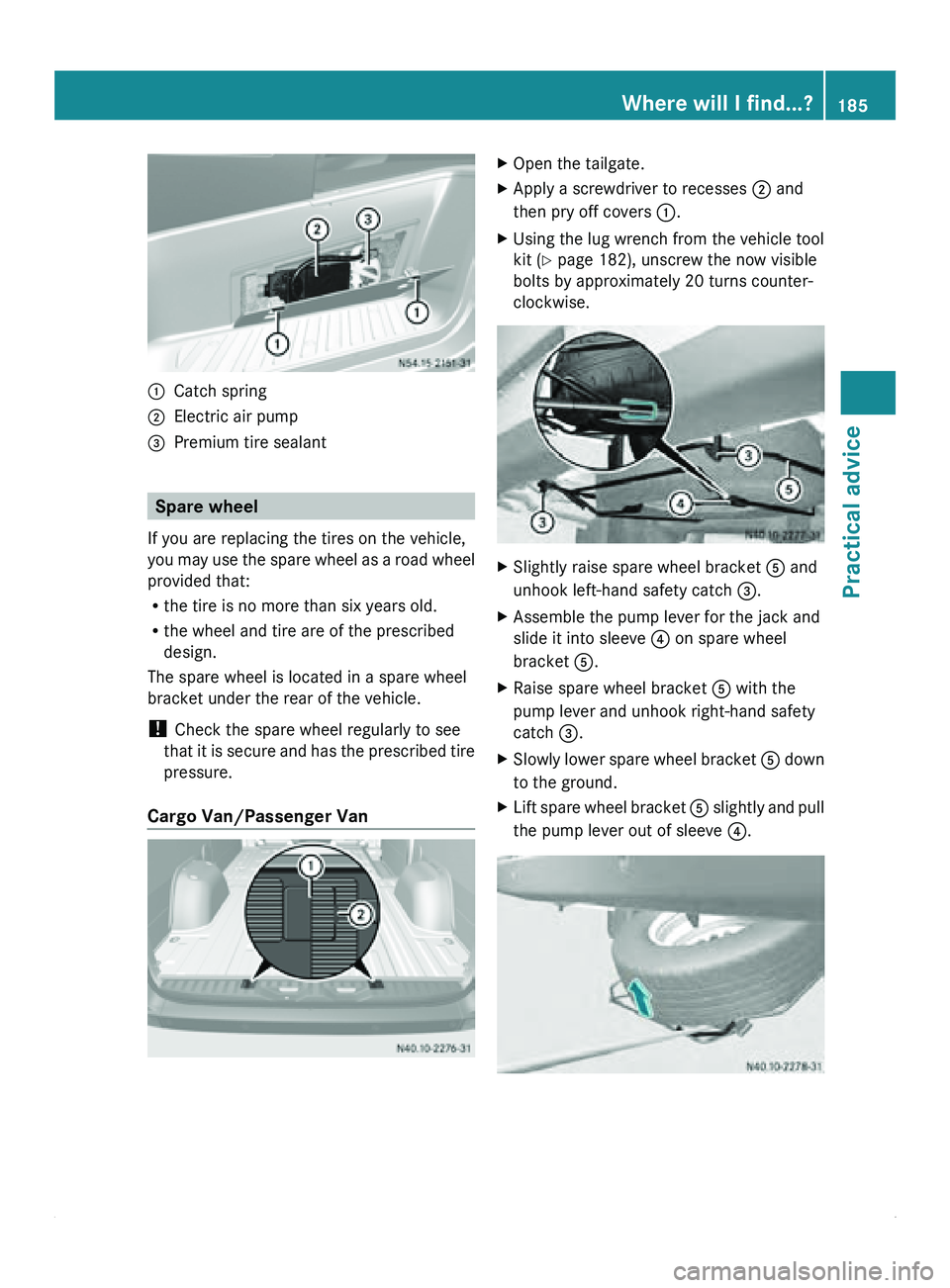
0046
Catch spring
0047 Electric air pump
008A Premium tire sealant Spare wheel
If you are replacing the tires on the vehicle,
you may use
the spare wheel as a road wheel
provided that:
R the tire is no more than six years old.
R the wheel and tire are of the prescribed
design.
The spare wheel is located in a spare wheel
bracket under the rear of the vehicle.
! Check the spare wheel regularly to see
that it is secure and has the prescribed tire
pressure.
Cargo Van/Passenger Van X
Open the tailgate.
X Apply a screwdriver to recesses 0047 and
then pry off covers 0046.
X Using the lug wrench from the vehicle tool
kit ( Y page 182), unscrew the now visible
bolts by approximately 20 turns counter-
clockwise. X
Slightly raise spare wheel bracket 0086 and
unhook left-hand safety catch 008A.
X Assemble the pump lever for the jack and
slide it into sleeve 0088 on spare wheel
bracket 0086.
X Raise spare wheel bracket 0086 with the
pump lever and unhook right-hand safety
catch 008A.
X Slowly lower spare wheel bracket 0086 down
to the ground.
X Lift spare
wheel bracket 0086 slightly and
pull
the pump lever out of sleeve 0088. Where will I find...?
185
Practical advice Z