warning light MERCEDES-BENZ SPRINTER 2012 MY12 Operator’s Manual
[x] Cancel search | Manufacturer: MERCEDES-BENZ, Model Year: 2012, Model line: SPRINTER, Model: MERCEDES-BENZ SPRINTER 2012Pages: 292, PDF Size: 6.75 MB
Page 38 of 292
Tensioning Device could be triggered in the
event of an accident.
ETDs help remove
slack in the seat belts in an
accident, pulling the seat belt close against
the occupant's body.
ETDs do not correct incorrect seat positions
or incorrectly fastened seat belts.
ETDs do not pull vehicle occupants back
towards the backrest.
If the seat belt is also equipped with a seat
belt force limiter and this is triggered, the
force exerted by the seat belt on the vehicle
occupant is reduced.
The seat belt force limiters are synchronized
with the front air bags, which take on a part
of the deceleration force in an accident. Thus,
the force exerted on the occupant is
distributed over a greater area.
The ETDs can only be triggered if the ignition
is switched on and the restraint systems are
operational, see "SRS warning lamp" .
The ETDs are triggered depending on the type
and severity of an accident:
R in the event of a head-on or rear-end
collision, if the vehicle decelerates or
accelerates rapidly in a longitudinal
direction during the initial stages of the
impact
R in the event of a side impact if the vehicle
decelerates or accelerates rapidly in a
lateral direction and the vehicle is equipped
with side impact air bags and/or window
curtain air bags
R in certain situations, if the system detects
that the vehicle will overturn
If the ETDs are triggered, you will hear a bang
and powder may also be released. In rare
cases the bang may temporarily affect your
hearing. The power emitted is generally not
hazardous to health. The 008A SRS indicator
lamp lights up. G
Warning
Pyrotechnic ETDs that were activated must be
replaced. For your safety, when disposing of the
pyrotechnic ETDs always follow our safety
instructions. These are available at any
authorized Sprinter Dealer.
SRS (Supplemental Restraint System)
Introduction SRS reduces the risk of occupants hitting the
vehicle interior
in
the event of an accident. In
addition, it can reduce the forces the
occupants are subjected to during an
accident.
SRS consists of:
R the 008A SRS indicator lamp
R air bags
R air bag control unit (with crash sensors)
R ETDs for the driver's and co-driver's seat
R seat belt force limiters, for the driver's and
co-driver's seat
008A indicator lamp The SRS system conducts a self-test when
the ignition is switched on and in regular
intervals while the engine is running. This
facilitates detection of system malfunctions.
The 008A SRS indicator lamp in the
instrument cluster comes on when the
ignition is switched on.
It goes out no later than a few seconds after
the engine has been started.
The SRS components are in operational
readiness when
the 008A
SRS indicator lamp
is not lit while the engine is running. G
Warning
The SRS self-check has detected a
malfunction if the 008A SRS indicator lamp:
R does not come on at all
R fails to go out approximately 4 seconds
after the engine was started
R comes on after the engine was started or
while driving36
Occupant safety
Safety
Page 43 of 292
R
independently of the front air bags
R independently of the Emergency
Tensioning Devices
The side impact air bags are generally not
deployed in the
event of a rollover, unless the
system detects high vehicle deceleration or
acceleration in a lateral direction and
determines that they can offer additional
protection to that provided by the seat belt.
The side impact air bags are not deployed in
side impacts which do not exceed the
system's deployment threshold.
Window curtain air bags G
Warning
Observe "Important safety notes"
(Y page 38).
The window curtain air bags enhance
protection for the head (but not the chest or
arms) of the
vehicle occupants on the side of
the vehicle on which the impact occurs.
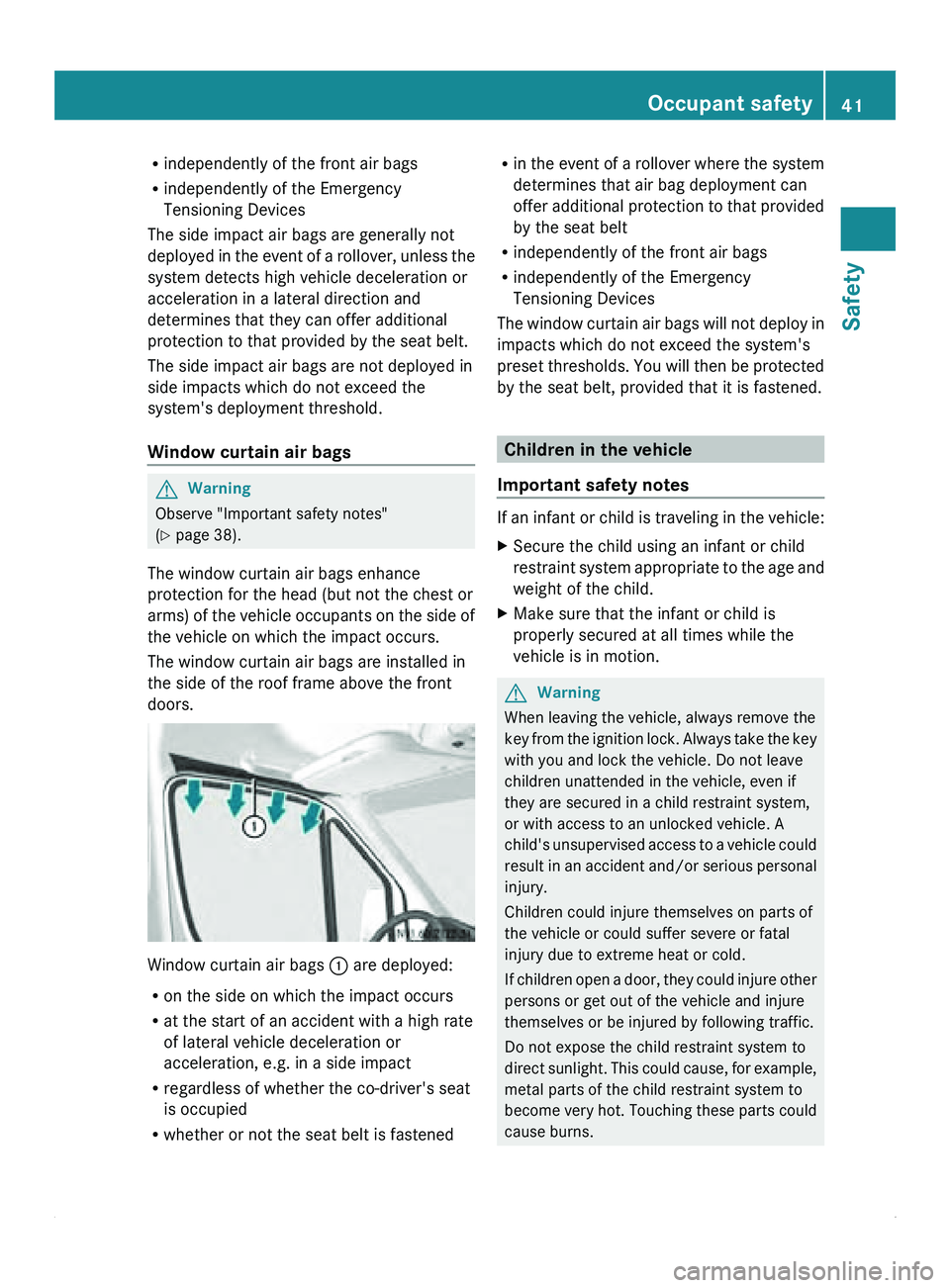
The window curtain air bags are installed in
the side of the roof frame above the front
doors. Window curtain air bags
0046 are deployed:
R on the side on which the impact occurs
R at the start of an accident with a high rate
of lateral vehicle deceleration or
acceleration, e.g. in a side impact
R regardless of whether the co-driver's seat
is occupied
R whether or not the seat belt is fastened R
in the event
of a rollover where the system
determines that air bag deployment can
offer additional protection to that provided
by the seat belt
R independently of the front air bags
R independently of the Emergency
Tensioning Devices
The window curtain air bags will not deploy in
impacts which do not exceed the system's
preset thresholds. You will then be protected
by the seat belt, provided that it is fastened. Children in the vehicle
Important safety notes If an infant or child is traveling in the vehicle:
X
Secure the child using an infant or child
restraint system appropriate
to the age and
weight of the child.
X Make sure that the infant or child is
properly secured at all times while the
vehicle is in motion. G
Warning
When leaving the vehicle, always remove the
key from the
ignition lock. Always take the key
with you and lock the vehicle. Do not leave
children unattended in the vehicle, even if
they are secured in a child restraint system,
or with access to an unlocked vehicle. A
child's unsupervised access to a vehicle could
result in an accident and/or serious personal
injury.
Children could injure themselves on parts of
the vehicle or could suffer severe or fatal
injury due to extreme heat or cold.
If children open a door, they could injure other
persons or get out of the vehicle and injure
themselves or be injured by following traffic.
Do not expose the child restraint system to
direct sunlight. This could cause, for example,
metal parts of the child restraint system to
become very hot. Touching these parts could
cause burns. Occupant safety
41
Safety Z
Page 47 of 292
X
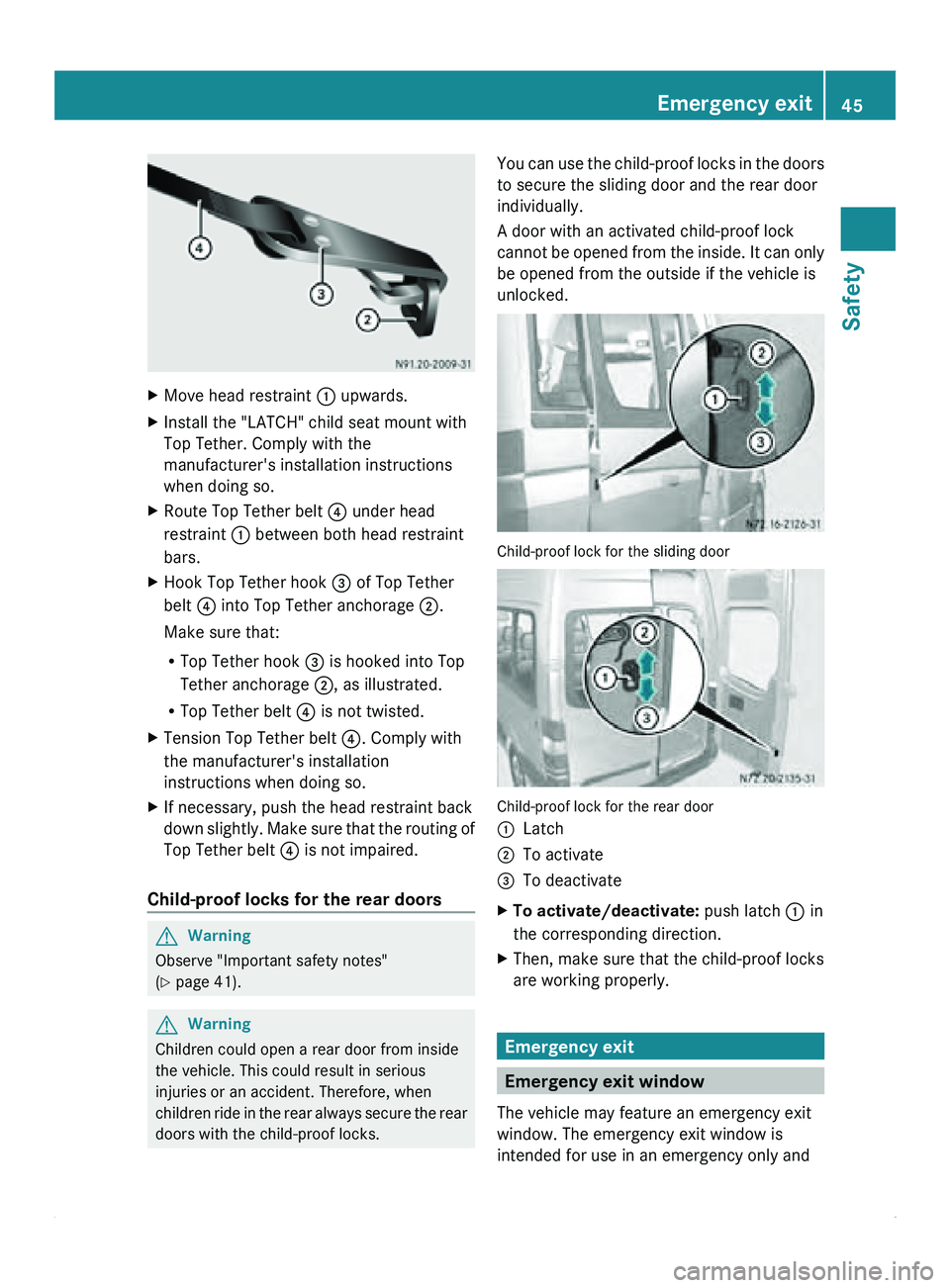
Move head restraint 0046 upwards.
X Install the "LATCH" child seat mount with
Top Tether. Comply with the
manufacturer's installation instructions
when doing so.
X Route Top Tether belt 0088 under head
restraint 0046 between both head restraint
bars.
X Hook Top Tether hook 008A of Top Tether
belt 0088 into Top Tether anchorage
0047.
Make sure that:
R Top Tether hook 008A is hooked into Top
Tether anchorage 0047
, as illustrated.
R Top Tether belt 0088 is not twisted.
X Tension Top Tether belt 0088
. Comply with
the manufacturer's installation
instructions when doing so.
X If necessary, push the head restraint back
down slightly. Make sure that the routing of
Top Tether belt 0088 is not impaired.
Child-proof locks for the rear doors G
Warning
Observe "Important safety notes"
(Y page 41). G
Warning
Children could open a rear door from inside
the vehicle. This could result in serious
injuries or an accident. Therefore, when
children ride in the rear always secure the rear
doors with the child-proof locks. You can use the child-proof locks in the doors
to secure the sliding door and the rear door
individually.
A door with an activated child-proof lock
cannot be opened from the inside. It can only
be opened from the outside if the vehicle is
unlocked.
Child-proof lock for the sliding door
Child-proof lock for the rear door
0046
Latch
0047 To activate
008A To deactivate
X To activate/deactivate: push latch 0046 in
the corresponding direction.
X Then, make sure that the child-proof locks
are working properly. Emergency exit
Emergency exit window
The vehicle may feature an emergency exit
window. The emergency exit window is
intended for use in an emergency only and Emergency exit
45
Safety Z
Page 48 of 292
must not be opened unless the vehicle is
stationary.
In an emergency, or after an accident, the
vehicle occupants can exit the vehicle
through the emergency exit window.
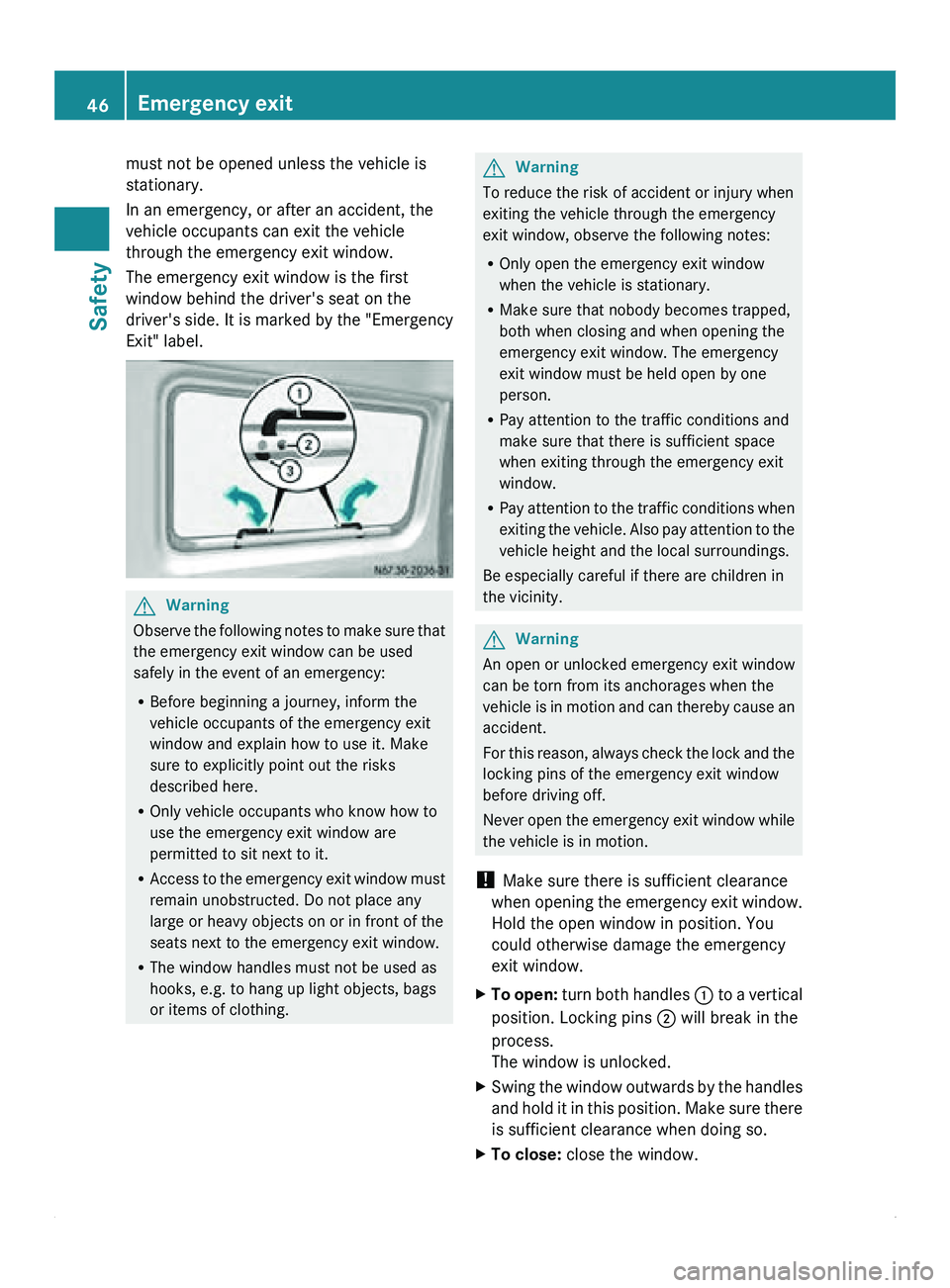
The emergency exit window is the first
window behind the driver's seat on the
driver's side.
It
is marked by the "Emergency
Exit" label. G
Warning
Observe the following notes to make sure that
the emergency exit window can be used
safely in the event of an emergency:
R Before beginning a journey, inform the
vehicle occupants of the emergency exit
window and explain how to use it. Make
sure to explicitly point out the risks
described here.
R Only vehicle occupants who know how to
use the emergency exit window are
permitted to sit next to it.
R Access to the
emergency exit window must
remain unobstructed. Do not place any
large or heavy objects on or in front of the
seats next to the emergency exit window.
R The window handles must not be used as
hooks, e.g. to hang up light objects, bags
or items of clothing. G
Warning
To reduce the risk of accident or injury when
exiting the vehicle through the emergency
exit window, observe the following notes:
R Only open the emergency exit window
when the vehicle is stationary.
R Make sure that nobody becomes trapped,
both when closing and when opening the
emergency exit window. The emergency
exit window must be held open by one
person.
R Pay attention to the traffic conditions and
make sure that there is sufficient space
when exiting through the emergency exit
window.
R Pay attention to
the traffic conditions when
exiting the vehicle. Also pay attention to the
vehicle height and the local surroundings.
Be especially careful if there are children in
the vicinity. G
Warning
An open or unlocked emergency exit window
can be torn from its anchorages when the
vehicle is in
motion and can thereby cause an
accident.
For this reason, always check the lock and the
locking pins of the emergency exit window
before driving off.
Never open the emergency exit window while
the vehicle is in motion.
! Make sure there is sufficient clearance
when opening the emergency exit window.
Hold the open window in position. You
could otherwise damage the emergency
exit window.
X To open: turn both handles 0046
to a vertical
position. Locking pins 0047 will break in the
process.
The window is unlocked.
X Swing the window outwards by the handles
and hold
it
in this position. Make sure there
is sufficient clearance when doing so.
X To close: close the window.46
Emergency exit
Safety
Page 49 of 292
X
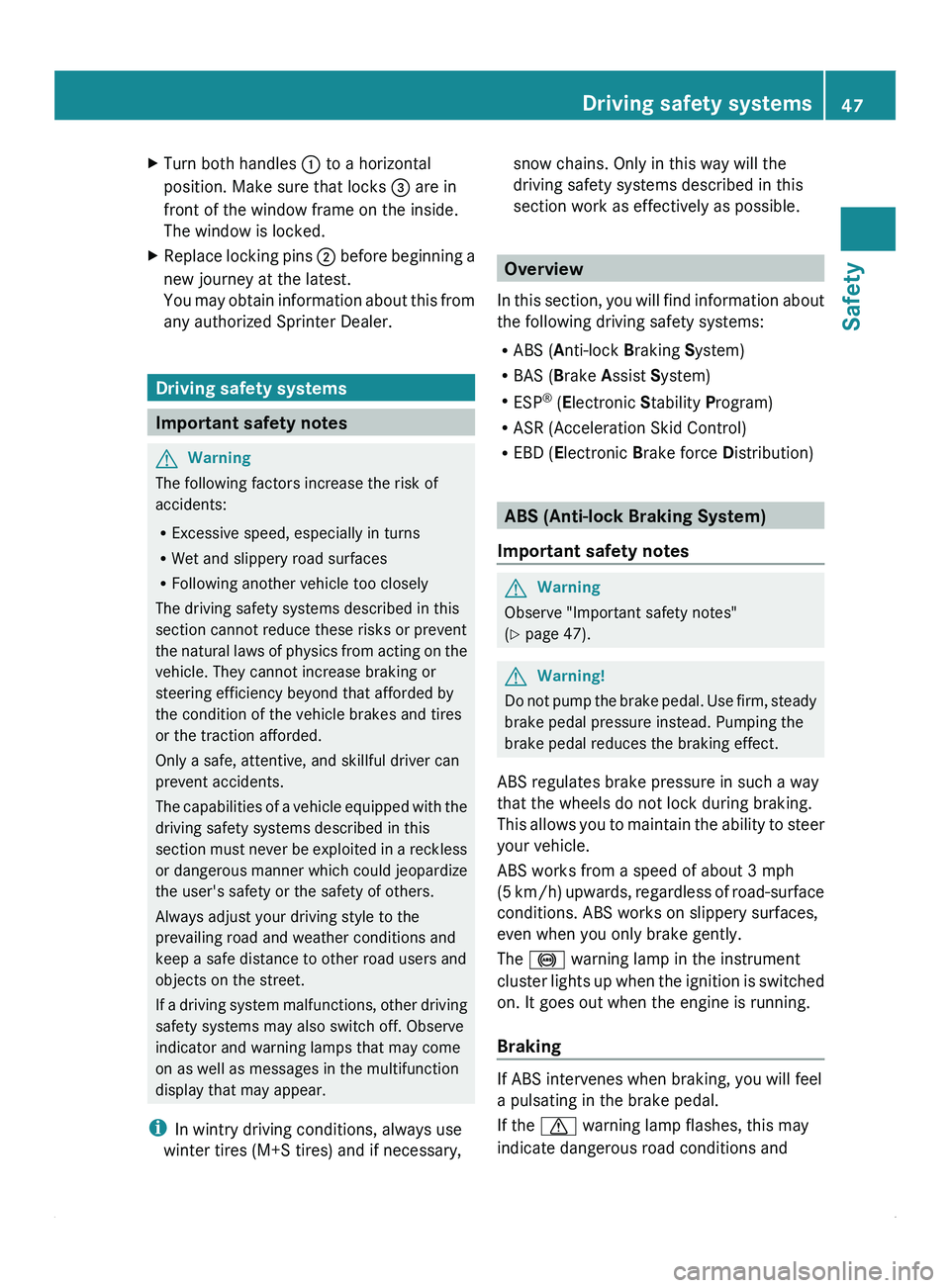
Turn both handles 0046 to a horizontal
position. Make sure that locks 008A are in
front of the window frame on the inside.
The window is locked.
X Replace locking pins 0047 before
beginning a
new journey at the latest.
You may obtain information about this from
any authorized Sprinter Dealer. Driving safety systems
Important safety notes
G
Warning
The following factors increase the risk of
accidents:
R Excessive speed, especially in turns
R Wet and slippery road surfaces
R Following another vehicle too closely
The driving safety systems described in this
section cannot reduce these risks or prevent
the natural laws
of physics from acting on the
vehicle. They cannot increase braking or
steering efficiency beyond that afforded by
the condition of the vehicle brakes and tires
or the traction afforded.
Only a safe, attentive, and skillful driver can
prevent accidents.
The capabilities of a vehicle equipped with the
driving safety systems described in this
section must never be exploited in a reckless
or dangerous manner which could jeopardize
the user's safety or the safety of others.
Always adjust your driving style to the
prevailing road and weather conditions and
keep a safe distance to other road users and
objects on the street.
If a driving system malfunctions, other driving
safety systems may also switch off. Observe
indicator and warning lamps that may come
on as well as messages in the multifunction
display that may appear.
i In wintry driving conditions, always use
winter tires (M+S tires) and if necessary, snow chains. Only in this way will the
driving safety systems described in this
section work as effectively as possible.
Overview
In this section,
you will find information about
the following driving safety systems:
R ABS ( Anti-lock Braking System)
R BAS ( Brake Assist System)
R ESP ®
(Electronic Stability Program)
R ASR (Acceleration Skid Control)
R EBD ( Electronic Brake force Distribution) ABS (Anti-lock Braking System)
Important safety notes G
Warning
Observe "Important safety notes"
(Y page 47). G
Warning!
Do not pump the brake pedal. Use firm, steady
brake pedal pressure instead. Pumping the
brake pedal reduces the braking effect.
ABS regulates brake pressure in such a way
that the wheels do not lock during braking.
This allows you
to maintain the ability to steer
your vehicle.
ABS works from a speed of about 3 mph
(5 km/h) upwards, regardless of road-surface
conditions. ABS works on slippery surfaces,
even when you only brake gently.
The 0031 warning lamp in the instrument
cluster lights up when the ignition is switched
on. It goes out when the engine is running.
Braking If ABS intervenes when braking, you will feel
a pulsating in the brake pedal.
If the
0067 warning lamp flashes, this may
indicate dangerous road conditions and Driving safety systems
47
Safety Z
Page 50 of 292
serves as a reminder to take extra care while
driving.
X
If ABS intervenes: continue to depress the
brake pedal with force until the braking
situation is over.
X To make a full brake application:
depress the brake pedal with full force. G
Warning
If the ABS malfunctions, other driving systems
such as the
BAS or the ESP ®
are also switched
off. Observe indicator and warning lamps that
may come on as well as messages in the
multifunction display that may appear.
If the ABS malfunctions, the wheels may lock
during hard braking, reducing the steering
capability and extending the braking distance. BAS (Brake Assist System)
G
Warning
Observe "Important safety notes"
(Y page 47).
BAS operates in emergency braking
situations. If you depress the brake pedal
quickly, BAS automatically
boosts the braking
force, potentially reducing the stopping
distance.
X Keep the brake pedal firmly depressed until
the emergency braking situation is over.
ABS prevents the wheels from locking.
The brakes will function as usual once you
release the brake pedal. BAS is deactivated. G
Warning
If the BAS malfunctions, the brake system still
functions, but without the additional brake
boost available that the BAS would normally
provide in an emergency braking maneuver.
Therefore, the braking
distance may increase. EBD (Electronic Brake force
Distribution)
G
Warning
Observe "Important safety notes"
(Y page 47).
EBD monitors and controls the brake
pressure on the rear wheels to improve
driving stability while braking. G
Warning
If the 009E, 003D, 0031 and 0065 indicator
lamps light up while the vehicle is in motion,
EBD may be defective.
If EBD malfunctions,
the brake system will still
function with full brake boost. However, the
rear wheels could lock up during emergency
braking situations, for example. You could
lose control of the vehicle and cause an
accident.
Adapt your driving style to the changed
driving characteristics. ASR (acceleration skid control)
Important safety notes G
Warning
Observe "Important safety notes"
(Y page 47).
ASR can significantly improve traction, i.e.
the transmission of power from the tires to
the road surface, and thus may increase the
vehicle's driving stability. ASR assists in
pulling away and
accelerating, particularly on
smooth and slippery surfaces.
ASR can brake individual wheels and limits
the engine torque to help prevent the drive
wheels from spinning.
If ASR intervenes, the 0067 warning lamp
flashes in the instrument cluster. 48
Driving safety systems
Safety
Page 51 of 292
G
Warning
Never switch off ASR when you see the
0067 warning lamp
flashing in the instrument
cluster. In this case proceed as follows:
R when driving off, apply as little throttle as
possible.
R while driving, ease off the accelerator
pedal.
R adapt your speed and driving style to the
prevailing road conditions.
Failure to observe these guidelines could
cause the vehicle to skid. ESP ®
cannot
prevent accidents resulting from excessive
speed.
If, taking tires, cargo load and gradient into
consideration, the surface driven on still
provides insufficient traction, you may
experience difficulties in pulling away despite
ASR.
Vehicles without steering-wheel buttons:
the 003D indicator lamp in the instrument
cluster lights up when you switch on the
ignition. It goes out when the engine is
running.
Activating/deactivating ASR G
Warning
ASR should
not be switched off during normal
driving other than in the circumstances
described below. Deactivating
the system will
reduce vehicle stability in driving maneuvers.
Do not switch off ASR when a spare wheel is
mounted.
ASR is activated automatically when the
engine is running.
It may be best to deactivate ASR briefly in the
following situations:
R when using snow chains
R in deep snow
R on sand or gravel If you deactivate ASR:
R
the engine's torque
is no longer limited and
the drive wheels can spin. The spinning of
the wheels results in a cutting action, which
provides better grip.
R brake intervention will continue to improve
traction where a drive wheel begins to spin,
e.g. if only the side of the road is slippery.
The wheel will be braked to increase
traction under such circumstances.
R active brake intervention by ESP ®
to
increase driving stability remains active. G
Warning
Even with ASR deactivated, ESP ®
remains
active and continues to perform brake
interventions where this is necessary to
improve driving stability. The 0067 warning
lamp flashes.
With ASR deactivated, there is an increased
risk of your vehicle's brake system
overheating and suffering damage due to
prolonged application. A
hot brake system will
also result in increased stopping distance.
Therefore, only deactivate ASR when
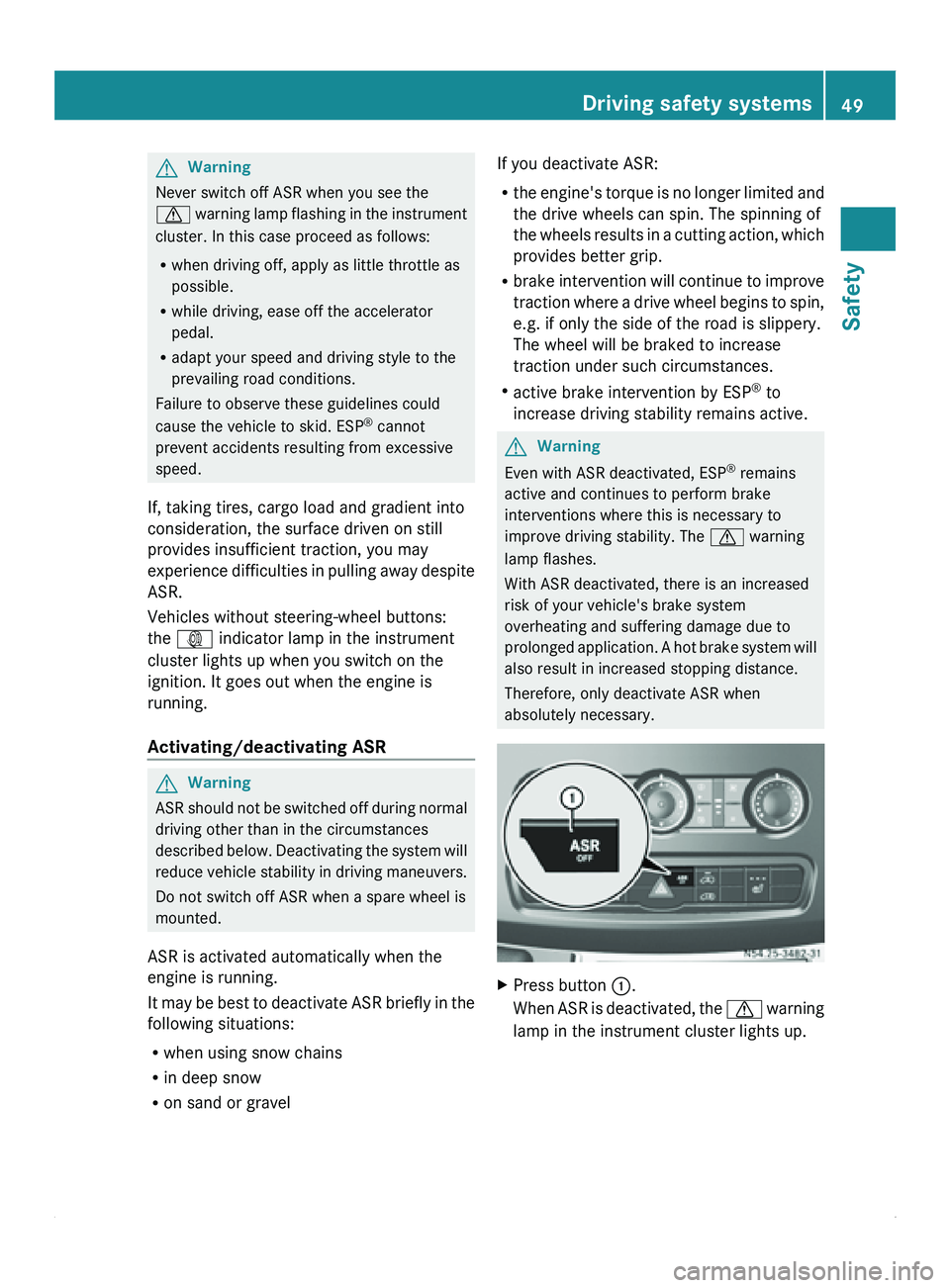
absolutely necessary. X
Press button 0046
.
When ASR is
deactivated, the 0067 warning
lamp in the instrument cluster lights up. Driving safety systems
49
Safety Z
Page 58 of 292
Deactivating automatic locking when
driving
X
Turn the key to position 1 or 2 in the ignition
lock when the doors are closed.
X For the entire vehicle: press upper
section 0046 of central locking button until
the indicator lamp in the button flashes
twice.
X For the sliding doors and rear doors
only:
press lower section 0047 of the central
locking button until the indicator lamp in
the button flashes twice. Ignition lock
005D
To insert/remove the key, to lock the
steering wheel
004A To unlock the steering wheel, power
supply for some consumers (e.g. the
radio)
004B To switch on the ignition, power supply for
all consumers preglow and drive position
004C To start the engine
i To unlock the steering wheel, move the
steering wheel slightly while turning the key
to position 1.
On vehicles with a battery isolating switch,
you must first switch on the electrical
system (Y page 87). Driver's door and co-driver's door
G
Warning
Make sure that nobody can become trapped
as you close and open the doors. Exercise
particular care, especially if children are near
the vehicle.
Only open the doors when road and traffic
conditions permit. Make sure that there is
sufficient clearance when opening the doors.
You could otherwise cause injury to yourself
and others.
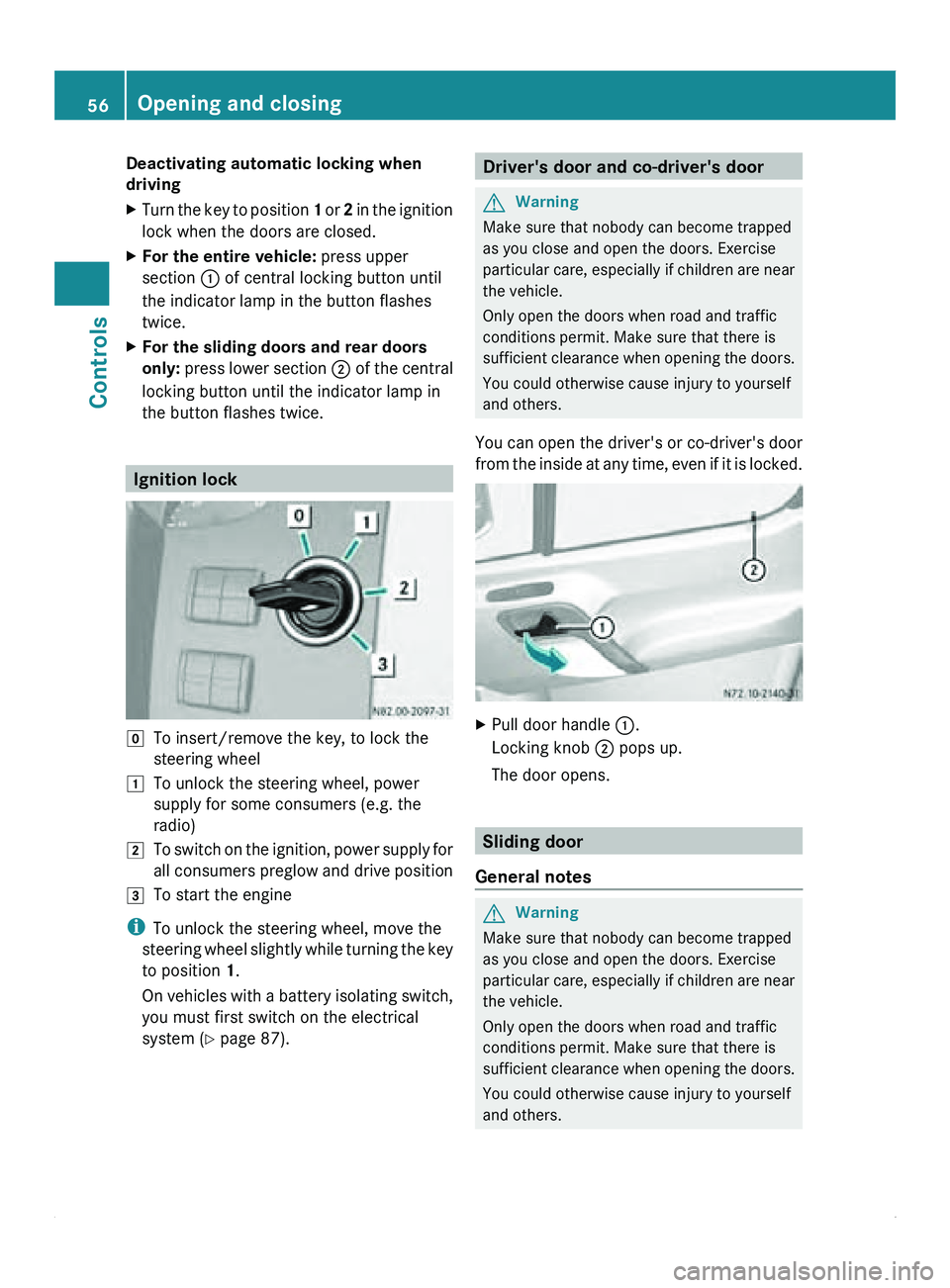
You can open the driver's or co-driver's door
from the inside at any time, even if it is locked. X
Pull door handle 0046.
Locking knob 0047 pops up.
The door opens. Sliding door
General notes G
Warning
Make sure that nobody can become trapped
as you close and open the doors. Exercise
particular care, especially if children are near
the vehicle.
Only open the doors when road and traffic
conditions permit. Make sure that there is
sufficient clearance when opening the doors.
You could otherwise cause injury to yourself
and others. 56
Opening and closing
Controls
Page 65 of 292
mirror or on the grab handles on the
headliner. This will prevent a false alarm.
Deactivating the interior
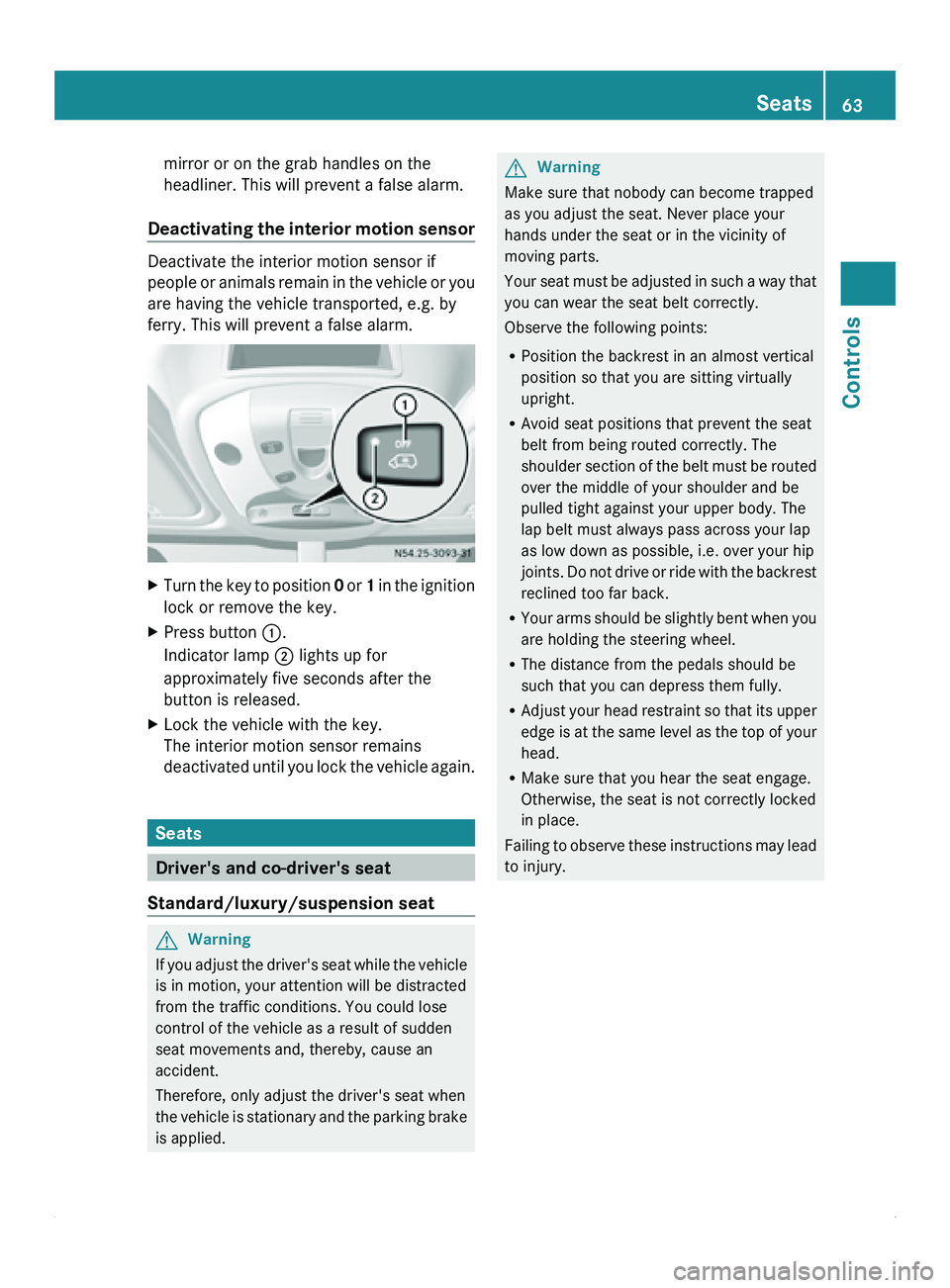
motion sensorDeactivate the interior motion sensor if
people or
animals
remain in the vehicle or you
are having the vehicle transported, e.g. by
ferry. This will prevent a false alarm. X
Turn the key to position 0 or 1
in the ignition
lock or remove the key.
X Press button 0046.
Indicator lamp 0047 lights up for
approximately five seconds after the
button is released.
X Lock the vehicle with the key.
The interior motion sensor remains
deactivated until
you
lock the vehicle again.Seats
Driver's and co-driver's seat
Standard/luxury/suspension seat G
Warning
If you adjust the driver's seat while the vehicle
is in motion, your attention will be distracted
from the traffic conditions. You could lose
control of the vehicle as a result of sudden
seat movements and, thereby, cause an
accident.
Therefore, only adjust the driver's seat when
the vehicle is
stationary and the parking brake
is applied. G
Warning
Make sure that nobody can become trapped
as you adjust the seat. Never place your
hands under the seat or in the vicinity of
moving parts.
Your seat must
be adjusted in such a way that
you can wear the seat belt correctly.
Observe the following points:
R Position the backrest in an almost vertical
position so that you are sitting virtually
upright.
R Avoid seat positions that prevent the seat
belt from being routed correctly. The
shoulder section of the belt must be routed
over the middle of your shoulder and be
pulled tight against your upper body. The
lap belt must always pass across your lap
as low down as possible, i.e. over your hip
joints. Do not drive or ride with the backrest
reclined too far back.
R Your arms should be slightly bent when you
are holding the steering wheel.
R The distance from the pedals should be
such that you can depress them fully.
R Adjust your head restraint so that its upper
edge is at the same level as the top of your
head.
R Make sure that you hear the seat engage.
Otherwise, the seat is not correctly locked
in place.
Failing to observe these instructions may lead
to injury. Seats
63
Controls Z
Page 67 of 292
Swiveling front seats
G
Warning
Do not start the engine unless the driver's and
co-driver's seats are facing in the direction of
travel and are locked in position. Only adjust
the seats when the vehicle is stationary and
the parking brake is applied. You could
otherwise lose control of the vehicle as a
result of sudden seat movements and thereby
cause an accident.
The safety systems only work when the
driver's and co-driver's seats are facing in the
direction of travel.
The driver's seat and co-driver's seat can be
rotated through 180°.
The seats engage when facing in the direction
of travel as well as when facing in the opposite
direction and also engage at an angle of 50°
to the door.
! When rotating the seats, make sure that
there is sufficient space to do so.
Move the seat forward or back first. This
will help to avoid contact with other parts
of the interior.
Push the handbrake lever down to the stop.
The parking brake or handbrake lever could
otherwise be damaged.
i Always slide the co-driver's seat forwards
before rotating it (Y page 64).
X Make sure that the parking brake has been
engaged and that the handbrake lever has
been pushed down to the stop
(Y page 112).
X Adjust the steering wheel to provide the
necessary space to rotate and adjust the
driver's seat ( Y
page 69). G
Warning
When releasing and rotating the seats, make
sure that you do not trap yourself or others.
Never place your hands under the seat or in
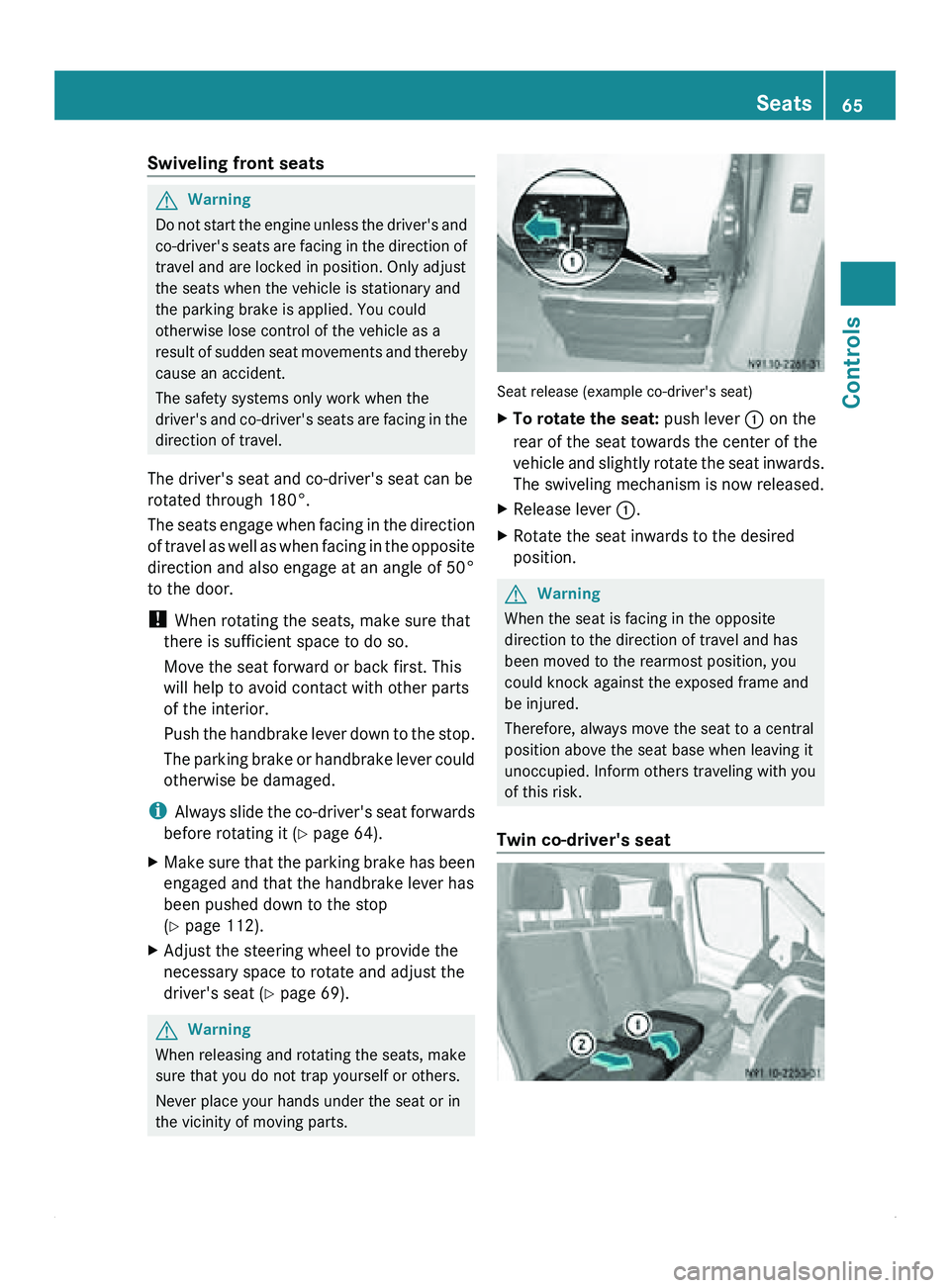
the vicinity of moving parts. Seat release (example co-driver's seat)
X
To rotate the seat: push lever 0046 on the
rear of the seat towards the center of the
vehicle and
slightly rotate the seat inwards.
The swiveling mechanism is now released.
X Release lever 0046.
X Rotate the seat inwards to the desired
position. G
Warning
When the seat is facing in the opposite
direction to the direction of travel and has
been moved to the rearmost position, you
could knock against the exposed frame and
be injured.
Therefore, always move the seat to a central
position above the seat base when leaving it
unoccupied. Inform others traveling with you
of this risk.
Twin co-driver's seat Seats
65Controls Z