light MERCEDES-BENZ SPRINTER 2012 MY12 Operator’s Manual
[x] Cancel search | Manufacturer: MERCEDES-BENZ, Model Year: 2012, Model line: SPRINTER, Model: MERCEDES-BENZ SPRINTER 2012Pages: 292, PDF Size: 6.75 MB
Page 51 of 292
G
Warning
Never switch off ASR when you see the
0067 warning lamp
flashing in the instrument
cluster. In this case proceed as follows:
R when driving off, apply as little throttle as
possible.
R while driving, ease off the accelerator
pedal.
R adapt your speed and driving style to the
prevailing road conditions.
Failure to observe these guidelines could
cause the vehicle to skid. ESP ®
cannot
prevent accidents resulting from excessive
speed.
If, taking tires, cargo load and gradient into
consideration, the surface driven on still
provides insufficient traction, you may
experience difficulties in pulling away despite
ASR.
Vehicles without steering-wheel buttons:
the 003D indicator lamp in the instrument
cluster lights up when you switch on the
ignition. It goes out when the engine is
running.
Activating/deactivating ASR G
Warning
ASR should
not be switched off during normal
driving other than in the circumstances
described below. Deactivating
the system will
reduce vehicle stability in driving maneuvers.
Do not switch off ASR when a spare wheel is
mounted.
ASR is activated automatically when the
engine is running.
It may be best to deactivate ASR briefly in the
following situations:
R when using snow chains
R in deep snow
R on sand or gravel If you deactivate ASR:
R
the engine's torque
is no longer limited and
the drive wheels can spin. The spinning of
the wheels results in a cutting action, which
provides better grip.
R brake intervention will continue to improve
traction where a drive wheel begins to spin,
e.g. if only the side of the road is slippery.
The wheel will be braked to increase
traction under such circumstances.
R active brake intervention by ESP ®
to
increase driving stability remains active. G
Warning
Even with ASR deactivated, ESP ®
remains
active and continues to perform brake
interventions where this is necessary to
improve driving stability. The 0067 warning
lamp flashes.
With ASR deactivated, there is an increased
risk of your vehicle's brake system
overheating and suffering damage due to
prolonged application. A
hot brake system will
also result in increased stopping distance.
Therefore, only deactivate ASR when
absolutely necessary. X
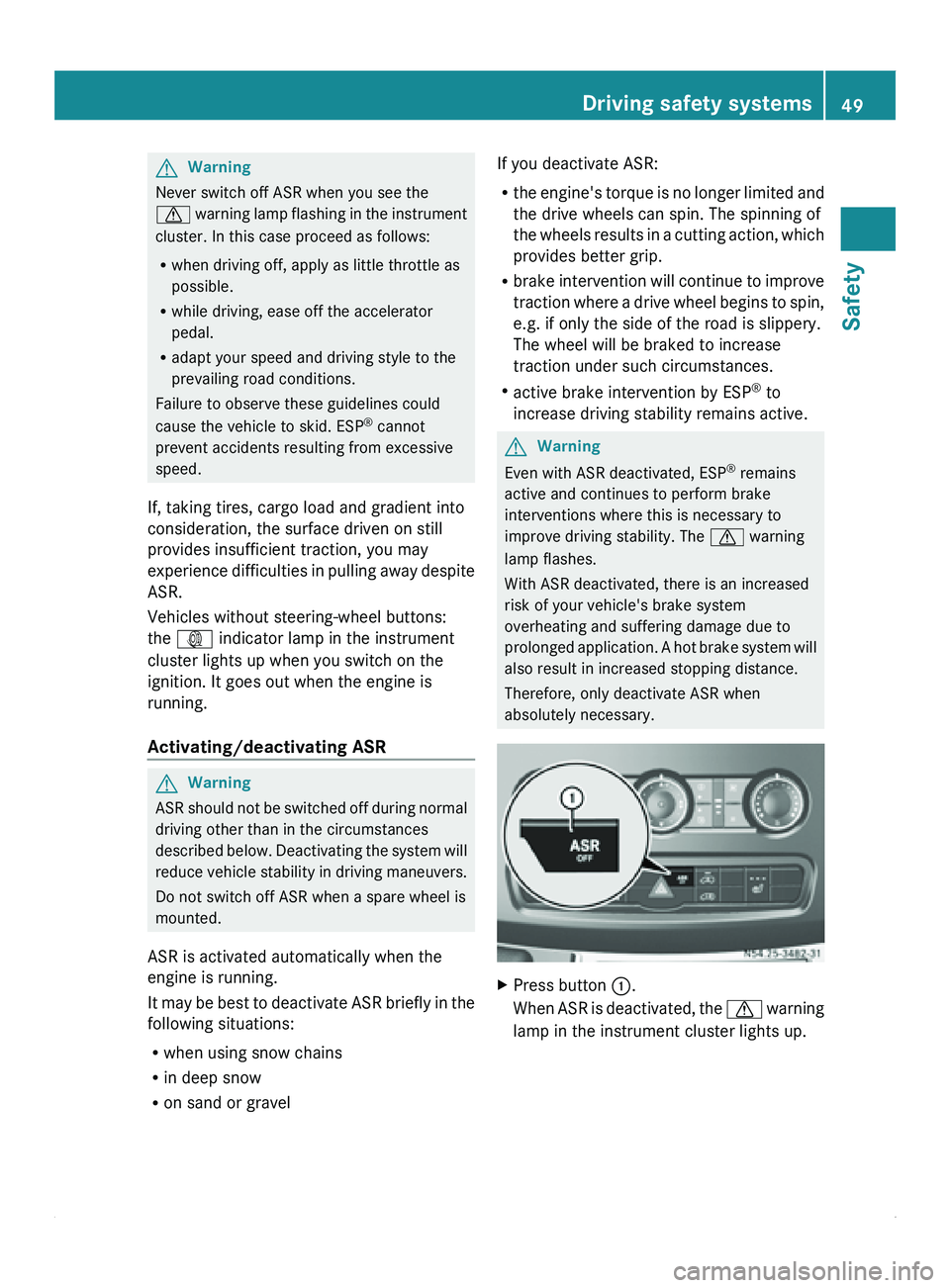
Press button 0046
.
When ASR is
deactivated, the 0067 warning
lamp in the instrument cluster lights up. Driving safety systems
49
Safety Z
Page 53 of 292
Vehicle equipment ..............................
52
Opening and closing ...........................52
Anti-theft systems .............................. 61
Seats .................................................... 63
Steering wheel .................................... 69
Mirrors ................................................. 69
Instrument cluster ..............................70
On-board computer without steer-
ing wheel buttons ............................... 72
On-board computer with steering
wheel buttons ..................................... 74
Power supply ....................................... 87
Lighting ................................................ 88
Good visibility ...................................... 94
Climate control .................................... 97
Driving and parking .......................... 108
Brakes ................................................ 112
Automatic transmission ................... 113
Driving the vehicle ............................116
Driving systems ................................ 117
Features ............................................. 128
Communications ............................... 133 51Controls
Page 55 of 292
restraint system. Children could otherwise
injure themselves on parts of the vehicle.
They could
be
severely or even fatally injured
by prolonged exposure to intense heat or
cold.
If children open a door, they could:
R injure other people
R get out of the vehicle and thereby injure
themselves or be injured by a passing
vehicle
R severely injure themselves by falling down,
in particular due to the vehicle height
Always take the key with you when leaving the
vehicle, even if you are only leaving for a short
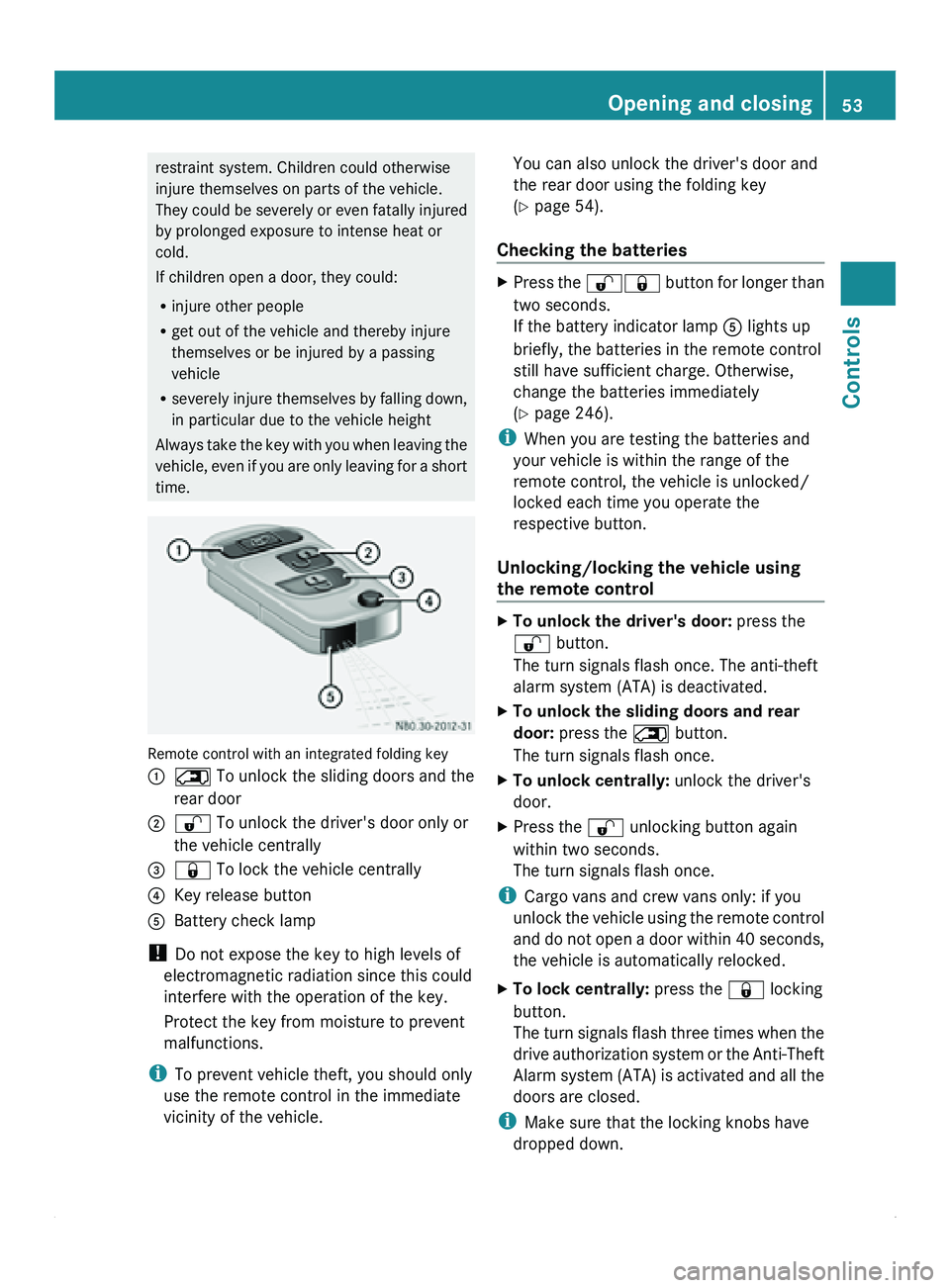
time. Remote control with an integrated folding key
0046
0042 To unlock the sliding doors and the
rear door
0047 0036
To unlock the driver's door only or
the vehicle centrally
008A 0037 To lock the vehicle centrally
0088 Key release button
0086 Battery check lamp
! Do not expose the key to high levels of
electromagnetic radiation since this could
interfere with the operation of the key.
Protect the key from moisture to prevent
malfunctions.
i To prevent vehicle theft, you should only
use the remote control in the immediate
vicinity of the vehicle. You can also unlock the driver's door and
the rear door using the folding key
(Y page 54).
Checking the batteries X
Press the 00360037 button
for
longer than
two seconds.
If the battery indicator lamp 0086 lights up
briefly, the batteries in the remote control
still have sufficient charge. Otherwise,
change the batteries immediately
(Y page 246).
i When you are testing the batteries and
your vehicle is within the range of the
remote control, the vehicle is unlocked/
locked each time you operate the
respective button.
Unlocking/locking the vehicle using
the remote control X
To unlock the driver's door: press the
0036
button.
The turn signals flash once. The anti-theft
alarm system (ATA) is deactivated.
X To unlock the sliding doors and rear
door: press the 0042 button.
The turn signals flash once.
X To unlock centrally: unlock the driver's
door.
X Press the 0036 unlocking button again
within two seconds.
The turn signals flash once.
i Cargo vans and crew vans only: if you
unlock the vehicle
using the remote control
and do not open a door within 40 seconds,
the vehicle is automatically relocked.
X To lock centrally: press the 0037 locking
button.
The turn signals
flash three times when the
drive authorization system or the Anti-Theft
Alarm system (ATA) is activated and all the
doors are closed.
i Make sure that the locking knobs have
dropped down. Opening and closing
53
Controls Z
Page 57 of 292
Locking and unlocking manually
Using the central locking button, you can
centrally lock/unlock
either
the entire vehicle
or just the sliding doors and rear doors from
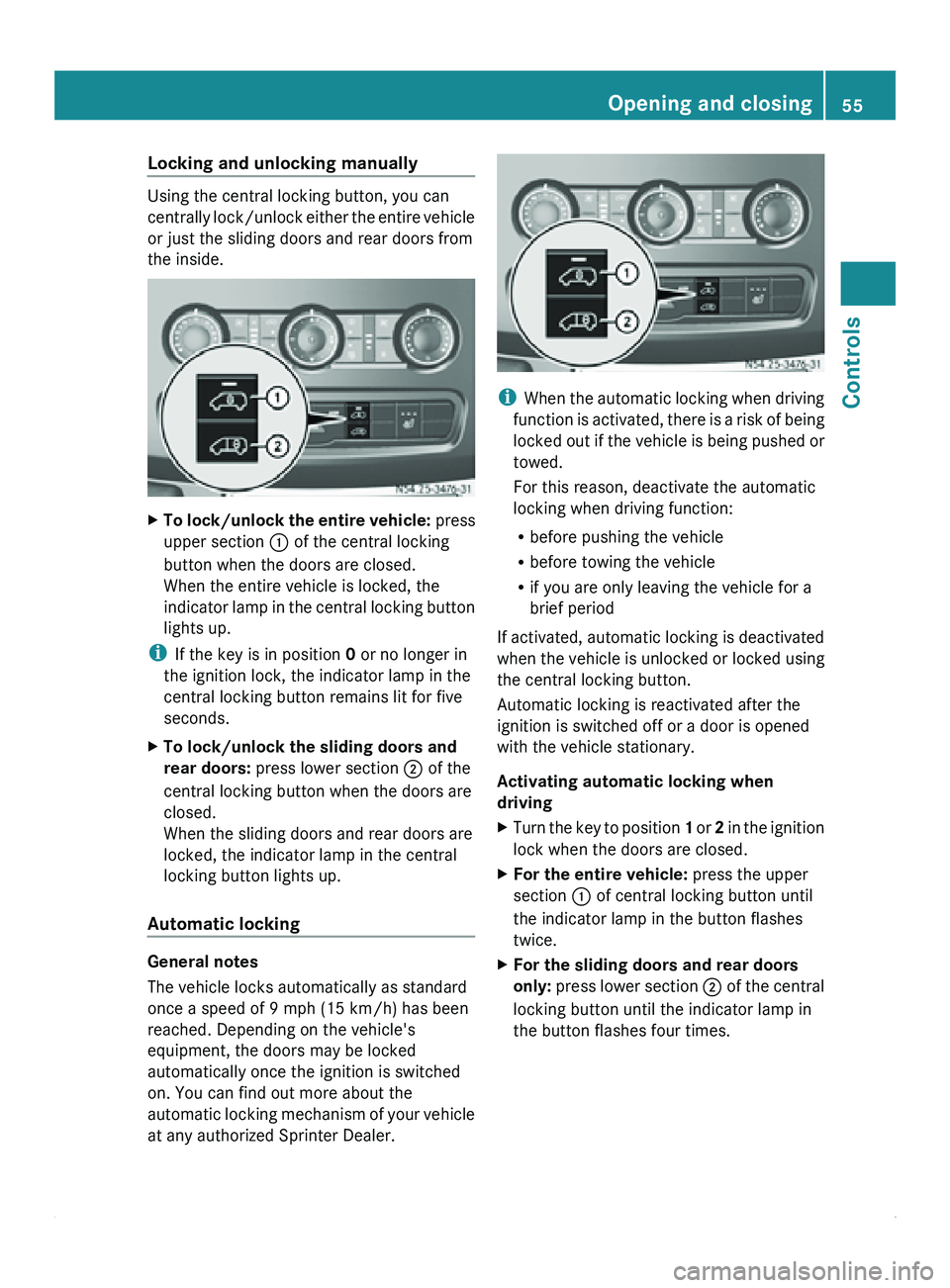
the inside. X
To lock/unlock the entire vehicle: press
upper section 0046 of the central locking
button when the doors are closed.
When the entire vehicle is locked, the
indicator lamp in
the central locking button
lights up.
i If the key is in position 0 or no longer in
the ignition lock, the indicator lamp in the
central locking button remains lit for five
seconds.
X To lock/unlock the sliding doors and
rear doors: press lower section 0047 of the
central locking button when the doors are
closed.
When the sliding doors and rear doors are
locked, the indicator lamp in the central
locking button lights up.
Automatic locking General notes
The vehicle locks automatically as standard
once a speed of 9 mph (15 km/h) has been
reached. Depending on the vehicle's
equipment, the doors may be locked
automatically once the ignition is switched
on. You can find out more about the
automatic locking
mechanism
of your vehicle
at any authorized Sprinter Dealer. i
When the automatic
locking when driving
function is activated, there is a risk of being
locked out if the vehicle is being pushed or
towed.
For this reason, deactivate the automatic
locking when driving function:
R before pushing the vehicle
R before towing the vehicle
R if you are only leaving the vehicle for a
brief period
If activated, automatic locking is deactivated
when the vehicle is unlocked or locked using
the central locking button.
Automatic locking is reactivated after the
ignition is switched off or a door is opened
with the vehicle stationary.
Activating automatic locking when
driving
X Turn the key to position 1 or 2
in the ignition
lock when the doors are closed.
X For the entire vehicle: press the upper
section 0046 of central locking button until
the indicator lamp in the button flashes
twice.
X For the sliding doors and rear doors
only: press lower
section 0047 of the central
locking button until the indicator lamp in
the button flashes four times. Opening and closing
55
Controls Z
Page 58 of 292
Deactivating automatic locking when
driving
X
Turn the key to position 1 or 2 in the ignition
lock when the doors are closed.
X For the entire vehicle: press upper
section 0046 of central locking button until
the indicator lamp in the button flashes
twice.
X For the sliding doors and rear doors
only:
press lower section 0047 of the central
locking button until the indicator lamp in
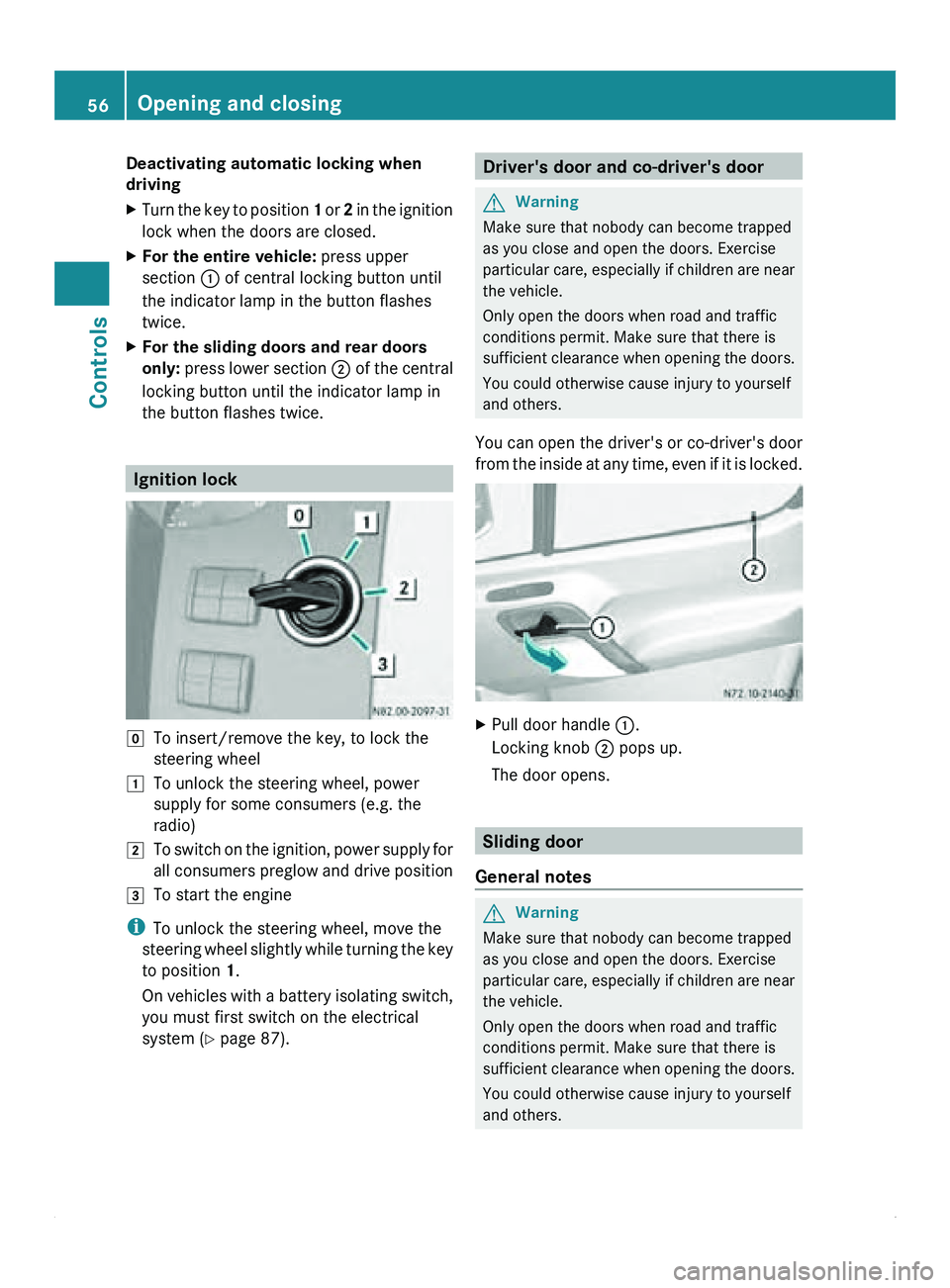
the button flashes twice. Ignition lock
005D
To insert/remove the key, to lock the
steering wheel
004A To unlock the steering wheel, power
supply for some consumers (e.g. the
radio)
004B To switch on the ignition, power supply for
all consumers preglow and drive position
004C To start the engine
i To unlock the steering wheel, move the
steering wheel slightly while turning the key
to position 1.
On vehicles with a battery isolating switch,
you must first switch on the electrical
system (Y page 87). Driver's door and co-driver's door
G
Warning
Make sure that nobody can become trapped
as you close and open the doors. Exercise
particular care, especially if children are near
the vehicle.
Only open the doors when road and traffic
conditions permit. Make sure that there is
sufficient clearance when opening the doors.
You could otherwise cause injury to yourself
and others.
You can open the driver's or co-driver's door
from the inside at any time, even if it is locked. X
Pull door handle 0046.
Locking knob 0047 pops up.
The door opens. Sliding door
General notes G
Warning
Make sure that nobody can become trapped
as you close and open the doors. Exercise
particular care, especially if children are near
the vehicle.
Only open the doors when road and traffic
conditions permit. Make sure that there is
sufficient clearance when opening the doors.
You could otherwise cause injury to yourself
and others. 56
Opening and closing
Controls
Page 64 of 292
X
To arm: close all doors.
X Lock the vehicle using the 0037 button on
the key.
The indicator lamp in the upper central
locking button ( Y
page 55) flashes.
X To deactivate: unlock the
vehicle using the
0036 button on the remote control.
The indicator lamp in the upper central
locking button (Y page 55) goes out.
i Cargo van and passenger van only:
Unless you open
a door within 40 seconds
after unlocking the vehicle:
R the vehicle will be locked again.
R the anti-theft alarm system will be re-
armed.
i The alarm system will be triggered if the
vehicle was previously locked with the key
and is then unlocked from the inside.
X To stop the alarm: insert the key into the
ignition lock.
or
X Press the 0036 button on the remote
control.
The alarm is switched off. Tow-away alarm
A visual and audible alarm is triggered if the
inclination of the vehicle changes when tow-
away protection is armed.
i The alarm signal
is triggered, for example
if the vehicle is being jacked up on one side,
shortly before the wheel leaves the ground.
Tow-away protection is automatically armed
approximately 20 seconds after you lock the
vehicle.
Tow-away protection is automatically
deactivated when you unlock the vehicle.
Deactivate tow-away protection if the vehicle
is being transported or loaded onto another
vehicle. This will prevent a false alarm. X
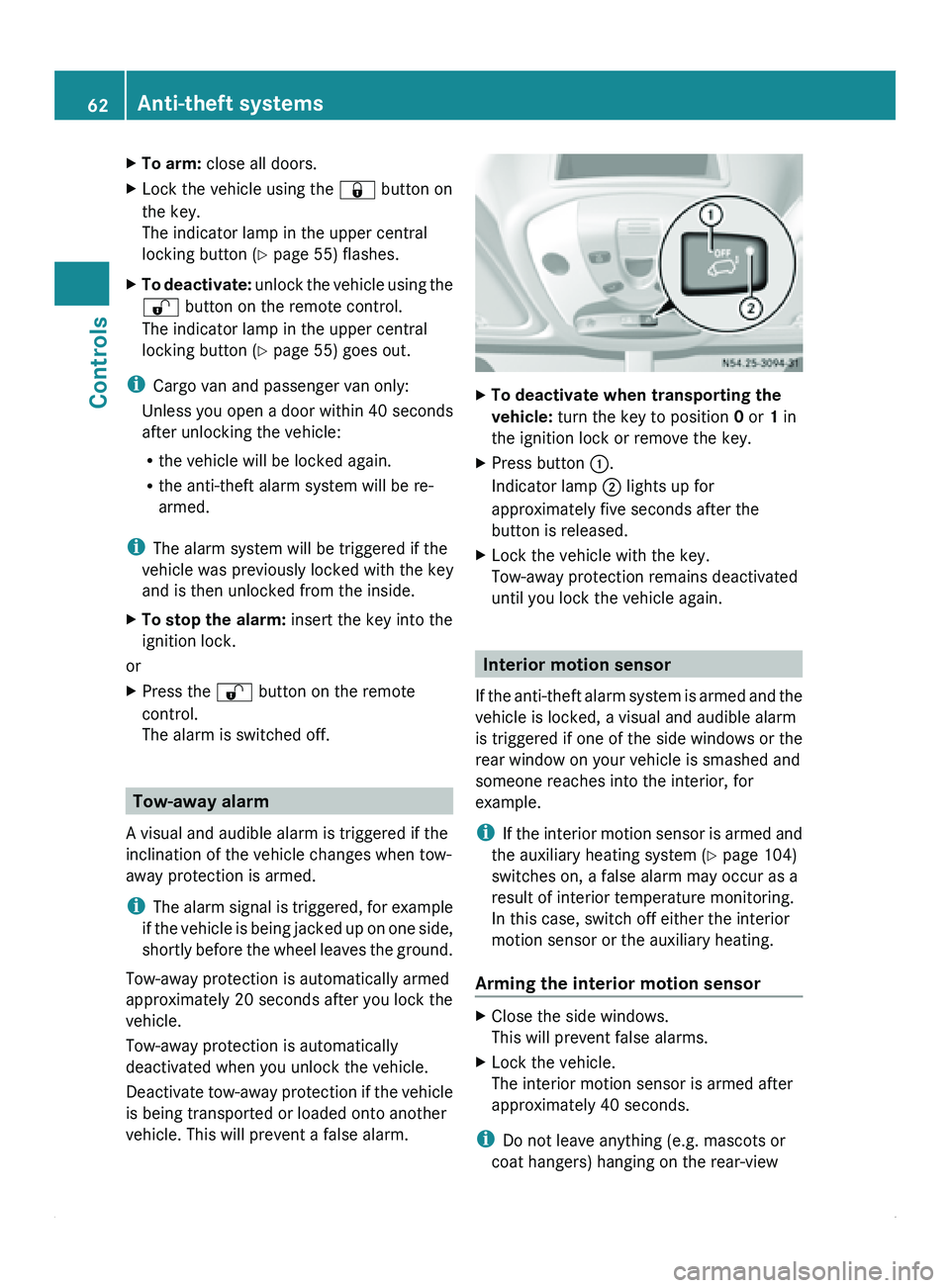
To deactivate when transporting the
vehicle: turn the key to position 0 or 1 in
the ignition lock or remove the key.
X Press button 0046.
Indicator lamp 0047 lights up for
approximately five seconds after the
button is released.
X Lock the vehicle with the key.
Tow-away protection remains deactivated
until you lock the vehicle again. Interior motion sensor
If the anti-theft
alarm system is armed and the
vehicle is locked, a visual and audible alarm
is triggered if one of the side windows or the
rear window on your vehicle is smashed and
someone reaches into the interior, for
example.
i If the interior motion sensor is armed and
the auxiliary heating system (Y page 104)
switches on, a false alarm may occur as a
result of interior temperature monitoring.
In this case, switch off either the interior
motion sensor or the auxiliary heating.
Arming the interior motion sensor X
Close the side windows.
This will prevent false alarms.
X Lock the vehicle.
The interior motion sensor is armed after
approximately 40 seconds.
i Do not leave anything (e.g. mascots or
coat hangers) hanging on the rear-view 62
Anti-theft systems
Controls
Page 65 of 292
mirror or on the grab handles on the
headliner. This will prevent a false alarm.
Deactivating the interior
motion sensorDeactivate the interior motion sensor if
people or
animals
remain in the vehicle or you
are having the vehicle transported, e.g. by
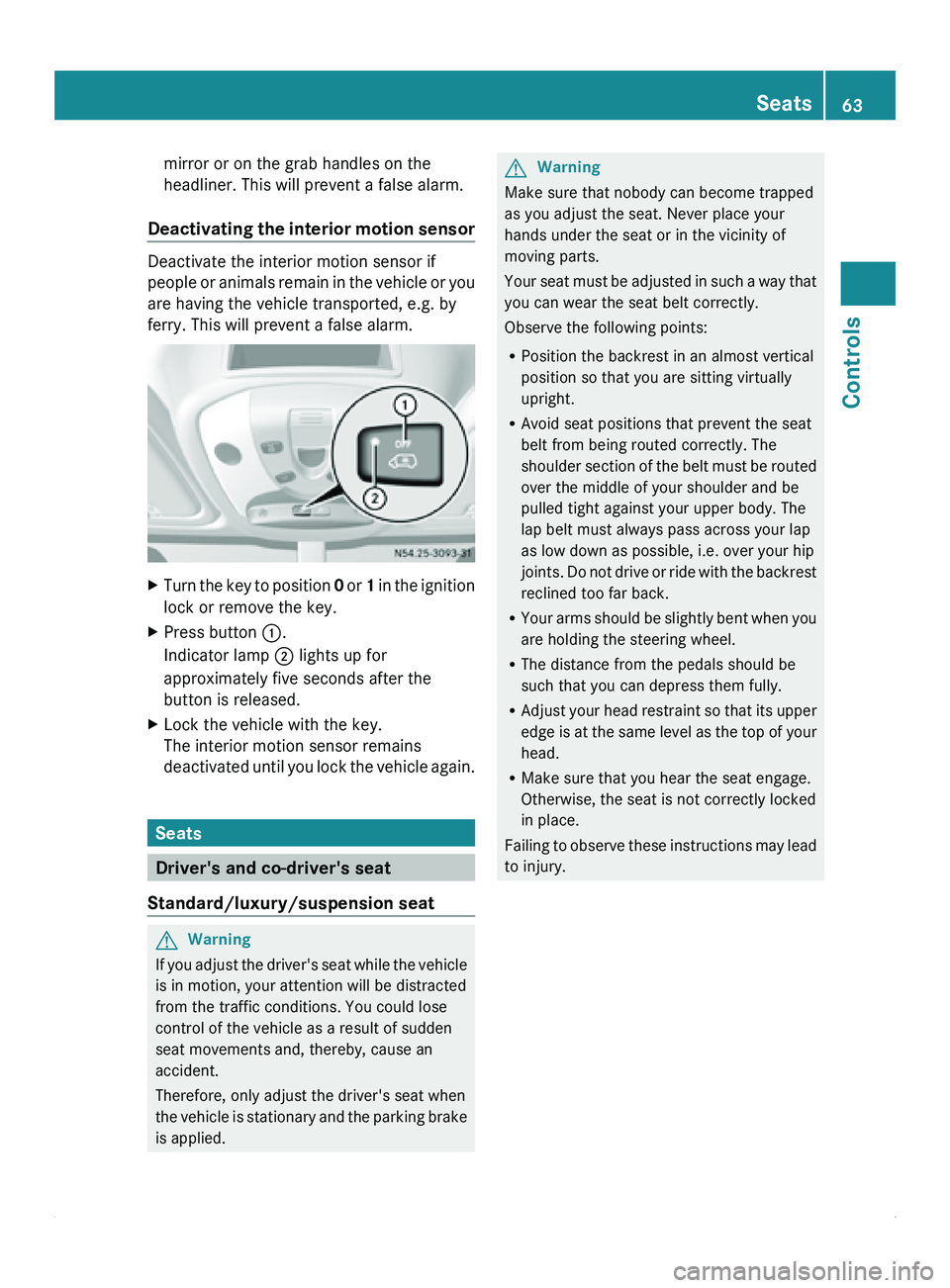
ferry. This will prevent a false alarm. X
Turn the key to position 0 or 1
in the ignition
lock or remove the key.
X Press button 0046.
Indicator lamp 0047 lights up for
approximately five seconds after the
button is released.
X Lock the vehicle with the key.
The interior motion sensor remains
deactivated until
you
lock the vehicle again.Seats
Driver's and co-driver's seat
Standard/luxury/suspension seat G
Warning
If you adjust the driver's seat while the vehicle
is in motion, your attention will be distracted
from the traffic conditions. You could lose
control of the vehicle as a result of sudden
seat movements and, thereby, cause an
accident.
Therefore, only adjust the driver's seat when
the vehicle is
stationary and the parking brake
is applied. G
Warning
Make sure that nobody can become trapped
as you adjust the seat. Never place your
hands under the seat or in the vicinity of
moving parts.
Your seat must
be adjusted in such a way that
you can wear the seat belt correctly.
Observe the following points:
R Position the backrest in an almost vertical
position so that you are sitting virtually
upright.
R Avoid seat positions that prevent the seat
belt from being routed correctly. The
shoulder section of the belt must be routed
over the middle of your shoulder and be
pulled tight against your upper body. The
lap belt must always pass across your lap
as low down as possible, i.e. over your hip
joints. Do not drive or ride with the backrest
reclined too far back.
R Your arms should be slightly bent when you
are holding the steering wheel.
R The distance from the pedals should be
such that you can depress them fully.
R Adjust your head restraint so that its upper
edge is at the same level as the top of your
head.
R Make sure that you hear the seat engage.
Otherwise, the seat is not correctly locked
in place.
Failing to observe these instructions may lead
to injury. Seats
63
Controls Z
Page 67 of 292
Swiveling front seats
G
Warning
Do not start the engine unless the driver's and
co-driver's seats are facing in the direction of
travel and are locked in position. Only adjust
the seats when the vehicle is stationary and
the parking brake is applied. You could
otherwise lose control of the vehicle as a
result of sudden seat movements and thereby
cause an accident.
The safety systems only work when the
driver's and co-driver's seats are facing in the
direction of travel.
The driver's seat and co-driver's seat can be
rotated through 180°.
The seats engage when facing in the direction
of travel as well as when facing in the opposite
direction and also engage at an angle of 50°
to the door.
! When rotating the seats, make sure that
there is sufficient space to do so.
Move the seat forward or back first. This
will help to avoid contact with other parts
of the interior.
Push the handbrake lever down to the stop.
The parking brake or handbrake lever could
otherwise be damaged.
i Always slide the co-driver's seat forwards
before rotating it (Y page 64).
X Make sure that the parking brake has been
engaged and that the handbrake lever has
been pushed down to the stop
(Y page 112).
X Adjust the steering wheel to provide the
necessary space to rotate and adjust the
driver's seat ( Y
page 69). G
Warning
When releasing and rotating the seats, make
sure that you do not trap yourself or others.
Never place your hands under the seat or in
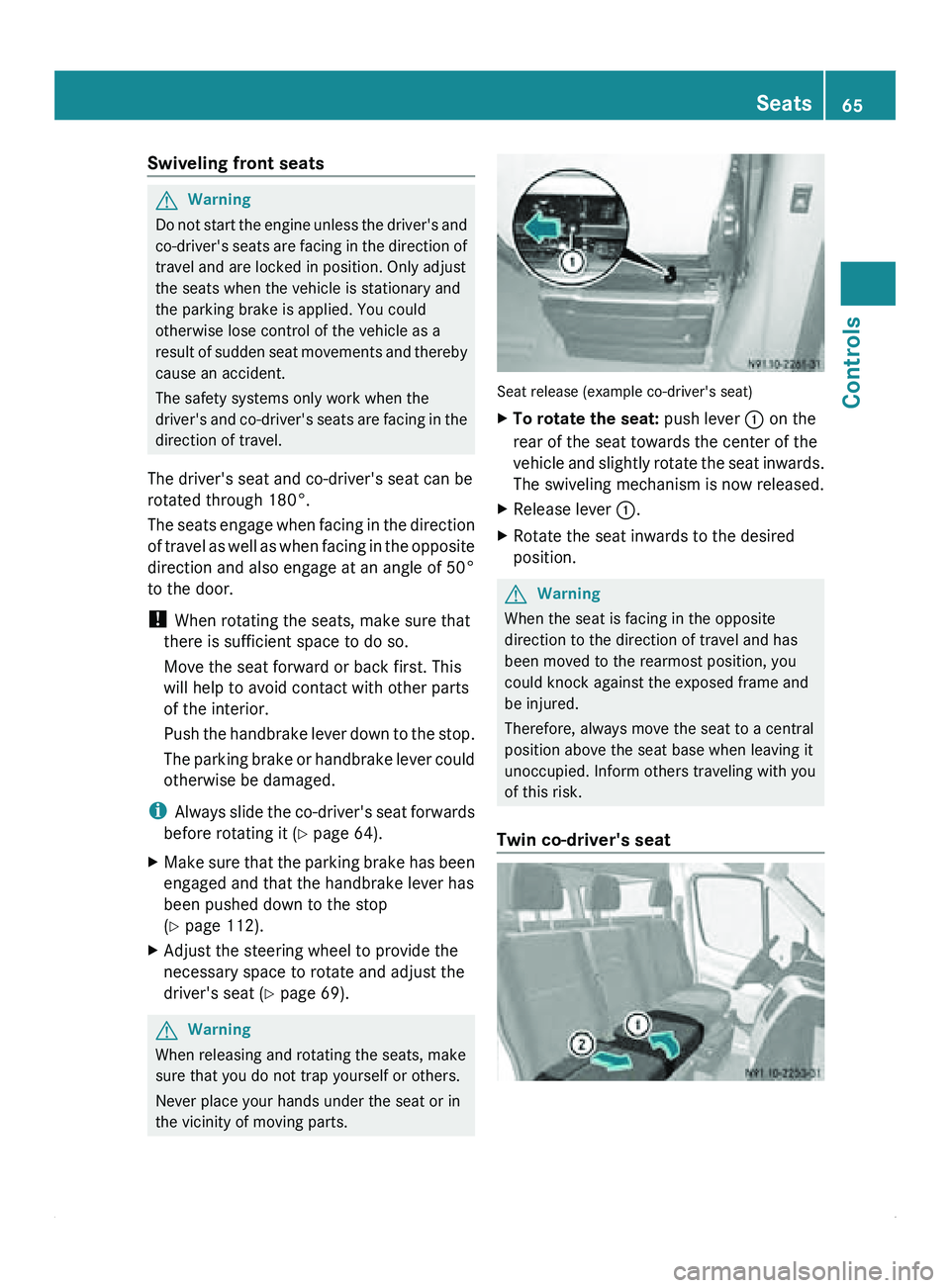
the vicinity of moving parts. Seat release (example co-driver's seat)
X
To rotate the seat: push lever 0046 on the
rear of the seat towards the center of the
vehicle and
slightly rotate the seat inwards.
The swiveling mechanism is now released.
X Release lever 0046.
X Rotate the seat inwards to the desired
position. G
Warning
When the seat is facing in the opposite
direction to the direction of travel and has
been moved to the rearmost position, you
could knock against the exposed frame and
be injured.
Therefore, always move the seat to a central
position above the seat base when leaving it
unoccupied. Inform others traveling with you
of this risk.
Twin co-driver's seat Seats
65Controls Z
Page 68 of 292
X
To fold the seat cushions forwards: lift
the seat cushion out of front
anchorage 0046.
X Pull the seat cushion forwards slightly and
out of rear anchorage 0047.
X Fold the rear edge of the seat cushion up.
i You can stow
various articles in the space
under the twin co-driver's seat.
X To fold the seat cushion back: fold down
the seat cushion by the rear edge.
X Slide the seat cushion under the seat
backrest into rear anchorage 0047
.
X Push down on the seat cushion at the front
until it engages in front anchorage 0046. Rear bench seat
G
Warning!
The unlocking levers at the foot of the rear
bench seat must lie parallel to the vehicle
floor. You may only install a rear bench seat
with two seats on the driver's side.
Information about this can be found at any
authorized Sprinter dealer.
The integral seat
belts can only protect you as
intended if you correctly install the prescribed
rear bench seats. For this reason, have a rear
bench seat with four seats installed only at a
qualified specialist workshop, e.g. an
authorized Sprinter dealer.
Keep the mounting shells of the bench seats
on the floor free from dirt and other objects.
The secure engaging of the locks is
guaranteed only in this way.
For safety reasons, have bench seat mounting
shells retrofitted only at an authorized
Sprinter dealer.
i Do not exceed the maximum permissible
number of seats for models registered as
passenger vehicles.
! For safety reasons, the rear bench seat
with four seats must be installed or
removed only at a qualified specialist workshop, e.g. an authorized Sprinter
dealer.
Removing two-seat or three-seat rear
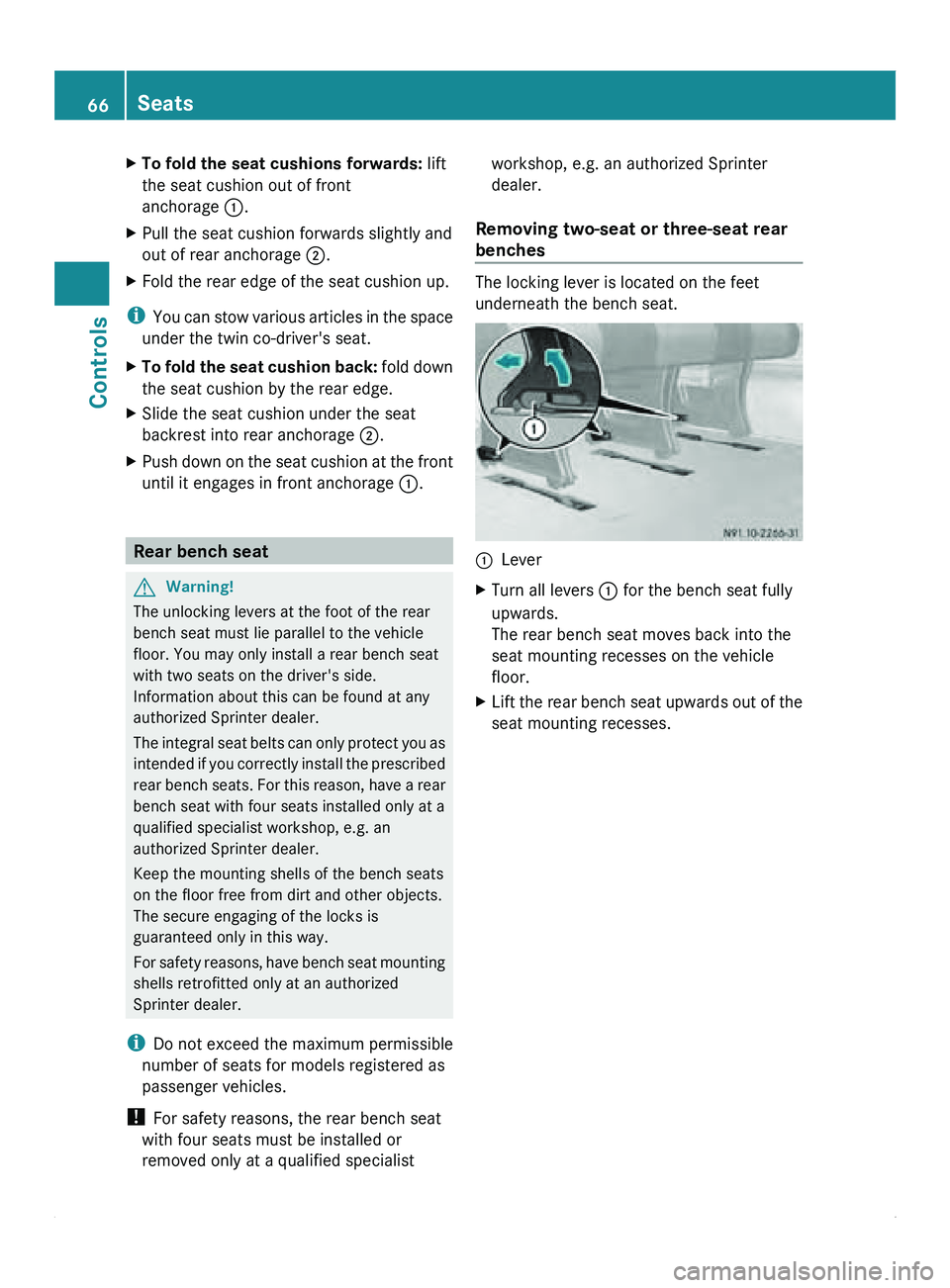
benches The locking lever is located on the feet
underneath the bench seat.
0046
Lever
X Turn all levers 0046 for the bench seat fully
upwards.
The rear bench seat moves back into the
seat mounting recesses on the vehicle
floor.
X Lift the rear bench seat upwards out of the
seat mounting recesses.66
Seats
Controls
Page 73 of 292
The display in the instrument cluster is
activated when you:
R
open the driver's door
R turn the key
to position 2 in the ignition lock
R press the 0048 reset button
R switch on the lights
The display switches off automatically after
approximately 30 seconds if:
R the vehicle lighting is not switched on.
R the key is in position 0 in the ignition lock.G
Warning
No messages can be displayed if the
instrument cluster and/or the display fails.
You will then not be able to see information
about the vehicle status, such as speed and
outside temperature, warning/indicator
lamps and display messages or the failure of
systems. Handling characteristics may be
affected. Adapt your speed and driving style
accordingly.
Immediately consult a qualified specialist
workshop. The qualified specialist workshop
must have the necessary specialist
knowledge and tools to carry out the work
required. We recommend an authorized
Sprinter Dealer for
this purpose. In particular,
all work relevant to safety or on safety-related
systems must be carried out at a qualified
specialist workshop. G
Warning
Only use the adjustment buttons on the
instrument cluster when
the traffic conditions
permit. You would otherwise be too distracted
and could cause an accident.
Do not reach through the steering wheel to
operate the adjustment buttons. The
movement of the steering wheel would be
significantly impeded. Your attention would
also be diverted from road and traffic
conditions. This could cause you to lose
control of the vehicle, and lead to an accident. Do not rest your head or chest on the steering
wheel or dashboard when operating the
adjustment buttons.
You will find page references for further
information in the index under "Air bag".
Speedometer
i In some countries, a warning sounds
when the vehicle reaches the maximum
speed limit, e.g. at 75 mph (120 km/h).
The speed can also be shown in the display.
You can find information on the digital
speedometer for vehicles without steering
wheel buttons under ( Y page 73) and for
vehicles with steering wheel buttons under
(Y page 77). Tachometer
The red band
in the tachometer indicates the
engine's overrevving range.
To protect the engine, the fuel supply is
interrupted when the red band is reached.
! Do not drive in the overrevving range, as
this could damage the engine.
0040Environmental information
Avoid driving at high engine revs. This driving
style causes an unnecessary increase in
vehicle fuel consumption and, therefore,
damage to the
environment due to increased
emission of pollution. Instrument cluster
71
Controls Z