change wheel MERCEDES-BENZ SPRINTER 2012 MY12 Operator’s Manual
[x] Cancel search | Manufacturer: MERCEDES-BENZ, Model Year: 2012, Model line: SPRINTER, Model: MERCEDES-BENZ SPRINTER 2012Pages: 292, PDF Size: 6.75 MB
Page 218 of 292
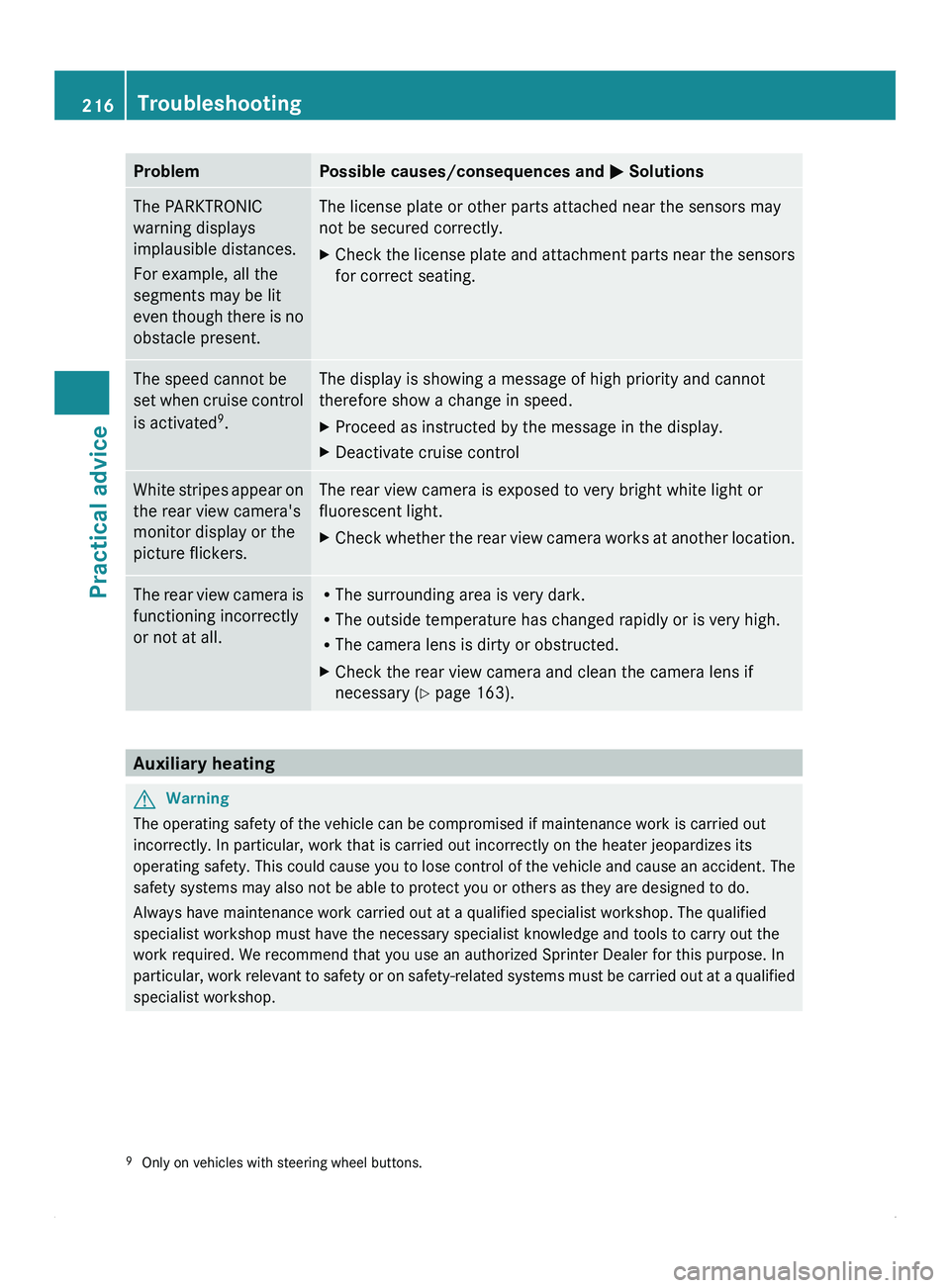
Problem Possible causes/consequences and
0050 SolutionsThe PARKTRONIC
warning displays
implausible distances.
For example, all the
segments may be lit
even though there
is no
obstacle present. The license plate or other parts attached near the sensors may
not be secured correctly.
X
Check the license plate and attachment parts near the sensors
for correct seating. The speed cannot be
set when cruise
control
is activated 9
. The display is showing a message of high priority and cannot
therefore show a change in speed.
X
Proceed as instructed by the message in the display.
X Deactivate cruise control White stripes appear on
the rear view camera's
monitor display or the
picture flickers. The rear view camera is exposed to very bright white light or
fluorescent light.
X
Check whether the rear view camera works at another location. The rear view camera is
functioning incorrectly
or not at all. R
The surrounding area is very dark.
R The outside temperature has changed rapidly or is very high.
R The camera lens is dirty or obstructed.
X Check the rear view camera and clean the camera lens if
necessary ( Y page 163).Auxiliary heating
G
Warning
The operating safety of the vehicle can be compromised if maintenance work is carried out
incorrectly. In particular, work that is carried out incorrectly on the heater jeopardizes its
operating safety. This
could cause you to lose control of the vehicle and cause an accident. The
safety systems may also not be able to protect you or others as they are designed to do.
Always have maintenance work carried out at a qualified specialist workshop. The qualified
specialist workshop must have the necessary specialist knowledge and tools to carry out the
work required. We recommend that you use an authorized Sprinter Dealer for this purpose. In
particular, work relevant to safety or on safety-related systems must be carried out at a qualified
specialist workshop.
9 Only on vehicles with steering wheel buttons.216
Troubleshooting
Practical advice
Page 223 of 292
Engine
Draining the fuel filter
If the 00BA
indicator lamp lights up, you must
drain the fuel filter.
! When the 00BA indicator lamp lights up,
drain the fuel filter with water separator
immediately. Otherwise, the engine may be
damaged.
0040Environmental note
When handling, storing and disposing of
diesel and diesel mixtures, please observe
the relevant regulations.
To this end, have the fuel filter with water
separator drained at a qualified specialist
workshop which
has
the necessary specialist
knowledge and tools to carry out the work
required, e.g. an authorized Sprinter Dealer.
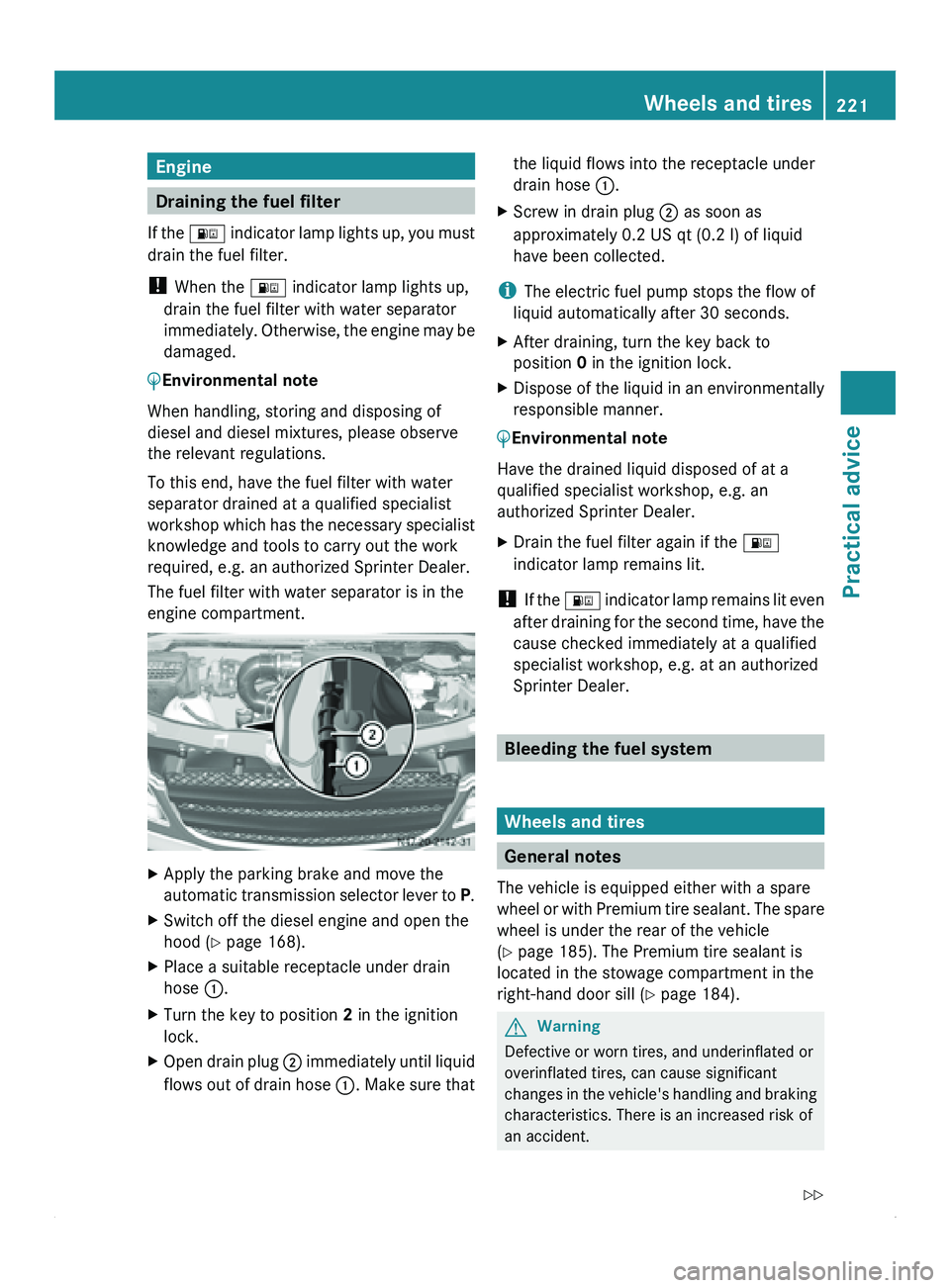
The fuel filter with water separator is in the
engine compartment. X
Apply the parking brake and move the
automatic
transmission selector
lever to P.
X Switch off the diesel engine and open the
hood ( Y page 168).
X Place a suitable receptacle under drain
hose 0046.
X Turn the key to position 2 in the ignition
lock.
X Open drain plug 0047
immediately until
liquid
flows out of drain hose 0046. Make sure that the liquid flows into the receptacle under
drain hose
0046.
X Screw in drain plug 0047 as soon as
approximately 0.2 US qt (0.2 l) of liquid have been collected.
i The electric fuel pump stops the flow of
liquid automatically after 30 seconds.
X After draining, turn the key back to
position
0 in the ignition lock.
X Dispose of the liquid in an environmentally
responsible manner.
0040Environmental note
Have the drained liquid disposed of at a
qualified specialist workshop, e.g. an
authorized Sprinter Dealer.
X Drain the fuel filter again if the 00BA
indicator lamp remains lit.
! If the
00BA
indicator lamp remains lit even
after draining for the second time, have the
cause checked immediately at a qualified
specialist workshop, e.g. at an authorized
Sprinter Dealer. Bleeding the fuel system
Wheels and tires
General notes
The vehicle is equipped either with a spare
wheel or with
Premium tire sealant. The spare
wheel is under the rear of the vehicle
(Y page 185). The Premium tire sealant is
located in the stowage compartment in the
right-hand door sill ( Y page 184). G
Warning
Defective or worn tires, and underinflated or
overinflated tires, can cause significant
changes in the
vehicle's handling and braking
characteristics. There is an increased risk of
an accident. Wheels and tires
221
Practical advice
Z
Page 225 of 292
compartment in the right-hand doorway
(Y page 184).
X Affix the sticker within the driver's field of
vision. G
Warning
It is essential to comply with the
manufacturer's safety notice
on the sticker on
the electric air pump and the tire sealant
bottle. You could otherwise fail to recognize
dangers and injure yourself and others. G
Warning
Tire sealant must not come into contact with
your skin, eyes or clothing. Do not inhale the
fumes.
R If tire sealant
comes into contact with your
eyes or skin, immediately rinse thoroughly
with clean water.
R Immediately change out of clothing that
has been in contact with tire sealant.
R If an allergic reaction occurs, consult a
doctor immediately.
Keep tire sealant away from children.
R If tire sealant is swallowed, immediately
rinse your mouth out thoroughly and drink
plenty of water.
R Do not induce vomiting. Consult a doctor
immediately.
i The tire sealant is water-soluble. If tire
sealant escapes, you can wash it away with
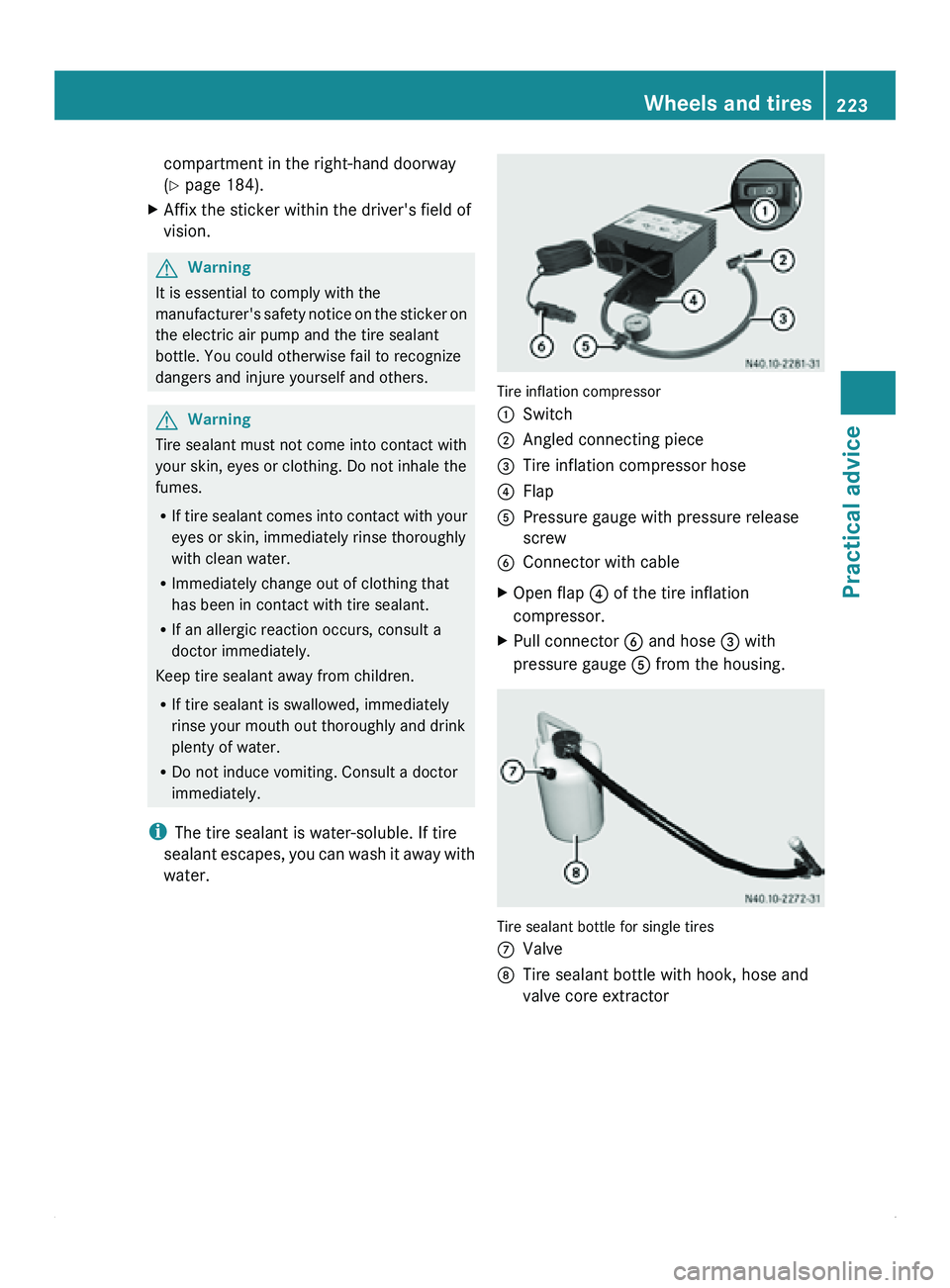
water. Tire inflation compressor
0046
Switch
0047 Angled connecting piece
008A Tire inflation compressor hose
0088 Flap
0086 Pressure gauge with pressure release
screw
0087 Connector with cable
X Open flap 0088 of the tire inflation
compressor.
X Pull connector 0087 and hose 008A with
pressure gauge 0086 from the housing. Tire sealant bottle for single tires
006E
Valve
006F Tire sealant bottle with hook, hose and
valve core extractor Wheels and tires
223
Practical advice Z
Page 231 of 292
G
Warning
If the minimum tire pressure of 43.5 psi
(3 bar) still cannot
be achieved, the tire is too
badly damaged.
Do not drive any further. Consult a qualified
specialist workshop which has the necessary
specialist knowledge and tools to carry out
the work required.
For this reason, we recommend an authorized
Sprinter Dealer. In particular, work relevant to
safety or on safety-related systems must be
carried out at a qualified specialist workshop.
0040Environmental note
Have the used tire sealant disposed of at a
qualified specialist workshop, e.g. an
authorized Sprinter Dealer.
! Have the tire sealant bottle replaced
every eight years at a qualified specialist
workshop, e.g. an authorized Sprinter
Dealer. Changing a
wheel in the event of a flat
tire G
Warning
To avoid the risk of serious or even fatal injury
and to avoid damage to the vehicle, observe
the following:
R the vehicle's jack is intended only to raise
the vehicle for
a short time when changing
a wheel.
R position the jack on the appropriate jacking
point only. Make sure that the jack is
correctly positioned under the jacking point
before raising the vehicle.
R the jack must be placed on a firm, flat
surface.
R before raising the vehicle, you should also
secure it against rolling away, e.g. by
placing chocks under the wheels. Never
release the parking brake while the vehicle
is raised. R
make sure that the distance between the
underside
of the
tires and the ground does
not exceed 1.2 in (3 cm). The vehicle could
otherwise slip off the jack or tip over.
R never place your hands or feet under the
raised vehicle.
R never start the engine, and prevent other
jolts or vibrations while the vehicle is
raised. The vehicle could otherwise slip off
the jack.
Preparing to change a wheel X
Prepare the vehicle as described
(Y
page 222).
X Secure the vehicle against rolling away
using chocks or similar items.
Use the chock ( Y
page 183) to do so. G
Warning
The vehicle
could slip off the jack on uphill and
downhill gradients.
To avoid the risk of causing serious or even
fatal injury or damage to the vehicle, do not
change wheels on uphill and downhill
gradients.
On a level road:
X Place chocks in front of and behind the
wheel which is diagonally opposite the
wheel you wish to change.
X Take the vehicle tool kit and the jack from
the footwell on the co-driver's side
(Y page 182).
X Remove the spare wheel from the spare
wheel bracket ( Y page 185).
X On wheels with wheel bolts, remove the
hub cap.
X Assemble the lug wrench extension using
the middle rod
and the rod with the largest
diameter from the three-piece jack pump
lever.
X Starting with the middle rod, slide the lug
wrench extension as far as it will go onto
the lug wrench. Wheels and tires
229
Practical advice Z
Page 232 of 292
!
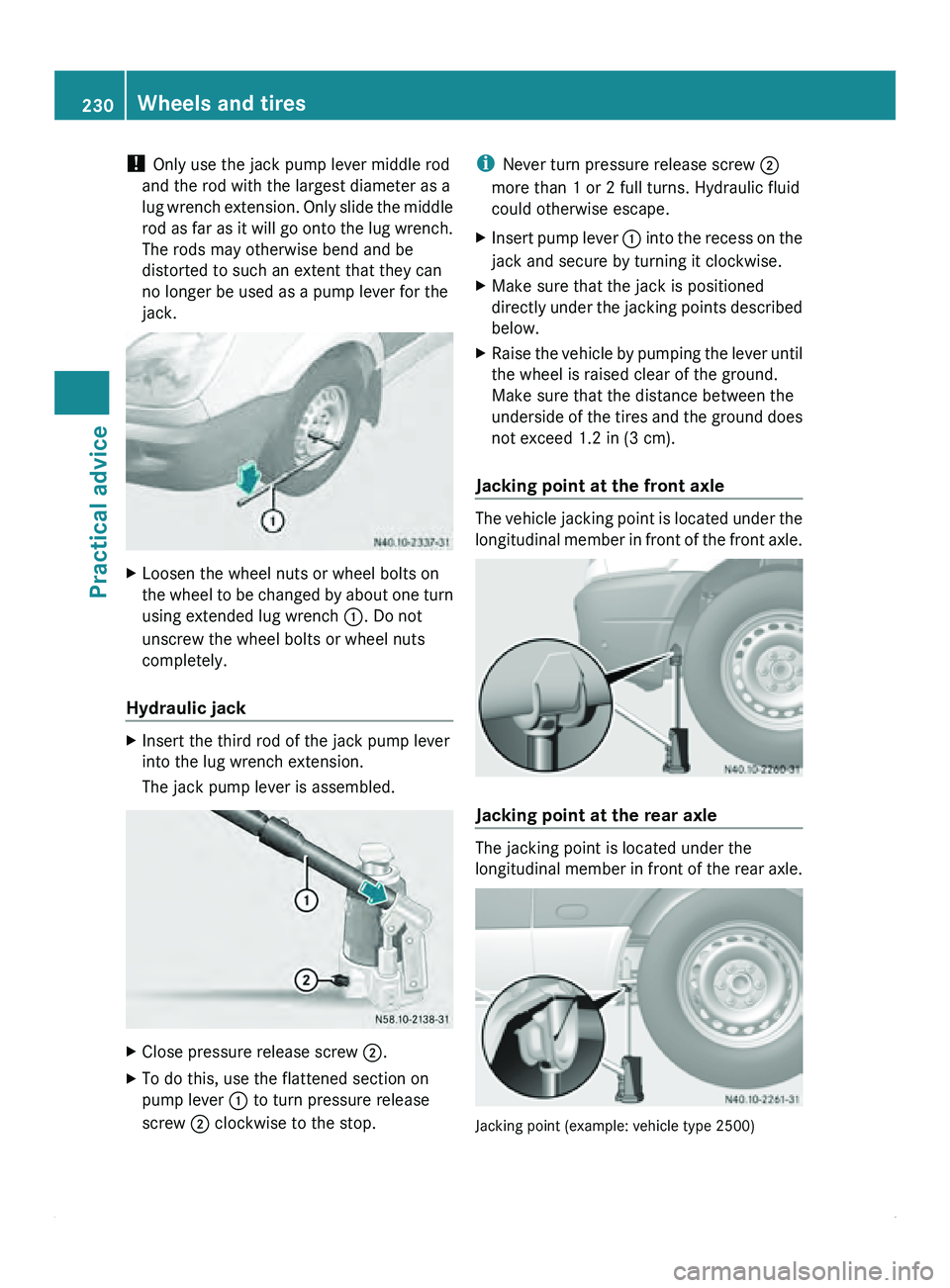
Only use the jack pump lever middle rod
and the rod with the largest diameter as a
lug wrench extension.
Only slide the middle
rod as far as it will go onto the lug wrench.
The rods may otherwise bend and be
distorted to such an extent that they can
no longer be used as a pump lever for the
jack. X
Loosen the wheel nuts or wheel bolts on
the wheel to
be changed by about one turn
using extended lug wrench 0046. Do not
unscrew the wheel bolts or wheel nuts
completely.
Hydraulic jack X
Insert the third rod of the jack pump lever
into the lug wrench extension.
The jack pump lever is assembled. X
Close pressure release screw 0047.
X To do this, use the flattened section on
pump lever 0046 to turn pressure release
screw 0047 clockwise to the stop. i
Never turn pressure release screw 0047
more than 1 or 2 full turns. Hydraulic fluid
could otherwise escape.
X Insert pump lever 0046 into the
recess on the
jack and secure by turning it clockwise.
X Make sure that the jack is positioned
directly under the
jacking points described
below.
X Raise the vehicle by pumping the lever until
the wheel is raised clear of the ground.
Make sure that the distance between the
underside of the
tires and the ground does
not exceed 1.2 in (3 cm).
Jacking point at the front axle The vehicle jacking point is located under the
longitudinal member
in
front of the front axle. Jacking point at the rear axle
The jacking point is located under the
longitudinal member
in
front of the rear axle. Jacking point (example: vehicle type 2500)230
Wheels and tires
Practical advice
Page 233 of 292
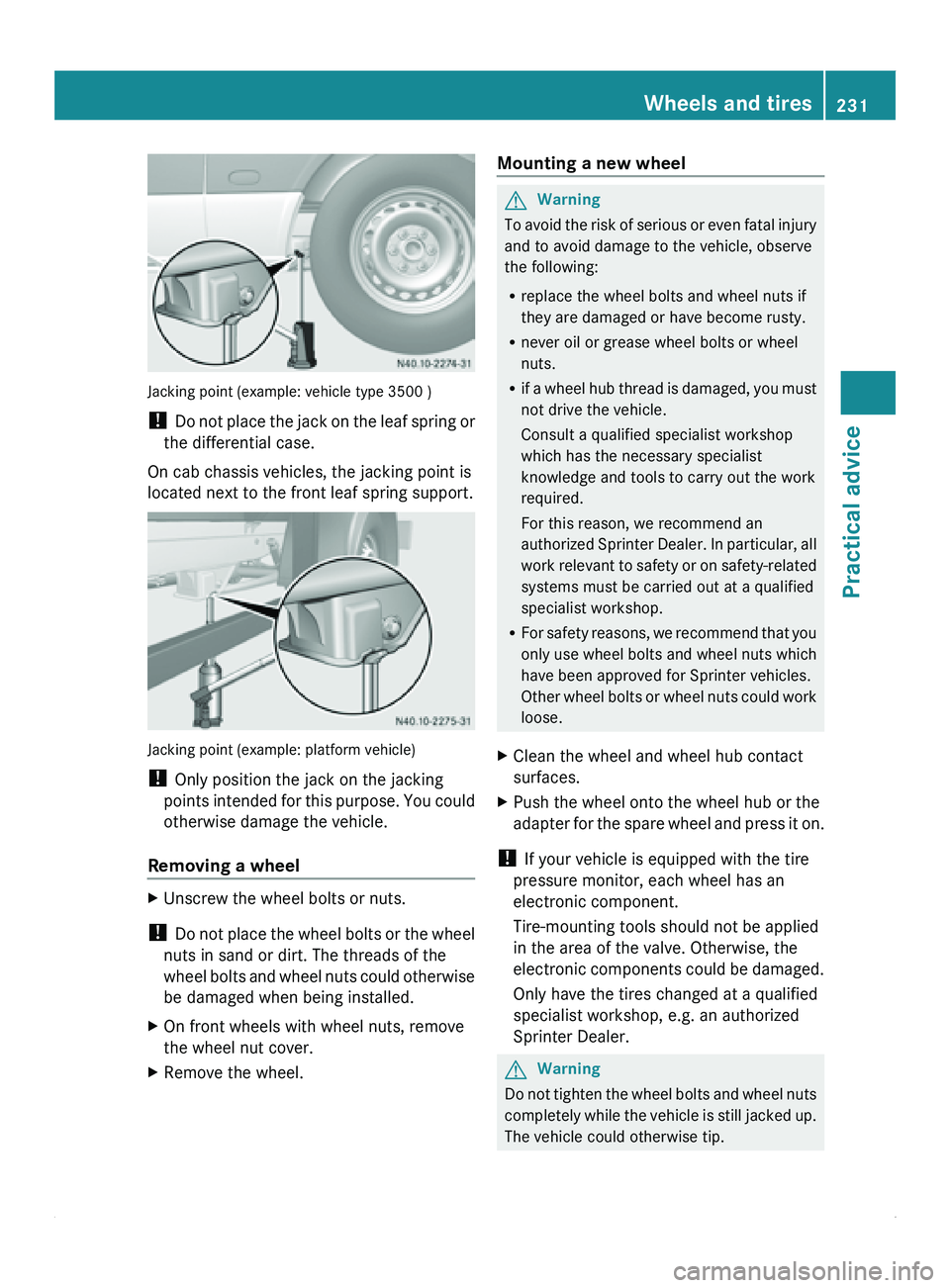
Jacking point (example: vehicle type 3500 )
!
Do not place
the jack on the leaf spring or
the differential case.
On cab chassis vehicles, the jacking point is
located next to the front leaf spring support. Jacking point (example: platform vehicle)
!
Only position the jack on the jacking
points intended for
this purpose. You could
otherwise damage the vehicle.
Removing a wheel X
Unscrew the wheel bolts or nuts.
! Do not place
the wheel bolts or the wheel
nuts in sand or dirt. The threads of the
wheel bolts and wheel nuts could otherwise
be damaged when being installed.
X On front wheels with wheel nuts, remove
the wheel nut cover.
X Remove the wheel. Mounting a new wheel G
Warning
To avoid the risk of serious or even fatal injury
and to avoid damage to the vehicle, observe
the following:
R replace the wheel bolts and wheel nuts if
they are damaged or have become rusty.
R never oil or grease wheel bolts or wheel
nuts.
R if a wheel
hub thread is damaged, you must
not drive the vehicle.
Consult a qualified specialist workshop
which has the necessary specialist
knowledge and tools to carry out the work
required.
For this reason, we recommend an
authorized Sprinter Dealer. In particular, all
work relevant to safety or on safety-related
systems must be carried out at a qualified
specialist workshop.
R For safety reasons, we recommend that you
only use wheel bolts and wheel nuts which
have been approved for Sprinter vehicles.
Other wheel bolts or wheel nuts could work
loose.
X Clean the wheel and wheel hub contact
surfaces.
X Push the wheel onto the wheel hub or the
adapter for the
spare wheel and press it on.
! If your vehicle is equipped with the tire
pressure monitor, each wheel has an
electronic component.
Tire-mounting tools should not be applied
in the area of the valve. Otherwise, the
electronic components could
be damaged.
Only have the tires changed at a qualified
specialist workshop, e.g. an authorized
Sprinter Dealer. G
Warning
Do not tighten the wheel bolts and wheel nuts
completely while the
vehicle is still jacked up.
The vehicle could otherwise tip. Wheels and tires
231
Practical advice Z
Page 235 of 292
X
Push the edge of the hub cap with both
hands against the wheel until it clicks into
place.
! With a hub
cap for the middle of the wheel,
make sure that the clamping lugs of the
cover are positioned over the wheel bolts.
X Hit the middle of the hub cap to engage it
on the wheel.
X Push the piston on the hydraulic jack in
again and close the pressure release
screw.
X Secure the faulty wheel in the spare wheel
bracket (Y page 185).
X Stow the jack and the vehicle tool kit.
X Check the tire pressure and correct if
necessary ( Y page 280).
X Retighten the wheel bolts or wheel nuts to
the specified tightening torque after the
vehicle has been driven for 30 miles
(50 km). Retightening wheel nuts/wheel bolts
G
Warning
After changing a wheel, for safety reasons you
must:
R have the tightening torque checked. For
wheel bolts, the tightening torque is
177 lb-ft (240 Nm) (steel wheel)/ 133 lb-ft
(180
Nm) (alloy wheel). For wheel nuts, the
tightening torque is 133 lb-ft (180 Nm). The
wheels could otherwise work loose.
R check the tire pressure and correct it if
necessary.
R have the wheel bolts/wheel nuts
retightened after driving a distance of 30
miles (50 km). The tightening torque for
wheel bolts is 177 lb-ft (240 Nm)(steel
wheel)/133 lb-ft (180 Nm) (alloy wheel).
The tightening torque for wheel nuts is
133 lb-ft (180 Nm).
R if using new or painted rims, have the wheel
bolts and wheel nuts retightened at the specified tightening torque after the vehicle
has been driven for approximately 600 to
3000 miles (1000 to
5000 km)
.
R have the direction of rotation corrected, if
reversed, as soon as possible at a qualified
specialist workshop, e.g. an authorized
Sprinter Dealer. The vehicle handling
characteristics could otherwise be
affected.
Otherwise, the operating reliability and road
safety of the vehicle could be jeopardized.
This could cause you to lose control of your
vehicle, resulting in an accident and injuring
yourself or others. Electrical system
Notes on changing bulbs
The bulbs and lamps are an essential
component of vehicle
safety. Therefore, make
sure that each bulb is always working. G
Warning
Bulbs and lamps can become very hot. For
this reason, allow them to cool down before
changing them. Otherwise, you could burn
yourself when you touch them.
Keep bulbs out of the reach of children.
Otherwise, they could, for example, damage
the bulbs and injure themselves.
Never use a bulb which has been dropped.
Such a bulb may explode and injure you.
Halogen bulbs are pressurized and could
explode when you change them, especially if
they are very hot. You should therefore wear
eye protection and gloves when you are
changing them. G
Warning
Xenon bulbs are under high voltage. You could
get an electric
shock and be seriously or even
fatally injured if you touch the electric
contacts on Xenon bulbs. Therefore, do not
remove the cover on Xenon bulbs. Electrical system
233
Practical advice
Z
Page 258 of 292
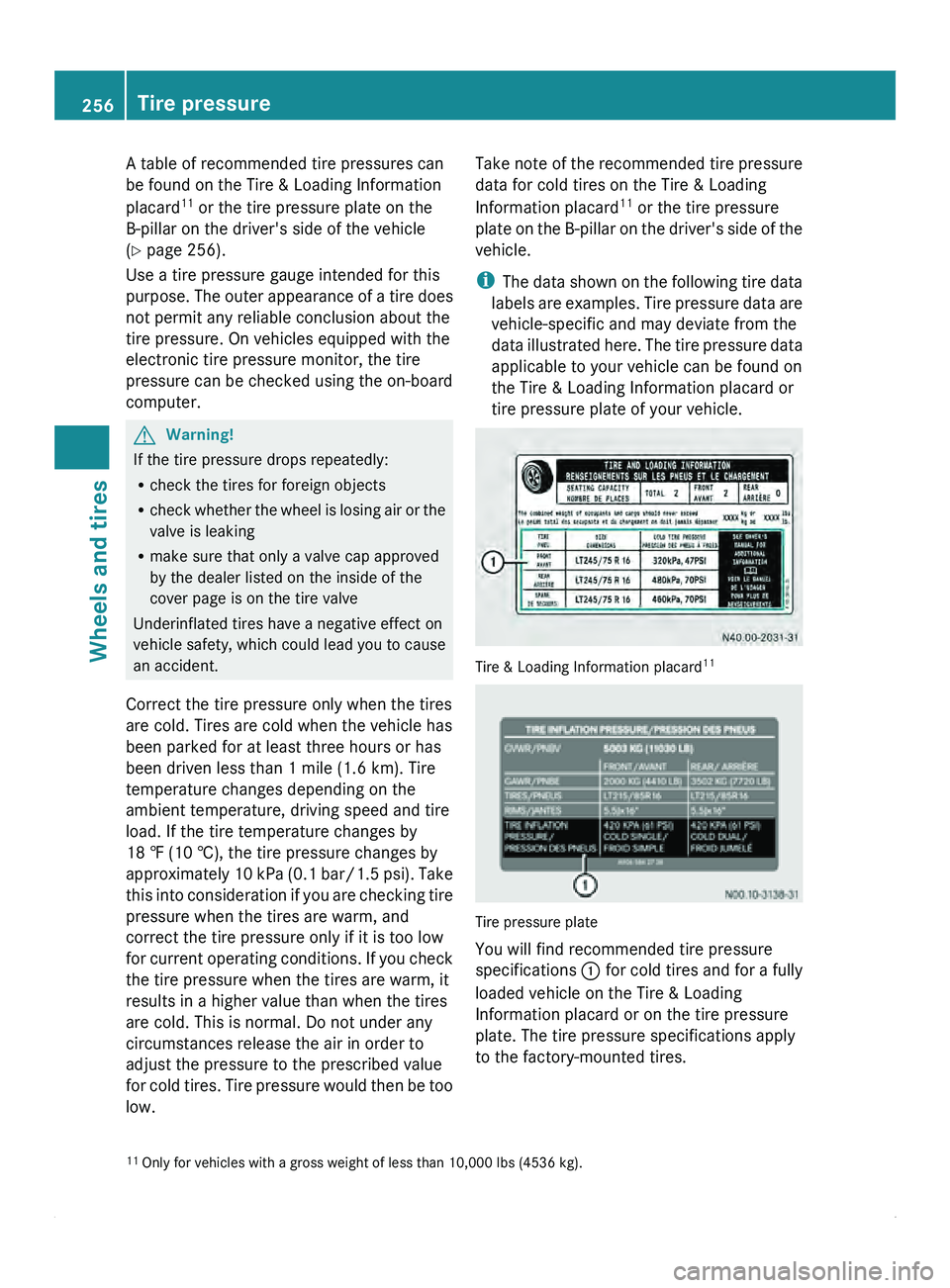
A table of recommended tire pressures can
be found on the Tire & Loading Information
placard
11
or the tire pressure plate on the
B-pillar on the driver's side of the vehicle
(Y page 256).
Use a tire pressure gauge intended for this
purpose. The outer
appearance of a tire does
not permit any reliable conclusion about the
tire pressure. On vehicles equipped with the
electronic tire pressure monitor, the tire
pressure can be checked using the on-board
computer. G
Warning!
If the tire pressure drops repeatedly:
R check the tires for foreign objects
R check whether the
wheel is losing air or the
valve is leaking
R make sure that only a valve cap approved
by the dealer listed on the inside of the
cover page is on the tire valve
Underinflated tires have a negative effect on
vehicle safety, which could lead you to cause
an accident.
Correct the tire pressure only when the tires
are cold. Tires are cold when the vehicle has
been parked for at least three hours or has
been driven less than 1 mile (1.6 km). Tire
temperature changes depending on the
ambient temperature, driving speed and tire
load. If the tire temperature changes by
18 ‡ (10 †), the tire pressure changes by
approximately 10 kPa (0.1 bar/1.5 psi). Take
this into consideration if you are checking tire
pressure when the tires are warm, and
correct the tire pressure only if it is too low
for current operating conditions. If you check
the tire pressure when the tires are warm, it
results in a higher value than when the tires
are cold. This is normal. Do not under any
circumstances release the air in order to
adjust the pressure to the prescribed value
for cold tires. Tire pressure would then be too
low. Take note of the recommended tire pressure
data for cold tires on the Tire & Loading
Information placard
11
or the tire pressure
plate on the
B-pillar on the driver's side of the
vehicle.
i The data shown on the following tire data
labels are examples. Tire pressure data are
vehicle-specific and may deviate from the
data illustrated here. The tire pressure data
applicable to your vehicle can be found on
the Tire & Loading Information placard or
tire pressure plate of your vehicle. Tire & Loading Information placard
11 Tire pressure plate
You will find recommended tire pressure
specifications
0046 for cold
tires and for a fully
loaded vehicle on the Tire & Loading
Information placard or on the tire pressure
plate. The tire pressure specifications apply
to the factory-mounted tires.
11 Only for vehicles with a gross weight of less than 10,000 lbs (4536 kg).256
Tire pressure
Wheels and tires
Page 262 of 292
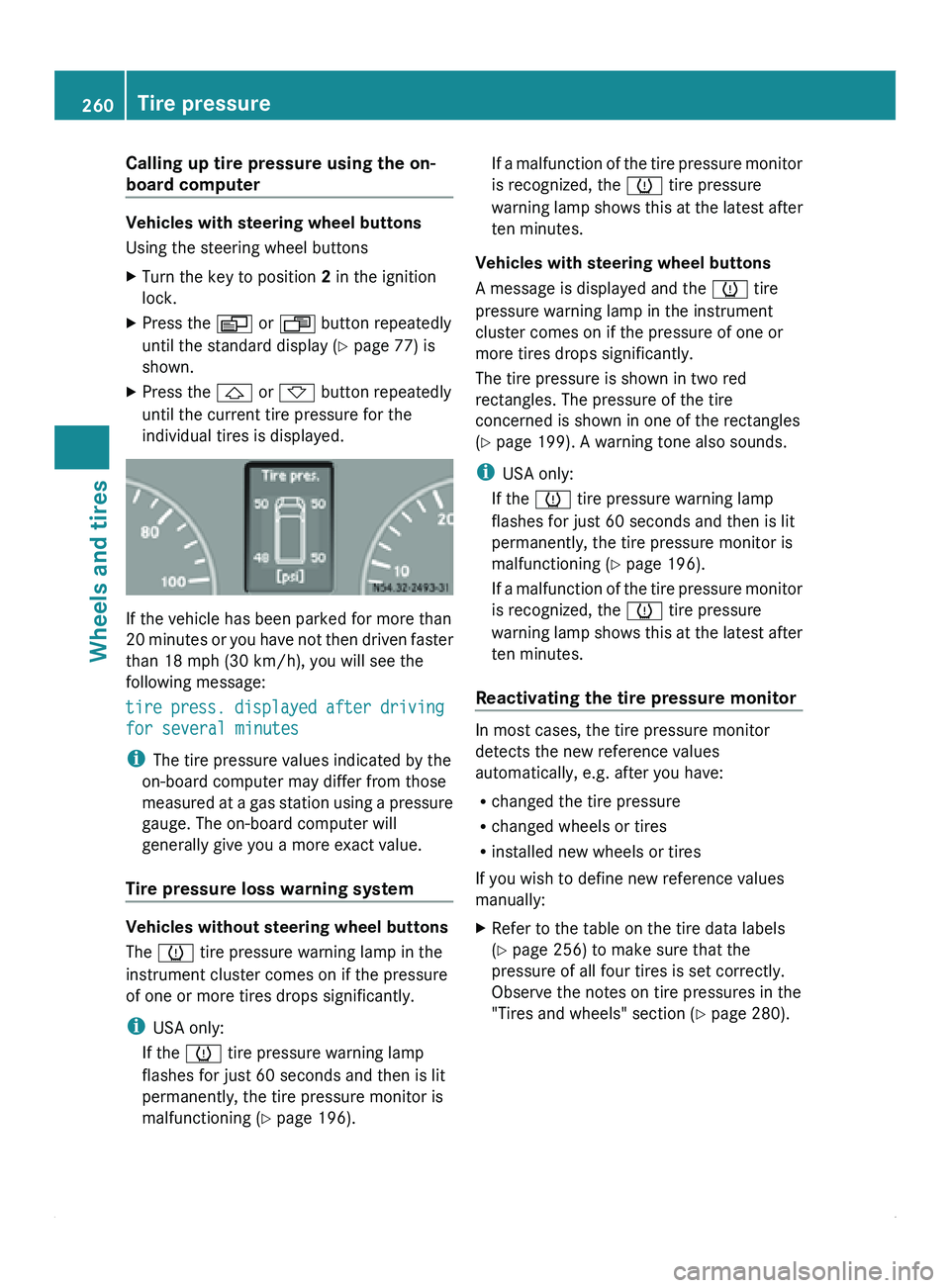
Calling up tire pressure using the on-
board computer
Vehicles with steering wheel buttons
Using the steering wheel buttons
X
Turn the key to position 2 in the ignition
lock.
X Press the 0059 or 0058 button repeatedly
until the standard display ( Y page 77) is
shown.
X Press the
0029 or 002D button repeatedly
until the current tire pressure for the
individual tires is displayed. If the vehicle has been parked for more than
20 minutes
or
you have not then driven faster
than 18 mph (30 km/h), you will see the
following message:
tire press. displayed after driving
for several minutes
i The tire pressure values indicated by the
on-board computer may differ from those
measured at a gas station using a pressure
gauge. The on-board computer will
generally give you a more exact value.
Tire pressure loss warning system Vehicles without steering wheel buttons
The 0077 tire pressure warning lamp in the
instrument cluster comes on if the pressure
of one or more tires drops significantly.
i
USA only:
If the 0077 tire pressure warning lamp
flashes for just 60 seconds and then is lit
permanently, the tire pressure monitor is
malfunctioning (Y page 196). If a malfunction of the tire pressure monitor
is recognized, the 0077 tire pressure
warning lamp
shows
this at the latest after
ten minutes.
Vehicles with steering wheel buttons
A message is displayed and the 0077 tire
pressure warning lamp in the instrument
cluster comes on if the pressure of one or
more tires drops significantly.
The tire pressure is shown in two red
rectangles. The pressure of the tire
concerned is shown in one of the rectangles
(Y page 199). A warning tone also sounds.
i USA only:
If the 0077 tire pressure warning lamp
flashes for just 60 seconds and then is lit
permanently, the tire pressure monitor is
malfunctioning (Y page 196).
If a malfunction of the tire pressure monitor
is recognized, the 0077 tire pressure
warning lamp shows this at the latest after
ten minutes.
Reactivating the tire pressure monitor In most cases, the tire pressure monitor
detects the new reference values
automatically, e.g. after you have:
R
changed the tire pressure
R changed wheels or tires
R installed new wheels or tires
If you wish to define new reference values
manually:
X Refer to the table on the tire data labels
(Y page 256) to make sure that the
pressure of all four tires is set correctly.
Observe the notes on tire pressures in the
"Tires and wheels" section ( Y page 280).260
Tire pressure
Wheels and tires
Page 274 of 292
characteristics could otherwise be
affected.
Otherwise, the operating reliability and road
safety of the vehicle could be jeopardized.
This could cause you to lose control of your
vehicle, resulting in an accident and injuring
yourself or others.
The vehicle tires
are an essential component
in the overall performance and stability of the
vehicle. The service life of tires is dependent
upon and proportional to tire type, speed
rating, environmental conditions, tire load,
tire pressure, road quality and individual
driving style.
For this reason, we recommend regularly
checking wear and correct tire pressure as
well as – according to the appropriate tire
configuration of the vehicle – regularly
rotating the tires.
The wear patterns on the front and rear tires
differ, depending on the operating conditions.
Rotate the wheels before a clear wear pattern
has formed on the tires. Front tires typically
wear more on the shoulders and the rear tires
in the center.
If your vehicle's tire configuration allows, you
can rotate the wheels according to the
intervals in the tire manufacturer's warranty
book in your vehicle documents. If no
warranty book is available, the tires should be
rotated every 3000 to 6000 miles
(5000 to 10000 km), or earlier if tire wear
requires. Do not change the direction of
rotation.
Clean the contact surfaces of the wheel and
the brake disc thoroughly every time a wheel
is rotated. Check the tire pressures.
! If your vehicle is equipped with the tire
pressure monitor, each wheel has an
electronic component.
Tire-mounting tools should not be applied
in the area of the valve. Otherwise, the
electronic components could be damaged. Only have the tires changed at a qualified
specialist workshop, e.g. an authorized
Sprinter Dealer.
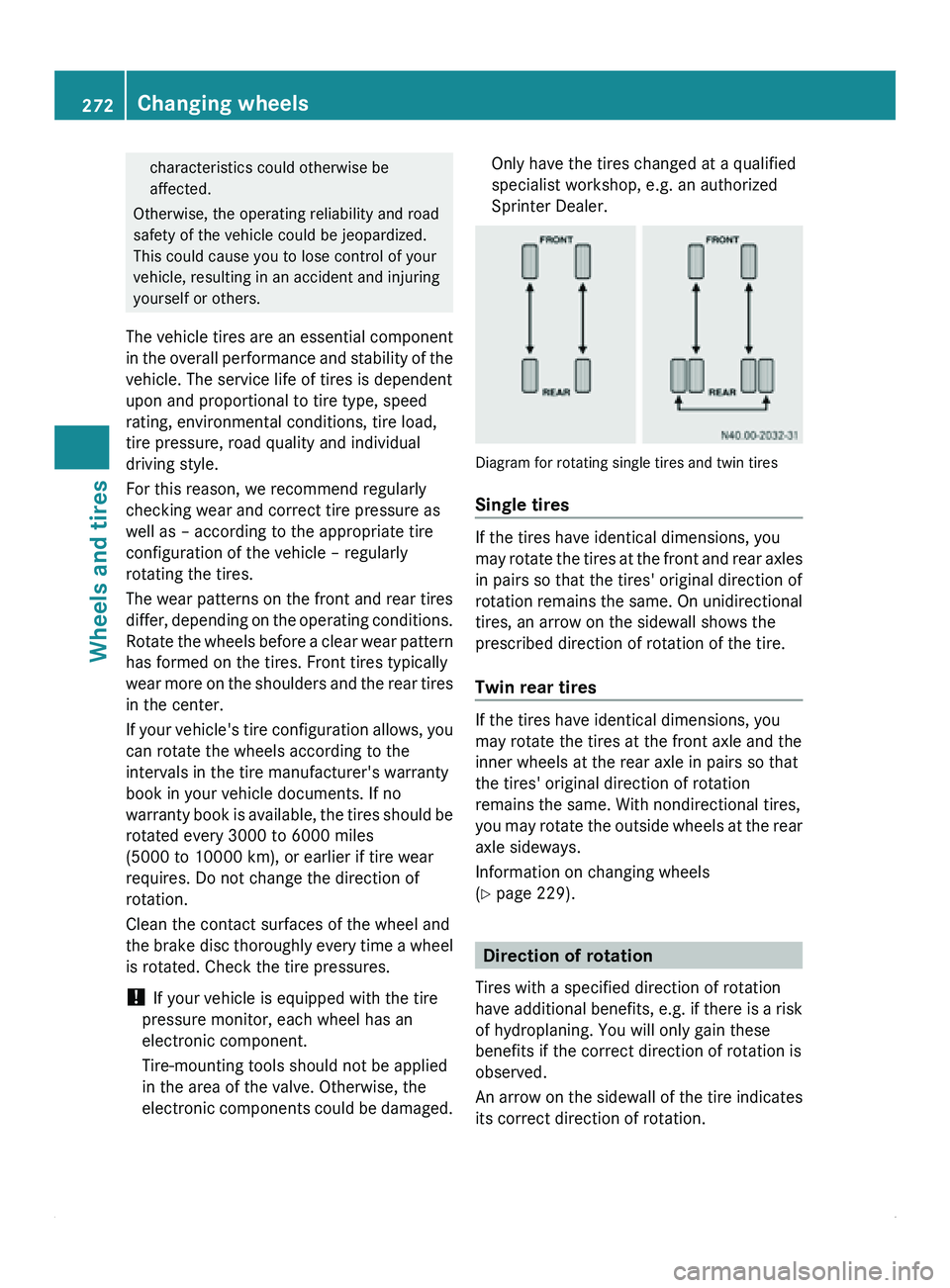
Diagram for rotating single tires and twin tires
Single tires
If the tires have identical dimensions, you
may rotate
the
tires at the front and rear axles
in pairs so that the tires' original direction of
rotation remains the same. On unidirectional
tires, an arrow on the sidewall shows the
prescribed direction of rotation of the tire.
Twin rear tires If the tires have identical dimensions, you
may rotate the tires at the front axle and the
inner wheels at the rear axle in pairs so that
the tires' original direction of rotation
remains the same. With nondirectional tires,
you may
rotate
the outside wheels at the rear
axle sideways.
Information on changing wheels
(Y page 229). Direction of rotation
Tires with a specified direction of rotation
have
additional benefits,
e.g. if there is a risk
of hydroplaning. You will only gain these
benefits if the correct direction of rotation is
observed.
An arrow on the sidewall of the tire indicates
its correct direction of rotation. 272
Changing wheels
Wheels and tires