ESP MERCEDES-BENZ SPRINTER 2012 MY12 Operator’s Manual
[x] Cancel search | Manufacturer: MERCEDES-BENZ, Model Year: 2012, Model line: SPRINTER, Model: MERCEDES-BENZ SPRINTER 2012Pages: 292, PDF Size: 6.75 MB
Page 235 of 292
X
Push the edge of the hub cap with both
hands against the wheel until it clicks into
place.
! With a hub
cap for the middle of the wheel,
make sure that the clamping lugs of the
cover are positioned over the wheel bolts.
X Hit the middle of the hub cap to engage it
on the wheel.
X Push the piston on the hydraulic jack in
again and close the pressure release
screw.
X Secure the faulty wheel in the spare wheel
bracket (Y page 185).
X Stow the jack and the vehicle tool kit.
X Check the tire pressure and correct if
necessary ( Y page 280).
X Retighten the wheel bolts or wheel nuts to
the specified tightening torque after the
vehicle has been driven for 30 miles
(50 km). Retightening wheel nuts/wheel bolts
G
Warning
After changing a wheel, for safety reasons you
must:
R have the tightening torque checked. For
wheel bolts, the tightening torque is
177 lb-ft (240 Nm) (steel wheel)/ 133 lb-ft
(180
Nm) (alloy wheel). For wheel nuts, the
tightening torque is 133 lb-ft (180 Nm). The
wheels could otherwise work loose.
R check the tire pressure and correct it if
necessary.
R have the wheel bolts/wheel nuts
retightened after driving a distance of 30
miles (50 km). The tightening torque for
wheel bolts is 177 lb-ft (240 Nm)(steel
wheel)/133 lb-ft (180 Nm) (alloy wheel).
The tightening torque for wheel nuts is
133 lb-ft (180 Nm).
R if using new or painted rims, have the wheel
bolts and wheel nuts retightened at the specified tightening torque after the vehicle
has been driven for approximately 600 to
3000 miles (1000 to
5000 km)
.
R have the direction of rotation corrected, if
reversed, as soon as possible at a qualified
specialist workshop, e.g. an authorized
Sprinter Dealer. The vehicle handling
characteristics could otherwise be
affected.
Otherwise, the operating reliability and road
safety of the vehicle could be jeopardized.
This could cause you to lose control of your
vehicle, resulting in an accident and injuring
yourself or others. Electrical system
Notes on changing bulbs
The bulbs and lamps are an essential
component of vehicle
safety. Therefore, make
sure that each bulb is always working. G
Warning
Bulbs and lamps can become very hot. For
this reason, allow them to cool down before
changing them. Otherwise, you could burn
yourself when you touch them.
Keep bulbs out of the reach of children.
Otherwise, they could, for example, damage
the bulbs and injure themselves.
Never use a bulb which has been dropped.
Such a bulb may explode and injure you.
Halogen bulbs are pressurized and could
explode when you change them, especially if
they are very hot. You should therefore wear
eye protection and gloves when you are
changing them. G
Warning
Xenon bulbs are under high voltage. You could
get an electric
shock and be seriously or even
fatally injured if you touch the electric
contacts on Xenon bulbs. Therefore, do not
remove the cover on Xenon bulbs. Electrical system
233
Practical advice
Z
Page 241 of 292
X
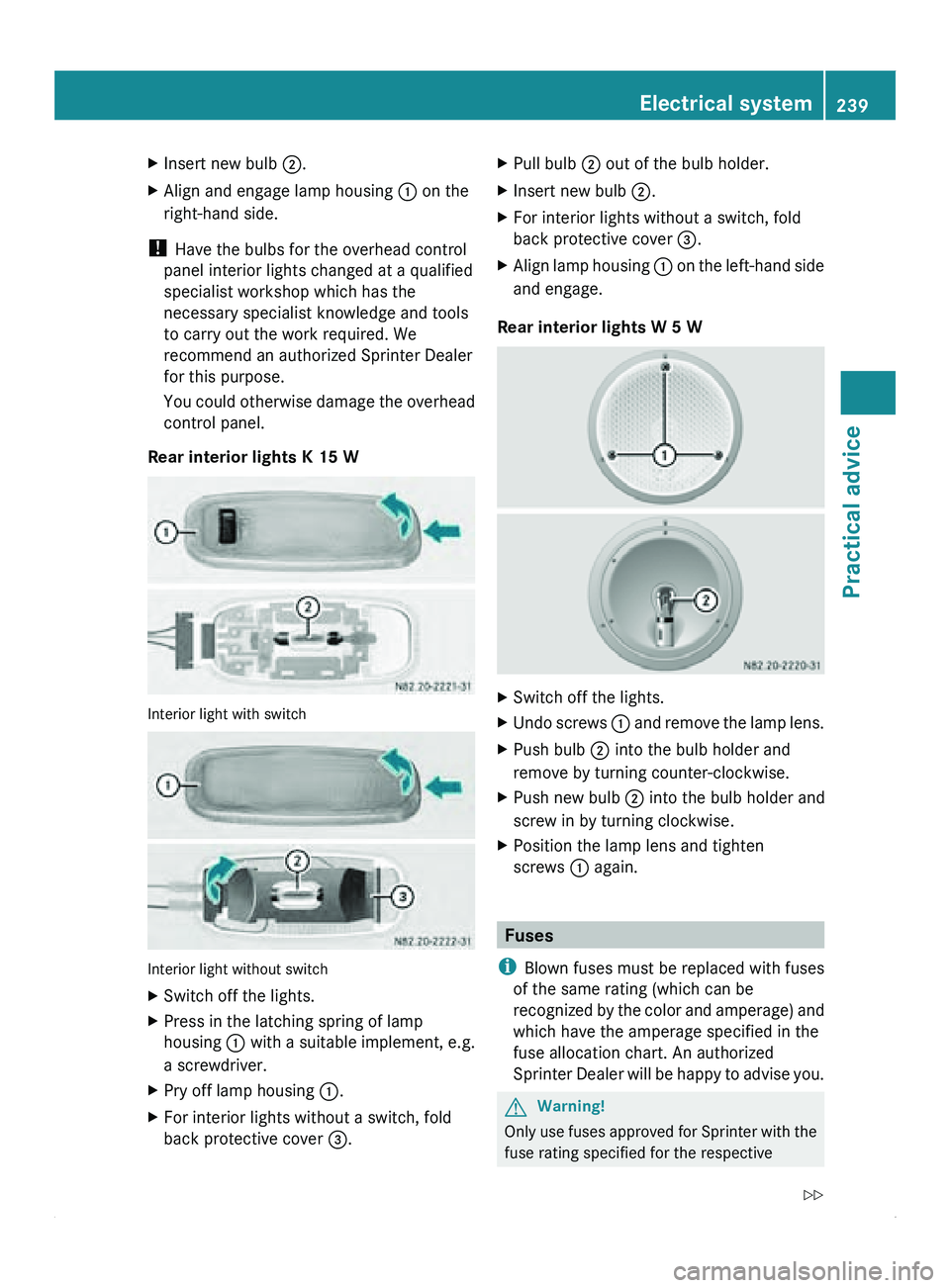
Insert new bulb 0047.
X Align and engage lamp housing 0046 on the
right-hand side.
! Have the bulbs for the overhead control
panel interior lights changed at a qualified
specialist workshop which has the
necessary specialist knowledge and tools
to carry out the work required. We
recommend an authorized Sprinter Dealer
for this purpose.
You could
otherwise
damage the overhead
control panel.
Rear interior lights K 15 W Interior light with switch
Interior light without switch
X
Switch off the lights.
X Press in the latching spring of lamp
housing 0046 with a
suitable implement, e.g.
a screwdriver.
X Pry off lamp housing 0046.
X For interior lights without a switch, fold
back protective cover 008A. X
Pull bulb 0047 out of the bulb holder.
X Insert new bulb 0047.
X For interior lights without a switch, fold
back protective cover 008A.
X Align lamp housing 0046 on the
left-hand side
and engage.
Rear interior lights W 5 W X
Switch off the lights.
X Undo screws 0046
and remove
the lamp lens.
X Push bulb 0047 into the bulb holder and
remove by turning counter-clockwise.
X Push new bulb 0047 into the bulb holder and
screw in by turning clockwise.
X Position the lamp lens and tighten
screws 0046 again. Fuses
i Blown fuses must be replaced with fuses
of the same rating (which can be
recognized by the
color and amperage) and
which have the amperage specified in the
fuse allocation chart. An authorized
Sprinter Dealer will be happy to advise you. G
Warning!
Only use fuses approved for Sprinter with the
fuse rating specified for the respective Electrical system
239
Practical advice
Z
Page 248 of 292
recycled in an environmentally
responsible manner.
Dispose of old batteries in an
environmentally responsible
manner. Take discharged batteries
to a qualified specialist workshop,
e.g. an authorized Sprinter Dealer,
or to a special collection point for
old batteries.
Key with remote control
You need two CR 2025 3 V cell batteries.
When changing the batteries, do not press
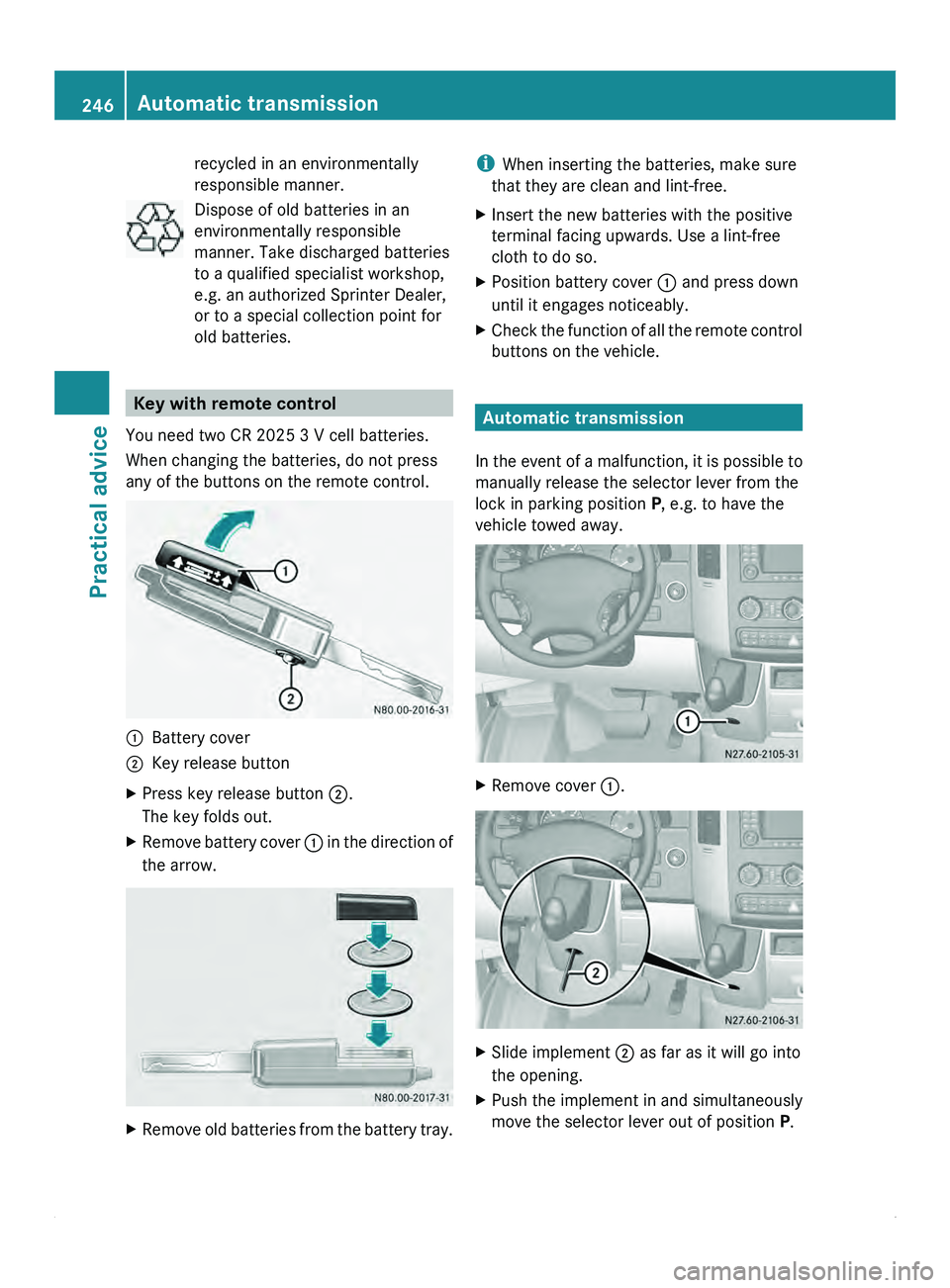
any of the buttons on the remote control. 0046
Battery cover
0047 Key release button
X Press key release button 0047.
The key folds out.
X Remove battery cover 0046 in
the direction of
the arrow. X
Remove old batteries from the battery tray. i
When inserting the batteries, make sure
that they are clean and lint-free.
X Insert the new batteries with the positive
terminal facing upwards. Use a lint-free
cloth to do so.
X Position battery cover 0046 and press down
until it engages noticeably.
X Check the function of all the remote control
buttons on the vehicle. Automatic transmission
In the event
of a malfunction, it is possible to
manually release the selector lever from the
lock in parking position P, e.g. to have the
vehicle towed away. X
Remove cover 0046. X
Slide implement 0047 as far as it will go into
the opening.
X Push the implement in and simultaneously
move the selector lever out of position P.246
Automatic transmission
Practical advice
Page 252 of 292
down, e.g. with the aid of another person or
by tying the propeller shaft up.
X Always remove the propeller shafts leading
to the driven axles.
! Always use new bolts when installing the
propeller shafts.
With front axle damage
X Turn the key to position 1 in the ignition
lock.
X Raise the front axle. G
Warning
A propeller shaft could fall off as it is being
removed and injure
you. Secure the propeller
shaft before removal to prevent it from falling
down, e.g. with the aid of another person or
by tying the propeller shaft up.
! The ignition must be switched off if the
vehicle is being towed with the front or rear
axle raised. Otherwise, ESP ®
may intervene
and damage the brake system.
With rear axle damage
X Turn the key to position 1 in the ignition
lock.
X Raise the rear axle.
Malfunction in the electrical system
If the battery is defective, the automatic
transmission will be locked in position P. To
shift the automatic transmission to
position N, you must provide power to the
vehicle's electrical system in the same way
as jump-starting ( Y page 247).
Have the vehicle
transported on a transporter
or trailer.
Transporting the vehicle The towing
eye can be used to pull the vehicle
onto a special transporter or trailer for
transportation.
! Only lash the
vehicle down by the wheels
or rims, not by vehicle parts such as axle or steering components. There is otherwise a
risk of damage to the vehicle.
X Move the selector lever of the automatic
transmission to position N.250
Jump starting, tow-starting and towing away
Practical advice
Page 256 of 292
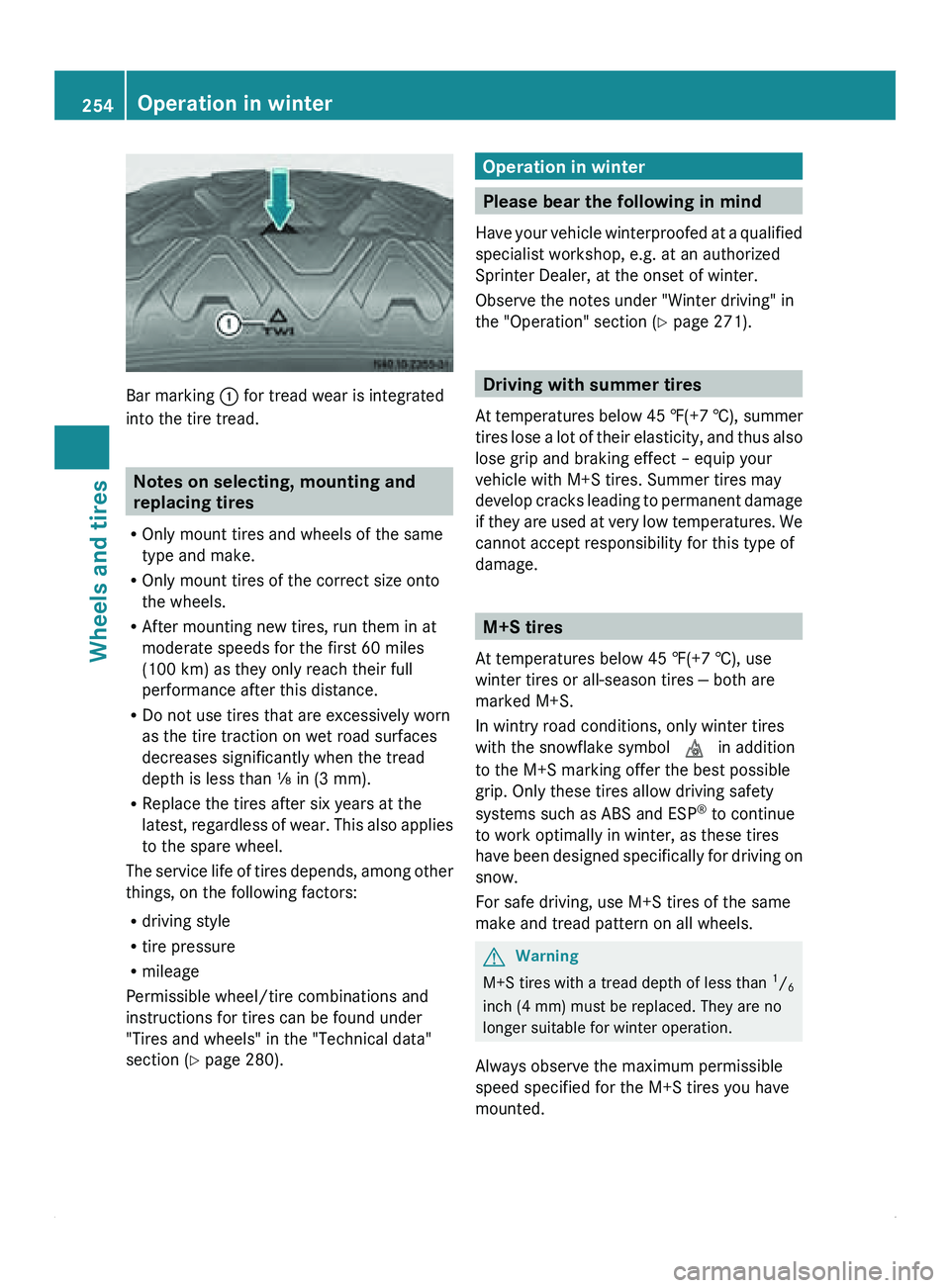
Bar marking 0046 for tread wear is integrated
into the tire tread.
Notes on selecting, mounting and
replacing tires
R Only mount tires and wheels of the same
type and make.
R Only mount tires of the correct size onto
the wheels.
R After mounting new tires, run them in at
moderate speeds for the first 60 miles
(100 km) as they only reach their full
performance after this distance.
R Do not use tires that are excessively worn
as the tire traction on wet road surfaces
decreases significantly when the tread
depth is less than ⅛ in (3 mm).
R Replace the tires after six years at the
latest, regardless of
wear. This also applies
to the spare wheel.
The service life of tires depends, among other
things, on the following factors:
R driving style
R tire pressure
R mileage
Permissible wheel/tire combinations and
instructions for tires can be found under
"Tires and wheels" in the "Technical data"
section ( Y page 280). Operation in winter
Please bear the following in mind
Have your vehicle
winterproofed at a qualified
specialist workshop, e.g. at an authorized
Sprinter Dealer, at the onset of winter.
Observe the notes under "Winter driving" in
the "Operation" section (Y page 271). Driving with summer tires
At temperatures below
45 ‡(+7 †), summer
tires lose a lot of their elasticity, and thus also
lose grip and braking effect – equip your
vehicle with M+S tires. Summer tires may
develop cracks leading to permanent damage
if they are used at very low temperatures. We
cannot accept responsibility for this type of
damage. M+S tires
At temperatures below 45 ‡(+7 †), use
winter tires or all-season tires — both are
marked M+S.
In wintry road conditions, only winter tires
with the snowflake symbol 004D in addition
to the M+S marking offer the best possible
grip. Only these tires allow driving safety
systems such as ABS and ESP ®
to continue
to work optimally in winter, as these tires
have been
designed specifically for driving on
snow.
For safe driving, use M+S tires of the same
make and tread pattern on all wheels. G
Warning
M+S tires with a tread depth of less than 1
/ 6
inch (4 mm) must be replaced. They are no
longer suitable for winter operation.
Always observe the maximum permissible
speed specified for the M+S tires you have
mounted. 254
Operation in winter
Wheels and tires
Page 261 of 292
Underinflation also reduces fuel efficiency
and tire
tread
life, and may affect the vehicle's
handling and stopping ability. Please note that
the TPMS is not a substitute for proper tire
maintenance, and it is the driver's
responsibility to maintain correct tire
pressure, even if underinflation has not
reached the level to trigger illumination of the
TPMS low tire pressure telltale.
USA only:
Your vehicle has also been equipped with a
TPMS malfunction indicator to indicate when
the tire pressure monitoring system is not
operating properly. The TPMS malfunction
indicator is combined with the low tire
pressure telltale. When the system detects a
malfunction, the telltale will flash for
approximately one minute and then remain
continuously illuminated. This sequence will
continue upon subsequent vehicle start-ups
as long as the malfunction exists. When the
malfunction indicator is lit, the system may
not be able to detect or signal low tire
pressure as intended.
TPMS malfunctions may occur for a variety of
reasons, including the installation of
incompatible replacement or alternate tires
or wheels on the vehicle that prevent the
TPMS from functioning properly. Always
check the TPMS malfunction telltale after
replacing one or more tires or wheels on your
vehicle to ensure that the replacement or
alternate tires and wheels allow the TPMS to
continue to function properly.
i USA only:
If the tire pressure monitor is
malfunctioning, it may take more than
10 minutes for the 0077 tire pressure
warning lamp to inform you of the
malfunction by flashing for 60 seconds and
then remaining lit.
When the malfunction has been rectified,
the tire pressure warning lamp goes out
after driving for a few minutes. Information on tire pressures is displayed in
the on-board computer. After a few minutes
of driving, the current tire pressure of each
tire is shown in the on-board computer
i
The tire pressure values indicated by the
on-board computer may differ from those
measured at a gas station with a pressure
gauge. The tire
pressures shown by the on-
board computer refer to those measured at
sea level. At high altitudes, the tire pressure
values indicated by a pressure gauge are
higher than those shown by the on-board
computer. In this case, do not reduce the
tire pressures.
i If radio transmitting equipment (e.g.
wireless headphones, two-way radios) is
operated inside the vehicle or in the vicinity
of the vehicle, this can interfere with the
operation of the tire pressure monitor.
i USA only:
This device complies with Part 15 of the
FCC Rules. Operation is subject to the
following two conditions:
1. This device may not cause harmful
interference, and
2. This device must withstand any
interference received, including
interference that may cause undesired
operation.
Unauthorized modifications to the device
could void the user’s authority to operate
the equipment.
i Canada only:
This device complies with the RSS-210
Rules from Industry Canada. Operation is
subject to the following two conditions:
1. This device may not cause harmful
interference, and
2. This device must accept any interference
received, including interference that may
cause undesired operation.
Unauthorized modifications to the device
could void the user’s authority to operate
the equipment. Tire pressure
259
Wheels and tires Z
Page 264 of 292
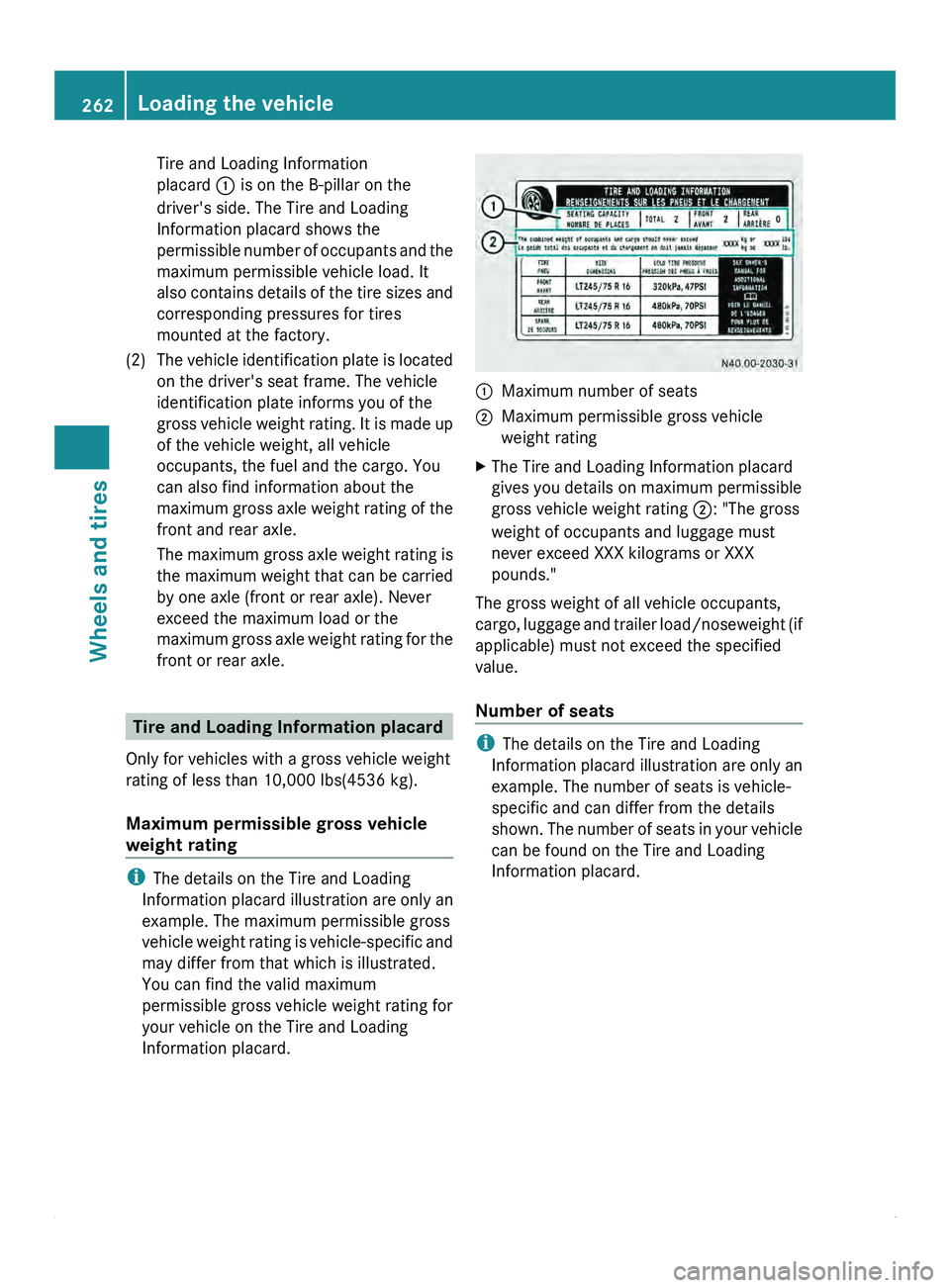
Tire and Loading Information
placard
0046 is on the B-pillar on the
driver's side. The Tire and Loading
Information placard shows the
permissible number of
occupants and the
maximum permissible vehicle load. It
also contains details of the tire sizes and
corresponding pressures for tires
mounted at the factory.
(2) The vehicle identification plate is located on the driver's seat frame. The vehicle
identification plate informs you of the
gross vehicle weight
rating. It is made up
of the vehicle weight, all vehicle
occupants, the fuel and the cargo. You
can also find information about the
maximum gross axle weight rating of the
front and rear axle.
The maximum gross axle weight rating is
the maximum weight that can be carried
by one axle (front or rear axle). Never
exceed the maximum load or the
maximum gross axle weight rating for the
front or rear axle. Tire and Loading Information placard
Only for vehicles with a gross vehicle weight
rating of less than 10,000 lbs(4536 kg).
Maximum permissible gross vehicle
weight rating i
The details on the Tire and Loading
Information placard illustration
are only an
example. The maximum permissible gross
vehicle weight rating is vehicle-specific and
may differ from that which is illustrated.
You can find the valid maximum
permissible gross vehicle weight rating for
your vehicle on the Tire and Loading
Information placard. 0046
Maximum number of seats
0047 Maximum permissible gross vehicle
weight rating
X The Tire and Loading Information placard
gives you details on maximum permissible
gross vehicle weight rating 0047: "The gross
weight of occupants and luggage must
never exceed XXX kilograms or XXX
pounds."
The gross weight of all vehicle occupants,
cargo, luggage
and
trailer load/noseweight (if
applicable) must not exceed the specified
value.
Number of seats i
The details on the Tire and Loading
Information placard illustration
are only an
example. The number of seats is vehicle-
specific and can differ from the details
shown. The number of seats in your vehicle
can be found on the Tire and Loading
Information placard. 262
Loading the vehicle
Wheels and tires
Page 269 of 292
Tire code:
tire code 0088 specifies the tire type.
"R" represents radial tires. "D" represents
diagonal tires, "B" represents diagonal radial
tires.
Rim diameter: rim diameter 0086 is the
diameter of the bead seat, not the diameter
of the rim flange. The rim diameter is
specified in inches (in).
Load bearing index: load bearing index 0087
is a numerical code which specifies the
maximum load-bearing capacity of a tire. G
Warning
The tire load rating must always be at least
half of the GAWR of your vehicle. Otherwise,
sudden tire failure may be the result which
could cause an
accident and/or serious injury
to you or others.
Always replace rims and tires with rims and
tires having the same specifications
(designation, manufacturer and type) as
shown on the original part. G
Warning
Do not overload the tires by exceeding the
specified load limit as indicated on the Tire
and Loading Information placard on the
driver's door B-pillar . Overloading the tires
can overheat them, possibly causing a
blowout. Overloading
the tires can also result
in handling or steering problems, or brake
failure.
Example:
The load bearing index 120 is equivalent to a
maximum load of 3042 lbs (1380 kg) that the
tire can carry. If two load-bearing capacity
indices are specified (as shown above), the
first number states the load-bearing capacity
for single tires, the second number the load-
bearing capacity for twin tires. For further
information on the maximum tire load in
kilograms and pounds, see ( Y page 265).
Speed index: speed index 006E specifies the
approved maximum speed of the tire. G
Warning
Even when permitted by law, never operate a
vehicle at speeds greater than the maximum
speed rating of the tires.
Exceeding the maximum
speed for which tires
are rated can lead to sudden tire failure,
causing loss of vehicle control and possibly
resulting in an accident and/or serious
personal injury and possible death, for you
and for others.
Regardless of the speed index always observe
the speed limits. Drive carefully and adapt
your driving style to the traffic conditions. Index Speed rating
F up to 50 mph (80 km/h)
G up to 56 mph (90 km/h)
J up to 62 mph (100 km/h)
K up to 68 mph (110 km/h)
L up to 74 mph (120 km/h)
M up to 80 mph (130 km/h)
N up to 87 mph (140 km/h)
P up to 93 mph (150 km/h)
Q up to 100 mph (160 km/h)
R above 106 mph (170 km/h)
i
Not all tires that have the M+S
identification offer the driving
characteristics of winter tires. Winter tires
have, in addition
to the M+S identification,
the 004D snow flake symbol on the tire
sidewall. Tires with this identification fulfill
the requirements of the Rubber
Manufacturers Association (RMA) and the
Rubber Association of Canada (RAC)
regarding the tire traction on snow and
have been especially developed for driving
on snow.
More information on reading the tire data can
be obtained at any qualified specialist Tire labeling
267
Wheels and tires Z
Page 270 of 292
workshop, e.g. at an authorized Sprinter
Dealer.
DOT, Tire Identification Number (TIN)
U.S. tire regulations
prescribe that every new
tire manufacturer or retreader has to imprint
a TIN in or on the sidewall of each tire
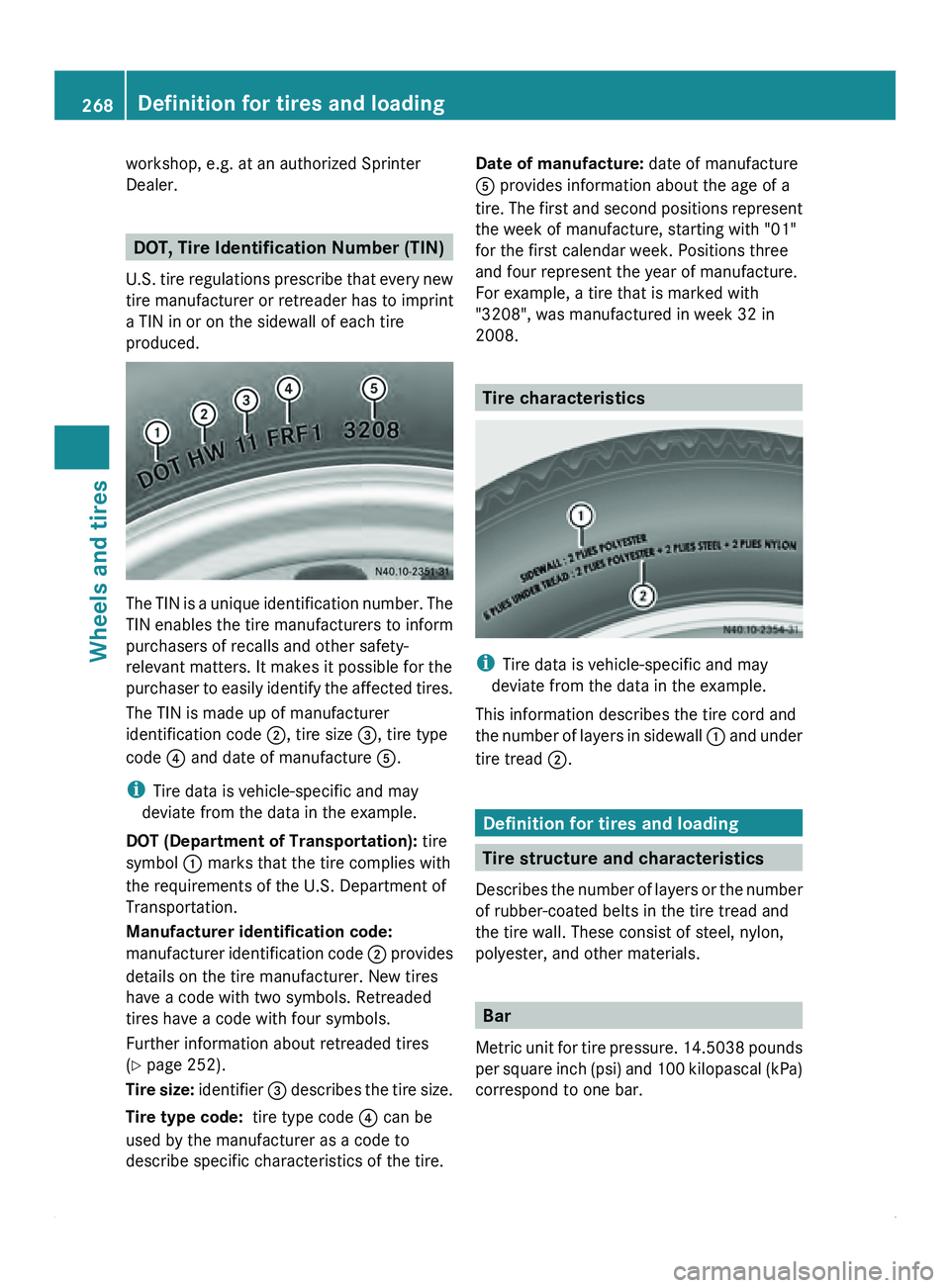
produced. The TIN is a unique identification number. The
TIN enables the tire manufacturers to inform
purchasers of recalls and other safety-
relevant matters. It makes it possible for the
purchaser to
easily
identify the affected tires.
The TIN is made up of manufacturer
identification code 0047, tire size 008A, tire type
code 0088 and date of manufacture 0086.
i Tire data is vehicle-specific and may
deviate from the data in the example.
DOT (Department of Transportation): tire
symbol 0046 marks that the tire complies with
the requirements of the U.S. Department of
Transportation.
Manufacturer identification code:
manufacturer identification code 0047 provides
details on the tire manufacturer. New tires
have a code with two symbols. Retreaded
tires have a code with four symbols.
Further information about retreaded tires
(Y page 252).
Tire size: identifier 008A describes the tire size.
Tire type code: tire type code 0088 can be
used by the manufacturer as a code to
describe specific characteristics of the tire. Date of manufacture:
date of manufacture
0086 provides information about the age of a
tire. The
first
and second positions represent
the week of manufacture, starting with "01"
for the first calendar week. Positions three
and four represent the year of manufacture.
For example, a tire that is marked with
"3208", was manufactured in week 32 in
2008. Tire characteristics
i
Tire data is vehicle-specific and may
deviate from the data in the example.
This information describes the tire cord and
the number of
layers in sidewall 0046 and under
tire tread 0047. Definition for tires and loading
Tire structure and characteristics
Describes the number
of layers or the number
of rubber-coated belts in the tire tread and
the tire wall. These consist of steel, nylon,
polyester, and other materials. Bar
Metric unit for
tire pressure. 14.5038 pounds
per square inch (psi) and 100 kilopascal (kPa)
correspond to one bar. 268
Definition for tires and loading
Wheels and tires
Page 275 of 292
You may mount a spare wheel against the
direction of rotation. Observe the time
restriction on use as well as the speed
limitation specified on the spare wheel.
Storing wheels
Store wheels that
are not being used in a cool,
dry and preferably dark place. Protect the
tires from contact with oil, grease and fuel. Cleaning wheels
G
Warning
Do not use power washers with circular jet
nozzles (concentrated-power jets) to clean
your vehicle, especially
for cleaning tires. You
could otherwise damage the tires and cause
an accident. Changing wheels
273
Wheels and tires Z