roof MERCEDES-BENZ SPRINTER 2014 MY14 Operator’s Manual
[x] Cancel search | Manufacturer: MERCEDES-BENZ, Model Year: 2014, Model line: SPRINTER, Model: MERCEDES-BENZ SPRINTER 2014Pages: 338, PDF Size: 6.78 MB
Page 56 of 338
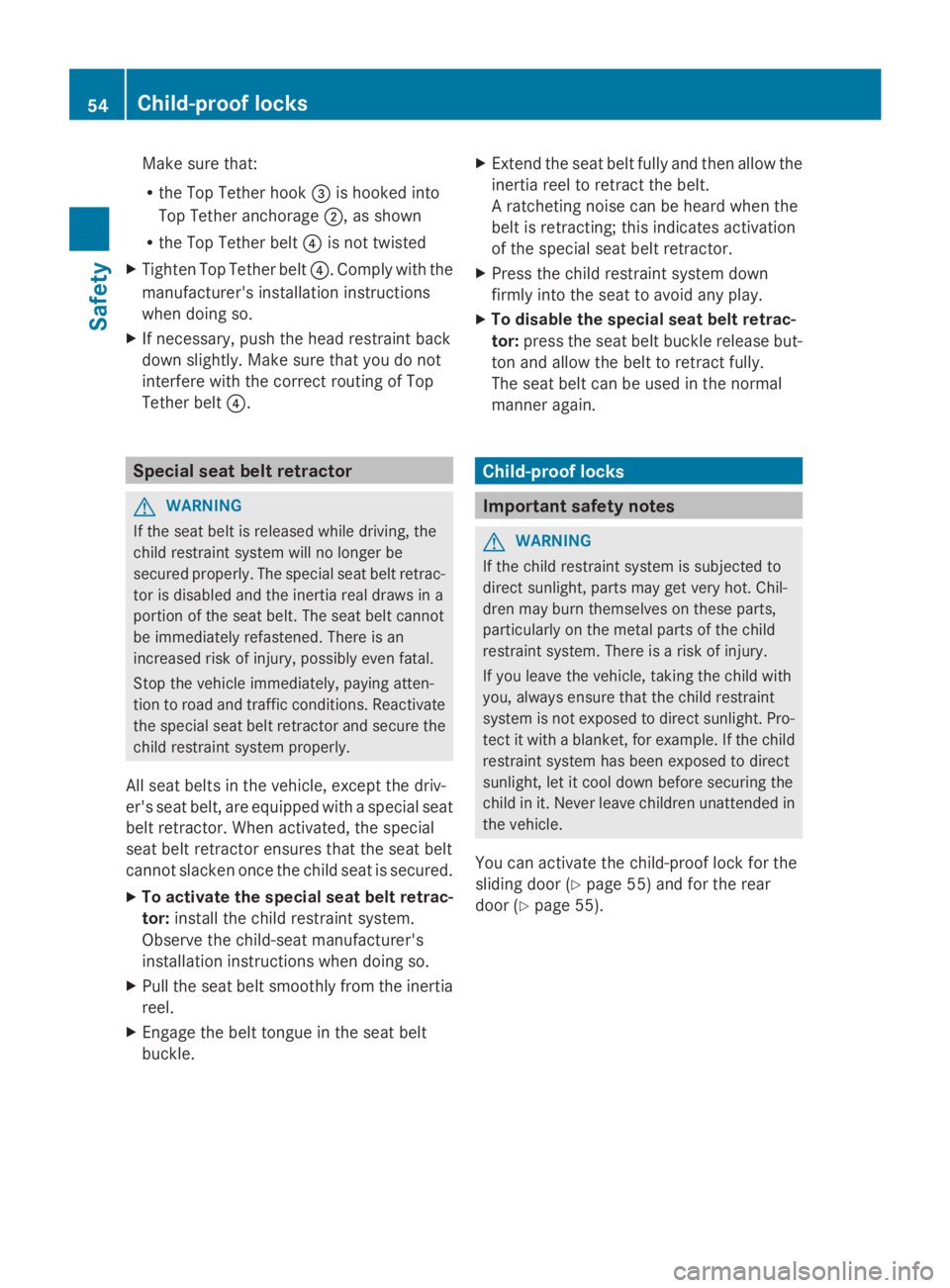
Make sure that:
R
the Top Tether hook 0087is hooked into
Top Tether anchorage 0044, as shown
R the Top Tether belt 0085is not twisted
X Tighten Top Tether belt 0085. Comply with the
manufacturer's installation instructions
when doing so.
X If necessary, push the head restraint back
down slightly. Make sure that you do not
interfere with the correct routing of Top
Tether belt 0085. Special seat belt retractor
G
WARNING
If the seat belt is released while driving, the
child restraint system will no longer be
secured properly. The special seat belt retrac-
tor is disabled and the inertia real draws in a
portion of the seat belt. The seat belt cannot
be immediately refastened. There is an
increased risk of injury, possibly even fatal.
Stop the vehicle immediately, paying atten-
tion to road and traffic conditions. Reactivate
the special seat belt retractor and secure the
child restraint system properly.
All seat belts in the vehicle, except the driv-
er's seat belt, are equipped with a special seat
belt retractor. When activated, the special
seat belt retractor ensures that the seat belt
cannot slacken once the child seat is secured.
X To activate the special seat belt retrac-
tor: install the child restraint system.
Observe the child-seat manufacturer's
installation instructions when doing so.
X Pull the seat belt smoothly from the inertia
reel.
X Engage the belt tongue in the seat belt
buckle. X
Extend the seat belt fully and then allow the
inertia reel to retract the belt.
A ratcheting noise can be heard when the
belt is retracting; this indicates activation
of the special seat belt retractor.
X Press the child restraint system down
firmly into the seat to avoid any play.
X To disable the special seat belt retrac-
tor: press the seat belt buckle release but-
ton and allow the belt to retract fully.
The seat belt can be used in the normal
manner again. Child-proof locks
Important safety notes
G
WARNING
If the child restraint system is subjected to
direct sunlight, parts may get very hot. Chil-
dren may burn themselves on these parts,
particularly on the metal parts of the child
restraint system. There is a risk of injury.
If you leave the vehicle, taking the child with
you, always ensure that the child restraint
system is not exposed to direct sunlight. Pro-
tect it with a blanket, for example. If the child
restraint system has been exposed to direct
sunlight, let it cool down before securing the
child in it. Never leave children unattended in
the vehicle.
You can activate the child-proof lock for the
sliding door (Y page 55) and for the rear
door (Y page 55). 54
Child-proof locksSafety
Page 57 of 338
Child-proof locks for the sliding door/
rear door G
WARNING
If children are traveling in the vehicle, they
could:
R open doors, thus endangering other people
or road users
R exit the vehicle and be caught by oncoming
traffic
R operate vehicle equipment and become
trapped
There is a risk of an accident and injury.
Always activate the child-proof locks and
override feature if children are traveling in the
vehicle. When leaving the vehicle, always take
the key with you and lock the vehicle. Never
leave children unattended in the vehicle.
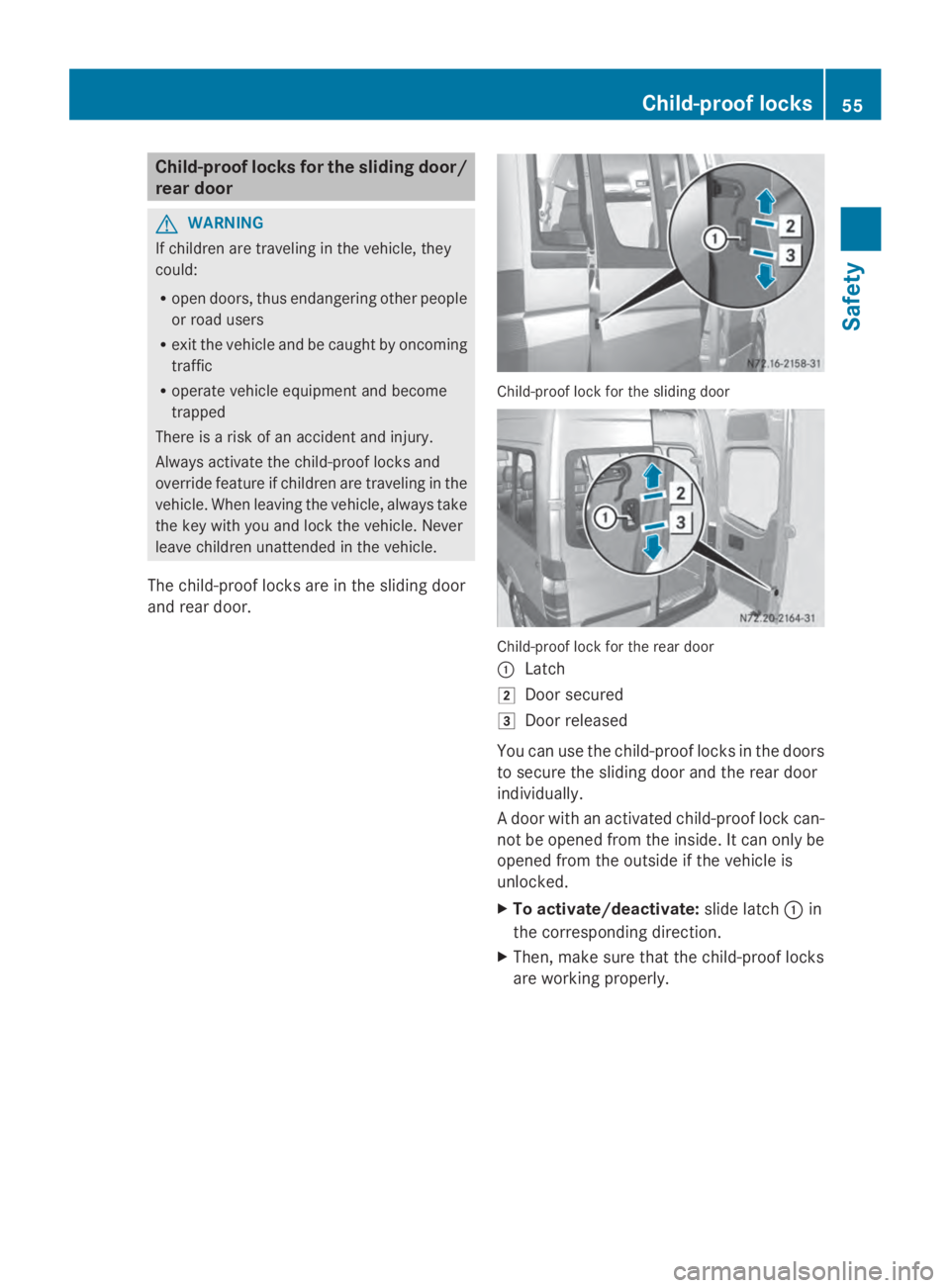
The child-proof locks are in the sliding door
and rear door. Child-proof lock for the sliding door
Child-proof lock for the rear door
0043
Latch
0048 Door secured
0049 Door released
You can use the child-proof locks in the doors
to secure the sliding door and the rear door
individually.
A door with an activated child-proof lock can-
not be opened from the inside. It can only be
opened from the outside if the vehicle is
unlocked.
X To activate/deactivate: slide latch0043in
the corresponding direction.
X Then, make sure that the child-proof locks
are working properly. Child-proof locks
55Safety Z
Page 68 of 338
Useful information
This Operator's Manual describes all models
as well as standard and optional equipment
of your vehicle that were available at the time
of going to print. Country-specific variations
are possible. Note that your vehicle may not
be equipped with all of the described func-
tions. This also applies to systems and func-
tions relevant to safety.
Read the information on qualified specialist
workshops (Y page 26). Key
Important safety notes
G
WARNING
Activate the child-proof door locks if children
are traveling in the vehicle. The children could
otherwise open the doors while the vehicle is
in motion, injuring themselves and others. G
WARNING
Do not leave children unsupervised in the
vehicle, even if they are secured in a child
restraint system. Children could otherwise
injure themselves on parts of the vehicle.
They could be severely or even fatally injured
by prolonged exposure to intense heat or
cold.
If children open a door, they could:
R injure other people
R get out of the vehicle and thereby injure
themselves or be injured by a passing vehi-
cle
R severely injure themselves by falling down,
in particular due to the vehicle height
Always take the key with you when leaving the
vehicle, even if you are only leaving for a short
time. G
WARNING
If you attach heavy or large objects to the
SmartKey, the SmartKey could be uninten- tionally turned in the ignition lock. This could
cause the engine to be switched off. There is
a risk of an accident.
Do not attach any heavy or large objects to
the SmartKey. Remove any bulky key rings
before inserting the SmartKey into the igni-
tion lock.
Do not keep the key with remote control:
R with electronic devices, e.g. a mobile
phone or another key with remote control
R with metallic objects, e.g. coins or metal
foil
R in metallic objects, e.g. metal cases
This can affect the key's functionality. Key functions of the remote control
General notes The vehicle is equipped with either 2 or
4 remote controls with a folding key, or 4
mechanical keys. In this Operator's Manual,
both the mechanical keys and the keys with
remote control are referred to as keys. The
remote control key has a range of up to
32 ft (10 m). Use the remote control of the
key only when in immediate proximity of the
vehicle. This prevents theft.
Remote controls that are not included in the
scope of delivery for the vehicle must be pro-
grammed before use. Further information can
be obtained at any authorized Sprinter
Dealer.
The key's remote control locks/unlocks the
driver's door and/or the following centrally if
the factory settings have not been changed:
R the driver's and the co-driver's door
R the sliding doors
R the rear doors
i If the driver's or co-driver's door is not
closed, the corresponding door is not
locked. If a sliding door or a rear door is not
closed properly, none of the rear doors are
locked. 66
KeyOpening and closing
Page 73 of 338
Central locking
Important safety notes
G
WARNING
Activate the child-proof door locks if children
are traveling in the vehicle. The children could
otherwise open the doors while the vehicle is
in motion, injuring themselves and others. G
WARNING
Do not leave children unsupervised in the
vehicle, even if they are secured in a child
restraint system. Children could otherwise
injure themselves on parts of the vehicle.
They could be severely or even fatally injured
by prolonged exposure to intense heat or
cold.
If children open a door, they could:
R injure other people
R get out of the vehicle and thereby injure
themselves or be injured by a passing vehi-
cle
R severely injure themselves by falling down,
in particular due to the vehicle height
Always take the key with you when leaving the
vehicle, even if you are only leaving for a short
time.
You can open a locked front door from the
inside at any time. You can open a locked
sliding door or rear door from the inside if it
has been previously unlocked from inside. Locking and unlocking manually
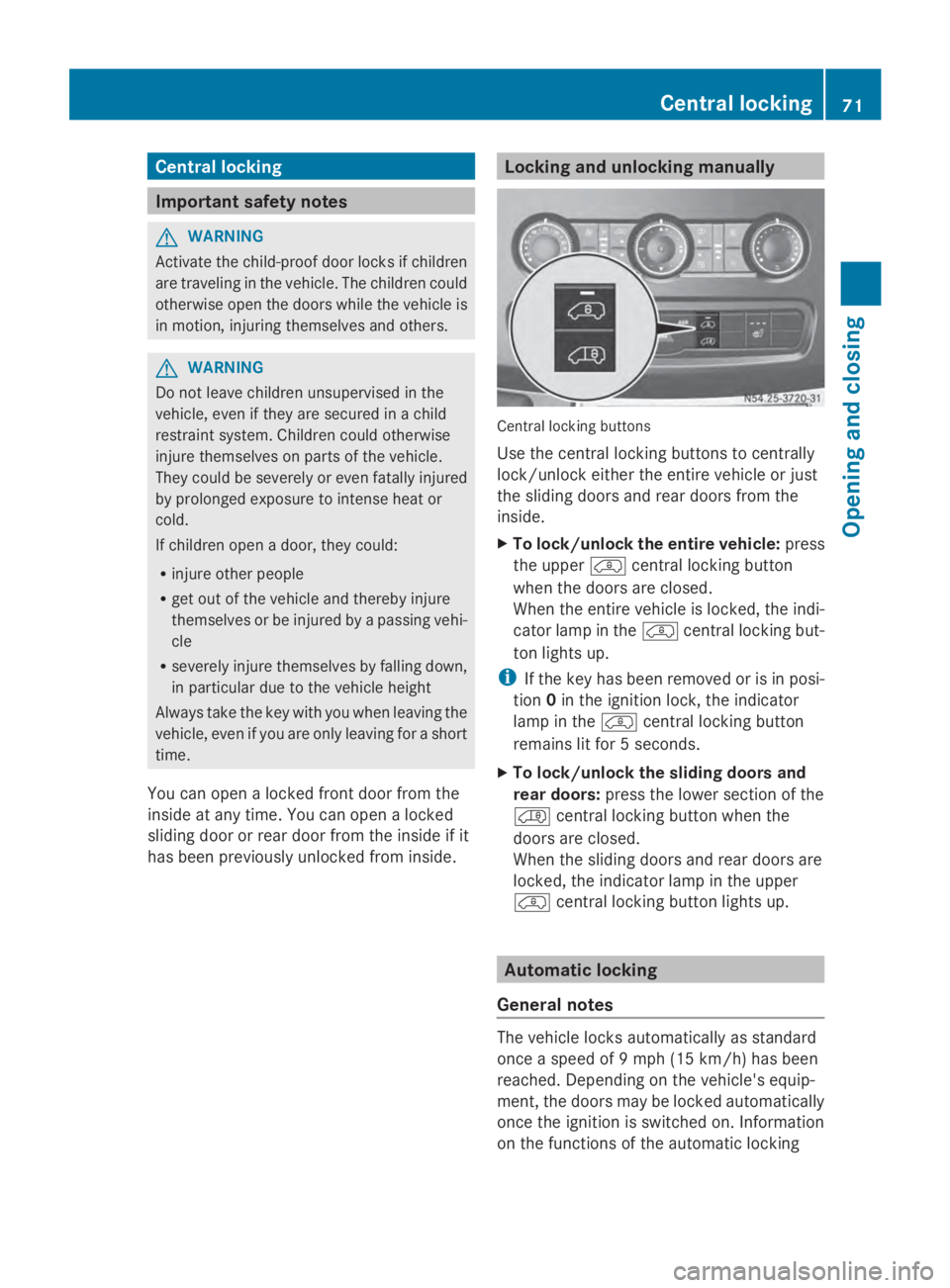
Central locking buttons
Use the central locking buttons to centrally
lock/unlock either the entire vehicle or just
the sliding doors and rear doors from the
inside.
X
To lock/unlock the entire vehicle: press
the upper 00BFcentral locking button
when the doors are closed.
When the entire vehicle is locked, the indi-
cator lamp in the 00BFcentral locking but-
ton lights up.
i If the key has been removed or is in posi-
tion 0in the ignition lock, the indicator
lamp in the 00BFcentral locking button
remains lit for 5 seconds.
X To lock/unlock the sliding doors and
rear doors: press the lower section of the
00C0 central locking button when the
doors are closed.
When the sliding doors and rear doors are
locked, the indicator lamp in the upper
00BF central locking button lights up. Automatic locking
General notes The vehicle locks automatically as standard
once a speed of 9 mph (15 km/h) has been
reached. Depending on the vehicle's equip-
ment, the doors may be locked automatically
once the ignition is switched on. Information
on the functions of the automatic locking Central locking
71Opening and closing Z
Page 75 of 338
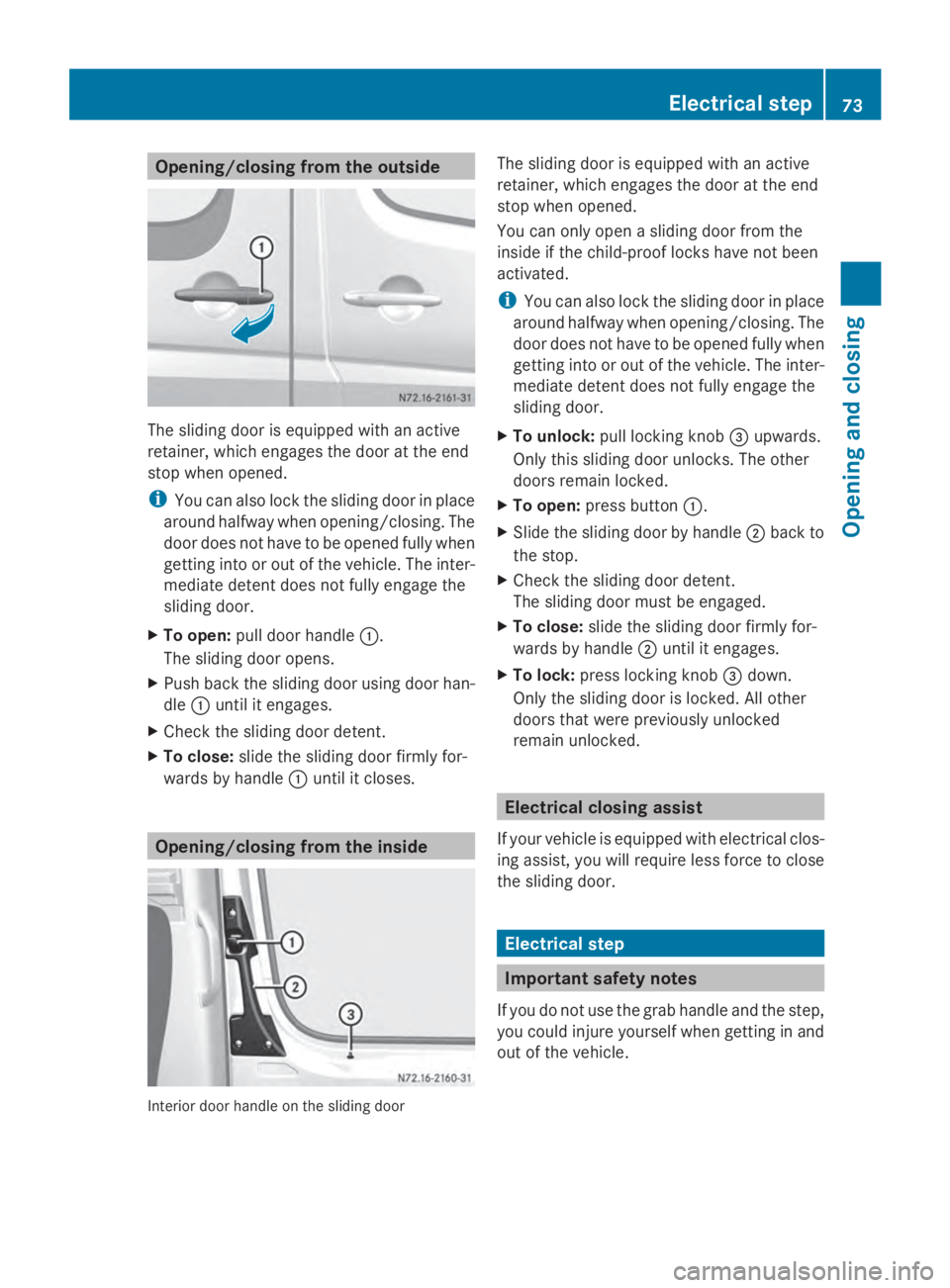
Opening/closing from the outside
The sliding door is equipped with an active
retainer, which engages the door at the end
stop when opened.
i You can also lock the sliding door in place
around halfway when opening/closing. The
door does not have to be opened fully when
getting into or out of the vehicle. The inter-
mediate detent does not fully engage the
sliding door.
X To open: pull door handle 0043.
The sliding door opens.
X Push back the sliding door using door han-
dle 0043until it engages.
X Check the sliding door detent.
X To close: slide the sliding door firmly for-
wards by handle 0043until it closes. Opening/closing from the inside
Interior door handle on the sliding door The sliding door is equipped with an active
retainer, which engages the door at the end
stop when opened.
You can only open a sliding door from the
inside if the child-proof locks have not been
activated.
i
You can also lock the sliding door in place
around halfway when opening/closing. The
door does not have to be opened fully when
getting into or out of the vehicle. The inter-
mediate detent does not fully engage the
sliding door.
X To unlock: pull locking knob 0087upwards.
Only this sliding door unlocks. The other
doors remain locked.
X To open: press button 0043.
X Slide the sliding door by handle 0044back to
the stop.
X Check the sliding door detent.
The sliding door must be engaged.
X To close: slide the sliding door firmly for-
wards by handle 0044until it engages.
X To lock: press locking knob 0087down.
Only the sliding door is locked. All other
doors that were previously unlocked
remain unlocked. Electrical closing assist
If your vehicle is equipped with electrical clos-
ing assist, you will require less force to close
the sliding door. Electrical step
Important safety notes
If you do not use the grab handle and the step,
you could injure yourself when getting in and
out of the vehicle. Electrical step
73Opening and closing Z
Page 79 of 338
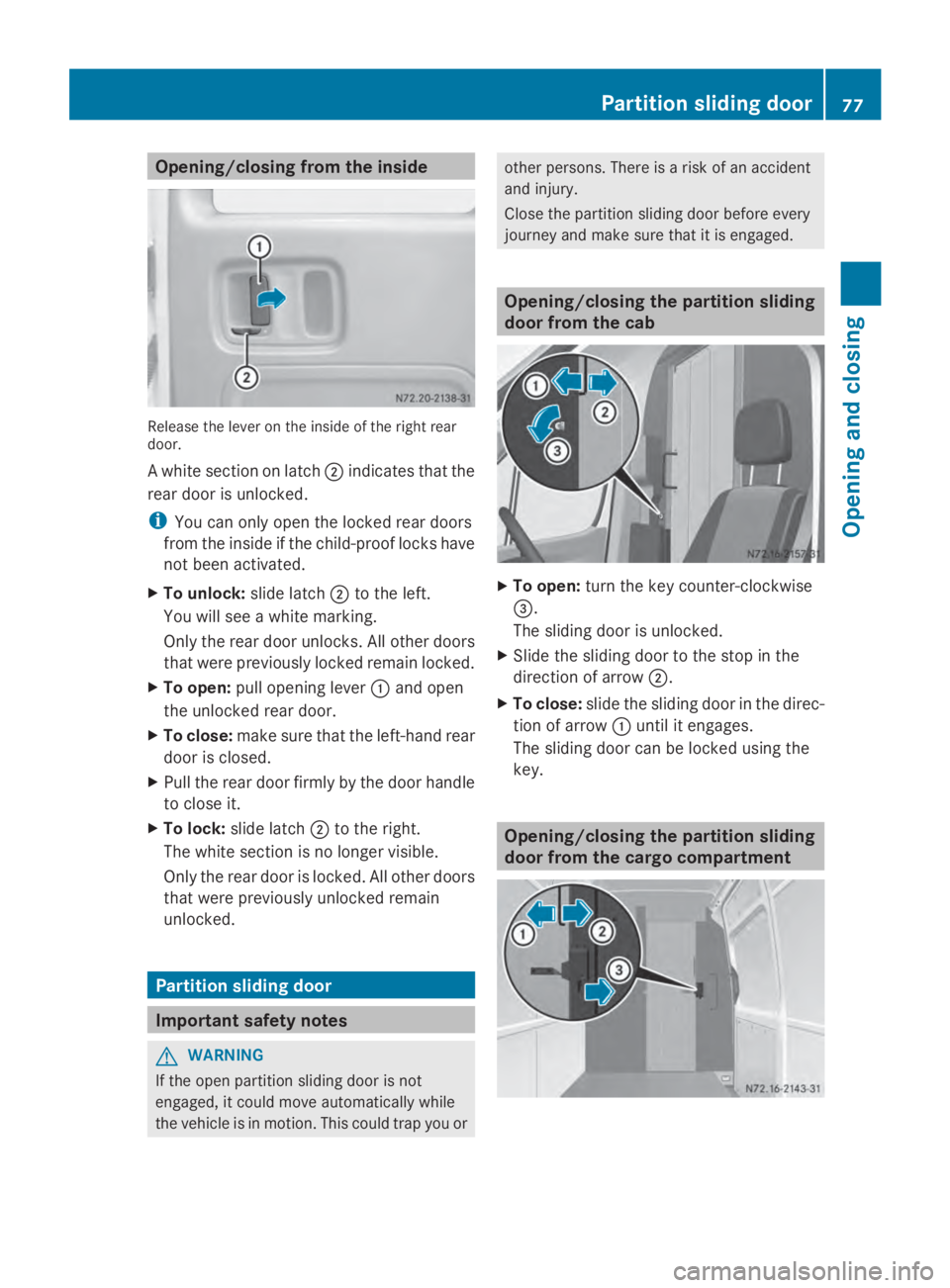
Opening/closing from the inside
Release the lever on the inside of the right rear
door.
A white section on latch 0044indicates that the
rear door is unlocked.
i You can only open the locked rear doors
from the inside if the child-proof locks have
not been activated.
X To unlock: slide latch0044to the left.
You will see a white marking.
Only the rear door unlocks. All other doors
that were previously locked remain locked.
X To open: pull opening lever 0043and open
the unlocked rear door.
X To close: make sure that the left-hand rear
door is closed.
X Pull the rear door firmly by the door handle
to close it.
X To lock: slide latch 0044to the right.
The white section is no longer visible.
Only the rear door is locked. All other doors
that were previously unlocked remain
unlocked. Partition sliding door
Important safety notes
G
WARNING
If the open partition sliding door is not
engaged, it could move automatically while
the vehicle is in motion. This could trap you or other persons. There is a risk of an accident
and injury.
Close the partition sliding door before every
journey and make sure that it is engaged.
Opening/closing the partition sliding
door from the cab
X
To open: turn the key counter-clockwise
0087.
The sliding door is unlocked.
X Slide the sliding door to the stop in the
direction of arrow 0044.
X To close: slide the sliding door in the direc-
tion of arrow 0043until it engages.
The sliding door can be locked using the
key. Opening/closing the partition sliding
door from the cargo compartment Partition sliding door
77Opening and closing Z
Page 81 of 338
Resetting the side windows
You must reset the side windows if there has
been a malfunction or an interruption in the
voltage supply.
X Turn the key to position 2in the ignition
lock.
X Pull the two power window switches and
hold for approximately one second after
closing the side window. Problems with the side windows
If you cannot completely open or close a side
window:
If there are no objects or leaves in the window
guide that prevent the sliding sunroof from
closing, there has been a malfunction or the
on-board voltage has been interrupted.
X Reset the side window (Y page 79). Side windows
79Opening and closing Z
Page 107 of 338
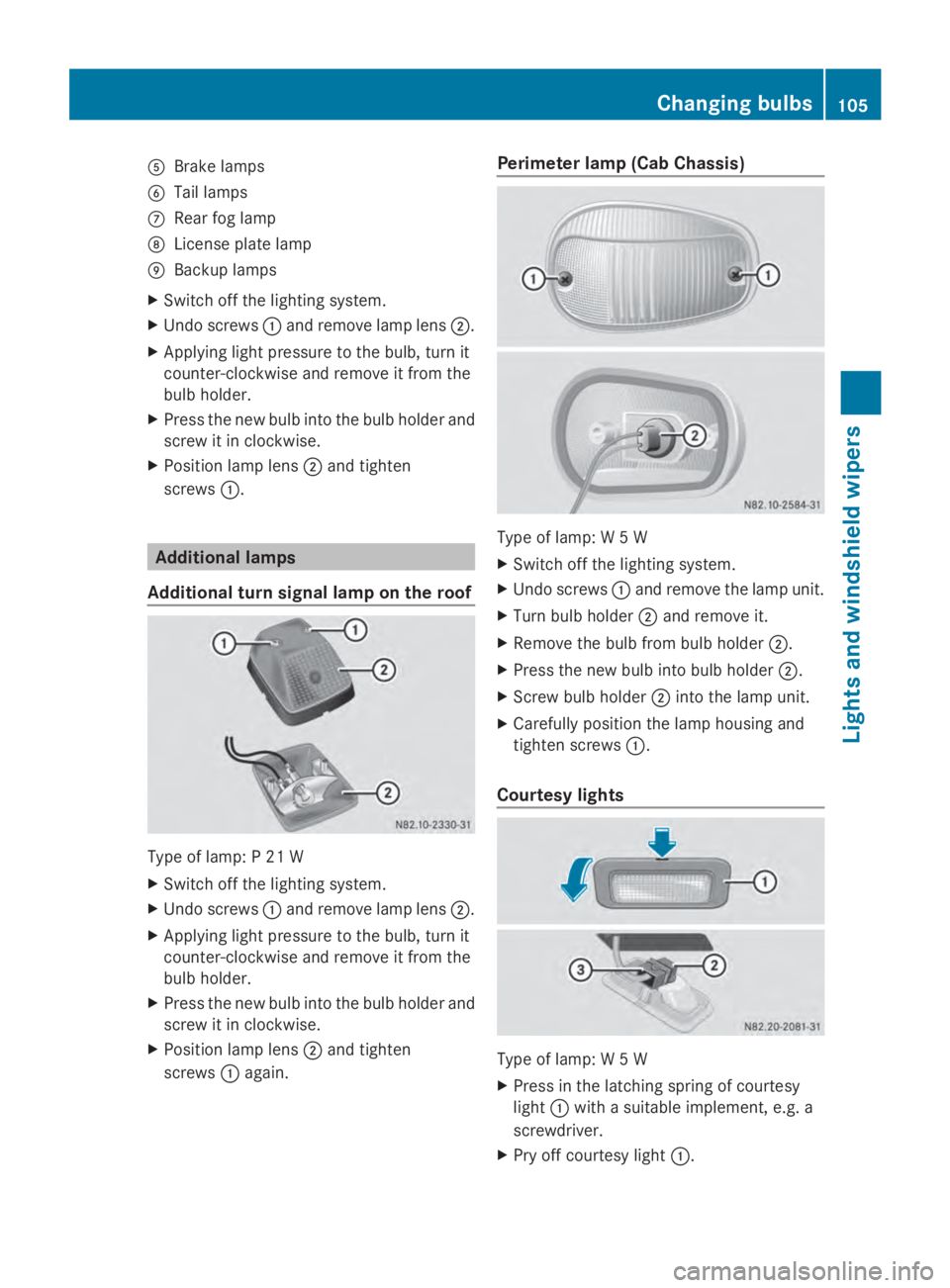
0083
Brake lamps
0084 Tail lamps
006B Rear fog lamp
006C License plate lamp
006D Backup lamps
X Switch off the lighting system.
X Undo screws 0043and remove lamp lens 0044.
X Applying light pressure to the bulb, turn it
counter-clockwise and remove it from the
bulb holder.
X Press the new bulb into the bulb holder and
screw it in clockwise.
X Position lamp lens 0044and tighten
screws 0043. Additional lamps
Additional turn signal lamp on the roof Type of lamp: P 21 W
X
Switch off the lighting system.
X Undo screws 0043and remove lamp lens 0044.
X Applying light pressure to the bulb, turn it
counter-clockwise and remove it from the
bulb holder.
X Press the new bulb into the bulb holder and
screw it in clockwise.
X Position lamp lens 0044and tighten
screws 0043again. Perimeter lamp (Cab Chassis)
Type of lamp: W 5 W
X
Switch off the lighting system.
X Undo screws 0043and remove the lamp unit.
X Turn bulb holder 0044and remove it.
X Remove the bulb from bulb holder 0044.
X Press the new bulb into bulb holder 0044.
X Screw bulb holder 0044into the lamp unit.
X Carefully position the lamp housing and
tighten screws 0043.
Courtesy lights Type of lamp: W 5 W
X
Press in the latching spring of courtesy
light 0043with a suitable implement, e.g. a
screwdriver.
X Pry off courtesy light 0043. Changing bulbs
105Lights and windshield wipers Z
Page 123 of 338
Adjusting the air vents
Important safety notes
G
WARNING
Very hot or very cold air can flow from the air
vents. This could result in burns or frostbite in
the immediate vicinity of the air vents. There
is a risk of injury.
Make sure that all vehicle occupants always
maintain a sufficient distance to the air out-
lets. If necessary, redirect the airflow to
another area of the vehicle interior.
The center and side air vents are adjustable.
On vehicles with a rear-compartment air-con-
ditioning system, you can also adjust the air
vents in the roof duct.
i For virtually draft-free ventilation, adjust
the sliders of the center air vents to the
center position.
In order to ensure the direct flow of fresh air
through the air vents into the vehicle interior,
please observe the following notes:
R keep the air inlet grille on the hood free of
blockages, such as ice, snow or leaves.
R never cover the vents or the ventilation
grilles in the vehicle interior. Setting the center air vents
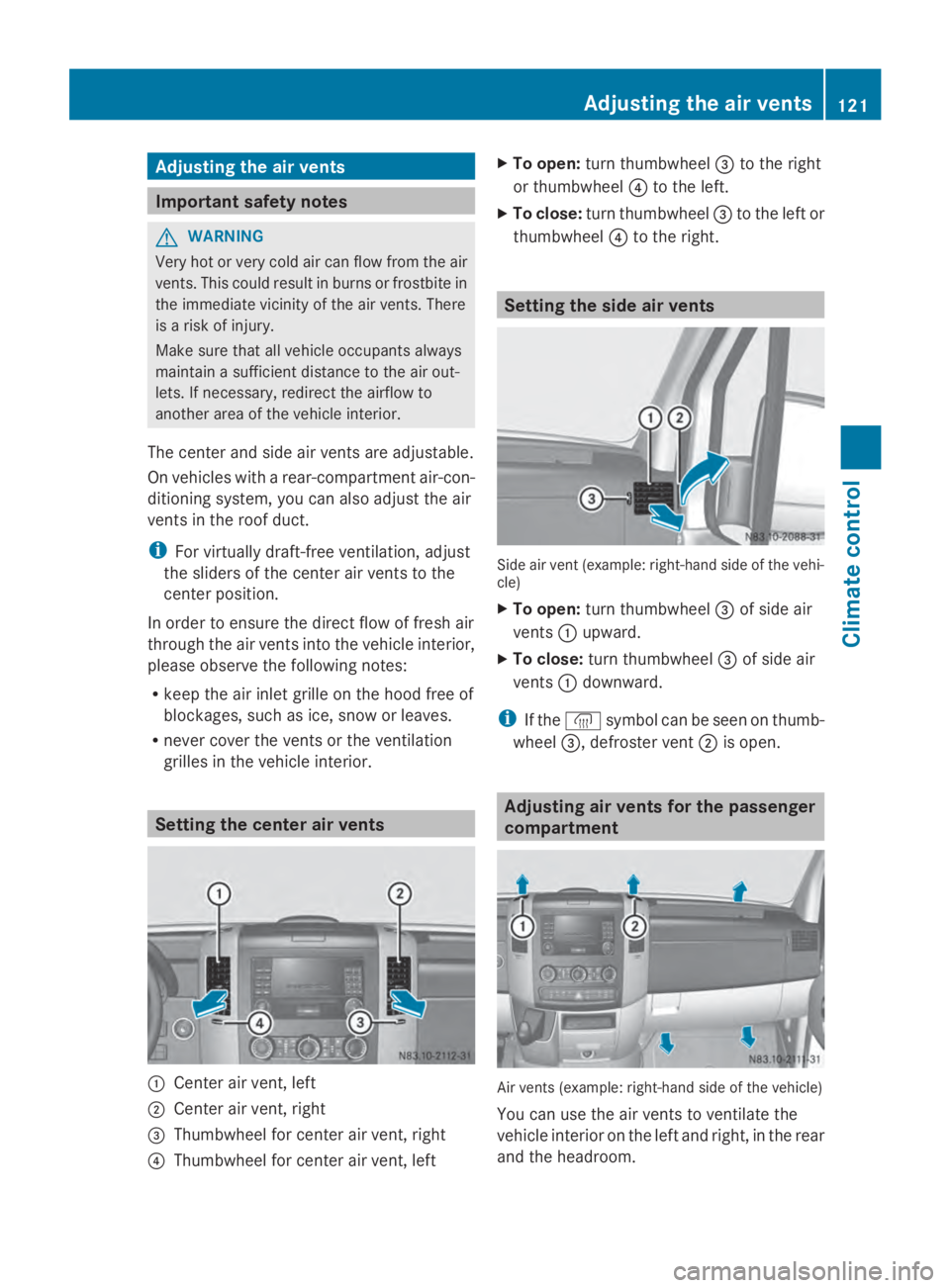
0043
Center air vent, left
0044 Center air vent, right
0087 Thumbwheel for center air vent, right
0085 Thumbwheel for center air vent, left X
To open: turn thumbwheel 0087to the right
or thumbwheel 0085to the left.
X To close: turn thumbwheel 0087to the left or
thumbwheel 0085to the right. Setting the side air vents
Side air vent (example: right-hand side of the vehi-
cle)
X
To open: turn thumbwheel 0087of side air
vents 0043upward.
X To close: turn thumbwheel 0087of side air
vents 0043downward.
i If the 0060 symbol can be seen on thumb-
wheel 0087, defroster vent 0044is open. Adjusting air vents for the passenger
compartment
Air vents (example: right-hand side of the vehicle)
You can use the air vents to ventilate the
vehicle interior on the left and right, in the rear
and the headroom. Adjusting the air vents
121Climate control Z
Page 124 of 338
X
To open: for the right-hand side of the vehi-
cle, turn thumbwheel 0044or for the left-hand
side of the vehicle, thumbwheel 0043of the
air vents clockwise.
X To close: for the right-hand side of the
vehicle, turn thumbwheel 0044or for the left-
hand side of the vehicle, thumbwheel 0043of
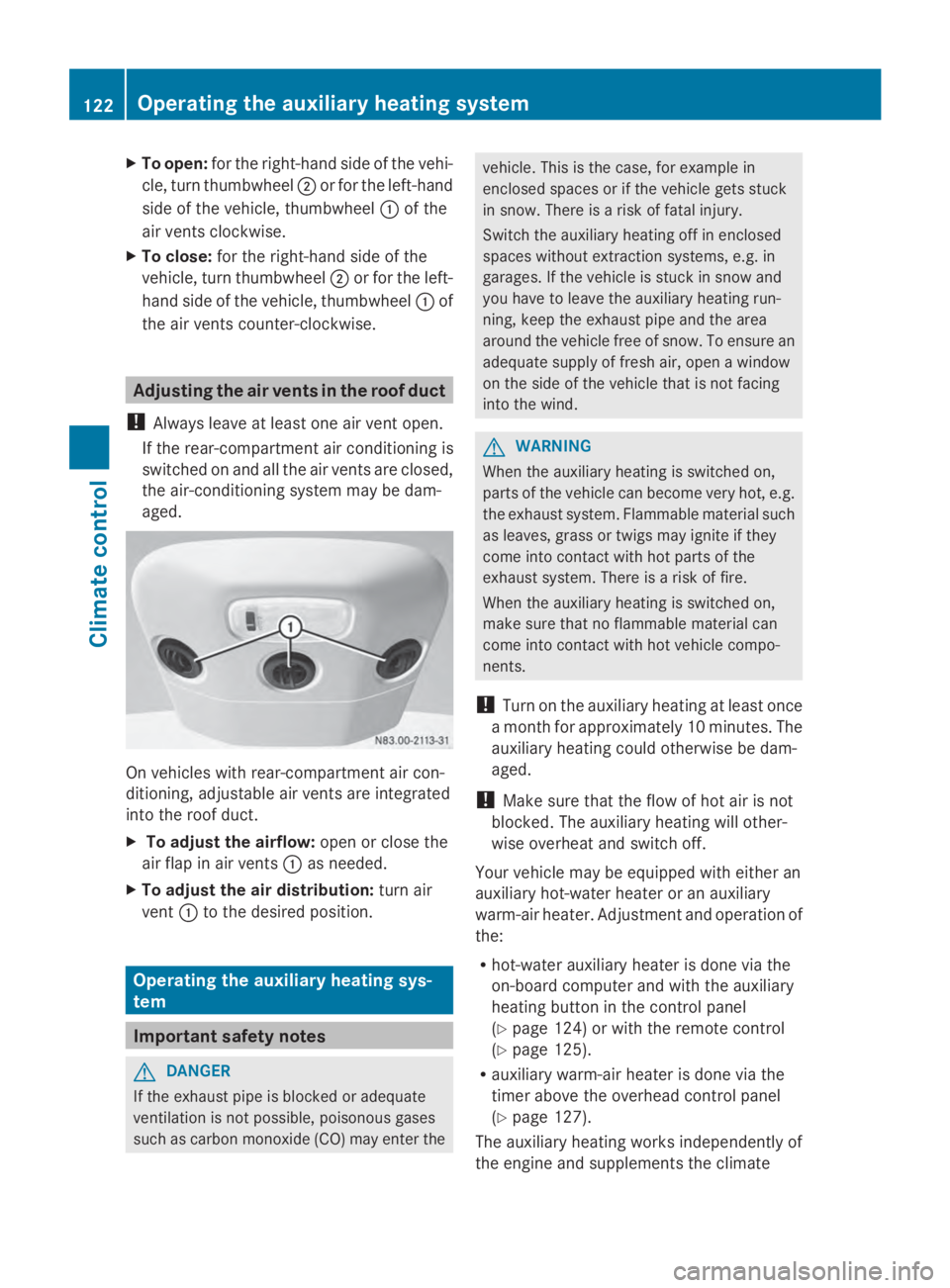
the air vents counter-clockwise. Adjusting the air vents in the roof duct
! Always leave at least one air vent open.
If the rear-compartment air conditioning is
switched on and all the air vents are closed,
the air-conditioning system may be dam-
aged. On vehicles with rear-compartment air con-
ditioning, adjustable air vents are integrated
into the roof duct.
X To adjust the airflow: open or close the
air flap in air vents 0043as needed.
X To adjust the air distribution: turn air
vent 0043to the desired position. Operating the auxiliary heating sys-
tem Important safety notes
G
DANGER
If the exhaust pipe is blocked or adequate
ventilation is not possible, poisonous gases
such as carbon monoxide (CO) may enter the vehicle. This is the case, for example in
enclosed spaces or if the vehicle gets stuck
in snow. There is a risk of fatal injury.
Switch the auxiliary heating off in enclosed
spaces without extraction systems, e.g. in
garages. If the vehicle is stuck in snow and
you have to leave the auxiliary heating run-
ning, keep the exhaust pipe and the area
around the vehicle free of snow. To ensure an
adequate supply of fresh air, open a window
on the side of the vehicle that is not facing
into the wind. G
WARNING
When the auxiliary heating is switched on,
parts of the vehicle can become very hot, e.g.
the exhaust system. Flammable material such
as leaves, grass or twigs may ignite if they
come into contact with hot parts of the
exhaust system. There is a risk of fire.
When the auxiliary heating is switched on,
make sure that no flammable material can
come into contact with hot vehicle compo-
nents.
! Turn on the auxiliary heating at least once
a month for approximately 10 minutes. The
auxiliary heating could otherwise be dam-
aged.
! Make sure that the flow of hot air is not
blocked. The auxiliary heating will other-
wise overheat and switch off.
Your vehicle may be equipped with either an
auxiliary hot-water heater or an auxiliary
warm-air heater. Adjustment and operation of
the:
R hot-water auxiliary heater is done via the
on-board computer and with the auxiliary
heating button in the control panel
(Y page 124) or with the remote control
(Y page 125).
R auxiliary warm-air heater is done via the
timer above the overhead control panel
(Y page 127).
The auxiliary heating works independently of
the engine and supplements the climate 122
Operating the auxiliary heating systemClimate control