tow MERCEDES-BENZ SPRINTER 2014 MY14 Operator’s Manual
[x] Cancel search | Manufacturer: MERCEDES-BENZ, Model Year: 2014, Model line: SPRINTER, Model: MERCEDES-BENZ SPRINTER 2014Pages: 338, PDF Size: 6.78 MB
Page 21 of 338
Bar (definition)
............................... 304
Changing a wheel .......................... 307
Characteristics .............................. 304
Checking ........................................ 287
Definition of terms .........................304
Direction of rotatio n...................... 308
Distribution of the vehicle occu-
pants (definition) ............................ 307
DOT, Tire Identification Number
(TIN) .............................................. .304
DOT (Department of Transporta-
tion) (definition) ............................. 305
GAWR (Gross Axle Weight Rating)
(definition) ..................................... 305
GTW (Gross Trailer Weight) (defi-
nition) ............................................ 305
GVW (Gross Vehicle Weight) (def-
inition) ........................................... 305
GVWR (Gross Vehicle Weight Rat-
ing) (definition) .............................. 305
Important safety notes ..................286
Increased vehicle weight due to
optional equipment (definition) ......305
Kilopascal (kPa) (definition) ...........305
Labeling (overview )........................ 301
Load bearing index (definition) ......306
Load index ..................................... 303
Load index (definition) ...................306
M+S tires ....................................... 288
Maximum loaded vehicle weight
(definition) ..................................... 305
Maximum load on a tire (defini-
tion) ............................................... 306
Maximum permissible tire pres-
sure (definition) ............................. 306
Maximum tire loa d......................... 303
Maximum tire load (definition) .......306
Optional equipment weight (defi-
nition) ............................................ 306
PSI (pounds per square inch) (def-
inition) ........................................... 306
Replacing ....................................... 307
Service life ..................................... 288
Sidewall (definition) .......................306
Speed rating (definition) ................305
Storing ........................................... 308
Structure and characteristics
(definition) ..................................... 304Summer tires
................................. 288
TIN (Tire Identification Number)
(definition) ..................................... 306
Tire bead (definition) ......................306
Tire pressure (definition) ................306
Tire pressures (recommended )...... 305
Tire size (data) ............................... 297
Tire size designation, load-bearing
capacity, speed rating .................... 302
Tire tread ....................................... 287
Tire tread (definition) .....................306
Total load limit (definition) .............307
Traction (definition) .......................307
TWR (permissible trailer drawbar
noseweight) (definition) .................307
Uniform Tire Quality Grading
Standards (definition) ....................305
Unladen weight (definition) ............306
valve, Snap-In ................................ 292
Wear indicator (definition) .............307
Wheel rim (definition) ....................305
Top Tether ............................................ 53
Touchshift (automatic transmis-
sion) .................................................... 145
Tow-away alarm Arming/deactivating ........................63
Deactivating .................................... .63
Operation ........................................ .63
Towing
If the vehicle is stuck .....................282
Important safety guidelines ...........279
Installing/removing the towing
eye ................................................ .280
In the event of malfunctions ..........281
With a raised front or rear axle ......281
Towing a trailer
Axle load, permissible ....................333
Cleaning the trailer tow hitch ......... 271
Coupling up a trailer ......................176
Decoupling a trailer .......................177
Driving tips .................................... 173
Important safety notes ..................173
Installing and removing the ball
coupling ......................................... 175
Notes on retrofitting ......................332
Power supply ................................. 179
Trailer loads ................................... 333 Index
19
Page 22 of 338
Towing away
With both axles on the ground .......282
Tow-starting
Emergency engine starting ............282
Important safety notes ..................279
Trailer
Brake force booster malfunction ...222
Trailer coupling
see Trailer tow hitch
Trailer loads and drawbar nose-
weights ............................................... 178
Trailer towing Blind Spot Assist ............................ 166
PARKTRONIC ................................. 170
Permissible trailer loads and
drawbar noseweights .....................178
Transmission
see Automatic transmission
Transmission oil ................................ 328
Transport Loading guidelines .........................242
Vehicle .......................................... .282
Transportation
Rail ................................................ 156
Transport by rail ................................ 156
Transporting Load distribution ............................ 244
Securing a loa d.............................. 244
Trim pieces (cleaning instructions) ..272
Trip computer (on-board com-
puter) ................................................. .197
Trip meter see Trip odometer
Trip odometer
Display (vehicles without steering
wheel buttons) ............................... 184
Display (vehicles with steering
wheel buttons) ............................... 189
Resetting ....................................... 183
see Trip computer (on-board com-
puter)
Turn signals
Replacing bulbs (front) ................... 102
Replacing bulbs (rear) ....................103
Switching on/off .............................. 95
Turn signals (Chassis Cab)
Replacing bulbs (rear) ....................104Twin co-driver's seat
Folding table .................................. 236
Stowage compartment ..................235
Two-way radios
Type approval/frequency ..............318
TWR (Tongue Weight Rating) (defi-
nition) ................................................. 307 U
Unlocking From inside the vehicle (central
unlocking button) ............................. 71
USB port ............................................. 240 V
Vehicle Correct use ...................................... 26
Data acquisition ............................... 29
Display message ............................ 219
Electronics ..................................... 318
Equipment ....................................... 23
Individual settings (vehicles with
steering wheel buttons) .................190
Limited Warranty ............................. 29
Loading .......................................... 298
Locking (SmartKey) .......................... 66
Lowering ........................................ 312
Maintenance .................................... 23
Operating safety .............................. 24
Parking for a long period ................ 153
Pulling away ................................... 139
Raising ........................................... 309
Registration ..................................... 23
Reporting problems .........................28
Securing from rolling away ............151
Towing away .................................. 279
Transporting .................................. 282
Unlocking (SmartKey) ......................66
Vehicle battery
see Battery (vehicle)
Vehicle bodies
General notes .................................. 27
Vehicle data ....................................... 331
Vehicle identification number .......... 319
Vehicle identification plate ..............319
Vehicle tool kit .................................. 27620
Index
Page 28 of 338
G
WARNING
Objects in the driver's footwell can restrict the
pedal travel or obstruct a depressed pedal.
The operating and road safety of the vehicle
is jeopardized. There is a risk of an accident.
Make sure that all objects in the vehicle are
stowed correctly, and that they cannot enter
the driver's footwell. Install the floormats
securely and as specified in order to ensure
sufficient clearance for the pedals. Do not use
loose floormats and do not place floormats on
top of one another.
! If the engine is switched off and a device
which is connected to the on-board diag-
nostics connection is being used, the bat-
tery may discharge.
Connecting equipment to the diagnostics
connections can lead to emissions monitor-
ing information being reset. The possible out-
come may be that the vehicle no longer fulfills
the emissions laws and regulations. This may
be a criminal offense or breach of road traffic
regulations in certain countries. Qualified specialist workshops
An authorized Sprinter Dealer is a qualified
specialist workshop. A qualified specialist
workshop has the necessary specialist knowl-
edge, tools and qualifications to correctly
carry out the work required on the vehicle.
This is especially the case for work relevant
to safety.
Observe the information in the Maintenance
Booklet.
The following work should always be carried
out at qualified specialist workshop:
R work relevant to safety
R service and maintenance work
R repair work
R modifications as well as installations and
alterations
R work on electronic components For this reason, we recommend an authorized
Sprinter Dealer. Proper use
G
WARNING
Gases and fluids from substances that con-
stitute a health hazard or react aggressively
can escape even from securely closed con-
tainers. When transporting such substances
in the vehicle interior, your ability to concen-
trate or your health could be affected during
the journey. Malfunctions, short circuits or
electrical component system failures may
also result. There is a risk of an accident and
fire.
Do not store or transport any substances in
the vehicle interior which are hazardous to
health or react aggressively.
Do not store or transport any substances in
the vehicle interior which are hazardous to
health or react aggressively.
These include:
R solvents
R fuel
R oils and greases
R cleaning agents
R acids
There are various warning stickers affixed to
your vehicle. If you remove warning stickers,
others may fail to recognize the dangers.
Leave the warning stickers in their original
position.
Observe the following information when oper-
ating your vehicle:
R the safety information in these instructions
R the “Technical data“ section in this Opera-
tor's Manual
R traffic rules and regulations
R motor vehicle laws and safety standards 26
Introduction
Page 34 of 338
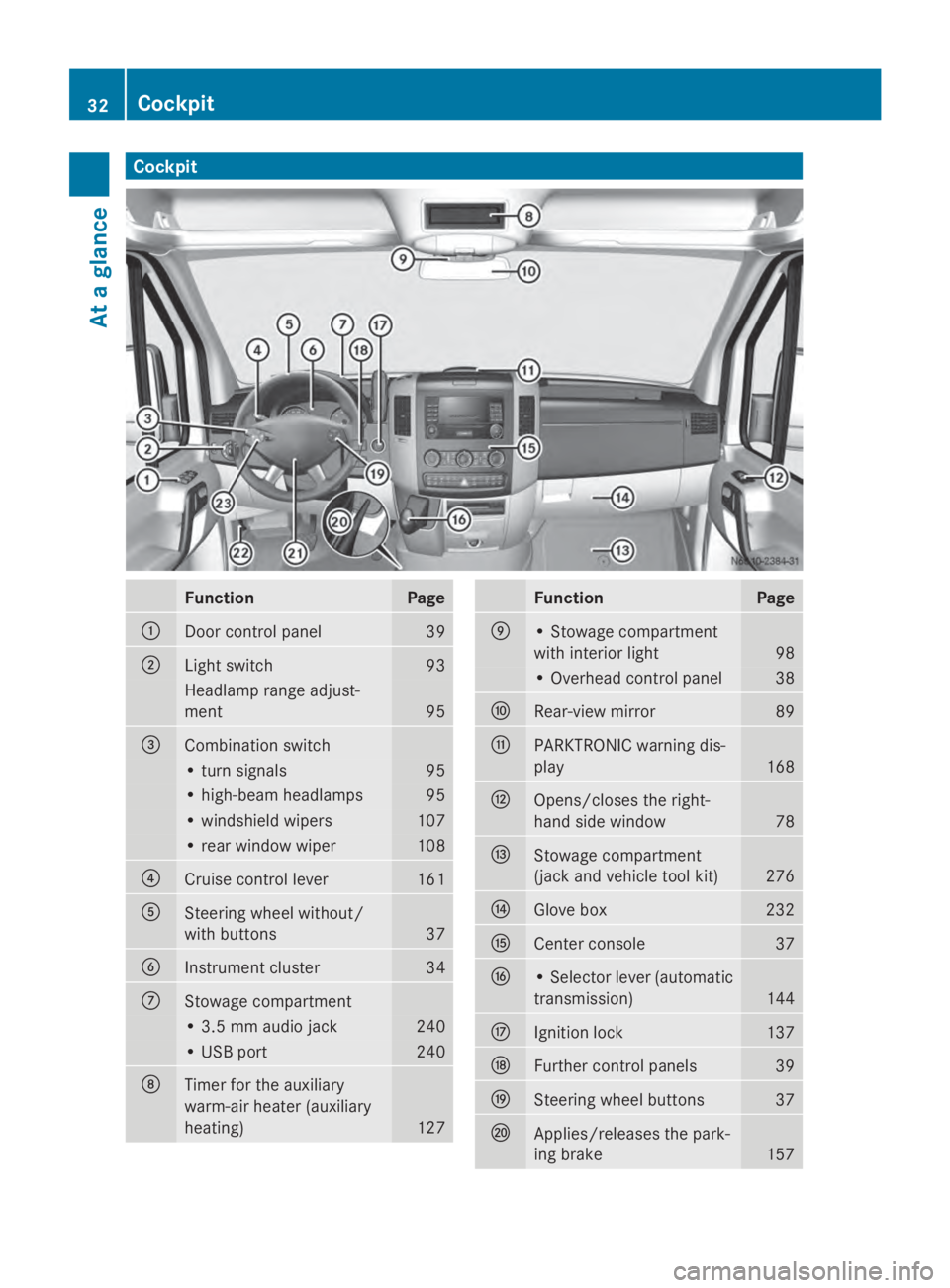
Cockpit
Function Page
0043
Door control panel 39
0044
Light switch 93
Headlamp range adjust-
ment 95
0087
Combination switch
• turn signals 95
• high-beam headlamps 95
• windshield wipers 107
• rear window wiper 108
0085
Cruise control lever 161
0083
Steering wheel without/
with buttons
37
0084
Instrument cluster 34
006B
Stowage compartment
• 3.5 mm audio jack 240
• USB port 240
006C
Timer for the auxiliary
warm-air heater (auxiliary
heating)
127 Function Page
006D
• Stowage compartment
with interior light
98
• Overhead control panel 38
006E
Rear-view mirror 89
006F
PARKTRONIC warning dis-
play
168
0070
Opens/closes the right-
hand side window
78
0071
Stowage compartment
(jack and vehicle tool kit)
276
0072
Glove box 232
0073
Center console 37
0074
• Selector lever (automatic
transmission)
144
0075
Ignition lock 137
0076
Further control panels 39
0077
Steering wheel buttons 37
0078
Applies/releases the park-
ing brake
15732
CockpitAt a glance
Page 39 of 338
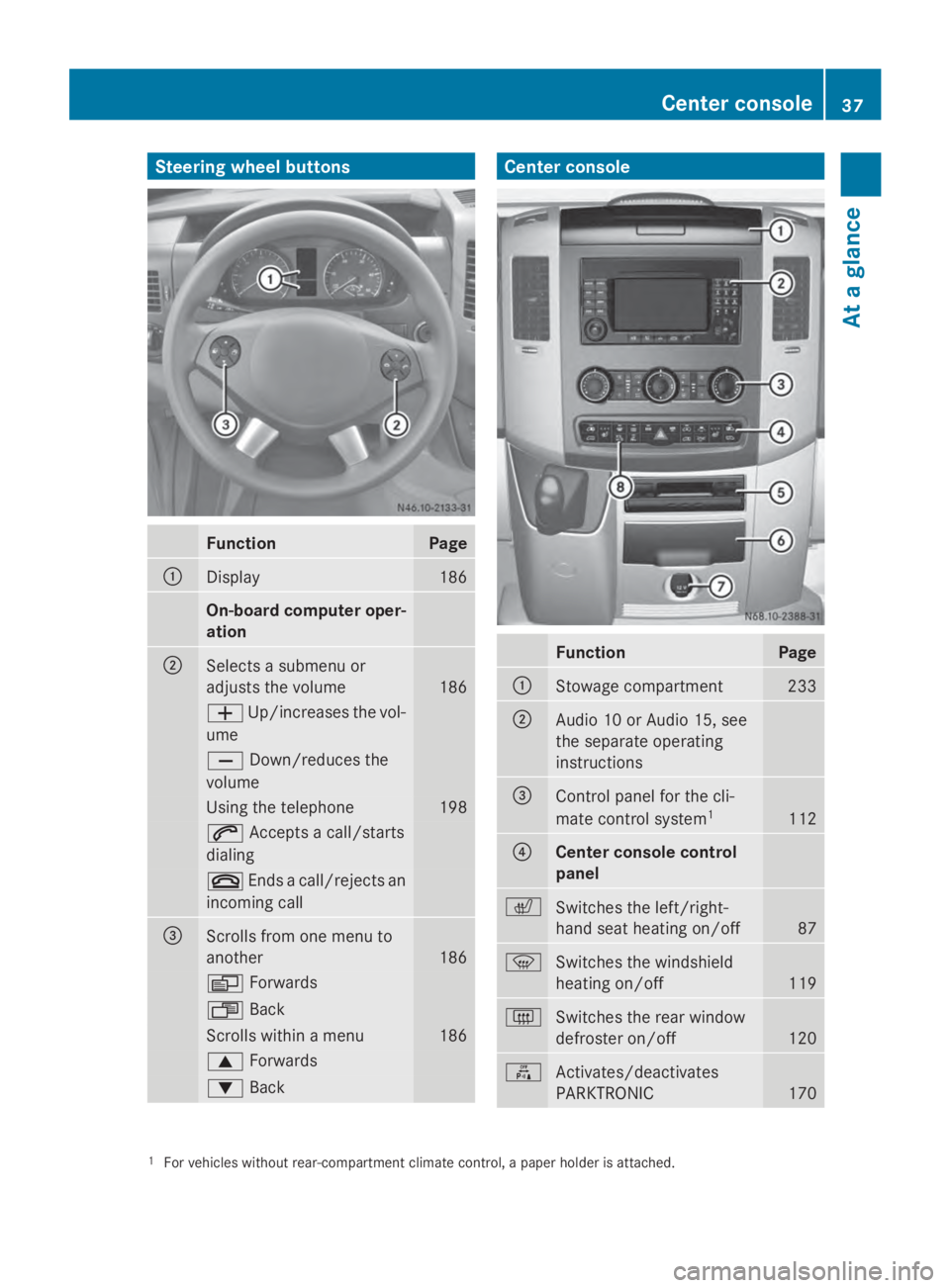
Steering wheel buttons
Function Page
0043
Display 186
On-board computer oper-
ation
0044
Selects a submenu or
adjusts the volume
186
0081
Up/increases the vol-
ume 0082
Down/reduces the
volume Using the telephone 198
0061
Accepts a call/starts
dialing 0076
Ends a call/rejects an
incoming call 0087
Scrolls from one menu to
another
186
0080
Forwards 007F
Back Scrolls within a menu 186
0063
Forwards 0064
Back Center console
Function Page
0043
Stowage compartment 233
0044
Audio 10 or Audio 15, see
the separate operating
instructions
0087
Control panel for the cli-
mate control system
1 112
0085
Center console control
panel
0072
Switches the left/right-
hand seat heating on/off
87
0085
Switches the windshield
heating on/off
119
0071
Switches the rear window
defroster on/off
120
0069
Activates/deactivates
PARKTRONIC
170
1
For vehicles without rear-compartment climate control, a paper holder is attached. Center console
37At a glance
Page 40 of 338
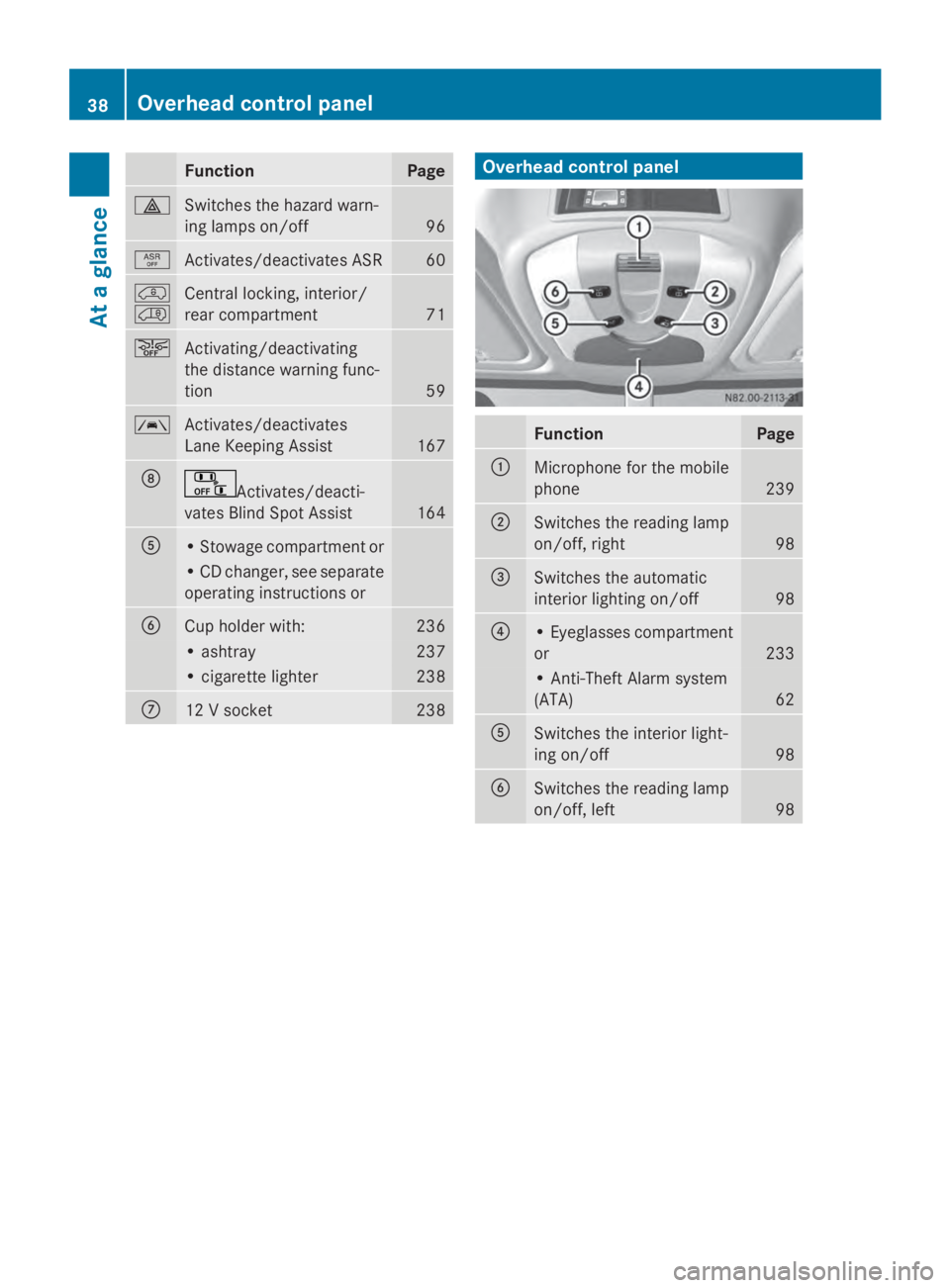
Function Page
002F
Switches the hazard warn-
ing lamps on/off
96
00E3
Activates/deactivates ASR 60
00BF
00C0
Central locking, interior/
rear compartment
71
00D4
Activating/deactivating
the distance warning func-
tion
59
00B0
Activates/deactivates
Lane Keeping Assist
167
006C
Activates/deacti-
vates Blind Spot Assist 164
0083
• Stowage compartment or
• CD changer, see separate
operating instructions or
0084
Cup holder with: 236
• ashtray 237
• cigarette lighter 238
006B
12 V socket 238 Overhead control panel
Function Page
0043
Microphone for the mobile
phone 239
0044
Switches the reading lamp
on/off, right 98
0087
Switches the automatic
interior lighting on/off 98
0085
• Eyeglasses compartment
or
233
• Anti-Theft Alarm system
(ATA)
62
0083
Switches the interior light-
ing on/off 98
0084
Switches the reading lamp
on/off, left 9838
Overhead control panelAt a glance
Page 46 of 338
Air bags
Important safety notes G
WARNING
To reduce the risk of injury when the front air
bags inflate, it is very important for the driver
and co-driver to always be in a properly seated
position and to wear their respective seat
belt.
For maximum protection in the event of a col-
lision always be in normal seated position with
your back against the seat backrest. Fasten
your seat belt and make sure it is properly
positioned on your body.
Since the air bag inflates with considerable
speed and force, a proper seating position
and correct positioning of the hands on the
steering wheel will help to keep you at a safe
distance from the air bag. Occupants who are
not wearing their seat belt, are not seated
properly or are too close to the air bag can be
seriously injured or killed by an air bag as it
inflates with great force instantaneously:
R Sit with the seat belt properly fastened in a
position that is as upright as possible with
your back against the seat backrest.
R Move the driver's seat as far back as pos-
sible, still permitting proper operation of
vehicle controls. The distance from the
center of the driver's chest to the center of
the air bag cover on the steering wheel
must be at least 10 inches (25 cm) or more.
You should be able to accomplish this by
adjusting the seat and steering wheel. If
you have any difficulties, please contact a
qualified specialist workshop.
R Do not lean your head or chest close to the
steering wheel or instrument panel.
R Keep hands on the outside of the steering
wheel rim. Placing hands and arms inside
the rim can increase the risk and potential
severity of hand/arm injury when the driver
front air bag inflates. R
Move the co-driver's seat as far as possible
away from the instrument panel when the
seat is occupied.
R Occupants, especially children, should
never place their bodies or lean their heads
in the area of the door where the side
impact air bag inflates. This could result in
serious injuries or death should the side
impact air bag be deployed. Always sit as
upright as possible, wear the seat belt prop-
erly and use an appropriately sized infant
restraint, toddler restraint, or booster seat
recommended for the size and weight of the
child.
R Children twelve years old and under must
never travel on the co-driver's seat. They
will otherwise be struck by the co-driver's
front air bag when it inflates in a crash. This
could result in serious or fatal injury.
Failure to follow these instructions can result
in severe injuries to you or other occupants.
If you sell your vehicle, it is important that you
make the buyer aware of this safety informa-
tion. Be sure to give the buyer this Operator's
Manual. G
WARNING
The air bag parts are hot after the airbag has
been deployed. There is a risk of injury.
Do not touch the air bag parts. Have the
deployed air bags replaced at a qualified spe-
cialist workshop as soon as possible.
i If the vehicle is still in running condition,
have it towed to a qualified specialist work-
shop. G
WARNING
If you modify the air bag covers or affix objects
such as stickers to them, the air bags may not
function correctly. There is an increased risk
of injury.
Never modify the air bag covers or affix
objects to them. 44
Occupant safetySafety
Page 52 of 338
Emergency Tensioning Devices, seat
belt force limiters G
WARNING
Pyrotechnic ETDs that were activated must be
replaced.
For your safety, when disposing of the pyro-
technic ETDs always follow our safety instruc-
tions. These instructions are available from
any authorized Sprinter Dealer.
! If the front-passenger seat is not occu-
pied, do not engage the seat belt tongue in
the buckle on the front-passenger seat.
Otherwise, the Emergency Tensioning
Device could be triggered in the event of an
accident.
X In order to ensure that the pyrotechnic
Emergency Tensioning Devices have not
been triggered, always have the seat belts
checked after an accident.
If the Emergency Tensioning Devices have
been triggered, they must be replaced.
If the vehicle is equipped with a driver's air
bag, the seat belts on the driver's and co-
driver's seats have Emergency Tensioning
Devices and seat belt force limiters.
ETDs tighten the seat belts in an accident,
pulling them close against the seat occu-
pant's body.
ETDs do not correct incorrect seat positions
or incorrectly fastened seat belts.
ETDs do not pull vehicle occupants back
towards the backrest.
When activated, the seat belt force limiters
reduce the force exerted by the seat belt on
the driver or co-driver.
The seat belt force limiters are synchronized
with the front air bags, which absorb part of
the deceleration force, resulting in the force
exerted on the occupant being distributed
over a greater area.
The ETDs can only be triggered if the ignition
is switched on and the restraint systems are
operational, see " 007Ewarning lamp"
(Y page 42). The Emergency Tensioning Devices are trig-
gered depending on the type and severity of
an accident:
R
in the event of a head-on or rear-end colli-
sion if the vehicle decelerates or acceler-
ates rapidly in a longitudinal direction dur-
ing the initial stages of the impact
R in the event of a side impact if the vehicle
decelerates or accelerates rapidly in a lat-
eral direction and the vehicle is equipped
with thorax side impact air bags and/or
window curtain air bags
If the ETDs are triggered, you will hear a bang
and powder may also be released. Only in rare
cases will the bang affect your hearing. The
powder emitted is not generally hazardous to
health. The 007Ewarning lamp lights up. Child restraint systems
Important safety notes
G
WARNING
If the child restraint system is not installed
correctly to a suitable seat, the child may not
be secured in the event of an accident or sud-
den braking and may be seriously or even
fatally injured. Therefore, when installing a
child restraint system, you must observe the
manufacturer's installation instructions as
well as the notes on using the child restraint
system.
Child restraint systems should preferably be
installed to the rear seats. Children are gen-
erally better protected there.
Never place objects, e.g. cushions, under the
child restraint system. The entire base of the
child restraint system must always rest on the
seat cushion.
A child restraint system must not be used
without the genuine cover designed for it.
Only replace damaged covers with genuine
covers.
On the rear seats, use only child restraint sys-
tems that have been recommended for use in
the Sprinter. 50
Child restraint systemsSafety
Page 54 of 338
again. The opening or closing procedure will
be stopped. G
WARNING
If the child restraint system is installed incor-
rectly or is not secured, it can come loose in
the event of an accident, heavy braking or a
sudden change in direction. The child
restraint system could be thrown about, strik-
ing vehicle occupants. There is an increased
risk of injury, possibly even fatal.
Always install child restraint systems prop-
erly, even if they are not being used. Make
sure that you observe the child restraint sys-
tem manufacturer's installation instructions.
Further information on secure stowage of
loads can be found under "Loading guide-
lines".
If an infant or child is traveling in the vehicle:
R secure the child with a child or infant seat
restraint system appropriate to the age and
weight of the child
R make sure that the infant or child is prop-
erly secured at all times while the vehicle
is in motion.
We recommend that you always properly
secure all infants and children in an infant or
child restraint system for the journey.
The use of seat belts and infant and child
restraint systems is required by law in:
R all 50 states
R the U.S. territories
R the District of Columbia
R all Canadian provinces
Infants and children must always be seated in
an appropriate infant or child restraint system
recommended for the size and weight of the
child. This must be properly secured in
accordance with the manufacturer's installa-
tion instructions for the infant or child seat
restraint system. All infant or child restraint systems must meet
the following standards:
R
U.S. Federal Motor Vehicle Safety Stand-
ards 213 and 225
R Canadian Motor Vehicle Safety Standards
213 and 210.2
A statement by the child restraint manufac-
turer of compliance with these standards can
be found on the instruction label on the child
restraint system. You will also find the state-
ment in the instruction manual provided with
the child restraint system.
When using any infant restraint, child
restraint or booster seat, make sure to care-
fully read and follow all manufacturer's
instructions for installation and use.
Observe the warning labels in the vehicle
interior or on the infant or child restraint. LATCH-type (ISOFIX) child seat secur-
ing system
G
WARNING
Children that are too large for a child restraint
must travel in seats using normal seat belts.
Position shoulder belt across the chest and
shoulder, not face or neck.
A booster seat may be necessary to achieve
proper seat belt positioning for children over
41 lb (18 kg) until they reach a height where
a lap/shoulder belt fits properly without a
booster.
Install the child restraint system in accord-
ance with the manufacturer's instructions.
Attach the child restraint system to both
securing rings.
An incorrectly installed child restraint system
could come loose during an accident and ser-
iously or even fatally injure the child.
Child restraint systems or child seat securing
rings that are malfunctioning or damaged as
the result of a collision must be replaced. 52
Child restraint systemsSafety
Page 65 of 338
If the alarm system is armed, a visual and
audible alarm is triggered by the following:
R Unlocking the vehicle from inside
R Opening a door
R Opening the hood
i The alarm is not switched off, even if you
immediately close the open door that has
triggered it, for example.
X To stop the alarm: press the0036button
on the remote control.
Or
X Insert the key into the ignition lock.
The alarm stops. Tow-away alarm
Operation A visual and audible alarm is triggered if the
inclination of the vehicle changes when the
tow-away alarm is armed. This can be the
case if the vehicle is raised on one side, for
example.
Arming/deactivating The tow-away alarm is automatically armed
approximately 20 seconds after you lock the
vehicle.
The tow-away alarm is automatically deacti-
vated when you unlock the vehicle.
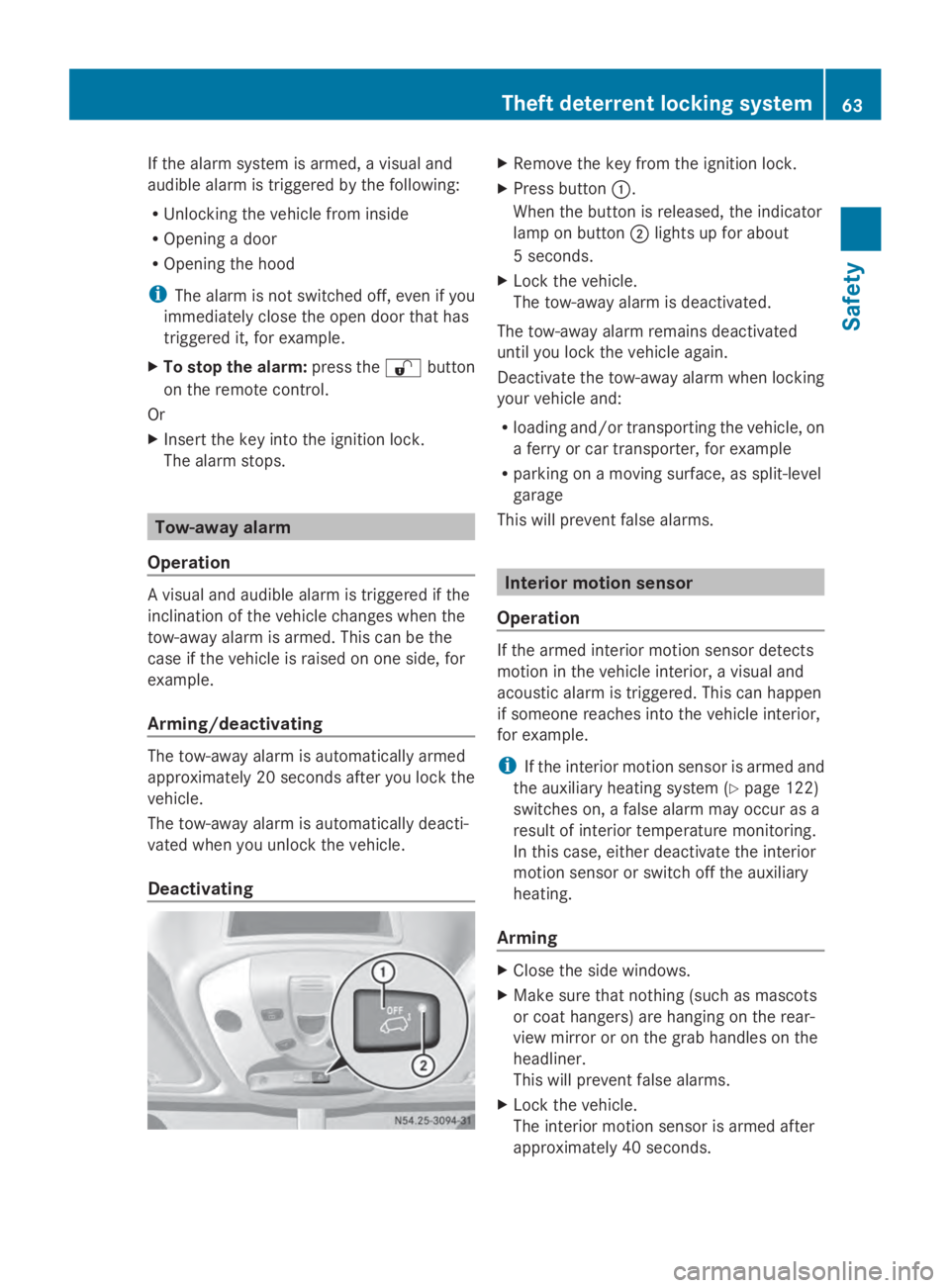
Deactivating X
Remove the key from the ignition lock.
X Press button 0043.
When the button is released, the indicator
lamp on button 0044lights up for about
5 seconds.
X Lock the vehicle.
The tow-away alarm is deactivated.
The tow-away alarm remains deactivated
until you lock the vehicle again.
Deactivate the tow-away alarm when locking
your vehicle and:
R loading and/or transporting the vehicle, on
a ferry or car transporter, for example
R parking on a moving surface, as split-level
garage
This will prevent false alarms. Interior motion sensor
Operation If the armed interior motion sensor detects
motion in the vehicle interior, a visual and
acoustic alarm is triggered. This can happen
if someone reaches into the vehicle interior,
for example.
i
If the interior motion sensor is armed and
the auxiliary heating system (Y page 122)
switches on, a false alarm may occur as a
result of interior temperature monitoring.
In this case, either deactivate the interior
motion sensor or switch off the auxiliary
heating.
Arming X
Close the side windows.
X Make sure that nothing (such as mascots
or coat hangers) are hanging on the rear-
view mirror or on the grab handles on the
headliner.
This will prevent false alarms.
X Lock the vehicle.
The interior motion sensor is armed after
approximately 40 seconds. Theft deterrent locking system
63Safety Z