wheel MERCEDES-BENZ SPRINTER 2014 MY14 Operator’s Manual
[x] Cancel search | Manufacturer: MERCEDES-BENZ, Model Year: 2014, Model line: SPRINTER, Model: MERCEDES-BENZ SPRINTER 2014Pages: 338, PDF Size: 6.78 MB
Page 35 of 338

Function Page
0079
Horn
007A
Opens the hood 250
007B
Steering wheel buttons 37 Cockpit
33At a glance
Page 36 of 338
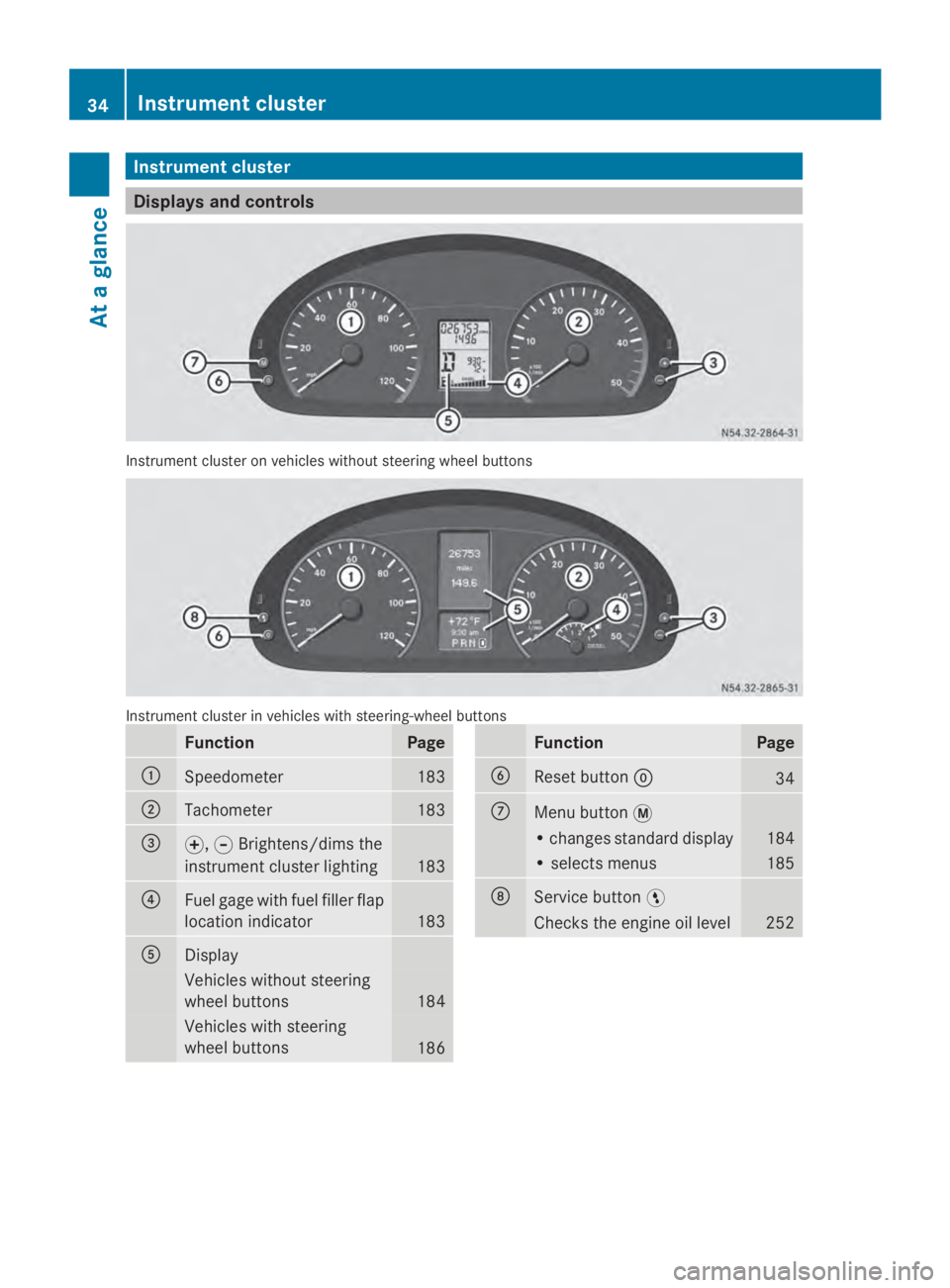
Instrument cluster
Displays and controls
Instrument cluster on vehicles without steering wheel buttons
Instrument cluster in vehicles with steering-wheel buttons
Function Page
0043
Speedometer 183
0044
Tachometer 183
0087
0074,
0075Brightens/dims the
instrument cluster lighting 183
0085
Fuel gage with fuel filler flap
location indicator
183
0083
Display
Vehicles without steering
wheel buttons
184
Vehicles with steering
wheel buttons 186 Function Page
0084
Reset button
0045 34
006B
Menu button
0079 • changes standard display 184
• selects menus 185
006C
Service button
0098 Checks the engine oil level 25234
Instrument clusterAt a glance
Page 37 of 338
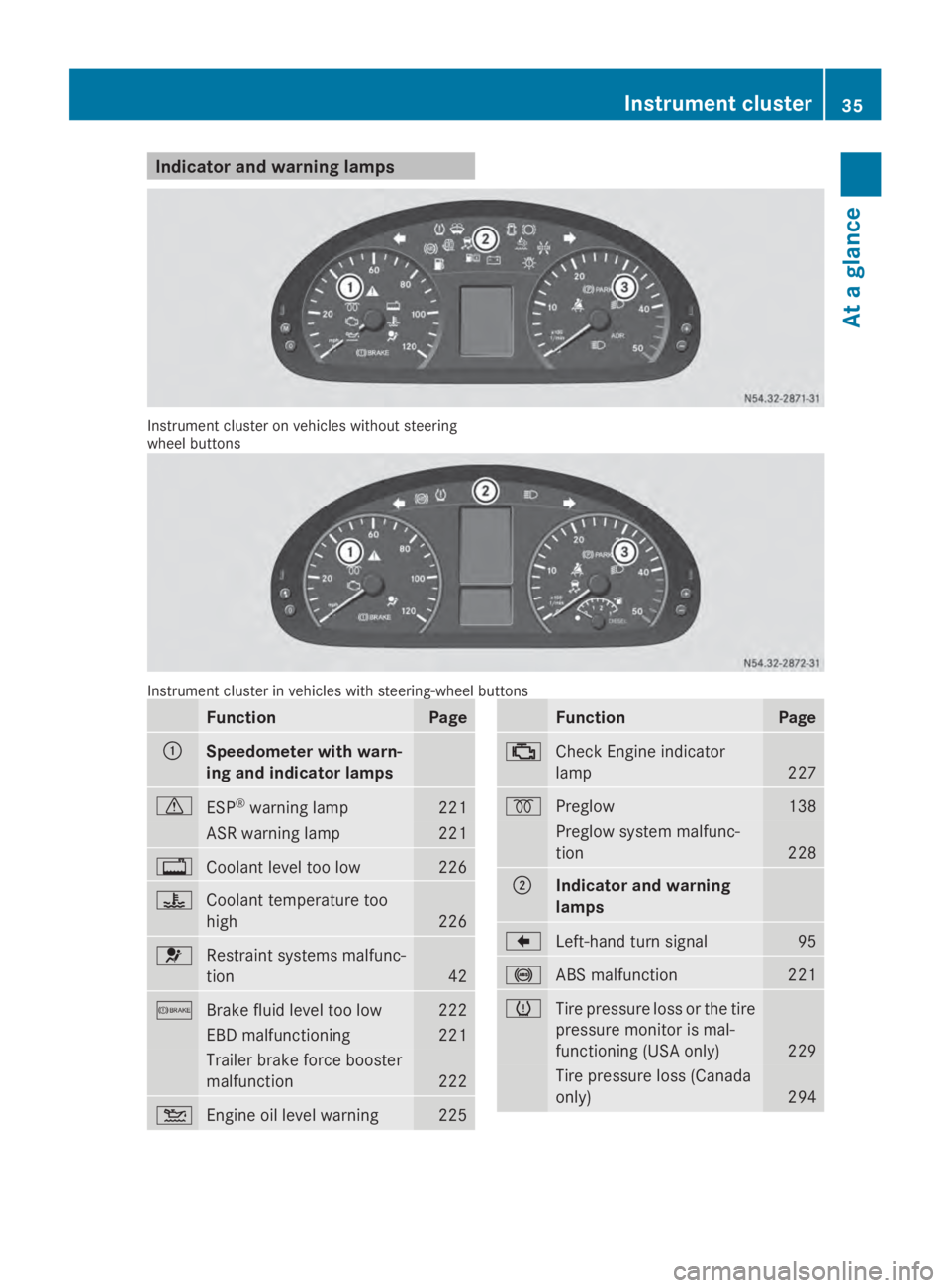
Indicator and warning lamps
Instrument cluster on vehicles without steering
wheel buttons Instrument cluster in vehicles with steering-wheel buttons
Function Page
0043
Speedometer with warn-
ing and indicator lamps
0072
ESP
®
warning lamp 221
ASR warning lamp 221
003F
Coolant level too low 226
00AC
Coolant temperature too
high 226
0075
Restraint systems malfunc-
tion 42
0065
Brake fluid level too low 222
EBD malfunctioning 221
Trailer brake force booster
malfunction
222
00B2
Engine oil level warning 225 Function Page
00B9
Check Engine indicator
lamp
227
0028
Preglow 138
Preglow system malfunc-
tion
228
0044
Indicator and warning
lamps
004A
Left-hand turn signal 95
0025
ABS malfunction 221
0077
Tire pressure loss or the tire
pressure monitor is mal-
functioning (USA only)
229
Tire pressure loss (Canada
only)
294Instrument cluster
35At a glance
Page 39 of 338
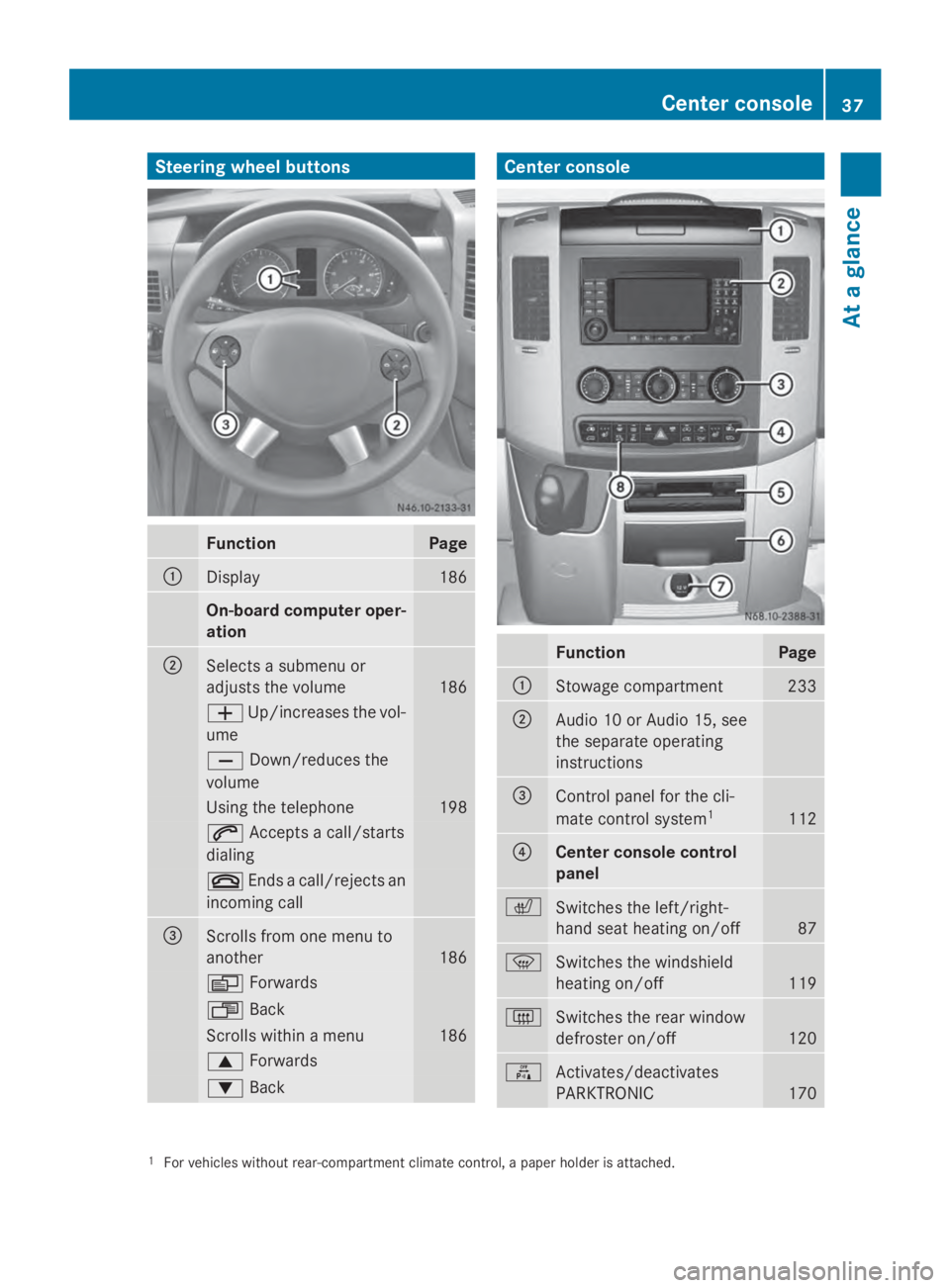
Steering wheel buttons
Function Page
0043
Display 186
On-board computer oper-
ation
0044
Selects a submenu or
adjusts the volume
186
0081
Up/increases the vol-
ume 0082
Down/reduces the
volume Using the telephone 198
0061
Accepts a call/starts
dialing 0076
Ends a call/rejects an
incoming call 0087
Scrolls from one menu to
another
186
0080
Forwards 007F
Back Scrolls within a menu 186
0063
Forwards 0064
Back Center console
Function Page
0043
Stowage compartment 233
0044
Audio 10 or Audio 15, see
the separate operating
instructions
0087
Control panel for the cli-
mate control system
1 112
0085
Center console control
panel
0072
Switches the left/right-
hand seat heating on/off
87
0085
Switches the windshield
heating on/off
119
0071
Switches the rear window
defroster on/off
120
0069
Activates/deactivates
PARKTRONIC
170
1
For vehicles without rear-compartment climate control, a paper holder is attached. Center console
37At a glance
Page 41 of 338
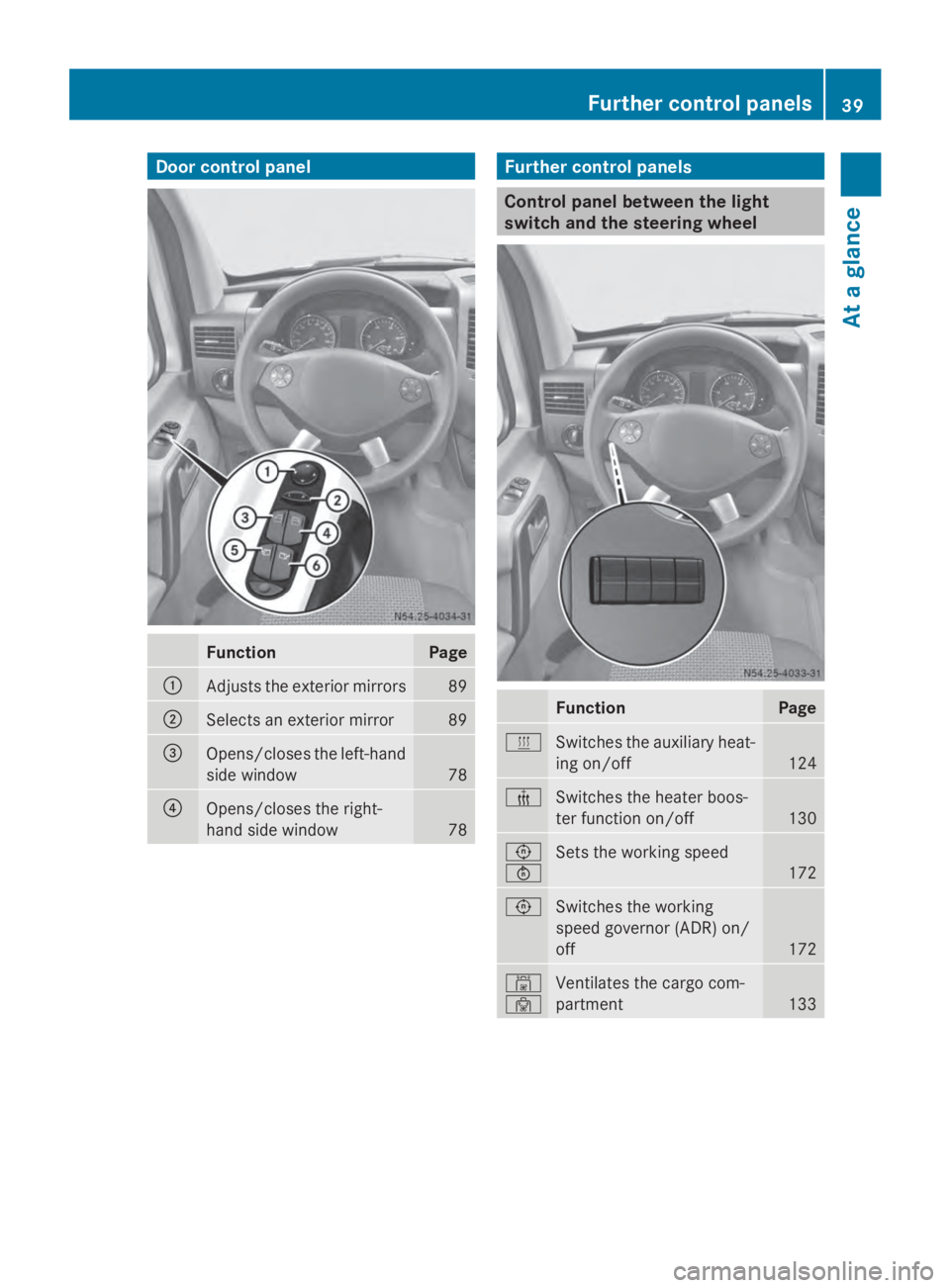
Door control panel
Function Page
0043
Adjusts the exterior mirrors 89
0044
Selects an exterior mirror 89
0087
Opens/closes the left-hand
side window
78
0085
Opens/closes the right-
hand side window 78 Further control panels
Control panel between the light
switch and the steering wheel
Function Page
0084
Switches the auxiliary heat-
ing on/off
124
00AB
Switches the heater boos-
ter function on/off
130
0091
0092
Sets the working speed
172
0091
Switches the working
speed governor (ADR) on/
off
172
00A8
00A7
Ventilates the cargo com-
partment
133Further cont
rol panels
39At a glance
Page 42 of 338
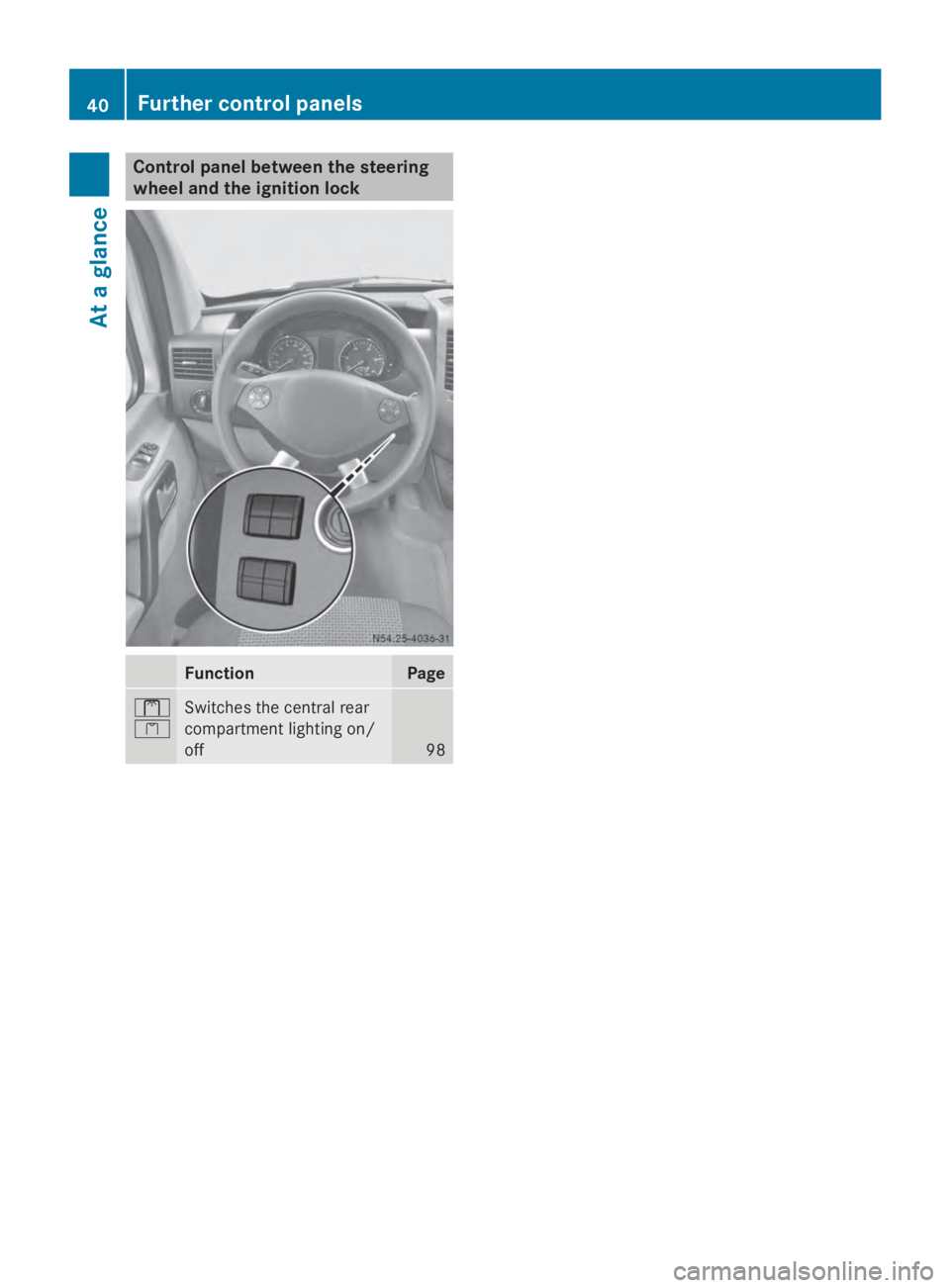
Control panel between the steering
wheel and the ignition lock Function Page
0039
0038
Switches the central rear
compartment lighting on/
off
9840
Further control panelsAt a glance
Page 45 of 338
When you switch on the ignition, the
007E
warning lamp in the instrument cluster lights
up for approximately 4 seconds.
A malfunction has occurred if the 007Ewarn-
ing lamp:
R does not light up when you switch on the
ignition, or
R does not go out within a few seconds of
switching on the ignition, or
R lights up again
Safety guidelines for seat belts, Emer-
gency Tensioning Devices (ETDs) and
air bags G
WARNING
R Damaged seat belts or seat belts that have
been subjected to stress in an accident
must be replaced and their anchoring
points must also be checked. Only use seat
belts which have been installed or supplied
by a qualified specialist workshop.
R Air bags and pyrotechnic Emergency Ten-
sioning Devices (ETDs) contain perchlorate
material, which may require special han-
dling and regard for the environment.
Check with your local government's dis-
posal guidelines. California residents, see
www.dtsc.ca.gov/HazardousWaste/
Perchlorate/index.cfm.
R Air bags and ETDs are designed to function
on a one-time-only basis. An air bag or ETD
that has deployed must be replaced.
R Do not pass seat belts over sharp edges.
They could tear.
R Do not make any modification that could
change the effectiveness of the seat belts.
R Do not bleach or dye seat belts as this may
severely weaken them. In a crash they may
not be able to provide adequate protection.
R No modifications of any kind may be made
to any components or wiring of the SRS.
R Do not change or remove any component
or part of the SRS. R
Do not install additional paneling, seat cov-
ers, badges etc. over the steering wheel
hub, co-driver's front air bag cover, out-
board sides of the seat backrests, door trim
panels, or door frame trims.
R Do not install additional electrical/elec-
tronic equipment on or near SRS compo-
nents and wiring.
R Keep the area between air bags and occu-
pants free of objects (e.g. packages,
purses, umbrellas etc.).
R Do not hang items such as coat hangers
from the coat hooks or handles over the
door. These items may be thrown around in
the vehicle and cause head and other inju-
ries when the window curtain air bag is
deployed.
R Air bag system components will be hot after
an air bag has inflated. Do not touch them.
R Never place your feet on the instrument
panel or on the seat. Always keep both feet
on the floor in front of the seat.
R Improper repair work creates a risk of ren-
dering the SRS inoperative or causing unin-
tended air bag deployment. Work on the
SRS must therefore only be performed by
qualified technicians. Please contact a
qualified specialist workshop.
R For your protection and the protection of
others, when scrapping the air bag unit or
ETD, our safety instructions must be fol-
lowed. These instructions are available
from any authorized Sprinter Dealer.
R Given the considerable deployment speed,
required inflation volume, and the material
of the air bags, there is the possibility of
abrasions or other, potentially more serious
injuries resulting from air bag deployment.
If you sell your vehicle, we strongly recom-
mend that you inform the subsequent owner
that the vehicle is equipped with SRS. Also
refer them to the applicable section in the
Operator's Manual. Occupant safety
43Safety Z
Page 46 of 338
Air bags
Important safety notes G
WARNING
To reduce the risk of injury when the front air
bags inflate, it is very important for the driver
and co-driver to always be in a properly seated
position and to wear their respective seat
belt.
For maximum protection in the event of a col-
lision always be in normal seated position with
your back against the seat backrest. Fasten
your seat belt and make sure it is properly
positioned on your body.
Since the air bag inflates with considerable
speed and force, a proper seating position
and correct positioning of the hands on the
steering wheel will help to keep you at a safe
distance from the air bag. Occupants who are
not wearing their seat belt, are not seated
properly or are too close to the air bag can be
seriously injured or killed by an air bag as it
inflates with great force instantaneously:
R Sit with the seat belt properly fastened in a
position that is as upright as possible with
your back against the seat backrest.
R Move the driver's seat as far back as pos-
sible, still permitting proper operation of
vehicle controls. The distance from the
center of the driver's chest to the center of
the air bag cover on the steering wheel
must be at least 10 inches (25 cm) or more.
You should be able to accomplish this by
adjusting the seat and steering wheel. If
you have any difficulties, please contact a
qualified specialist workshop.
R Do not lean your head or chest close to the
steering wheel or instrument panel.
R Keep hands on the outside of the steering
wheel rim. Placing hands and arms inside
the rim can increase the risk and potential
severity of hand/arm injury when the driver
front air bag inflates. R
Move the co-driver's seat as far as possible
away from the instrument panel when the
seat is occupied.
R Occupants, especially children, should
never place their bodies or lean their heads
in the area of the door where the side
impact air bag inflates. This could result in
serious injuries or death should the side
impact air bag be deployed. Always sit as
upright as possible, wear the seat belt prop-
erly and use an appropriately sized infant
restraint, toddler restraint, or booster seat
recommended for the size and weight of the
child.
R Children twelve years old and under must
never travel on the co-driver's seat. They
will otherwise be struck by the co-driver's
front air bag when it inflates in a crash. This
could result in serious or fatal injury.
Failure to follow these instructions can result
in severe injuries to you or other occupants.
If you sell your vehicle, it is important that you
make the buyer aware of this safety informa-
tion. Be sure to give the buyer this Operator's
Manual. G
WARNING
The air bag parts are hot after the airbag has
been deployed. There is a risk of injury.
Do not touch the air bag parts. Have the
deployed air bags replaced at a qualified spe-
cialist workshop as soon as possible.
i If the vehicle is still in running condition,
have it towed to a qualified specialist work-
shop. G
WARNING
If you modify the air bag covers or affix objects
such as stickers to them, the air bags may not
function correctly. There is an increased risk
of injury.
Never modify the air bag covers or affix
objects to them. 44
Occupant safetySafety
Page 47 of 338
The air bag installation locations are identi-
fied by the label SRS/AIRBAG or AIRBAG.
R Front air bags (Y page 45)
R Thoraxbags (Y page 45)
R Window curtain air bags (Y page 46)
The air bags are deployed if the air bag control
unit detects the need for deployment. Only in
the event of such a situation will they provide
their supplemental protection.
If the driver and co-driver do not wear their
seat belts, it is not possible for the air bags to
provide their supplemental protection.
In the event of other types of impacts and
impacts below air bag deployment thresh-
olds, the air bags will not deploy. The driver
and passengers will then be protected to the
extent possible by a properly fastened seat
belt. A properly fastened seat belt is also
needed to provide the best possible protec-
tion in a rollover.
Air bags provide additional protection, but are
not a substitute for the seat belts. All vehicle
occupants must fasten their seat belts
regardless of whether your vehicle is equip-
ped with air bags or not.
If an air bag is deployed, you will hear a bang
and a small amount of powder is released
briefly. Only in rare cases will the bang affect
your hearing. The powder emitted is not gen-
erally hazardous to health. The 007Ewarning
lamp lights up. If it is safe to do so:
X Exit the vehicle immediately.
If you are unable to leave the vehicle:
X Open a window.
You will be able to breathe in fresh air and
avoid respiratory problems.
It is important for your safety and that of any
passengers to have deployed air bags
replaced and to have any malfunctioning air
bags repaired. This will help to make sure the
air bags continue to perform their protective
function for the vehicle occupants in the
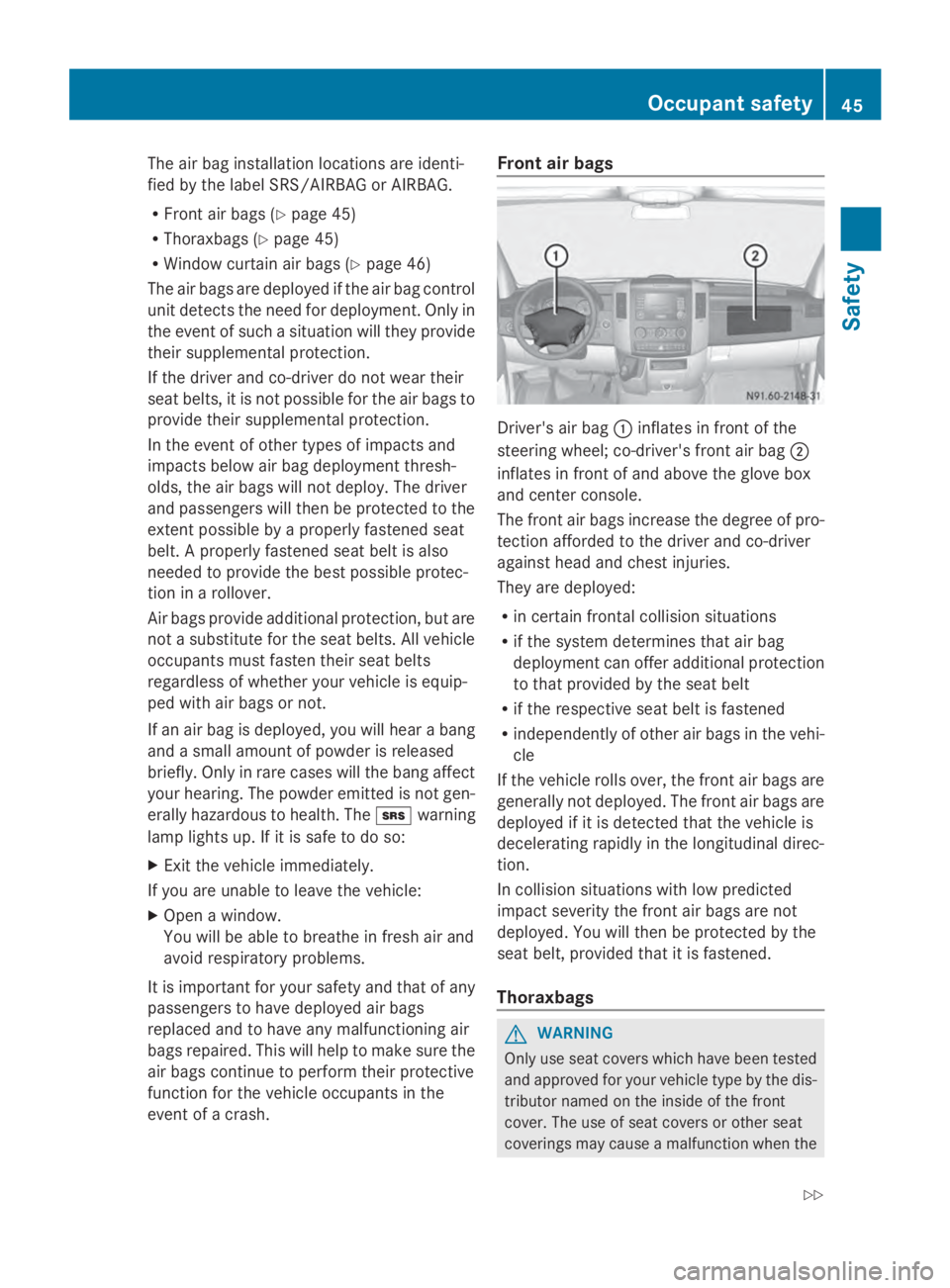
event of a crash. Front air bags
Driver's air bag
0043inflates in front of the
steering wheel; co-driver's front air bag 0044
inflates in front of and above the glove box
and center console.
The front air bags increase the degree of pro-
tection afforded to the driver and co-driver
against head and chest injuries.
They are deployed:
R in certain frontal collision situations
R if the system determines that air bag
deployment can offer additional protection
to that provided by the seat belt
R if the respective seat belt is fastened
R independently of other air bags in the vehi-
cle
If the vehicle rolls over, the front air bags are
generally not deployed. The front air bags are
deployed if it is detected that the vehicle is
decelerating rapidly in the longitudinal direc-
tion.
In collision situations with low predicted
impact severity the front air bags are not
deployed. You will then be protected by the
seat belt, provided that it is fastened.
Thoraxbags G
WARNING
Only use seat covers which have been tested
and approved for your vehicle type by the dis-
tributor named on the inside of the front
cover. The use of seat covers or other seat
coverings may cause a malfunction when the Occupant safety
45Safety
Z
Page 58 of 338
Pets in the vehicle
G
WARNING
If you leave animals unattended or unsecured
in the vehicle, they could press buttons or
switches, for example.
As a result, they could:
R activate vehicle equipment and become
trapped, for example
R activate or deactivate systems, thereby
endangering other road users
Unsecured animals could also be flung around
the vehicle in the event of an accident or sud-
den steering or braking, thereby injuring vehi-
cle occupants. There is a risk of an accident
and injury.
Never leave animals unattended in the vehi-
cle. Always secure animals properly during
the journey, e.g. use a suitable animal trans-
port box. Driving safety systems
Driving safety systems overview
In this section, you will find information about
the following driving safety systems:
R ABS (Anti-lock BrakingSystem)
R BAS (Brake AssistSystem)
R ASR (Acceleration SkidControl)
R ESP ®
(Electronic StabilityProgram)
R EBD ( Electronic Brake Force Distribution)
R Crosswind Assist
R COLLISION PREVENTION ASSIST Important safety notes
If you fail to adapt your driving style or if you
are inattentive, the driving safety systems can
neither reduce the risk of accident nor over-
ride the laws of physics. Driving safety sys-
tems are merely aids designed to assist driv-
ing. You are responsible for the distance to
the vehicle in front, for vehicle speed and for braking in good time. Always adapt your driv-
ing style to the prevailing road and weather
conditions and maintain a sufficient, safe dis-
tance from other road users. Drive carefully.
The driving safety systems described can only
attain their maximum effectiveness when
there is optimum contact between the tires
and the road can. Therefore pay special atten-
tion to the information on tires, the recom-
mended minimum tire tread, etc., in the
"Wheels and tires" section (Y
page 286).
In wintry driving conditions, always use winter
tires (M+S tires) and if necessary, snow
chains. Only in this way will the driving safety
systems described in this section work as
effectively as possible. ABS (Anti-lock Braking System)
Important safety notes G
WARNING
If ABS is faulty, the wheels could lock when
braking. The steerability and braking charac-
teristics may be severely impaired. Addition-
ally, further driving safety systems are deac-
tivated. There is an increased danger of skid-
ding and accidents.
Drive on carefully. Have ABS checked imme-
diately at a qualified specialist workshop.
If ABS is malfunctioning, other systems will
also fail, including driving safety systems.
Observe the information relating to
the 0025 warning lamp (Y page 221).
ABS regulates brake pressure in such a way
that the wheels do not lock when you brake.
This allows you to continue steering the vehi-
cle when braking.
ABS works from a speed of about 5 mph
(8 km/h), regardless of road-surface condi-
tions. ABS works on slippery surfaces, even
when you only brake gently.
The yellow 0025warning lamp in the instru-
ment cluster lights up when the ignition is 56
Driving safety systemsSafety