engine oil MERCEDES-BENZ SPRINTER 2014 MY14 Operator’s Manual
[x] Cancel search | Manufacturer: MERCEDES-BENZ, Model Year: 2014, Model line: SPRINTER, Model: MERCEDES-BENZ SPRINTER 2014Pages: 338, PDF Size: 6.78 MB
Page 271 of 338

Cleaning the engine
!
Water must not enter intake or ventilation
openings. When cleaning with high pres-
sure water or steam cleaners, the spray
must not be aimed directly at electrical
components or the terminals of electrical
lines.
Preserve the engine after the engine has
been cleaned. Protect the belt drive system
from exposure to the preservative agent.
Also observe the information in the section
"Power washer" (Y page 268).
Cleaning the paintwork !
Do not affix:
R stickers
R films
R magnetic plates or similar items
to painted surfaces. You could otherwise
damage the paintwork.
Scratches, corrosive deposits, areas affected
by corrosion and damage caused by inade-
quate care cannot always be completely
repaired. In such cases, visit a qualified spe-
cialist workshop.
X Remove impurities immediately, where
possible, whilst avoiding rubbing too hard.
X Soak insect remains with insect remover
and rinse off the treated areas afterwards.
X Soak bird droppings with water and rinse
off the treated areas afterwards.
X Remove coolant, brake fluid, tree resin,
oils, fuels and greases by rubbing gently
with a cloth soaked in petroleum ether or
lighter fluid.
X Use tar remover to remove tar stains.
X Use silicone remover to remove wax.
Cleaning the windows G
WARNING
You could become trapped by the windshield
wipers if they start moving while cleaning the windshield or wiper blades. There is a risk of
injury.
Always switch off the windshield wipers and
the ignition before cleaning the windshield or
wiper blades.
! Do not fold the windshield wipers away
from the windshield unless the hood is
closed. Otherwise, you could damage the
hood.
! Hold the wiper arm securely when folding
back. The windshield could be damaged if
the wiper arm smacks against it suddenly.
! Do not use dry cloths, abrasive products,
solvents or cleaning agents containing sol-
vents to clean the inside of the windows.
Do not touch the insides of the windows
with hard objects, e.g. an ice scraper or
ring. There is otherwise a risk of damaging
the windows.
Before cleaning the windshield
X Turn the key to position 0in the ignition
lock or remove it.
X Fold the windshield wiper arms away from
the windshield until you feel them engage.
Before switching the ignition on again, fold
the windshield wipers back into position.
Cleaning the windows
X Clean the inside and outside of the win-
dows with a damp cloth and a cleaning
agent that is recommended and approved
for Sprinter vehicles. Exterior
Cleaning the wheels !
Do not use any acidic or alkaline cleaning
agents. They can cause corrosion on the
wheel bolts (wheel nuts) or the retainer
springs for the wheel-balancing weights.
! Do not park the vehicle for an extended
period straight after cleaning it, particularly
after having cleaned the wheels with wheel Care
269Maintenance and care Z
Page 310 of 338
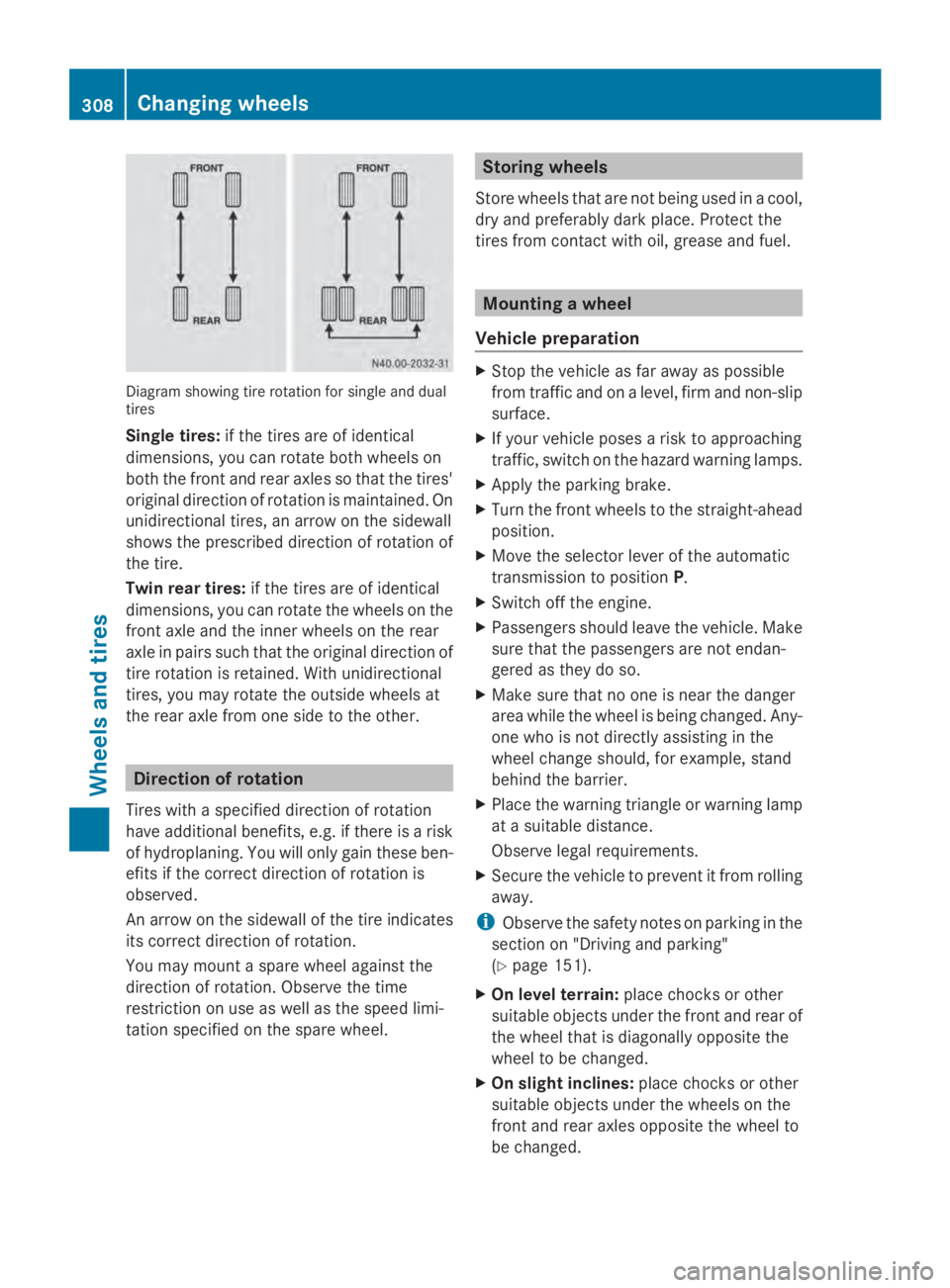
Diagram showing tire rotation for single and dual
tires
Single tires: if the tires are of identical
dimensions, you can rotate both wheels on
both the front and rear axles so that the tires'
original direction of rotation is maintained. On
unidirectional tires, an arrow on the sidewall
shows the prescribed direction of rotation of
the tire.
Twin rear tires: if the tires are of identical
dimensions, you can rotate the wheels on the
front axle and the inner wheels on the rear
axle in pairs such that the original direction of
tire rotation is retained. With unidirectional
tires, you may rotate the outside wheels at
the rear axle from one side to the other. Direction of rotation
Tires with a specified direction of rotation
have additional benefits, e.g. if there is a risk
of hydroplaning. You will only gain these ben-
efits if the correct direction of rotation is
observed.
An arrow on the sidewall of the tire indicates
its correct direction of rotation.
You may mount a spare wheel against the
direction of rotation. Observe the time
restriction on use as well as the speed limi-
tation specified on the spare wheel. Storing wheels
Store wheels that are not being used in a cool,
dry and preferably dark place. Protect the
tires from contact with oil, grease and fuel. Mounting a wheel
Vehicle preparation X
Stop the vehicle as far away as possible
from traffic and on a level, firm and non-slip
surface.
X If your vehicle poses a risk to approaching
traffic, switch on the hazard warning lamps.
X Apply the parking brake.
X Turn the front wheels to the straight-ahead
position.
X Move the selector lever of the automatic
transmission to position P.
X Switch off the engine.
X Passengers should leave the vehicle. Make
sure that the passengers are not endan-
gered as they do so.
X Make sure that no one is near the danger
area while the wheel is being changed. Any-
one who is not directly assisting in the
wheel change should, for example, stand
behind the barrier.
X Place the warning triangle or warning lamp
at a suitable distance.
Observe legal requirements.
X Secure the vehicle to prevent it from rolling
away.
i Observe the safety notes on parking in the
section on "Driving and parking"
(Y page 151).
X On level terrain: place chocks or other
suitable objects under the front and rear of
the wheel that is diagonally opposite the
wheel to be changed.
X On slight inclines: place chocks or other
suitable objects under the wheels on the
front and rear axles opposite the wheel to
be changed. 308
Changing wheelsWheels and tires
Page 322 of 338
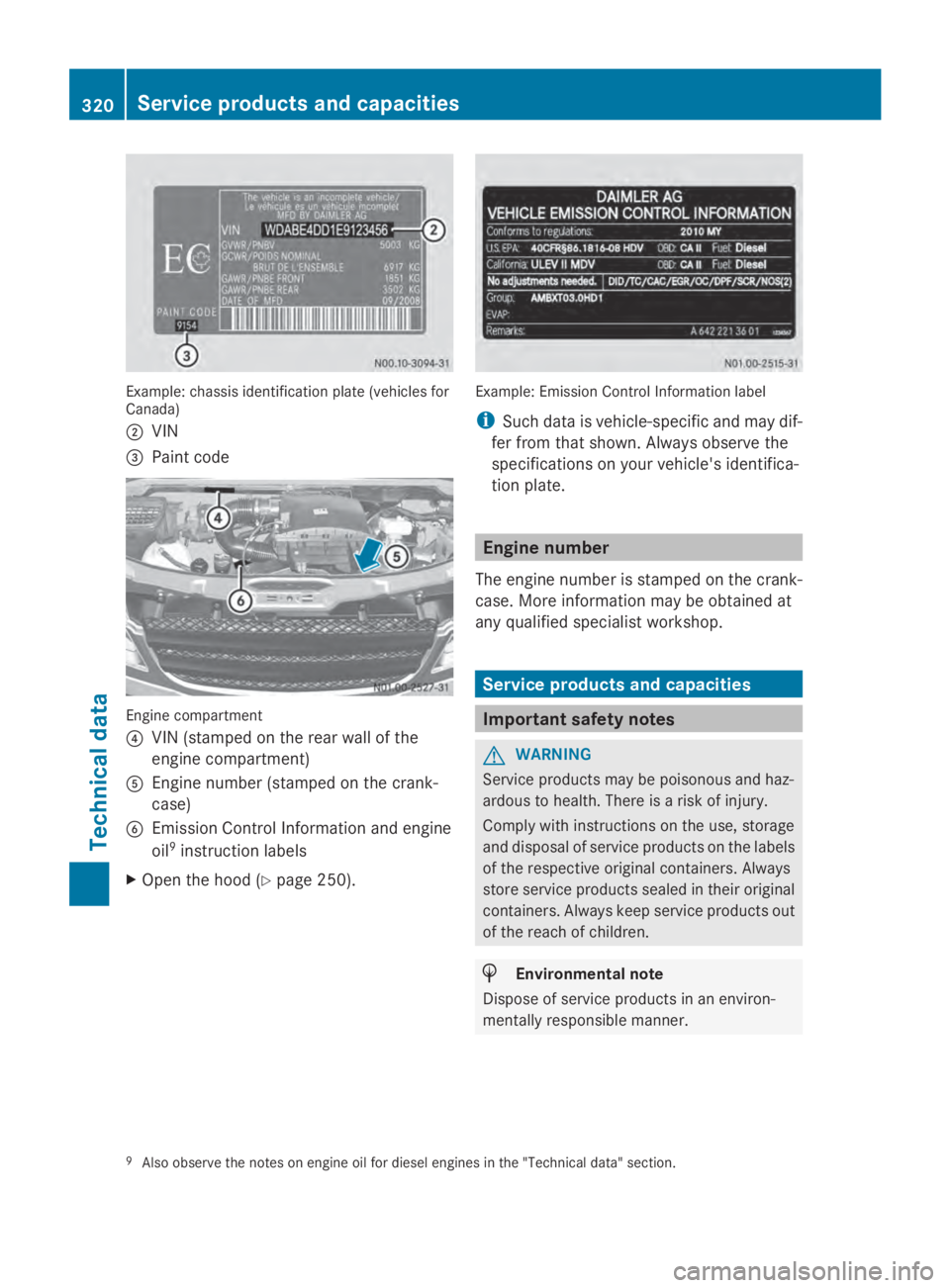
Example: chassis identification plate (vehicles for
Canada)
0044 VIN
0087 Paint code Engine compartment
0085
VIN (stamped on the rear wall of the
engine compartment)
0083 Engine number (stamped on the crank-
case)
0084 Emission Control Information and engine
oil 9
instruction labels
X Open the hood (Y page 250). Example: Emission Control Information label
i
Such data is vehicle-specific and may dif-
fer from that shown. Always observe the
specifications on your vehicle's identifica-
tion plate. Engine number
The engine number is stamped on the crank-
case. More information may be obtained at
any qualified specialist workshop. Service products and capacities
Important safety notes
G
WARNING
Service products may be poisonous and haz-
ardous to health. There is a risk of injury.
Comply with instructions on the use, storage
and disposal of service products on the labels
of the respective original containers. Always
store service products sealed in their original
containers. Always keep service products out
of the reach of children. H
Environmental note
Dispose of service products in an environ-
mentally responsible manner.
9 Also observe the notes on engine oil for diesel engines in the "Technical data" section. 320
Service products and capacitiesTechnical data
Page 323 of 338
Service products include the following:
R Fuels, e.g. diesel
R Additives for the exhaust gas aftertreat-
ment, e.g. Diesel Exhaust Fluid (DEF)
R Lubricants, e.g. engine oil, transmission oil
R Coolant
R Brake fluid
R Washer fluid
R Climate control system refrigerants
Approved service products comply with the
highest quality standards and are listed in the
MB Specifications for Service Products. Only
use service products approved for the vehi-
cle. This is an important condition for the war-
ranty.
You will recognize the approved service prod-
ucts by the inscription on the container: MB
Approval (e.g. MB Approval 228.5)
Other identifications and recommendations
refer to quality level or a specification accord-
ing to an MB Sheet Number (e.g. MB 228.5).
They are therefore not necessarily approved.
Further information can be obtained at any
qualified specialist workshop.
Additives for approved service products are
neither required nor permitted. Approved fuel
additives are the exception. Additives can
cause engine damage and must therefore not
be added to the service products.
The use of additives is always the responsi-
bility of the vehicle operator. The use of addi-
tives may result in the restriction or loss of
your Limited Warranty entitlements. Fuel
Important safety notes G
WARNING
Fuel is highly flammable. Improper handling
of fuel creates a risk of fire and explosion. Avoid fire, open flames, smoking and creating
sparks under all circumstances. Switch off the
engine and, if applicable, the auxiliary heating
before refueling.
G
WARNING
Fuel is poisonous and hazardous to health.
There is a risk of injury.
You must make sure that fuel does not come
into contact with your skin, eyes or clothing
and that it is not swallowed. Do not inhale fuel
vapors. Keep fuel away from children.
If you or others come into contact with fuel,
observe the following:
R Wash away fuel from skin immediately
using soap and water.
R If fuel comes into contact with your eyes,
immediately rinse them thoroughly with
clean water. Seek medical assistance with-
out delay.
R If fuel is swallowed, seek medical assis-
tance without delay. Do not induce vomit-
ing.
R Immediately change out of clothing which
has come into contact with fuel.
When handling, storing and disposing of fuels,
please observe the relevant regulations. Service products and capacities
321Technical data Z
Page 324 of 338
Tank contents
Depending on equipment, the total capacity
of the fuel tank may vary. Total capacity
210 CDI, 213 CDI, 216 CDI,
219 CDI, 310 CDI, 313 CDI,
316 CDI, 319 CDI, 510 CDI,
513 CDI, 516 CDI, 519 CDI
216, 316, 516 Approx-
imately 75 l
Or
Approx- imately
100 l 10
Or
Approx- imately
72 l 11 of which reserve fuel
Models with approximately
72 l total capacity Approx-
imately 12 l Models with approximately
75 l total capacity Approx-
imately 13 l Models with approximately
100 l total capacity Approx-
imately 20 l Diesel
Fuel grade
G
WARNING
If you mix diesel fuel with gasoline, the flash
point is lower than that of pure diesel fuel.
When the engine is running, exhaust system
components could overheat without being
noticed. There is a risk of fire.
Never refuel with gasoline. Never mix gasoline
with diesel fuel.
! Filter the fuel before transferring it to the
vehicle if you are refueling the vehicle from
barrels or containers. This will prevent malfunctions in the fuel
system due to contaminated fuel.
! Vehicles without a diesel particle fil-
ter: in countries where only diesel fuel with
a high sulfur content is available, you will
need to carry out your vehicle's oil change
at shorter intervals. Further information on
oil change intervals can be obtained at a
qualified specialist workshop.
! Sprinter with Euro 3 diesel engine
You will damage the diesel engine and the
diesel particle filter (DPF) if you refuel with
the following diesel fuels:
R diesel fuel with a sulfur content of more
than 2,500 ppm
R diesel fuel with a bio-diesel content of
more than 10%
R diesel fuel with a bio-diesel content of up
to 10%, which does not fulfill the require-
ments stated under "Fuel grade"
! Sprinter with Euro 4 diesel engine
You will damage the diesel engine and the
diesel particle filter (DPF) if you refuel with
the following diesel fuels:
R diesel fuel with a sulfur content of more
than 500 ppm
R diesel fuel with a bio-diesel content of
more than 7%
R diesel fuel with a bio-diesel content of up
to 7%, which does not fulfill the require-
ments stated under "Fuel grade"
! Sprinter with Euro 5 diesel engine
You will damage the diesel engine and the
diesel particle filter (DPF) if you refuel with
the following diesel fuels:
R low-sulfur diesel fuel with a maximum
sulfur content of 500 ppm
R diesel fuel with a sulfur content of more
than 50 ppm
10 Optional equipment.
11 Only valid for low chassis vehicles. 322
Service products and capacitiesTechnical data
Page 328 of 338
Engine oil
General notes !
The bottles of the various engine oil types
are marked with ACEA (Association des
Constructeurs Européens d'Automobiles)
and/or API (American Petroleum Institute)
classifications. Only use approved engine
oils that conform to the following MB Spec-
ifications for Service Products and the pre-
scribed ACEA and/or API classifications.
Using engine oils of another quality is not
permitted and may invalidate the New Vehi-
cle Limited Warranty.
The use of other, non-approved engine oils
for diesel engines can cause damage to the
diesel particle filter (DPF).
Use only engine oils that have been approved
for your vehicle according to the MB Specifi-
cations for Service Products.
The MB Specifications for Service Products
are valid for your vehicle 16
R 228.51
R 229.31
R 229.51
These are high quality engine oils which have
a positive effect on:
R engine wear
R fuel consumption
R exhaust gas emissions
Multi-grade engine oils of the prescribed SAE
class (viscosity) may be used all year round,
taking the outside temperatures into
account.
Engine oil viscosity !
If the SAE viscosity class of the engine oil
used does not cover the outside tempera-
ture range in which you are operating the
vehicle, it must be changed in good time, in
particular before the cold season commen-
ces. Using an engine oil that does not have adequate temperature characteristics can
lead to engine damage.
The temperature range information of the
SAE classification always refers to that of
fresh oil. The temperature characteristics
of the engine oil may deteriorate signifi-
cantly due to aging in use, especially at low
outside temperatures.
We recommend that you change the engine
oil before the cold season commences. Use
an approved engine oil of the specified SAE
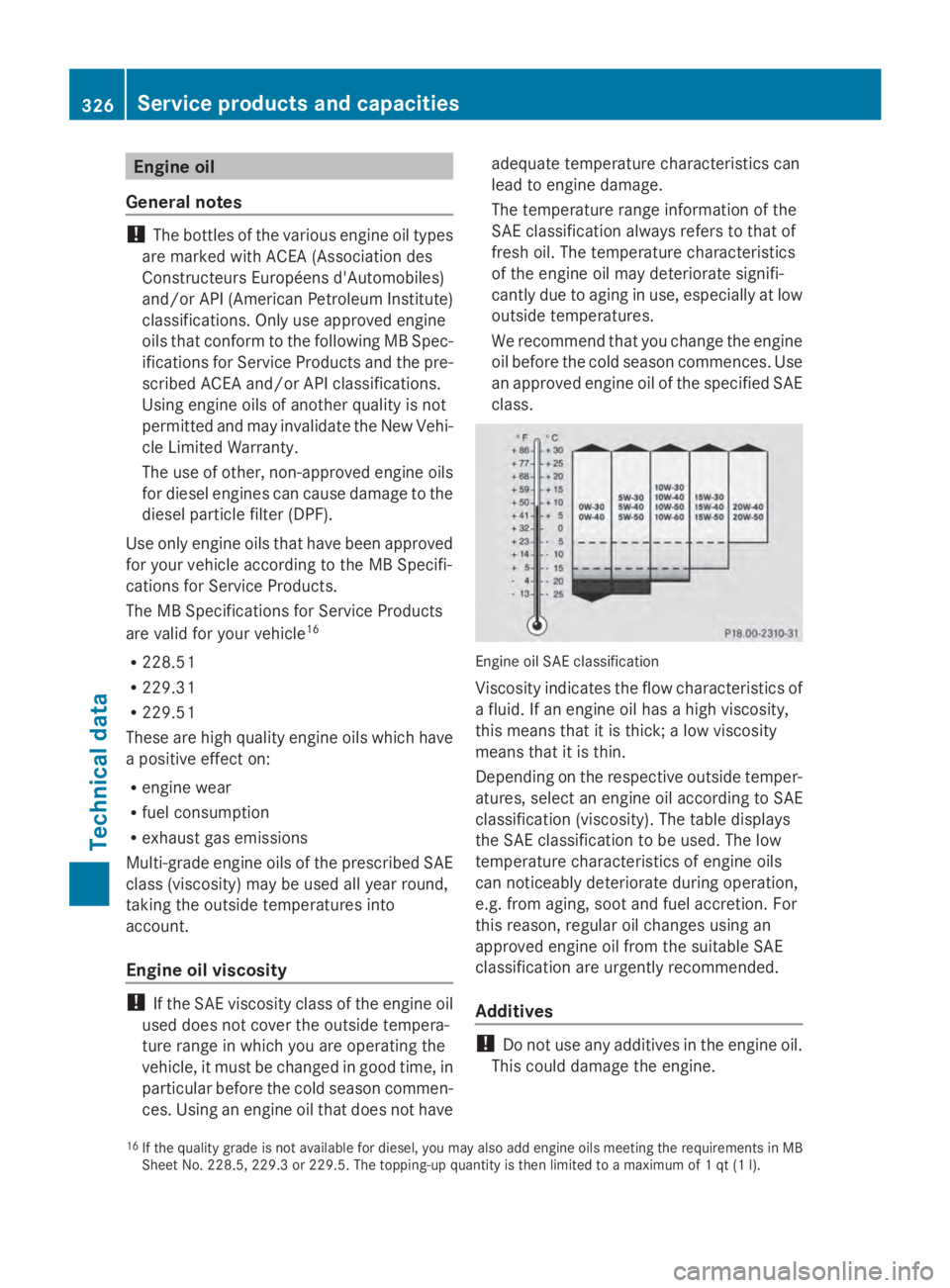
class. Engine oil SAE classification
Viscosity indicates the flow characteristics of
a fluid. If an engine oil has a high viscosity,
this means that it is thick; a low viscosity
means that it is thin.
Depending on the respective outside temper-
atures, select an engine oil according to SAE
classification (viscosity). The table displays
the SAE classification to be used. The low
temperature characteristics of engine oils
can noticeably deteriorate during operation,
e.g. from aging, soot and fuel accretion. For
this reason, regular oil changes using an
approved engine oil from the suitable SAE
classification are urgently recommended.
Additives !
Do not use any additives in the engine oil.
This could damage the engine.
16 If the quality grade is not available for diesel, you may also add engine oils meeting the requirements in MB
Sheet No. 228.5, 229.3 or 229.5. The topping-up quantity is then limited to a maximum of 1 qt (1 l). 326
Service products and capacitiesTechnical data
Page 329 of 338
Miscibility of engine oils
!
Mixing oils reduces the benefits of using
high grade engine oils.
We recommend that you only add engine oil
of the same quality grade and SAE class as
used when the engine oil was last changed.
If, in exceptional cases, oil of the type in the
engine is not available, top up using another
approved mineral or synthetic engine oil.
If the quality grade is not available for diesel
engines, you may also add engine oils meet-
ing the requirements in MB Sheet Number
228.5, 229.3 or 229.5. The topping-up quan-
tity is then limited to a maximum of 1 qt (1 l).
Engine oils are differentiated according to:
R engine oil brand
R quality grade (sheet number)
R SAE class (viscosity)
Subsequently have the engine oil changed at
the earliest possible opportunity.
Interval for oil change The on-board computer automatically shows
the date for the next oil change as an event
message in the display.
Only by using engine oil with a particularly
high quality grade, e.g. according to Sheet
Number 228.51 of the Mercedes-Benz Spec-
ifications for Service Products, can the maxi-
mum interval for oil change be achieved.
We recommend having the oil changed at a
qualified specialist workshop.
Engine oil for diesel engines Product name/number
see the Maintenance Booklet
MB Sheet Number 228.51, 229.31, 229.51
Capacities
!
Do not add too much oil. adding too much
engine oil can result in damage to the
engine or to the catalytic converter. Have
excess engine oil siphoned off. Oil change including oil filter Vehicles Engine oil
210 CDI, 213 CDI,
216 CDI, 310 CDI,
313 CDI, 316 CDI,
510 CDI, 513 CDI,
516 CDI Approximately
11.5 l 219 CDI, 319 CDI,
519 CDI Approximately
12.5 l 216, 316, 516 Approximately 8.0 l
Information about oil consumption
!
If the vehicle is predominantly used for
short-distance driving, this could lead to a
malfunction in the automatic cleaning func-
tion for the diesel particle filter. As a result,
fuel may accumulate in the engine oil and
cause engine failure.
Therefore, if you mainly drive short distan-
ces, you should drive on a highway or on
rural roads for 20 minutes every 310 miles
(500 km). This ensures sufficient regener-
ation of the diesel particle filter.
Depending on the driving style, the vehicle
consumes a maximum of 1.0 US qt (1.0 l)of
engine oil over a distance of 620 miles
(1000 km).
Oil consumption may be higher if:
R the vehicle is new.
R you mainly operate the vehicle under ardu-
ous operating conditions.
R you frequently drive at high engine speeds.
Regular maintenance is one of the precondi-
tions for moderate rates of consumption.
You can only estimate the oil consumption
after you have driven a considerable distance.
Check the engine oil level on a regular basis,
e.g. weekly or each time you refuel
(Y page 252). Service products and capacities
327Technical data Z
Page 331 of 338
Service product:
brake fluid
Product name/
number Intac B026E
R Boiling point: 500 ‡
(260 †)
R Wet boiling point:
356 ‡ (180 †) MB Sheet No. 331.0
Maintenance
interval 2 years
i
Have the brake fluid renewed every 2
years at a qualified specialist workshop.
There is usually a notice in the engine com-
partment to remind you when the next
brake fluid change is due. Coolant
Important safety notes G
WARNING
If antifreeze comes into contact with hot com-
ponents in the engine compartment, it may
ignite. There is a risk of fire and injury.
Let the engine cool down before you add anti-
freeze. Make sure that antifreeze is not spilled
next to the filler neck. Thoroughly clean the
antifreeze from components before starting
the engine.
! Take care not to spill any coolant on
painted surfaces. You could otherwise
damage the paintwork.
When handling, storing and disposing of cool-
ant and antifreeze, please observe the rele-
vant regulations and the safety notes in the
"Service products and capacities" section
(Y page 320). Coolant additive with corrosion/anti-
freeze protection !
Use only approved antifreeze/corrosion
inhibitor that complies with MB Specifica-
tion for Service Products, Sheet Number
325. Using other, non-approved anti-
freeze/corrosion inhibitors may cause
damage to the coolant system and reduce
the engine's service life.
Coolant is a mixture of water and antifreeze/
corrosion inhibitor. It performs the following
tasks:
R corrosion protection
R antifreeze protection
R raises the boiling point
When the vehicle is first delivered, it is filled
with a coolant mixture that ensures adequate
antifreeze and corrosion protection. Coolant
must be used in the system all year round to
ensure anti-corrosion protection and a raised
boiling point – even in countries with high
outside temperatures.
To prevent damage to the engine cooling sys-
tem, use only approved corrosion inhibitor/
antifreeze that comply with the Mercedes-
Benz Specifications for Service Products. You
will find information about approved corro-
sion inhibitor/antifreeze for your vehicle in
the Maintenance Booklet.
We recommend corrosion inhibitor/anti-
freeze that meets the requirements in MB
Specifications for Service Products Sheet
Number 325.
Check the antifreeze/corrosion inhibitor con-
centration in the coolant every six months.
The percentage of corrosion inhibitor/anti-
freeze additive in the engine cooling system
should:
R be at least 50%. This way, the engine cool-
ing system is protected against freezing
down to approximately -35 ‡ (-37 †).
R not exceed 55% (antifreeze protection
down to -49 ‡ [-45 †]). Otherwise, heat
will not be dissipated as effectively. Service products and capacities
329Technical data Z