brake MERCEDES-BENZ SPRINTER 2015 MY15 Operator’s Manual
[x] Cancel search | Manufacturer: MERCEDES-BENZ, Model Year: 2015, Model line: SPRINTER, Model: MERCEDES-BENZ SPRINTER 2015Pages: 334, PDF Size: 5.94 MB
Page 327 of 334
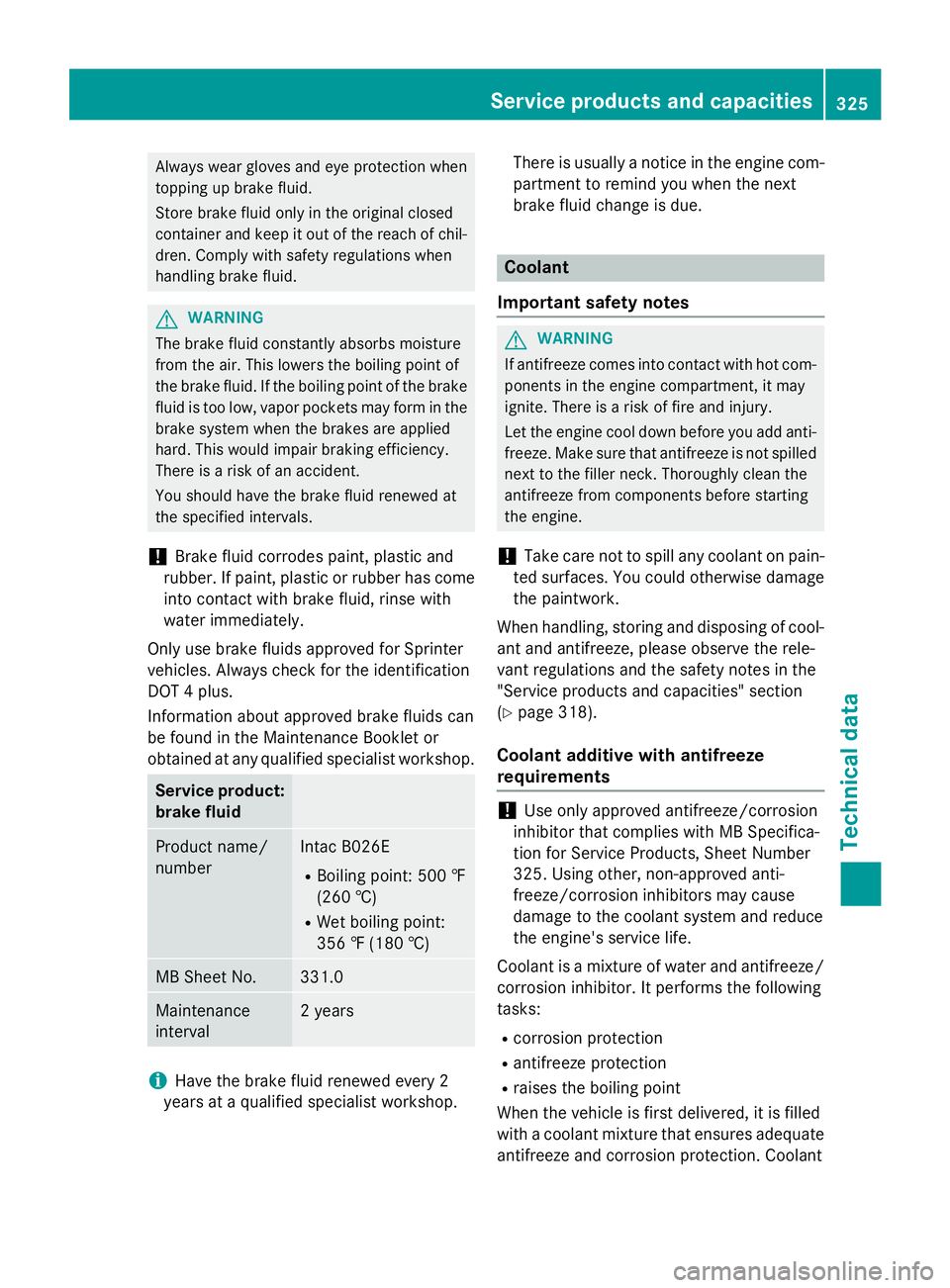
Always wear gloves and eye protection when
topping up brake fluid.
Store brake fluid only in the original closed
container and keep it out of the reach of chil- dren. Comply with safety regulations when
handling brake fluid. G
WARNING
The brake fluid constantly absorbs moisture
from the air. This lowers the boiling point of
the brake fluid. If the boiling point of the brake fluid is too low, vapor pockets may form in the brake system when the brakes are applied
hard. This would impair braking efficiency.
There is a risk of an accident.
You should have the brake fluid renewed at
the specified intervals.
! Brake fluid corrodes paint, plastic and
rubber. If paint, plastic or rubber has come
into contact with brake fluid, rinse with
water immediately.
Only use brake fluids approved for Sprinter
vehicles. Always check for the identification
DOT 4 plus.
Information about approved brake fluids can
be found in the Maintenance Booklet or
obtained at any qualified specialist workshop. Service product:
brake fluid Product name/
number Intac B026E
R Boiling point: 500 ‡
(260 †)
R Wet boiling point:
356 ‡ (180 †) MB Sheet No. 331.0
Maintenance
interval 2 years
i
Have the brake fluid renewed every 2
years at a qualified specialist workshop. There is usually a notice in the engine com-
partment to remind you when the next
brake fluid change is due. Coolant
Important safety notes G
WARNING
If antifreeze comes into contact with hot com- ponents in the engine compartment, it may
ignite. There is a risk of fire and injury.
Let the engine cool down before you add anti-
freeze. Make sure that antifreeze is not spilled
next to the filler neck. Thoroughly clean the
antifreeze from components before starting
the engine.
! Take care not to spill any coolant on pain-
ted surfaces. You could otherwise damage
the paintwork.
When handling, storing and disposing of cool-
ant and antifreeze, please observe the rele-
vant regulations and the safety notes in the
"Service products and capacities" section
(Y page 318).
Coolant additive with antifreeze
requirements !
Use only approved antifreeze/corrosion
inhibitor that complies with MB Specifica-
tion for Service Products, Sheet Number
325. Using other, non-approved anti-
freeze/corrosion inhibitors may cause
damage to the coolant system and reduce
the engine's service life.
Coolant is a mixture of water and antifreeze/ corrosion inhibitor. It performs the following
tasks:
R corrosion protection
R antifreeze protection
R raises the boiling point
When the vehicle is first delivered, it is filled
with a coolant mixture that ensures adequate antifreeze and corrosion protection. Coolant Service products and capacities
325Technical data Z
Page 329 of 334
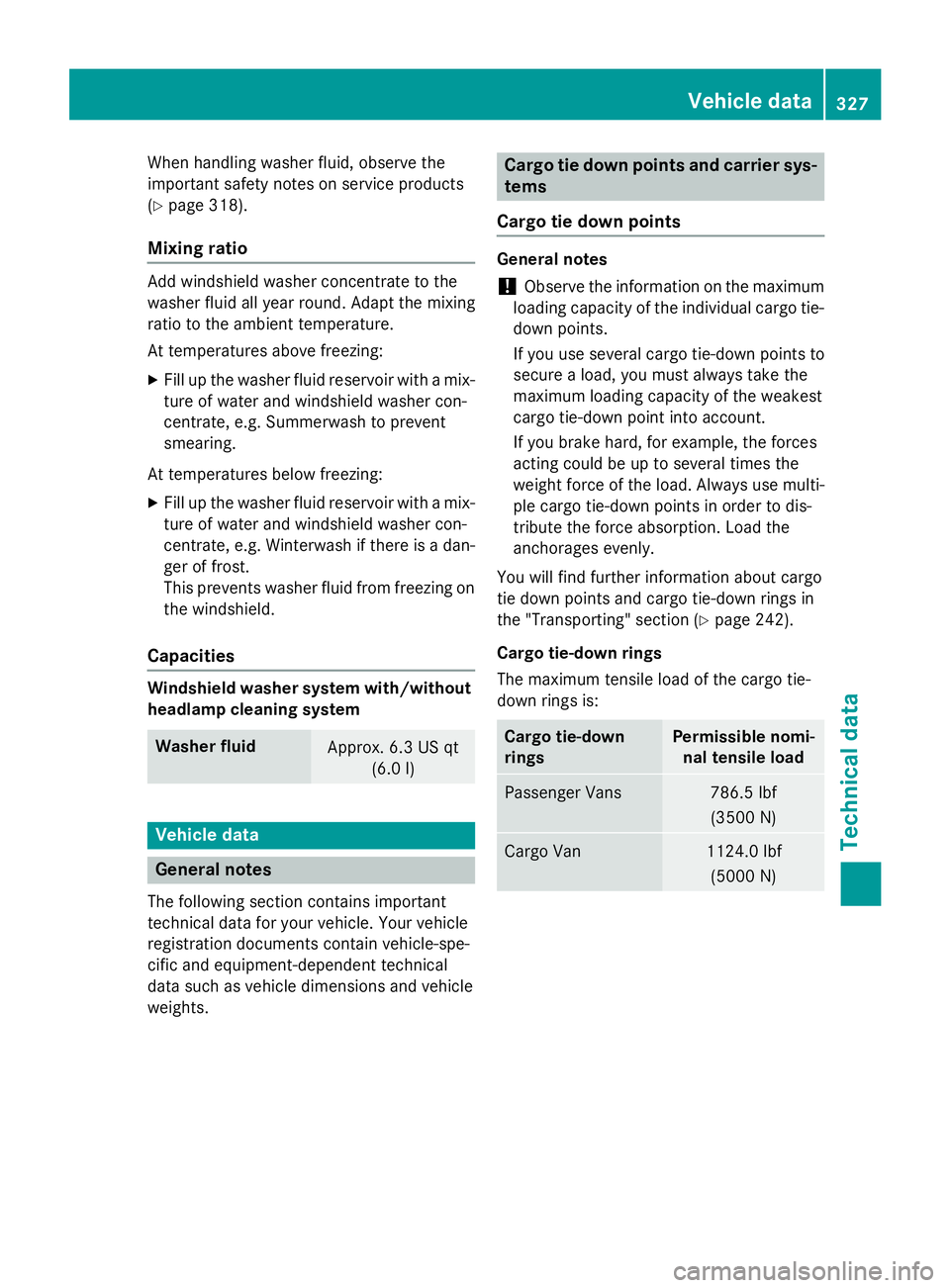
When handling washer fluid, observe the
important safety notes on service products
(Y page 318).
Mixing ratio Add windshield washer concentrate to the
washer fluid all year round. Adapt the mixing
ratio to the ambient temperature.
At temperatures above freezing:
X Fill up the washer fluid reservoir with a mix-
ture of water and windshield washer con-
centrate, e.g. Summerwash to prevent
smearing.
At temperatures below freezing: X Fill up the washer fluid reservoir with a mix-
ture of water and windshield washer con-
centrate, e.g. Winterwash if there is a dan- ger of frost.
This prevents washer fluid from freezing on the windshield.
Capacities Windshield washer system with/without
headlamp cleaning system Washer fluid
Approx. 6.3 US qt
(6.0l) Vehicle data
General notes
The following section contains important
technical data for your vehicle. Your vehicle
registration documents contain vehicle-spe-
cific and equipment-dependent technical
data such as vehicle dimensions and vehicle
weights. Cargo tie down points and carrier sys-
tems
Cargo tie down points General notes
! Observe the information on the maximum
loading capacity of the individual cargo tie-
down points.
If you use several cargo tie-down points to
secure a load, you must always take the
maximum loading capacity of the weakest
cargo tie-down point into account.
If you brake hard, for example, the forces
acting could be up to several times the
weight force of the load. Always use multi-
ple cargo tie-down points in order to dis-
tribute the force absorption. Load the
anchorages evenly.
You will find further information about cargo
tie down points and cargo tie-down rings in
the "Transporting" section (Y page 242).
Cargo tie-down rings
The maximum tensile load of the cargo tie-
down rings is: Cargo tie-down
rings Permissible nomi-
nal tensile load Passenger Vans 786.5 lbf
(3500 N) Cargo Van 1124.0 lbf
(5000 N) Vehicle data
327Technical data Z