steering MERCEDES-BENZ SPRINTER 2015 MY15 Operator’s Manual
[x] Cancel search | Manufacturer: MERCEDES-BENZ, Model Year: 2015, Model line: SPRINTER, Model: MERCEDES-BENZ SPRINTER 2015Pages: 334, PDF Size: 5.94 MB
Page 294 of 334
standstill. Do not carry out any sudden steer-
ing maneuvers.
The tire pressure monitor has a yellow 0077
warning lamp in the instrument cluster for
indicating pressure loss/malfunctions (USA)
or pressure loss (Canada). Depending on how
the warning lamp flashes or lights up, an
underinflated tire or a malfunction in the tire
pressure monitor is displayed:
R if the 0077 warning lamp is lit continuously,
the tire pressure on one or more tires is
significantly too low. The tire pressure mon-
itor is not malfunctioning.
R USA only: if the 0077warning lamp flashes
for 60 seconds and then remains lit con-
stantly, the tire pressure monitor is mal-
functioning.
Only vehicles with steering wheel buttons: the on-board computer displays information on
tire pressure. After a few minutes of driving,
the current tire pressure of each tire is shown
in the on-board computer.
USA only: if the tire pressure monitor is mal-
functioning, it may be more than 10 minutes
before the malfunction is shown. The 0077
tire pressure warning lamp flashes for
60 seconds and then remains lit. When the
malfunction has been rectified, the 0077tire
pressure warning lamp goes out after a few
minutes of driving.
The tire pressure values indicated by the on-
board computer may differ from those meas-
ured at a gas station with a pressure gage.
The tire pressures shown by the on-board
computer refer to those measured at sea
level. At high altitudes, the tire pressure val-
ues indicated by a pressure gage are higher
than those shown by the on-board computer. In this case, do not reduce the tire pressures.
If radio transmitting equipment (e.g. wireless headphones, two-way radios) is operated
inside the vehicle or in the vicinity of the vehi-
cle, this can interfere with the operation of the tire pressure monitor. Checking the tire pressure electroni-
cally (vehicles with steering wheel but-
tons)
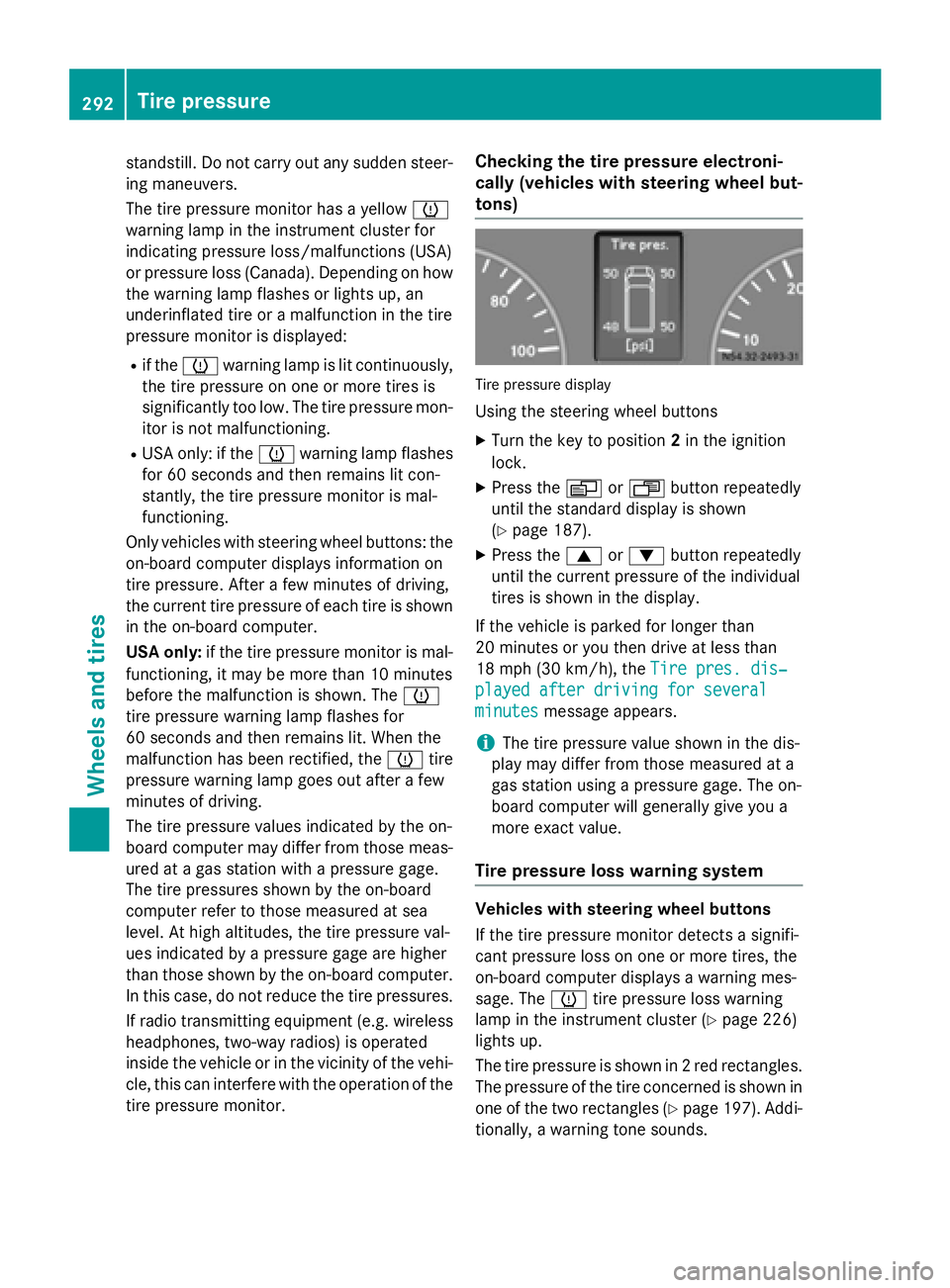
Tire pressure display
Using the steering wheel buttons
X Turn the key to position 2in the ignition
lock.
X Press the 0080or007F button repeatedly
until the standard display is shown
(Y page 187).
X Press the 0063or0064 button repeatedly
until the current pressure of the individual
tires is shown in the display.
If the vehicle is parked for longer than
20 minutes or you then drive at less than
18 mph (30 km/h), the Tire pres. dis‐ Tire pres. dis‐
played after driving for several played after driving for several
minutes minutes message appears.
i The tire pressure value shown in the dis-
play may differ from those measured at a
gas station using a pressure gage. The on-
board computer will generally give you a
more exact value.
Tire pressure loss warning system Vehicles with steering wheel buttons
If the tire pressure monitor detects a signifi-
cant pressure loss on one or more tires, the
on-board computer displays a warning mes-
sage. The 0077tire pressure loss warning
lamp in the instrument cluster (Y page 226)
lights up.
The tire pressure is shown in 2 red rectangles. The pressure of the tire concerned is shown in
one of the two rectangles (Y page 197). Addi-
tionally, a warning tone sounds. 292
Tire pressureWheels and tires
Page 295 of 334
Each tire that is affected by a significant loss
of pressure is highlighted in the pressure dis-
play.
Restarting the tire pressure monitor When you restart the tire pressure monitor,
the currently set tire pressure are taken as
reference values for monitoring.
In most cases, the tire pressure monitor
detects the new reference values automati-
cally, e.g. after you have:
R changed the tire pressure
R changed wheels or tires
R installed new wheels or tires
However, you can also define reference val-
ues manually as described here.
Before restarting the tire pressure moni-
tor:
X Set the tire pressure to the value recom-
mended on the Tire and Loading Informa-
tion placard or the tire pressure table on
the B-pillar on the driver's side
(Y page 288).
Observe the notes on tire pressure when
doing so (Y page 288).
X Make sure that the tire pressure is correct
on all four wheels.
Restarting the tire pressure monitor
(vehicles without steering wheel but-
tons):
X Turn the key to position 2in the ignition
lock.
X Press the 0079menu button on the instru-
ment cluster repeatedly until the display
shows the following message:
+CAL- TPMS
+CAL- TPMS
X Press the 0074button on the instrument clus-
ter.
The display shows:
OK TPMS
OK TPMS
The tire pressure monitor activation proc-
ess has begun. The tire pressures meas-
ured for the individual wheels are stored as the new reference values, provided that the
tire pressure monitor considers them to be plausible.
If you wish to cancel the restart:
X Press the 0075button or the 0079menu button
on the instrument cluster.
The activation process is canceled auto-
matically if 30 second s elapse without
input.
Restarting the tire pressure monitor
(vehicles with steering wheel buttons): X Turn the key to position 2in the ignition
lock.
X Press the 0080or007F button on the steer-
ing wheel until the standard display
(Y page 187) appears in the display.
X Press the 0063or0064 button on the steer-
ing wheel repeatedly until the current pres-
sure of the individual tires is displayed or
the display shows the following message:
Tire
Tire pres. pres. displayed
displayed after
afterdriving
driving
for several minutes
for several minutes
X Press the 0045reset button on the instru-
ment cluster.
The display shows the following message:
Monitor current tire pressure? Monitor current tire pressure?
X Press the 0081button on the steering
wheel.
The display shows the following message:
Tire pres. monitor reactivated Tire pres. monitor reactivated
The tire pressure monitor activation proc-
ess has begun. The tire pressures meas-
ured for the individual wheels are stored as the new reference values, provided that the
tire pressure monitor considers them to be plausible.
If you wish to cancel the restart:
X Press the 0082button on the steering
wheel. Tire pressure
293Wheels and tires Z
Page 297 of 334
Rear axle tire pressure values:
the following tire pressure values only apply to vehicles with
a permissible rear axle load of 5360 lb s(2431 kg), 7060 lbs (3202 kg) or 7720 lbs (3502 kg). Tires/disc wheel Rear axle load
5360 lbs
(2431 kg) 7060 lbs
(3202 kg) 7720 lbs
(3502 kg) LT 215/85 R 16 115/112N
5.5Jx16
Half distance between centers:
4.94 in (125.5 mm) — 380 kPa
(3.8 bar/55 psi) 420 kPa
(4.2 bar/61 psi) LT 215/85 R 16 115/112Q
5.5Jx16
Half distance between centers:
4.94 in (125.5 mm) — 380 kPa
(3.8 bar/55 psi) 420 kPa
(4.2 bar/61 psi) LT 245/75 R 16 120/116N
6.5J x 16
Wheel offset: 2.13 in (54 mm) 480 kPa
(4.8 bar/ 70 psi) — —
285/65 R 16 C 128/126N (121 R)
285/65 R 16 C 128/126 N (123
R)
8
8.5J x 16 ET 63 — 450 kPa
(4.5 bar/65 psi) —
235/65 R 16 C 121N (118R)
6,5Jx16
Spare wheel, Vehicles with
Super Single tires. — 520 kPa
(5.2 bar/75 psi) —
Loading the vehicle
Instruction labels for tires and loads
G
WARNING
Overloaded tires can overheat, causing a
blowout. Overloaded tires can also impair the steering and driving characteristics and lead
to brake failure. There is a risk of accident.
Observe the load rating of the tires. The load
rating must be at least half of the GAWR of
your vehicle. Never overload the tires by
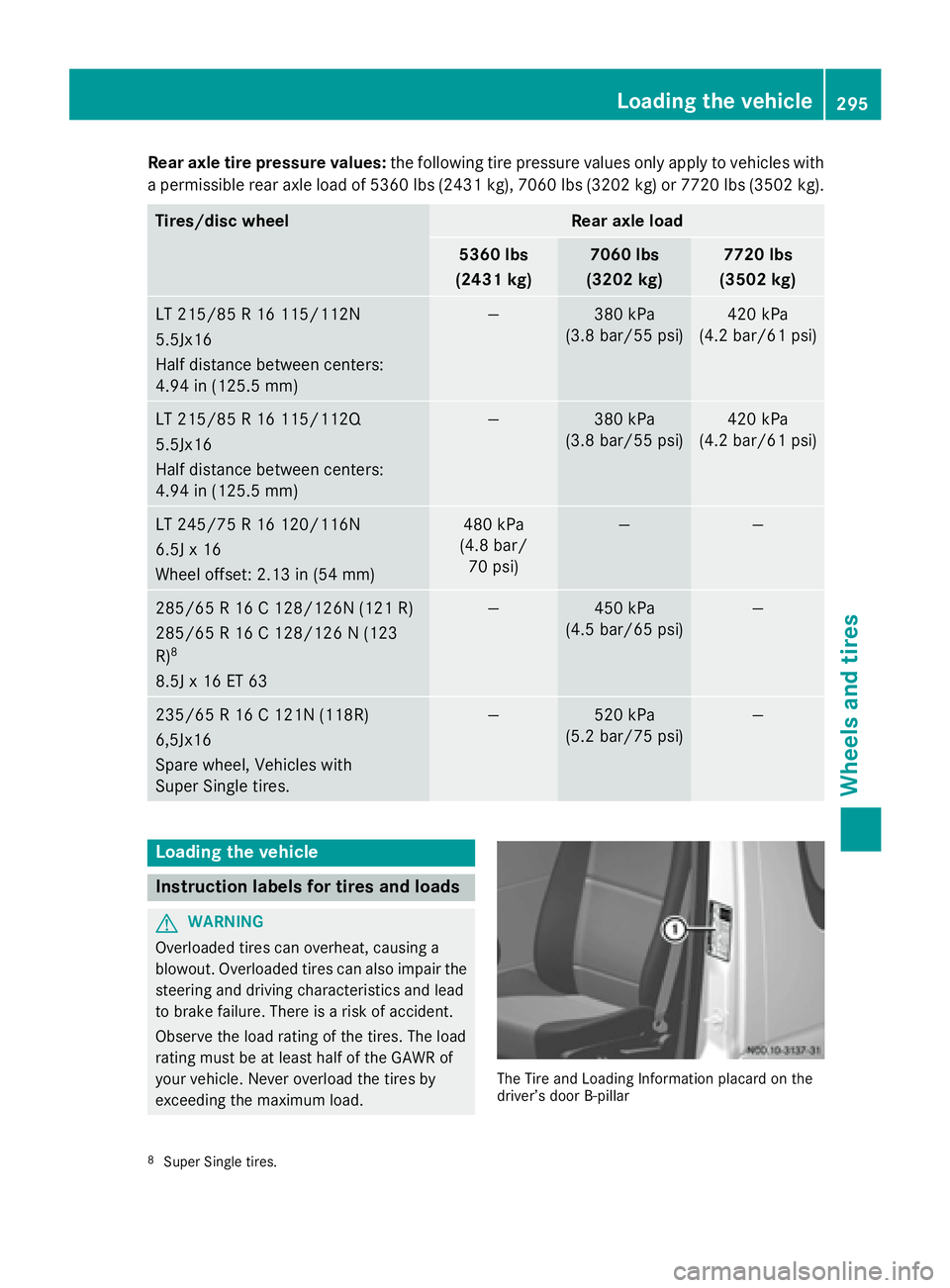
exceeding the maximum load. The Tire and Loading Information placard on the
driver’s door B-pillar
8 Super Single tires. Loading the vehicle
295Wheels and tires Z
Page 326 of 334
Information about oil consumption
!
If the vehicle is predominantly used for
short-distance driving, this could lead to a
malfunction in the automatic cleaning func- tion for the diesel particle filter. As a result,
fuel may accumulate in the engine oil and
cause engine failure.
Therefore, if you mainly drive short distan-
ces, you should drive on a highway or on
rural roads for 20 minutes every 310 miles
(500 km). This ensures sufficient regener-
ation of the diesel particle filter.
Depending on the driving style, the vehicle
consumes a maximum of 1.0 US qt (1.0 l) of
engine oil over a distance of 620 miles
(1000 km).
Oil consumption may be higher if:
R the vehicle is new.
R you mainly operate the vehicle under ardu-
ous operating conditions.
R you frequently drive at high engine speeds.
Regular maintenance is one of the precondi-
tions for moderate rates of consumption.
You can only estimate the oil consumption
after you have driven a considerable distance.
Check the engine oil level on a regular basis,
e.g. weekly or each time you refuel
(Y page 250). Transmission and power steering oil
Automatic transmission Service product: automatic transmission
fluid Product name/number Maintenance
interval Shell ATF 3403/M-115
MB Sheet No. 236.10 —
Fuchs/Shell ATF 3353
MB Sheet No. 236.12 Further information can be obtained at any
qualified specialist workshop.
Rear axle Service product: transmission oil
Product name/number Maintenance
interval BP Energear Hypo DC
80W-90
MB Sheet No. 235.20 —
Mobil Delvac Synthetic
Gear Oil 75W-90
MB Sheet No. 235.8 Further information can be obtained at any
qualified specialist workshop.
Steering Service product: power steering fluid
Product name/number Maintenance
interval Mobil ATF‑
D,
Exxon Mobil Corporation
or equivalent
MB Sheet No. 236.3 —
The steering is maintenance-free. Further
information can be obtained at any qualified
specialist workshop. Brake fluid
G
WARNING
Brake fluid is hazardous to health. Do not
swallow brake fluid. See a doctor immediately if you swallow brake fluid.
Make sure that brake fluid does not come into
contact with skin, clothing or eyes. Rinse
affected areas with plenty of clean water and
consult a doctor if necessary. 324
Service products and capacitiesTechnical data
Page 330 of 334
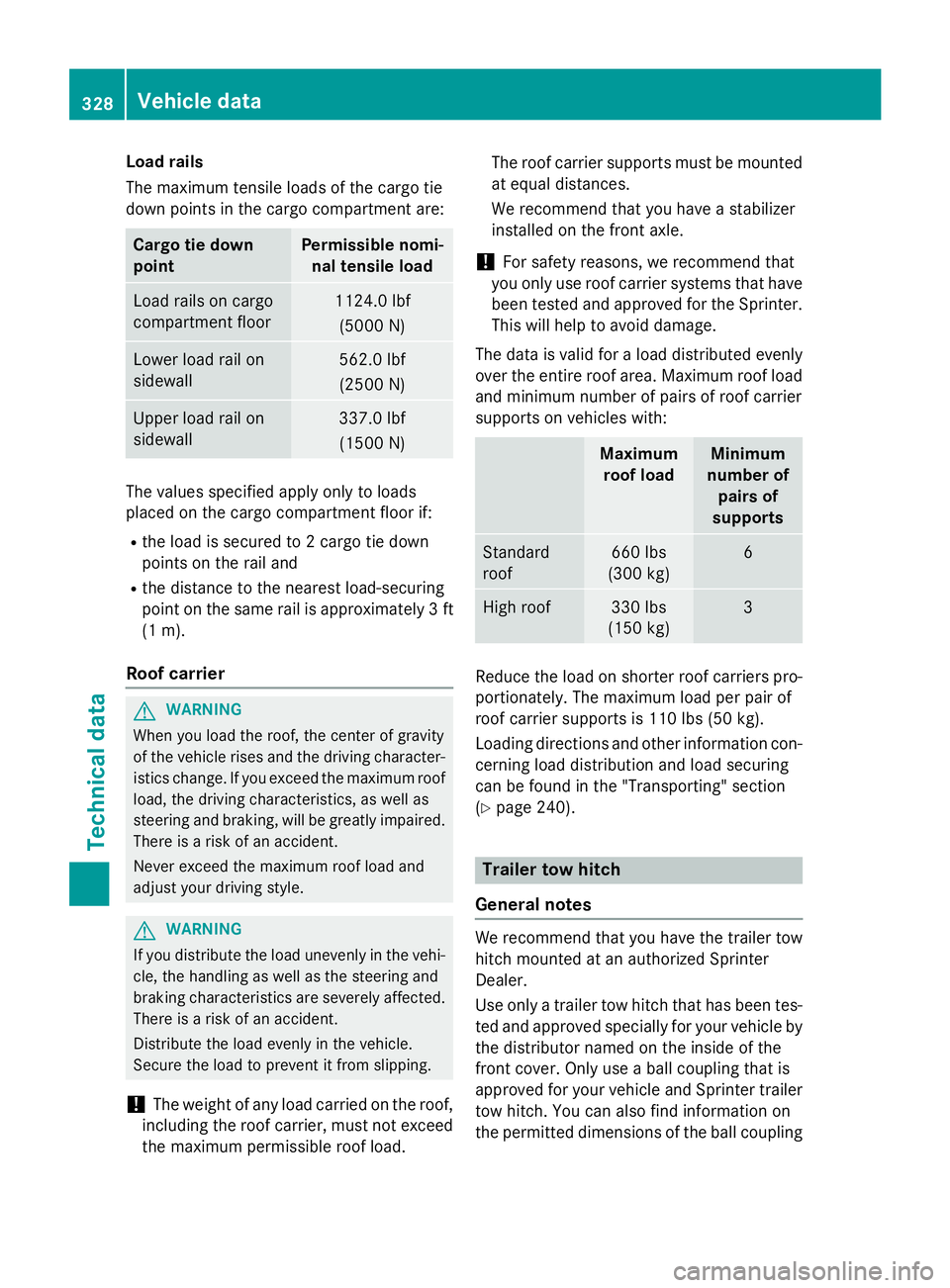
Load rails
The maximum tensile loads of the cargo tie
down points in the cargo compartment are: Cargo tie down
point Permissible nomi-
nal tensile load Load rails on cargo
compartment floor 1124.0 lbf
(5000 N) Lower load rail on
sidewall 562.0 lbf
(2500 N) Upper load rail on
sidewall 337.0 lbf
(1500 N) The values specified apply only to loads
placed on the cargo compartment floor if:
R the load is secured to 2 cargo tie down
points on the rail and
R the distance to the nearest load-securing
point on the same rail is approximately 3 ft
(1 m).
Roof carrier G
WARNING
When you load the roof, the center of gravity
of the vehicle rises and the driving character- istics change. If you exceed the maximum roof
load, the driving characteristics, as well as
steering and braking, will be greatly impaired. There is a risk of an accident.
Never exceed the maximum roof load and
adjust your driving style. G
WARNING
If you distribute the load unevenly in the vehi- cle, the handling as well as the steering and
braking characteristics are severely affected.
There is a risk of an accident.
Distribute the load evenly in the vehicle.
Secure the load to prevent it from slipping.
! The weight of any load carried on the roof,
including the roof carrier, must not exceed the maximum permissible roof load. The roof carrier supports must be mounted
at equal distances.
We recommend that you have a stabilizer
installed on the front axle.
! For safety reasons, we recommend that
you only use roof carrier systems that have
been tested and approved for the Sprinter.
This will help to avoid damage.
The data is valid for a load distributed evenly
over the entire roof area. Maximum roof load
and minimum number of pairs of roof carrier
supports on vehicles with: Maximum
roof load Minimum
number of pairs of
supports Standard
roof 660 lbs
(300 kg) 6
High roof 330 lbs
(150 kg) 3
Reduce the load on shorter roof carriers pro-
portionately. The maximum load per pair of
roof carrier supports is 110 lbs (50 kg).
Loading directions and other information con- cerning load distribution and load securing
can be found in the "Transporting" section
(Y page 240). Trailer tow hitch
General notes We recommend that you have the trailer tow
hitch mounted at an authorized Sprinter
Dealer.
Use only a trailer tow hitch that has been tes- ted and approved specially for your vehicle by
the distributor named on the inside of the
front cover. Only use a ball coupling that is
approved for your vehicle and Sprinter trailer
tow hitch. You can also find information on
the permitted dimensions of the ball coupling 328
Vehicle dataTechnical data