steering MERCEDES-BENZ SPRINTER 2015 MY15 Operator’s Manual
[x] Cancel search | Manufacturer: MERCEDES-BENZ, Model Year: 2015, Model line: SPRINTER, Model: MERCEDES-BENZ SPRINTER 2015Pages: 334, PDF Size: 5.94 MB
Page 242 of 334
Useful information
This Operator's Manual describes all models
as well as standard and optional equipment of your vehicle that were available at the time of going to print. Country-specific variations are
possible. Note that your vehicle may not be
equipped with all of the described functions.
This also applies to systems and functions
relevant to safety.
Read the information on qualified specialist
workshops (Y page 25). Loading guidelines
Important safety notes
G
WARNING
As a result of improperly placed or unevenly
distributed loads, the center of gravity of the
load being transported may be too high or too far back. This can significantly impair handlingas well as steering and braking characteris-
tics. There is a risk of an accident.
Always make sure that the center of gravity of
the load is:
R between the axles
and
R as low as possible, near the rear axle. G
WARNING
When objects are unsecured or inadequately
secured, they can slip, turn over or be thrown about, striking vehicle occupants. This also
applies to:
R luggage or loads
R a rear bench seat which has been removed
and is being transported in the vehicle in an
exceptional case.
There is a risk of injury, particularly in the
event of braking maneuvers or abrupt
changes in direction.
Always stow objects in such a way that they
cannot be tossed about. Before traveling,
secure objects, luggage or loads to prevent them slipping or tipping over. If you remove a
rear bench seat, it is advisable to store it out- side the vehicle. G
WARNING
When the permissible wheel loads, axle loads and/or the maximum permissible gross vehi-
cle weight are exceeded, driving safety is
compromised. The handling as well as steer-
ing and braking characteristics may be signif- icantly impaired. Overloaded tires may over-
heat, causing them to burst. There is a risk ofan accident.
When transporting a load, always observe the
permissible wheel loads, axle loads and the
maximum permissible gross vehicle weight
for the vehicle (including occupants). G
WARNING
When you load the roof, the center of gravity
of the vehicle rises and the driving character- istics change. If you exceed the maximum roof
load, the driving characteristics, as well as
steering and braking, will be greatly impaired.There is a risk of an accident.
Never exceed the maximum roof load and
adjust your driving style.
! If you are using a roof carrier, observe the
maximum roof load and maximum roof car-
rier load.
You will find information about the maximum roof load in the "Technical data" section
(Y page 328) and information about roof car-
riers in the "Carrier systems" section
(Y page 245).
R Do not stack luggage or loads higher than
the backrests.
R Stow objects preferably in the cargo com-
partment.
R When transporting luggage, always use the
cargo tie-down rings and a parcel net, if
present.
R Use cargo tie-down rings and fasteners
which are suitable for the weight and size of the load. 240
Loading guidelinesTransporting loads
Page 247 of 334
the locking mechanism and out of the load-
ing rail through a recess. Carrier systems
Roof carrier
G
WARNING
When you load the roof, the center of gravity
of the vehicle rises and the driving character- istics change. If you exceed the maximum roof
load, the driving characteristics, as well as
steering and braking, will be greatly impaired. There is a risk of an accident.
Never exceed the maximum roof load and
adjust your driving style.
You can find information about the maximum
roof load in the "Technical data" section
(Y page 328).
! Make sure that:
R the screws for the roof carrier are tight-
ened in the sliding blocks to a torque of
6.0 – 7.4 lb-ft (8 – 10 Nm)
R the bolts, when tightened, do not touch
the rails.
R the slot nuts are not located in the area of
the plastic caps.
R the slot nuts have the right cross-section.
R the mounting rails in the interior are free
of dirt.
R the screws are retightened evenly after
approximately 300 miles (500 km).
We recommend that you only use roof
racks tested and approved by Sprinter.
These help avoid vehicle damage.
! If you want to retrofit securing rails, have
it done at a qualified specialist workshop.
You could otherwise damage the vehicle. 0043
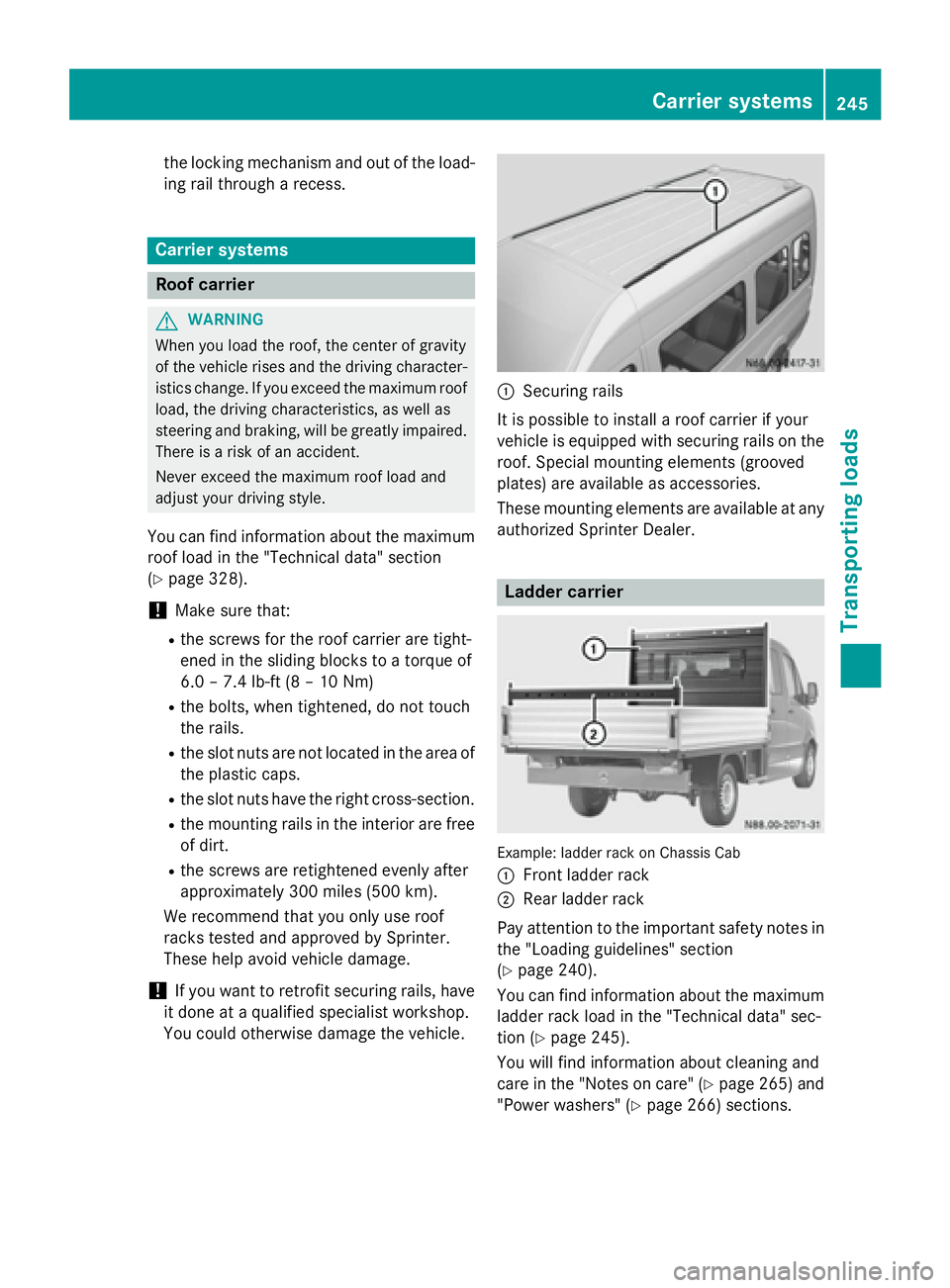
Securing rails
It is possible to install a roof carrier if your
vehicle is equipped with securing rails on the roof. Special mounting elements (grooved
plates) are available as accessories.
These mounting elements are available at any
authorized Sprinter Dealer. Ladder carrier
Example: ladder rack on Chassis Cab
0043
Front ladder rack
0044 Rear ladder rack
Pay attention to the important safety notes in the "Loading guidelines" section
(Y page 240).
You can find information about the maximum
ladder rack load in the "Technical data" sec-
tion (Y page 245).
You will find information about cleaning and
care in the "Notes on care" (Y page 265) and
"Power washers" (Y page 266) sections. Carrier systems
245Transporting loads Z
Page 251 of 334
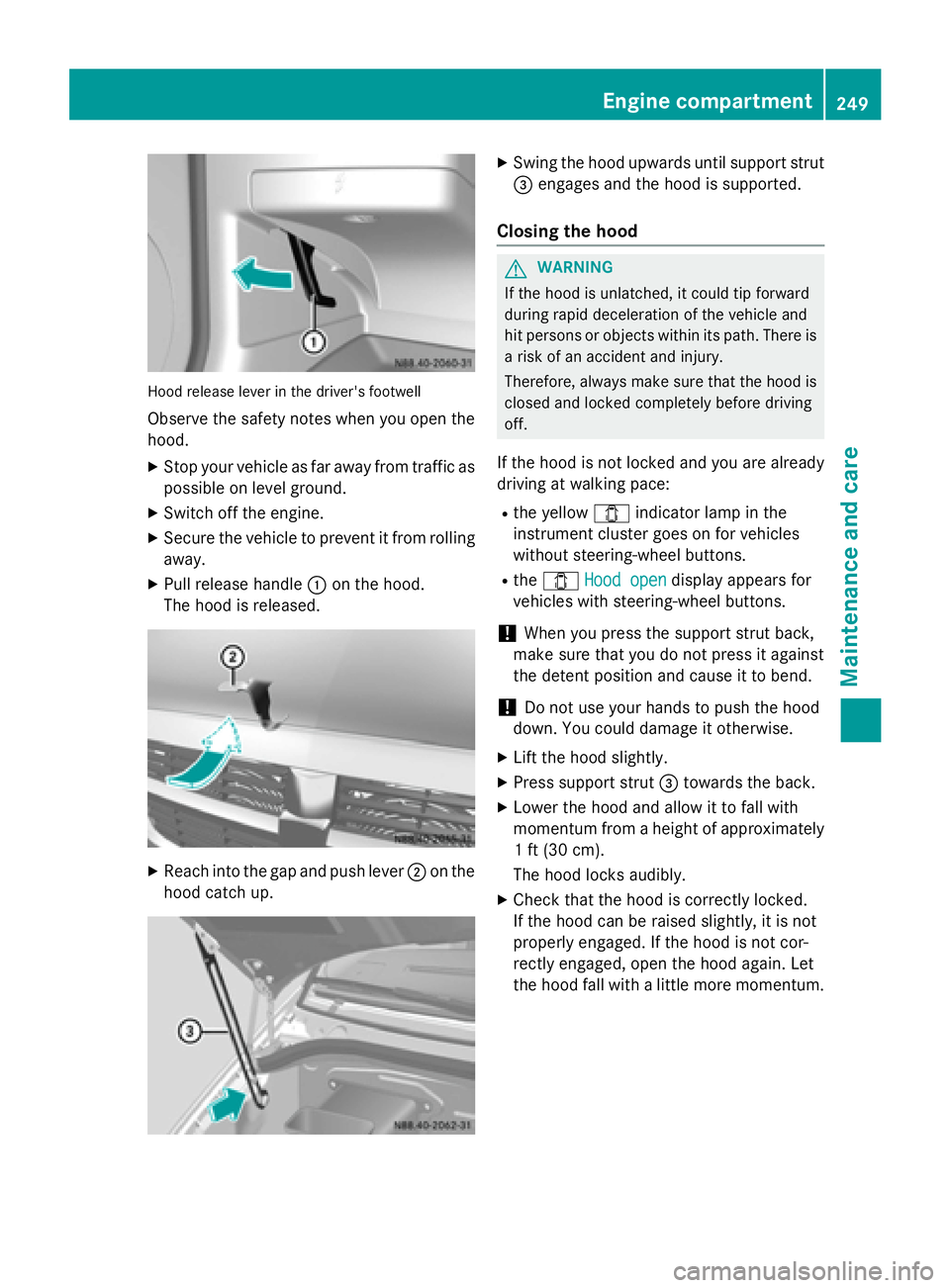
Hood release lever in the driver's footwell
Observe the safety notes when you open the
hood.
X Stop your vehicle as far away from traffic as
possible on level ground.
X Switch off the engine.
X Secure the vehicle to prevent it from rolling
away.
X Pull release handle 0043on the hood.
The hood is released. X
Reach into the gap and push lever 0044on the
hood catch up. X
Swing the hood upwards until support strut
0087 engages and the hood is supported.
Closing the hood G
WARNING
If the hood is unlatched, it could tip forward
during rapid deceleration of the vehicle and
hit persons or objects within its path. There is
a risk of an accident and injury.
Therefore, always make sure that the hood is closed and locked completely before driving
off.
If the hood is not locked and you are already
driving at walking pace:
R the yellow 003Eindicator lamp in the
instrument cluster goes on for vehicles
without steering-wheel buttons.
R the 003E Hood open
Hood open display appears for
vehicles with steering-wheel buttons.
! When you press the support strut back,
make sure that you do not press it against
the detent position and cause it to bend.
! Do not use your hands to push the hood
down. You could damage it otherwise.
X Lift the hood slightly.
X Press support strut 0087towards the back.
X Lower the hood and allow it to fall with
momentum from a height of approximately
1 ft (30 cm).
The hood locks audibly.
X Check that the hood is correctly locked.
If the hood can be raised slightly, it is not
properly engaged. If the hood is not cor-
rectly engaged, open the hood again. Let
the hood fall with a little more momentum. Engine compartment
249Maintenance and care Z
Page 252 of 334
Overview of the engine compartment
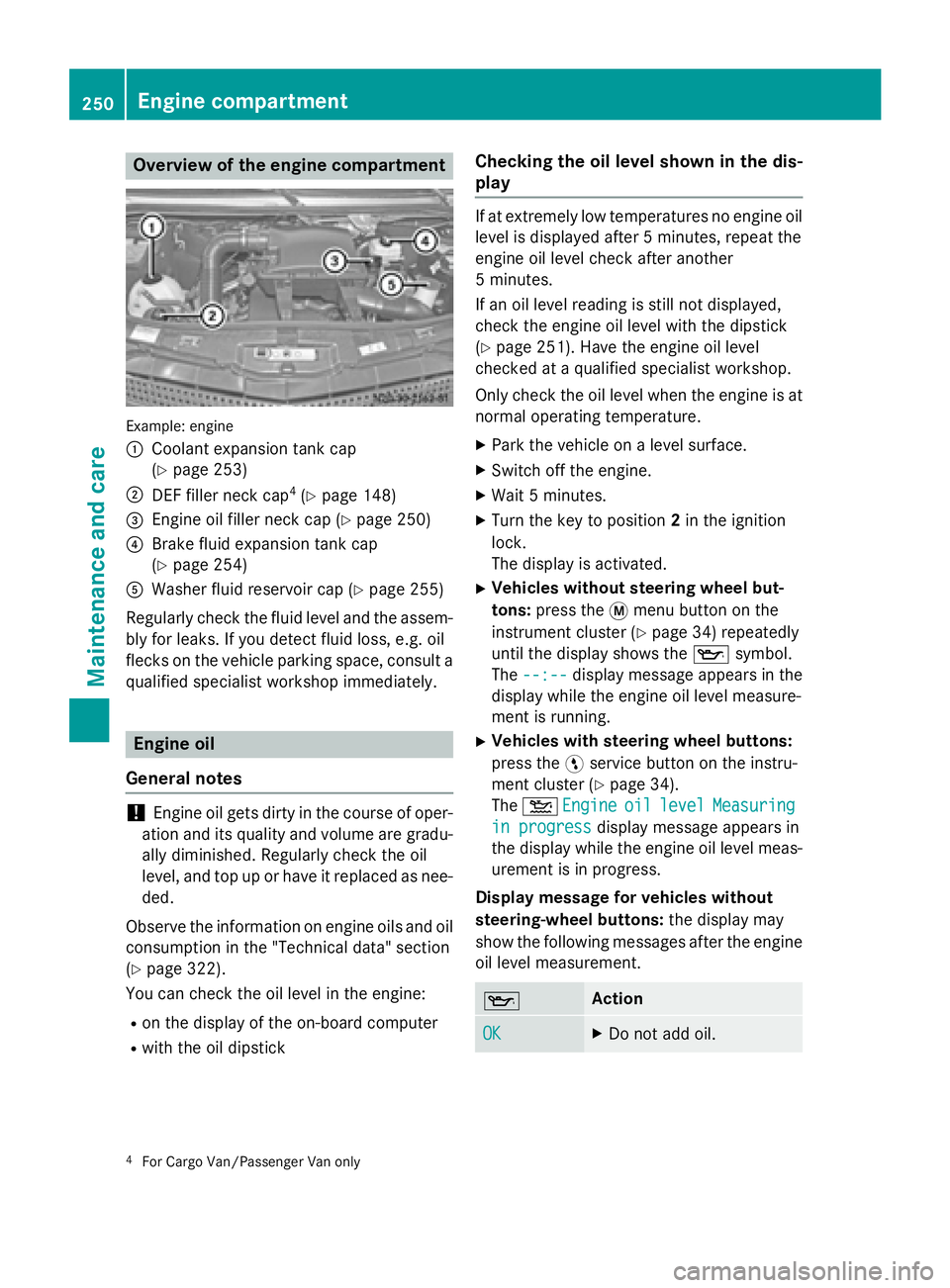
Example: engine
0043
Coolant expansion tank cap
(Ypage 253)
0044 DEF filler neck cap 4
(Y page 148)
0087 Engine oil filler neck cap (Y page 250)
0085 Brake fluid expansion tank cap
(Ypage 254)
0083 Washer fluid reservoir cap (Y page 255)
Regularly check the fluid level and the assem- bly for leaks. If you detect fluid loss, e.g. oil
flecks on the vehicle parking space, consult a qualified specialist workshop immediately. Engine oil
General notes !
Engine oil gets dirty in the course of oper-
ation and its quality and volume are gradu- ally diminished. Regularly check the oil
level, and top up or have it replaced as nee-
ded.
Observe the information on engine oils and oil
consumption in the "Technical data" section
(Y page 322).
You can check the oil level in the engine:
R on the display of the on-board computer
R with the oil dipstick Checking the oil level shown in the dis-
play If at extremely low temperatures no engine oil
level is displayed after 5 minutes, repeat the
engine oil level check after another
5 minutes.
If an oil level reading is still not displayed,
check the engine oil level with the dipstick
(Y page 251). Have the engine oil level
checked at a qualified specialist workshop.
Only check the oil level when the engine is at
normal operating temperature.
X Park the vehicle on a level surface.
X Switch off the engine.
X Wait 5 minutes.
X Turn the key to position 2in the ignition
lock.
The display is activated.
X Vehicles without steering wheel but-
tons: press the 0079menu button on the
instrument cluster (Y page 34) repeatedly
until the display shows the 00AFsymbol.
The --:--
--:-- display message appears in the
display while the engine oil level measure-
ment is running.
X Vehicles with steering wheel buttons:
press the 0098service button on the instru-
ment cluster (Y page 34).
The 00B2 Engine Engine oil
oillevel
level Measuring
Measuring
in progress
in progress display message appears in
the display while the engine oil level meas-
urement is in progress.
Display message for vehicles without
steering-wheel buttons: the display may
show the following messages after the engine oil level measurement. 00AF Action
OK OK X
Do not add oil. 4
For Cargo Van/Passenger Van only 250
Engine compartmentMaintenance and care
Page 259 of 334
responsible manner. Comply with the instruc-
tions for use of the care products.
Do not run the engine for longer than neces-
sary when the vehicle is stationary.
Before having maintenance and repairs per-
formed, it is essential to read the materials
related to the maintenance and repairs: R the applicable sections of the technical
documentation, e.g. the Operator's Manual
and workshop information.
R regulations such as industrial safety regu-
lations and accident prevention regula-
tions.
While working under the vehicle, you must
secure the vehicle on jack stands with suffi-
cient load capacity.
Never use the jack as a substitute. The vehi-
cle's jack is intended only to raise the vehicle for a short time when changing a wheel. It is
not suited for performing maintenance work
under the vehicle.
Please also refer to the notes about qualified
specialist workshops (Y page 25).
The scope and regularity of the inspection
and maintenance work primarily depend on
the often diverse operating conditions. Spe-
cialist knowledge beyond the scope of this
Operator's Manual is required when carrying
out testing and maintenance work. This work
should only be carried out by trained staff.
The vehicle Maintenance Booklet describes
the scope and frequency of maintenance
work and contains additional notes on the
New Vehicle Limited Warranty and on service products.
Maintenance services must be carried out in
accordance with the provisions and recom-
mendations in the Maintenance Booklet. Not
doing so could void the warranty claim and
lead to refusal of goodwill gestures after the
manufacturer has submitted a damage
report. i
Observe the information on Sprinter orig-
inal parts in the "Technical data" section
(Y page 27). Service interval display
General notes A service that is due is displayed in the service
interval display about 1 month in advance. A
message is then displayed while the vehicle is in motion or when the ignition is switched on.
i The service interval display does not pro-
vide information about the engine oil level. The service interval display should there-
fore not be confused with the 00B3engine
oil level display.
The service due date is displayed in days or
miles (kilometers), depending on the total
distance driven.
The symbols or letters on the service display
show the type of service that is due.
0099 orA A for a minor service
009A orB
B for a major service
Service due date display Vehicles with steering wheel buttons:
the
following messages may be displayed.
R 0099 Service A due in ... days Service A due in ... days
R 0099 Service A due in ... mi
Service A due in ... mi (kmkm)
R 0099 Service A Carry out now
Service A Carry out now
Vehicles without steering wheel buttons:
the following messages may be displayed.
R 0099 for service A
R 009A for Service B
Additionally, you will see the remaining dis-
tance in miles (mi mi) or kilometers (km km) or the
remaining time in days (d d). Maintenance
257Maintenance and care Z
Page 260 of 334
Service due date has been exceeded
Vehicles with steering wheel buttons:
if
you have missed the service due date, one of
the following messages appears in the display and warning tone also sounds.
R 0099 Service A overdue by ... days Service A overdue by ... days
R 0099 Service
Service A
Aoverdue
overdue by
by...
... km
km(kmkm)
Vehicles without steering wheel buttons:
if you have missed the service due date, the
0099 or009A symbol for the service flashes
for 10 seconds after the ignition is switched
on. A minus sign also appears in front of the
service due date.
Calling up the service due date X
Turn the key to position 2in the ignition
lock.
The display is activated.
Vehicles without steering wheel buttons X Press the 0079menu button on the instru-
ment cluster repeatedly until the 0099or
009A symbol for the service appears in the
display.
Additionally, you will see the remaining dis-
tance in miles (mi mi) or kilometers ( km km) or the
remaining time in days ( d
d).
Vehicles with steering wheel buttons
X Press the 0080or007F button on the steer-
ing wheel until the standard display
(Y page 187) appears in the display.
X Press the 0041or0068 button on the steer-
ing wheel repeatedly until the service mes-
sage appears in the display, for example:
R 0099 Service A due in ... days
Service A due in ... days
R 0099 Service A due in ... km Service A due in ... km (kmkm) Battery
Important safety notes
Work on the battery, e.g. removing or instal-
ling, requires specialist knowledge and the
use of special tools. Therefore, always have work on the battery carried out at a qualified
specialist workshop. G
WARNING
Work carried out incorrectly on the battery
can lead, for example, to a short circuit and
thus damage the vehicle electronics. This can lead to function restrictions applying to
safety-relevant systems, e.g. the lighting sys-
tem, ABS (anti-lock braking system) or ESP ®
(Electronic Stability Program). The operating
safety of your vehicle may be restricted. You
could lose control of the vehicle, for example:
R braking
R in the event of abrupt steering maneuver
and/or when the vehicle's speed is not
adapted to the road conditions
There is a risk of an accident.
In the event of a short circuit or a similar inci- dent, contact a qualified specialist workshop
immediately. Do not drive any further. You
should have all work involving the battery car-
ried out at a qualified specialist workshop.
Further information can be found under "ABS"
(Y page 57) and under "ESP ®
" (Y page 59). G
WARNING
Electrostatic build-up can lead to the creation of sparks, which could ignite the highly explo-
sive gases of a battery. There is a risk of an
explosion.
Before handling the battery, touch the vehicle body to remove any existing electrostatic
build-up.
The flammable gas mix is produced when the
battery is charged or when the vehicle is
jump-started.
Always make sure that neither you nor the
battery are electrostatically charged. Electro- static charging results, for example, from:
R wearing synthetic clothing
R friction between clothing and the seat 258
BatteryMaintenance and care
Page 272 of 334
X
Clean access step in the bumper 0043with a
power washer.
Cleaning the trailer tow hitch !
Do not clean the ball coupling with a
power washer. Do not use solvents.
! Observe the notes on care in the Opera-
tor's Manual for the trailer tow hitch and
the ball coupling manufacturer.
You can also have the maintenance work on
the ball coupling and the trailer tow hitch car-
ried out by a qualified specialist workshop. Interior
Cleaning with power washers !
When using liquids to clean the vehicle
interior, observe the following points:
R Under no circumstances use power
washers.
R Make sure that no fluids enter or remain
in gaps and cavities.
R Ensure sufficient ventilation when clean-
ing.
R Make sure that the vehicle interior is
completely dry after cleaning.
Cleaning the display !
For cleaning, do not use any of the fol-
lowing:
R alcohol-based thinner or gasoline
R abrasive cleaning agents
R commercially-available household clean-
ing agents
These may damage the display surface. Do not put pressure on the display surface
when cleaning. This could lead to irrepara-
ble damage to the display. X
Switch off the audio equipment and let the
display cool down.
X Clean the display surface with a commer-
cially available microfiber cloth and cleaner
for TFT/LCD displays.
X Dry the display surface using a dry micro-
fiber cloth.
Cleaning the plastic trim G
WARNING
Care products and cleaning agents containing solvents cause surfaces in the cockpit to
become porous. As a result, plastic parts may
come loose in the event of air bag deploy-
ment. There is a risk of injury.
Do not use any care products and cleaning
agents to clean the cockpit.
! Do not affix the following to plastic surfa-
ces:
R stickers
R films
R scented oil bottles or similar items
You can otherwise damage the plastic.
! Do not allow cosmetics, insect repellent
or sunscreen to come into contact with the
plastic trim. This maintains the high-quality look of the surfaces.
X Wipe the plastic trim and the cockpit with a
damp, lint-free cloth, e.g. a microfiber
cloth.
X Heavy soiling: use a mild detergent or care
products and cleaning agents recommen-
ded and approved by Mercedes-Benz.
Cleaning the steering wheel and selec-
tor lever X
Thoroughly wipe with a damp cloth.
Cleaning the trim elements !
Do not use solvent-based cleaning agents
such as tar remover, wheel cleaners, pol- 270
CareMaintenance and care
Page 279 of 334
R
Only use jumper cables that have a suffi-
cient cross-section and insulated terminal
clamps.
R If the battery is fully discharged, attach the
battery of another vehicle for a few minutes before attempting to start. This charges the
empty battery a little.
R Make sure that the two vehicles do not
touch.
Make sure that:
R the jumper cables are not damaged.
R bare parts of the terminal clamps do not
come into contact with other metal parts
while the jumper cables are connected to
the battery.
R the jumper cables cannot come into con-
tact with parts such as the V-belt pulley or
the fan. These parts move when the engine
is started and while it is running.
i Jumper cables and further information
regarding jump starting can be obtained at any qualified specialist workshop. Before connecting the jumper cables
On vehicles with a battery main switch, check whether the battery main switch is switched
on (Y page 137).
X Apply the parking brake.
X Move the selector lever of the automatic
transmission to position P.
X Switch off all electrical consumers, e.g.
audio equipment, blower.
X Turn the key to position 0in the ignition
lock and remove it (Y page 138).
X Open the hood (Y page 248). Tow-starting and towing away
Important safety notes
G
WARNING
Functions relevant to safety are restricted or
no longer available if:
R the engine is not running.
R the brake system or the power steering is
malfunctioning.
R there is a malfunction in the voltage supply
or the vehicle's electrical system.
If your vehicle is being towed, much more
force may be necessary to steer or brake.
There is a risk of an accident.
In such cases, use a tow bar. Before towing,
make sure that the steering moves freely. G
WARNING
You can no longer steer the vehicle if the
steering wheel lock has been engaged. There is a risk of an accident.
Always switch off the ignition when towing the
vehicle with a tow cable or a tow bar. G
WARNING
When towing or tow-starting another vehicle
and its weight is greater than the permissible gross weight of your vehicle, the:
R the towing eye could detach itself
R the vehicle/trailer combination could roll-
over.
There is a risk of an accident.
When towing or tow-starting another vehicle,
its weight should not be greater than the per- missible gross weight of your vehicle.
Information on the gross vehicle weight can
be found on the vehicle identification plate
(Y page 316).
! Only secure the tow rope or tow bar at the
towing eyes. Otherwise, the vehicle could
be damaged. Tow-starting and towing away
277Roadside Assistance Z
Page 281 of 334
Removing the front towing eye
X
Remove the screwdriver from the vehicle
tool kit.
X Insert the screwdriver into the towing eye
and turn the screwdriver counter-clock-
wise.
X Unscrew the towing eye.
X Insert cover 0043with the lug at the bottom
and press it in at the top until it engages.
X Place the towing eye and screwdriver back
in the vehicle tool kit. Towing away in the event of malfunc-
tions
With transmission damage !
Always use new bolts when installing the
propeller shafts.
i Only have the propeller shafts fitted/
removed by qualified, skilled personnel.
If the vehicle has transmission damage, have
the propeller shaft removed before towing
away. Towing with the front or rear axle
raised
General notes !
The ignition must be switched off if the
vehicle is being towed with the front or rear
axle raised. Otherwise, ESP ®
may intervene
and damage the brake system.
! Always use new bolts when installing the
propeller shafts.
i Only have the propeller shafts fitted/
removed by qualified, skilled personnel.
Observe the following before towing a vehicle
with a raised front or rear axle:
R the information on towing in the event of
malfunctions (Y page 279) and
R the important safety notes (Y page 277).If the front axle is damaged, raise the vehicle
at the front axle and if the rear axle is dam-
aged, raise the vehicle at the rear axle.
Towing If the front axle is raised, the vehicle may be
towed a maximum of 30 miles (50 km). For a
towing distance of over 30 miles (50 km), the propeller shafts to the driven axles must be
removed.
X Turn the key to position 2in the ignition
lock.
X Depress the brake pedal and keep it
depressed.
X Shift the automatic transmission to posi-
tion N.
X Release the brake pedal.
X Release the parking brake.
X Turn the key to position 1in the ignition
lock and leave it in this position.
X Switch on the hazard warning lamps
(Y page 95).
X If the front axle is raised, do not exceed the
towing speed of 30 mph (50 km/h) and the towing distance of 30 miles (50 km). Towing the vehicle with both axles on
the ground
Important safety notes G
WARNING
You can no longer steer the vehicle if the
steering wheel lock has been engaged. There is a risk of an accident.
Always switch off the ignition when towing the
vehicle with a tow cable or a tow bar.
! Do not exceed a towing speed of 31 mph
(50 km/h). You could otherwise damage
the transmission.
! Always use new bolts when installing the
propeller shafts. Tow-starting and towing away
279Roadside Assistance Z
Page 282 of 334
i
Only have the propeller shafts fitted/
removed by qualified, skilled personnel.
Before towing the vehicle, observe the fol-
lowing:
R the information on towing in the event of
malfunctions (Y page 279) and
R the important safety notes (Y page 277).
Towing You may only tow the vehicle a maximum dis-
tance of 30 miles (50 km). For a towing dis-
tance of over 30 miles (50 km), the propeller
shafts to the driven axles must be removed.
X Turn the key to position 2in the ignition
lock.
X Depress the brake pedal and keep it
depressed.
X Shift the automatic transmission to posi-
tion N.
X Release the brake pedal.
X Release the parking brake.
X Leave the key in position 2in the ignition
lock.
X Switch on the hazard warning lamps
(Y page 95).
X Do not exceed the towing speed of 30 mph
(50 km/h) and the towing distance of
30 miles (50 km). Recovering a vehicle that is stuck
! When recovering a vehicle that has
become stuck, pull it as smoothly and
evenly as possible. Excessive tractive
power could damage the vehicles.
If the drive wheels get trapped on loose or
muddy ground, recover the vehicle with the
utmost care. This is especially the case if the
vehicle is laden.
Never attempt to recover a vehicle with a
trailer attached. Pull out the vehicle backwards, if possible,
using the tracks it made when it became
stuck. Transporting the vehicle
! You may only secure the vehicle by the
wheels, not by parts of the vehicle such as
axle or steering components. Otherwise,
the vehicle could be damaged. Tow-starting (emergency engine
starting)
Vehicles with automatic transmission !
Vehicles with automatic transmission
must not be tow-started. You could other-
wise damage the automatic transmission.
You can find information on jump-starting
under "Jump-starting“ (Y page 276). Electrical fuses
G
WARNING
If you manipulate or bridge a faulty fuse or if
you replace it with a fuse with a higher amper- age, the electric cables could be overloaded.
This could result in a fire. There is a risk of an
accident and injury.
Always replace faulty fuses with the specified
new fuses having the correct amperage.
! Only use fuses that have been approved
for Sprinter vehicles and that have the
required fuse rating for the systems con-
cerned. Components or systems could oth- erwise be damaged.
The fuses in your vehicle switch off defective power circuits. If a fuse blows, all the com-
ponents on the circuit and their functions will
cease to operate.
Blown fuses must be replaced with fuses of
the same rating, which you can recognize by
the color and fuse rating. Observe the infor- 280
Electrical fusesRoadside Assistance