engine MERCEDES-BENZ SPRINTER 2015 MY15 Operator’s Manual
[x] Cancel search | Manufacturer: MERCEDES-BENZ, Model Year: 2015, Model line: SPRINTER, Model: MERCEDES-BENZ SPRINTER 2015Pages: 334, PDF Size: 5.94 MB
Page 21 of 334
Curb weight (definition
)................. 304
Definition of terms ......................... 302
Direction of rotation ...................... 306
Distribution of the vehicle occu-
pants (definition) ............................ 305
DOT (Department of Transporta-
tion) (definition) ............................. 303
DOT, Tire Identification Number
(TIN) ............................................... 302
GAWR (Gross Axle Weight Rating)
(definition) ..................................... 303
GTW (Gross Trailer Weight) (defi-
nition) ............................................ 303
GVW (Gross Vehicle Weight) (def-
inition) ........................................... 303
GVWR (Gross Vehicle Weight Rat-
ing) (definition) .............................. 303
Important safety notes .................. 284
Increased vehicle weight due to
optional equipment (definition) ...... 303
Information on driving .................... 284
Kilopascal (kPa) (definition) ........... 303
Labeling (overview) ........................ 299
Load bearing index (definition) ...... 304
Load index ..................................... 301
Load index (definition) ................... 304
M+S tire s....................................... 286
Maximum load on a tire (defini-
tion) ............................................... 304
Maximum loaded vehicle weight
(definition) ..................................... 303
Maximum permissible tire pres-
sure (definition) ............................. 304
Maximum tire load ......................... 301
Maximum tire load (definition) ....... 304
Optional equipment weight (defi-
nition) ............................................ 304
PSI (pounds per square inch) (def-
inition) ........................................... 304
Replacing ....................................... 305
Service life ..................................... 286
Sidewall (definition) ....................... 304
Snow chains .................................. 287
Speed rating (definition) ................ 303
Storing ........................................... 306
Structure and characteristics
(definition) ..................................... 302
Summer tire s................................. 286 TIN (Tire Identification Number)
(definition) ..................................... 304
Tire bead (definition) ...................... 304
Tire pressure (definition) ................ 304
Tire pressures (recommended) ...... 303
Tire size (data) ....................... 294, 311
Tire size designation, load-bearing capacity, speed rating .................... 300
Tire tread ....................................... 285
Tire tread (definition) ..................... 304
Total load limit (definition) ............. 305
Traction (definition) ....................... 304
TWR (permissible trailer drawbar
noseweight) (definition) ................. 305
Uniform Tire Quality Grading
Standards (definition) .................... 303
valve, Snap-In ................................ 290
Wear indicator (definition) ............. 305
Wheel rim (definition) .................... 303
Top Tether ............................................ 54
Touchshift (automatic transmis-
sion) .................................................... 143
Tow-away alarm
Arming/deactivating ........................ 62
Deactivating ..................................... 62
Operation ......................................... 62
Tow-starting
Emergency engine starting ............ 280
Important safety notes .................. 277
Towing
If the vehicle is stuck ..................... 280
Installing/removing the towing
eye ................................................. 278
With a raised front or rear axle ...... 279
Towing a trailer
Axle load, permissibl e.................... 330
Cleaning the trailer tow hitch ......... 270
Coupling up a traile r...................... 175
Decoupling a trailer ....................... 177
Driving tip s.................................... 173
Important safety notes .................. 173
Notes on retrofitting ...................... 328
Power supply ................................. 178
Trailer load s................................... 330
Towing away
Important safety guidelines ........... 277
In the event of malfunctions .......... 279
With both axles on the ground ....... 279 Index
19
Page 23 of 334
W
Warning Stickers .......................................... .22
Warning and indicator lamps
Brakes .......................................... .219
Check Engine ................................. 224
Coolant .......................................... 223
Diesel Exhaust Fluid (DEF) ............. 221
Electrical step ................................ 227
ESP ®
.............................................. 218
ESP ®
function ................................ 221
Overview .......................................... 35
Seat belt ........................................ 227
Warning lamp ................................... .275
Warning triangle ................................ 275
Warning- and indicator lamps
ABS ................................................ 218
Air filter .......................................... 225
ASR ................................................ 218
BAS ................................................ 218
Battery charge ............................... 222
Brake wear ................................... .222
Bulbs .............................................. 227
Doors ............................................. 227
Engine oil level ............................... 222
Preglow .......................................... 225
Reserve fuel ................................... 224
Tire pressure monitor .................... 226
Water separator ............................ .226
Windshield washer fluid ................. 226
Washer fluid
Adding .......................................... .255
Capacities ...................................... 327
Display message ............................ 217
Indicator lamp ................................ 226
Notes ............................................. 326
Wiping with ................................... .107
Wheels
Changing a wheel .......................... 305
Checking ........................................ 285
Cleaning ......................................... 267
Important safety notes .................. 284
Installing the adapter (spare
wheel) ............................................ 309
Interchanging/changing ................ 305
Mounting a new wheel ................... 309
Mounting a wheel .......................... 306 Removing a wheel .......................... 309
Removing and mounting the spare
wheel ............................................. 313
Snow chains .................................. 287
Storing .......................................... .306
Tightening torque ........................... 310
Wheel size/tire size ....................... 311
Window curtain air bag ....................... 49
Windows
see Side windows
Windshield
Defrosting ...................................... 118
Windshield heating
Problem (malfunction) ................... 119
Switching on/off ........................... 119
Windshield washer fluid
Adding .......................................... .255
Indicator lamp ................................ 226
Windshield wipers
Problem (malfunction) ................... 109
Rain and light sensor ..................... 107
Rear window wiper ........................ 108
Replacing the wiper blades ............ 108
Setting the sensitivity (vehicles
with steering wheel buttons and
rain/light sensor) ........................... 193
Switching on/off ........................... 107
Wiping with windshield washer
fluid ............................................... 107
Winter diesel ..................................... 319
Winter driving
Slippery road surfaces ................... 156
Snow chains .................................. 287
Winter operation
General notes ................................ 286
Radiator cover ................................. 27
Winter tires
M+S tires ....................................... 286
Setting a limit speed ..................... .153
Wiper blades
Cleaning ......................................... 268
Replacing ....................................... 108
Workshop
see Qualified specialist workshop Index
21
Page 25 of 334
G
WARNING
Gases and fluids from substances that con-
stitute a health hazard or react aggressively
can escape even from securely closed con-
tainers. When transporting such substances
in the vehicle interior, your ability to concen-
trate or your health could be affected during
the journey. Malfunctions, short circuits or
electrical component system failures may
also result. There is a risk of an accident and
fire.
Do not store or transport any substances in
the vehicle interior which are hazardous to
health or react aggressively.
These instructions must also be observed for
vehicles where the cargo compartment is not fully separated from the driver's cab.
Partition with door/window: always keep thedoor/window in the partition closed during
transport.
Examples of substances that are hazardous
to health and/or react aggressively:
R Solvents
R Fuel
R Oil and grease
R Cleaning agents
R Acids Protection of the environment
Economic and environmentally aware
driving H
Environmental note
Daimler's declared policy is one of compre-
hensive environmental protection.
The objectives are for the natural resources
that form the basis of our existence on this
planet to be used sparingly and in a manner
that takes the requirements of both nature
and humanity into account.
You too can help to protect the environment
by operating your vehicle in an environmen-
tally responsible manner. Fuel consumption and the rate of engine,
transmission, brake and tire wear are affected
by these factors:
R operating conditions of your vehicle
R your personal driving style
You can influence both factors. You should
bear the following in mind:
Operating conditions:
R avoid short trips as these increase fuel con-
sumption.
R always make sure that the tire pressures
are correct.
R do not carry any unnecessary weight.
R remove roof racks once you no longer need
them.
R a regularly serviced vehicle will contribute
to environmental protection. You should
therefore adhere to the service intervals.
R always have service work carried out at a
qualified specialist workshop.
Personal driving style:
R do not depress the accelerator pedal when
starting the engine.
R do not warm up the engine when the vehicle
is stationary.
R drive carefully and maintain a safe distance
from the vehicle in front.
R avoid frequent, sudden acceleration and
braking.
R change gear in good time and use each gear
only up to 00C3of its maximum engine speed.
R switch off the engine in stationary traffic.
R keep an eye on the vehicle's fuel consump-
tion. Environmental issues and recommen-
dations
When prompted by this Operator's Manual to dispose of materials, please try to regenerate
and recycle these materials. Observe all rel-
evant environmental guidelines and regula- Introduction
23 Z
Page 27 of 334
Diagnostics connection
The diagnostics connection is only intended
for the connection of diagnostic equipment at
a qualified specialist workshop. G
WARNING
If you connect equipment to the diagnostics
connection in the vehicle, it may affect the
operation of the vehicle systems. As a result, the operating safety of the vehicle could be
affected. There is a risk of an accident.
Do not connect any equipment to a diagnos-
tics connection in the vehicle. Changing the engine power output
! Increases in engine power can:
R change the emission values
R cause malfunctions
R cause consequential damage
The operating reliability of the engine is not
guaranteed in all cases.
Any tampering with the engine management
system in order to increase the engine power output will lead to the loss of the New Vehicle
Limited Warranty and other warranty entitle-
ments.
If you sell the vehicle, inform the purchaser
about the changes to the engine power out-
put of the vehicle. If you do not inform the
buyer, this may constitute a punishable
offense under national legislation. Qualified specialist workshops
An authorized Sprinter Dealer is a qualified
specialist workshop.
A qualified specialist workshop has the nec-
essary specialist knowledge, tools and quali-
fications to correctly carry out the work
required on the vehicle.
This is especially the case for work relevant to
safety. Observe the information in the Main-
tenance Booklet. The following work should always be carried
out at qualified specialist workshop:
R work relevant to safety
R service and maintenance work
R repair work
R modifications as well as installations and
alterations
R work on electronic components
For this reason, we recommend an authorized Sprinter Dealer.
! Only have work carried out on the engine
electronics and its associated parts, such
as control units, sensors, actuating com-
ponents and connector leads, at a qualified specialist workshop. Vehicle components
may otherwise wear more quickly and the
vehicle's operating permit may be invalida-
ted. Registering your vehicle
We may ask our authorized Sprinter Dealers
to carry out technical inspections on certain
vehicles to improve their quality or safety. We can only inform you about vehicle checks if
we have your registration data.
Your registration data is not stored if:
R you did not purchase your vehicle at an
authorized Sprinter Dealer.
R your vehicle has never been inspected at an
authorized Sprinter Dealer.
It is advisable to register your vehicle with an
authorized Sprinter Dealer. Please inform us
as soon as possible about any change of
address or vehicle ownership. Exhaust gas aftertreatment
To function properly, exhaust gas aftertreat-
ment must be operated with Diesel Exhaust
Fluid (DEF) reducing agent . The DEF range is dependent on operating and driving condi-
tions. Therefore, add to the DEF supply tank
regularly during vehicle operation or, at the Int
roduction
25 Z
Page 28 of 334
latest, after receiving the first warning mes-
sage via the on-board computer.
To conform to emission regulations, you must
operate the vehicle with DEF and refill the
supply regularly. The engine management
recognizes attempts to operate the vehicle
without DEF, with thinned DEF or with
another reducing agent. After previous warn-
ing messages, the engine management then
prevents a further engine start.
If the DEF level drops below 1.5 US gal (5.5 l), the first warning message is issued and a
warning tone sounds. After the message
appears for the first time, and under normal
driving conditions, the remaining DEF supply
will last for approximately 1000 miles
(1600 km).
If a reserve mark of 0.8 US gal (3.0 l) is
reached, a second warning message is issued and a warning tone sequence sounds. After
the first message, the DEF supply will last for
approximately 1200 miles (1900 km). Subse-
quently, you will only be able to start the
engine a further 16 times.
You should immediately add 2.0 US gal (7.6 l)
of DEF (Y page 147) or have the DEF supply
reservoir filled at a qualified specialist work-
shop.
When the number of remaining engine starts
is 0
0 and the engine is restarted, the engine
management prevents the vehicle from being
driven at a speed exceeding 5 mph (8 km/h).
If the 00B9 Check Engine indicator lamp lights
up, the exhaust gas aftertreatment is faulty or
an emission-related malfunction has occur-
red (Y page 211). You will then only be able to
drive a maximum 50 mi (80 km) before the
engine management restricts the number of
starts remaining.
If the exhaust gas aftertreatment is faulty,
have it checked and repaired at a qualified
specialist workshop.
Further information on DEF can be found in
the "Refueling" (Y page 147) and "Service
products and capacities" (Y page 320) sec-
tions. Attachments, bodies, equipment and
conversions
Information about body/equipment
mounting directives !
For safety reasons, have add-on equip-
ment manufactured and installed accord-
ing to the Sprinter body/equipment mount- ing directives in force. These body/equip-
ment mounting directives ensure that the
chassis and the body form one unit and that
maximum operating and road safety is ach- ieved.
We recommend for safety reasons that:
R you carry out no other modifications to
the vehicle.
R you obtain the agreement of the distrib-
utor named on the inside of the front
cover for any deviations from the
approved body/equipment mounting
directives.
Approval from certified inspection agen-
cies or official approvals cannot rule out
risks to your safety.
Please observe the information concerning
Mercedes-Benz Genuine Parts (Y page 27).
Further information can be obtained at any
authorized Sprinter Dealer. G
WARNING
The function of systems or components can
be affected by conversions or modifications
to the vehicle. They might not function prop-
erly any more and/or jeopardize the opera-
tional safety of the vehicle. There is an
increased risk of an accident and injury.
Conversions or modifications should always
be carried out at qualified specialist work-
shop.
If you intend to make modifications to your
vehicle, we strongly recommend that you
contact the distributor named on the inside of
the front cover. There you will receive all the
necessary information and a charge may be
levied. 26
Introduction
Page 29 of 334
You alone accept the responsibility if body
manufacturers or dealers make modifications that affect the final certification of the engine,
the vehicle or the equipment. This also
applies to the identification and documenta-
tion of modifications to the affected vehicle
components.
You are responsible for certification and con- firmation that:
R all the applicable standards and regulations
that are affected by the vehicle modifica-
tion are met
R the modified vehicle fulfills the vehicle
safety standards and emissions laws and
regulations
R the modifications or installation of acces-
sories does not affect the safety of the
vehicle
We are not responsible for the final certifica-
tion, product liability or warranty claims
which result from the modifications. This
applies to:
R the modified components, assemblies or
systems
R any resulting noncompliance with any of
the emissions laws and regulations or the
motor vehicle safety standards
R any consequences arising from the
changes that make the vehicle less safe or even render it defective
We do not assume responsibility as the final- stage manufacturer or for the consequential
product liability.
Notes on the radiator Even seemingly small changes to the vehicle,
such as attaching a radiator trim for winter
driving, is not permitted. Do not cover up the radiator. Do not use thermal mats, insect pro-
tection covers or anything similar.
Otherwise, the values of the diagnostic sys-
tem may be affected. Some of these values
are legally prescribed and must always be
correct. Information on the cargo compartment
floor !
The wooden or plastic cargo area floor fit-
ted at the factory is an integral component
of the vehicle structure. The vehicle body
could be damaged if you have the load area floor removed. This then affects the secur-ing of loads and the maximum loading
capacity of the lashing points is no longer
guaranteed.
Therefore, do not have the load area floor
removed. Genuine Mercedes-Benz parts
! Air bags and Emergency Tensioning Devi-
ces, as well as control units and sensors for
these restraint systems, may be installed in the following areas of your vehicle:
R doors
R door pillars
R door sills
R seats
R cockpit
R instrument cluster
R center console
Do not install accessories such as audio
systems in these areas. Do not carry out
repairs or welding. You could impair the
operating efficiency of the restraint sys-
tems.
Have aftermarket accessories installed at a
qualified specialist workshop. H
Environmental note
We supply reconditioned assemblies and
parts which are of the same quality as new
parts. The same New Vehicle Limited War-
ranty applies as for new parts.
The operating safety of the vehicle could be
jeopardized if you use parts, tires and wheels
as well as accessories relevant to safety
which have not been approved by Mercedes-
Benz. This could lead to malfunctions in Introduction
27 Z
Page 30 of 334
safety-relevant systems, e.g. the brake sys-
tem. Only use genuine Mercedes-Benz parts
or parts of equal quality. Only use tires,
wheels and accessories that have been spe-
cifically approved for your vehicle.
We test genuine Sprinter parts, as well as
conversion parts and accessories that have
been specifically approved for the type of
vehicle, for:
R reliability
R safety
R suitability
Despite ongoing market research, Mercedes- Benz is unable to assess other parts. There-
fore, we accept no responsibility for the use of
such parts in Sprinter vehicles, even if they
have been officially approved or independ-
ently approved by a testing center.
In some countries, certain parts are only offi- cially approved for installation or modification
if they comply with legal requirements. All
genuine Sprinter parts satisfy these require-
ments. Make sure that all parts are suitable
for your vehicle.
Always specify the vehicle identification num- ber (VIN) and engine number when ordering
genuine Sprinter parts (Y page 316).Service and vehicle operation
Maintenance and literature
The Service and Warranty Information Book-
let contains detailed information on the types
of warranty that your Sprinter is covered by,
including:
R New Vehicle Limited Warranty
R Diesel Engine Limited Warranty
R Anti-Perforation Warranty
R Limited Warranty for Restraint Systems
(only vehicles that have been sold and reg- istered in the state of Kansas)
R Legally required Emission Performance
Warranty Replacement parts and accessories are sub-
ject to the Replacement Part and Accessory
Warranty of the dealer mentioned on the
inside cover. You can obtain these from any
authorized Sprinter dealer. Maintenance
The Maintenance Booklet and the Service and
Warranty Information Booklet describe all
necessary maintenance work that should be
carried out at regular intervals.
When you take the vehicle to an authorized
Sprinter dealer, always be sure to bring the
Maintenance/Service/Warranty Information
Booklet. Your customer service advisor
enters each maintenance service into the
Maintenance Booklet for you. Registering your vehicle
We may ask our authorized Sprinter Dealers
to carry out technical inspections on certain
vehicles to improve their quality or safety.
We can only inform you about vehicle checks if we have your registration data.
Your registration data is not stored if:
R you did not purchase your vehicle at an
authorized Sprinter Dealer.
R your vehicle has never been inspected at an
authorized Sprinter Dealer.
It is advisable to register your vehicle with an
authorized Sprinter Dealer. Please inform us
as soon as possible about any change of
address or vehicle ownership. Problems with your vehicle
If you should experience a problem with your
vehicle, particularly one that you believe may
affect its safe operation, we urge you to con-
tact an authorized Sprinter Dealer immedi-
ately to have the problem diagnosed and rec-
tified. 28
Introduction
Page 36 of 334
Instrument cluster
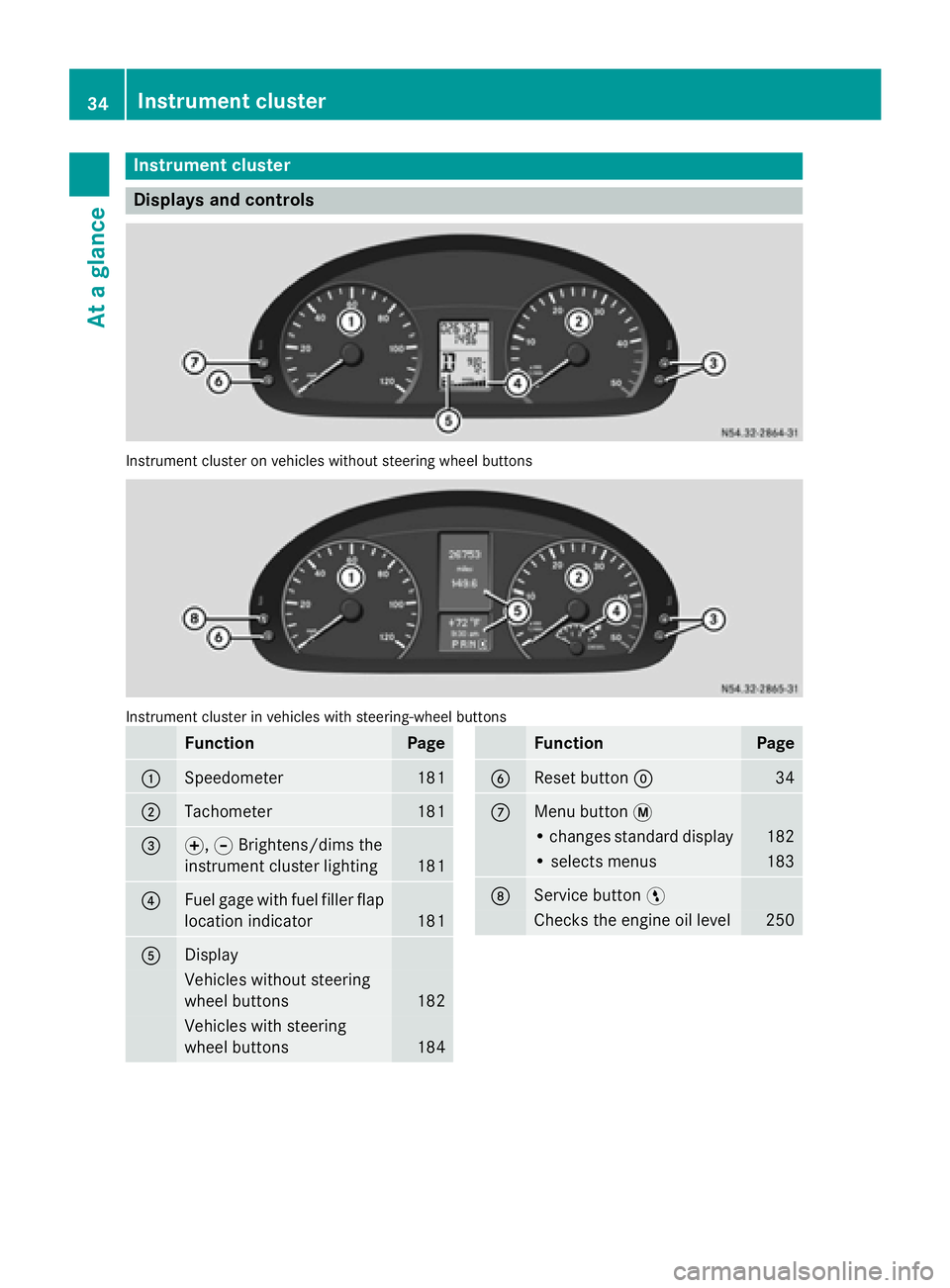
Displays and controls
Instrument cluster on vehicles without steering wheel buttons
Instrument cluster in vehicles with steering-wheel buttons
Function Page
0043
Speedometer 181
0044
Tachometer 181
0087
0074,
0075Brightens/dims the
instrument cluster lighting 181
0085
Fuel gage with fuel filler flap
location indicator 181
0083
Display
Vehicles without steering
wheel buttons
182
Vehicles with steering
wheel buttons 184 Function Page
0084
Reset button
0045 34
006B
Menu button
0079 • changes standard display 182
• selects menus 183
006C
Service button
0098 Checks the engine oil level 25034
Instrument clusterAt a glance
Page 37 of 334
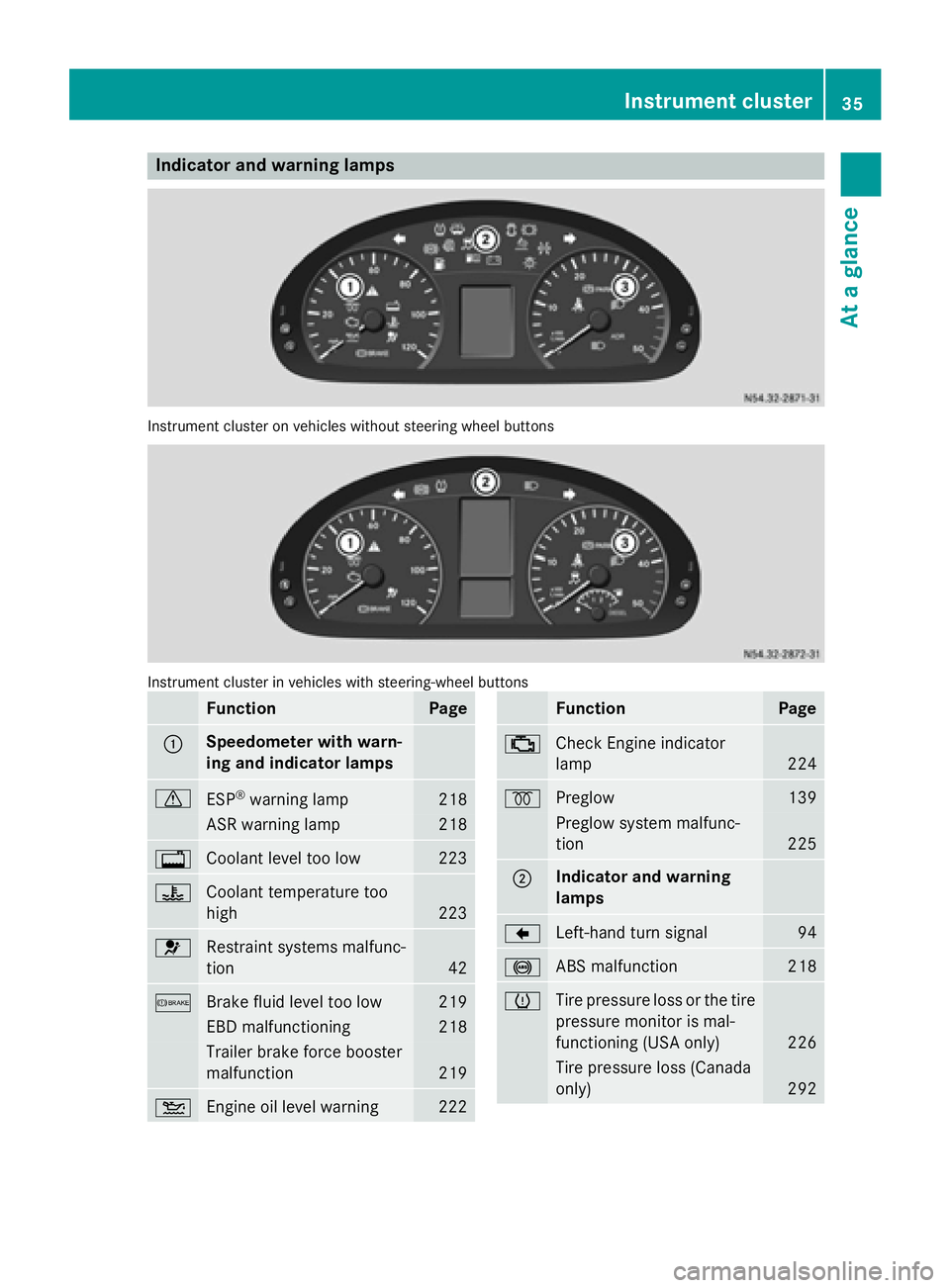
Indicator and warning lamps
Instrument cluster on vehicles without steering wheel buttons
Instrument cluster in vehicles with steering-wheel buttons
Function Page
0043 Speedometer with warn-
ing and indicator lamps
0072
ESP
®
warning lamp 218
ASR warning lamp 218
003F
Coolant level too low 223
00AC
Coolant temperature too
high 223
0075
Restraint systems malfunc-
tion 42
0065
Brake fluid level too low 219
EBD malfunctioning 218
Trailer brake force booster
malfunction
219
00B2
Engine oil level warning 222 Function Page
00B9
Check Engine indicator
lamp
224
0028
Preglow 139
Preglow system malfunc-
tion
225
0044 Indicator and warning
lamps
004A
Left-hand turn signal 94
0025
ABS malfunction 218
0077
Tire pressure loss or the tire
pressure monitor is mal-
functioning (USA only) 226
Tire pressure loss (Canada
only)
292Instrument cluster
35At a glance
Page 44 of 334
Useful information
This Operator's Manual describes all models
as well as standard and optional equipment of your vehicle that were available at the time of going to print. Country-specific variations are
possible. Note that your vehicle may not be
equipped with all of the described functions.
This also applies to systems and functions
relevant to safety.
Read the information on qualified specialist
workshops (Y page 25). Occupant safety
Restraint system introduction
The restraint system reduces the risk of vehi- cle occupants coming into contact with parts of the vehicle's interior in the event of an
accident. The restraint system can also
reduce the forces to which vehicle occupants
are subjected during an accident.
The restraint system comprises:
R Seat belt system
R Air bags
R Child restraint system
R Child seat securing systems
The components of the restraint system work
in conjunction with each other. They can only
deploy their protective function if, at all times,
all vehicle occupants:
R have fastened their seat belts correctly
(Y page 45)
R have adjusted their seat and head restraint
properly (Y page 82).
As the driver, you also have to make sure that
the steering wheel is adjusted correctly.
Observe the information relating to the cor-
rect driver's seat position (Y page 82).
You also have to make sure that an air bag can inflate properly if deployed (Y page 47).
An air bag supplements a correctly worn seat
belt. As an additional safety device, the air
bag increases the level of protection for vehi- cle occupants in the event of an accident. For
example, if, in the event of an accident, the
protection offered by the seat belt is suffi-
cient, the air bags are not deployed. When an
accident occurs, only the air bags that
increase protection in that particular accident
situation are deployed. However, seat belts
and air bags generally do not protect against objects penetrating the vehicle from the out-
side.
Information on restraint system operation
can be found under "Deployment of Emer-
gency Tensioning Devices and air bags"
(Y page 49).
For more information about children traveling with you in the vehicle and on child restraint
systems, see "Children in the vehicle"
(Y page 51). Important safety notes
G
WARNING
Modifications to the restraint system, may
cause it to no longer work as intended. The
restraint system may then not perform its
intended protective function and may fail in an accident or trigger unexpectedly, for example.
This poses an increased risk of injury or even fatal injury.
Never modify parts of the restraint system.
Never tamper with the wiring, the electronic
components or their software.
If it is necessary to modify an airbag system to
accommodate a person with disabilities, con- tact an authorized Sprinter dealership for
details. USA only: contact our Customer
Assistance Center at 1‑877‑762 ‑8267 for
details. Restraint system warning lamp
The restraint systems functions are checked
after the ignition is switched on and at regular
intervals when the engine is running. This 42
Occupant safetySafety