abs MERCEDES-BENZ SPRINTER 2015 MY15 Operator’s Manual
[x] Cancel search | Manufacturer: MERCEDES-BENZ, Model Year: 2015, Model line: SPRINTER, Model: MERCEDES-BENZ SPRINTER 2015Pages: 334, PDF Size: 5.94 MB
Page 256 of 334
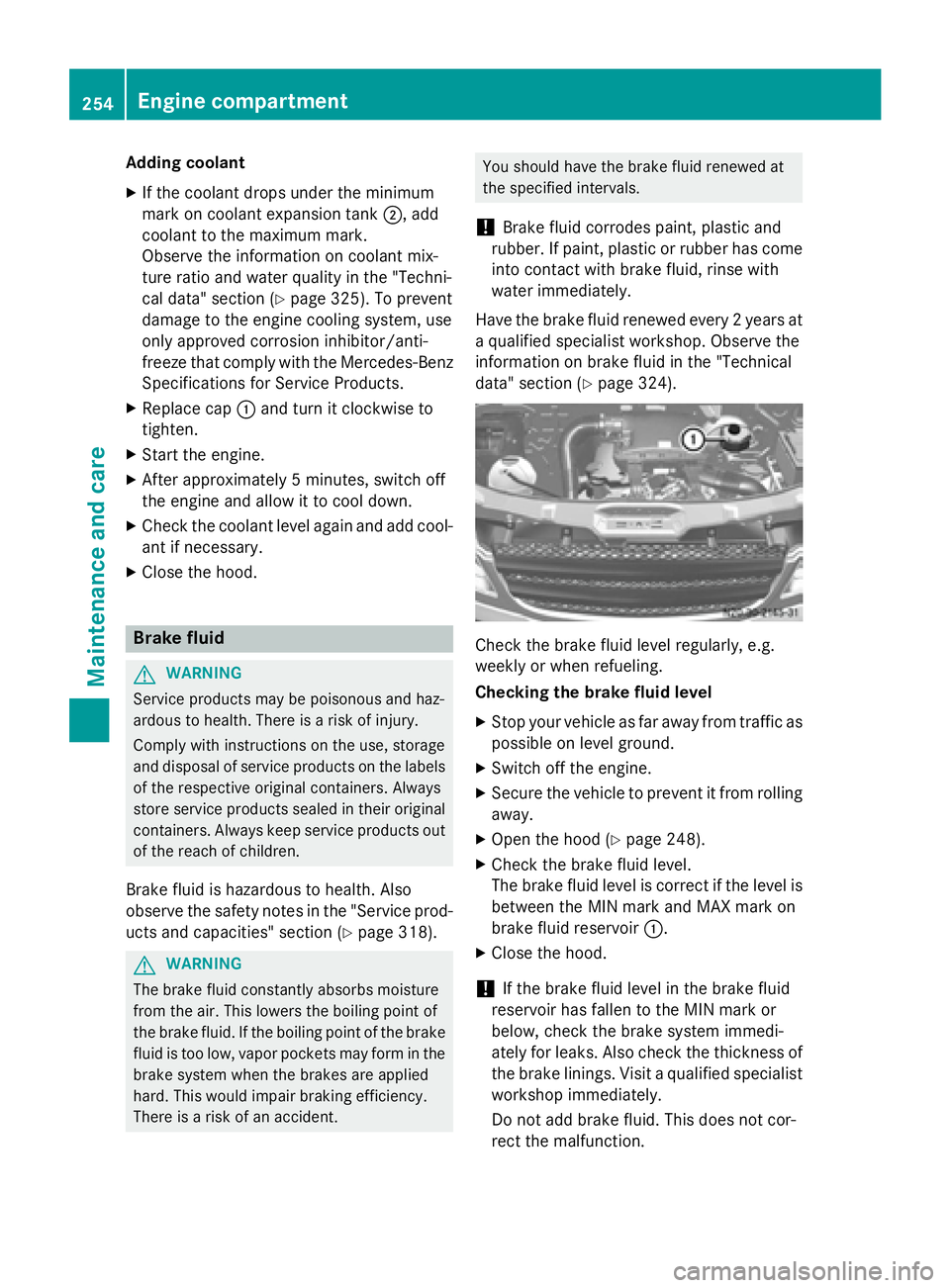
Adding coolant
X If the coolant drops under the minimum
mark on coolant expansion tank 0044, add
coolant to the maximum mark.
Observe the information on coolant mix-
ture ratio and water quality in the "Techni-
cal data" section (Y page 325). To prevent
damage to the engine cooling system, use
only approved corrosion inhibitor/anti-
freeze that comply with the Mercedes-Benz Specifications for Service Products.
X Replace cap 0043and turn it clockwise to
tighten.
X Start the engine.
X After approximately 5 minutes, switch off
the engine and allow it to cool down.
X Check the coolant level again and add cool-
ant if necessary.
X Close the hood. Brake fluid
G
WARNING
Service products may be poisonous and haz-
ardous to health. There is a risk of injury.
Comply with instructions on the use, storage
and disposal of service products on the labels of the respective original containers. Always
store service products sealed in their original containers. Always keep service products out
of the reach of children.
Brake fluid is hazardous to health. Also
observe the safety notes in the "Service prod-
ucts and capacities" section (Y page 318).G
WARNING
The brake fluid constantly absorbs moisture
from the air. This lowers the boiling point of
the brake fluid. If the boiling point of the brake fluid is too low, vapor pockets may form in the brake system when the brakes are applied
hard. This would impair braking efficiency.
There is a risk of an accident. You should have the brake fluid renewed at
the specified intervals.
! Brake fluid corrodes paint, plastic and
rubber. If paint, plastic or rubber has come into contact with brake fluid, rinse with
water immediately.
Have the brake fluid renewed every 2 years at
a qualified specialist workshop. Observe the
information on brake fluid in the "Technical
data" section (Y page 324). Check the brake fluid level regularly, e.g.
weekly or when refueling.
Checking the brake fluid level
X Stop your vehicle as far away from traffic as
possible on level ground.
X Switch off the engine.
X Secure the vehicle to prevent it from rolling
away.
X Open the hood (Y page 248).
X Check the brake fluid level.
The brake fluid level is correct if the level is
between the MIN mark and MAX mark on
brake fluid reservoir 0043.
X Close the hood.
! If the brake fluid level in the brake fluid
reservoir has fallen to the MIN mark or
below, check the brake system immedi-
ately for leaks. Also check the thickness of the brake linings. Visit a qualified specialist
workshop immediately.
Do not add brake fluid. This does not cor-
rect the malfunction. 254
Engine compartmentMaintenance and care
Page 260 of 334
Service due date has been exceeded
Vehicles with steering wheel buttons:
if
you have missed the service due date, one of
the following messages appears in the display and warning tone also sounds.
R 0099 Service A overdue by ... days Service A overdue by ... days
R 0099 Service
Service A
Aoverdue
overdue by
by...
... km
km(kmkm)
Vehicles without steering wheel buttons:
if you have missed the service due date, the
0099 or009A symbol for the service flashes
for 10 seconds after the ignition is switched
on. A minus sign also appears in front of the
service due date.
Calling up the service due date X
Turn the key to position 2in the ignition
lock.
The display is activated.
Vehicles without steering wheel buttons X Press the 0079menu button on the instru-
ment cluster repeatedly until the 0099or
009A symbol for the service appears in the
display.
Additionally, you will see the remaining dis-
tance in miles (mi mi) or kilometers ( km km) or the
remaining time in days ( d
d).
Vehicles with steering wheel buttons
X Press the 0080or007F button on the steer-
ing wheel until the standard display
(Y page 187) appears in the display.
X Press the 0041or0068 button on the steer-
ing wheel repeatedly until the service mes-
sage appears in the display, for example:
R 0099 Service A due in ... days
Service A due in ... days
R 0099 Service A due in ... km Service A due in ... km (kmkm) Battery
Important safety notes
Work on the battery, e.g. removing or instal-
ling, requires specialist knowledge and the
use of special tools. Therefore, always have work on the battery carried out at a qualified
specialist workshop. G
WARNING
Work carried out incorrectly on the battery
can lead, for example, to a short circuit and
thus damage the vehicle electronics. This can lead to function restrictions applying to
safety-relevant systems, e.g. the lighting sys-
tem, ABS (anti-lock braking system) or ESP ®
(Electronic Stability Program). The operating
safety of your vehicle may be restricted. You
could lose control of the vehicle, for example:
R braking
R in the event of abrupt steering maneuver
and/or when the vehicle's speed is not
adapted to the road conditions
There is a risk of an accident.
In the event of a short circuit or a similar inci- dent, contact a qualified specialist workshop
immediately. Do not drive any further. You
should have all work involving the battery car-
ried out at a qualified specialist workshop.
Further information can be found under "ABS"
(Y page 57) and under "ESP ®
" (Y page 59). G
WARNING
Electrostatic build-up can lead to the creation of sparks, which could ignite the highly explo-
sive gases of a battery. There is a risk of an
explosion.
Before handling the battery, touch the vehicle body to remove any existing electrostatic
build-up.
The flammable gas mix is produced when the
battery is charged or when the vehicle is
jump-started.
Always make sure that neither you nor the
battery are electrostatically charged. Electro- static charging results, for example, from:
R wearing synthetic clothing
R friction between clothing and the seat 258
BatteryMaintenance and care
Page 278 of 334
X
Take first-aid kit 0087out of the retainer.
X Fold the cover up and turn the quick-
release fasteners to position 0047.
The cover is locked.
i Check the expiration date on the first-aid
kit at least once a year. Replace any expired or missing contents. Fire extinguisher
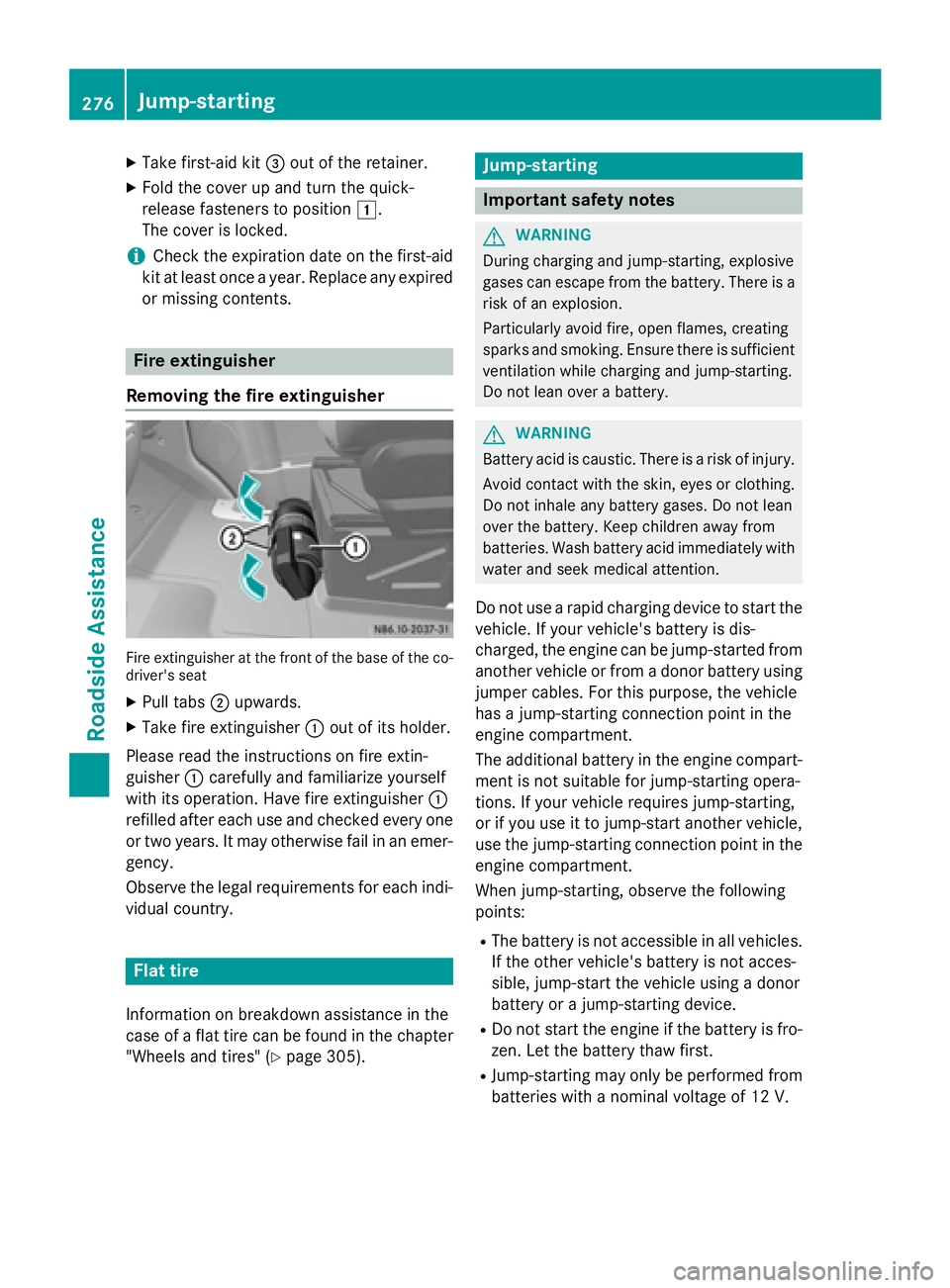
Removing the fire extinguisher Fire extinguisher at the front of the base of the co-
driver's seat
X Pull tabs 0044upwards.
X Take fire extinguisher 0043out of its holder.
Please read the instructions on fire extin-
guisher 0043carefully and familiarize yourself
with its operation. Have fire extinguisher 0043
refilled after each use and checked every one or two years. It may otherwise fail in an emer-
gency.
Observe the legal requirements for each indi- vidual country. Flat tire
Information on breakdown assistance in the
case of a flat tire can be found in the chapter "Wheels and tires" (Y page 305). Jump-starting
Important safety notes
G
WARNING
During charging and jump-starting, explosive
gases can escape from the battery. There is a risk of an explosion.
Particularly avoid fire, open flames, creating
sparks and smoking. Ensure there is sufficient
ventilation while charging and jump-starting.
Do not lean over a battery. G
WARNING
Battery acid is caustic. There is a risk of injury. Avoid contact with the skin, eyes or clothing.
Do not inhale any battery gases. Do not lean
over the battery. Keep children away from
batteries. Wash battery acid immediately with water and seek medical attention.
Do not use a rapid charging device to start the
vehicle. If your vehicle's battery is dis-
charged, the engine can be jump-started from another vehicle or from a donor battery using
jumper cables. For this purpose, the vehicle
has a jump-starting connection point in the
engine compartment.
The additional battery in the engine compart- ment is not suitable for jump-starting opera-
tions. If your vehicle requires jump-starting,
or if you use it to jump-start another vehicle,
use the jump-starting connection point in the
engine compartment.
When jump-starting, observe the following
points:
R The battery is not accessible in all vehicles.
If the other vehicle's battery is not acces-
sible, jump-start the vehicle using a donor
battery or a jump-starting device.
R Do not start the engine if the battery is fro-
zen. Let the battery thaw first.
R Jump-starting may only be performed from
batteries with a nominal voltage of 12 V. 276
Jump-startingRoadside Assistance
Page 288 of 334
approximately
00CDin(1.6 mm). If th is is the
case, the tire is so worn that it must be
replaced. Selecting, mounting and renewing
tires
R Only mount tires and wheels of the same
type and make.
R Only mount tires of the correct size onto
the wheels.
R Break in new tires at moderate speeds for
the first 65 miles (100 km).
R Do not drive with tires which have too little
tread depth, as this significantly reduces
the traction on wet roads (hydroplaning).
R Replace the tires after 6 years at the latest,
regardless of wear. This also applies to the spare wheel. Operation in winter
General notes
Have your vehicle winterproofed at a qualified specialist workshop at the onset of winter.
Prior to the onset of winter, ensure that snow
chains are stowed in the vehicle
(Y page 287).
Also observe the notes in the "Changing a
wheel" section (Y page 305). Driving with summer tires
At temperatures below 45 ‡(+7 †), summer
tires lose elasticity and therefore traction and braking power. Change the tires on your vehi-cle to M+S tire. Using summer tires at very
cold temperatures could cause tears to form,
thereby damaging the tires permanently. We
cannot accept responsibility for this type of
damage. M+S tires
G
WARNING
Wheel and tire dimensions as well as the type of tire can vary between the spare wheel and
the wheel to be replaced. When the spare
wheel is mounted, driving characteristics may be severely affected. There is a risk of an acci-
dent.
In order to reduce risks:
R you should therefore adapt your driving
style and drive carefully.
R never mount more than one spare wheel
that differs from the wheel to be replaced.
R only use a spare wheel that differs from the
wheel to be replaced for a short time.
R do not deactivate ESP ®
.
R have a spare wheel that differs from the
wheel that has been changed replaced at
the nearest qualified specialist workshop.
You must observe the correct wheel and
tire dimensions as well as the wheel type. G
WARNING
M+S tires with a tire tread depth of less than
00CF in (4 mm) are not suitable for use in winter
and do not provide sufficient traction. There is
a risk of an accident.
M+S tires with a tread depth of less than 00CFin
(4 mm) must be replaced immediately.
Use winter tires or all-season tires at temper-
atures below 45 ‡ (+7 †). Both types of tire
are identified by the M+S marking.
Only winter tires bearing the 004Dsnowflake
symbol in addition to the M+S marking pro-
vide the best possible grip in wintry road con- ditions.
Only these tires will allow driving safety sys-
tems such as ABS and ESP ®
to function opti-
mally in winter. These tires have been devel-
oped specifically for driving in snow.
For safe driving, use M+S tires of the same
make and tread pattern on all wheels. 286
Operation in winterWheels and tires
Page 327 of 334
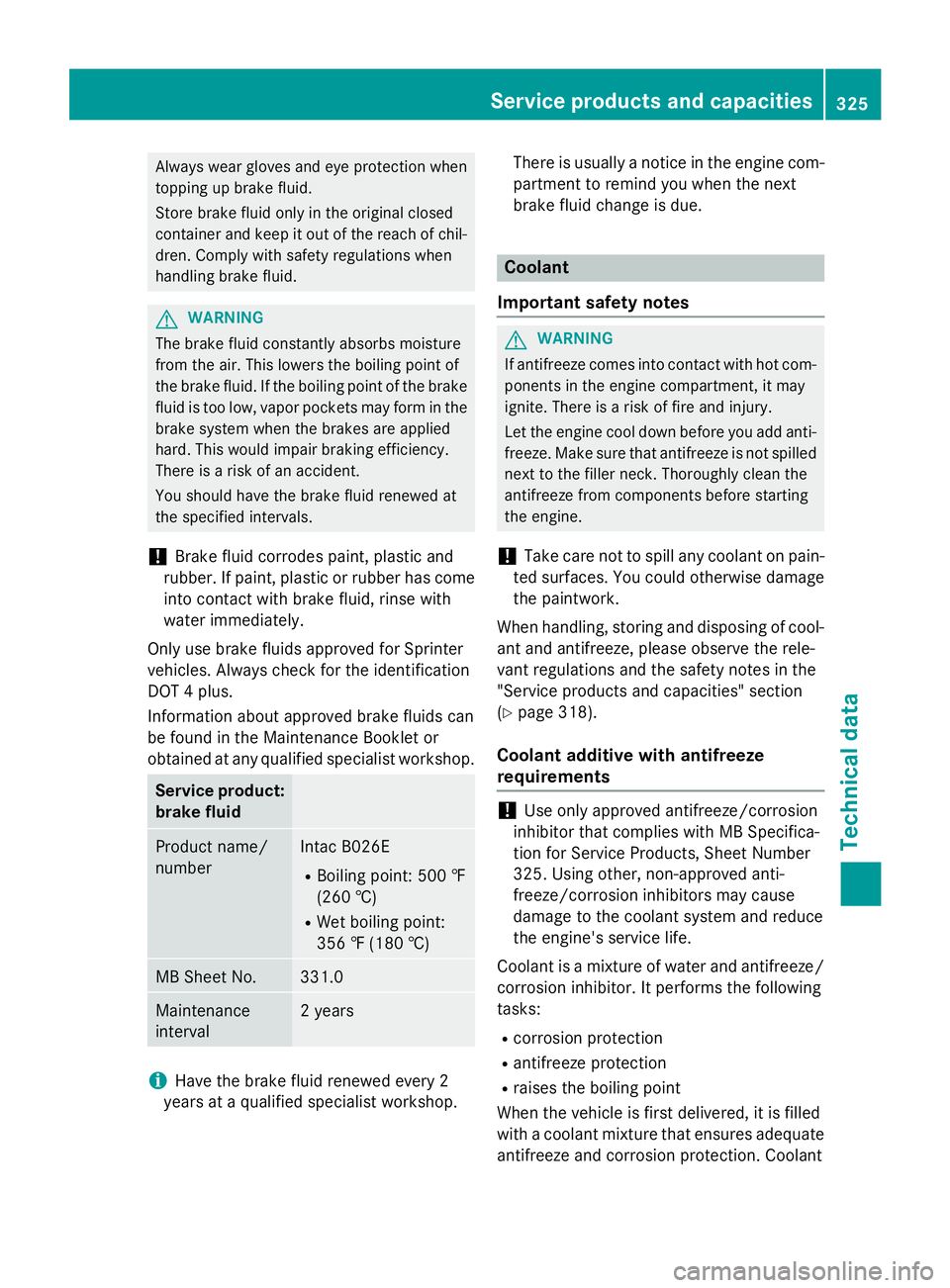
Always wear gloves and eye protection when
topping up brake fluid.
Store brake fluid only in the original closed
container and keep it out of the reach of chil- dren. Comply with safety regulations when
handling brake fluid. G
WARNING
The brake fluid constantly absorbs moisture
from the air. This lowers the boiling point of
the brake fluid. If the boiling point of the brake fluid is too low, vapor pockets may form in the brake system when the brakes are applied
hard. This would impair braking efficiency.
There is a risk of an accident.
You should have the brake fluid renewed at
the specified intervals.
! Brake fluid corrodes paint, plastic and
rubber. If paint, plastic or rubber has come
into contact with brake fluid, rinse with
water immediately.
Only use brake fluids approved for Sprinter
vehicles. Always check for the identification
DOT 4 plus.
Information about approved brake fluids can
be found in the Maintenance Booklet or
obtained at any qualified specialist workshop. Service product:
brake fluid Product name/
number Intac B026E
R Boiling point: 500 ‡
(260 †)
R Wet boiling point:
356 ‡ (180 †) MB Sheet No. 331.0
Maintenance
interval 2 years
i
Have the brake fluid renewed every 2
years at a qualified specialist workshop. There is usually a notice in the engine com-
partment to remind you when the next
brake fluid change is due. Coolant
Important safety notes G
WARNING
If antifreeze comes into contact with hot com- ponents in the engine compartment, it may
ignite. There is a risk of fire and injury.
Let the engine cool down before you add anti-
freeze. Make sure that antifreeze is not spilled
next to the filler neck. Thoroughly clean the
antifreeze from components before starting
the engine.
! Take care not to spill any coolant on pain-
ted surfaces. You could otherwise damage
the paintwork.
When handling, storing and disposing of cool-
ant and antifreeze, please observe the rele-
vant regulations and the safety notes in the
"Service products and capacities" section
(Y page 318).
Coolant additive with antifreeze
requirements !
Use only approved antifreeze/corrosion
inhibitor that complies with MB Specifica-
tion for Service Products, Sheet Number
325. Using other, non-approved anti-
freeze/corrosion inhibitors may cause
damage to the coolant system and reduce
the engine's service life.
Coolant is a mixture of water and antifreeze/ corrosion inhibitor. It performs the following
tasks:
R corrosion protection
R antifreeze protection
R raises the boiling point
When the vehicle is first delivered, it is filled
with a coolant mixture that ensures adequate antifreeze and corrosion protection. Coolant Service products and capacities
325Technical data Z
Page 329 of 334
When handling washer fluid, observe the
important safety notes on service products
(Y page 318).
Mixing ratio Add windshield washer concentrate to the
washer fluid all year round. Adapt the mixing
ratio to the ambient temperature.
At temperatures above freezing:
X Fill up the washer fluid reservoir with a mix-
ture of water and windshield washer con-
centrate, e.g. Summerwash to prevent
smearing.
At temperatures below freezing: X Fill up the washer fluid reservoir with a mix-
ture of water and windshield washer con-
centrate, e.g. Winterwash if there is a dan- ger of frost.
This prevents washer fluid from freezing on the windshield.
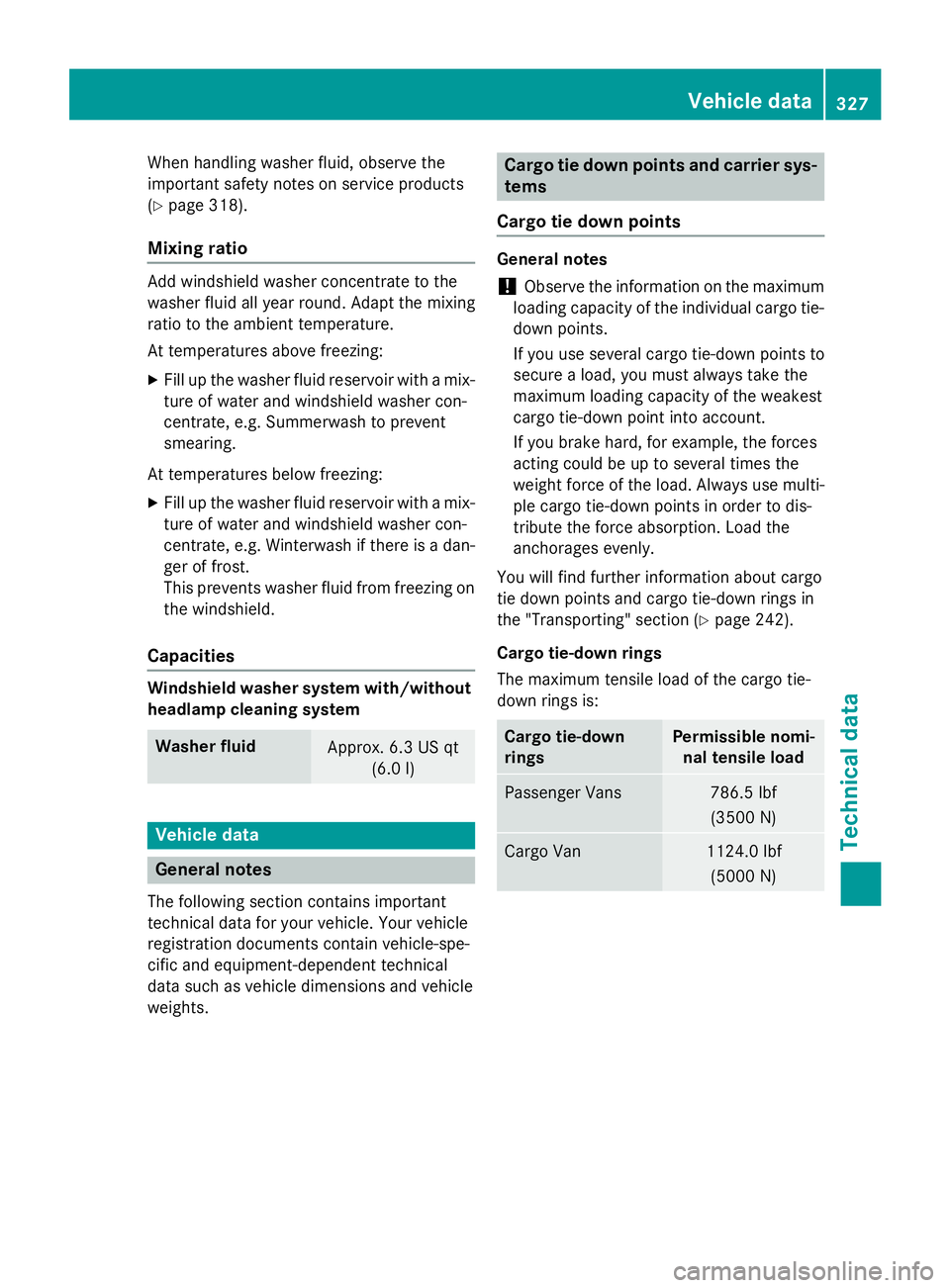
Capacities Windshield washer system with/without
headlamp cleaning system Washer fluid
Approx. 6.3 US qt
(6.0l) Vehicle data
General notes
The following section contains important
technical data for your vehicle. Your vehicle
registration documents contain vehicle-spe-
cific and equipment-dependent technical
data such as vehicle dimensions and vehicle
weights. Cargo tie down points and carrier sys-
tems
Cargo tie down points General notes
! Observe the information on the maximum
loading capacity of the individual cargo tie-
down points.
If you use several cargo tie-down points to
secure a load, you must always take the
maximum loading capacity of the weakest
cargo tie-down point into account.
If you brake hard, for example, the forces
acting could be up to several times the
weight force of the load. Always use multi-
ple cargo tie-down points in order to dis-
tribute the force absorption. Load the
anchorages evenly.
You will find further information about cargo
tie down points and cargo tie-down rings in
the "Transporting" section (Y page 242).
Cargo tie-down rings
The maximum tensile load of the cargo tie-
down rings is: Cargo tie-down
rings Permissible nomi-
nal tensile load Passenger Vans 786.5 lbf
(3500 N) Cargo Van 1124.0 lbf
(5000 N) Vehicle data
327Technical data Z