ECU MERCEDES-BENZ SPRINTER 2015 MY15 Operator’s Manual
[x] Cancel search | Manufacturer: MERCEDES-BENZ, Model Year: 2015, Model line: SPRINTER, Model: MERCEDES-BENZ SPRINTER 2015Pages: 334, PDF Size: 5.94 MB
Page 178 of 334
X
Remove the objects that are preventing the
trailer from rolling, e.g. wheel chocks.
X Release the trailer parking brake.
i The subharness of the vehicle has a cable
connection to the brake lamp indicator
lamp.
Observe the maximum permissible trailer
dimensions (width and length).
Most federal states and all Canadian provin-
ces require by law:
R safety chains between the towing vehicle
and the trailer. The chains should be cross-
wound under the trailer drawbar. They must be fastened to the vehicle's trailer cou-
pling, not to the bumper or the axle.
Leave enough slack in the chains. This
allows you to drive round tight corners.
R a separate brake system for certain types
of trailer.
R a safety switch for braked trailers. Find out
the specific requirements according to the
applicable laws.
If the trailer detaches from the towing vehi- cle, the safety switch applies the trailer's
brakes. Towing a trailer
There are numerous legal requirements con-
cerning the towing of a trailer, e.g. speed
restrictions. Make sure your vehicle/trailer
combination complies with local laws. This
not only means where you live, but also any-
where you are driving to. Information is avail-
able from the police and local authorities.
Observe the following when towing a trailer:
R Practice driving around bends, stopping
and backing up at a place where there is no
traffic. This enables you to gain experience and get used to the new handling charac-
teristics.
R Before driving, check:
- that the trailer tow hitch and ball cou-
pling are secure
- that the safety switch for a braked trailer
is functioning properly
- that the safety chains are secure and not
damaged
- that the electrical connections are
secure
- that the lights are working
- that the wheels are in good order and the
tire pressure is correct
R Adjust the exterior mirrors to provide an
unobstructed view of the rear section of the
trailer.
R If the trailer has electronically controlled
brakes, pull the vehicle/trailer combina-
tion away carefully. Brake manually using
the brake controller and check that the
brakes are working.
R Secure the load on the trailer according to
the applicable specifications and current
standards on securing loads (Y page 242).
R When driving with a trailer, check at regular
intervals that the load is secured and that
the brakes and lights are working.
R Bear in mind that the handling will be less
stable when towing a trailer than when driv-
ing without one. Avoid sudden steering
movements.
R The vehicle/trailer combination is heavier,
accelerates more slowly and has a
decreased gradient climbing capability and
a longer braking distance.
It is more susceptible to crosswinds and
requires cautious steering.
R If possible, do not brake suddenly, but
rather moderately at first so that the trailer
can activate its brakes. Then increase the
force on the brake pedal.
R If the automatic transmission repeatedly
shifts between gears when driving on 176
Towing a trailerDriving and pa
rking
Page 179 of 334
inclines, restrict the shift range. Select shift
range 4,3, 2or 1.
Driving in a low gear and at a low speed
reduces the risk of damaging the engine.
R When driving on a downhill gradient, shift to
a low gear and take advantage of the
engine's braking effect.
Avoid continuous brake application as this
may overheat the vehicle brakes and, if
installed, the trailer brakes.
R If the coolant temperature increases dra-
matically while the air-conditioning system
is switched on, switch off the air-condition-
ing system.
Coolant heat can also be dissipated by
switching the airflow and the temperature
of the heater/air conditioning to the maxi-
mum level. Open the windows if necessary.
R When overtaking, pay particular attention
to the extended length of your vehicle/
trailer combination.
Due to the length of your vehicle/trailer
combination you need an additional dis-
tance before you can return to your original
lane. Uncoupling a trailer
G
WARNING
If you uncouple a trailer with the overrun
brake engaged, you could trap your hand
between the vehicle and the trailer drawbar.
There is a risk of injury.
Do not uncouple a trailer if the overrun brake is engaged.
! Do not disconnect a trailer with an
engaged overrun brake. Otherwise, your
vehicle could be damaged by the rebound- ing of the overrun brake.
X Make sure the selector lever of the auto-
matic transmission is in position P.
X Apply the parking brake of the vehicle.
X Close all doors. X
Apply the parking brake of the trailer.
X In addition, secure the trailer against rolling
away with a wheel chock or similar object.
X Remove the trailer cable and safety chains
and decouple the trailer. Permissible trailer loads and trailer
drawbar noseweights
Weight information !
On vehicles with a permissible gross vehi-
cle weight of 11030 lbs (5003 kg), the per- missible gross combination weight is less
than the total of the permissible gross vehi-
cle weight and the permissible trailer load.
Exceeding the permissible gross combina-
tion weight can lead to damage to the driv-
etrain, to the transmission or to the trailer
tow hitch.
If the vehicle or the trailer is fully laden, the relevant value for the permissible gross
vehicle weight or the permissible trailer
load is therefore lower. In this case, the
trailer or the vehicle may only be partially
loaded.
The gross trailer weight (GTW) is calculated by adding the weight of the trailer to the weight
of the load and equipment.
The maximum gross vehicle weight is vehicle-specific and equipment-dependent: 5,000 lbs
(2,268 kg) or 7,500 lbs (3,402 kg).
The maximum perm issible trailer drawbar
noseweight on the ball coupling is 500 lbs
(227 kg) or 750 lbs (340 kg). Theactual nose-
weight may not exceed the value given on the
identification plates of the trailer tow hitch or
the trailer. If the values vary, the lowest value always applies.
The gross combination weight rating (GCWR)is calculated by adding the gross weight of the
trailer to the gross vehicle weight including a
driver's weight of approximately 150 lbs
(68 kg). The permissible Gross Combination
Weight Rating is vehicle-specific and depends
on the equipment level. Towing a trailer
177Driving and parking Z
Page 202 of 334
Display messages
Possible causes/consequences and
0050
0050Solutions Err
Err flashes for 5 seconds, the
00B0indicator lamp also flashes and
then lights up constantly.
Lane Keeping Assist is deactivated and temporarily inoperative.
Possible causes are:
R There are no lane markings present.
R The camera's functionality is impaired due to heavy rain, snow or
fog.
R The camera cannot recognize the road markings:
- It is too dark.
- The lane markings are worn or are covered, for example, by
dirt or snow.
R The windshield is dirty in the camera's field of vision.
X Stop the vehicle paying attention to road and traffic conditions.
X Secure the vehicle to prevent it from rolling away (Y page 149).
X Clean the windshield (Y page 267), particularly in the camera's
field of vision.
If the 00B0 indicator lamp goes out, Lane Keeping Assist is
operational again.
If the problem persists, visit a qualified specialist workshop. 0099
dEF Chk dEF Chk In addition, the yellow
00B9Check Engine indicator lamp and the
yellow 00E2DEF indicator lamp light up and a warning tone
sounds.
The DEF reducing agent is contaminated, diluted or is not compli-
ant with ISO 2224 1.
After the first message and under normal operating conditions,
you can drive on for up to approximately 50 miles (80 km). Then a warning tone sequence sounds and the engine can only be started
another 10 times.
X Have the DEF tank cleaned and refilled at a qualified specialist
workshop as soon as possible. 200
Display messagesOn-board computer and displays
Page 204 of 334
Display messages
Possible causes/consequences and
0050
0050Solutions 0099
StArtS RExx StArtS RExx In addition, the yellow
00E2DEF indicator lamp lights up and a
warning tone sequence sounds.
The DEF supply has dropped below the 0.8 US gal (3.0 l) reserve
mark.
After the message appears for the first time, the remaining DEF
supply will last for approximately 1000 miles (1600 km). The
engine can then only be started another 16 times.
The number of remaining engine starts XX XX(1616 to1
1) is shown in the
message every time the engine is started.
X Add at least 2.0 US gal (7.6 l) of DEF (Y page 147).
The 00E2 DEF indicator lamp disappears after no more than
20 seconds after the vehicle has stopped or you have switched
on the ignition or started the engine after refueling. 0099
StArtS IdLE StArtS IdLE If the message
StArtS IdLE
StArtS IdLEis displayed, you cannot drive the
vehicle at a speed exceeding 5 mph (8 km/h).
X Add at least 2.0 US gal (7.6 l) of DEF (Y page 147).
The 00E2 DEF indicator lamp disappears after no more than
20 second safter the vehicle has stopped or you have switched
on the ignition or started the engine after refueling. Err
Err flashes for 5 seconds, the
00CEindicator lamp also flashes and
then goes out.
Highbeam Assist is deactivated and temporarily not operational or
Highbeam Assist is malfunctioning.
Possible causes are:
R The camera's functionality is impaired due to heavy rain, snow or
fog.
R The windshield is dirty in the camera's field of vision.
X Stop the vehicle paying attention to road and traffic conditions.
X Secure the vehicle to prevent it from rolling away (Y page 149).
X Clean the windshield (Y page 267), particularly in the camera's
field of vision.
If the 00CE indicator lamp goes out, Highbeam Assist is opera-
tional again.
If the problem persists, visit a qualified specialist workshop. 202
Display messagesOn-board computer and displays
Page 212 of 334
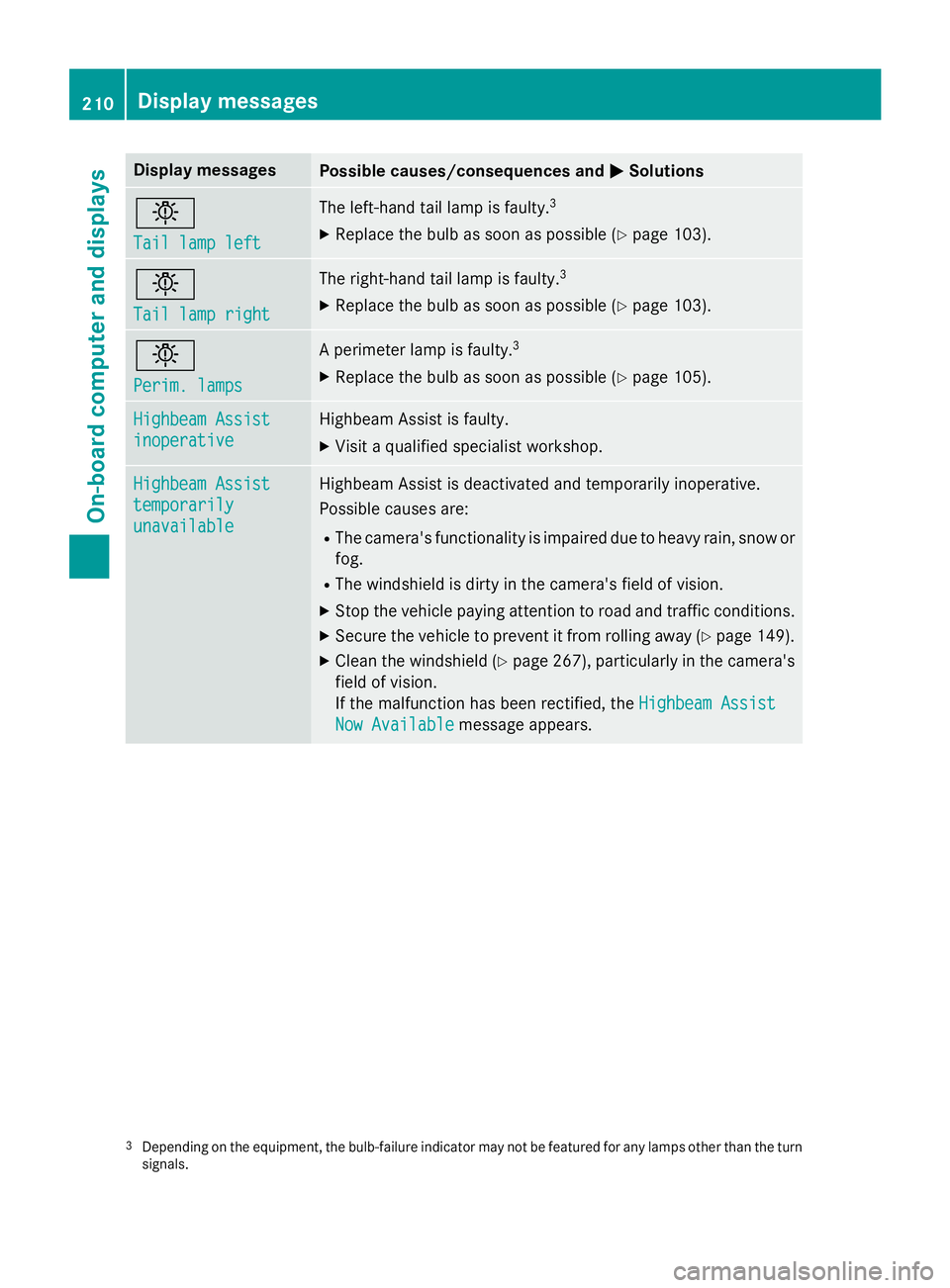
Display messages
Possible causes/consequences and
0050
0050Solutions 0049
Tail lamp left Tail lamp left The left-hand tail lamp is faulty.
3
X Replace the bulb as soon as possible (Y page 103).0049
Tail lamp right Tail lamp right The right-hand tail lamp is faulty.
3
X Replace the bulb as soon as possible (Y page 103).0049
Perim. lamps Perim. lamps A perimeter lamp is faulty.
3
X Replace the bulb as soon as possible (Y page 105).Highbeam Assist
Highbeam Assist
inoperative inoperative Highbeam Assist is faulty.
X Visit a qualified specialist workshop. Highbeam Assist
Highbeam Assist
temporarily temporarily
unavailable unavailable Highbeam Assist is deactivated and temporarily inoperative.
Possible causes are:
R The camera's functionality is impaired due to heavy rain, snow or
fog.
R The windshield is dirty in the camera's field of vision.
X Stop the vehicle paying attention to road and traffic conditions.
X Secure the vehicle to prevent it from rolling away (Y page 149).
X Clean the windshield (Y page 267), particularly in the camera's
field of vision.
If the malfunction has been rectified, the Highbeam Assist Highbeam Assist
Now Available
Now Available message appears. 3
Depending on the equipment, the bulb-failure indicator may not be featured for any lamps other than the turn
signals. 210
Display
messagesOn-board computer and displays
Page 216 of 334
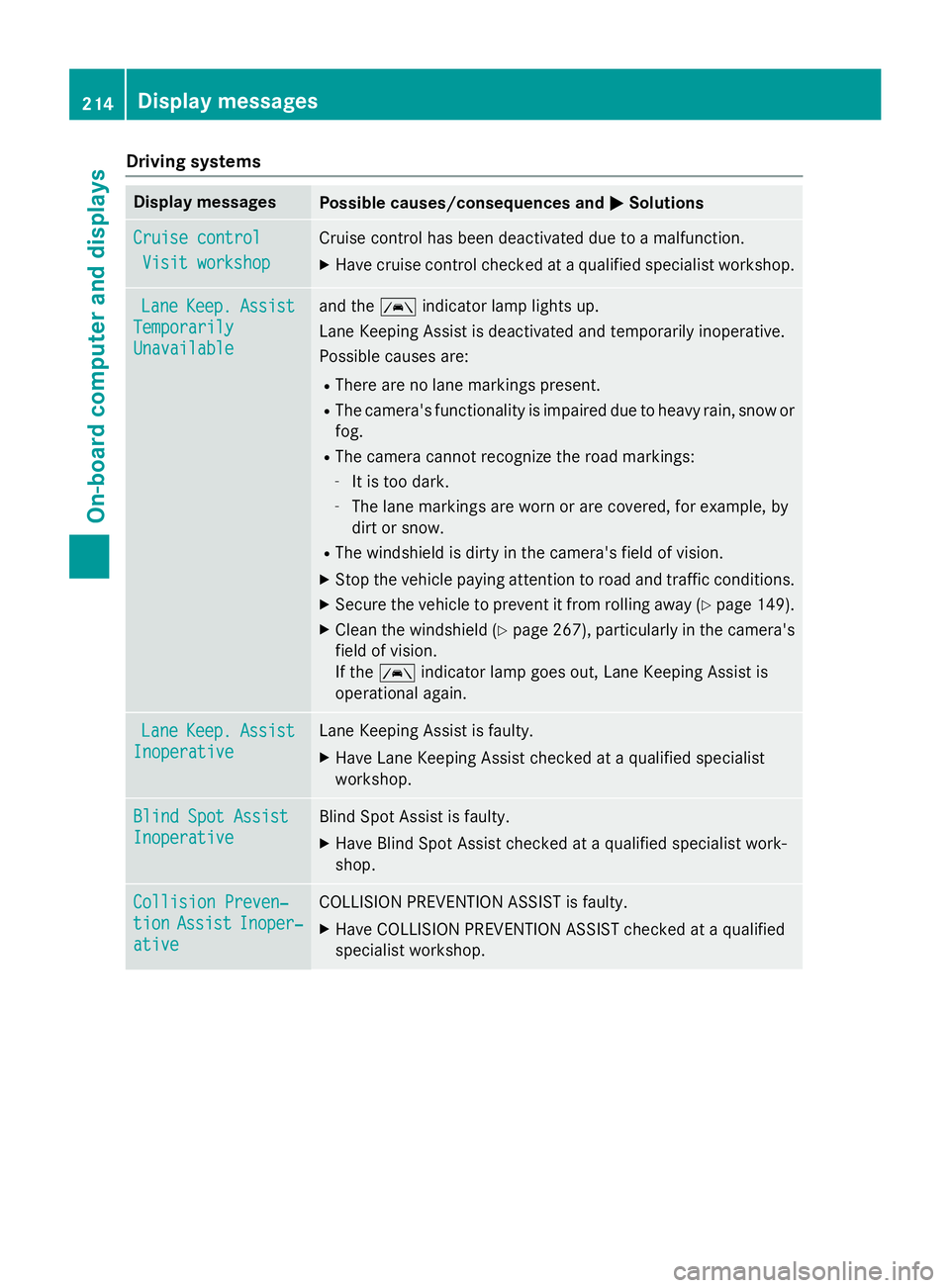
Driving systems
Display messages
Possible causes/consequences and
0050
0050Solutions Cruise control
Cruise control
Visit workshop
Visit workshop Cruise control has been deactivated due to a malfunction.
X Have cruise control checked at a qualified specialist workshop. Lane
Lane
Keep.
Keep. Assist
Assist
Temporarily
Temporarily
Unavailable Unavailable and the
00B0indicator lamp lights up.
Lane Keeping Assist is deactivated and temporarily inoperative.
Possible causes are:
R There are no lane markings present.
R The camera's functionality is impaired due to heavy rain, snow or
fog.
R The camera cannot recognize the road markings:
- It is too dark.
- The lane markings are worn or are covered, for example, by
dirt or snow.
R The windshield is dirty in the camera's field of vision.
X Stop the vehicle paying attention to road and traffic conditions.
X Secure the vehicle to prevent it from rolling away (Y page 149).
X Clean the windshield (Y page 267), particularly in the camera's
field of vision.
If the 00B0 indicator lamp goes out, Lane Keeping Assist is
operational again. Lane Lane
Keep.
Keep. Assist
Assist
Inoperative
Inoperative Lane Keeping Assist is faulty.
X Have Lane Keeping Assist checked at a qualified specialist
workshop. Blind Spot Assist Blind Spot Assist
Inoperative Inoperative Blind Spot Assist is faulty.
X Have Blind Spot Assist checked at a qualified specialist work-
shop. Collision Preven‐
Collision Preven‐
tion tion
Assist
Assist Inoper‐
Inoper‐
ative
ative COLLISION PREVENTION ASSIST is faulty.
X Have COLLISION PREVENTION ASSIST checked at a qualified
specialist workshop. 214
Display
messagesOn-board computer and displays
Page 232 of 334
Useful information
This Operator's Manual describes all models
as well as standard and optional equipment of your vehicle that were available at the time of going to print. Country-specific variations are
possible. Note that your vehicle may not be
equipped with all of the described functions.
This also applies to systems and functions
relevant to safety.
Read the information on qualified specialist
workshops (Y page 25). Stowage spaces and stowage com-
partments
Important safety notes
G
WARNING
If you do not correctly store objects in the
vehicle interior, they can slip or be flung
around, thus striking vehicle occupants.
There is a risk of injury, especially when brak- ing or abruptly changing directions.
R Always store objects so that they cannot be
flung around in these or in similar situa-
tions.
R Always make sure that objects do not pro-
trude from stowage compartments, parcel
nets or stowage nets.
R Close lockable stowage compartments
while driving.
R Stow and secure objects that are heavy,
hard, pointy, sharp-edged, fragile or too
large in the trunk.
In addition, observe the information in the
"Loading guidelines" section (Y page 240). Glove box
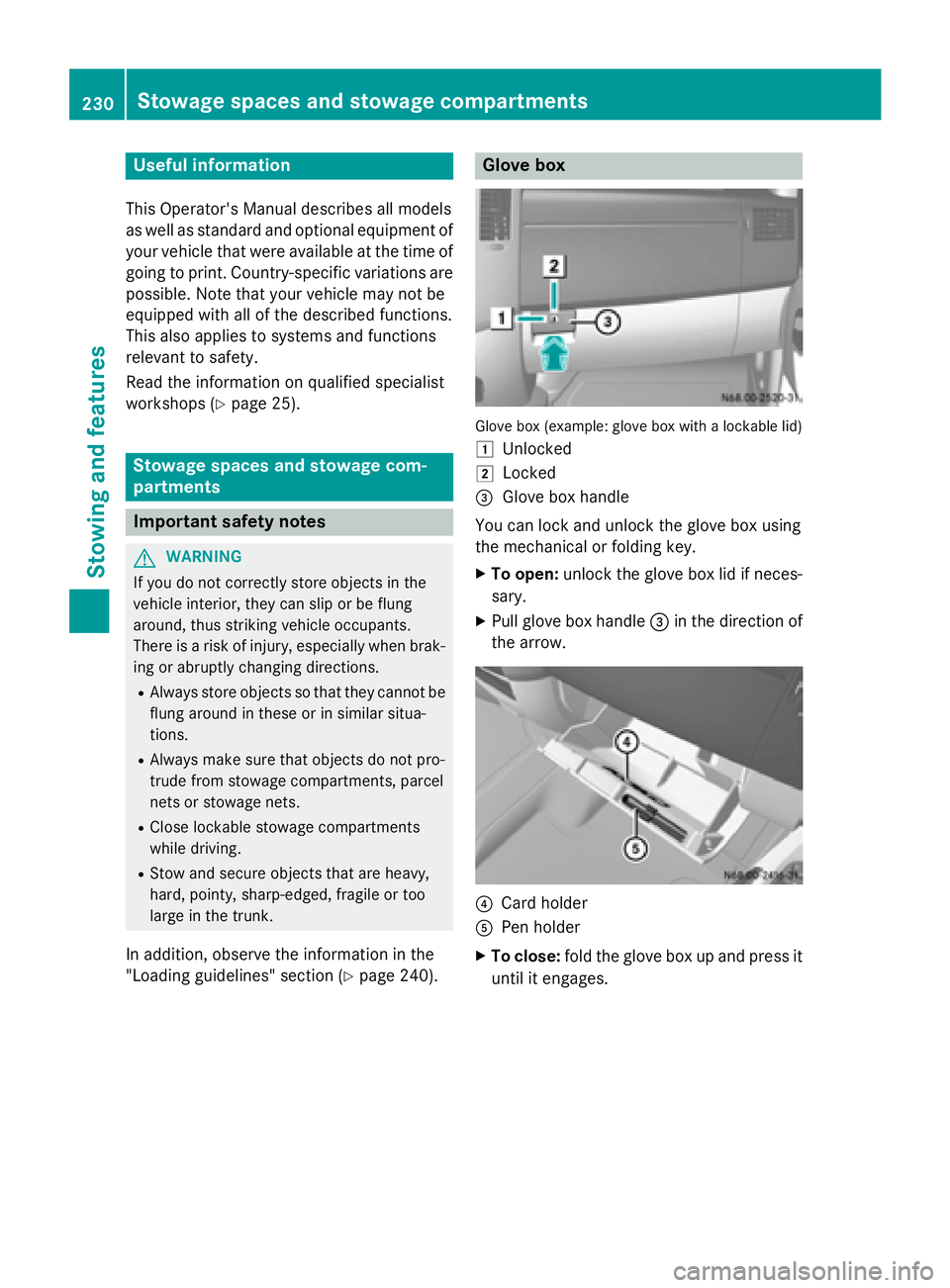
Glove box (example: glove box with a lockable lid)
0047 Unlocked
0048 Locked
0087 Glove box handle
You can lock and unlock the glove box using
the mechanical or folding key.
X To open: unlock the glove box lid if neces-
sary.
X Pull glove box handle 0087in the direction of
the arrow. 0085
Card holder
0083 Pen holder
X To close: fold the glove box up and press it
until it engages. 230
Stowage spaces and stowage compartmentsStowing and features
Page 235 of 334
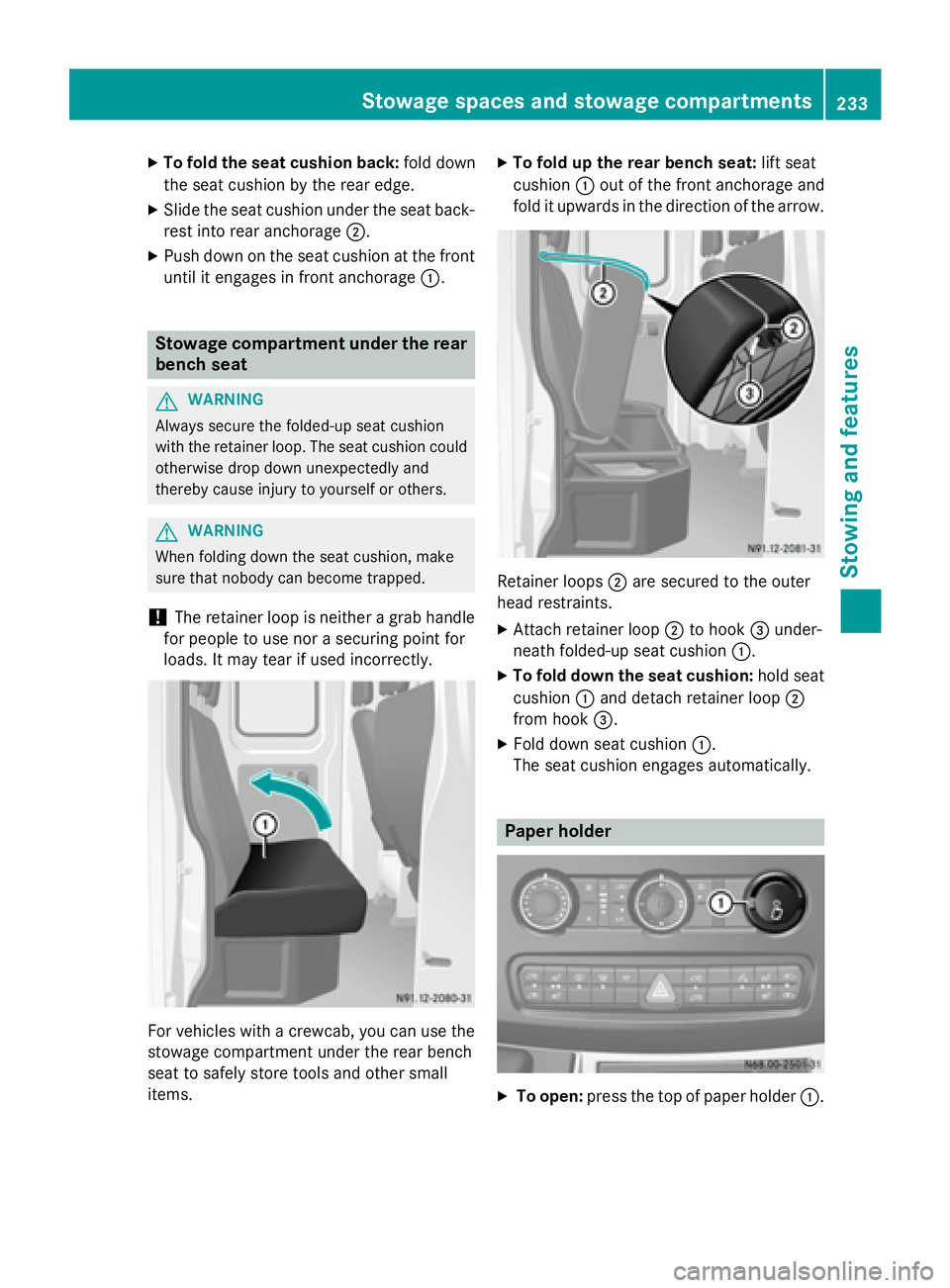
X
To fold the seat cushion back: fold down
the seat cushion by the rear edge.
X Slide the seat cushion under the seat back-
rest into rear anchorage 0044.
X Push down on the seat cushion at the front
until it engages in front anchorage 0043.Stowage compartment under the rear
bench seat G
WARNING
Always secure the folded-up seat cushion
with the retainer loop. The seat cushion could otherwise drop down unexpectedly and
thereby cause injury to yourself or others. G
WARNING
When folding down the seat cushion, make
sure that nobody can become trapped.
! The retainer loop is neither a grab handle
for people to use nor a securing point for
loads. It may tear if used incorrectly. For vehicles with a crewcab, you can use the
stowage compartment under the rear bench
seat to safely store tools and other small
items. X
To fold up the rear bench seat: lift seat
cushion 0043out of the front anchorage and
fold it upwards in the direction of the arrow. Retainer loops
0044are secured to the outer
head restraints.
X Attach retainer loop 0044to hook 0087under-
neath folded-up seat cushion 0043.
X To fold down the seat cushion: hold seat
cushion 0043and detach retainer loop 0044
from hook 0087.
X Fold down seat cushion 0043.
The seat cushion engages automatically. Paper holder
X
To open: press the top of paper holder 0043. Stowage spaces and stowage compartments
233Stowing an d features Z
Page 236 of 334
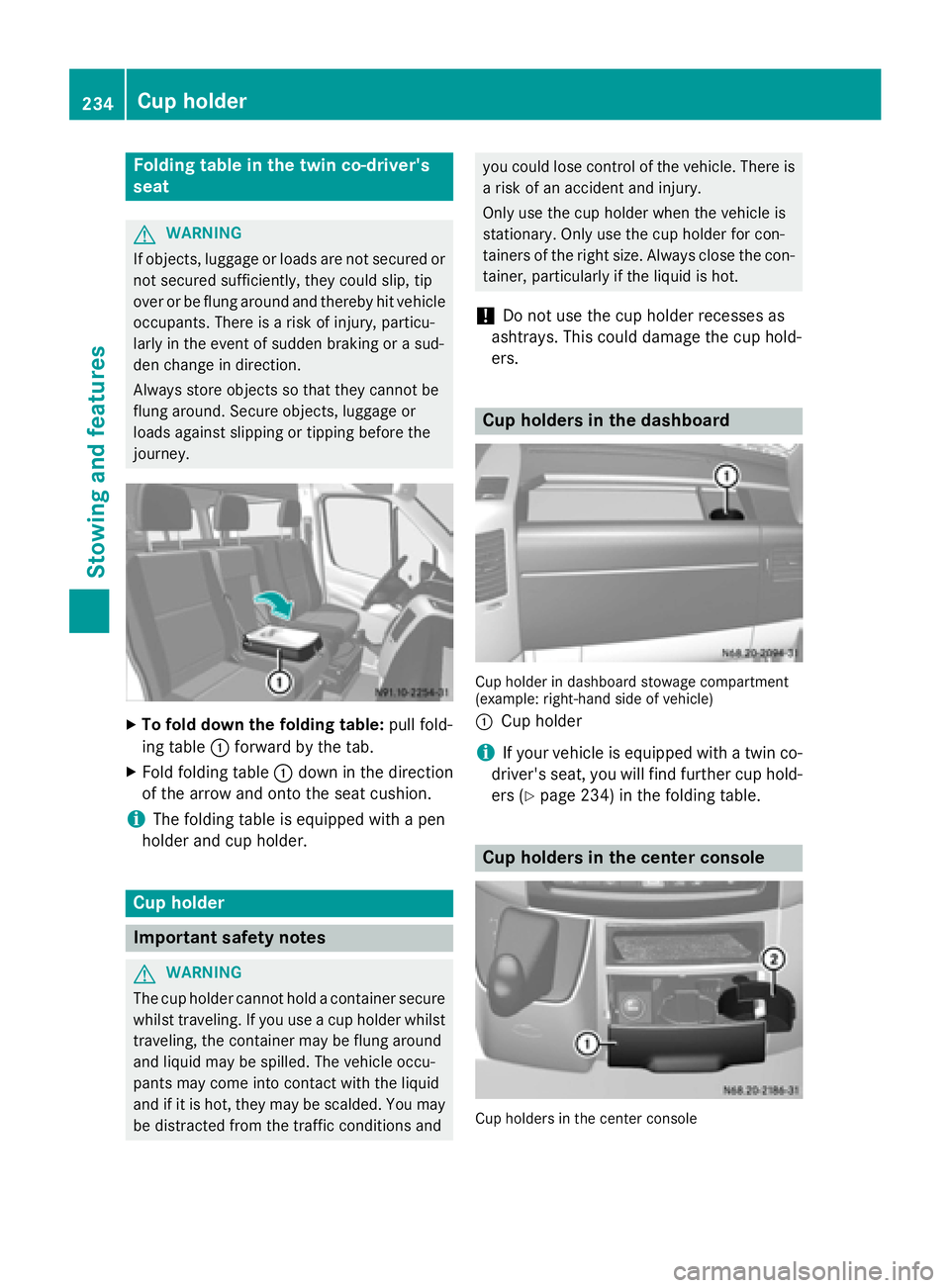
Folding table in the twin co-driver's
seat G
WARNING
If objects, luggage or loads are not secured or not secured sufficiently, they could slip, tip
over or be flung around and thereby hit vehicle
occupants. There is a risk of injury, particu-
larly in the event of sudden braking or a sud-
den change in direction.
Always store objects so that they cannot be
flung around. Secure objects, luggage or
loads against slipping or tipping before the
journey. X
To fold down the folding table: pull fold-
ing table 0043forward by the tab.
X Fold folding table 0043down in the direction
of the arrow and onto the seat cushion.
i The folding table is equipped with a pen
holder and cup holder. Cup holder
Important safety notes
G
WARNING
The cup holder cannot hold a container secure whilst traveling. If you use a cup holder whilsttraveling, the container may be flung around
and liquid may be spilled. The vehicle occu-
pants may come into contact with the liquid
and if it is hot, they may be scalded. You may
be distracted from the traffic conditions and you could lose control of the vehicle. There is
a risk of an accident and injury.
Only use the cup holder when the vehicle is
stationary. Only use the cup holder for con-
tainers of the right size. Always close the con-
tainer, particularly if the liquid is hot.
! Do not use the cup holder recesses as
ashtrays. This could damage the cup hold-
ers. Cup holders in the dashboard
Cup holder in dashboard stowage compartment
(example: right-hand side of vehicle)
0043 Cup holder
i If your vehicle is equipped with a twin co-
driver's seat, you will find further cup hold-
ers (Y page 234) in the folding table. Cup holders in the center console
Cup holders in the center console234
Cup holderStowing and featu
res
Page 239 of 334
You and others can suffer health-related dam-
age through electromagnetic radiation. By
using an exterior antenna, a possible health
risk caused by electromagnetic fields, as dis-cussed in scientific circles, is taken into
account. Only have the exterior antenna
installed by a qualified specialist workshop.
We recommend the use of an approved exte-
rior antenna for operating the mobile phone.
Only in this way can optimal mobile phone
reception quality in the vehicle be ensured
and mutual interference between the vehicle
electronics and mobile phones minimized.
Observe the legal requirements for each indi- vidual country. Mobile phone pre-installation
The mobile phone pre-installation includes a
hands-free system integrated into the vehi-
cle. The microphone for the hands-free sys-
tem is installed in the overhead control panel or in the overhead stowage compartment
together with the front interior light.
In order to use the hands-free system, you will
need a special bracket. The Sprinter acces-
sories include brackets for various mobile
phone models.
i Mobile phone brackets which are availa-
ble from various manufacturers on the
open market are not compatible with the
Sprinter telephone system. You can recog- nize suitable holders for your mobile phoneby the imprinted star and the B6 spare part
number on the back of the bracket.
Detailed instructions for use can be found in
the operating instructions for the mobile
phone bracket and in the separate operating
instructions for the mobile phone pre-instal-
lation.
i The mobile phone battery is charged
depending on the condition of charge and
the position of the key in the ignition lock.
The mobile phone display indicates the
charging process. Additional communications equip-
ment
Important safety notes
G
WARNING
If you operate mobile communication equip-
ment while driving, you will be distracted from traffic conditions. You could also lose controlof the vehicle. There is a risk of an accident.
Only operate this equipment when the vehicleis stationary.
You must observe the legal requirements for
the country in which you are currently driving when operating mobile communication
equipment.
Please remember, a navigation system does
not supply information on the load-bearing
capacity of bridges or the overhead clearance
of underpasses. The driver remains responsi- ble for safety at all times.
You and others can suffer health-related dam-
age through electromagnetic radiation. By
using an exterior antenna, a possible health
risk caused by electromagnetic fields, as dis- cussed in scientific circles, is taken into
account. Only have the exterior antenna
installed by a qualified specialist workshop.
You will find information on installing electri-
cal or electronic equipment in the “Vehicle
electronics” section (Y page 316). Installation for PND mobile navigation
devices
You can secure a personal navigation device
(Personal Navigation Device PND) using a
commercially available adapter. Additional communications equipment
237Stowing and features Z