tire pressure MERCEDES-BENZ SPRINTER 2015 MY15 Operator’s Manual
[x] Cancel search | Manufacturer: MERCEDES-BENZ, Model Year: 2015, Model line: SPRINTER, Model: MERCEDES-BENZ SPRINTER 2015Pages: 334, PDF Size: 5.94 MB
Page 293 of 334
X
If the tire pressure is too high, release air by
pressing down the metal pin in the valve.
Use the tip of a pen, for example. Then,
check the tire pressure again using the tire
pressure gauge.
X Screw the valve cap onto the valve.
X Repeat the steps for the other tires. Tire pressure monitor
Important safety notes G
WARNING
Each tire, including the spare (if provided),
should be checked at least once a month
when cold and inflated to the pressure rec-
ommended by the vehicle manufacturer on
the Tire and Loading Information placard on
the driver's door B-pillar or the tire pressure
label on the inside of the fuel filler flap. If your vehicle has tires of a different size than the
size indicated on the Tire and Loading Infor-
mation placard or the tire pressure label, you should determine the proper tire pressure for
those tires.
As an added safety feature, your vehicle has
been equipped with a tire pressure monitoring system (TPMS) that illuminates a low tire pres-
sure telltale when one or more of your tires
are significantly underinflated. Accordingly,
when the low tire pressure telltale illuminates,
you should stop and check your tires as soon
as possible, and inflate them to the proper
pressure. Driving on a significantly underin-
flated tire causes the tire to overheat and can lead to tire failure. Underinflation also
reduces fuel efficiency and tire tread life, and may affect the vehicle's handling and stop-
ping ability.
Please note that the TPMS is not a substitute
for proper tire maintenance, and it is the driv-
er's responsibility to maintain correct tire
pressure, even if underinflation has not
reached the level to trigger illumination of the
TPMS low tire pressure telltale.
USA only: Your vehicle has also been equipped with a
TPMS malfunction indicator to indicate if the
system is not operating properly. The TPMS
malfunction indicator is combined with the
low tire pressure telltale. When the system
detects a malfunction, the warning lamp will
flash for approximately a minute and then
remain continuously illuminated. This
sequence will be repeated every time the vehi-
cle is started as long as the malfunction
exists.
When the malfunction indicator is illuminated,
the system may not be able to detect or signal low tire pressure as intended. TPMS malfunc-tions may occur for a variety of reasons,
including the mounting of incompatible
replacement or alternate tires or wheels on
the vehicle that prevent the TPMS from func-
tioning properly. Always check the TPMS mal-
function telltale after replacing one or more
tires or wheels on your vehicle to ensure that the replacement or alternate tires and wheels
allow the TPMS to continue to function prop-
erly.
Vehicles with a tire pressure monitor are
equipped with sensors in the wheels that
monitor the tire pressure of all four tires. The tire pressure monitor monitors the pressure
in all four tires; you set this pressure when you
activate the tire pressure monitor. The tire
pressure monitor warns you when the pres-
sure drops in one or more of the tires. The tire
pressure monitor only functions if the corre-
sponding sensors are installed on all wheels.
You should always adjust the tire pressure
according to the vehicle load. Restart the tire
pressure monitor if you change the tire pres-
sure.
The tire pressure monitor does not warn you if a tire pressure is incorrect. Observe the notes
on the recommended tire pressure
(Y page 288).
The tire pressure monitor is not able to warn
you of a sudden loss of pressure, e.g. follow-
ing penetration by a foreign object. In this
event, brake the vehicle until it comes to a Tire pressure
291Wheels and tires Z
Page 294 of 334
standstill. Do not carry out any sudden steer-
ing maneuvers.
The tire pressure monitor has a yellow 0077
warning lamp in the instrument cluster for
indicating pressure loss/malfunctions (USA)
or pressure loss (Canada). Depending on how
the warning lamp flashes or lights up, an
underinflated tire or a malfunction in the tire
pressure monitor is displayed:
R if the 0077 warning lamp is lit continuously,
the tire pressure on one or more tires is
significantly too low. The tire pressure mon-
itor is not malfunctioning.
R USA only: if the 0077warning lamp flashes
for 60 seconds and then remains lit con-
stantly, the tire pressure monitor is mal-
functioning.
Only vehicles with steering wheel buttons: the on-board computer displays information on
tire pressure. After a few minutes of driving,
the current tire pressure of each tire is shown
in the on-board computer.
USA only: if the tire pressure monitor is mal-
functioning, it may be more than 10 minutes
before the malfunction is shown. The 0077
tire pressure warning lamp flashes for
60 seconds and then remains lit. When the
malfunction has been rectified, the 0077tire
pressure warning lamp goes out after a few
minutes of driving.
The tire pressure values indicated by the on-
board computer may differ from those meas-
ured at a gas station with a pressure gage.
The tire pressures shown by the on-board
computer refer to those measured at sea
level. At high altitudes, the tire pressure val-
ues indicated by a pressure gage are higher
than those shown by the on-board computer. In this case, do not reduce the tire pressures.
If radio transmitting equipment (e.g. wireless headphones, two-way radios) is operated
inside the vehicle or in the vicinity of the vehi-
cle, this can interfere with the operation of the tire pressure monitor. Checking the tire pressure electroni-
cally (vehicles with steering wheel but-
tons)
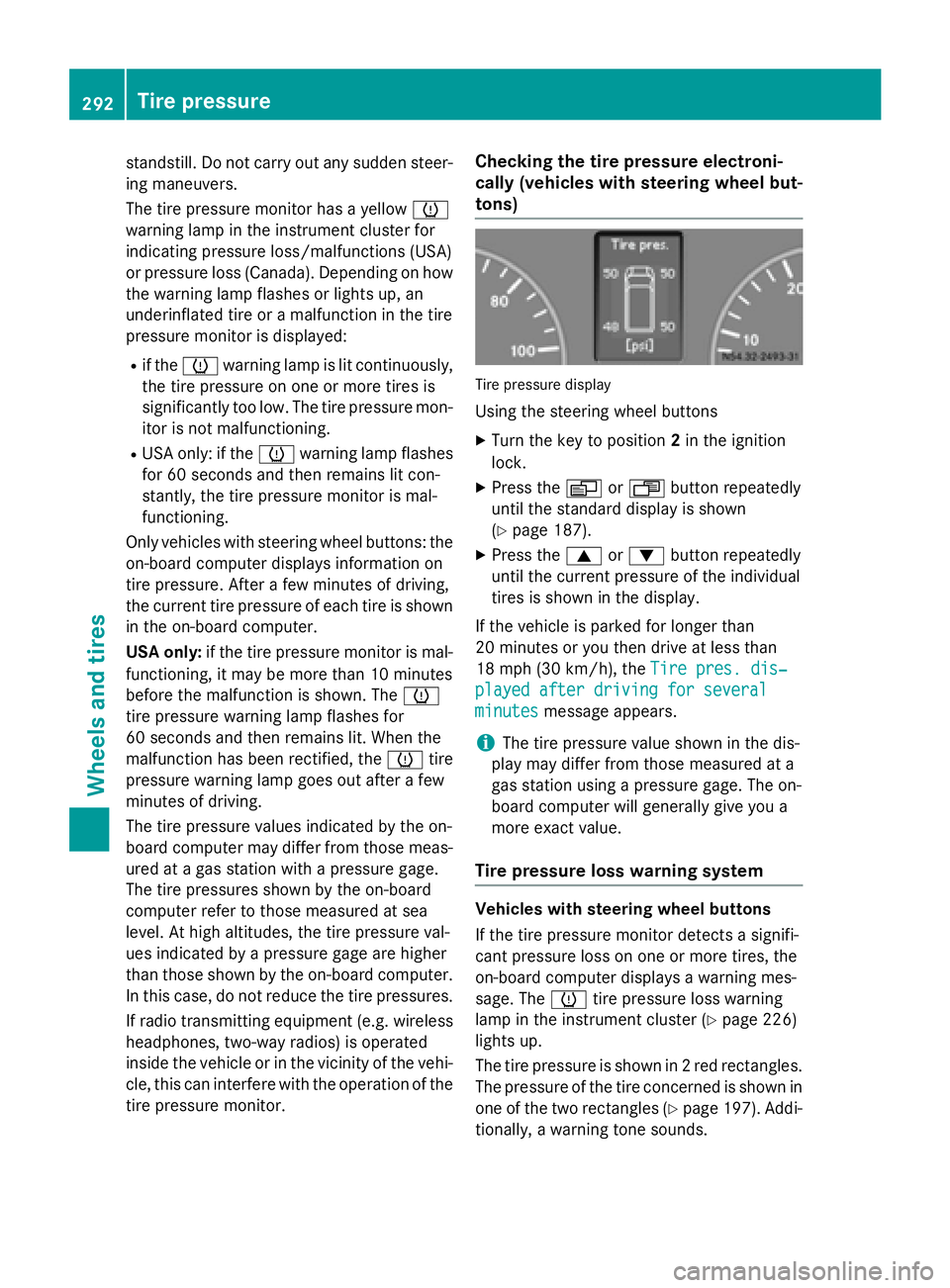
Tire pressure display
Using the steering wheel buttons
X Turn the key to position 2in the ignition
lock.
X Press the 0080or007F button repeatedly
until the standard display is shown
(Y page 187).
X Press the 0063or0064 button repeatedly
until the current pressure of the individual
tires is shown in the display.
If the vehicle is parked for longer than
20 minutes or you then drive at less than
18 mph (30 km/h), the Tire pres. dis‐ Tire pres. dis‐
played after driving for several played after driving for several
minutes minutes message appears.
i The tire pressure value shown in the dis-
play may differ from those measured at a
gas station using a pressure gage. The on-
board computer will generally give you a
more exact value.
Tire pressure loss warning system Vehicles with steering wheel buttons
If the tire pressure monitor detects a signifi-
cant pressure loss on one or more tires, the
on-board computer displays a warning mes-
sage. The 0077tire pressure loss warning
lamp in the instrument cluster (Y page 226)
lights up.
The tire pressure is shown in 2 red rectangles. The pressure of the tire concerned is shown in
one of the two rectangles (Y page 197). Addi-
tionally, a warning tone sounds. 292
Tire pressureWheels and tires
Page 295 of 334
Each tire that is affected by a significant loss
of pressure is highlighted in the pressure dis-
play.
Restarting the tire pressure monitor When you restart the tire pressure monitor,
the currently set tire pressure are taken as
reference values for monitoring.
In most cases, the tire pressure monitor
detects the new reference values automati-
cally, e.g. after you have:
R changed the tire pressure
R changed wheels or tires
R installed new wheels or tires
However, you can also define reference val-
ues manually as described here.
Before restarting the tire pressure moni-
tor:
X Set the tire pressure to the value recom-
mended on the Tire and Loading Informa-
tion placard or the tire pressure table on
the B-pillar on the driver's side
(Y page 288).
Observe the notes on tire pressure when
doing so (Y page 288).
X Make sure that the tire pressure is correct
on all four wheels.
Restarting the tire pressure monitor
(vehicles without steering wheel but-
tons):
X Turn the key to position 2in the ignition
lock.
X Press the 0079menu button on the instru-
ment cluster repeatedly until the display
shows the following message:
+CAL- TPMS
+CAL- TPMS
X Press the 0074button on the instrument clus-
ter.
The display shows:
OK TPMS
OK TPMS
The tire pressure monitor activation proc-
ess has begun. The tire pressures meas-
ured for the individual wheels are stored as the new reference values, provided that the
tire pressure monitor considers them to be plausible.
If you wish to cancel the restart:
X Press the 0075button or the 0079menu button
on the instrument cluster.
The activation process is canceled auto-
matically if 30 second s elapse without
input.
Restarting the tire pressure monitor
(vehicles with steering wheel buttons): X Turn the key to position 2in the ignition
lock.
X Press the 0080or007F button on the steer-
ing wheel until the standard display
(Y page 187) appears in the display.
X Press the 0063or0064 button on the steer-
ing wheel repeatedly until the current pres-
sure of the individual tires is displayed or
the display shows the following message:
Tire
Tire pres. pres. displayed
displayed after
afterdriving
driving
for several minutes
for several minutes
X Press the 0045reset button on the instru-
ment cluster.
The display shows the following message:
Monitor current tire pressure? Monitor current tire pressure?
X Press the 0081button on the steering
wheel.
The display shows the following message:
Tire pres. monitor reactivated Tire pres. monitor reactivated
The tire pressure monitor activation proc-
ess has begun. The tire pressures meas-
ured for the individual wheels are stored as the new reference values, provided that the
tire pressure monitor considers them to be plausible.
If you wish to cancel the restart:
X Press the 0082button on the steering
wheel. Tire pressure
293Wheels and tires Z
Page 296 of 334
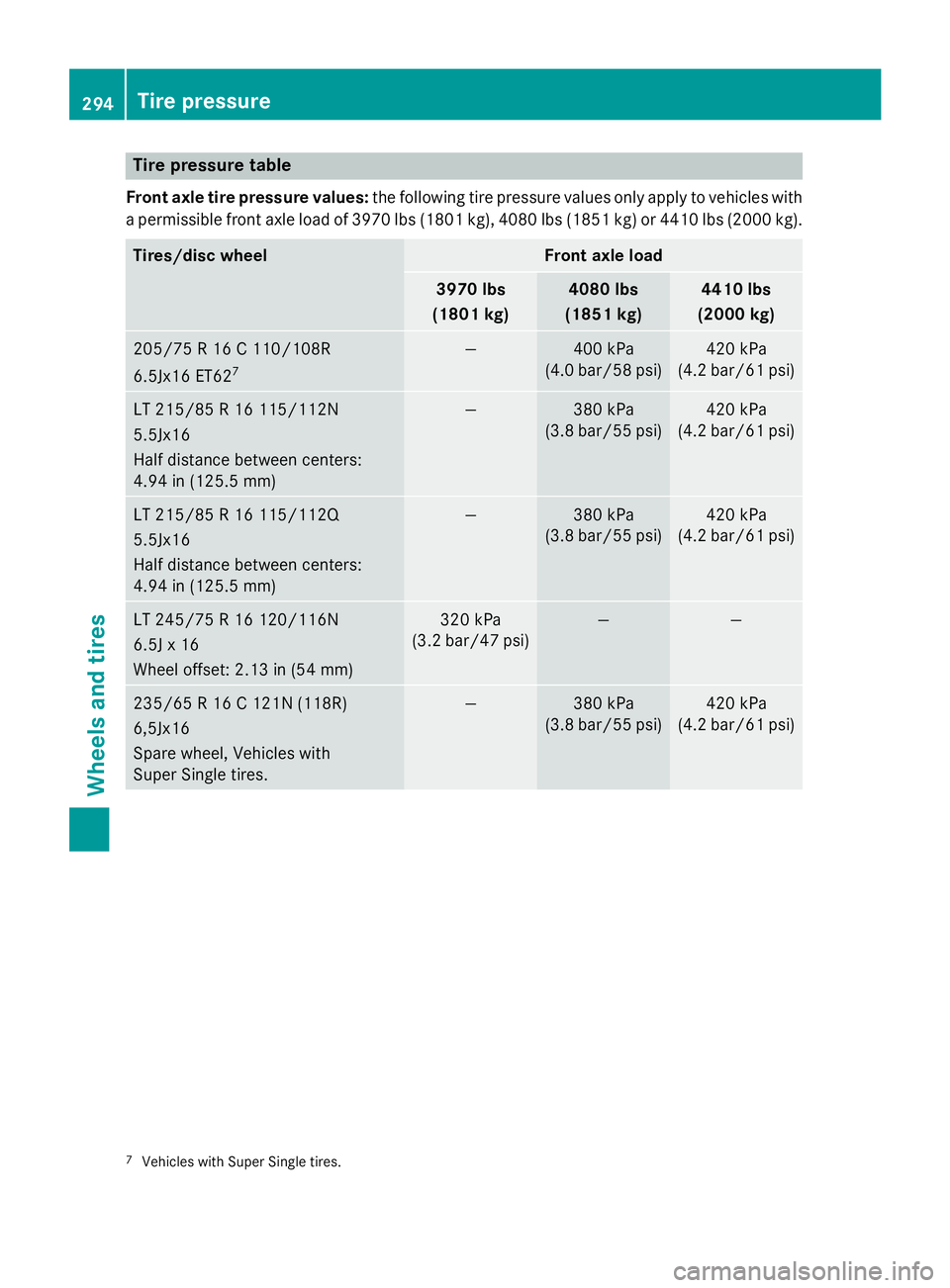
Tire pressure table
Front axle tire pressure values: the following tire pressure values only apply to vehicles with
a permissible front axle load of 3970 lb s(1801 kg), 4080 lbs (1851 kg) or 4410 lbs (2000 kg). Tires/disc wheel Front axle load
3970 lbs
(1801 kg) 4080 lbs
(1851 kg) 4410 lbs
(2000 kg) 205/75 R 16 C 110/108R
6.5Jx16 ET62
7 — 400 kPa
(4.0 bar/58 psi) 420 kPa
(4.2 bar/61 psi) LT 215/85 R 16 115/112N
5.5Jx16
Half distance between centers:
4.94 in (125.5 mm) — 380 kPa
(3.8 bar/55 psi) 420 kPa
(4.2 bar/61 psi) LT 215/85 R 16 115/112Q
5.5Jx16
Half distance between centers:
4.94 in (125.5 mm) — 380 kPa
(3.8 bar/55 psi) 420 kPa
(4.2 bar/61 psi) LT 245/75 R 16 120/116N
6.5J x 16
Wheel offset: 2.13 in (54 mm) 320 kPa
(3.2 bar/47 psi) — —
235/65 R 16 C 121N (118R)
6,5Jx16
Spare wheel, Vehicles with
Super Single tires. — 380 kPa
(3.8 bar/55 psi) 420 kPa
(4.2 bar/61 psi) 7
Vehicles with Super Single tires. 294
Tire pressureWheels and tires
Page 297 of 334
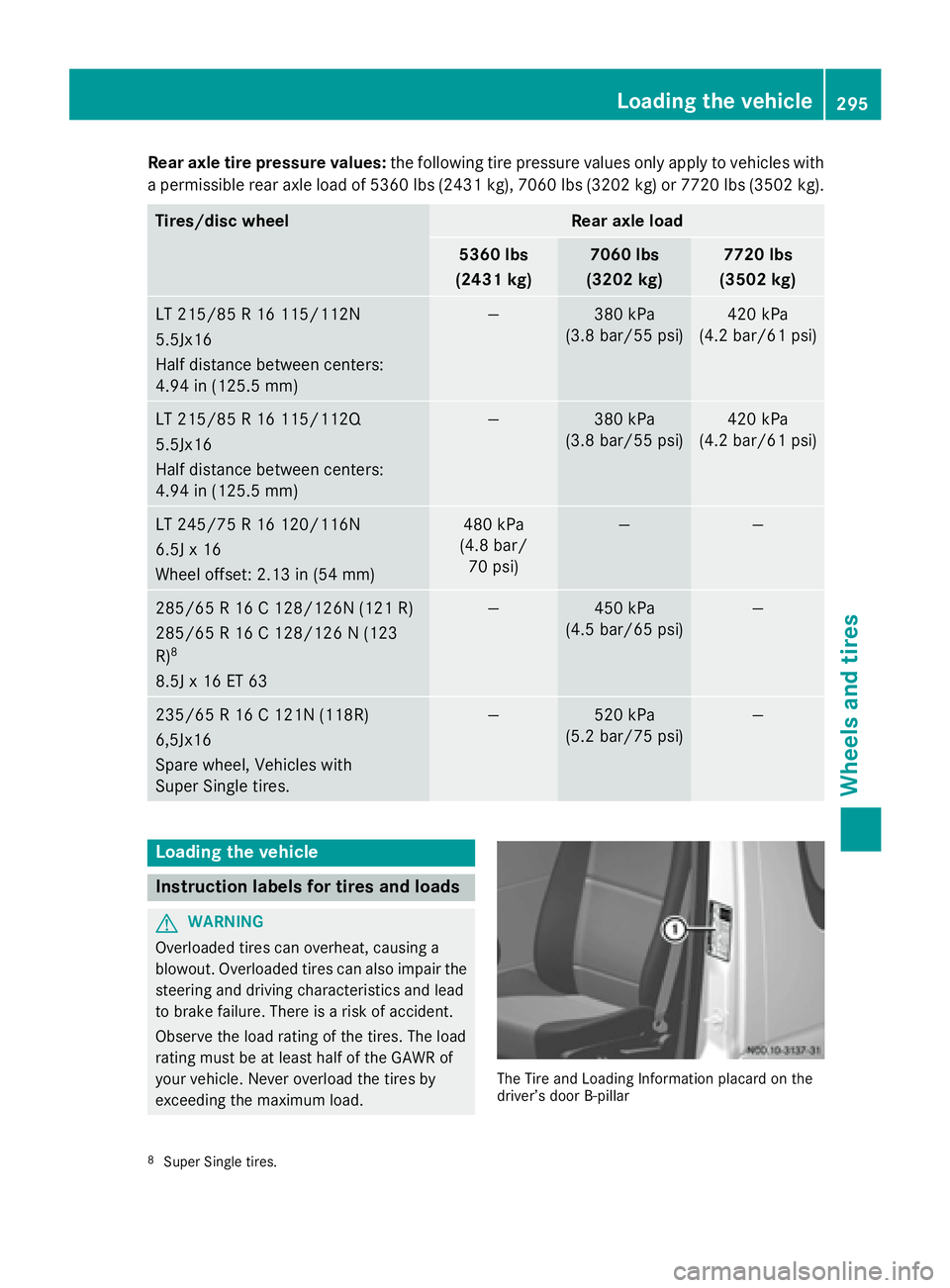
Rear axle tire pressure values:
the following tire pressure values only apply to vehicles with
a permissible rear axle load of 5360 lb s(2431 kg), 7060 lbs (3202 kg) or 7720 lbs (3502 kg). Tires/disc wheel Rear axle load
5360 lbs
(2431 kg) 7060 lbs
(3202 kg) 7720 lbs
(3502 kg) LT 215/85 R 16 115/112N
5.5Jx16
Half distance between centers:
4.94 in (125.5 mm) — 380 kPa
(3.8 bar/55 psi) 420 kPa
(4.2 bar/61 psi) LT 215/85 R 16 115/112Q
5.5Jx16
Half distance between centers:
4.94 in (125.5 mm) — 380 kPa
(3.8 bar/55 psi) 420 kPa
(4.2 bar/61 psi) LT 245/75 R 16 120/116N
6.5J x 16
Wheel offset: 2.13 in (54 mm) 480 kPa
(4.8 bar/ 70 psi) — —
285/65 R 16 C 128/126N (121 R)
285/65 R 16 C 128/126 N (123
R)
8
8.5J x 16 ET 63 — 450 kPa
(4.5 bar/65 psi) —
235/65 R 16 C 121N (118R)
6,5Jx16
Spare wheel, Vehicles with
Super Single tires. — 520 kPa
(5.2 bar/75 psi) —
Loading the vehicle
Instruction labels for tires and loads
G
WARNING
Overloaded tires can overheat, causing a
blowout. Overloaded tires can also impair the steering and driving characteristics and lead
to brake failure. There is a risk of accident.
Observe the load rating of the tires. The load
rating must be at least half of the GAWR of
your vehicle. Never overload the tires by
exceeding the maximum load. The Tire and Loading Information placard on the
driver’s door B-pillar
8 Super Single tires. Loading the vehicle
295Wheels and tires Z
Page 302 of 334
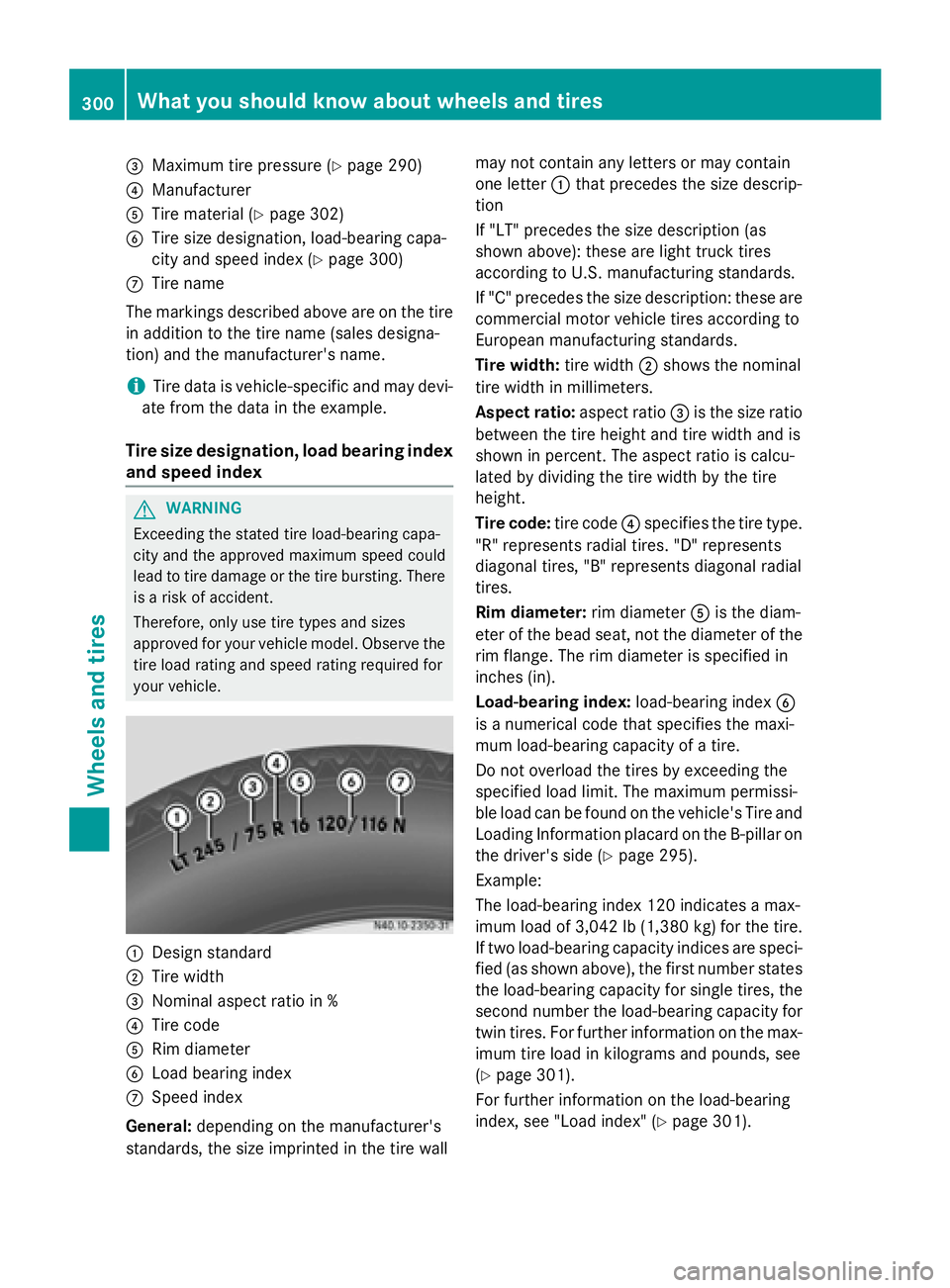
0087
Maximum tire pressure (Y page 290)
0085 Manufacturer
0083 Tire material (Y page 302)
0084 Tire size designation, load-bearing capa-
city and speed index (Y page 300)
006B Tire name
The markings described above are on the tire in addition to the tire name (sales designa-
tion) and the manufacturer's name.
i Tire data is vehicle-specific and may devi-
ate from the data in the example.
Tire size designation, load bearing index and speed index G
WARNING
Exceeding the stated tire load-bearing capa-
city and the approved maximum speed could
lead to tire damage or the tire bursting. There is a risk of accident.
Therefore, only use tire types and sizes
approved for your vehicle model. Observe the
tire load rating and speed rating required for
your vehicle. 0043
Design standard
0044 Tire width
0087 Nominal aspect ratio in %
0085 Tire code
0083 Rim diameter
0084 Load bearing index
006B Speed index
General: depending on the manufacturer's
standards, the size imprinted in the tire wall may not contain any letters or may contain
one letter
0043that precedes the size descrip-
tion
If "LT" precedes the size description (as
shown above): these are light truck tires
according to U.S. manufacturing standards.
If "C" precedes the size description: these are
commercial motor vehicle tires according to
European manufacturing standards.
Tire width: tire width0044shows the nominal
tire width in millimeters.
Aspect ratio: aspect ratio0087is the size ratio
between the tire height and tire width and is
shown in percent. The aspect ratio is calcu-
lated by dividing the tire width by the tire
height.
Tire code: tire code0085specifies the tire type.
"R" represents radial tires. "D" represents
diagonal tires, "B" represents diagonal radial
tires.
Rim diameter: rim diameter0083is the diam-
eter of the bead seat, not the diameter of the rim flange. The rim diameter is specified in
inches (in).
Load-bearing index: load-bearing index0084
is a numerical code that specifies the maxi-
mum load-bearing capacity of a tire.
Do not overload the tires by exceeding the
specified load limit. The maximum permissi-
ble load can be found on the vehicle's Tire and
Loading Information placard on the B-pillar on the driver's side (Y page 295).
Example:
The load-bearing index 120 indicates a max-
imum load of 3,042 lb (1,380 kg) for the tire.
If two load-bearing capacity indices are speci- fied (as shown above), the first number states
the load-bearing capacity for single tires, the second number the load-bearing capacity for
twin tires. For further information on the max- imum tire load in kilograms and pounds, see
(Y page 301).
For further information on the load-bearing
index, see "Load index" (Y page 301).300
What you should know about wheels and tiresWheels and tires
Page 303 of 334
Speed rating:
speed rating006Bspecifies the
approved maximum speed of the tire.
Regardless of the speed index always observe the speed limits. Drive carefully and adapt
your driving style to the traffic conditions.
i Tire data is vehicle-specific and may devi-
ate from the data in the example. Index Speed rating
F up to 50 mph (80 km/h)
G up to 56 mph (90 km/h)
J up to 62 mph (100 km/h)
K up to 68 mph (110 km/h)
L up to 74 mph (120 km/h)
M up to 80 mph (130 km/h)
N up to 87 mph (140 km/h)
P up to 93 mph (150 km/h)
Q up to 100 mph (160 km/h)
R over 106 mph (170 km/h)
i
Not all tires that have the M+S identifica-
tion offer the driving characteristics of win-
ter tires. In addition to the M+S marking,
winter tires also have the 004Dsnowflake
symbol on the tire wall. Tires with this mark- ing fulfill the requirements of the Rubber
Manufacturers Association (RMA) and the
Rubber Association of Canada (RAC)
regarding the tire traction on snow. They
have been especially developed for driving
on snow.
Further information on the reading of tire
information can be obtained at any qualified
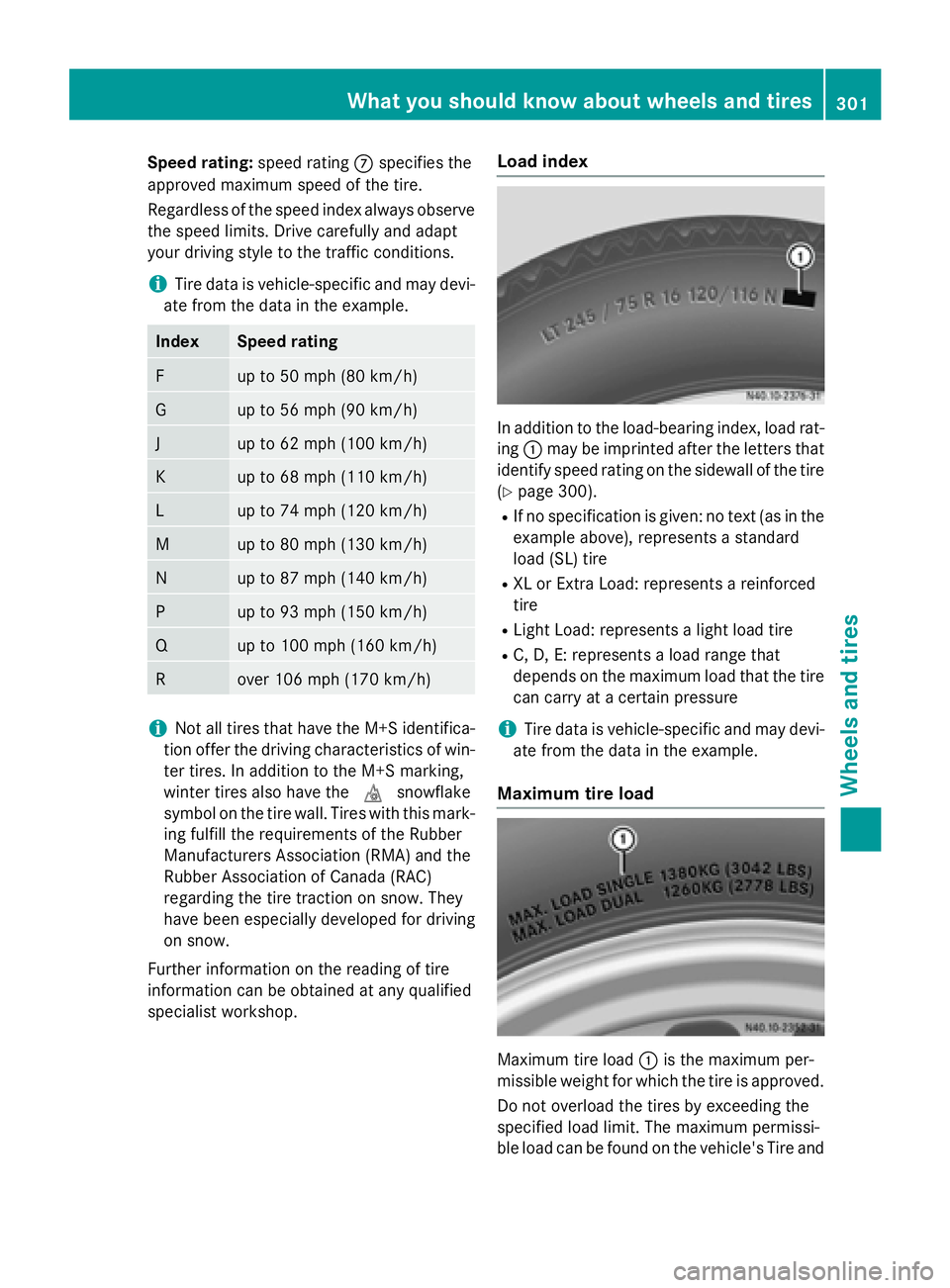
specialist workshop. Load index In addition to the load-bearing index, load rat-
ing 0043may be imprinted after the letters that
identify speed rating on the sidewall of the tire (Y page 300).
R If no specification is given: no text (as in the
example above), represents a standard
load (SL) tire
R XL or Extra Load: represents a reinforced
tire
R Light Load: represents a light load tire
R C, D, E: represents a load range that
depends on the maximum load that the tire
can carry at a certain pressure
i Tire data is vehicle-specific and may devi-
ate from the data in the example.
Maximum tire load Maximum tire load
0043is the maximum per-
missible weight for which the tire is approved.
Do not overload the tires by exceeding the
specified load limit. The maximum permissi-
ble load can be found on the vehicle's Tire and What you should know about wheels and tires
301Wheels and tires Z
Page 304 of 334
Loading Information placard on the B-pilla
ron
the driver's side (Y page 295).
i The actual values for tires are specific to
each vehicle and may deviate from the val-
ues in the illustration.
DOT, Tire Identification Number (TIN) U.S. tire regulations stipulate that every tire
manufacturer or retreader must imprint a TIN
in or on the sidewall of each tire produced. The TIN is a unique identification number. The
TIN enables the tire manufacturers or retread- ers to inform purchasers of recalls and other
safety-relevant matters. It makes it possible
for the purchaser to easily identify the affec-
ted tires.
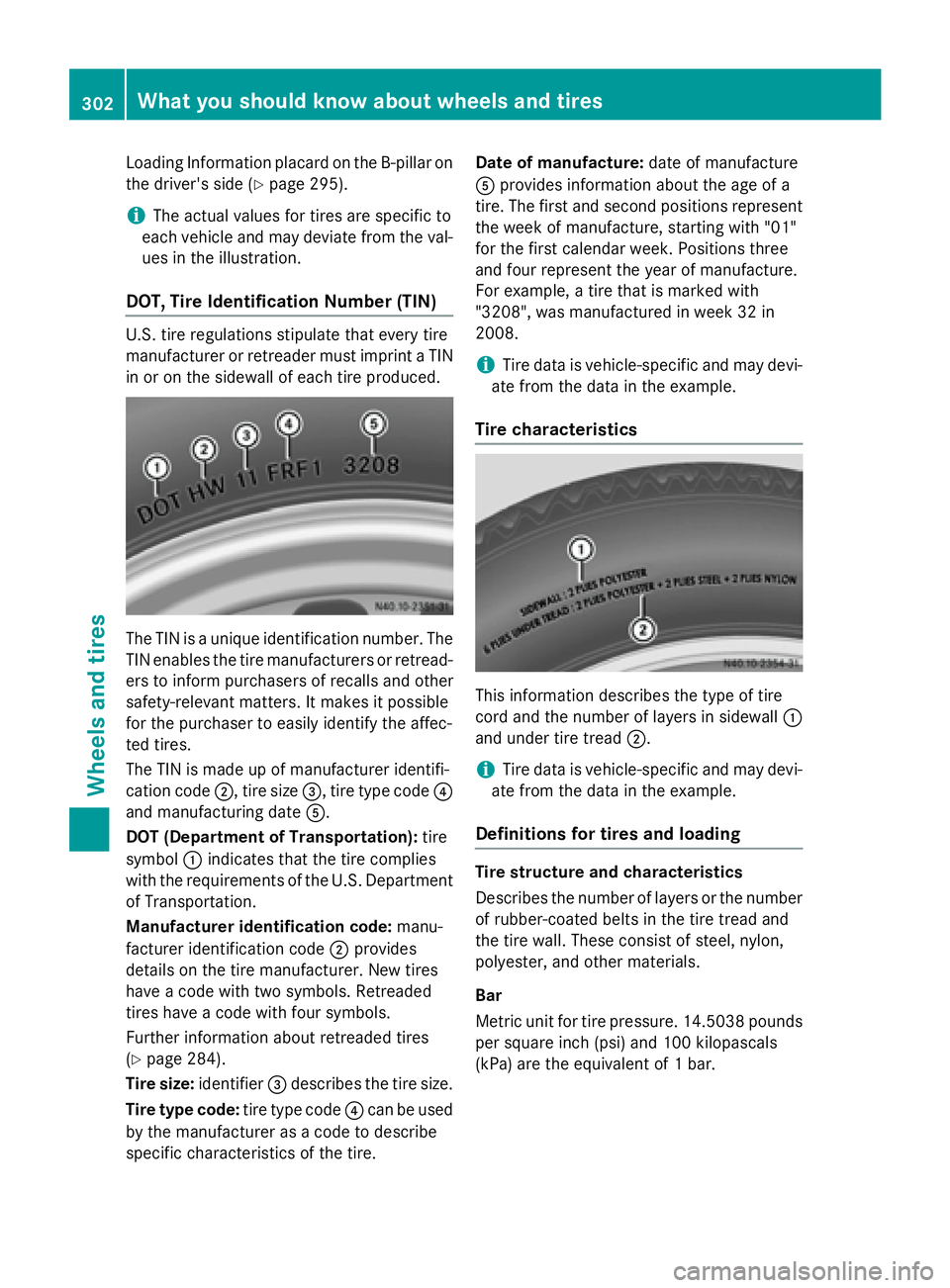
The TIN is made up of manufacturer identifi-
cation code 0044, tire size0087, tire type code 0085
and manufacturing date 0083.
DOT (Department of Transportation): tire
symbol 0043indicates that the tire complies
with the requirements of the U.S. Department
of Transportation.
Manufacturer identification code: manu-
facturer identification code 0044provides
details on the tire manufacturer. New tires
have a code with two symbols. Retreaded
tires have a code with four symbols.
Further information about retreaded tires
(Y page 284).
Tire size: identifier0087describes the tire size.
Tire type code: tire type code0085can be used
by the manufacturer as a code to describe
specific characteristics of the tire. Date of manufacture:
date of manufacture
0083 provides information about the age of a
tire. The first and second positions represent the week of manufacture, starting with "01"
for the first calendar week. Positions three
and four represent the year of manufacture.
For example, a tire that is marked with
"3208", was manufactured in week 32 in
2008.
i Tire data is vehicle-specific and may devi-
ate from the data in the example.
Tire characteristics This information describes the type of tire
cord and the number of layers in sidewall
0043
and under tire tread 0044.
i Tire data is vehicle-specific and may devi-
ate from the data in the example.
Definitions for tires and loading Tire structure and characteristics
Describes the number of layers or the number
of rubber-coated belts in the tire tread and
the tire wall. These consist of steel, nylon,
polyester, and other materials.
Bar
Metric unit for tire pressure. 14.5038 pounds per square inch (psi) and 100 kilopascals
(kPa) are the equivalent of 1 bar. 302
What you should kno
w about wheels andtiresWheels and tires
Page 305 of 334
DOT (Department of Transportation)
DOT marked tires fulfill the requirements of
the United States Department of Transporta- tion.
Average weight of vehicle occupants
The number of occupants for which the vehi-
cle is designed multiplied by 68 kilograms
(150 lbs).
Uniform Tire Quality Grading Standards
A uniform standard to grade the quality of
tires with regard to tread quality, traction and
temperature characteristics. The quality
grading assessment is made by the manufac- turer following specifications from the U.S
government. The quality grade of a tire is
imprinted on the sidewall of the tire.
Recommended tire pressure
The recommended tire pressures are the
pressures specified for the tires mounted on
the vehicle at the factory.
The tire and load information table 9
contains
the recommended tire pressures for cold
tires, the maximum permissible load and the
maximum permissible vehicle speed.
The tire pressure table contains the recom-
mended tire pressure for cold tires under var- ious operating conditions, i.e. loading and/orspeed of the vehicle.
Increased vehicle weight due to optional
equipment
The combined weight of all standard and
optional equipment available for the vehicle,
regardless of whether it is actually installed
on the vehicle or not.
Wheel rim
The part of the wheel on which the tire is
mounted.
GAWR (Gross Axle Weight Rating)
GAWR is the maximum gross axle weight rat-
ing. The actual load on an axle must never
exceed the gross axle weight rating. The Gross Axle Weight Rating can be found on the
vehicle identification plate on the driver seat
frame (Y page 316).
Speed index
The speed index is part of the tire identifica-
tion. It specifies the speed range for which the tire is approved.
GTW (Gross Trailer Weight)
GTW is the total of weight of a trailer and the
weight of the load, accessories etc. on the
trailer.
GVW (Gross Vehicle Weight)
The gross vehicle weight includes the weight
of the vehicle including fuel, tools, spare
wheel, accessories installed, occupants, lug-
gage and the drawbar noseweight if applica-
ble. The gross vehicle weight may never
exceed the gross vehicle weight rating
(GVWR) specified on the vehicle identification
plate at the base of the driver's seat
(Y page 316).
GVWR (Gross Vehicle Weight Rating)
The GVWR is the maximum permitted gross
weight of the fully laden vehicle (weight of the
vehicle including all accessories, occupants,
fuel, luggage and the drawbar noseweight if
applicable). The Gross Vehicle Weight Rating
is specified on the vehicle identification plate on the driver seat frame (Y page 316).
Maximum weight of the laden vehicle
The maximum weight is the sum of:
R the curb weight of the vehicle
R the weight of the accessories
R the load limit
R the weight of the factory installed optional
equipment
Kilopascal (kPa)
Metric unit for tire pressure. 6.9 kPa are the
equivalent of 1 psi. Another tire pressure unit
9 Only for vehicles with a gross weight of less than 10,000 lbs (4536 kg). What you should know about wheels and ti
res
303Wheels and tires Z
Page 306 of 334
is bar. 100 kilopascals (kPa) are the equiva-
lent of 1 bar.
Load index
In addition to the load bearing index, a load
index can be stamped onto the sidewall of the
tire. It specifies the load-bearing capacity of
the tire more precisely.
Curb weight
The weight of a vehicle with standard equip-
ment including the maximum filling capacity
of fuel, oil, and coolant. It also includes the
air-conditioning system and optional equip-
ment if these are installed on the vehicle, but
does not include passengers or luggage.
Maximum tire load
The maximum tire load in kilograms or
pounds is the maximum weight for which a
tire is approved.
Maximum permissible tire pressure
Maximum permissible tire pressure for one
tire.
Maximum load on one tire
Maximum load on one tire. This is calculated
by dividing the maximum axle load of one axle by two.
PSI (Pounds per square inch)
Standard unit of measurement for tire pres-
sure.
Aspect ratio
Relationship between tire height and width in
percent.
tire pressure
Pressure inside the tire applying an outward
force to every square inch of the tire's sur-
face. Tire pressure is specified in pounds per square inch (psi), in kilopascal (kPa) or in bar.
Tire pressure should only be corrected when
the tires are cold. Cold tire pressure
The tires are cold:
R if the vehicle has been parked for at least
three hours without direct sunlight on the
tires, and
R if the vehicle has not been driven further
than 1 mile (1.6 km)
Tire tread
The part of the tire th at comes into contact
with the road.
Tire bead
The tire bead ensures that the tire sits
securely on the wheel. There are several steel wires in the bead to prevent the tire from
coming loose from the wheel rim.
Sidewall
The part of the tire between the tread and the
tire bead.
Weight of optional extras
The combined weight of those optional extras
that weigh more than the replaced standard
parts and more than 2.3 kg (5lbs). These
optional extras, such as high-performance
brakes, a roof rack or a high-performance
battery, are not included in the curb weight
and the weight of the accessories.
TIN (Tire Identification Number)
A unique identification number which can be
used by a tire manufacturer to identify tires,
for example for a product recall, and thus
identify the purchasers. The TIN is composed of the manufacturer identification code, tire
size, tire model code and manufacturing date.
Load bearing index
The load bearing index (also load index) is a
code that contains the maximum load bearing capacity of a tire.
Traction
Traction is the result of friction between the
tires and the road surface. 304
What you should know about wheels and tiresWheels and tires