weight MERCEDES-BENZ SPRINTER 2015 MY15 Operator’s Manual
[x] Cancel search | Manufacturer: MERCEDES-BENZ, Model Year: 2015, Model line: SPRINTER, Model: MERCEDES-BENZ SPRINTER 2015Pages: 334, PDF Size: 5.94 MB
Page 314 of 334
used tires if you have no information about
their previous usage.
The recommended tire pressures can be
found:
R on the Tire and Loading Information plac-
ard 10
on the B-pillar on the driver's side
R on the tire pressure table on the B-pillar on
the driver's side
The recommended tire pressure can also be
found in the "Tire pressure table" section in
this Operator's Manual (Y page 294). The
wheel/tire combination for your vehicle can
be found on the tire pressure table. Further
information on wheel/tire combination can
be obtained at any qualified specialist work-
shop.
Check tire pressures regularly and only when
the tires are cold. Observe the notes on the
recommended tire pressure (Y page 288).
Follow the maintenance recommendations in the tire manufacturer's warranty book in your
vehicle documents.
Notes on the vehicle equipment – always
equip the vehicle:
R with tires of the same size across an axle
(left/right)
R with the same type of tires on all wheels at
a given time (summer tires, winter tires)
Tires that have been specially designed and
approved for your vehicle are marked with
MO or MO1 (Mercedes-Benz Original). You
can find this identification on the tires them-
selves and in the following table.
i Not all wheel/tire combinations can be
installed at the factory in all countries. Spare wheel
Important safety notes
G
WARNING
Wheel and tire dimensions as well as the type of tire can vary between the spare wheel and the wheel to be replaced. When the spare
wheel is mounted, driving characteristics may be severely affected. There is a risk of an acci-
dent.
In order to reduce risks:
R you should therefore adapt your driving
style and drive carefully.
R never mount more than one spare wheel
that differs from the wheel to be replaced.
R only use a spare wheel that differs from the
wheel to be replaced for a short time.
R do not deactivate ESP ®
.
R have a spare wheel that differs from the
wheel that has been changed replaced at
the nearest qualified specialist workshop.
You must observe the correct wheel and
tire dimensions as well as the wheel type.
When using a spare wheel of a different size,
do not exceed the maximum speed of
80 km/h. General notes
! Check the spare wheel regularly to see
that it is secure and has the prescribed tire
pressure.
The procedure for mounting the spare wheel
is described in "Mounting a wheel"
(Y page 306).
The following should be checked regularly,
particularly prior to long journeys:
R the tire pressure of the spare wheel, which
should then be corrected if necessary
(Y page 288).
R the fastenings of the spare wheel bracket.
The spare wheel is located in a spare wheel
bracket under the rear of the vehicle.
Replace the tires after 6 years at the latest,
regardless of wear. This also applies to the
spare wheel.
10 Only for vehicles with a gross weight of less than 10,000 lbs (4,536 kg). 312
Spare wheelWheels and ti
res
Page 315 of 334
i
If you have mounted a spare wheel, the
tire pressure monitor (Y page 291) will not
function for this wheel. The spare wheel is
not equipped with a sensor for monitoring
tire pressure. Removing and installing the spare
wheel
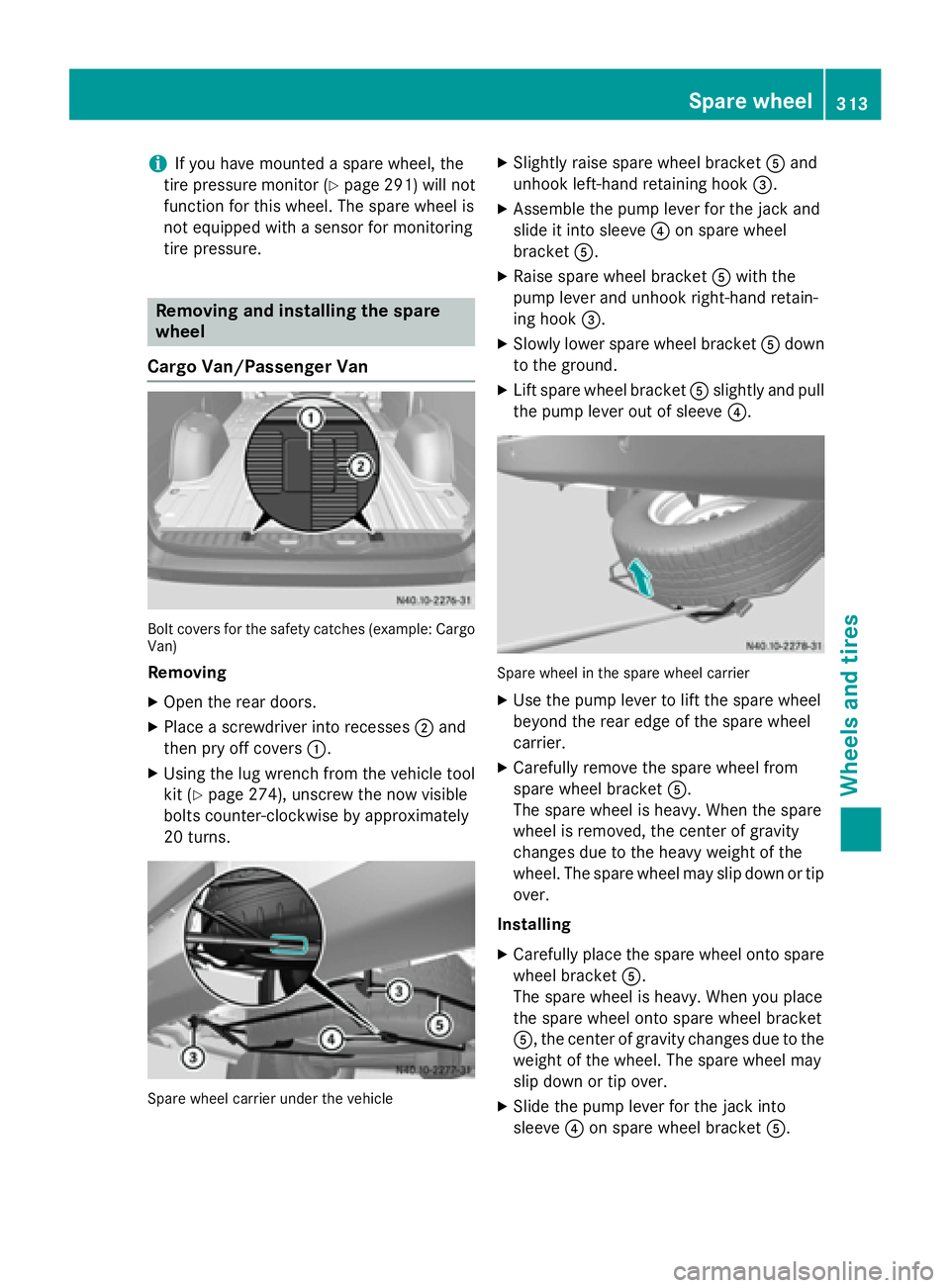
Cargo Van/Passenger Van Bolt covers for the safety catches (example: Cargo
Van)
Removing
X Open the rear doors.
X Place a screwdriver into recesses 0044and
then pry off covers 0043.
X Using the lug wrench from the vehicle tool
kit (Y page 274), unscrew the now visible
bolts counter-clockwise by approximately
20 turns. Spare wheel carrier under the vehicle X
Slightly raise spare wheel bracket 0083and
unhook left-hand retaining hook 0087.
X Assemble the pump lever for the jack and
slide it into sleeve 0085on spare wheel
bracket 0083.
X Raise spare wheel bracket 0083with the
pump lever and unhook right-hand retain-
ing hook 0087.
X Slowly lower spare wheel bracket 0083down
to the ground.
X Lift spare wheel bracket 0083slightly and pull
the pump lever out of sleeve 0085. Spare wheel in the spare wheel carrier
X Use the pump lever to lift the spare wheel
beyond the rear edge of the spare wheel
carrier.
X Carefully remove the spare wheel from
spare wheel bracket 0083.
The spare wheel is heavy. When the spare
wheel is removed, the center of gravity
changes due to the heavy weight of the
wheel. The spare wheel may slip down or tip over.
Installing X Carefully place the spare wheel onto spare
wheel bracket 0083.
The spare wheel is heavy. When you place
the spare wheel onto spare wheel bracket
0083, the center of gravity changes due to the
weight of the wheel. The spare wheel may
slip down or tip over.
X Slide the pump lever for the jack into
sleeve 0085on spare wheel bracket 0083. Spare wheel
313Wheels and tires Z
Page 316 of 334
X
Raise spare wheel bracket 0083with the
pump lever and attach right-hand retaining hook 0087.
X Slightly raise spare wheel bracket 0083and
attach left-hand retaining hook 0087.
X Pull the pump lever out of sleeve 0085.
X Using the lug wrench, tighten the retaining
hook bolts by turning them clockwise.
X Replace and engage covers 0043.
X Close the rear doors.
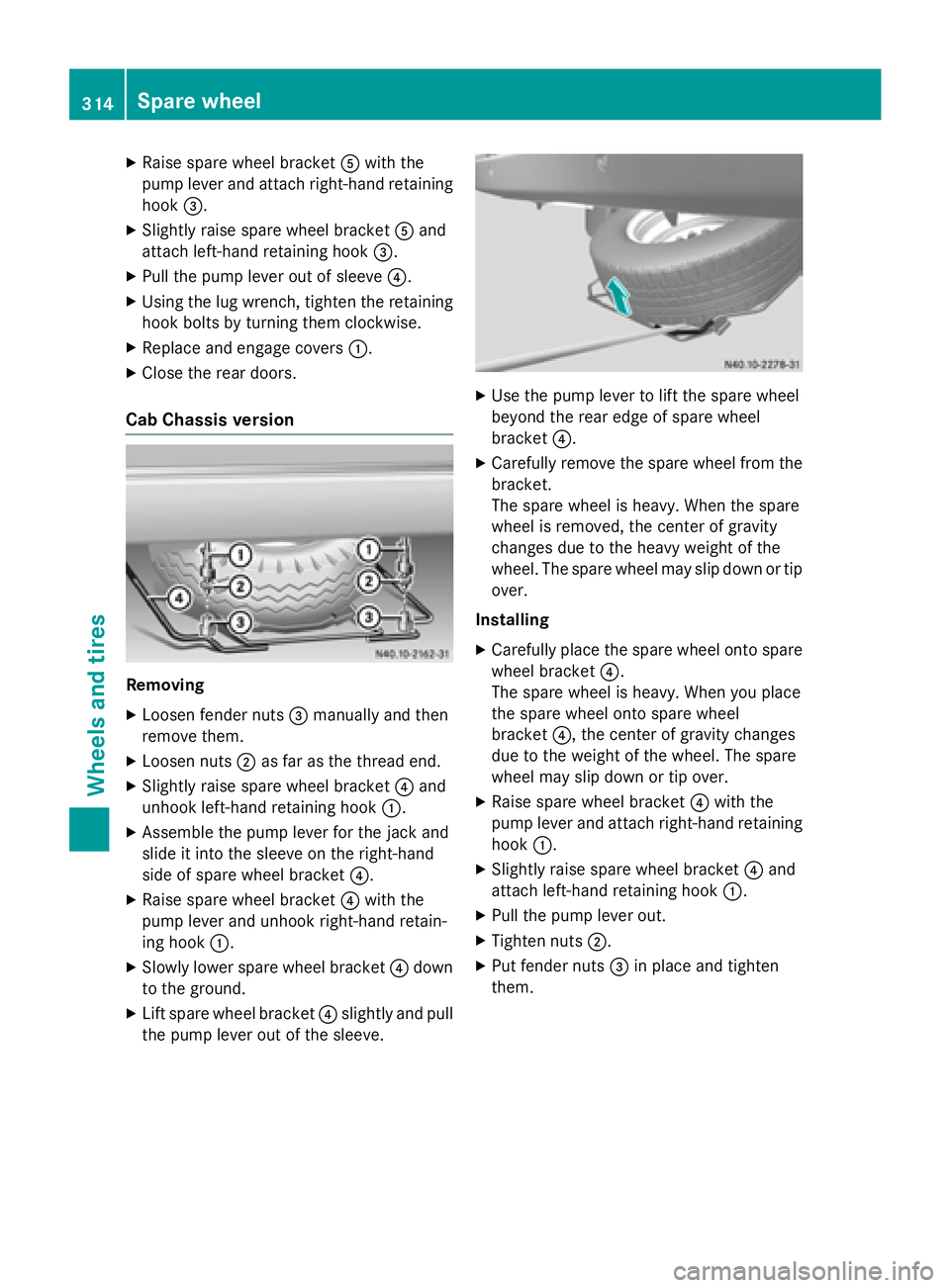
Cab Chassis version Removing
X Loosen fender nuts 0087manually and then
remove them.
X Loosen nuts 0044as far as the thread end.
X Slightly raise spare wheel bracket 0085and
unhook left-hand retaining hook 0043.
X Assemble the pump lever for the jack and
slide it into the sleeve on the right-hand
side of spare wheel bracket 0085.
X Raise spare wheel bracket 0085with the
pump lever and unhook right-hand retain-
ing hook 0043.
X Slowly lower spare wheel bracket 0085down
to the ground.
X Lift spare wheel bracket 0085slightly and pull
the pump lever out of the sleeve. X
Use the pump lever to lift the spare wheel
beyond the rear edge of spare wheel
bracket 0085.
X Carefully remove the spare wheel from the
bracket.
The spare wheel is heavy. When the spare
wheel is removed, the center of gravity
changes due to the heavy weight of the
wheel. The spare wheel may slip down or tip over.
Installing X Carefully place the spare wheel onto spare
wheel bracket 0085.
The spare wheel is heavy. When you place
the spare wheel onto spare wheel
bracket 0085, the center of gravity changes
due to the weight of the wheel. The spare
wheel may slip down or tip over.
X Raise spare wheel bracket 0085with the
pump lever and attach right-hand retaining hook 0043.
X Slightly raise spare wheel bracket 0085and
attach left-hand retaining hook 0043.
X Pull the pump lever out.
X Tighten nuts 0044.
X Put fender nuts 0087in place and tighten
them. 314
Spare wheelWheels and
tires
Page 319 of 334
(VIN), the paint code and the permissible
weight data.
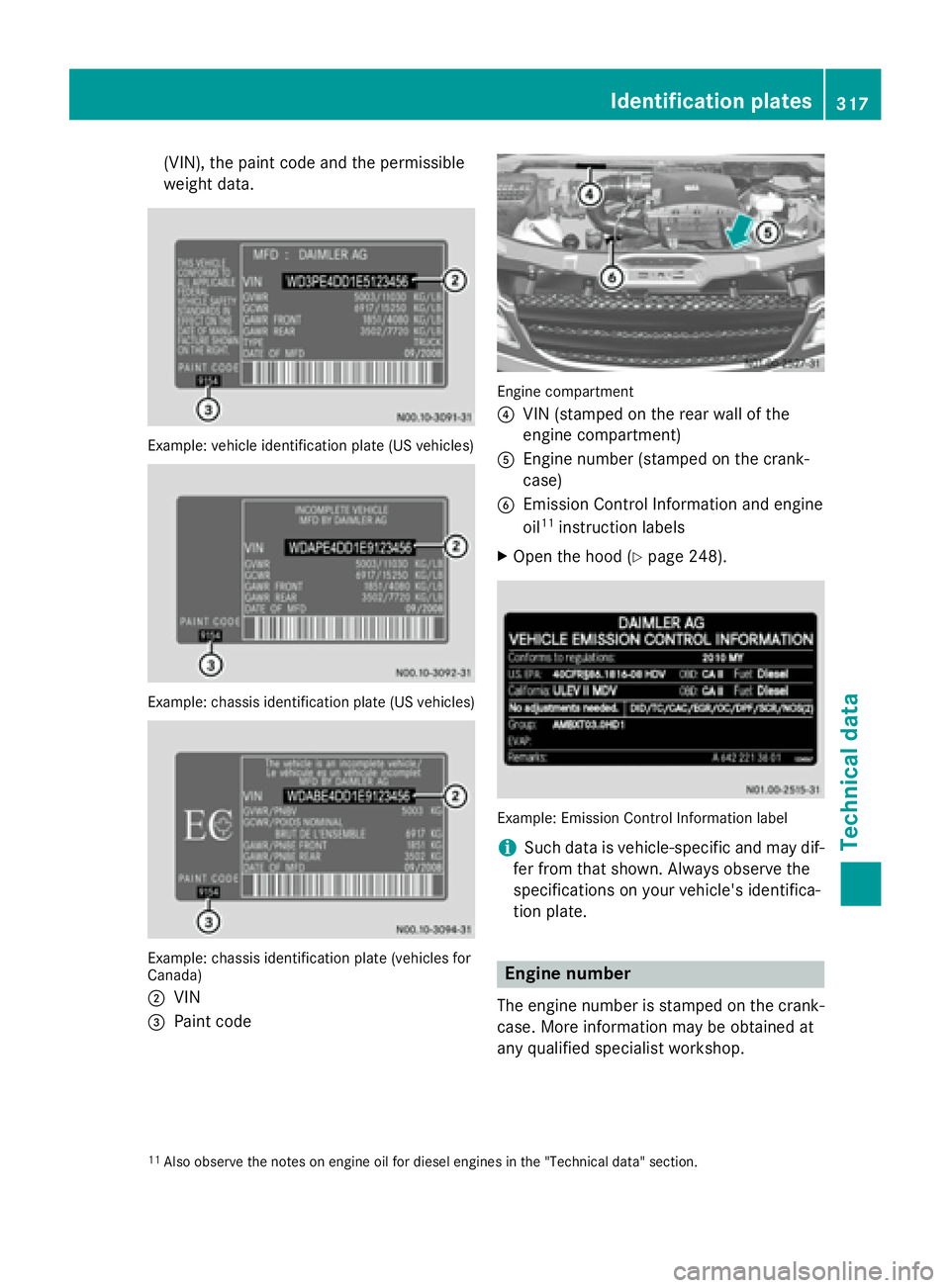
Example: vehicle identification plate (US vehicles)
Example: chassis identification plate (US vehicles)
Example: chassis identification plate (vehicles for
Canada)
0044
VIN
0087 Paint code Engine compartment
0085
VIN (stamped on the rear wall of the
engine compartment)
0083 Engine number (stamped on the crank-
case)
0084 Emission Control Information and engine
oil 11
instruction labels
X Open the hood (Y page 248). Example: Emission Control Information label
i
Such data is vehicle-specific and may dif-
fer from that shown. Always observe the
specifications on your vehicle's identifica-
tion plate. Engine number
The engine number is stamped on the crank-
case. More information may be obtained at
any qualified specialist workshop.
11 Also observe the notes on engine oil for diesel engines in the "Technical data" section. Identification plates
317Technical data Z
Page 329 of 334
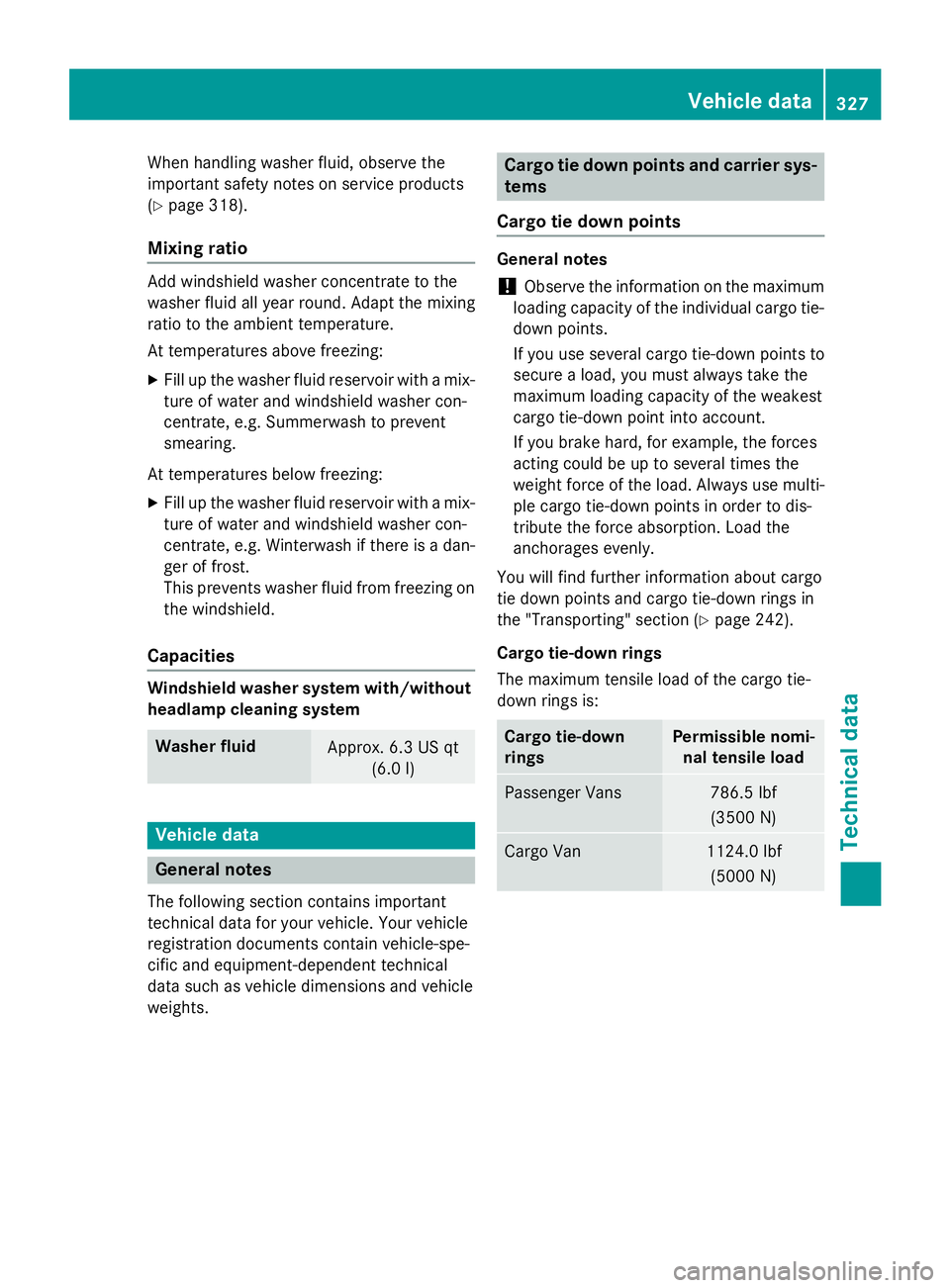
When handling washer fluid, observe the
important safety notes on service products
(Y page 318).
Mixing ratio Add windshield washer concentrate to the
washer fluid all year round. Adapt the mixing
ratio to the ambient temperature.
At temperatures above freezing:
X Fill up the washer fluid reservoir with a mix-
ture of water and windshield washer con-
centrate, e.g. Summerwash to prevent
smearing.
At temperatures below freezing: X Fill up the washer fluid reservoir with a mix-
ture of water and windshield washer con-
centrate, e.g. Winterwash if there is a dan- ger of frost.
This prevents washer fluid from freezing on the windshield.
Capacities Windshield washer system with/without
headlamp cleaning system Washer fluid
Approx. 6.3 US qt
(6.0l) Vehicle data
General notes
The following section contains important
technical data for your vehicle. Your vehicle
registration documents contain vehicle-spe-
cific and equipment-dependent technical
data such as vehicle dimensions and vehicle
weights. Cargo tie down points and carrier sys-
tems
Cargo tie down points General notes
! Observe the information on the maximum
loading capacity of the individual cargo tie-
down points.
If you use several cargo tie-down points to
secure a load, you must always take the
maximum loading capacity of the weakest
cargo tie-down point into account.
If you brake hard, for example, the forces
acting could be up to several times the
weight force of the load. Always use multi-
ple cargo tie-down points in order to dis-
tribute the force absorption. Load the
anchorages evenly.
You will find further information about cargo
tie down points and cargo tie-down rings in
the "Transporting" section (Y page 242).
Cargo tie-down rings
The maximum tensile load of the cargo tie-
down rings is: Cargo tie-down
rings Permissible nomi-
nal tensile load Passenger Vans 786.5 lbf
(3500 N) Cargo Van 1124.0 lbf
(5000 N) Vehicle data
327Technical data Z
Page 330 of 334
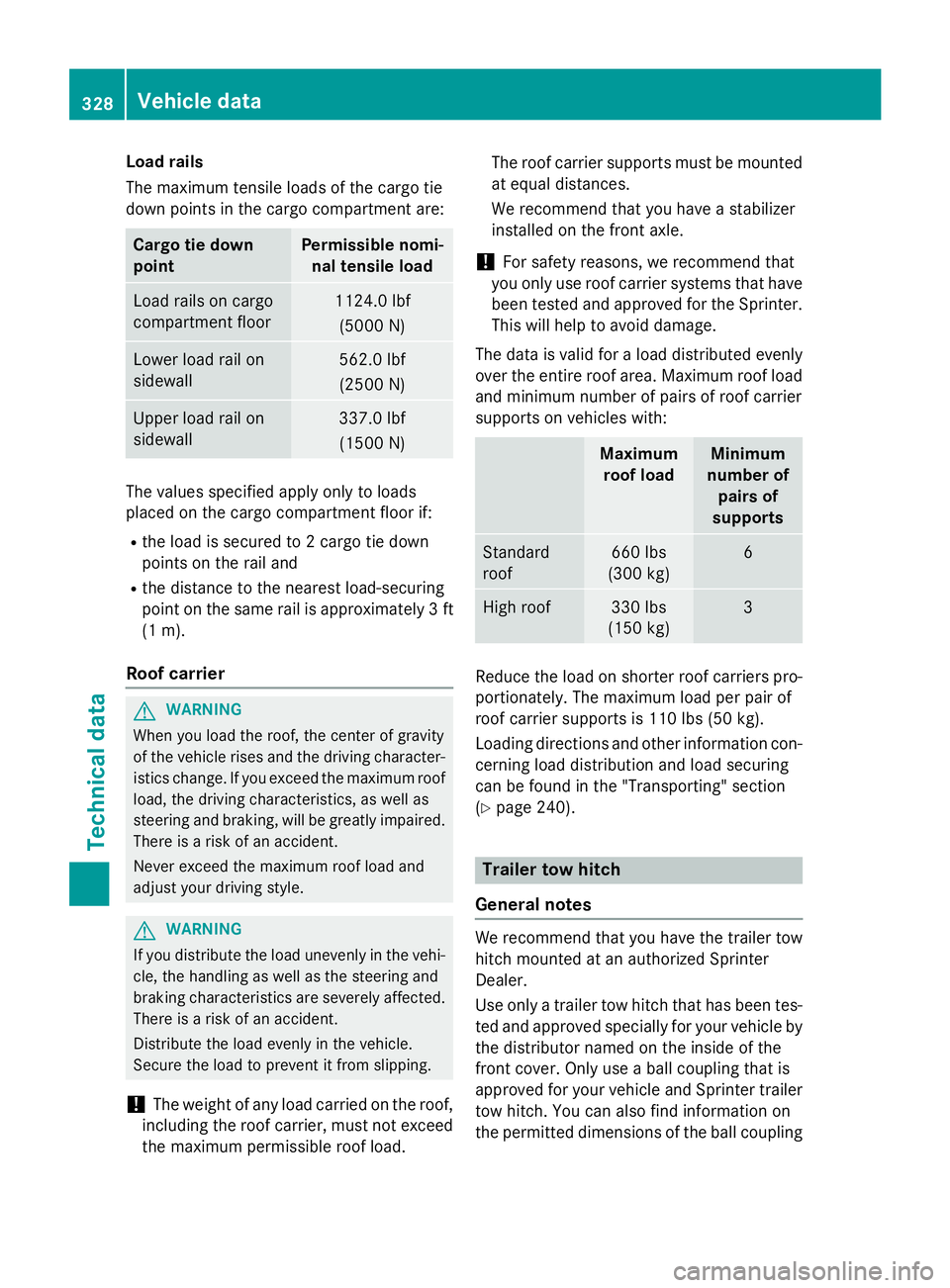
Load rails
The maximum tensile loads of the cargo tie
down points in the cargo compartment are: Cargo tie down
point Permissible nomi-
nal tensile load Load rails on cargo
compartment floor 1124.0 lbf
(5000 N) Lower load rail on
sidewall 562.0 lbf
(2500 N) Upper load rail on
sidewall 337.0 lbf
(1500 N) The values specified apply only to loads
placed on the cargo compartment floor if:
R the load is secured to 2 cargo tie down
points on the rail and
R the distance to the nearest load-securing
point on the same rail is approximately 3 ft
(1 m).
Roof carrier G
WARNING
When you load the roof, the center of gravity
of the vehicle rises and the driving character- istics change. If you exceed the maximum roof
load, the driving characteristics, as well as
steering and braking, will be greatly impaired. There is a risk of an accident.
Never exceed the maximum roof load and
adjust your driving style. G
WARNING
If you distribute the load unevenly in the vehi- cle, the handling as well as the steering and
braking characteristics are severely affected.
There is a risk of an accident.
Distribute the load evenly in the vehicle.
Secure the load to prevent it from slipping.
! The weight of any load carried on the roof,
including the roof carrier, must not exceed the maximum permissible roof load. The roof carrier supports must be mounted
at equal distances.
We recommend that you have a stabilizer
installed on the front axle.
! For safety reasons, we recommend that
you only use roof carrier systems that have
been tested and approved for the Sprinter.
This will help to avoid damage.
The data is valid for a load distributed evenly
over the entire roof area. Maximum roof load
and minimum number of pairs of roof carrier
supports on vehicles with: Maximum
roof load Minimum
number of pairs of
supports Standard
roof 660 lbs
(300 kg) 6
High roof 330 lbs
(150 kg) 3
Reduce the load on shorter roof carriers pro-
portionately. The maximum load per pair of
roof carrier supports is 110 lbs (50 kg).
Loading directions and other information con- cerning load distribution and load securing
can be found in the "Transporting" section
(Y page 240). Trailer tow hitch
General notes We recommend that you have the trailer tow
hitch mounted at an authorized Sprinter
Dealer.
Use only a trailer tow hitch that has been tes- ted and approved specially for your vehicle by
the distributor named on the inside of the
front cover. Only use a ball coupling that is
approved for your vehicle and Sprinter trailer
tow hitch. You can also find information on
the permitted dimensions of the ball coupling 328
Vehicle dataTechnical data
Page 332 of 334
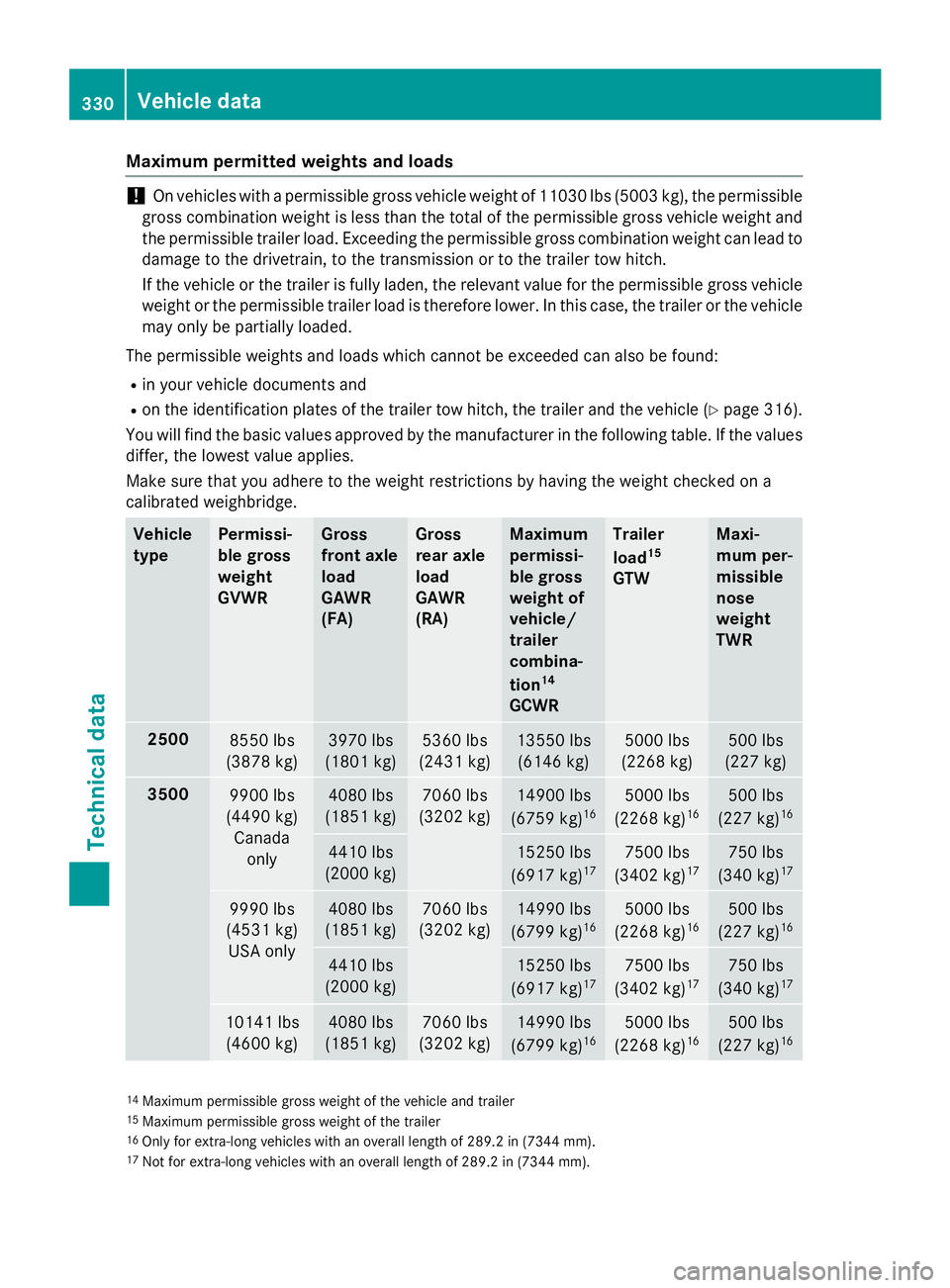
Maximum permitted weights and loads
!
On vehicles with a permissible gross vehicle weight of 11030 lbs (5003 kg), the permissible
gross combination weight is less than the total of the permissible gross vehicle weight and the permissible trailer load. Exceeding the permissible gross combination weight can lead to
damage to the drivetrain, to the transmission or to the trailer tow hitch.
If the vehicle or the trailer is fully laden, the relevant value for the permissible gross vehicle weight or the permissible trailer load is therefore lower. In this case, the trailer or the vehicle may only be partially loaded.
The permissible weights and loads which cannot be exceeded can also be found: R in your vehicle documents and
R on the identification plates of the trailer tow hitch, the trailer and the vehicle (Y page 316).
You will find the basic values approved by the manufacturer in the following table. If the values
differ, the lowest value applies.
Make sure that you adhere to the weight restrictions by having the weight checked on a
calibrated weighbridge. Vehicle
type Permissi-
ble gross
weight
GVWR Gross
front axle
load
GAWR
(FA) Gross
rear axle
load
GAWR
(RA) Maximum
permissi-
ble gross
weight of
vehicle/
trailer
combina-
tion
14
GCWR Trailer
load
15
GTW Maxi-
mum per-
missible
nose
weight
TWR
2500
8550 lbs
(3878 kg) 3970 lbs
(1801 kg) 5360 lbs
(2431 kg) 13550 lbs
(6146 kg) 5000 lbs
(2268 kg) 500 lbs
(227 kg) 3500
9900 lbs
(4490 kg) Canada only 4080 lbs
(1851 kg) 7060 lbs
(3202 kg) 14900 lbs
(6759 kg) 16 5000 lbs
(2268 kg) 16 500 lbs
(227 kg) 16 4410 lbs
(2000 kg) 15250 lbs
(6917 kg) 17 7500 lbs
(3402 kg) 17 750 lbs
(340 kg) 17 9990 lbs
(4531 kg) USA only 4080 lbs
(1851 kg) 7060 lbs
(3202 kg) 14990 lbs
(6799 kg) 16 5000 lbs
(2268 kg) 16 500 lbs
(227 kg) 16 4410 lbs
(2000 kg) 15250 lbs
(6917 kg) 17 7500 lbs
(3402 kg) 17 750 lbs
(340 kg) 17 10141 lbs
(4600 kg) 4080 lbs
(1851 kg) 7060 lbs
(3202 kg) 14990 lbs
(6799 kg) 16 5000 lbs
(2268 kg) 16 500 lbs
(227 kg) 16 14
Maximum permissible gross weight of the vehicle and trailer
15 Maximum permissible gross weight of the trailer
16 Only for extra-long vehicles with an overall length of 289.2 in (7344 mm).
17 Not for extra-long vehicles with an overall length of 289.2 in (7344 mm). 330
Vehicle dataTechnical data
Page 333 of 334
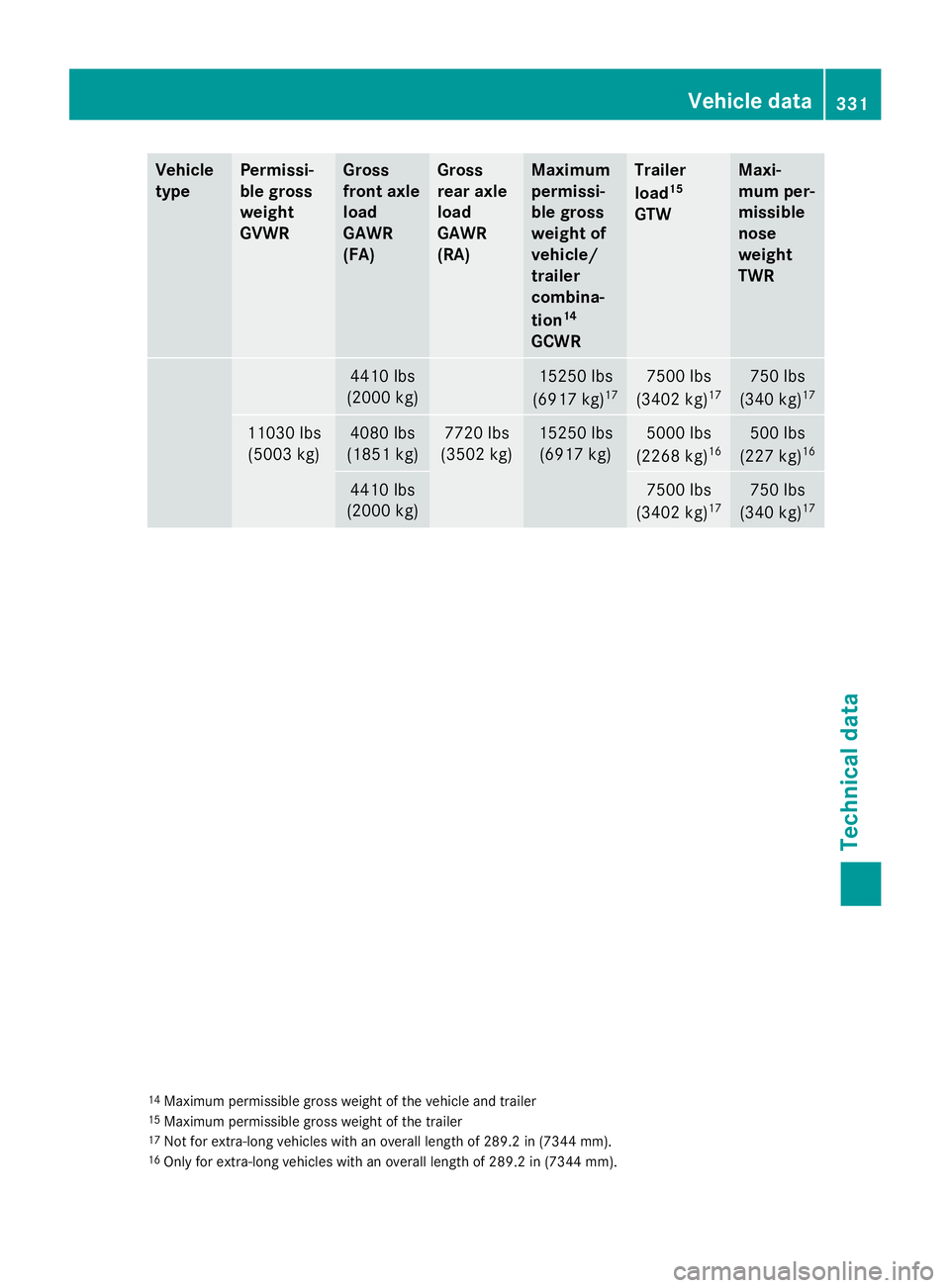
Vehicle
type Permissi-
ble gross
weight
GVWR Gross
front axle
load
GAWR
(FA) Gross
rear axle
load
GAWR
(RA) Maximum
permissi-
ble gross
weight of
vehicle/
trailer
combina-
tion 14
GCWR Trailer
load
15
GTW Maxi-
mum per-
missible
nose
weight
TWR
4410 lbs
(2000 kg) 15250 lbs
(6917 kg) 17 7500 lbs
(3402 kg) 17 750 lbs
(340 kg) 17 11030 lbs
(5003 kg) 4080 lbs
(1851 kg) 7720 lbs
(3502 kg) 15250 lbs
(6917 kg) 5000 lbs
(2268 kg) 16 500 lbs
(227 kg) 16 4410 lbs
(2000 kg) 7500 lbs
(3402 kg) 17 750 lbs
(340 kg) 17 14
Maximum permissible gross weight of the vehicle and trailer
15 Maximum permissible gross weight of the trailer
17 Not for extra-long vehicles with an overall length of 289.2 in (7344 mm).
16 Only for extra-long vehicles with an overall length of 289.2 in (7344 mm). Vehicle data
331Technical data Z