heating MERCEDES-BENZ SPRINTER 2015 MY15 Operator’s Manual
[x] Cancel search | Manufacturer: MERCEDES-BENZ, Model Year: 2015, Model line: SPRINTER, Model: MERCEDES-BENZ SPRINTER 2015Pages: 334, PDF Size: 5.94 MB
Page 238 of 334
In addition, flammable materials can ignite if:
R the hot cigarette lighter falls
R a child holds the hot cigarette lighter to
objects, for example
There is a risk of fire and injury.
Always hold the cigarette lighter by the knob.
Always make sure that the cigarette lighter is
out of reach of children. Never leave children unsupervised in the vehicle. X
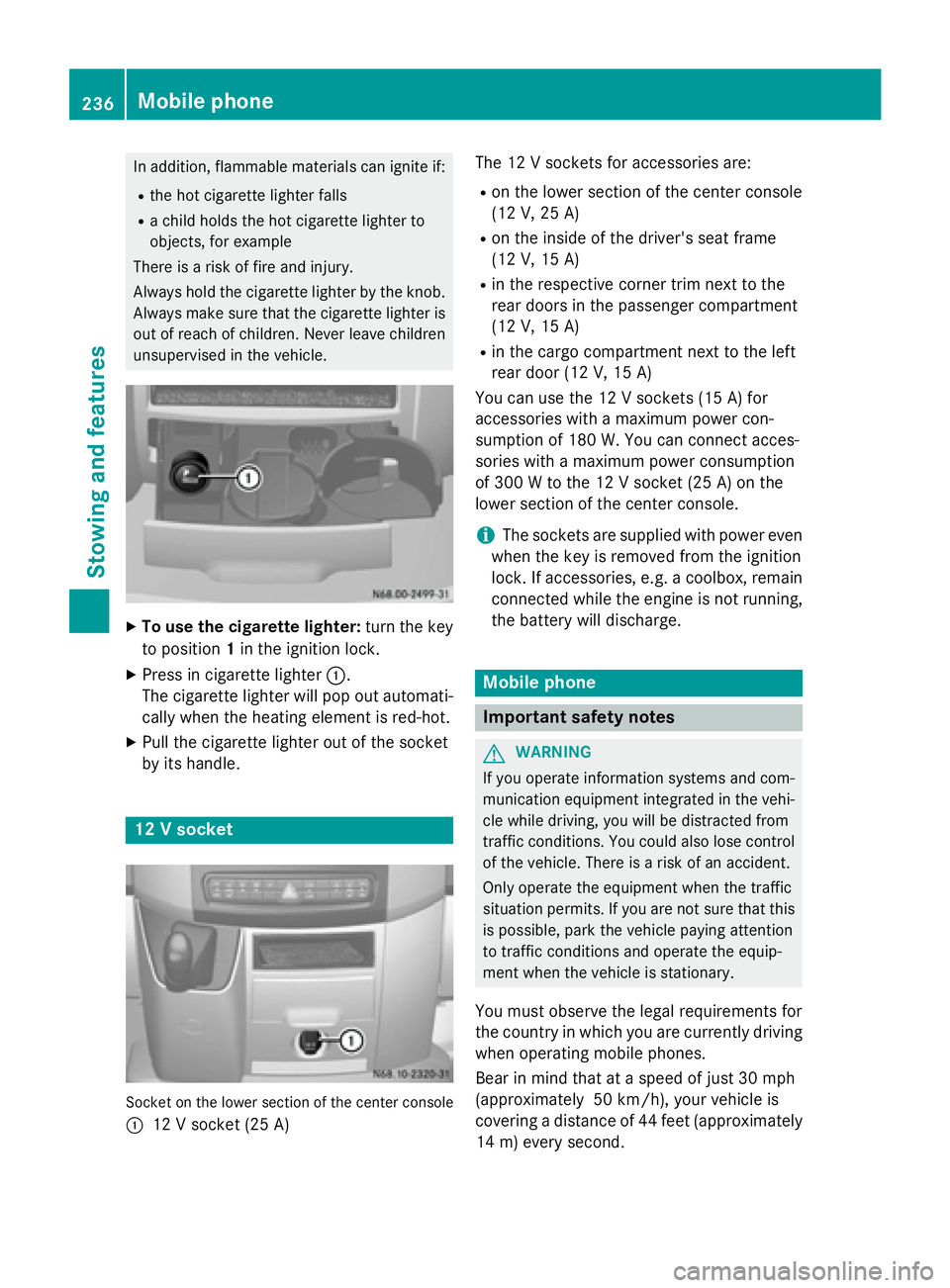
To use the cigarette lighter: turn the key
to position 1in the ignition lock.
X Press in cigarette lighter 0043.
The cigarette lighter will pop out automati- cally when the heating element is red-hot.
X Pull the cigarette lighter out of the socket
by its handle. 12 V socket
Socket on the lower section of the center console
0043 12 V socket (25 A) The 12 V sockets for accessories are:
R
on the lower section of the center console
(12 V, 25 A)
R on the inside of the driver's seat frame
(12 V, 15 A)
R in the respective corner trim next to the
rear doors in the passenger compartment
(12 V, 15 A)
R in the cargo compartment next to the left
rear door (12 V, 15 A)
You can use the 12 V sockets (15 A) for
accessories with a maximum power con-
sumption of 180 W. Youcan connect acces-
sories with a maximum power consumption
of 300 Wto the 12 V socket (25 A) on the
lower section of the center console.
i The sockets are supplied with power even
when the key is removed from the ignition
lock. If accessories, e.g. a coolbox, remain
connected while the engine is not running, the battery will discharge. Mobile phone
Important safety notes
G
WARNING
If you operate information systems and com-
munication equipment integrated in the vehi- cle while driving, you will be distracted from
traffic conditions. You could also lose control of the vehicle. There is a risk of an accident.
Only operate the equipment when the traffic
situation permits. If you are not sure that this
is possible, park the vehicle paying attention
to traffic conditions and operate the equip-
ment when the vehicle is stationary.
You must observe the legal requirements for
the country in which you are currently driving when operating mobile phones.
Bear in mind that at a speed of just 30 mph
(approximately 50 km/h), your vehicle is
covering a distance of 44 fee t(approximately
14 m) every second. 236
Mobile phoneStowing and features
Page 255 of 334
X
Replace cap 0085on the filler neck and
tighten.
When doing so, make sure that the cap
engages correctly.
X Check the oil level with the oil dipstick
(Y page 251) or on the display
(Y page 250).
X Close the hood. Coolant
G
WARNING
The engine cooling system is pressurized, par- ticularly when the engine is warm. When
opening the cap, you could be scalded by hotcoolant spraying out. There is a risk of injury.
Let the engine cool down before opening the
cap. Wear eye and hand protection when
opening the cap. Open the cap slowly half a
turn to allow pressure to escape.
Only check the coolant level and/or fill the
coolant if the vehicle is on a level surface and the engine has cooled down. The coolant tem-
perature must be below 122 ‡ (50 †).
! Check the engine cooling and heating sys-
tem regularly for leaks.
If a large quantity of coolant is lost, have the
cause traced and rectified at a qualified
specialist workshop. G
WARNING
Coolant contains glycol and is therefore toxic. Do not swallow the coolant. See a doctor
immediately if you swallow coolant.
Make sure that coolant does not come into
contact with skin, eyes or clothing. In case of
contact with eyes, rinse immediately with
plenty of clean water. Clean affected areas of skin and clothing with soap and water imme-
diately. Change any affected clothing imme-
diately. G
WARNING
If antifreeze comes into contact with hot com- ponents in the engine compartment, it may
ignite. There is a risk of fire and injury.
Let the engine cool down before you add anti-
freeze. Make sure that antifreeze is not spilled
next to the filler neck. Thoroughly clean the
antifreeze from components before starting
the engine.
! Take care not to spill any coolant on pain-
ted surfaces. You could otherwise damage
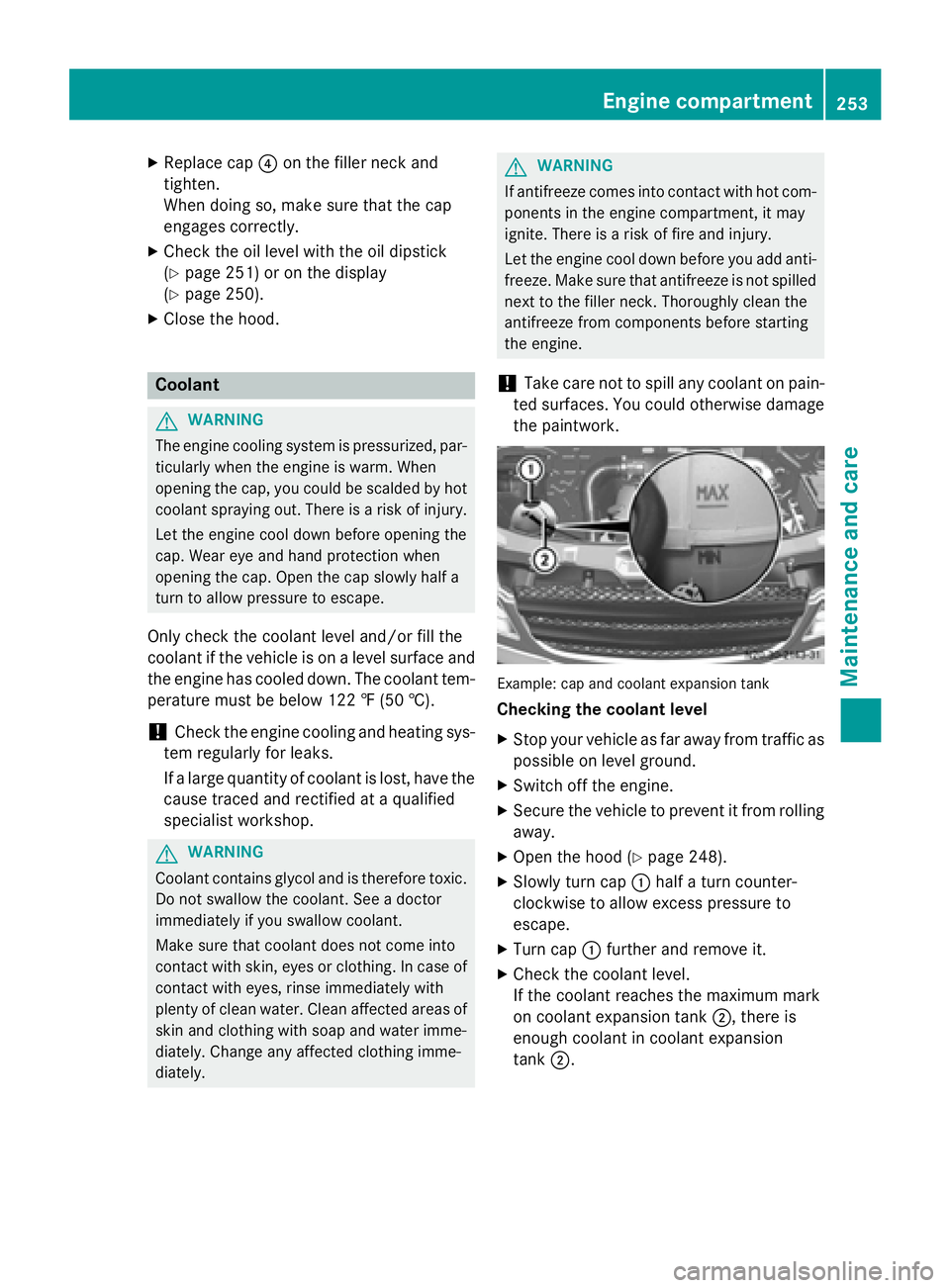
the paintwork. Example: cap and coolant expansion tank
Checking the coolant level
X Stop your vehicle as far away from traffic as
possible on level ground.
X Switch off the engine.
X Secure the vehicle to prevent it from rolling
away.
X Open the hood (Y page 248).
X Slowly turn cap 0043half a turn counter-
clockwise to allow excess pressure to
escape.
X Turn cap 0043further and remove it.
X Check the coolant level.
If the coolant reaches the maximum mark
on coolant expansion tank 0044, there is
enough coolant in coolant expansion
tank 0044. Engine compartment
253Maintenance and care Z
Page 257 of 334
Washer fluid
G
WARNING
Windshield washer concentrate could ignite if it comes into contact with hot engine compo-
nents or the exhaust system. There is a risk of
fire and injury.
Make sure that no windshield washer con-
centrate is spilled next to the filler neck.
! Only use washer fluid that is suitable for
plastic lamp lenses, e.g. MB SummerFit or
MB WinterFit. Unsuitable washer fluid
could damage the plastic lenses of the
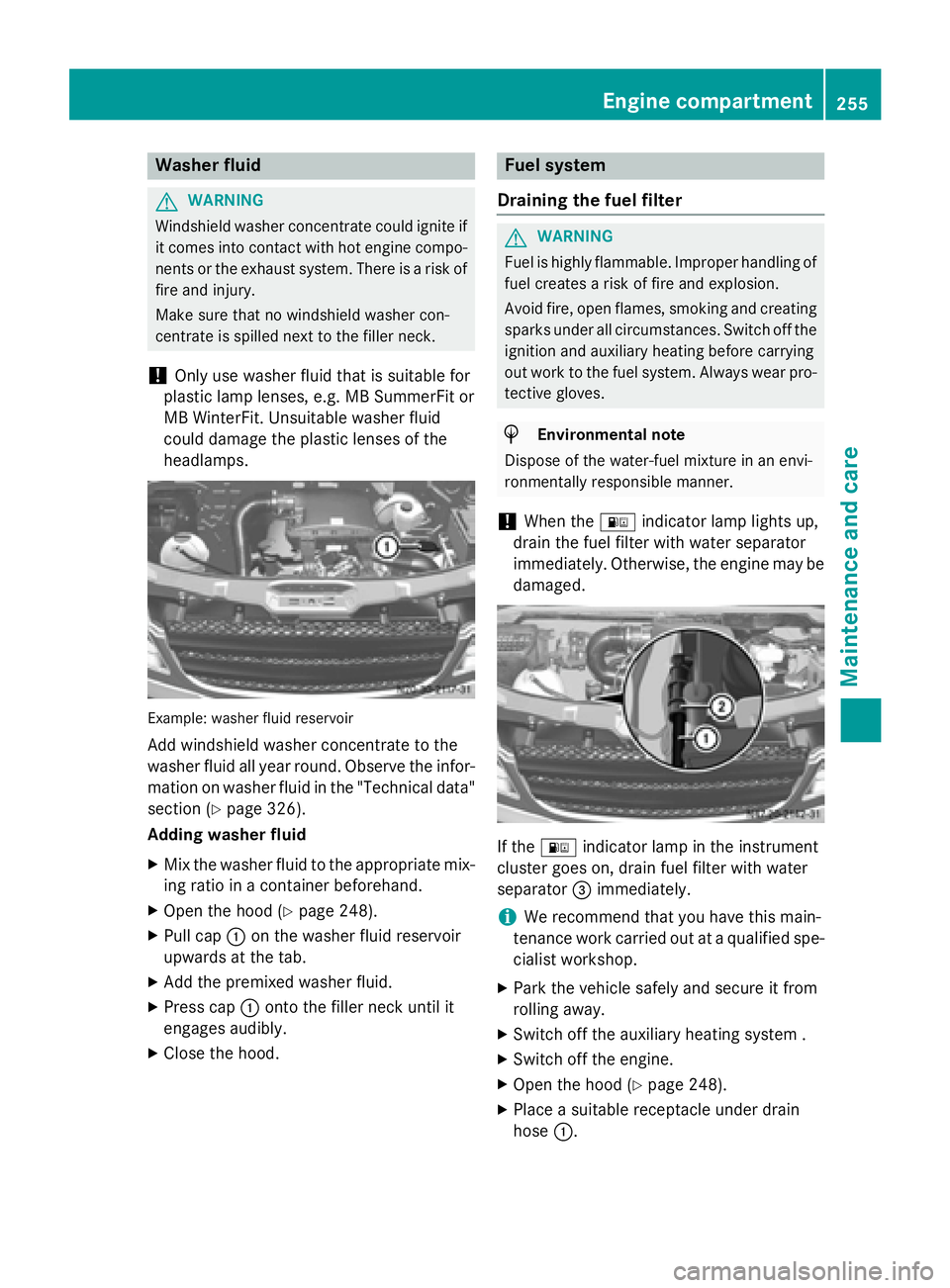
headlamps. Example: washer fluid reservoir
Add windshield washer concentrate to the
washer fluid all year round. Observe the infor- mation on washer fluid in the "Technical data"
section (Y page 326).
Adding washer fluid
X Mix the washer fluid to the appropriate mix-
ing ratio in a container beforehand.
X Open the hood (Y page 248).
X Pull cap 0043on the washer fluid reservoir
upwards at the tab.
X Add the premixed washer fluid.
X Press cap 0043onto the filler neck until it
engages audibly.
X Close the hood. Fuel system
Draining the fuel filter G
WARNING
Fuel is highly flammable. Improper handling of fuel creates a risk of fire and explosion.
Avoid fire, open flames, smoking and creatingsparks under all circumstances. Switch off the
ignition and auxiliary heating before carrying
out work to the fuel system. Always wear pro- tective gloves. H
Environmental note
Dispose of the water-fuel mixture in an envi-
ronmentally responsible manner.
! When the
00B8indicator lamp lights up,
drain the fuel filter with water separator
immediately. Otherwise, the engine may be
damaged. If the
00B8 indicator lamp in the instrument
cluster goes on, drain fuel filter with water
separator 0087immediately.
i We recommend that you have this main-
tenance work carried out at a qualified spe-
cialist workshop.
X Park the vehicle safely and secure it from
rolling away.
X Switch off the auxiliary heating system .
X Switch off the engine.
X Open the hood (Y page 248).
X Place a suitable receptacle under drain
hose 0043. Engine compartment
255Maintenance and care Z
Page 273 of 334
ishes or waxes. There is otherwise a risk of
damaging the surface.
X Wipe the trim elements with a damp, lint-
free cloth, e.g. a microfiber cloth.
X Heavy soiling: use care products and
cleaning agents recommended and
approved for Sprinter vehicles.
Cleaning the seat covers !
Do not use microfiber cloths to clean arti-
ficial leather covers. If used often, a micro- fiber cloth can damage the cover.
! Clean:
R artificial leather covers with a cloth mois-
tened with a solution containing 1%
detergent, e.g. dish washing liquid.
R cloth covers with a microfiber cloth mois-
tened with a solution containing 1%
detergent, e.g. dish washing liquid. Wipeentire seat sections carefully to avoid
leaving visible lines. Leave the seat to dry
afterwards. Cleaning results depend on
the type of dirt and how long it has been
there.
Cleaning the seat belts G
WARNING
Seat belts can become severely weakened if
bleached or dyed. This could cause the seat
belts to tear or fail, for instance, in the event of an accident. This poses an increased risk of
injury or fatal injury.
Never bleach or dye the seat belts.
! Do not clean the seat belts using chemical
cleaning agents. Do not dry the seat belts
by heating at temperatures above 176 ‡
(80 †) or in direct sunlight.
Remove any stains or dirt immediately. This
will avoid residue or damage.
X Use clean, lukewarm water and soap solu-
tion. Cleaning the headliner X
Use a soft brush or dry shampoo to remove
heavy soiling.
Cleaning the curtains !
The curtains must not be washed. Wash-
ing could cause the curtains to shrink and
lose their fire-retardant properties. Always
have the curtains dry-cleaned. Care
271Maintenance and care Z
Page 320 of 334
Service products and capacities
Important safety notes
G
WARNING
Service products may be poisonous and haz-
ardous to health. There is a risk of injury.
Comply with instructions on the use, storage
and disposal of service products on the labels of the respective original containers. Always
store service products sealed in their original containers. Always keep service products out
of the reach of children. H
Environmental note
Dispose of service products in an environ-
mentally responsible manner.
Service products include the following:
R Fuels, e.g. diesel
R Additives for the exhaust gas aftertreat-
ment, e.g. Diesel Exhaust Fluid (DEF)
R Lubricants, e.g. engine oil, transmission oil
R Coolant
R Brake fluid
R Washer fluid
R Climate control system refrigerants
Approved service products comply with the
highest quality standards and are listed in the MB Specifications for Service Products. Only
use service products approved for the vehi-
cle. This is an important condition for the war-
ranty.
You will recognize the approved service prod- ucts by the inscription on the container: MB
Approval (e.g. MB Approval 228.5)
Other identifications and recommendations
refer to quality level or a specification accord-
ing to an MB Sheet Number (e.g. MB 228.5).
They are therefore not necessarily approved.
Further information can be obtained at any
qualified specialist workshop.
Additives for approved service products are
neither required nor permitted. Approved fuel additives are the exception. Additives can cause engine damage and must therefore not
be added to the service products.
The use of additives is always the responsi-
bility of the vehicle operator. The use of addi- tives may result in the restriction or loss of
your Limited Warranty entitlements. Fuel
Important safety notes G
WARNING
Fuel is highly flammable. Improper handling of fuel creates a risk of fire and explosion.
Avoid fire, open flames, smoking and creatingsparks under all circumstances. Switch off the
engine and, if applicable, the auxiliary heating before refueling. G
WARNING
Fuel is poisonous and hazardous to health.
There is a risk of injury.
You must make sure that fuel does not come into contact with your skin, eyes or clothing
and that it is not swallowed. Do not inhale fuel
vapors. Keep fuel away from children.
If you or others come into contact with fuel,
observe the following:
R Wash away fuel from skin immediately
using soap and water.
R If fuel comes into contact with your eyes,
immediately rinse them thoroughly with
clean water. Seek medical assistance with-
out delay.
R If fuel is swallowed, seek medical assis-
tance without delay. Do not induce vomit-
ing.
R Immediately change out of clothing which
has come into contact with fuel.
When handling, storing and disposing of fuels,
please observe the relevant regulations. 318
Service products and capacitiesTechnical data
Page 321 of 334
Tank contents
Depending on equipment, the total capacity
of the fuel tank may vary.
Total capacity
2500
3500 Approx-
imately
26.4 US gal (100 l) of which reserve fuel
Models with a total capacity
of approximately
26.4 US gal (100 l) Approx-
imately
5.3 US gal (20 l) Diesel
Fuel grade
G
WARNING
If you mix diesel fuel with gasoline, the flash
point is lower than that of pure diesel fuel.
When the engine is running, exhaust system
components could overheat without being
noticed. There is a risk of fire.
Never refuel with gasoline. Never mix gasoline with diesel fuel.
! Filter the fuel before transferring it to the
vehicle if you are refueling the vehicle from
barrels or containers.
This will prevent malfunctions in the fuel
system due to contaminated fuel.
! Vehicles without a diesel particle fil-
ter: in countries where only diesel fuel with
a high sulfur content is available, you will
need to carry out your vehicle's oil change
at shorter intervals. Further information on
oil change intervals can be obtained at a
qualified specialist workshop.
! Sprinter diesel engine
You will damage the diesel engine if you do not refuel with ultra-low sulfur diesel or use a diesel fuel with a sulfur content greater
than 15 ppm.
! Do not use the following:
R Marine diesel
R Heating oil
R Bio-diesel
R Vegetable oil
R Gasoline
R Paraffin
R Kerosene
Do not mix such fuels with diesel fuel and
do not use any special additives. This can
otherwise lead to engine damage. This
does not include flow improver additives.
For further information, see "Flow improv-
ers".
You will generally find information about the
fuel grade on the filling pump. If there is no
identification on the filling pump, consult a
gas station attendant.
For more information about refueling
(Y page 145).
Diesel at very low outside temperatures G
WARNING
If you heat fuel system components, e.g. with a hot-air gun or open flame, these compo-
nents could be damaged. This can cause fuel to escape and ignite. Depending on the type
of damage, fuel may also not escape until the
engine is running. There is a risk of fire and
explosion.
Never heat fuel system components. Contact a qualified specialist workshop to rectify the
malfunction.
Refill only with commercially available
ULTRA-LOW SULFUR DIESEL (ULSD, maxi-
mum sulfur content 15 ppm), which fulfills the
ASTM D975 standard.
The flow properties of diesel may be inade-
quate at low outside temperatures due to
paraffin separation. Service products and capacities
319Technical data Z
Page 322 of 334
i
Malfunctions resulting from paraffin sep-
aration can only be rectified by heating the
entire fuel system. Park the vehicle in a
heated garage, for example.
To prevent operating problems, diesel with
better flow qualities is available during the
winter months. You can obtain information at the gas station or from your fuel supplier.
Your vehicle is equipped with a fuel preheat-
ing system. This improves the flow properties
of the diesel by approximately 46 ‡ (8 †).
ULTRA-LOW SULFUR DIESEL can be used
without risk of malfunction down to an out-
side temperature of approximately 14 ‡
(00F810 †).
Fuel additives
! Do not add gasoline or kerosene to diesel
fuel to improve its flow characteristics.
Gasoline or kerosene impairs the lubricat-
ing properties of the diesel fuel. This can
result in damage to the fuel injection sys-
tem, for example.
Information on fuel consumption H
Environmental note
CO 2(carbon dioxide) is the gas which scien-
tists believe to be principally responsible for
global warming (the greenhouse effect). Your
vehicle's CO 2emissions are directly related to
fuel consumption and therefore depend on:
R efficient use of the fuel by the engine
R driving style
R other non-technical factors, such as envi-
ronmental influences, road conditions or
traffic flow
You can minimize your vehicle's CO 2emis-
sions by driving carefully and having it serv-
iced regularly.
Fuel consumption depends on: R the vehicle version
R the style of driving R
the operating conditions
R the type or quality of the fuel used
The vehicle will use more fuel than usual in the following situations:
R at very low outside temperatures
R in city traffic
R during short journeys
R on mountainous terrain
R when towing a trailer
To keep fuel consumption low, observe the
advice in the "Protection of the environment" section (Y page 23).
The following components of the different
vehicle versions influence fuel consumption:
R tire sizes, tire tread, tire pressure, tire con-
dition
R body
R transmission ratios for the drive assem-
blies
R additional equipment (e.g. air-conditioning
system, auxiliary heating system)
For these reasons, the actual consumption
figures for your vehicle may deviate from the
consumption figures determined according
to EU Directive 80/1268/EEC.
Data concerning fuel consumption are recor- ded in the on-board computer; use the steer-
ing wheel buttons to call up the Trip com-
puter menu (Y page 195).
Diesel Exhaust Fluid (DEF) General notes
! Only use DEF in accordance with
ISO 22241. The exhaust gas aftertreatment system may otherwise be damaged.
Observe the MB Specifications for Service
Products, Sheet No. 352.0.
Damage caused by the use of other reduc-
ing agents will invalidate the New Vehicle
Limited Warranty. 320
Service products and capacitiesTechnical data
Page 323 of 334
!
If DEF comes into contact with a painted
or aluminum surface, wash the surface off
immediately with plenty of water.
High ambient temperatures
When opening the DEF tank filler cap at high
outside temperatures, ammonia vapors may
escape. Ammonia vapors have a pungent
odor and are particularly irritating for your
skin, respiratory organs and eyes. This may
result in burning eyes, nose and throat, as
well as coughing and watering eyes. Do not
inhale ammonia vapors.
If DEF heats up, e.g. in direct sunlight, in the
DEF supply reservoir for some time to over
122 ‡ (50 †), ammonia vapor will develop.
Low ambient temperatures
DEF freezes at a temperature of approx-
imately 12 ‡(00F811 †). The vehicle is equipped
with a DEF preheating system at the factory.
Winter operation is therefore also guaranteed at temperatures under 12 ‡ (00F811 †).
Additives and tap water
! Do not mix DEF with any additives and do
not dilute DEF with tap water. Otherwise,
the exhaust gas aftertreatment may be
damaged.
Observe the MB Specifications for Service
Products, Sheet No. 352.0.
Damage that arises through the use of addi- tives or tap water will invalidate the New
Vehicle Limited Warranty.
Storage
! Containers made of aluminum, copper,
copper alloys as well as unalloyed or
galvanized steel are not suitable for storing
DEF. If stored in these types of containers, DEF could cause constituents of these met- als to dissolve and cause irreparable dam-
age to the exhaust gas aftertreatment.
Damage caused by such impurities in the
DEF will invalidate the New Vehicle Limited
Warranty. Only store DEF in containers made of high-
alloy Cr‑Ni steel or Mo‑Cr‑Ni steel in accord-
ance with DIN EN 10 088 ‑1/2/3 or plastic
containers made of polypropylene or poly-
ethylene.
Purity
! Impurities in DEF (e.g. caused by other
service products, cleaning agents, dust,
etc.) result in increased emissions, mal-
functions, catalytic converter damage or
engine damage.
The purity of DEF is essential to prevent mal-
functions in the exhaust gas aftertreatment.
If DEF is pumped out of the DEF tank, e.g.
during repair work, the same liquid must not
be used to refill the tank. Its purity is no longer guaranteed.
Disposal
Observe country-specific laws and regula-
tions when disposing of DEF.
003D Environmental note
Dispose of DEF in an environmentally respon- sible manner.
DEF supply reservoir content
Depending on equipment, the DEF supply res-
ervoir content may vary. Tank contents
Diesel Exhaust Fluid (DEF)
12 Approximately 4.7 US gal (18.0 l)
DEF consumption
For vehicles with a 4-cylinder, in-line
engine (OM 651), the DEF consumption of
the vehicle is:
R as a Cargo Van/Passenger Van, approx.
2322 MPG (0.2 l/100 km)
R as a Cab Chassis, approx. 1720 MPG
(0.35 l/100 km)
12 DEF according to ISO 22241. Observe MB Specifications for Service Products, Sheet 352.0. Service products and capacities
321Technical data Z