maintenance MERCEDES-BENZ SPRINTER 2015 MY15 Operator’s Manual
[x] Cancel search | Manufacturer: MERCEDES-BENZ, Model Year: 2015, Model line: SPRINTER, Model: MERCEDES-BENZ SPRINTER 2015Pages: 334, PDF Size: 5.94 MB
Page 272 of 334
X
Clean access step in the bumper 0043with a
power washer.
Cleaning the trailer tow hitch !
Do not clean the ball coupling with a
power washer. Do not use solvents.
! Observe the notes on care in the Opera-
tor's Manual for the trailer tow hitch and
the ball coupling manufacturer.
You can also have the maintenance work on
the ball coupling and the trailer tow hitch car-
ried out by a qualified specialist workshop. Interior
Cleaning with power washers !
When using liquids to clean the vehicle
interior, observe the following points:
R Under no circumstances use power
washers.
R Make sure that no fluids enter or remain
in gaps and cavities.
R Ensure sufficient ventilation when clean-
ing.
R Make sure that the vehicle interior is
completely dry after cleaning.
Cleaning the display !
For cleaning, do not use any of the fol-
lowing:
R alcohol-based thinner or gasoline
R abrasive cleaning agents
R commercially-available household clean-
ing agents
These may damage the display surface. Do not put pressure on the display surface
when cleaning. This could lead to irrepara-
ble damage to the display. X
Switch off the audio equipment and let the
display cool down.
X Clean the display surface with a commer-
cially available microfiber cloth and cleaner
for TFT/LCD displays.
X Dry the display surface using a dry micro-
fiber cloth.
Cleaning the plastic trim G
WARNING
Care products and cleaning agents containing solvents cause surfaces in the cockpit to
become porous. As a result, plastic parts may
come loose in the event of air bag deploy-
ment. There is a risk of injury.
Do not use any care products and cleaning
agents to clean the cockpit.
! Do not affix the following to plastic surfa-
ces:
R stickers
R films
R scented oil bottles or similar items
You can otherwise damage the plastic.
! Do not allow cosmetics, insect repellent
or sunscreen to come into contact with the
plastic trim. This maintains the high-quality look of the surfaces.
X Wipe the plastic trim and the cockpit with a
damp, lint-free cloth, e.g. a microfiber
cloth.
X Heavy soiling: use a mild detergent or care
products and cleaning agents recommen-
ded and approved by Mercedes-Benz.
Cleaning the steering wheel and selec-
tor lever X
Thoroughly wipe with a damp cloth.
Cleaning the trim elements !
Do not use solvent-based cleaning agents
such as tar remover, wheel cleaners, pol- 270
CareMaintenance and care
Page 273 of 334
ishes or waxes. There is otherwise a risk of
damaging the surface.
X Wipe the trim elements with a damp, lint-
free cloth, e.g. a microfiber cloth.
X Heavy soiling: use care products and
cleaning agents recommended and
approved for Sprinter vehicles.
Cleaning the seat covers !
Do not use microfiber cloths to clean arti-
ficial leather covers. If used often, a micro- fiber cloth can damage the cover.
! Clean:
R artificial leather covers with a cloth mois-
tened with a solution containing 1%
detergent, e.g. dish washing liquid.
R cloth covers with a microfiber cloth mois-
tened with a solution containing 1%
detergent, e.g. dish washing liquid. Wipeentire seat sections carefully to avoid
leaving visible lines. Leave the seat to dry
afterwards. Cleaning results depend on
the type of dirt and how long it has been
there.
Cleaning the seat belts G
WARNING
Seat belts can become severely weakened if
bleached or dyed. This could cause the seat
belts to tear or fail, for instance, in the event of an accident. This poses an increased risk of
injury or fatal injury.
Never bleach or dye the seat belts.
! Do not clean the seat belts using chemical
cleaning agents. Do not dry the seat belts
by heating at temperatures above 176 ‡
(80 †) or in direct sunlight.
Remove any stains or dirt immediately. This
will avoid residue or damage.
X Use clean, lukewarm water and soap solu-
tion. Cleaning the headliner X
Use a soft brush or dry shampoo to remove
heavy soiling.
Cleaning the curtains !
The curtains must not be washed. Wash-
ing could cause the curtains to shrink and
lose their fire-retardant properties. Always
have the curtains dry-cleaned. Care
271Maintenance and care Z
Page 293 of 334
X
If the tire pressure is too high, release air by
pressing down the metal pin in the valve.
Use the tip of a pen, for example. Then,
check the tire pressure again using the tire
pressure gauge.
X Screw the valve cap onto the valve.
X Repeat the steps for the other tires. Tire pressure monitor
Important safety notes G
WARNING
Each tire, including the spare (if provided),
should be checked at least once a month
when cold and inflated to the pressure rec-
ommended by the vehicle manufacturer on
the Tire and Loading Information placard on
the driver's door B-pillar or the tire pressure
label on the inside of the fuel filler flap. If your vehicle has tires of a different size than the
size indicated on the Tire and Loading Infor-
mation placard or the tire pressure label, you should determine the proper tire pressure for
those tires.
As an added safety feature, your vehicle has
been equipped with a tire pressure monitoring system (TPMS) that illuminates a low tire pres-
sure telltale when one or more of your tires
are significantly underinflated. Accordingly,
when the low tire pressure telltale illuminates,
you should stop and check your tires as soon
as possible, and inflate them to the proper
pressure. Driving on a significantly underin-
flated tire causes the tire to overheat and can lead to tire failure. Underinflation also
reduces fuel efficiency and tire tread life, and may affect the vehicle's handling and stop-
ping ability.
Please note that the TPMS is not a substitute
for proper tire maintenance, and it is the driv-
er's responsibility to maintain correct tire
pressure, even if underinflation has not
reached the level to trigger illumination of the
TPMS low tire pressure telltale.
USA only: Your vehicle has also been equipped with a
TPMS malfunction indicator to indicate if the
system is not operating properly. The TPMS
malfunction indicator is combined with the
low tire pressure telltale. When the system
detects a malfunction, the warning lamp will
flash for approximately a minute and then
remain continuously illuminated. This
sequence will be repeated every time the vehi-
cle is started as long as the malfunction
exists.
When the malfunction indicator is illuminated,
the system may not be able to detect or signal low tire pressure as intended. TPMS malfunc-tions may occur for a variety of reasons,
including the mounting of incompatible
replacement or alternate tires or wheels on
the vehicle that prevent the TPMS from func-
tioning properly. Always check the TPMS mal-
function telltale after replacing one or more
tires or wheels on your vehicle to ensure that the replacement or alternate tires and wheels
allow the TPMS to continue to function prop-
erly.
Vehicles with a tire pressure monitor are
equipped with sensors in the wheels that
monitor the tire pressure of all four tires. The tire pressure monitor monitors the pressure
in all four tires; you set this pressure when you
activate the tire pressure monitor. The tire
pressure monitor warns you when the pres-
sure drops in one or more of the tires. The tire
pressure monitor only functions if the corre-
sponding sensors are installed on all wheels.
You should always adjust the tire pressure
according to the vehicle load. Restart the tire
pressure monitor if you change the tire pres-
sure.
The tire pressure monitor does not warn you if a tire pressure is incorrect. Observe the notes
on the recommended tire pressure
(Y page 288).
The tire pressure monitor is not able to warn
you of a sudden loss of pressure, e.g. follow-
ing penetration by a foreign object. In this
event, brake the vehicle until it comes to a Tire pressure
291Wheels and tires Z
Page 309 of 334
X
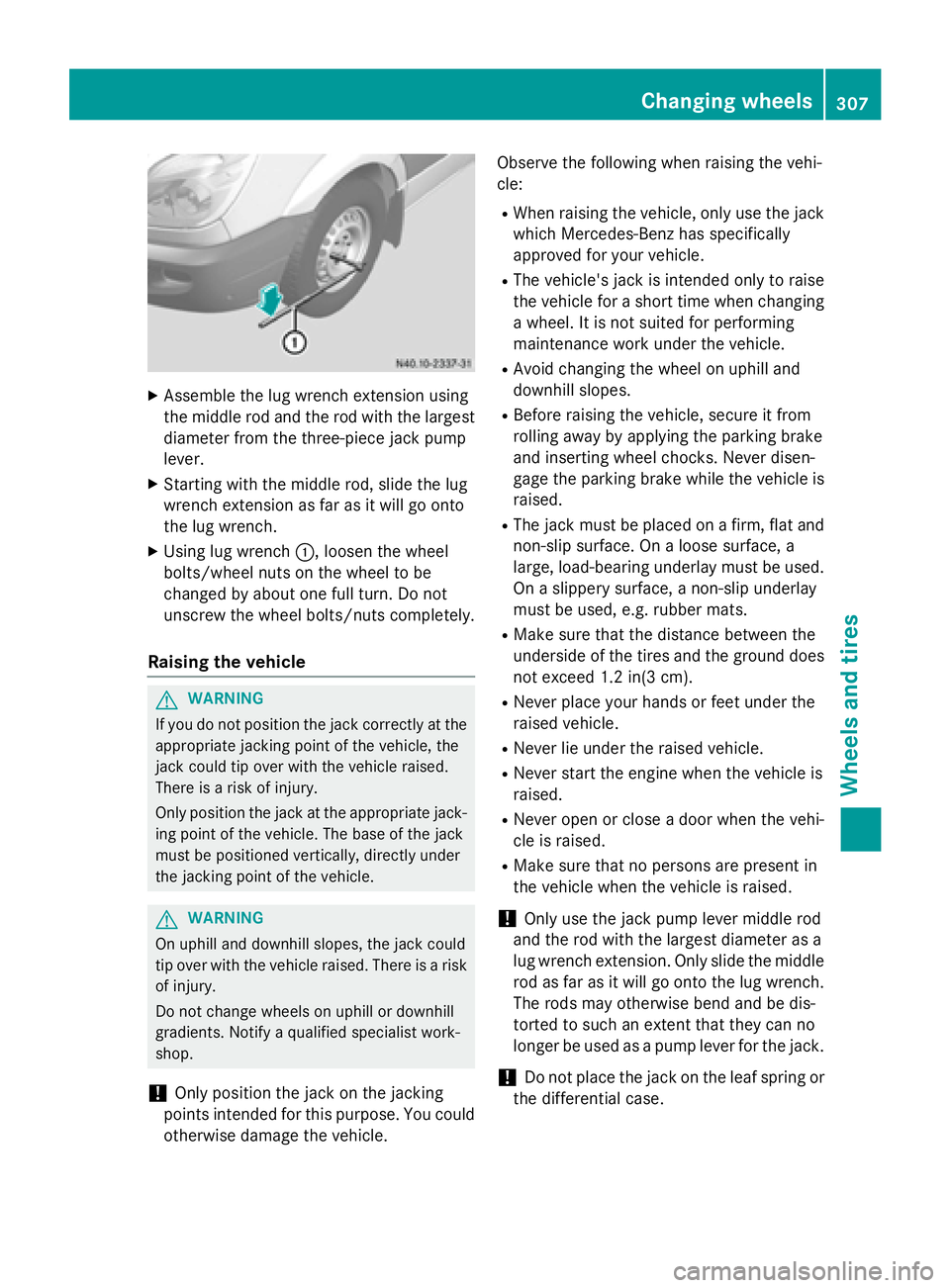
Assemble the lug wrench extension using
the middle rod and the rod with the largest diameter from the three-piece jack pump
lever.
X Starting with the middle rod, slide the lug
wrench extension as far as it will go onto
the lug wrench.
X Using lug wrench 0043, loosen the wheel
bolts/wheel nuts on the wheel to be
changed by about one full turn. Do not
unscrew the wheel bolts/nuts completely.
Raising the vehicle G
WARNING
If you do not position the jack correctly at the appropriate jacking point of the vehicle, the
jack could tip over with the vehicle raised.
There is a risk of injury.
Only position the jack at the appropriate jack-
ing point of the vehicle. The base of the jack
must be positioned vertically, directly under
the jacking point of the vehicle. G
WARNING
On uphill and downhill slopes, the jack could
tip over with the vehicle raised. There is a risk of injury.
Do not change wheels on uphill or downhill
gradients. Notify a qualified specialist work-
shop.
! Only position the jack on the jacking
points intended for this purpose. You could
otherwise damage the vehicle. Observe the following when raising the vehi-
cle:
R When raising the vehicle, only use the jack
which Mercedes-Benz has specifically
approved for your vehicle.
R The vehicle's jack is intended only to raise
the vehicle for a short time when changing
a wheel. It is not suited for performing
maintenance work under the vehicle.
R Avoid changing the wheel on uphill and
downhill slopes.
R Before raising the vehicle, secure it from
rolling away by applying the parking brake
and inserting wheel chocks. Never disen-
gage the parking brake while the vehicle is
raised.
R The jack must be placed on a firm, flat and
non-slip surface. On a loose surface, a
large, load-bearing underlay must be used. On a slippery surface, a non-slip underlay
must be used, e.g. rubber mats.
R Make sure that the distance between the
underside of the tires and the ground does
not exceed 1.2 in(3 cm).
R Never place your hands or feet under the
raised vehicle.
R Never lie under the raised vehicle.
R Never start the engine when the vehicle is
raised.
R Never open or close a door when the vehi-
cle is raised.
R Make sure that no persons are present in
the vehicle when the vehicle is raised.
! Only use the jack pump lever middle rod
and the rod with the largest diameter as a
lug wrench extension. Only slide the middle rod as far as it will go onto the lug wrench. The rods may otherwise bend and be dis-
torted to such an extent that they can no
longer be used as a pump lever for the jack.
! Do not place the jack on the leaf spring or
the differential case. Changing wheels
307Wheels and tires Z
Page 314 of 334
used tires if you have no information about
their previous usage.
The recommended tire pressures can be
found:
R on the Tire and Loading Information plac-
ard 10
on the B-pillar on the driver's side
R on the tire pressure table on the B-pillar on
the driver's side
The recommended tire pressure can also be
found in the "Tire pressure table" section in
this Operator's Manual (Y page 294). The
wheel/tire combination for your vehicle can
be found on the tire pressure table. Further
information on wheel/tire combination can
be obtained at any qualified specialist work-
shop.
Check tire pressures regularly and only when
the tires are cold. Observe the notes on the
recommended tire pressure (Y page 288).
Follow the maintenance recommendations in the tire manufacturer's warranty book in your
vehicle documents.
Notes on the vehicle equipment – always
equip the vehicle:
R with tires of the same size across an axle
(left/right)
R with the same type of tires on all wheels at
a given time (summer tires, winter tires)
Tires that have been specially designed and
approved for your vehicle are marked with
MO or MO1 (Mercedes-Benz Original). You
can find this identification on the tires them-
selves and in the following table.
i Not all wheel/tire combinations can be
installed at the factory in all countries. Spare wheel
Important safety notes
G
WARNING
Wheel and tire dimensions as well as the type of tire can vary between the spare wheel and the wheel to be replaced. When the spare
wheel is mounted, driving characteristics may be severely affected. There is a risk of an acci-
dent.
In order to reduce risks:
R you should therefore adapt your driving
style and drive carefully.
R never mount more than one spare wheel
that differs from the wheel to be replaced.
R only use a spare wheel that differs from the
wheel to be replaced for a short time.
R do not deactivate ESP ®
.
R have a spare wheel that differs from the
wheel that has been changed replaced at
the nearest qualified specialist workshop.
You must observe the correct wheel and
tire dimensions as well as the wheel type.
When using a spare wheel of a different size,
do not exceed the maximum speed of
80 km/h. General notes
! Check the spare wheel regularly to see
that it is secure and has the prescribed tire
pressure.
The procedure for mounting the spare wheel
is described in "Mounting a wheel"
(Y page 306).
The following should be checked regularly,
particularly prior to long journeys:
R the tire pressure of the spare wheel, which
should then be corrected if necessary
(Y page 288).
R the fastenings of the spare wheel bracket.
The spare wheel is located in a spare wheel
bracket under the rear of the vehicle.
Replace the tires after 6 years at the latest,
regardless of wear. This also applies to the
spare wheel.
10 Only for vehicles with a gross weight of less than 10,000 lbs (4,536 kg). 312
Spare wheelWheels and ti
res
Page 325 of 334
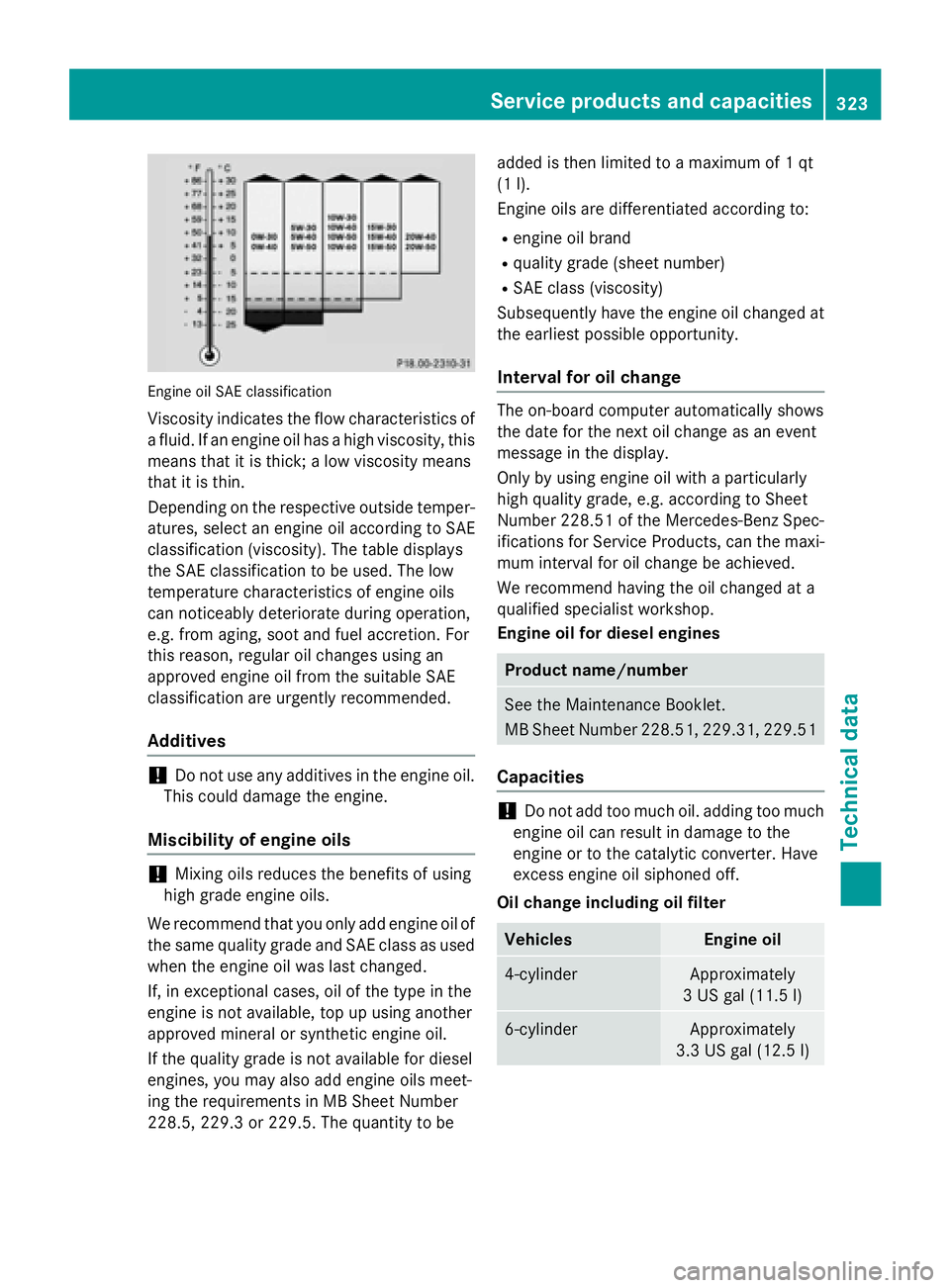
Engine oil SAE classification
Viscosity indicates the flow characteristics of a fluid. If an engine oil has a high viscosity, thismeans that it is thick; a low viscosity means
that it is thin.
Depending on the respective outside temper- atures, select an engine oil according to SAE
classification (viscosity). The table displays
the SAE classification to be used. The low
temperature characteristics of engine oils
can noticeably deteriorate during operation,
e.g. from aging, soot and fuel accretion. For
this reason, regular oil changes using an
approved engine oil from the suitable SAE
classification are urgently recommended.
Additives !
Do not use any additives in the engine oil.
This could damage the engine.
Miscibility of engine oils !
Mixing oils reduces the benefits of using
high grade engine oils.
We recommend that you only add engine oil of
the same quality grade and SAE class as used when the engine oil was last changed.
If, in exceptional cases, oil of the type in the
engine is not available, top up using another
approved mineral or synthetic engine oil.
If the quality grade is not available for diesel
engines, you may also add engine oils meet-
ing the requirements in MB Sheet Number
228.5, 229.3 or 229.5. The quantity to be added is then limited to a maximum of 1 qt
(1 l).
Engine oils are differentiated according to:
R engine oil brand
R quality grade (sheet number)
R SAE class (viscosity)
Subsequently have the engine oil changed at
the earliest possible opportunity.
Interval for oil change The on-board computer automatically shows
the date for the next oil change as an event
message in the display.
Only by using engine oil with a particularly
high quality grade, e.g. according to Sheet
Number 228.51 of the Mercedes-Benz Spec-
ifications for Service Products, can the maxi-
mum interval for oil change be achieved.
We recommend having the oil changed at a
qualified specialist workshop.
Engine oil for diesel engines Product name/number
See the Maintenance Booklet.
MB Sheet Number 228.51, 229.31, 229.51
Capacities
!
Do not add too much oil. adding too much
engine oil can result in damage to the
engine or to the catalytic converter. Have
excess engine oil siphoned off.
Oil change including oil filter Vehicles Engine oil
4-cylinder Approximately
3 US gal (11.5 l) 6-cylinder Approximately
3.3 US gal (12.5 l) Service products and capacities
323Technical data Z
Page 326 of 334
Information about oil consumption
!
If the vehicle is predominantly used for
short-distance driving, this could lead to a
malfunction in the automatic cleaning func- tion for the diesel particle filter. As a result,
fuel may accumulate in the engine oil and
cause engine failure.
Therefore, if you mainly drive short distan-
ces, you should drive on a highway or on
rural roads for 20 minutes every 310 miles
(500 km). This ensures sufficient regener-
ation of the diesel particle filter.
Depending on the driving style, the vehicle
consumes a maximum of 1.0 US qt (1.0 l) of
engine oil over a distance of 620 miles
(1000 km).
Oil consumption may be higher if:
R the vehicle is new.
R you mainly operate the vehicle under ardu-
ous operating conditions.
R you frequently drive at high engine speeds.
Regular maintenance is one of the precondi-
tions for moderate rates of consumption.
You can only estimate the oil consumption
after you have driven a considerable distance.
Check the engine oil level on a regular basis,
e.g. weekly or each time you refuel
(Y page 250). Transmission and power steering oil
Automatic transmission Service product: automatic transmission
fluid Product name/number Maintenance
interval Shell ATF 3403/M-115
MB Sheet No. 236.10 —
Fuchs/Shell ATF 3353
MB Sheet No. 236.12 Further information can be obtained at any
qualified specialist workshop.
Rear axle Service product: transmission oil
Product name/number Maintenance
interval BP Energear Hypo DC
80W-90
MB Sheet No. 235.20 —
Mobil Delvac Synthetic
Gear Oil 75W-90
MB Sheet No. 235.8 Further information can be obtained at any
qualified specialist workshop.
Steering Service product: power steering fluid
Product name/number Maintenance
interval Mobil ATF‑
D,
Exxon Mobil Corporation
or equivalent
MB Sheet No. 236.3 —
The steering is maintenance-free. Further
information can be obtained at any qualified
specialist workshop. Brake fluid
G
WARNING
Brake fluid is hazardous to health. Do not
swallow brake fluid. See a doctor immediately if you swallow brake fluid.
Make sure that brake fluid does not come into
contact with skin, clothing or eyes. Rinse
affected areas with plenty of clean water and
consult a doctor if necessary. 324
Service products and capacitiesTechnical data
Page 327 of 334
Always wear gloves and eye protection when
topping up brake fluid.
Store brake fluid only in the original closed
container and keep it out of the reach of chil- dren. Comply with safety regulations when
handling brake fluid. G
WARNING
The brake fluid constantly absorbs moisture
from the air. This lowers the boiling point of
the brake fluid. If the boiling point of the brake fluid is too low, vapor pockets may form in the brake system when the brakes are applied
hard. This would impair braking efficiency.
There is a risk of an accident.
You should have the brake fluid renewed at
the specified intervals.
! Brake fluid corrodes paint, plastic and
rubber. If paint, plastic or rubber has come
into contact with brake fluid, rinse with
water immediately.
Only use brake fluids approved for Sprinter
vehicles. Always check for the identification
DOT 4 plus.
Information about approved brake fluids can
be found in the Maintenance Booklet or
obtained at any qualified specialist workshop. Service product:
brake fluid Product name/
number Intac B026E
R Boiling point: 500 ‡
(260 †)
R Wet boiling point:
356 ‡ (180 †) MB Sheet No. 331.0
Maintenance
interval 2 years
i
Have the brake fluid renewed every 2
years at a qualified specialist workshop. There is usually a notice in the engine com-
partment to remind you when the next
brake fluid change is due. Coolant
Important safety notes G
WARNING
If antifreeze comes into contact with hot com- ponents in the engine compartment, it may
ignite. There is a risk of fire and injury.
Let the engine cool down before you add anti-
freeze. Make sure that antifreeze is not spilled
next to the filler neck. Thoroughly clean the
antifreeze from components before starting
the engine.
! Take care not to spill any coolant on pain-
ted surfaces. You could otherwise damage
the paintwork.
When handling, storing and disposing of cool-
ant and antifreeze, please observe the rele-
vant regulations and the safety notes in the
"Service products and capacities" section
(Y page 318).
Coolant additive with antifreeze
requirements !
Use only approved antifreeze/corrosion
inhibitor that complies with MB Specifica-
tion for Service Products, Sheet Number
325. Using other, non-approved anti-
freeze/corrosion inhibitors may cause
damage to the coolant system and reduce
the engine's service life.
Coolant is a mixture of water and antifreeze/ corrosion inhibitor. It performs the following
tasks:
R corrosion protection
R antifreeze protection
R raises the boiling point
When the vehicle is first delivered, it is filled
with a coolant mixture that ensures adequate antifreeze and corrosion protection. Coolant Service products and capacities
325Technical data Z
Page 328 of 334
must be used in the system all year round to
ensure anti-corrosion protection and a raised
boiling point – even in countries with high
outside temperatures.
To prevent damage to the engine cooling sys- tem, use only approved corrosion inhibitor/
antifreeze that comply with the Mercedes-
Benz Specifications for Service Products.
We recommend corrosion inhibitor/anti-
freeze that meets the requirements in MB
Specifications for Service Products Sheet
Number 325.
Check the antifreeze/corrosion inhibitor con- centration in the coolant every six months.
The percentage of corrosion inhibitor/anti-
freeze additive in the engine cooling system
should:
R be at least 50%. This way, the engine cool-
ing system is protected against freezing
down to approximately -35 ‡ (-37 †).
R not exceed 55% (antifreeze protection
down to -49 ‡ [-45 †]). Otherwise, heat
will not be dissipated as effectively.
If there has been coolant loss, do not refill
only with water. If the vehicle has lost coolant,
add equal parts water and corrosion inhibi-
tor/antifreeze additive. The water used as
part of the coolant mixture must fulfill certain requirements; these are usually fulfilled by
drinking water. If the water quality is not suf-ficient, you must treat the water.
Service product: coolant Product name/number
EURO Peak Coolant/Antifreeze,
OLD WORLD INDUSTRIES
MB Sheet No. 325.0
Zerex G05, The Valvoline Company
MB Sheet No. 325.0 Product name/number
Zerex G48, The Valvoline Company
MB Sheet No. 325.0
Glysantin G05, BASF AG
MB Sheet No. 325.0
Capacities
Engine cooling system
Coolant
Approximately
10.75 US qt (10.0 l) Refrigerant
The air-conditioning system uses the refrig-
erant R‑134a. This refrigerant does not dam-
age the ozone layer. Product name/number Maintenance
interval Refrigerant R‑134a
MB Sheet No. 361.0 —
Further information can be obtained at any
qualified specialist workshop. Washer fluid
Important safety notes G
WARNING
Windshield washer concentrate could ignite if it comes into contact with hot engine compo-
nents or the exhaust system. There is a risk of
fire and injury.
Make sure that no windshield washer con-
centrate is spilled next to the filler neck.
! Only use washer fluid that is suitable for
plastic lamp lenses, e.g. MB SummerFit or
MB WinterFit. Unsuitable washer fluid
could damage the plastic lenses of the
headlamps. 326
Service products and capacitiesTechnical data