tow bar MERCEDES-BENZ SPRINTER 2016 MY16 Operator’s Manual
[x] Cancel search | Manufacturer: MERCEDES-BENZ, Model Year: 2016, Model line: SPRINTER, Model: MERCEDES-BENZ SPRINTER 2016Pages: 290, PDF Size: 6.44 MB
Page 245 of 290
Before connecting the jumper cables
On vehicles with a battery main switch, check
whether the battery main switch is switched on
(
Ypage 118).
XApply the parking brake.
XMove the selector lever of the automatic
transmission to positionP.
XSwitch off all electrical consumers, e.g. audio
equipment, blower.
XTurn the key to position0in the ignition lock
and remove it (Ypage 119).
XOpen the hood (Ypage 218).
Tow-starting and towing away
Important safety notes
GWARNING
Functions relevant to safety are restricted or
no longer available if:
Rthe engine is not running.
Rthe brake system or the power steering is
malfunctioning.
Rthere is a malfunction in the voltage supply or the vehicle's electrical system.
If your vehicle is being towed, much more
force may be necessary to steer or brake.
There is a risk of an accident.
In such cases, use a tow bar. Before towing,
make sure that the steering moves freely.
GWARNING
You can no longer steer the vehicle if the
steering wheel lock has been engaged. There
is a risk of an accident.
Always switch off the ignition when towing the
vehicle with a tow cable or a tow bar.
GWARNING
When towing or tow-starting another vehicle
and its weight is greater than the permissible
gross weight of your vehicle, the:
Rthe towing eye could detach itself
Rthe vehicle/trailer combination could roll-
over.
There is a risk of an accident.
When towing or tow-starting another vehicle,
its weight should not be greater than the per- missible gross weight of your vehicle.
Information on the gross vehicle weight can be
found on the vehicle identification plate
(
Ypage 276).
!Only secure the tow rope or tow bar at the
towing eyes. Otherwise, the vehicle could be
damaged.
!Observe the following points when towing
with a tow rope:
RSecure the tow rope on the same side on
both vehicles.
REnsure that the tow cable is not longer than
legally permitted. Mark the tow cable in the
middle, e.g. with a white cloth (30 x 30 cm).
This will make other road users aware that
the vehicle is being towed.
ROnly secure the tow cable to the towing
eye.
RObserve the brake lamps of the towing
vehicle while driving. Always maintain a dis-
tance so that the tow rope does not sag.
RDo not use steel cables or chains to tow
your vehicle. You could otherwise damage
the vehicle.
!Do not use the towing eye for recovery, this
could damage the vehicle. If in doubt, recover
the vehicl
e with a crane.
!When towing, pull away slowly and
smoothly. If the tractive power is too high, the
vehicles could be damaged.
When towing away, you must observe the legal
requirements for the country in which you are
currently driving.
It is preferable to have the vehicle transported
on a transporter or trailer instead of towing it.
Tow-starting and towing away243
Roadside Assistance
Z
Page 247 of 290
Towing with the front or rear axle
raised
General notes
!The ignition must be switched off if the vehi-
cle is being towed with the front or rear axle
raised. Otherwise, ESP
®may intervene and
damage the brake system.
!Always use new bolts when installing the
propeller shafts.
iOnly have the propeller shafts installed and
removed by qualified, skilled personnel.
Observe the following before towing a vehicle
with a raised front or rear axle:
Rthe information on towing in the event of mal-
functions (Ypage 244) and
Rthe important safety notes (Ypage 243).
If the front axle is damaged, raise the vehicle at
the front axle and if the rear axle is damaged,
raise the vehicle at the rear axle.
Towing
If the front axle is raised, the vehicle may be
towed a maximum of 30 miles (50 km). For a
towing distance of over 30 miles (50 km), the
propeller shafts to the driven axles must be
removed.
XTurn the key to position 2in the ignition lock.
XDepress the brake pedal and keep it
depressed.
XShift the automatic transmission to position
N.
XTurn the key to position 1in the ignition lock
and leave it in this position.
XSwitch on the hazard warning lamps
(Ypage 82).
XRelease the brake pedal.
XRelease the parking brake.
XIf the front axle is raised, do not exceed the
towing speed of 30 mph (50 km/h) and the
towing distance of 30 miles (50 km).
Towing the vehicle with both axles on
the ground
Important safety notes
GWARNING
You can no longer steer the vehicle if the
steering wheel lock has been engaged. There
is a risk of an accident.
Always switch off the ignition when towing the
vehicle with a tow cable or a tow bar.
!Do not exceed a towing speed of 31 mph
(50 km/h). You could otherwise damage the
transmission.
iOnly have the propeller shafts fitted and
removed by qualified, skilled personnel.
Before towing the vehicle, observe the follow-
ing:
Rthe information on towing in the event of mal-
functions (Ypage 244) and
Rthe important safety notes (Ypage 243).
Towing
You may only tow the vehicle a maximum dis-
tance of 30 miles (50 km). For a towing distance
of over 30 miles (50 km), the propeller shafts to the driven axles must be removed.
XTurn the key to position 2in the ignition lock.
XDepress the brake pedal and keep it
depressed.
XShift the automatic transmission to position
N.
XRelease the brake pedal.
XRelease the parking brake.
XLeave the key in position 2in the ignition lock.
XSwitch on the hazard warning lamps
(Ypage 82).
XDo not exceed the towing speed of 30 mph
(50 km/h) and the towing distance of
30 miles (50 km).
Recovering a vehicle that is stuck
!
When recovering a vehicle that has become
stuck, pull it as smoothly and evenly as pos-
sible. Excessive tractive power could damage
the vehicles.
Tow-starting and towing away245
Roadside Assistance
Z
Page 268 of 290
Load bearing index
The load bearing index (also load index) is a code
that contains the maximum load bearing capa-
city of a tire.
Traction
Traction is the result of friction between the tires
and the road surface.
TWR (permissible trailer drawbar load)
The TWR is the maximum permissible weight
that may act on the ball coupling of the trailer
tow hitch.
Wear indicator
Narrow bars (tread wear bars) that are distrib-
uted over the tire tread. If the tire tread is level
with the bars, the wear limit ofáin(1.6 mm )
ha sbeen re ached.
Distribution of the vehicle occupants
The distribution of vehicle occupants over des-
ignated seat positions in a vehicle.
Maximum permissible payload weight
Nominal load and goods/luggage load plus
68 kg (150 lbs) multiplied by the number of
seats in the vehicle.
Flat tire
General notes
If your vehicle is equipped with a spare wheel,
the spare wheel is under the rear of the vehicle
(
Ypage 272).
Information about installing a wheel can be
found in the "Wheel change" section
(
Ypage 267).
Changing wheels
Rotating the wheels
GWARNING
Interchanging the front and rear wheels may
severely impair the driving characteristics if
the wheels or tires have different dimensions. The wheel brakes or suspension components
may also be damaged. There is a risk of acci-
dent.
Rotate front and rear wheels only if the wheels and tires are of the same dimensions.
!On vehicles equipped with a tire pressure
monitor, electronic components are located
in the wheel.
Tire-mounting tools should not be used near
the valve. This could damage the electronic
components.
Only have tires changed at a qualified spe-
cialist workshop.
Always observe the instructions and safety
notes in the "Mounting a wheel" section
(
Ypage 267).
The wear patterns on the front and rear tires
differ, depending on the operating conditions.
Rotate the wheels before a clear wear pattern
has formed on the tires. Front tires typically
wear more on the shoulders and the rear tires in
the center.
If your vehicle's tire configuration allows, you
can rotate the wheels according to the intervals
in the tire manufacturer's warranty book in your
vehicle documents. If no warranty book is avail-
able, the tires should be rotated every 3,000 to
6,000 miles (5,000 to 10,000 km), or earlier if
tire wear requires. Do not change the direction
of rotation.
Clean the contact surfaces of the wheel and the brake disc thoroughly every time a wheel is rota-
ted.
Check the tire pressure and reactivate the tire
pressure monitor if necessary.
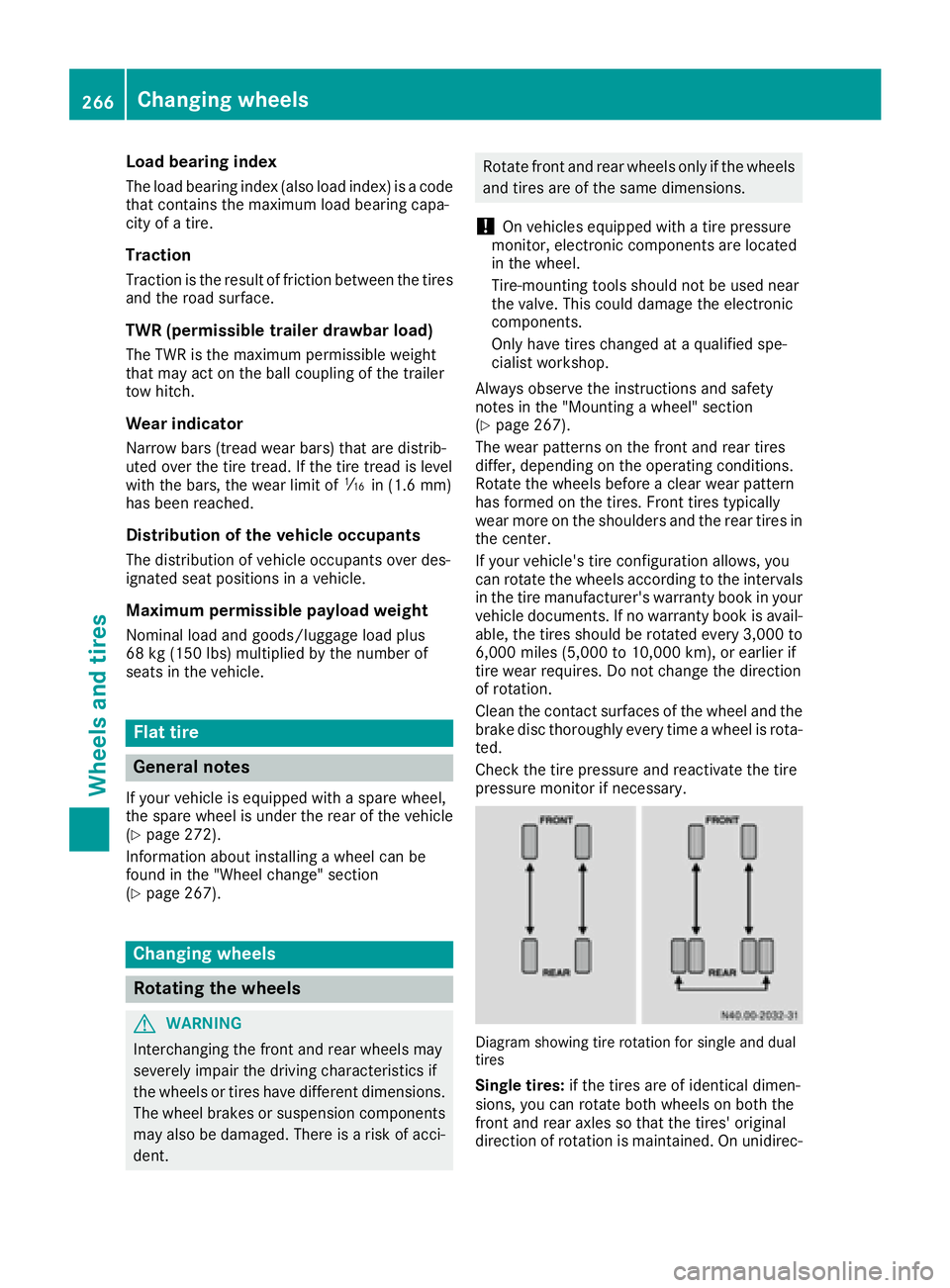
Diagram showing tire rotation for single and dual
tires
Single tires: if the tires are of identical dimen-
sions, you can rotate both wheels on both the
front and rear axles so that the tires' original
direction of rotation is maintained. On unidirec-
266Changing wheels
Wheels and tires