charging MERCEDES-BENZ SPRINTER 2018 MY18 Operator’s Manual
[x] Cancel search | Manufacturer: MERCEDES-BENZ, Model Year: 2018, Model line: SPRINTER, Model: MERCEDES-BENZ SPRINTER 2018Pages: 294, PDF Size: 4.36 MB
Page 235 of 294
Installing and removing the additional
battery (engine compartment)
Removing the additional battery
XDisconnect th ebattery (Ypage 232).
XLoosen th ebolt sholding th eretainer that pre -
vents th ebattery from moving around.
XRemove th ebattery holder and tak eout th e
battery.
Installing the additional battery
XInser tth ebattery int oth ebattery case.
XInser tth ebattery holder.
XTighte nth ebolt sholding th eretainer that
prevents th ebattery in th eengin ecompart-
men tfrom moving around.
XConnect th ebattery (Ypage 232).
Charging
GWARNIN G
A discharged battery can freez eat tempera-
tures belo wfreezing point. When jump-start -
ing th evehicl eor charging th ebattery, gase s
can escape from th ebattery. Ther eis aris kof
an explosion .
Allow th efrozen battery to thaw out before
charging it or jump-starting .
If th eindicator/warning lamp sdo no tligh tup in
th einstrumen tcluste rwhen temperatures are
low, it is probably because th edischarged bat -
tery has frozen .Should this be th ecase, do no t
jump-start th evehicl eor charge th ebattery. The
servic elife of athawed battery may be shorter.
Start-up behavior may deteriorate, in particular
at low temperatures .Hav eth ethawed battery
checke dat aqualified specialist workshop.
GWARNIN G
During charging and jump-starting ,explosive
gase scan escape from th ebattery. Ther eis a
ris kof an explosion .
Particularly avoi dfire, open flames, creating
sparks and smoking. Ensur ethere is sufficien t
ventilation while charging and jump-starting .
Do no tlean ove r abattery.
GWARNIN G
Battery acid is caustic. Ther eis aris kof injury.
Avoid contact wit hskin, eyes or clothing .Do
no tinhale any battery gases. Do no tlean ove r
th ebattery. Kee pchildren away from batter-
ies. Wash away battery acid immediately wit h
plenty of clean water and seek medical atten -
tion .
!Only charge th einstalled battery wit h abat-
tery charge rthat has been tested and
approve dby th edistributo rnamed on th e
inside of th efron tcover .This device allows
th ebattery to be charge dwhen it is installed
in th evehicle. The vehicle's electronics may
otherwise be damaged.
A battery charge runit specially adapted for
Mercedes-Ben zvehicles and tested and
approve dby Mercedes-Ben zis available as an
accessory. Only this device permit sth echarging
of th ebattery in it sinstalled position .Only
charge th einstalled battery wit h abattery
charge rthat has been tested and approve dby
Mercedes-Benz, usin gth ejump-start connec -
tion poin tin th eengin ecompartment. Contac t
an authorize dMercedes-Ben zCente rfor infor-
mation and availability. Read th eoperating
instruction sfor your charge rbefore charging
th ebattery.
The additional battery canno tbe charge dfrom
th eju
mp-starting connection point.
Recharge th ebattery mor efrequentl yif you use
th evehicl emainly for short trips and/o rdriv eat
low outside temperatures .
XCharge thebattery. Observ eth enote sin th e
operating instruction sfor your battery
charger.
XIf necessary, instal lth ebattery. Observ eth e
note son reconnecting th ebattery.
iIfabattery is no tinstalled and no tin service,
you should charge it every three months. This
will counter self-dischargin gand preven tbat -
tery damage.
Care
!
Dirt ybattery clamps and battery surfaces
caus eleak currents whic hlead to th ebatter-
ies discharging.
Battery233
Maintenance and care
Z
Page 245 of 294
Fire extinguisher
Removing the fire extinguisher
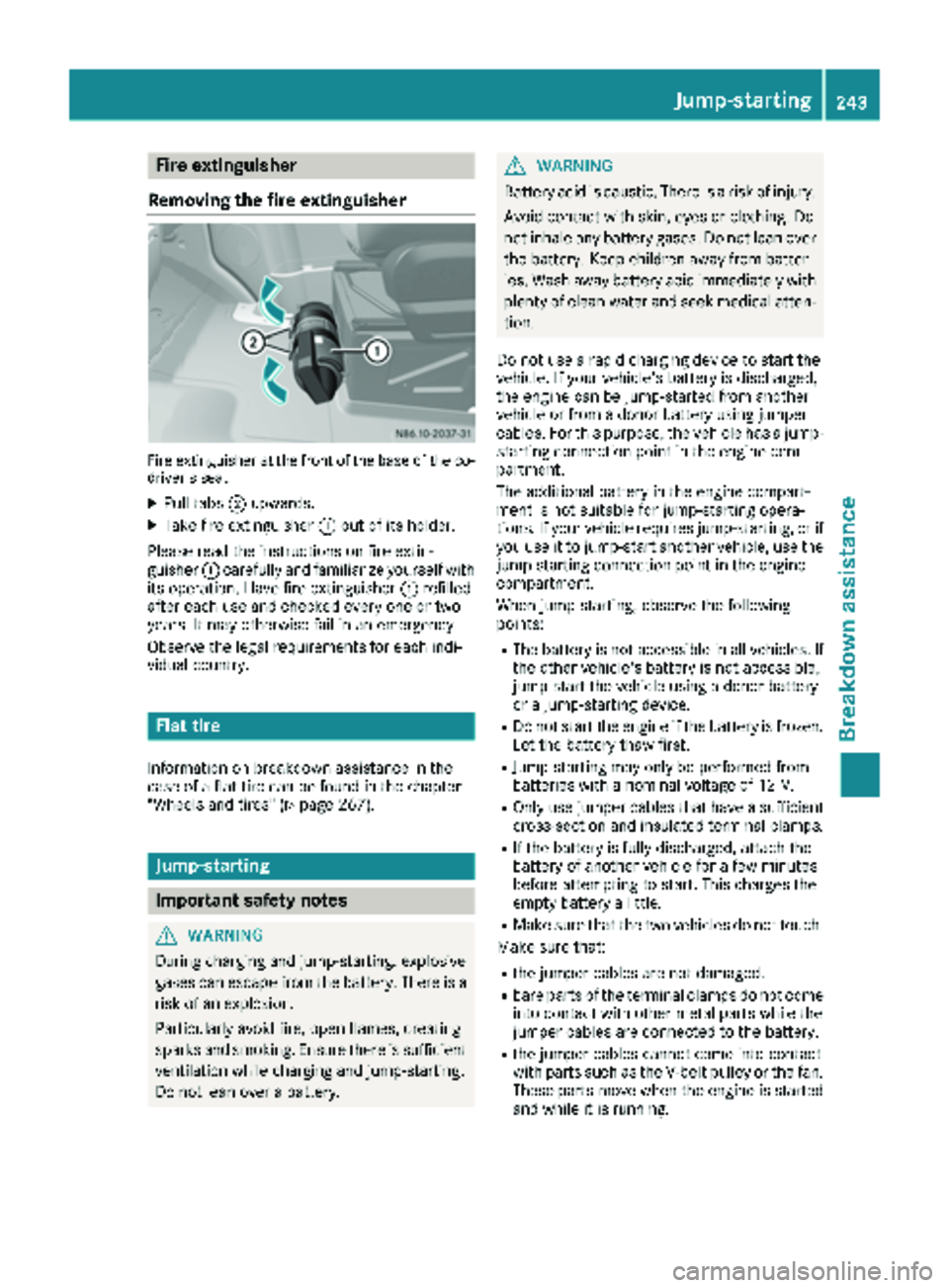
Fir eextinguisher at th efron tof th ebase of th eco -
driver' sseat
XPull tab s; upwards.
XTak efir eextinguishe r: out of it sholder.
Pleas eread th einstruction son fir eextin-
guisher :carefully and familiarize yourself wit h
it s operation .Hav efir eextinguishe r: refilled
after eac huse and checked every on eor two
years .It may otherwise fail in an emergency.
Observ eth elegal requirements for eac hindi-
vidua lcountry.
Flat tire
Information on breakdown assistanc ein th e
cas eof aflat tire can be foun din th echapter
"Wheels and tires " (
Ypage 267).
Jump-starting
Important safety notes
GWARNING
During charging and jump-starting ,explosive
gase scan escape from th ebattery. Ther eis a
ris kof an explosion .
Particularly avoi dfire, open flames, creating
sparks and smoking. Ensure there is sufficien t
ventilation while charging and jump-starting .
Do no tlean ove r abattery.
GWARNIN G
Battery acid is caustic. Ther eis aris kof injury.
Avoid contact wit hskin, eyes or clothing .Do
no tinhale any battery gases. Do no tlean ove r
th ebattery. Kee pchildren away from batter-
ies. Wash away battery acid immediately wit h
plenty of clean water and seek medical atten -
tion .
Do no tuse arapi dcharging device to start th e
vehicle. If your vehicle's battery is discharged,
th eengin ecan be jump-started from another
vehicl eor from adonor battery usin gjumper
cables. Fo rthis purpose ,th evehicl ehas ajump-
starting connection poin tin th eengin ecom-
partment.
The additional battery in th eengin ecompart-
men tis no tsuitable for jump-starting opera-
tions. If your vehicl erequire sjump-starting ,or if
you use it to jump-start another vehicle, use th e
jump-starting connection poin tin th eengin e
compartment.
When jump-starting ,observ eth efollowin g
points :
RThe battery is no taccessible in all vehicles. If
th eother vehicle's battery is no taccessible,
jump-start th evehicl eusin g adonor battery
or ajump-starting device .
RDo notstart th eengin eif th ebattery is frozen .
Let th ebattery thaw first .
RJump-starting may only be performed from
batteries with anominal voltag eof 12 V.
ROnly use jumper cables that have asufficien t
cross-section and insulated termina lclamps.
RIf th ebattery is fully discharged, attach th e
battery of another vehicl efor afew minute s
before attempting to start .This charge sth e
empty battery alittle.
RMak esure that th etwo vehicles do no ttouch .
Mak esure that:
Rth ejumper cables are no tdamaged.
Rbare part sof th etermina lclamps do no tcome
int ocontact wit hother metal part swhile th e
jumper cables are connected to th ebattery.
Rth ejumper cables canno tcome int ocontact
wit hpart ssuc has th eV-belt pulley or th efan .
Thes epart smov ewhen th eengin eis started
and while it is running.
Jump-starting243
Breakdown assistance
Z
Page 278 of 294
Useful information
This Operator's Manual describes all models as
well as standard and optional equipment of your
vehicle that were available at the time of going
to print. Country-specific variations are possi-
ble. Note that your vehicle may not be equipped
with all of the described functions. This also
applies to systems and functions relevant to
safety.
Read the information on qualified specialist
workshops (
Ypage 27).
Vehicle electronics
Tampering with the engine electron-
ics
!
Only have engine electronics and the corre-
sponding parts, such as control units, actua-
tors, sensors or connector leads, serviced at a
qualified specialist workshop. Otherwise, the
vehicle parts may wear more quickly. This can
lead to loss of the New Vehicle Limited War-
ranty.
Installing electrical or electronic
equipment
You and others can suffer health-related dam-
age through electromagnetic radiation. By using
an exterior antenna, a possible health risk
caused by electromagnetic fields, as discussed
in scientific circles, is taken into account. Only
have the exterior antenna installed by a qualified specialist workshop.
Electrical and electronic devices may have a
detrimental effect on both the comfort and the
operating safety of the vehicle. If equipment of
this kind is installed, its electromagnetic com-
patibility must be checked and verified.
If these devices are linked to functions associ-
ated with resistance to interference, they must
have type approval. This applies to the device or
its interfaces to the vehicle electronics, e.g.
charging brackets.
A telephone or two-way radio to be installed in
the vehicle must be approved. Further informa-
tion can be obtained from any Sprinter Dealer.
For operation of mobile phones and two-way
radios, Mercedes-Benz recommends connec- tion to an approved exterior antenna. This is the
only way to ensure optimum reception quality
inside the vehicle and to minimize mutual inter-
ference between the vehicle electronics, mobile
phones and two-way radios.
The transmission output of the mobile phone or
two-way radio may not exceed the following
maximum transmission output (PEAK):
Frequency rangeMaximum trans-
mission output
(PEAK)
Shortwave
(f < 50 MHz)100 W
4 m waveband30 W
2 m waveband50 W
Trunked radio/Tetra35 W
70 cm waveband35 W
GSM/UMTS/LTE10 W
Identification plates
Vehicle identification plate with vehi-
cle identification number (VIN)
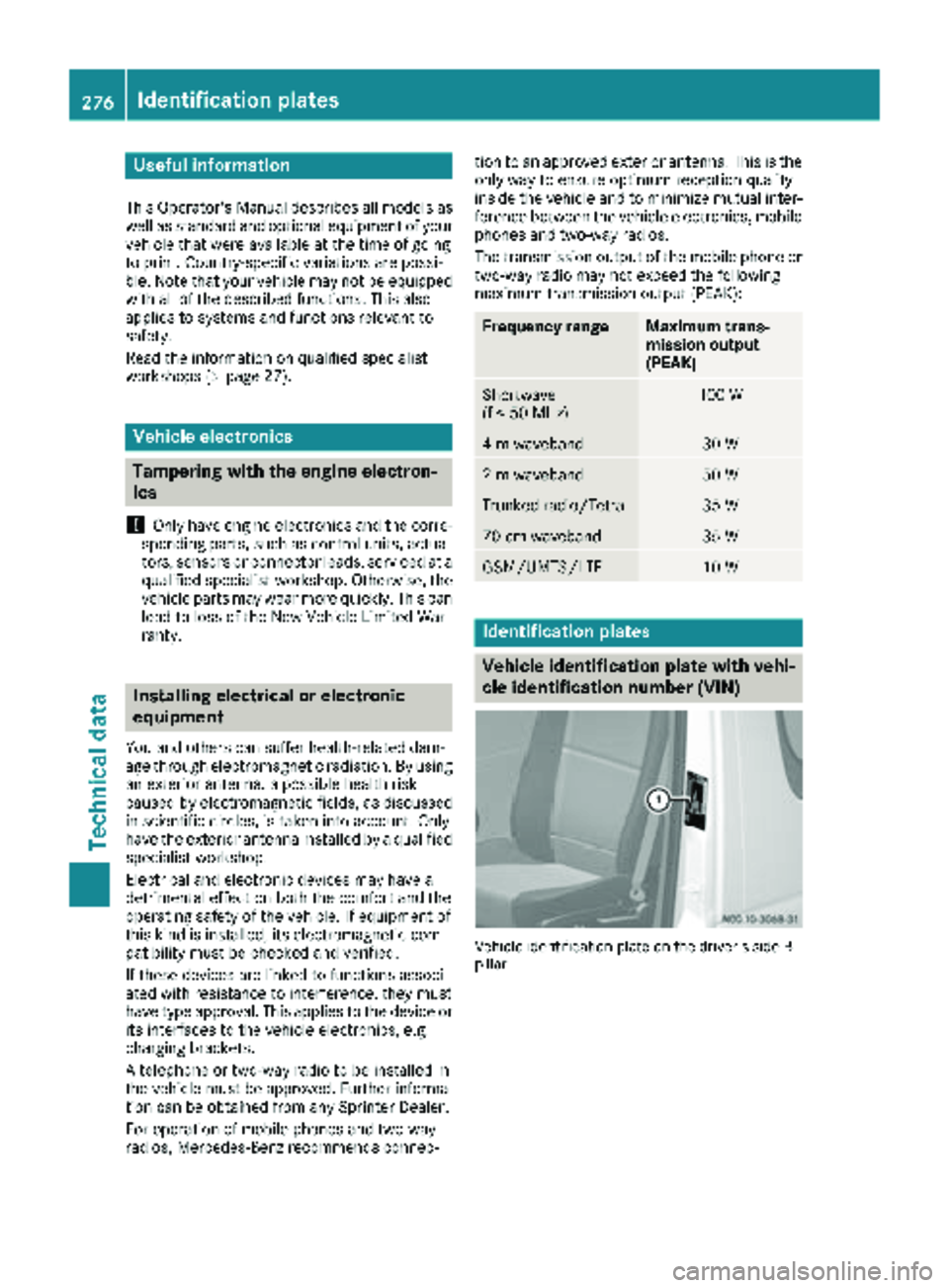
Vehicle identification plate on the driver's side B-
pillar
276Identification plates
Technical data