ABS MERCEDES-BENZ SPRINTER 2018 MY18 Operator’s Manual
[x] Cancel search | Manufacturer: MERCEDES-BENZ, Model Year: 2018, Model line: SPRINTER, Model: MERCEDES-BENZ SPRINTER 2018Pages: 294, PDF Size: 4.36 MB
Page 6 of 294
1, 2, 3 ...
4ETS (Electronic Traction System).... 57
12-V socket ........................................ 211
A
ABS (Anti-lock Braking System)
Display message ............................ 181
Function/notes ................................ 54
Important safety notes .................... 54
Indicator lamp ................................ 196
Access step in the bumper
Cleaning .........................................2 38
Activating/deactivating cooling
with air dehumidification ................. 103
Activating/deactivating the roof
ventilator ...........................................1 17
Adaptive Brake Assist
Function/notes .............................1 42
ADAPTIVE ESP
®
see ESP®(Electronic Stability Program)
Add-on equipment ............................... 28
Additional indicators
Replacing bulbs ............................... 91
Replacing bulbs (roof) ......................9 4
Additives
Diesel ............................................ 280
Engine oil ...................................... .283
Adjusting the headlamp range ........... 84
ADR (working speed governor) ........153
Air bags
Deployment ..................................... 47
Front air bag (driver, front
passenger) ....................................... 46
Important safety notes .................... 45
Introduction ..................................... 45
Side impact air bag .......................... 46
Window curtain air bag .................... 47
Air filter
Indicator lamp ................................ 202
Air pressure
see Tire pressure
Air vents
Adjusting for the passenger com-
partment ........................................ 107
Adjusting on the roof ..................... 107
Importa nt sa
fety notes .................. 106 Setting the center air vents ........... 106
Setting the side air vents ...............1
07
Air vents
see Air vents
Air-conditioning system
Refrigerant ..................................... 286
see Climate control
Air-recirculation mode
Important safety notes .................. 105
Switching on/off ........................... 105
All-wheel drive
Engaging/disengaging ................... 147
Important safety notes .................. 146
LOW RANGE transmission ratio ..... 147
Anti-lock braking system
see ABS (Anti-lock Braking System)
Anti-theft system
Interior motion sensor ..................... 59
Armrests .............................................. 78
Ashtray ............................................... 210
ASR (acceleration skid control)
Activating/deactivating ................... 55
Display message ............................ 182
Function/notes ................................ 55
Important safety notes .................... 55
Indicator lamp ................................ 196
ATA (Anti-Theft Alarm system)
Activating/deactivating ................... 58
Switching off the alarm .................... 58
Authorized workshop
see Qualified specialist workshop
Automatic car wash (care) ...............234
Automatic headlamp mode ................ 83
Automatic locking ............................... 66
Automatic transmission
Accelerator pedal position ............. 125
Changing gear ............................... 124
Changing gear yourself .................. 124
Driving tips .................................... 125
Emergency running mode .............. 126
Important safety notes .................. 123
Kickdown ....................................... 125
Maneuvering .................................. 125
Overview ........................................ 123
Problem (malfunction) ................... 126
Releasing the parking lock man-
ually ............................................... 126
4Index
Page 8 of 294
Display message ............................ 183
Notes ............................................. 284
Warning lamp ................................. 197
Brake force distribution
Display message ............................ 183
see EBD (electronic brake force
distribution)
Brake lamps
Replacing bulbs ............................... 92
Brake lamps (Chassis Cab)
Replacing bulbs ............................... 93
Brake linings
Display message ............................ 182
Indicator lamp ................................ 199
Brake pads/linings
New ............................................... 135
Brake system
Warning lamp ................................. 196
Brakes
ABS .................................................. 54
Adaptive Brake Assist .................... 142
Applying the parking brake ............ 130
BAS .................................................. 56
Brake fluid (notes) ......................... 284
Checking brake fluid level .............. 224
Display message ............................ 183
EBD .................................................. 56
Important safety notes .................. 134
New brake pads/linings ................ 135
Parking brake (notes) ..................... 135
Riding tips ...................................... 134
Breakdown
Fire extinguisher ............................ 243
First-aid kit .................................... 242
Jump-starting ................................. 243
Reflective safety jacket .................. 242
Vehicle tool kit ............................... 241
Warning lamp ................................. 242
Warning triangle ............................ 242
see Towing away
Bulb failure indicator .......................... 82
C
California
Important notice for retail cus-
tomers and lessees .......................... 23 Car
see Vehicle
Care
Access step in the bumper ............ 238
Car wash ........................................ 234
Display ........................................... 238
Exterior lights ................................ 237
Interior ........................................... 238
Notes ............................................. 234
Paint .............................................. 236
Plastic trim .................................... 239
Power washer ................................ 235
Rear view camera .......................... 237
Roof lining ...................................... 239
Seat belt ........................................ 239
Seat cover ..................................... 239
Selector lever ................................ 239
Sensors ......................................... 237
Sliding door ................................... 238
Steering wheel ............................... 239
Step (electrical) ............................. 238
Trim pieces .................................... 239
Washing by hand ........................... 235
Washing the engine ....................... 235
Wheels ........................................... 236
Windows ........................................ 236
Wiper blades .................................. 236
Cargo compartment
Activating/deactivating ventila-
tion ................................................ 117
Cargo compartment floor ................... 29
Cargo tie-down points and tie
downs
Important safety notes .................. 215
Cargo tie-down rings
Installing ........................................ 217
Permissible tensile load ................. 287
Carrier system
Ladder rack ................................... 218
Center console overview .................... 37
Central locking
Automatic locking ............................ 66
Important safety notes .................... 65
Locking/unlocking (buttons) ........... 65
Locking/unlocking (SmartKey) ........ 61
Locking/unlocking manually ............ 65
Central locking system
see Central locking
6Index
Page 11 of 294
Switching on/off (vehicles with-
out steering wheel buttons) ........... 163
Dealership
see Qualified specialist workshop
Declarations of conformity ................. 27
DEF (Diesel Exhaust Fluid )
Refilling .......................................... 128
Delayed switch-off ............................ 171
Diagnostics connection
Operating safety and vehicle
approval ........................................... 27
Diesel .................................................. 279
Diesel engine
Preglow indicator lamp .................. 202
Diesel Exhaust Fluid (DEF)
Display messages (vehicles with
steering wheel buttons) ................. 187
Display messages (vehicles with-
out steering wheel buttons) ........... 177
Indicator lamp ................................ 198
Level indicator ............................... 161
Notes ............................................. 281
Storage .......................................... 281
Tank content .................................. 282
Diesel particle filter
Short-distance driving .................... 133
Digital speedometer
Setting the unit (vehicles with
steering wheel buttons) ................. 168
Display
Outside temperature (vehicles
with steering wheel buttons) ......... 166
Outside temperature display
(vehicles without steering wheel
buttons) ......................................... 162
Standard display (vehicles with
steering wheel buttons) ................. 166
Standard display (vehicles with-
out steering wheel buttons) ........... 162
see Warning and indicator lamps
Display
see Warning and indicator lamps
Display messages
Calling up the message memory .... 175
Driving systems ............................. 191
Engine ............................................ 187
Important safety notes .................. 175
Lights ............................................. 185 Safety systems .............................. 181
Service interval display .................. 227
SmartKey ....................................... 194
Ti
res ............................................... 193
Ve
hicle ........................................... 194
Distance recorder ............................. 166
see Odometer
see Trip odometer
Distance warning function
Activating/deactivating ................. 142
Indicator lamp ................................ 142
Warning lamp ................................. 195
Door lock
see Central locking
Doors
Central locking/unlocking
(SmartKey) ....................................... 61
Control panel ................................... 39
Display message ............................ 194
Indicator lamp ................................ 203
Drinking and driving ......................... 132
Drinks holder
see Bottle holder
Driver's/front-passenger door
Unlocking ......................................... 66
Driving abroad ................................... 133
Driving off-road
DSR (Downhill Speed Regulation) .. 148
see Off-road driving
Driving on flooded roads .................. 136
Driving safety systems
4ETS (Electronic Traction Sys-
tem) ................................................. 57
ABS (Anti-lock Braking System) ....... 54
Adaptive Brake Assist .................... 142
ASR (Acceleration Skid Control) ...... 55
BAS (Brake Assist System) .............. 56
Distance warning function ............. 141
EBD (electronic brake force distri-
bution) ............................................. 56
ESP
®(Electronic Stability Pro-
gram) ............................................... 56
Important safety information ........... 54
Overview .......................................... 54
Driving system
Display messages (vehicle with-
out steering wheel buttons) ........... 180
Index9
Page 23 of 294
Two-way radiosType approval/frequency .............. 276
TWR (Tongue Weight Rating) (defi-
nition) ................................................. 266
Type plate
Vehicle identification number
(VIN) .............................................. 276
U
UnlockingFrom inside the vehicle (central
unlocking button) ............................. 65
USB port ............................................. 212
V
Vehicle
Data acquisition ............................... 30
Display message ............................ 194
Electronics ..................................... 276
Equipment ....................................... 23
Individual settings (vehicles with
steering wheel buttons) ................. 167
Limited Warranty ............................. 23
Loading .......................................... 259
Locking (SmartKey) .......................... 61
Lowering ........................................ 272
Maintenance .................................... 24
Operating safety .............................. 26
Parking for a long period ................ 131
Pulling away ................................... 121
Raising ........................................... 268
Registration ..................................... 28
Reporting problems ......................... 28
Securing from rolling away ............ 129
Towing away .................................. 244
Transporting .................................. 247
Unlocking (SmartKey) ...................... 61
Vehicle battery
see Battery (vehicle)
Vehicle bodies ..................................... 28
Body/equipment mounting direc-
tives for trucks ................................. 28
Vehicle data ....................................... 286
Vehicle identification number .......... 276
Vehicle identification plate .............. 276
Vehicle tool kit .................................. 241 VIN
...................................................... 276
Voltage supply
Fuses ............................................. 247
W
WarningStickers ........................................... 25
Warning and indicator lamp
Power assistance for the steering .. 204
Warning and indicator lamps
Brakes ........................................... 197
Check Engine ................................. 201
Coolant .......................................... 200
Diesel Exhaust Fluid (DEF) ............. 198
Distance warning function ............. 195
Electrical step ................................ 204
ESP
®.............................................. 195
ESP®function ................................ 199
Lane Keeping Assist ...................... 195
Overview .......................................... 35
Seat belt ........................................ 203
Warning lamp .................................... 242
Warning triangle ................................ 242
Warning- and indicator lamps
ABS ................................................ 196
Air filter .......................................... 202
ASR ................................................ 195
BAS ................................................ 196
Battery charge ............................... 199
Brake wear .................................... 199
Bulbs .............................................. 203
Doors ............................................. 203
Engine oil level ............................... 200
Preglow .......................................... 202
Reserve fuel ................................... 201
Tire pressure monitor .................... 202
Water separator ............................. 203
Windshield washer fluid ................. 203
Warranty .............................................. 23
Washer fluid
Adding ........................................... 225
Capacities ...................................... 286
Display message ............................ 194
Indicator lamp ................................ 203
Notes ............................................. 286
Wiping with ...................................... 96
Index21
Page 44 of 294
A malfunction has occurred if the6restraint
system warning lamp:
Rdoes not light up after the ignition is switched
on
Rdoes not go out after a few seconds
Rgoes out but then lights up again while the
engine is running, for example
GWARNING
If the restraint system is malfunctioning,
restraint system components may be trig-
gered unintentionally or may not deploy as
intended during an accident. This can affect
for example the Emergency Tensioning
Device or the air bag. This poses an increased
risk of injury or even fatal injury.
Have the restraint system checked and
repaired in a qualified specialist workshop as
soon as possible.
Seat belts
Introduction
Seat belts are the most effective means of
restricting the movement of vehicle occupants
in the event of an accident or the vehicle rolling
over. This reduces the risk of vehicle occupants coming into contact with parts of the vehicle
interior or being ejected from the vehicle. Fur-
thermore, the seat belt helps to keep the vehicle
occupant in the best position in relation to the
air bag.
The seat belt system comprises:
RSeat belts
REmergency Tensioning Devices for the front
seat belts
The seat belt system also includes a seat belt force limiter for the relevant seat if the vehicle
is equipped with a front air bag.
On vehicles with a front-passenger bench
seat, only the seat belt of the outer front-
passenger seat has a seat belt force limiter.
The seat belt system does not include an Emer- gency Tensioning Device and a seat belt force
limiter if the vehicle does not have a driver's air
bag.
If the seat belt is pulled out of the belt outlet
quickly or with a jerky movement, the belt retractor locks. The belt strap cannot be extrac-
ted any further.
The Emergency Tensioning Device tightens the
seat belt in an accident, pulling the belt close
against the body. However it does not
pul
l the
vehicle occupant back in the direction of the
backrest.
The Emergency Tensioning Device does not cor-
rect an incorrect seat position or the routing of
an incorrectly fastened seat belt.
When triggered, a seat belt force limiter helps to
reduce the force exerted by the seat belt on the
vehicle occupant.
The seat belt force limiters are synchronized
with the front air bags which absorb part of the
deceleration force. This can reduce the force
exerted on the vehicle occupants during an acci-
dent.
The Emergency Tensioning Device of the front-
passenger seat is triggered independently of the
lock status of the seat belt.
Important safety notes
The use of seat belts and child restraint systems
is required by law in:
Rall 50 states
Rthe U.S. territories
Rthe District of Columbia
Rall Canadian provinces
Even where this is not required by law, all vehicle
occupants should correctly fasten their seat
belts before starting the journey.
GWARNING
If the seat belt is not worn correctly, it cannot
perform its intended protective function. An
incorrectly fastened seat belt can also cause
injuries, for example, in the event of an acci-
dent or when braking or changing direction
abruptly. This poses an increased risk of injury
or even fatal injury.
Always ensure that all vehicle occupants have
their seat belts fastened correctly and are sit-
ting properly.
42Occupant safety
Safety
Page 53 of 294
Replacechild restrain tsystems whic hhav e
been damaged or subjecte dto aload in an
acciden tas soo nas possible. Hav eth esecur-
ing systems on th echild restrain tsystem
checke dat aqualified specialist workshop,
before you instal l achild restrain tsystem
again .
The securin gsystems of child restrain tsystems
are:
Rth eseat belt system
Rth eLATCH-type (ISOFIX) securin grings
Rth eTop Tether anchorage
iIf it is absolutely necessar yto instal l achild
restrain tsystem on th efront-passenger seat ,
always observ eth einformation on "Child
restrain tsystems on th efront-passenger
seat " (
Ypage 52) .
All child restrain tsystems mus tmee tth efol -
lowin gstandards :
RU.S. Federal Motor Vehicl eSafet yStandards
21 3and 22 5
RCanadian Motor Vehicl eSafet yStandards
21 3and 210. 2
Confirmation that th echild restrain tsystem cor-
responds to th estandards can be foun don an
instruction label on th echild restrain tsystem.
This confirmation can also be foun din th einstal -
lation instruction sthat are included wit hth e
child restrain tsystem.
Observ eth ewarning labels in th evehicl einte-
rio rand on th echild restrain tsystem.
LATCH-type (ISOFIX) child seat secur-
ing system
GWARNIN G
LATCH-type (ISOFIX) child restrain tsystems
do no toffer sufficien tprotection for children
whos eweigh tcombined wit hth echild
restrain tsystem is greate rthan 65 lbs (29 kg)
and who are secured usin gth esafet ybelt
integrate din th echild restrain tsystem. In th e
event of an accident, achild might no tbe
restrained correctly. This poses an increased
ris kof injury or eve nfatal injury.
If th echild and th echild restrain tsystem
together weigh mor ethan 65 lbs (29 kg), only
use LATCH-type (ISOFIX) child restrain tsys-
tems wit hwhic hth echild is also secured wit h
th evehicl eseat belt .Als osecure th echild
restrain tsystem wit hth eTop Tether belt ,if
available.
Always comply wit hth emanufacturer' sinstal -
lation and operating instruction sfor th echild
restrain tsystem used .
Befor eevery trip, mak esur ethat th eLATCH -
typ e(ISOFIX) child restrain tsystem is engage d
correctl yin bot hLATCH-type (ISOFIX) securin g
rings
!When installin gth echild restrain tsystem,
mak esur ethat th eseat belt for th emiddle
seat does no tget trapped .The seat belt could
otherwise be damaged.
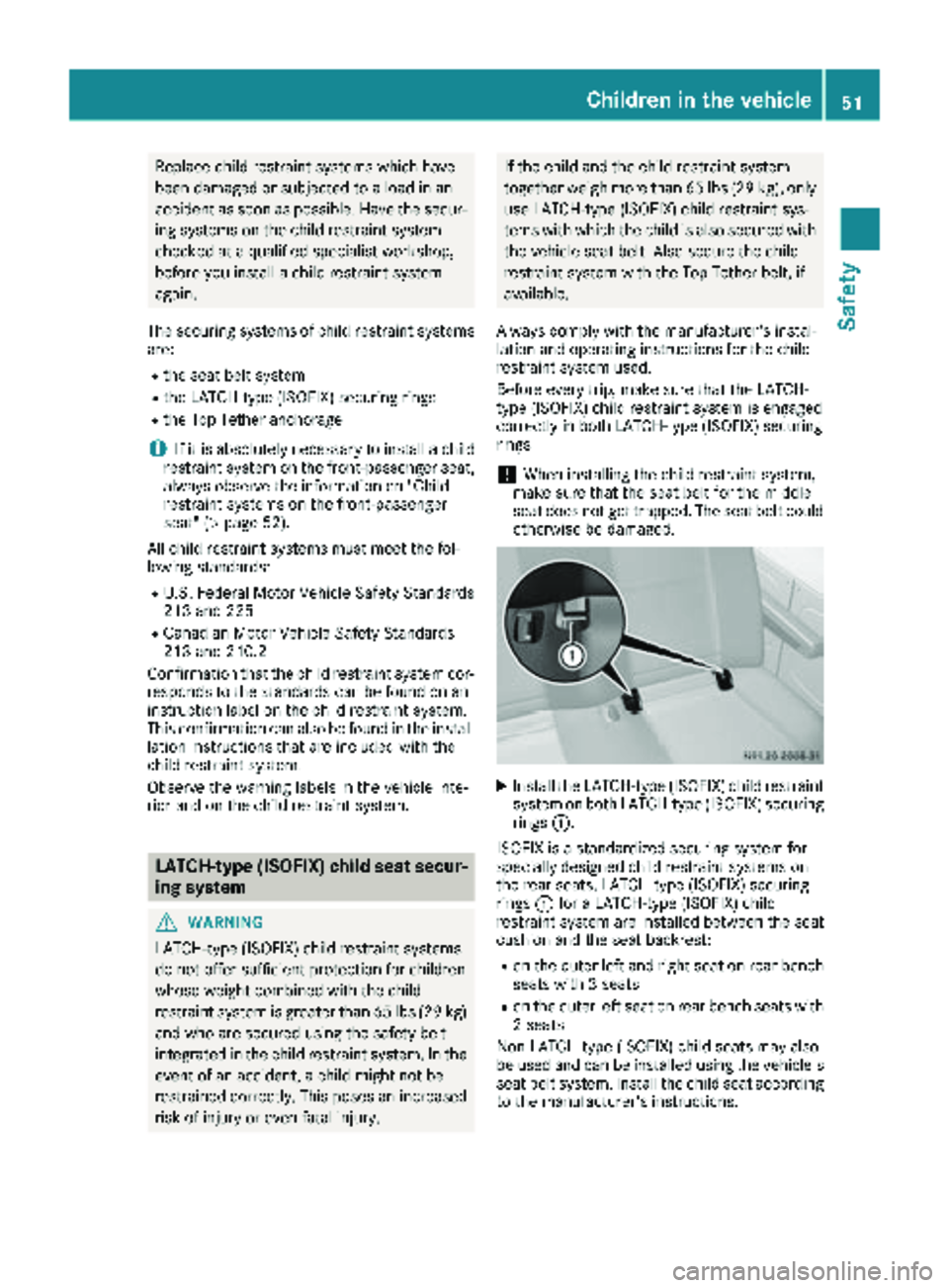
XInstall th eLATCH-type (ISOFIX) child restrain t
system on bot hLATCH-type (ISOFIX) securin g
rings :.
ISOFIX is astandardize dsecurin gsystem for
specially designed child restrain tsystems on
th erear seats. LATCH-type (ISOFIX) securin g
rings :for aLATCH-type (ISOFIX) child
restrain tsystem are installed between th eseat
cushion and th eseat backrest :
Ron theouter lef tand right seat on rear bench
seat swit h 3 seat s
Ron th eouter lef tseat on rear bench seat swit h
2 seat s
Non-LATCH-typ e(ISOFIX) child seat smay also
be used and can be installed usin gth evehicle's
seat belt system. Install th echild seat according
to th emanufacturer' sinstructions.
Children in the vehicle51
Safety
Z
Page 55 of 294
ufacturer's installation and operating instruc-
tions.
Forward-facing child restraint system
If it isabsolute lynecessary to install a forward-
facing ch ildrestraint system on the front-
passenger seat, always move the front-
passenger seat as far back as possible. The
entire base of the ch ildrestraint system must
always rest on the seat cushion of the front-
passenger seat. The backrest of the ch ild
restraint system must lieas flat as possible
against the backrest of the front-passenger
seat. The ch ildrestraint system must not be
subjected to a load bythe head restraint. Adjust
the head restraint position accordingly. Always
make sure that the shoulder beltstrap iscor-
rectly routed from the veh icle beltoutlet to the
shoulder beltguide on the ch ildrestraint sys-
tem. The shoulder beltstrap must berouted
forward and downfrom the veh icle beltoutlet.If
necessary, adjust the veh icle beltoutlet and the
front-passenger seat accordingly.
Alwa ys observe the ch ildrestraint system man-
ufacturer's installation and operating instruc-
tions.
Override features/Child-proof locks
Important safety notes
GWAR NING
If ch ildr en are traveling inthe veh icle, they
co uld:
Ropen doors, thus endangering other people
or road users
Rexit the veh icleand becaught byoncoming
traff ic
Roperate veh icle equipment and become
trapped
There isa risk of an acc ident and injury.
Alwa ys activate the ch ild-proof locks and
overr idefeature ifch ildr en are traveling inthe
veh icle. When leaving the veh icle, always take
the key with you and lock the veh icle. Never
leave ch ildren unattended inthe veh icle.
Child- proof locks for rear doors (
Ypage 54).
GWARNING
If you leave children unsupervised in the vehi-
cle, they could set it inmotion by, for example:
Rrelease the parking brake.
Rshift the automatic transmission out of the
parking position P.
Rstart the engine.
In addition, they may operate vehicle equip-
ment and become trapped. There is a risk of
an accident and injury.
When leaving the vehicle, always take the
Sm artKey with you and lock the vehicle. Never
leave ch ildren unsupervised in the vehicle.
GWARNING
If persons, particularly ch ildren are subjected
to prolonged exposure to extreme heat or
cold, there is a risk of injury, possibly even
fatal. Never leave children unattended in the
vehicle.
GWARNING
If the child restraint system issubjected to
direct sunlight, parts may get very hot. Chil-
dren may burn thems elves on these parts,
particular lyon the metal parts of the child
restraint system. There is a risk of injury.
If you leave the vehicle, taking the child with
you, always ensure that the child restraint
system isnot exposed to direct sunlight. Pro-
tect it wit h a blanket, for example. If the child
restraint system has been exposed to direct
sunlight, let it cool down before securing the
child in it. Never leave children unattended in
the vehicle.
Children in the vehicle53
Safety
Z
Page 56 of 294
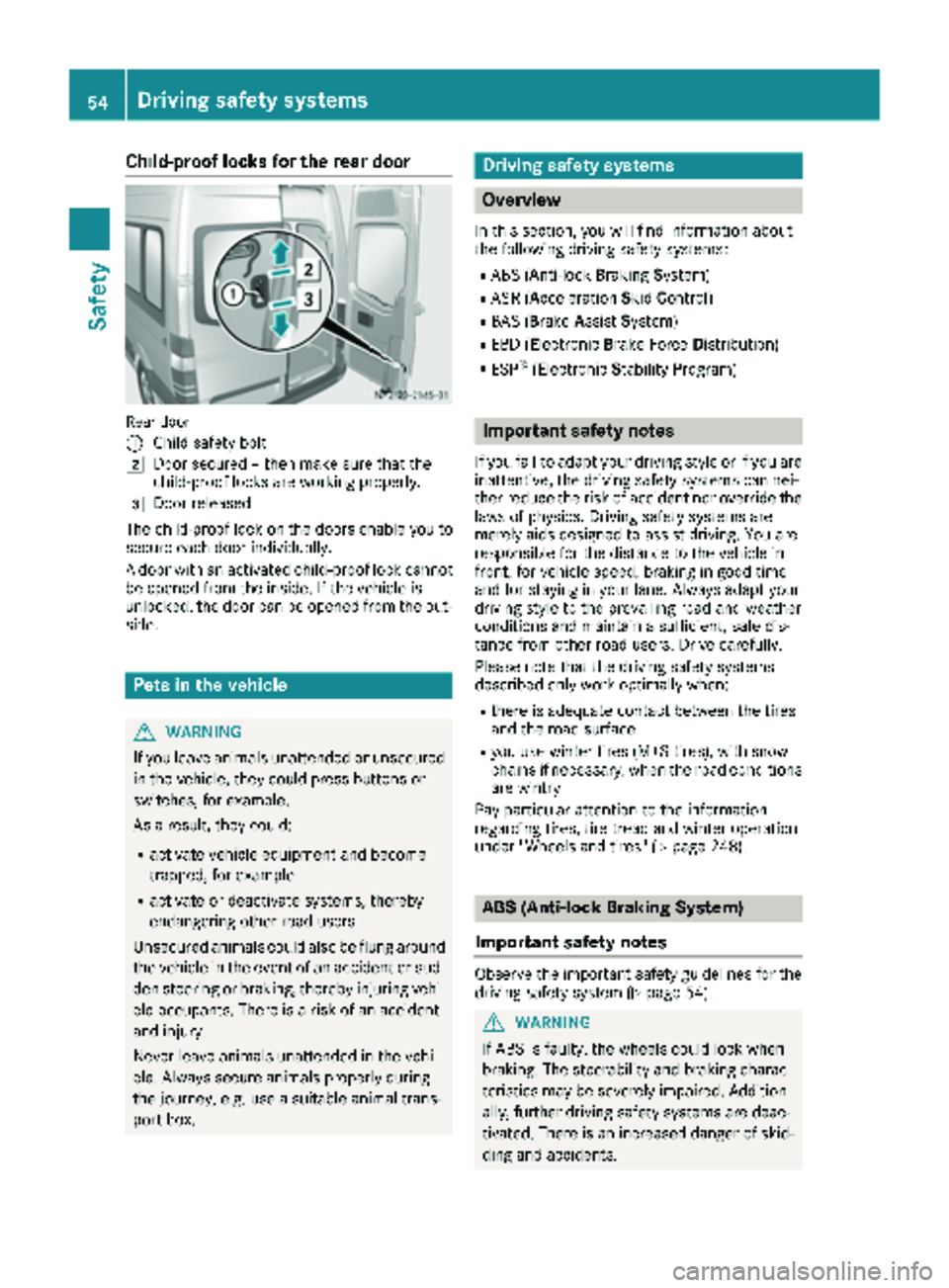
Child-proof locks for the rear door
Rear door
:
Child safety bolt
2Door secured – then make sure that the
child-proof locks are working properly.
3Door released
The child-proof lock on the doors enable you to
secure each door individually.
A door with an activated child-proof lock cannot
be opened from the inside. If the vehicle is
unlocked, the door can be opened from the out-
side.
Pets in the vehicle
GWARNING
If you leave animals unattended or unsecured
in the vehicle, they could press buttons or
switches, for example.
As a result, they could:
Ractivate vehicle equipment and become
trapped, for example
Ractivate or deactivate systems, thereby
endangering other road users
Unsecured animals could also be flung around
the vehicle in the event of an accident or sud-
den steering or braking, thereby injuring vehi-
cle occupants. There is a risk of an accident
and injury.
Never leave animals unattended in the vehi-
cle. Always secure animals properly during
the journey, e.g. use a suitable animal trans-
port box.
Driving safety systems
Overview
In this section, you will find information about
the following driving safety systems:
RABS (Anti-lock Braking System)
RASR (Acceleration SkidControl)
RBAS (B rakeAssist System)
REBD (Electronic Brake Force Distribution)
RESP®(Electronic StabilityProgram)
Important safety notes
If you fail to adapt your driving style or if you are
inattentive, the driving safety systems can nei-
ther reduce the risk of accident nor override the
laws of physics. Driving safety systems are
merely aids designed to assist driving. You are
responsible for the distance to the vehicle in
front, for vehicle speed, braking in good time
and for staying in your lane. Always adapt your
driving style to the prevailing road and weather
conditions and maintain a sufficient, safe dis-
tance from other road users. Drive carefully.
Please note that the driving safety systems
described only work optimally when:
Rthere is adequate contact between the tires
and the road surface
Ryou use winter tires (M+S tires), with snow
chains if necessary, when the road conditions
are wintry
Pay particular attention to the information
regarding tires, tire tread and winter operation
under "Wheels and tires" (
Ypage 248).
ABS (Anti-lock Braking System)
Important safety notes
Observe the important safety guidelines for the
driving safety system (Ypage 54).
GWARNING
If ABS is faulty, the wheels could lock when
braking. The steerability and braking charac-
teristics may be severely impaired. Addition-
ally, further driving safety systems are deac-
tivated. There is an increased danger of skid-
ding and accidents.
54Driving safety systems
Safety
Page 57 of 294
Drive on carefully. Have ABS checked imme-
diately at a qualified specialist workshop.
If ABS is malfunctioning, other systems will also
fail, including driving safety systems. Observe
the information relating to the !warning
lamp (
Ypage 196).
ABS regulates brake pressure in such a way that the wheels do not lock when you brake. This
allows you to continue steering the vehicle when
braking.
ABS works from a speed of about 5 mph
(8 km/h), regardless of road-surface conditions. ABS works on slippery surfaces, even when you
only brake gently.
The yellow !warning lamp in the instrument
cluster lights up when the ignition is switched
on. The lamp goes out when the engine starts
running.
Braking
If ABS intervenes when braking, you will feel a
pulsating in the brake pedal.
The pulsating brake pedal can be an indication
of hazardous road conditions and functions as a
reminder to take extra care while driving.
XIf ABS intervenes: continue to depress the
brake pedal with force until the braking sit-
uation is over.
XTo make a full brake application: depress
the brake pedal with full force.
ASR (acceleration skid control)
General notes
Important safety notes
Observe the important safety guidelines for the
driving safety system (Ypage 54).
ASR can neither reduce the risk of an accident
nor suspend the laws of physics if the driver
does not pay attention when pulling away or
accelerating. ASR is only an aid. Always adapt
your driving style to suit the prevailing road and
weather conditions.
If you activate or deactivate the all-wheel drive
in a vehicle with this option, ASR will be deacti- vated for the duration of the activation/deacti-
vation process. Vehicles without steering wheel buttons: if ASR
is malfunctioning, the
:indicator lamp lights
up while the engine is running and the engine
power may be reduced (
Ypage 196).
ASR significantly improves traction, i.e. the
transmission of power from the tires to the road surface, and thus increases the vehicle's driving
stability. If the driving wheels start to spin, ASR
brakes individual drive wheels and limits the
engine torque. ASR thus significantly assists you
when pulling away and accelerating, especially
on wet or slippery roads.
If traction on the road surface is not sufficient,
even ASR will not allow you to pull awa
y without
difficulty. The type of tires and total weight of the
vehicle as well as the gradient of the road also
play a crucial role.
If ASR intervenes, the dwarning lamp in the
instrument cluster flashes.
Activating/deactivating ASR
GWARNING
If deactivated, ASR will not attempt to stabi-
lize the vehicle during pulling away and accel- eration. There is an increased risk of skidding
and of an accident.
Only deactivate ASR in the situations descri-
bed in the following.
!If you deactivate ASR, ESP®will still inter-
vene to stabilize the vehicle. Frequent braking
automatically triggered by ESP
®can damage
the brake system.
For this reason, deactivate ASR only briefly
and when absolutely necessary.
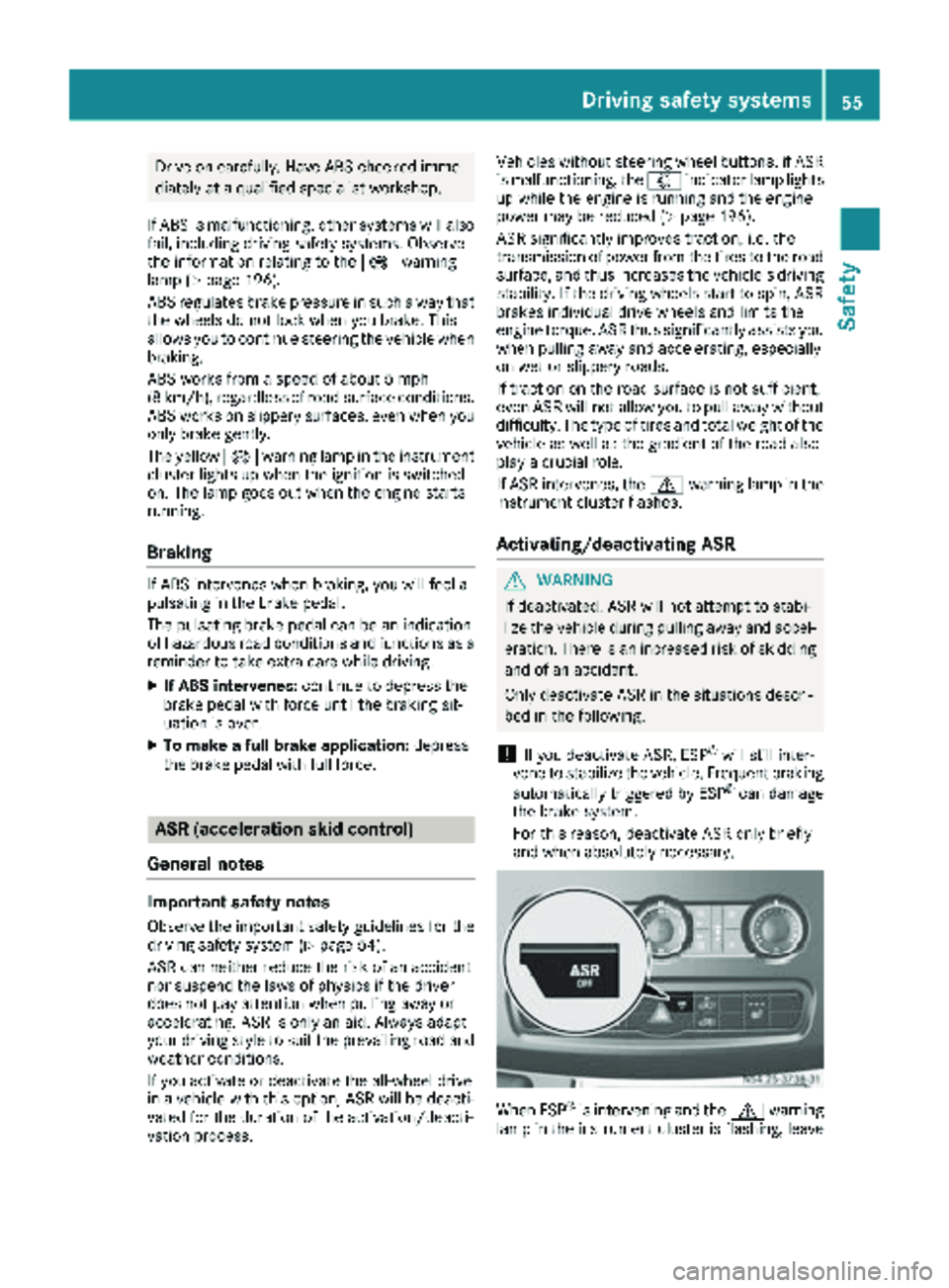
When ESP®is intervening and the dwarning
lamp in the instrument cluster is flashing, leave
Driving safet ysystem s55
Safety
Z
Page 58 of 294
ASR on. In this case, only depress the acceler-
ator pedal as far as required when pulling away.
XPress theàbutton.
If ASR is deactivated, the dwarning lamp
in the instrument cluster lights up.
ASR is automatically activated when the engine
is started.
It may be best to deactivate ASR briefly in the
following situations:
Rwhen using snow chains
Rin deep snow
Ron sand or gravel
If you deactivate ASR:
Rengine torque is not limited and the drive
wheels are able to spin. The spinning wheels
will then achieve a cutting effect for better
traction.
Rtraction control remains active through brake
intervention. If a drive wheel attains its tire
traction limit because one side of the road is
slippery, for example, that wheel is braked.
The traction is then increased in this situation.
Ractive brake intervention by ESP®to increase
driving stability remains active. The d
warning lamp in the instrument cluster
flashes when ESP
®is intervening.
BAS (Brake Assist System)
GWARNING
If BAS is malfunctioning, the braking distance
in an emergency braking situation is
increased. There is a risk of an accident.
In an emergency braking situation, depress
the brake pedal with full force. ABS prevents
the wheels from locking.
Vehicles without steering wheel buttons: if the
BAS driving safety system is malfunctioning,
the : warning lamp lights up while the
engine is running (
Ypage 196).
BAS operates in emergency braking situations.
If you depress the brake quickly, BAS automat-
ically increases the brake pressure, thereby
reducing the stopping distance.
The brakes will function as usual once you
release the brake pedal. BAS is deactivated.
EBD (electronic brake force distribu-
tion)
GWARNING
If EBD is malfunctioning, the rear wheels can
lock, e.g. under full braking. This increases the
risk of skidding and an accident.
You should therefore adapt your driving style
to the different handling characteristics. Have
the brake system checked at a qualified spe-
cialist workshop.
EBD monitors and controls the brake pressure
to the rear wheels. This enables EBD to improve
handling during braking.
Observe the information on warning and indica-
tor lamps (
Ypage 196).
ESP®(Electronic Stability Program)
Important safety notes
GWARNING
If ESP
®is malfunctioning it will not provide
any vehicle stabilization. There is an increased
risk of skidding or of an accident.
Exercise caution when continuing to drive.
Have ESP
®checked at a qualified specialist
workshop.
!Do not run the vehicle on a roller dynamom-
eter (e.g. for performance tests). If you must
operate the vehicle on a roller dynamometer,
please consult a qualified specialist workshop
in advance. You could otherwise damage the
drive train or the brake system.
If you activate or deactivate the all-wheel drive
in a vehicle with this option, ESP
®will be deac-
tivated for the duration of the activation/deac-
tivation process.
If ESP
®is malfunctioning, the hindicator
lamp lights up while the engine is running and
the engine power may be reduced
(
Ypage 195).
iOnly use wheels with the recommended tire
sizes. Only then will ESP®function properly.
56Driving safety systems
Safety