child seat MERCEDES-BENZ SPRINTER 2019 MY19 with 7” screen
[x] Cancel search | Manufacturer: MERCEDES-BENZ, Model Year: 2019, Model line: SPRINTER, Model: MERCEDES-BENZ SPRINTER 2019Pages: 354, PDF Size: 6.15 MB
Page 24 of 354
Publication details
Internet
Fu rther information about Mercedes-Benz vehi‐
cles and about Daimler AGcan be found on the
fo llowing websites:
http://www.mercedes-benz.com
http://www.mbusa.com (USA only)
http://www.mercedes-benz.ca (Canada only)
Documentation team
Should you ha veany questions or suggestions
re ga rding these Operating Instructions, you can
re ach thete ch nical documentation team at the
address lis ted on the inside co ver page.
© Daimler VANS US A,LLC
Daimler VANS US A,LLC and Mercedes-Benz Can‐
ada, Inc. are Daimler enterprises.
© Daimler AG: not tobe reprinted, translated or
ot herwise reproduced, in whole or in part, with‐
out written permission from Daimler AG.
Ve hicle manufacturer
Daimler AG
Mercedesstraße 137
70327 Stutt gart
Germany
Ve hicle dealer
Daimler VANS US A,LLC
One Mercedes-Benz Drive
Sandy Springs, GA 30328
http://www.mbusa.com (USA only)
www.mbsprinterusa.com
Cus tomer Assis tance Center:
1-8 77-762-8267
Mercedes-Benz Canada, Inc.
98 Vande rhoof Avenue
To ronto, ON M4G 4C9
http://ww w.mercedes-benz.ca (Canada only)
Cus tomer Relations Department:
1-800-3 87-0100
Mercedes-Benz US A,LLC and Mercedes-Benz
Canada, Inc. are Daimler enterprises.
Canada only: "Authorized Sprinter Dealer" is
defined as an authorized Mercedes-Benz Sprinter
Dealer. Fr
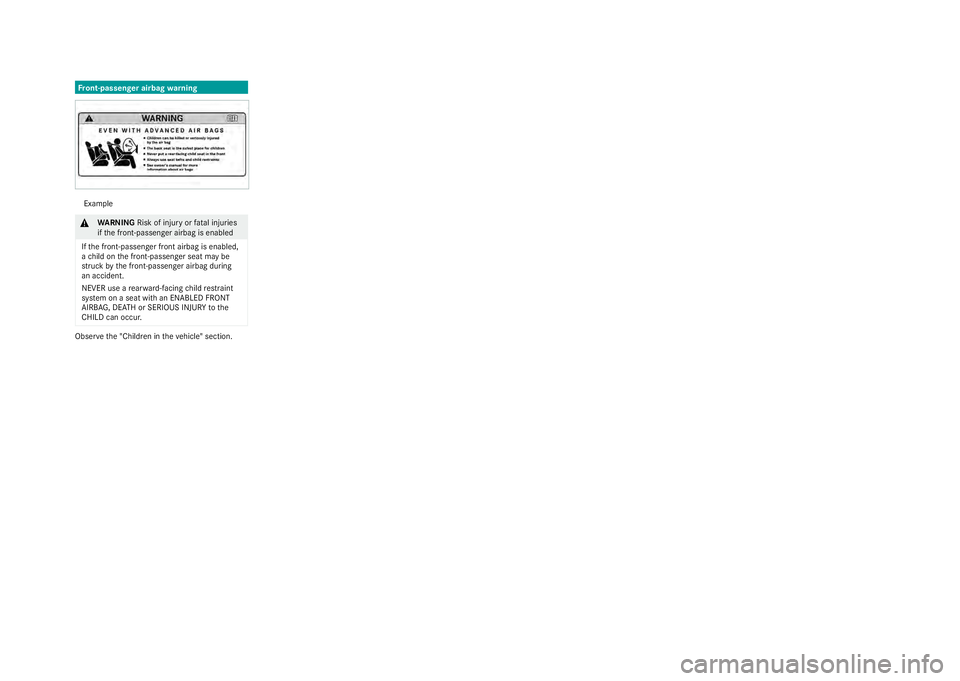
ont-passenger airbag warning Example
&
WARNING Risk of inju ryor fatal injuries
if th e front-passenger airbag is enabled
If th e front-passenger front airbag is enabled,
a ch ild on the front-passenger seat may be
st ru ck bythe front-passenger airbag during
an accident.
NEVER use a rear wa rd-facing child restra int
sy stem on a seat with an ENABLED FRONT
AIRB AG, DEAT H or SERIOUS INJU RYtothe
CH ILD can occur. Obser
vethe "Children in theve hicle" section.
As at 25.06.2018
Page 26 of 354
Symbols
..................................................... 4At
agl ance ................................................. 6
Cockpit ........................................................ 6
Instrument clus ter ....................................... 7
Overhead control panel ............................. 10
Door control panel .................................... .14
Emergencies and breakdowns ................... 16Genera
l notes.......................................... 18
Environmental pr otection .......................... 18
Mercedes-Benz Genuine Parts ...................18
Information about attachments, add-
on equipment, ins tallations and con‐
ve rsions .................................................... .19
Operating Instructions ...............................20
Service and vehicle operation ...................20
Operating saf ety ........................................ 21
Declarations of conformity ........................ 22
Diagno stics connection ............................ .22
No tes on changes tothe engine output ..... 23
Qualified specialist workshop .................... 23
Ve hicle registration ................................... 23
Cor rect use of theve hicle .........................23
Multi Purpose Vehicle ................................ 24
Information on problems with your
ve hicle .......................................................24
Re porting saf ety defects ............................ 24
Limited Warranty ...................................... .24
QR codes forre scue card .......................... 24
Data storage ..............................................25
Copyright .................................................. .27Occupant saf
ety...................................... 28
Re stra int sy stem ........................................28
Seat belts .................................................. 30
Airbags ...................................................... 32
Children in theve hicle ...............................34
No tes on pets in theve hicle ......................40 Opening and closing
...............................41
SmartK ey................................................... 41
Doo rs........................................................ 44
Sliding door ............................................... 45
Electrical sliding door ................................ 46
Re ar-end doors .......................................... 50
Pa rtition sliding door .................................. 51
Electrical step ............................................ 52
Side window ..............................................53
Anti-theft pr otection ..................................55 Seats and
stowage .................................. 59
Co rrect driver's seat position .................... 59
Seats ......................................................... 59
Ad justing thesteering wheel ..................... 71
St ow age areas .......................................... .72
Bottle holder .............................................. 74
Cup holder ................................................ .74
Ashtr ayand cigar ette lighter ...................... 74
Soc kets ...................................................... 75
Wi relessly charging the mobile phone
and coupling with theex terior antenna ..... 77
Ins talling or removing thefloor mats ......... 78 Light and vision
....................................... 79
Ex terior lighting ......................................... 79
Ad justing the interior lighting .................... 82
Changing bulbs .......................................... 83
Wi ndshield wipe rs..................................... 88
Mir rors ...................................................... 90
Using sun visors ........................................ 92 Climate control
....................................... 93
Overview of climate control sy stems ......... 93
Operating climate control sy stems ............ 95
Operating air vents .................................... 98
Au xilia ryheating ........................................99
Operating cargo compartment ventila‐
tion .......................................................... 102 Driving and pa
rking .............................. 103
Driving .................................................... .103
Battery main switch ................................. 11 4
Au tomatic transmission ........................... 11 5
All-wheel drive .......................................... 11 8
DSR (Downhill Speed Regulation) ............ 12 0
Electronic le vel control ............................ 121
Re fueling ................................................ .125
Pa rking .................................................... 13 2
Driving and driving sa fety sy stems ..........1 36
Wo rkmode ............................................. .156
Tr ailer operation ...................................... 157 Instrument Display and on-board
compu
ter............................................... 16 3
Overview of Instrument Display ............... 16 3
Overview of the buttons on thesteer‐
ing wheel .................................................1 64
Operating the on-board computer ........... 16 4
Overview of the displa yson the multi‐
function display ....................................... 16 5
Setting the instrument lighting ................1 662
Contents
Page 52 of 354
Re
stra int sy stem Pr
otection bythere stra int sy stem The
restra int sy stem includes thefo llowing com‐
ponents:
R Seat belt sy stem
R Airbags
R Child restra int sy stem
R Child seat securing sy stems
The restra int sy stem can help pr eventtheve hicle
occupants from coming into contact with parts of
th eve hicle interior in theeve nt of an accident. In
th eeve nt of an accident, there stra int sy stem can
also reduce thefo rc es towhich theve hicle occu‐
pants are subjected.
A seat belt can only pr ovide the best le vel of pro‐
te ction if it is worncor rectly. Depending on the
de tected accident situation, Emer gency Tension‐
ing Devices and/or airbags supplement the pro‐
te ction of fere dby a cor rectly wornseat belt.
Emer gency Tensioning Devices and/or airbags
are not depl oyed in every accident.
Ve hicles with a front passenger bench seat: the
Emergency Tensioning Device on the front
passenger seat is triggered whe ther or not the
seat belt tongue is engaged in the seat belt
buckle.
If th eve hicle does not ha vea driver's airbag, the
seat belt sy stem does not include an Emer gency
Te nsioning Device or a seat belt forc e limiter.
In order forth ere stra int sy stem toprov ide the
intended le vel of pr otection, each vehicle occu‐
pant must obser vethefo llowing information:
R Fasten seat belts cor rectl y.
R Sit in an almost up right seat position with
th eir back against the seat backrest.
R Sit with their feet resting on thefloor, if possi‐
ble.
R Always secure persons under 5 ft(1.50 m)
ta ll in an additional restra int sy stem suitable
fo rth is vehicle.
Ho wever,no sy stem available today can com‐
ple tely eliminate injuries and fata lities in every
accident situation. In particular, the seat belt and
airbag general lydo not pr otect against objects
penetrating theve hicle from the outside. It is also
not possible tocomple tely rule out therisk of
injury caused bythe airbag deploying. Limited pr
otection from there stra int sy stem &
WARNING Risk of inju ryor death from
modifications tothere stra int sy stem
The restra int sy stem can no longer function
cor rectly af ter alterations ha vebeen made.
The restra int sy stem may then not pr otect the
ve hicle occupants as intended byfailing in an
accident or triggering unexpec tedly, forex am‐
ple #
Never alter the parts of there stra int
sy stem. #
Neverta mp er with the wiring or any
electronic component parts or their
software. If it is necessary
toadjust theve hicle toaccom‐
modate a person with disabilities, con tact an
au thorized Mercedes-Benz Center for de tails.
USA only: con tact our Cu stomer Assis tance Cen‐
te r at 1‑8 77‑762‑826 7for de tails. Re
stra int sy stem functionality When
the ignition is switched on, a self-test is
per form ed, during which the0075 restra int sys‐
te m wa rning lamp lights up. It goes out no later
th an a few seconds af terth eve hicle is star ted.
The components of there stra int sy stem are then
functional. Malfunctioning
restra int sy stem A malfunction has occur
red in there stra int sys‐
te m if:
R The 0075 restra int sy stem warning lamp does
not light up when the ignition is switched on
R The 0075 restra int sy stem warning lamp
lights up continuously or repeatedly during a
journey &
WARNING Risk of inju rydue tomalfunc‐
tions in there stra int sy stem
If th ere stra int sy stem is malfunctioning,
re stra int sy stem components may be trig‐
ge red unintentionally or may not deploy as
intended during an accident. This may af fect
th e Emer gency Tensioning Devices or airbags,
fo rex ample. 28
Occupant saf ety
Page 54 of 354
Seat belts
Pr
otection pr ovided bythe seat belt Alw
aysfast enyour seat belt cor rectly before
st arting a journe y.A seat belt can only pr ovide
th e best le vel of pr otection if it is worncor rectl y. &
WARNING Risk of inju ryor death due to
incor rectly fastened seat belt
If th e seat belt is not worncor rectly, it cannot
per form its intended pr otective function.
In addition, an incor rectly fastened seat belt
can also cause injuries, forex ample, in the
eve nt of an accident or when braking or
ch anging direction sudden ly.#
Always ensure that all vehicle occupants
ha ve their seat belts fastened cor rectly
and are sitting prope rly. Alw
ays obser vethe instructions about the cor rect
driver's seat position and adjusting the seats
(/ page 59).
In order forth e cor rectly wornseat belt topro‐
vide the intended le vel of pr otection, each vehicle
occupant must obser vethefo llowing information:
R The seat belt must not be twis ted and must fit
tightly and snu gly across the body.
R The seat belt must be routed across the cen‐
te r of the shoulder and as low down across
th e hips as possible.
R The shoulder section of the seat belt should
not touch your neck nor be routed under your
arm or behind your bac k.
R Avoid wearing bulky clo thing, e.g. a winter
coat.
R Push the lap belt down as far as possible
across your hips and pull tight with the shoul‐
der section of the belt. Ne verro ute the lap
belt across your abdomen.
Pregnant women must also take particular
care with this.
R Neverro ute the seat belt across sharp, poin‐
te d, abrasive or fragile objects.
R Only one person may use each seat belt at
any one time. Infants and children must ne ver
tr ave l sitting on the lap of a vehicle occupant.
R Never secure objects with a seat belt if the
seat belt is being used byone of theve hicle's
occupants. Alw ays obser vethe instructions
fo r loading theve hicle when securing objects,
luggage or loads (/ page72). Also ensure
that no objects, e.g. a cushion,
are ever placed between a person and the
seat.
The seat belts on thefo llowing seats are equip‐
ped with a special seatbelt retractor:
R Co-driver seat
R Rear seats
Ac tivate or deacti vate the special seatbelt retrac‐
to r of the seat belt (/ page 35).
If ch ildren are tr aveling in theve hicle, be sure to
obser vethe instructions and saf ety no tes on
"Children in theve hicle" (/ page 34). Limitations of
the pr otection pr ovided bythe
seat belt &
WARNING Risk of inju ryor death due to
incor rect seat position
The seat belt does not of ferth e intended le vel
of pr otection if you ha venot mo vedth e seat
backrest toan almost vertical position.
When braking or in theeve nt of an accident,
yo u could slide unde rneath the seat belt and
sus tain abdominal or neck injuries, forex am‐
ple. #
Adjust the seat properly before begin‐
ning your journe y. #
Always ensure that the seat backrest is
in an almost vertical position and that
th e shoulder section of your seat belt is
ro uted across the center of your shoul‐
der. &
WARNING Risk of inju ryor death when
additional restra int sy stems are not used
fo r persons with a smaller build
Pe rsons under 5 ft(1.50 m) tall cannot wear
th e seat belt cor rectly wi thout a suitable addi‐
tional restra int sy stem.
If th e seat belt is not worncor rectly, it cannot
per form its intended pr otective function. In
addition, an incor rectly fastened seat belt can
also cause injuries, forex ample, in theeve nt
of an accident or when braking or changing
direction suddenly. #
Always secure persons under 5 ft
(1.50 m) tall in a suitable restra int sys‐
te m. 30
Occupant saf ety
Page 58 of 354
Child
ren in theve hicle Note
s onthe safe transportation of children &
WARNING Risk of accident and inju ry
due tochildren left unat tended in the
ve hicle
If ch ildren are left unat tended in theve hicle,
th ey could:
R Open doo rs,th ereby endangering other
persons or road users.
R Get out and be stru ck byoncoming traf‐
fi c.
R Ope rate ve hicle equipment and become
trapped, forex ample.
In addition, thech ildren could also set the
ve hicle in motion, forex ample by:
R Releasing the parking brake.
R Changing the transmission position.
R Starting theve hicle. #
Never lea vechildren unat tended in the
ve hicle. #
When leaving theve hicle, alw aysta ke
th eke y with you and lock theve hicle. #
Keep theve hicle key out of reach of
ch ildren. &
WARNING Risk offata l injury due to
ex posure toextreme heat or cold in the
ve hicle
If people – particular lych ildren – are exposed
to extreme temp eratures over an extended
pe riod of time, there is a risk of serious or
eve nfa ta l injur y. #
Never lea veanyone – pa rticularly chil‐
dren – unat tended in theve hicle. #
Never lea veanimals in theve hicle unat‐
te nded. &
WARNING Risk of bu rns when thech ild
seat is exposed todirect sunlight
If th ech ild restra int sy stem is exposed to
direct sunlight or heat, parts could heat up.
Children could suf fer burns from these parts,
particular lyon me tallic parts of thech ild
re stra int sy stem. #
Always make sure that thech ild
re stra int sy stem is not exposed todirect
sunlight. #
Protect it with a blank et,fo rex ample. #
Ifth ech ild restra int sy stem has been
ex posed todirect sunlight, allow it to
cool before secu ring a child into it. #
Never lea vechildren unat tended in the
ve hicle. The use of seat belts and
child restra int sy stems
is requ ired bylaw:
R in all 50 states
R inU.S. territories
R inthe District of Columbia
R in all Canadian pr ovinces
All child restra int sy stems must meet thefo llow‐
ing standards:
R U.S. Federal Mo torVe hicle Saf etySt andards
21 3 and 225
R Canadian Mo torVe hicle Saf etySt andards 213
and 210.2
Yo u can obtain fur ther information about the cor‐
re ct child restra int sy stem from an authorized
Mercedes-Benz Center.
To impr oveprotection forch ildren younger than
12 years old or under 5 ft(1.50 m) in height,
Mercedes-Benz recommends you alw ays obser ve
th efo llowing no tes:
R Only secure children in a child restra int sys‐
te m which is suitable and recommended for
Mercedes-Benz vehicles and which is appro‐
priate forth e age, weight and size of the
ch ild. Obser vethe instructions for cor rect use
of thech ild restra int sy stem.
R If possible, ins tallth ech ild restra int sy stem
on a rear seat.
R Onlyuse thefo llowing securing sy stems for
ch ild restra int sy stems:
- the seat belt sy stem
- theLA TC H-type (ISOFIX) secu ring rings
- theTo pTe ther anchorages
R Obser vethech ild restra int sy stem manufac‐
turer's ins tallation instructions.
R Obser vethewa rning labels in theve hicle
interior and on thech ild restra int sy stem. 34
Occupant saf ety
Page 59 of 354
&
WARNING Risk of inju ryor death caused
by incor rect ins tallation of thech ild
re stra int sy stem
If th ech ild restra int sy stem is incor rectly
ins talled on a suitable seating position, it can‐
not per form its intended pr otective function.
The child cannot be restra ined in theev ent of
an accident, heavy braking or a sudden
ch ange of direction. #
Always comply with the manufacturer's
ins tallation instructions forth ech ild
re stra int sy stem and its cor rect use. #
Make sure that the entire base of the
ch ild restra int sy stem alw aysre sts on
th e sitting sur face of the seat. #
Never place objects under or behind the
ch ild restra int sy stem, e.g. cushions. #
Always use child restra int sy stems with
th e original co ver designed forth em. #
Alwaysre place damaged co vers with
ge nuine co vers. &
WARNING Risk of inju ryor death from
unsecured child restra int sy stems in the
ve hicle
If th ech ild restra int sy stem is not cor rectly
ins talled or secured, it could release in the
eve nt of an accident, sudden braking or a
sudden change in direction.
The child restra int sy stem could be flung
around and hit vehicle occupants. #
Always ins tallch ild restra int sy stems
cor rectl y,eve n when not in use. #
Always comply with thech ild restra int
sy stem manufacturer's ins tallation
instructions. &
WARNING Risk of inju ryor death caused
by the use of damaged child restra int
sy stems
Child restra int sy stems or their retai ning sys‐
te ms that ha vebeen subjected toa load in an
accident may then not be able toper form
th eir intended pr otective function.
The child cannot be restra ined in theev ent of
an accident, heavy braking or a sudden
ch ange of direction. #
Alwaysre place child restra int sy stems
immediately that ha vebeen damaged or
in vo lved in an ac cident. #
Have the securing sy stems forth ech ild
re stra int sy stems checked at a qualified
specialist workshop before ins talling a
ch ild restra int sy stem again. A boos
ter seat may be necessary toachie ve
proper seat belt positioning forch ildren over
40 lbs (18 kg) until they reach a height where a
th re e-point seat belt fits properly wi thout a boos‐
te r seat.
The following no tes must be obser ved:
R When ins talling a child restra int sy stem on
th e co-driver seat, obser vethe information on
ch ild restra int sy stems on the co-driver seat
(/ page 38).
R Safety no tes on the seat belt (/ page 30).
R Information on the cor rect use of the seat
belt (/ page31). Ac
tivating/deactivating the seat belt's child
special seat belt retractor &
WARNING Risk of inju ryor death if a
seat belt is unfas tened while theve hicle
is in motion
If th e seat belt is released while theve hicle is
in motion, thech ild restra int sy stem is no lon‐
ge r cor rectly secu red. The child seat saf ety
fe ature is deactivated and the seat belt is
dr aw n in a bit bythe inertia reel.
It is therefore not possible toengage the seat
belt again. #
Pull over and stop theve hicle safely as
soon as possible, paying attention to
ro ad and traf fic conditions. #
Activate thech ild seat saf etyfe ature
again and cor rectly secu rethech ild
re stra int sy stem. When enabled,
the special seat belt retractor
ensures that the seat belts of the front passenger
seat and rear seats do not slac ken once thech ild
re stra int sy stem is secured.
The seat belts on thefo llowing seats are equip‐
ped with a special seat belt retractor:
R Front passenger seat
R Rear seats Occupant saf
ety35
Page 60 of 354
#
Toinstall a child restra int sy stem: when
ins talling a child restra int sy stem, alw ays
obser vethe manufacturer's ins tallation and
operating instructions as well as the informa‐
tion in this Operator's Manual. #
Pull the seat belt smoo thly from the seat belt
outlet. #
Enga gethe seat belt tongue in the seat belt
buckle. #
Toactivate the special seat belt retractor:
pull the seat belt out fully and let the inertia
re el retract it again.
When the special seat belt retractor is acti va‐
te d, you should hear a ratcheting sound. #
Push thech ild restra int sy stem down until the
seat belt sits tightl y. #
Todeactivate the special seat belt retrac‐
to r:press there lease button of the seat belt
buckle. #
Hold the seat belt tongue and guide ba ckto
th e seat belt outlet. Installing
theLA TC H-type (ISOFIX) child
re stra int sy stem on there ar seat Note
s onLATC H-type (ISOFIX) child seat
securing sy stems &
WARNING Risk of inju ryor death if the
permissible gross mass of thech ild and
ch ild restra int sy stem is exceeded
Fo rLA TC H-type (ISOFIX) child restra int sys‐
te ms in which thech ild is secured using the
integ rated seat belt in thech ild restra int sys‐
te m, the permissible gross mass of thech ild
and child restra int sy stem is 73lb (33 kg).
If th ech ild and thech ild restra int sy stem
to ge ther we igh more than 73 lb (33 kg),the
LA TC H-type (ISOFIX) child restra int sy stem
with integrated seat belt does not of fer suf fi‐
cient pr otection. An excessive load may be
placed on theLA TC H-type (ISOFIX) child seat
attachments and thech ild may not be
re stra ined in theeve nt of an accident, for
ex ample. #
Ifth ech ild and thech ild restra int sys‐
te m toge ther we igh more than 73 lb
(33 kg), use only a LATC H-type (ISOFIX)
ch ild restra int sy stem that secures the
ch ild with theve hicle seat belt. #
Also secure thech ild restra int sy stem
with theTo pTe ther belt, if available. Alw
ays comply with the information about the
mass of thech ild restra int sy stem:
R Inthe manufacturer's ins tallation and operat‐
ing instructions forth ech ild restra int sy stem
used
R On a label on thech ild restra int sy stem, if
av ailable
Check regularly that the permissible gross mass
of thech ild plus thech ild restra int sy stem is not
exc eeded.
When ins talling a child restra int sy stem, be sure
to obser vethe manufacturer's ins tallation and
operating instructions and the cor rect use of the
ch ild restra int sy stem as well as consider the
suitability of the seats.
ISOFIX is a standardized securing sy stem for spe‐
cial restra int sy stems. LATC H-type (ISOFIX) child
re stra int sy stems are appr oved in accordance
with UN-R44.
Only child restra int sy stems that ha vebeen
appr oved in accordance with UN-R44 may be
attached toLATC H-type (ISOFIX) mounting brack‐
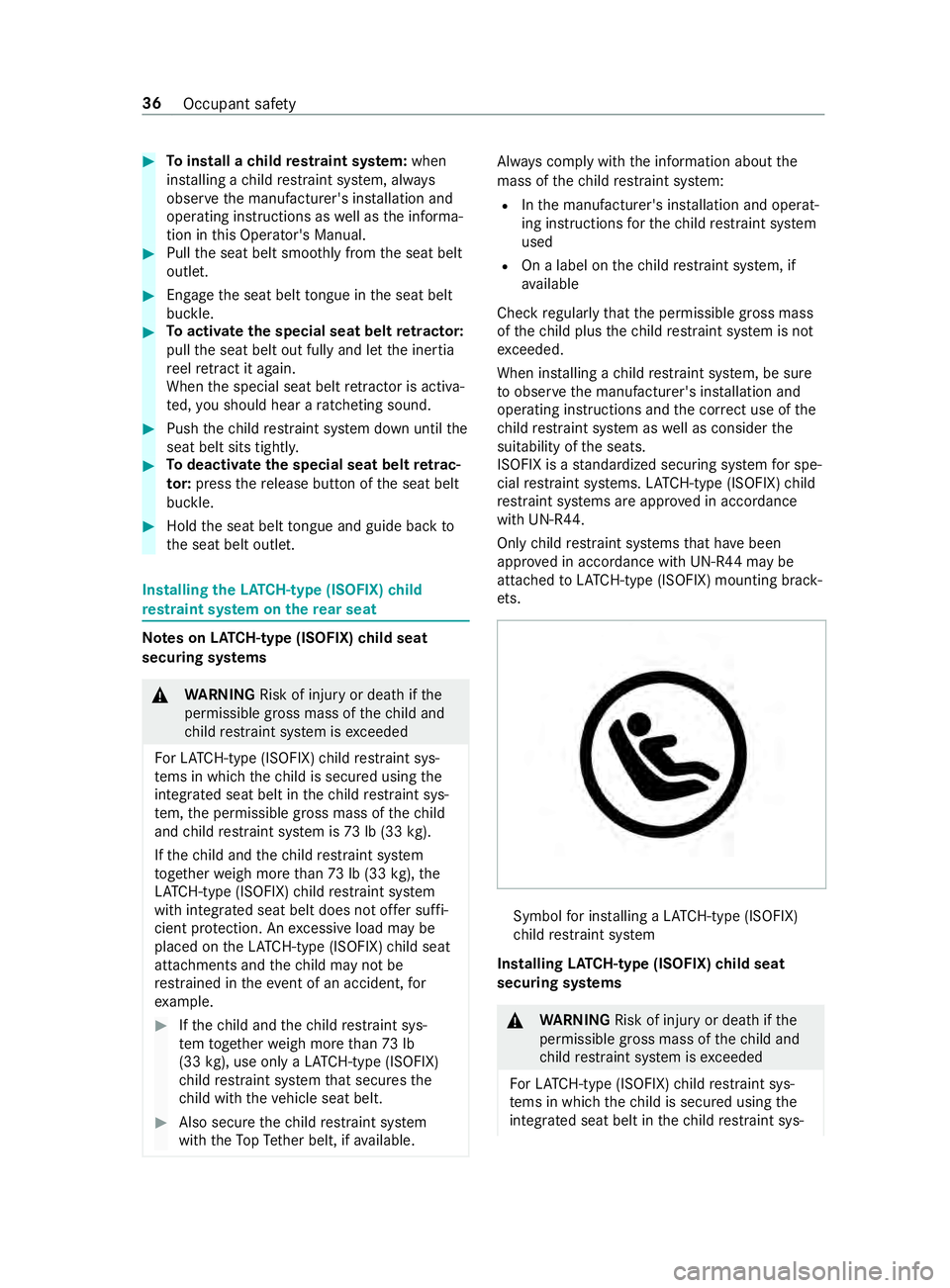
et s. Symbol
for ins talling a LATC H-type (ISOFIX)
ch ild restra int sy stem
Installing LATC H-type (ISOFIX) child seat
securing sy stems &
WARNING Risk of inju ryor death if the
permissible gross mass of thech ild and
ch ild restra int sy stem is exceeded
Fo rLA TC H-type (ISOFIX) child restra int sys‐
te ms in which thech ild is secured using the
integ rated seat belt in thech ild restra int sys‐ 36
Occupant saf ety
Page 61 of 354
te
m, the permissible gross mass of thech ild
and child restra int sy stem is 73lb (33 kg).
If th ech ild and thech ild restra int sy stem
to ge ther we igh more than 73 lb (33 kg),the
LA TC H-type (ISOFIX) child restra int sy stem
with integrated seat belt does not of fer suf fi‐
cient pr otection. An excessive load may be
placed on theLA TC H-type (ISOFIX) child seat
attachments and thech ild may not be
re stra ined in theeve nt of an accident, for
ex ample. #
Ifth ech ild and thech ild restra int sys‐
te m toge ther we igh more than 73 lb
(33 kg), use only a LATC H-type (ISOFIX)
ch ild restra int sy stem that secures the
ch ild with theve hicle seat belt. #
Also secure thech ild restra int sy stem
with theTo pTe ther belt, if available. Alw
ays comply with the information about the
mass of thech ild restra int sy stem:
R Inthe manufacturer's ins tallation and operat‐
ing instructions forth ech ild restra int sy stem
used
R On a label on thech ild restra int sy stem, if
av ailable
Check regularly that the permissible gross mass
of thech ild plus thech ild restra int sy stem is not
exc eeded.
When ins talling a child restra int sy stem, be sure
to obser vethe manufacturer's ins tallation and
operating instructions and the cor rect use of the
ch ild restra int sy stem as well as consider the
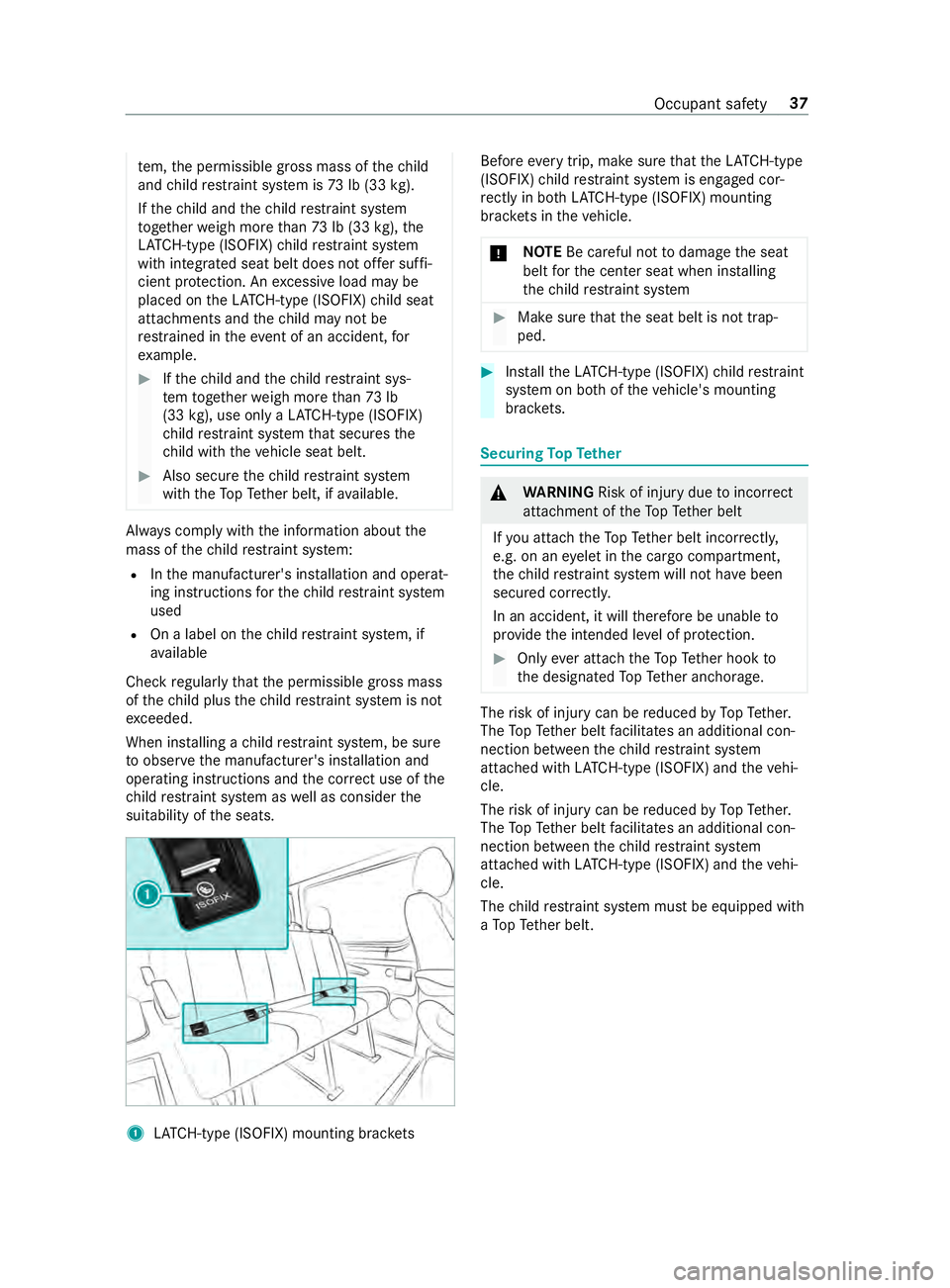
suitability of the seats. 1
LATC H-type (ISOFIX) mounting brac kets Before
every trip, make sure that theLA TC H-type
(ISOFIX) child restra int sy stem is engaged cor‐
re ctly in bo thLATC H-type (ISOFIX) mounting
brac kets in theve hicle.
* NO
TEBe careful not todamage the seat
belt forth e center seat when ins talling
th ech ild restra int sy stem #
Make sure that the seat belt is not trap‐
ped. #
Installth eLA TC H-type (ISOFIX) child restra int
sy stem on bo thoftheve hicle's mounting
brac kets. Secu
ring TopTe ther &
WARNING Risk of inju rydue toincor rect
attachment of theTo pTe ther belt
If yo u attach theTo pTe ther belt incor rectl y,
e.g. on an eyelet in the cargo compartment,
th ech ild restra int sy stem will not ha vebeen
secured cor rectly.
In an accident, it will therefore be unable to
pr ov ide the intended le vel of pr otection. #
Only ever attach theTo pTe ther hook to
th e designated TopTe ther anchorage. The
risk of injury can be reduced byTopTe ther.
The TopTe ther belt facilitates an additional con‐
nection between thech ild restra int sy stem
attached with LATC H-type (ISOFIX) and theve hi‐
cle.
The risk of injury can be reduced byTopTe ther.
The TopTe ther belt facilitates an additional con‐
nection between thech ild restra int sy stem
attached with LATC H-type (ISOFIX) and theve hi‐
cle.
The child restra int sy stem must be equipped with
a To pTe ther belt. Occupant saf
ety37
Page 62 of 354
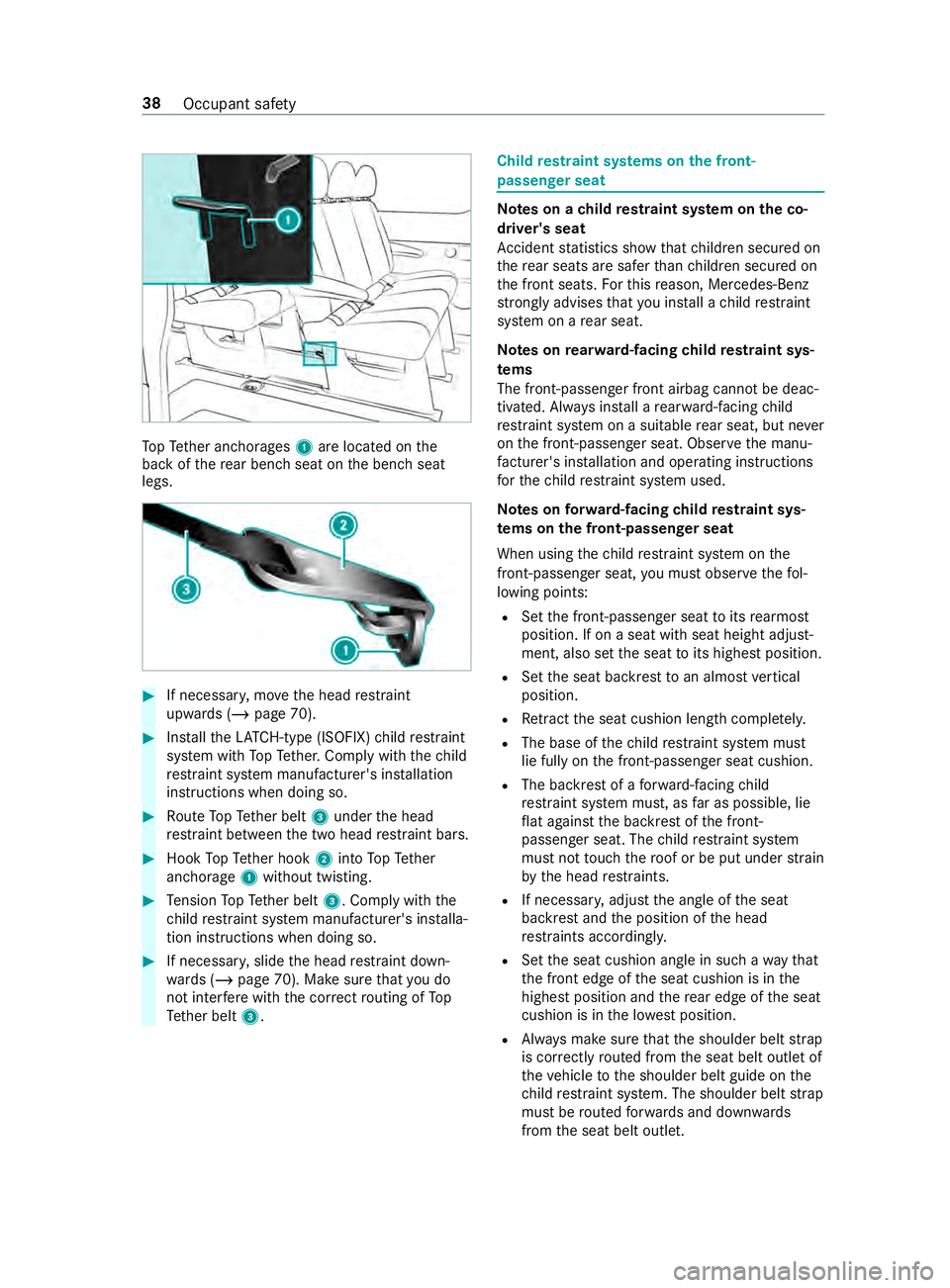
To
pTe ther anchorages 1are located on the
back of there ar ben chseat on the bench seat
legs. #
If necessar y,mo vethe head restra int
upwards (/ page 70). #
Installth eLA TC H-type (ISOFIX) child restra int
sy stem with TopTe ther. Comply with thech ild
re stra int sy stem manufacturer's ins tallation
instructions when doing so. #
Route TopTe ther belt 3under the head
re stra int between the two head restra int bars. #
Hook TopTe ther hook 2into TopTe ther
anchorage 1without twisting. #
Tension TopTe ther belt 3. Comply with the
ch ild restra int sy stem manufacturer's ins talla‐
tion instructions when doing so. #
If necessar y,slide the head restra int down‐
wa rds (/ page 70). Make sure that you do
not inter fere with the cor rect routing of To p
Te ther belt 3. Child
restra int sy stems on the front-
passenger seat Note
s on a child restra int sy stem on the co-
driver's seat
Ac cident statistics show that children secured on
th ere ar seats are safer than children secured on
th e front seats. Forth is reason, Mercedes-Benz
stro ngly advises that you ins tall a child restra int
sy stem on a rear seat.
Note s onrear wa rd-facing child restra int sys‐
te ms
The front-passen ger front airbag cannot be deac‐
tivated. Alw ays ins tall a rear wa rd-facing child
re stra int sy stem on a suitable rear seat, but ne ver
on the front-passen ger seat. Obser vethe manu‐
fa cturer's ins tallation and operating instructions
fo rth ech ild restra int sy stem used.
Note s onforw ard-facing child restra int sys‐
te ms on the front-passenger seat
When using thech ild restra int sy stem on the
front-passenger seat, you must obse rveth efo l‐
lowing points:
R Set the front-passen ger seat toits rearmost
position. If on a seat with seat height adjust‐
ment, also set the seat toits highest position.
R Set the seat backrest toan almost vertical
position.
R Retract the seat cushion length comple tely.
R The base of thech ild restra int sy stem must
lie fully on the front-passen ger seat cushion.
R The backrest of a forw ard-facing child
re stra int sy stem must, as far as possible, lie
fl at against the backrest of the front-
passenger seat. The child restra int sy stem
must not touch thero of or be put under stra in
by the head restra ints.
R If necessar y,adjust the angle of the seat
backrest and the position of the head
re stra ints acco rding ly.
R Set the seat cushion angle in such a wayth at
th e front edge of the seat cushion is in the
highest position and there ar edge of the seat
cushion is in the lo west position.
R Always make sure that the shoulder belt strap
is cor rectly routed from the seat belt outlet of
th eve hicle tothe shoulder belt guide on the
ch ild restra int sy stem. The shoulder belt strap
must be routed forw ards and down wards
from the seat belt outlet. 38
Occupant saf ety
Page 63 of 354
R
If necessar y,adjust the seat belt outlet and
th e front-passenger seat as appropriate.
R Never place objects under or behind thech ild
re stra int sy stem, e.g. cushions.
Alw ays obser vethe manufacturer's ins tallation
and operating instructions forth ech ild restra int
sy stem being used. Ac
tivating/deactivating child saf ety loc ksfor
th e doors &
WARNING Risk of accident and inju ry
due tochildren left unat tended in the
ve hicle
If ch ildren are left unat tended in theve hicle,
th ey could:
R Open doo rs,th ereby endangering other
persons or road users.
R Get out and be stru ck byoncoming traf‐
fi c.
R Ope rate ve hicle equipment and become
trapped, forex ample.
In addition, thech ildren could also set the
ve hicle in motion, forex ample by:
R Releasing the parking brake.
R Changing the transmission position.
R Starting theve hicle. #
Never lea vechildren unat tended in the
ve hicle. #
When leaving theve hicle, alw aysta ke
th eke y with you and lock theve hicle. #
Keep theve hicle key out of reach of
ch ildren. &
WARNING Risk offata l injury due to
ex posure toextreme heat or cold in the
ve hicle
If people – particular lych ildren – are exposed
to extreme temp eratures over an extended
pe riod of time, there is a risk of serious or
eve nfa ta l injur y. #
Never lea veanyone – pa rticularly chil‐
dren – unat tended in theve hicle. #
Never lea veanimals in theve hicle unat‐
te nded. &
WARNING Risk of accident and injury
due tochildren left unat tended in the
ve hicle
When children are tra veling in theve hicle,
th ey could:
R open doo rs,th ereby endangering other
people or road users
R getout of theve hicle and be hit bytraf fic
R operate vehicle equipment and become
trapped, forex ample #
When children are tra veling in theve hi‐
cle, alw ays activate theav ailable child
saf ety loc ks. #
Never lea vechildren unat tended in the
ve hicle. #
When leaving theve hicle, alw aysta ke
th eke y with you and lock theve hicle. The
following doors ha vechild saf ety loc ks:
R Sliding doo rs
The child saf ety loc kson the doors secure each
door separatel y.The doors can no longer be
opened from the inside (e xception: electric slid‐
ing door). When theve hicle is unloc ked, the door
can be opened from the outside.
If th e electric sliding door is secured, only the
sliding door contro ls inthere ar are deactivated.
The electric sliding door can be opened at any
time using the switch in the center console
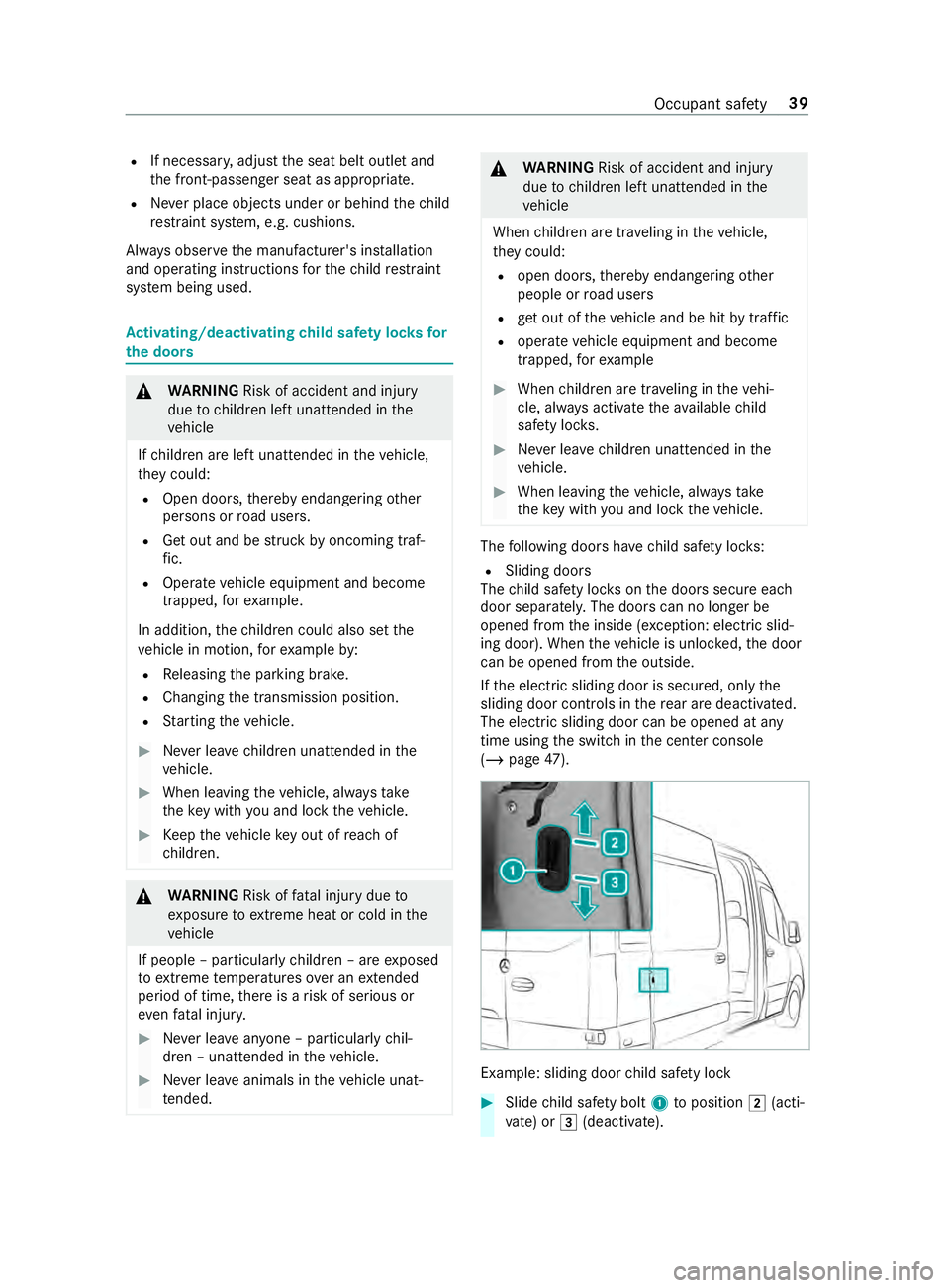
(/ page 47). Example: sliding door
child saf ety lock #
Slide child saf ety bolt 1toposition 0048(acti‐
va te) or 0049(deactivate). Occupant saf
ety39