tire pressure MERCEDES-BENZ SPRINTER 2019 MY19 with 7” screen
[x] Cancel search | Manufacturer: MERCEDES-BENZ, Model Year: 2019, Model line: SPRINTER, Model: MERCEDES-BENZ SPRINTER 2019Pages: 354, PDF Size: 6.15 MB
Page 27 of 354
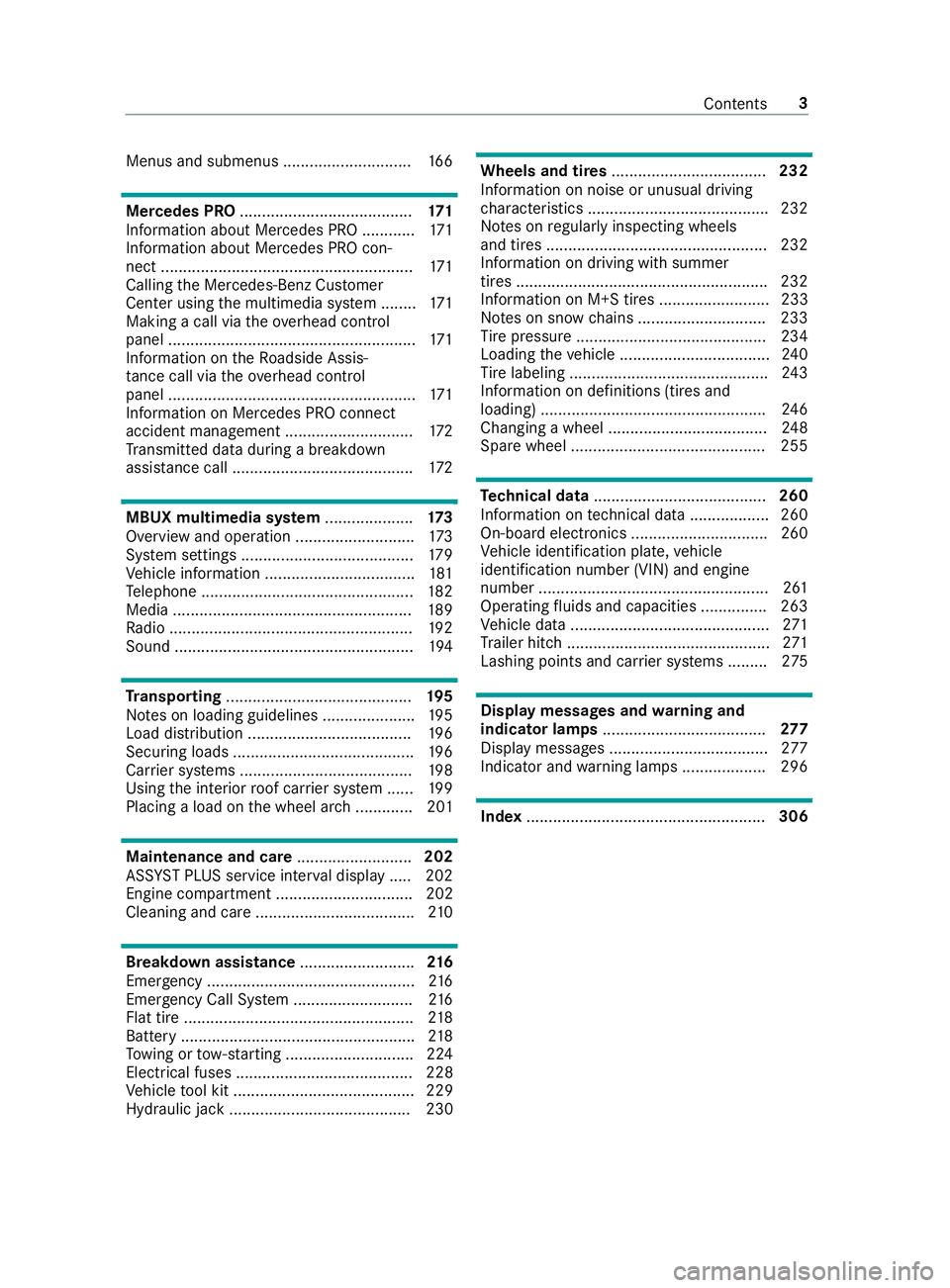
Menus and submenus .............................
16 6Mercedes PRO
....................................... 171
Information about Mercedes PRO ............ 171
Information about Mercedes PRO con‐
nect .........................................................1 71
Calling the Mercedes-Benz Cus tomer
Center using the multimedia sy stem ........ 171
Making a call via theove rhead control
panel ........................................................ 171
Information on theRo adside Assis‐
ta nce call via theove rhead control
panel ........................................................ 171
Information on Mercedes PRO connect
accident management .............................1 72
Tr ansmit ted data during a breakdown
assis tance call ......................................... 172MBUX multimedia sy
stem .................... 17 3
Overview and operation ........................... 173
Sy stem settings ....................................... 17 9
Ve hicle information ..................................1 81
Te lephone ................................................ 182
Media ...................................................... 189
Ra dio .......................................................1 92
Sound ...................................................... 194Tr
anspo rting .......................................... 19 5
No tes on loading guidelines ..................... 19 5
Load distribution ..................................... 19 6
Secu ring loads ......................................... 19 6
Car rier sy stems ....................................... 19 8
Using the interior roof car rier sy stem ...... 19 9
Placing a load on the wheel ar ch............. 201 Main
tenance and care .......................... 202
ASS YST PLUS service inter val display .... .202
Engine compartment ............................... 202
Cleaning and care ................................... .210 Breakdown assistance
..........................216
Emergency ............................................... 216
Emergency Call Sy stem ........................... 216
Flat tire ................................................... .218
Battery ..................................................... 218
To wing or tow- starting ............................ .224
Electrical fuses ........................................ 228
Ve hicle tool kit ......................................... 229
Hydraulic jack ......................................... 230 Wheels and tires
................................... 232
Information on noise or unusual driving
ch aracteristics ........................................ .232
No tes on regular lyinspecting wheels
and tires .................................................. 232
Information on driving with summer
tires ........................................................ .232
Information on M+S tires ......................... 233
No tes on snow chains ............................ .233
Ti re pressure ...........................................2 34
Loading theve hicle ..................................2 40
Ti re labeling ............................................ .243
Information on definitions (tires and
loading) ................................................... 24 6
Changing a wheel .................................... 24 8
Spa rewheel ............................................ 255 Te
ch nical data ....................................... 260
Information on tech nical da ta.................. 260
On-board electronics ............................... 260
Ve hicle identification plate, vehicle
identification number (VIN) and engine
number ....................................................2 61
Operating fluids and capacities .............. .263
Ve hicle data ............................................. 271
Tr ailer hit ch.............................................. 271
Lashing points and car rier sy stems ......... 275 Display messages and
warning and
indicator lamps ..................................... 277
Displ aymessa ges .................................... 277
Indicator and warning lamps .................. .296 Index
...................................................... 306 Contents
3
Page 31 of 354
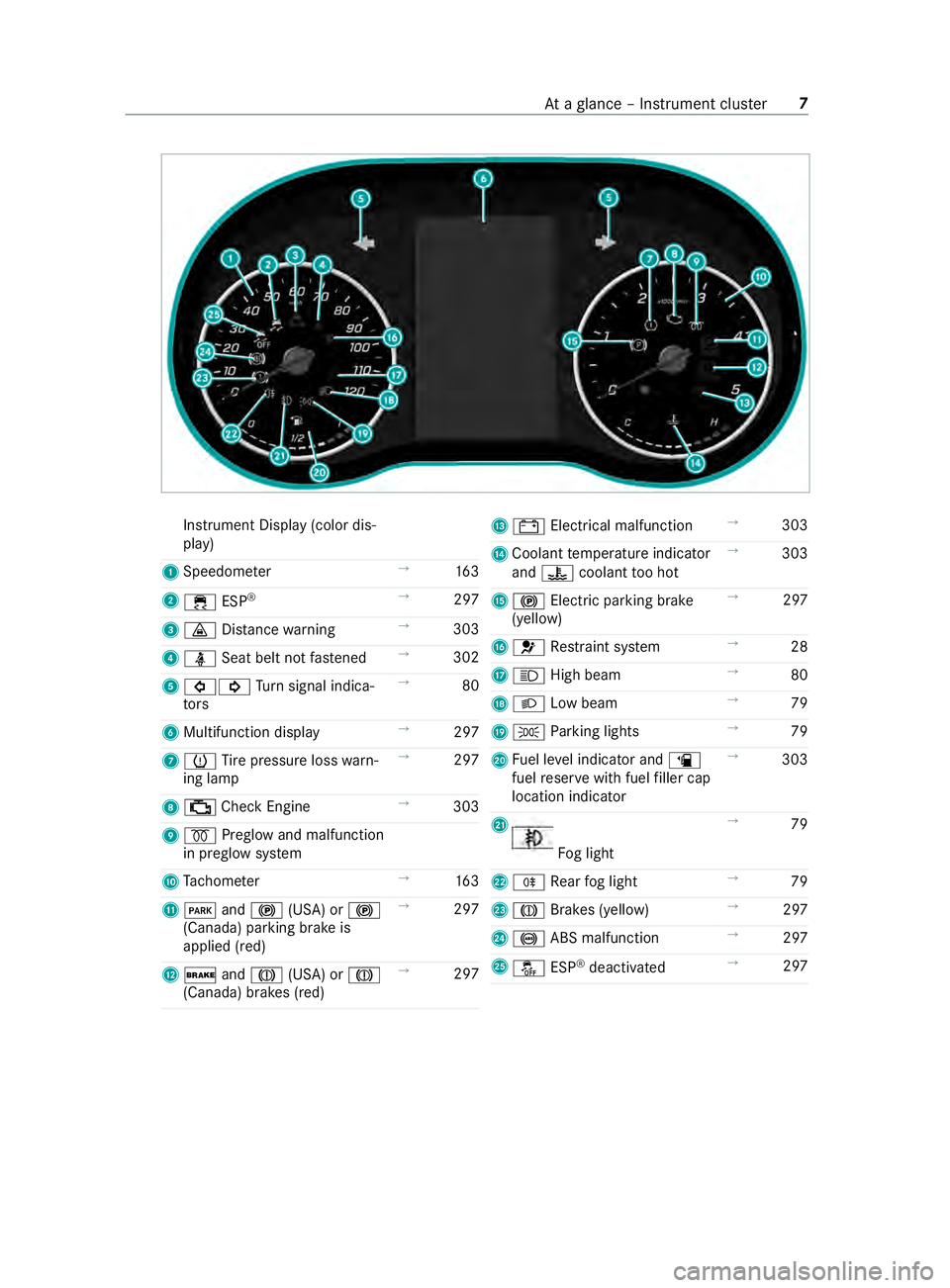
Instrument Display (color dis‐
play)
1 Speedome ter →
16 3
2 00E5 ESP®
→
297
3 00BA Distance warning →
303
4 00E9 Seat belt not fastened →
302
5 003E003D Turn signal indica‐
to rs →
80
6 Multifunction display →
297
7 0077 Tire pressure loss warn‐
ing lamp →
297
8 00B9 Check Engine →
303
9 0028 Preglow and malfunction
in preglow sy stem
A Tach ome ter →
16 3
B 0049 and0024 (USA) or 0024
(Canada) parking brake is
applied (red) →
297
C 0027 and004D (USA) or 004D
(Canada) brakes (red) →
297 D
003D Electrical malfunction →
303
E Coolant temp erature indicator
and 00AC coolant too hot →
303
F 0024 Electri c parking brake
(yellow) →
297
G 0075 Restra int sy stem →
28
H 0057 High beam →
80
I 0058 Low beam →
79
J 0060 Parking lights →
79
K Fuel le vel indicator and 00D4
fuel reser vewith fuel filler cap
location indicator →
303
L Fo
g light →
79
M 005E Rear fog light →
79
N 004D Brakes (yellow) →
297
O 0025 ABS malfunction →
297
P 00BB ESP®
deactivated →
297 At
aglance – In stru ment clus ter7
Page 32 of 354
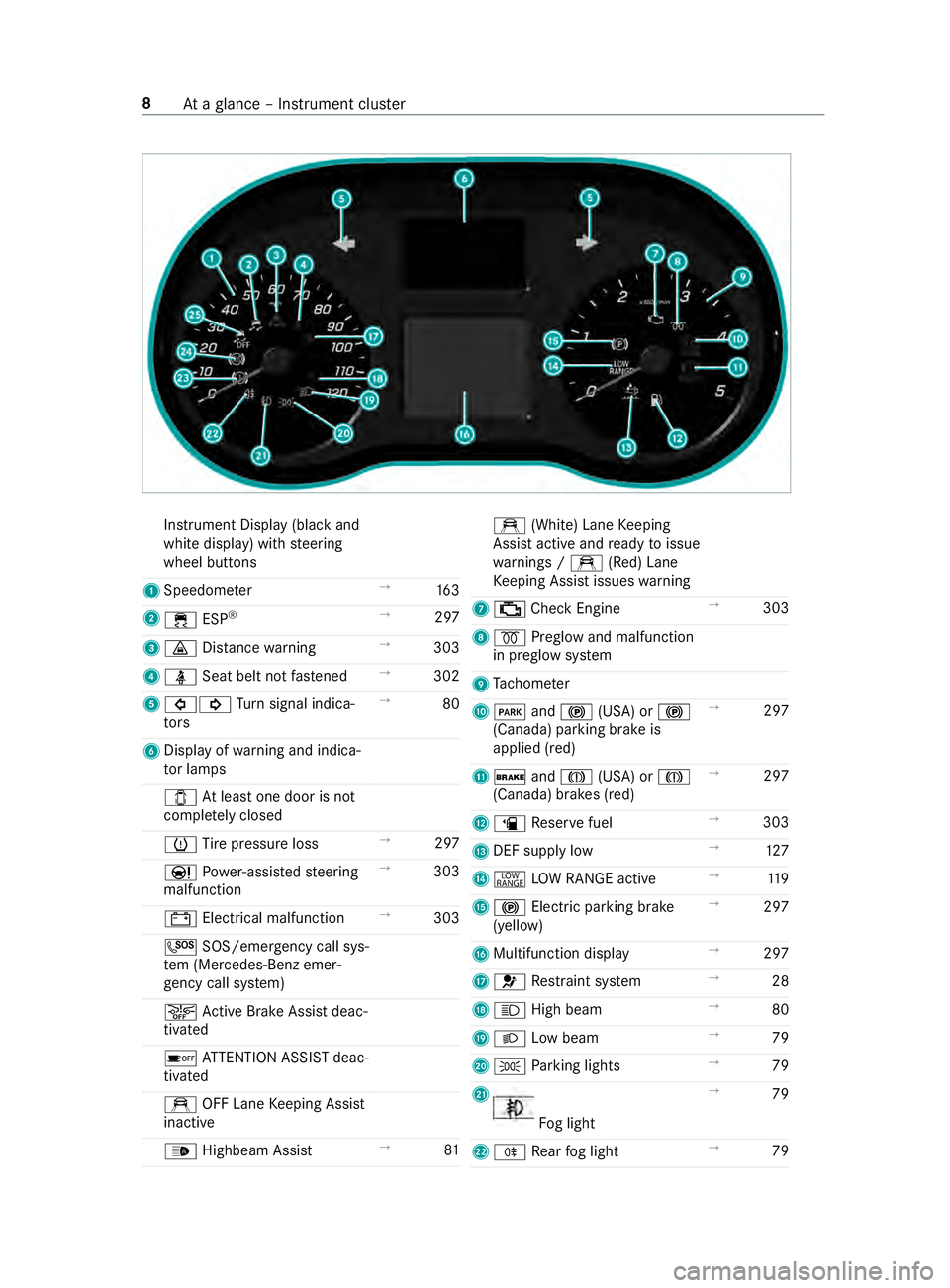
Instrument Display (black
and
white display) with steering
wheel buttons
1 Speedome ter →
16 3
2 00E5 ESP®
→
297
3 00BA Distance warning →
303
4 00E9 Seat belt not fastened →
302
5 003E003D Turn signal indica‐
to rs →
80
6 Displ ayofwa rning and indica‐
to r lamps
003E Atleast one door is not
comple tely closed
0077 Tire pressure loss →
297
00CC Powe r-assis tedsteering
malfunction →
303
003D Electrical malfunction →
303
0053 SOS/emergency call sys‐
te m (Mercedes-Benz emer‐
ge ncy call sy stem)
00D4 Active Brake Assi stdeac‐
tivated
00D7 ATTENTION ASSIST deac‐
tivated
e OFF Lane Keeping Assist
inactive
00CE Highbeam Assist →
81 e
(White) Lane Keeping
Assist active and ready toissue
wa rnings / e(Red) Lane
Ke eping Assist issues warning
7 00B9 Check Engine →
303
8 0028 Preglow and malfunction
in preglow sy stem
9 Tach ome ter
A 0049 and0024 (USA) or 0024
(Canada) parking brake is
applied (red) →
297
B 0027 and004D (USA) or 004D
(Canada) brakes (red) →
297
C 00D4 Reser vefuel →
303
D DEF supply low →
127
E 002E LOW RANGE active →
11 9
F 0024 Electric pa rking brake
(yellow) →
297
G Multifunction display →
297
H 0075 Restra int sy stem →
28
I 0057 High beam →
80
J 0058 Low beam →
79
K 0060 Parking lights →
79
L Fo
g light →
79
M 005E Rear fog light →
79 8
Ataglance – In stru ment clus ter
Page 42 of 354
Environmental pr
otection
+ ENVIRONMENTAL
NOTEEnvironmental
damage due tooperating conditions and
personal driving style The pollutant emission of
your vehicle is
directly related totheve hicle's operation.
Yo u can make a contribution toenvironmen tal
pr otection byoperating your vehicle in an
environmentally responsible manner. Todo
th is, obser vethefo llowing recommendations
on ope rating conditions and your personal
driving style.
Operating conditions: #
Make sure that the tire pressures are
alw ays cor rect. #
Do not transport any unnecessa ry
we ight (e.g. a roof rack which is no lon‐
ge rre qu ired). #
Obser vethe service inter vals.
A regularly serviced vehicle will contri b‐
ute toenvironmen tal pr otection. #
Always ha vemaintenance workcar ried
out at a qualified specialist workshop.
Pe rsonal driving style: #
Do not depress the accelera tor pedal
when starting the engine. #
Do not warm upthe engine while sta‐
tionar y. #
Drive carefully and maintain a su fficient
dis tance to ot hervehicles. #
Avoid frequent, sudden acceleration and
braking. #
Shift gears in good time and use each
ge ar only up to00C3 of its maximum
engine speed. #
Switch off the engine when in stationary
traf fic fo r a prolonged time. #
Drive in a fuel-ef ficient manne r.Pay
attention tothe ECO display for a fuel-
ef ficient driving style. Environmental issues and
recommendations
It is recommended torege nerate and recycle sub‐
st ances ins tead of immediately disposing of
th em.
The releva nt environmental guidelines and regula‐
tions ser vetoprotect the environment and
should be follo we d carefully. Mercedes-Benz Genuine
Parts
+ ENVIRONMENTAL
NOTEEnvironmental
damage caused bynot using recycled
re conditioned components Daimler
AGoffers recycled reconditioned
components and pa rts with the same quality
as new parts. The same entitlement from the
Limited Warranty is valid as for new parts. #
Use recycled reconditioned components
and pa rts from Daimler AG. *
NO
TEThe ef fectiveness of there stra int
sy stems can be impaired byinstalling
accessory parts, per form ing repairs or
we lding operations Airbags, Emer
gency Tensioning Devices as
we ll as control units and sensors forthe
re stra int sy stems can be ins talled in thefo l‐
lowing areas of theve hicle:
R Door frames
R Roof frames
R Doors
R Door pillars
R Door sills
R Seats
R Cockpit
R Instrument clus ter
R Center console #
Do not ins tall any accessories such as
audio sy stems in these areas. #
Do not per form repairs or welding oper‐
ations. #
Have accesso ryparts ins talled at a
qu alified specialist workshop. If
yo u use parts, tires, wheels or saf ety-re leva nt
accesso ries which ha venot been appr ovedby
Mercedes-Benz, the operating saf ety of theve hi‐
cle may be jeopardized. Saf ety-re leva nt sy stems,
e.g. the brake sy stem, may malfunction. Only use
Mercedes-Benz Genuine Parts or parts of equal
qu ality. Use only tires, wheels and accesso ry
parts that are appr oved foryo ur vehicle model.
Mercedes-Benz tests original parts, con version
parts and accessory parts that ha vebeen
appr ovedfo ryo ur vehicle model forre liability,
saf ety and suitabilit y.Despite ongoing ma rket
re sear ch,we are unable toassess other parts. 18
General no tes
Page 49 of 354
card contains, in compact
form ,th e most impor‐
ta nt information about your vehicle e.g. thero ut‐
ing of electric cables.
Fu rther information can be found at http://
www.mercedes-benz.de/qr-code. Data
storage Electronic control units
Electronic control units are ins
talled in your vehi‐
cle. Some of these are necessary forth e safe
operation of your vehicle, while some assist you
when driving (driver assis tance sy stems). In addi‐
tion, your vehicle pr ovides com fort and enter tain‐
ment functions, which are also made possible by
electronic cont rol units.
The elect ronic control units contain da tamemo‐
ri es which can temp orarily or permanently store
te ch nical information about theve hicle's operat‐
ing state, component loads, main tenance requ ire‐
ments and tech nical events or malfunctions.
In general, this information documents thest ate
of a component part, a module, a sy stem or the
sur roundings such as:
R operating states of sy stem components (e.g.
fl uid le vels, battery status, tire pressure)
R status messages concerning theve hicle and
its individual components (e.g. number of
wheel revo lutions/speed, deceleration, lateral
acceleration, display of thefast ened seat
belts)
R malfunctions or defects in impor tant sy stem
components (e.g. lights, brakes)
R information on events leading tovehicle dam‐
age
R system reactions in special driving situations
(e.g. airbag deployment, inter vention of sta‐
bility control sy stems)
R ambient conditions (e.g. temp erature, rain
sensor)
In addition toprov iding the actual cont rol unit
function, this data assists the manufacturer in
de tecting and rectifying malfunctions and opti‐
mizing vehicle functions. The majority of this data
is temp orary and is only processed in theve hicle
itself. Only a small portion of the data is stored in
th eeve nt or malfunction memo ry.
When your vehicle is serviced, tech nical da ta
from theve hicle can be read out byservice net‐
wo rkemplo yees (e.g. workshops, manufacturers)
or third parties (e.g. breakdown services). Serv‐ ices include
repair services, maintenance pro‐
cesses, warranty claims and quality assurance
measures, forex ample. The read out is per‐
fo rm ed via the legally prescribed port forthe
diagnostics connection in theve hicle. The
re spective service network locations or third par‐
ties collect, process and use this data. They
document tech nical statuses of theve hicle,
assist in finding malfunctions and impr oving qual‐
ity and are transmitted tothe manufacturer, if
necessar y.Fu rthermore, the manufacturer is sub‐
ject toproduct liability. Forth is, the manufacturer
re qu ires tech nical da tafrom vehicles.
Malfunction memories in theve hicle can be reset
by a service outlet as part of repair or mainte‐
nance work.
Depending on the selected equipment, you can
import data into vehicle con venience and info‐
ta inment functions yourself.
This includes, forex ample:
R multimedia data such as music, films or pho‐
to sfo r playback in an integrated multimedia
sy stem
R address book data for use in connection with
an integrated hands-free sy stem or an inte‐
grated navigation sy stem
R entered navigation destinations
R data about the use of Internet services
This data can be sa ved locally in theve hicle or it
is located on a device which you ha veconnected
to theve hicle (e.g. smartphone, USB flash drive
or MP3 pla yer). If this data is stored in theve hi‐
cle, you can dele teit at any time. This data is
sent tothird parties only at your requ est, particu‐
lar lywhen you use online services in accordance
with the settings that you ha veselected.
Yo u can store or change con venience settings/
individualization in theve hicle at any time.
Depending on the equipment, this includes, for
ex ample:
R seat and steering wheel position settings
R suspension and climate cont rol settings
R Individualization such as interior lighting
If yo ur vehicle is accordingly equipped, you can
connect your smartphone or ano ther mobile end
device totheve hicle. You can control this by
means of the cont rol elements integrated in the
ve hicle. Images and audio from the smartphone
can be output via the multimedia sy stem. Cer tain General no
tes25
Page 129 of 354
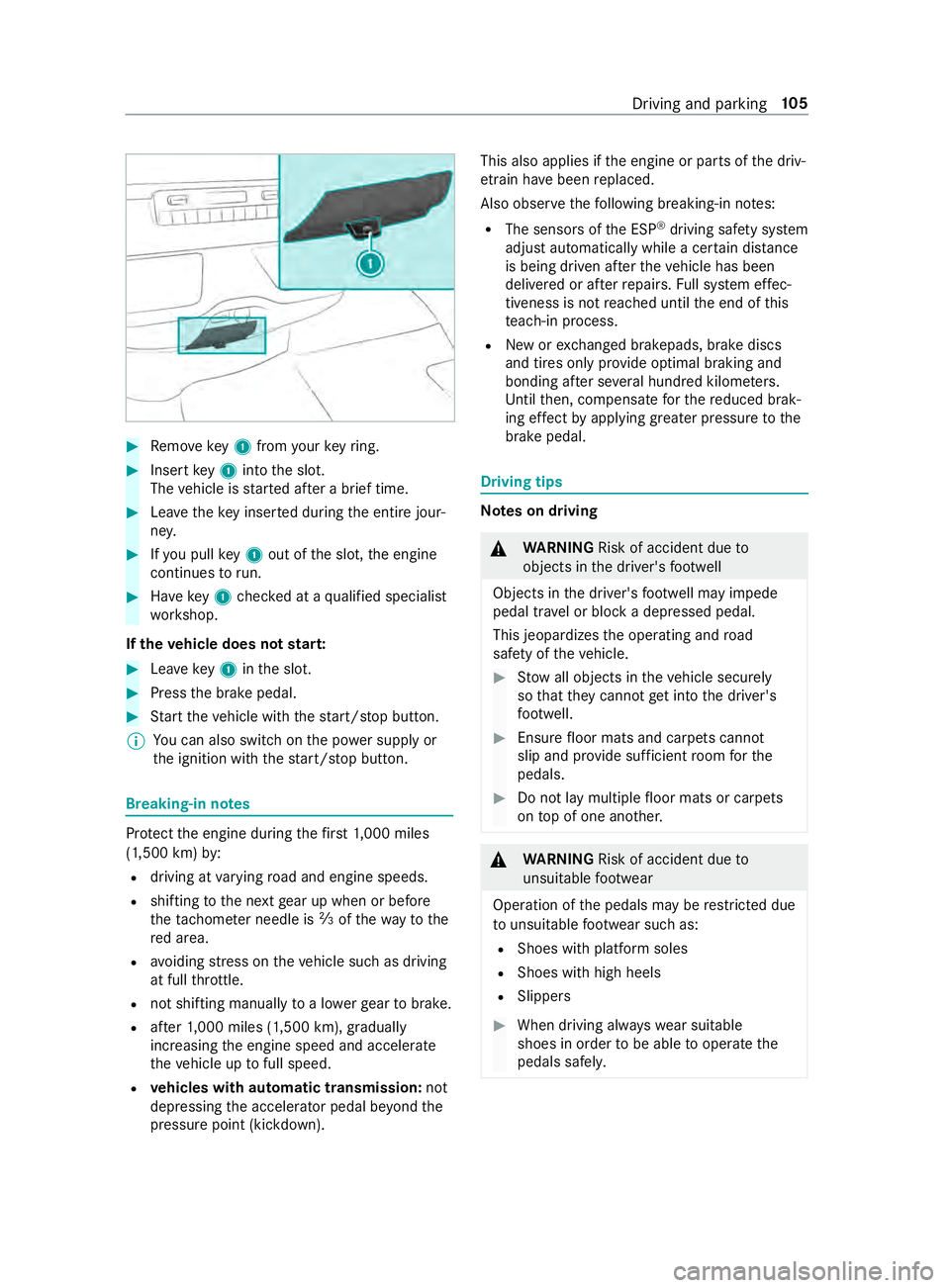
#
Remo vekey1 from your keyring. #
Inse rtkey1 into the slot.
The vehicle is star ted af ter a brief time. #
Leavetheke y inser ted during the entire jour‐
ne y. #
Ifyo u pull key1 out of the slot, the engine
continues torun. #
Have key1 checked at a qualified specialist
wo rkshop.
If th eve hicle does not star t: #
Leavekey1 inthe slot. #
Press the brake pedal. #
Start theve hicle with thest art/ stop button.
% Yo
u can also swit chon the po wer supp lyor
th e ignition with thest art/ stop button. Breaking-in no
tes Pr
otect the engine during thefirs t1, 000 miles
(1,500 km) by:
R driving at varying road and engine speeds.
R shifting tothe next gear up when or before
th etac home ter needle is 00C3ofthewa yto the
re d area.
R avoiding stre ss on theve hicle such as driving
at full thro ttle.
R not shi fting manually toa lo werge ar to brake.
R afte r1, 000 miles (1,500 km), gradually
increasing the engine speed and accelerate
th eve hicle up tofull speed.
R vehicles with automatic transmission: not
depressing the accelera tor pedal be yond the
pressure point (kickdown). This also applies if
the engine or parts of the driv‐
et ra in ha vebeen replaced.
Also obser vethefo llowing breaking-in no tes:
R The sensors of the ESP ®
driving saf ety sy stem
adjust automatically while a cer tain di stance
is being driven af terth eve hicle has been
delivered or af terre pairs. Full sy stem ef fec‐
tiveness is not reached until the end of this
te ach-in process.
R New or exch anged brakepads, brake discs
and tires only pr ovide optimal braking and
bonding af ter se veral hundred kilom eters.
Un tilthen, compensate forth ere duced brak‐
ing ef fect by applying greater pressure tothe
brake pedal. Driving tips
Note
s on driving &
WARNING Risk of accident due to
objects in the driver's foot we ll
Objects in the driver's foot we ll may impede
pedal tr avel or block a depressed pedal.
This jeopardizes the operating and road
saf ety of theve hicle. #
Stow all objects in theve hicle securely
so that they cannot getinto the driver's
fo ot we ll. #
Ensure floor mats and carpets cannot
slip and pr ovide suf ficient room forthe
pedals. #
Do not lay multiple floor mats or carpets
on top of one ano ther. &
WARNING Risk of accident due to
unsuitable foot we ar
Operation of the pedals may be restricted due
to unsuitable foot we ar such as:
R Shoes with plat form soles
R Shoes with high heels
R Slippers #
When driving alw ayswe ar suitable
shoes in order tobe able tooperate the
pedals safel y. Driving and pa
rking 105
Page 131 of 354
*
NO
TEWearing out the brake linings by
continuously dep ressing the brake pedal #
Do not depress the brake pedal continu‐
ously whilst driving. #
Touse the braking ef fect of the engine,
shift toa lo werge ar in good time. *
NO
TEDama getothe driv etra in and
engine when pulling away #
Do not warm upthe engine while the
ve hicle is stationar y.Pull away immedi‐
atel y. #
Avoid high engine speeds and driving at
full thro ttle until the engine has reached
its operating temp erature. *
NO
TEDama getothe catalytic con verter
due tonon-combu sted fuel The engine is not
running smo othly and is
misfiring.
Non-combus ted fuel may getinto the cata‐
lytic con verter. #
Only depress the accelera tor pedal
slightly. #
Have the cause rectified immedia tely at
a qualified speciali st workshop. Exhaust emission monitoring
Specific engine sy
stems are designed tokeep
poisonous components of exhaust emissions
within legal limits.
These sy stems only workoptimally if they are
main tained exactly according tomanufacturer's
specifications. It is forth is reason that all work
on the engine should only be per form ed byquali‐
fi ed and authorized Mercedes-Benz Center tech‐
nicians.
Under no circum stances should engine settings
be changed. In addition, all specific main tenance
wo rkmust be per form ed at regular inter vals and
in compliance with the service regulations of the
dealer named in the imprint. Referto the mainte‐
nance booklet for de tails.
Information about short-distance trips
If th eve hicle is predominantly used for short-dis‐
ta nce driving, fuel may accumulate in the engine
oil and cause engine damage.
If yo u main lydrive short dis tances, you should
drive on a free way or go for a country drive for 20 minutes
every300 km (480 miles). This facili‐
ta testh ere ge neration of the diesel particulate fil‐
te r.
Note s onthe speed limitation &
WARNING Risk of inju rythro ugh exceed‐
ing the specified tire load rating or the
permissible speed rating
Exceeding the specified tire load rating or the
permissible speed rating may lead totire
dama geand tothe tires bur sting. #
Therefore, only use tire types and sizes
appr ovedfo ryo ur vehicle model. #
Obser vethe tire load rating and speed
ra ting requ ired foryo ur vehicle. As
the driver, you must find out about the maxi‐
mum permissible speed forth e tires (tire and tire
pressure). In particular, obser vethe legal requ ire‐
ments for tires forth e count ryyou are in.
Yo u can permanently limit the speed of your vehi‐
cle.
Mercedes-Benz recommends a qualified special‐
ist workshop for programming the speed limita‐
tion.
Before overtaking, take into consideration that
th e engine speed limiter pr events the speed
increasing be yond the programmed speed limita‐
tion.
On downhill gradients, the speed limitation may
be exc eeded. Apply the brakes if necessar y.
Displ aymessages indica tethat you are approach‐
ing the limit speed.
Information about fore ign trips
Service
An extensive Mercedes-Benz service is also avail‐
able abroad. Ne vertheless, please remember that
services or spare parts may not be available
immediatel y.The releva nt wo rkshop directories
are available from an authorized Mercedes-Benz
Center.
Fu el
In some countries, only fuels with an inc reased
sulfur con tent are available.
Uns uitable fuel can cause engine damage. In for‐
mation about fuel can be found in the "Fuel" sec‐
tion (/ page 264). Driving and parking
107
Page 133 of 354
brakepads
byper form ing a visual inspection to
look for pad material wear.
If yo u are unable tocheck the brakepad wear on
th e inside of the wheels, remo vethe wheels if
yo u possess there qu ired skills, or visit a qualified
specialist workshop.
If th e brakepad material thickness is less than
0. 12 in (3 mm), ha vethe brakepads checked and
re placed at a qualified specialist workshop, if
necessar y.
Do not solely rely on the brakepad wear sensor.
It is also strongly recommended that you ha ve
th e brakepads checked at a qualified specialist
wo rkshop, not only at everyservice displa yedby
th e maintenance inter val displa y,but also prior to
long journe ysand when ever the wheels are
re mo ved.
Ne w brake discs and brakepads
New brakepads and brake discs on lyreach their
optimal braking ef fect af ter appro ximately
10 0 miles (100 kilome ters).
Unti lth en, compensate forth ere duced braking
ef fect by applying greater pressure tothe brake
pedal. For saf etyre asons, Mercedes-Benz recom‐
mends that you only ha vebrakepads and brake
discs which are appr ovedby Mercedes-Benz
ins talled on your vehicle.
Other brake discs or brakepads may compromise
th e saf ety of your vehicle.
Alw aysre place all brake discs and brakepads on
an axle at the same time. Alw ays ins tall new
brakepads when replacing brake discs.
Pa rking brake &
WARNING Risk of skidding or an acci‐
dent bybraking with the parking brake
If yo u ha vetobrake your vehicle with the
parking brake, the braking dis tance is consid‐
erab lylonger and the wheels may loc k.There
is an increased risk of skidding and/or acci‐
dent. #
Only brake theve hicle with the parking
brake if the service brake has failed. #
Inthis case, do not apply the parking
brake with too much forc e. #
Ifth e wheels loc k,immediately release
th e parking brake as much as required
fo rth e wheels toturn again. Ve
hicles with a manual parking brake
When driving on wetro ads or dirt-co vered sur fa‐
ces, road salt or dirt may getinto the parking
brake. This causes cor rosion and a reduction of
braking forc e.
In order topreve ntthis, drive with the parking
brake lightly applied from time totime.
When doing so, drive for a dis tance of appr ox‐
imately 300 ftat a maximum speed of 13mph
(20 km/h).
The brake lights do not light up when you brake
th eve hicle with the parking brake.
Information about driving on wetroads
Hydroplaning &
WARNING Risk of aquaplaning because
tire tread is too low
Depending on the dep thofthewate r onthe
ro adw ay, aquaplaning can occur despite suf fi‐
cient tire tread dep thand low speed. #
Avoid tire ruts and brake carefully. The
refore , in heavy rain or other conditions in
which hydroplaning can occur, drive as follo ws:
R Reduce your speed.
R Avoid tire ruts.
R Brake carefully.
Driving on flooded roads
Bear in mind that vehicles tr aveling in front or in
th e opposite direction create waves. This may
cause the maximum permissible dep thofwa ter
to be exc eeded. These no tes must be obser ved
under all circum stances. Otherwise, you can
damage the engine, electrics and transmission.
If yo u ha vetodrive on stre tches of road on which
wa ter has collected, please bear in mind thefo l‐
lowing:
R The wate r level of standing water may not be
abo vethe lo wer edge of the front bumper.
R You may drive no faster than walking pace.
Obser vethe no tes on ford ing while off- road for
all-wheel drive vehicles (/ page110). Driving and parking
109
Page 135 of 354
#
When driving on unpa vedro ads or off-
ro ad, regular lych eck theve hicle under‐
side. #
Remo vetrapped plants or other flam‐
mable material. #
Ifth ere is damage, consult a qualified
specialist workshop immediately. *
NO
TEDama getotheve hicle af ter driving
off-road When driving off-road or on unpa
ved sur fa‐
ces, fore ign bodies such as stones and
branches could become trapped on theve hi‐
cle underside, on wheels and tires, causing
damage totheve hicle.
Fo reign bodies could cause thefo llowing
damage:
R Damage the suspension, the fuel tank or
th e brake sy stem.
R Disturb the balance and cause vibrations. #
Regular lyremo veany trapped fore ign
bodies, e.g. stones and branches. #
After driving off-road, check carefully
whe ther there is any damage tothe
ve hicle. #
Ifth ere is damage, ha vetheve hicle
ch ecked at a qualified specialist work‐
shop. When driving off-road or on unpa
ved sur faces,
ch eck theve hicle underside, wheels and tires
re gularly at regular inter vals. In particular,
re mo veany trapped fore ign bodies, e.g. stones
and branches.
Obser vethefo llowing no tesre ga rding fore ign
bodies of this kind:
R They may damage the suspension, the fuel
ta nk or the brake sy stem.
R They may disturb the balance and cause
vibrations.
R They may be flung out from theve hicle when
yo u continue driving.
If th ere is any damage, inform a qualified special‐
ist workshop.
When driving off-road on steep inclines, you must
make sure that the DEF tank is su fficiently filled.
Therefore, ensure a le vel of at least ten li ters
before off-road driving. When driving off-road and on con
stru ction sites,
sand, mud and water,also mixed with oil, can get
into the brakes. This may lead toare duction in
braking ef fect or total brake failure, also as a
re sult of increased wear. The braking characteris‐
tics will vary depending on the material that has
got into the sy stem. Clean the brakes af ter driv‐
ing off-road. If youth en notice a reduced braking
ef fect or hear scraping noises, ha vethe brake
sy stem checked immediately at a qualified spe‐
cialist workshop. Adjust your driving style to the
ch anged braking characteristics.
Driving off- road or on con stru ction sites increa‐
ses the possibility of vehicle damage which may
in turn lead tothefa ilure of cer tain major assem‐
blies and sy stems. Adapt your driving style to the
off-road driving conditions. Drive carefull y.Ha ve
any vehicle damage rectified at a qualified spe‐
cialist workshop as soon as possible.
When driving on rough cross-country terrain, do
not shift the transmission into the neutral posi‐
tion and do not disengage the clutch. You could
lose control when attem pting tobrake theve hicle
with the service brake. If your vehicle cannot
manage an uphill incline, drive back down in
re ve rsege ar.
When loading your vehicle for off-road driving or
on a construction site, keep theve hicle's center
of gr avity as low as possible.
Checklist before off-road driving R Check the fuel and DEF le vels (/ page163)
and add if necessary (/ page 125).
R Engine: check the oil le vel and add oil if nec‐
essary (/ page 205). Before driving up or
down extreme inclines or slopes, fill th e oil to
th e maximum le vel.
% If
yo u drive up or down extreme inclines or
slopes, the00B2 symbol may appear in the
multifunction displa y.The engine operating
saf ety is not put at risk if you ha vefilled the
engine oil tothe maximum le vel before the
jou rney.
R Vehicle tool kit: check that the jack is work‐
ing (/ page 250).
R Make sure that a lug wrench (/ page 250), a
wo oden underlay forth e jac k,aro bust tow
ro pe, a folding spade and a wheel chock are
car ried in theve hicle.
R Tire s and wheels: check the tire tread dep th
( / page 232) and the tire pressure
(/ page 239). Driving and parking
111
Page 142 of 354

0047
Use
the engine's braking ef fect on extremely
st eep downhill gradients and on long down‐
hill stre tches. Using kickdown
#
For maximum acceleration: depressthe
accelerator pedal be yond the pressure point. #
Ease off the accelera tor pedal once the
desired speed is reached. All-wheel drive
Note
s on all-wheel drive All-wheel drive ensures permanent drive
for all
fo ur wheels, and toget her with ESP ®
it impr oves
th e traction of theve hicle.
The traction contro l ofthe all-wheel drive also
ta ke s place via the brake sy stem. Therefore, the
brake sy stem can overheat during extreme off-
ro ad use. In this case, ease off the accelerator
pedal or stop toallow the brake sy stem tocool
down.
If a driven wheel spins due toinsuf ficient trac‐
tion, obser vethefo llowing no tes:
R When pulling away, make use of the traction
cont rol integrated in ESP ®
. Depress the
accelerator pedal as far as necessar y.
R Take your foot off the accelera tor pedal,
slowly, while theve hicle is in motion.
In wintry driving conditions, alw ays use winter
tires (M+S tires) and, if necessar y,snow chains
(/ page 233). Only in this wa y can the maximum
ef fect of all-wheel drive be achie ved.
Use DSR (Downhill Speed Regulation) when driv‐
ing downhill off-road (/ page120).
If yo ufa ilto adapt your driving style or if you are
inat tentive, the all-wheel drive sy stem can neither
re duce therisk of an accident nor override the
la ws of ph ysics. The all-wheel drive sy stem can‐
not take road, weather and traf fic conditions into
account. The all-wheel drive sy stem is only an
aid. You are responsible for maintaining a safe
dis tan ce from theve hicle in front, forve hicle
speed, for braking in good time and forst ay ing in
lane. *
NO
TERisk of damage tothe driv etra in
and the brake sy stem If
yo u operate vehicles with all-wheel drive on
a one-axle test st and, you may damage the
driv etra in or the brake sy stem. #
A function or per form ance test should
only be car ried out on a two-axle test
st and. #
Ifyo u wish tooperate theve hicle on
such a test st and, please consult a
qu alified specialist workshop in
advance. *
NO
TERisk of damage tothe transfer
case If
yo uto w theve hicle with a raised axle, the
trans fer case can getdamaged. Such damage
is not co veredby Mercedes-Benz Limited
Wa rrant y. #
Neverto w theve hicle with a raised axle. #
Only tow theve hicle with all wheels on
th e ground or fully raised. #
Notethe instructions on towing the
ve hicle with full contact with the ground
fo r all wheels. Engaging all-wheel drive
Conditions
for en gaging/disengaging
Yo u can engage and deactivate the all-wheel drive
when stationary or while driving slowl y.
When stationar y,thefo llowing must be obser ved:
R The engine is running.
R The steering wheel in thest ra ight-ahead posi‐
tion.
If th e all-wheel drive cann otbe engaged when
st ationary: #
Vehicles with automatic transmission:
shift the selector le ver from 005Cto005B from
005B to005C from 005Cto005E and back to005C .
Engaging and disengaging the all-wheel drive
can be made easier in this wa y.
Obser vethefo llowing when driving slowly:
R The engine is running.
R The vehicle is not tr aveling fasterthan
6.2 mph (1 0 km/h).
R The vehicle is not being driven around a bend. 11 8
Driving and pa rking