warning MERCEDES-BENZ SPRINTER 2019 MY19 with no MMS Operator’s Manual
[x] Cancel search | Manufacturer: MERCEDES-BENZ, Model Year: 2019, Model line: SPRINTER, Model: MERCEDES-BENZ SPRINTER 2019Pages: 322, PDF Size: 5.91 MB
Page 228 of 322

R
Use sno wchains only when ther oad sur face
is comple tely sno w-covered. Re mo vethe
sno wchains as soon as possiblew henyou
come toaroad that is no tsnow-covered.
R Local regulations ma yrestrict theu se of
sno wchains. Obser vethea pplicable regula‐
tions befor einstal ling sno wchains.
R Activat eall-whee ldrive before driving of fwith
sno wchains (/ page119).
R If sn ow ch ains ar einstalled, them aximum
permissible speed is 30 mph(50 km/h ).
R Vehicles with Parking Assis t:do no tuse
Pa rking Assis tPARKTRONIC if sno wchains
ar ei nstalled.
% Youc an deactivat eESP®
to pull away .This
allo ws th ewheels tospin, achieving an
increased driving forc e. Ti
re pressure Note
sont irep ressure &
WARNING Risk of accident du etoinsuf‐
fi cient or excessiv etirep ressure
Underinfla tedoro verinfla tedt ires pose the
fo llowing risks:
R The tires ma yburst,e speciall yasthe load
and vehicle speed increase.
R The tires ma ywear excessively and/or
une venly ,w hich ma ygreatly impair tire
traction.
R The driving characteristics, as well as
st eering and braking, ma ybegreatly
impaired. #
Compl ywitht he recommended tire
pressur eand checkt he tir epressur eof
all tires including thes par ew heel regu‐
larly:
R at leas tonce amonth
R when thel oad changes
R befor eembarkin gonalongerjourney
R if operating conditions change, e.g .off-
ro ad driving #
Adjus tthe tir epressur easn ecessar y. Driving wi
thtirep ressur ethat is tooh igh or too
lo wc an:
R Shor tent he service lif eofthe tires. R
Cause increased tir edamage.
R Adversely af fect handling characteristic sand
th us drivin gsafet y, e.g. due to hydroplaning. &
WARNING Risk of an accident du eto
insuf ficient tir epressu re
Ti re sw ithp ressur ethat is tool ow can over‐
heat and bur stas aresult.
In addition ,the ya lso suf ferf rome xcessive
and/or ir regular wear,w hic hc an significantly
impair theb raking properties and theh an‐
dling characteristics. #
Avoid excessively lo wtirep ressures in
all thet ires, including thes par ew heel. Ti
re pressur ewhichist oo lo wcan cause:
R Tire malfunctions as aresult of overheating
R Impaired handling characteristics
R Irre gular wear
R Increased fuel consum ption &
WARNING Risk of accident from exces‐
siv etirep ressure
Ti re sw ithe xcessively high pressur ecan bur st
because they ared amaged mor eeasil yby
highw ayfill, po tholes etc.
In addition, they also suf ferf romi rregular
we ar,w hic hc an significantl yimp air theb rak‐
ing properties and theh andling characteris‐
tics. #
Avoid excessively high tir epressures in
all thet ires, including thes par ew heel. Excessively high tir
epressur ecan result in:
R Increased braking dis tance
R Impaired handling characteristics
R Irre gular wear
R Impaired drivin gcom fort
R Susceptibility todamage &
WARNING Risk of accident caused by
re peated drop in tir epressure
If th et irep ressur edrops repeatedly ,the
wheel, valveort irem aybe damaged.
Insuf ficient tir epressu recan cause thet ires
to bur st. #
Inspect thet iref or signs of fore ign
objects. 204
Wheels and tires
Page 229 of 322
#
Chec kwhether thew heel or valveh as a
leak. #
Ifyo ua reunabl etorectify thed amage,
contact aqualified specialis tworks hop. Yo
uc an find information on recommended tire
pressures fort he vehicle's factor y-ins talled tires
on thef ollowing labels:
R Tire and Loadin gInforma tionp lacar dont he
B‑pi llarofyour vehicle (/ page210).
R Tire pressur etable on thei nside of thef uel
fi ller flap .
Obse rvet he maximum tir epressure
(/ page215).
Use asuita ble tir epressur egaug etoc heckthe
tir ep ressure. The ou tera ppearance of atired oes
no tp ermit an yreliable conclusion about thet ire
pressure.
+ ENVIRONMEN
TALN OTE Environmental
damag eduetoinsuf ficient or excessive
tir ep ressure No
tethat insuf ficient or excessiv etirep res‐
sur eshor tens thes ervice lif eofthe tires. #
Forthis reason ,chec kthe tir epressure
re gularly ;atleastevery 14 days. Ve
hicles with atirep ressur emonitor: youc an
also checkt he tir epressur eusing theo n-board
computer.
Onl ycorrect tir epressur ewhent he tires are
cold. Conditions forc old tires:
R The vehicle has been par kedw itht he tires out
of direct sunlight foratl east thre eh ours.
R The vehicle has tr aveled less than 1m ile
(1.6 km).
Ar ise in thet iret emperatur eof18°F( 10°C)
increases thet irep ressur ebya pprox.10k Pa
(0. 1b ar/1.5 psi). Take this int oaccount when
ch ecking thet irep ressur eofw armt ires.
The tir epressur erecommended fori ncreased
load/spee dinthe tir epressur etable ma yaffect
th er ide comfort. &
WARNING Risk of accident du eto
unsuitable accesso ries on tir evalve
If yo um ountunsuitable accesso ries ont otire
va lves, thet irev alves ma ybeoverloaded and malfunction
,whic hc an cause aloss of tire
pressure. Af term arke ttirep ressur emonitor‐
ing sy stems will cause thet irev alvetor emain
open ,depending on thed esign. This can also
re sult in aloss of tir epressure. #
Only scr ewstandar dvalvec aps or valve
cap sspecifically appr ovedbyM ercedes-
Benz fory our vehicle ont othe tir evalve. Note
sont owing atrailer
The applicable tir epressures fort he tires of the
re ar axle is alw ayst he recommended tir epres‐
sur efor afull load. Ti
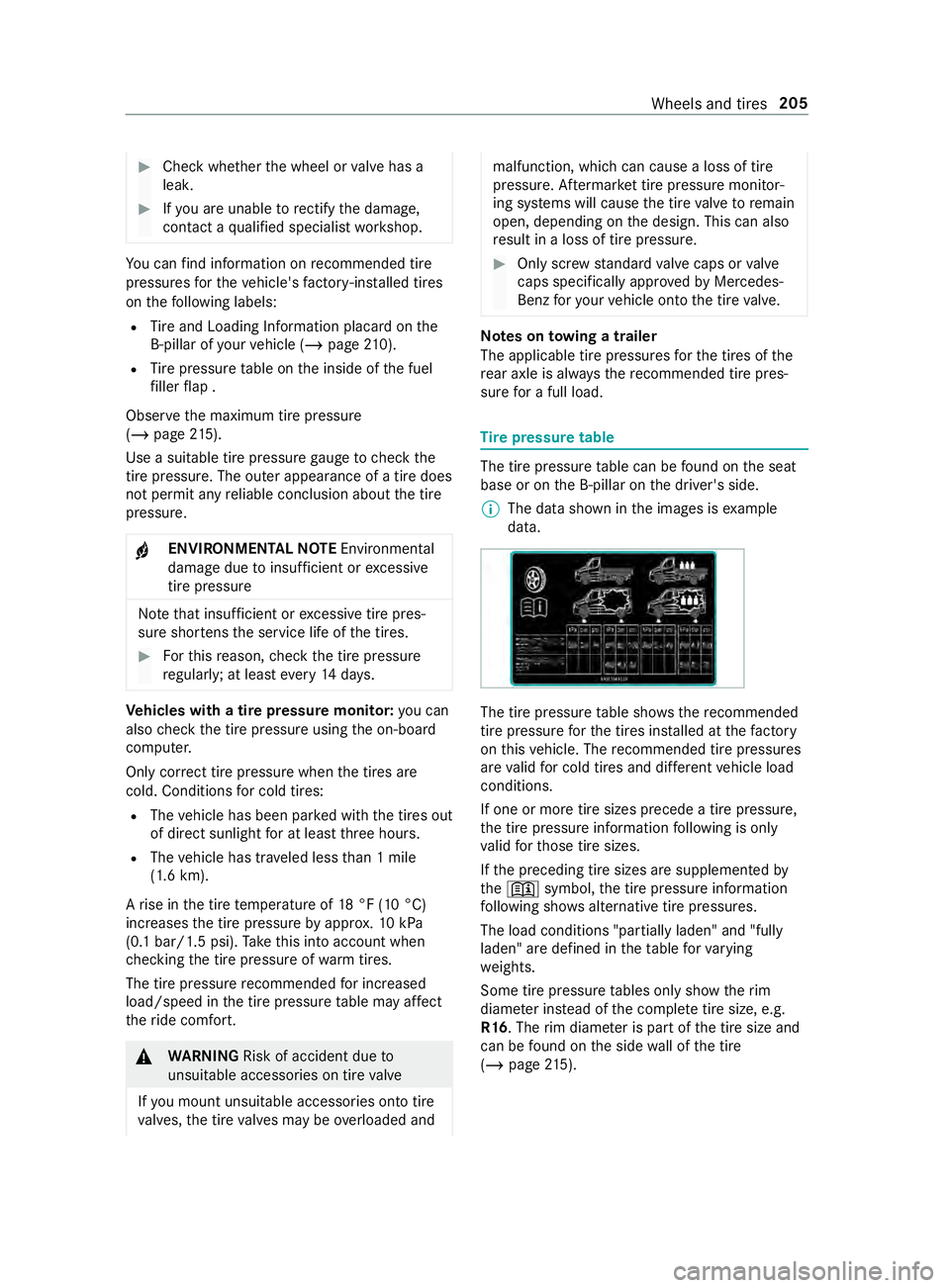
re pressur etable The tir
epressur etable can be found on thes eat
base or on theB ‑pillar on thed rive r's side.
% The dat
ashown in thei mages is example
data. The tir
epressur etable sho ws therecommended
tir ep ressu refort he tires ins talled at thef actory
on this vehicle. The recommended tir epressures
ar ev alid forc old tires and dif fere nt vehicle load
conditions.
If one or mor etires izes precede atirep ressure,
th et irep ressur einformation following is only
va lid fort hose tir esizes.
If th ep receding tir esizes ar esupplemented by
the 0091 symbol, thet irep ressur einformation
fo llowing sho wsalternativ etirep ressures.
The load condition s"partiall yladen "and "fully
laden "aredefine dinthetable forv arying
we ights.
Som etirep ressur etables onl yshowt he rim
diame teri ns tead of thec omple tetires ize, e.g.
R16.T herimd iame terisp artoft he tir esize and
can be found on thes ide wall of thet ire
(/ page215). Wheels an
dtires 205
Page 233 of 322

re
placement or alternat etires or wheels on
th ev ehicle that pr event theT PMS from func‐
tionin gproper ly.
Alw aysc hec kthe TPMS malfunction warning
lam pafter replacing one or mor etires or
wheels on your vehicle toensur ethat the
re placement or alternat etires and wheels
allo wthe TPMS tocontinu etofunction prop‐
er ly. The sy
stem checks thet irep ressur eand thet em‐
peratur eofthe tires ins talled tothev ehicle by
means of atirep ressur esensor.
Ne wt irep ressur esensors, e.g. in winter tires,
ar ea utomatically taught-in thef irst time they are
driven.
The tir epressur eand thet iret emperatur eappear
in them ultifunction displa y(/pag e160).
If th er eisas ubstantia llos soft irep ressure, a
wa rning is issued:
R via displa ymessages (/ page260)
R viathe 0077 warning lam pinthe instrument
clus ter
It is thed rive r's responsibility tosetthe tir epres‐
sur etot herecommended cold tir epressur esuit‐
able fort he operating situation. Se tthe tir epres‐
sur efor cold tires using atirep ressu regauge.
No tethat thec orrect tir epressure fort he cur rent
ope rating situatio nmustfirst be taught-in tothe
tir ep ressur emonitoring sy stem.
In mos tcases, thet irep ressur emonitoring sys‐
te mw illa utomatically updat ethe ne wreference
va lues af tery ou ha vechanged thet irep ressure.
Yo uc an,h owe ver,also updat ethe refere nce val‐
ues byrestartin gthe tir epressur emonitoring
sy stem manually (/ page210).
Sy stem limitations
The sy stem ma ybeimpaired or ma ynotfunction
in thef ollowing situations:
R ifth et irep ressur eiss etincor rectly
R ifth er eisas udden pressur eloss caused by a
fo re ign object penetrating thet ire, fore xam‐
ple
R ifth er eisam alfunction caused byano ther
ra dio signal source
Mak esuretoo bservethef ollowing fur ther rela‐
te ds ubject:
R Notesont irep ressur e(/pag e204) Checking
thet irep ressur ewitht he tir epres‐
sur em onitoring sy stem
Requ irements:
R The ignition is switched on
On-boar dcomputer:
4 Service 5
Tires
One of thef ollowing displa ysappears:
R The cur rent tir epressur eand tir etempera‐
tur eoft he individual wheels Instrument Displa
ywithc olor display
R The cur rent tir epressur efor eac hwheel Instrument Displa
ywithb lack and whit edisplay
R Tire pressure will be displaye dafter driving a
few minutes :the teach-in process of thes ys‐
te misn otyetc ompl ete. The tir epressur eare
already being monitored. #
Compar ethe tir epressur ewitht he recom‐
mende dtirep ressur efor thec urrent ope rat‐
ing condition .Obser vethen otes on tir etem‐
peratur e(/pag e204).
% The
values displa yedint he multifunction dis‐
pla ym aydeviat efromt hose of thet irep res‐
sur egaug east heyr efer tosea le vel.At high
altitudes, thet irep ressur evalues indicated
by ap ressur egaug earehigher than those
shown bytheo n-boar dcomputer .Inthis
case, do no treduce thet irep ressure. Wheels and tires
209
Page 234 of 322
Mak
esuretoo bservethef ollowing fur ther rela‐
te ds ubject:
R Notesont irep ressur e(/pag e204)
Rest arting thet irep ressur emonitor
Requ irements:
R The recommended tir epressur eisc orrectly
se tfor ther espectiv eoperating condition on
eac hoft he wheels (/ page204).
R Re
star tt he tir epressur emonitoring sys‐
te mi nthe following situations:
- The tir epressur ehaschanged.
- The wheels or tires ha vebeen changed or
newl yins talled.
On-boar dcomputer:
4 Service 5
Tires #
Scroll down in them enu.
The Use Current Pressures as New Refer-
ence Values messageappear sinthe multi‐
function displa y. #
Con firm them essag etoinitiat earestart.
The Tire Press. Monito rRestarted message
appear sinthe multifunction displa y.
Cur rent wa rning messages ar edeleteda nd
the 0077 yello ww arning lam pgoes out.
Af tery ou ha vedriven foraf ewminutes, the
sy stem checks whe ther thec urrent tir epres‐
su resa rewithin thes pecified range. The cur‐
re nt tir epressures ar ethen accep tedasr ef‐
erence values and monitored.
Mak esuretoo bservethef ollowing fur ther rela‐
te ds ubject:
R Notesont irep ressur e(/pag e204) Ra
dio-equipment appr oval of thet irep res‐
sur em onitoring sy stem
Ra dio equipment appr oval numbers Countr
yRadio equipment appr oval
number
Canada IC: 4008C- TSSRE4A
Ope ratio niss ubject tothef ollow‐
ing tw oconditions:
(1) this device ma ynotcause
harmful inter fere nce, and
(2) this device mus tacce ptany
inter fere nce received, including
inter fere nce that ma ycause
undesired operation.
Mexic oM odel:TSSRE4A &TSSSG4G6,
IFETEL: RLVHUTS17-0806
US AF CC ID:YGO TSSRE4A
Thi sd evice complie swithP art15
of theF CC Rules. Operation is
subjec ttothefollowing tw ocon‐
ditions: (1) this device ma ynot
cause harmful inter fere nce, and
(2) this device mus tacce ptany
inter fere nce received, including
inter fere nce that ma ycause
undesired operation.
WA RNING: An ychanges or modifi‐
cation no texpressly appr ovedby
th ep arty responsible forc ompli‐
ance could void theu ser's author‐
ity tooperat ethis equipment. Loading the
vehicle Ti
re and Loading Information placard &
WARNING Risk of an accident whe ndriv‐
ing wi than ove rloaded tire
Overloaded tires ma yoverheat and bur stas a
consequence. Overloaded tires can also
impair thes teering and handling characteris‐
tic sa nd lead tobrak efailure. #
Obser vethel oad rating of thet ires. #
The load rating mu stbe at leas thalf the
gros saxle weight rating of thev ehicle.
Mercedes-Ben zrecommends youu se
th el oad-bearing index, whic hisgiven in
th ev ehicle documents. 210
Wheels and tires
Page 238 of 322
tire's ability
tocome toas tandstill on awetpave‐
ment under controlle dconditions on aspecified
U. S. go vernment test sur face mad efroma sphalt
and concr ete.
Te mp eratur egrade &
WARNING Risk of accident from tire
ove rheating and tir efailure
The temp eratur egrade fort his tir eisestab‐
lished forat iret hat is properly inflated and
no to verloaded. Excessiv espeed, underinfla‐
tion, or excessiv eloading, either separatel yor
in combination, can cause excessiv eheat
build-up and possible tir efailure. #
Obser vether ecommended tir epres‐
sures and regular lych eckt he tir epres‐
sur eofa ll tires including thes pare
wheel. #
Adjus tthe tir epressur easn ecessar y. The
temp eratur egrades ar eA(highes tgrade), B
and C. These relat etoat ire'sresis tance toheat
and its ability torelease heat on aspecified test
wheel in laborator ytests under cont rolled condi‐
tions. Sus tained high temp eratures can cause the
material of thet iretod egenerat eand reduce tire
life. In addition, excessivel yhigh temp eratures
can lead tosudden tir efailure. Grade Crefer sto
ap erform anc ewhicha ll passenger vehicle tires
mus texhibit, accordin gtotheU.S. Depa rtment
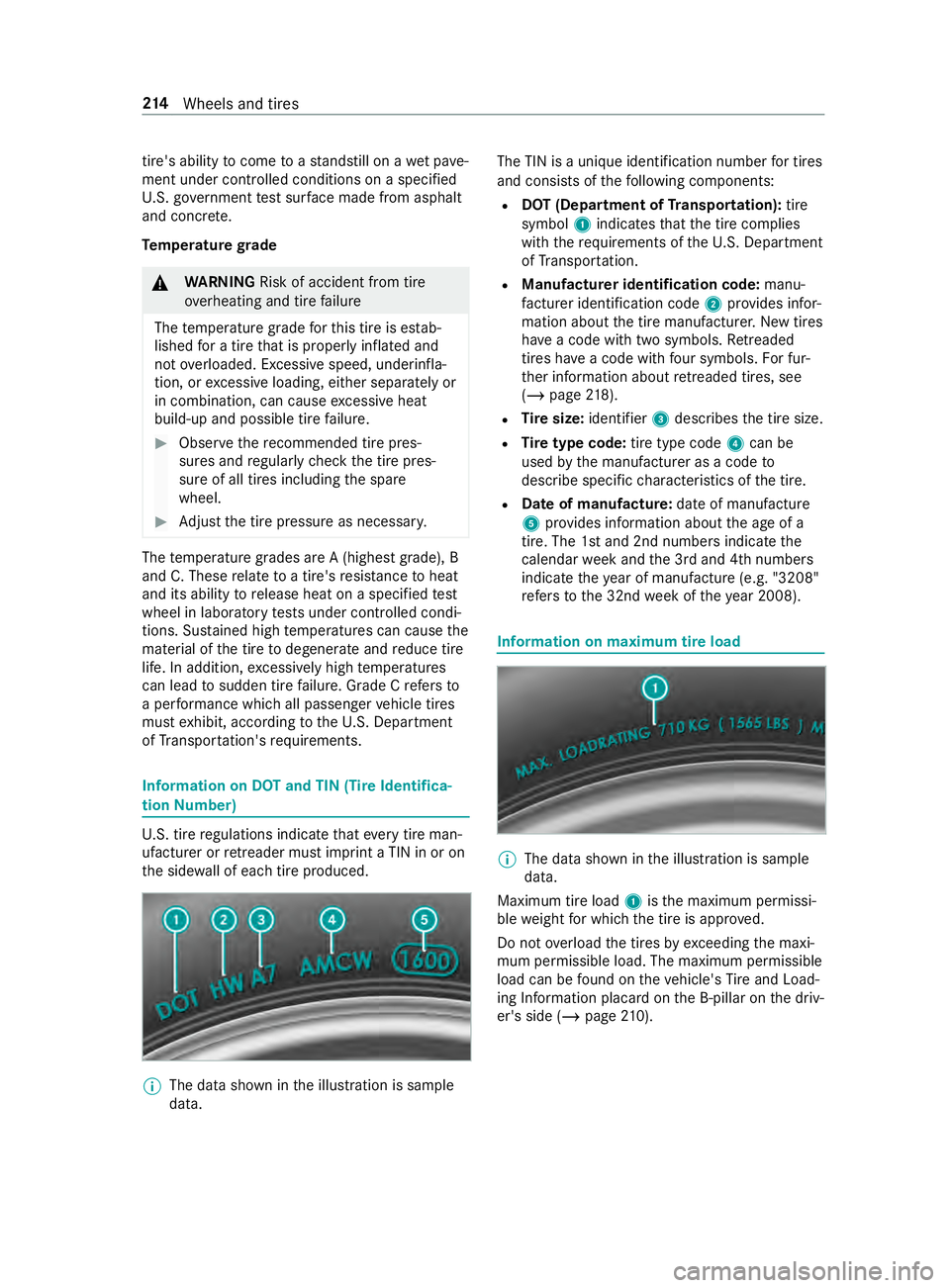
of Transpor tation's requ irements. Information on DO
Tand TIN (Tir eIdentifica‐
tion Number) U.
S. tir eregulations indicat ethat everyt irem an‐
ufacturer or retreade rmustimp rint aT IN in or on
th es ide wall of eac htirep roduced. %
The dat
ashown in thei llustration is sample
data. The TIN is
aunique identification number fort ires
and consists of thef ollowing components:
R DOT(Department of Transportation): tire
symbol 1indicates that thet irec omplies
wit hthe requ irements of theU .S. Depa rtment
of Transpor tation.
R Manufacturer identi fication code: manu‐
fa cturer identification code 2prov ides infor‐
matio nabout thet irem anufacturer .New tires
ha ve ac odew itht wo symbols. Retreaded
tires ha veac odew ithf our symbols.F or fur‐
th er information about retreade dtires, see
(/ page 218).
R Tire size: identifier 3describes thet ires ize.
R Tire type code: tiret ypec ode 4can be
used bythem anufacturer as acode to
describe specific characteristic softhe tire.
R Dat eofm anufactu re:date of manufacture
5 prov ides informatio nabout thea geof a
tire. The 1s tand 2nd number sindicat ethe
calendar week and the3 rdand 4t hnumbers
indicat ethe year of manufactur e(e.g. "3208"
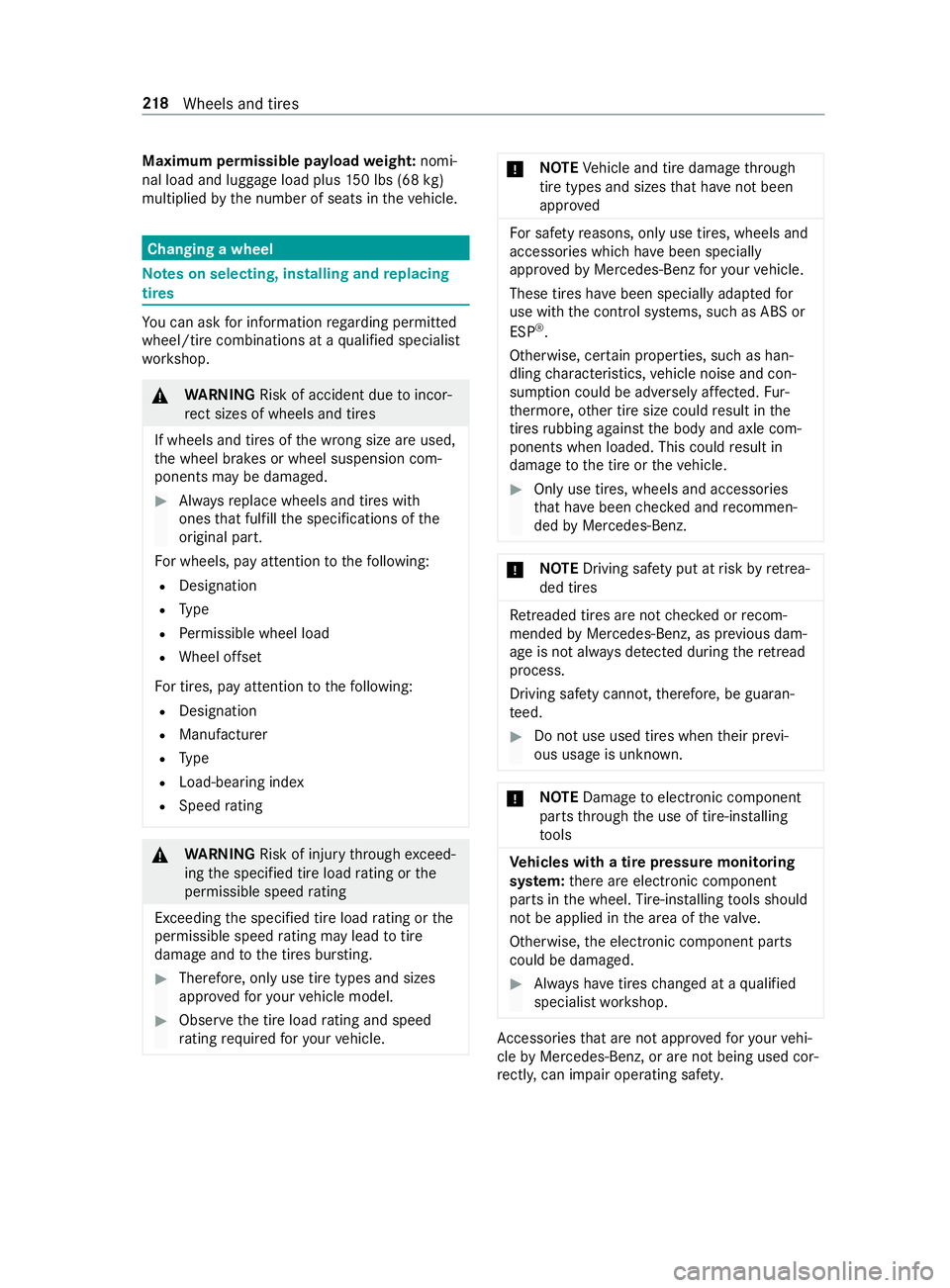
re fers to the3 2ndw eek of they ear 2008). Information on maximum tir
eload %
The dat
ashown in thei llustration is sample
data.
Maximum tir eload 1isthem aximum permissi‐
ble weight forw hichthe tir eisa pprove d.
Do no toverload thet ires by ex ceeding them axi‐
mum permissible load. The maximum permissible
load can be found on thev ehicle's Tire and Load‐
ing In form atio nplacar dont he B-pillar on thed riv‐
er's side (/ page210). 214
Wheels and tires
Page 239 of 322

Information on maximum tir
epressu re %
The dat
ashown in thei llustration is sample
data.
Maximum permitted tir epressure 1,whichis
permitted fort he tires mus tnotbe exceeded.
Exception: whe nusing the2 25/ 75R16C
12 1/120R (122L) tires as aspare wheel on the
re ar axle of Supe rSinglev ehicles wit hadista nce
limit of 62 mi (100 km) and speed limit of 34 mph
(55 km/h). Information on tir
echaracteristics %
The dat
ashown in thei llustration is sample
data.
This information describes thet ype of tir ecord
and then umber of la yers in side wall1 and
under tir etread 2. Ti
re size designation, load-bearing capacity,
speed ratin ga nd load index &
WARNING Risk of inju rythro ugh exceed‐
ing thes pecified tir eload rating or the
permissible speed rating
Exceeding thes pecified tir eload rating or the
permissible speed rating ma ylea dtot ire
dama geand tothet ires bur sting. #
Therefore, onl yuse tir etypes and sizes
appr ovedfor your vehicle model. #
Obser vethet irel oad rating and speed
ra ting requ ired fory our vehicle. 1
Prefixing letter
2 Nominal tir ewidthinm illimeters
3 Aspect ratio (i npercent)
4 Tire code
5 Rimd iame ter
6 Load-bearing index
7 Speed rating
8 Loadind ex
% The dat
ashown in thei llustration is sample
data.
Fu rther information about reading tir edatac an
be obtaine dfroma nyqualified specialis twork‐
shop.
Prefixing letter 1 1:
R "LT": light truc ktires in accordance wit hUS
manufacturer standards.
R "C": tires forc ommercial usage in accordance
wit hE uropean manufacturer standards.
Aspect ratio (i npercent) 3 3:
The size ratio betwee nthe tir eheight and tire
widt hand is shown in percent (tir eheight divided
by tirew idth ).
Ti re code 4 4(tiretype):
R "R": radial tire
Rim diam eter 5
5:
The diame teroft he bead seat (no tthe diame ter
of ther im flange). The rimd iame teriss pecified in
inches (in).
Load-bearing index 6 6:
Numerical code whic hspecifies them aximum
load-bearing capacity of atire( "91" equals, e.g.
13 56 lb (6 15kg)).
The tir eload-bearing capacit ymustbeatl east
half theg ross axle weight rating of thev ehicle. Wheels and tires
215
Page 242 of 322
Maximum permissible pa
yload weight: nomi‐
nal load and luggag eload plus 150lbs (68 kg)
multiplied bythen umber of seats in thev ehicle. Changing
awheel Note
sons electing, installing and replacing
tires Yo
uc an ask fori nformation rega rding permit ted
wheel/tir ecombinations at aqualified specialist
wo rkshop. &
WARNING Risk of accident du etoincor‐
re ct size sofwheels and tires
If wheels and tires of thew rong size ar eused,
th ew heel brakes or wheel suspension com‐
ponents ma ybedamaged. #
Alwaysr eplace wheels and tires with
ones that fulfill thes pecification softhe
original part.
Fo rw heels, pa yattention tothef ollowing:
R Designation
R Type
R Perm issible wheel load
R Wheel of fset
Fo rtires, pa yattention tothef ollowing:
R Designation
R Manufacturer
R Type
R Load-bearing index
R Speed rating &
WARNING Risk of inju rythro ugh exceed‐
ing thes pecified tir eload rating or the
permissible speed rating
Exceeding thes pecified tir eload rating or the
permissible speed rating ma ylea dtot ire
dama geand tothet ires bur sting. #
Therefore, onl yuse tir etypes and sizes
appr ovedfor your vehicle model. #
Obser vethet irel oad rating and speed
ra ting requ ired fory our vehicle. *
NO
TEVehicle and tir edamag ethrough
tir et ype sand sizes that ha venotb een
appr oved Fo
rs afet yr easons, onl yuse tires, wheels and
accesso ries whic hhave been specially
appr ovedbyM ercedes-Benzf oryour vehicle.
These tires ha vebeen speciall yadap tedf or
use wit hthe contro lsystems, suc hasABS or
ESP ®
.
Otherwise, cer tain properties ,suc hash an‐
dling characteristics, vehicle noise and con‐
sum ption could be adversel yaffected. Fur‐
th ermore, other tir esize could result in the
tires rubbing agains tthe body and axle com‐
ponents when loaded. This could result in
damag etothe tireort hevehicle. #
Onlyuse tires, wheels and accessories
th at ha vebeen checkeda nd recommen‐
ded byMercedes-Benz. *
NO
TEDriving sa fety pu tatriskbyretrea‐
de dt ires Re
treade dtires ar enotcheckedorr ecom‐
mended byMercedes-Benz, as pr evious dam‐
ag eisn otalw aysd etected during ther etre ad
process.
Driving sa fety cannot, therefore, be guaran‐
te ed. #
Do no tuse used tires when their pr evi‐
ous usag eisunknown. *
NO
TEDama getoelectronic component
parts thro ugh theu se of tire-ins talling
to ols Ve
hicles with atirep ressur emonitoring
sy stem: ther ea reelectronic component
parts in thew heel. Tire -ins talling tools should
no tbea pplied in thea reaoft hevalve.
Otherwise, thee lectronic componen tparts
could be damaged. #
Alwaysh ave tires changed at aqualified
specialis tworks hop. Ac
cesso ries that ar enotappr ovedfor your vehi‐
cle byMercedes-Benz, or ar enotbeing used cor‐
re ctly ,can impair ope rating sa fety. 218
Wheels and tires
Page 243 of 322

Befor
epurch asing and using non-appr oved
accesso ries, visit aqualified specialis tworks hop
and inquir eabout:
R Suitability
R Legal stipulations
R Factor yrecommendations
Obser vethef ollowing points when selecting,
ins talling and replacing tires:
R Use onl ytires and wheels of thes ame type,
design (winter tires, all-season tire) and
make.
R Onlyins tall wheels of thes ame size and tread
design on one axle (lef tand right).
It is onl ypermissible toins tallad iffe re nt
wheel size tothis in thee vent of aflat tir ein
order todriv etot he specialis tworks hop.
R Onlyins tall tires of thec orrect size ont othe
wheels.
R Ve
hicles with atirep ressur emonitoring
sy stem: all ins talled wheels mus tbeequip‐
ped wit hfunctioning sensor sfor thet irep res‐
sur em onitoring sy stem.
R Attemp eratures belo w50°F(10°C), use
winter tires or all-season tir emarke dM +Sfor
all wheels.
Wi nter tires bearing the004D snowflak esym‐
bol in addition totheM +S marking pr ovide
th eb estp ossible grip in wintr yroad condi‐
tions.
R Only use tires wit hthe same tread.
R Obser vethem aximum permissible speed for
th ei nstalled tires.
If th is is belo wthe vehicle's maximum speed,
th is mus tbeindicated in an appropriat elabel
in thed rive r's field of vision.
R Break in ne wtires at moderat espeeds fort he
fi rs t60m iles (100 km).
R Replace thet ires af ters ixyearsatt he latest,
re ga rdless of wear.
Fo rm orei nformation on wheels and tires, con‐
ta ct aq ualified specialis tworks hop.
% Ve
hicles with twin tires:
Fo rv ehicles wit htwin tires wit haGVW of
11 ,030 lbs or 12,125 lbs, onl yuse tires with
th ed imension LT215/85 R1 6which have
been appr ovedfor this vehicle bythem anu‐
fa cturer .Itisn otpermissibl etouse tires with
dif fere nt dimensions; doing so ma ylea dtoa ge
neral ope rating pe rmit being rende red
in va lid.
% Ve
hicles with single tires:
Fo rv ehicles wit hsingle tires wit haGVW less
th an or equal to9480 lbs, onl yuse tires with
th ed imension LT245/7 5R16whi chhave
been appr ovedfor this vehicle bythem anu‐
fa cturer .Itisn otpermissibl etouse tires with
dif fere nt dimensions; doing so ma ylea dtoa
ge neral ope rating pe rmit being rende red
in va lid.
% Ve
hicles with Super Single tires:
Fo rv ehicles wit hsingle tires wit haGVW of
11 ,030 lbs, onl yuse tires wit hthe dimen‐
sions 225/7 5R16C( FA)and 285/65 R16C
(RA) whic hhaveb een appr ovedfor this vehi‐
cle bythem anufacturer .Itisnotpermissible
to use tires wit hdiffe re nt dimensions; doing
so ma ylea dtoa general ope rating pe rmit
being rende redi nva lid.
Be sur etoalso obse rvet he following fur ther rela‐
te ds ubjects:
R Notesont irep ressur e(/pag e204)
R Tire and Loadin gInforma tionp lacard
(/ page210)
R Tire size designation, load-beari ng capacity,
speed rating and load ind ex (/pag e215 )
R Tire pressur etable
R Notesont he emergency spar ewheel
(/ page225) Note
sonr otating wheels &
WARNING Risk of inju rythro ugh dif fer‐
ent whee lsizes
Inter changing thef ront and rear wheels if the
wheels or tires ha vediffere nt dimensions may
se verely impair thed riving characteristics.
The wheel brakes or wheel suspension com‐
ponent smayalso be damaged. #
Rotate front and rear wheels onl yifthe
wheels and tires ar eofthe same dimen‐
sions. On
vehicles that ha vethes ame size front and
re ar wheels ,rotatet he wheels according tothe
inter vals in thet irem anufacturer's warrant ybook
in your vehicle documents. If this is no tavailable,
ro tate thet ires every3,000 (5,000) to
6,000 mile s(10 ,000 km) ,depending on the Wheels and tires
219
Page 245 of 322
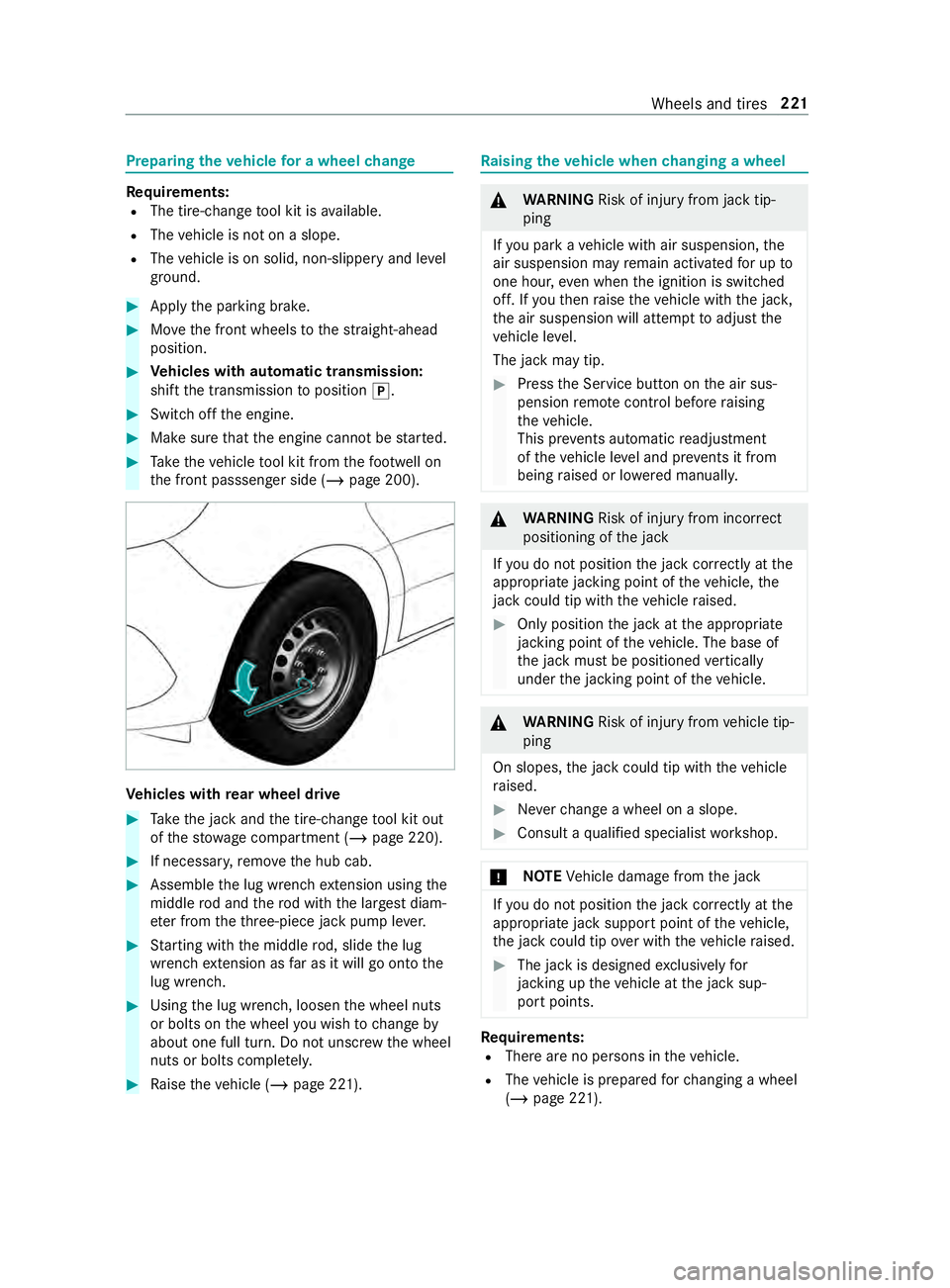
Preparing
thev ehicle foraw heelchange Re
quirements:
R The tire-chang etool kit is available.
R The vehicle is no tonaslope.
R The vehicle is on solid, non-slipper yand le vel
ground. #
Appl ythe parking brake. #
Movethef ront wheels tothes traight-ahead
position. #
Vehicles with automatic transmission:
shif tthe transmission toposition 005D. #
Switc hoffthee ngine. #
Mak esuret hat thee ngine cann otbe star ted. #
Take thev ehicle tool kit from thef ootwell on
th ef ront passsenger side (/ page200). Ve
hicles with rear wheel drive #
Take thej acka nd thet ire-chang etool kit out
of thes towa ge compartment (/ page220). #
If necessar y,remo vetheh ub cab. #
Assemble thel ug wrenc hextensio nusing the
middl erod and ther od wit hthe lar gest diam‐
et er from thet hree-piece jac kpum pleve r. #
Startin gwitht he middle rod, slide thel ug
wrenc hextensio nasfar as it will go ont othe
lug wrench. #
Using thel ug wrench, loosen thew heel nuts
or bolts on thew heel youw ish tochang eby
about one full turn. Do no tunscr ewthew heel
nuts or bolts comple tely. #
Raise thev ehicle (/ page221). Ra
ising thev ehicle when changing awheel &
WARNING Risk of inju ryfrom jac ktip‐
ping
If yo up arkav ehicle wit hair suspension, the
air suspension ma yremain acti vatedf or up to
one hour ,evenw hen thei gnition is switched
off. If yout hen raise thev ehicle wit hthe jac k,
th ea ir suspension will attem pttoadjus tthe
ve hicle le vel.
The jac kmaytip. #
Press theS ervice button on thea ir sus‐
pension remo tecontrol befor eraising
th ev ehicle.
This pr events au tomatic readjustment
of thev ehicle le vela nd pr events it from
being raised or lo weredm anually. &
WARNING Risk of inju ryfrom incor rect
positioning of thej ack
If yo udon otpositio nthe jac kcorrectl yatt he
appropriat ejackin gpointoft hevehicle, the
jac kc ould tip wi th thevehicle raised. #
Onlyposition thej ackatt he appropriate
jacking point of thev ehicle. The base of
th ej ackm ustbep ositioned vertically
under thej acking point of thev ehicle. &
WARNING Risk of inju ryfrom vehicle tip‐
ping
On slopes, thej ackc ould tip wit hthe vehicle
ra ised. #
Neverc hang eaw heel on aslope. #
Consult aqualified specialis tworks hop. *
NO
TEVehicle damag efromt he jack If
yo udon otpositio nthe jac kcorrectl yatt he
appropriat ejacks uppor tpoin toft hevehicle,
th ej ackc ould tip overwitht he vehicle raised. #
The jac kisdesigned exclusively for
jacking up thev ehicle at thej acks up‐
por tpoints. Re
quirements:
R Ther eareno persons in thev ehicle.
R The vehicle is prepared forc hanging awheel
(/ page221). Wheel
sand tires 221
Page 247 of 322
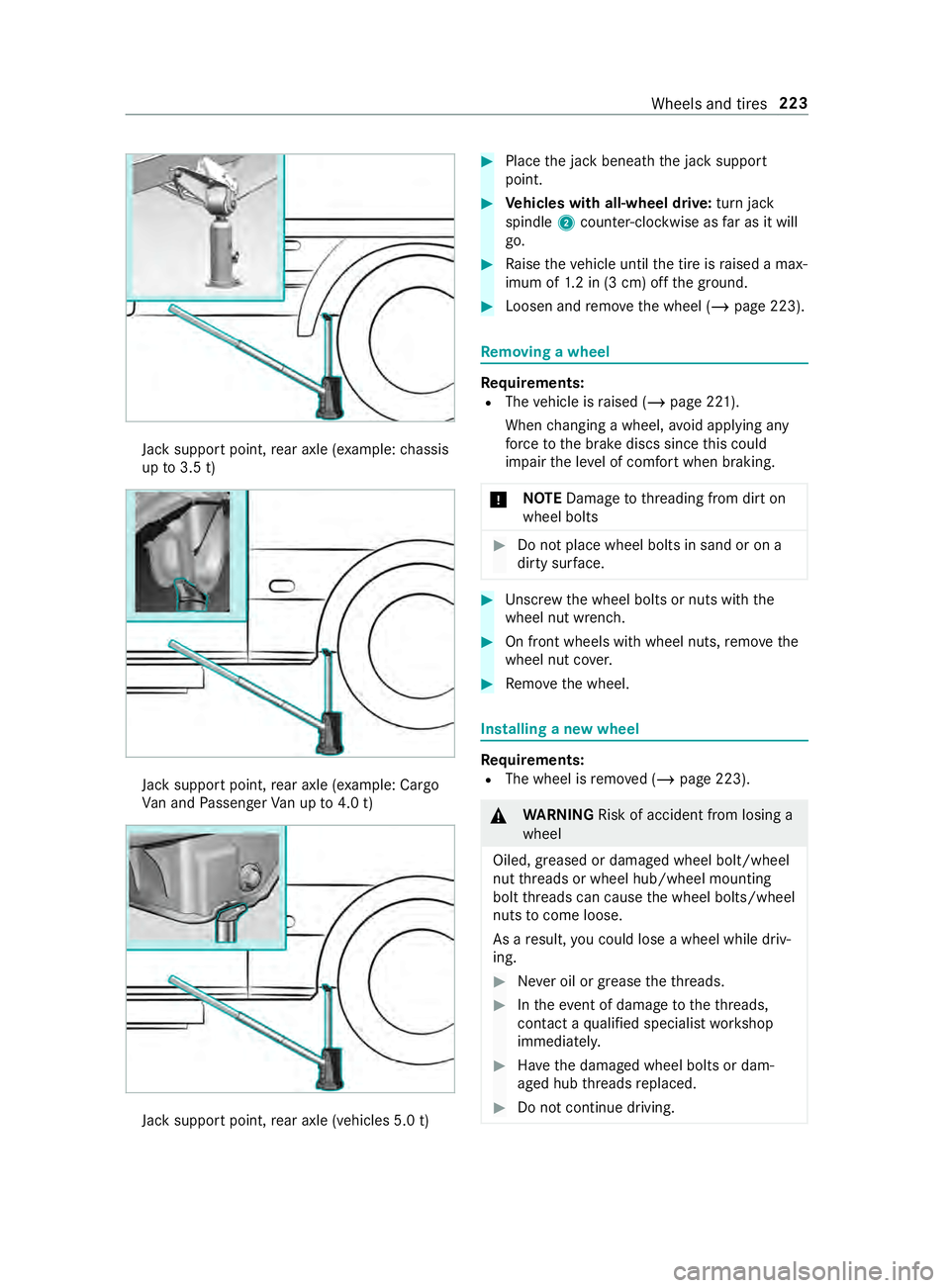
Jac
ksuppor tpoint, rear axle (e xamp le:chassis
up to3.5 t) Jack
suppor tpoint, rear axle (e xamp le: Cargo
Va na nd Passenger Vanu pto4 .0 t) Jack
suppor tpoint, rear axle (vehicles 5. 0t) #
Place thej ackb eneat hthe jac ksupport
point. #
Vehicles with all-wheel drive: turnjack
spindle 2counter-clockwise as farasitw ill
go. #
Raise thev ehicle until thet ireisr aised amax‐
imum of 1.2in(3c m) offthe ground. #
Loosen and remo vethew heel (/ page223). Re
moving awheel Re
quirements:
R The vehicle is raised (/ page221).
When changing awheel, avoid applying any
fo rc etot he brak ediscs since this could
impair thel eve lofc omfort when braking.
* NO
TEDama getothre ading from dir ton
wheel bolts #
Do no tplace wheel bolt sinsandorona
dirty sur face. #
Unscr ewthew heel bolts or nuts wit hthe
whee lnut wrench. #
On front wheels wit hwheel nuts, remo vethe
wheel nut co ver. #
Remo vethew heel. Installing
anew wheel Re
quirements:
R The wheel is remo ved( /pag e223). &
WARNING Risk of accident from losing a
wheel
Oiled, greased or damaged wheel bolt/wheel
nut thre ads or wheel hub/wheel mounting
bolt thre ads can cause thew heel bolts/wheel
nuts tocome loose.
As aresult, youc oul dlose awheel while driv‐
ing. #
Nevero il or grease thet hreads. #
Inthee vent of damag etothethre ads,
con tact aq ualified specialis tworks hop
immediatel y. #
Have thed amaged wheel bolts or dam‐
aged hub thre ads replaced. #
Do no tcontinue driving. Wheels and tires
223