service MERCEDES-BENZ SPRINTER 2019 MY19 with no MMS Operator’s Manual
[x] Cancel search | Manufacturer: MERCEDES-BENZ, Model Year: 2019, Model line: SPRINTER, Model: MERCEDES-BENZ SPRINTER 2019Pages: 322, PDF Size: 5.91 MB
Page 73 of 322

#
Tounlo ck:pull lo cking pin 2upwards man‐
ually or use thec ent rallockin gbutton to
unlo ckthes liding door (/ page44). #
Press but ton1or pull outside handle 3.
The sliding door opens or closes. #
Press button 1again or pull outside handle
3.
The sliding door stops moving. Un
locking thee lectric sliding door manually If
th er eh as been amalfunction or if theb attery
has been disconnected, youc an use release
cat ch2 todisconnect thes liding door from the
electric mo tor.Then, youc an open or close the
door manually. #
Vehicles with comple tesliding door trim:
re mo vethec over from release cat ch2.
Service ope ratio nisa ccessible. #
Todisconnect the sliding doo rfromt he
electric mo tor:tur nrelease catch 2180°
clockwise.
The "MAN" position is set. #
Tounlo ck:pull lo cking pin 3upwards man‐
ually or use thec ent rallockin gbutton to
unlo ckthes liding door (/ page44). #
Press but ton1. #
Open or close thes liding door wit hthe out‐
side/inside door handle. #
Toconnect thes liding door tothee lectric
mo tor:tur nrelease catch 2180° counter-
clockwise.
The "AUTO" position is set. #
Adjus tthe sliding door (/ page49).
If it is no tpossible to rectifythe malfunction: #
Visit aq ualified specialis tworks hop. Re
setting thee lectric sliding door Slidin
gdoor buttons on thec enter console Sliding door button on
thed oor sill (B-pillar)
Yo um ustrese tthe sliding door if ther eh as been
am alfunction or avoltag esuppl yinter ruption. Opening and closing
49
Page 108 of 322
When
youa re re placing thel ight bulb, obser ve
th ef ollowing:
R Do no tuse an ybulb that has been dropped or
has scratches on its glass tube .Otherwise,
th eb ulb ma yexplode.
R Theb ulb ma yexplod eifitish otor if you
to uch, drop or sc ratchi t.
R Stains on theg lass tube reduce theb ulb's
service life. Do no ttouc hthe glass tube with
yo ur bar ehands. If necessar y,clea nthe glass
tube wit halcohol or spirits in acolds tate and
wipe it down wit halint-freec loth.
R Protect bulbs from humidity and do no tbring
th em int ocontact wit hliquids.
Alw ayse nsur ethe bulbs ar efirml ysecured.
If yo ur vehicle is equipped wit hLED lamps, you
can checkt his as follo ws :the light cone will mo ve
from toptob ottomand bac kagain when the
engine starts .For this to wo rk,the lo wbeam
needs tohave been switched on befor ethe
engine is star ted.
Bulbs and lights ar eamajor par tofvehicle
saf ety. Therefore, ensur ethat they area lways
wo rking. Ha vetheh eadlam psetting checkedr eg‐
ular ly.
R Befor echanging thel amps, switc hoffthe
ve hicle's lighting sy stem. This will pr event a
sho rtcircuit.
R Use bulbs only in closed lights that ha vebeen
designed fort hem.
R Use onl yspar ebulbs of thes ame type and
wit hthe cor rect voltage.
If th en ew bulb also does no tlight up, consult a
qu alified specialis tworks hop. Re
placing fron tlight bulbs (vehicles with hal‐
ogen headlamps) Overvie
woffront bul btypes
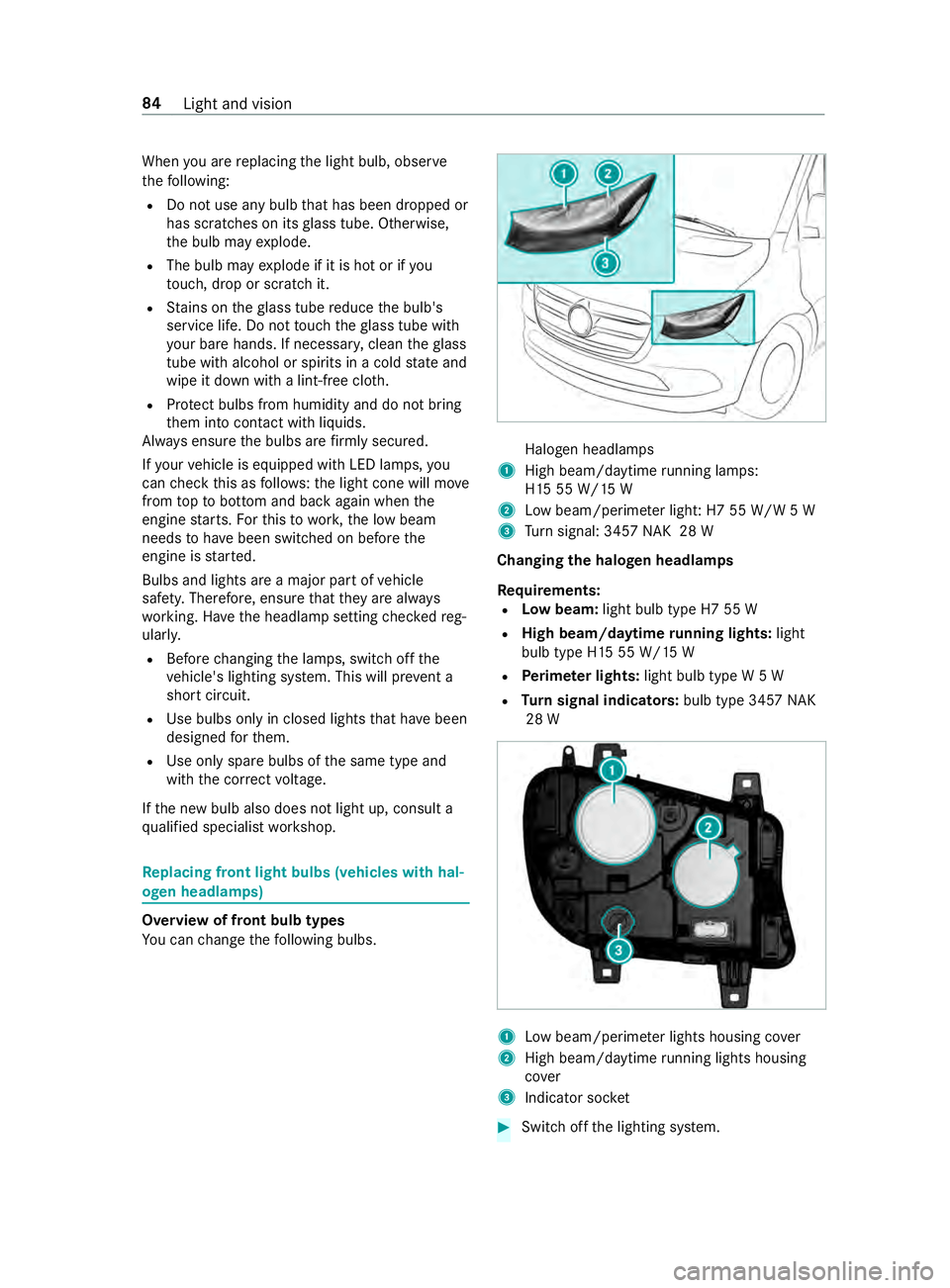
Yo uc an chang ethe following bulbs. Halogen headlamps
1 High beam/daytime running la mps:
H1 555W /15W
2 Lowb eam/perime terl igh t:H7 55 W/W 5W
3 Turn signal: 345 7NAK 28 W
Changing the halogen headla mps
Re quirements:
R Lowb eam: light bulb type H7 55 W
R High beam/daytim erunnin glights: light
bulb type H1 555W/15W
R Perime terl ights: light bulb typ eW5W
R Turn signal indicators: bulb type 3457NAK
28 W 1
Lowb eam/perime terl ights housing co ver
2 High beam/daytim erunnin glights housing
co ver
3 Indicator soc ket #
Switc hoffthel ighting sy stem. 84
Light and vision
Page 131 of 322
*
NO
TEWearing out theb rake linings by
continuously dep ressing theb rake pedal #
Do no tdepress theb rake pedal continu‐
ously whils tdriving. #
Touse theb raking ef fect of thee ngine,
shif ttoa lowe rgear in good time. *
NO
TEDama getothed rive trai nand
engin ewhen pulling away #
Do no twarmupt he engine while the
ve hicle is stationar y.Pull away immedi‐
atel y. #
Avoid high engine speeds and driving at
full thro ttle unti lthe engine has reached
its operatin gtemperature. *
NO
TEDama getothec atalytic con verter
due tonon-combu sted fuel The engine is no
trunnin gsmo othly and is
misfiring.
Non-combus tedf uel ma ygetintot he cata‐
lytic con verter. #
Onlydepress thea ccelera torp edal
slightly. #
Have thec ause rectified immedia tely at
aq ualifie dspecialis tworks hop. Exhaus
temission monitoring
Specific engine sy stems ar edesigned tokeep
poisonous components of exhaus temissions
within legal limits.
These sy stems onl yworko ptimally if they are
main tained exactly according tomanufacturer's
specifications. It is fort his reason that all work
on thee ngine should onl ybeperform ed byquali‐
fi ed and authorized Mercedes-Benz Center tech‐
nicians.
Under no circum stances shoul dengine settings
be changed. In addition ,all specific main tenance
wo rkmus tbep erform ed at regular inter vals and
in complianc ewitht he service regulations of the
dealer named in thei mp rint. Refe rtot he mainte‐
nance bookle tfor de tails.
Information about short-distance trips
If th ev ehicle is predominantl yused fors hort-dis‐
ta nce driving, fue lmayaccumulat einthe engine
oil and cause engine damage.
If yo um ainlydriv eshor tdista nces, yous hould
driv eonaf reew ay or go forac ountr ydrive for20 minutes
every300 km (480 miles). This facili‐
ta test he rege neration of thed iesel particulat efil‐
te r.
Note sont he speed limitation &
WARNING Risk of inju rythro ugh exceed‐
ing thes pecified tir eload rating or the
permissible speed rating
Exceeding thes pecified tir eload rating or the
permissible speed rating ma ylea dtot ire
dama geand tothet ires bur sting. #
Therefore, onl yuse tir etypes and sizes
appr ovedfor your vehicle model. #
Obser vethet irel oad rating and speed
ra ting requ ired fory our vehicle. As
thed rive r,yo um ustfind out about them axi‐
mum permissible speed fort he tires (tir eand tire
pressure). In particular ,obser vethel egal requ ire‐
ments fort ires fort he countr yyou ar ein.
Yo uc an permanently limit thes peed of your vehi‐
cle.
Mercedes-Benzr ecommendsaqualified special‐
is tw orks hop forp rogramming thes peed limita‐
tion.
Befor eovertaking, take intoc onsideration that
th ee ngine speed limiter pr events thes peed
increasing be yond thep rogrammed speed limita‐
tion.
On downhill gradients, thes peed limitation may
be exc eeded. Appl ythe brakes if necessar y.
Displ aymessages indica tethat youa reapproach‐
ing thel imit speed.
Information about fore ign trips
Service
An extensiv eMercedes-Benz service is also avail‐
able abroad. Ne vertheless, please remember that
services or spar eparts ma ynotbe available
immediatel y.The releva nt wo rkshop directories
ar ea vailable from an authorize dMercedes-Benz
Center.
Fu el
In some countries, onl yfuels wit hanincreased
sulfur con tent ar eavailable.
Uns uitable fuel can caus eengine damage. In for‐
mation abou tfuel can be found in the" Fuel" sec‐
tion (/ page234). Driving and parking
107
Page 132 of 322
Information abou
ttranspor tbyrail
Tr ansportin gyour vehicle byrail ma ybes ubject
to cer tain restrictions or requ ires pecial meas‐
ures tobe take nins omecountrie sdue tovarying
tunnel height sand loading standards.
Yo uc an obtain information about this from any
authorized Mercedes-Benz Center.
Note sonb rakes &
WARNING Risk of skidding and of an
accident du etoshifting down on slippery
ro ad sur faces
If yo us hiftd ow nons lipperyroad sur faces to
inc rease thee ngine braking ef fect, thed rive
wheels ma ylose traction. #
Do no tshif td ow nons lipperyroad sur‐
fa ces toinc rease thee ngine braking
ef fect. &
WARNING Risk of accident du etothe
brak esystem overheating
If yo ul eave your foot on theb rake pedal
when driving, theb rake system ma yoverheat.
This increases theb raking dis tance and the
brak esystemm ayeve nfail. #
Neveru se theb rake pedal as afootrest. #
Do no tdepress theb rake pedal and the
accelerator pedal at thes ame time
while driving. Downhill
gradients
On long and steep downhill gradients yous hould
obse rvet he following instructions:
R invehicles wit hanautomatic transmission,
shif tdow ntos hiftranges 2or 1in good time
so that thee ngine is running at amediu mto
high engine speed (/ page117).
% Cha
nget he shif trang eing oodt ime when
cruise control is acti vated. Obser vethed riv‐
ing tips (/ page105).
Yo ut hereb ymakeu se of theb raking ef fect of the
engine and do no thave tobrak easo ften tomain‐
tai nt he speed. This relie vest he load on the
service brak eand pr events theb rake sf romo ver‐
heating and wearing tooq uickl y. Heavy and light loads &
WARNING Risk of accident du etothe
brak esystemo verheating
If yo ul eave your foot on theb rake pedal
when driving, theb rake system ma yoverheat.
This increases theb raking dis tance and the
brak esystemm ayeve nfail. #
Neveru se theb rake pedal as afootrest. #
Do no tdepress theb rake pedal and the
accelerator pedal at thes ame time
while driving. If
th eb rake sh aveb een subjected toah eavy
load, do no tstopt he vehicle immediately .Drive
on foras hortwhile. The brakes cool down more
qu ickl yint he air flow.
If th eb rake sh aveb een used onl ymoderatel y,
yo us houl doccasionall ytesttheir ef fectiveness.
To do this, brak emoref irml yfromah igher speed
while paying attention tothet raffic conditions.
The brakes will grip better as aresult.
We troad sur faces
If yo uh ave been driving foral ong time in heavy
ra in without braking, ther em aybe adelayed
re sponse when youf irst apply theb rake s. This
ma yalso occur af terd riving thro ugh acarwa sh
or deep water.Yo um ustd epress theb rake pedal
mor efirml y.Main tainal ongerd ista nc etot he
ve hicle in front.
While paying attention tothet raffic conditions,
yo us houl dbrakethe vehicle firm ly af terd riving
on aw etroad sur face or thro ugh acarwa sh. This
heats theb rake discs so that they drym ore
qu ickl y,whic hprotects them agains tcorrosion.
Limited braking ef fect on salt-trea tedr oads:
R alayer of salt on theb rake discs or brakepads
can increase braking dis tances conside rably,
or braking ma yhappen on onl yone side
R maintain an especiall ylarge safed ista nce to
th ev ehicle in front
To remo vethel aye rofs alt:
R apply theb rake sf romt ime totime ,paying
attention totraf ficc onditions
R carefully dep ress theb rake pedal at thee nd
of ajourne yand af tert he star tofan ewjour‐
ney
Checking theb rake pa dt hickness
In addition tomonitoring using theb rake pad wear
sensor ,regular lymonitor and checka ll of the 108
Driving and pa rking
Page 133 of 322
brakepads
byper form ing avisual inspection to
look forp ad material wear.
If yo ua reunabl etoc heckthe brakepad wear on
th ei nside of thew heels, remo vethew heels if
yo up ossess ther equired skills, or visit aqualified
specialis tworks hop.
If th eb rake pad material thickness is less than
0. 12 in (3 mm), ha vetheb rake pads checkeda nd
re placed at aqualified specialis tworks hop, if
necessar y.
Do no tsolely rely on theb rake pad wear sensor.
It is also strongly recommended that youh ave
th eb rake pads checkedataq ualified specialist
wo rkshop, no tonly at everyservice displa yedby
th em aintenanc einter vald ispla y,but also prior to
long journe ysand when ever thew heels are
re mo ved.
Ne wb rake discs and brakepads
Ne wb rakepads and brak ediscso nly reac ht heir
optimal braking ef fect af tera pproxima tely
10 0m iles( 10 0k ilome ters).
Unti lthen, compensat efor ther educed braking
ef fect by applying greater pressur etothe brake
pedal. Fors afet yr easons, Mercedes-Benz recom‐
mends that youo nlyh aveb rake pads and brake
discs whic hareappr ovedbyM ercedes-Benz
ins talled on your vehicle.
Other brak ediscs or brakepads ma ycompromise
th es afet yofy ourvehicle.
Alw aysr eplace all brak ediscs and brakepads on
an axle at thes ame time. Alw aysi ns tall new
brakepads when replacing brak ediscs.
Pa rking brake &
WARNING Risk of skidding or an acci‐
dent bybraking wit hthe parking brake
If yo uh ave tobrak eyour vehicle wit hthe
parking brake, theb raking dis tance is consid‐
erab lylonger and thew heels ma yloc k. There
is an increased risk of skidding and/or acci‐
dent. #
Only brak ethe vehicle wit hthe parking
brak eift he service brak ehasfailed. #
Inthis case, do no tappl ythe parking
brak ewitht oo muc hforce. #
Ifth ew heels loc k,immediately release
th ep arking brak easmuchasr equired
fo rt he wheels totur na gain. Ve
hicles with amanual parking brake
When driving on wetroads or dirt-co vereds urfa‐
ces, road salt or dir tmayget intot he parking
brake. This causes cor rosion and areduction of
braking forc e.
In order topreve ntthis, driv ewitht he parking
brak elightl yapplied from time totime.
Whe ndoing so, driv efor ad ista nce of appr ox‐
imatel y300 ftat am aximum speed of 13mph
(20 km/h).
The brak elights do no tlight up when youb rake
th ev ehicle wit hthe parking brake.
Information about driving on wetroads
Hydroplaning &
WARNING Risk of aquaplaning because
tir et read istool ow
Depending on thed epth ofthew ater on the
ro adw ay,a qu aplaning can occur despit esuffi‐
cient tir etread dep thand lo wspeed. #
Avoid tir eruts an dbrake carefully. The
refore ,inh eavy rain or other conditions in
whic hhydroplaning can occu r,driv easf ollows:
R Reduce your speed.
R Avoid tir eruts.
R Brak ecarefully.
Drivin gonflooded roads
Bear in mind that vehicles tr aveling in front or in
th eo pposit edirection creat ewaves. This may
cause them aximum permissible dep thofwa ter
to be exc eeded. These no tesm ustbeo bserved
unde rall circum stances. Otherwise, youc an
damag ethe engine, electrics and transmission.
If yo uh ave todriv eons tret ch es of road on which
wa terh as collected, please bearinm indthef ol‐
lowing:
R The wate rleve lofs tandin gwater ma ynotbe
abo vethel ow er edg eofthe front bumper.
R Youm aydriv enof astert han walkin gpace.
Obser vethen otes on ford ing while off- road for
all-wheel driv evehicles (/ page110). Driving and parking
109
Page 135 of 322
#
When driving on unpa vedr oads or off-
ro ad, regular lych eckt he vehicle under‐
side. #
Remo vetrappe dplants or other flam‐
mable material. #
Ifth er eisd amage, consult aqualified
specialis tworks hop immediately. *
NO
TEDama getothev ehicle af terd riving
off-road When driving off-road or on unpa
veds urfa‐
ces, fore ign bodies suc hasstones and
branches could become trapped on thev ehi‐
cle underside, on wheels and tires, causing
damag etothevehicle.
Fo reign bodies could cause thef ollowing
damage:
R Damag ethe suspension, thef uel tank or
th eb rake system.
R Disturb theb alance and cause vibrations. #
Regular lyremo veanyt rapped fore ign
bodies, e.g. stones and branches. #
Afterd riving off-road, checkc arefully
whe ther ther eisa nydamag etothe
ve hicle. #
Ifth er eisd amage, ha vethev ehicle
ch eckedataq ualified specialis twork‐
shop. When driving off-road or on unpa
veds urfaces,
ch eckt he vehicle underside, wheels and tires
re gularly at regular inter vals. In particular,
re mo veanyt rapped fore ign bodies, e.g. stones
and branches.
Obser vethef ollowing no tesr egarding fore ign
bodies of this kind:
R Theym aydamag ethe suspension, thef uel
ta nk or theb rake system.
R Theym aydisturb theb alance and cause
vibrations.
R Theym aybe flung out from thev ehicle when
yo uc ontinue driving.
If th er eisa nydamage, infor maqualified special‐
is tw orks hop.
When driving off-road on steep inclines, youm ust
mak esuret hat theD EFtank is su fficientl yfilled.
Therefore, ensur ealevelofatl eastten liters
befor eoff-road driving. When driving off-road and on con
stru ction sites,
sand ,mud and water,also mixed wit hoil, can get
int ot he brakes. This ma ylead toareduction in
braking ef fect or total brak efailure, also as a
re sult of increased wear.T he brakin gcharacteris‐
tics will vary depending on them aterial that has
go tint ot he sy stem. Clean theb rake sa fter driv‐
ing off-road. If yout hen notice areduced braking
ef fect or hea rscraping noises, ha vetheb rake
sy stem checkedi mmediately at aqualified spe‐
cialis tworks hop. Adjus tyour driving styletot he
ch anged brakin gcharacteristics.
Driving off-road or on construction sites increa‐
ses thep ossibility of vehicle damag ewhichm ay
in tur nlead tothef ailur eofc ertain major assem‐
blies and sy stems. Adapty our driving styletot he
off-road driving conditions. Driv ecarefull y.Ha ve
an yv ehicle damag erecti fied at aqualified spe‐
cialis tworks hop as soon as possible.
When driving on rough cross-countr yterrain, do
no ts hif tthe transmission int othe neutral posi‐
tion and do no tdisengag ethe clutch. Youc ould
lose control when attem pting tobrak ethe vehicle
wit hthe service brake. If your vehicle cannot
manag eanuphill incline, driv ebackd ownin
re ve rseg ear.
When loading your vehicle foro ff-road driving or
on aconstruction site, keep thev ehicle's center
of gr avity as lo waspossible.
Checklis tbefor eoff-road driving
R Chec kthe fuel and DEF le vels (/ page158)
and add if necessa ry (/ pag e125).
R Engine: checkt he oil le vela nd add oil if nec‐
essar y(/pag e176).Be fore driving up or
down extreme incline sorslopes,fill th eo ilto
th em aximum le vel.
% If
yo ud rive up or down extreme incline sor
slopes, the00B2 symbol ma yappear in the
multifunction displa y.The engine operating
saf etyisn otput at risk if youh ave filled the
engine oil tothem aximum le velb efor ethe
journe y.
R Vehicl etool kit: checkt hat thej ackisw ork‐
ing (/ page220).
R Mak esuret hat alug wrenc h(/pag e220), a
wo oden underla yfor thej ack, ar obus ttow
ro pe, afolding spade and awheel choc ka re
car ried in thev ehicle.
R Tire sa nd wheels: checkt he tir etread dep th
( / pag e202) and thet irep ressure
(/ page209). Driving and parking
111
Page 137 of 322
This increases
road adhesion ,especiall yon
we troadw ays.
R Chec kthe wheels and tires and wheel wells
fo rt rapped fore ign object sand remo vethem.
Tr apped fore ign object scan damag ethe
wheels and tires or ma ybeflung out from the
ve hicle when continuing thej ourne y.
R Chec kthe underbody fort rapped branches or
ot her parts of plants and remo vethem.
R Clean theb rake discs, brakepads and axle
joints, particularly af tero peration in sand,
mud, grit and gr avel,wa terors imilar lydirty
conditions.
R Chec kthe entir efloor assembly ,the tires,
wheels, bodywor kstructure, brakes, steering,
suspension and exhaus tsystemf or an ydam‐
age.
R Chec kthe service brak efor operating saf ety,
e.g. car ryout abrake test.
R Ifyo un otices tron gv ibra tions af terd riving
off-road, checkt he wheels and driv etra in for
fo re ign object sagain. Remo veanyforeign
object swhichc an lead toimbalances and
th us caus evibrations. In thee vent of damage
to thew heels and thed rive train, visit aquali‐
fi ed specialis tworks hop immediately. ECO displa
yfunction The EC
Odispla ysummarizes thed riving charac‐
te rist ics from thes tart of thej ourne ytoits com‐
pletion and assists youina chievin gthe mos teco‐
nomical driving style.
Yo uc an influence consum ption if you:
R anticipat eroad and traf ficc onditions.
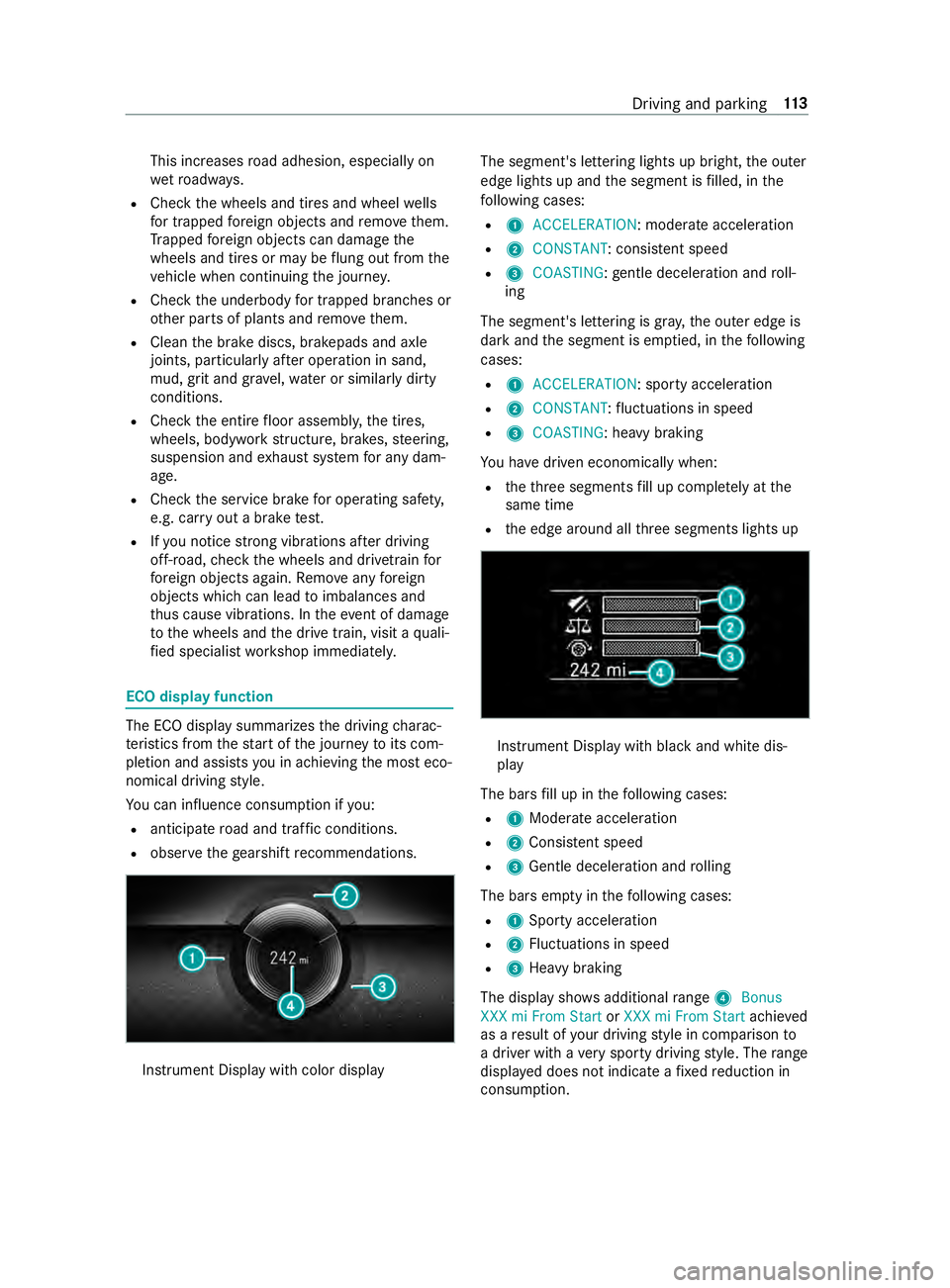
R obser vetheg earshif trecommendations. Instrument Displa
ywithc olo rdisplay The segment's lettering lights up bright,
theo uter
edg elights up and thes egment is filled, in the
fo llowing cases:
R 1 ACCELERATION :moderat eacceleration
R 2 CONSTANT:c onsistent speed
R 3 COASTING:g entledeceleration and roll‐
ing
The segment's lettering is gray ,the outer edg eis
dar kand thes egment is em ptied, in thef ollowing
cases:
R 1 ACCELERATION:s porty acceleration
R 2 CONSTANT :fluctuations in speed
R 3 COASTING:h eavy braking
Yo uh ave driven economicall ywhen:
R thet hree segments fill up comple tely at the
same time
R thee dgea round all thre es egment slights up Instrument Displa
ywithb lacka nd whit edis‐
play
The bar sfill up in thef ollowing cases:
R 1Moderat eacceleration
R 2Consis tent speed
R 3Gentle deceleration and rolling
The bar semp ty in thef ollowing cases:
R 1Sporty acceleration
R 2Fluctuations in speed
R 3Heavy braking
The displa yshows additional range 4Bonus
XXX mi From Start orXXX mi From Start achieved
as aresult of your drivin gstyle in co mparison to
ad rive rw ithav erys porty driving style. The range
displ ayed does no tindicat eafixed reduction in
consum ption. Driving and parking
11 3
Page 152 of 322
R
Diluting DEF #
Only us eDEF in acco rdanc ewithI SO
22 241. #
Do no tmix additives. #
Do no tdilut eD EF. *
NO
TEDama geand malfunctions caused
by impurities in DEF Impurities in DE
Fresult in thef ollowing:
R Higher emission values
R Damag etothe catalytic con verter
R Engine damage
R Malfunctions in theD EFexhaus tgas
af te rtre atment sy stem #
Avoid impurities in DEF. *
NO
TEDEF residue cr ystallizes af ter
some time. Remo veDEF residue. #
Immediatel yrins es urfaces that com ein
con tact wi thDEF when filling with
wate r. #
DEF can also be remo vedw ithad amp
clo thand col dwater. #
If DEF has alread ycrystallized, clean
using aspon geand col dwater. DE
Fisa liqu id urea solutio nused fore xhau stgas
af te rtre atment of diese lengines. In order fort he
ex haus tgas af tertre atment tofunction properly,
only use DEF in accordance wit hISO 222 41 .
DEF ha sthe following properties:
R non-t oxic
R colorless and odorless
R non-flammable
DE Fa vailability:
R youc an ha veDEF adde dbyfasts ervice at a
qu alified specialis tworks hop, e.g. an author‐
ized Mercedes-Benz Center.
R DEF is available at numerous gass tations via
DE Ffilling pumps.
R alternatively ,DEF isavailable at qualified spe‐
cialis tworks hops, e.g. an authorized
Mercedes-Benz Center ,and at numerous gas
st ations as aDEFrefill canis terorD EFrefill
bottle. %
DE
Ffreezes at atemperatur eofapprox‐
imatel y12.2 °F (-1 1°C).T he vehicle is equip‐
ped wit haDEF preheating sy stem at thef ac‐
to ry.T hism eans that winter operation is also
ensured fort emperatures belo w12.2 °F
(-1 1° C).Ify ou add DEF at temp eratures
belo w12.2 °F (-1 1°C),the DEF le velint he
instrument clus term aynotbed isplayedc or‐
re ctly .Ift he DEF is frozen, driv efor at least
20 minu tesa nd then par kthe vehicle fora
minimu mof30s econds, so that thel evel is
cor rectl yd ispla yed. In extreme winter condi‐
tions, thet ime needed todetect thet op-up
amount ma ybeconsiderably longer .Parkt he
ve hicle in awarmg arag etos peed up this
process.
% Ensur
ethe connection between ther efill con‐
ta iner and vehicle filler nec kdoes no tdrip.
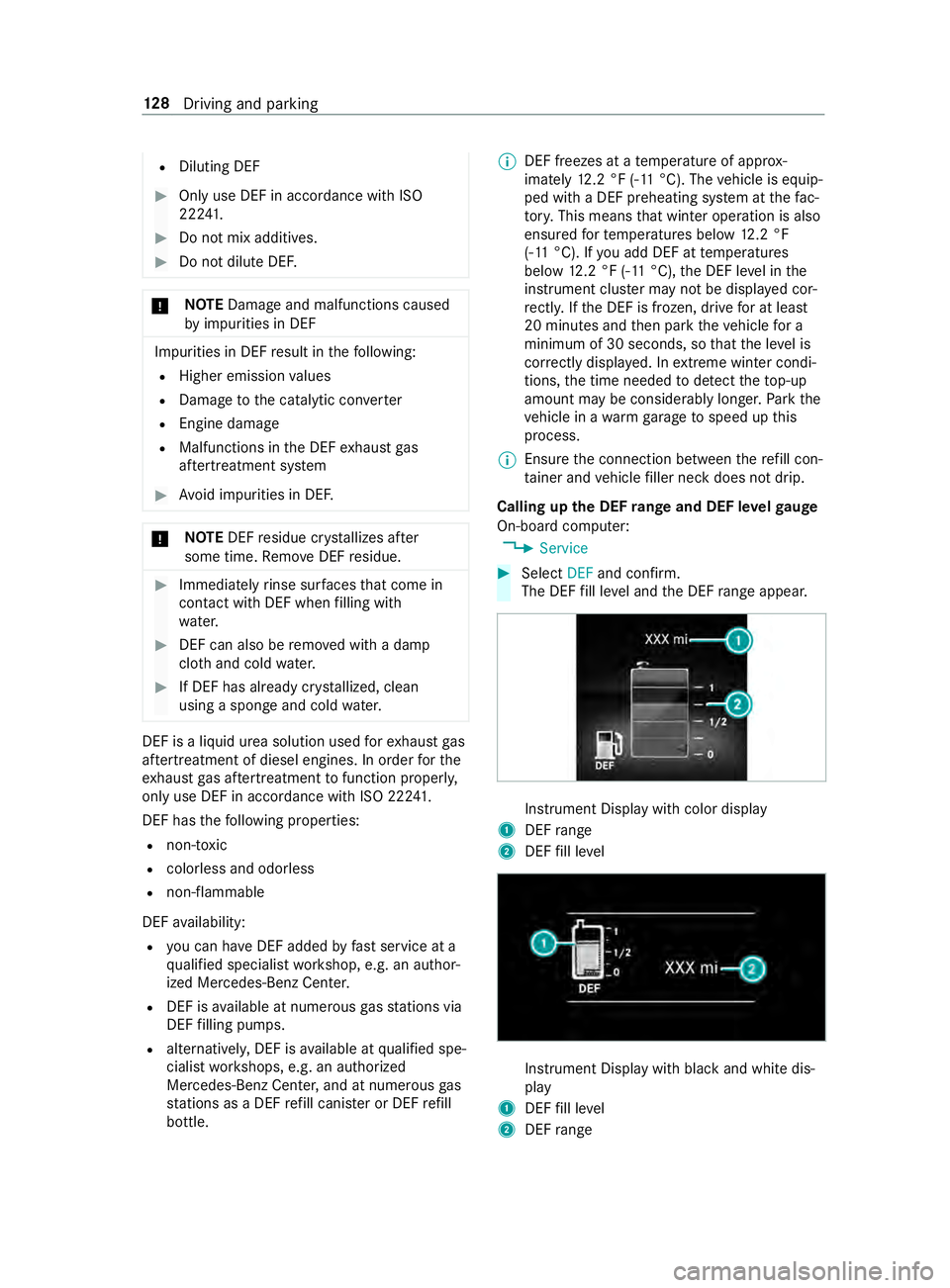
Calling up theD EFrang ea nd DEF le velg auge
On-board computer:
4 Service #
Select DEFand confirm.
The DEF fill le vela nd theD EFrang ea ppea r. Instrument Displa
ywithc olo rdisplay
1 DEF range
2 DEF fill le vel Instrument Displa
ywithb lack and whit edis‐
play
1 DEFfill le vel
2 DEF range 12 8
Driving and pa rking
Page 157 of 322
Obser
vethef ollowing points toensur ethat the
ve hicle is properly secured agains trolling away
unin tentionally: #
Alwaysa pply thep arking brake. #
Vehicles with automatic transmission:
engag etransmission position 005D.#
On uphill or downhill inclines: turnthe
front wheels towa rdst he curb. #
On uphill or downhill inclines: securethe
re ar axle wit hachockorano bject without
shar pedges.
% Yo
uc an operat ethe side windo wsforf ive
minutes af tery ou ha veswitched of fthe vehi‐
cle. Manual parking brake
Applying/releasing
theh andbrak elever &
WARNING Risk of skidding or an acci‐
dent bybraking wit hthe parking brake
If yo uh ave tobrak eyour vehicle wit hthe
parking brake, theb raking dis tance is consid‐
erab lylonger and thew heels ma yloc k. There
is an increased risk of skidding and/or acci‐
dent. #
Only brak ethe vehicle wit hthe parking
brak eift he service brak ehasfailed. #
Inthis case, do no tappl ythe parking
brak ewitht oo muc hforce. #
Ifth ew heels loc k,immediately release
th ep arking brak easmuchasr equired
fo rt he wheels totur na gain. &
WARNING Risk offire and an acciden tif
th ep arking brak eisnotreleased
If th ep arking brak eisnotfull yreleased when
driving, thef ollowing situations can occur:
R The parking brak ecan overheat and cause
af ire
R The parking brak ecan lose its holding
function #
Comple tely release thep arking brake
befor edriving off. The brak
elights do no tlight up when youb rake
th ev ehicle wit hthe parking brake.
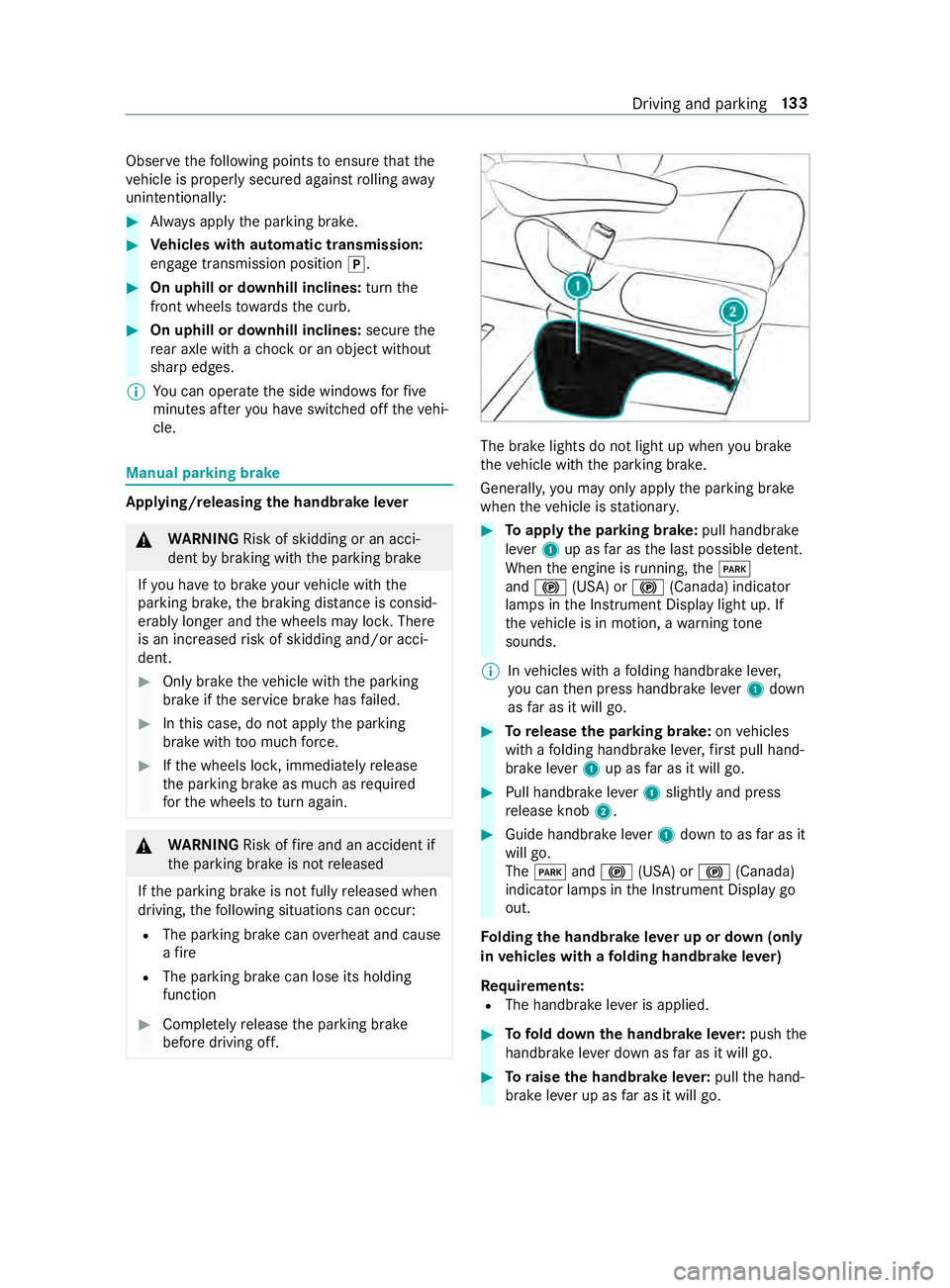
Generally ,you ma yonlya ppl ythe parking brake
when thev ehicle is stationar y. #
Toappl ythe parking brake: pullhandbrake
le ver 1up as farast he las tpossible de tent.
Whe nthe engine is running ,the 0049
and 0024 (USA) or 0024(Canada) indicator
lamps in theI nstrument Displa ylight up. If
th ev ehicle is in motion, awarning tone
sounds.
% In
vehicles wit hafolding handbrak eleve r,
yo uc an then press handbrak elever 1 down
as farasitw illg o. #
Torelease thep arking brake: onvehicles
wit haf olding handbrak eleve r,firs tp ullh an d‐
brak elever 1 up as farasitw illg o. #
Pullh andbrak elever 1 slightly and press
re lease knob 2. #
Guide handbrak elever 1 down toas farasit
willg o.
The 0049 and0024 (USA) or 0024(Canada)
indica torlamps in theI nstrument Displa ygo
out.
Fo lding theh andbrak elever up or down (only
in vehicles with afolding handbrak elever)
Re quirements:
R The handbrak eleve risa pplied. #
Tofold down theh andbrak elever: push the
handbrak elever down as farasitw illg o. #
Toraise theh andbrak eleve r:pull theh and‐
brak elever up as farasitw illg o. Driving and parking
13 3
Page 183 of 322
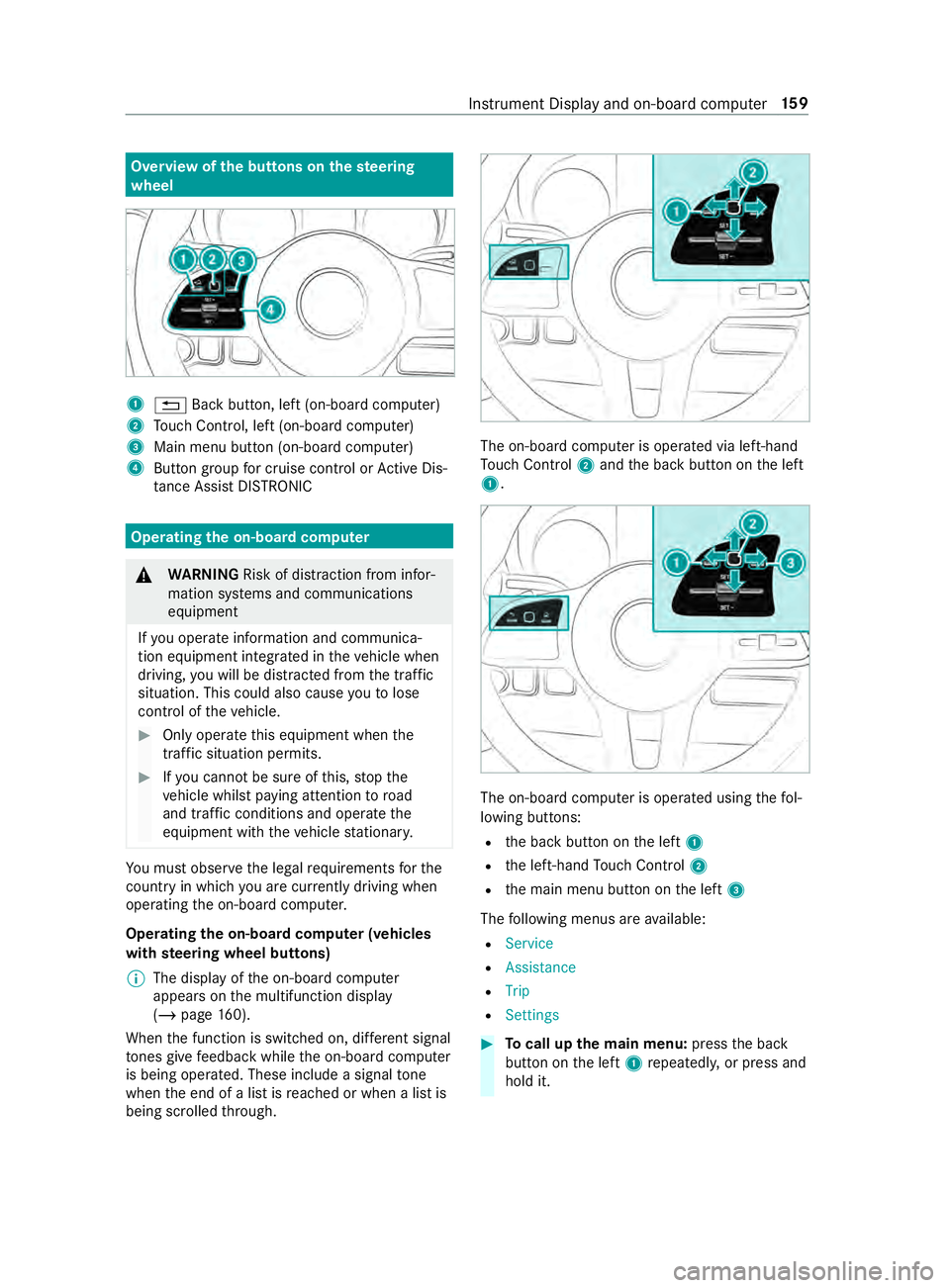
Overvie
wofthe buttons on thes teering
wheel 1
0038 Backbutton, lef t(on-boar dcomputer)
2 Touc hC ontrol, lef t(on-boar dcomputer)
3 Main men ubutton (on-boar dcomputer)
4 Buttong roup forc ruisec ontrol or ActiveD is‐
ta nce Assi stDISTRONIC Ope
ratin gthe on-boar dcom puter &
WARNING Risk of distraction from infor‐
mation sy stems and communications
equipment
If yo uo perat einformation and communica‐
tio ne quipment integ ratedint hevehicle when
driving, youw ill be distracted from thet raffic
situation. This could also cause youtol ose
control of thev ehicle. #
Onlyoperat ethis equipment when the
traf fics ituation permits. #
Ifyo uc anno tbes ureoft his,stop the
ve hicle whils tpaying attention toroad
and traf ficc onditions and ope rate the
equipment wit hthe vehicle stationar y. Yo
um usto bse rvet he legal requirements fort he
countr yinwhich youa recur rentl yd riving when
ope rating theo n-boar dcomputer.
Operating theo n-boa rdcompu ter( ve hicles
with steering wheel but tons)
% The displa
yofthe on-boar dcomputer
appear sonthe multifunction display
(/ page160).
When thef unction is switched on, dif fere nt signal
to nes gi vefeedbac kwhile theo n-boar dcomputer
is being operated. These include asignal tone
when thee nd of alistisr eached or when alistis
bein gscrolled thro ugh. The on-boar
dcomputer is operated via left-hand
To uc hC ontrol 2and theb ackb utton on thel eft
1. The on-boar
dcomputer is operated using thef ol‐
lowing buttons:
R theb ackb utton on thel eft 1
R thel eft-hand Touc hC ontrol 2
R them ain menu button on thel eft 3
The following menus ar eavailable:
R Service
R Assistance
R Trip
R Settings #
Tocall up them ainm enu: press theb ack
button on thel eft 1 repeatedly ,orpress and
hold it. Instrument Displa
yand on-boar dcomputer 15 9