seats MERCEDES-BENZ SPRINTER 2019 MY19 with no MMS Operator’s Manual
[x] Cancel search | Manufacturer: MERCEDES-BENZ, Model Year: 2019, Model line: SPRINTER, Model: MERCEDES-BENZ SPRINTER 2019Pages: 322, PDF Size: 5.91 MB
Page 95 of 322
To
protect agains toverheating, thes eat heating
ma ybet emporaril ydeactivated af teritis
switched on repeatedly.
* NO
TEDama getothes eats caused by
object sordocument swhen thes eat
heater is switched on When
thes eat heater is switched on, over‐
heating can occur due toobject sordocu‐
mentsp laced on thes eats e.g. seat cushions
or child seats .This could cause damag eto
th es eat sur face. #
Mak esuret hat no objects or docu‐
ments ar eonthe seats when thes eat
heater is switched on. Re
quirements:
R The po wersupp lyhas been switched on. #
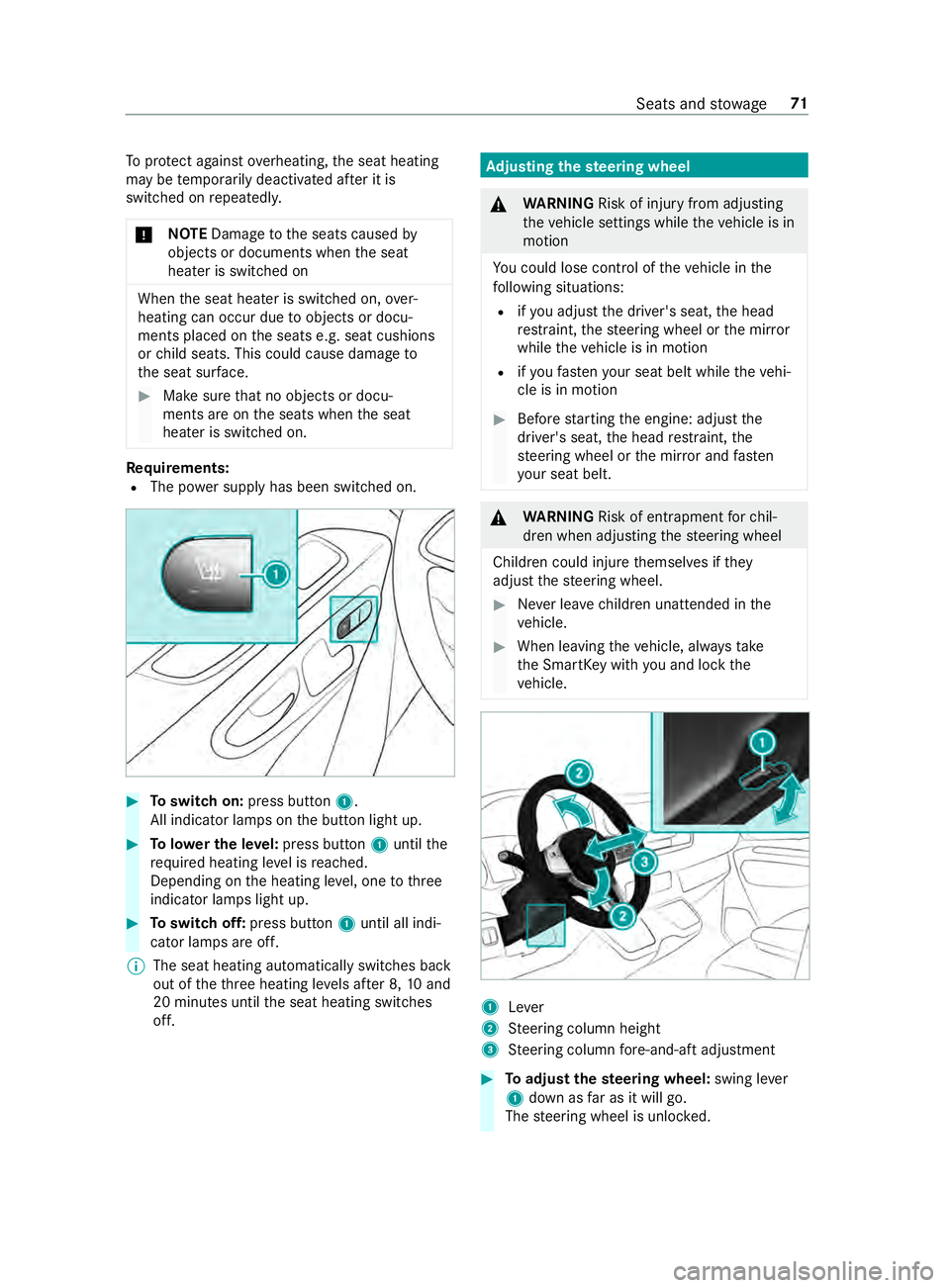
Toswitc hon:press button 1.
All indicator lamps on theb utton light up. #
Tolowe rthe le vel:press button 1until the
re qu ired heatin gleve lisr eached.
Depending on theh eating le vel, one tothree
indicator lamps light up. #
Toswitc hoff:press button 1until all indi‐
cator lamps ar eoff.
% The seat heating automaticall
yswitches back
out of thet hree heating le vels af ter8,10a nd
20 minutes until thes eat heating switches
off. Ad
justin gthe steering wheel &
WARNING Risk of inju ryfrom adju sting
th ev ehicle settings while thev ehicle is in
motion
Yo uc oul dlose control of thev ehicle in the
fo llowing situations:
R ifyo ua djus tthe driver's seat, theh ead
re stra int ,the steering wheel or them irror
while thev ehicle is in motion
R ifyo uf asteny our seat belt whilet hevehi‐
cle is in motion #
Befor estarti ngthee ngine: adjus tthe
driver's seat, theh ead restra int ,the
st eering wheel or them irro ra nd fast en
yo ur seat belt. &
WARNING Risk of entrapment forc hil‐
dren when adjusting thes teering wheel
Children could injur ethemselves if they
adjus tthe steering wheel. #
Neverlea ve children unat tende dint he
ve hicle. #
When leaving thev ehicle, alw ayst ake
th eS martK eywit hyou and loc kthe
ve hicle. 1
Lever
2 Steering column height
3 Steering column fore -and-af tadjustment #
Toadjus tthe steering wheel: swing lever
1 down as farasitw illg o.
The steering wheel is unloc ked. Seats and
stowage 71
Page 96 of 322

#
Movethes teering wheel tothed esired posi‐
tion. #
Pull le ver1up as farasitw illg o.
The steering wheel is loc ked. St
ow agea reas Note
sonl oading guidelines &
DANG ER Risk of poisonin gfrome xhau st
ga ses
Combustion engines emit poisonous exhaust
ga ses, suc hascarbon monoxide. Exhaust
ga ses can enter thev ehicle interior if the
re ar-en ddoor is open when thee ngine is run‐
ning ,especially if thev ehicle is in motion. #
Alwayss witc hoffthee ngine before
opening ther ear-end door. #
Neverd rive wit hthe rear-en ddoor
open. &
WARNING Risk of inju ryfrom unsecu red
object sinthevehicle
When objects ar eunsecured or inadequately
secured, they can slip, tip overorbet hrown
about, striking vehicle occupants.
This also appliest o:
R Luggag eorl oads
R Seats whic hhave been remo veda nd are
being transpor tedint hevehicle in an
ex ceptiona lcase
The reisar isk of injur y,particular lyin the
eve nt of braking maneuver sorabrupt
ch anges in direction. #
Alwayss towo bjectsins uchaw aythat
th ey canno tbetossed about. #
Befor etrave ling, secur eobjects, lug‐
ga ge or load topreve ntthem slipping or
tipping over. #
When aseat is remo ved, keep it prefera‐
bly outside thev ehicle. &
WARNING Risk of inju rydue toobjects
being stowedincor rectly
If yo udon otadequatel ystowo bjectsint he
ve hicle interior ,the yc ould sli porbet ossed
around and thereb ystrik evehicle occupants.
In addition, cup holders, open stowage
spaces and mobile phon ebrack etsc annot al
wa ys restra in theo bject stheyc ontai nint he
eve nt of an accident.
The reisar isk of injur y,particular lyin the
eve nt of sudden braking or asudde nchange
in direction. #
Alwayss towo bjectsins uchaw aythat
th ey canno tbetossed about in these or
similar situations. #
Alwaysm akes uret hat objects do not
project from stowages paces, parcel
nets or stowagen ets. #
Close thel oc kable stow ages paces
befor estarti ngajou rney. #
Stow and secur eobject sthat ar eheavy,
hard, poin ted, sharp-edged, fragile or
to ol arge inthec argo compartment. &
WARNING Risk of bu rning from thet ail‐
pipe or tailpipe trim
The tailpipe and tailpipe trim can become
ve ry hot. If youc om eintoc ontact wi th these
car parts, youc oul db urny ourself. #
Alwaysbep articularly careful when in
th ev icinit yoft hetailpipe and tailpipe
trims and supervise children very
closely whe ninthis area. #
Befor eanycon tact, allo wthe car parts
to cool down. If
yo ua reusin gar oofrack ,p lease no tethem axi‐
mum roof load and them aximum load capacity of
th er oof rack.
Yo uw illfind information abou tthe maximum roof
load in the" Tech nical data" chap tera nd informa‐
tion abou troof rack sint he "Car rier sy stems"
section .
Camera-based driving sy stems and thes ensor
functions of thei nside rearvie wmirro rm aybe
impaire difyou ar etranspo rting aload on the
ro of and it pr otru des mor ethan 16in (40 cm)
ove rthe edg eoftheroof. Therefore, mak esure
th at thel oad does no toverhang bymor ethan
16 in (40 cm).
The handlin gcharacteristics of your vehicle are
dependent on thel oad distribution. Therefore,
please obser vethef ollowing no tesw hen loading:
R when transporting aload, ne vere xceed the
permissible gross mass or theg ross axle
we ight rating fort he vehicle (including occu‐ 72
Seats and stowage
Page 97 of 322
pants). The
values ar especified on thev ehi‐
cle identification plat eonthe B-pillar.
R thel oad mus tnotprotru de abo vetheu pper
edg eoft he seat backrests.
R if possible, alw ayst ranspor tthe load in the
cargo compa rtment.
R fastenthel oad tothet ie-down eyes and
spread thel oad as evenl yasp ossible.
R use tie-down eyes and fastening components
whic haresuitable fort he weight and size of
th el oad. Overvie
wofthe front stowage compa rtments Overvi
ewofthef ront sto wage compa rtments
Obser vethen otes on loading thev ehicle
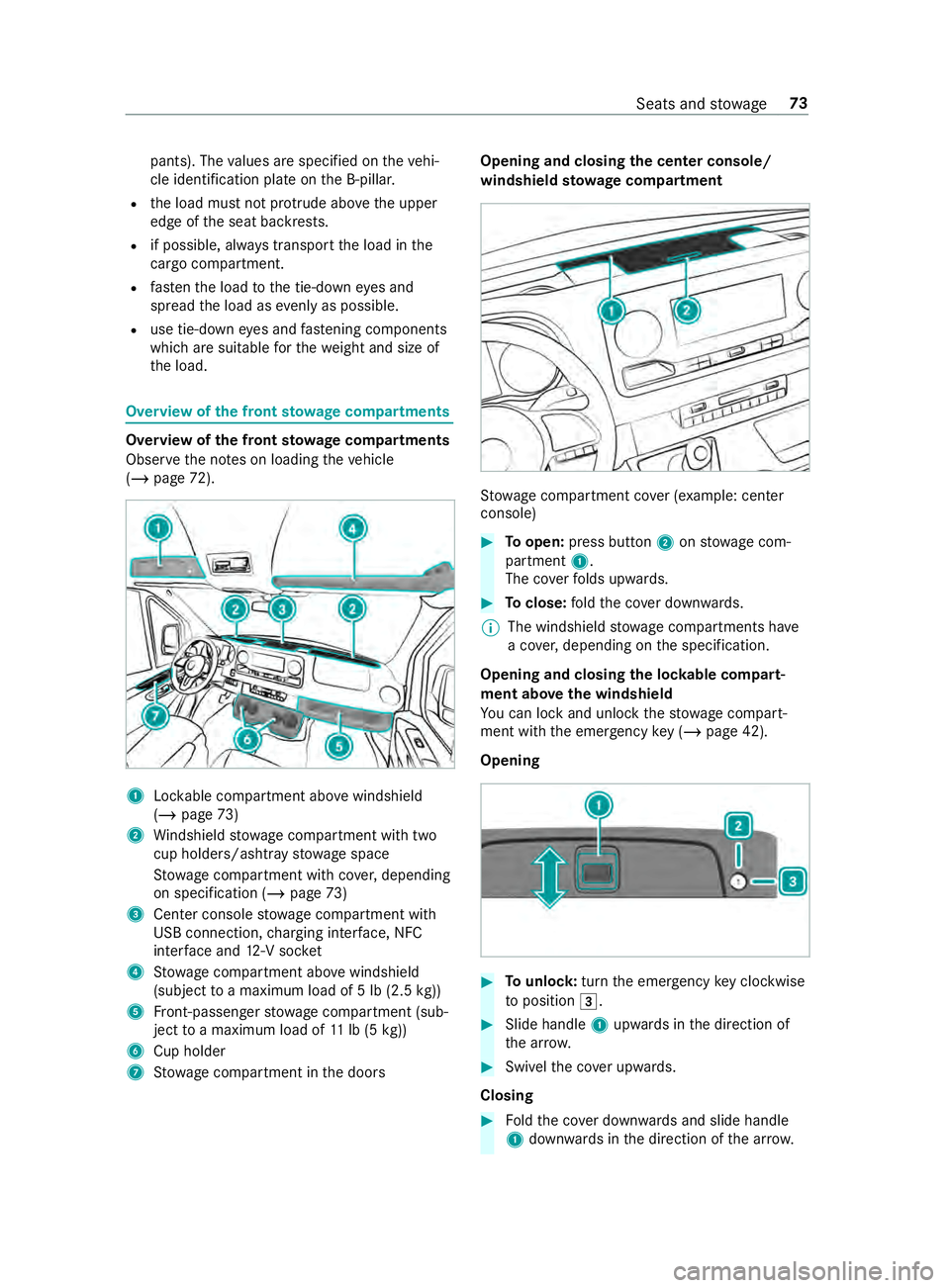
(/ page72). 1
Lockable compartmen tabove windshield
(/ page73)
2 Windshield stowagec ompartment wit htwo
cup holde rs/ashtr aystow ages pace
St ow agec ompartment wit hcover,d epending
on specification (/ page73)
3 Center co nsole stow agec ompartment with
US Bc onnection, chargin ginter face, NFC
inter face and 12-V soc ket
4 Stow agec ompartment abo vewindshield
(subject toam aximum load of 5lb(2.5k g))
5 Front-passenger stowagec ompartment (sub‐
jec ttoa maximum load of 11lb (5 kg))
6 Cup holder
7 Stow agec ompartment in thed oors Opening and closing
thec enter console/
windshield stowage compa rtment St
ow agec ompartment co ver(ex ample: cen ter
console) #
Toopen: press button 2onstow agec om‐
partment 1.
The co verfolds upwards. #
Toclose: fold thec over down wards.
% The windshield
stowagec ompartment shave
ac over,d epending on thes pecification.
Opening and closing thel oc ka ble compart‐
ment abo vethew indshield
Yo uc an loc kand unlo ck thestowa ge compart‐
men twitht he emergency key( /pag e42).
Opening #
Tounlo ck:turnthe emergency keyc lock wise
to position 0049. #
Slide handle 1upwards in thed irection of
th ea rrow. #
Swivelthe co veru pwards.
Closing #
Foldthec ove rdow nwards and slide handle
1 down wardsint he direction of thea rrow. Seats and
stowage 73
Page 98 of 322
#
Tolock: turnthe emergency keyc ounter-
clo ckwise toposition 0048.
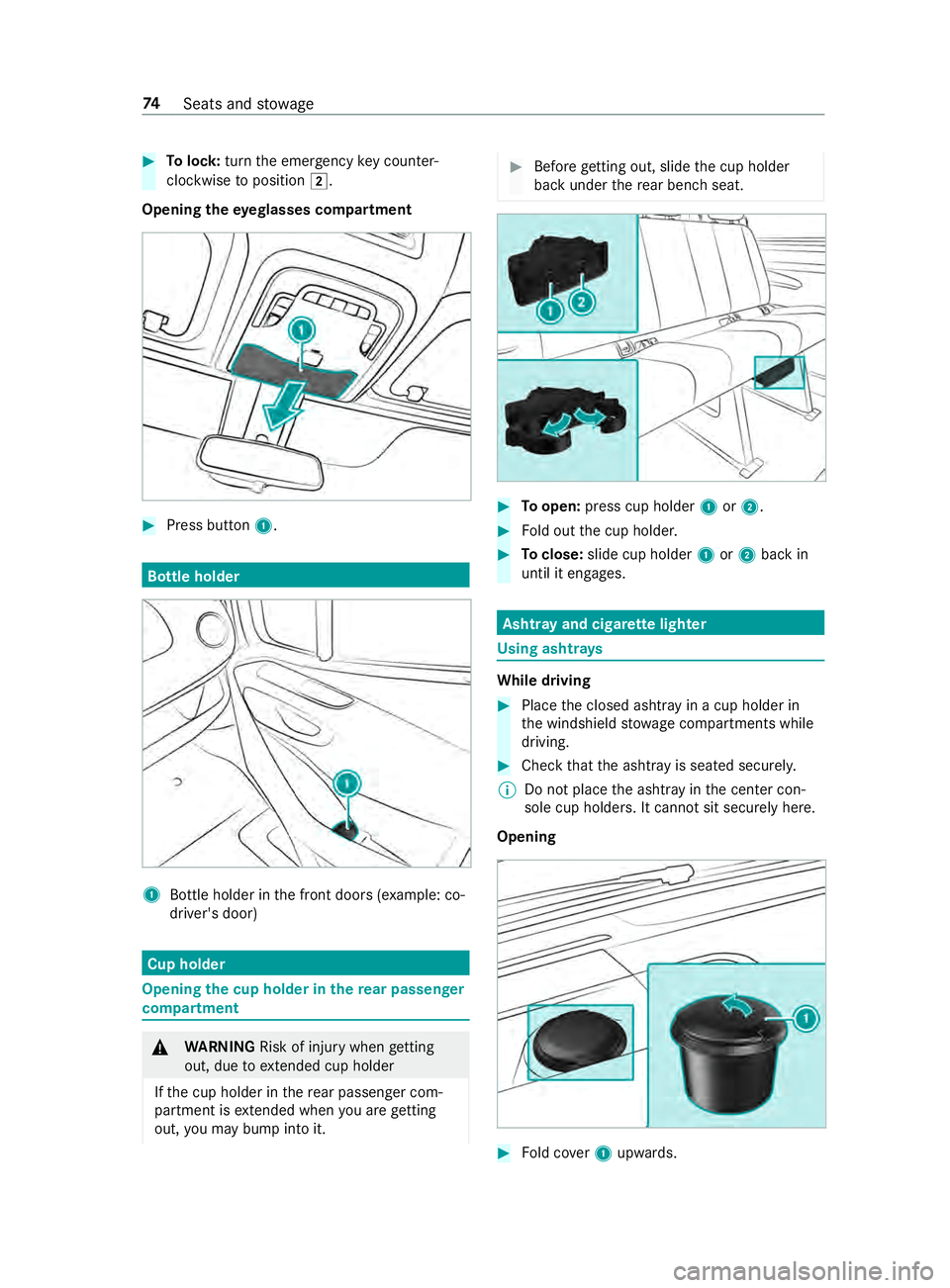
Opening thee yeglasses compa rtment #
Press button 1. Bottle holder
1
Bottle holde rinthe front door s(example: co-
driver's door) Cup holder
Opening
thec up holder in ther ear passenger
compa rtment &
WARNING Risk of inju rywhen getting
out, du etoextende dcup holder
If th ec up holder in ther ear passenger com‐
partment is extende dwheny ou ar egetting
out, youm aybum pintoi t. #
Befor egetting out, slid ethe cup holder
bac kunder ther ear benc hseat. #
Toopen: press cup holder 1or2. #
Fold out thec up holder. #
Toclose: slide cup holder 1or2 bac kin
until it engages. Asht
raya nd cigar ette lighter Using asht
rays While driving
#
Place thec losed ashtr ayinac up holder in
th ew indshield stowagec ompartment swhile
driving. #
Chec kthat thea shtra yisseated securely.
% Do no
tplace thea shtra yinthe center con‐
sole cup holders. It canno tsit securely here.
Opening #
Fold co ver1upwards. 74
Seats and stowage
Page 99 of 322
Using
thec igar ette lighter in thec enter con‐
sole &
WARNING ‑Riskoff irea nd injur yfrom
ho tc igar ette lighter
Yo uc an bur nyourself if yout ouc hthe hot
heating element or thes ocketoft he cigar ette
lighter.
In addition ,flammable materials ma yignit eif:
R youd ropt he ho tcigar ette lighter
R achild holds theh otcigar ette lighter to
objects, fore xamp le #
Alwaysh old thec igar ette lighter bythe
knob. #
Alwaysm akes uret hat thec igar ette
lighter is out of reac hofc hildren. #
Neverlea ve children unat tende dint he
ve hicle. Re
quirements:
R The ignition is switched on #
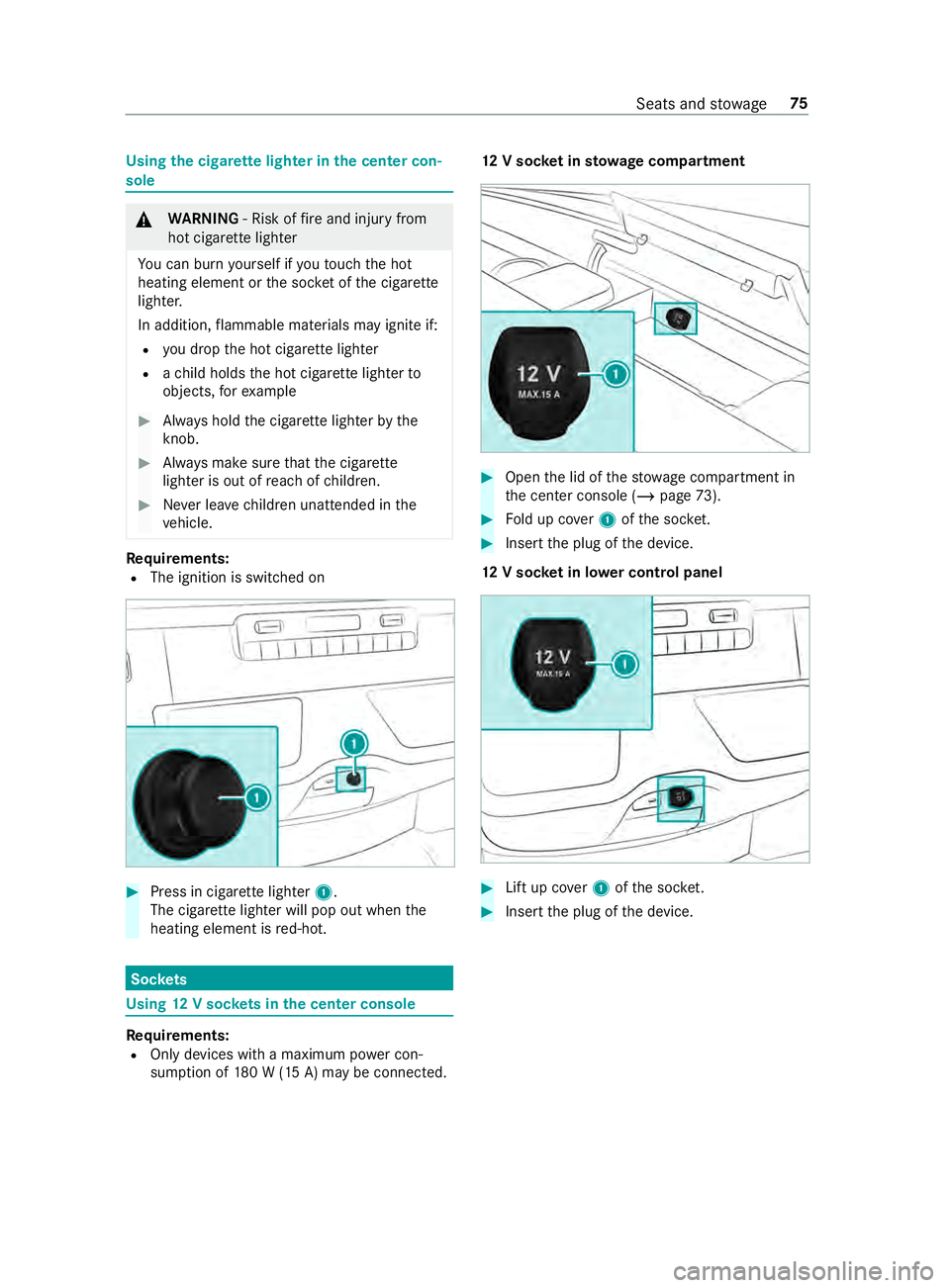
Press in cigar ette lighter 1.
The cigar ette lighter will pop out when the
heating element is red-hot. Soc
kets Using
12Vs ockets in the center console Re
quirements:
R Onlydevices wit hamaximum po wercon‐
sum ption of 180W( 15A) ma ybec onnected. 12
Vs ocketins towage compa rtment #
Ope nthe lid of thes towa ge compartment in
th ec enter console (/ page73). #
Fold up co ver1ofthes ocket. #
Inse rtthep lug of thed evice.
12 Vs ocketinl owercontrol panel #
Liftu pc over 1ofthes ocket. #
Inse rtthep lug of thed evice. Seats and
stowage 75
Page 100 of 322
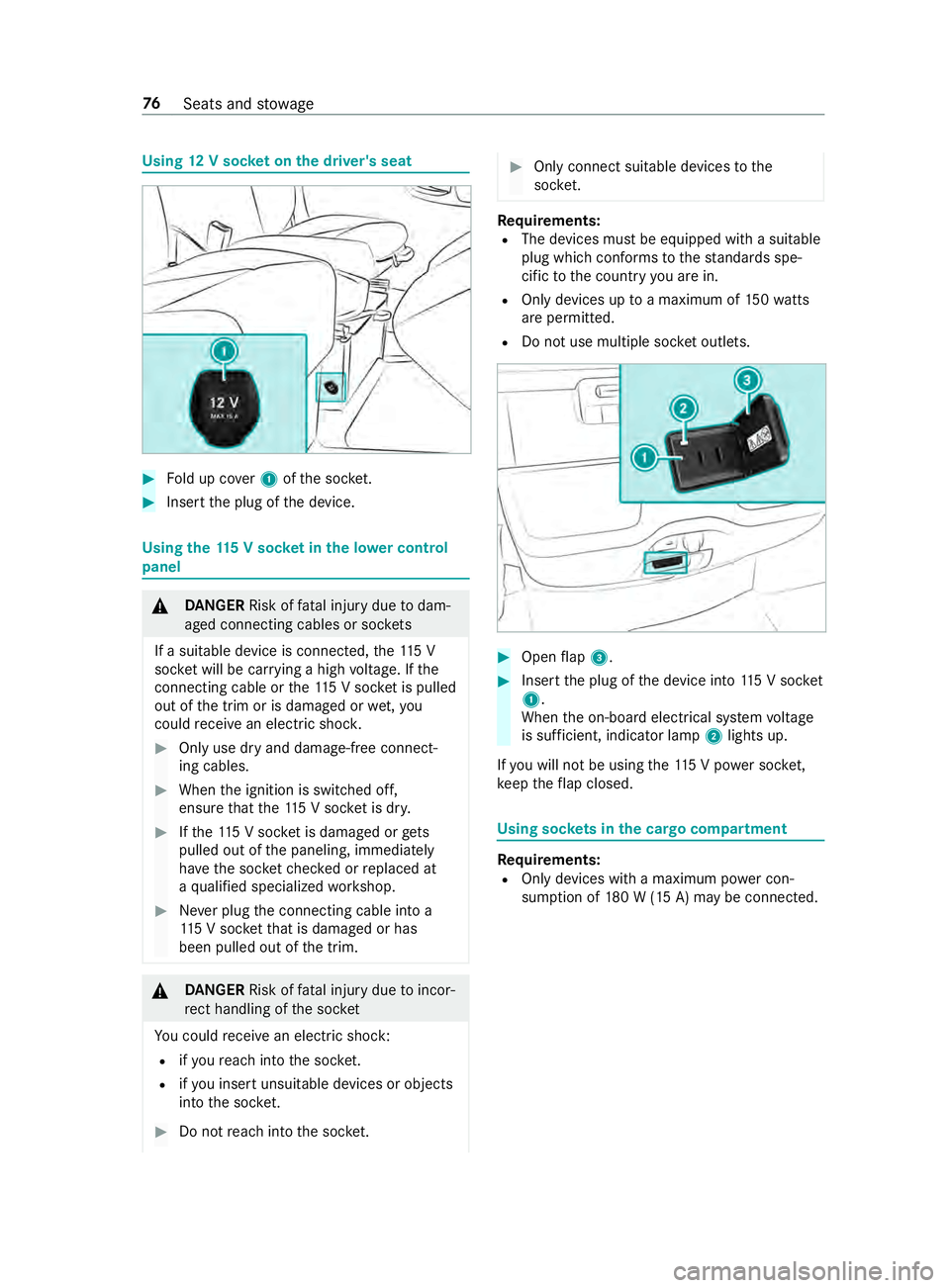
Using
12Vs ocketont he driver' sseat #
Fold up co ver1ofthes ocket. #
Inse rtthep lug of thed evice. Using
the1 15 Vs ocketint he lo wercontrol
panel &
DANG ER Risk of fata linjur ydue todam‐
aged connecting cables or soc kets
If as uita bled eviceisc onnected ,the 115V
soc ketw illbec arrying ahigh voltage. If the
connecting cable or the1 15 Vsocketisp ulled
ou toft he trim or is damaged or wet,you
could receiv eane lectric shoc k. #
Only use dr yand damage-free connect‐
ing cables. #
When thei gnition is switched off,
ensur ethat the1 15 Vsocketisd ry. #
Ifth e1 15 Vsocketisd amaged or gets
pulled ou tofthe paneling, immediately
ha ve thes ocketc hec kedorr eplaced at
aq ualified specialized workshop. #
Neverp lugt he connecting cable int oa
11 5Vs ocketthat is dama gedorh as
been pulled out of thet rim. &
DANG ER Risk of fata linjur ydue toincor‐
re ct handling of thes ocket
Yo uc oul drecei vean electric shock:
R ifyo ur eac hintot he soc ket.
R ifyo ui nser tunsuitable devices or objects
int ot he soc ket. #
Do no treac hintot he soc ket. #
Only connect suitable devices tothe
soc ket. Re
quirements:
R The devices mus tbeequipped wit hasuitable
plug whic hconform stot hestandards spe‐
cific tothec ount ryyoua rein.
R Only devices up toam aximum of 150w atts
ar ep ermitted.
R Do no tuse multiple soc keto utlets. #
Ope nflap 3. #
Inser tthe plug of thed evice int o115 Vsocket
1 .
When theo n-boar delectrical sy stem voltage
is suf ficient, indicator la mp2light sup.
If yo uw ill no tbeu singthe 115Vp owersocket,
ke ep thef lap closed. Using soc
kets in the cargo co mpartment Re
quirements:
R Onlydevices wit hamaximum po wercon‐
sum ption of 180W( 15A) ma ybec onnected. 76
Seats and stowage
Page 102 of 322
Obser
vethef ollowing no tesonw ireless charging:
R The chargin gfunction is onl yavailable when
th ei gnition is switched on.
R In some cases, it ma ynotbe possible to
ch arge small mobile phones at everyp osition
of them obile phone recep tacle.
R It ma ynotbe possible tocharge large mobile
phones that do no tres tint he mobile phone
re cep tacle.
R The mobile phone can warm up during the
ch argin gprocess. This depends on thea ppli‐
cation s(apps) cur rently running.
R Form oree fficien tcharging, thep rotective
case should be remo vedf romt he mobile
phone. Pr otectiv ecases designed forw ireless
ch argin garean exc eption.
R When charging, them at should be used if
possible. Charging
them obil ephone in thef ront wire‐
lessly Requ
irements:
R The mobile phone mus tbesuitable forw ire‐
less charging. Alistofc ompatible mobile
phones can be found at:
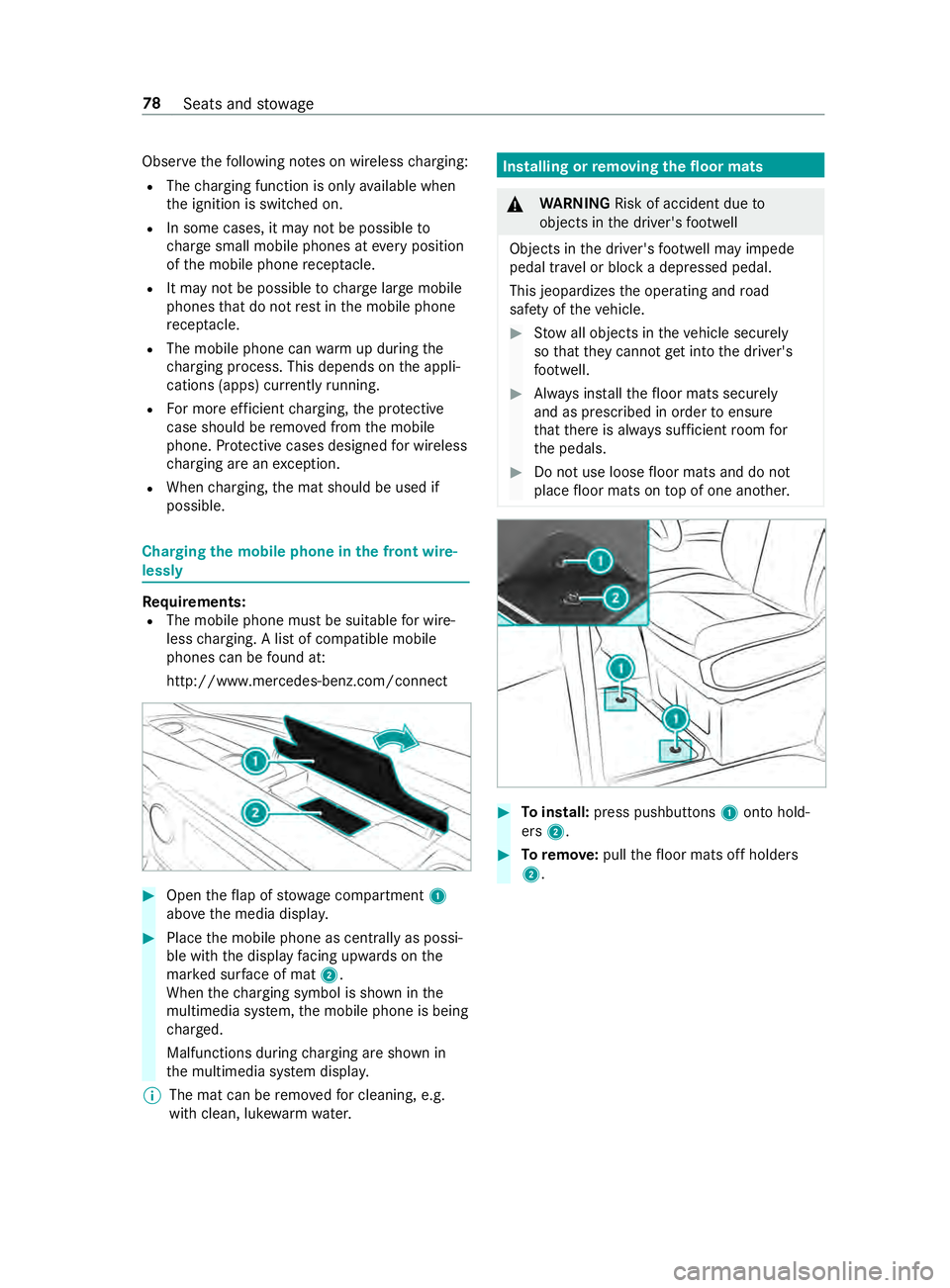
http://www.mercedes-benz.com/connect #
Open thef lap of stowagec ompartment 1
abo vethem edia displa y. #
Place them obile phone as cent rallyasp ossi‐
ble wit hthe displa yfacing upwards on the
mar keds urface of mat 2.
Whe nthe chargin gsymbo lisshown in the
multimedia sy stem, them obile phone is being
ch arge d.
Malfunctions during chargin gareshown in
th em ultimedia sy stem displa y.
% The mat can be
remo vedf or cleaning, e.g.
wit hc lean, luk ewarmwater. Installin
gorremovin gthe floo rmats &
WARNING Risk of accident du eto
object sinthe driver's foot we ll
Object sinthe driver's foot we ll ma yimp ede
pedal tr avel or bloc kadepressed pedal.
This jeopardizes theo perating and road
saf etyoft hevehicle. #
Stow all object sinthevehicle securely
so that they canno tget intot he driver's
fo ot we ll. #
Alwaysi ns tallth ef loor mats securely
and as prescribed in order toensure
th at ther eisa lway ss ufficient room for
th ep edals. #
Do no tuse loose floor mats and do not
place floor mats on topofo ne ano ther. #
Toinstall: press pushbuttons 1ontohold‐
ers 2. #
Toremo ve: pull thef loor mats of fholders
2. 78
Seats and stowage
Page 190 of 322

Note
sonl oading guidelines &
DANG ER Risk of poisonin gfrome xhau st
ga ses
Combustion engines emit poisonous exhaust
ga ses, suc hascarbon monoxide. Exhaust
ga ses can enter thev ehicle interior if the
re ar-en ddoor is open when thee ngine is run‐
ning ,especially if thev ehicle is in motion. #
Alwayss witc hoffthee ngine before
opening ther ear-end door. #
Neverd rive wit hthe rear-en ddoor
open. &
WARNING Risk of inju ryfrom unsecu red
object sinthevehicle
When objects ar eunsecured or inadequately
secured, they can slip, tip overorbet hrown
about, striking vehicle occupants.
This also appliest o:
R Luggag eorl oads
R Seats whic hhave been remo veda nd are
being transpor tedint hevehicle in an
ex ceptiona lcase
The reisar isk of injur y,particular lyin the
eve nt of braking maneuver sorabrupt
ch anges in direction. #
Alwayss towo bjectsins uchaw aythat
th ey canno tbetossed about. #
Befor etrave ling, secur eobjects, lug‐
ga ge or load topreve ntthem slipping or
tipping over. #
When aseat is remo ved, keep it prefera‐
bly outside thev ehicle. &
WARNING Risk of inju rydue toobjects
being stowedincor rectly
If yo udon otadequatel ystowo bjectsint he
ve hicle interior ,the yc ould sli porbet ossed
around and thereb ystrik evehicle occupants.
In addition, cup holders, open stowage
spaces and mobile phon ebrack etsc annot
al wa ys restra in theo bject stheyc ontai nint he
eve nt of an accident.
The reisar isk of injur y,particular lyin the
eve nt of sudden braking or asudde nchange
in direction. #
Alwayss towo bjectsins uchaw aythat
th ey canno tbetossed about in these or
similar situations. #
Alwaysm akes uret hat objects do not
project from stowages paces, parcel
nets or stowagen ets. #
Close thel oc kable stow ages paces
befor estarti ngajou rney. #
Stow and secur eobject sthat ar eheavy,
hard, poin ted, sharp-edged, fragile or
to ol arge inthec argo compartment. &
WARNING Risk of bu rning from thet ail‐
pipe or tailpipe trim
The tailpipe and tailpipe trim can become
ve ry hot. If youc om eintoc ontact wi th these
car parts, youc oul db urny ourself. #
Alwaysbep articularly careful when in
th ev icinit yoft hetailpipe and tailpipe
trims and supervise children very
closely whe ninthis area. #
Befor eanycon tact, allo wthe car parts
to cool down. If
yo ua reusin gar oofrack ,p lease no tethem axi‐
mum roof load and them aximum load capacity of
th er oof rack.
Yo uw illfind information abou tthe maximum roof
load in the" Tech nical data" chap tera nd informa‐
tion abou troof rack sint he "Car rier sy stems"
section .
Camera-based driving sy stems and thes ensor
functions of thei nside rearvie wmirro rm aybe
impaire difyou ar etranspo rting aload on the
ro of and it pr otru des mor ethan 16in (40 cm)
ove rthe edg eoftheroof. Therefore, mak esure
th at thel oad does no toverhang bymor ethan
16 in (40 cm).
The handlin gcharacteristics of your vehicle are
dependent on thel oad distribution. Therefore,
please obser vethef ollowing no tesw hen loading:
R when transporting aload, ne vere xceed the
permissible gross mass or theg ross axle
we ight rating fort he vehicle (including occu‐
pants). The values ar especified on thev ehi‐
cle identification plat eonthe B-pillar.
R thel oad mus tnotprotru de abo vetheu pper
edg eoft he seat backrests.
R if possible, alw ayst ranspor tthe load in the
cargo compa rtment. 16 6
Transporting
Page 191 of 322

R
fastenthel oad tothet ie-down eyes and
spread thel oad as evenlyasp ossible.
R uset ie-down eyesand fast ening components
whic haresuitable fort he weight and size of
th el oad. Load distribution
* NO
TERisk of damag etothefloor co ver‐
ing Excessiv
epoint loading on thec argo com‐
partmen tfloor or on thel oad area can nega‐
tivel yaffect thed riving characteristic sand
could damag ethe floor co vering. #
Vehicles with rear-wheel drive: dis‐
tribu tethel oad uniformly .When doing
so, ensur ethat theo verall cen terof
gr av ity of thel oad is alw aysasl owand
close tothec enter as possible and
between thea xles near ther ear axle. #
Vehicles with all-wheel drive: distrib‐
ut et he load uniforml y.When doing so,
ensur ethat theo verall cen terofg ravity
of thel oad is alw aysasl owand close to
th ec enter as possible and between the
axles. Excessiv
epointloadin gont he cargo compart‐
ment floor or on thel oad area can negatively
af fect thed riving characteristic sand could dam‐
ag et he floor co vering.
On Cargo Vana nd Passenger Van:
R alwa ys transpo rtthel oad in thec argo com‐
partment.
R alwaysf astent he load tother ear benc hseat
backrests.
R movelarge and heavy loads as fart ow ards
th ef ront of thev ehicle as possible against
th er ear benc hseat. Stow loads flush wit hthe
re ar ben chseat.
R alwaysa dditionally secur ethe load wit hsuita‐
ble load securing aids or tie downs.
R thel oad mus tnotprotru de abo vetheu pper
edg eoft he seat backrests.
R transpor tloads behind seats that ar enot
occupied.
R ifth er ear benc hseat is no toccupied, insert
th es eat belts crosswise int othe buckle of the
opposit eseat belt. Securing loads
Note
sonl oad securing &
WARNING Risk of accident and injury
du etoi ncorrect use of thel ashing stra ps
If yo ua ttac hthe lashing stra pi ncor rectly
whe nsecu ring loads, thef ollowing ma yoccur
in thee vent of abrup tchanges in direction,
braking maneuver or an accident:
R The tie-down eyes ma ybecome de tach ed
or thel ashing stra pm aytear if thep er‐
missible load is exceeded.
R The load cann otbe restra ined.
This ma ycause thel oad toslip, tip overorbe
fl ung about ,striking vehicle occupants. #
Alwayst ension thel ashing stra ps in the
proper manner and onl ybetwe en the
described tie-down eyes. #
Alwaysu se lashing stra ps designed spe‐
cificall yfor thel oads. %
Obser
vethei nformation relatin gtot he maxi‐
mum loading capacity of thei ndividual cargo
tie-down point. If youc ombin evarious cargo
tie-down points tosecur eaload, alw ayst ake
th em aximum loading capacity of thew eak‐
es tc argo tie-down poin tint oa ccount .During
maximum full- stop braking, forc es ma yact
whic hcan multipl ythe weight of thel oad.
Alw aysu se se veralc argo tie-down point sto
distribut eand spread thel oad. Spread the
load evenly between thec argo tie-down
points or tie-down eyes.
Alw ayso bser vetheo perating instruction sorthe
lashing stra pm anufacturer's instruction sfor the
operation of thel ashing stra p.
Obser vethei nformation relatin gtot he maximum
loading capacity of thec argo tie-down points
(/ page245).
As thed rive r,yo ua re re sponsible fore nsuring the
fo llowing:
R The load is secured agains tslipping, tipping,
ro lling or falling off.
Ta ke usual traf ficc onditions as well as swerv‐
ing or full brak eapplication and bad roads
int oa ccount.
R The applicable requ irements and guidelines
re latin gtol oad-securing practices ar emet.
If th is is no tthe case, this ma yconstitut ea
punishable of fense, depending on local legis‐ Tr
ansporting 167
Page 235 of 322

#
Nevero verload thet ires by exc eeding
th em aximum load. Onl
yvehicles wit hagross vehicle weight of less
th an 10,000 lbs (4,53 6kg) ha veaT irea nd Load‐
ing In form atio nplacar dont he B-pillar on thed riv‐
er's side. 1
Tire and Loadin gInforma tionp lacard %
The dat
ashown in thei llustration is sample
data.
The Tire and Loadin gInforma tionp lacar dshows:
R The maximum number of seats indicates the
maximu mnumber of occupants permitted to
tr ave lint hevehicle.
R The maximum permissible load equals the
gros sweight of all vehicle occupants, thel ug‐
ga ge and cargo.
R The recommended tir epressures forc old
tires. The recommended tir epressures apply
to them aximum permissible load and up to
th em aximum permissible speed of thev ehi‐
cle.
Also obser vethef ollowing information:
R The information about permissible weight son
th ev ehicle identification plat e(/pag e231).
R The information about tir epressur eont he
tir ep ressur etable .
Ad ditional related subjects:
R Determ inin gthe maximum load
(/ page211).
R Notesont irep ressur e(/pag e204). De
term ining them aximum load The
following steps ha vebeen de veloped as
re qu ired of all manufacturer sunder Title 49,
Code of U.S. Federal Regulations, Part57 5in
accordance wit hthe "National Traf fica nd Mo tor
Ve hicle Saf etyA ct of 1966." #
Step1:loca tethes tatement, "The combined
we ight of occupant sand cargo should ne ver
exc eed XXX kgor XXX lbs." on theT irea nd
Loading In form atio nplacar dofy ourvehicle. #
Step2:de term ine thec ombined weight of
th ed rive ra nd passenger sthat will be tra vel‐
ing in your vehicle. #
Step3:subtract thec ombined weight of the
driver and passenger sfromX XXkgor
XXX lbs. #
Step4:th eresulting figur eequals thep er‐
missible amount of cargo and luggag eload
capacity .For example, if the" XXX" amount
equals 1,400 lbs and ther ew ill be five 150lb
passenger sinyourvehicle, thea mount of
av ailable cargo and luggag eload capacity is
65 0lbs (1,40 0–750 (5 x150) =650 lbs). #
Step5:de term ine thec ombined weight of
luggag eand cargo being loaded on thev ehi‐
cle. Fors afet yr easons, this we ight mus tnot
exc eed thec argo and luggag eload capacity
calculated in step 4.
Even if youh avec alculated thet otal load care‐
full y,yo us houl dstillm akes uret hat them axi‐
mum permissible gross weight and them aximum
gross axle weight rating of your vehicle ar enot
exc eeded. Information fort his can be found on
th ev ehicle identification plate. #
Weigh thel aden vehicle, including driver ,pas‐
senger sand load, on asuitable vehicle weigh‐
bridge.
The measured values mus tnotexc eed the
maximu mpermitted values lis tedont hevehi‐
cle identification plate.
Ad ditional related subjects:
R Sample calculation ford eterminin gthe maxi‐
mum load (/ page212 )
R Tire and Loadin gInforma tionp lacard
(/ page210)
R Tire pressur etable
R Vehicle identification plate Wheels and tires
211