steering MERCEDES-BENZ SPRINTER 2019 MY19 with no MMS Operator’s Manual
[x] Cancel search | Manufacturer: MERCEDES-BENZ, Model Year: 2019, Model line: SPRINTER, Model: MERCEDES-BENZ SPRINTER 2019Pages: 322, PDF Size: 5.91 MB
Page 162 of 322
st
yletos uitthep reva iling road and weather con‐
ditions.
If yo ua ctivat eord eactivat ethe all-wheel driv ein
av ehicle wit hthis option, ASR will be deactivated
fo rt he duration of thea ctivation/deactivation
process.
Ve hicles without steering wheel but tons: if
ASR is malfunctioning, the00E5 indicator lamp
lights up while thee ngine is running and the
engine output ma ybereduced (/ page23).
ASR impr ovestraction, i.e. thet ransfer of po wer
from thet ires tother oad sur face, foras ustained
period and, thereb y,also impr ovesthe driving
st abilit yoft hevehicle. If thed riving wheels start
to spin, ASR brakes individuald rive wheels and
limits thee ngine torque. ASRthus significantly
assists youw hen pullin gawaya nd accelerating,
especiall yonw etor slippe ryroads.
If traction on ther oad sur face is no tsufficient,
eve nASR will no tallow youtop ullaway without
dif ficulty .The typ eoftires and totalwe ight of the
ve hicle as well as theg radient of ther oad also
pla yac rucial role.
If AS Rinter venes, the00E5 warning lam pinthe
instrument display flashes. Fu
nctions of ESP ®
(Electronic Stability Pro‐
gr am) &
WARNING Risk of skidding if ESP ®
is
malfunctioning
If ESP ®
is malfunctioning ,ESP ®
canno tcarry
out vehicle stabilization. In addition ,other
driving saf etys ystems ar eswitched off. #
Driv eonc arefull y. #
Have ESP ®
ch eckedataq ualified spe‐
cialis tworks hop. &
WARNING Risk of skidding if ESP ®
is
deactivated
If yo ud eactivat eESP®
,E SP ®
canno tcarry out
ve hicle stabilization. #
ESP ®
shoul donlybed eactivated in the
fo llowing situations. Do no
topera tethev ehicle on aroller dynamo me‐
te r( e.g. forap erform anc etest). If youh ave to
operat ethe vehicle on aroller dynamo meter,con‐
sult aqualified specialis tworks hop beforehand. If
yo ua ctivat eord eactivat ethe all-wheel driv ein
av ehicle wit hthis option, ESP ®
will be deactiva‐
te df or thed uration of thea ctivation/deactiva‐
tion process.
If ESP ®
is malfunctioning or deactivated, the
00E5 warning lam plight supw hilethee ngine is
ru nning and thee ngine output ma ybereduced
(/ page23).
% Onl
yuse wheels wit hthe recommended tire
sizes. Only then will ESP ®
function properly. Ac
tivating/deactivatin gESP®
(Electronic Sta‐
bility Prog ram) On-boa
rdcompu ter:
4 Settings 5
DriveAssist 5
ESP (ESP) #
Select Ein(On) or Aus00BB (Off). Fu
nctions of ESP ®
Crosswind Assist Crosswind Assis
tdoes no tworkifE SP®
is deacti‐
va tedord isabled due toam alfunction.
Crosswind Assis tdoes no treact under thef ollow‐
ing conditions:
R The vehicle is subjected tosevere jolts and
vib rations, e.g .asar esult of une vens urfaces
or po tholes.
R The vehicle loses traction, e.g. on sno worice
or when hydroplaning.
R The driver is per form ing sudden and lar ge
st eering mo vements.
Crosswind Assis tisoperational again as soon as
th ed riving conditions retur nton ormal.
Crosswind Assi stdetects stro ng crosswind gu sts
th at can impair abilit yofyourvehicle todrive
st ra ight ahead. Crosswin dAssis tinter venes
depending on thed irection and stre ngt hoft he
crosswind.
As tabilizing brak eapplicatio nhelps youtok eep
th ev ehicle on trac k.
Information is shown in thei nstrument clus terin
th ee vent of aclearly discernible inter vention by
Crosswind Assist.
Crosswind Assis tisactiveabove avehicle speed
of 50 mph(80 km/h )whent he vehicle is driving
st ra ight ahead or cornering gently. 13 8
Driving and pa rking
Page 165 of 322

Sy
stem limitations
The sy stem ma ybeimpaired or ma ynotfunction
in thef ollowing situations:
R The sensor sareaffected bysno w,rain, fogor
heavy spr ay.
R The sensor saredirty ,fogged up, damaged or
co vered.
R The sensor sareaffected byinter fere nce from
ot her radar sources, e.g. strongradar reflec‐
tions in parking garage s.
R Ifal oss of tir epressur eorad efectivetireh as
been de tected and displa yed.
R Full sy stem per form anc eisn otavailable fora
fe ws econd safter swit ching on thei gnition or
af te rd riving off.
The sy stem ma ynotreact cor rectl yint hefollow‐
ing situations:
R In comple xtraffic situations, objectsm aynot
al wa ys be clear lyde tected.
R Pedestrians or vehicles mo vequickl yintot he
de tection rang eoft he sensors.
R Pedestrians ar eobscured by other objects.
R In bends wit hanarrow radius. Setting
Activ eB rake Assi st Re
quirements:
R The ignition is switched on
On-boar dcomputer:
4 Settings 5
DriveAssist
5 Aktive rBrems-Assistent (ActiveBrake Assist)
The following settings ar eavailable:
R Early
R Medium
R Late #
Select asetting.
% Af
tert he ignition has been switched of fand
th en bac konagain, Medium is setbyd efault. Cruise control
Fu
nction of cruise control
Cruise cont rola ccelerates and brakes thev ehicle
automaticall yinorder tomaintain apreviously
st ored speed.
If yo ua ccelerat etoovertake, fore xamp le,the
st ored speed is no tdele ted. If your emo veyour fo
ot from thea ccelerator pedal af tero vertaking,
cruise control will resume speed regulation back
to thes tore ds peed.
Cruise contro lisoperated using thec orrespond‐
ing steering wheel buttons. Youc an stor ea ny
ro ad speed abo ve15 mp h(20 km/h).
If yo uf ail toadap tyour driving style, cruise con‐
trol can neither reduce ther isk of an accident nor
ove rride thel aws of ph ysics. It canno ttak ei nto
account road, weather or traf ficc onditions.
Cruise control is only an aid. Youa re re sponsible
fo rt he dis tance tothev ehicle in front, forv ehicle
speed, braking in good time and fors taying in
yo ur lane.
Displa ysinthem ultifunction display
The status of cruise control and thes tore ds peed
ar es hown in them ultifunction displa y. Displ
ayintheI nstrument Displa y(color display)
1 Cruise cont roliss elected
2 Setspeed gr ay:s peed is stored, cruise con‐
trol is deactivated
3 Setspeed green: speed is stored, cruise con‐
trol is activated
Sy stem limitations
Cruise control ma ybeunable tomaintain the
st ored speed on uphill gradients. The stored
speed is resumed when theg radient evens out.
On long and steep downhill gradients, yous hould
ch ang edowntoa lowe rgear in good time. Take
particular no teofthis when driving aladen vehi‐
cle. By doing so, youw ill mak euse of the
engine' sbraking ef fect. Thi srelie vest he load on
th eb rake system and pr events theb rake sf rom
ove rheating and wearing tooq uickl y.
Do no tuse cruise control in thef ollowing situa‐
tions:
R In traf fics ituations whe refrequent speed
ch anges ar erequired, e.g. in heavy traf ficor
on winding roads. Drivin
gand parking 141
Page 174 of 322
Fu
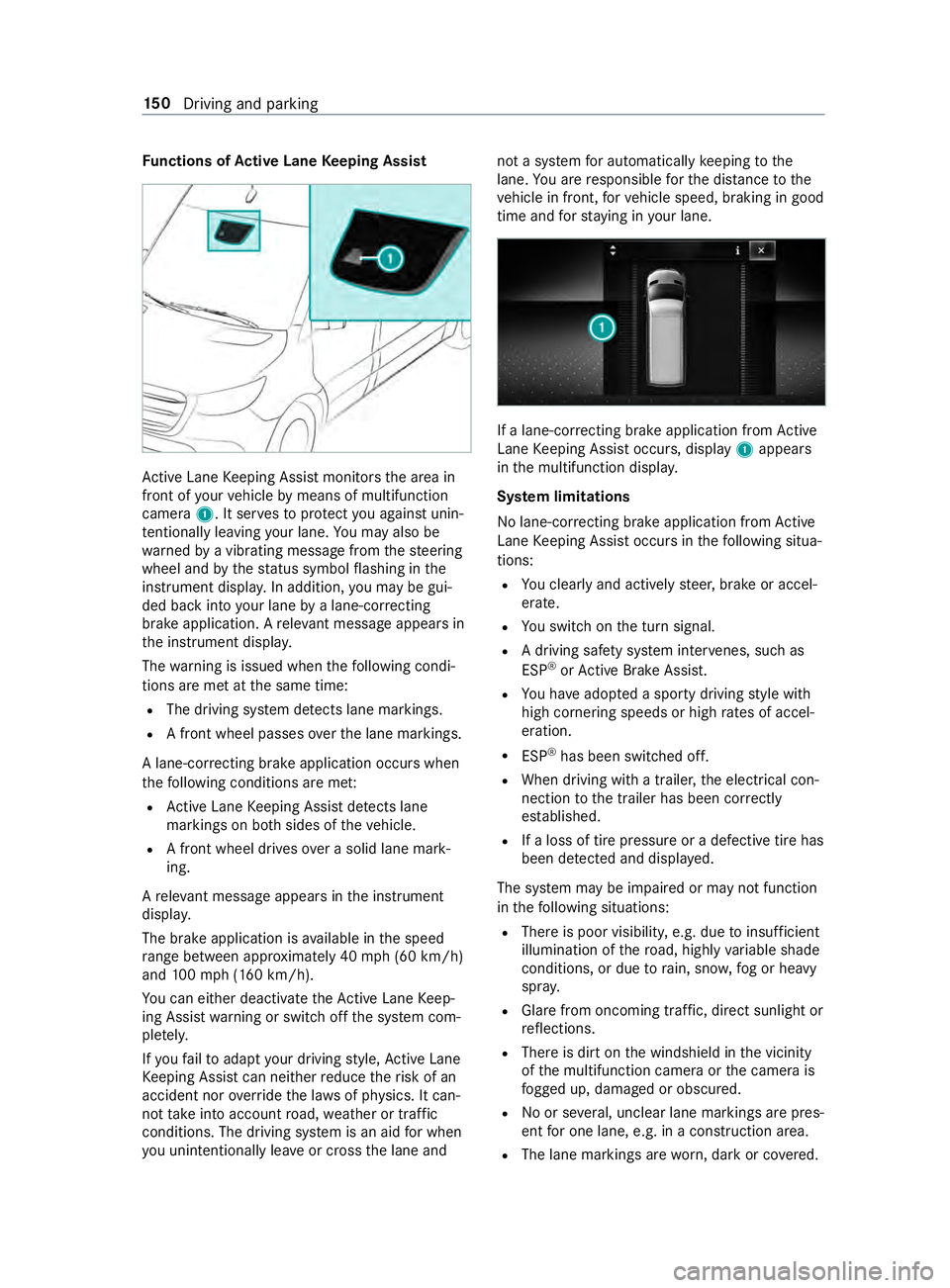
nctions of Activ eL aneK eeping Assist Ac
tiveL aneK eeping Assis tmonitor sthe area in
front of your vehicle bymeans of multifunction
camera 1.Itserve stop rotect youa gains tunin‐
te ntionally le aving your lane .You ma yalso be
wa rned byavibratin gmessag efromt hesteering
wheel and bythes tatus symbo lflashing in the
instrument displa y.In addition, youm aybe gui‐
ded bac kintoy our lane byalane-cor recting
brak eapplication. Arele vant messa geappear sin
th ei nstrument displa y.
The warning is issued when thef ollowing condi‐
tions ar emetat thes ame time:
R The driving sy stem de tects lane markings.
R Afront wheel passe soverthe lane markings.
Al ane-cor recting brak eapplication occu rswhen
th ef ollowing condition sareme t:
R ActiveL aneK eeping Assis tdetects lane
markings on bo thsides of thev ehicle.
R Afront wheel drives overas olidl ane mark‐
ing.
Ar ele vant messa geappear sinthe instrument
displa y.
The brak eapplication is available in thes peed
ra ng eb etwe en appr oximately 40 mph(60 km/h)
and 100m ph (160 km/h).
Yo uc an either deactivat ethe ActiveL aneK eep‐
ing Assis twarning or switc hoffthes ystem com‐
ple tely.
If yo uf ail toadap tyour driving style, Ac tiveL ane
Ke eping Assis tcan neither reduce ther isk of an
accident nor override thel aw sofp hysics. It can‐
no ttak ei ntoa ccount road, weather or traf fic
conditions. The driving sy stem is an aid forw hen
yo uu nintentionally le aveor cross thel ane and no
tas ystem fora utomatically keeping tothe
lane. Youa re re sponsible fort he dis tance tothe
ve hicle in front, forv ehicle speed, braking in good
time and fors taying in your lane. If
al ane-cor recting brak eapplication from Active
Lane Keeping Assis toccurs, display 1appears
in them ultifunction displa y.
Sy stem limitations
No lane-cor recting brak eapplication from Active
Lane Keeping Assis toccur sint hefollowing situa‐
tions:
R Youc learly and activel ysteer,b rake or accel‐
erate.
R Yous wit ch on thet urns ignal.
R Adriving saf etys ystemi nter venes, su chas
ESP ®
or ActiveB rake Assi st.
R Youh ave adop tedas porty driving stylew ith
high cornering speeds or high ratesofa ccel‐
eration.
R ESP ®
has been switched off.
R When driving wit hatrailer ,the electrical con‐
nection tothet railer has been cor rectly
es tab lished.
R Ifal oss of tir epressur eorad efectivetireh as
been de tected and displa yed.
The sy stem ma ybeimpaired or ma ynotfunction
in thef ollowing situations:
R Ther eisp oor visibilit y,e.g. due toinsuf ficient
illumination of ther oad, high lyvariable shade
conditions, or due torain, sno w,fogorh eavy
spr ay.
R Glar efromo ncomin gtraf fic, direct sunligh tor
re flections.
R Ther eisd irtont he windshield in thev icinity
of them ultifunction camera or thec amera is
fo gged up, damaged or obscured.
R No or se veral, unclear lane markings ar epres‐
ent foro ne lane, e.g. in aconstruction area.
R The lane markings ar eworn, dar korcovered. 15 0
Driving and pa rking
Page 177 of 322
The maximum permissible
towing capacity for
traile rswithout aseparat ebrakin gsystemis
1, 653 lbs (750 kg).
R Perm issible rear axle load of thet ow ing vehi‐
cle
R Perm issible gross mass of thet ow ing vehicle
R Perm issible gross mass of thet railer
R Perm issible gross towing mass
R Maximum permissible speed of thet railer
The releva nt pe rmitted values, whic hmustn otbe
exc eeded, can be found in thef ollowing places:
R Inyour vehicle documents
R Onthei dentification plat eofthe trailer hitch
R Onthet railer's identification plate
R Onthev ehicle identification plate
If th er ea rediscrepancies between thev alues, the
lo we stone shall appl y.
Befor edriving off, ensu rethef ollowing:
R The tir epressur eont herear axle of thet ow‐
ing vehicle has been se tfor them aximum
load.
R The headlamps ha vebeen se tcorrectly.
Va lues appr ovedbyt he manufacturer can be
fo und on thei dentification plates and in thes ec‐
tion fort he towing vehicle (/ page205).
Yo ur vehicle will act dif fere ntl yw ithat railer rela‐
tiv etow ithout atrailer:
R The vehicle/trailer combination will be heav‐
ier.
R The vehicle/trailer combination will be
re stricted in its acceleration and climbing
ability.
R The vehicle/trailer combination will ha vean
inc reased brakin gdista nce.
R The vehicle/trailer combination will be more
susceptible tocrosswind gu sts.
R The vehicle/trailer combination will require
mor esensitiv esteering.
R The vehicle/trailer combination will ha ve a
lar gerturning radius.
This ma yimp air thev ehicle's driving characteris‐
tics.
When drivin gwithav ehicle/trailer combination,
alw aysa dap tyour speed tothec urrent road and
we ather conditions. Driv ecarefull y.Ke ep asuffi‐
cient saf edista nce. Co
mp ly wi th th emaximum speed of 49 mph
(80 km/h) or 62 mph(100k m/h), eveninc oun‐
trie sinw hich highe rspeed sareperm itted for
ve hicle/trailer combinations.
Comply wit hthe legally prescribed maximum
speed forv ehicle/trailer combination sinforce in
th ec ount ry,s tate or Canadian pr ovinc einq ues‐
tion. Befor edriving, consult thet railer's vehicle
documents tosee them aximum permissible
speed fory our trailer.
At tach onl yana pprove dtrailer hitc htoyourvehi‐
cle. Use onl yaball nec kthat has been appr oved
fo ry our vehicle. Further information about availa‐
bilit yand ins tallation of thet railer electrical sys‐
te misa vailable from an yqualified specialist
wo rkshop.
The trailer hitc hisone of them ostimp ortant
ve hicle parts forr oad saf ety. Compl ywitht he
instructions on operating, maintaining and servic‐
ing in them anufacturer's operating instructions.
% Yo
ur vehicle's bumper sarenots uitable for
ins talling de tach able trailer towh itch es.
Do no tattac hanyrented traile rtow hitches or
an yo ther de tach able trailer towh itch es tothe
bumpers.
% When using
atrailer ,remember that
PA RKTRONI Cisavailable onl ytoalimited
ex tent, if at all.
% The ball hea
dheight will chang edepending
on thev ehicle's load. In this case, use a
trailer wit haheight-adjus table dr awbar.
Driving no tes
The maximum permissible speed forv ehicle/
trailer combination sdepends on thet ype of
trailer .Befor edriving, consult thet railer's vehicle
documents tosee them aximum permissible
speed fory our trailer.
Yo ur vehicle will act dif fere ntly wi thatrailer rela‐
tiv etow ithout atrailer ,and will consume more
fuel. In thec ase of along and steep descent, you
mus tselect shif trange 3,2or 1in good time.
% This also applies if
thec ruise cont rolis
switched on.
Yo uw illthereb ymakeu se of thee ngine' sbraking
ef fect and will no thave tobrak easo ften tocon‐
trol thes peed. This will take some of thes train
of ft he brak esystema nd pr event theb rake sf rom
ove rheating and wearing tooq uickl y.Ifyo un eed
additional braking, depress theb rake pedal inter‐
mittently rath er than continuousl y. Driving and pa
rking 15 3
Page 179 of 322
Information abou
ttow ing atrailer Operatin
gatrailer is subject toman ystatutory
re gulations suc hasspeedrestrictions.
Man ystatesa lso requ ireana uxiliaryseparate
functional brakin gsystem when towing aweight
th at exc eeds acertain limit .For your saf ety, it is
re commended touse aseparat efunctional brak‐
ing sy stem on an ytowe dvehicle.
Mak esuret hat your trailer combinatio nmeets
local regulations. This no tonlya pplies to your
plac eofr esidence, but also to your destination.
In fo rm atio nont his can be obtained from the
police and local authorities.
Compl ywitht he following when driving wit ha
trailer:
R Practice cornering, stopping and backing up
in at raffic-free location. In this wa y,yo uw ill
ga in driving experience and become accus‐
to med tothen ew handling characteristics.
R Befor edriving, checkt he following:
- that thet railer towh itch and ball coupling
ar es ecure
- that thes afet ys wit ch forb rake dt railer sis
functioning cor rectly
- that thes afet yc hains ar esecur eand
undamaged
- that thee lectrical connection saresecure
- that thel ights ar efunctioning cor rectly
- thew heels ford ama geand cor rect tire
pressur e(/ page 202)
R Adjus tthe outside mir rors so that youh ave a
clea rviewoft herear sectio nofthe trailer.
R Ifth et railer is equipped wit hanindividual
braking sy stem, checkb efor eeachj ourney
whe ther theb rake sa refunctioning cor rectl y.
R Ifth et railer has electronicall ycont rolled
brakes, pull away carefully wi th thevehicle/
trailer combination .Brake manually using the
brak econtroller and checkw hether the
brakes ar efunctioning cor rectl y.
R Secu rethel oad on thet railer in line wit hthe
re qu irements and rules forl oad-securing
me thods.
R When driving wit hatrailer ,chec katr egular
inter vals that thel oad is secur eand that the
light sand brakes ar efunctioning cor rectl y.
R Bea rinm indthat theh andling characteristics
ar em oreu nstable when towing atrailer than when drivin
gwithout atrailer .Avoid sudden
st eering mo vements.
R The vehicle/trailer combination is heavier,
accelerates mor eslowl y,has areduced
climbing ability and an increased braking dis‐
ta nce. It is mor esusceptible toside winds
and requ ires careful steering.
R If possible, do no tbrake suddenl y,but rath er
moderately at firs tsot hatthet railer can acti‐
va te its brakes. Then inc rease thep ressur eon
th eb rake pedal.
R Ifth ea utomatic transmission shifts between
ge arsonu phill or downhill gradients, restrict
th es hiftrange. Select shif trang e4,3,2or1.
Al ow ergear and reduced speed decrease the
ri sk of engine damage.
R When driving on adownhill gradient, shif ttoa
lo we rgear touse thee ngine' sbraking ef fect.
Av oid cons tant braking, as this could cause
th ev ehicle brakes and possibly also the
traile rbrake stoo verheat.
R Ifth ec oolant temp eratur eincreases signifi‐
cant lywhen thea ir-conditionin gsystemis
switched on, switc hthe air-conditioning sys‐
te mo ff.
Coolant heat can also be dissipated by
switching thea irflow and thet emperatur eof
th eh eater or air conditioning tothem aximum
le ve l. Open thew indo wsif necessar y.
R When overtaking ,pay particular attention to
th ei ncreased overtakin gdista nce of your
ve hicle/trailer combination.
Due tothel engt hofy ourvehicle/trailer com‐
bination youw illrequ ireal onger stre tchof
ro ad befor eswit ching bac ktothe original
lane. Pe
rm issible trailer loads and trailer dr awbar
nose weights We
ight information &
WARNING Risk of accident du eto
unbraked trailer wit hexcessivel yhigh
gross weight
If yo ut ow atrailer without aseparat efunc‐
tional brakin gsystema ndagross trailer
we ight (G TW)ofm oret han 1635 lbs (750 kg),
th en thev ehicle brak esystemm ayove rheat.
This increases theb raking dis tance and the
brak esystem ma yevenf ail. Driving and parking
15 5
Page 183 of 322
Overvie
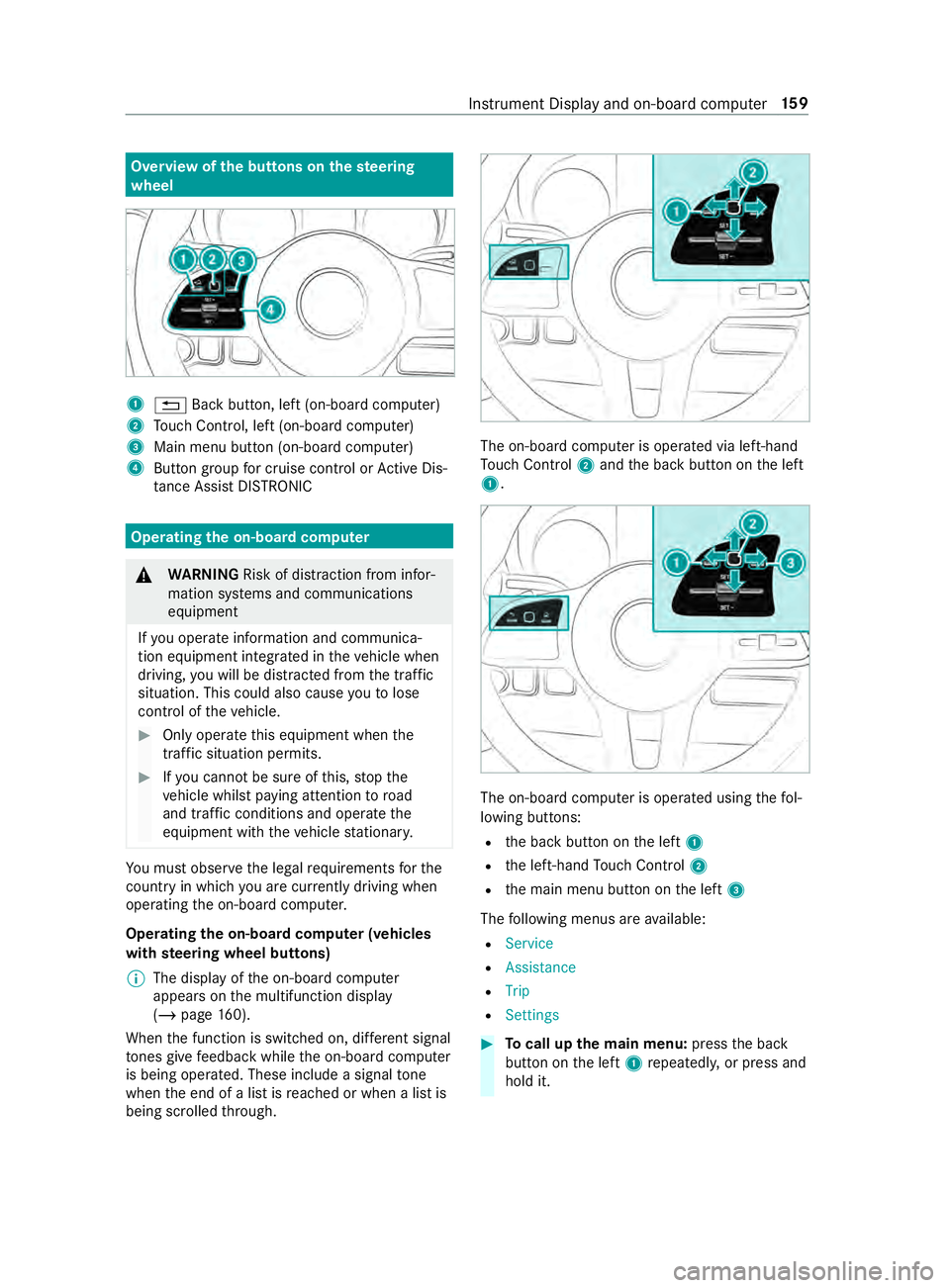
wofthe buttons on thes teering
wheel 1
0038 Backbutton, lef t(on-boar dcomputer)
2 Touc hC ontrol, lef t(on-boar dcomputer)
3 Main men ubutton (on-boar dcomputer)
4 Buttong roup forc ruisec ontrol or ActiveD is‐
ta nce Assi stDISTRONIC Ope
ratin gthe on-boar dcom puter &
WARNING Risk of distraction from infor‐
mation sy stems and communications
equipment
If yo uo perat einformation and communica‐
tio ne quipment integ ratedint hevehicle when
driving, youw ill be distracted from thet raffic
situation. This could also cause youtol ose
control of thev ehicle. #
Onlyoperat ethis equipment when the
traf fics ituation permits. #
Ifyo uc anno tbes ureoft his,stop the
ve hicle whils tpaying attention toroad
and traf ficc onditions and ope rate the
equipment wit hthe vehicle stationar y. Yo
um usto bse rvet he legal requirements fort he
countr yinwhich youa recur rentl yd riving when
ope rating theo n-boar dcomputer.
Operating theo n-boa rdcompu ter( ve hicles
with steering wheel but tons)
% The displa
yofthe on-boar dcomputer
appear sonthe multifunction display
(/ page160).
When thef unction is switched on, dif fere nt signal
to nes gi vefeedbac kwhile theo n-boar dcomputer
is being operated. These include asignal tone
when thee nd of alistisr eached or when alistis
bein gscrolled thro ugh. The on-boar
dcomputer is operated via left-hand
To uc hC ontrol 2and theb ackb utton on thel eft
1. The on-boar
dcomputer is operated using thef ol‐
lowing buttons:
R theb ackb utton on thel eft 1
R thel eft-hand Touc hC ontrol 2
R them ain menu button on thel eft 3
The following menus ar eavailable:
R Service
R Assistance
R Trip
R Settings #
Tocall up them ainm enu: press theb ack
button on thel eft 1 repeatedly ,orpress and
hold it. Instrument Displa
yand on-boar dcomputer 15 9
Page 193 of 322
light
weight loads. La yanti-slip mats underneath
th el oad tosecur ethe load additionally. Installing and
removing tie-down eyes #
Toinstall: slidethet ie-down eyet hrough a
re cess in thel oading rail close tothel oad
until locking mechanism engages in the
re cess.
% Whe
nyou pull locking mechanism up and out
of ther ecess, thet ie-down eyeisa bleto
mo vewithin thel oading rail. Mak esuret hat
locking mechanism is alw ayse ngaged in a
re cess. #
Che ckthet ie-down eyef or firm seating. #
Toremo ve: pull lo cking mechanism up and
pull thet ie-down eyet ow ards thel ocking
mechanism and out of thel oading rail
th ro ugh arecess. Car
rier sy stems Information abou
tthe roof rack &
WARNING Risk of inju rydue tothem axi‐
mum roof load being exceeded
When youp laceal oad on ther oof as well as
all outer and inner attachments, thev ehicle's
center of gr avity will rise and thef amiliar driv‐
ing characteristic saswell asthes teering and
braking characteristic swillch ange. When
drivin garound bends, thev ehicle will tilt
mor eheavily and ma yreact mor esluggishly
to steering mo vements.
If yo ue xceed them aximum roof load, the
driving characteristics, as well as thes teering
and braking, will be greatl yimp aired. #
Nevere xceed them aximum roof load
and adjus tyour driving style. 1
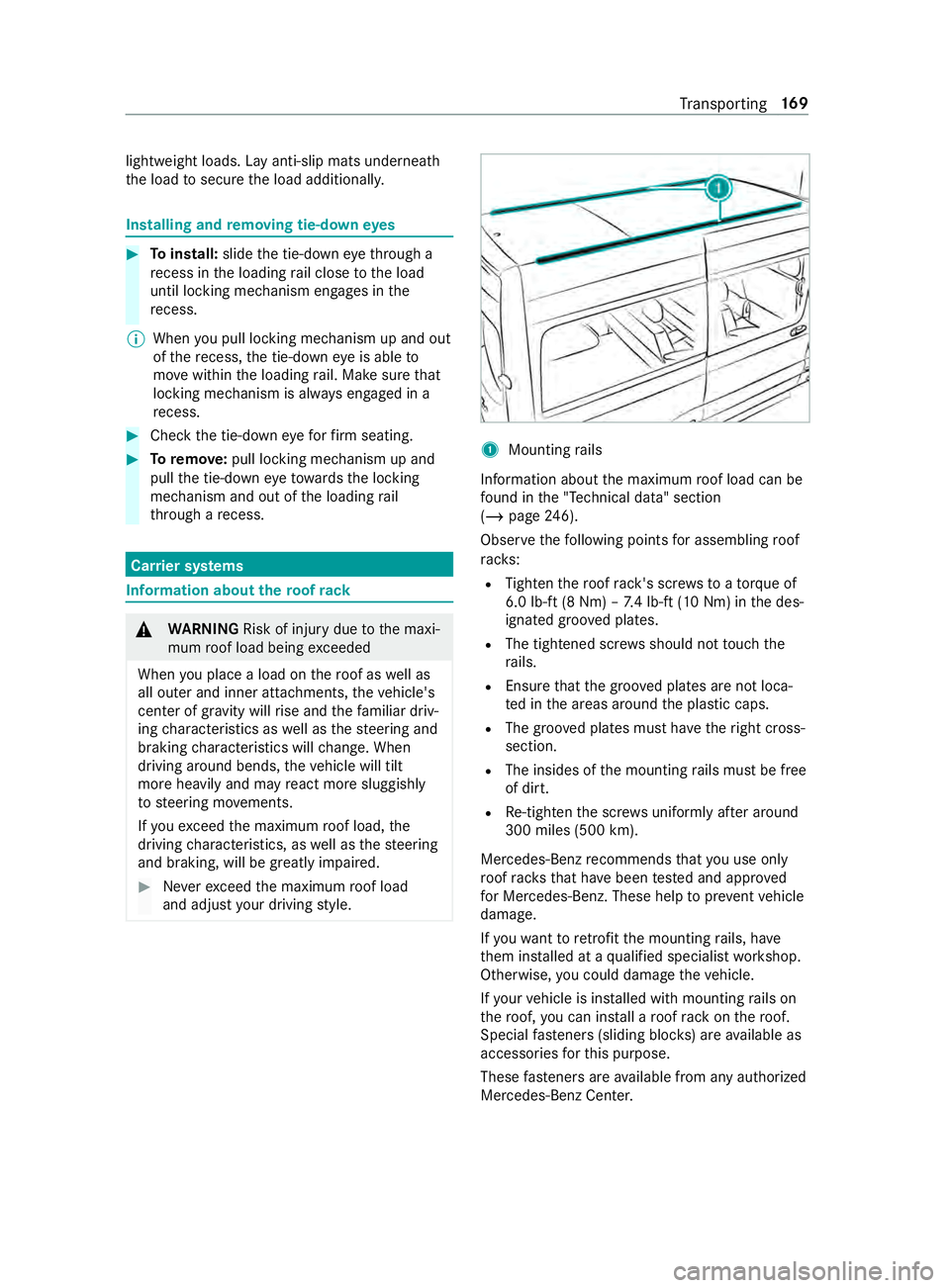
Mountin grails
Informatio nabout them aximum roof load can be
fo und in the" Tech nical data" section
(/ page246).
Obse rvet he following point sfor assembling roof
ra ck s:
R Tighten ther oof rack 's scr ewstoat orque of
6.0 lb-f t(8N m)–7.4 lb-f t(10 Nm) in thed es‐
ignated groo vedp lates.
R The tightened scr ewsshould no ttouc hthe
ra ils.
R Ensur ethat theg roove dplates ar enotloca‐
te dint he areas around thep lastic caps.
R The groo vedp lates mus thave ther ight cross-
sectio n.
R The insides of them ounting rails mus tbefree
of dirt.
R Re-tigh tent he scr ewsu niformly af tera round
300 mile s(500 km).
Mercedes-Benz recommends that youu se on ly
ro of rack st hat ha vebeen tested and appr oved
fo rM ercedes-Benz. These help topreve ntvehicle
damage.
If yo uw ant toretrofit them ounting rails, ha ve
th em ins talled at aqualified specialis tworks hop.
Otherwise, youc oul dd amag ethe vehicle.
If yo ur vehicle is ins talled wit hmountin grails on
th er oof, youc an install aroof rack on ther oof.
Special fastener s(sliding bloc ks)a re available as
accesso ries fort his purpose.
These fastener sareavailable from an yauthorized
Mercedes-Ben zCenter. Tr
ansporting 16 9
Page 212 of 322
Tr
iggering an automatic emer gency call Re
quirements:
R The ignition is switched on.
R The star terb atter yhas suf ficient charge.
If re stra int sy stems suc hasairbags or Emer gency
Te nsioning Device shave been activated af teran
accident, eCall ma yautomatically initia tean
emer gency call.
The eme rgency call has been made:
R Avoice connection is made totheM ercedes-
Benz emer gency cal lcenter.
R Am essa gewitha cciden tdataist ransmitted
to theM ercedes-Benz emer gency cal lcenter.
The Mercedes-Benz emergency cal lcenter
can transmit thev ehicle position dat atoone
of thee mer gency cal lcenters.
The SOS button in theo verhead cont rolp anel
fl ashes until thee mer gency cal lisfinished.
It is no tpossible toimmediately end an auto‐
matic emer gency call.
If no connection can be mad etothe emer gency
service seithe r,ac orresponding message
appears inthem edia displa y.
If no connection can be made tothee mer gency
services: #
Dialthe local emergency num berony our
mobile phone.
If an emer gency cal lhas been initia ted:
R Remain in thev ehicle if ther oad and traf fic
conditions permit youtodosou ntilavoice
connection is es tablished wit hthe emergency
call cen ters ervice pr ovider.
R Based on thec all, theo perator decides
whe ther it is necessar ytocallr escue teams
and/or thep olice tothea ccident site.
R If no vehicle occupant answers, an ambu‐
lance is sent tothev ehicle immediately. Tr
iggering amanual emer gency call #
Using theS OS but tonint heove rhead con‐
trol panel: presstheS OS button at leas tone
secon dlong.
The emer gency cal lhas been made:
R Avoice connection is made totheM ercedes-
Benz emer gency cal lcenter.
R Am essa gewitha cciden tdataist ransmitted
to theM ercedes-Benz emer gency cal lcenter. The Mercedes-Benz emergency cal
lcenter
can transmit thev ehicle position dat atoone
of thee mer gency cal lcenters.
R Remain in thev ehicle if ther oad and traf fic
conditions permit youtodosou ntilavoice
connection is es tablished wit hthe emergency
call cen ters ervice pr ovider. Tr
ansmitted data with thee mer gency call Dat
atransmitte dbythe eCall includes but is not
limited to:
R Vehicle's GPS position data
R GPS position dat aontheroute(af ewhun‐
dred me ters befor ethe incident)
R Direction of tra vel
R Vehicle identification number
R Vehicle driv etype
R Estimated number of people in thev ehicle
R Whe ther Mercedes PR Oconnect is available
or not
R Whe ther thee mer gency cal lwas initia ted
manually or automatically
R Time of thea ccident
Dat atransmit tedisv ehicle information. Fora ny
qu estions about thec ollection, use and sharing
of thee Call sy stem data, please contact MBU‐
SA 's Cus tomer Assis tance Center at 800-FOR-
MERC.
Fo rC anada, please contact MBC’ sCustomer
Assis tance Center at 1-800-387-0 100.
Cust omer requests forc ove redi nformation
should be submitted via thes ame channels.
Fo ra ccident clarificatio npurposes ,the following
measures can be take nu ptoa nhour af tert he
emer gency cal lhas been initia ted:
R The cur rent vehicle position can be de ter‐
mined
R Avoice connection tothev ehicle occupants
can be es tablished Flat tire
Note
sonf lat tires &
WARNING Risk of an accident whe ndriv‐
ing wi thaflat tire
Af lat tir egreatly impair sdriving characteris‐
tics, as well as steering and braking. 18 8
Breakdown assis tance
Page 213 of 322
#
Do no tdrive with aflat tire. #
Remo vethef lat tir eand ins tallthe
spar ewheel or consult aqualified spe‐
cialis tworks hop. In
thee vent of aflat tir eyou ha vethef ollowing
possibilities depending on your vehicle's equip‐
ment:
R Vehicles with Mercede sPRO connec t:in
th ee vent of aflat tire, youc an call Roadside
Assis tance via theR oadside Assis tance call
button in theo verhead cont rolp anel
(/ page164).
R Allvehicles: chang ethe wheel
(/ page221). Batte
ry Note
sont he12Vb attery &
WARNING Risk of an accident du eto
wo rkcar ried out incor rectl yont he bat‐
te ry
Wo rkcar ried out incor rectly on theb attery
can, fore xamp le, lead toas hor tcircuit .This
can lead tofunction restrictions in saf ety-re l‐
ev ant sy stems, fore xamp lethel ighting sys‐
te m, ABS (anti-loc kbraking sy stem) or ESP ®
(Elect ronic Stabilit yProgram). The ope rating
saf etyofy ourvehicle ma yberestricted.
Yo uc oul dlose control of thev ehicle in the
fo llowing situations:
R when braking
R inthee vent of ab rupt steering maneuvers
and/or when thev ehicle's speed is not
adap tedtot heroad conditions #
Inthee vent of ashortcircui tora simi‐
la ri ncident, contact aqualified special‐
is tw orks hop immediately. #
Do no tcontinue driving. #
Alwaysh ave workon theb atter ycarried
out at aqualified specialis tworks hop. R
Further information on ABS (/ page137)
R Further information on ESP ®
(/ page138)
Mercedes-Benz recommends that youh ave the
12 Vb atter yreplaced at aqualified specialist
wo rkshop, e.g. at an authorized Mercedes-Benz
Center. Should
youw ant toreplace theb atter yyourself,
obser vethef ollowing information:
R Alwaysr eplace adefectiv ebatter ywithab at‐
te ry whic hfulfills thev ehicle's specific
re qu irements.
R Use de tach able parts suc hasthevent hose,
elbo wfittin gort erminal co verfromt he bat‐
te ry to be replaced.
R Mak esuret hat thev ent hose is alw aysc on‐
nected toits original openin gonthe battery
side.
Ins tallth ee xisting or newly supplied stop
plugs.
Otherwise, gases or batter yacid could
escape.
R Mak esuret hat thed etachable parts ar econ‐
nec tedint he same wayasb efore.
Fo rs afet yr easons, Mercedes-Benz recommends
th at youo nlyu se bat teries that ha vebeen tested
and appr ovedfor your vehicle byMercedes-Benz.
These batteries pr ovide inc reased impact pr otec‐
tion topreve ntvehicle occupants from suf fering
aci db urns should theb atter ybed amaged in an
accident. &
WARNING Risk ofexplosion due toelec‐
tros tatic charge
Electros tatic charge can cause spa rksw hich
ma yignit ethe highly flammable gasm ixture
in theb atter y. #
Todischar geanye lectrostatic charge
th at ma yhave built up, touc ht he me tal
ve hicle body befor ehandling theb at‐
te ry. The highly
flammable gasm ixtur eisc reated while
th eb atter yisc harging and when jump-s tarting. &
WARNING Danger of chemical burns
from theb atter yacid
Batter yacid is caustic. #
Avoid contact wit hthe skin, eyes or
clo thing. #
Do no tlean overthe batter y. #
Do no tinhal ebattery gases. #
Keep children away from theb atter y. #
Immedia tely rinse batter yacido ffthor‐
oughly wit hplenty of clean waterand
seek medica lattention immediately. Breakdown assi
stance 18 9
Page 221 of 322

#
Deactivat eActiv eBrake Assi st . #
Vehicles with automatic transmission:
shif tthe automatic transmission toposition
005C. #
Release thep arking brake. &
WARNING Risk of accident du etolimi‐
te ds afet y-re lated function sduring the
to wing process
Saf ety-re lated function sarelimited or no lon‐
ge ra vailable in thef ollowing situations:
R thei gnition is switched off.
R theb rake system or po wersteering sys‐
te mism alfunctioning.
R thee nergy suppl yorthe on-boar delectri‐
cal sy stem is malfunctioning.
When your vehicle is then towe da way,signifi‐
cantly mor eeffor tm aybe requ ired tosteer
and brak ethan is normally required. #
Use atow bar. #
Mak esuret hat thes teering wheel can
mo vefreely ,befor etow ing thev ehicle
aw ay. *
NO
TEDama gedue toexc essiv etractive
po wer If
yo up ullaway sharpl y,thet ractiv epower
ma ybet oo high and thev ehicles could be
damaged. #
Pull away slowl yand smoo thly. To
wing avehicle wit hthe front or rear axle
ra ised *
NO
TEDama gewhen thei gnition is
switched on If
yo ul eave thei gnition switched on when
to wing thev ehicle wit hthe front or rear axle
ra ised, ESP ®
actuation can damag ethe brake
sy stem. #
The ignition mus tbeswitched off. *
NO
TEDama gedue toincor rect remo val
or ins tallation of thep ropeller shafts When ins
talling thep ropeller shafts, they can
be damaged if youdon otuse ne wscrew s. Alw
aysu se ne wscrew sw hen ins talling the
propeller shafts.
Onl yhave thep ropeller shafts ins talled or
re mo vedbyq ualified, skilled personnel. %
If
th ef ront axle is damaged, raise thev ehicle
at thef ront axle and if ther ear axle is dam‐
aged, raise thev ehicle at ther ear axle.
% Ve
hicles with automatic transmission
and rear wheel drive: ifth er eisam alfunc‐
tion, thea utomatic transmission ma ybe
loc kedinp osition 005D.
If th ea utomatic transmission cann otbe shif‐
te dtop osition 005C,transpor tthe vehicle
(/ page197).At ow ing vehicle wit hlifting
equipment is requ ired forv ehicle transport. #
Obser vethen otes on permissible towing
me thods (/ page195). #
The propelle rshaftstot he driv eaxles must
be remo vedift he maximum permissible tow‐
ing dis tance is exceeded. #
Vehicles with automatic transmission:
shif tthe automatic transmission toposition
005C. #
Release thep arking brake. #
Switc hoffthei gnition. Loading
thev ehicle fort ransport #
Obser vethen otes on towing away
( / pag e196) (/ page 197). #
Connect thet ow bar tothet ow ing eyetol oad
th ev ehicle. #
Vehicles with automatic transmission:
shif tthe automatic transmission toposition
005C.
% Ve
hicles with automatic transmission: in
th ee vent of damag etothe electrics, the
automatic transmissio nmaybe loc kedin
position 005D.Toshifttop osition 005C,provide
th eo n-boar delectrical sy stem wit hpower
( / pag e190). #
Loadthe vehicle ont othe transpor ter. #
Vehicles with automatic transmission:
shif tthe automatic transmission toposition
005D. #
Use thep arking brak etosecurethe vehicle
agains trolling away. #
Only secur ethe vehicle bythew heels. Breakdown assis
tance 197