ECU MERCEDES-BENZ SPRINTER 2019 MY19 with no MMS Operator’s Manual
[x] Cancel search | Manufacturer: MERCEDES-BENZ, Model Year: 2019, Model line: SPRINTER, Model: MERCEDES-BENZ SPRINTER 2019Pages: 322, PDF Size: 5.91 MB
Page 176 of 322
&
WARNING Swerving of thev ehicle/
trailer combination due toinc reased
speed
If th ev ehicle/trailer combination swer ves,
yo uc an lose control of it.
The vehicle/trailer combination can even tip
ove r. #
Under no ci rcums tances shoul dyou try
to inc rease thes peed tostra ighten the
ve hicle/trailer combination. #
Reduce speed and do no tcounter-s teer. #
If necessar y,appl ythe brakes. &
WARNING Risk of accident du etothe
brak esystem overheating
If yo ul eave your foot on theb rake pedal
when driving, theb rake system ma yoverheat.
This increases theb raking dis tance and the
brak esystemm ayeve nfail. #
Neveru se theb rake pedal as afootrest. #
Do no tdepress theb rake pedal and the
accelerator pedal at thes ame time
while driving. &
WARNING Danger of accident du eto
unsuitable ball coupling
If yo ui nstall an unsuitable ball coupling, over‐
loading of thet railer hitc hand rear axle will
be ther esult. This is particularly thec ase if
th eb all coupling is relatively long or angled
dif fere ntl y.
The handling characteristic smaybe heavily
impaired and thet railer can become
de tach ed. Ther eisarisk offata linjur y. #
Only ins tallab all couplin gthat meets
th ep ermitted dimension sand has been
designed fort he trailer operation
re qu irements. #
Do no tmodif ythe ball coupling or the
traile rhitch. &
WARNING Risk of accident and inju ry
due toan incor rectl yins talled ball cou‐
pling
If th eb all coupling is no tins talled and
engaged cor rectly ,itm aybecome de tach ed
during tr avel and endanger other road users.
Ther eisar isk offata linjur y. #
Install and secur ethe ball coupling as
described in theb all coupling manufac‐
turer's ins tallation instructions. #
When theb all coupling has been ins tal‐
led, ensur ethat it is cor rectly secu red
befor eevery trip. &
WARNING Risk of accident du etoan
incor rectl yins tal led and secured ball
neck
If th eb all nec kisnotcor rectl yins talled and
secured, thet railer can become de tach ed. #
Install and secur ethe ball nec kas
described in theb all nec kmanufactur‐
er's ins tallation instructions. #
When theb all nec khas been ins talled,
ensur ethat it is cor rectly secu red
befor eevery trip *
NO
TEWearing out theb rake linings by
continuously dep ressing theb rake pedal #
Do no tdepress theb rake pedal continu‐
ously whils tdriving. #
Touse theb raking ef fect of thee ngine,
shif ttoa lowe rgear in good time. Alw
aysc ompl ywitht he operating instructions of
th em anufacturer of thet railer coupling and the
ball nec k.
Place your vehicle/trailer combination on sur fa‐
ces that ar ease vena spossible and secu reit
agains trolling away ( /pag e132). Coupl eand
uncoupl ethe trailer carefully.
When backing up thet ow ing vehicle, ensur ethat
th er eisn o-one between thev ehicle and the
traile r.
If yo udon otconnec tthe trailer tothet ow ing
ve hicle cor rectly ,the trailer ma ybecome
de tach ed. Onceith as been connected and is
ro adwor thy, thet railer mus tbeinah orizontal
position behind thet ow ing vehicle.
No tethef ollowing rega rding thet ongue weight:
R Mak efull use of them aximum tongu eweight,
wher epossible
R Do no texceed or fall belo wthe permitted
to ngu eweight
Do no texceed thef ollowing values:
R Perm itted braked or unbraked towing capa‐
city 15 2
Driving and pa rking
Page 178 of 322
Drivin
gtips
If th et railer sw ays, remember thef ollowing
points:
R Do no taccelerat eunder an ycircums tances.
R Do no tcounter steer.
R If necessar y,appl ythe brakes.
% Yo
uc an pr eventthet railer from sw aying and
rock ingbyretrofitting stabilizer bar sortrailer
st abilit yprograms. Youc an obtain fur ther
information from an authorized Mercedes-
Benz Center.
R Maintain alarge rd ista nce than when driving
without atrailer.
R Avoid braking abruptl y.If possible, brak egen‐
tl yf irst of al lsot hatthet railer closes up
behind your vehicle. Then, increase theb rak‐
ing forc er apidl y.
R The values given fors tart-o ff gradeability
re fertos ea level. When driving in moun tain‐
ous areas, no tethat engine output, and there‐
fo re start-of fgradeability ,will dec rease with
inc reasin galtitude. Coupling/uncoupling
atrailer Coupling
atrailer
* NO
TEDama getothev ehicle batter ydue
to full discharge Charging
thet railer batter yusing thep ower
supply of thet railer can damag ethe vehicle
batter y. #
Do no tuse thev ehicle's po wersupply
to charge thet railer batter y. #
Shif tthe selector le vertop osition 005D. #
Appl ythe vehicle's parking brake. #
Close all thed oors. #
Position thet railer on alevel sur face behind
th ev ehicle.
% The ball head height
changes depending on
th ev ehicle's load. In this case, use atrailer
wit hah eight-adjus table trailer dr awbar. #
Couple up thet railer. #
Establish all electrical and other connections
to thet railer. #
Remo veobject sordevices whic hpreve nt the
traile rfromr olling, e.g. wheel choc ks. #
Release thet railer's parking brake.
% The
vehicle harness has acable connection
to theb rake light indicator lamp.
Obser vethem aximum permissible trailer dimen‐
sions (widt hand length).
Mos tUSs tatesa nd all Canadian pr ovinces pre‐
scribe thef ollowing points, and youa reurge ntly
re commended tocomply wi th these:
R Safetyc hains between thet ow ing vehicle and
th et railer .The chains should be routed in a
criss-cross pat tern unde rthe trailer dr awbar.
The ym ustbec onnected tothet railer tow
hitc hand no ttothe bumper or tothev ehicle
axle.
Lea vesuf ficient sla ckinthec hains. This
allo wsfore vens harp cornering.
R Aseparat ebrake system is requ ired forc er‐
ta in trailers.
R Asafet yf eatur eisrequired forb rake dt railers.
De term ine thes pecific requ irements acco rd‐
ing tother ele vant la ws.
If th et railer becomes de tach ed from thet ow‐
ing vehicle, thes afet yf eatur etrigger sthe
trailer brakes and can thus reduce thed anger.
Un coupling atrailer &
WARNING Risk of being crushed and
becoming trapped whe nuncoupling a
trailer
Whe nuncoupling atrail er wi than engaged
ine rtia-activated brake, your han dmay
become trapped between thev ehicle and the
traile rdrawbar. #
Do no tuncouple trailer swithan
engaged overrun brake. Do no
tuncouple atrailer wit hanoverrun brak ein
as tate ofove rrun. Otherwise, ther ebound of the
ove rrunb rake can damag eyour vehicle. #
Shif tthe selector le vertop osition 005D. #
Appl ythe vehicle's parking brake. #
Close all thed oors. #
Appl ythe trailer's parking brake. #
Secur ethe trailer agains trolling away wit ha
wheel choc kors imilar object. #
Remo vethet railer cables and saf etyc hains. #
Uncouple thet railer. 15 4
Driving and pa rking
Page 179 of 322
Information abou
ttow ing atrailer Operatin
gatrailer is subject toman ystatutory
re gulations suc hasspeedrestrictions.
Man ystatesa lso requ ireana uxiliaryseparate
functional brakin gsystem when towing aweight
th at exc eeds acertain limit .For your saf ety, it is
re commended touse aseparat efunctional brak‐
ing sy stem on an ytowe dvehicle.
Mak esuret hat your trailer combinatio nmeets
local regulations. This no tonlya pplies to your
plac eofr esidence, but also to your destination.
In fo rm atio nont his can be obtained from the
police and local authorities.
Compl ywitht he following when driving wit ha
trailer:
R Practice cornering, stopping and backing up
in at raffic-free location. In this wa y,yo uw ill
ga in driving experience and become accus‐
to med tothen ew handling characteristics.
R Befor edriving, checkt he following:
- that thet railer towh itch and ball coupling
ar es ecure
- that thes afet ys wit ch forb rake dt railer sis
functioning cor rectly
- that thes afet yc hains ar esecur eand
undamaged
- that thee lectrical connection saresecure
- that thel ights ar efunctioning cor rectly
- thew heels ford ama geand cor rect tire
pressur e(/ page 202)
R Adjus tthe outside mir rors so that youh ave a
clea rviewoft herear sectio nofthe trailer.
R Ifth et railer is equipped wit hanindividual
braking sy stem, checkb efor eeachj ourney
whe ther theb rake sa refunctioning cor rectl y.
R Ifth et railer has electronicall ycont rolled
brakes, pull away carefully wi th thevehicle/
trailer combination .Brake manually using the
brak econtroller and checkw hether the
brakes ar efunctioning cor rectl y.
R Secu rethel oad on thet railer in line wit hthe
re qu irements and rules forl oad-securing
me thods.
R When driving wit hatrailer ,chec katr egular
inter vals that thel oad is secur eand that the
light sand brakes ar efunctioning cor rectl y.
R Bea rinm indthat theh andling characteristics
ar em oreu nstable when towing atrailer than when drivin
gwithout atrailer .Avoid sudden
st eering mo vements.
R The vehicle/trailer combination is heavier,
accelerates mor eslowl y,has areduced
climbing ability and an increased braking dis‐
ta nce. It is mor esusceptible toside winds
and requ ires careful steering.
R If possible, do no tbrake suddenl y,but rath er
moderately at firs tsot hatthet railer can acti‐
va te its brakes. Then inc rease thep ressur eon
th eb rake pedal.
R Ifth ea utomatic transmission shifts between
ge arsonu phill or downhill gradients, restrict
th es hiftrange. Select shif trang e4,3,2or1.
Al ow ergear and reduced speed decrease the
ri sk of engine damage.
R When driving on adownhill gradient, shif ttoa
lo we rgear touse thee ngine' sbraking ef fect.
Av oid cons tant braking, as this could cause
th ev ehicle brakes and possibly also the
traile rbrake stoo verheat.
R Ifth ec oolant temp eratur eincreases signifi‐
cant lywhen thea ir-conditionin gsystemis
switched on, switc hthe air-conditioning sys‐
te mo ff.
Coolant heat can also be dissipated by
switching thea irflow and thet emperatur eof
th eh eater or air conditioning tothem aximum
le ve l. Open thew indo wsif necessar y.
R When overtaking ,pay particular attention to
th ei ncreased overtakin gdista nce of your
ve hicle/trailer combination.
Due tothel engt hofy ourvehicle/trailer com‐
bination youw illrequ ireal onger stre tchof
ro ad befor eswit ching bac ktothe original
lane. Pe
rm issible trailer loads and trailer dr awbar
nose weights We
ight information &
WARNING Risk of accident du eto
unbraked trailer wit hexcessivel yhigh
gross weight
If yo ut ow atrailer without aseparat efunc‐
tional brakin gsystema ndagross trailer
we ight (G TW)ofm oret han 1635 lbs (750 kg),
th en thev ehicle brak esystemm ayove rheat.
This increases theb raking dis tance and the
brak esystem ma yevenf ail. Driving and parking
15 5
Page 183 of 322
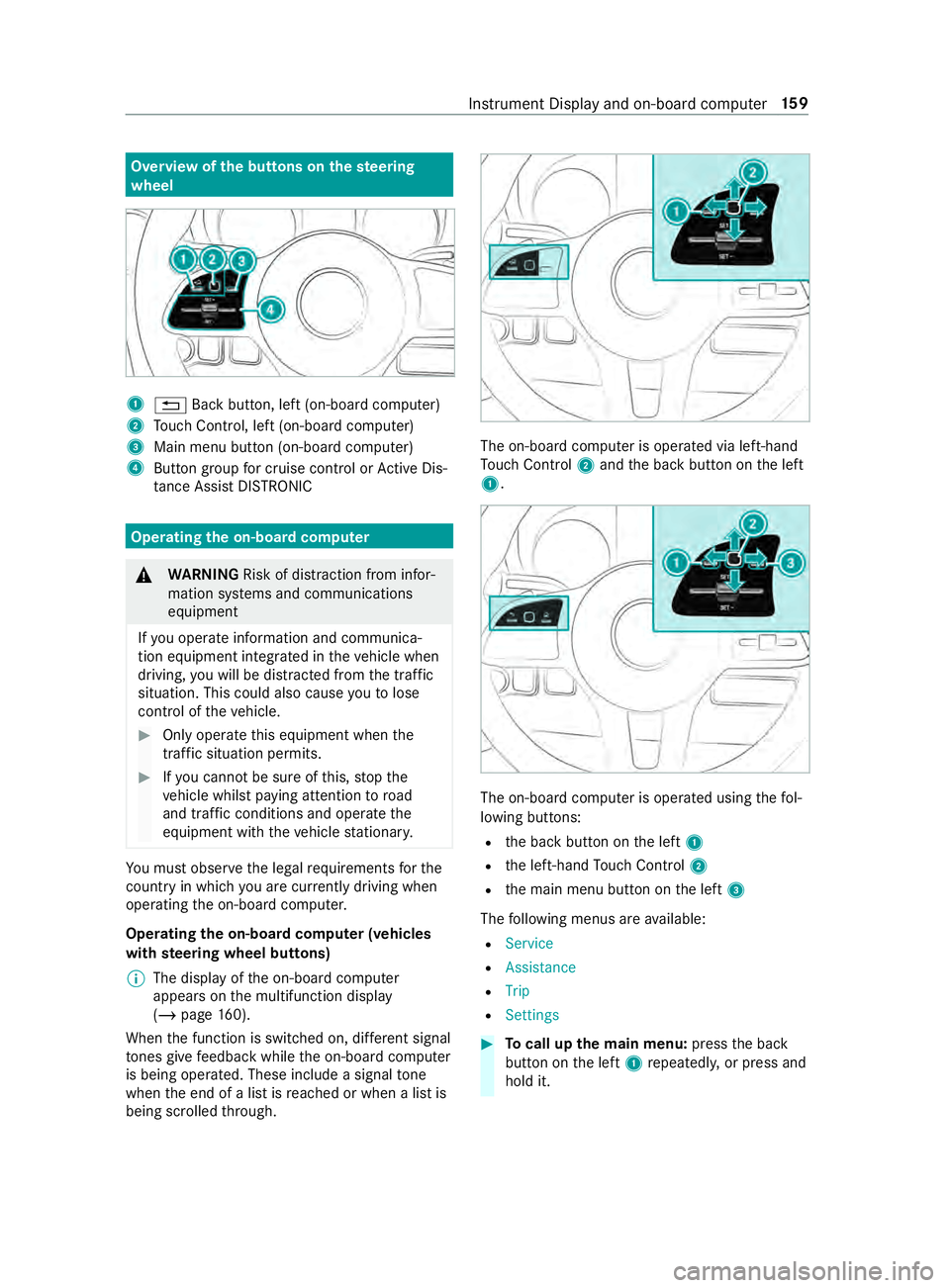
Overvie
wofthe buttons on thes teering
wheel 1
0038 Backbutton, lef t(on-boar dcomputer)
2 Touc hC ontrol, lef t(on-boar dcomputer)
3 Main men ubutton (on-boar dcomputer)
4 Buttong roup forc ruisec ontrol or ActiveD is‐
ta nce Assi stDISTRONIC Ope
ratin gthe on-boar dcom puter &
WARNING Risk of distraction from infor‐
mation sy stems and communications
equipment
If yo uo perat einformation and communica‐
tio ne quipment integ ratedint hevehicle when
driving, youw ill be distracted from thet raffic
situation. This could also cause youtol ose
control of thev ehicle. #
Onlyoperat ethis equipment when the
traf fics ituation permits. #
Ifyo uc anno tbes ureoft his,stop the
ve hicle whils tpaying attention toroad
and traf ficc onditions and ope rate the
equipment wit hthe vehicle stationar y. Yo
um usto bse rvet he legal requirements fort he
countr yinwhich youa recur rentl yd riving when
ope rating theo n-boar dcomputer.
Operating theo n-boa rdcompu ter( ve hicles
with steering wheel but tons)
% The displa
yofthe on-boar dcomputer
appear sonthe multifunction display
(/ page160).
When thef unction is switched on, dif fere nt signal
to nes gi vefeedbac kwhile theo n-boar dcomputer
is being operated. These include asignal tone
when thee nd of alistisr eached or when alistis
bein gscrolled thro ugh. The on-boar
dcomputer is operated via left-hand
To uc hC ontrol 2and theb ackb utton on thel eft
1. The on-boar
dcomputer is operated using thef ol‐
lowing buttons:
R theb ackb utton on thel eft 1
R thel eft-hand Touc hC ontrol 2
R them ain menu button on thel eft 3
The following menus ar eavailable:
R Service
R Assistance
R Trip
R Settings #
Tocall up them ainm enu: press theb ack
button on thel eft 1 repeatedly ,orpress and
hold it. Instrument Displa
yand on-boar dcomputer 15 9
Page 186 of 322
R
Lane markings solid and thin: Lane Keeping
Assis tswitched on, no tready toissue warn‐
ings
R Lane markings solid and thick: Lane Keeping
Assis tready toissue warnings Calling up displa
yson thet ripm enu On-boar
dcomputer:
4 Trip #
Selec tthe desired displa yand confirm.
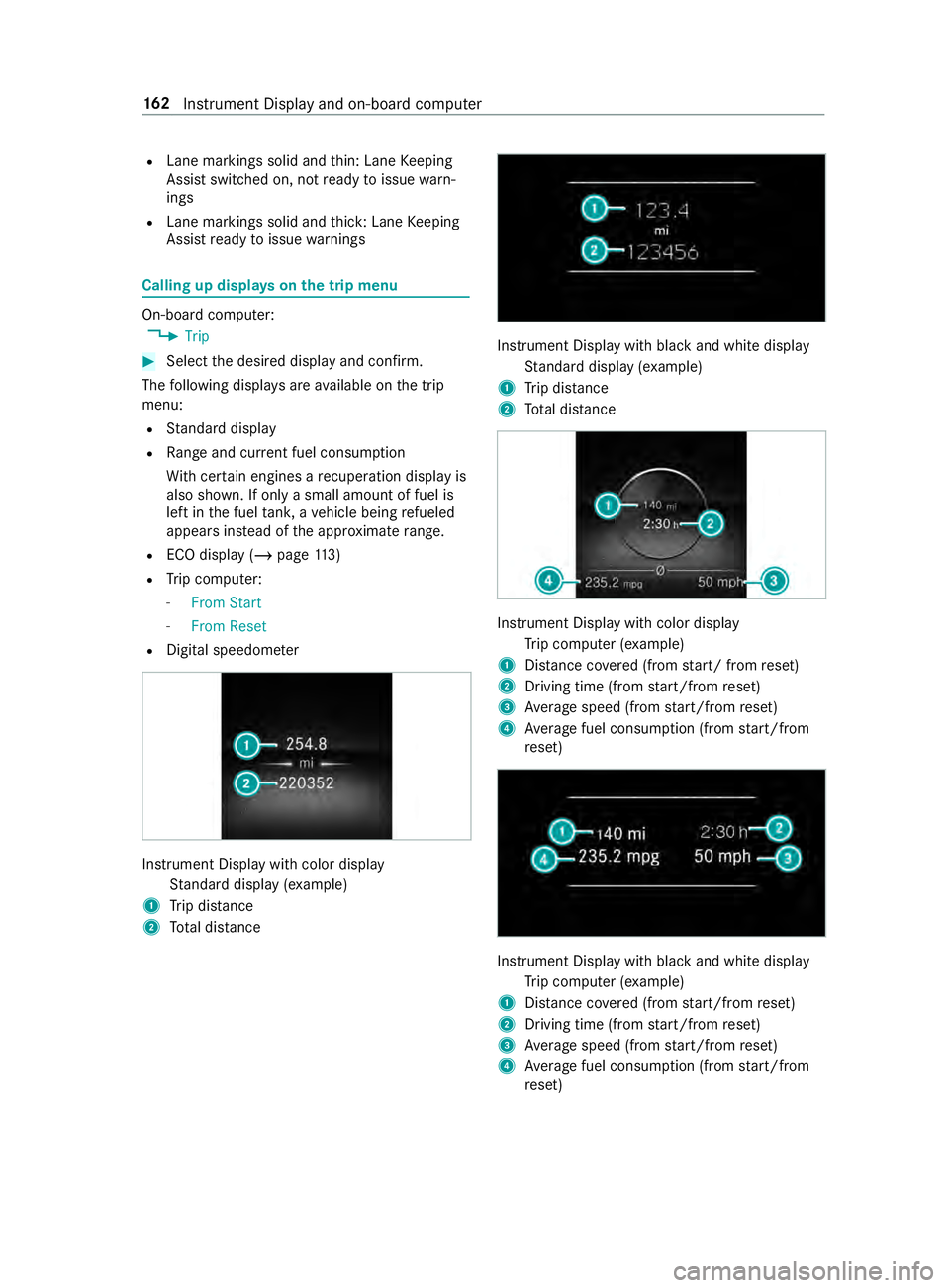
The following displa ysarea vailable on thet rip
menu:
R Standar ddisplay
R Rangea nd cur rent fue lconsu mption
Wi th cer tain engines arecuperation displa yis
also shown. If only asmall amount of fue lis
lef tint he fuel tank ,av ehicle being refueled
appear sins tead of thea ppr oximat erange.
R ECOd ispl ay ( /pag e113 )
R Trip computer:
- FromS tart
- FromR eset
R Digital speedom eter Instrument Displa
ywithc olor display
St andar ddispla y(example)
1 Trip dis tance
2 Totald ista nce Instrument Displa
ywithb lacka nd whit edisplay
St andar ddispla y(example)
1 Trip dis tance
2 Totald ista nce Instrument Displa
ywithc olo rdisplay
Tr ip computer (e xamp le)
1 Distance co vered( from start/ from reset)
2 Driving time (from start/from reset)
3 Averag espeed (from start/from reset)
4 Averag efuel consum ption (from start/from
re set) Instrument Displa
ywithb lacka nd whit edisplay
Tr ip computer (e xamp le)
1 Distance co vered( from start/from reset)
2 Driving time (from start/from reset)
3 Averag espeed (from start/from reset)
4 Averag efuel consum ption (from start/from
re set) 16 2
Instrument Displa yand on-boar dcomputer
Page 190 of 322

Note
sonl oading guidelines &
DANG ER Risk of poisonin gfrome xhau st
ga ses
Combustion engines emit poisonous exhaust
ga ses, suc hascarbon monoxide. Exhaust
ga ses can enter thev ehicle interior if the
re ar-en ddoor is open when thee ngine is run‐
ning ,especially if thev ehicle is in motion. #
Alwayss witc hoffthee ngine before
opening ther ear-end door. #
Neverd rive wit hthe rear-en ddoor
open. &
WARNING Risk of inju ryfrom unsecu red
object sinthevehicle
When objects ar eunsecured or inadequately
secured, they can slip, tip overorbet hrown
about, striking vehicle occupants.
This also appliest o:
R Luggag eorl oads
R Seats whic hhave been remo veda nd are
being transpor tedint hevehicle in an
ex ceptiona lcase
The reisar isk of injur y,particular lyin the
eve nt of braking maneuver sorabrupt
ch anges in direction. #
Alwayss towo bjectsins uchaw aythat
th ey canno tbetossed about. #
Befor etrave ling, secur eobjects, lug‐
ga ge or load topreve ntthem slipping or
tipping over. #
When aseat is remo ved, keep it prefera‐
bly outside thev ehicle. &
WARNING Risk of inju rydue toobjects
being stowedincor rectly
If yo udon otadequatel ystowo bjectsint he
ve hicle interior ,the yc ould sli porbet ossed
around and thereb ystrik evehicle occupants.
In addition, cup holders, open stowage
spaces and mobile phon ebrack etsc annot
al wa ys restra in theo bject stheyc ontai nint he
eve nt of an accident.
The reisar isk of injur y,particular lyin the
eve nt of sudden braking or asudde nchange
in direction. #
Alwayss towo bjectsins uchaw aythat
th ey canno tbetossed about in these or
similar situations. #
Alwaysm akes uret hat objects do not
project from stowages paces, parcel
nets or stowagen ets. #
Close thel oc kable stow ages paces
befor estarti ngajou rney. #
Stow and secur eobject sthat ar eheavy,
hard, poin ted, sharp-edged, fragile or
to ol arge inthec argo compartment. &
WARNING Risk of bu rning from thet ail‐
pipe or tailpipe trim
The tailpipe and tailpipe trim can become
ve ry hot. If youc om eintoc ontact wi th these
car parts, youc oul db urny ourself. #
Alwaysbep articularly careful when in
th ev icinit yoft hetailpipe and tailpipe
trims and supervise children very
closely whe ninthis area. #
Befor eanycon tact, allo wthe car parts
to cool down. If
yo ua reusin gar oofrack ,p lease no tethem axi‐
mum roof load and them aximum load capacity of
th er oof rack.
Yo uw illfind information abou tthe maximum roof
load in the" Tech nical data" chap tera nd informa‐
tion abou troof rack sint he "Car rier sy stems"
section .
Camera-based driving sy stems and thes ensor
functions of thei nside rearvie wmirro rm aybe
impaire difyou ar etranspo rting aload on the
ro of and it pr otru des mor ethan 16in (40 cm)
ove rthe edg eoftheroof. Therefore, mak esure
th at thel oad does no toverhang bymor ethan
16 in (40 cm).
The handlin gcharacteristics of your vehicle are
dependent on thel oad distribution. Therefore,
please obser vethef ollowing no tesw hen loading:
R when transporting aload, ne vere xceed the
permissible gross mass or theg ross axle
we ight rating fort he vehicle (including occu‐
pants). The values ar especified on thev ehi‐
cle identification plat eonthe B-pillar.
R thel oad mus tnotprotru de abo vetheu pper
edg eoft he seat backrests.
R if possible, alw ayst ranspor tthe load in the
cargo compa rtment. 16 6
Transporting
Page 191 of 322

R
fastenthel oad tothet ie-down eyes and
spread thel oad as evenlyasp ossible.
R uset ie-down eyesand fast ening components
whic haresuitable fort he weight and size of
th el oad. Load distribution
* NO
TERisk of damag etothefloor co ver‐
ing Excessiv
epoint loading on thec argo com‐
partmen tfloor or on thel oad area can nega‐
tivel yaffect thed riving characteristic sand
could damag ethe floor co vering. #
Vehicles with rear-wheel drive: dis‐
tribu tethel oad uniformly .When doing
so, ensur ethat theo verall cen terof
gr av ity of thel oad is alw aysasl owand
close tothec enter as possible and
between thea xles near ther ear axle. #
Vehicles with all-wheel drive: distrib‐
ut et he load uniforml y.When doing so,
ensur ethat theo verall cen terofg ravity
of thel oad is alw aysasl owand close to
th ec enter as possible and between the
axles. Excessiv
epointloadin gont he cargo compart‐
ment floor or on thel oad area can negatively
af fect thed riving characteristic sand could dam‐
ag et he floor co vering.
On Cargo Vana nd Passenger Van:
R alwa ys transpo rtthel oad in thec argo com‐
partment.
R alwaysf astent he load tother ear benc hseat
backrests.
R movelarge and heavy loads as fart ow ards
th ef ront of thev ehicle as possible against
th er ear benc hseat. Stow loads flush wit hthe
re ar ben chseat.
R alwaysa dditionally secur ethe load wit hsuita‐
ble load securing aids or tie downs.
R thel oad mus tnotprotru de abo vetheu pper
edg eoft he seat backrests.
R transpor tloads behind seats that ar enot
occupied.
R ifth er ear benc hseat is no toccupied, insert
th es eat belts crosswise int othe buckle of the
opposit eseat belt. Securing loads
Note
sonl oad securing &
WARNING Risk of accident and injury
du etoi ncorrect use of thel ashing stra ps
If yo ua ttac hthe lashing stra pi ncor rectly
whe nsecu ring loads, thef ollowing ma yoccur
in thee vent of abrup tchanges in direction,
braking maneuver or an accident:
R The tie-down eyes ma ybecome de tach ed
or thel ashing stra pm aytear if thep er‐
missible load is exceeded.
R The load cann otbe restra ined.
This ma ycause thel oad toslip, tip overorbe
fl ung about ,striking vehicle occupants. #
Alwayst ension thel ashing stra ps in the
proper manner and onl ybetwe en the
described tie-down eyes. #
Alwaysu se lashing stra ps designed spe‐
cificall yfor thel oads. %
Obser
vethei nformation relatin gtot he maxi‐
mum loading capacity of thei ndividual cargo
tie-down point. If youc ombin evarious cargo
tie-down points tosecur eaload, alw ayst ake
th em aximum loading capacity of thew eak‐
es tc argo tie-down poin tint oa ccount .During
maximum full- stop braking, forc es ma yact
whic hcan multipl ythe weight of thel oad.
Alw aysu se se veralc argo tie-down point sto
distribut eand spread thel oad. Spread the
load evenly between thec argo tie-down
points or tie-down eyes.
Alw ayso bser vetheo perating instruction sorthe
lashing stra pm anufacturer's instruction sfor the
operation of thel ashing stra p.
Obser vethei nformation relatin gtot he maximum
loading capacity of thec argo tie-down points
(/ page245).
As thed rive r,yo ua re re sponsible fore nsuring the
fo llowing:
R The load is secured agains tslipping, tipping,
ro lling or falling off.
Ta ke usual traf ficc onditions as well as swerv‐
ing or full brak eapplication and bad roads
int oa ccount.
R The applicable requ irements and guidelines
re latin gtol oad-securing practices ar emet.
If th is is no tthe case, this ma yconstitut ea
punishable of fense, depending on local legis‐ Tr
ansporting 167
Page 192 of 322
lation and an
yensuin gconsequences.
Obser vecountr y-specific la ws.
Mak esuret hat thel oad is secur ebefor eevery
jou rney and at regular inter vals during along
journe y.Ad jus tthe load securing as necessar y.
Information on ho wtosecureloads cor rectly can
be obtained from them anufacturer sofload
securing aids or tie downs forl oad-securing, for
ex ample.
When securing loads, obse rvet he following:
R Fill spaces between thel oad and thec argo
compartmen twalls or wheel wells. Forthis
purpose, use rigid load securing aids, suc has
we dges, wooden fixing sorp adding.
R Attach secured and stabilized loads in all
directions.
Use thec argo tie-down points or tie-down
ey es and thel oading rails in thec argo com‐
partmen toronthe load sur face.
Only use tie downs, suc haslashing rods, lock
ro ds or lashing nets and lashing stra ps, which
has been tested in accordance wit hcurrent
st andards (e.g. DI NEN). Alw aysu sethec argo
tie-down point closes ttothe load; pad sharp
edges.
Loads, and heavy loads in particular ,should
preferably be secured using thet ie-down
ey es.
% Yo
uw ill obtain tie downs tested in accord‐
ance wit hcurrent standards (e.g. DI NEN)
from an yspecialis tcompan yorfromaq uali‐
fi ed specialis tworks hop.
Note sont he partition
Wi thout apartition ,vehicles that ar eappr ove das
commercial vehicles (N1 ,N2) do no tfulfill ISO
27 956, whi chdescribes thee quipment forp rop‐
erly securing aloa dind elivery vehicles. If the
ve hicle is used totranspo rtgoods, retrofitting the
partition is stro ng lyrecommended ,asprope rly
securing thel oad in vehicles without apartition
will alw aysbeac omplexoperation. Overvie
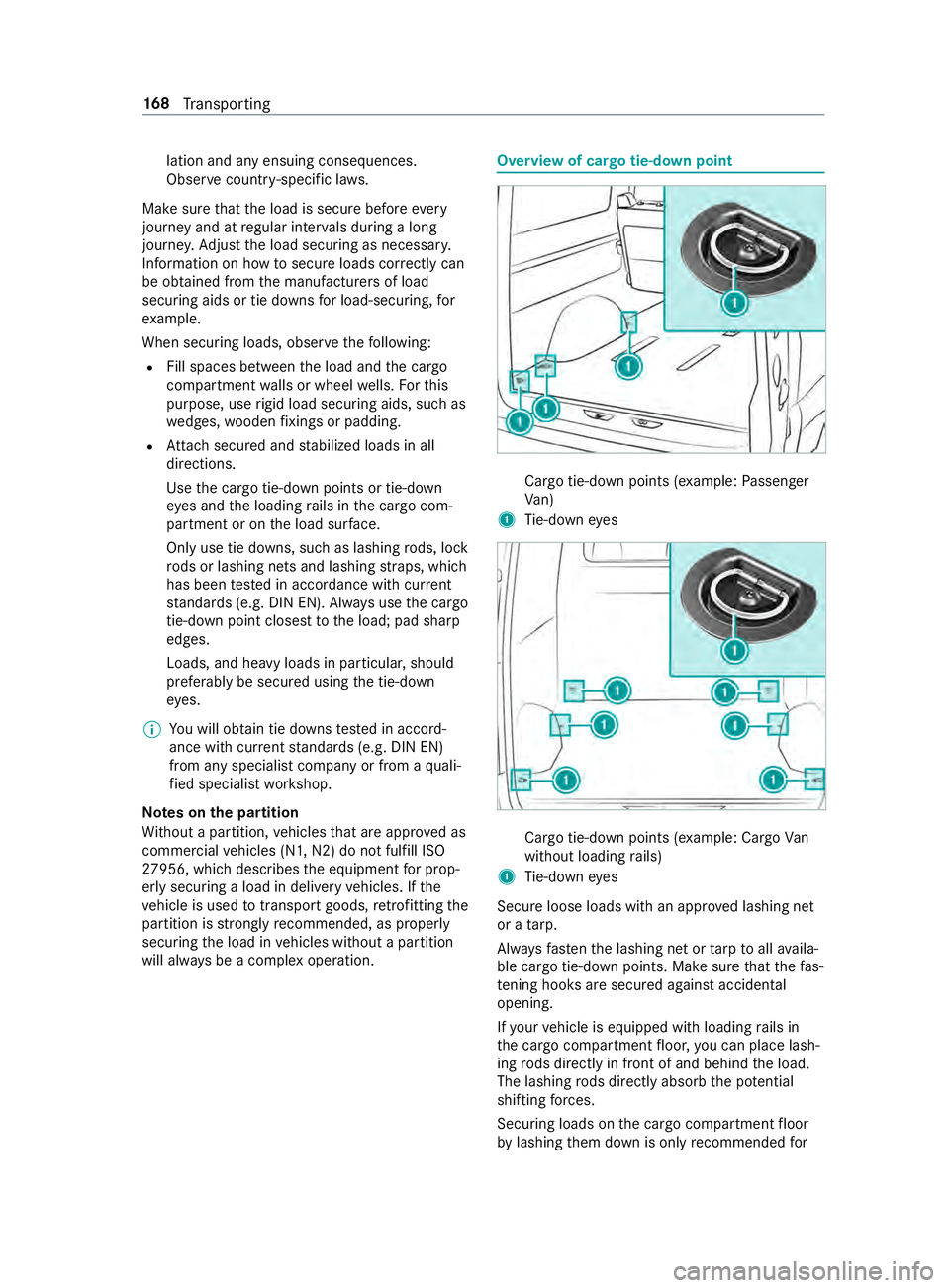
wofcargo tie-down point Cargo tie-down points (e
xample:Passenger
Va n)
1 Tie-down eyes Cargo tie-down points (e
xample: Cargo Van
without loadin grails)
1 Tie-down eyes
Secur eloose loads wit hanapprove dlashing net
or atarp.
Al wa ys fast enthel ashing ne tortarptoa llav aila‐
ble cargo tie-down points .Makes uret hat thef as‐
te ning hoo ksares ecured agains tacciden tal
opening.
If yo ur vehicle is equipped wit hloading rails in
th ec argo compartmen tfloor ,you can place lash‐
ing rods directly in front of and behind thel oad.
The lashing rods directly absorb thep otential
shifting forc es.
Securing loads on thec argo compartmen tfloor
by lashing them down is onl yrecommended for 16 8
Transporting
Page 193 of 322
light
weight loads. La yanti-slip mats underneath
th el oad tosecur ethe load additionally. Installing and
removing tie-down eyes #
Toinstall: slidethet ie-down eyet hrough a
re cess in thel oading rail close tothel oad
until locking mechanism engages in the
re cess.
% Whe
nyou pull locking mechanism up and out
of ther ecess, thet ie-down eyeisa bleto
mo vewithin thel oading rail. Mak esuret hat
locking mechanism is alw ayse ngaged in a
re cess. #
Che ckthet ie-down eyef or firm seating. #
Toremo ve: pull lo cking mechanism up and
pull thet ie-down eyet ow ards thel ocking
mechanism and out of thel oading rail
th ro ugh arecess. Car
rier sy stems Information abou
tthe roof rack &
WARNING Risk of inju rydue tothem axi‐
mum roof load being exceeded
When youp laceal oad on ther oof as well as
all outer and inner attachments, thev ehicle's
center of gr avity will rise and thef amiliar driv‐
ing characteristic saswell asthes teering and
braking characteristic swillch ange. When
drivin garound bends, thev ehicle will tilt
mor eheavily and ma yreact mor esluggishly
to steering mo vements.
If yo ue xceed them aximum roof load, the
driving characteristics, as well as thes teering
and braking, will be greatl yimp aired. #
Nevere xceed them aximum roof load
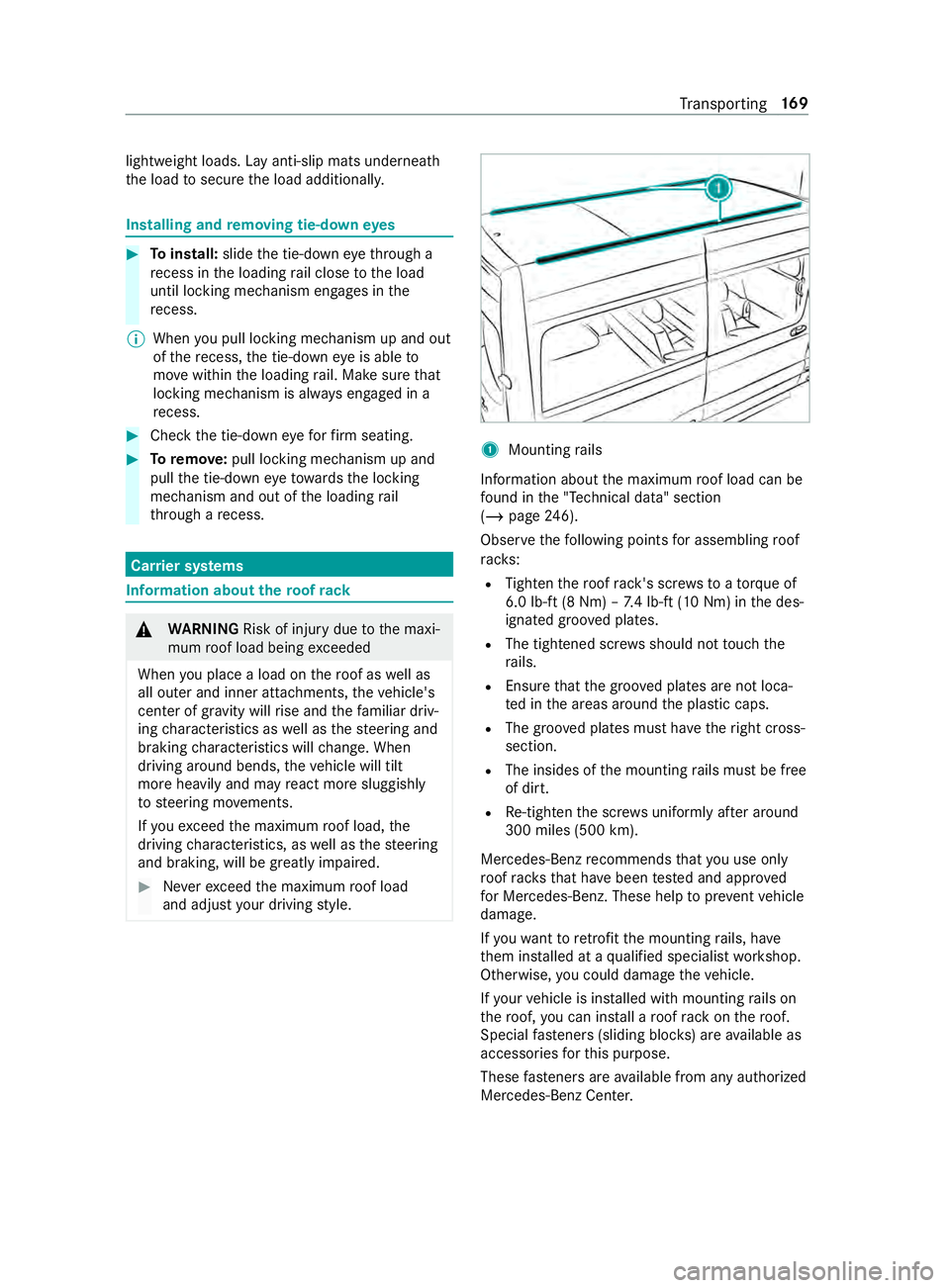
and adjus tyour driving style. 1
Mountin grails
Informatio nabout them aximum roof load can be
fo und in the" Tech nical data" section
(/ page246).
Obse rvet he following point sfor assembling roof
ra ck s:
R Tighten ther oof rack 's scr ewstoat orque of
6.0 lb-f t(8N m)–7.4 lb-f t(10 Nm) in thed es‐
ignated groo vedp lates.
R The tightened scr ewsshould no ttouc hthe
ra ils.
R Ensur ethat theg roove dplates ar enotloca‐
te dint he areas around thep lastic caps.
R The groo vedp lates mus thave ther ight cross-
sectio n.
R The insides of them ounting rails mus tbefree
of dirt.
R Re-tigh tent he scr ewsu niformly af tera round
300 mile s(500 km).
Mercedes-Benz recommends that youu se on ly
ro of rack st hat ha vebeen tested and appr oved
fo rM ercedes-Benz. These help topreve ntvehicle
damage.
If yo uw ant toretrofit them ounting rails, ha ve
th em ins talled at aqualified specialis tworks hop.
Otherwise, youc oul dd amag ethe vehicle.
If yo ur vehicle is ins talled wit hmountin grails on
th er oof, youc an install aroof rack on ther oof.
Special fastener s(sliding bloc ks)a re available as
accesso ries fort his purpose.
These fastener sareavailable from an yauthorized
Mercedes-Ben zCenter. Tr
ansporting 16 9
Page 194 of 322
Using the interior
roof car rier sy stem &
WARNING Risk of inju rydue tounse‐
cured loads
When yous ecur eorl oosen aload, thel oad
ma yfall down and injur evehicle occupants. #
When securing or loosening aload, do
no ts tand unde rthe load. *
NO
TERisk of damag etothe belt stra ps
and slider Excessiv
epoint loading on theb elt stra ps and
slider smaycause theb elt stra ps totear or cause
thes lider stob reak of ffro mt herack
ra il. #
Distribut ethe load evenly. When doing
so, ensur ethat theo verall cen terof
gr av ity of thel oad is alw aysasc loseto
th ec enter as possible and between the
ro of rails and between ther ackr ails. Yo
uc an use thei nterior roof rack system to
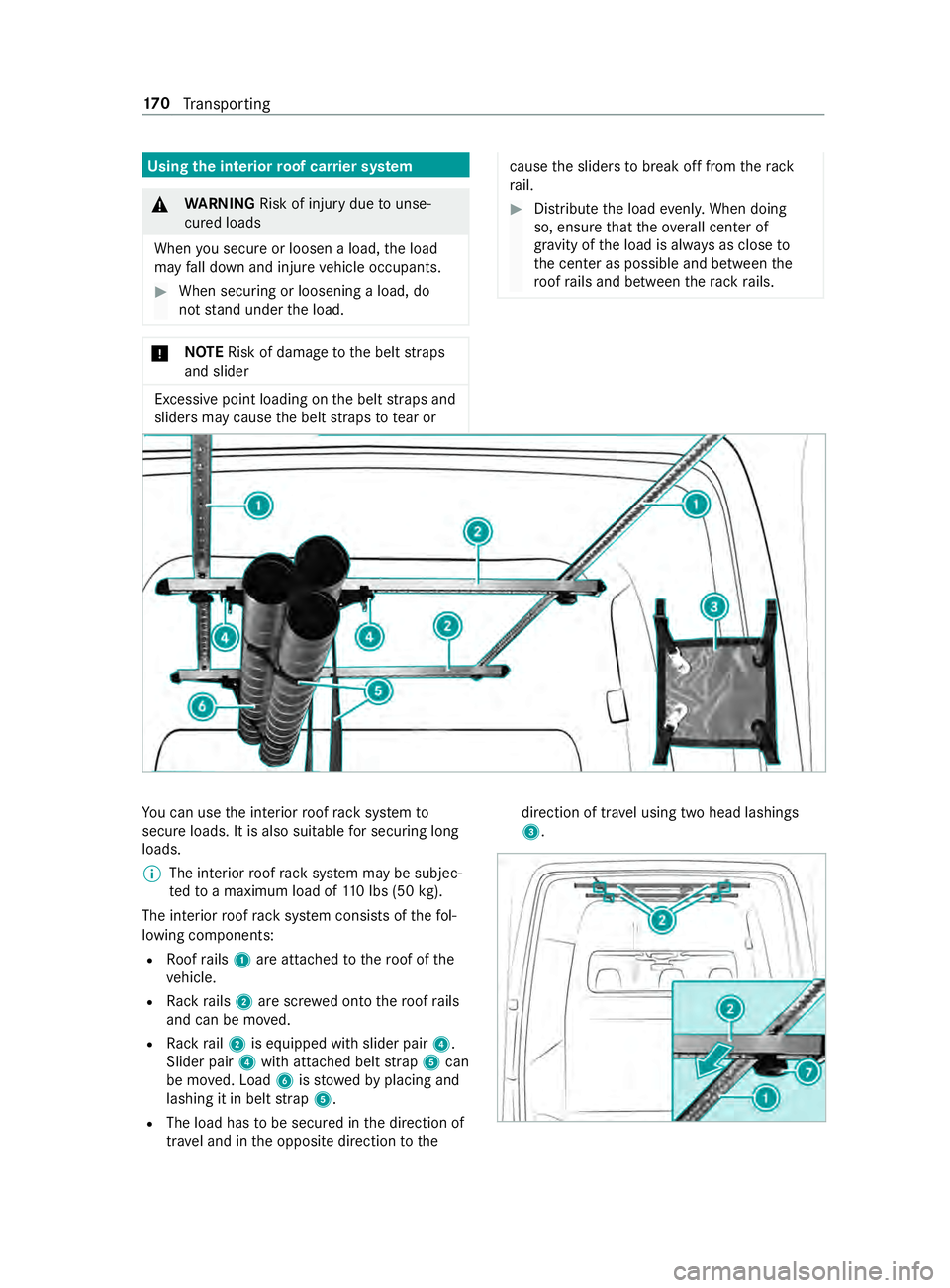
secur eloads. It is also suitable fors ecuring long
loads.
% The interior
roof rack system ma ybesubjec‐
te dtoam aximum load of 110l bs (50 kg).
The interior roof rack system consists of thef ol‐
lowing components:
R Roofrails 1 area ttached tother oof of the
ve hicle.
R Rack rails 2 ares crew ed ont othe roof rails
and can be mo ved.
R Rack rail2 is equipped wit hslider pair 4.
Slider pair 4witha ttached belt strap 5can
be mo ved. Load 6isstowe dbyp lacing and
lashing it in belt strap 5.
R The load has tobe secured in thed irection of
tra vela nd in theo pposit edirection tothe direction of tra
velu sing tw ohead lashings
3. 17 0
Transporting