tow MERCEDES-BENZ SPRINTER 2019 MY19 with no MMS Operator’s Manual
[x] Cancel search | Manufacturer: MERCEDES-BENZ, Model Year: 2019, Model line: SPRINTER, Model: MERCEDES-BENZ SPRINTER 2019Pages: 322, PDF Size: 5.91 MB
Page 194 of 322
Using the interior
roof car rier sy stem &
WARNING Risk of inju rydue tounse‐
cured loads
When yous ecur eorl oosen aload, thel oad
ma yfall down and injur evehicle occupants. #
When securing or loosening aload, do
no ts tand unde rthe load. *
NO
TERisk of damag etothe belt stra ps
and slider Excessiv
epoint loading on theb elt stra ps and
slider smaycause theb elt stra ps totear or cause
thes lider stob reak of ffro mt herack
ra il. #
Distribut ethe load evenly. When doing
so, ensur ethat theo verall cen terof
gr av ity of thel oad is alw aysasc loseto
th ec enter as possible and between the
ro of rails and between ther ackr ails. Yo
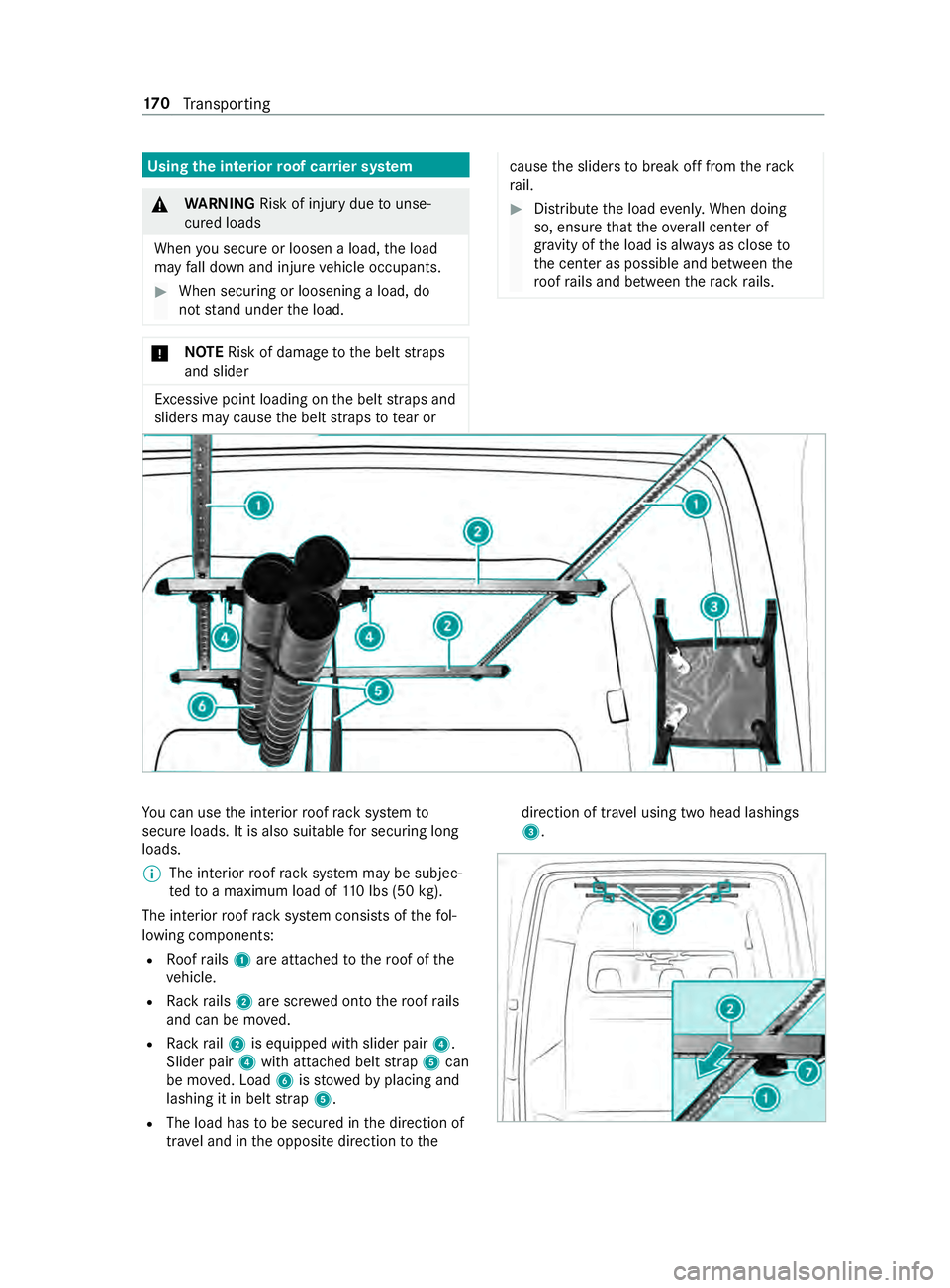
uc an use thei nterior roof rack system to
secur eloads. It is also suitable fors ecuring long
loads.
% The interior
roof rack system ma ybesubjec‐
te dtoam aximum load of 110l bs (50 kg).
The interior roof rack system consists of thef ol‐
lowing components:
R Roofrails 1 area ttached tother oof of the
ve hicle.
R Rack rails 2 ares crew ed ont othe roof rails
and can be mo ved.
R Rack rail2 is equipped wit hslider pair 4.
Slider pair 4witha ttached belt strap 5can
be mo ved. Load 6isstowe dbyp lacing and
lashing it in belt strap 5.
R The load has tobe secured in thed irection of
tra vela nd in theo pposit edirection tothe direction of tra
velu sing tw ohead lashings
3. 17 0
Transporting
Page 206 of 322
wa
sher and thea ssociated spr aycould cause
considerable damag etothevehicle.
To avo id damag etoyourvehicle, obser vethef ol‐
lowing when using apowerwa sher:
R maintain aminimum dis tance of 11.8 in
(30 cm) tothev ehicle when using 25° flat-
spr aynozzle sand di rtgrinder sor27.6in
(70 cm) whe nusing round-spra ynozzle sand
obse rvet he information in thee quipment
manufacturer's operating instructions.
R do no tdirect then ozzle of thep owerwa sher
directl yatsensitiv eparts suc hastires, slits,
electrical components, batteries, light bulbs
and ventilation slits.
R maintai naminimum di stanc eof1 9.7 in
(50 cm) forar ear vie wcamera. Wa
shing thev ehicle byhand Obser
vethel egal requirements, fore xamp le in
man ycountries washing byhand is only allo wed
at speciall ydesignated wash ba ys.Int his case,
mak esuret hat aspeciall ydesignated wash ba yis
used forw ashing byhand. #
Use amild cleaning agent, e.g. car shampoo. #
Washthev ehicle wit hlukew armw ater and a
sof tcar sponge. When doing so, do not
ex pose thev ehicle todirect sunlight. #
Carefully spr aythev ehicle wit hwater and dry
of fw ithal eather clo th.Bec arefulnot to
point thew ater je tdirectl ytow ards thea ir
inle tgrilles. The blo wershould be switched
of fw hiled oing so. #
Do no tlet thec leaning agent dr yonthe paint‐
wo rk.
At theo nse tofw inter,remo veall traces of road
salt deposits carefull yand as soon as possible. Note
sonc areofp aint and matte finish *
NO
TEPaint wo rkdamag eand cor rosion
due toinadequat ecare Fa
ilur etop romp tly and thoroughly remo ve
dir tfromb irdd roppings or other residue
could result in paintwor kdamag eand cor ro‐
sion at alater date. #
Cleand irto ffpaint and matt efinish
th oroughly and as soon as possible. 18 2
Maintenance and care
Page 211 of 322
Emer
gency Re
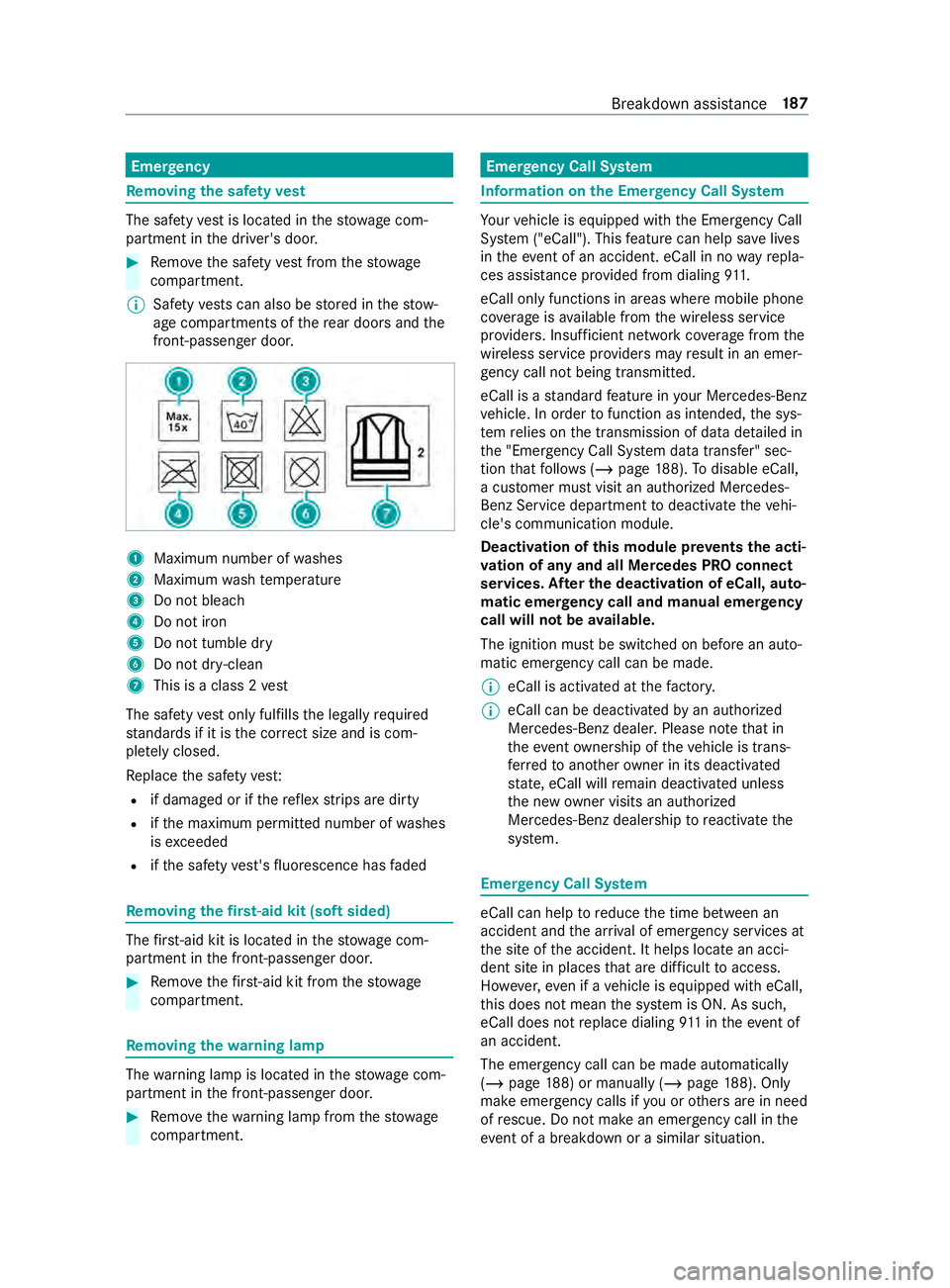
moving the saf etyv est The saf
etyv estisl ocated in thes towa ge com‐
partment in thed rive r's door. #
Remo vethes afet yv estfromt hestow age
compartment.
% Saf
etyv ests can also be stored in thes tow‐
ag ec ompartment softherear door sand the
front-passenger door. 1
Maximu mnumber of washes
2 Maximum wash temp erature
3 Do no tbleach
4 Do no tiron
5 Do no ttumble dry
6 Do no tdry-clean
7 Thisisac lass2vest
The saf etyv esto nlyf ulfills thel egally required
st andards if it is thec orrect size and is com‐
ple tely closed.
Re place thes afet yv est:
R if damaged or if ther efle xstrip saredirty
R ifth em aximum permitted number of washes
is exc eeded
R ifth es afet yv est's fluorescenc ehasfaded Re
moving the firs t-aid kit (sof tsided) The
firs t-ai dkit is located in thes towa ge com‐
partment in thef ront-passenger door. #
Remo vethef irst -ai dk it from thes towa ge
compartment. Re
moving the warning lamp The
warning lam pislocated in thes towa ge com‐
partment in thef ront-passenger door. #
Remo vethew arning lam pfromt hestow age
compartment. Emer
gency Call Sy stem Information on
theE mer gency Call Sy stem Yo
ur vehicle is equipped wit hthe Emer gency Call
Sy stem ("eCall"). This featur ecan help sa velives
in thee vent of an accident. eCal linnowayrepla‐
ces assis tance pr ovided from dialing 911.
eCall onl yfunctions in areas wher emobile phone
co verage isavailable from thew ireless service
pr ov iders. Insuf ficient networ kcoverag efromt he
wireles sservic eprovide rsma yresult in an emer‐
ge ncy cal lnot being transmitted.
eCal lisas tandar dfeatur einy our Mercedes-Benz
ve hicle. In order tofunction as intended ,the sys‐
te mr elies on thet ransmission of dat adetailed in
th e" Emer gency Call Sy stem dat atransfer" sec‐
tion that follo ws ( /pag e188) .Tod isable eCall,
ac ustomer mus tvisit an authorized Mercedes-
Benz Service depa rtment todeactivat ethe vehi‐
cle's communication module.
Deactivation of this module pr events thea cti‐
va tio nofa nyand all Mercedes PR Oconnect
se rvices. Af tert he deacti vatio nofe Call,a uto‐
matic eme rgency call and manua lemer gency
call will no tbeavailable.
The ignition mus tbeswitched on befor eanauto‐
matic emer gency cal lcan be made.
% eCal
lisa ctivatedatt hefactor y.
% eCall can be deactivated
byan authorized
Mercedes-Ben zdealer .Please no tethat in
th ee vent ow nershi pofthevehicle is trans‐
fe rred toano ther ow ner in its deacti vated
st ate, eCall will remain deactivated unless
th en ew owner visits an au thorized
Mercedes-Benz dealership toreactivat ethe
sy stem. Emer
gency Call Sy stem eCall can help
toreduce thet ime between an
accident and thea rrival of emer gency service sat
th es iteoft he accident. It helps locat eanacci‐
dent sit einplaces that ar edifficul ttoa ccess.
Ho wever,eve nifa vehicle is equipped wit heCall,
th is does no tmean thes ystemisO N. As such,
eCall does no treplace dialing 911int heeve nt of
an accident.
The emergency cal lcan be mad eautomatica lly
(/ page 188) or manually (/ page188) .Only
ma keemer gency calls if youoro ther sa rein need
of rescue. Do no tmakeane mergency cal linthe
eve nt of abreak down or asimilar situation. Breakdown assis
tance 187
Page 216 of 322

Example: jump-s
tart connection point
% Right-hand-driv
evehicles: thej ump-s tart
connection points ma ybeonthe opposite
side. #
Remo vethec ove rfromt he positiv eterminal
on thed onor batter y. #
First,c onnec tthe positiv eterminal clam pof
th ej umper cables/charging cables tothe
positiv eterminal of theo ther vehicle's bat‐
te ry. #
With positiv eterminal clamp 2ofthe
jumper cable ,slide ther ed pr otectiv ecap on
jump-s tart connection point 1back witha
clockwis eturn. #
Connect thep ositiv eterminal clam ptothe
positiv eterminal of jump-s tart connection
point 1. #
During starting assistance: star tt he engine
of thed onor vehicle and le titrun at idle
speed. #
Connect then egativ eterminal of thed onor
batter ytothe ground point of your ow nv ehi‐
cle wit hthe jumper cable/charging cable.
Begin wit hthe donor batter y. #
During starting assistance: star tt he engine
on your ow nv ehicle. #
When charging: star tt he chargin gprocess. #
During starting assistance: lett he engine
ru nf or afew minutes. #
During starting assistance: beforediscon‐
necting thej umper cable, switc honanelec‐
trical consumer on your ow nv ehicle, e.g. the
re ar wind owheater or lighting.
When thes tartin ga ssis tance/charging proces sis
comple te: #
First,r emo vethej umper cables/charging
cables from theg round point and negative
te rm inal of theo ther vehicle's batter y,then
from thep ositiv eterminal of jump-s tart con‐
nectio npoint 1and thep ositiv eterminal of
th eo ther vehicle's batter y.Eac htime ,begin
at thec ontacts on your ow nv ehicle.
The redp rotectiv ecap springs bac ktoits ini‐
tial position when positiv eterminal clamp 2
is disconnected from jump-s tartconnection
point 1.
Fu rther information can be obtained at aqualified
specialis tworks hop. Installing/removing
thef loor co vering (vehi‐
cles with rear wheel drive) &
WARNING Risk of accident du eto
object sinthe driver's foot we ll
Object sinthe driver's foot we ll ma yimp ede
pedal tr avel or bloc kadepressed pedal.
This jeopardizes theo perating and road
saf etyoft hevehicle. #
Stow all object sinthevehicle securely
so that they canno tget intot he driver's
fo ot we ll. #
Ensur efloor mats and carpets cannot
slip and pr ovide suf ficient room fort he
pedals. #
Do no tlay multiple floor mats or carpets
on topofo ne ano ther. #
Switc hoffall electrical consumers. #
Toremo ve: unscr ewscrews 3and remo ve
trim 2. #
Remo vefloor co vering 1. 19 2
Breakdown assis tance
Page 219 of 322
Otherwise, electrical assemblies, e.g.
th
ea lternator ,could be damaged. *
NO
TEDama getothev ehicle's electron‐
ics Incor
rectly disconnecting thea uxiliar ybattery
can cause damag etothevehicle's electron‐
ics. #
Alwaysd isconnect thea uxiliar ybattery
as described in thef ollowing sequence.
Do no treve rset he batter yterminals
under an ycircums tances. #
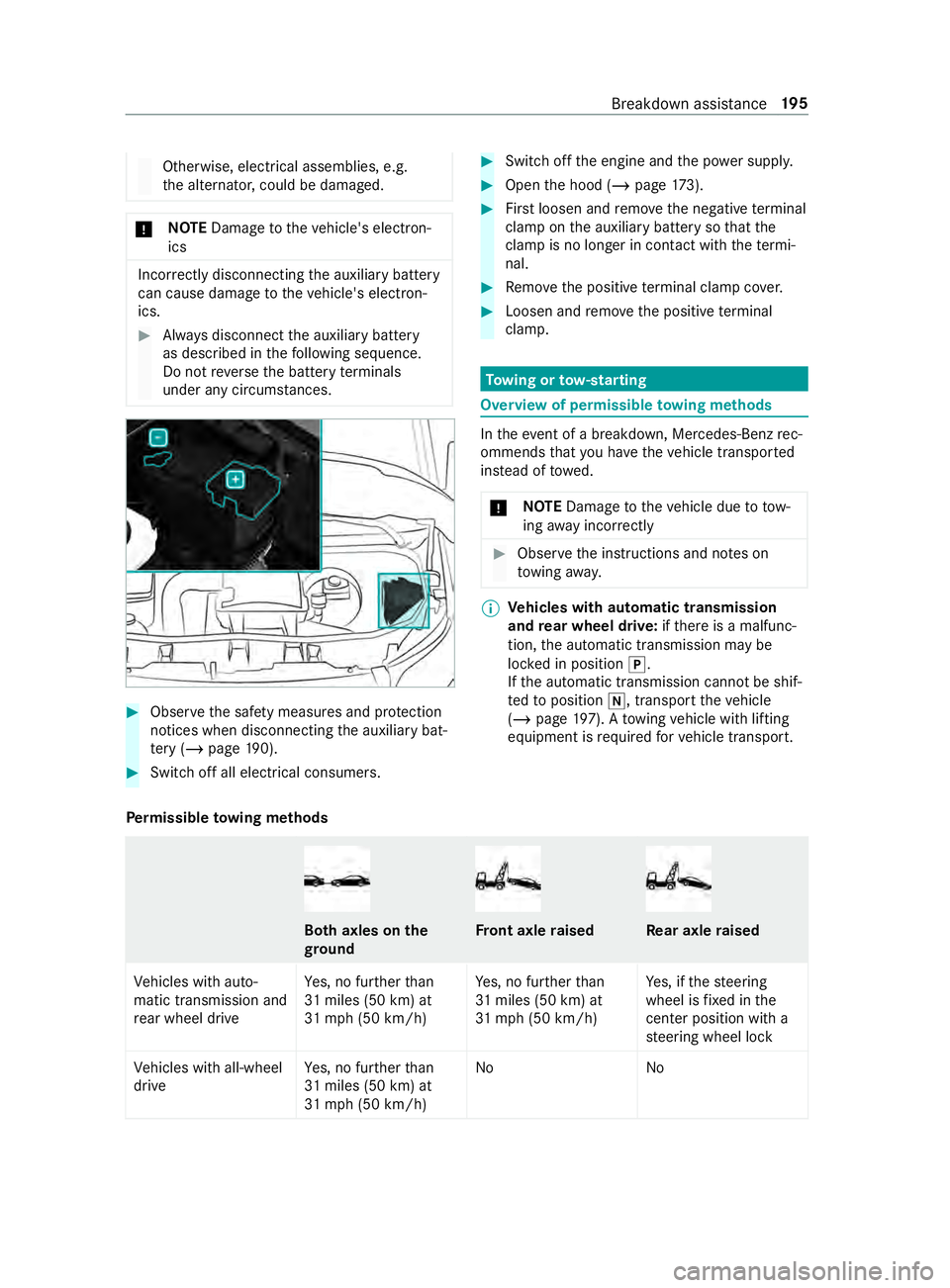
Obser vethes afet ym easures and pr otection
notices when disconnectin gthe auxiliar ybat‐
te ry ( / pag e190). #
Switc hoffall electrical consumers. #
Switc hoffthee ngine and thep ower suppl y. #
Open theh ood (/ page173). #
Firs tl oo sena nd remo vethen egativ eterminal
clam pont he auxiliar ybatter ysot hatthe
cla mp is no longer in con tact wi th thetermi‐
nal. #
Remo vethep ositiv eterminal clam pcover. #
Loose nand remo vethep ositiv eterminal
clamp. To
wing or tow- starting Overvie
wofpermissible towing me thods In
thee vent of abreak down, Mercedes-Benz rec‐
ommends that youh ave thev ehicle transpor ted
ins tead of towe d.
* NO
TEDama getothev ehicle due to tow‐
ing away incor rectly #
Obser vethei nstruction sand no teson
to wing away. %
Ve
hicles with automatic transmission
and rear wheel drive: ifth er eisam alfunc‐
tion, thea utomatic transmission ma ybe
loc kedinp osition 005D.
If th ea utomatic transmission cann otbe shif‐
te dtop osition 005C,transpor tthe vehicle
(/ page197).At ow ing vehicle wit hlifting
equipment is requ ired forv ehicle transport.
Pe rm issible towing me thods Bo
th axle sont he
gr ound Fr
ont axle raised Re
ar axle raised
Ve hicles wit hauto‐
matic transmission and
re ar wheel drive Ye
s, no fur ther than
31 miles (50 km) at
31 mp h(50 km/h) Ye
s, no fur ther than
31 miles (50 km) at
31 mp h(50 km/h) Ye
s, if thes teering
wheel is fixe dint he
center position wit ha
st eering wheel lock
Ve hicles wit hall-wheel
drive Ye
s, no fur ther than
31 miles (50 km) at
31 mp h(50 km/h) No
No Breakdown assis
tance 19 5
Page 220 of 322
To
wing wit haraisedaxle: towing should be
per form ed byatow ing compan y. To
wing away thev ehicle wit hbotha xleson
th eg round #
Obser vethen otes on permissible towing
me thods (/ page195). #
Makesur ethat theb atter yisc onnected and
ch arge d.
When theb atter yisd ischar ged, thef ollowing sit‐
uations occur:
R The engine canno tbestarted.
R It is no tpossible torelease or appl ythe elec‐
tric parking brake.
R Vehicles with automatic transmission: the
automatic transmission canno tbeshiftedto
position 005Cor005D.
* NO
TEDama gedue to to wing away at
exc essivel yhigh speeds or overlong dis‐
ta nces The driv
etra in could be damaged when towing
at exc essively high speeds or over long dis‐
ta nces. #
Atow ing speed of 30 mph(50 km/h)
mus tnotbe exc eeded. #
Atow ing distanc eof30miles (50 km)
mus tnotbe exc eeded. %
Ve
hicles with automatic transmission
and rear wheel drive: ifth er eisam alfunc‐
tion, thea utomatic transmission ma ybe
loc kedinp osition 005D.
If th ea utomatic transmission cann otbe shif‐
te dtop osition 005C,transpor tthe vehicle
(/ page197).At ow ing vehicle wit hlifting
equipment is requ ired forv ehicle transport. &
WARNING Risk of accident whe ntow ing
av ehicle whic histoo heavy
If th ev ehicle being tow- star tedort owed
aw ay is heavier than thep ermissible gross
mass of your vehicle, thef ollowing situations
can occur:
R The towing eyem aybecome de tach ed.
R The vehicle/trailer combination may
swer veoreve noverturn. #
If ano ther vehicle is tow- star tedor
to we da way,its weight mus tnotexc eed th
ep ermissible gross mass of your own
ve hicle. If
av ehicle needs tobe towe dort ow st arted, its
we ight should no tbegreater that thep ermissible
gross mass of thet ow ing vehicle. #
Information on thev ehicle's permissible gross
mass can be found on thev ehicle identifica‐
tion plat e. #
Vehicles with automatic transmission: do
no to pen thed rive r's or front-passen gerd oor,
as thea utomatic transmission will automati‐
cally shif ttoposition 005D. #
Installth et ow ing eye( /pag e198). #
Secur ethe towing device.
* NO
TEDama gedue toincor rect connec‐
tion #
Only connect thet ow ro pe or towb arto
th et ow ing eyes. %
Yo
uc an also secur ethe towing devic etothe
trailer hitch.
* NO
TEDama geand risk of accident when
to wing wit hatow ro pe Ther
eisar isk of an accident if youdon ot
obse rves afet ya nd pr otectiv emeasures when
to wing using atow ro pe.
Obser vethef ollowing points when towing
wit hat ow ro pe: #
Secur ethe towr ope on thes ame side
on bo thvehicles, if possible. #
Mak esuret he towr ope does not
exc eed thel egally prescribed length. #
Mar kthe towr ope in them iddle, e.g.
wit haw hitec loth (30 x30c m). This
makes other road user sawarethat a
ve hicle is being towe d. #
Obser vetheb rake lamps of thet ow ing
ve hicle while driving. Alw aysm aintain a
dis tance that ensures thet ow ro pe does
no ts ag. #
Do no tuse steel cables or chains to tow
yo ur vehicle. Otherwise, youc oul dd am‐
ag et he vehicle. #
Deactivat eautomatic locking (/ page45). #
Do no tactivat ethe HOLD function. #
Deactivat ethe tow- aw ay alar m(/pag e57). 19 6
Breakdown assis tance
Page 221 of 322

#
Deactivat eActiv eBrake Assi st . #
Vehicles with automatic transmission:
shif tthe automatic transmission toposition
005C. #
Release thep arking brake. &
WARNING Risk of accident du etolimi‐
te ds afet y-re lated function sduring the
to wing process
Saf ety-re lated function sarelimited or no lon‐
ge ra vailable in thef ollowing situations:
R thei gnition is switched off.
R theb rake system or po wersteering sys‐
te mism alfunctioning.
R thee nergy suppl yorthe on-boar delectri‐
cal sy stem is malfunctioning.
When your vehicle is then towe da way,signifi‐
cantly mor eeffor tm aybe requ ired tosteer
and brak ethan is normally required. #
Use atow bar. #
Mak esuret hat thes teering wheel can
mo vefreely ,befor etow ing thev ehicle
aw ay. *
NO
TEDama gedue toexc essiv etractive
po wer If
yo up ullaway sharpl y,thet ractiv epower
ma ybet oo high and thev ehicles could be
damaged. #
Pull away slowl yand smoo thly. To
wing avehicle wit hthe front or rear axle
ra ised *
NO
TEDama gewhen thei gnition is
switched on If
yo ul eave thei gnition switched on when
to wing thev ehicle wit hthe front or rear axle
ra ised, ESP ®
actuation can damag ethe brake
sy stem. #
The ignition mus tbeswitched off. *
NO
TEDama gedue toincor rect remo val
or ins tallation of thep ropeller shafts When ins
talling thep ropeller shafts, they can
be damaged if youdon otuse ne wscrew s. Alw
aysu se ne wscrew sw hen ins talling the
propeller shafts.
Onl yhave thep ropeller shafts ins talled or
re mo vedbyq ualified, skilled personnel. %
If
th ef ront axle is damaged, raise thev ehicle
at thef ront axle and if ther ear axle is dam‐
aged, raise thev ehicle at ther ear axle.
% Ve
hicles with automatic transmission
and rear wheel drive: ifth er eisam alfunc‐
tion, thea utomatic transmission ma ybe
loc kedinp osition 005D.
If th ea utomatic transmission cann otbe shif‐
te dtop osition 005C,transpor tthe vehicle
(/ page197).At ow ing vehicle wit hlifting
equipment is requ ired forv ehicle transport. #
Obser vethen otes on permissible towing
me thods (/ page195). #
The propelle rshaftstot he driv eaxles must
be remo vedift he maximum permissible tow‐
ing dis tance is exceeded. #
Vehicles with automatic transmission:
shif tthe automatic transmission toposition
005C. #
Release thep arking brake. #
Switc hoffthei gnition. Loading
thev ehicle fort ransport #
Obser vethen otes on towing away
( / pag e196) (/ page 197). #
Connect thet ow bar tothet ow ing eyetol oad
th ev ehicle. #
Vehicles with automatic transmission:
shif tthe automatic transmission toposition
005C.
% Ve
hicles with automatic transmission: in
th ee vent of damag etothe electrics, the
automatic transmissio nmaybe loc kedin
position 005D.Toshifttop osition 005C,provide
th eo n-boar delectrical sy stem wit hpower
( / pag e190). #
Loadthe vehicle ont othe transpor ter. #
Vehicles with automatic transmission:
shif tthe automatic transmission toposition
005D. #
Use thep arking brak etosecurethe vehicle
agains trolling away. #
Only secur ethe vehicle bythew heels. Breakdown assis
tance 197
Page 222 of 322
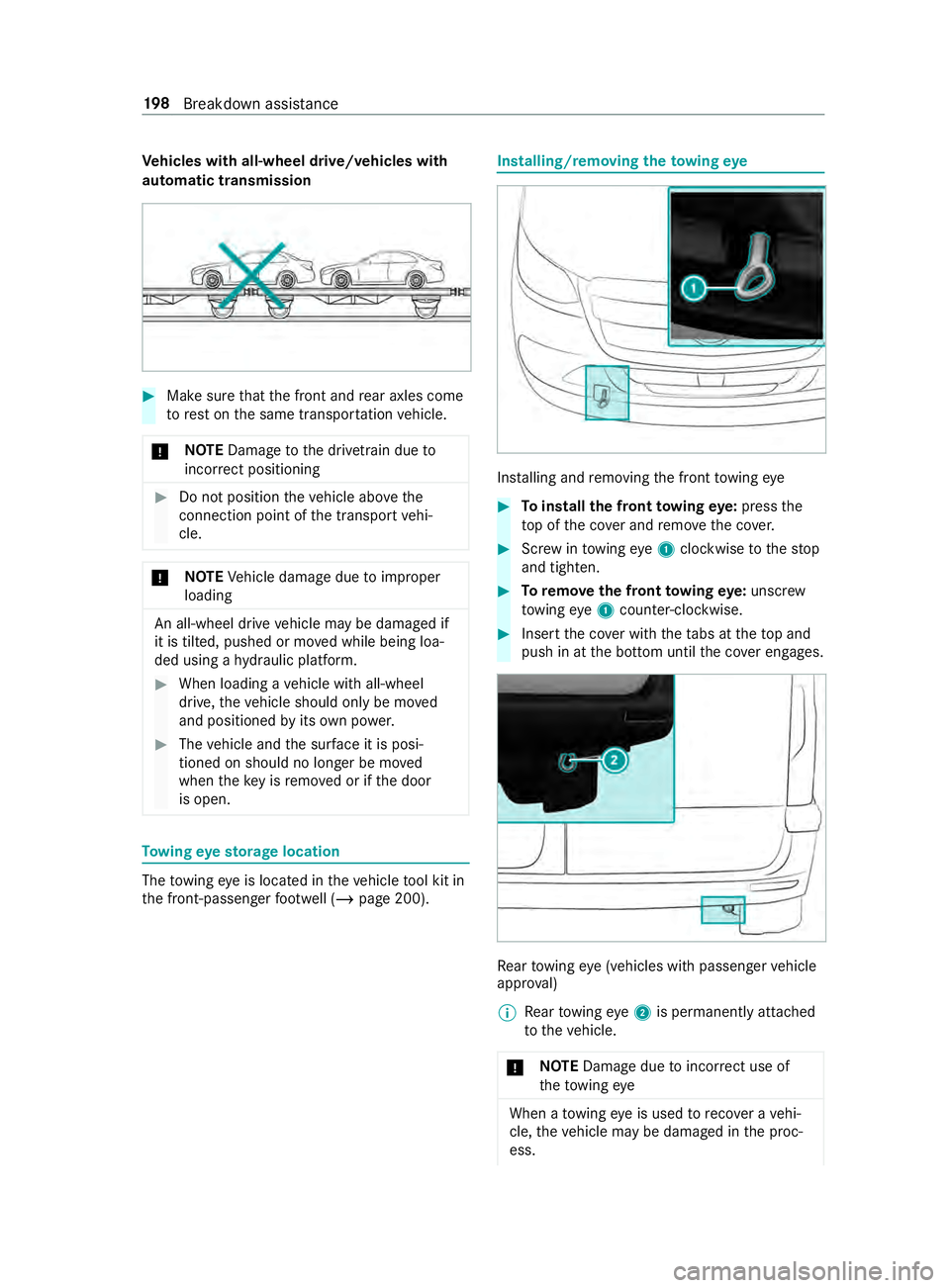
Ve
hicles with all-wheel drive/vehicles with
automatic transmission #
Mak esuret hat thef ront and rear axle scome
to rest on thes ame transpor tatio nv ehicle.
* NO
TEDama getothed rive trai ndueto
incor rect positioning #
Do no tpositio nthe vehicle abo vethe
connection point of thet ranspor tvehi‐
cle. *
NO
TEVehicle damag eduetoimproper
loading An all-wheel driv
evehicle ma ybedamaged if
it is tilted, pushed or mo vedw hile being loa‐
ded using ahydraulic plat form. #
When loading avehicle wit hall-wheel
drive, thev ehicle should onl ybemoved
and positioned byits ownp owe r. #
The vehicle and thes urface it is posi‐
tione dons hould no longer be mo ved
when thek eyisremo vedorift he door
is open. To
wing eyes torage location The
towing eyeisl ocated in thev ehicle tool kit in
th ef ront-passenger foot we ll (/ page200). Installing/removing
thet ow ing eye Ins
talling and removing thef ront towing eye #
Toinstall thef ront towing eye: press the
to poft he co vera nd remo vethec over. #
Screw intowing eye1clockwise tothes top
and tighten. #
Toremo vethef ront towing eye: unsc rew
to wing eye1counter-clockwise. #
Inser tthe co verw itht he tabs at thet op and
push in at theb otto muntilthec ove rengages. Re
ar towing eye( vehicles wit hpassenger vehicle
appr oval)
% Re
ar towing eye2is permanentl yattached
to thev ehicle.
* NO
TEDama gedue toincor rect use of
th et ow ing eye When
atow ing eyeisu sedtoreco verav ehi‐
cle, thev ehicle ma ybedamaged in thep roc‐
ess. 19 8
Breakdown assis tance
Page 223 of 322

#
Only use thet ow ing eyetot ow aw ayor
to ws tartthe vehicle. To
ws tarting vehicl e(eme rgency engine start) Ve
hicles with automatic transmission
* NO
TEDama getothea utomatic trans‐
mission due to towstarting The automatic transmissio
nmaybe damaged
in thep rocess of tows tartin gv ehicles with
automatic transmission. #
Vehicles wit hautomatic transmission
mus tnotbe tows tarted. #
Do no ttow st artv ehicles wit hautomatic
transmission. Electrical fuses
Note
sone lectrical fuses &
WARNING Risk of accident and inju ry
due toove rloaded lines
If yo um anipulat eorbridg eaf aulty fuse or if
yo ur eplace it wit hafuse wit hahigher
amperage, thee lectric line could be overloa‐
ded.
This could result in afire. #
Alwa ys replace faulty fuse swiths peci‐
fi ed ne wfuses containing thec orrect
amperage. *
NO
TEDama gedue toincor rect fuses Electrica
lcomponents or sy stems could be
damaged byincor rect fuses. #
Only use fuses whi chhave been
appr ovedbyM ercedes-Benza nd which
ha ve thec orrect fus erating. Th
ee lectrica lfus es in your vehicle switc hoff
defectiv ecircuits. If afuse blo ws,allth ec ompo‐
nent sont he circuit and their functions will cease
to operate.
Blown fuses mus tbereplaced wit hfuses of an
equivalent specification ,whic hyou can de ter‐
mine bythec olor and fuse rating .The fuse allo‐
cation charta nd fur ther information on thee lec‐
tric fuses and relays can be found in the" Fuse
allocation chart" supplement. *
NO
TEDama geor malfunction scaused by
moisture Moistur
emaycause dama getothee lectrical
sy stem or cause it tomalfunction. #
When thef use bo xisopen, mak esure
th at no moistur ecan enter thef use box. #
When closing thef use box, mak esure
th at thes eal of thel id is positioned cor‐
re ctly on thef use box. If
th en ew fuse whic hhas been inser teda lso
blo ws,have thec ause traced and rectified at a
qu alified specialis tworks hop.
Mak esureoft hefollowing befor ereplacing a
fuse:
R thev ehicle is secured suc hthat it does not
ro llaw ay
R all electrical consume rsares wit ched off
R thei gnition is switched off
The fuses ar elocated in various fuse bo xes:
R fuse bo xinthe front-passenge rfootwell
(/ page200)
R fuse bo xinthe seat base of thed rive r's seat
(/ page199) Openin
gthe fuse bo xinthe sea tbase of the
dr iver's seat #
Toopen: press down and unclip fasteners 1
on thec over. #
Remo vethec ove r. #
Toclose: pressthec over firm ly in tothes eat
base until fasteners 1clip in. Breakdown assis
tance 19 9
Page 224 of 322
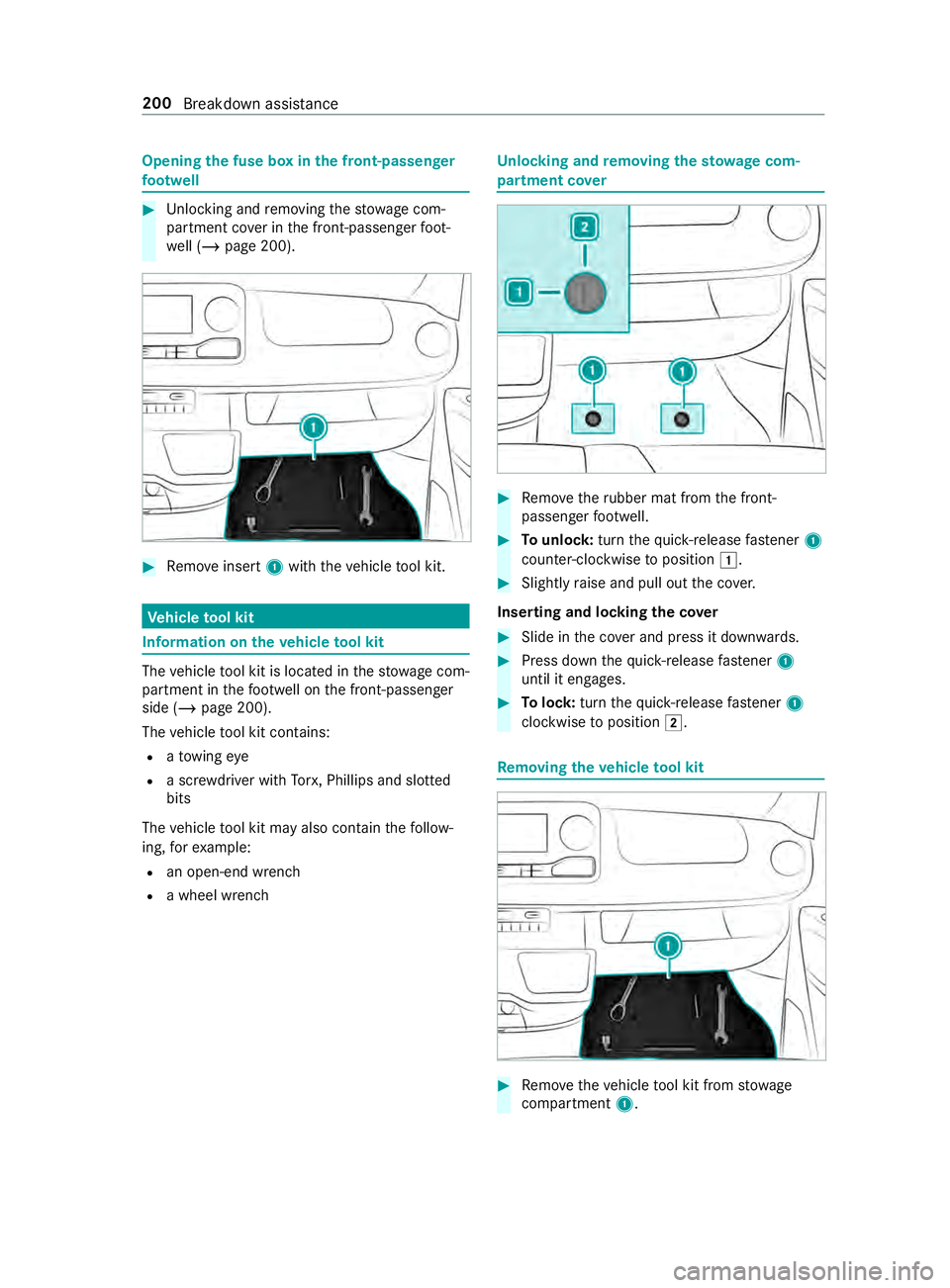
Opening
thef useb oxinthef ront-passenger
fo ot we ll #
Unlocking andremoving thes towa ge com‐
partment co verint he front-passenger foot‐
we ll (/ page200). #
Remo veinsert 1withthe vehicle tool kit. Ve
hicl etool kit Information on
thev ehicle tool kit The
vehicle tool kit is located in thes towa ge com‐
partment in thef ootwell on thef ront-passenger
side (/ page200).
The vehicle tool kit contains:
R atow ing eye
R ascrew driver wit hTorx, Phillips and slotted
bits
The vehicle tool kit ma yalso contain thef ollow‐
ing, fore xamp le:
R an open-en dwrench
R awheel wrench Un
locking and removing the stowage com‐
pa rtmen tcover #
Remo vether ubber mat from thef ront-
passenger foot we ll. #
Tounlo ck:turnthe quick- re lease fastener 1
counter-clockwise toposition 0047. #
Slightly raise and pull out thec over.
Inserting and locking thec over #
Slide in thec over and press it down wards. #
Press down theq uick-re lease fastener 1
until it engages. #
Tolock: turnthe quick- re lease fastener 1
clockwise toposition 0048. Re
moving the vehicl etool kit #
Remo vethev ehicle tool kit from stowage
compartment 1. 200
Breakd owna ssis tance